The weekly photo challenge posed by WordPress is taking a week off. I don’t have to. I thought I’d add to the piles of photos clogging up the internet showing snow. Snow in the garden, out by the lake, up a mountain, shutting down the motorways, whitening city streets ….
We woke up this morning to bitter cold. Minus One Celsius. This will make my American and Canadian readers laugh. Look at this post from my blogging friend Kerry. Where she wakes up it’s -32, and steam is rising from the frozen lake. She’d better not read this. Where she is, nobody ventures out, not even – especially not even – the cats.
This is snowy weather British style. Just a couple of inches. Just enough to snarl up the transport system and fill the airwaves with ‘Is your journey really necessary?’ type warnings. It’ll probably be gone tomorrow.
It’s easy to feel like the only person out in the landscape. But you’ll have come with a friend or two, if only to haul you upright when, inevitably you fall deep into a drift of snow.
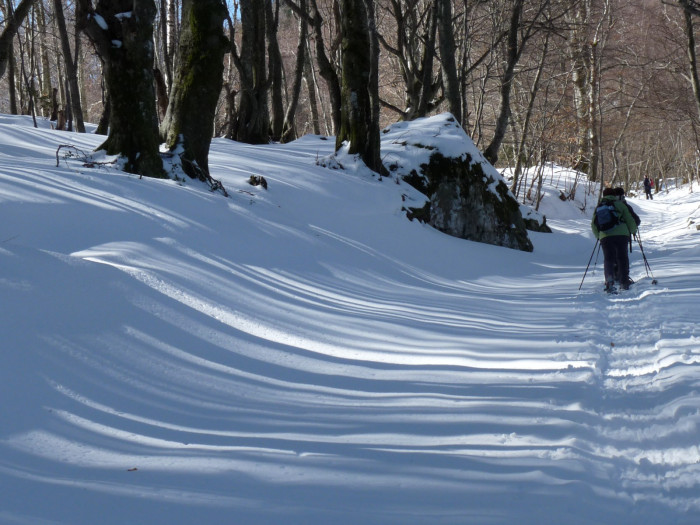
Back in France, in the Ariège, the very best way of getting out into virgin snow and becoming at one with a pure, glittering white winter landscape was take yourself off to the nearest mountain, strap on your snowshoes and walk through the fresh crisp air as if you were the only person in that particular bit of world. It was hard work though, and after the first hour, I’d had enough.
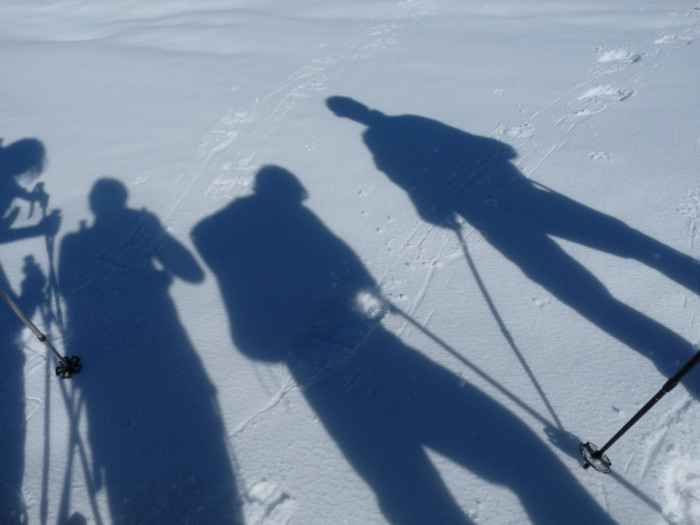
Three years on, and the memory of the pain, sweat and general exhaustion of the entire procedure has faded. I remember instead the vivid sunlit skies and startlingly white and unspoilt snow. And sometimes there were shadows: clear silhouettes mirroring, yet enhancing the world above the glistering mantle.
This week’s WordPress Photo challenge is ‘shadow’. The challenge is now issued on a Wednesday rather than a Friday. I think I’ll now usually respond on Saturday, not Sunday.
…. which is, being very roughly translated, our pot-luck picnic on the Resistance trail.
Posh picnic? I think not. But it’s the taste and the company – that counts.
Jean-Charles has long wanted to get us up to Croquié, a village high above the road between Foix and Tarascon, for a walk with a 360 degree panorama of the Pyrenees, and a very moving monument to some of the Maquisards who died fighting in the French resistance in World War II. This really was the last Sunday we could go, and the day was glorious: hot, with clear blue skies and views for miles and miles in every direction.
Neither Malcolm nor I is particularly on form at the moment, so while our Laroquais friends yomped up a semi-vertical path, deeply slicked in mud, we went part-way up the mountainside from the village of Croquié by car, and then walked on up by road (a road, however, closed to cars) to meet the rest of the group.
Our first destination was the Monument to the Resistance. This site, with views across to the mountains dividing us from Spain, far-reaching from west to east, was chosen as a memorial site not because it was a war-time battle ground. Instead it was a training school for resistance fighters from France, Spain and beyond. There are no barracks, no lecture-halls, no buildings of any kind. Instead the men led hidden existences among the forest trees and rocks. And now there is a fine memorial to them. Singled out were two men who died in nearby Vira (the area where we walked last week) a Maquis stronghold, one who died in our neighbouring town of Bélesta, and one who died following deportation. There is a statue to these men, who are nevertheless depicted without facial features. In this way they stand representative for all the men – and women – who died whether through fighting, by acting as liaison workers, or by offering essential support by giving shelter, clothing and food. Individuals did not pass over to Spain from here: the border is too far away. Instead they were driven to one of the freedom trails such as those near Oust and Seix. Petrol? It could be organised, albeit with difficulty. A key man ran a garage.
First glimpse of the monument.
A better look at it
This is the view those figures have
The sculptor of this monument is Ted Carrasco. A native of Bolivia, pre-Columbian art is a clear influence on his work. He seeks always for his pieces to be in harmony with the environment in which they are placed. His monumental granite figures look over to the Pyrenees which were the scene of their fight against fascism and the Nazi occupation of France.
Time to move on, however. Our path took us slowly upwards through forest, along a track which became increasingly snow-covered and tough going. However, it was only 3 km. or so until we reached the top, where there’s a refuge dedicated to the memory of its original owner, Henri Tartie, known as ‘l ‘Aynat’ – the elder, in Occitan. The original structure is tiny, but served as shelter to many a Maquisard . Now it’s a wood store, because a newer concrete annexe has been added with cooking facilities so that hardy mountain walkers can rest, make a meal, and warm themselves up.
The way up to the refuge.
Jean-Charles gives us a short history lesson outside the refuge.
The modern extension and its ‘facilities’.
A cheerful picnic.
This was our view.
And this.
And this.
This too.
And this , on the way down.
We commandeered a circular concrete table outside, with apparently unending views of those Pyrenees, and somehow squeezed all ten of us round. We unpacked our food: as ever there was wine to share, rhum baba à l’orange, galette charentaise, biscuits – all home-made, of course. Malcolm and I knew it was our last walk with our friends. The fine views, the fine company, the cheerful conversation had a predictable effect. We became tearful. But so grateful that this walk was a bit of a first. Extra-special views, extra-special weather for March, the chance to get close to an important slice of Ariègeois history, and our extra-special friends. We shan’t be with them next Sunday: there’ll be too much to do. It doesn’t bear thinking about.
Yesterday, I changed my mind. But nobody led me into a darkened room…..
I had my reasons after all. I was unlucky last year. I probably will never have the chance to do raquettes ever again. My Thursday walking friends wouldn’t set the bar too high. Everyone raves about the Plateau de Beille as a winter sports playground ….. These all turned out to be excuses rather than reasons.
A very mild winter means you have to climb pretty high this year to be sure of snow. The Plateau de Beille is high. 1800 metres and rising. The snow appeared at the roadside only during the last kilometre or so of a very dizzy 10 mile climb upwards. And when we arrived, the car park was packed, and every school child in the Ariège seemed to be there, muffled in ski-suits and excitedly fastening on skis. Which was fun to watch, but we were relieved that once we too had got booted and spurred, in our case with raquettes, and yomped just half a kilometre or so, we were in the wild and wide empty spaces .
Children arriving: all togged up
Getting organised.
Children get away from a day at their desks.
And that’s where it all could have gone wrong for me. We came to a signpost: ‘Pas de l’Ours. 11km’. ‘Eleven k? With raquettes? I don’t think so.’ I was not alone in protesting. Anne-Marie and I wimped out and chose a 3 km pathway, and had a fine time chatting as we soldiered up an admittedly steep slope, safe in the knowledge that this challenge would quite soon be over. Resting at a cabane at the top, we were surprised to be joined by our friends. It seemed their journey had taken a different route to this point, and whereas we had 2 km to complete, they still had 10. Three of them had a bit of a think. ‘We’re coming with you’. And that’s what they did. We waved the other six goodbye and arranged to meet in three or four hours: slow stuff, snow-shoeing.
The B team set off.
Tired already.
Nearly at the end of the journey.
We had a fine time. We got back to base in time for lunch and watched the children on the nursery slopes and the huskies drawing sleds as we ate our picnic in the bright cold sunshine.
Busy huskies
Then we discarded our raquettes and rucksacks, dumping them in the car, in favour of a snowy walk to see the views. It became windy. It became cold. It threatened to rain. But we weren’t on an 11km. route march, that was the main thing.
Can you see 3 different sets of animal tracks?
Perfect prints. But of what?
Bigger beasts.
When our friends re-joined us, they announced that they hadn’t been either. They’d found a short-cut and taken it. Cheats. But it just shows. This raquettes lark isn’t all it’s cracked up to be. Little and not-very-often seems to be the way forward. But next time, I’ll stay at home.
The end of the day: cold, windy, but still good to look at.
Click on any of the circular images to see the whole photo, and a miniature slide show.
Funny place, Andorra. It’s where we went to satisfy our desire for a ‘white Christmas’ and it’s one of the smallest nations in Europe – only 468 sq.km, and tightly wedged between France and Spain. It’s a mountainous place – every bit of it is between nearly 3000′ and nearly 10,000′ high, and only one main road linking France and Spain drives though the country. All other roads off peter out as they reach the small communities they serve.
It’s a principality, jointly ‘ruled’ by two ‘princes’. One is the Spanish Bishop of Urgell, the other the French President, currently François Hollande, and yet it forms no part of the European Union. It used to be extremely underpopulated: it only had some 6,000 inhabitants right up until the 1950’s. Now it has more than 85,000. But these new inhabitants aren’t indigenous Andorran baby-boomers. They’re incomers from principally Spain, Portugal and France, but also Britain, Italy, and more recently Russia. They come because Andorra’s a tax haven, because there is no income tax and goods are cheap, or because they love to ski: Andorra has some of the most reliable ski-fields in Europe.
And this is what makes Andorra a funny sort of place. Much – most – of the building is relatively new. It has very fine Romanesque churches, but little else that counts as historic buildings.
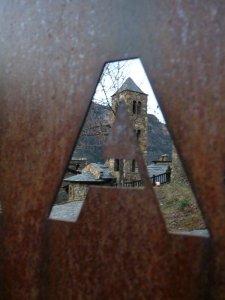
The Romanesque church at Aubinyà glimpsed through a village gate
So most settlements, even quite small ones, consist mainly of blocks of flats clustered together, often clinging apparently precariously to the edges of hillsides high above the valley floor. And everyone knows that Andorra is Shopping Central. People come in their thousands from France and Spain to stock up on – well, most things – and every weekend sees long lines of traffic from both countries as French and Spanish citizens flood into the supermarkets to load up with cigarettes – particularly cigarettes – alcohol, electrical goods, groceries, clothing…. before facing their own country’s customs who take a dim view of those exceeding their allowances.
Snowy Andorra
Near the French border.
More snow
Nevertheless, away from the towns, Andorra is beautiful. The mountains climb almost vertically skywards and this means that every road that leaves the valley bottom will zig-zag upwards with one hairpin bend after another. From our apartment in the tiny settlement of Aubinyà we could see a supermarket almost below us. We even thought of walking down to it (well, I did). When we came to try to shop there, we discovered we had to zig-zag to the valley, zig-zag back (left) to the nearest town, Sant Julia de Lorià, turn hard right and drive a kilometre or two to get there. Most journeys are like that. But it means that wherever you are, you will have fabulous views of craggy mountain sides cloaked in forest, or for much of the year, dusted or deeply covered with shimmering snow. Much as we loved the view from the window of our apartment, though, we wondered if eventually, we wouldn’t feel somewhat hemmed in, having no long distance views.
The view from our window
Another view.
And another. That’s a vineyard you can see below.
We had a lovely Christmas break, Malcolm, Emily and I. Many of our memories consist of eating out: it’s easy to find good Catalan cuisine , or anything else you fancy really at a very fair price. Skiing’s not our thing, but we enjoyed the brisk, sharp cold and the glaring whiteness of the snow set against the sombre green of the coniferous forest. We’d go again, but have no desire to join the many thousands of ex-pats from many nations who form much of Andorra’s day-to-day population. We’ll keep it as it was for us this time: a scenic and relaxing place for a break from routine.
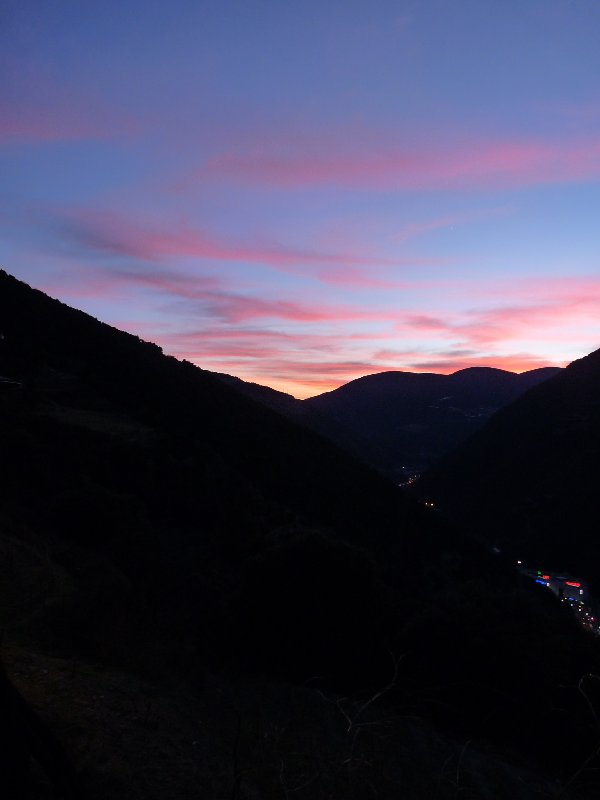
Sunset seen from our window. And yes, far below you can just see that so-near-yet-so-far supermarket.
An early visitor to Mont d’Olmes has already left.
Our Thursday walking friends opted for a day with raquettes today: snowshoes. Earlier this year, I’d vowed never to indulge in this particular form of masochism again. So we didn’t.
But the idea of walking near crisp white snow, with views from the clear air of a mountain top across to wooded slopes cloaked in snow, and as-yet uncloaked valley bottoms, appealed. We’d pop up to Mont d’Olmes. That would do the trick. It’s the nearest place round here for winter sports, so maybe we could watch some of the action, and sit down for a bit clutching a strong shot of coffee or a mug of hot chocolate.
That was the theory. We always forget how far away our friendly neighbourhood mountain really is. Once you turn off the main drag to follow the road that goes only to Mont d’Olmes, you still have 8 miles of climbing to do. Soon the sides of the road were boundaried by walls of snow, while the rocky mountain sides to which the road clings were home to packs of giant icicles and glassy pillars of ice, and still we drove on upwards.
And then we dumped the car. As discussed, we weren’t equipped with snow shoes, so we chose to finish our climb using the road. We passed the chalets hired out to holiday-makers, all clearly shut up, the stairways to their doors still buried deep in the snow. The only people we saw were tradesman in the area to do running repairs or make improvements for the hardly-started season.
And then there we were. Mont d’Olmes The Resort. Like most ski stations that aren’t really up and running, it was just a bit depressing. It’s focussed on a few shops and a hotel that look exactly like a suburban ’60’s shopping centre. And nothing was open: not even a single bar. A few snow buggies were zipping around, their drivers busy with routine cleaning and maintenance. The slopes themselves were scoured with the tracks left by weekend skiers. There even were a couple of skiers. But they had to manage without benefit of ski-lifts or any of the other infrastructure that would have made their day out less labour intensive.
Great views though. White sparkling mountain sides above, more sparsely covered rocky crags below, and a shockingly blue sky. And we had the place almost to ourselves. It’ll be a different story at the weekend. The car parks will be full, the bars, shops and restaurants busy, and above all the slopes will be crowded with hundreds of locals enjoying their very own neighbourhood winter playground. Unlike us, they’ll be joining traffic jams on the way both up and down the mountains. We got what we needed. A decent walk in the sharp cold air, some deep-and-crisp-and-uneven snow, snowy peaks outlined against a clear sky, and a bit of peace.
A 400 year old oak, with a girth of over 5 metres.
Snow, with autumn leaves still on the trees
Snowy field, green field
The rainy season still hasn’t stopped. It’s rained every day for over a fortnight now, except for one. That was Friday, the day it snowed. I had to come back from nearby Villeneuve d’Olmes at nearly midnight that day, driving at a stately 12 miles an hour along newly – and deeply – snow-covered roads. The last bit was easy enough though. I followed a snow plough.
So Sunday’s all-day walk was abandoned yet again. There was heavy rain again this morning. Nobody was leaving home except to collect the daily bread. We had a back-up plan, we members of the walking group, to begin walking at 1 o’clock if the morning’s weather was poor. By 11.45, with the skies still black and full of rain we were all ‘phoning each other to say ‘No thanks. Count me out’.
Except that at quarter to one, it stopped raining. I decided after all to make a break for it (Malcolm stayed in front of the fire). Maryse arrived at the usual rendezvous too, then Annick and Michel turned up. Then Jean-Charles, Danielle and Marcel. We’d all got cabin fever and we’d walk come what may. We had three rain-free hours. No country paths for us today: all sodden. Strictly road-walking. Snowy fields, snowy views across to the Plantaurel, a small lake, forest paths. We had our ‘pause café’ at Fajou, with its 400 year old oak, and an apple tree just waiting for us to collect its windfalls. Still no rain. Still an hour’s walk to do though, so we didn’t stop for long, and continued onwards, enjoying the familiar landscape in its new white winter clothing
Back home, refreshed after a shower and a cup of tea, I leaned over to draw the curtains. Of course I glanced out of the window. You’ve guessed. It was raining again
Eight days ago: lunch outside in thin tee shirts: a garden umbrella protected us from the bright hot sun.
Seven, six, five, four, three, two, days ago. Rain. Rain. More rain. Heavy, chilly gusts choking the streets and drains with fallen leaves. More rain.
One day ago. Snow. The first snow – and in advance of the first winter frost too. Not a lot, but enough to rest heavily on fading garden plants, weighing down leaves and bowing stems.
This morning, we knew we’d need to get out early to beat the rain, which was threatening yet again. I didn’t take my camera because I thought the mountains would be shrouded in foggy mist. They weren’t. The lower peaks, and even the much lower hills of the Plantaurel peeked through a thin layer of snow that dusted trees and painted the rocky and grassy slopes a severe white. I dashed back for my camera. Five minutes? Ten? Long enough for the misty clouds to drop down and dump themselves on the snowy hilltops like squashy berets, hiding them from view.
And then, straight away, the rain again. That’s what we’ve had all day, streaming along the gutters, making splashy garden puddles, dripping incessantly from the trees and down our necks as we walk underneath. I continued my early morning walk regardless though, and caught what may be the last few days of Autumn colour, though little enough of the snow, which is there somewhere, under those bonnets of mist and cloud.
Snow on the Plantaurel behind Laroque.
A wet cow: a local cow, a Gascon. They’re used to it.
Mist over the Plantaurel
A neapolitan slice of snow, evergreens, autumnal trees and grass
We keep a mental list of the walks we’ve particularly enjoyed. Walks we’ve treasured for the views, the flowers, the butterflies, the skyscapes, the lunchspot – all sorts of reasons. The only problem is that the walk at the top of the list tends to be the one we did last. There’s no such thing as a duff hike round here.
But last Sunday’s walk is assured a place of honour on this list. It’s one we’ll want to share with you if you come to stay, and we’re keen to do it again ourselves, at every season of the year.
If you drive from here to Mirepoix, you’ll pass through a village called la Bastide de Bousignac. Just after that there’s a road off to the left, signposted to Saint Julien de Gras Capou. Take it. It’ll wind upwards between grassy pastures, home to sheep and cattle and not much else, and finally deposit you in the main street of the village – current population 62. Park near the church, lace up your walking boots, grab your rucksack with its all-important picnic, find the first yellow waymark – and set off.
The village is so-called because back in the 12th and 13th centuries, it had acquired a reputation as being the place where fine fat capons were raised to feed fine people: that’s the ‘gras capou’ bit. I don’t know where St. Julien comes into it. There are hens here still, and in so many ways, the village is perhaps little changed. It’s a peaceful, rather isolated place, despite being so near to Mirepoix and one of the main roads in the Ariège.
Our walk took us along farm and forest tracks, through fields and woodland still splashed with colour from flowers and late butterflies. It was an easy route, rising only gently, passing the tiny hamlet of Montcabirol towards the village of Besset. Shortly after that though, we found we did have a short sharp climb, through the woods, to reach the Pic d’Estelle.
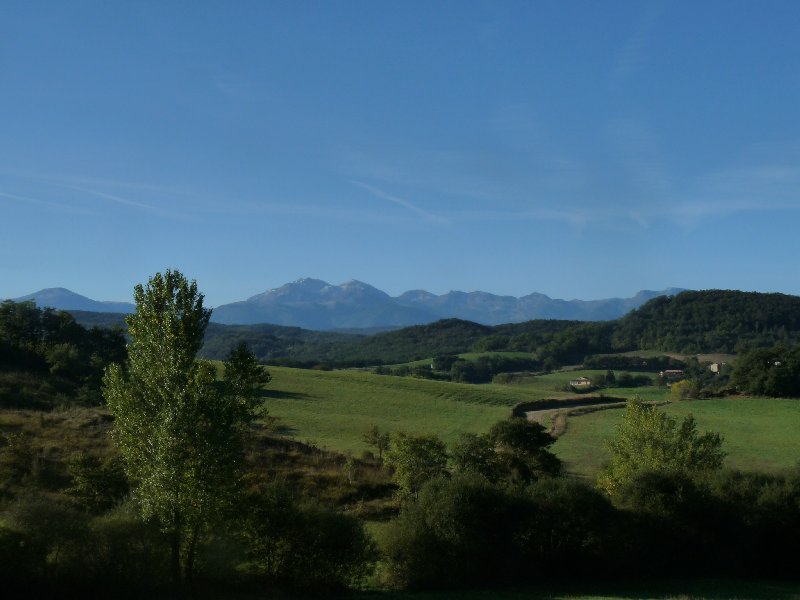
Wow. It was worth it. From here, we had a 360 degree panorama. The chain of the Pyrenees marched across our horizon, its peaks already dusted with snow, or even quite thickly covered in the case of the higher summits. As we turned in other directions, we could see Mirepoix, immediately recognisable from its distinctive cathedral spire, and the Montagne Noir beyond. There are foothills nearby too, across which pilgrims on the Chemin de Saint Jacques de Compostelle still travel: and other sights too – the ruined Château de Lagarde, and its near neighbour the Château de Sibra. We stayed a long time, simply relishing these views, the sky, the silence and peace at what seemed to us, at that moment, the top of the world.
When we finally shrugged on our rucksacks once more, we only had three or four more kilometres to go, along more unpeopled pathways. After negotiating the only obstacle of the afternoon, a group of cows supervised by a bull – we let them get well ahead of us – we were soon back at base. It was good, very good. I just wish my camera could do justice to those peaks. But we’ll be back, in winter, when they’re truly thick with snow
The walk begins
We passd a few fords: here’s a puddle
And here’s what we spotted at the isolated hamlet of Montcabirol














 From Pyrenees to Pennines
You must be logged in to post a comment.