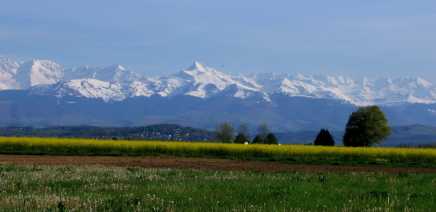
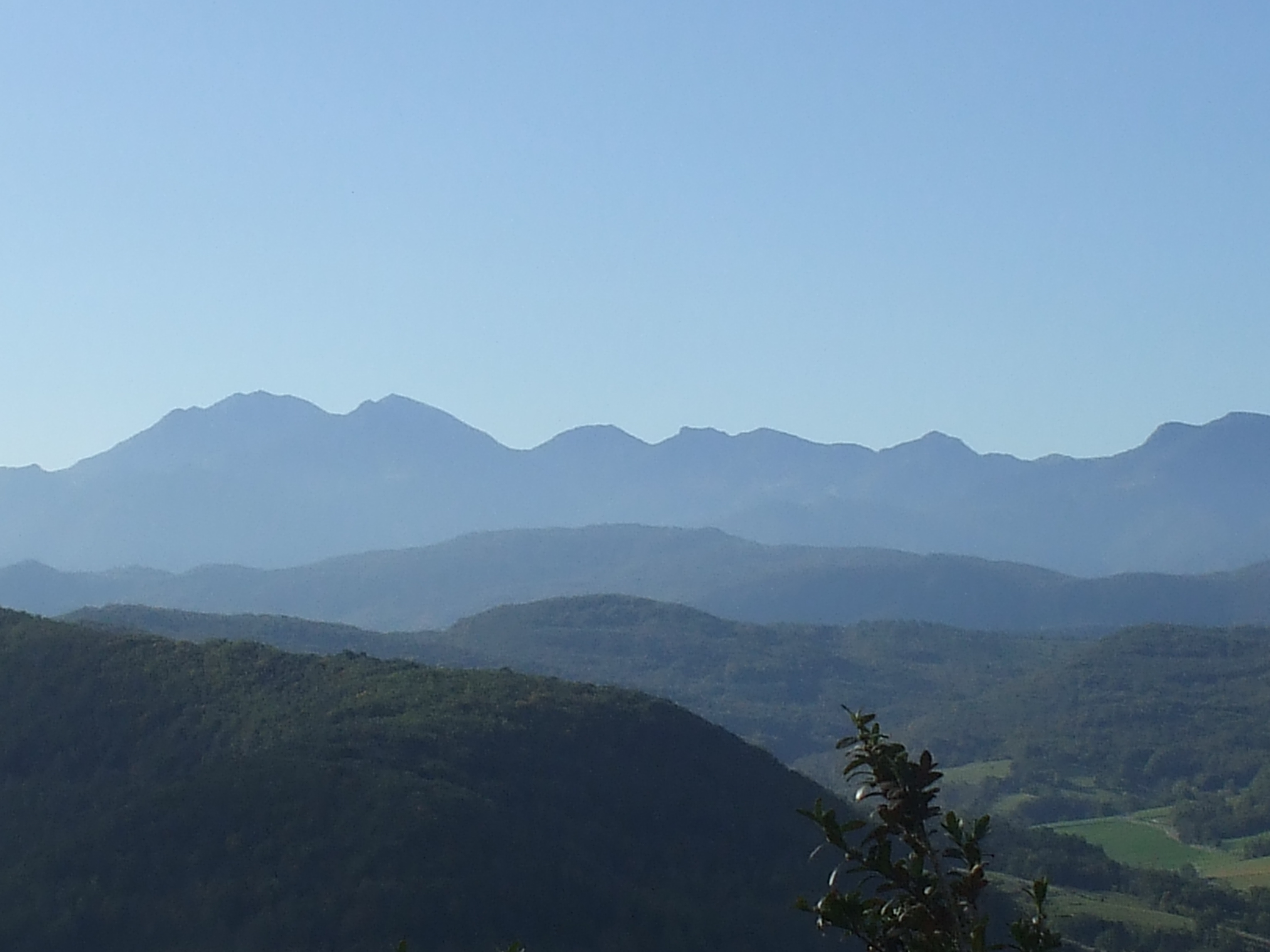
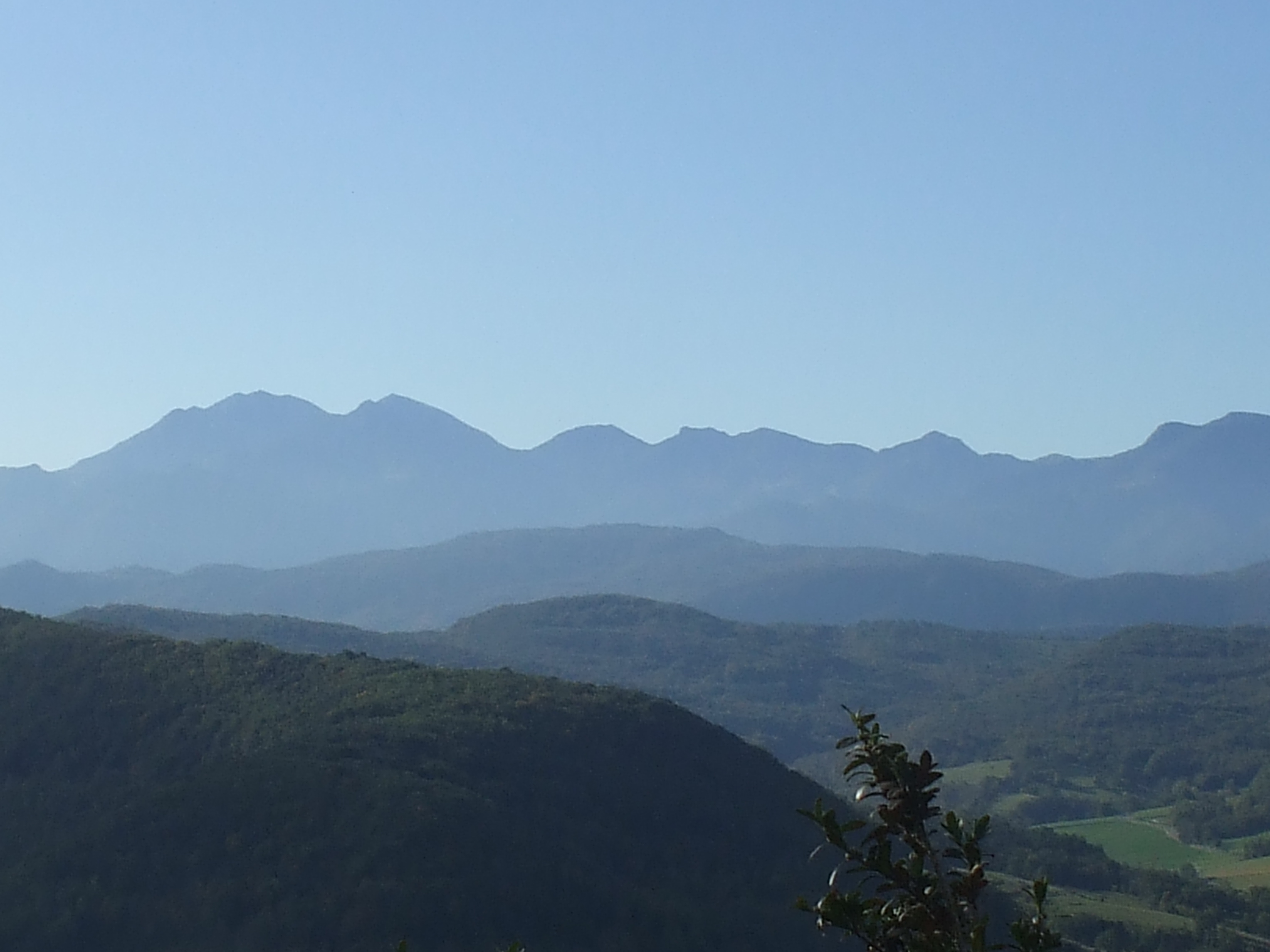
Distant Pyrénées. Not my photo, not the view we saw. But you get the idea
I gather that the last thing anyone in England needs right now is someone chirruping about how beautiful the snow is. Well, here in the foothills of the Pyrénées, we’ve been almost alone in France in being a snow-free zone. But please note: ‘the foothills’. The mountain tops have been covered for some weeks, and over the last week, the snow levels have crept down..and down…and ever nearer. And it’s quite simply beautiful.
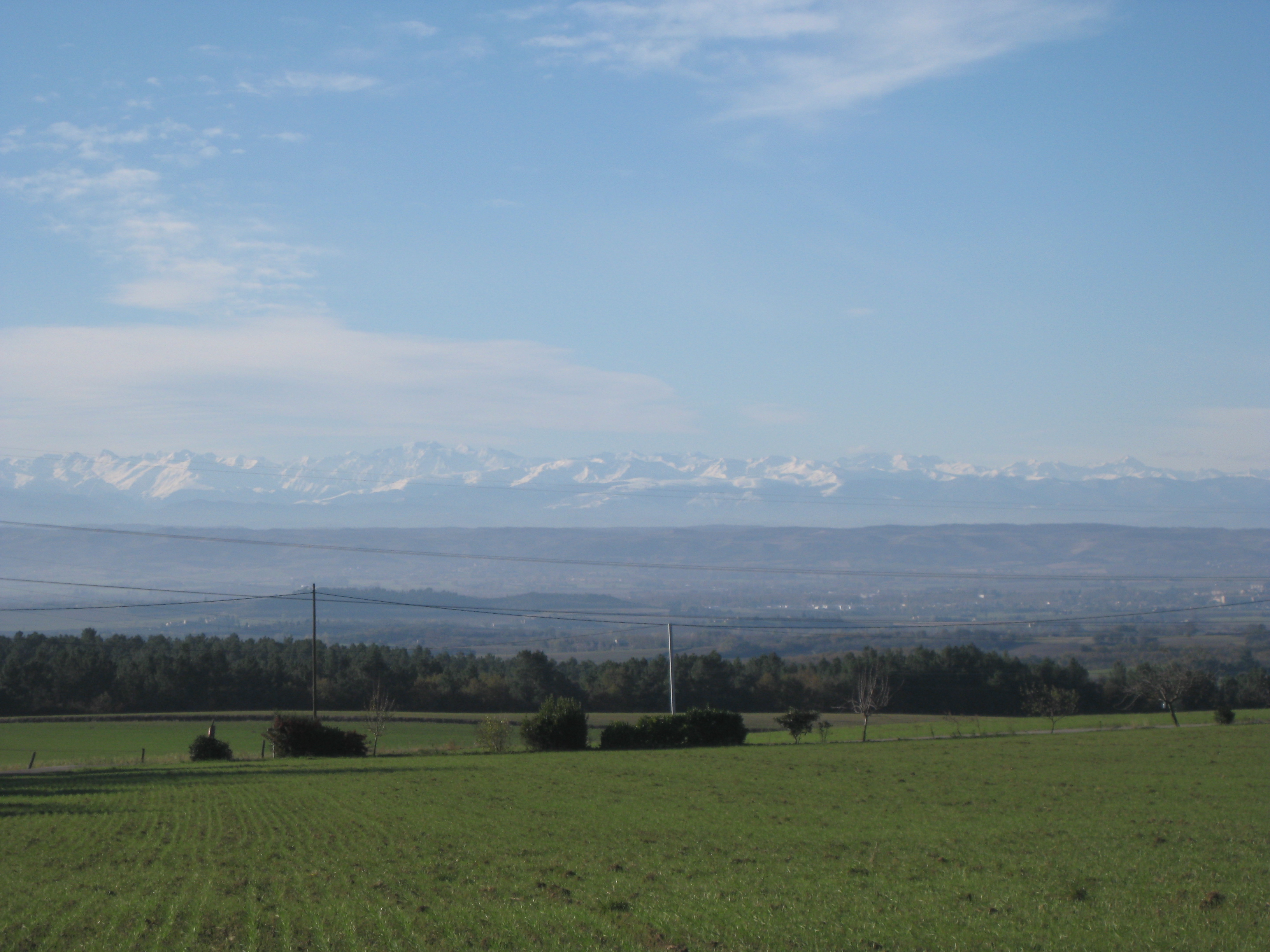
Distant Pyrénées
Yesterday we went walking in the Lauragais. That’s a gentle, verdant region north of here on the edge of la Montagne Noir. Perhaps the most wonderful thing about the walk we had here, through sandy woodland paths, crunchy with fallen leaves, were the views across to the Pyrénées: mile after mile of distant peaks blanketed in blue-white snow beneath a bluer sky. If only my camera began to do justice to this impressive sight.
A misericord to support a monkish bottomAbbaye de Saint Papoul
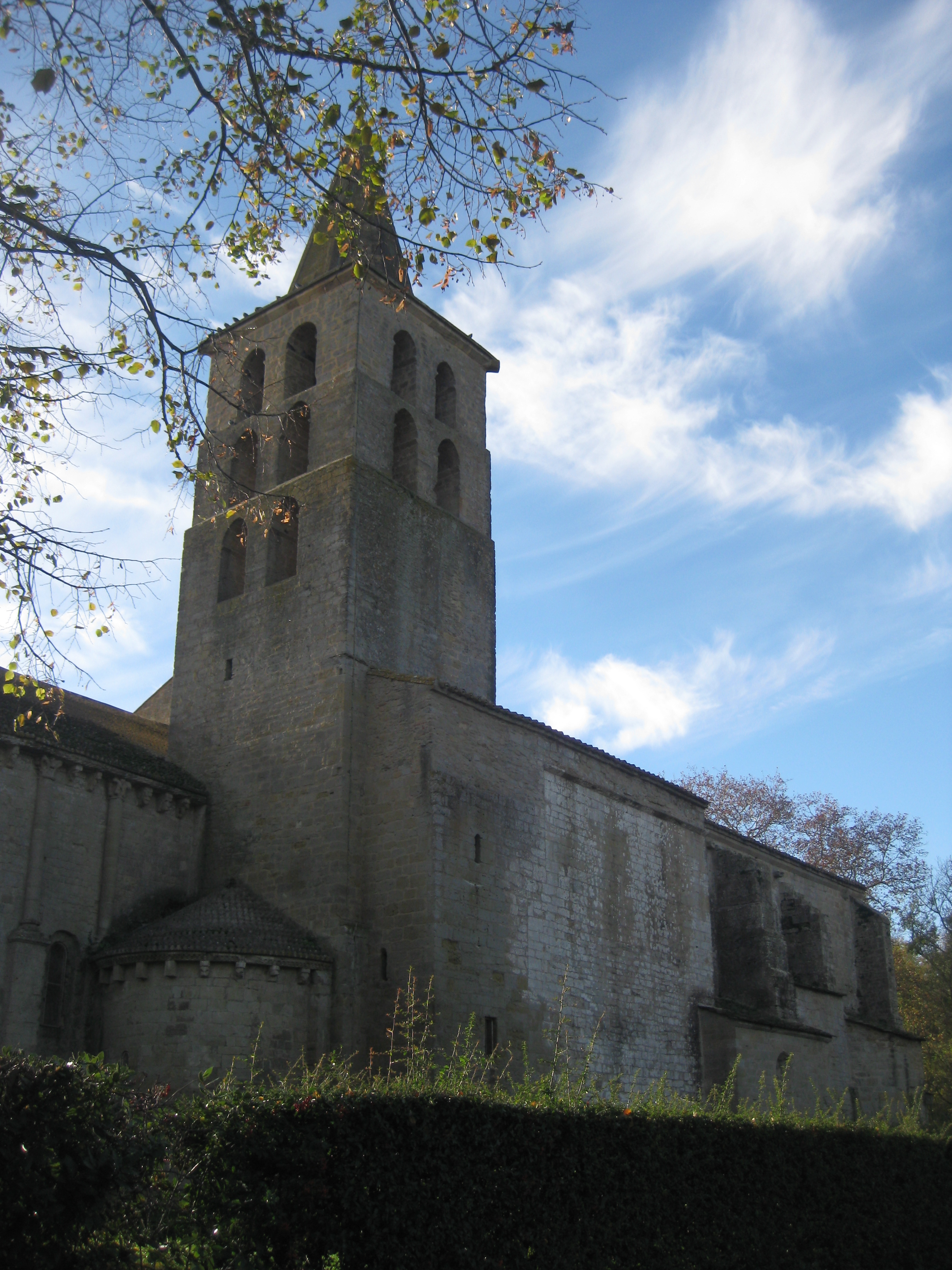
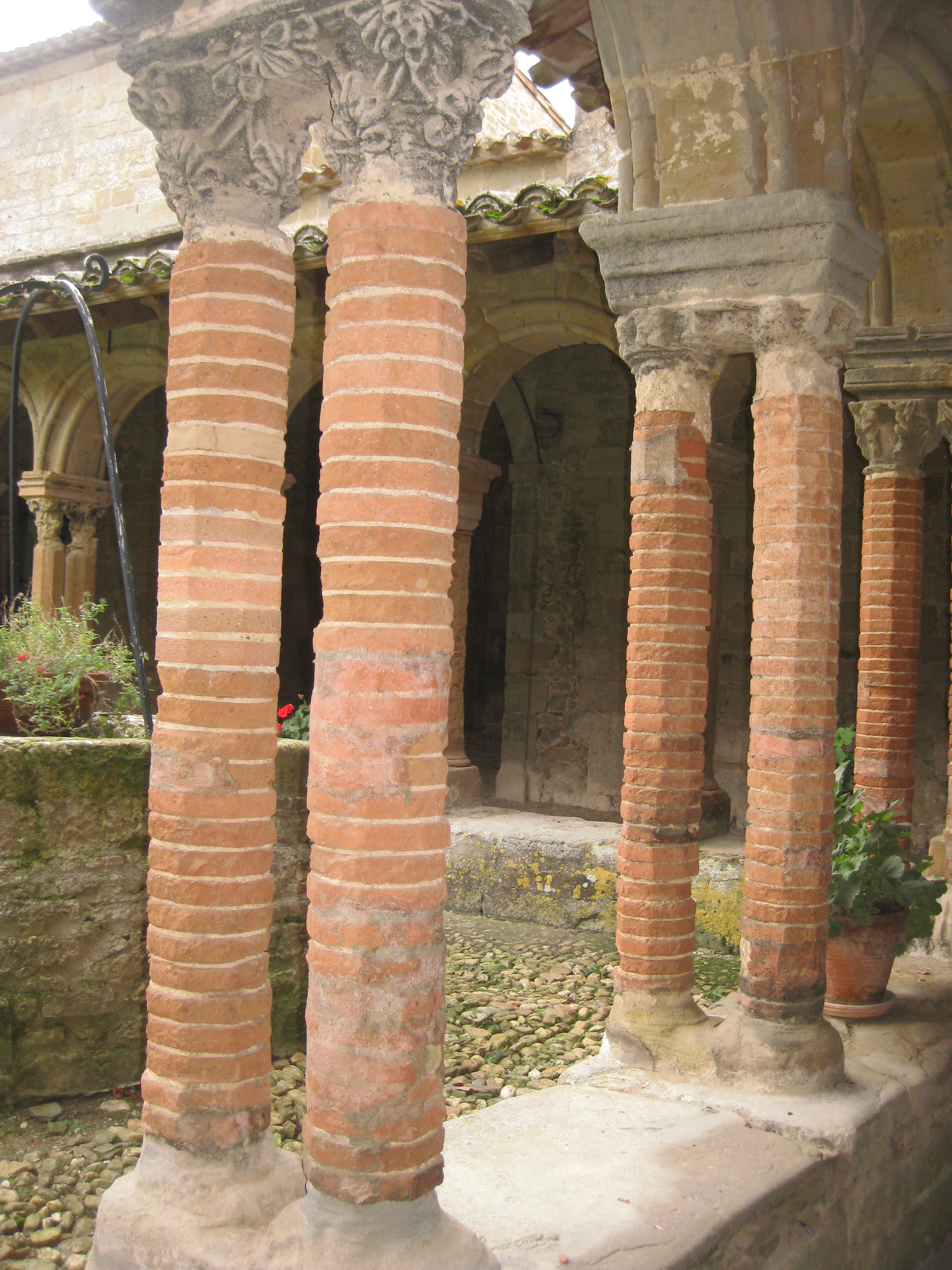
Healthily exercised, we came down to the village of Saint Papoul, and looked round the Benedictine Abbey of the same name. I found myself lingering in the 14th century cloisters and in the abbey itself, inspecting the misericords, the small decorated wooden shelves hidden under the seats to provide a bit of support for the poor monks as they stood for long hours during their religious devotions.
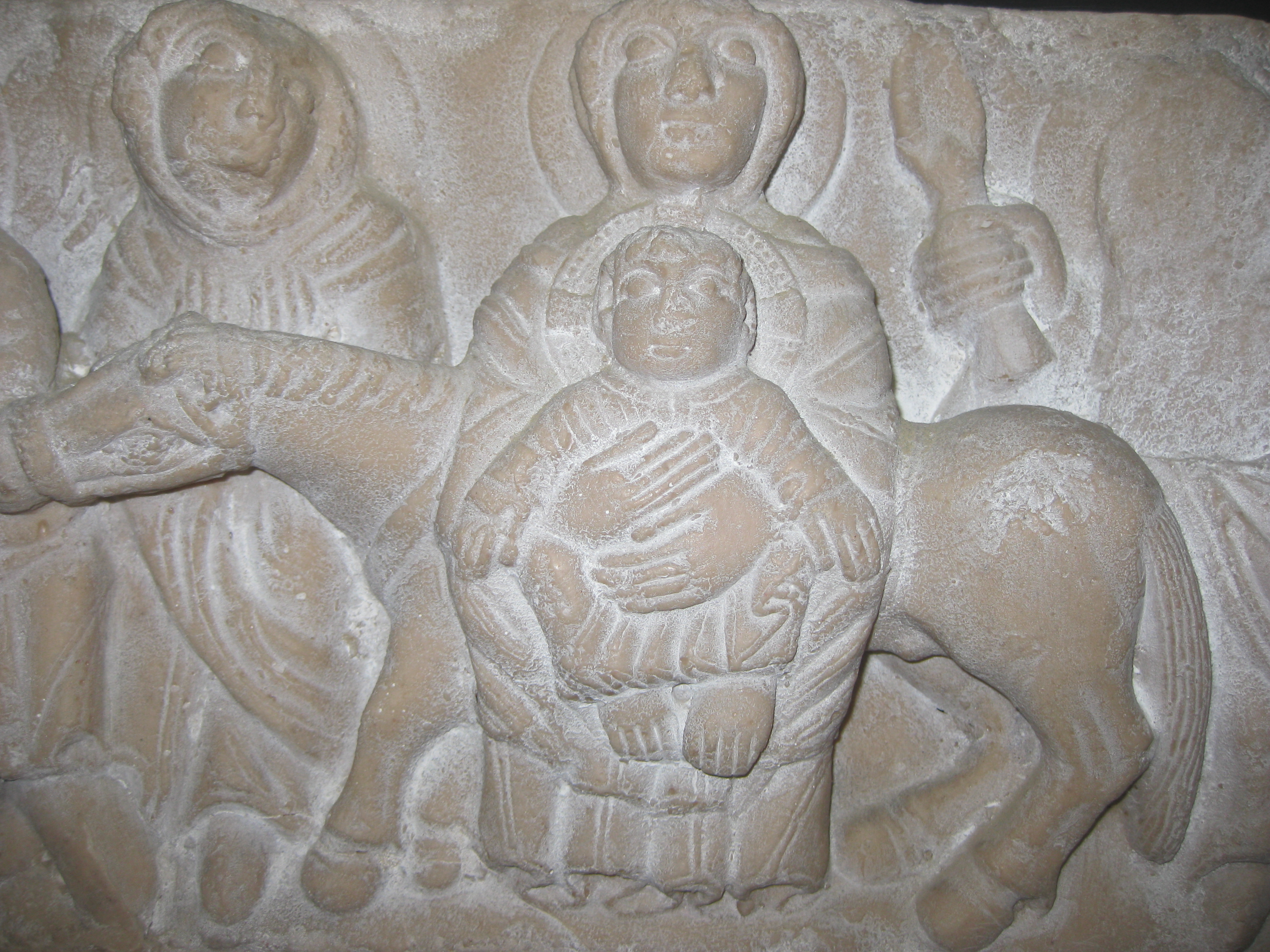
The Flight into Egypt
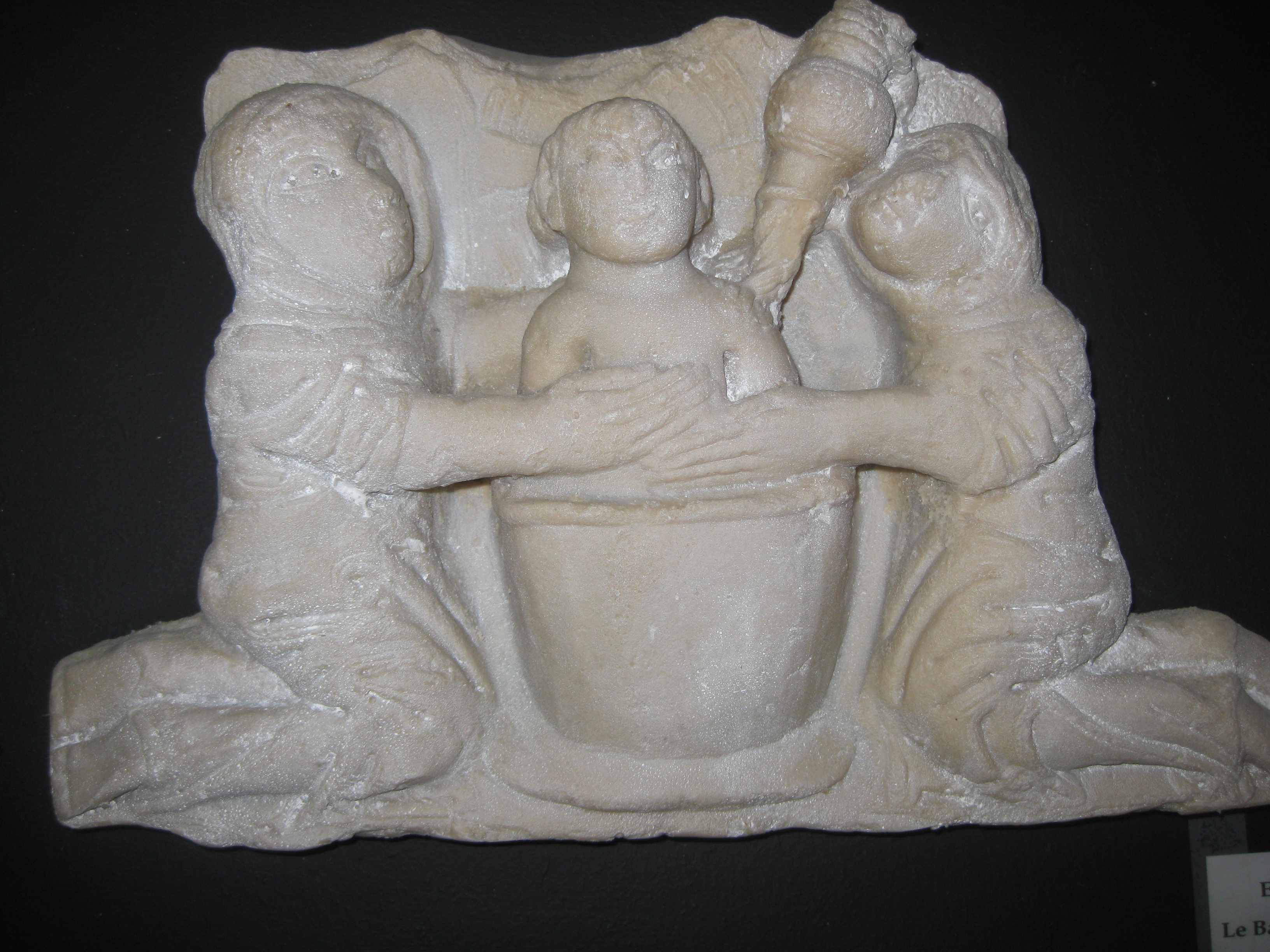
Perhaps the most enjoyable bit of our visit was a chance to look at the special exhibition devoted to le Maître de Cabestany, a Romanesque sculptor who seems to have left his mark on many of the pilgrimage churches on the route from Rome to Compostella.
The infant Jesus takes a bath
His figures, despite their realism, their chunky hands and elongated eyes, seem to have a slightly supernatural feel to them and they were fun to explore and enjoy.
It was cold though. Snow threatened, but didn’t fall in the end. We decided against a mooch round the village: probably something to do in the future, and scurried back home to toast our toes and fingers
The weathered pillars of the cloisters, and their equally weathered capitals
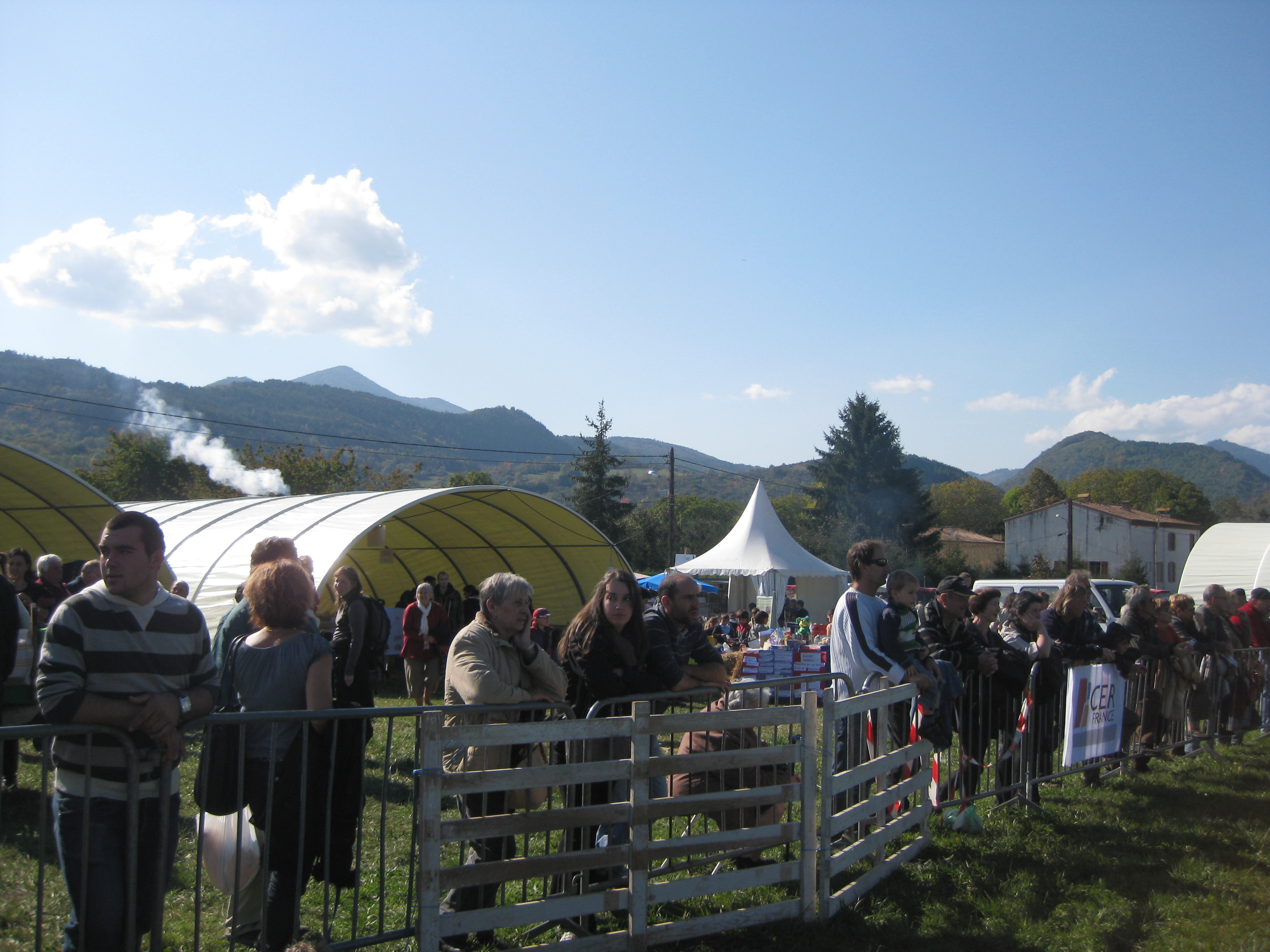
Waiting for horses to enter the ring. The fair at Espezel gets under way
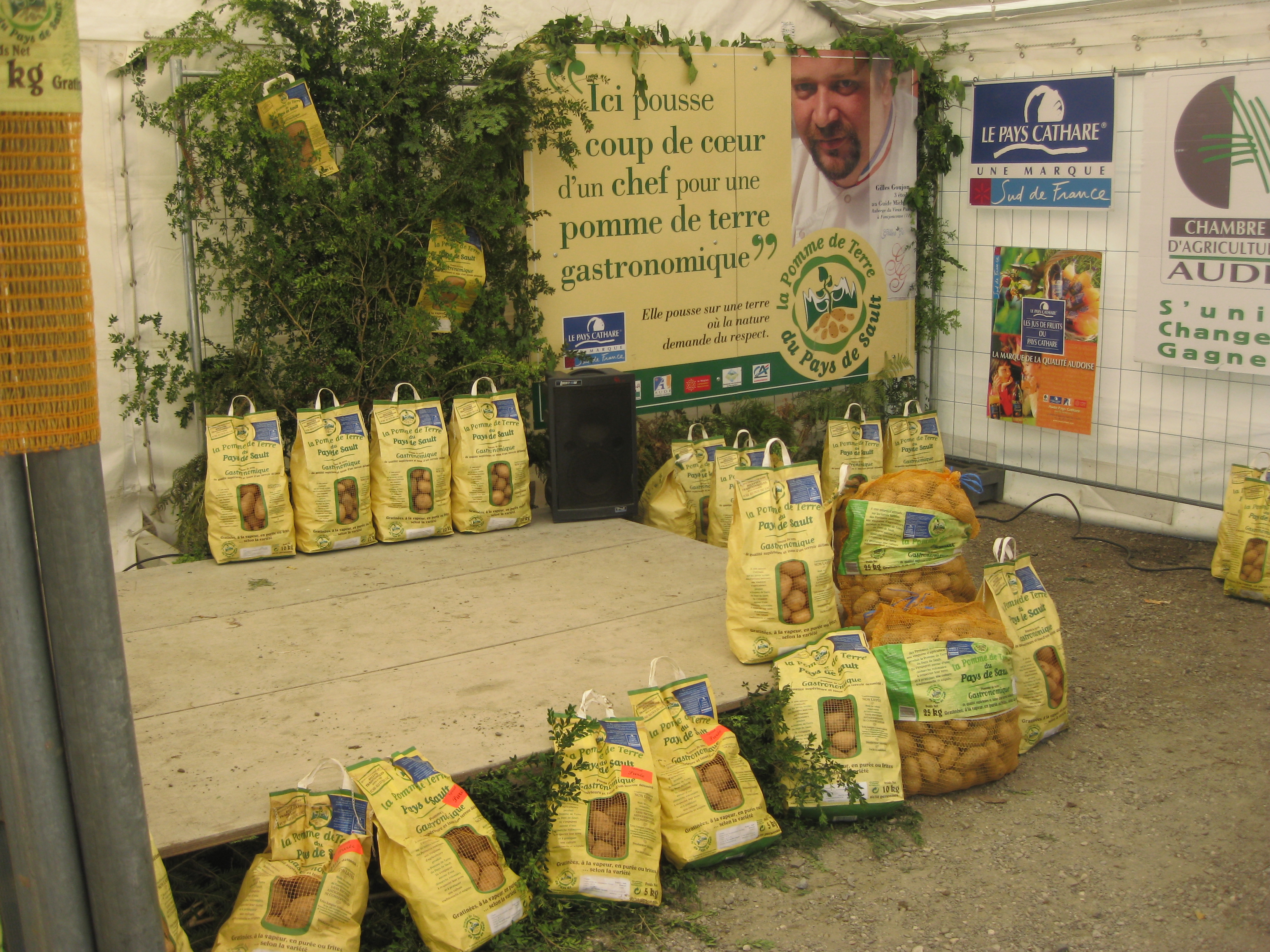
If you live round here, you’ll know about the Plateau de Sault. It’s where the potatoes come from.
Plateau de Sault potatoes. Plenty more where they came from.
They’re very proud of their potatoes. They’re also proud of their country fair, la Foire Départementale de l’Elevage, held at Espezel. Though this fair, held in October each year, is less about potatoes, and more about animals, as the name suggests.
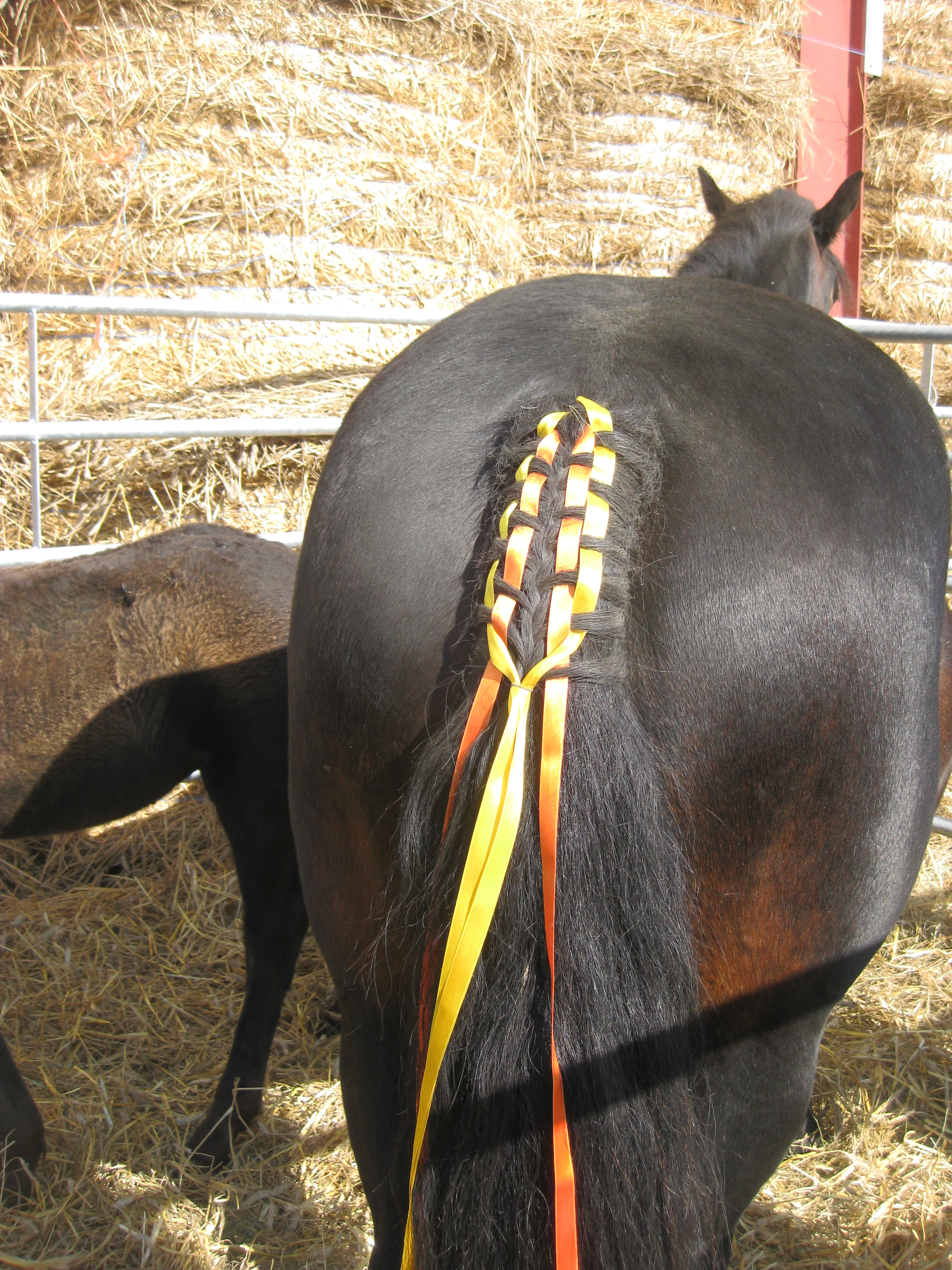
A show tail for a show horse
Working horses, bulls with a reputation, Jack-of-all-trades Tarascon sheep, sheepdogs, pigs, rabbits and chickens were all there, together with state of the art tractors and farm machinery.
We could have bought this fellow: but we couldn’t raise the money
There were food stalls, clothing stalls, catch-penny stalls: plenty to keep us busy. Gill and David, our guests from England, who are County Fair Connoisseurs and stalwarts of shows all over Yorkshire, spent their time eyeing up horses – particularly the heavy, working Castillon horses, while we enjoyed the working sheepdogs.
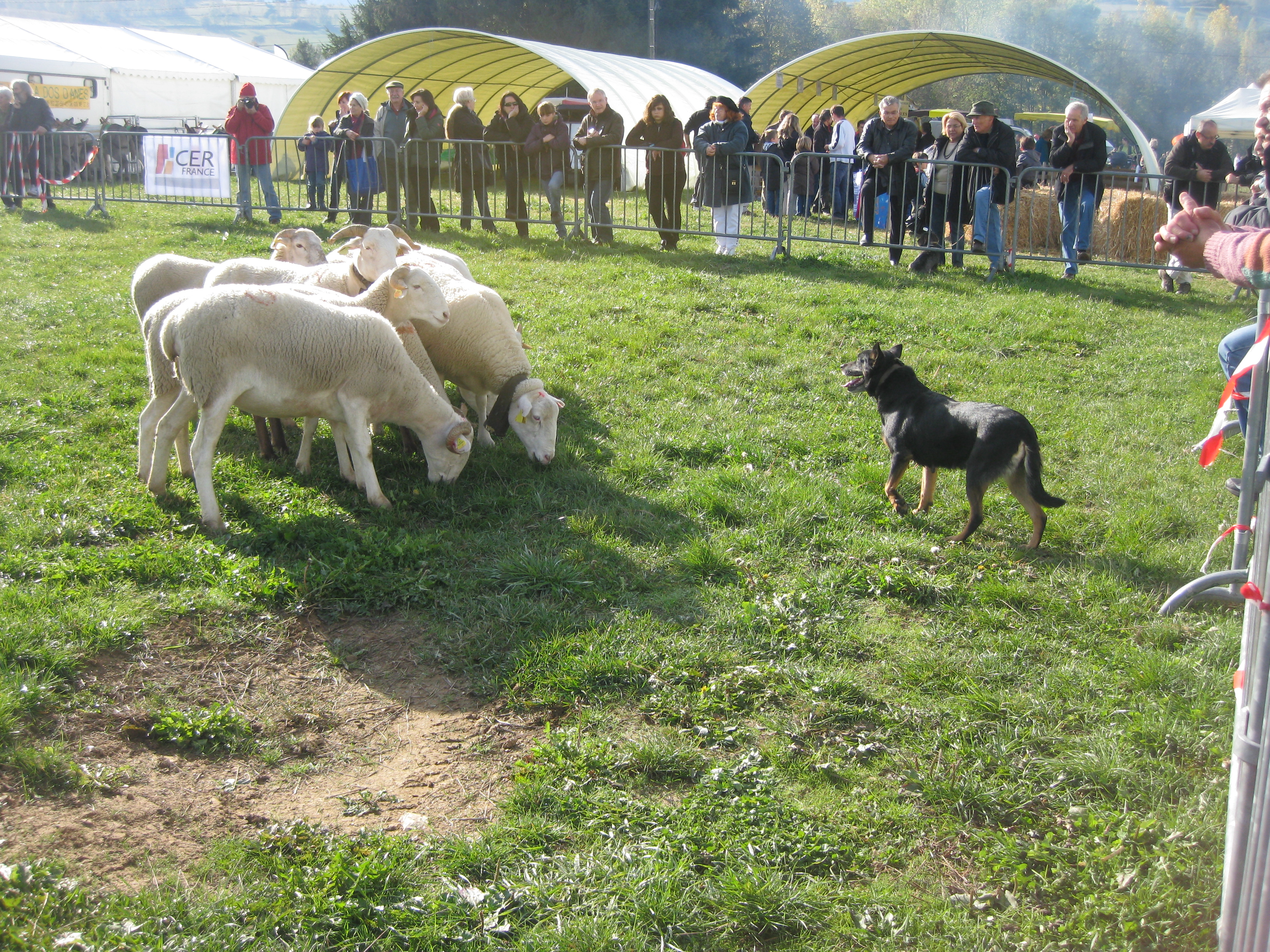
The Australian sheep dog rounds up his sheep
As in England, most sheepdogs are border collies, but some are Australian sheepdogs, crossed with dingos. They might look fierce – the sheep certainly think so – but they’re gentle and tractable, and do the business.
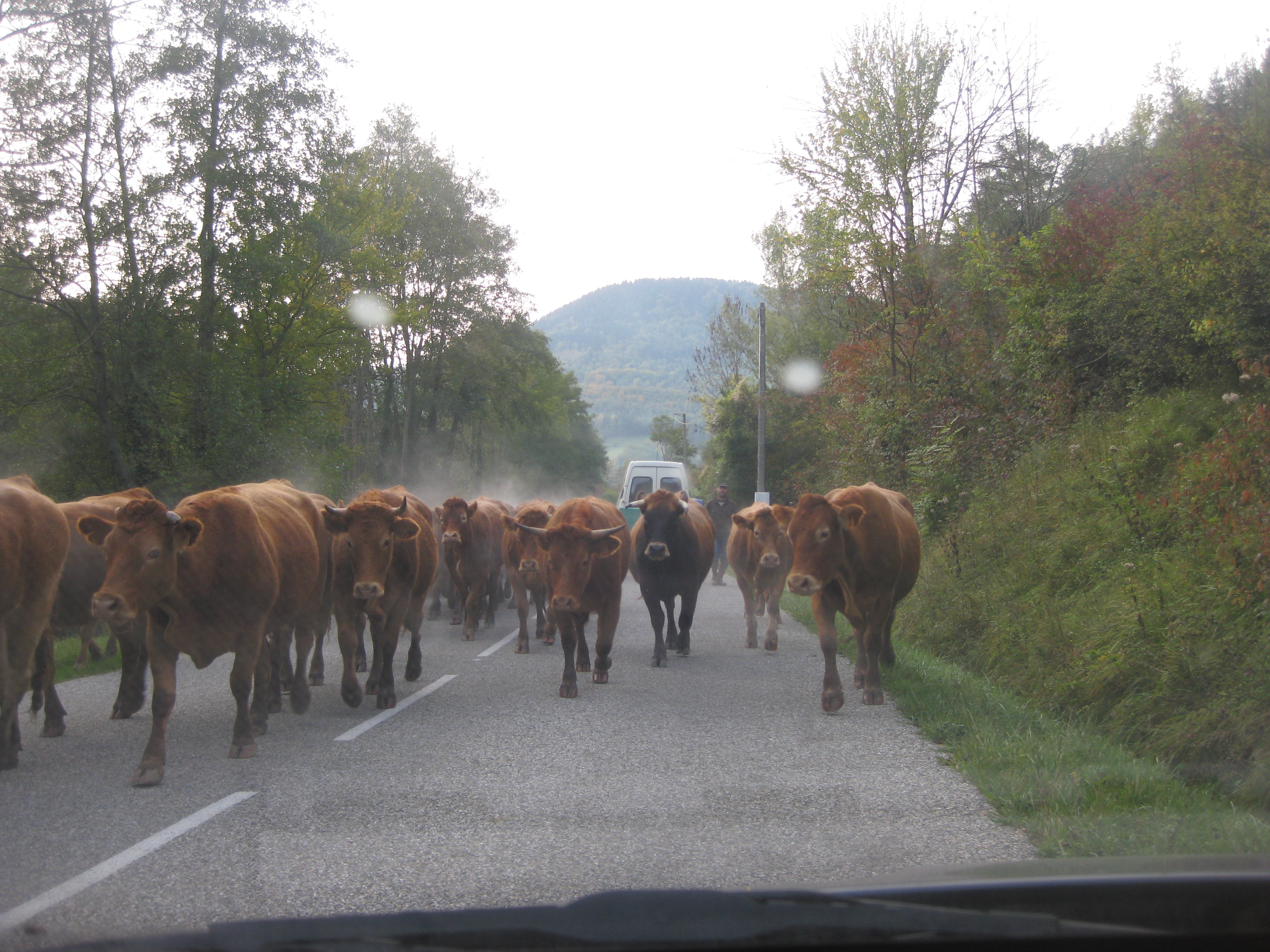
Oh, and on the way there, we had a piece of luck. We got held up, and it was a traffic jam we really didn’t mind. On the road to L’Aiguillon, a slow moving car with a sign reading ‘Transhumance’ flagged us down. Dozens of cows were being brought down to their lowland home from their summer pasture, and a score of cowherds and hangers on accompanied them on their long walk from Comus on the Plateau de Sault, to Mirepoix. That’s a 50 km. journey, but they probably didn’t walk it all. They’d have hitched a lift in a cattle transporter for at least part of the way, more than likely. We however, saw the picturesque procession, and it began our day on a suitably bucolic note.
Tell most Ariegeois that you’re going to Andorra, and they’ll assume you’re popping over to stock up on hooch, cigarettes, cosmetics and cleaning products, then fill the car with as much petrol or diesel as it’ll hold.
The Principat de les Valles de Andorra is a little historical oddity. It’s a Catalan speaking independent country, only 468 square km., slap in the midst of the Pyrénées between France and Spain. It was, since 1278, co-ruled by the President of France (as the Count of Foix is no more) and the Bishop of La Seu d’Urgell in Cataluña. In odd numbered years, France receives tribute money, and in even-numbered years, the Spanish bishop calls in 900 pesetas (or the euro equivalent, I suppose), 12 chickens, 6 hams and 12 cheeses. 1n 1993, the Andorrans voted for democracy and a constitution- but those tributes still get paid.
What makes Andorra popular, here in the Ariège as elsewhere in France, is its lack of taxes. Petrol therefore costs something like 40 cents a litre less than in neighbouring France, and you can buy 3 new car tyres for the cost of two here. And so on. So Andorra’s border towns are nothing more than huge unpleasant shopping malls, blighting the slopes of the wilderness Pyrénées on which they’re situated. The capital city, Andorra le Velle, and the surrounding towns which have become its suburbs, are given over to little other than retail therapy.
In other words, not really our cup of tea.
Andorra, though, offers so much more. Zig-zag up the narrow mountain roads only a few kilometres away from the capital, and you’ll be alone amongst grand peaks, dense forest and craggy paths. Apparently, the further you travel from the capital, the wilder and more spectacular the scenery becomes. Tiny villages remain undefended by castles: the circumstances of its past government meant castles were forbidden. But charming Romanesque churches, often with original frescoes, are common throughout the country.
Henri and Brigitte invited his cousin and wife and us, to join them on a mid-week break at an Andorran hotel they’d chanced upon a few months ago. Henri doesn’t do bargain basement, so we were surprised when he told us that full board at this 3 star hotel was 51 euros each.
Hostal La Font is in a tiny village, Os de Civis, clinging to the mountain side not, as it turned out, in Andorra at all. It’s in Spain. But it might as well not be. The one road serving the community connects the village to Andorra la Velle and to nowhere whatsoever in Spain. Out of season, 20 people live there.
It was busy when we checked in to the hotel though, just in time for lunch. Vegetarians need not apply. Before the meal, tomatoes, garlic, olive oil, dried sausage, olives all appeared on the table. Then a hearty meatball-cabbage-chickpea-potato soup arrived. Then a selection of salads and charcuterie. Full yet? I hope not. There’s grilled lamb and 3 different sorts of grilled sausage with baked potato, and a large choice of puddings to come. The secret of course is to help yourself to tiny portions of everything offered: that’s what I did anyway, because I knew there would be a 3 course meal in the evening, and Henri has a way of making sure that nobody does their own thing by skipping dinner – or even a course.
Anyway, after lunch, we all chose to stride forth into the mountains. Henri’s cousin, Jean-Claude, has been a lifelong farmer, and made a great walking companion. We learnt from him the grasses that any discerning sheep chooses, given half a chance. He showed us how the local cows, a Swiss grey breed, have narrow agile hooves and legs to enable them to cope with climbing up and down the steep slopes of their summer pasture. And he told us tales of transhumance: the days in spring and autumn when cows and sheep are taken up to high pastures for the summer, and down again in winter: for his sheep, each journey took three days.
Later, we explored the village. Just as well the streets are equipped with handrails. Steepest village I’ve met. The dark local stone is the picturesque material both houses and streets are built from. It might look pretty in the September sun, but life looks tough here, and I’m not surprised the village all but closes once the tourists go.
We’ll be back. A walking week or so in these wild and empty mountains is a must, and hotels are affordable. Anyway, the car needed 2 new tyres, and the money we saved by buying in Andorra all but paid for the holiday.
We’ve just had a wonderful weekend at Lanoux. Well on the way to Andorra and Spain, the reservoir at Lanoux is high up (7261 feet) in the Pyrénées Orientales. It’s a natural lake, enlarged by the creation of an immense barrage that enables it to produce quantities of electricity for the area and for industry in the Ariège. Building this barrage must have been quite an undertaking – it took 20 years from 1940-1960: up there, it’s a good 2 ½ hour walk down to the nearest road (though they did have a cable car, since removed), and the winter months are given over to deep snow. And of course there was a world war on in the 1940’s. We stayed in the refuge used by the construction workers at the time, a simple structure with a dormitory of three storey bunk beds, a large kitchen-living room, two hole-in-the-floor toilets, and … one washbasin just inside the entrance. Everything we ate, everything we needed, we had to carry up – and bring any rubbish down again. But our two days there were memorable. Why?
Was it the landscape? Our walk from the valley floor began with wooded green meadows, and as we climbed, we saw lakes, crossed 20 or more streams, and followed the course of a dozen others. Higher, the landscape became starker with slatey outcrops that reminded us of the Lake District or North Wales, though on a much bigger scale. Even though it’s June and the weather was warm, we soon reached what was left of the snowfields. We were surrounded by peaks higher still than we were, such as le Carlit, over 9 ½ thousand feet high
The flowers? Early June is a wonderful time to do this walk. The azaleas aren’t quite out, but we saw Alpine & spring gentians, both a brilliant royal blue, orchids, sempervivum (joubarbe), vividly yellow gorse, creamy rock roses and saxifrage, tiny pink and white moss campion, delicate mauve violets, bilberry flowers, even a few late daffodils
The animals? Lower down, we spotted a herd of isards (Pyrenéan chamois) bounding across a meadow where semi-wild black Merens horses grazed. Near our refuge, there were chestnut horses too, with their leggy young foals. We spotted distant mouflons, and on the way down from Lanoux, marmots chasing and playing on the rocky grass.
The water? The lake itself is sternly beautiful, set among the slatey mountains of le Carlit, and the area is criss-crossed by deltas of streams and rivers, with splashing cascades as the water tumbles down the mountain sides. There are ponds and lakes at every turn, and in every distant view.
Friendship? Weekends like this are the chance to nourish existing relationships, as this weekend with our Laroquais friends showed. Up at the refuge though, we were joined by a group from Toulouse, who’d come, like us, to enjoy the empty countryside and to spend time together. They all knew each other very well, and could have resented our intrusion: but instead, we shared some very special moments. We pooled our food and drink, ate their homemade pâtés, and drank their homemade apéros. We talked, laughed, played silly card games, and the next morning, went walking together. So now we have some new friends too.
Shot on location in the Ariège by Jacques, Malcolm & Margaret.
A Lawrenson-Hamilton-Clift Production MMX
‘Curiously, I had no feelings of fear or apprehension, perhaps because of what our friends had told us about Jacques, the pilot, and his machine – it’s his pride and joy, and he takes great care of it.
There was a sharp feeling of exposure after take-off – we were not in a cabin, there was no protection from wind, we were just vulnerable beings in a powered shell under a giant wing – it reminded me of riding pillion on a motorbike, but this was in the air.
The various destinations came up quickly – not like travelling on the ground, even though our speed was only about 80-85 kph.
Over the mountain peaks, it was very cold – temperature had fallen from 13 or so on take-off to minus 1 over the snowfields and the flat white surfaces of isolated frozen lakes were still clearly to be seen. And suddenly, directly underneath, a herd of Pyrenean chamois, running and leaping, disturbed by the engine’s sudden sound in their snow-quiet world
A few minutes more and we were at 2600 metres, when the mountains seemed so empty and cold, even in the lovely morning sunlight. We could see long distances in the clear air at this altitude – 200 km away, we could see the Pic du Midi
The warmth after we left the mountains behind and lost altitude was welcome, and I could concentrate on the views of walks we had previously done, and which had sometimes seemed long and meandering, but were now clearly visible with their beginnings and ends.
Then back to the field and the short grass runway. As we flew over, I could see Margaret far below, waving. Then it was down, very smoothly, and a turn, and back to rest. What an experience! And how kind of my family to make this possible.’
Whenever we think we’re beginning to know the areas near home quite well, something comes along to surprise us.
Take Couiza, for instance, a town in the Aude that has been the centre point for quite a few of our walks. It can offer, within easy reach of the town, a typical Audois landscape which is almost Tuscan, with rolling hills vineyards and cypresses. Or craggy, scrubby garrigue, almost Spanish looking. Or there’s le Domaine de l’Eau Salee, which I blogged about previously, where the streams are pink with salt washed from the earth, and have been exploited by man for centuries.
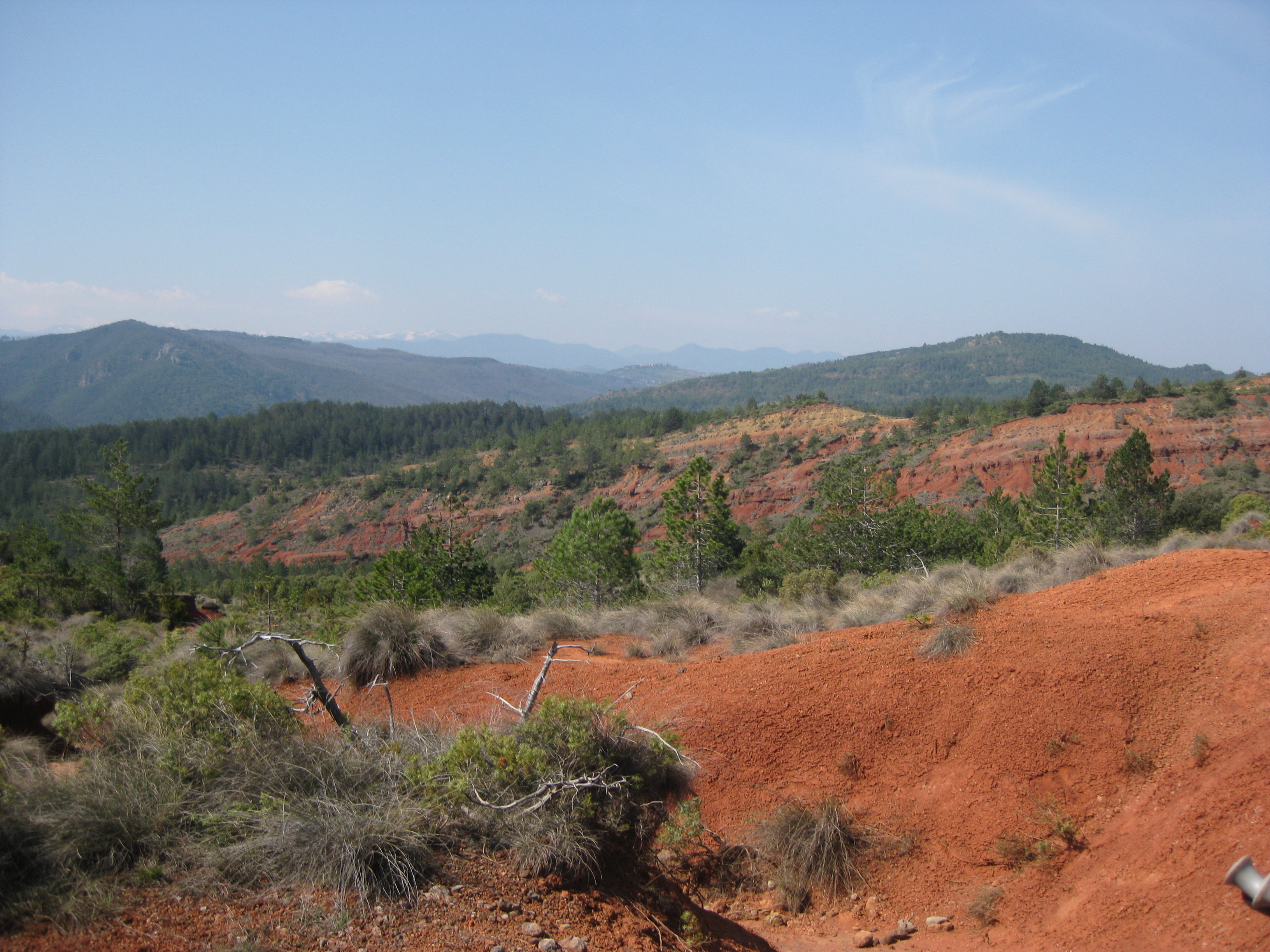
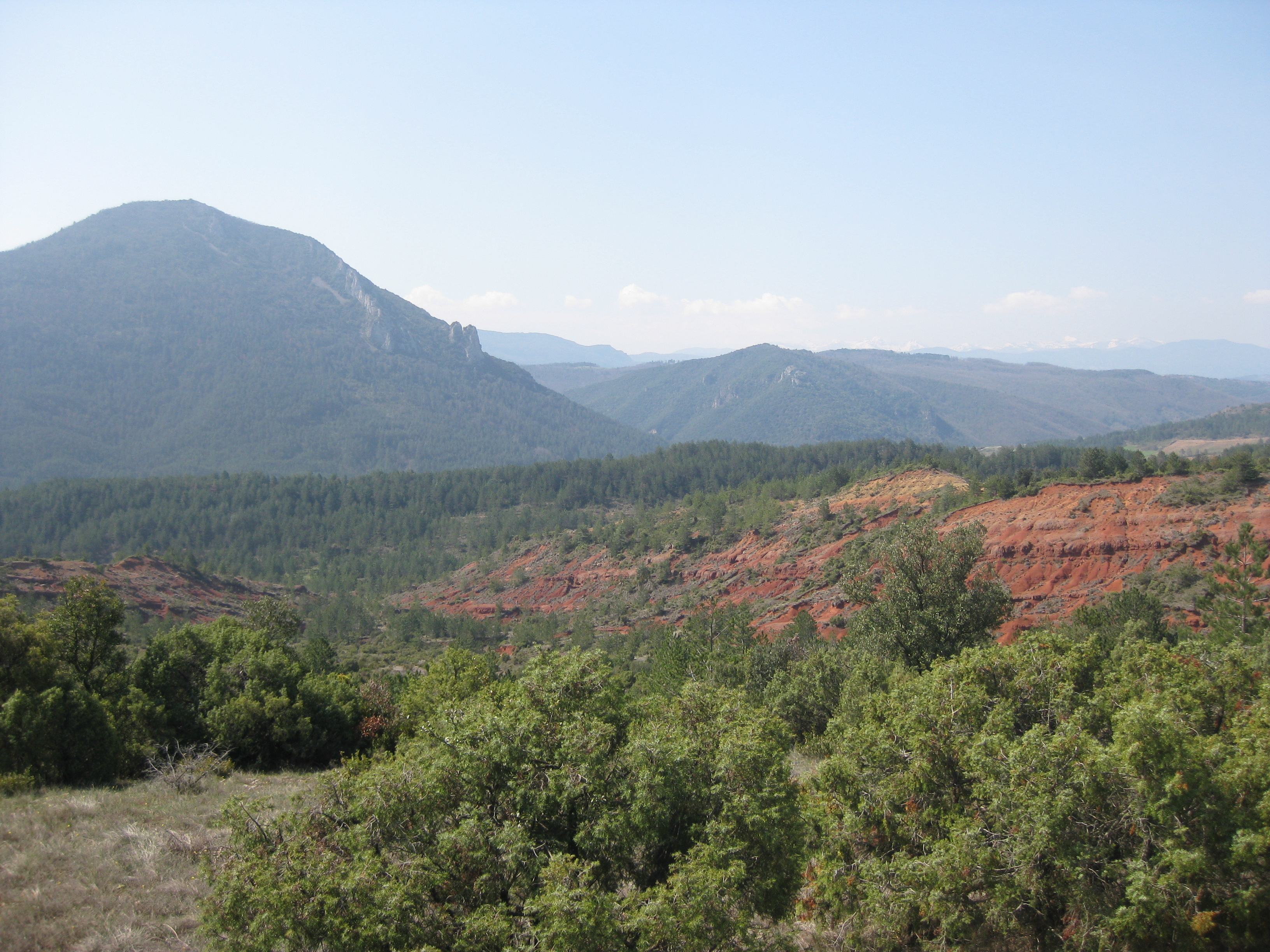
Yesterday, however, we went with le Rando del’Aubo to Terre Rouge, an area near Couiza which astonished us with the rich red colour of the earth which dominated the landscape.
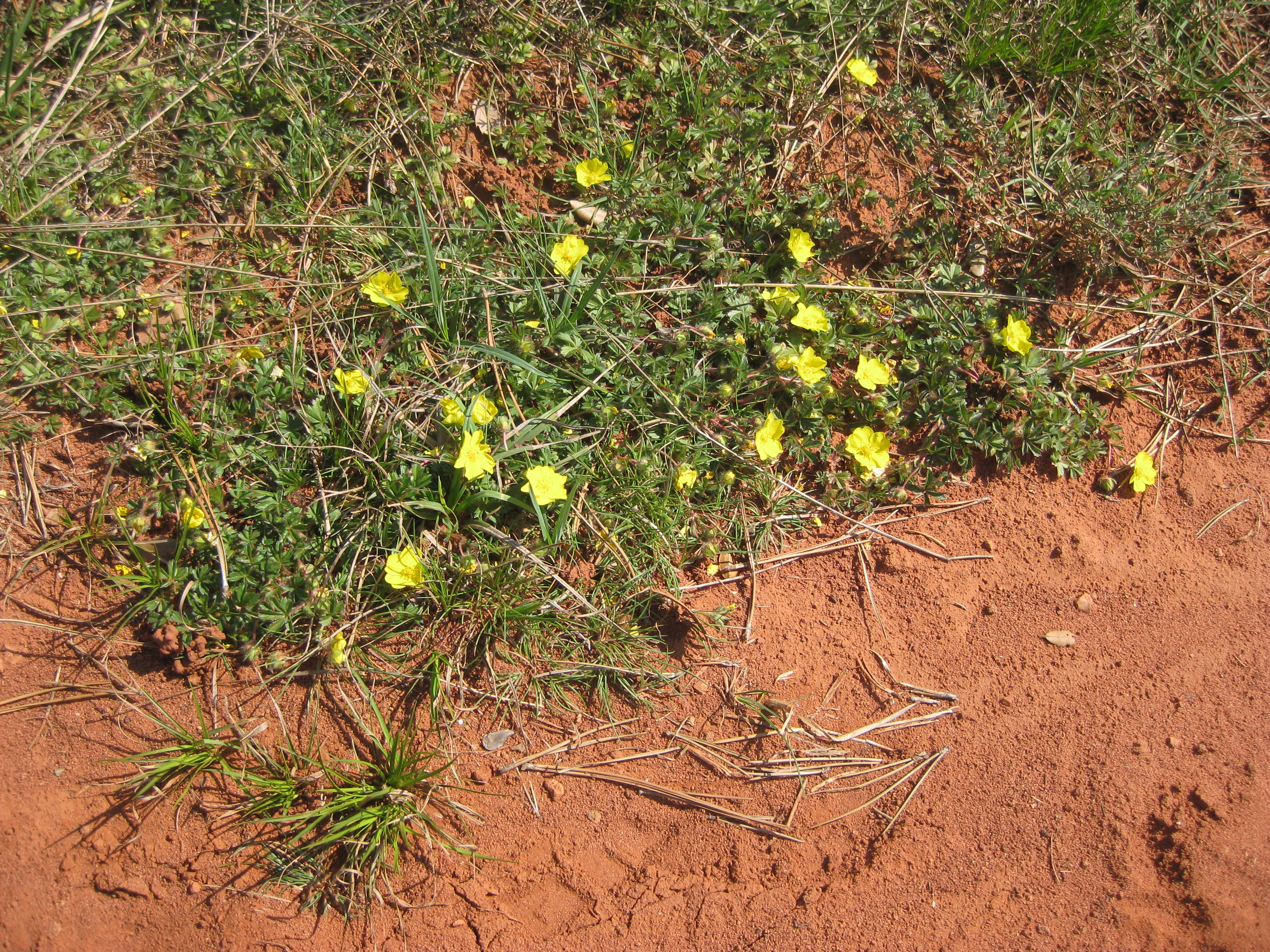
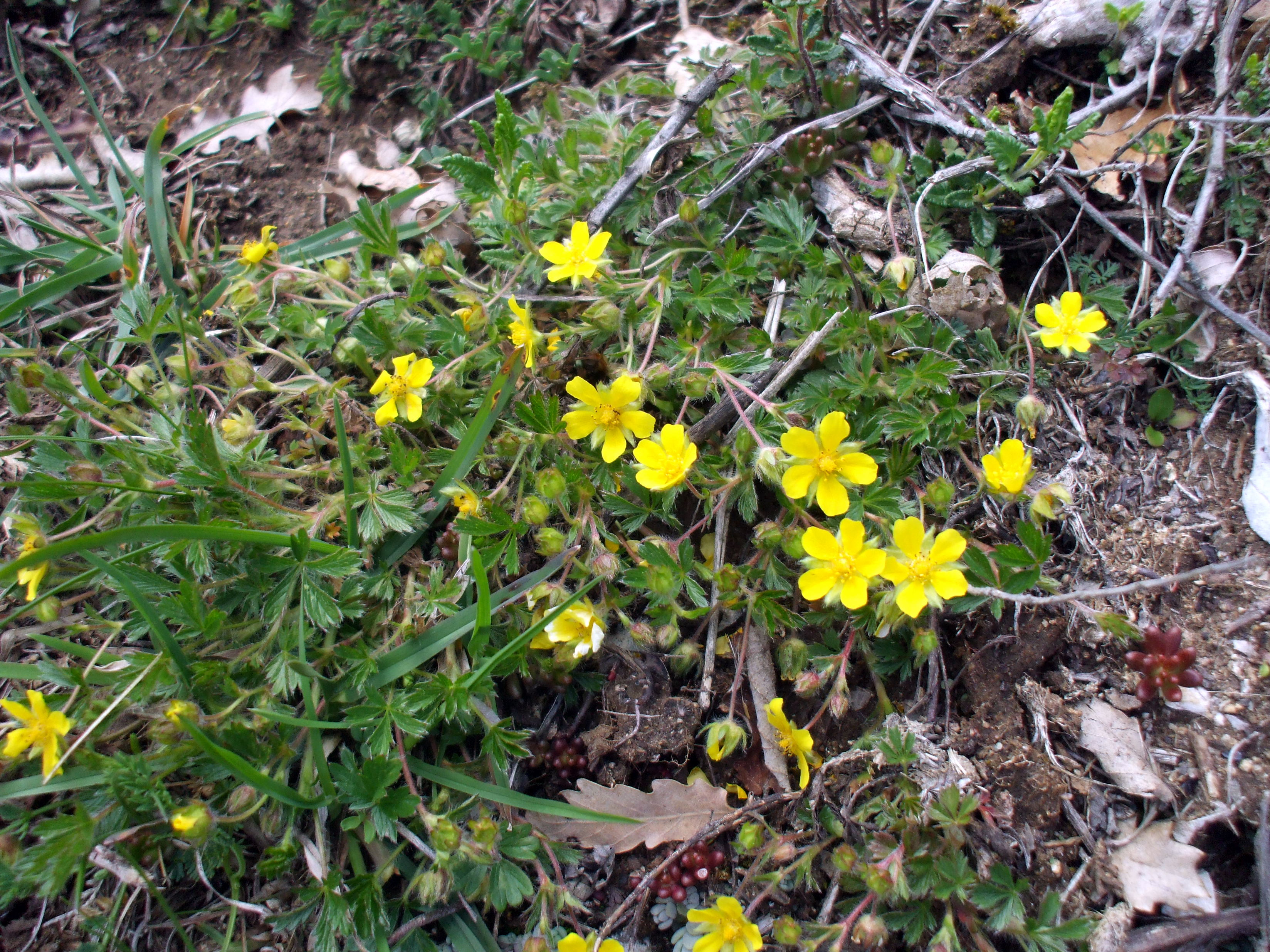
It supports a rich variety of plant life which is just springing into flower: Tiny daffodils, less than 3 inches high, bright yellow potentilla, grape hyacinths. Bluish grasses bind the dry and sometimes sandy earth, and the air is rich with the strong scent of various wild thymes and lavender.
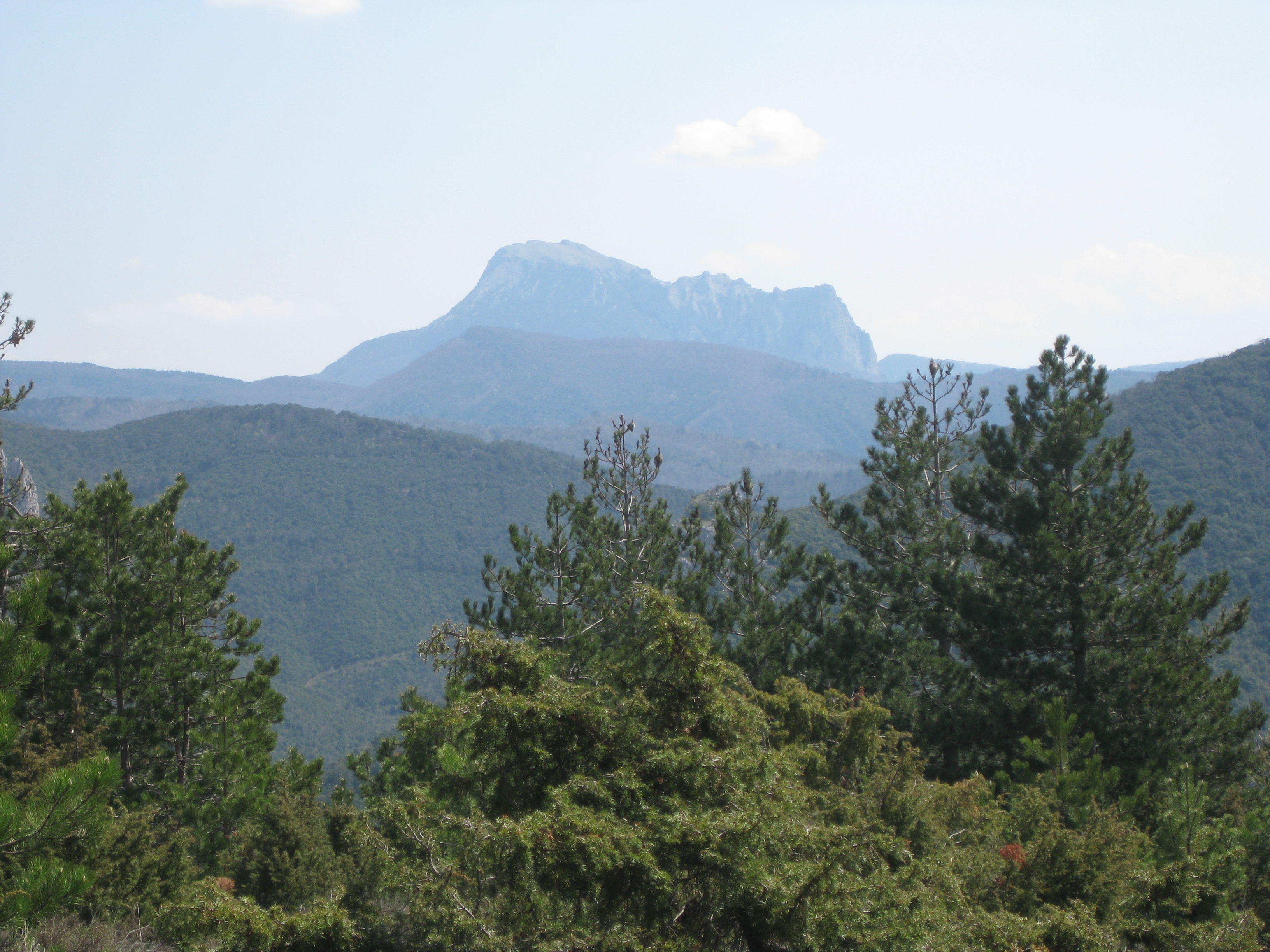
Bugarach
This red earth is all-encompassing. And then suddenly, it stops. And we’re back again among more pallid yellowish soils, enjoying views of the distant Pyrenees, and the mountain which dominates this part of the world, Bugarach.
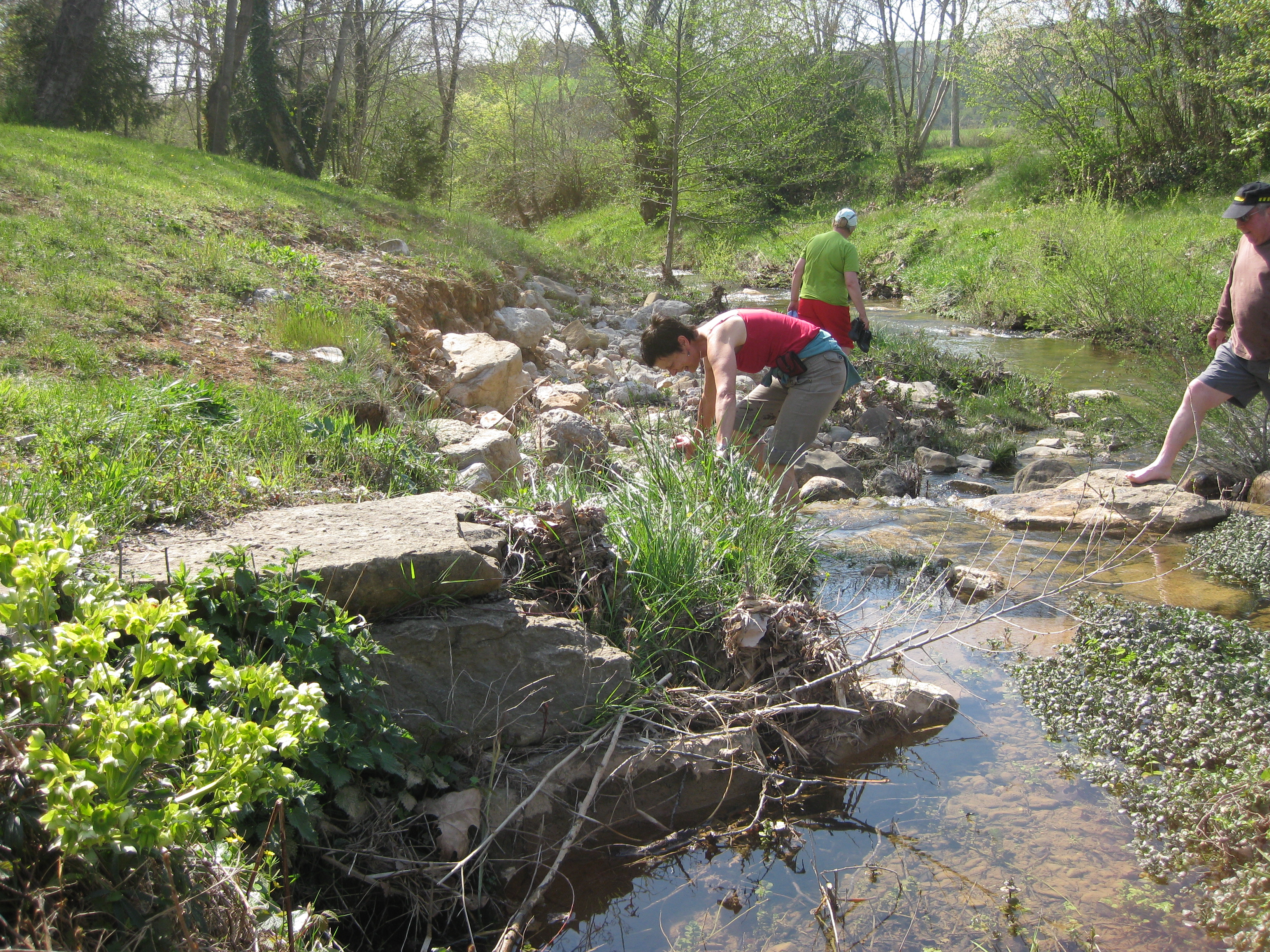
The walk was on the hottest day of the year so far, with clear, vivid blue sky. We shed jumpers, long trousers, and our pasty winter skin turned the colour of that red earth. There was a wide shallow stream at the village where our walk began and ended, and a few of us enjoyed a paddle. I greatly contributed to the end-of-day bonhomie by falling in…….
Accent –local: If standard French is a challenge, how much more so is the local accent? Remember school French, and being told that usually you don’t pronounce the final letter? Doesn’t apply here. ‘Pain’ is ‘peng’, ‘loin’ is ‘lueng’, and so on. ‘G’s happen a lot – ‘tous ensemble’ becomes ‘tous angsamble’
L’Apero, l’heure de: Great custom
Bio: – organic. Buying organic food is ‘normale’ here, especially at the markets.
Bountiful free food: The hoarding season’s pretty much past its best now. We’ve been out looking for walnuts, almonds, chestnuts, rosehips, apples, sloes and coming home with the kind of quantities that will see us through the year. It’s a full time job.
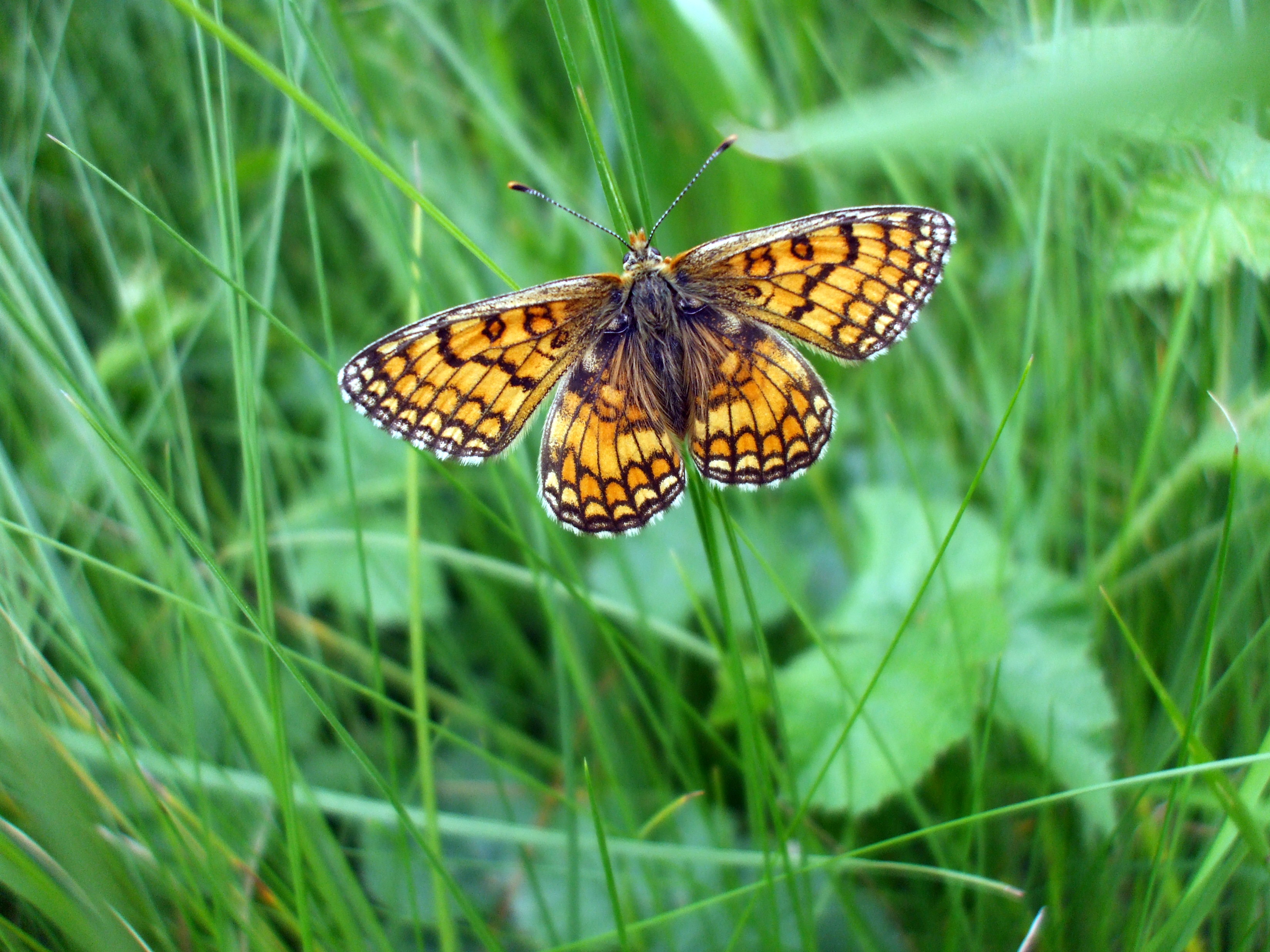
Butterflies: So many varieties, and seen everywhere, almost all the year round. Even yesterday, November 22nd.
Courtesy: Walking down the street here, it’s normal to offer greetings to everyone you meet. ‘Bonjour Madame!’ With anyone you actually know, you shake hands, maybe exchange bises on both cheeks. Small children greet you, surly teenagers greet you. It’s one of the real pleasures of small town life.
This sheep is currently not on milk-for-cheese duties
Cheeses: Cows, goats, sheep, all busily producing milk for dozens of varieties of (preferably non pasteurised) cheese: soft, hard, creamy, runny, mild, stinky.
Dépêche du Midi (La): It’s the local daily. We don’t often buy it, as world events seem to pass it by in favour of the marriage of the local lass in La Bastide de Bousignac.
En cas où…….. Out walking, we always have a spare bag stuffed in a pocket. En cas où we find some mushrooms, a handful of berries, some windfalls, a log for the fire. Everybody does it.
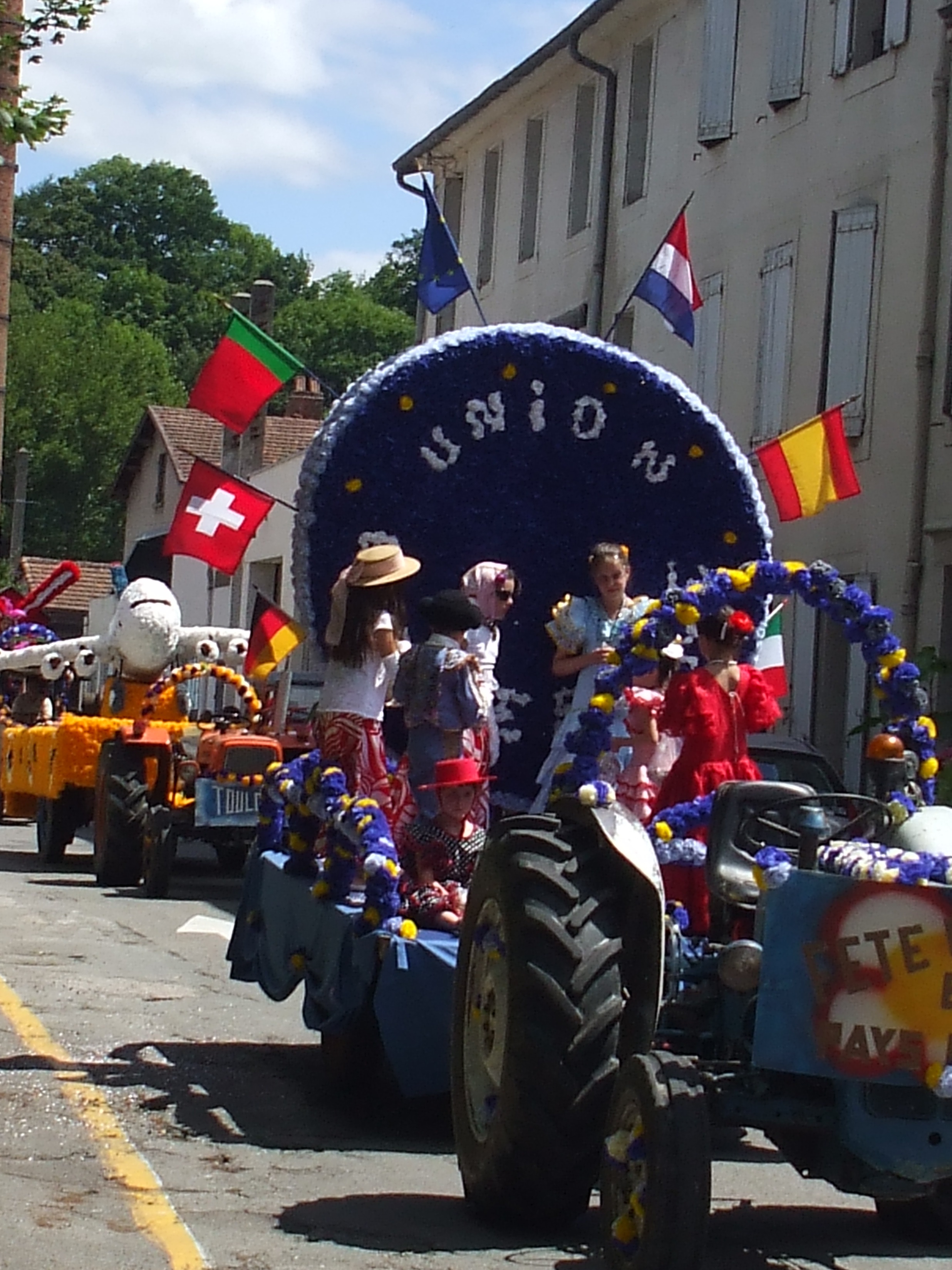
Fêtes Festivals and Fun: No weekend is complete without its fête, or festival, somewhere nearby. The other weekend saw the Fête de la Transhumance at le Sautel, with cows and sheep returning to the lowlands. There was a food market, a vide grenier (see below), films, dancing, a barbary organ, a big communal meal on Sunday. Le Sautel is a hamlet rather than a village, but it hasn’t stopped it running a right good show. Recently, there have been la Fête de la Noisette at Lavelanet, la Fête de la Figue at Mas d’Azil…. and in among, there are small local fêtes in nearby villages. No need to get bored at weekends, ever.
Gallic shrugs and gestures. I’ve posted about this before, and do you know, I don’t think my accent’s getting any better. I’m rubbish (shakes left hand vigorously with floppy movement from wrist)
History: I love it that so many people, especially older people, seem to know so much about the history of the region. They’re proud to tell you stories of times past, farming traditions and customs.
Ingenuity: The sort of make-do-and-mend that is such a feature of English allotment life is even more commonplace here. Our garden shed is made of several old doors, a redundant polystyrene fish box, random bits of corrugated iron and plastic screwed together, ancient bits of wire netting and bits of string. To our knowledge it’s been standing 20 years or more, and it’s not about to fall down.
Junk: Freecycle may not exist here – yet – but one person’s junk is another person’s lucky find. We take our household rubbish to central collection points – no dustbin collections here. On Sunday evenings, lots of people (including us, naturally) will be hovering to walk off with and make use of discarded pans, empty packaging, toys, plant pots….
Kilometres and Kilometres of space….. North Yorkshire, which always seems spacious by English standards, has a population density of 74 people per square km. The Ariège has 28. So there’s plenty of room
Lizards: Our garden companions on any sunny day
Lunar calendar: Planting by the phases of the moon is completely mainstream here. Gardening magazines carry free lunar calendars early every spring, and anybody you talk to will give you unsolicited advice on which day the moon dictates you get those spuds into the ground
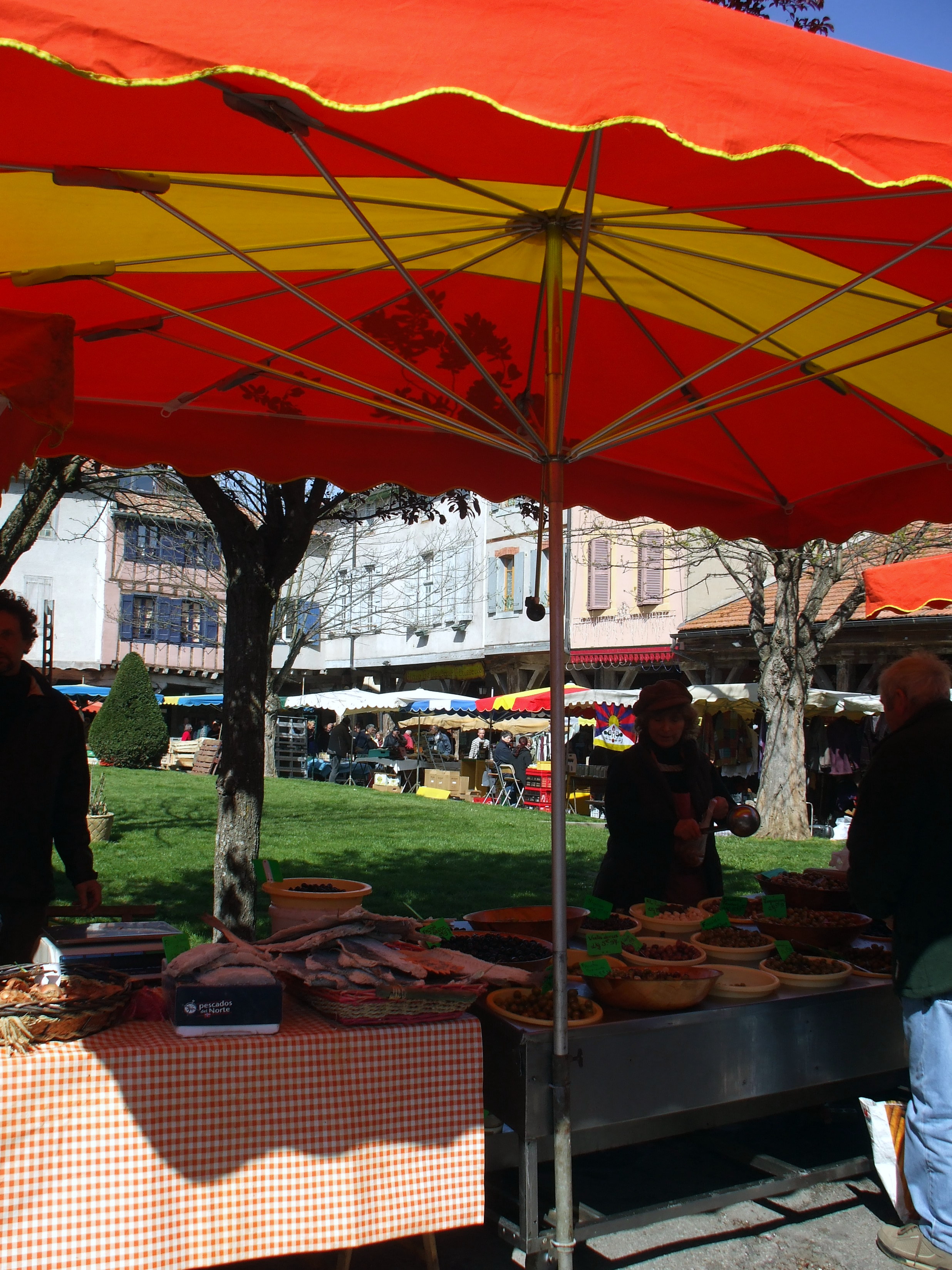
Monday market, Mirepoix
Markets: The best and happiest way to shop for fresh seasonal food. Don’t be in a hurry though.
Music: So important here. Concerts of every kind, cheap or free, in public buildings, market halls and squares, and churches everywhere. Choirs (introduced to a large extent by the English apparently) in most communes – I belong to two. Bands and singers at fêtes. Even small towns like ours have their own music centres. And lots of bars are home to groups of local musicians too.
Non! Protest comes naturally to the French. We’ve even been on a ‘manif’ ourselves, protesting at teacher cuts. But you won’t travel too far in France before you see signs painted, very large, across the road. ‘Non à l’ours’ (bears are being reintroduced to the Pyrénées, to the disgust of the farmers). ‘Non à la déchetterie!’ (tip), ‘Non aux aeoliennes !’ (wind farms)
Occitan: The everyday language of south western France until well into the 20th century, the Lenga d’òc is little spoken now, thanks to the systematic imposition of the French language in the early years of the twentieth century. Nevertheless, we do hear the elderly speaking it from time to time. It’s once again taught as an option in schools, and in adult education classes. I love passing through the many places that celebrate their Occitan heritage by having town and street names expressed in Occitan as well as French – Autariba rather than Auterive for example.
Patrimoine in the Pays d’Olmes et Pyrénées: ‘Patrimoine’ translates I suppose as ‘heritage’, but it’s not quite as chintzy and twee as that word suggests. Everyone here is proud of their history, and there’s so much going on to celebrate it – talks, walks, conferences, often with a meal thrown in. Just join the party!
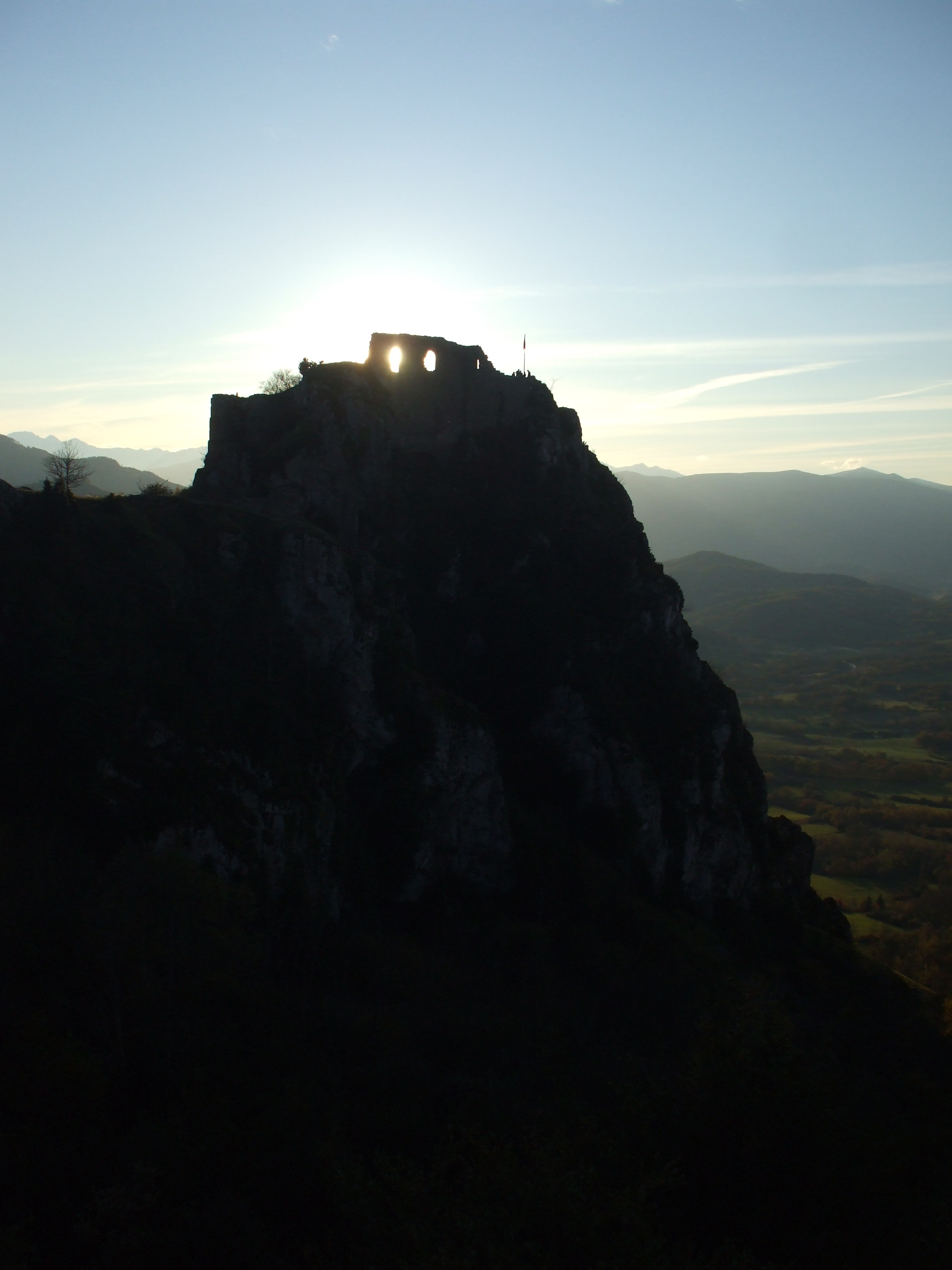
Sunset over Roquefixade
Queuing. Don’t let anyone tell you that only the English queue. It’s part of life in neighbourhood shops and markets here. But it’s not a problem. It’s an opportunity to chat with friends and strangers, exchanging local gossip, recipes, scandals. If it’s our cheese man in Lavelanet market, he’ll join in too, and you’ll never get away
Restaurants: I’m not thinking of the elegant once-in-a-blue-moon meal out. I’m thinking of the ‘formule’ at midday, when to a large extent you get what you’re given, in copious and well cooked quantities. Take today, when we went to a fairly down-at-heel looking brasserie on a busy street corner at the wrong end of town. Great salad, followed by tender tasty magret de canard and wonderfully creamy dauphinoise potatoes, a home made concoction of fromage blanc and crème chantilly, coffee, wine, all for 12 euros. We shan’t be eating again today….
Shopping-centre-free-zone. Bliss. Also, though this has recently been partially undermined, almost no Sunday shopping. AND shops usually close for between 2 and 4 hours at midday
Temperatures: Proper seasons here. Summers are hot, winters cold. Autumn, warm, is a time of glorious colour and food for free. Spring, warm, is a treat for its flowers
Underwear. If you want to be disabused of the notion that the French are chic, that haute couture rules, go to any market stall selling women’s undies. Turquoise knickers, orange bras, lime green or luridly lavender matching sets….. And while you’re there, check out those lovely pinafore dresses so beloved of French women of a certain age. Wonder when I’ll be old enough to wear one?
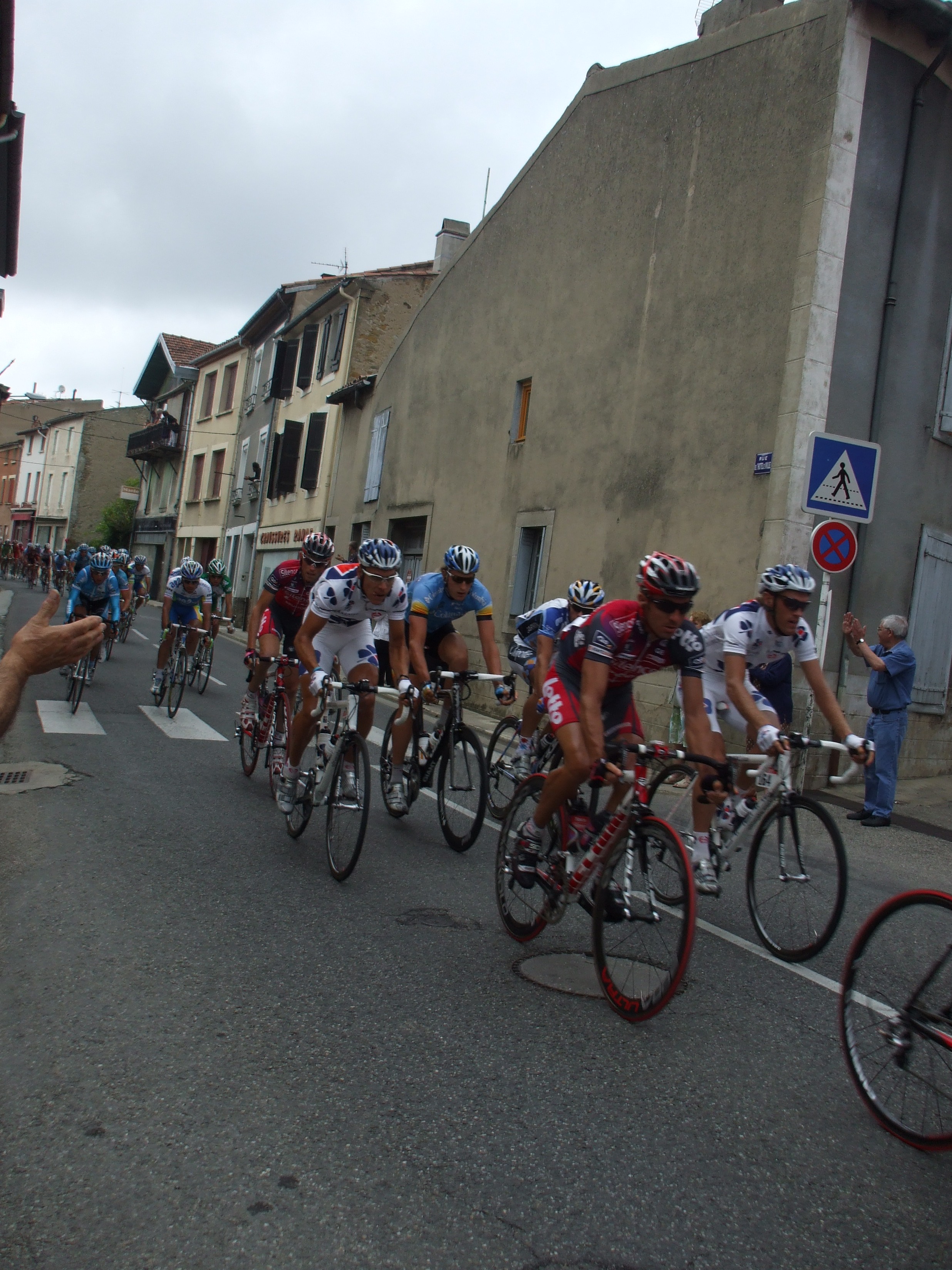
The Tour de France whips down our street in 2008
Vélo . Cycling’s big here. Any cyclist, old or young, is kitted out in skin tight lycra, and may well own a bike costing several thousand euros. There’s a cycling club here that meets on Wednesdays and Saturdays. Its runs are routinely 120 km. or more (and it’s very hilly). The wimps manage some 80 km., but only ‘les ancêtres’ can get away with a mere 40 km or so
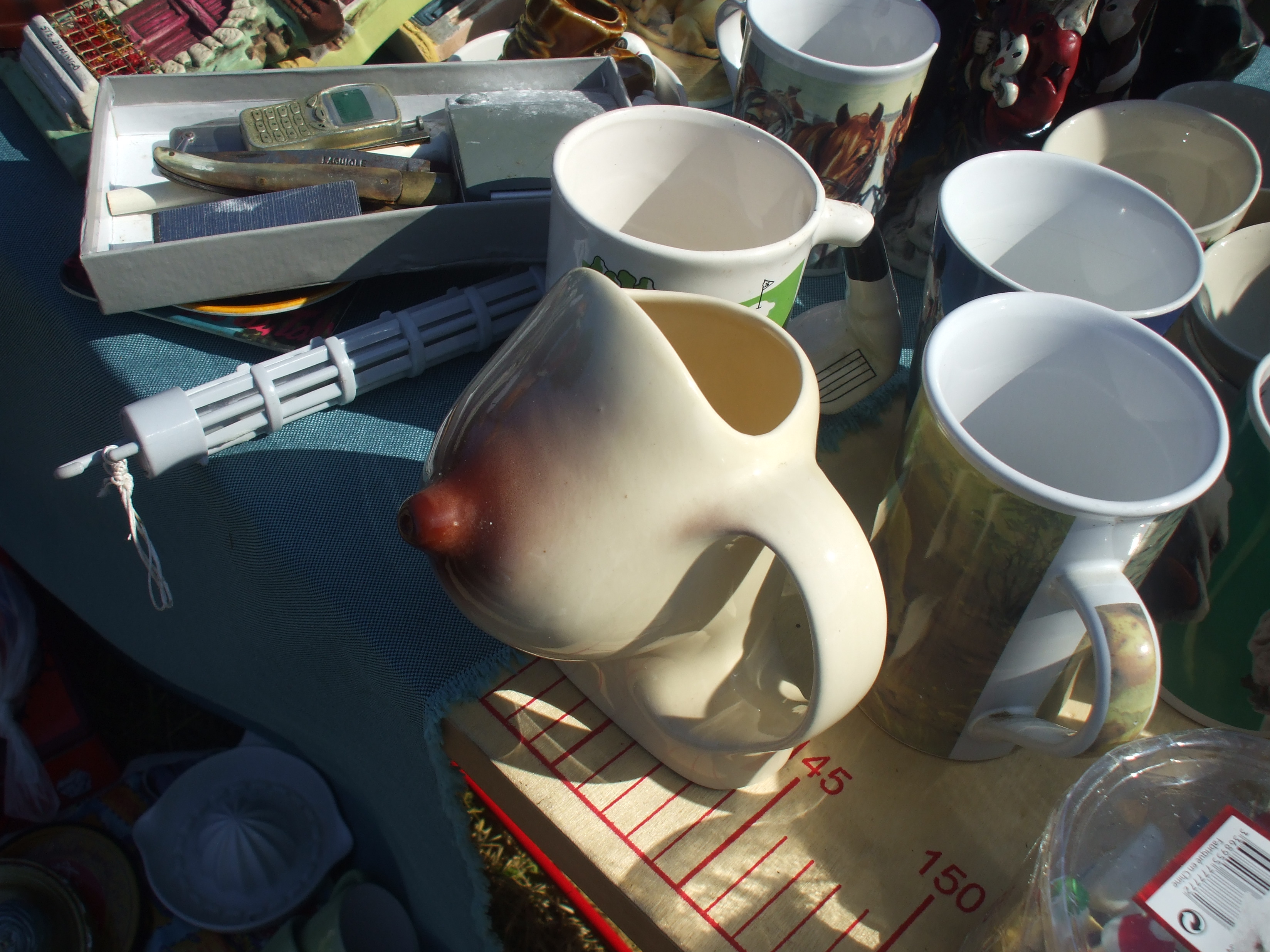
A lucky find at a vide grenier?
Vide Greniers; People here empty their attics instead of filling their car boots. Any Sunday in spring, summer or autumn some commune or another nearby will have a Vide Grenier organized. One of the larger streets, and probably a few more besides, will have been taken over by the sellers, who display their goods from early morning till supper time,. It’s the same mixture as an English car boot sale, with the addition of all kinds of rusting tools and junk that really HAS come out of the attic. Nobody will buy it. It’ll just appear at the next sale
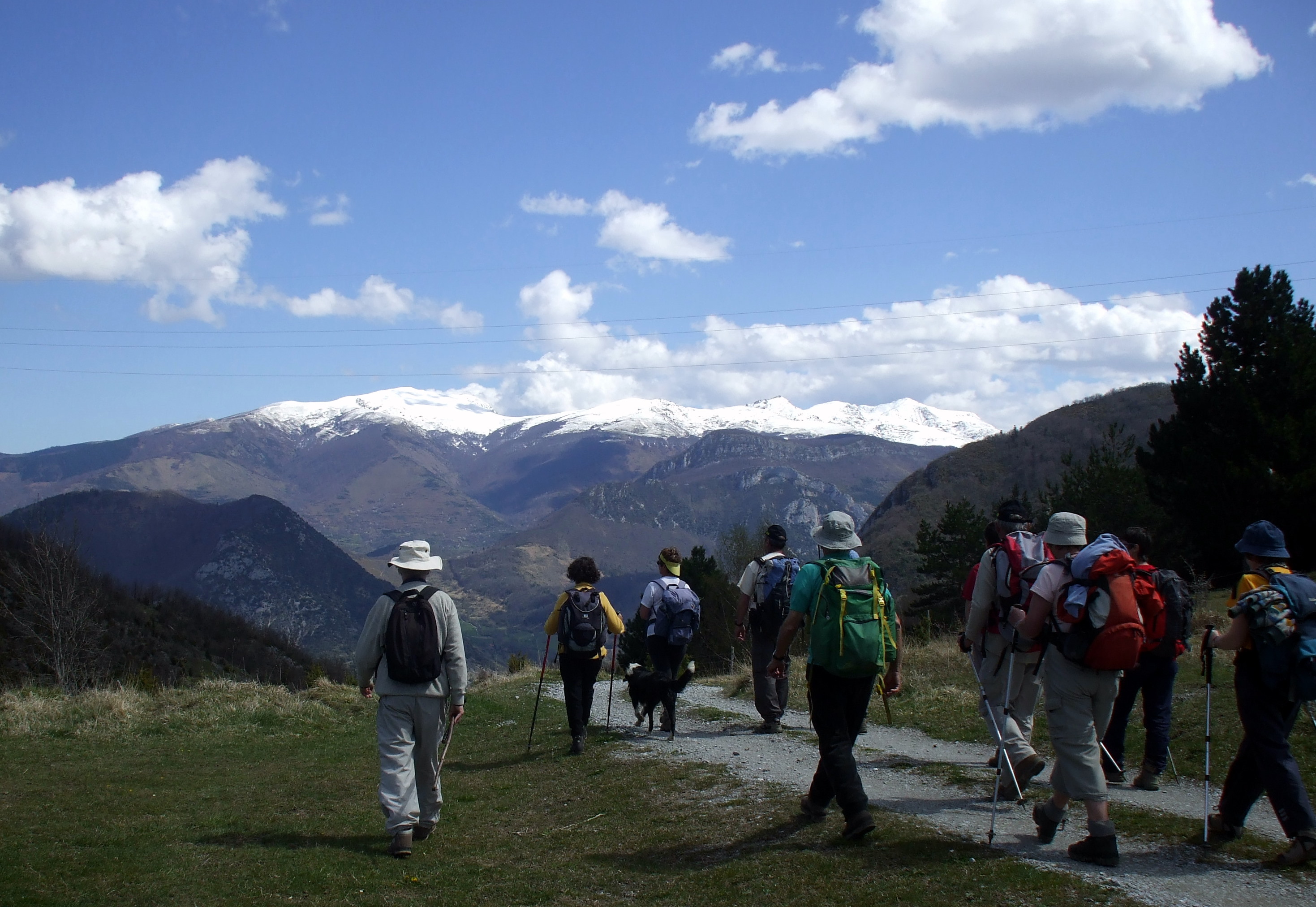
A walk with our group, near Tarascon
Walking: so many walks, so much variety. We love learning about new places to explore from books, from maps, from talking to friends, from walking groups. We’ll never run out of fresh walks to try, ever.
Wood-burning stoves: So cosy, we really looked forward to November chill. As for foraging for wood, see ‘en cas où ’, above
Xmas. In early September, a friend over from the UK said that Christmas had already started in the shops. We’re happy to report that nothing at all will happen here until the first week of December at the earliest. Wonderful.
You: Here, there’s the whole tricky business of ‘tu’ or ‘vous’, and it’s a minefield. Children and your friends are of course ‘tu’. The shopkeeper, the bank manager and those adults you really don’t know, are obviously ‘vous’. But there’s a whole grey area in between. Fellow randonneurs and choir members generally settle for ‘tu’ from Day 1, on the grounds we’re all in this together. But not necessarily. Last year at Choir, I sat between 2 women, both more or less my age, both chatty and friendly. To one I was routinely ‘tu’, to the other. ‘vous’. And I was supposed to pick the bones out of that??
Zero Neuf: 09, the Ariège, our department. We love the space, the huge variety of scenery. There’s gently rolling countryside that wouldn’t be out of place in Shropshire with its orchards and winding lanes, oak and beech forests, gentle foothills with grey Gascon cattle, and stunning, awe-inspiring mountains with craggy outcrops and peaks. And all within easy reach of our house.
A few minutes from our house...and this is the view




 From Pyrenees to Pennines


You must be logged in to post a comment.