‘Whether the weather be cold, or whether the weather be hot,
We’ll weather the weather, whatever the weather, whether we like it or not.’
Indeed. Not cold. Not hot. Just wet, very wet indeed. Just look at those floods in England, Brittany and even the Var. We really shouldn’t complain when the worst we’ve had here is a soaking and muddy boots. Especially when, as on Tuesday, the downpours suddenly stop, the sun comes out and dries up all the rain, and we can get out and enjoy the views.
Christine took us out on a walk she enjoys, just up the road from her house. It’s great for these soggy times, because it involves walking on roads so narrow they can barely be dignified as ‘single-track’ – but they are tarmacadam, and therefore mud free – and on farmyard tracks used so often that they too are in decent enough condition. The sky was very blue: spring was in the air.
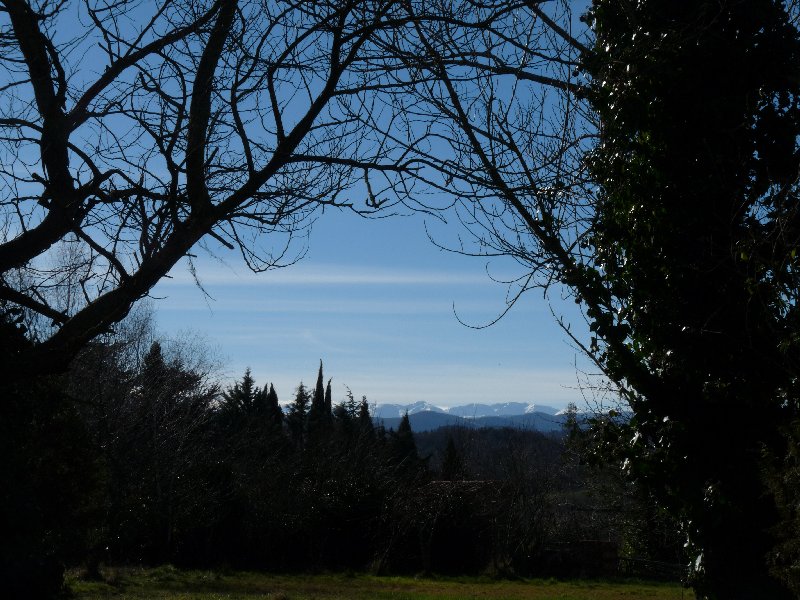
As we started climbing, the mountains came into view
We passed Troye d’Ariège and the sheep farm we’d once visited, and then our path rose to allow us views of the Pyrenees before returning us once more to the valley floor, to la Bastide de Bousignac, and then back to her village, Saint Quentin.
Shadows lengthen as we near home.
The pollarded avenue on the road into la Bastide de Bousignac.
Reception committee from the birds as we arrive back in time for tea.
She’d made a cake. I’d made a cake. We put each to the test. Hers was yoghurt and bilberry. Mine was a pear, almond and chocolate loaf, recently posted by the deliciously greedy Teen Baker. Which was the better one? Malcolm and Max diplomatically cast a vote for each, and they weren’t wrong. We all tucked in, feeling we deserved a reward after an hour or two eating up the kilometres in the warming gentle sun.
Yesterday, I changed my mind. But nobody led me into a darkened room…..
I had my reasons after all. I was unlucky last year. I probably will never have the chance to do raquettes ever again. My Thursday walking friends wouldn’t set the bar too high. Everyone raves about the Plateau de Beille as a winter sports playground ….. These all turned out to be excuses rather than reasons.
A very mild winter means you have to climb pretty high this year to be sure of snow. The Plateau de Beille is high. 1800 metres and rising. The snow appeared at the roadside only during the last kilometre or so of a very dizzy 10 mile climb upwards. And when we arrived, the car park was packed, and every school child in the Ariège seemed to be there, muffled in ski-suits and excitedly fastening on skis. Which was fun to watch, but we were relieved that once we too had got booted and spurred, in our case with raquettes, and yomped just half a kilometre or so, we were in the wild and wide empty spaces .
Children arriving: all togged up
Getting organised.
Children get away from a day at their desks.
And that’s where it all could have gone wrong for me. We came to a signpost: ‘Pas de l’Ours. 11km’. ‘Eleven k? With raquettes? I don’t think so.’ I was not alone in protesting. Anne-Marie and I wimped out and chose a 3 km pathway, and had a fine time chatting as we soldiered up an admittedly steep slope, safe in the knowledge that this challenge would quite soon be over. Resting at a cabane at the top, we were surprised to be joined by our friends. It seemed their journey had taken a different route to this point, and whereas we had 2 km to complete, they still had 10. Three of them had a bit of a think. ‘We’re coming with you’. And that’s what they did. We waved the other six goodbye and arranged to meet in three or four hours: slow stuff, snow-shoeing.
The B team set off.
Tired already.
Nearly at the end of the journey.
We had a fine time. We got back to base in time for lunch and watched the children on the nursery slopes and the huskies drawing sleds as we ate our picnic in the bright cold sunshine.
Busy huskies
Then we discarded our raquettes and rucksacks, dumping them in the car, in favour of a snowy walk to see the views. It became windy. It became cold. It threatened to rain. But we weren’t on an 11km. route march, that was the main thing.
Can you see 3 different sets of animal tracks?
Perfect prints. But of what?
Bigger beasts.
When our friends re-joined us, they announced that they hadn’t been either. They’d found a short-cut and taken it. Cheats. But it just shows. This raquettes lark isn’t all it’s cracked up to be. Little and not-very-often seems to be the way forward. But next time, I’ll stay at home.
The end of the day: cold, windy, but still good to look at.
Click on any of the circular images to see the whole photo, and a miniature slide show.
About a year ago, someone suggested ‘Les Collines du Vent’ – the Windy Hills – for one of the Sunday walks with our Laroque walking group. The appointed day came, and it rained – a lot. We re-scheduled. The day came again, and it rained – a lot. We re-scheduled. The day came yet again, and it was foggy, a real pea-souper: the kind of fog that almost any Frenchman confidently assures us blankets London every day of the year (any Frenchman who’s read Charles Dickens that is).
And so it went on for five or six attempts. Today though, it didn’t rain. Nor was it foggy. In fact it was sunny until we left the Ariège and approached our destination in the hilly countryside in the Aude outside Castelnaudary. Then it became rather grey, though not menacing enough to stop us in our tracks. What DID nearly stop us in our tracks was the wind. The countryside here is rolling and open. The idea of any walk in the area is to get up there and stride from hilltop to hilltop. But that wind! It gusted and blew. It snatched us off-balance. It whistled through our trousers and tried to grab our hats. And it was only doing what it apparently does almost every day of the year. No wonder our path led us past a windmill during the afternoon.
The weather brightened, and we had wonderful all-round panoramas. Sadly we couldn’t quite see the Pyrenees: distant mists saw them off. And in the early afternoon, we had evidence that we really were the tough guys we thought we were, battling through that wind. We were overtaken by a battalion of the French Foreign Legion in training. Though admittedly they were all additionally burdened by enormous rucksacks that must have weighed 40 kilos. And guns. If you’ve read ‘Beau Geste’ you will remember that this band of soldiers is recruited from foreign nationals who wish to serve in the French army (don’t ask….). Coming from different countries, different cultures, the men are put through very challenging training designed to build their esprit de corps. We noted that Marcel, our leader for the day was putting us through a similar programme. Though at the end, he offered us a large slice of the Galette des Rois which he himself had made. We’d already had our usual lunch time bonanza of wine-and-cake-sharing. But nobody refused this last additional treat. We felt we’d earned it.
Funny place, Andorra. It’s where we went to satisfy our desire for a ‘white Christmas’ and it’s one of the smallest nations in Europe – only 468 sq.km, and tightly wedged between France and Spain. It’s a mountainous place – every bit of it is between nearly 3000′ and nearly 10,000′ high, and only one main road linking France and Spain drives though the country. All other roads off peter out as they reach the small communities they serve.
It’s a principality, jointly ‘ruled’ by two ‘princes’. One is the Spanish Bishop of Urgell, the other the French President, currently François Hollande, and yet it forms no part of the European Union. It used to be extremely underpopulated: it only had some 6,000 inhabitants right up until the 1950’s. Now it has more than 85,000. But these new inhabitants aren’t indigenous Andorran baby-boomers. They’re incomers from principally Spain, Portugal and France, but also Britain, Italy, and more recently Russia. They come because Andorra’s a tax haven, because there is no income tax and goods are cheap, or because they love to ski: Andorra has some of the most reliable ski-fields in Europe.
And this is what makes Andorra a funny sort of place. Much – most – of the building is relatively new. It has very fine Romanesque churches, but little else that counts as historic buildings.
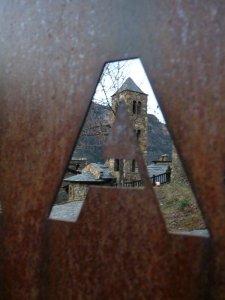
The Romanesque church at Aubinyà glimpsed through a village gate
So most settlements, even quite small ones, consist mainly of blocks of flats clustered together, often clinging apparently precariously to the edges of hillsides high above the valley floor. And everyone knows that Andorra is Shopping Central. People come in their thousands from France and Spain to stock up on – well, most things – and every weekend sees long lines of traffic from both countries as French and Spanish citizens flood into the supermarkets to load up with cigarettes – particularly cigarettes – alcohol, electrical goods, groceries, clothing…. before facing their own country’s customs who take a dim view of those exceeding their allowances.
Snowy Andorra
Near the French border.
More snow
Nevertheless, away from the towns, Andorra is beautiful. The mountains climb almost vertically skywards and this means that every road that leaves the valley bottom will zig-zag upwards with one hairpin bend after another. From our apartment in the tiny settlement of Aubinyà we could see a supermarket almost below us. We even thought of walking down to it (well, I did). When we came to try to shop there, we discovered we had to zig-zag to the valley, zig-zag back (left) to the nearest town, Sant Julia de Lorià, turn hard right and drive a kilometre or two to get there. Most journeys are like that. But it means that wherever you are, you will have fabulous views of craggy mountain sides cloaked in forest, or for much of the year, dusted or deeply covered with shimmering snow. Much as we loved the view from the window of our apartment, though, we wondered if eventually, we wouldn’t feel somewhat hemmed in, having no long distance views.
The view from our window
Another view.
And another. That’s a vineyard you can see below.
We had a lovely Christmas break, Malcolm, Emily and I. Many of our memories consist of eating out: it’s easy to find good Catalan cuisine , or anything else you fancy really at a very fair price. Skiing’s not our thing, but we enjoyed the brisk, sharp cold and the glaring whiteness of the snow set against the sombre green of the coniferous forest. We’d go again, but have no desire to join the many thousands of ex-pats from many nations who form much of Andorra’s day-to-day population. We’ll keep it as it was for us this time: a scenic and relaxing place for a break from routine.
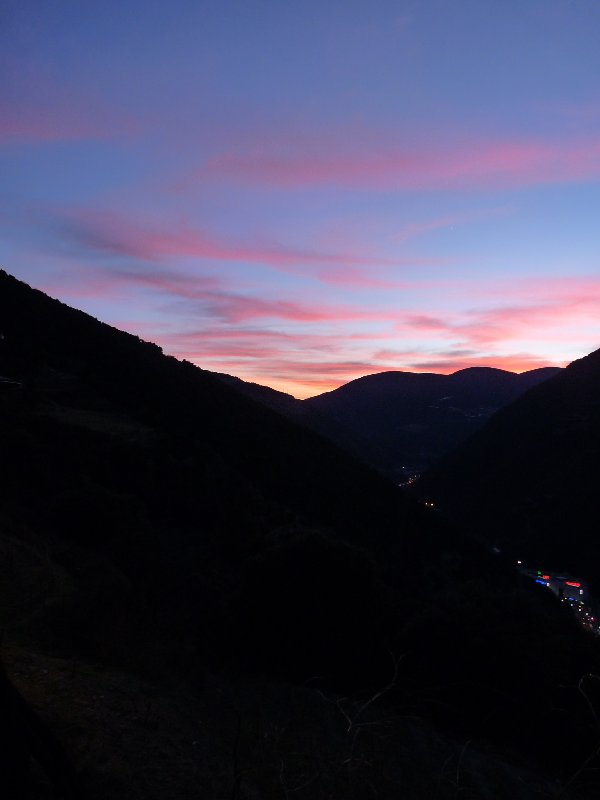
Sunset seen from our window. And yes, far below you can just see that so-near-yet-so-far supermarket.
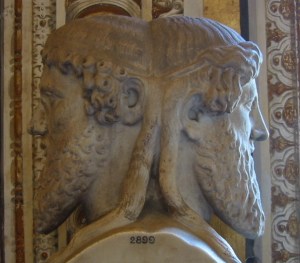
We’ve all heard of Janus, the Roman god of beginnings, endings and transitions. He’s the one with two faces: the grizzled lived-in one looks back towards the past, while on the other side of his head is the younger version, looking with optimism and hope to the future. He puts himself about at this time of year, and indeed gives his name to January.
He’s been putting more energy at the moment however, into clambering inside our heads, mine and Malcolm’s. He’s got us at our own game, as we look both forwards and backwards at every moment
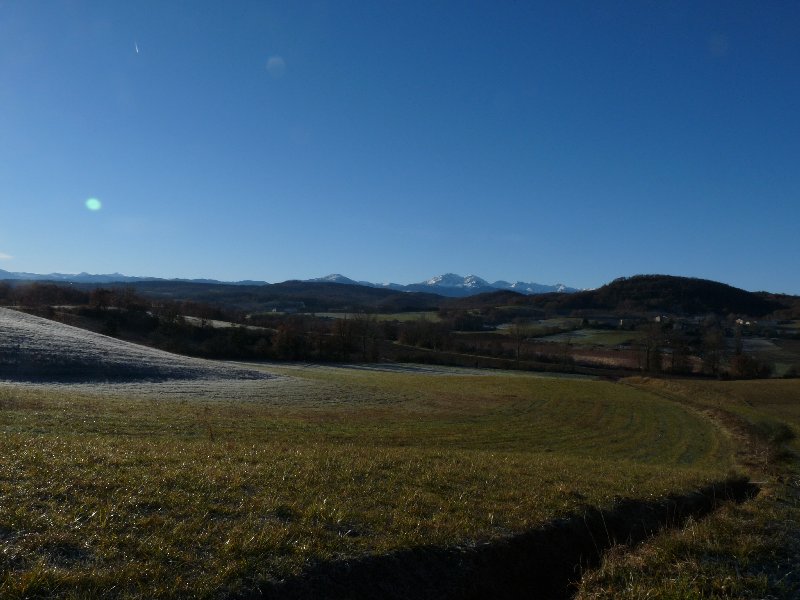
The grizzled half of my head is fully occupied in reminiscence. It doesn’t even try to understand why anyone would want to look at a future in England. It thinks about our walks, particularly our Sunday walks with our Laroque friends. What scenery! However characterful, green and lovely English scenery might be, nowhere is going to provide the snowy summits of the Pyrenees as a backdrop to every walk. And there’s something about those midday picnics too which I’m not expecting to see repeated at an English walker’s lunch spot. The aperitif that gets handed round, the bottle or two of wine, two or three home-made cakes, coffee and digestif….. And last Sunday, a mid-December Sunday, it was so warm that one of our number stripped off his tee-shirt to get the sun on his back.
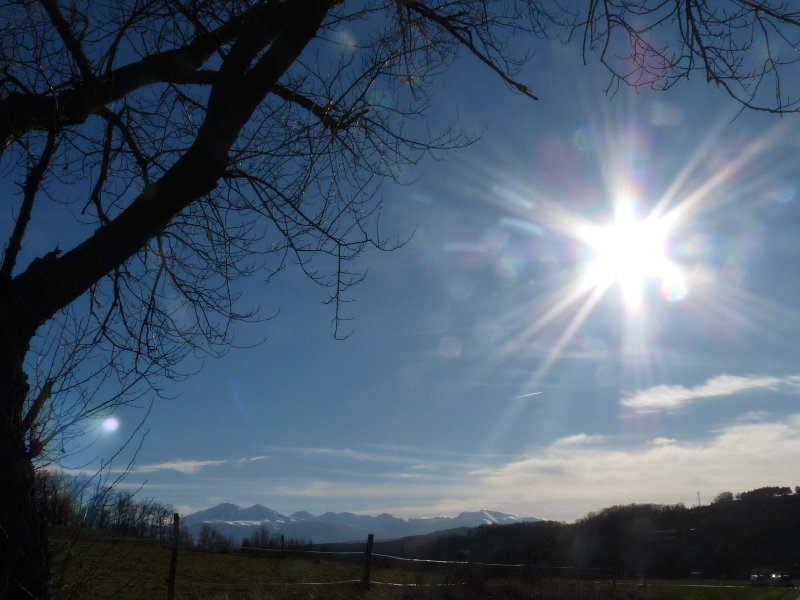
The Pyrenees: always there. The constant backdrop round here
Apéro anybody?
Towards the end of Sunday’s picnic
View from the picnic spot, near St. Julien de Gras Capou.
The grizzled half of my head realises that tomorrow’s concert with the choir will be my last one ever and makes sure that my eyes mist over and my throat constricts as I try to follow the music. It points out that those summer evenings spent in our back yard over a leisurely meal and glass of wine are now things of the past. Those moments with friends, those trips to explore, discover and re-discover the area we’ve called home these last few years area are all but over. Grizzled Janus is holding all the cards when he’s in the mood. He knows very well that we’re finding it tough to say ‘Goodbye’ to all this.
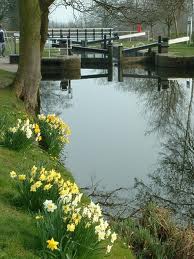
Ripon Canal in spring (Nigel Homer, geograph.org.uk via Wikimedia Commons)
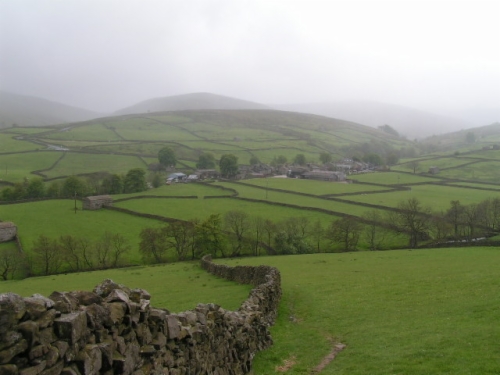
But Janus has two equally potent faces. The young version is optimistic and cheerful. He points out that we’ve never fancied growing old, much less infirm in France, and this is the moment to get involved in life in Ripon, a community where we already feel comfortable, but where there is so much more still to discover. Much of what we most appreciate in France is available to us there too: wonderful walking scenery and an active community that welcomes people who want to join in. Theatre and concerts will be within easy reach and we’ll be able to mix small-town life with easy access to bigger towns too. And do you know what? I’m going to appreciate those English summers, if not the winters so much. I can’t be doing with those days when the temperature is in the high 30s: and I used to be a sun-worshipper. It’ll be good to return to speaking English and to understand most cultural references : though I expect we’re dreadfully out of touch.
Thwaite in the Yorkshire Dales (David Dunford, geograph.org.uk. via Wikimedia Commons)
Dear two-faced Janus, you’re a terribly mixed up sort of chap. We expect to be terribly mixed up too. We made a decision, and we believe it’s the right one. But we don’t think we’re going to get through the next few months without periods of excitement, periods of mourning, periods of confusion. Often all on the same day. It’s probably all going to be a bit exhausting….. and it might end in tears.
An early visitor to Mont d’Olmes has already left.
Our Thursday walking friends opted for a day with raquettes today: snowshoes. Earlier this year, I’d vowed never to indulge in this particular form of masochism again. So we didn’t.
But the idea of walking near crisp white snow, with views from the clear air of a mountain top across to wooded slopes cloaked in snow, and as-yet uncloaked valley bottoms, appealed. We’d pop up to Mont d’Olmes. That would do the trick. It’s the nearest place round here for winter sports, so maybe we could watch some of the action, and sit down for a bit clutching a strong shot of coffee or a mug of hot chocolate.
That was the theory. We always forget how far away our friendly neighbourhood mountain really is. Once you turn off the main drag to follow the road that goes only to Mont d’Olmes, you still have 8 miles of climbing to do. Soon the sides of the road were boundaried by walls of snow, while the rocky mountain sides to which the road clings were home to packs of giant icicles and glassy pillars of ice, and still we drove on upwards.
And then we dumped the car. As discussed, we weren’t equipped with snow shoes, so we chose to finish our climb using the road. We passed the chalets hired out to holiday-makers, all clearly shut up, the stairways to their doors still buried deep in the snow. The only people we saw were tradesman in the area to do running repairs or make improvements for the hardly-started season.
And then there we were. Mont d’Olmes The Resort. Like most ski stations that aren’t really up and running, it was just a bit depressing. It’s focussed on a few shops and a hotel that look exactly like a suburban ’60’s shopping centre. And nothing was open: not even a single bar. A few snow buggies were zipping around, their drivers busy with routine cleaning and maintenance. The slopes themselves were scoured with the tracks left by weekend skiers. There even were a couple of skiers. But they had to manage without benefit of ski-lifts or any of the other infrastructure that would have made their day out less labour intensive.
Great views though. White sparkling mountain sides above, more sparsely covered rocky crags below, and a shockingly blue sky. And we had the place almost to ourselves. It’ll be a different story at the weekend. The car parks will be full, the bars, shops and restaurants busy, and above all the slopes will be crowded with hundreds of locals enjoying their very own neighbourhood winter playground. Unlike us, they’ll be joining traffic jams on the way both up and down the mountains. We got what we needed. A decent walk in the sharp cold air, some deep-and-crisp-and-uneven snow, snowy peaks outlined against a clear sky, and a bit of peace.
Well, not much anyway. You can’t go walking in that patch of the Aude near la Digne d’Amont and not enjoy looking at those vineyards marching across to the snow-covered Pyrenees one way, and the equally distant (and almost equally snow-covered) Montagne Noir the other.
This slideshow requires JavaScript.
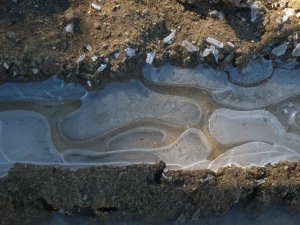
Today though, let’s not have a travelogue. Let’s look at one or two of the other things that caught our eye on today’s walk, sunny but oh-so-cold. We began walking in temperatures of not much more than minus 5 degrees. There was the ice itself, underfoot. The cold froze the mud and made it good and hard to walk on.
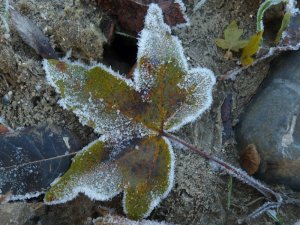
There were the frost-framed leaves mulching the ground.
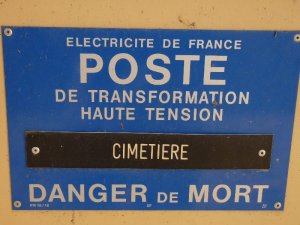
There was a giggle-worthy notice on an electricity sub-station.
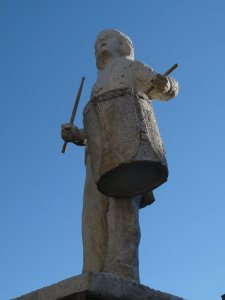
And in the tiny village of Toureilles (population 143), there was a statue to its most famous son. Pierre Bayle (1783-1794) was the youngest soldier ever to die for France. A drummer boy in the Republican Army, he was engaged in the campaign to prevent the Spanish invade Roussillon, and died in battle at Figueres, aged 11.
As we left Toureilles, along a single track road , we came upon a rather fine, wide, but very short stretch of road, with a fine stretch of car park along its length. It led only to a dusty track.If we didn’t know why it was there, neither did the villagers. Here’s what they thought of it.
‘Before: a pretty path. Now: urbanisation of our countryside’
‘Frequent landings’ – on the car park or runway presumably
Back in Digne d’Amont, the municipal notice board had news of an evening’s Bingo (Loto) on – shucks, we’ve missed it – 16th November. Prizes? Two loads of wood for burning, a whole pig (dead, of course) and a hamper of beef as well as other smaller prizes.
And at the end, Gilbert produced a cake for us to eat, formerly much enjoyed locally and which he’d managed to find out about: amazérat, a pastry with a solid bite to it and strongly flavoured with aniseed.
A 400 year old oak, with a girth of over 5 metres.
Snow, with autumn leaves still on the trees
Snowy field, green field
The rainy season still hasn’t stopped. It’s rained every day for over a fortnight now, except for one. That was Friday, the day it snowed. I had to come back from nearby Villeneuve d’Olmes at nearly midnight that day, driving at a stately 12 miles an hour along newly – and deeply – snow-covered roads. The last bit was easy enough though. I followed a snow plough.
So Sunday’s all-day walk was abandoned yet again. There was heavy rain again this morning. Nobody was leaving home except to collect the daily bread. We had a back-up plan, we members of the walking group, to begin walking at 1 o’clock if the morning’s weather was poor. By 11.45, with the skies still black and full of rain we were all ‘phoning each other to say ‘No thanks. Count me out’.
Except that at quarter to one, it stopped raining. I decided after all to make a break for it (Malcolm stayed in front of the fire). Maryse arrived at the usual rendezvous too, then Annick and Michel turned up. Then Jean-Charles, Danielle and Marcel. We’d all got cabin fever and we’d walk come what may. We had three rain-free hours. No country paths for us today: all sodden. Strictly road-walking. Snowy fields, snowy views across to the Plantaurel, a small lake, forest paths. We had our ‘pause café’ at Fajou, with its 400 year old oak, and an apple tree just waiting for us to collect its windfalls. Still no rain. Still an hour’s walk to do though, so we didn’t stop for long, and continued onwards, enjoying the familiar landscape in its new white winter clothing
Back home, refreshed after a shower and a cup of tea, I leaned over to draw the curtains. Of course I glanced out of the window. You’ve guessed. It was raining again
Eight days ago: lunch outside in thin tee shirts: a garden umbrella protected us from the bright hot sun.
Seven, six, five, four, three, two, days ago. Rain. Rain. More rain. Heavy, chilly gusts choking the streets and drains with fallen leaves. More rain.
One day ago. Snow. The first snow – and in advance of the first winter frost too. Not a lot, but enough to rest heavily on fading garden plants, weighing down leaves and bowing stems.
This morning, we knew we’d need to get out early to beat the rain, which was threatening yet again. I didn’t take my camera because I thought the mountains would be shrouded in foggy mist. They weren’t. The lower peaks, and even the much lower hills of the Plantaurel peeked through a thin layer of snow that dusted trees and painted the rocky and grassy slopes a severe white. I dashed back for my camera. Five minutes? Ten? Long enough for the misty clouds to drop down and dump themselves on the snowy hilltops like squashy berets, hiding them from view.
And then, straight away, the rain again. That’s what we’ve had all day, streaming along the gutters, making splashy garden puddles, dripping incessantly from the trees and down our necks as we walk underneath. I continued my early morning walk regardless though, and caught what may be the last few days of Autumn colour, though little enough of the snow, which is there somewhere, under those bonnets of mist and cloud.
Snow on the Plantaurel behind Laroque.
A wet cow: a local cow, a Gascon. They’re used to it.
Mist over the Plantaurel
A neapolitan slice of snow, evergreens, autumnal trees and grass
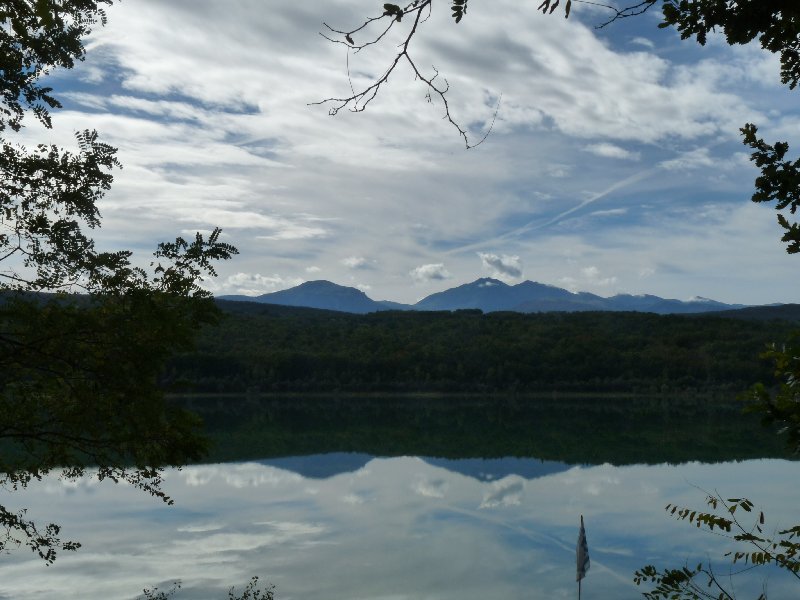
Our new friend Jenny-from-Bilbao came for a flying visit late last week, so we did a quick Cook’s Tour of some of our favourite spots. Roquefixade, of course, Montségur: and then on a bright Autumnal Saturday morning, we finished off by a quick look at our local lake, Montbel. It’s a man-made reservoir, actually, but it looks as though it’s been there forever, and fish, herons and humans all appreciate its cool expanse of water as a change from all those hills, mountains, rivers and streams.
Those herons
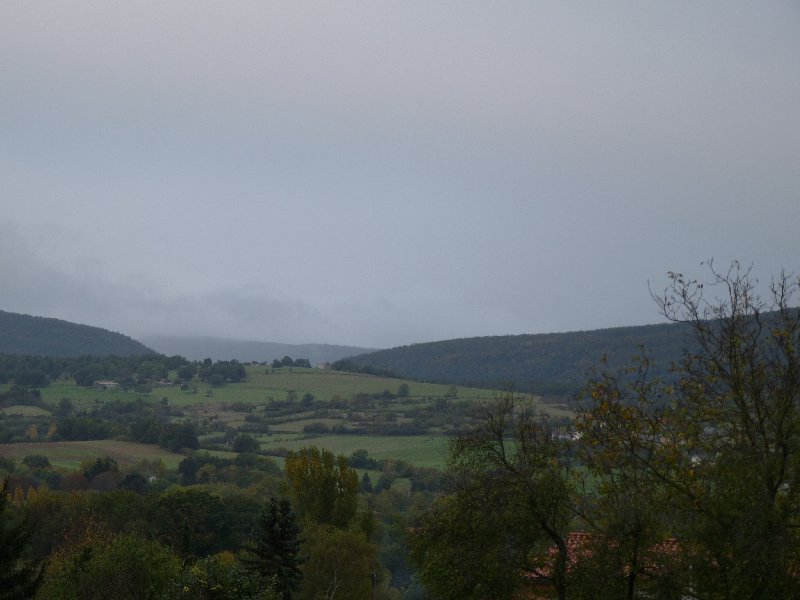
What a difference a day makes. Sunday sulked. It rained in the night, it rained in the morning, grudgingly cleared up, then spent the rest of the day teasing us with odd showers which never quite decided whether to go for a full-blown drenching, or merely hang around as damp atmosphere, cloaking the landscape with fog.
View down over Laroque
How did that get there?
Misty view over the Douctouyre valley
Copse along the ridge
Out of the woods once more
… but not for long.
This young lady welcomed us as we passed her farm
Autumn colours
And some more
Autumn leaves
Our misty wooded path
The view’s largely obscured now
Last lap. Civilisation approaches….
Almost home. This farm’s for sale. Any takers?
Tamed trees. The edge of Laroque
So our planned walk from Croquié, with its promise of stunning views as our reward for a stiff climb was abandoned. Instead we met at 1.00, we hardy types, and Jean-Charles proposed what I thought was little more than a walk round the block. ‘Just up to Tabre, along the ridge and back’ he said. Well, Tabre is the next village along, Mirepoix direction, so that sounded easy enough. So off we went, along a bosky path, through Tabre, up a hilly climb to great views back to Laroque. A long and often muddy forest track took us past further views, over the Douctouyre valley, and circled us over and past the next village along from Tabre, Aigues-Vives. Down we climbed again, and took paths through fields back to Laroque. A fabulous walk, all 15 km or so of it, and almost every step of it previously unknown to us. And we pride ourselves on having got to know our patch pretty well. Thank goodness for local friends who carry on helping us to discover even more.














 From Pyrenees to Pennines
You must be logged in to post a comment.