French as she is spoke

Did you do French at school?  Probably, if you’re English.  You had all that stuff to learn about not usually pronouncing the final letter, that ‘choux’ (cabbages) is pronounced ‘shoe’.  Perhaps you battled to remember when to use accents, and whether they should be grave (`) or acute (´) or circumflex (ˆ)?  With any luck, you learnt some everyday phrases to use on everyday occasions.

And that was fine for the school trip to Paris and later, that nice holiday in Normandy.

Where you’ll come unstuck though, is down here, and across wide swathes of the southern parts of France.

You’ll be OK if you visit an attractive town some 25 miles from here, Limoux.  It’s pronounced just as you’d expect, to rhyme with ‘choux’.
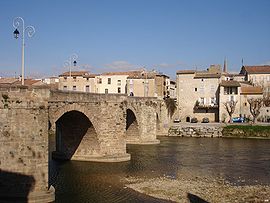
Limoux, Pont Neuf
Limoux, Pont Neuf

But last week, we went walking near a little village a few miles north, Hounoux.  It doesn’t rhyme with ‘choux’.  No, you must pronounce every letter – sort of ‘Hoonoox’.

A snowy day near Hounoux: Thanks Anny, for this photo

Driving there, we passed very near another village, Roumengoux.  It doesn’t rhyme with ‘choux’ and ‘Limoux’.  It doesn’t rhyme with ‘Hounoux’ either.  Instead, the locals call it ‘Roumengousse’.panneau-roumengoux.

Here, we spend our daily round with people who don’t talk standard French, as taught in all good GCSE textbooks.  They’ll go to the baker’s tomorrow (demeng) morning (matteng), to buy their bread (peng).  Then later they may work in their garden (jardeng).  In the evening, perhaps the Music Centre will put on a concert, with one of the local ensembles (angsambles) centre stage.  Très bien! (byeng).

There’s a sort of energy and vigour in the local speech patterns I find very attractive, as local people give full weight to every syllable in a word.  So rather than Laroque, it’s Laroqu-e.  I’m quite relieved it’s nothing more complicated than that, and that in any case, everyone round here is quite prepared to listen to standard French, or even Franglais.


‘Comment shoppez-vous?’

Stuck in a waiting room with a pile of magazines between me and my appointment time, my idea of hell is a choice between fashion mags and ones about cars.

Less so in France, at least as far as the fashion ones are concerned.  It’s not that I’m more interested in being stylish and chic here.  I simply have fun reading the articles and noting the ‘English’ words and phrases on almost every line.

Are you a sophisticated lady? Cool? Relax et sexyShow-off? Perhaps you aim for le twist sporty-glam, or like le mix et le match, le style ‘street’, or le fun et le trash.

Down at the shops are you looking for un look color block, le style boyish ou girly, arty-trendy, crazy doll, grungy girl?  If you’ve any sense, you’ll have made a shopping list, to make sure you come home with le jean,  le blazer, le trench, le legging, les shoes (with kitten-heel perhaps), and perhaps one or two it pièces.  Then you could really get to show off and expect le red carpet treatment.

When it comes to make-up, I hope you don’t like le make-up too much.  Light is so much more subtle.  If you’re a beauty addict perhaps you should be looking for un effet sixties, or un twist, using liner and shadowing your eyelids en smoky or flashy to achieve le total-look of your choice.  Then you’d look a real star.

It’s pretty exhausting really.  That’s why keeping up with fashion isn’t very high on my to do list.

Le twist sexy-glam as seen in ‘Le Figaro’

Tongue-tied in Catalonia

The waitress gazed at us in bafflement. All she wanted to do was to take our order.  We became more and more frustrated and slightly hysterical at our inability to explain that we’d only given our order (‘café solo e café con leche’ – we could cope with that) about a minute ago to her colleague.  Sadly, he wasn’t in view, so we couldn’t point him out.

We were in Catalonia visiting our daughter for the weekend, and we couldn’t wait for her to join us in the bar.  When she arrived, she smoothly took over, explained the tapas menu to us, and gave our order to el patron.  He complimented her on her Spanish, but then spoilt it by wondering if she were Belgian.

She’s already had an interesting few months as a language assistant in a Catalan primary school.  She’s more likely to hear Catalan, but Spanish is common too, and this is the language she’s keen to learn.  The family she’s currently living with speaks Catalan, Spanish, German and English – even occasionally French – round the dinner table, but she claims this as a positive and helpful experience, probably because they all correct each other.

We found it difficult and frustrating being in Spain with only the most rudimentary language tools.  Any efforts on our part to communicate in Spanish or Catalan were greeted with friendliness and enthusiasm by the locals.  We battled to be understood, they battled to understand, and laughter at each other’s efforts broke down lots of barriers.  Still, we can’t go on like this.  We want to make an effort to learn a little more of the language before we visit Emily next.

How do people who come to live in Spain (or France come to that) cope if they don’t try to master the language?  We know of people who’ve been here ten years or more and can still hardly communicate.  If we found it hard booking a ten-journey train pass or telling the waitress we didn’t need her just then, how much worse would it have been if we’d been trying to contact a plumber, say, or the local town council?

And most of our best times here are spent sharing experiences – whether it’s a walk, an hour at the gym, or simply having a coffee together – with our French friends and neighbours.  Unable at the moment to replicate those free and easy exchanges when we go to Spain makes us feel we’re missing out.  Must Try Harder.

The Pronunciation Unit

The Chorale at Laroque.  We’re limbering up for a Christmas concert, and for one of the numbers, I’ve been put in charge of Pronunciation Studies.

‘Amezzing gress, ’ow sweet zuh soond….’.  Every week, we practise sticking out tongues between our teeth in a thoroughly exaggerated way to get that dreaded ‘th’ sound out of our mouths, but it’s so hard for the French to remember, even harder to do….

I’m not mocking here: I’m all too well aware how difficult it is for us English to get certain sounds right as we mangle the French language in our turn.

How can it be that we’re all born with the same vocal equipment and ears, and yet only a few short years after we first learn to speak, seem unable either to hear or reproduce the sounds and inflections of any other language?  The ‘r’ sound is often especially problematical.

We have a young English friend here. She’s eight, and has been here since she was three.  To our ears, she’s utterly French as she chatters away to her friends, but apparently, if you listen carefully, she gives her origins away.  It’s lucky that most of us, wherever we come from, find that our own language spoken in a less-than-perfect accent can sound both charming, and on occasion, even sexy.

Bon viatge! Emily’s off to Barcelona….

When my generation graduated, back in the early 1970s, it never occurred to any of us that we wouldn’t get a half-way decent job in a field that interested us.  By 2010, it was a different story.  Emily’s first taste of work, post graduation, was as casual bar staff for a national pub chain.  Mind you, these posts now seem to be exclusively reserved for young graduates and the occasional favoured undergraduate.

Emily all checked in and ready to go at Leeds-Bradford airport

After that, it was a bank: that was pretty soul-destroying too.  Because all the time, what she really wanted to do was train as a teacher. And these days, you need lots of voluntary experience before they’ll even consider you.  How do you get that alongside a day-job?

Then she had a lucky break.  She spotted an advert from CAPS, an organisation supplying English Language Assistants to schools in Barcelona.  She applied.  She was accepted.  And today – she went.  She’s flying over, and she and the other successful candidates will spend a day (and a night) together, being briefed, before going tomorrow to meet the families they’ll be staying with.  School on Monday.

She’s looking forward to meeting the people she’s staying with.  She’ll be trading spending time with her six year old boy twin nephews, for staying with another family with 6 year old twins – girls this time.  She’s wondering if the Spanish she’s managed to learn over the last few weeks will be any help at all – or whether only Catalan will do.  She’s looking forward to being in Spain, to finding out if teaching really is for her, but most of all to the Big Barcelona Adventure she’s already started writing about in her blog

And we’re looking forward to a few excuses to go and visit her there.

Sagrada Familia: bound to be on Emily's visiting list

Voilà!

Voilà!  The most useful word in the French language.

Here’s what happened at the baker’s this morning.  Translations appear in brackets.

Me: Oh!  Isn’t the pain bio ready yet?

Madame: Voilà! (Nope.  Quite right)

Me: So if I call in after 9, you’ll have some?  Could you please save me a loaf?

Madame:  Voilà! (Yes, and yes).  Would you like to pay now, then it’ll be all done and dusted?

Me:  Voilà! (Makes sense.  I’ll do that)

By the way, I was all grottily dressed in my oldest paint-spattered, holes-in-the-knee-ready-to-face-a-morning’s-tiling gear.  This is Laroque after all: no shame in working clothes here.

Madame:  You’re looking very chic today, if I may say so!

Me:  Voilà!  (And don’t I know it).

Why bother to learn more French?  Voilà donc!

Lost in Translation

Umbrellas sheltering the unjust?

The rain it raineth every day

Upon the just and unjust fellah:

But more upon the just because

The unjust hath the just’s umbrella.

This daft ditty came into my head as a sudden shower threatened to stop our concreting efforts in the yard – we’re nearly ready to show you the final result – watch this space.  And I thought – ‘If you, dear English reader of my blog, had been here with us, whether you know that verse or not, you’d probably have come up with some doggerel of your own – a nursery rhyme perhaps’:

Doctor Foster went to Gloucester

In a shower of rain.

He stepped in a puddle

Right up to his middle,

And never went there again.

And then I realised that if instead you’d been with me, dear French reader, I wouldn’t have been talking about ‘just and unjust fellahs’ at all: lost in translation doesn’t even begin to cover it. I’m finding that more and more, I’m missing that shared cultural experience. By culture, I don’t mean the literature, the art and so on. To an extent you can mug up your Molière, get up to date with Gavalda.

One potato, two potato, three potato, four….

I mean the shared heritage we all grow up with from childhood. In France I don’t know the equivalent of that whole children’s choosing routine that involves ‘one potato, two potato, three potato, four…..’, or ‘ip dip dip, my little ship, sailing on the water, like a cup and saucer…..’

I don’t know how to criticise someone’s persistently down-beat attitude other than by telling them not to be such a Tony Hancock. Or a Grumpy Old Man.

Anyone in the UK, I guess, would immediately understand ‘I speak English. I learn it from a book’. That’s Manuel in Fawlty Towers. Astonishingly, a French woman actually said that to me last week. How could I have explained, if I’d given in to the almost uncontainable urge to burst out laughing?

Then there are all those people we feel we almost know, but who are probably unknown abroad. Anne Widdecombe and other politicians like her have gone from Scourge of The Left to National Treasure in the blink of an eye.  In France, who cares?  People like me rely on the likes of Nigel Slater and Nigella Lawson to come up with new ideas for Thursday’s meal.  Who does the job in France?

I’ve not heard programmes like ‘The News Quiz’ on French radio.  It would be lost on me if I had.  But then I can read ‘Private Eye’ with some enjoyment and comprehension.  ‘Le Canard Enchainé’?  Not a chance

Mine is the popular culture of an already bygone age. I know cream’s ‘naughty but nice’, and that ‘life’s too short to stuff a mushroom’ (it isn’t), but in the right company, I understand and am understood.  Of course I’m not really complaining that I can’t go round France talking in clichés.  What I do mind is that here, I don’t recognise the allusions that I do hear, and I certainly can’t make them myself. It’ll simply have to remain a closed book (or switched off TV).