What to do next?

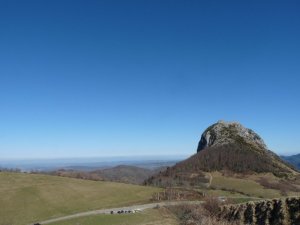
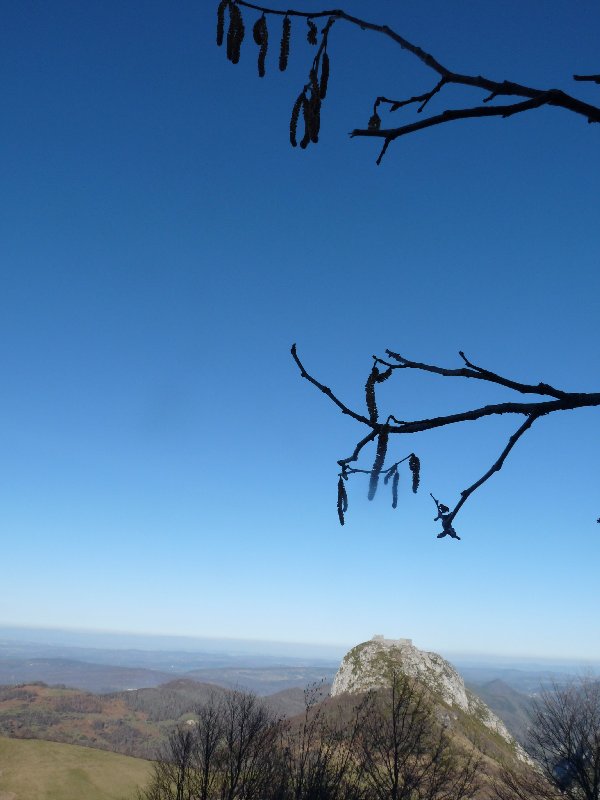
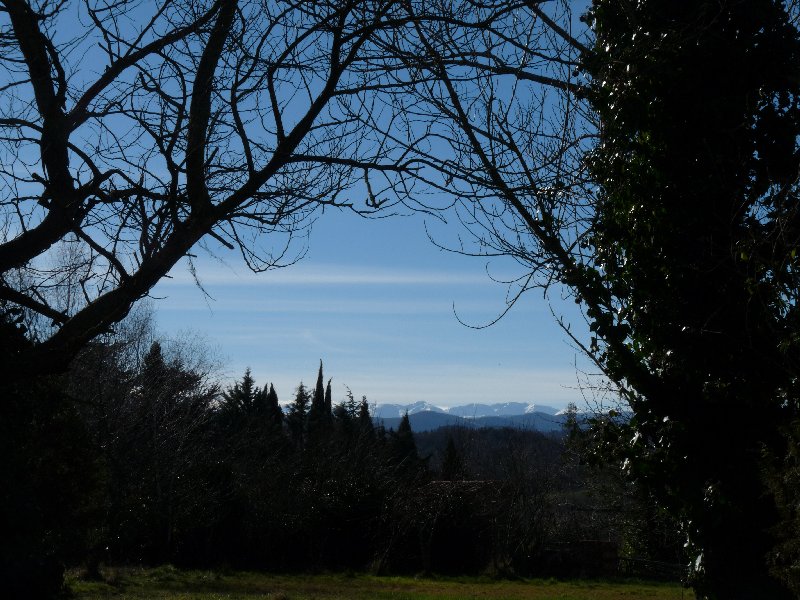
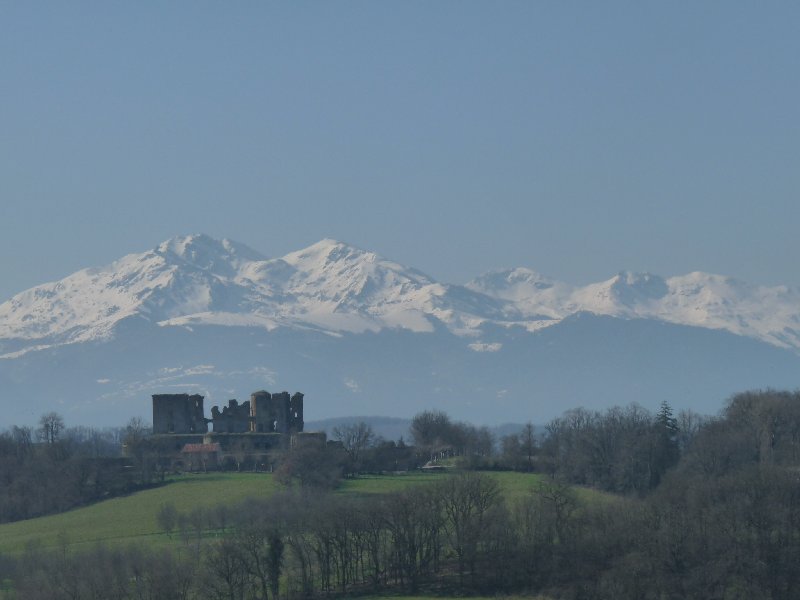
One of the views from our walk last Thursday.  In the distance, the ruined castle of Lagarde.  In the far distance, the Pyrenees.
One of the views from our walk last Thursday. In the distance, the ruined castle of Lagarde. In the far distance, the Pyrenees.

It’s come at last.  The week we move back to Yorkshire.  On Saturday we did ‘The Long Goodbye VI’.  This time next week, we’ll have been back in England almost three days.

So that’s it for ‘Life in Laroque’.  Maybe one more post.  Maybe not.

So what do I do about it?  Shut up shop and start again?  Or simply change the title and keep writing?  I don’t know how things will change for me once I get back to Yorkshire.  I’m fairly sure I’ll want to keep on writing a blog.  I’ve enjoyed the discipline of getting memories recorded.  I’ve loved having feedback from friends.  At first, these friends were people I’ve shared part of my life with, people I’ve worked with or spent time with socially.  Increasingly, they’re cyber-friends: people who take the trouble to comment, criticise, offer suggestions and memories of their own, and whose blogs interest me.

Yesterday, though, Malcolm made a suggestion, remembering the exhibition I’d had a hand in organising here, comparing the Ariège with Yorkshire.  Why not change the title of my blog to ‘From the Pyrenees to the Pennines’?  That’s what we’re going to be doing after all : exchanging one set of hills for another.  For quite a while, having been away so long, I expect to be something of a foreigner in my own country, and this might be reflected in what I choose to write about.  Or not.  I just don’t know.

I’m sure I’ll lose some of you, dear readers.  Perhaps your interest is in France, specifically this part of France.  But I’d love it if some of you choose to continue the journey with me, as we settle back to life in the UK and travel further afield from time to time.  We’re bound to come back to the Ariège too.  There are favourite people to see, favourite places to visit, and  new places still to discover.

So ……. new blog?  Continue with this blog under a new name?  What do you think?   I’d love to hear from you, especially if you’re one of those bloggers with whom I have cyber-conversations.  Thanks for coming with me this far.  I’ve enjoyed your company.
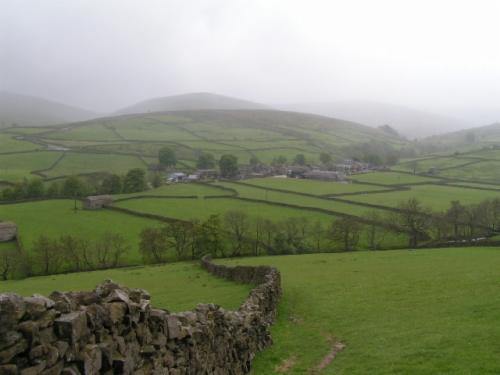
The Yorkshire Dales.  They're not bad either, are they?
The Yorkshire Dales. They’re not bad either, are they?


‘L’auberge espagnole de la Résistance’

…. which is, being very roughly translated, our pot-luck picnic on the Resistance trail.

Posh picnic?  I think not. But it's the taste  and the company - that counts.
Posh picnic? I think not. But it’s the taste and the company – that counts.

Jean-Charles has long wanted to get us up to Croquié, a village high above the road between Foix and Tarascon, for a walk with a 360 degree panorama of the Pyrenees, and a very moving monument to some of the Maquisards who died fighting in the French resistance in World War II.  This really was the last Sunday we could go, and the day was glorious: hot, with clear blue skies and views for miles and miles in every direction.

Neither Malcolm nor I is particularly on form at the moment, so while our Laroquais friends yomped up a semi-vertical path, deeply slicked in mud, we went part-way up the mountainside from the village of Croquié by car, and then walked on up by road (a road, however, closed to cars) to meet the rest of the group.

Our first destination was the Monument to the Resistance.  This site, with views across to the mountains dividing us from Spain, far-reaching from west to east, was chosen as a memorial site not because it was a war-time battle ground.  Instead it was a training school for resistance fighters from France, Spain and beyond.  There are no barracks, no lecture-halls, no buildings of any kind.  Instead the men led hidden existences among the forest trees and rocks.  And now there is a fine memorial to them.  Singled out were two men who died in nearby Vira (the area where we walked last week) a Maquis stronghold, one who died in our neighbouring town of Bélesta, and one who died following deportation.  There is a statue to these men, who are nevertheless depicted without facial features.  In this way they stand representative for all the men – and women – who died whether through fighting, by acting as liaison workers, or by offering essential support by giving shelter, clothing and food.  Individuals did not pass over to Spain from here: the border is too far away.  Instead they were driven to one of the freedom trails such as those near Oust and Seix.  Petrol?  It could be organised, albeit with difficulty.  A key man ran a garage.
The sculptor of this monument is Ted Carrasco.  A native of Bolivia, pre-Columbian art  is a clear influence on his work.  He seeks always for his pieces to be in harmony with the environment in which they are placed.  His monumental granite figures look over to the Pyrenees which were the scene of their fight against fascism and the Nazi occupation of France.

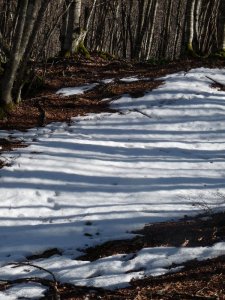
Time to move on, however.  Our path took us slowly upwards through forest, along a track which became increasingly snow-covered and tough going.  However, it was only 3 km. or so until we reached the top, where there’s a refuge dedicated to the memory of its original owner, Henri Tartie, known as ‘l ‘Aynat’ – the elder, in Occitan.  The original structure is tiny, but served as shelter to many a Maquisard .  Now it’s a wood store, because a newer concrete annexe has been added with cooking facilities so that hardy mountain walkers can rest, make a meal, and warm themselves up.

We commandeered a circular concrete table outside, with apparently unending views of those Pyrenees, and somehow squeezed all ten of us round.  We unpacked our food:  as ever there was wine to share, rhum baba à l’orange, galette charentaise, biscuits – all home-made, of course.  Malcolm and I knew it was our last walk with our friends.  The fine views, the fine company, the cheerful conversation had a predictable effect.  We became tearful.  But so grateful that this walk was a bit of a first.  Extra-special views, extra-special weather for March, the chance to get close to an important slice of Ariègeois history, and our extra-special friends.  We shan’t be with them next Sunday: there’ll be too much to do.  It doesn’t bear thinking about.

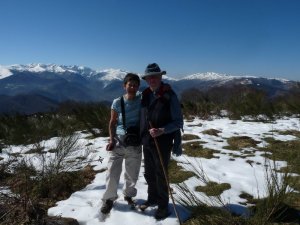
The two of us, just after lunch.

Two walks: the last walks?

This post is really just a chance  to post a few photos from a couple of recent walks, one in the Ariège, and one in the Aude.  Each walk brought out some of the contrasts and similarities between  the two Départements.

The more local walk, near Ventenac last Sunday, was near meadows where cattle grazed, through fields being prepared for sowing feed crops such as maize, and through oak and beech forest.  Though there are villages dotted about, the area is still thinly populated, densely forested.  During the Second World War it provided cover for the Spanish Maquis , scourge of the German army.  With the support of many, but not all locals,  the Maquis came to regard the area as a centre of gravity, from which they emerged to pass soldiers and refugees across the mountains, and to organise acts of resistance to German occupation . You’ll find monuments to their activities, their battles, their acts of martyrdom all over the area.  It’s easy to see how, in this large territory, with under-developed links of communication, the Germans had such difficulties keeping tabs on the Maquis’ whereabouts.

Over in the Aude on Thursday, near Esperaza, we saw no farm animals, but our path took us past vineyards where the vines were being hard-pruned ready for 6 months of vigorous growth and grape production.  Martine, from a wine-producing family, explained some of the different methods of pruning  – and there are dozens.  Older varieties of vine, unsupported by wires, may be pruned with an open centre, so the core looks almost like a bowl.  Other kinds of grape usually require training along wires: all sorts of schools of thought here.  These days, much harvesting is mechanical.  Martine’s family send their grapes to a wine co-operative for processing.  This co-operative sends an oenologist every year to analyse their grapes and those of all the other members of the cooperative.  Then he will book everybody a two-day spot with the mechanical harvester at what he believes to be the optimum moment for their particular harvest.  Few grapes cannot be harvested in this way, but the local Blanquette de Limoux is one.  Its low-growing grapes are unsuited to mechanical methods.  With wine-production the main agricultural industry, the villages here have a properous air to them.

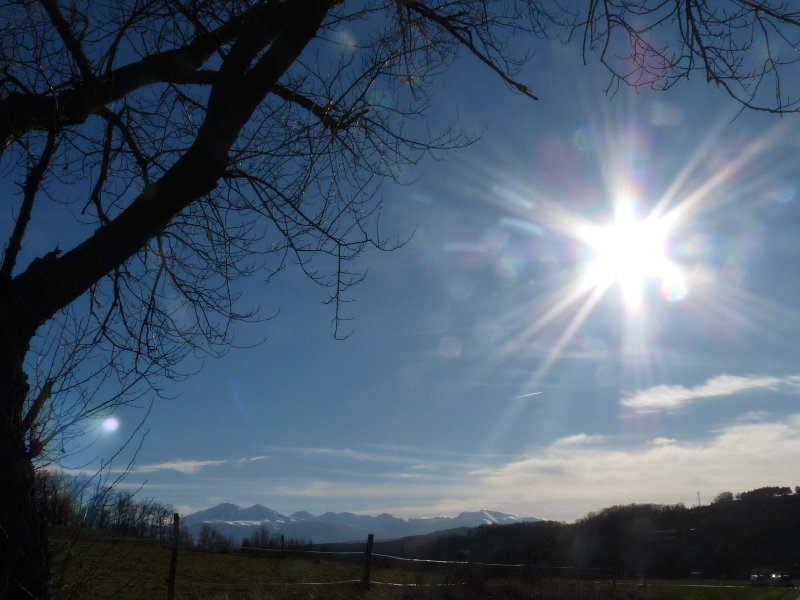
Both walks shared a fair bit up uphill (and therefore downhill) marching.  And in both cases, the rewards were in the views of the distant Pyrenees, still covered in snow.  In the Ariège, you’ll be looking to recognise the peaks of Saint Barthélemy and  Soularac, whereas in the Aude, you’ll have no difficulty in recognising Bugarach looming above the surrounding peaks.

These last walks are bitter-sweet.  We’re enjoying them, but not enjoying the fact that, for the time being, there are (almost) no more to come.

The long ‘Goodbye’ III

No, you haven’t missed anything.  There was a ‘Long Goodbye II’ – another meal, another great set of walking friends – but that time I didn’t write about it.

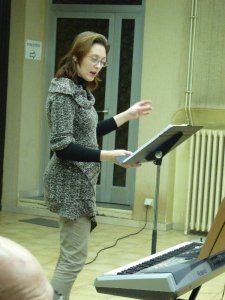
Vanessa, making us sing - and sing it right.
Vanessa, making us sing – and sing it right.

‘Long Goodbye III’ was on Wednesday, at the choir.  I thought I was doing the offering this time.  To drink, there was my home-made elderflower cordial which, added to a crisp chardonnay, made a rather different take on the kir with which they’re familiar.  I made sausage rolls too, using the fine English-style sausage meat produced by the talented Mister Saucisse, and hunted down some cheddar to produce cheese straws.

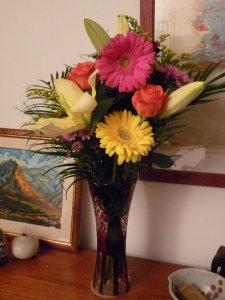
Vanessa curtailed our rehearsal, the party got under way, various people produced cameras and took lots of group shots. As we got organised for one of these, Robert, irritatingly, disappeared.  Then reappeared, bearing a rather large bouquet, which was, apparently,  for me.  Here it is:

A bouquet, a rose.  No wonder I look so surprised.
A bouquet, a rose. No wonder I look so surprised.

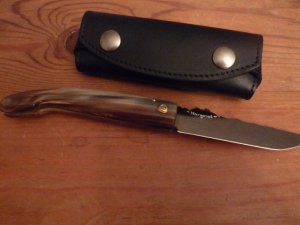
Then another gift.  This really is special.  The next village along, la Bastide-sur l’Hers, is home to a specialist knife manufacturer, of world importance in his field, Jean-Paul Tisseyre.  He’s been on our ‘to-visit’ list for ages, but so far it hasn’t happened.  Instead, one of his knives came to me.  It’s a Montségur.  It’s hand- cast in one piece with a mottled horn tip.  Along its back, you can see the profile of the Pyrenees, starting from Montségur and travelling westwards.  On one side of the blade, my name’s been inscribed.  It’s a gorgeous thing, which was given to me in an equally gorgeous hand-made leather case.   I’ll treasure it always, though whether I’ll ever risk taking it out hiking, as intended, is another matter.   The French, like the English, consider that  to give knives or scissors as gifts risks ‘cutting’ the friendship, so next week I’ll be sure to make a token payment: I have a purse full of English pennies for the purpose.

Isn't this a wonderful knife?
Isn’t this a wonderful knife?

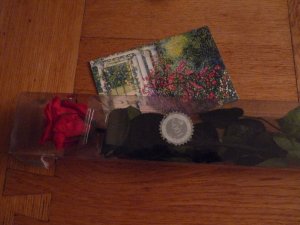
Jocelyne, our choir’s senior member, gave me an everlasting rose….

The rose before being nicely arranged.

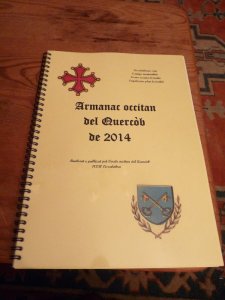
…. and Marianne and Danielle have offered me a book in Occitan.  They thought I wouldn’t understand much, but some knowledge of French, Italian and Latin makes the whole thing pretty accessible.

My Occitan library.
My Occitan library.

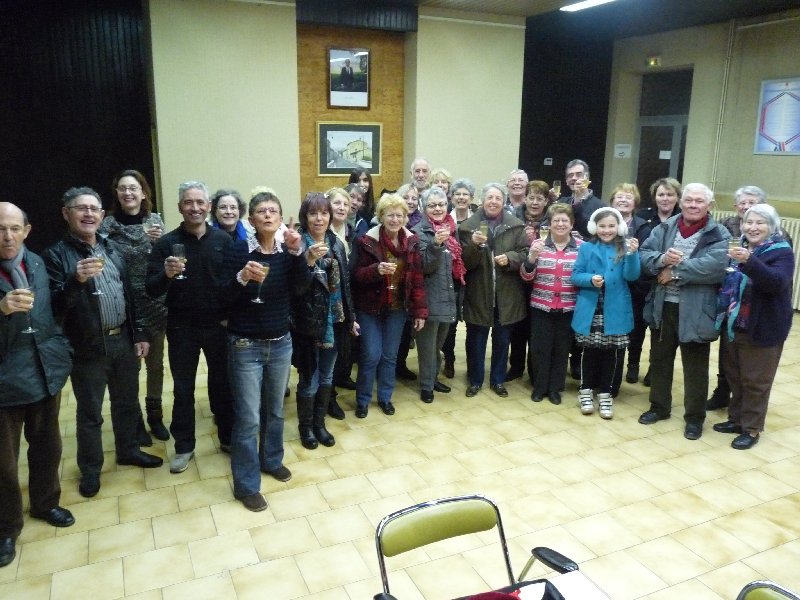
Spontaneously, the group burst into song.  ‘Se Canto’, the anthem of the Ariege, obviously, which everyone loves to sing at the least provocation, followed by ‘Les Montagnards’: then finally the Cathar hymn ‘Can lou bouyè ben de laoura’, of which I was proud to know some of the words.

Those flowere, back home.  Can you see Montségur, Henri's version, in the background?
Those flowers, back home. Can you see Montségur, Henri’s version, in the background?

Malcolm – who’s not a choir member – and I were near to tears much of the time.  We want to go home, but how can we bring ourselves to leave this community where we’ve been so welcomed and happy?

P1110256

What a difference a year makes…..

This time last year, and well into March in fact, I did little but moan about struggling around in snowshoes on our Sunday walks.   Here’s a picture I took on March 4th last year.

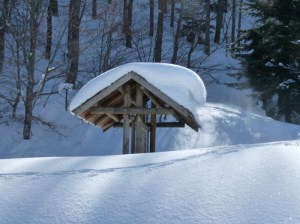
Buried information board on a local snowshoes expedition last March

And here we are on February 23rd 2014, enjoying full-on Spring.  These are shots of some of our daffodils in the garden, taken today.

Daffodils in our garden this evening.

Today, Joseph led us on a walk from the foot of Montségur to the Roc du Banquels.  It’s one of those walks where from Step One, you’re climbing, ever upward.  We whinged about it, and one of our number, who’d gone and left his hiking boots in a carrier bag in the car park at Laroque (you know who you are, M.rc.l) even had to jump ship.

The walk begins.  That's Montségur you can see.
The walk begins. That’s Montségur you can see.

Ever onward, ever upward.  It was warm though, and we brushed past trees covered not in snow as last year, but with tightly-furled leaves about to burst into growth, and catkins.  Eventually, as we reached a height of some 1,200 metres, we did reach snow underfoot.  It wasn’t very deep though, and walking through it wasn’t too much of a challenge.

The snow begins.
The snow begins.

Our efforts were rewarded.  As we panted up the final slope, we saw before us, clearly defined against a bright blue sky, a large and craggy rock over which juniper bushes straggled .  This was our destination.  We ditched our sacs and walking batons in favour of scrambling up those final few metres, searching for tiny footholds and clumps of juniper to help us on our way.  There far below was the summit of Montségur.  Beyond it, Laroque, St. Quentin.  In another direction, the lac de Montbel, its usual Mediterranean blue. Look towards the Aude, and looming out of the mist was the immense peak of Bugarach.  It’s nearly 60 km away, but is so imposing that it makes its presence felt even at this distance.

We sat awhile, enjoying our magnificent vantage point and the warm sun.  Heigh ho, time to go –  before the sun sets behind the mountains and we all start feeling cold.  Going down’s always quicker than climbing up.

P1110189

We almost scuttled down the slopes, and were taking our boots off ready for our short ride home just as the sun began to drop behind the high peaks.  An excellent afternoon.

Catkins on the way down point towards Montségur

Millas. National treasure?

Pop along to your local butcher round here, and you’ll find pale yellow slabs of something that rather resembles polenta on sale.  It’s millas.  And it resembles polenta because they’re first cousins. Both are made of corn meal cooked into a kind of porridge.  Whereas Italians favour polenta as a base for various savoury dishes, millas is usually served sweet.

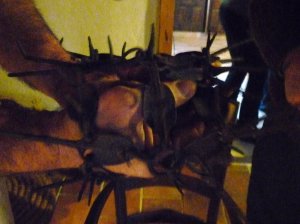
And today, we were invited, together with the rest of the Commission du Patrimoine here in Laroque to watch it being made, before sitting down to a millas tea party.  Our hosts were Paul and Aline Garrigue, whose house is a fascinating museum to traditional Ariègeois life, and filled with artefacts from the not-at-all-distant past.  Who’d have guessed that the fearsome collar six inches wide and covered with spikes used to be worn by local dogs to prevent their being savaged in the neck by wolves?  Which of us still has a bread oven built into the side of the fire-place?

A fiersome anti-wolf collar for a dog
A fearsome anti-wolf collar for a dog

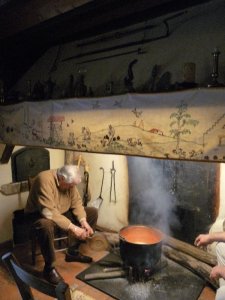
By early afternoon, water was set to come to the boil in a huge copper pan set over an open fire.  Various expert fire-makers set to with the bellows, and soon the water was ready for other ingredients.

Getting the fire blazing with bellows.

Milk first.  Then cornmeal, slowly and gently dropped in by hand so that it didn’t go all lumpy.  Then more cornmeal.  A small amount of flour.  Salt.  Duck fat.  Vanilla sugar.  A decent slug of eau de vie.  And all the while, Paul stirred and stirred, with his toudaille.  You could have one of your own if you’d like.  Next year, on Twelfth Night, take your Christmas tree, and cut away almost all its branches, apart from maybe six or seven towards the bottom.  Trim these so they’re just a few inches long.  Strip the bark off and dry the whole thing out.  And there you have it.  A multi-pronged stirring instrument that does the job of a balloon whisk, but on a much larger scale.

You can just about spot the 'prongs' of the toudaille.
You can just about spot the ‘prongs’ of the toudaille.

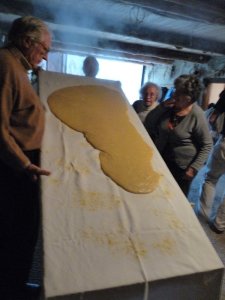
And still Paul stirred.  He tasted.  Nope, not thick enough.  He stirred some more.  Finally, he pronounced it just right.  A couple of muscular types staggered off with this huge vat of the pale porridgey stuff, and …. tipped it out over a trestle table, covered with a flour-sprinkled cloth.  Then the table itself was tipped, this way and that, so that the millas flowed and settled into a thickish  sheet.  And there it stayed.  It’ll probably still be there till tomorrow morning.  Once it’s good and cold, it can be cut up into slices and …. on to the next stage.

Tipping the millas.
Tipping the millas.

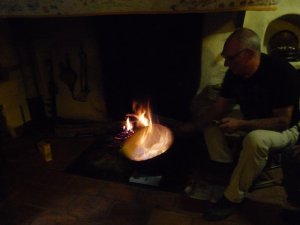
The un-scraped out pan was put back on the fire.  Eau de vie, plenty of it, was added.  Paul set a match to it, and it flamed in the manner of a  good old British Christmas pudding.  We were all issued with a teaspoon, and had a go scraping the pan.  Malcolm and I couldn’t quite manage the enthusiasm of the rest, but it was pleasant enough.

Flaming the millas.
Flaming the millas.

Then it was time for tea .  It was a ‘Here’s one I made earlier’ moment, with yesterday’s millas chilled then grilled, to be served with jam, honey, whatever you fancy.  We decided once more that you have to be Ariègeois to appreciate it.  It doesn’t really taste of a great deal to us.  We had assumed it was a cheap and filling everyday food once upon a time.  But it was particularly associated with this time of year, when families killed their pigs and spent time feasting, cooking and preserving all the meat the pig provides.  Another version of millas, less common now,  uses pig’s blood, in much the same way as in a black pudding.

Grilled millas.
Grilled millas.

Nowadays you’ll find millas at every time of year, but in memory of its associations with the pig, it’s the butcher’s shop where you’ll need to look.

We weren’t converted to millas eating,  but watching the stuff being made, and sharing the moment with people who had so much to tell us about this traditional treat was a wonderful way to spend a wet Saturday afternoon.

Nothing to do with millas.  A charming detail from the embroidered smoke screen above the chimney breast.
Nothing to do with millas. A charming detail from the embroidered smoke screen above the chimney breast.

A superior sunset

The sunset begins.
The sunset begins.

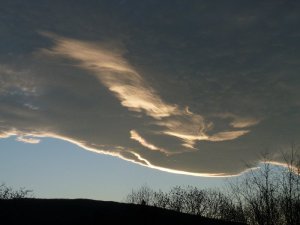
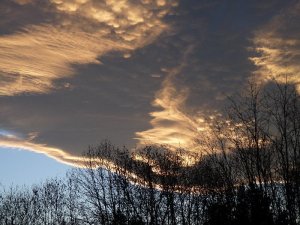
Sunset time last Thursday.  There in the  sky was a large, puffy, bruise-coloured cloud, washed at the edges with a soft copper tint.  As it swelled, it briefly developed brilliant aquamarine edges which had disappeared by the time I’d fetched my camera.

P1100834

We watched from the window, we watched from the roof terrace.  Then I grabbed Daughter Number 1 who was staying for a few days, and we marched up the hill together to the square outside the Church to watch the spectacle from there.  Here it is.


An afternoon without rain

As in England, so in France……

‘Whether the weather be cold, or whether the weather be hot,

We’ll weather the weather, whatever the weather, whether we like it or not.’

 Indeed.  Not cold.  Not hot.  Just wet, very wet indeed.  Just look at those floods in England, Brittany and even the Var.   We really shouldn’t complain when the worst we’ve had here is a soaking and muddy boots.  Especially when, as on Tuesday, the downpours suddenly stop, the sun comes out and dries up all the rain, and we can get out and enjoy the views.

Christine took us out on a walk  she enjoys, just up the road from her house.  It’s great for these soggy times, because it involves walking on roads so narrow they can barely be dignified as ‘single-track’ – but they are tarmacadam, and therefore mud free – and on farmyard tracks used so often that they too are in decent enough condition.  The sky was very blue: spring was in the air.

As we started climbing, the mountains came into view

We passed Troye d’Ariège and the sheep farm we’d once visited, and then our path rose to allow us views of the Pyrenees before returning us once more to the valley floor, to la Bastide de Bousignac, and then back to her village, Saint Quentin.

She’d made a cake.  I’d made a cake.  We put each to the test.  Hers was yoghurt and bilberry.  Mine was a pear, almond and chocolate loaf, recently posted by the deliciously greedy Teen Baker.  Which was the better one?  Malcolm and Max diplomatically cast a vote for each, and they weren’t wrong.  We all tucked in, feeling we deserved a reward after an hour or two eating up the kilometres in the warming gentle sun.

Journey's end.
Journey’s end.

The long ‘Goodbye’

We’ve been wondering for a while how to commemorate our leaving Laroque.  Not long now: we’re working towards mid-March.  We thought some kind of party, but with weather so uncertain, some friends away in February or early March,  the house gradually being more and more unpicked, and with no obvious alternative such as a village hall or room-above-the-pub, it was all a bit of a puzzle.

Then the walking group here in Laroque stole our thunder.  Subtle hints came our way, and we understood that we were at all costs to keep Friday evening free.  We realised that food was involved – of course, c’est la France – but other than that, were left pretty much in the dark.

Finally, the invitation became more specific.  We were to present ourselves at the restaurant up the hill, Table d’Angèle, at quarter to eight, and don’t be late.  So we did.  And there were 22 of our friends, our companions on Sunday and many other days of the week, ready to greet us as we came through the door.

Democracy was abandoned for the evening.  Choose where to sit?  Not a chance. We were instructed to do as we were told, and ushered to the centre seats, the places of honour.  So different from our very first community meal in the same restaurant, when we were pretty new to Laroque.  People then were wary, wondering how hard it would be to cope with talking to their new English neighbours. This time, we were all  laughing as we sat down together.  It was a  fine meal, entirely cooked and served by the immensely hard-working two-person team of Obé (named after Obélix of Asterix fame) and his wife.

We took our time.  There was plenty to eat, and lots to talk about, but finally, we took our last mouthfuls.  The evening was not, it seemed, drawing to a close.  Yvette stood up, a parcel in her hand.  It was this book:

Repas4

They’d chosen it because they knew it would remind us of our home here.  But they thought that it linked too with our Yorkshire home, as the textile industries play such an important part in the history of both areas.

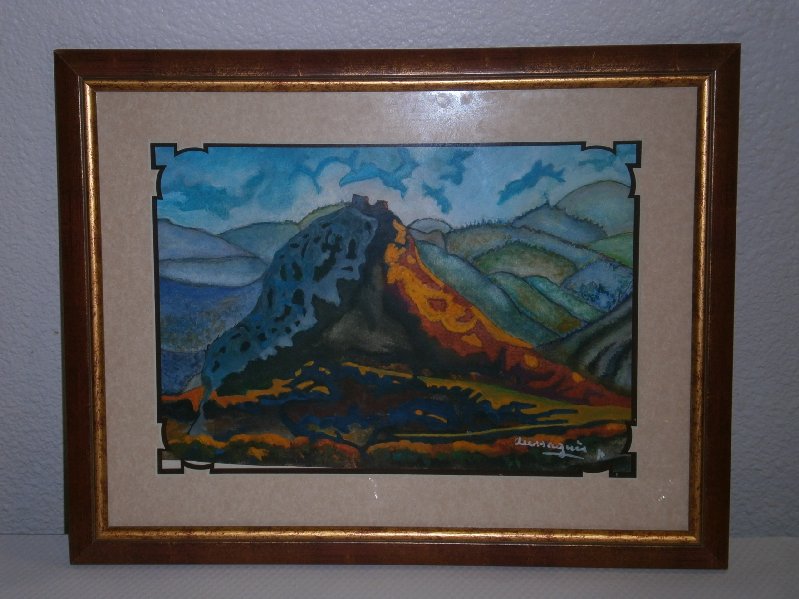
Then Henri stood up.  In his retirement he’s become a keen amateur painter, and his latest piece was done with us in mind.  Montségur, local landmark and place of pilgrimage.  Here it is: he’s presented it to us, and it will always have a place on a wall in our home, wherever we live in the future.Repas14

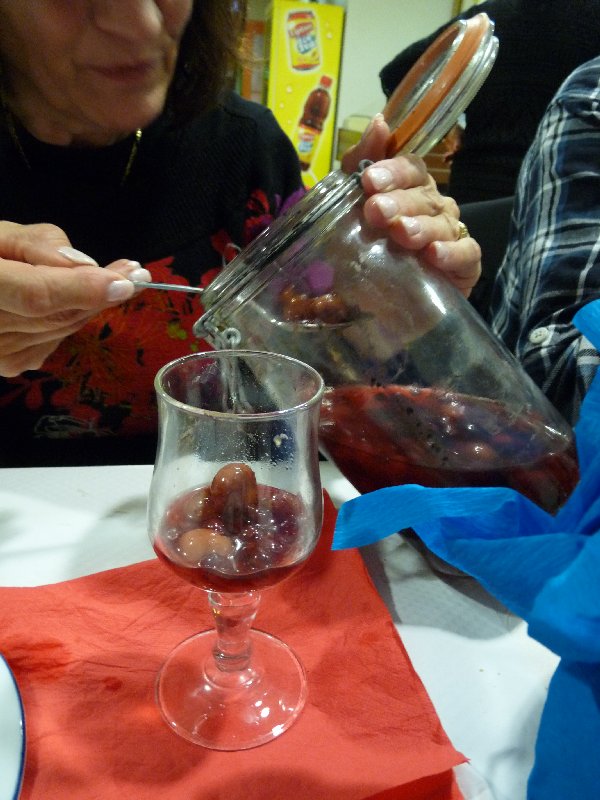
Henri had another trick up his sleeve too.  He produced a large jar of ‘confiture de vieux garçon’.  Not much jam about this.  It was  jar of red fruits macerated for several months in sugar and alcohol to spoon into a glass to both eat and drink.

'Confiture de vieux garçon'
‘Confiture de vieux garçon’

We put a jar of Seville orange marmalade for each guest at the meal (hence that ‘marmalade factory’) round the table, with instructions on how best to enjoy it.  We continued drinking, talking, laughing.  Somewhere in among, Malcolm made an emotional speech.  Blanquette de Limoux finished off the meal, and eventually, slowly, the evening drew to its close.

Such a memorable evening.  We’re touched beyond measure to have been so welcomed in Laroque, and that our friends chose to mark our departure with such careful planning and generosity.  It’s unthinkable not to come back, and often.  We’ve insisted too that they must all plan a visit to come and discover Yorkshire.  Like the Ariège, it’s splendid walking country.

Thanks , Jaques and Yvette, for most of the photos.  Mine seemed not to cut the mustard this time.  Too busy having a good time I suppose

Snowshoes IV: absolutely the very last episode

Plateau de Beille
Plateau de Beille

Loyal readers of my blog may remember a post from last March, which began:

‘I’m not doing raquettes (snowshoes) ever again.  Never.  If I ever show signs of changing my mind, lead me into a darkened room, talk kindly to me, and sit with me till the feeling passes.’

Yesterday, I changed my mind.  But nobody led me into a darkened room…..

I had my reasons after  all.  I was unlucky last year.  I probably will never have the chance to do raquettes ever again.  My Thursday walking friends wouldn’t set the bar too high.  Everyone raves about the Plateau de Beille as a winter sports playground …..  These all turned out to be excuses rather than reasons.

A very mild winter means you have to climb pretty high this year to be sure of snow.  The Plateau de Beille is high.  1800 metres and rising.  The snow appeared at the roadside only during the last kilometre or so of a very dizzy 10 mile climb upwards.  And when we arrived, the car park was packed, and every school child in the Ariège seemed to be there, muffled in ski-suits and excitedly fastening on skis.  Which was fun to watch, but we were relieved that once we too had got booted and spurred, in our case with raquettes, and yomped just half a kilometre or so, we were in the wild and wide empty spaces .

And that’s where it all could have gone wrong for me.  We came to a signpost: ‘Pas de l’Ours. 11km’.  ‘Eleven k?  With raquettes?  I don’t think so.’   I was not alone in protesting.  Anne-Marie and I wimped out and chose a 3 km pathway, and had a fine time chatting as we soldiered up an admittedly steep slope, safe in the knowledge that this challenge would quite soon be over.  Resting at a cabane at the top, we were surprised to be joined by our friends.  It seemed their journey had taken a different route to this point, and whereas we had 2 km to complete, they still had 10.  Three of them had a bit of a think.  ‘We’re coming with you’.  And that’s what they did.  We waved the other six goodbye and arranged to meet in three or four hours: slow stuff, snow-shoeing.

We had a fine time.  We got back to base in time for lunch and watched the children on the nursery slopes and the huskies drawing sleds as we ate our picnic in the bright cold sunshine.

Busy huskies
Busy huskies

Then we discarded our raquettes and rucksacks, dumping them in the car,  in favour of a snowy walk to see the views.  It became windy.  It became cold.  It threatened to rain.  But we weren’t on an 11km. route march, that was the main thing.

When our friends re-joined us, they announced that they hadn’t been either.  They’d found a short-cut and taken it.  Cheats.  But it just shows.  This raquettes lark isn’t all it’s cracked up to be.  Little and not-very-often seems to be the way forward.  But next time, I’ll stay at home.

The end of the day:  cold, windy, but still good to look at.
The end of the day: cold, windy, but still good to look at.

Click on any of the circular images to see the whole photo, and a miniature slide show.