Daffodil time

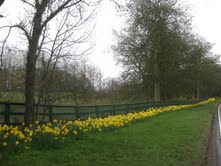
On the road from Ripon to Harrogate

I had a very pressing reason for wanting to come back to England for a few weeks.  I couldn’t wait for April, much less May.  The March heat wave made me worry that already I might be too late: I needed to see daffodils.

Of course the French have daffodils in their gardens too. Well, some people do.  You can even find them, delicate and lemon-hued up in the woods.  But nothing to compare with our English exuberance.

Here, regiments of daffodils march down the edges of inner-city dual carriageways.  Swathes of them along the verges announce the entrance to almost every town.  Shopping centres have great tubs full.  Gardens, whether tiny gravelled spaces in front of town terraces, cottage style plots, or more extensive lawned affairs, all boast generous clumps of brilliant yellow trumpets swaying in the breeze.

From the top of the bus passing through Ripley

Nothing else makes me so aware that winter’s on the way out.  Not the blossom slowly unfurling on the trees, nor the spears of green thrusting through the soil and moss on every country walk, and in every garden.  Of course I love these too.  But for me, nothing but those bright assertive confident flowers can state quite so definitely – even defiantly – ‘Spring is here!’

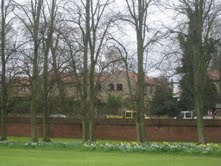
The Old College, Ripon

On the path of Cathar shepherds

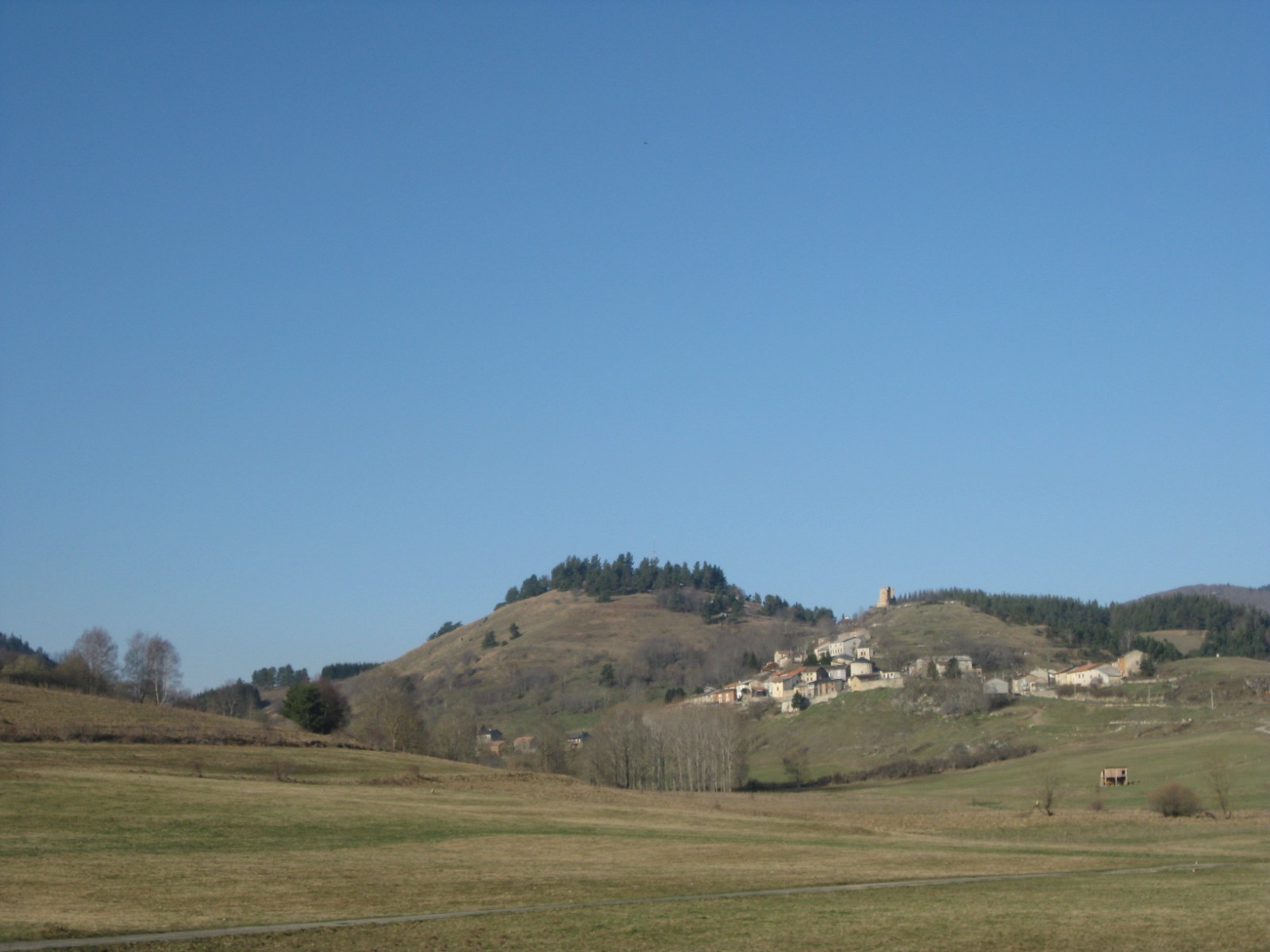
Montaillou

Yesterday we walked through Montaillou.  It might seem a tiny and unremarkable village now, but it’s the place that’s maybe done most to contribute to our understanding of turn-of-the-14th century village life in the Languedoc when religious strife between the Catholics and the Cathars was at its height.  This is a big subject: it deserves more than passing mention: a future blog maybe.

I’d read le Roy Ladurie’s book on Montaillou more than 30 years ago,and never dreamed that I might one day live in what the tourist offices are pleased to call ‘Cathar Country’.  So it was the shepherds of Montaillou I was thinking of as we began our Sunday walk.  They would come to the annual fair at Laroque d’Olmes, a good 40 km from where they lived.  They would drive their flocks long distances for good pasture, and as national boundaries meant little in these mountain zones, their fellow shepherds whom they met in their travels would sometimes be Spanish.

Blossom and snow

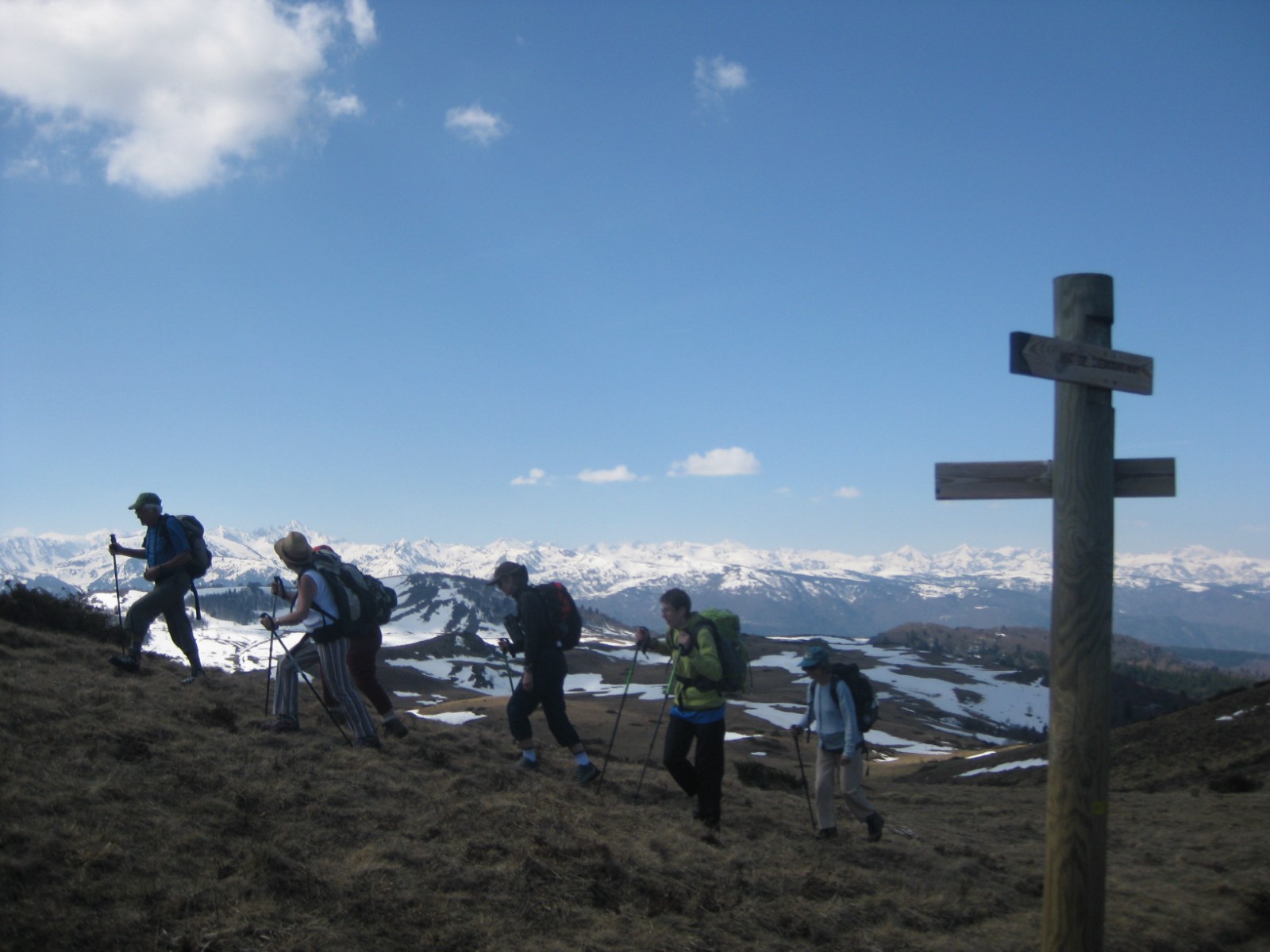
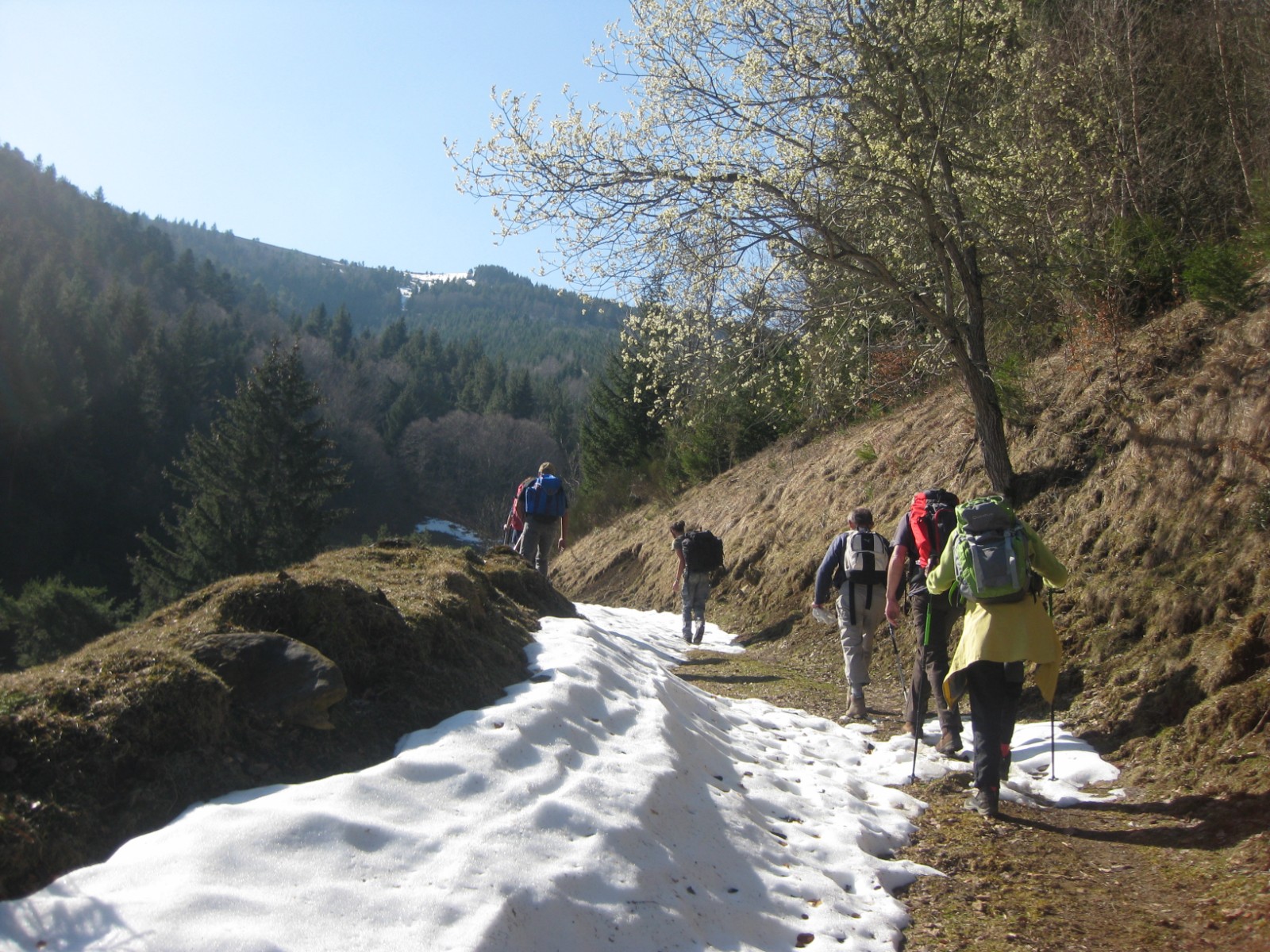
We too were climbing out of Montaillou.  The paths seemed unchanged through the centuries – short springy turf with early spring flowers pushing through. Pale pink and white blossoms busting open.  Narrow streams cutting deep channels through the turf.  Thick forest climbing the slopes.  Patches of snow made the going a bit tough from time to time.  It was warm and sunny, the slopes were steep and sometimes hard-going

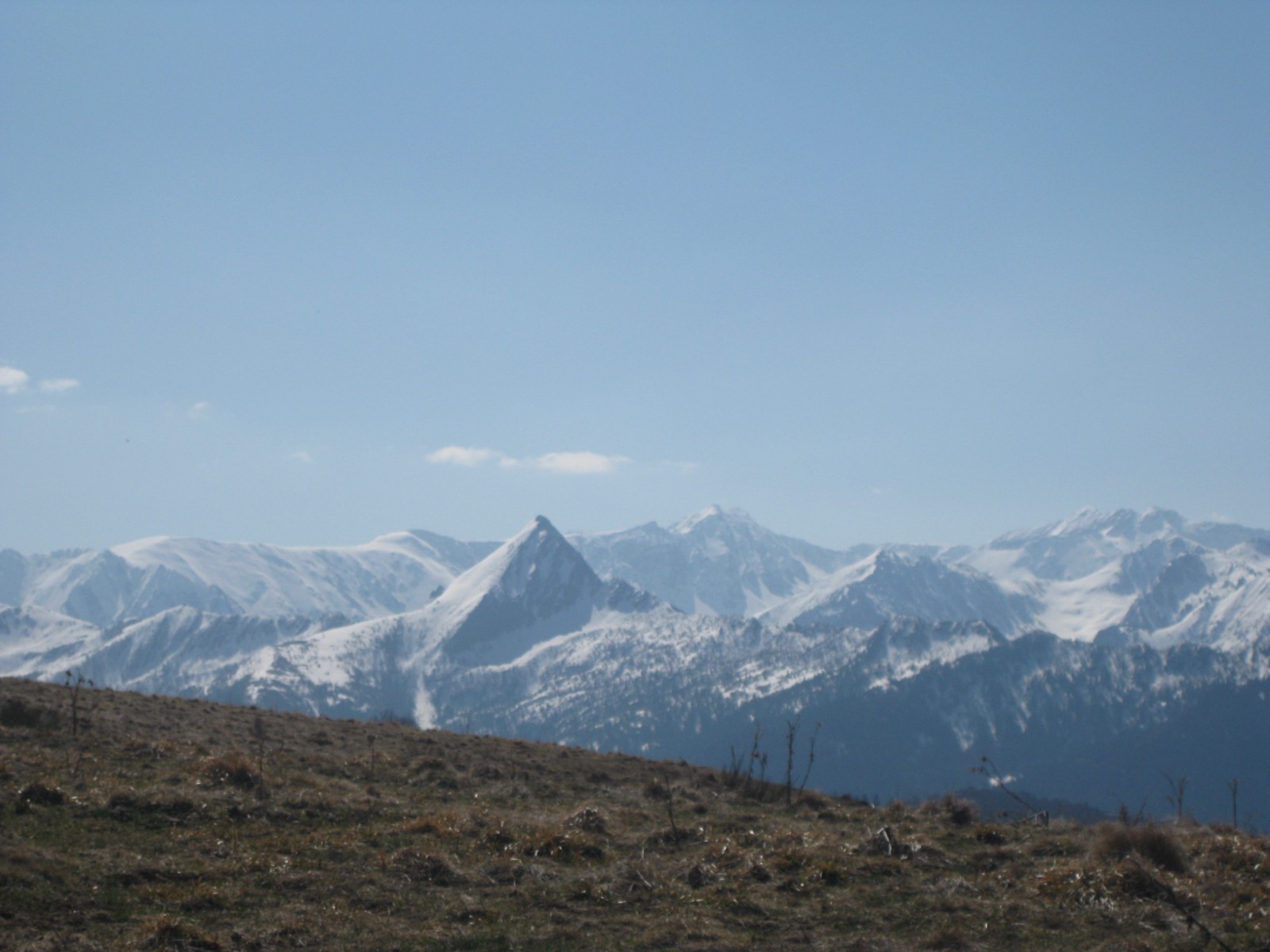
Those peaks appear

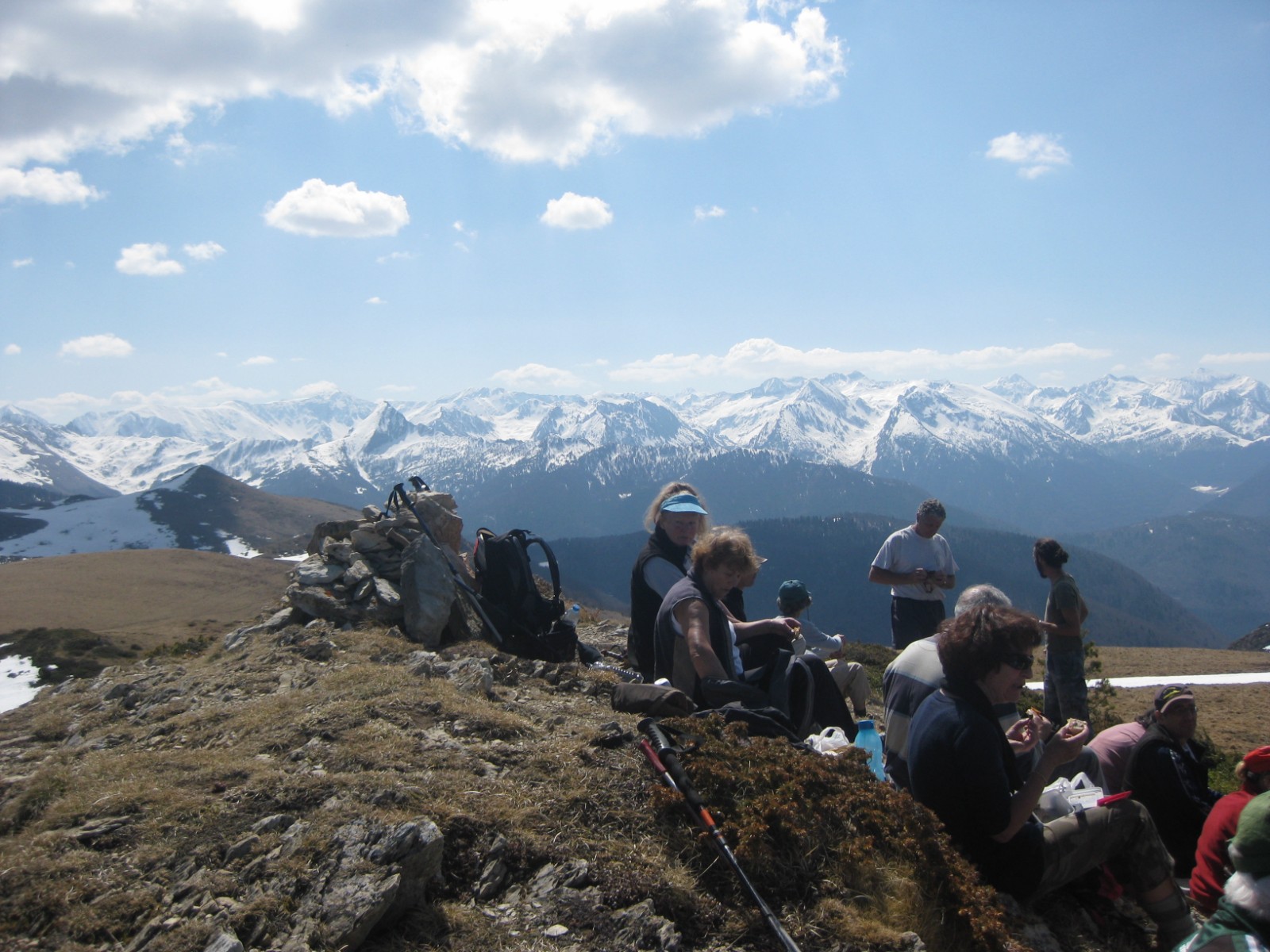
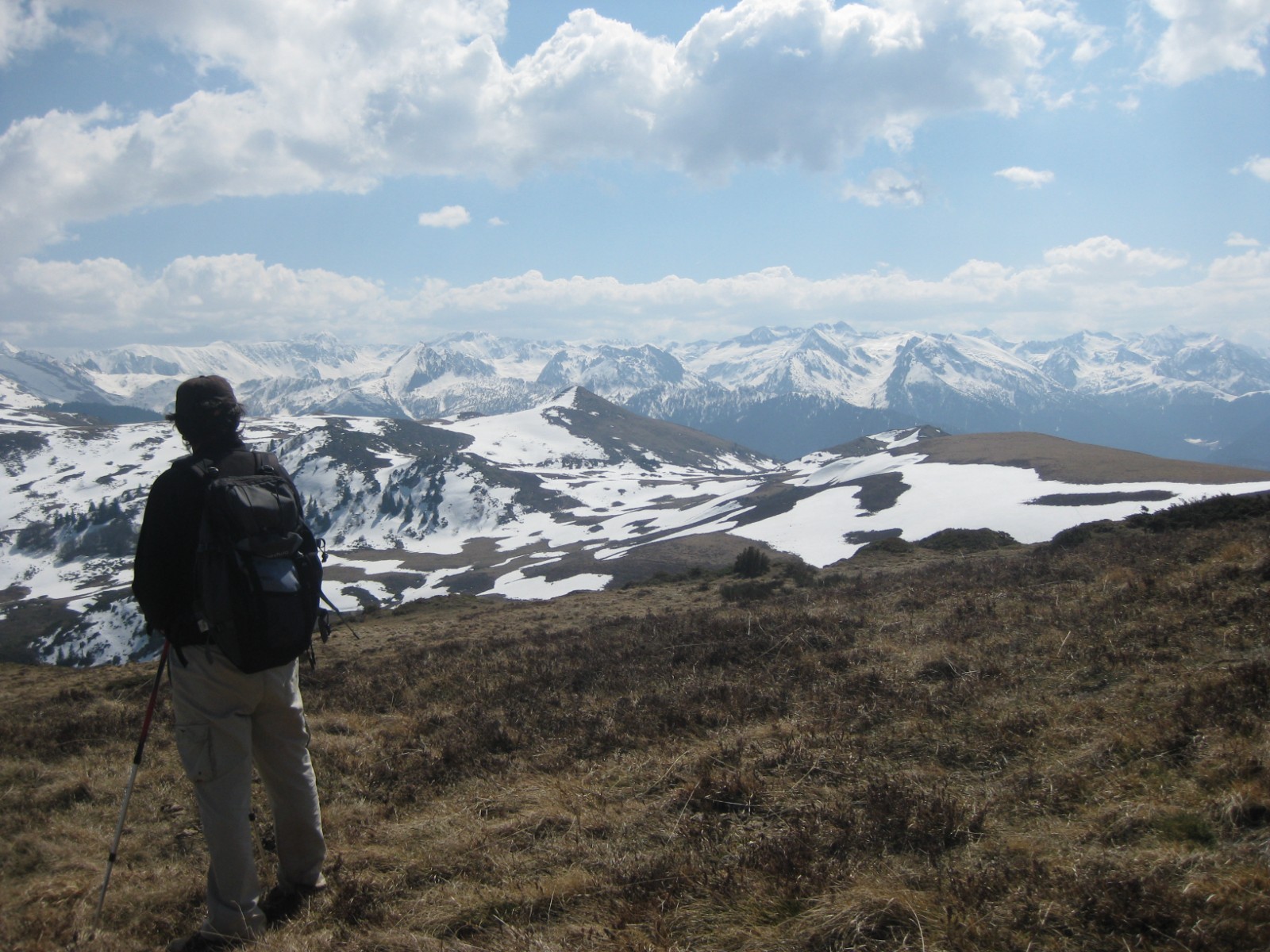
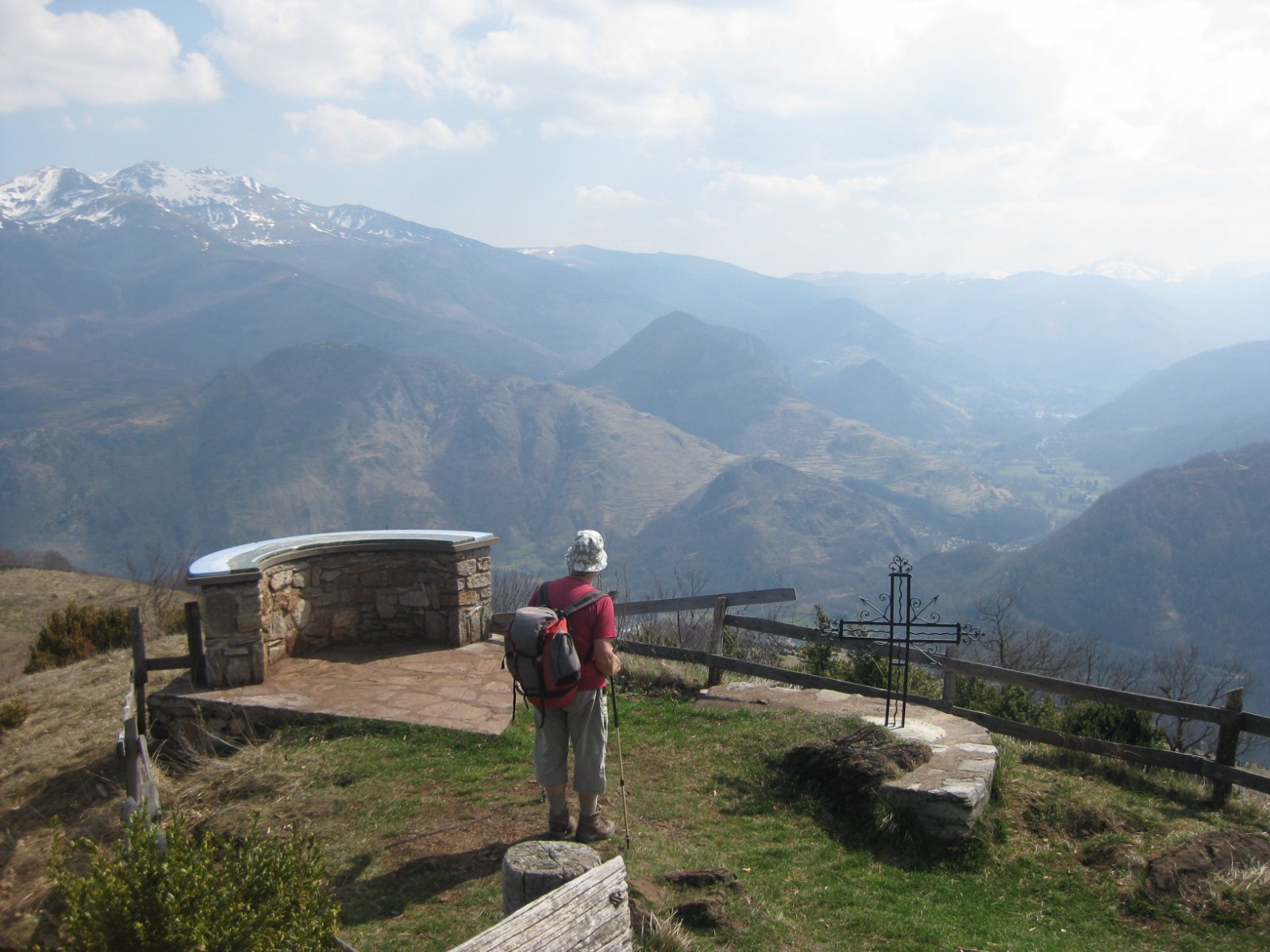
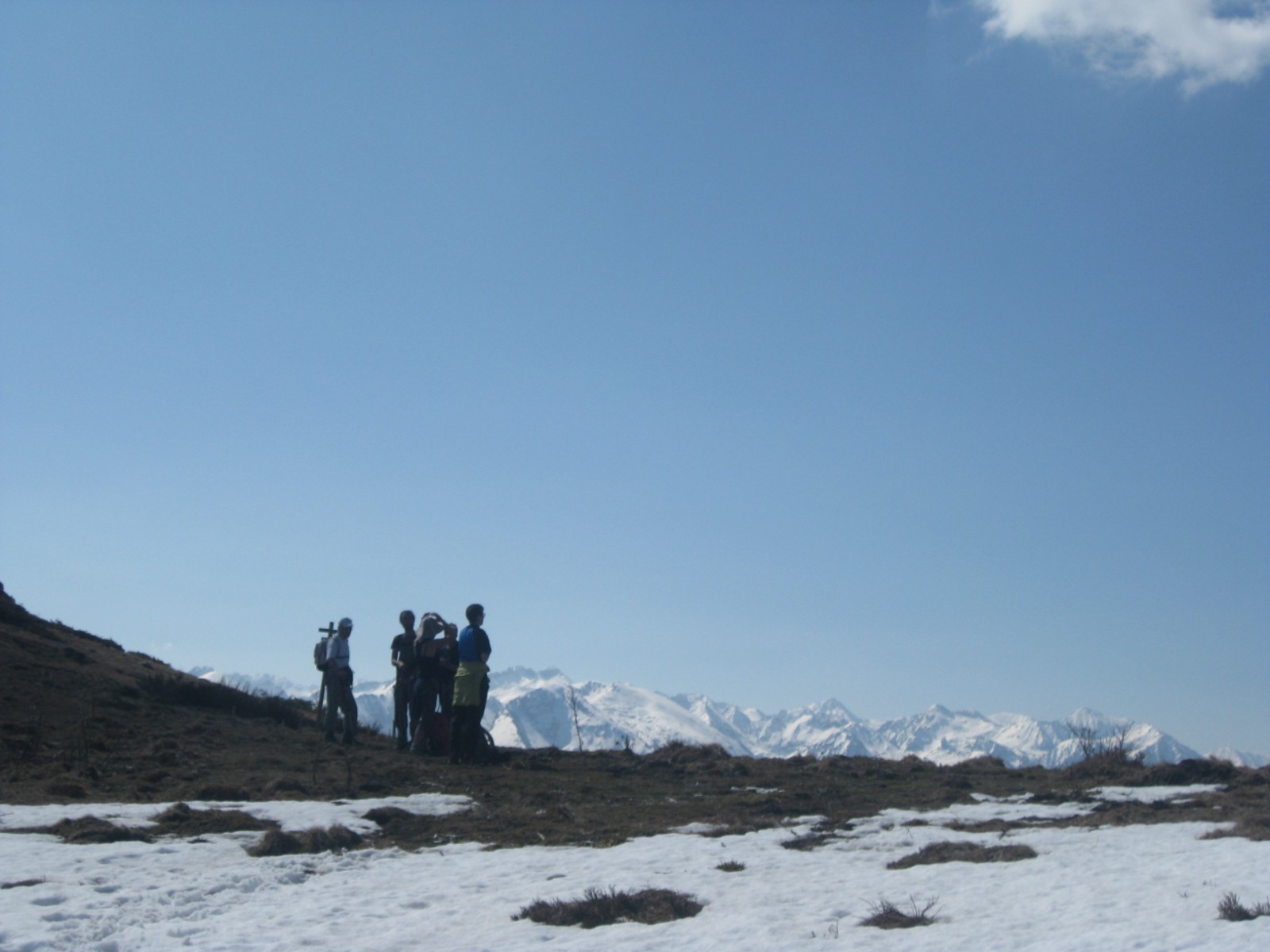
Then suddenly…suddenly, and so unexpectedly, we reached the top of our first climb.  Around us, to east, south and west were the snow-covered peaks of the Pyrenees, glistening white against the blue sky.  Above us, skylarks called and swooped.  Later, Danielle remarked that she felt as if at that moment she’d received a special gift: that perfect view, the clean clear air, the singing birds which were the only sounds.  She voiced, I think, what we all felt.

A few of those unending peaks
We keep walking
More distant peaks

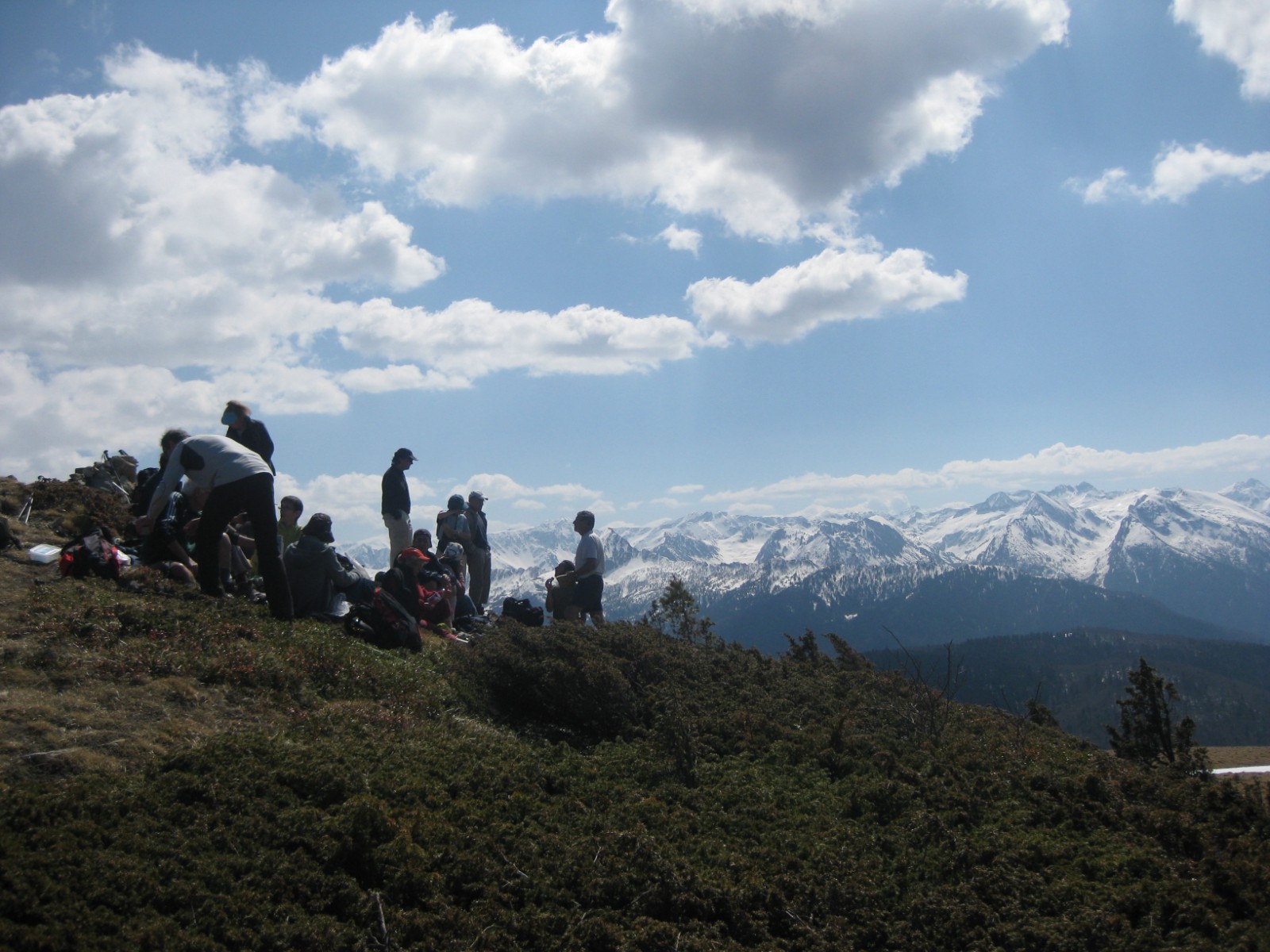
We hadn’t reached our highest point: we climbed onwards, always with those snow capped mountains at our side.  And then we were on top: handy rocks provided seats and shelves and we unwrapped and shared our lunches, lingering in the sun, drinking in the views for well over an hour.

Picnic spot

The afternoon walk begins

Soon after lunch, we turned our back on the snowy mountains.  As we faced the hotter, drier Pyrénées Orientales, the equally high peaks there weren’t covered in white.  Our path was downwards now, and soon we had to pass the ski station above Camurac.  Built long after those years when snow could be relied upon throughout the winter, it was an area of scalped earth, snow machines and all-but-redundant chair lifts.  My Montaillou shepherds certainly wouldn’t have recognised it.

The walk draws to a close

But then it was forested paths again, open pasture and spring flowers.  We finished the walk passing a collection of horses, Thelwell style ponies, and appropriately for Palm Sunday, a couple of friendly donkeys.  A good day.

Pilgrims for a day

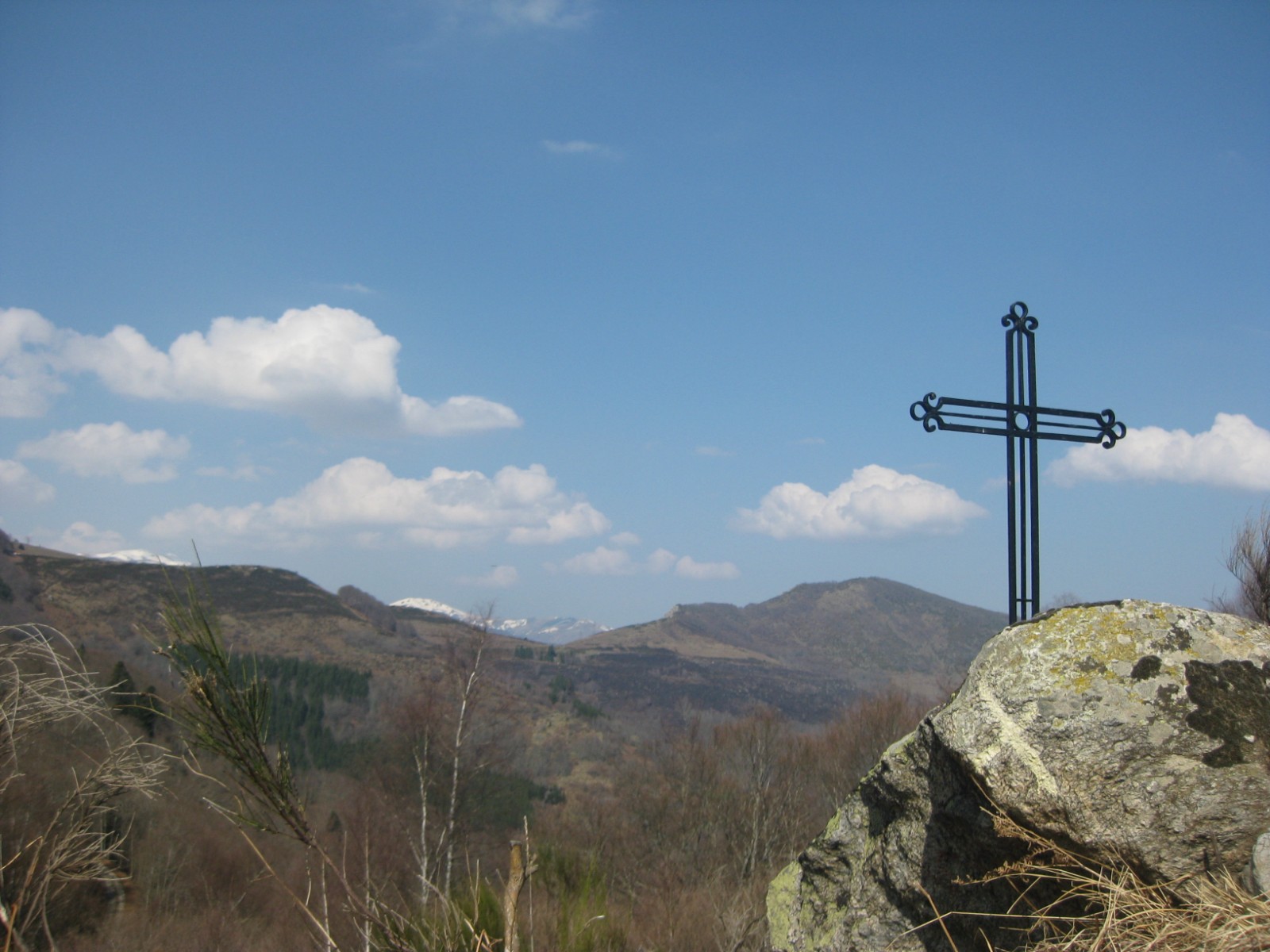
Such crosses - nearly all different - marked our route

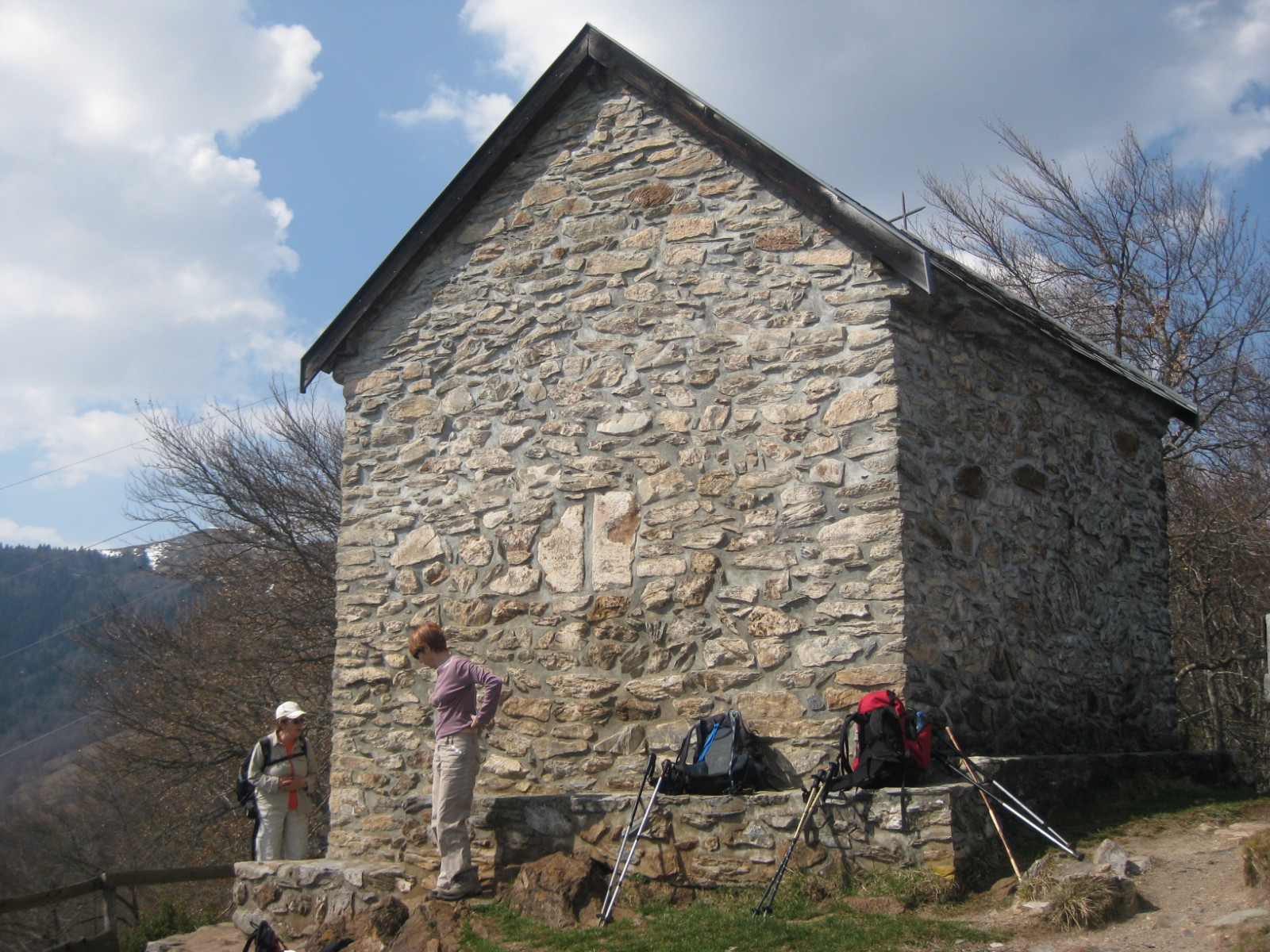
Our walk today was to the Chapelle de Saint Barthélemy, high in the Vallée d’Ax, beyond Tarascon.  We quickly realised we were on a pilgrimage route – our path was marked by decorative iron crosses.  But none of us knew why.  Now I know, and it’s a grisly story.

Back in 1854, cholera hit the area.  It’s hard to see how it spread in such a thinly populated region, where every settlement is surrounded by forest, fields and pasture.  Our drive up to the little village of Larnat, where we parked to begin our walk, was up and up a long single track road characterised by an unending series of hairpin bends – and no villages or farms on the way once we’d left the lower slopes.  The road to Larcat is up a similarly tortuous route. But despite this, cholera did arrive in the area, and when it struck, the people of Larcat didn’t hesitate to massacre the poor family responsible.  In time, the few survivors built a tiny chapel at the summit, dedicated to Saint Barthélemy, and promised an annual pilgrimage.  This chapel is a very simple windowless structure.  Some garden sheds are bigger.  It enjoys splendid views in every direction, and provided the perfect lunch-spot.

We arrive at the Chapelle de Saint Barthélemy
Cowslips en route

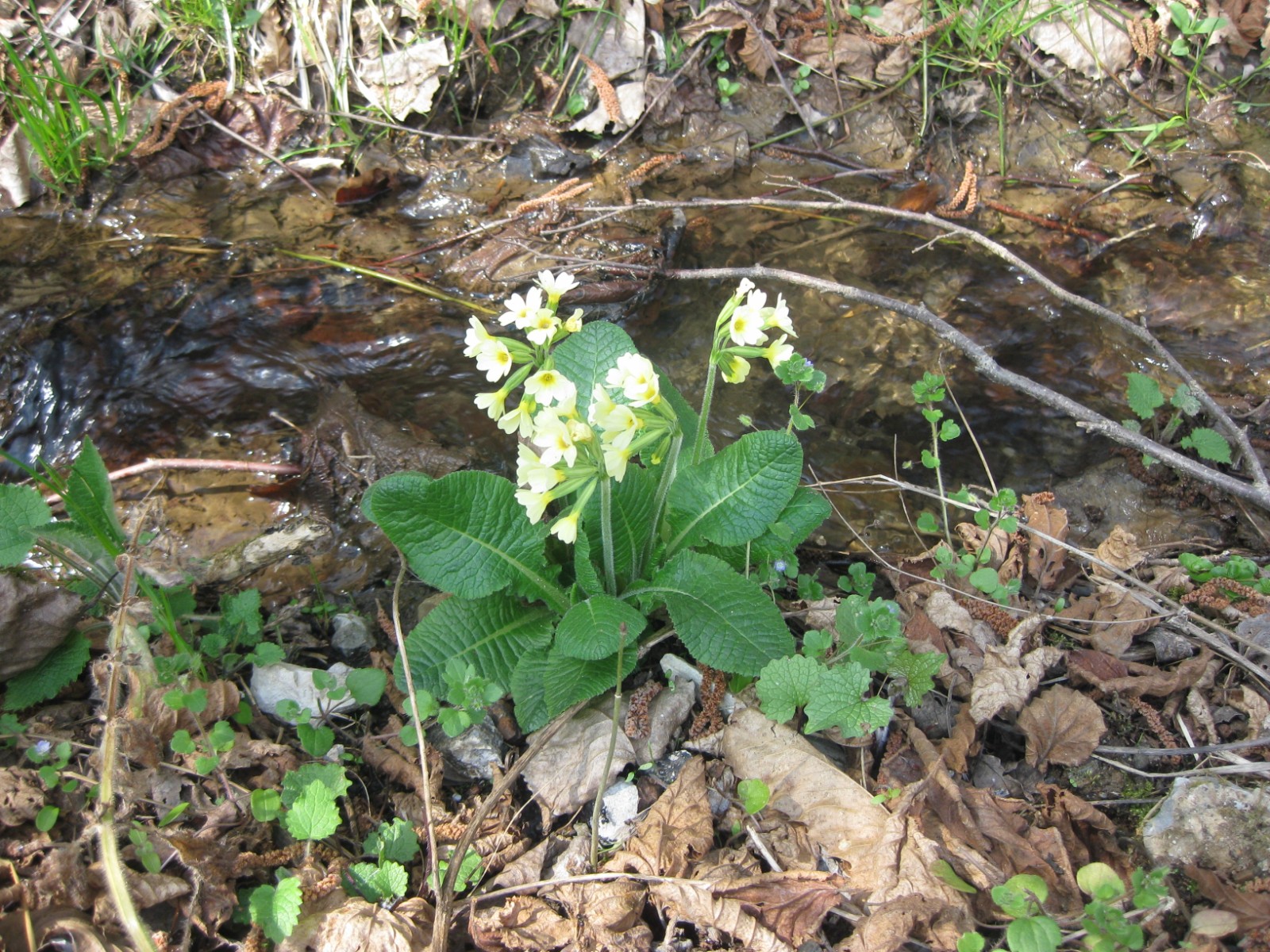
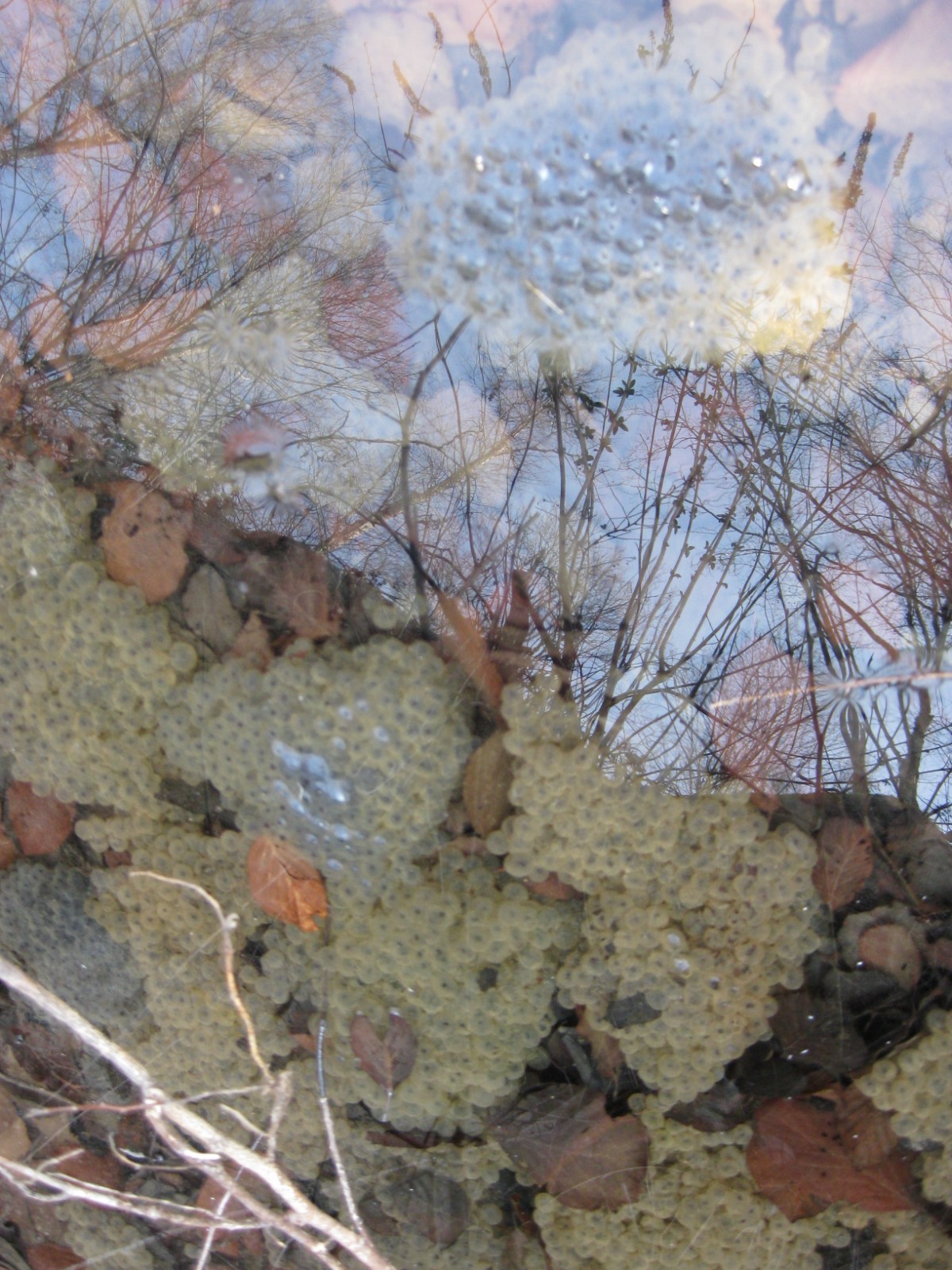
Ignorant of the bloody events that had caused the chapel to be built, we had a pretty easy feel-good walk.  The slope upwards was a gradual one, through forest tracks, emerging eventually onto an airy path commanding view of the mountains which surrounded us.  We had time to enjoy the emerging spring flowers –chiefly wood anemones and cowslips – and spotted several clumps of frogspawn.

Frogspawn en route

Did I know, Jean-Claude wondered, that when he was younger, it was quite common to see men staggering back from a country walk with hessian sacks stuffed not with the potatoes for which they were originally intended, but frogs destined for the market and then the dinner table?  I didn’t, and was glad to hear frogs are now protected and it’s illegal.  Apparently, though I’ve never seen them on the menu, frogs are still eaten.  Now however, they’re imported from China.

They certainly weren’t on offer today.  As usual, the day finished with tea and cake: much more welcome.

One of the views from the chapel

M et Mme Bibendum

Bibendum himself, or Michelin Man.

We want a job.  Not any old job.  We want a job that equips us with a Michelin book of maps, a decent lunch allowance, money for petrol, and a green felt tip pen.  We don’t even expect to be paid.

What we want to do is become Michelin Inspectors.  Not of Michelin starred restaurants – though perhaps they could send us to dine in one from time to time.  No, we want to inspect all their ‘green roads’, the ones they regard as especially scenic and maybe worth a detour.  And we want to make suggestions of our own,

The D6 for instance, from just outside Mirepoix to Castelnaudary.  How could that not be a green road?  The route twists and turns, echoing the contours of the wonderful rolling hillsides, with the most majestic of the peaks that the Pyrenees can offer as a distant backdrop.

The roads round Castelnaudary, all innocent of green route status

Or the D625, which brings you back from Castelnaudary another way.  Compared with those, some of the highways in the centre of France which are rated green are rather dull.  ‘Huh! Officially pretty?’ we snort, as we drive along the endless D 976 near Romorantin.

Really, they should give the job to us.  We know a route that’s worth a detour when we see it.  And we’re both pretty handy with a green felt tip pen.

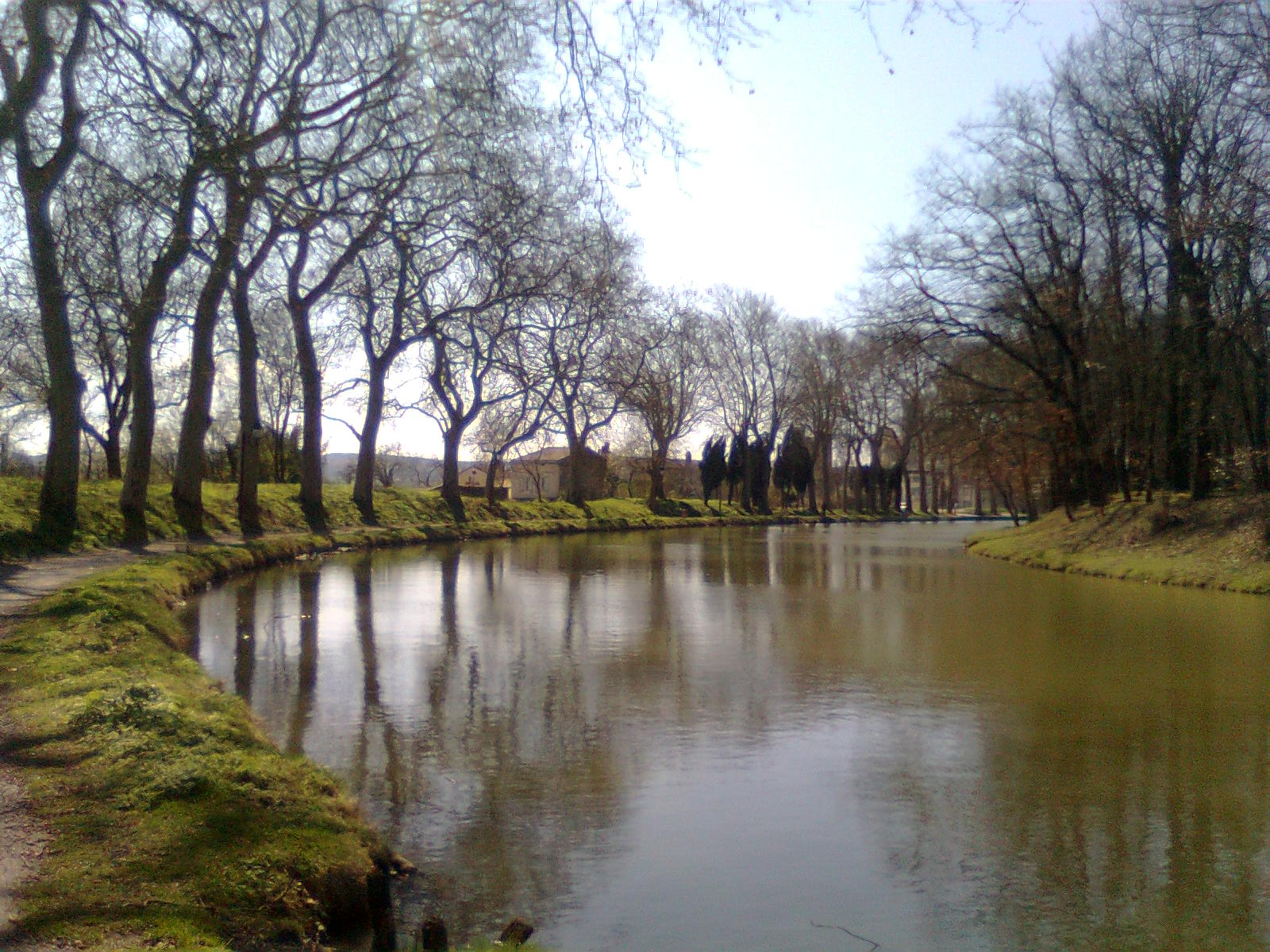
By the way, I forgot to take my camera with me on Friday when we drove along the above-mentioned D6 and the D625.  Please accept a view of the Canal du Midi in Castelnaudary itself in lieu.

Mufti *

Before I came to spend so much time in le fin fond de l’Ariège (‘back-end-of-beyond’ to you) I subscribed to the general British view that being well groomed and chic came naturally to the French.

Not so.  Frankly, looking as though you spend time studying the fashion pages forms no part of anyone’s life round here. Well, we’re a small country town here, so it’s scarcely surprising: but things don’t seem so very different in the bright lights of the department’s capital Foix (pop. 10,000), or the one Big City, Pamiers (pop. 19,000).

What’s surprised me though are the clothes worn by those people in service industries whose work brings them into contact with the general public.  In the UK, working for a bank, building society or even Marks & Spencer means that you’ll be fitted out with a uniform featuring a smart blouse or shirt at the least.  And men will be wearing ties.  School teachers don’t wear uniform of course, but their dress code requires them to be ‘smart-casual’ at the least, and yes, ties for the men.

Little of that applies here.  The only men I’ve ever seen wearing ties in France have been politicians or top businessmen making their mark on the TV evening news.  And the assistants in any pharmacy are as smart and carefully made up as the immaculately turned-out women who make me feel so inadequate as I pass the beauty counters in British department stores.  Neither of these groups represents the norm.

Calling into the electricity board recently we were greeted by a man whose T shirt indicated he might recently have been gardening.  Bank workers grab any old top and jeans before going into work.   The teacher who came with her class to the library the other day even had ripped jeans.  And of course her pupils were casually dressed too.

So it’s not surprising that when my friends call and spot the school photos of my grandsons, smart and smiling in their royal blue sweatshirts with neatly fastened ties beneath, they assume the boys frequent some rather posh private seat of learning.  ‘Nah’, I reply.  ‘Only the local school down the road’.  Opinions are divided then.  Some wish fervently that French children had to wear uniforms, to prevent the dreaded ‘designer-trainer syndrome’.  Others are aghast at the dreadful deprivation of liberty that forcing the children to dress alike represents.

I’m not bothered either way.  But it’s one of the things that we notice as we share our time between England and France.  Vive la difference!

Uniform, but not as we know it. Grandson Ben's football socks may take a little growing into

* Mufti, refers to ordinary clothing, especially when worn by one who normally wears, or has long worn, a military or other uniform. 

Plateau de Sault calling

Down here in the foothills of the Pyrénées, nobody’s interested in how far you walk as you stride up the mountainside.  It’s all about the DNV (dénivelé, or number of metres you’ve climbed – and remember a hillside can go down as well as up: coming up again after a descent starts the DNV counter all over again).  On Thursday, we did 791 metres.  That’s 2959 feet in real money.  Our mileage was less impressive:  19 km. or 11.8 miles – in the circumstances pretty damn’ good.

But we didn’t know the statistics till we’d finished.  We were far too busy having a very special walk.

To reach our departure point, you leave Belésta via a switchback forested road, over the Col de la Croix des Morts, and emerge onto a high and slightly bleak plateau.  This is the Plateau de Sault, home of the region’s potato growers.  We stopped at an insignificant track signposted Langrail and parked the cars.  As we got our boots on, we met another walker on a brief holiday from his home in Durban for a good long solitary hike (‘Durban?  Where do you suppose he meant?  Durban-sur-Arize in the Ariège?  The one in the Aude? South Africa even?’).  He was the last person we met all day.

It was the 14th March.  There were large patches of snow all along our route.  Yet we wore tee shirts all day and became lightly bronzed in the hot sun as we crunched through that still hard-crusted snow.  Through the forests we could see the peaks of our more local mountains: Maguy, born and bred round here taught us how to recognise each one.

Then, quite unexpectedly, we emerged into a splendid expanse of pasture interspersed with areas of snow.  In every direction, there was a distant fringe of mountains: our day-to day familiar slopes, the more distant and higher peaks of the Hautes Pyrénées,and behind us, bereft of snow, those of the Aude and Pyrénées Orientales. It was a really special pleasure to tramp across this apparently unending pasture, enjoying views of our constant neighbour Montségur, as well as the towns and villages where we all live, and much further away, the Montagne Noir, with the sky clear and blue above us.

It kept us happy till lunchtime.  We’d arrived at a refuge by then, thoughtfully provided with a table and benches in the sunshine.  After the picnic, we left our rucksacks with Gilbert, the honorary man in the group and went off to investigate the Belvédère, the local viewpoint.  Craggily folded rocks plunged down deep towards the Gorges de la Frau and still we had our views of Montségur.  We were impressed.

Our route for the day was a simple there-and-back.  But the views were quite different, looking towards more eastern slopes so we didn’t feel at all short changed that we were repeating our route.  And most of the return was downwards too.  Which was helpful.  When you’ve climbed 2000 feet or more, it can get quite tiring as the day nears its end.  Lucky that there was cake and tea to look forward to.

This slideshow requires JavaScript.
Apricot jam

There’s been discontent in the house.  No jam to go with the  fresh bread and coffee at breakfast time.  At this time of year, you can’t expect either the hedgerows or the market place to produce any suitable ingredients, so what to do?  Then I remembered my mother’s solution to winter jam crises, and a good one too.  Dried apricot jam.

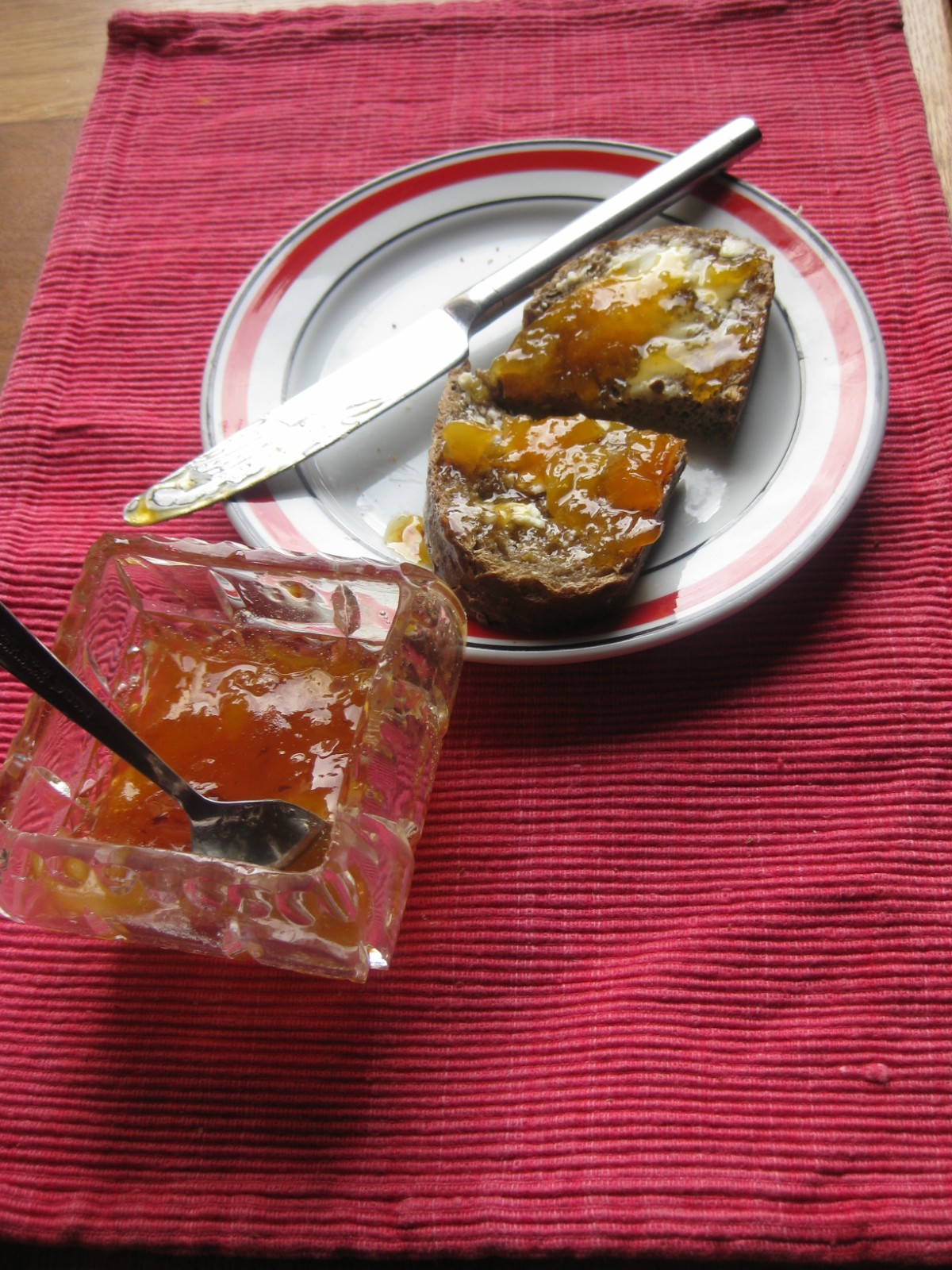
I remember that she used to use those dark, rich yet slightly tart and chewy fruits that needed long soaking and cooking to soften them, though I always used to prefer to eat them as they were.  Jam recipes recommend them still, but just you try buying them, even on Lavalanet market.  It’s all the plump pale soft style these days.  I was afraid these would deliver a slightly wishy-washy and anaemic jam so I added a few spices to the mix.  And here’s what I made:

Breakfast sorted.

Dried apricot jam

  • 500g dried apricots
  • 1 cinnamon stick
  • Seeds from 3 cardamom pods
  • A chunk of peeled fresh ginger
  • 500g caster sugar
  • A large lemon

Place apricots in a large bowl, cover with a litre of water and soak overnight.

Use a potato peeler to peel the zest thinly from the lemon: chop the zest into fine pieces.

Roughly chop the apricots, put them and the soaking liquid in a large pan with spices, bring to the boil, then reduce heat to low and simmer for 15 minutes. Add sugar and the juice from the lemon, and return mixture to a slow boil until jam setting point is reached (105 degrees C).  Remove the ginger chunk (I ate it).  Pour jam into about 3 sterilised jars.

Markets in Toulouse

We went to Toulouse yesterday, to visit the markets.  This wasn’t a trip to stock up the larder though.  This was a history lesson, as offered by Elyse Rivin, long term resident of Toulouse and great enthusiast for the city.  She is a full fledged official guide and art historian, and runs Toulouse Guided Walks.  We’d booked.

Minutes after we met, we found ourselves in front of Victor Hugo market.  You’ll go here for meat or fish, but also for all the other foodstuffs that markets do so well – fruit, vegetables, bread and patisseries, drinks.  At lunchtime you might pop up to the first floor to have a convivial meal at one of the several restaurants up there, all using fresh produce bought only an hour or two before from the stalls below.  This market, like every other in Toulouse bar one, is a concrete horror story.  Back in the late 1950’s and early 1960’s, they demolished the elegant iron and glass Victorian structures: they needed car parking space of course, and somehow contrived to squeeze car-parks-with-added-market onto those old sites.

Toulouse has had markets since way before the 12th century, and most had a speciality.  Victor Hugo’s (I’m guessing it wasn’t called that then) was wood.

We wandered along to the Capitole, the splendid central square of Toulouse.  Usually it’s an an elegant place, airy and inviting.  On Wednesdays it’s inviting for a different reason:  There’s a market: a big one.  Teeming with second-hand books, brocante of every kind, traders from every corner of the world……  And on other days, there’ll be organic food stalls instead.

I remember learning in history lessons how the streets of London were often taken over by particular trades – leather sellers, poulterers, bakers and so on.  So it was in Toulouse.  Many of these trade names have been lost, but there are still streets with the old Occitan names: the cauldron makers for instance.  And some trades hang on, in an unbroken line from the 12th century.  Rue Sainte Ursule for example, then as now, housed textile merchants.  These days that means clothes shops, textile wholesalers, even small scale manufacture.  This area is still named Quartier Bourse after the Bourse des Marchands (a trade association, an antecedent of the Chamber of Commerce).  In the 19th century a fine new neo-Classical building was built, and this is the Tribunal de Commerce, where trading disputes are resolved.

On to Esquirol.  Flour was measured here in a stone basin, by volume not weight, to prevent honest shoppers being short changed.  A beady eye was kept on those who attempted to ‘cut’ their flour with chaff, dustings of rye flour and so on.  Back in the middle ages, as now, white bread was prized.  No market here now, because back in the 19th century, several long straight roads – in this case Rue de Metz – were sliced through the city, laying waste anything in their tracks.  The market hall that was here has been rebuilt piece by piece at Lourdes, so you could go and see it if you liked, unlike all those other lost structures.

Next stop: a walk down down Rue des Filatiers.  I love this narrow street with its tall, elegant houses, many dating from the 16th century.  Take a look at the pictures.  And then we were at Carmes, originally home of the Carmelites.  The order eventually won a long battle with the city to be allowed to have a monastery in Toulouse.  What clinched it was when they assured the pope that their long ministry in the area of Mount Carmel gave them a unique possibility of converting the area’s small Jewish population.  The city fathers had to give in.

Carmes, like the other markets, is now a concrete box, instead of a complement to the smart 19th century character of this historic area.  But we were here to sample cheeses, guided by a local affineur, at a shop called Sena.  What this means is that the shop buys cheeses direct from the maker, and matures and ripens them to what it considers perfection.  Our guide for the occasion wanted to share three fairly local cheeses with us.  We had a young soft goat’s cheese ‘Cathare’, fresh and light, dusted with ash: this was 10 days old.  Our cow’s cheese, yielding, tasty and with a volcanic looking grey crust was 5 weeks old.  Best known was the Ossau-Iraty cheese, made from sheep’s milk from the Basque country and the Béarn, which had the most pronounced taste of all.  He paired these with fruits: raisins, candied kiwi, and almonds.  For tasting purposes, he explained, these are better than bread. We had a glass of the most local wine to Toulouse as well, Fronton.  This was a Négrette, low in tannin and acidity.

I talked to him about English cheeses.  He sells Blue Stilton, but I was alarmed to see, among all his hand-picked artisanal cheeses, a block of shrink-wrapped orange cheddar.  He told me that people bought it for barbecues, to put on cheeseburgers.  He had, he said, little incentive to stock English cheeses, which he knew could be very good, because the French would not buy.  Presented with shrink-wrapped cheddar, are you surprised?

Still, by now it was long past midday.  Back to Carmes to hunt for a lunch-stop, where we could discuss the morning over a leisurely plat du jour.

This slideshow requires JavaScript.
“Vaut mieux le vin d’ici que l’eau de là”

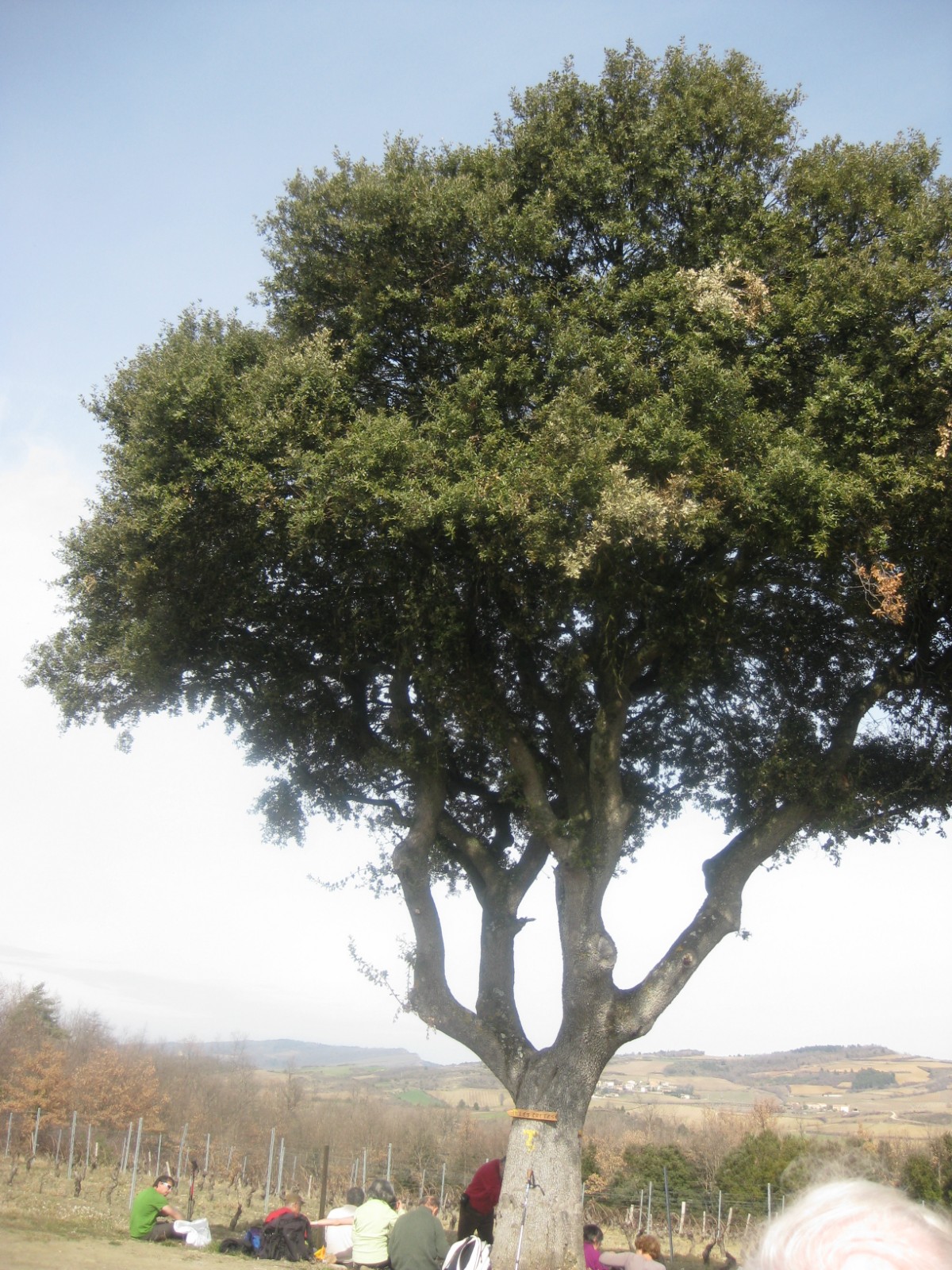
It was a walking day again yesterday – Malcolm too this time – this time with the new hiking group at Laroque.  The walk, again amongst vines, but in the more Spanish style garrigue around Esperaza, was relaxing and fun, but the highlight of the day was lunch.  We sat by a vineyard, either in the sun, or shaded by a shapely and statuesque holm oak tree, and unpacked our rucksacks.

Under the spreading holm oak tree we laid our picnics out.

For a picnic on a walk, most people put together a chunk or two of cheese and sausage, a bit of fruit, and stop at the boulangerie on the way to pick up some bread.  We all did that….but…. there was food to share too.

Phillippe, Sylvie and Jean-Charles opened wine.

Jean-Charles offered peanuts.

Michel produced home made charcuterie (dry cured sausage).

So did Phillippe and Sylvie (boudin blanc) – theirs was home made too.

They brought some of their daughter’s home made goats’ and sheeps’ milk cheese.

I made a drenched lemon cake.

Yvette made crisp chocolate biscuits.

Jean Charles brought an ‘artisanale’ fruit cake.

Then he came round with coffee.

And finally, Yvette offered plum eau de vie made by her grandfather in 1985. A little dripped onto a sugar lump and scrunched is the perfect end to a perfect picnic.

Then we all lay around in the sun for half an hour while we digested that little lot.

That’s the way to do it, eh?  And as everyone said, as we finally decided we ought to have a go at walking off all those calories, “Vaut mieux le vin d’ici que l’eau de là” : it’s better to have a drink among friends than to be no more for this world.

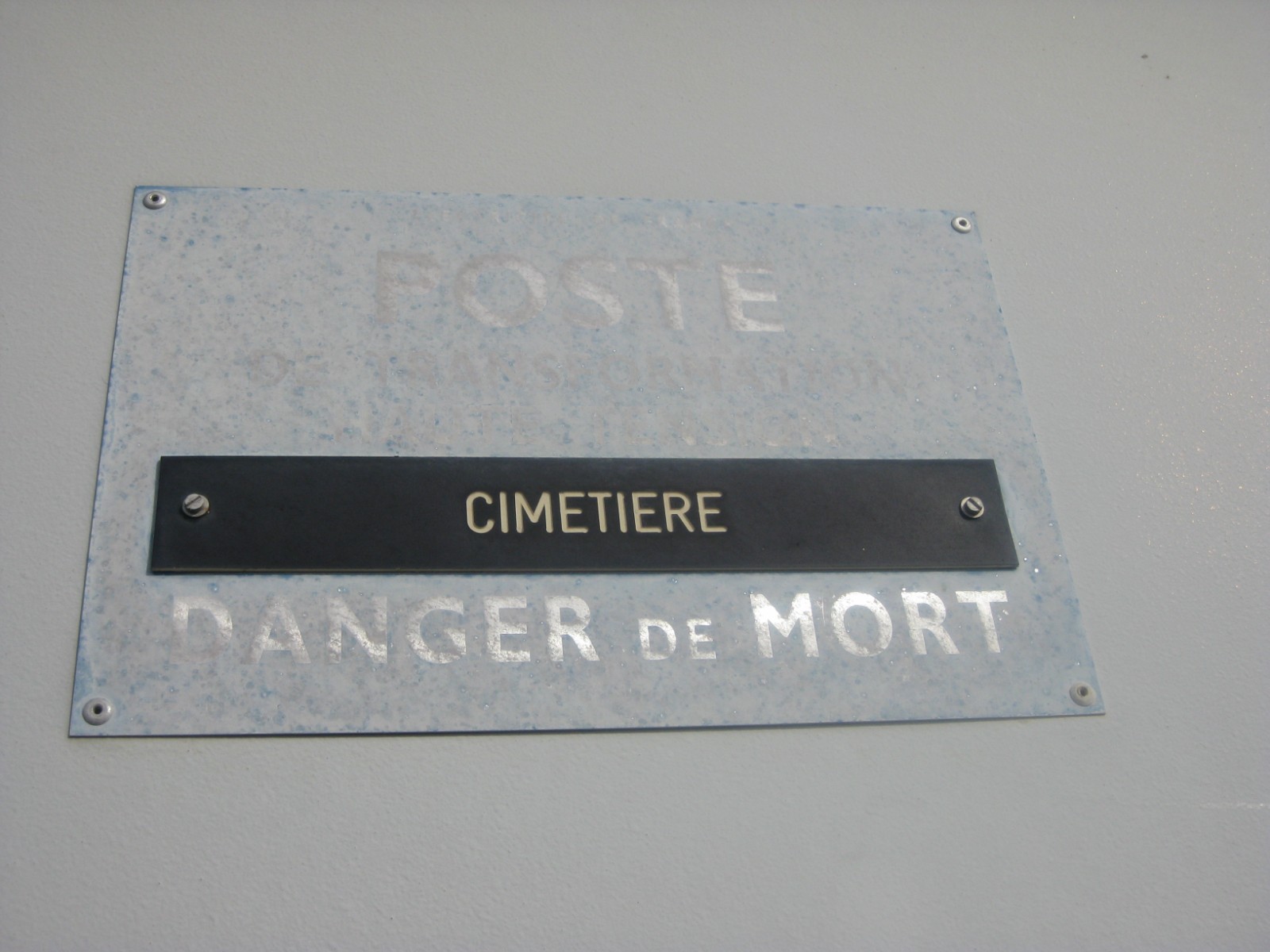
As we ended our walk, we found an electricity substation, handy for the graveyard, that reminded us that death is an ever-present threat.  Definitely a good thing to have shared that food and wine at lunchtime.

A walk from Cépie

Thursdays, I walk.  I do these days anyway.  A few weeks ago I was invited to join a small informal group from round these parts, went once, and had a great time.  Then The Great Snows came, and that was that for a while.

Yesterday, though, we went to Cépie, near Limoux.  Cépie is a village that Malcolm and I happened to be driving through several years ago in high summer, and where we spotted a fruit producer, selling peaches and nectarines.  Those peaches we saw that day have become the standard against which all others are measured.  Dripping with perfumed sweet juices, the tray we bought scented the car with its decadent fragrance, and all but intoxicated us as we drove home. So I was keen to go again, lack of peaches notwithstanding.

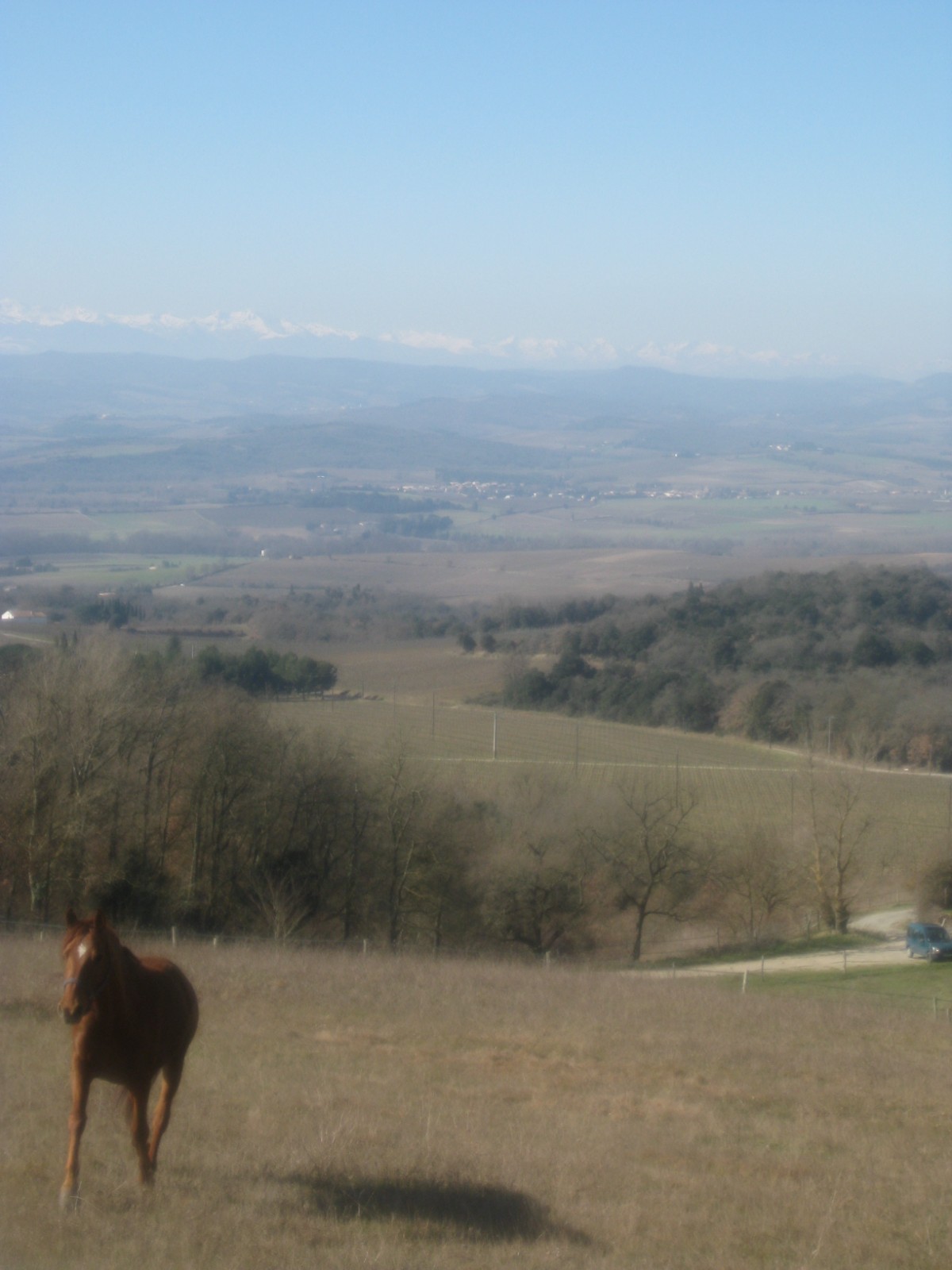
You'll struggle to see the snowy Pyrenees as the backdrop to this picture. They are there. Keep looking

Instead of peaches, there were views.  The Pyrenees are more distant here, but that means we got horizon-filling views of the gleaming snowy mountains as they rise and sink in a line of angular peaks, marching right across the skyline from east to west.  Because of the haziness of the day, the photos give no idea of the panoramas which we quite simply had to stop and gaze at, time after time.

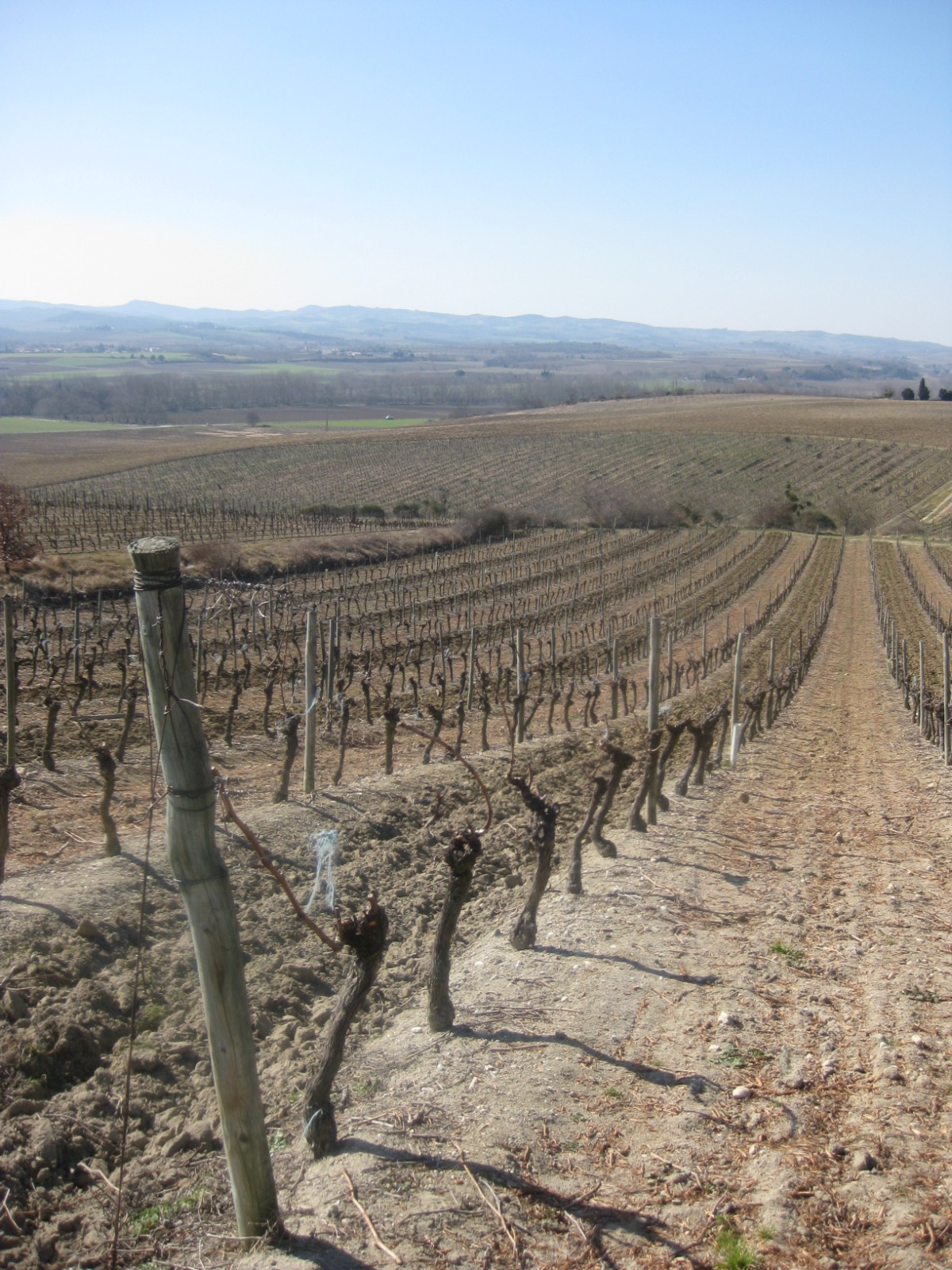
This area is Tuscan style Aude – rolling hills with distant domains and lines of cypresses, covered for acre after acre with mathematically precise lines of vines.  I used to find these vineyards rather dull in winter.

Notre Dame du Razès, protégez nous et protégez nos récoltes

Now, as the workers get busy in the fields, pruning away all the growth from the previous year to leave little more than a two or three foot high trunk, I enjoy the way these organised lines echo and follow the contours of the landscape.

Vineyards march across the landscape

Our walk took us in a figure of eight through sandy, stony wooded paths, passing near domaines and hamlets whose reason for being is those vineyards.  Towards the end, we paused in the tiny village of Saint Martin de Villereglan and enjoyed looking at the school-cum-town hall, the views down to the church, and generally pausing for breath before the final yomp up, then down the hill that divided us from Cépie.

A nice touch with these walks is that every week, one member of the group makes a special cake to share at the end of the day.  A lovely moment of sharing (in this case with a couple of passing villagers who got chatting), it gives a much needed calorie rush.  We’d only done about 16 km, but the local temperatures rose to more than 23 degrees, and we felt we deserved our gâteau aux noix.

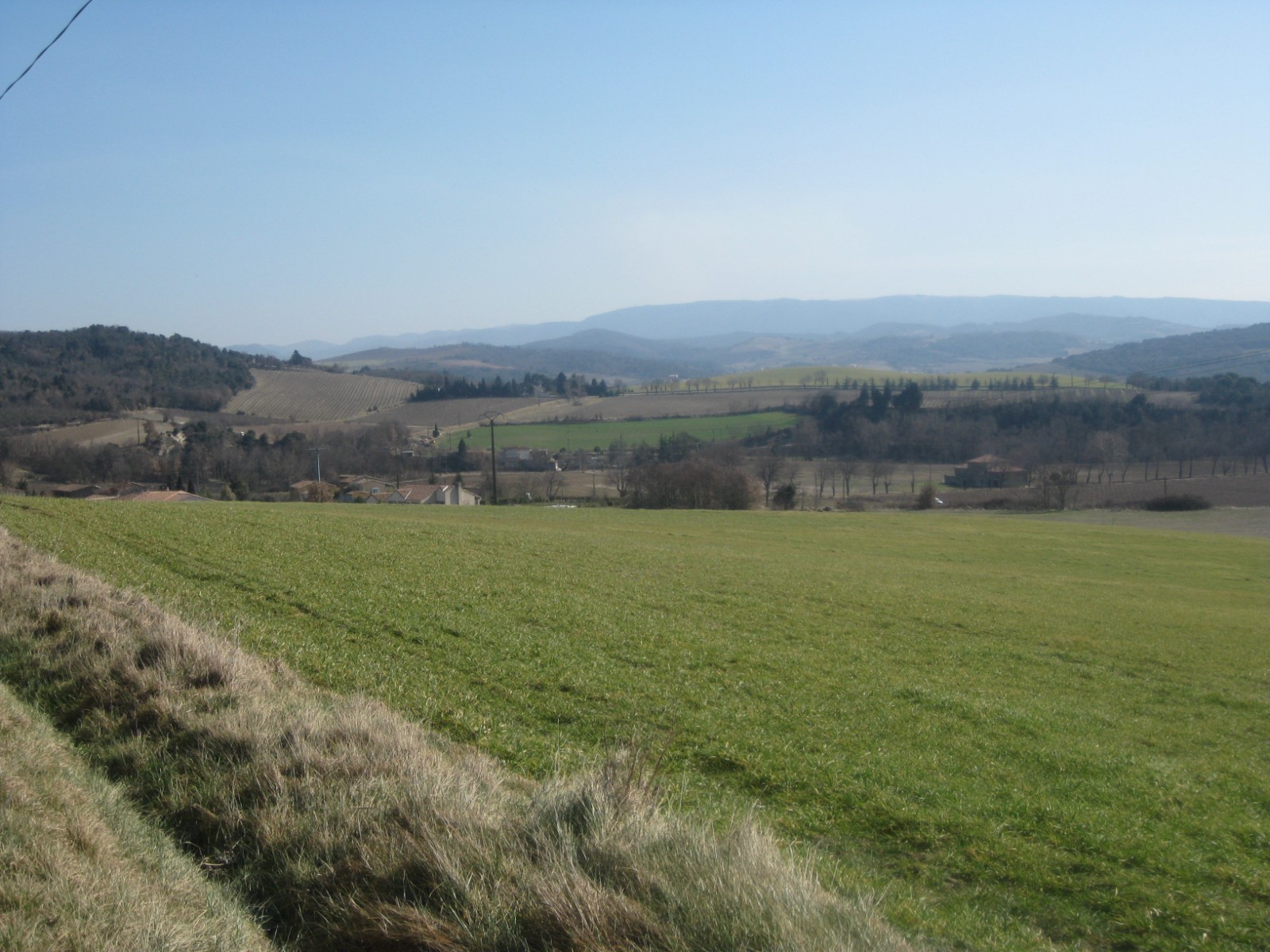
The homeward stretch