Our day out with John Rylands

Before we came back to France at the weekend, I wanted a day in Manchester, where I was at University more than 40 years ago.  It was a city people at that time seemed to love or hate.  I loved it then, and I still do.  It’s buzzy and busy, with galleries, music, shops, and a bravura display of civic Victorian architecture down every city centre street.
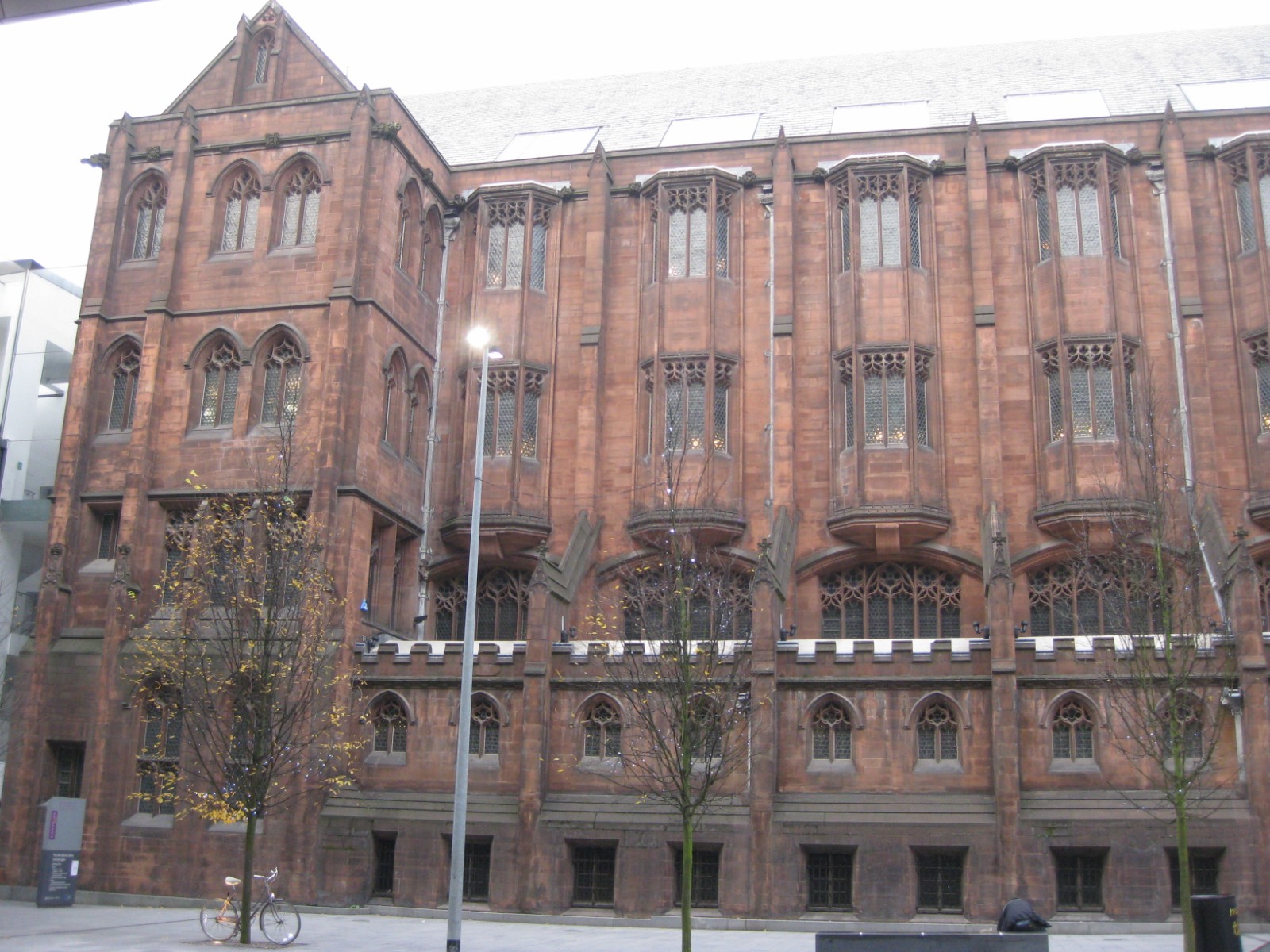
Outside John Rylands library

I had a particular memory I wanted to share with Malcolm.  The John Rylands Library.  I used to go there to write an essay or prepare for a seminar on those days when I wanted to pretend to some kind of scholarship that in truth was never part of my make-up.  The building was a celebration of Victorian Gothic architecture at its finest, with wonderful plaster tracery on the walls, splendid fan-vaulted ceilings, and shelf after shelf of ancient leather-bound books.  Seated in some darkened alcove, surrounded by the particular smell of the place – beeswax polish mixed with dusty books, I would work away for an hour or two, convincing myself, if nobody else, that I was getting down to the serious matter of studying in an industrious and creative manner.  Few other people would be there: there were no distractions other than the quiet beauty of the building itself.  The place was built for scholarship.
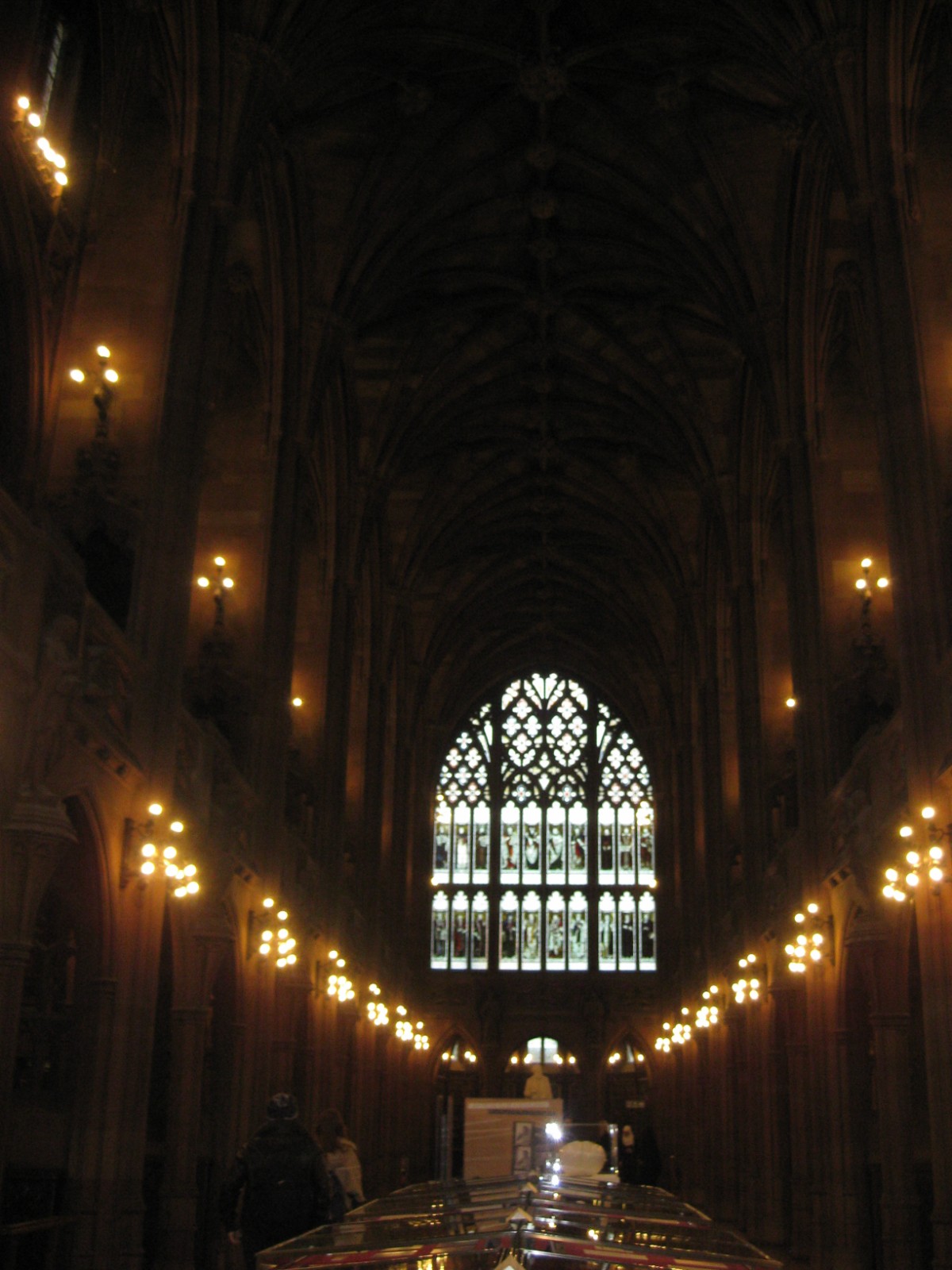
The reading room where I pretended to write essays.

It was built in the 1890’s by Enriqueta Rylands in memory of her husband John.  Although his origins were humble, he became Manchester’s first multi-millionaire, making his fortune in the textile industry as a cotton manufacturer.  At first, the library collection was modest, but over the years, has come to hold works of world-class importance: everything from the earliest known New Testament text, on papyrus, to medieval illustrated manuscripts, a Gutenberg bible, and the personal papers of the likes of Elizabeth Gaskell.
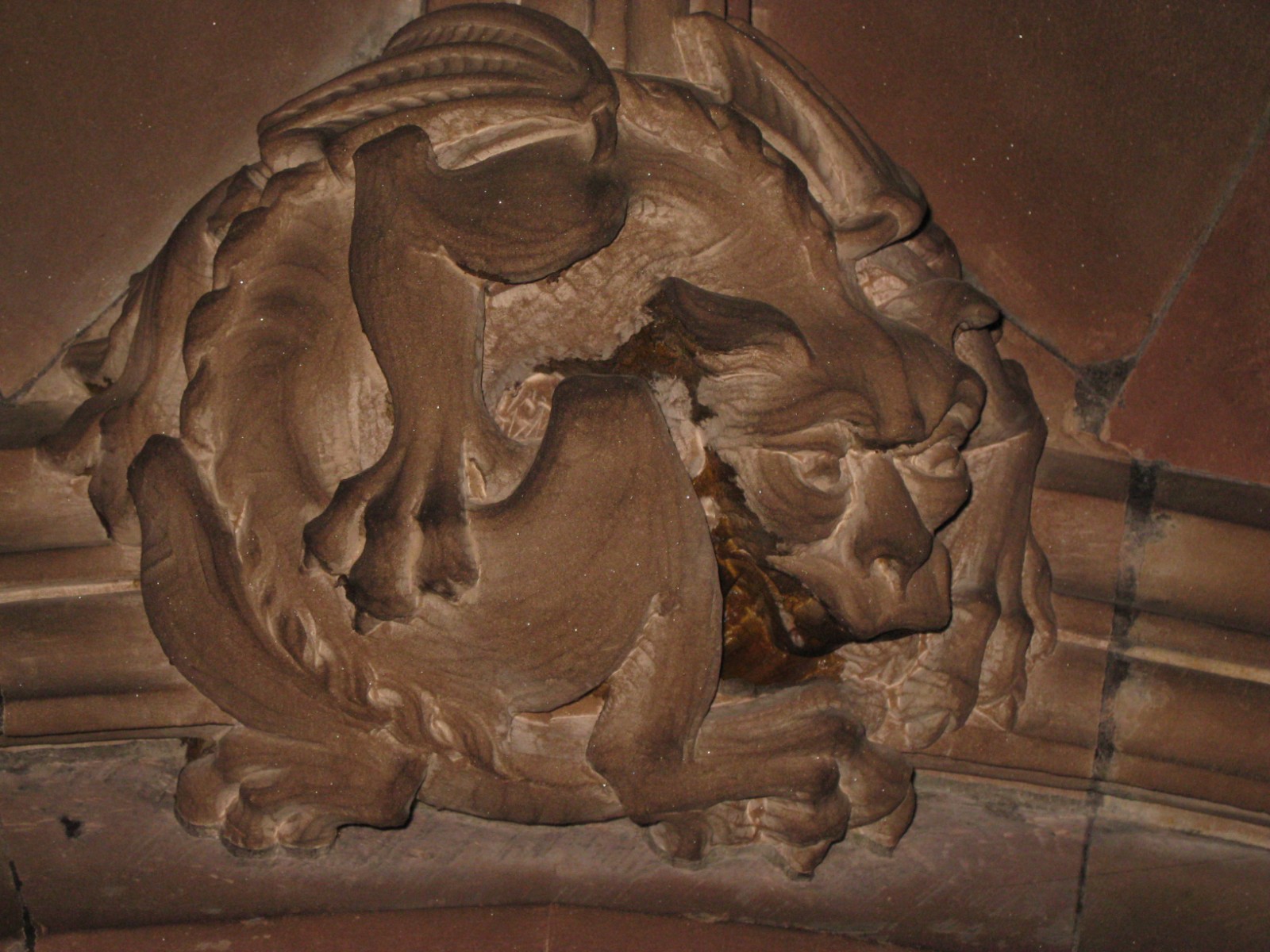
One of dozens of different fantastical creatures forming the roof bosses

I’m not qualified to comment on the early air conditioning systems, or the electricity originally generated on site.  I simply enjoy the richly patterned stained glass, the sumptuous woodwork, the dragons encircling ceiling bosses, and the sandstones in which the building is constructed, which range from soft pink to a rich dull red.
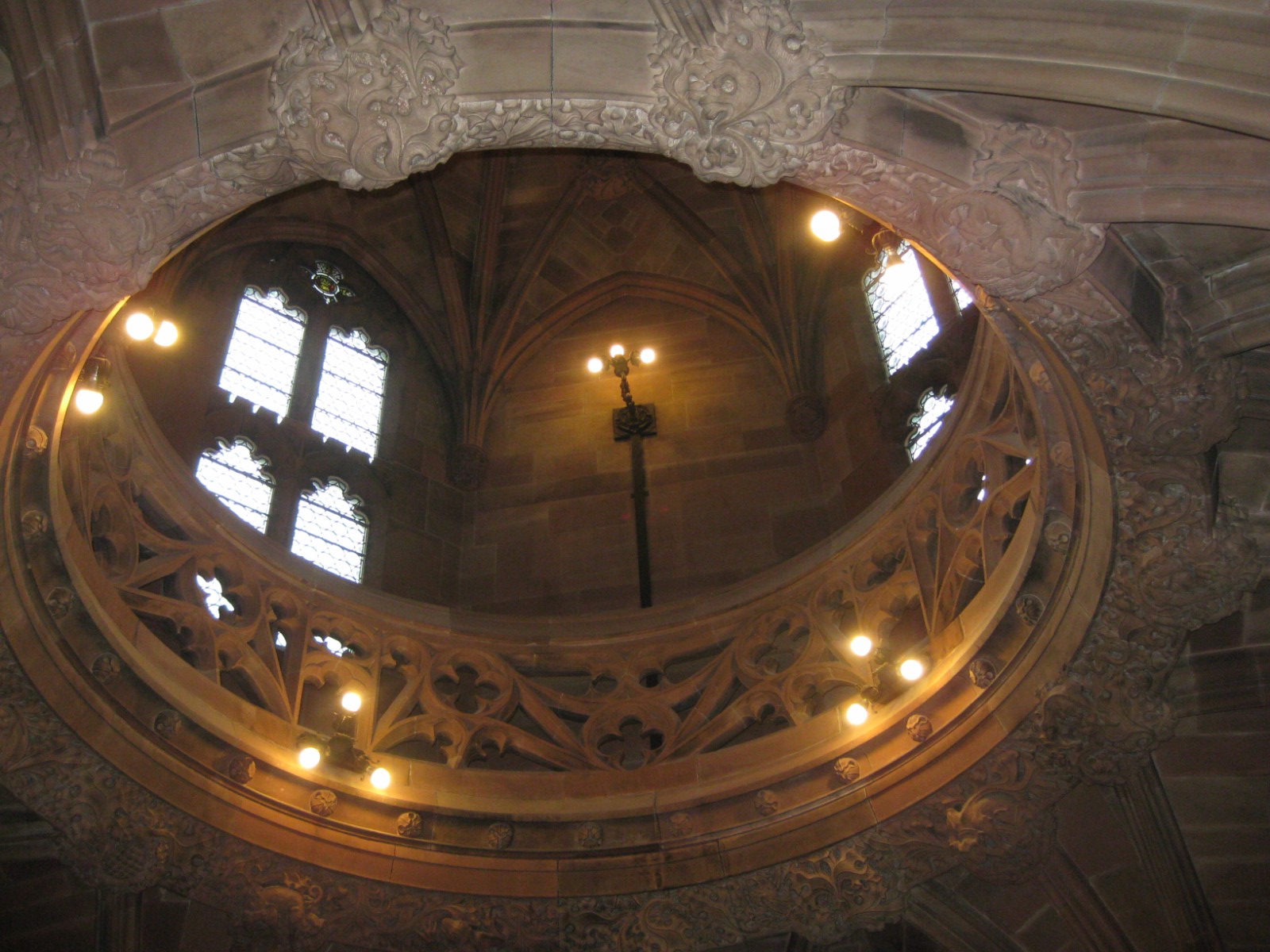
An upward glance whilst on a staircase

Back in the ‘60’s, I’d work till I got hungry, thirsty, or both.  Last week, we discovered that these days I’d have no excuse to leave, because there’s a modern extension sensitively joined to the side of the building.  This houses Café Rylands, where we had our lunch, made from locally sourced produce; a bookshop which, though small, presented us with fascinating choices, from architecture and design books to children’s stories; and an almost irresistible gift-shop.  It has an energetic and exciting programme of educational events, and I wished we could have signed up for some of them.
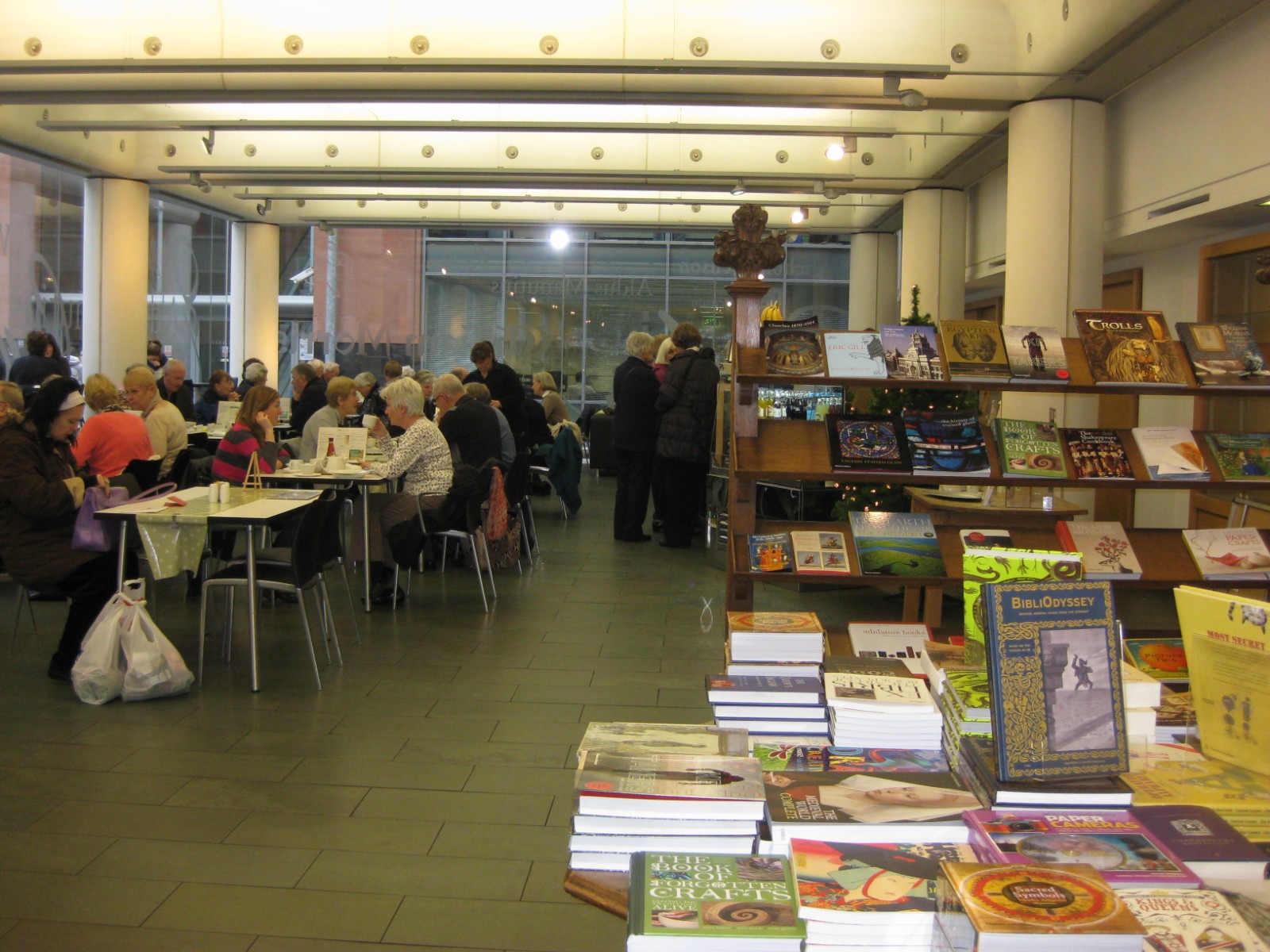
Café Rylands and the book shop

When I was a student in Manchester, the library was little known outside academic circles.  Now it’s a different story.  John Rylands Library has been made  Manchester’s ‘Large Visitor Attraction of the Year’ at the city’s annual tourism awards.  You could spend happy hours here, exploring the building itself, the exhibits, and making frequent sorties to the coffee shop for a relaxing break and browse through the papers.  And apart from your spending money, it’s all free.

Drop a coin or two into the donation box, and the automaton will go through its paces

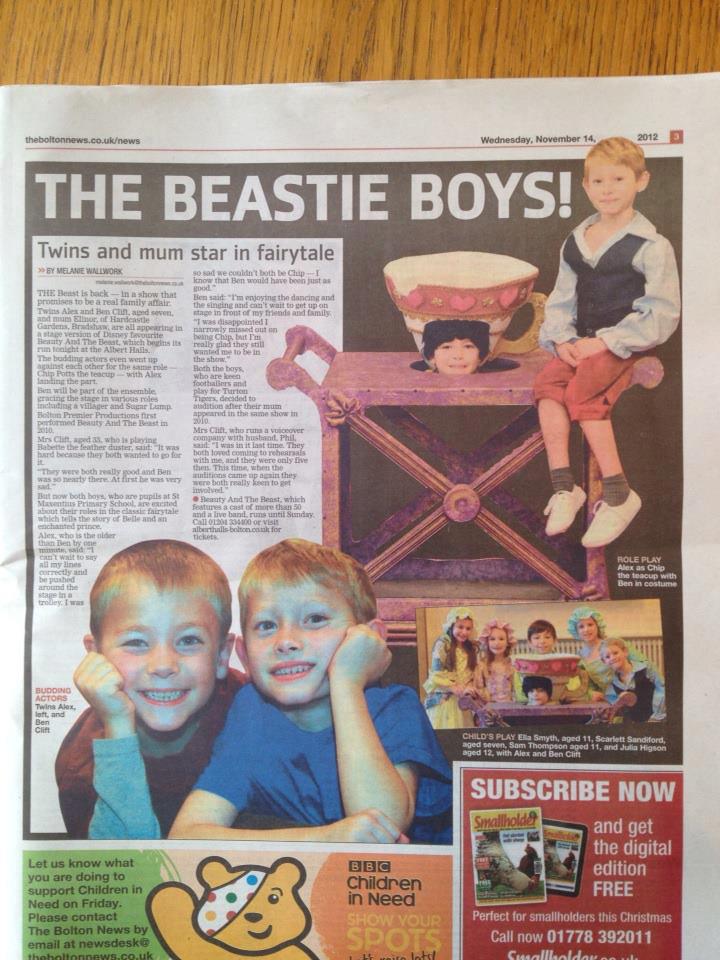
The page three ‘Beastie Boys’

The blog I was going to post has been pretty much written for me.  Here’s what we found on page 3 of the Bolton News this morning.

Page three boys

‘THE Beast is back — in a show that promises to be a real family affair.

Twins Alex and Ben Clift, aged seven, and mum Elinor, of Hardcastle Gardens, Bradshaw, are all appearing in a stage version of Disney favourite Beauty And The Beast, which begins its run tonight at the Albert Halls

The budding actors even went up against each other for the same role — Chip Potts the teacup — with Alex landing the part.

Ben will be part of the ensemble, gracing the stage in various roles including a villager and Sugar Lump.

Bolton Premier Productions first performed Beauty And The Beast in 2010.

Mrs Clift, aged 33, who is playing Babette the feather duster, said: “It was hard because they both wanted to go for it.

They were both really good and Ben was so nearly there. At first he was very sad.”

But now both boys, who are pupils at St Maxentius Primary School, are excited about their roles in the classic fairytale which tells the story of Belle and an enchanted prince.

Alex, who is the older than Ben by one minute, said: “I can’t wait to say all my lines correctly and be pushed around the stage in a trolley. I was so sad we couldn’t both be Chip — I know that Ben would have been just as good.”

Ben said: “I’m enjoying the dancing and the singing and can’t wait to get up on stage in front of my friends and family.

“I was disappointed I narrowly missed out on being Chip, but I’m really glad they still wanted me to be in the show.”

Both the boys, who are keen footballers and play for Turton Tigers, decided to audition after their mum appeared in the same show in 2010.

Mrs Clift, who runs a voiceover company with husband, Phil, said: “I was in it last time. They both loved coming to rehearsals with me, and they were only five then. This time, when the auditions came up again they were both really keen to get involved.” ‘

Thanks, Bolton News and reporter Melanie Wallwork.

Well, tonight we’re off to see the show – with all four of them: even Phil, Ellie’s husband, has his part to play.  He voices the ‘Ealth and Safety announcement at the beginning.  No wonder we had to come to England to be part of the audience.

What to do with a bag of foraged walnuts

Another set of recipes.  But these two walnut cake recipes are too good not to share.  The worst thing is shelling 175 grams of walnuts all at one go: but when the nuts have been foraged for free, it doesn’t seem right to complain.  So I won’t.

This first one isn’t something to knock together with only half an hour to spare, but it IS very good.  Thanks James Martin and the BBC Good Food website for this recipe,, which I’ve slightly simplified.

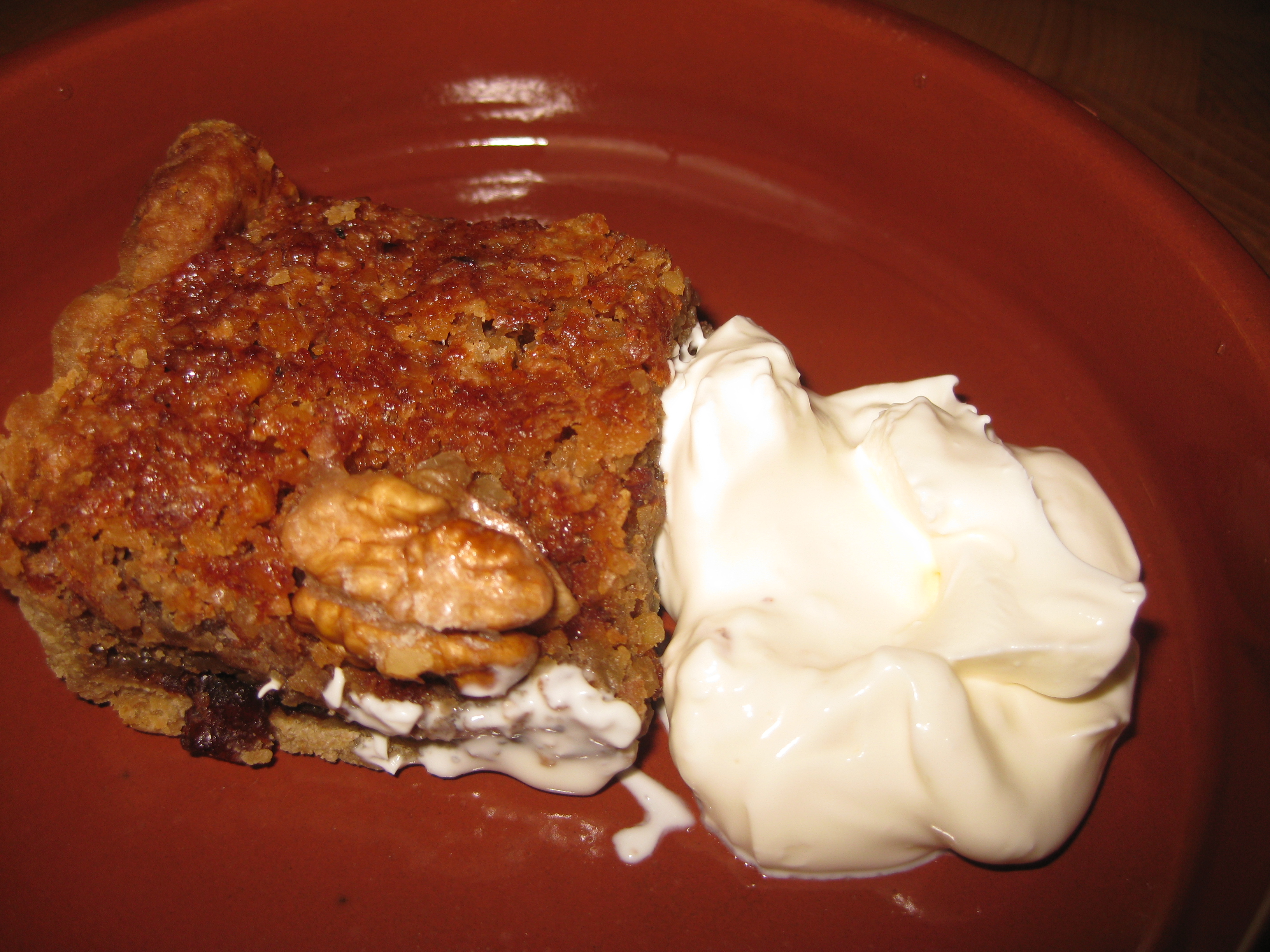
I forgot to photograph it till it was almost gone

Walnut and coffee frangipane tart with candied walnuts

Ingredients

For the tart

  • 500g sweet shortcrust pastry
  • plain flour, for dusting
  • 110g prunes, stoned, roughly chopped, soaked in Armagnac

For the frangipane

  • 175g butter, softened
  • 175g caster sugar
  • 4 free-range eggs
  • 3 tbsp strong coffee, cold
  • 175g walnuts, ground to a fine powder

For the candied walnuts 

  • 50g. caster sugar
  • 60ml. water
  • 18 walnut halves
  • 200g cream, to serve
  • Roll out the sweet shortcrust pastry on a floured work surface lightly dusted with flour to a 3mm thickness.
  • Carefully line six x 7.5cm deep-sided tart tins with the pastry, pressing the pastry into the edges of the tin. Leave 2.5cm of pastry overhanging the edge. Leave the lined tins to rest in the fridge for 10 minutes.
  • Line the pastry cases with greaseproof paper and then fill with baking beans or rice. Place the tart tins onto two large baking trays and bake in the oven for 10-12 minutes.
  • Remove the greaseproof paper and baking beans or rice, then return the tart cases to the oven for a further 5-10 minutes, or until they are pale golden-brown.
  • Remove from the oven and set aside to cool slightly. Trim the excess pastry with a sharp knife.
  • Meanwhile, blend the prunes with a little of the Armagnac in a food processor to make a thick paste.
  • For the frangipane, beat the butter and sugar together in a bowl until pale and fluffy.
  • Beat in the eggs, one at a time, beating well after each addition, until all of the eggs have been fully incorporated into the mixture.
  • Fold in the coffee and ground walnuts until well combined.
  • When the pastry case has cooled, spread the puréed prunes across the bottom of the sweet shortcrust pastry case. Top with the walnut mixture and smooth to the edges.
  • Return the tart to the oven for 15-18 minutes, or until the filling has risen and is cooked through and the surface is pale golden-brown. (The filling is cooked through when a skewer inserted into the centre comes out clean.)
  • Meanwhile, for the candied walnuts, place the sugar and water into a saucepan and bring to a simmer.
  • Add the walnuts and cook for a couple of minutes, or until just tender.
  • Drain and place onto a large sheet of greaseproof paper.
  • Carefully add the candied walnuts to the oil and cook for 1-2 minutes, or until just golden-brown.
  • Lift out and drain on a fresh sheet of greaseproof paper. Leave until cool.
  • To serve, place each tart in the centre of a small plate and top with a few candied walnuts. Finish with a dollop of cream.

Michel up the road gave me this recipe.   It’s a nicely moist cake which keeps and freezes well.

Walnut cake Amafaçon (my way)

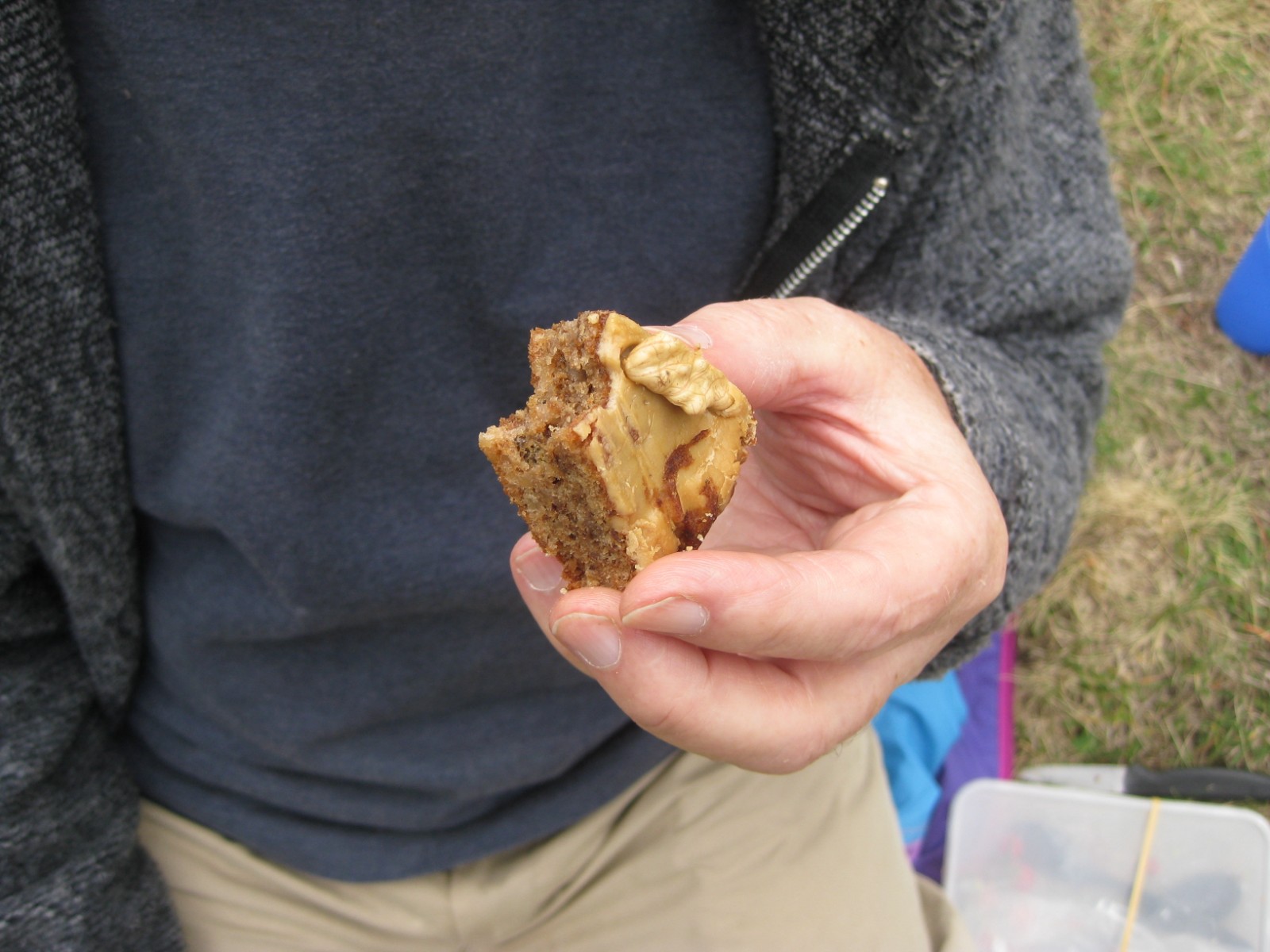
Mal puts away a slice of walnut cake on our walk to Bésines

 Ingredients    

180g. finely ground walnuts

30g. SR flour

12g. cornflour

4 eggs

120g. caster sugar

100g. butter

½ glass walnut liqueur, rum, or alcohol of choice

Pinch of salt

Preparation :

  • Heat the oven to 200°C
  • Mix half the sugar with the ground walnuts.
  • Mix the remaining sugar with the softened butter and add the walnut mixture.
  • Add 2 whole eggs one by one, and 2 yolks, one by one.  Mix well then add salt, flour, cornflour and liqueur.
  • Beat the 2 egg whites to soft peaks, and fold into the cake mixture.
  • Pour into a well-greased 22cm cake tin and bake for 35 minutes at 200°C .  The cake’s cooked through when a skewer inserted into the centre comes out clean.
    For a 24 cm. cake tin, bake for 50 minutes at 180°C.

Serve it just as it is, or if you’d like something more elegant,

  • ice with a strong coffee icing or
  • decorate with caramelised walnut kernels and a caramel sauce made with 150g. sugar caramelised in a thick-bottomed saucepan to which you add 30 g. of salted butter and 50ml. single cream.

A very English Sunday walk

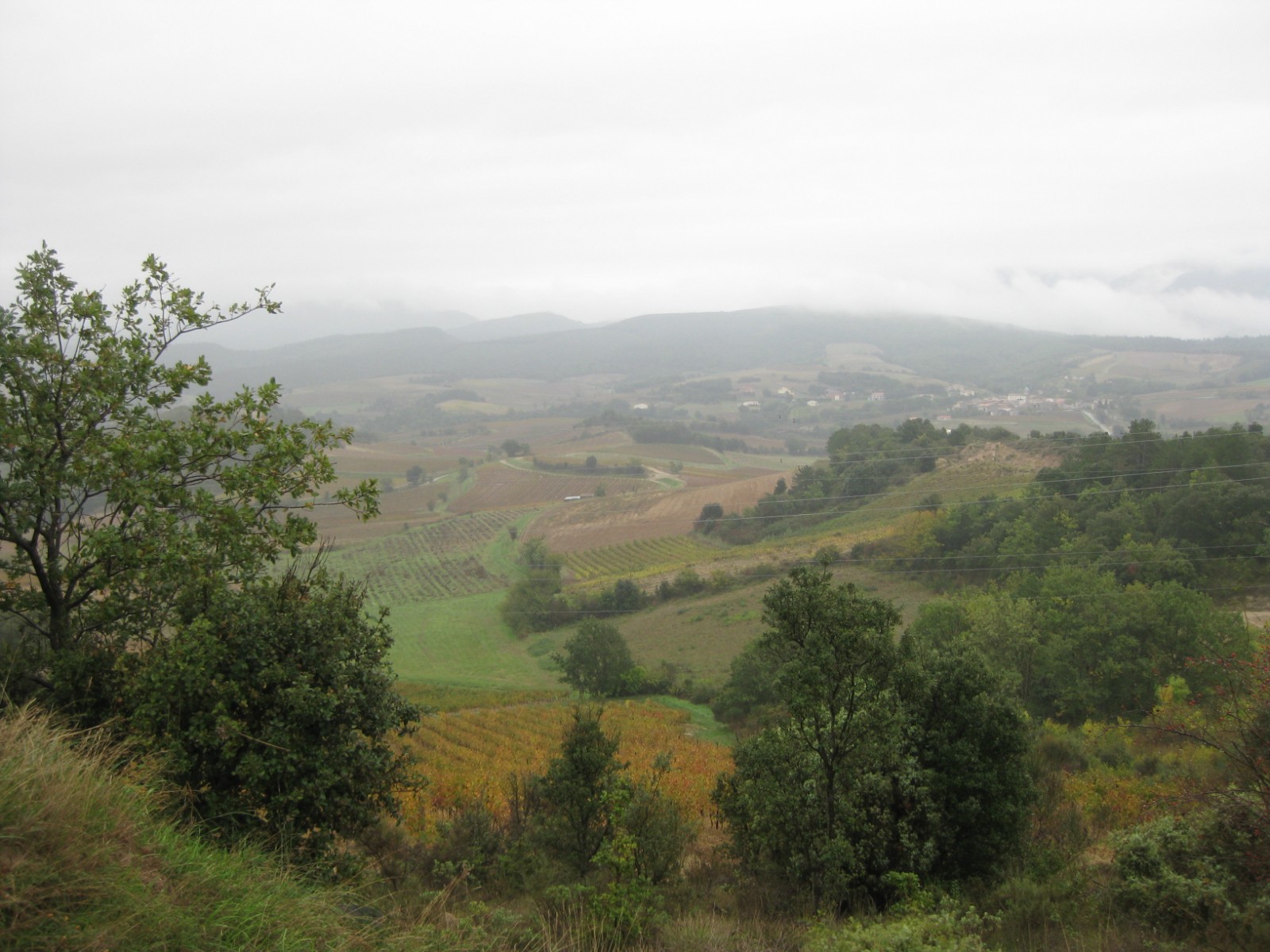
If you go on a walk near Limoux in the Aude at this time of year, you’re entitled to scenery like this:

Vineyards near Villar -St-Anselme

In our walking group here in Laroque we all take turns to organise the weekly outings.  And this week, it was the two of us, the only English, who were in charge. We decided on an autumn walk among the vines round Saint Polycarpe, near Limoux.  The weather forecast wasn’t great, but the rain promised to hold off till 3 o’clock.  But no.  English leaders, English weather. Think of us plodding through the mud as the rain increased in intensity, long long before 3 o’clock arrived.  Everyone blamed us, of course.  They think this is the only kind of weather we know, back in England.

It all began so well….

Above Saint Polycarpe, 10.00 this morning.

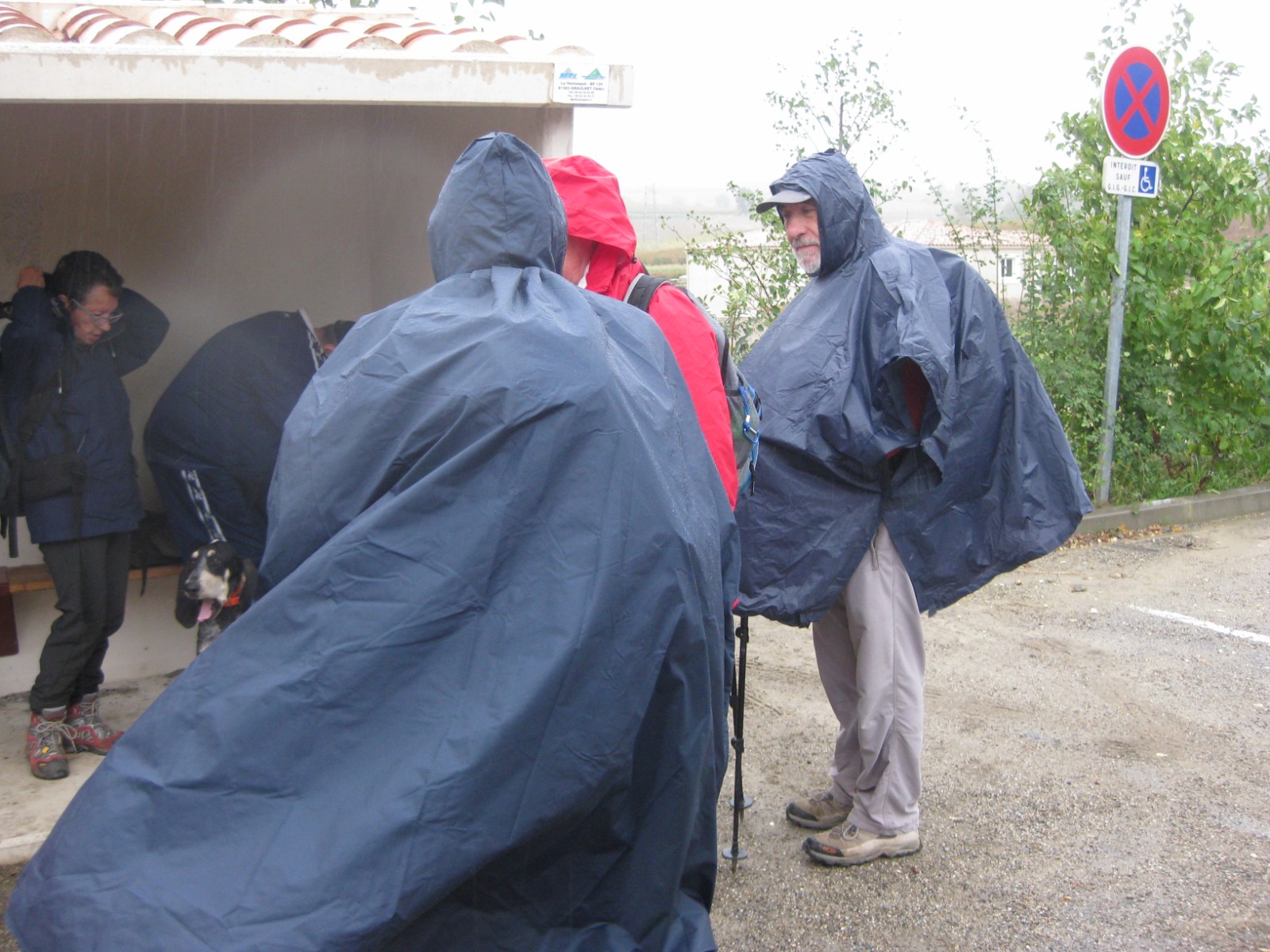
Lunch was early, at Gardie, but we didn’t beat the rain.  We had our break in the bus shelter, for goodness sake, and got togged up like this immediately after.

The clouds descend…..

And the gloom.

Can’t see much.

Saint Polycarpe’s down there somewhere…

Still, nobody complained.  We got our fresh air and exercise, and our friends had a thoroughly good time holding us responsible for the rain and mud.

PS.  Dangermouse update.  We caught him last week.  He is no more.  He was a rat.  Eurghhhhh.

What to do with a Hallowe’en pumpkin

Hallowe’en.  Pumpkin season.  Every fruit and veg stall in the markets here will have  red kuri, ‘le butternut’, or acorn squash at the very least, and there are those dedicated to selling nothing but the rich variety of squash, pumpkin and gourd you can grow here.  Kalba gave me this butternut squash some 3 weeks ago, grown in their own garden.

The butternut makes a bid to take over the fridge

It weighs in at more than 7 kilos.  More than a stone!  We’ve been chomping our way through it, but see how much remains.  What’s worse: Malcolm has just owned up to not caring for pumpkin very much.  How could he not like it?  That comforting sweetness works so well with the saltiness of bacon, the heat and colour of chillies and oriental spices, or the fatty unctuousness of cheap cuts of meat and sausages.  Well, his loss.  Here are two of my current favourite dishes, both courtesy of Nigel Slater, from Tender, Volume 1, you may not be surprised to hear.

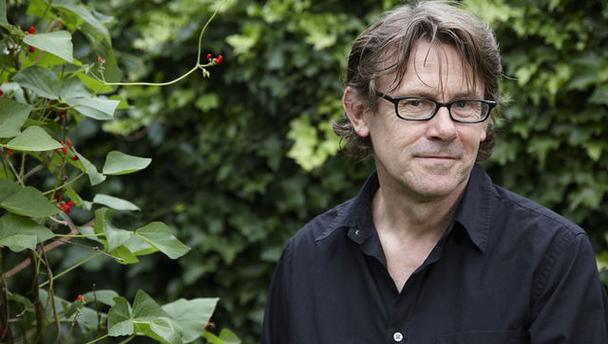
A recent BBC photo of Nigel Slater

Pumpkin laksa

Nigel says this is for a cold night.  Well, it is.  But it’s also a fine thing to dish up on a hot day after a gruelling few hours physical labour.  It looks complicated, but it isn’t.  Take a deep breath and read it slowly: tackle the pumpkin, then the spice paste; the rest just falls into place.

Ingredients

350g. pumpkin, unskinned

coriander and mint leaves to finish.

For the spice paste:

red bird’s eye chillies, 3-4

garlic- 2 cloves

ginger, a thumb sized lump

lemongrass, 2 plump stalks

coriander roots, 5 or 6 coriander leaves, a handful

sesame oil, 2 tablespoons

For the soup:

chicken or vegetable stock, 600ml

coconut milk, 400ml

nam pla (thai fish sauce), 2 tablespoons

tamari, 1-2 tablespoons, to taste

the juice of a lime

100g dried noodles, cooked as per packet and drained.

  • Peel and seed the pumpkin and cut the flesh into large chunks. Cook in a steamer or a metal colander balanced over a pan of boiling water until tender. remove from the heat.
  • For the spice paste, remove the stalks from the chillies, peel the garlic, peel and roughly chop the ginger and lemongrass. Put them all into a food processor with the coriander roots and leaves and sesame oil and blitz until you have a rough paste.
  • Get a large, deep pan hot and add the spice paste.  Fry for a minute, then stir in the stock and the coconut milk and bring to the boil.  Allow to simmer for seven to ten minutes, then stir in the nam pla, tamari, lime juice, pumpkin and the cooked and drained noodles.  Simmer briefly, add the coriander and mint noodles over the top, and serve in deep bowls.

And now for something completely different…..

Pumpkin and Apple fry-up:

either to accompany a meaty supper, or as a main dish in its own right.

Ingredients

a little butter

80g. fatty bacon

medium onion

650g. pumpkin flesh

400g. apples (Nigel says a desert variety.  Mine were very tart, and I thought all the better for it)

a lemon

caraway seeds, a pinch

  • Melt a slice of butter in a shallow pan, cut the bacon into short strips and let them colour lightly in the butter.
  • Peel and roughly chop the onion, add to the pan and allow to cook with the bacon until translucent but not browned.
  • Cut the pumpkin flesh into manageable pieces and add to the pan, turning from time to time till golden in patches and almost tender.
  • Core and roughly chop the apples, but don’t peel them. Stir them into the pan and leave to putter gently until they are on the verge of collapse. Avoid stirring too much, which is likely to mash the softening pumpkin.
  • Finely grate the zest from the lemon and add it to the pan with the juice, the caraway seeds and a little salt.

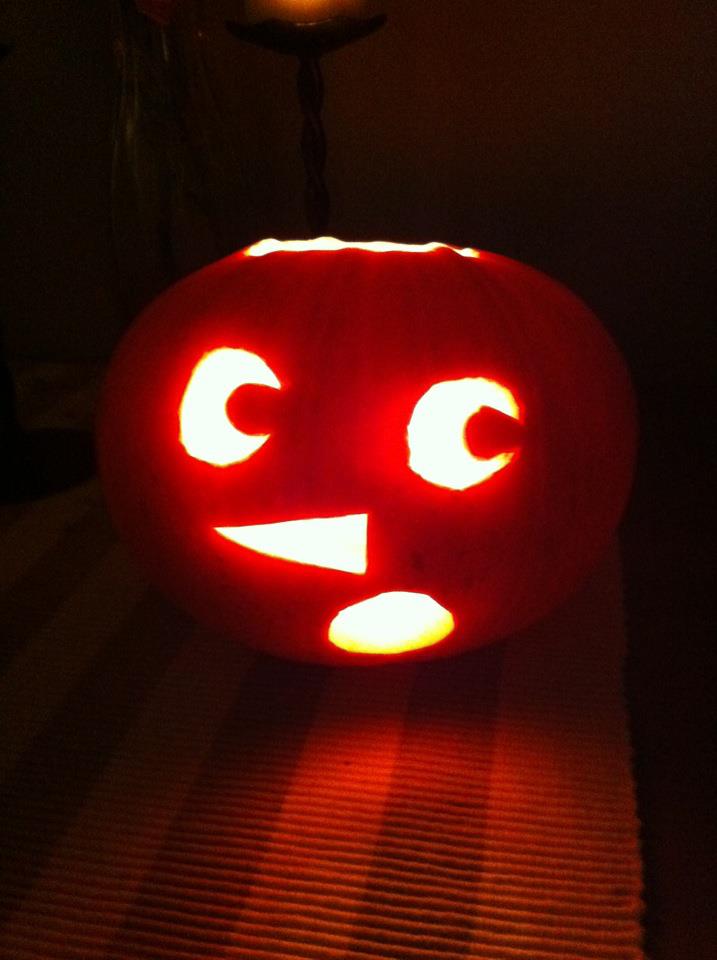
    But wait! Isn’t this what pumpkins are supposed to be for? My son obviously thinks so, and took this photo to prove it. Though he’s a dab hand at cooking too.

PS.  Some of you have been asking about Danger Mouse.  Well.  He’s not a mouse – too big, too cuddly.  He’s not a hamster, as we at one point thought.  Long tail.  He’s not a dormouse.  Wrong sort of tail.  And he’s not a rat.  Too small, too cuddly.  However, he’s continuing to be part of life here.  He rises at about 8.30 p.m. and organises his furniture behind the skirting boards, shoving stuff about quite noisily.  Then he knocks off and has a nap till we’ve gone to bed.  During the night he dismantles  the latest humane trap, and eats the bait.  In the small hours he may come and scurry round the floorboards under the bedroom.  Then he goes to bed until the next night.  If he ever goes, I think I shall miss him.

‘All is safely gathered in, ere the winter storms begin’ *

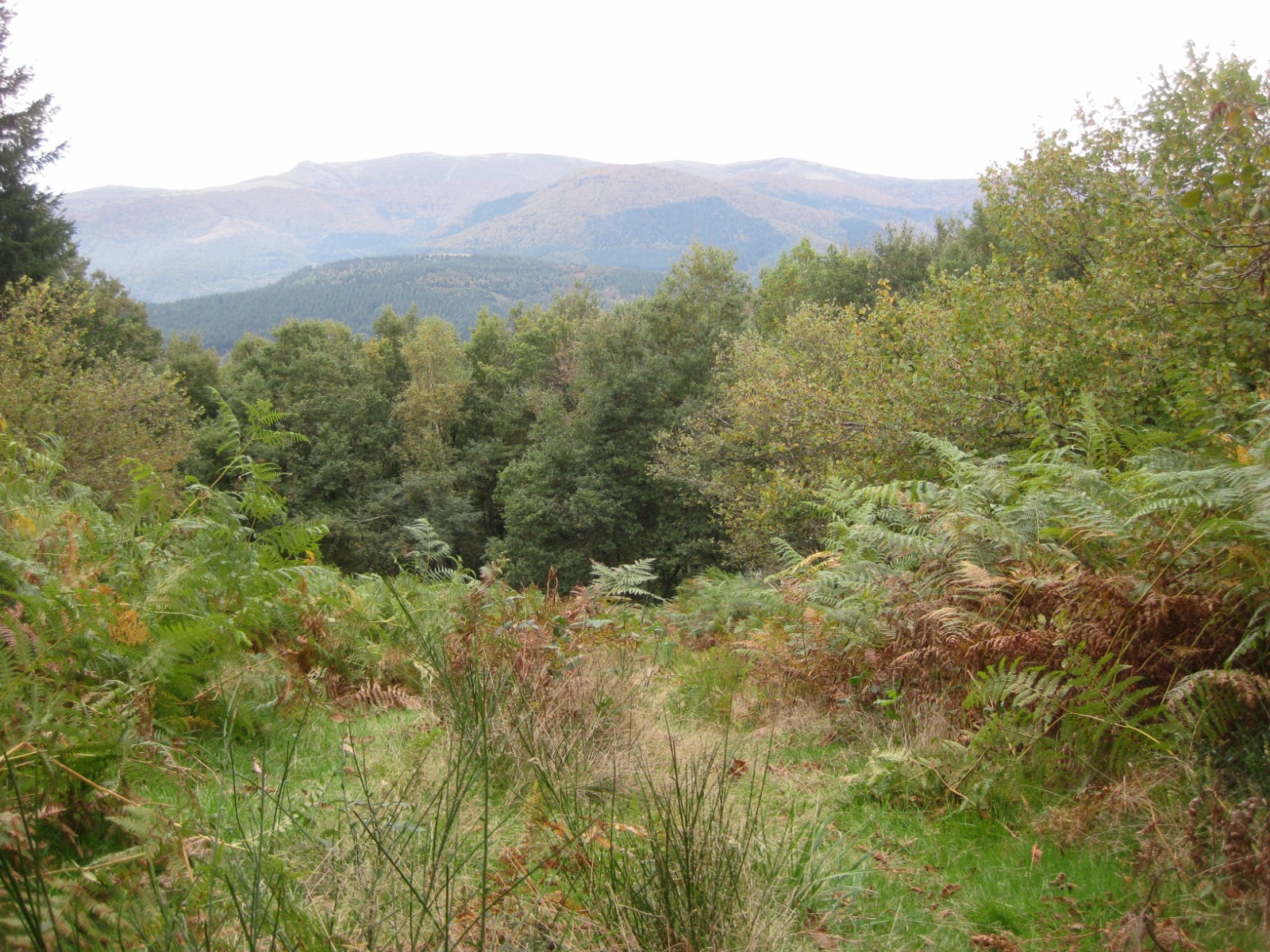
Autumn colours beginning means it’s harvest time for foragers

I’ve written before about the ‘au cas où’ bag: the carrier you always have with you on a walk, ‘just in case’ something tasty turns up and demands to be taken home and eaten.

Well, at this time of year, it isn’t really a case of ‘au cas où’ .  You’re bound to find something.  A fortnight ago, for instance, Mal and I went on a country stroll from Lieurac to Neylis.  We had with us a rucksack and two large bags, and we came home with just under 5 kilos of walnuts, scavenged from beneath the walnut trees along the path.  A walk through the hamlet of Bourlat just above Laroque produced a tidy haul of chestnuts too.

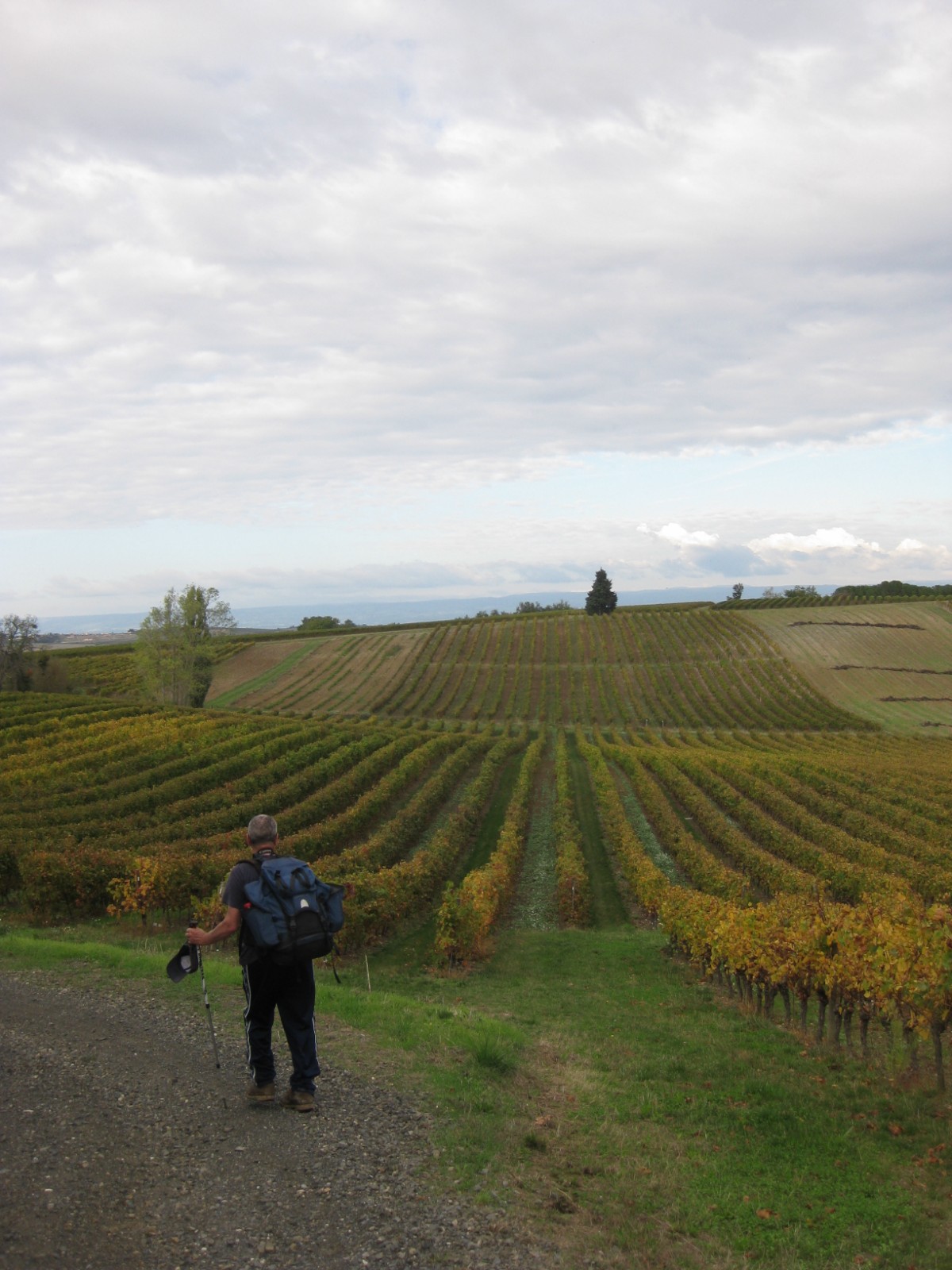
Yesterday, we Laroque walkers were among the vineyards of Belvèze-du-Razès.  The grapes had all been harvested in the weeks before, but luckily for us, some bunches remained on the endless rows of vines which lined the paths we walked along.  We felt no guilt as we gorged on this fruit all through the morning.  The grapes had either been missed at harvest-time, or hadn’t been sufficiently ripe.  They were unwanted – but not by us.

So many vines: there’ll be unharvested grapes there somewhere.

The walnuts we’re used to in the Ariège are replaced by almonds over in the Aude.  You have to be careful: non-grafted trees produce bitter almonds, not the sweet ones we wanted to find.  But most of us returned with a fine haul to inspect later.  Some of us found field mushrooms too.

Today, the destination of the Thursday walking group was the gently rising forested and pastoral country outside Foix known as la Barguillère.  It’s also known locally as an area richly provided with chestnut trees.  Any wild boar with any sense really ought to arrange to spend the autumn there, snuffling and truffling for the rich pickings.  We walked for 9 km or so, trying to resist the temptation to stop and gather under every tree we saw.  The ground beneath our feet felt nubbly and uneven as we trod our way over thousands of chestnuts, and the trees above threw further fruits down at us, popping and exploding as their prickly casings burst on the downward journey.

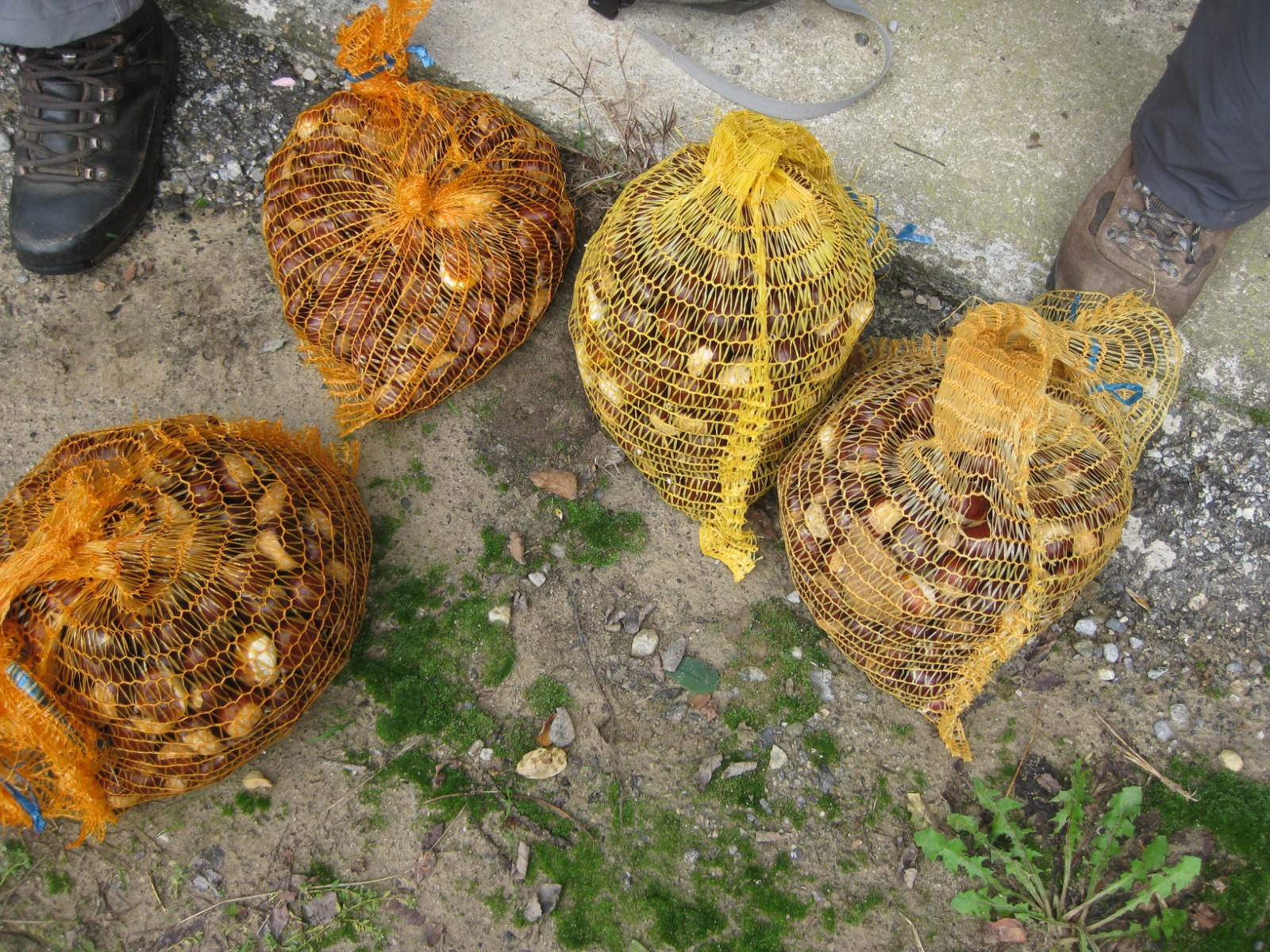
As our hike drew to an end, so did our supply of will-power.  We took our bags from our rucksacks and got stuck in.  So plentiful are the chestnuts here that you can be as picky as you like.  Only the very largest and choicest specimens needed to make it through our rigorous quality control.  I was restrained.  I gathered a mere 4 kilos.  Jacqueline and Martine probably each collected 3 times as much.  Some we’ll use, some we’ll give to lucky friends.

Now I’d better settle myself down with a dish of roasted chestnuts at my side, and browse through my collections of recipes to find uses for all this ‘Food for Free’.

I think these chestnuts represent Jacqueline, Martine and Maguy’s harvest.

* Two lines from an English hymn sung at Harvest Festival season: Come, ye thankful people, come’

The tragic and savage history of l’étang d’Izourt

The drive to the start of the walk was dramatic enough.  Forested and craggy, our narrow road out of Auzat switch-backed steeply up the slopes in a seemingly endless series of hairpin bends.

And our walk began, an 1800 foot climb, upwards through forest then out onto the stony, rocky path towards the man-made étang d’Izourt, one of the many reservoirs in the area maintained by EDF to provide power. Once, a helicopter flew over.  Since there are no roads up there,  it was delivering either men or supplies to a team we could see labouring on a more distant slope.

The walk changed for me as I learnt the story of what had happened back in 1939 when the reservoir was being built.  Most of the members of the construction team at that time were economic migrants, Italians from the Veneto, and whilst working there, they lived in huts on site.

The weather conditions had already been atrocious for days when on March 24th 1939, a fierce blizzard struck.  There was no option for the workers but to hole up in their huts.  The storm was so fierce that huts B and C were destroyed from the weight of snow above, and the roof from hut A blew off.  The desperate men sought both to escape and to try to help their work mates, many of whom had died or been gravely injured by the tumbling buildings.  A nearby avalanche brought down the cable car linking the site with the works below.  The only way up was on foot, and rescue attempts were pretty much futile, though bodies and the injured were recovered as management attempted to evacuate the entire area.  On 28th March, a team of army skiers managed to get through and working into the night, brought down the remaining bodies and wounded.  31 men, 29 Italians and 2 French, were buried at the cemetery in Vicdessos on 31st March.  There they remain, as the families in Italy were too poor to manage the expense of repatriating the corpses.  The memorials at the lakeside are still the site of pilgrimage, thanks to the efforts of the ‘Ricordate-Izourt’ Association: locals and Italians who honour the memory of those lost workers.

We ourselves had started our walk in bright sunlight.   Spots of rain began.  Then the wind.  By the time we reached the lake, there were times when the gusts felt almost horizontal, and we struggled to find protection from the rocks to eat our lunch.  The more modern huts now on site have their roofs held on by strong metal cables, and we could understand why.

The sky turned the colour of lead, and we rejected the idea of exploring the lake in favour of hurrying down the way we had come.  We knew we’d be OK, but we also know to treat the mountains seriously and with respect – conditions can change very quickly.  We were fine of course, but that fierce wind on a warm October day gave us the smallest hint of what things could be like if you were trapped there in much nastier conditions.  Even now, the most efficient way of supporting the workers still on site from time to time is to get them and their supplies there by helicopter.  A noisy chopper whirled up and down the mountainside several times as we walked down, our journey cheered by a rainbow linking our mountain with the one next door.  Though we were sorry the weather had chased us home, we were grateful  not to have been exposed to  the dangers the mountains can offer from time to time.

This slideshow requires JavaScript.

Danger Mouse: The Sequel

After my last post about Mr. Mouse, things went quiet.  Not quite quiet enough for Malcolm, who swore he could still hear scuttling in the wainscot.  I decided he was paranoid, as I’d gone on dusting surfaces with cornflour at night to track our intruder, and they’d remained undisturbed, just as the traps remained unbreached.

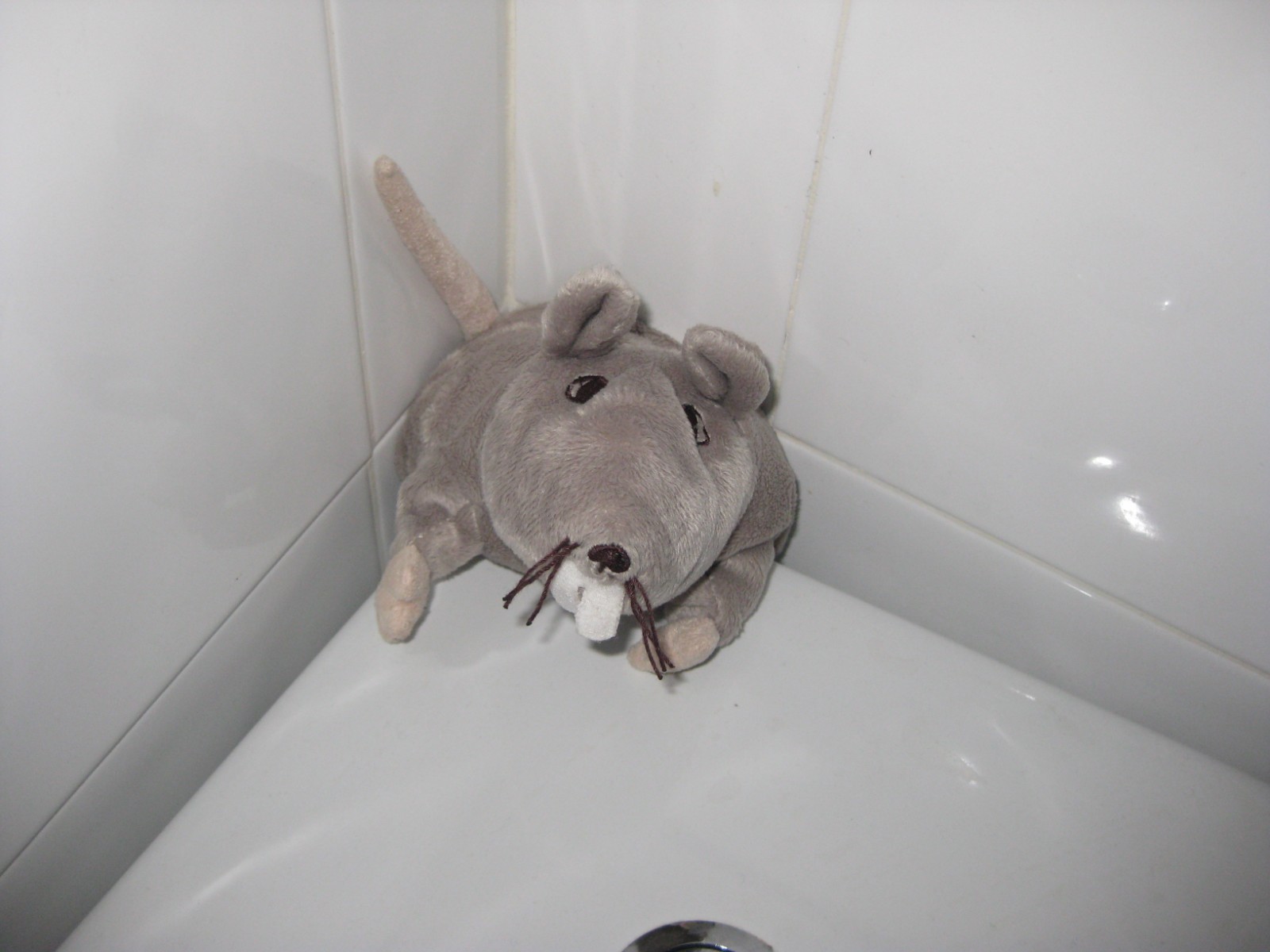
We’re getting a bit silly. Emily’s rat keeps popping up in odd places, because one of us has whisked it off there with the aim of making the other one jump.

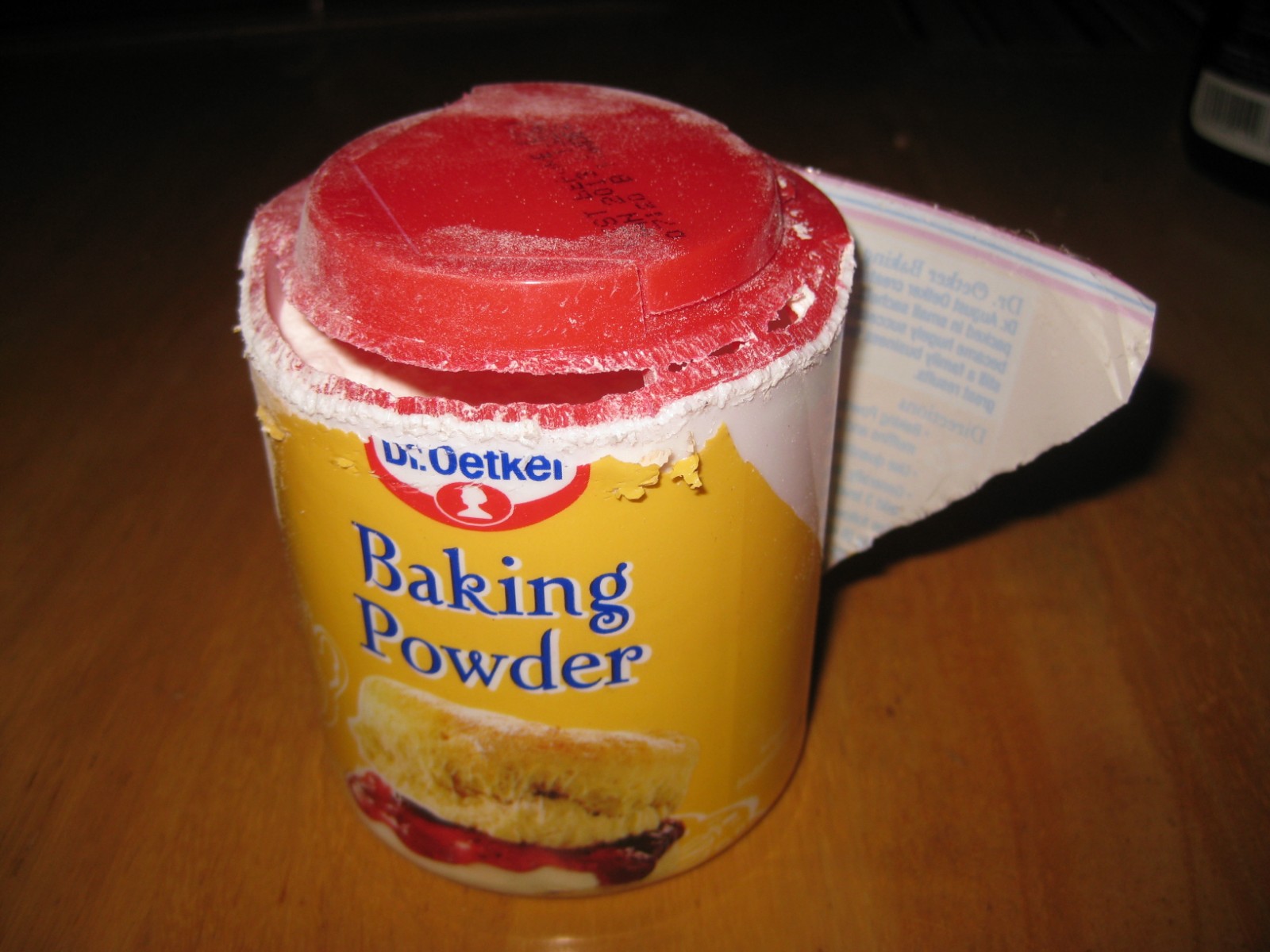
Then this morning, two things happened.  A bag of walnut shells, bagged up and waiting to do duty as slug-deterrent on some outdoor pot plants, was found to be ripped and the contents spilled all over the kitchen.  Later, tidying the garage (which is next to the kitchen), I discovered a bag of foodstuffs I’d forgotten to unpack after a recent cooking atelier.  The lid of the baking powder container had been gnawed, and the bag and everything in it was coated with a thick dusting of powder.

That’s what Danger Mouse is capable of.

The other thing is…. we’ve both seen him.  And he’s not a mouse at all, but almost certainly a hamster.  Anyone lost one?

So while you’re thinking of what we should do next, why not watch an episode of that 1980’s children’s cartoon Danger Mouse (or Dare Dare Motus, if you’re French), the James Bond of the mouse kingdom ?  Just click the link.

Mouse in the house

Thanks, Hull City Council, for useful info and this photo.

We first noticed it about a month ago.  Scrabbling and scratching somewhere near the kitchen skirting boards, mainly at night.  Then, one night, we accidentally left out the insignificant remains of a tomato, chili and pepper pasta sauce.  The following morning, a greasy red trail led from those leftovers to the space just behind the cooker.  Out came the cooker; off came the kitchen unit kick-boards.  Lying on the floor underneath the units, we saw it all: the napkin that had gone missing, now neatly and minutely shredded, a small cob of bread; fragments of kitchen roll….. and mouse droppings.

We bought humane traps.  We baited them with peanut butter: so much tastier than cheese, apparently, if you’re a mouse.  But we didn’t set them for a few nights, as per instructions.  Set or unset, Mr. Mouse ignored them, or extracted the prize and ran safely away to eat it.

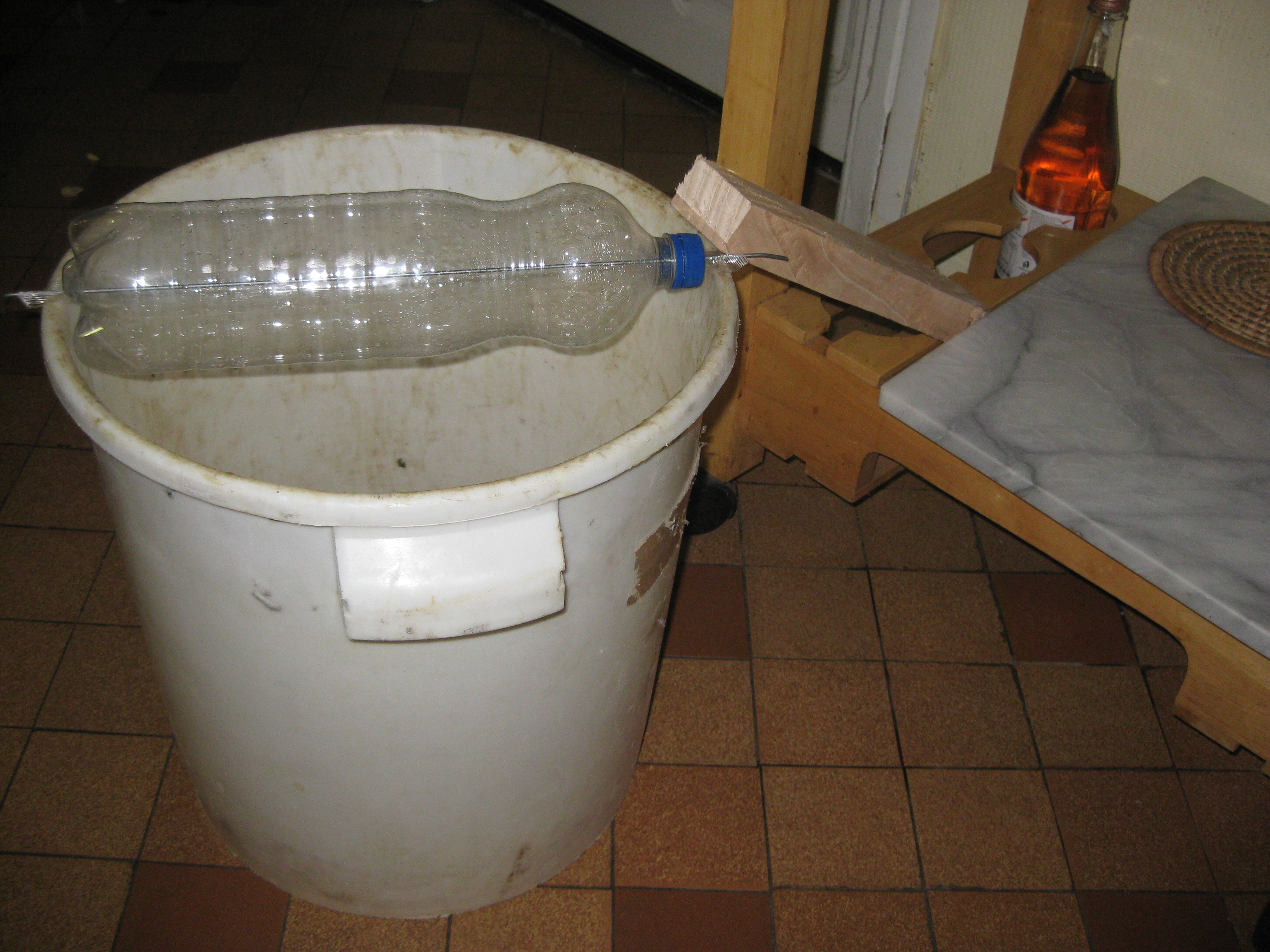
This is not a tube trap, but a spin-the-bottle model, on duty for the first time tonight. Let’s see….

Mal spent long hours on the net, watching excruciating amateur videos about making humane traps.  He picked out some of the ideas involving tubes, bait and deep buckets and set to.  Each night we left collections of baited tubes, unset, over the surfaces Mr. Mouse seemed to use, till one night, we set the trap.  Mr Mouse was to scuttle down the baited tube in quest of peanut butter and fall from the work surface into the deep bucket on the floor.  Theoretically.

At 11.30, Mal heard a crash in the kitchen, smiled at the thought of a job well done, turned over and went to sleep.

At 1.30, I woke up to the sound of Malcolm having a pee in the bathroom.  But wait!  Mal was snoring sweetly beside me.  I got up.  There was poor Mousie, almost drowned, swimming round the lavatory pan.  We have no idea at all how he got (a) upstairs and (b) clambered into the toilet.  Both awake now, and seeing that Mr. Mouse seemed almost dead, I’m truly ashamed to say we flushed him away.

Revealed: Mr. Mouse’s nest

So Mr. Mouse was no more.

The following morning saw us, despite our agonies of conscience, pulling off the skirting board and hoovering out Mr. Mouse’s flat, which was a mess, frankly, though undoubtedly cosy.

Peace at last.

Until the day before yesterday.  In the evening, we heard that familiar scrabbling in the kitchen. Round Two to Mr. Mouse.

Château de Lordat

This slideshow requires JavaScript.

Fourth of October.  The sun’s shining hot, but not too hot, high in an azure sky.  A small group of hikers stands outside a little church and gazes up a steep slope towards the ruins of the Château de Lordat.  And then sets off in the opposite direction.

It’s Anny who’s picked our route, and it’s designed to wind us up the hillside to the castle along chunks of country road, craggy uphill scrambles, dry-leaved woodland just thinking about exchanging green summer leaves for the ochre and russet tints of autumn, and the occasional tiny village – no more than a couple of streets encircling an ancient church.

Most of the time there are views upwards, towards the castle itself, or the cable-wagons serving the talc mines of nearby Luzenac, or across to the more distant mountains covered for the first time this season with bluish-white powdering of snow.  Or down, past thickly forested almost vertical slopes to craggy rust-stained rocky outcrops with occasional hamlets and villages scattered through the countryside. Near villages and farms, we pass walnut trees, and feel obliged to gather the recently ripened and fallen nuts – this is France after all.  We exchange recipe ideas.

Suddenly, we’re there. Lordat.  In high season, the village must be a tourist trap, but now we’re happy to saunter along the sunny empty streets, with their pastel-painted cottages and tubs of geraniums.  A final yomp and we’re at the castle walls.  It’s ruined and closed to the public at the moment, but the views in all directions make the climb worthwhile.

A meandering trek through the woods, trying hard not to kick over the delicately-stemmed autumn crocus, brings us to our lunch spot in Axiat, sitting outside its Romanesque church.  Mal and I are particularly taken by a notice on the door in French, English and Spanish. The English version reads: ‘Ladies and Gentlemen the visitors, we thank you for closing the door by going out’.

Afterwards, more craggy descents, sometimes through woods, at other times with more of those impressive views, along an ancient man-made winding path.  And back to the village we started from.  It’s a wonderful walk.  If you come to stay, make us take you.