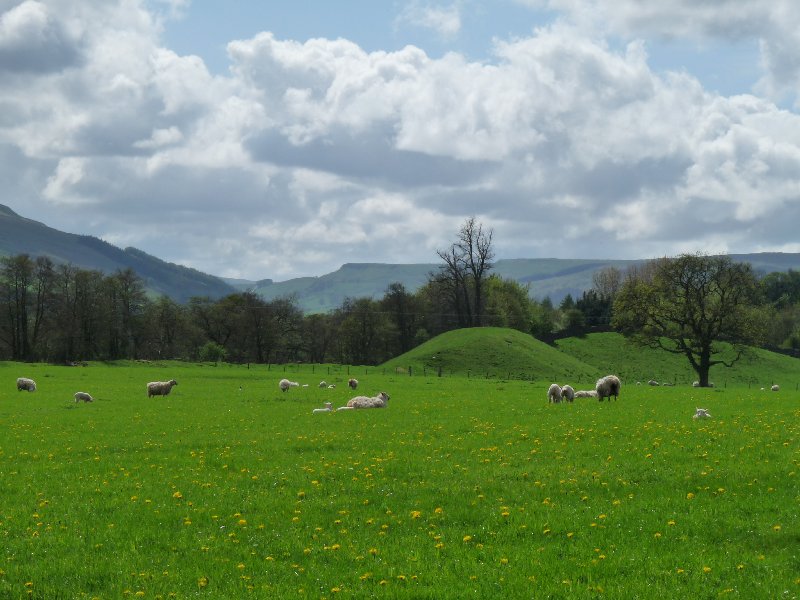
Malham panorama

Malham Cove seen from Malham Beck.

Malham: a place that sums up Yorkshire scenery and countryside, and a geology lesson in a landscape.

We – the Ripon Ramblers – had come to walk from Malham to the cove which shares its name, then on to the Tarn and then make a circuit of the way back to the village.  It’s a longish car trip for us to get there, but we thought it was worth it to enjoy the wild and rocky scenery with views far across dry-stone wall enclosed fields to the Dales beyond.
Once cultivated fields are now given over to grass and sheep.

Malham Cove is a large curved limestone cliff at the head of a valley across which water used to tumble as a glacier melted above it.  The stream that once cascaded over the cliff now disappears, like so many others in this land of porous limestone, into Water Sinks about a mile away.

The cove looks rather like an  imposing  and curtained castle wall or amphitheatre from which vegetation clings precariously.  It’s immense, and however often you visit, it never loses its power to impress.  We approached it walking along Malham Beck, a pretty stream which jostles and bubbles out of the cove, before we slogged up the 400 irregular rough-hewn stone steps alongside the cove which  are part of the Pennine Way.  It’s a tough climb, but rewarded every step of the way by seeing the Cove from ever-different viewpoints.

At the top, you’ll want to rest.  We had our coffee-stop on the limestone pavement which carpets the area.  That glacier all those years ago scraped and polished the limestone, and over the centuries, rain has niggled away at the soluble rock to divide the pavement into large irregular slabs called ‘clints’ and ‘grykes’.  It sounds grey and sombre.  But in fact there’s a rich diversity of tiny lime-loving plants such as wild thyme, limestone bedstraw, common rock-rose and bloody crane’s-bill – don’t you love those traditional names for these colourful flowers? .  Above us, skylarks trilled, and the landscape before us rewarded our efforts.
A view from the path

After our pause, we continued along narrow rough and rocky pathways before hitting more open ground on our path to Malham Tarn.  This is the highest lake in England, a shallow lake  which, though surrounded by limestone, is itself on a bed of  slate.  It’s rather boggy round here.  Pick your picnic spot, which you’ll be sharing with quite a lot of cows, with care or you’ll stand up after you’ve eaten, as I did,  feeling distinctly damp.
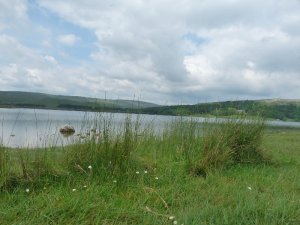
Malham Tarn
Malham Tarn

Much more open landscape after that.  We continued to climb… and descend, climb… and descend, always with those open views, and sheep or sturdy Belted Galloway cattle for company.  Suddenly, the climbing was over.  Before us was a landscape of ancient stone barns, of sheep enclosed in equally ancient narrow and irregular fields bounded by dry stone walls, and an unremittingly steep grassy path leading down to the valley and Malham, with its welcome tea shops.  There’s so much more to explore here.  But that will be for another day

Le Tour de Yorkshire

A stained glass window in Harrogate by Caryl Hallett celebrates the TdF

After seven years of living in France, we reckoned we were old hands at le Tour de France.  It had gone past our house twice – once west-east, once east-west, and jolly exciting too, for roughly 30 seconds, which is all it takes for the competitors to go whizzing past… though there’s the no-small-matter of the caravan, and all its extraordinary vehicles full of excitable young women (only gorgeous young females and the occasional hunk need apply) flinging forth key rings, baseball caps, sweets and so on to the crowds scrabbling around for these souvenirs of the day.

And this year, for the third time in our lives, the Tour is going past our house again: because in 2014, for one year only, the Tour de France begins in Yorkshire, aka God’s Own Country.  It’s quite a coup for Yorkshire tourism, as it’s an opportunity to showcase this wonderfully scenic area as a tourist destination to a world glued to its TV sets for the duration of the Tour.

Even letting agents are getting Tour de France fever.

Yorkshire has been going Tour mad for weeks – no, months.  One of the earliest signs was last November, when the Harrogate Advertiser asked readers to knit little TdF  jerseys to be strung as bunting in local streets.  3,000 jerseys should cover it, they reckoned.  We now known that there are well over 10, 000 of them – yellow, green, white-with-red-spots, in Harrogate District alone, and who knows how many in the county as a whole, or down south when the riders complete the Cambridge to London stage?  You can see them strung in shop windows, along house railings, swagged along churches, between public buildings or threaded through the branches of trees.

Then there are the yellow bikes.  There are town trails to discover the dozens of yellow-painted bikes deposited round towns, in gardens, along country roads, in shop windows….  I’m sure many will be around months after the event, but many more will have been cleaned up and shipped off to various projects in Africa.

Our own community, North Stainley, has had Rural Arts working with the children at the Primary School to produce their own interpretations of impressionist paintings, and these are now on display round the village.  The pond has got its own Monet style bridge with LED waterlilies for the duration.  There are two new sculptures inspired by the Tour, and there’s a whole programme of social events.  Every village and town along the route is involved in providing fun for residents and visitors alike on the weekend of the Tour.  The description of choice seems to be ‘Le Grand Départy’.  Please groan if you want to….

Roads along the route have been repaired and revamped, presumably to the detriment of the road maintenance programme of all highways not on the TdF course.  Traffic islands in towns have been replaced by moveable versions, so they can be shifted from the road for The Big Day.  Anyone with open land and the means to provide sanitary and other arrangements, from farmers to schools with big playgrounds, is offering camping or parking facilities for the duration.  The French may well look askance at this degree of organisation, because over there it’s fine to turn up and park your camper van on any spare bit of mountainside that you can find.  Here however thousands and thousands of would-be spectators all have to cram themselves along some 400 km. of route, as opposed to the 3,500 km available in France.  Our village alone has been told to expect up to 7,000 spectators, the next village along, 10,000.  The logistics  are a nightmare, and forward planning essential.

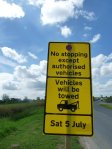
These signs suddenly appeared at the end of last week.

And there are three weeks to go…..

Bradley Wigg-fins visits a Ripon chippie

Slow paper is better than no paper

I’m not fully adapted to country life yet.  Forward planning – or lack of it –  is my failing.  I haven’t yet learned to anticipate whether we’ll need more milk, potatoes or whatever before the next planned trip to The Great Metropolis (aka Ripon), and quite often find myself grubbing around at the back of the cupboard for acceptable substitutes.

Saturday, though, is the day we treat ourselves and buy the paper.  There’s enough reading material there to get us through several days, and the sports section, discarded immediately,  is perfect for any number of little jobs such as lining the rubbish bin.  And yet today we had no excuse to visit Ripon, so would we have to go without our newspaper?

Well, no, there is another solution, but we have to reckon on leaving the house for well over an hour to complete the three and a half mile walk.  The round trip to the paper shop involves leaving home along the path through the woods, walking along the riverside path to Sleningford Mill caravan site, dallying by the weir for a few minutes, battling along the narrow path now surrounded by chest-high spring flowers, and finally reaching the bridge at West Tanfield.

The shop in the village is where you’ll find most things.  There’s food, drink, first aid and stationery – and a Post Office.  There’s a community board where today I found news of someone selling chilli plants – I’ll be buying some of those .  And there are newspapers.  I bought our weekly fix.  Then I set off home by a different route.  Out of the village on the road, up the hill, turn right at a farm gate.  The path here’s been slightly diverted, because the farmer’s made wide beetle banks to boost the number of farmer-friendly insects and spiders on his land.  Through several fields of sheep, who come to inspect me, and along the drive of Sleningford Park, a country house.  A final yomp along paths running alongside fields of wheat and barley, and I’m home once more.

It wasn’t quick.  But I came home refreshed by the birdsong I’d heard; the sight of birds, rabbits, squirrels and sheep I’d passed; the flowers I’d spotted on the paths, different already from the ones I’d spotted only a few days ago; and all those country smells, from wild garlic to sheep dung to spring flowers.  I’d had a better morning, I reckoned, than if I’d either gone without, or jumped in the car to grab a newspaper at the petrol station four miles away.

Bread Actually

A man walks in to the bakery with a tray of eggs, newly laid by his hens.  He’s ‘paid’ in bread. A woman comes with a bag of rosemary from her garden: she too receives bread, still warm from the oven.  Over there, at the back, another woman is steadily getting an enormous batch of scones ready for the oven, while in another corner, someone else is weighing out the ingredients to make biscuits.

Margaret Number 3 makes scones

We’re in the market town of Bedale (population four and a half thousand).  More specifically, we’re at Bedale Community Bakery (or ‘Bread Actually’), tucked away behind the railway bridge next to the Big Cow Little Sheep educational farm.  This is no ordinary baker’s shop.  For a start, though there’s a busy team at work throughout the day, there are few paid staff.  This is a not-for-profit community venture.

The bakers are paid – they’re the ‘bread and butter’ of the organisation after all.  Then there’s hands-on Chairman Carol, and Sarah who seems to be involved in everything.  But all the biscuits, cakes, scones – the non-bread items – are made by a willing team of volunteers managed by retired baker Alan.  From today, Malcolm and I are part of that team.

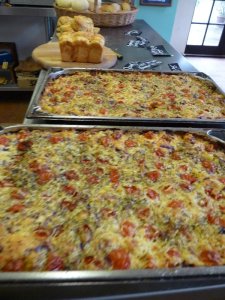
Focaccia in waiting.

It was a wonderful experience.  From the first moment, we were expected to roll our sleeves up and turn to.  But the friendly welcome, the team spirit, the willingness to share and help each other, the generosity of spirit shown by everyone there made for an unforgettable first morning.  Malcolm washed up and sliced cakes into even portions, and I helped Margaret ( ‘Not another Margaret, there’s three of you now’) make an entire batch of about 210 Anzac biscuits, bake them, cool them, and package them for sale in cellophane sacks of 6, closed with yellow ribbon.  There was focaccia to part-prepare for the just-about-to-start Bedale BAMfest.  There was more washing up, and sweeping and cleaning.  And time for a coffee-stop of course.

They’re seeking to build up the customer base.  There’s a country house, a high-end hotel or so, and various other outlets who like the quality and range that the bakery offers.  There are locals of course, who know a good thing when they find it, because there are always samples of the bread to taste, people around to discuss ingredients and recipes, and a constantly changing repertoire.  Today there was multi-seeded bread; cheese, chilli and – oh, crumbs, I’ve forgotten what else – sourdough; rosemary and black pepper; cheese, chive and onion bread; harvester loaves….. and so on and so on.  This is Slow Food at its best, made with locally sourced flour from Crakehall Watermill with not a single flour improver, and proved gently over several hours to develop the flavour.  Recipes are carefully tested and recorded, and every opportunity is taken to use seasonal flavours and ingredients offered from the community: a glut of fruits or herbs, as well as those eggs and that rosemary.

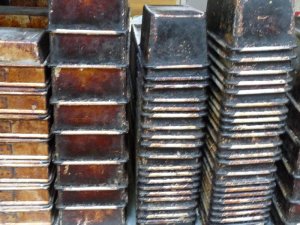
Off-duty loaf tins.
Off-duty loaf tins.

I hope there’s plenty more to tell about this place.  We think it’s worth the 16 mile round trip to volunteer here (and be ‘paid’ in bread), but others come from much further afield: Redcar, the home of one of the team,  is nearly 40 miles away, and Saltburn, where another lives, 50 miles.  We all appreciate good bread, and recognise a worthwhile project which offers the chance to learn new skills in a supportive and ‘can-do’  environment.

Camberwick Green

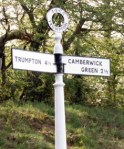
The way  to Camberwick Green?  Sadly not. This road sign was made by Countryways and stands by the Bluebell Railway in Sussex
The way to Camberwick Green? Sadly not. This road sign was made by Countryways and stands by the Bluebell Railway in Sussex

Hands up if you remember Trumptonshire!  If you were a child in the 1960s or 70s, or if you were the parent of such a child, chances are that you do remember your weekly visits to Trumpton or the smaller communities of Camberwick Green or Chigley.  For a blessed quarter of an hour after lunch you’d all sink yourselves in front of the TV to catch up with news from Trumpton fire station (‘Pugh, Pugh, Barney McGrew, Cuthbert, Dibble and Grub’), or Windy Miller’s windmill, or Lord Belborough and his steam engine of Winkstead Hall near Chigley.

Trumptonshire was a quiet and ordered little county.  And one of its communities, Camberwick Green, was the  picturesque village that embodied all that rural life is supposed to be about: the sense of community, the dramas that enliven everyday life and bring everyone together, the charming mixture of contemporary technology and Edwardian costume, the idiosyncratic mix of characters from every walk of life.

Reader, we’ve just moved to Camberwick Green.  Well, in fact our village is called North Stainley, but we’ve heard plenty of people who don’t live here refer to it disparagingly as ‘toy town’.  I can see why.  The traditionally designed houses clustered round the village green (home of the cricket club) are not old cottages, but have all been developed and built over the last few years.  The original village consisted of a very few houses near the main road, a small church and (now ex-) chapel, a tiny village school at risk of closure, and three duck ponds.

The local landowner, however, saw the potential of the community and gradually sold off land to developers, who built houses.  These developers however, didn’t throw up standard estates.  They grouped the new homes round existing open space and those duck ponds.  There’s a large, well-appointed and well-used village hall.  There’s an adventure playground for the children: because the village has plenty of children now and that tiny school is bursting at the seams: some classes take place in the village hall. And the families who moved in all bought into the idea of village life at its best.

This community has a regionally important cricket club, training the young players of the future.  There are women’s groups, a book group, a WI (obviously), a drama group, a social group which fundraises for the benefit of the young people in the community…. and so on.  Perhaps because most people can remember what it’s like to move to a community and know not a soul, they’re unusually welcoming to newcomers.  We’ve been made to feel at home amongst them, and encouraged to join in.

This morning, for instance, a large group of us were painting the walls of the long-closed village shop and garage, to smarten it up before the Tour de France passes through the village next month.  Tonight it’s the second and final night of the Arts Society’s production of Blood Brothers.  The village website demonstrates that this is a busy, sociable and purposeful community.  We’re very happy to be here.

The Ramblers Return

About time too.  Five weeks in England, and still we hadn’t got out and done a Proper Walk.  With a Proper Group.  Blame the general business of unpacking, organising furniture, pots and pans, clothes, books, pictures and day-to-day Stuff in our new home.  Blame constant strings of communication with officials who Need-To-Know our new details.  Add in those who fail to respond, perhaps because they no longer have local offices and, understaffed,  are too overwhelmed with work (DVLA ?), and you have all, well, some of the excuses you need for our having failed to get a decent walk in.

There was a certain reluctance too.  So many of our happiest times in France were spent discovering the region with our Sunday and Thursday walking friends. Apart from the scenery, we remember with so much nostalgia the conviviality and the leisurely picnics, as we all produced cheeses, charcuterie, bottles of wine and home-made cakes to share at the lengthy midday pause.

All the same, we shouldn’t have worried.  Yesterday we met members from a local group, unsurprisingly the one from Ripon.  We got ourselves to Wensleydale, to a picturesque village called West Burton, and had a hearty, but not too hearty, walk across to Aysgarth, before winding our way back.  We loved it.  The group was welcoming and friendly.  The walk had just the right amount of challenge – we have become just a bit unfit – and the views were all we hoped for.  The weather was good too.  Breezy, but not cold, and plenty of sunshine.

There was only one small disappointment.  At lunch time, British walkers sit with their own personal sandwich, get it eaten, then move on again.  But even that disappointment was relieved when at the end, Our Leader spotted a tea shop.  Sitting round over a large pot of tea, cakes for some, as we reviewed the day was a pretty good end to a pretty good walk.
P1120727

Our Bank Holiday excursion: Castle Howard
Stately homes.  Back in the day, they were home to the landed gentry, and were local employers par excellence, what with large households to cook, clean, furbish and refurbish for, ornamental and vegetable gardens and even farmland to nurture, children to rear and educate, hunting grounds to stock and maintain, guests to cater for.

Nowadays, they’re where the English like to go on a Bank Holiday.  They provide the chance to get a glimpse of other, very different lives, to learn a little history and to enjoy a stroll round gardens on such a different scale from that little patch you potter around back home. And because it’s a Bank Holiday, a little entertainment doesn’t go amiss either.  People arrive in their hundreds, expecting to spend the entire day exploring house and gardens, snacking rather well in one of several tea rooms, mooching round the gift shop and having a little bit of extra fun too.
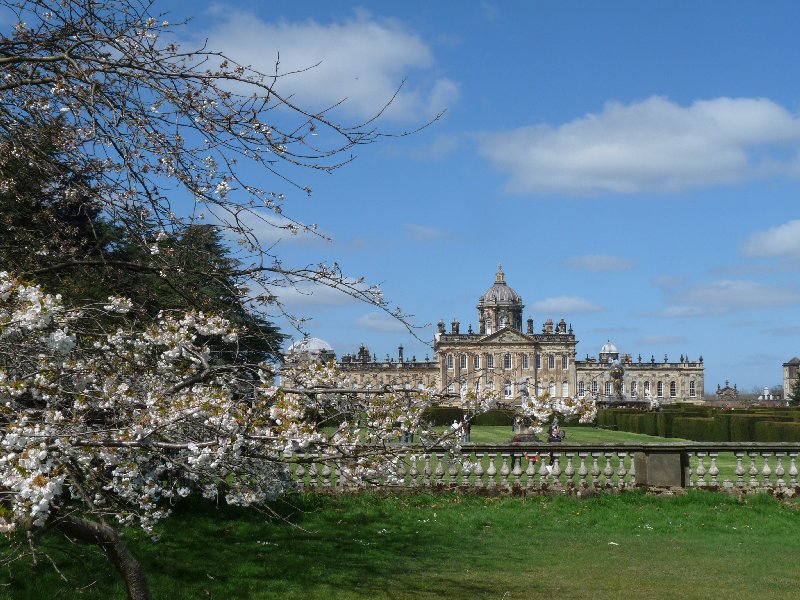
Castle Howard
Castle Howard

Emily had come over from Barcelona to visit, with boyfriend Miquel in tow.  Castle Howard seemed a good place to spend a day. Thanks to its frequent starring role in TV costume dramas and films, there can be few Brits who aren’t familiar with Castle Howard, even those who haven’t ventured north of Watford Gap.  Me, I’m the ‘Brideshead Revisited’ generation, and back in 1981, Tuesday evenings (I think) were put on hold for weeks and weeks as we turned the television to ITV and followed the Evelyn Waugh saga, feeding our nostalgia for a very different  pre-Second World War Britain.  Castle Howard was pretty much star of the show.
And really, why not? You can read its history here, but just spend a little time strolling round with us, as we re-discovered the parkland; the woodland; the walled gardens; the splendid 19th century Atlas fountain;  The Great Hall – where columns & arches covered with carved decorations rise towards the splendidly painted dome; the chapel decorated by Burne-Jones… and so on.


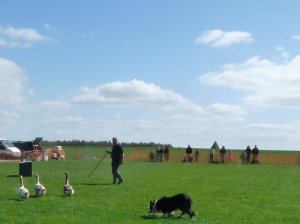
But because we went on a Bank Holiday we had extra things to do.  There were sheep dog displays.  We admired the skill of those so-well-trained dogs as they expertly rounded up not only sheep, but a gaggle of geese and a fussy line of ducks.

Sheep dog rounding up geese for a change.

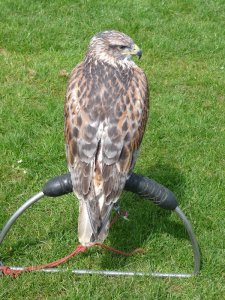
There were falconry displays.  Here is the splendid and majestic Ferruginous Buzzard who made a break for it and got away: last seen in a distant field, regarding us all with thorough disdain.  I hope handler Ben found him again: he was a very handsome beast indeed, as were all the birds of prey we saw that afternoon.

Ferruginous buzzard, contemplating his get-out plan.

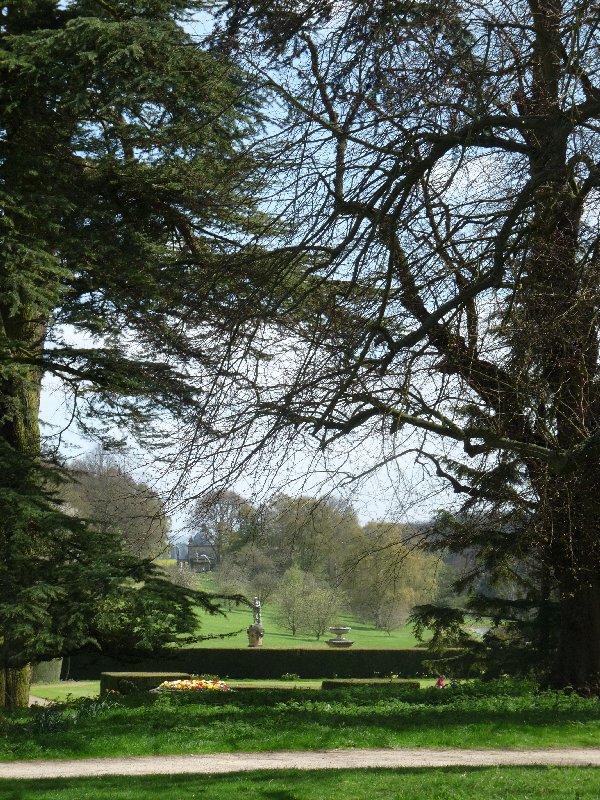
A final wander round the grounds, the walled garden, then we too made our excuses and left, just before closing time and the mass-escape for the car park.  We’d had a fine day.

A final glance at the parkland surrounding the house.

A new address

You’ve probably given up on me.  I have been silent.  But life has not been silent or tranquil.  We’ve been in England a month now, and since then, we’ve found somewhere to live, moved in and started, but not finished, unpacking.  We’ve started to explore our new neighbourhood, and begun, tentatively, to put down roots.

All of which has been complicated by our being somewhat incommunicado.  We had, until today, no land-line or internet connection.  Our (shortly to be ex-) mobile provider offers no connectivity whatsoever for several miles in every direction, so the whole business of communicating with the outside world has been put somewhat on hold, at a time when whole swathes of people and organisations require to hear from us, or to contact us.

From today, however, we’ve rejoined the 21st century, as BT came to install a phone line, bringing with it access to the internet and TV.  So here’s an update.

We arrived in England with a ‘must-have’ list when it came to house-hunting.

We wanted:

  • to be in Ripon itself, within walking distance of its shops, library, cinema and so on.
  • to have a house with a small garden or courtyard: apart from anything else, how else do you hang the washing out?
  • to have a garage.  Not necessarily for the car, but to accommodate the mountains of  ‘stuff’ we still seem to have despite our efforts to downsize.

On the first Monday back we found:

  • a flat at the edge of a village without a shop, about four miles from Ripon
  • with no personal outside space
  • and no garage.

It was perfect.  We signed immediately.

You see, this was no ordinary flat.  It’s the oldest part, tucked at the back, of a largely Georgian country house, set in gardens and grounds which include  formal lawns and borders, a secluded walled garden, woodland and grassland.

In fact, it’s not even a flat.  Downstairs, beyond the entrance hall, is an enormous room which we plan to make into our library and study, and which currently is our warehouse.  Upstairs is generously proportioned living space.  Every window offers views of those gardens, and the fields and countryside beyond.

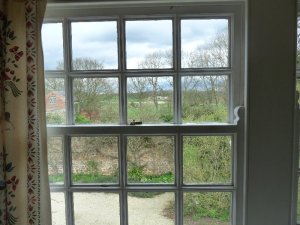
Looking out of the kitchen window towards the walled garden

Our landlords are the charming and generous owners of the Georgian house, and other members of the family live in nearby buildings converted for their use.  They insist that they want us to enjoy the gardens which give them so much pleasure – and hard work.  They even provide us with extra storage in part of a stable.  We’ve spent the little ‘down-time’ we’ve had exploring the gardens, the adjoining country walks, and getting to know a little about the village: more later about all of this.

We’ve decided that being four miles from Ripon, and just a little further from Masham is a very small price to pay for living in such utterly idyllic surroundings, with delightful landlords and neighbours.  Here’s just a taste of our new surroundings:  we shan’t invite you inside just yet – we’re still unpacking.

A honeymoon in the Valley Gardens

We’ve been back in England exactly a fortnight.  In many ways it’s been so easy to slip back into English life.  We’re quite fluent in the language and cultural mores, after all.  In other ways, it’s been a honeymoon, despite our difficulties in re-registering , re-taxing and insuring the car, which continues to be a frustrating, irksome, time-consuming and frankly ridiculous task.

We’re rediscovering sights and experiences with the eyes of a lover, both blind to faults and delighted by characteristics which may one day exasperate rather than charm.

For the time being, we’re discarding the pleasures of French food in favour of a cheeseboard that includes a sharp, crumbly tasty Lancashire or a creamy blue Cropwell Bishop.  When buying vegetables, we have to include handsful of purple sprouting broccoli, still unknown in southern France.  We’ve gone native.

Purple sprouting broccoli at Masham Market

We’re going back to old haunts. For instance, having gone to Harrogate (to try to sort out car insurance, grrr), we found ourselves with an hour or so to spare to visit the Valley Gardens.  This park has always charmed us, and yesterday we fell in love with it all over again.

It was developed for visitors to the spa town as an attractive place to walk as part of their exercise regime after taking some of the many waters on offer.  36 of  Harrogate’s 88 mineral wells are found within the park, and no two have exactly the same mineral composition.  Back in the later 19th  and early 20th centuries, visitors arrived in their thousands, attracted by the apparently curative powers of these waters. A boating lake, bandstand and tea room were built and still exist, but the Parks Department has chosen to focus on developing spectacular floral displays, formal in character towards the town centre, and becoming increasingly natural as the visitor walks upwards towards the pinewoods.These days, there’s a children’s playground, a skateboard park and visitors can play tennis and crazy golf too.  Somehow, though, these attractions don’t dominate.  The gardens are a place to visit to be at peace with nature, to spend quiet moments with a few friends or your dog, to enjoy the trees and flowers, both formal or less organised displays.  Come and share our walk with us.

‘…. a host of golden daffodils’*

When I realised that we were likely to move from France to England in the Spring, I immediately became anxious – no – panic-stricken, at the thought that this year we might be too late to enjoy one of the glories of English life: daffodils.  Of course, there are daffodils in France, and spectacularly so in hidden woodlands such as the one we visited last April.

But whilst the French have daffodils, they don’t do daffodils as we do here.  All over England, they’re in pots in urban courtyards, crowded into suburban gardens, rambling over country gardens.  They form part of the roadside verges on tiny D roads, march along urban by-passes and ring roads, line dual carriageways, and romp across traffic roundabouts.  Householders buy them two and three bunches at a time and place jugs and vases full of them all over their homes.

I shouldn’t have worried.  Since the moment we arrived, they’ve been at their spectacular best.  It’s impossible to feel anything but joyful when passing by whole armies of those bright yellow flowers nodding cheerfully in the breeze.

And goodness knows, we’ve needed distracting from the tasks in hand.  Since we arrived ten days ago, we’ve found a home to rent,  started the daunting process of re-registering our car in the UK (you can’t buy a tax-disc without having an English MOT, you can’t get an English MOT without an English number plate, you can’t get an English number plate until….. you get the picture), organised moving our goods, registered ourselves hither and yon, started the process of catching up with British friends, tried to maintain contact with French friends…..

…and finally, of course, I’ve changed the title of the blog.  The header, showing our transition from the Pyrenees to the Pennines, was master-minded by our friend, the talented amateur photographer Richard Bown.  He already has a family history blog, but I really hope he’ll begin a photography blog soon and share some of his fantastic images with you.  If he does, I’ll let you know.  Because you will want to subscribe.

*William Wordsworth: ‘The Daffodils’