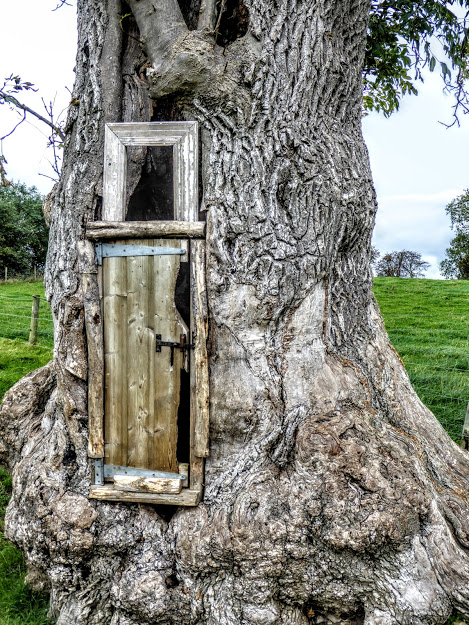
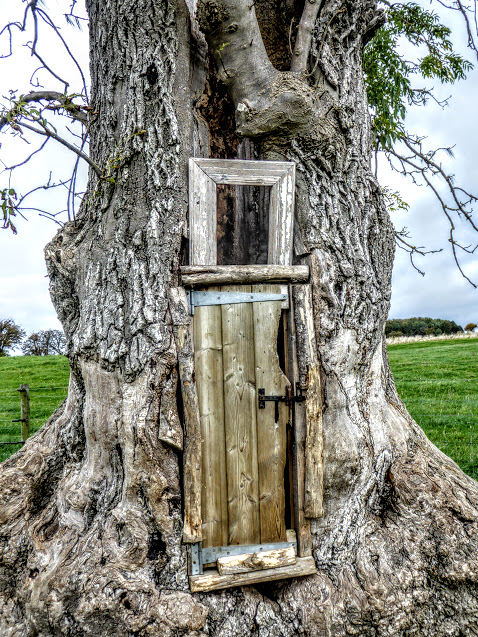
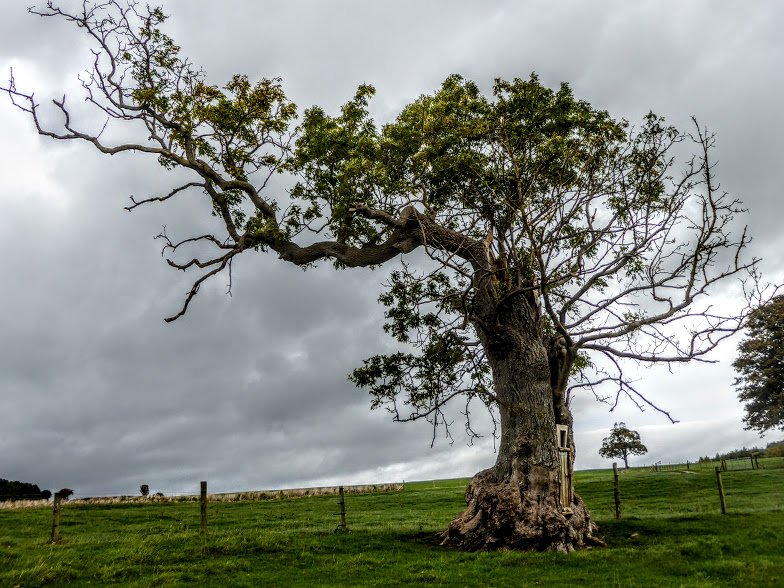
If you go walking in Wensleydale: if you go for a walk from Jervaulx to Jervaulx via Thornton Steward, you’ll come across this tree home, at the edge of a field, commanding views over the valley. It has just one door and, importantly for Monday Window, just one window.
It’s pretty much in the middle of nowhere, but I always like to imagine a doting grandfather, tall and rangy from a tough life’s farming and probably reminiscent of the BFG, lovingly creating a little refuge for his grandchild in this hollow tree.
A first glimpse ….
… a second glimpse …
… and the whole thing.
I couldn’t fit in it, neither could you. Perhaps the grandchild is too big now. But I know a couple of young people who’d love to play there. Perhaps you do too.
Summer in the countryside is show time. Here in Yorkshire, Harrogate kicks it off in July with The Great Yorkshire Show. Then week after week until the end of September, villages, towns and whole Dales follow on with theirs.
This is when farmers, breeders, stock men, makers of agricultural machinery and equipment and The Great British Public all get together to celebrate all things rural, and in the case of farmers, normally so isolated in their day-to-day working lives, simply to meet and have a chin-wag.
Emily wanted to take City Boy Miquel to a proper country fair. So the Wensleydale Show in Leyburn it was. He saw more sheep and cattle in a single day than he’s probably seen in a lifetime.
We began with the sheep dog trials. One expert dog, guided by the whistles and calls of its master, has to encourage a small group of sheep down the hill, through a gate, up the hill again and through another gate, round and back again to finish up closeted in a small wooden pen. Those dogs and their shepherds were pretty good. But from the sheep’s point of view, why go through a gate which has no fence on either side of it? Why not just go round? And certainly, why go into a small pen when there’s all that hillside to enjoy? Fun was had by all but the frustrated shepherds, none of whom completed the course with a full scorecard. But that didn’t stop them being pretty damn’ good.
One big field, and one small pen …..
Gotcha! Sheep contained.
Off to inspect the sheep themselves. Some had dense clouds of thick warm wool, others rangy dreadlocks. Some had squat round faces, others magisterial aquiline profiles. Miquel was astonished to find that sheep weren’t simply, well, sheep.
Wool …..
…. wool ….
…. and more wool.
Swaledale sheep.
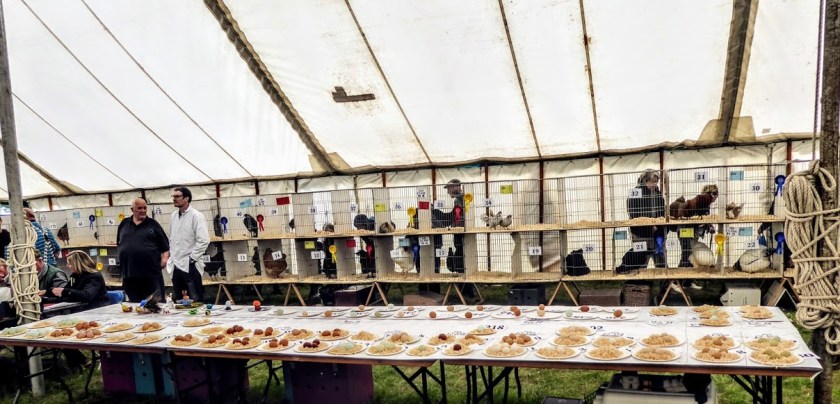
Poultry. Large hens and ducks, small hens and ducks, sleek hens and ducks, messily-feathered hens and ducks, long scaly legs, short feather-trousered legs. White eggs, brown eggs, blue eggs, speckled eggs …..
Hens, ducks and eggs in the poultry tent.
Cattle with beautiful hides, and bulls looking unusually complacent in this showground setting.
Best in show.
Best of all, a heavy working horse, a Suffolk Punch, just the one, a reminder of what crop farming and ploughing used to involve. This splendid beast was traditionally tricked up in her party clothes, reminding me of Whit Mondays when I was a child, when the shire horses employed for delivering beer and ale to pubs were dressed in all their finery for this one special day of the year.
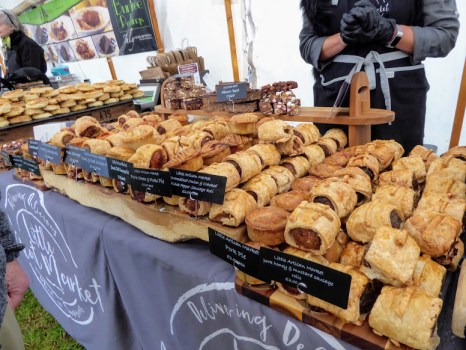
And in among, we watched displays in the show ring, sampled local cheeses and pies, bought decadent and wholly nontraditional treats like gooey chocolate brownies, and generally enjoyed All the Fun of the Fair.
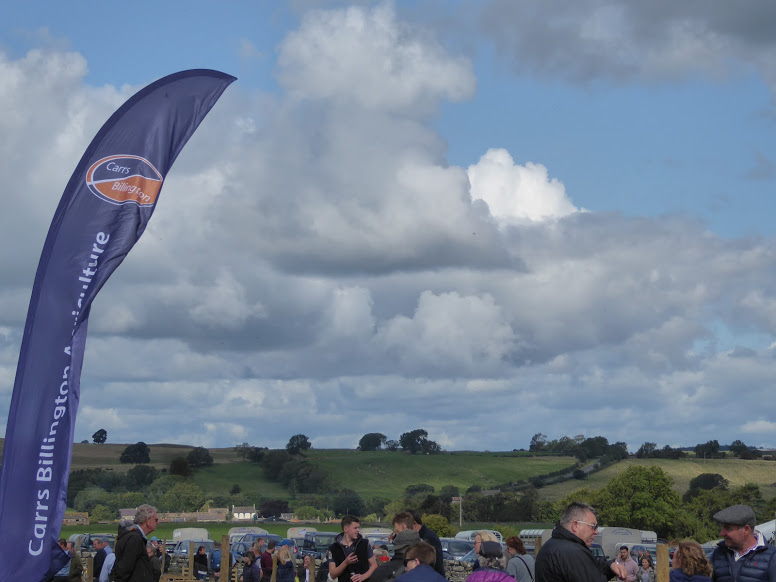
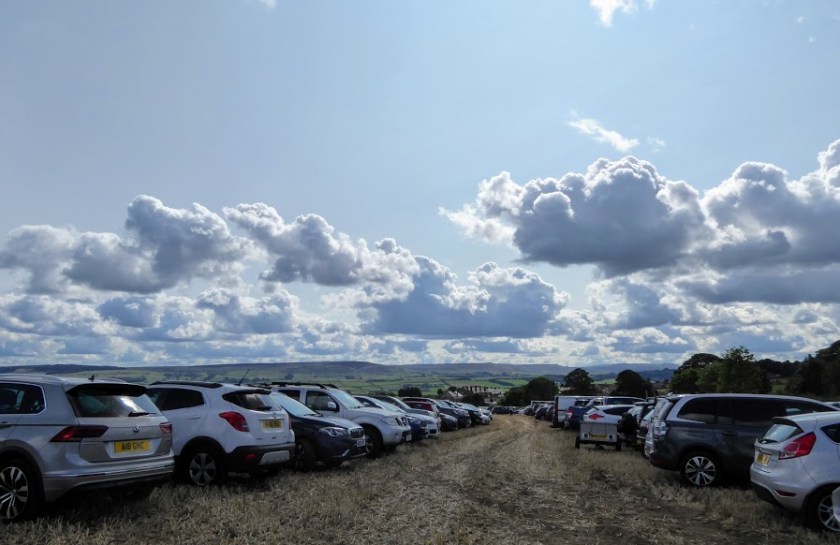
Hungry yet?Not a bad view from the car park.
Today’s Ragtag Prompt is ‘Fair’. Yesterday’s was ‘Coddiwomple’ – to travel purposefully towards a vague destination. Well, we – Miquel especially – were a bit vague about how we’d spend the day…… until we got there.
Nature has had the upper hand lately. Snow, and plenty of it, disrupted our daily rhythms a few times in recent weeks. Rain, and plenty of it, has swamped fields and tracks, making a walk in the country an utterly unreasonable pastime.
The other day though, cabin fever got the better of us, and we made a break for the countryside near West Witton, reasoning that some of the tracks there would be more or less passable. They were. More or less.
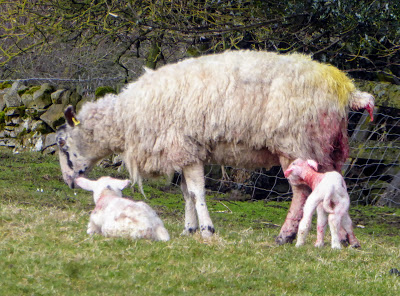
But Nature made its presence felt in full force. Here was almost our very first sight on our walk – a mother ewe with twin lambs so very newly born that she was still calmly licking them clean as they tottered beside her, looking for their very first feed of milk.
The weather was mild. Surely the snow would be long gone? Not up here. Bitter howling winds a week ago had snatched the snow into deep drifts at the edges of fields, or pounded it into hillside crevices.
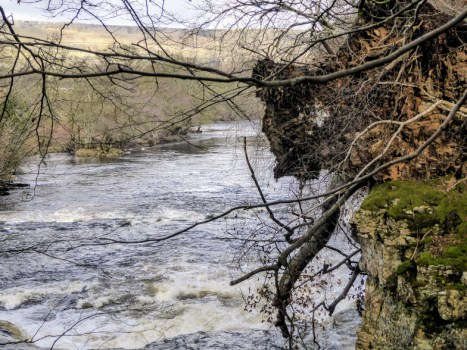
Redmire Force lived up to its name. Look at the waters swirling, frothing and plunging over the boulders in the River Ure. Look at the tree torn from its cliff side, now hanging precariously over the river.
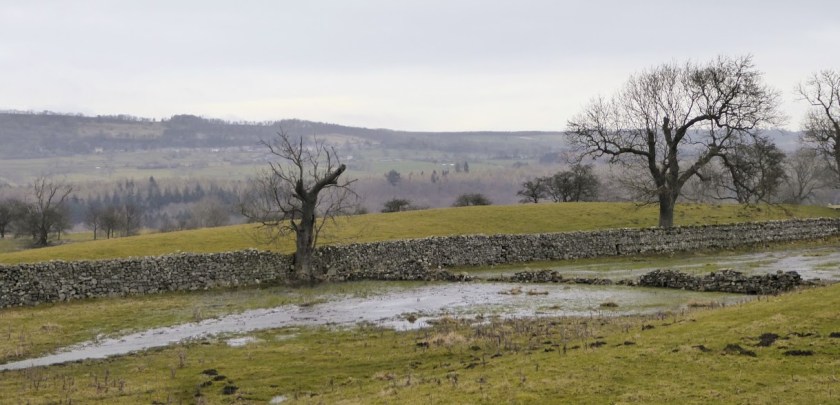
And as we came to the end of our walk – look! Is this a river, or is this a field, unusable by the sheep who normally graze here, but forming a stopping off point for the occasional passing water bird?
If you go walking in Wensleydale: if you go for a walk from Jervaulx to Jervaulx via Thornton Steward, you’ll come across this tree home, at the edge of a field, commanding views over the valley.
It’s pretty much in the middle of nowhere, but I always like to imagine a doting grandfather, tall and rangy from a tough life’s farming and probably reminiscent of the BFG, lovingly creating a little refuge for his grandchild in this hollow tree.
I couldn’t fit in it, neither could you. Perhaps the grandchild is too big now. It’s all a question of scale after all.
This is the scenery near Leyburn in Wensleydale. This is Bolton Castle.
Bolton Castle, Wensleydale.
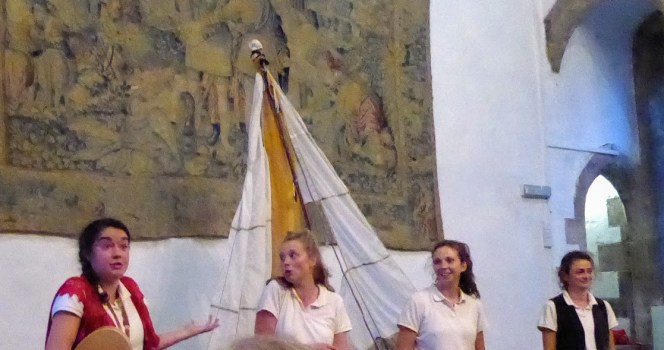
Imagine sitting in the grounds of this 14th century castle as evening draws in, a picnic beside you, to watch The Handlebards’ version of Shakespeare’s ‘As You Like It’. You know this will be no ordinary performance. The Handlebards are four female actors who cycle the length and breadth of the kingdom, with all they need for the tour crammed into two bicycle carriers. At each performance, they take every part in Shakespeare’s comedy of bizarre mistaken identity, family breakdown, love and lust.
So far so good. But this is England in July. We’d had two days of almost incessant rain. In a downpour, the Handlebards cycled the 26 (mainly uphill) miles from Ripon, where they’d performed at the Workhouse Museum.
The Castle has a Great Hall. Performing here rather than on a soggy greensward seemed a better idea in the circumstances. And it was. During the evening it rained. And then rained again. The audience never noticed a thing. We were too busy admiring the way four women became twenty or more people.
A simple, but infinitely adaptable stage set.
To become a man, all they had to do was don a codpiece adorned with a tennis or cricket ball. A selection of hats served to distinguish one character from another. Bicycle handlebars identified the wearers as sheep. Your character needs to disappear stage right to enter stage left as someone else? Easy. Leave the person whom you were addressing in charge of your hat, and s/he will continue to talk to it. With the flourish of a stick, a youth became faithful, ancient Adam. Orlando and his family were all twoubled by an inability to pwonounce the letter ‘r’. And so it went on, as one inventive twist or piece of slapstick followed another. Shakespeare would have loved it.
This is the only photo I have of the Handlebards, and it’s out of focus at that. They take a bow as we give them a more than enthusiastic standing ovation.
I’m now a Handlebards groupie. And the fun doesn’t end here. In other venues, having travelled there on other bicycles, a troupe of male actors is giving similarly irreverent treatment to ‘A Midsummer Night’s Dream’. We’re on the mailing list.
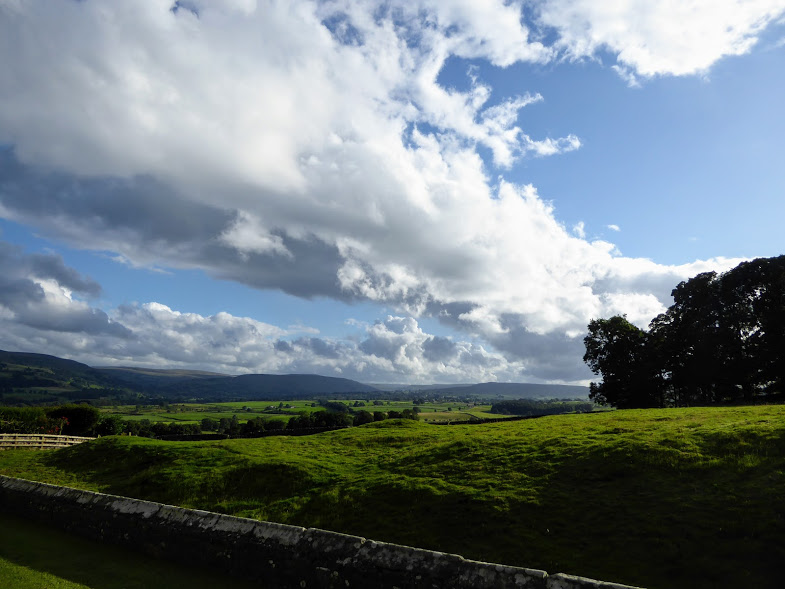
The rain let up a bit in the interval. Here’s the view.
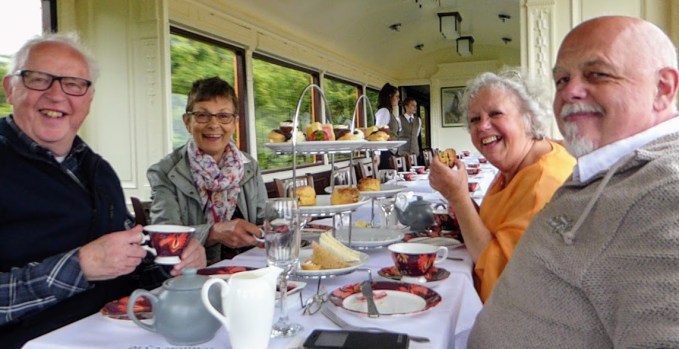
‘Everything stops for tea’. Not if you take it on the train it doesn’t. Just imagine. You and your fellow guests are seated at an elegantly appointed table covered with a damask cloth. Here are china cups and saucers, heavy cloth napkins, weighty cutlery. Before you, a Proper Cake Stand, prettily stacked with sandwiches (cucumber, of course, but also egg mayonnaise, ham and chutney and so on), two kinds of scone with clotted cream and strawberry jam on the side, and properly English cakes: chocolate cake, sponge cake, cream-filled meringues, tiny eclairs. Attentive and charming service. Unlimited pots of tea, of course too .
This was the scene that greeted us as we climbed aboard. The cucumber sandwiches have yet to arrive.
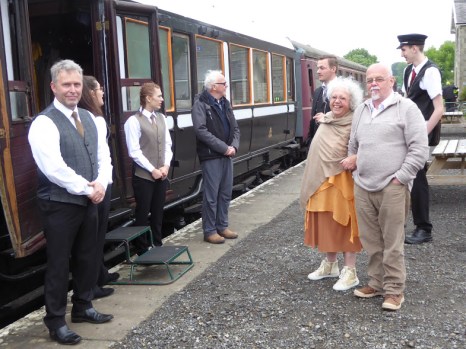
We were on the Wensleydale Railway, at the invitation of Susie and Pete, old friends from France and currently visiting England.
This is a heritage railway, staffed by volunteer enthusiasts, with engines and rolling stock from earlier times. Our carriage had been built in about 1913, at the behest of the infamous director of the Titanic who dressed himself as a woman in order to make his escape from the sinking vessel in a lifeboat. Our tea time experience was masterminded by the Institution at Bedale.
Here we are, enjoying our feast
Our tables were ranged down the middle of the carriage, enabling us all to have views of Wensleydale as we sat enjoying our tea. The train chugged steadily along the track, offering views quite different from those available to us as we travel by road, or walk along country footpaths. We were in another less hurried age, and enjoyed passing through little stations, past signal boxes pressed into service once more when trains like ours are on the move.
A level crossing, a signal box: just as I remember from childhood.
At Redmire, we had to dismount as the engine chugged away to turn round and pull us back once more to Bedale. We had time to admire the rolling stock.
Our steam train was off for repair. This youngster dates from the 1960s.
This was afternoon tea at its finest: a leisurely experience enabling us to put present worries aside, just for a couple of hours.
Have you ever had a flutter on who might win the Grand National or The Derby? If you have, there’s a very good chance that the horse you fancied might have trained at Middleham.
Middleham’s a small town in Wensleydale of 800 or so inhabitants. You’ll notice its fine castle (Richard III stayed here) even before you get there.
Middleham Castle
And when you arrive, you’re as likely to see – no, you’re likelier to see – horses rather than pedestrians. The principal industry of this little place, since about 1730, is training horses. There are some 15 training establishments in town, and each of them may have up to 150 horses or more, aiming to be among the next generation of racehorses.
Every day clusters of riders take their charges up onto The Gallops to exercise and train them. We citizens who come to the area to walk and take in the views have to play second fiddle, at least during morning exercises.
Who cares? On Thursday, we were happy to share the views and skyscapes with such magnificent beasts as we strode across the moorland.
Later on, we walked through Coverdale, past Tupgill, upwards through the tiny hamlet of Caldbergh along wild and little-frequented tracks. Then it was sheep who were obliged to share their pastureland with us. They were sure we’d have mangel-wurzels to offer them and hurried towards us. We hadn’t. They were unimpressed.
We left them to it. We had a walk to finish, preferably before lunchtime. And we rather hoped for something more appetising to eat than mangel-wurzels.
This was a fine day for a walk, and a fine day to have a few history lessons thrown in
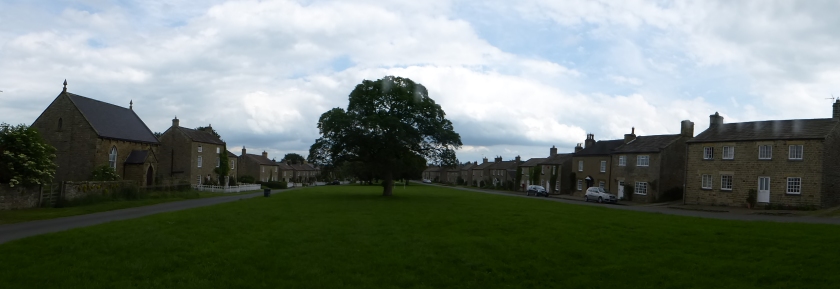
This is what we did. Here’s our starting point at East Witton, about 15 miles from home. It’s a lovely small village of about 250 people, where most of the houses were built in the early 19th century round the extensive village green.
East Witton
We passed through fields with views across the Dales. We walked along a green lane, through woods, and eventually reached a wooded gorge through which the River Cover runs, and where we crossed over the charming stone bridge known as the Hullo Bridge. It was quite a climb up the hill on the other side, and we were hoping for glimpses of Braithwaite Hall. Too many trees in full leaf. We hardly glimpsed it.
It’s built on the site of a grange belonging to Jervaulx Abbey. After the Dissolution of the Monasteries it continued as a sheep farm, as it had been under the monks. This is an area where the monks of both Jervaulx and Fountains Abbey extended their influence widely: enormous numbers of sheepall over the region were managed from local granges where the lay brothers who cared for them lived.
The ruins of Middleham Castle.
We were nearly in Middleham now. This is above all a horsey town. The monks of Jervaulx bred horses, and brought them to the Moor to exercise them. When the monks eventually went, the horses remained, as did the training tradition . Middleham these days is home to around 15 racehorse trainers and 500 horses, yet it’s a small town of hardly more than 820 people. It was too late for us to see the horses out on the Gallops this morning, so instead the first thing we saw was the castle, which dates back to 1190 and was the stronghold of the powerful Neville family from the 14th century. Richard Plantagenet, later Richard III was sent here as a young man to be trained in arms by Richard Neville, Earl of Warwick, his cousin.
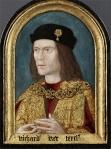
The earliest known portrait of Richard III (Wikimedia Commons)
Warwick had the bad habit of changing sides throughout the Wars of the Roses (1455-1485) depending on whether the Yorkists or Lancastrians had the upper hand. Eventually he came to a bad end when he was killed by the Yorkist King Edward IV and his younger brother Richard. Edward gave Middleham Castle, and much else to Richard who lived there with his wife, virtually ruling the North of England, for 11 years. When Edward died, Richard seized the throne and reigned for only 2 years before dying in August 1485 in the final battle of the Wars of the Roses, the Battle of Bosworth in Leicestershire. And there his body remained for 517 years, before being exhumed from a car park in Leicester in 2012.
For us, Middleham was the site for a rather good picnic, followed by a visit to a teashop for an indifferent cup of tea, and even more indifferent cake. But the calories were useful. There were stiles to cross into fields deep in cut grass, waiting to dry off into hay: a fine walled track Straight Lane – to walk along before reaching the River Cover, languidly passing over bleached white stones on its way to meet the River Ure. We briefly touched the road once more as we passed Coverbridge Inn. This dates from 1684, and was owned by the same family – the Towlers – till 1930. Local legend has it that when the monks of Jervaulx were forced to disband in 1537 at the Dissolution of the Monasteries, they shared their secret recipe for Wensleydale cheese with the Towlers. We shall never know.
A final walk along woodland paths, open farmland, fields enclosed by characterful drystone walling and we were back in East Witton. A grand day.
It was my turn to lead a walk on Tuesday. I chose Coverdale. Here’s why.
The River Cover, which gives the dale its name, wanders through an isolated corner of Wensleydale. Here you’ll find hamlets with intriguing names like Swineside, Horsehouse and Gammersgill, a few abandoned leadworkings, a great many sheep, and not much else. The principal settlement, Carlton, has 230 inhabitants and the main – the only – road to it is mainly single track. This is where we began our walk.
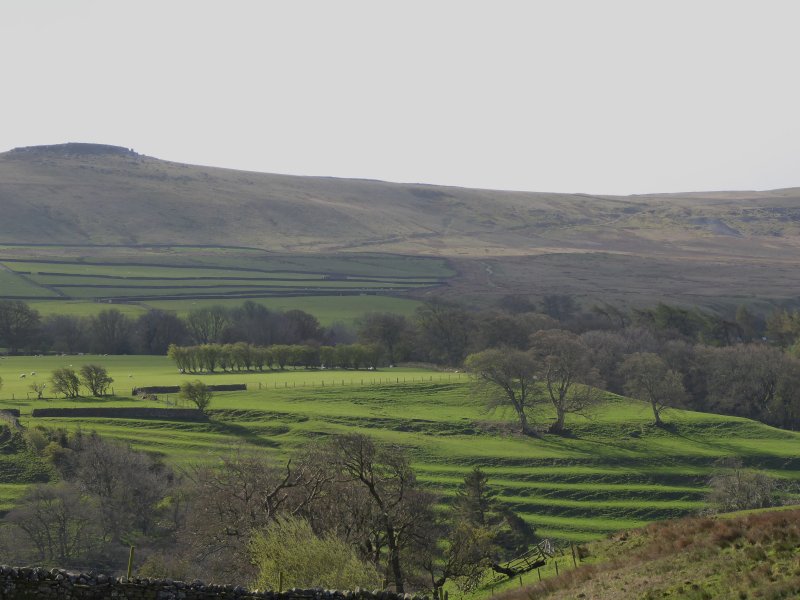
Here were hillsides, close-cropped by sheep. Here were ancient terraced field patterns showing that the area, even if lightly-populated now, has long been settled by farming communities. Here were narrow steep-sided gills sheltered by glades of trees. It offered a walk full of variety.
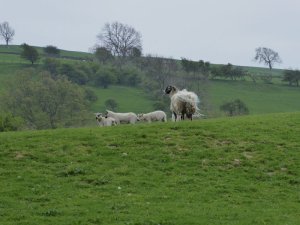
Sheep with her lambs.
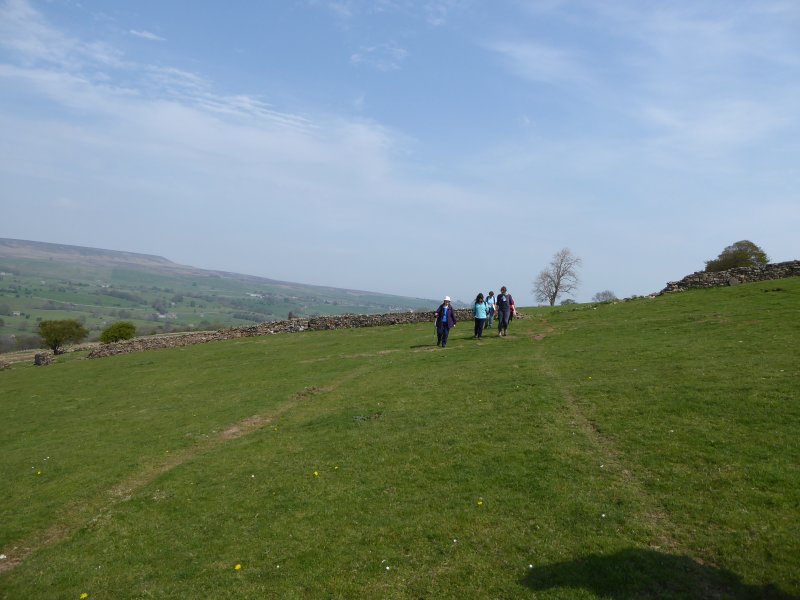
We yomped up and across meadows populated by those sheep and their curious, always hungry lambs, enjoying long-distance view across the fells. Curlews called above us.
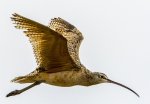
Curlew – Wikimedia Commons
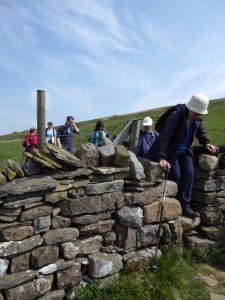
We climbed over wooden stiles, stone stiles, ladder stiles and through narrow-gap-in-the -stones-stiles. As we passed though woodland we sniffed the slightly acrid but appetising tang of early wild garlic.
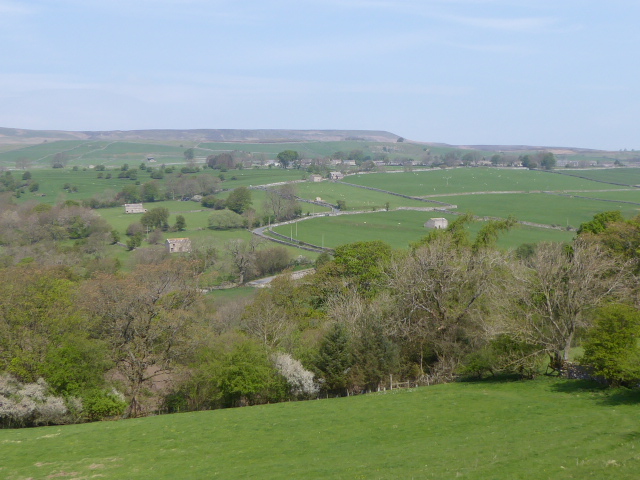
Our coffee-stop view across the valley. Those stone barns are typical of Wensleydale and Coverdale.
Soon we could see our half-way point on the other side of the valley. Horsehouse these days is a tiny collection of isolated homes. But it gets its name from the days when it was a really important staging post for those making the long journey from the north (even as far away as Edinburgh) to the south (London?).
And once we’d crossed the River Cover, we were in woodland again. We found a grassy bank, complete with bluebells, tree trunks to sit on, fat white pebbles for the waters to tumble over: perfect comfort, perfect peace.
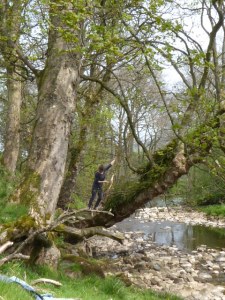
We had a young German guest, Felicia, with us for the day. You can see she’s 40 years younger than the rest of us. She’s climbing trees after the picnic.
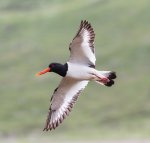
After lunch, curlews gave place to oystercatchers, with their smart black and white plumage and vivid orange beaks.
Oystercatcher – Wikimedia Commons.
And then we came to the point in the walk where the instructions read ‘Turn left at the last stile’. How mystifying. How can you possibly know which the last stile is till you’ve passed way beyond it and not found another? Ever-resourceful we found our way anyway, strode through Gammersgill, across a few final fields, and got to journey’s end not long before the day’s sunny warmth gave way to wind and showers.
Easter holidays. Time to have those ten-years-old grandsons over. Time to keep them so busy they don’t have a chance to realise that ours is not a home stuffed with devices. Not a smart phone in sight.
Let’s get them back to the past straight away, even before we get them back to our house. Are they too old for an Easter Bunny hunt at Fountains Abbey? Apparently not. Not when there’s a chocolate bunny to eat at the end. Are they too cool for egg and spoon races and egg-rolling down the hill? Apparently not.
Egg-and-spoon race.
Egg rolling.
Would they like to visit ‘Forbidden Corner’? They agreed they would, even though we failed to provide a description of what to expect. We couldn’t. It’s been described as ‘The Strangest Place in the World’. Perhaps it is. It’s a folly. It’s a fantastical collection of follies. It’s woodlands, walled gardens, mazes, tunnels, grottoes, built in the manner of a topsy-turvy collection of fairy tale castles in enchanted grounds. Every stone putto is liable to pee on you as you walk past. Every passage is too narrow, too low, too dark, and may lead nowhere. You just want to try to get along it anyway, because at the end there may be another secret door, with halls of mirrors, or ever-changing fountains, or grotesque stone gremlins, or stepping-stones …. And beyond, in every direction, the glorious countryside of North Yorkshire.
Next day, off to Brimham Rocks. No child can resist the opportunity to climb and jump among these extraordinary tottering towers of balanced rock formations. A visit there is a regular fixture for Alex and Ben.
And finally – yet more rocks. Underground this time. Stump Cross Caverns: limestone caves set about with stalactites and stalagmites, tinted in all kinds of shades from the iron and lead seams that also penetrate the area. Gloomy, dark and mysterious, and guaranteed to fire the imagination. Photographs courtesy of Ben.
Down, down, deep into the earth.
In the evenings we sat round the kitchen table and played board games. The London Game brought out everybody’s inner mean streak as we blocked other players in, or despatched them to the end of the line at Wembley Central. Stone Soup gave us the opportunity to lie and lie again in an effort to get rid of all our cards. All very satisfactory. A good time was had by all.
But Granny and Grandad would quite like a rest now. Please.























 From Pyrenees to Pennines
You must be logged in to post a comment.