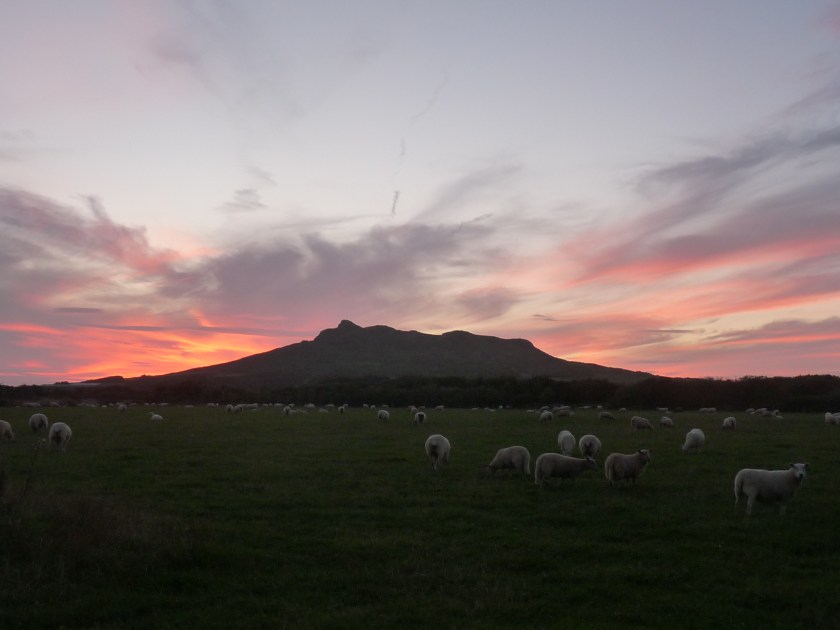
We’ve just come back from a glorious long weekend in Pembrokeshire in South Wales, with son, daughter-in-law and her parents. We were near St. David’s, Britain’s smallest city. Its population is the same as that of Laroque d’Olmes, and in other ways too the area seems to qualify as Ariège-on-Sea. Craggy mountains; fields of sheep and cattle; tiny one-track roads where the only likely traffic is a tractor, or even more likely, a herd of cattle coming home for milking; and long vistas, from the hill tops, of apparently endless countryside. And of course, the sea.
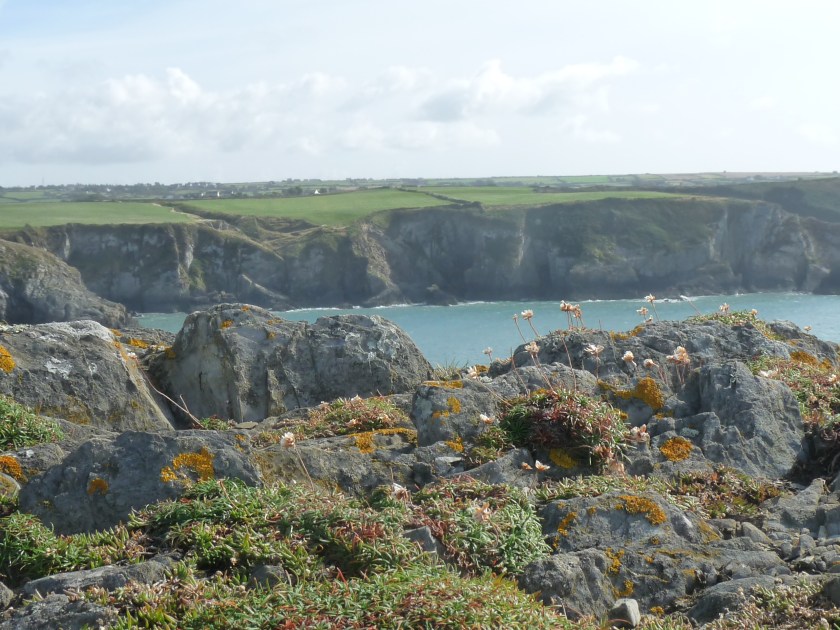
Our objective was to cover a goodish distance along the Pembrokeshire Coast Path. It’s some 299 km long: we managed about 40 km. so we have some distance to go. But what a journey. This scenery must be among the most stunning in the UK. Steep limestone cliffs and bays, volcanic headlands, beaches, inlets and flooded glacial valleys are the home to innumerable seabirds, and at this time of year, seals seeking sheltered nurseries to give birth to and rear their pups.
This slideshow requires JavaScript.
For me, this was the toughest walking since we’d left the Pyrenees. You know where you are there. On the whole, you’re walking up a mountain. Then you come down. Whereas along the coastal path, you’ll be scrambling upwards to reach the top of a high cliff, before descending again, perhaps almost to beach level. Then up again. After that you might swoop down to a cove before marching upwards to the next headland… and so on. Bright sunshine, warm breezes, and bracing sea air cheered us along and kept our energy levels high…. until the evening, when we found ourselves drooping and heading for bed as early as 10 o’clock.
Wednesday, August 20th. The morning air was chilly, just a little damp and drippy. Flowers in the borders hung their heads, their petals shabby and tired. Autumn has arrived. It does seem a little previous.
‘All is safely gathered in/ Ere the winter storms begin’
All the more reason to get out and about, before the days really close in. Ripon Ramblers chose to go to Harewood.
You’ll perhaps have seen Harewood House on TV recently, as that’s where the Tour de France really started from this year, after the Départ fictif from Leeds.* Half way between Leeds and Harrogate, it’s a playground for both towns, with its fine Adam-designed stately home, and extensive grounds designed by Capability Brown. At the time, the 1750s, investment in the slave trade brought immense wealth to the Lascelles family. Their descendents, the Earl and Countess of Harewood live in these fine surroundings built two and a half centuries ago. This stately home is regarded as being among the finest in Britain and is for the most part open to the public.
Our walk took us on a circular path that began outside the grounds, over farmland and with views across the Wharfe Valley. The route across the cow pastures was a bit of a puzzle. Weren’t those mango stones beneath our feet? And melon seeds? And even squashed tomatoes? The smell of rotting fruit wasn’t what we looked for on a country walk. Finally a young woman from a nearby stables helped us out. A local supermarket regularly dumps its surplus fruit at this farm for the cattle to enjoy. Four tons of fruit seemed to us to be remarkably poor stock control on the shop’s part, and we couldn’t help wondering what the cows’ insides made of this exotic diet.
Cow on a mango-hunt.
Far more enjoyable were the autumn fruits that lined our route for much of the day. We gathered blackberries every time we felt hungry or thirsty. We enjoyed the sight of haws turning red, elderberries turning black, and prickly chestnuts swelling and fattening on the trees.
Blackberries waiting to be picked.
Hawthorn berries ripen.
Elderberries too.
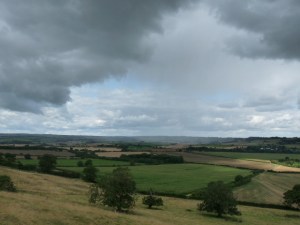
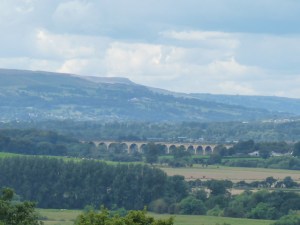
We completed our upward yomp, and walked along the ridge which offered a fine panorama across to the Crimple Valley and Harrogate beyond, to Almscliffe Crag, and even Ilkley Moor. Clouds in a dramatically cloudy sky were unloosing light rain into the nearby plain, and the breeze soon pushed the showers our way…..
Look carefully. You’ll see rain falling in the plain below. But not on us.
….and then pushed them on again, so that we could enjoy a rain-free lunchtime picnic with all that view before us.
Lunchtime view over the Crimple Valley.
After lunch, we were in the grounds of Harewood. Not the formal grounds near the house itself, but areas of woodland, pasture, lakes, deer park and farmland. And in the distance we spotted a fake Dales village, only built in 1998. This is Emmerdale, used in filming the long-running soap of the same name. No filming that day, so we were soon on our way, hurrying now before the rain, promised for mid-afternoon, settled in to spoil our walk. We made it – just.
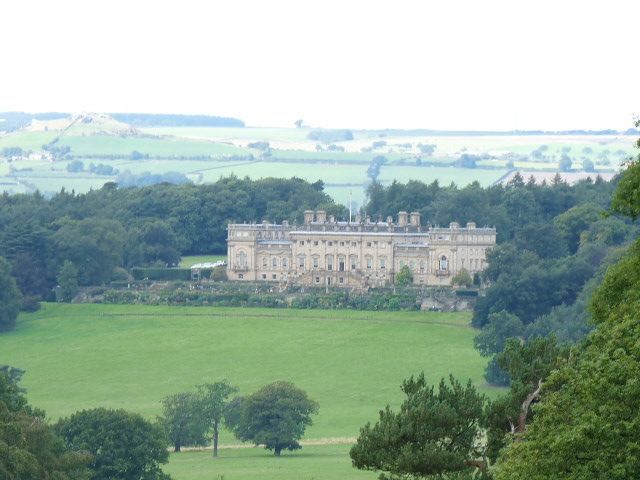
Our best view of Harewood House came at the end of our walk.
* The ‘départ réel’ of the Tour de France from Harewood signified the true beginning of the race. City centre Leeds was no place for cyclists to jockey for position, so riders just tootled out to Harewood on the ‘départ fictif’. Then the action started.
I’m not fully adapted to country life yet. Forward planning – or lack of it – is my failing. I haven’t yet learned to anticipate whether we’ll need more milk, potatoes or whatever before the next planned trip to The Great Metropolis (aka Ripon), and quite often find myself grubbing around at the back of the cupboard for acceptable substitutes.
Saturday, though, is the day we treat ourselves and buy the paper. There’s enough reading material there to get us through several days, and the sports section, discarded immediately, is perfect for any number of little jobs such as lining the rubbish bin. And yet today we had no excuse to visit Ripon, so would we have to go without our newspaper?
Well, no, there is another solution, but we have to reckon on leaving the house for well over an hour to complete the three and a half mile walk. The round trip to the paper shop involves leaving home along the path through the woods, walking along the riverside path to Sleningford Mill caravan site, dallying by the weir for a few minutes, battling along the narrow path now surrounded by chest-high spring flowers, and finally reaching the bridge at West Tanfield.
The shop in the village is where you’ll find most things. There’s food, drink, first aid and stationery – and a Post Office. There’s a community board where today I found news of someone selling chilli plants – I’ll be buying some of those . And there are newspapers. I bought our weekly fix. Then I set off home by a different route. Out of the village on the road, up the hill, turn right at a farm gate. The path here’s been slightly diverted, because the farmer’s made wide beetle banks to boost the number of farmer-friendly insects and spiders on his land. Through several fields of sheep, who come to inspect me, and along the drive of Sleningford Park, a country house. A final yomp along paths running alongside fields of wheat and barley, and I’m home once more.
It wasn’t quick. But I came home refreshed by the birdsong I’d heard; the sight of birds, rabbits, squirrels and sheep I’d passed; the flowers I’d spotted on the paths, different already from the ones I’d spotted only a few days ago; and all those country smells, from wild garlic to sheep dung to spring flowers. I’d had a better morning, I reckoned, than if I’d either gone without, or jumped in the car to grab a newspaper at the petrol station four miles away.
This one’s for our French friends: a stone and gated style, walkers-for-the-use-of.
Another valley, another view.
Spotted in a village garden, and obviously nicked from outside some French hamlet. Not Rimont, then, but where?
Another view across the Dales
Swaledale sheep: the image of the Yorkshire Dales.
A rather fine dry stone wall.
Our lunch time view.
Our lunch time companions.
Setting forth after lunch.
The River Ure at Aysgarth.
The falls at Aysgarth.
A final view of the river.
A few late primroses, still bright and fresh.
About time too. Five weeks in England, and still we hadn’t got out and done a Proper Walk. With a Proper Group. Blame the general business of unpacking, organising furniture, pots and pans, clothes, books, pictures and day-to-day Stuff in our new home. Blame constant strings of communication with officials who Need-To-Know our new details. Add in those who fail to respond, perhaps because they no longer have local offices and, understaffed, are too overwhelmed with work (DVLA ?), and you have all, well, some of the excuses you need for our having failed to get a decent walk in.
There was a certain reluctance too. So many of our happiest times in France were spent discovering the region with our Sunday and Thursday walking friends. Apart from the scenery, we remember with so much nostalgia the conviviality and the leisurely picnics, as we all produced cheeses, charcuterie, bottles of wine and home-made cakes to share at the lengthy midday pause.
All the same, we shouldn’t have worried. Yesterday we met members from a local group, unsurprisingly the one from Ripon. We got ourselves to Wensleydale, to a picturesque village called West Burton, and had a hearty, but not too hearty, walk across to Aysgarth, before winding our way back. We loved it. The group was welcoming and friendly. The walk had just the right amount of challenge – we have become just a bit unfit – and the views were all we hoped for. The weather was good too. Breezy, but not cold, and plenty of sunshine.
There was only one small disappointment. At lunch time, British walkers sit with their own personal sandwich, get it eaten, then move on again. But even that disappointment was relieved when at the end, Our Leader spotted a tea shop. Sitting round over a large pot of tea, cakes for some, as we reviewed the day was a pretty good end to a pretty good walk.
…. which is, being very roughly translated, our pot-luck picnic on the Resistance trail.
Posh picnic? I think not. But it’s the taste and the company – that counts.
Jean-Charles has long wanted to get us up to Croquié, a village high above the road between Foix and Tarascon, for a walk with a 360 degree panorama of the Pyrenees, and a very moving monument to some of the Maquisards who died fighting in the French resistance in World War II. This really was the last Sunday we could go, and the day was glorious: hot, with clear blue skies and views for miles and miles in every direction.
Neither Malcolm nor I is particularly on form at the moment, so while our Laroquais friends yomped up a semi-vertical path, deeply slicked in mud, we went part-way up the mountainside from the village of Croquié by car, and then walked on up by road (a road, however, closed to cars) to meet the rest of the group.
Our first destination was the Monument to the Resistance. This site, with views across to the mountains dividing us from Spain, far-reaching from west to east, was chosen as a memorial site not because it was a war-time battle ground. Instead it was a training school for resistance fighters from France, Spain and beyond. There are no barracks, no lecture-halls, no buildings of any kind. Instead the men led hidden existences among the forest trees and rocks. And now there is a fine memorial to them. Singled out were two men who died in nearby Vira (the area where we walked last week) a Maquis stronghold, one who died in our neighbouring town of Bélesta, and one who died following deportation. There is a statue to these men, who are nevertheless depicted without facial features. In this way they stand representative for all the men – and women – who died whether through fighting, by acting as liaison workers, or by offering essential support by giving shelter, clothing and food. Individuals did not pass over to Spain from here: the border is too far away. Instead they were driven to one of the freedom trails such as those near Oust and Seix. Petrol? It could be organised, albeit with difficulty. A key man ran a garage.
First glimpse of the monument.
A better look at it
This is the view those figures have
The sculptor of this monument is Ted Carrasco. A native of Bolivia, pre-Columbian art is a clear influence on his work. He seeks always for his pieces to be in harmony with the environment in which they are placed. His monumental granite figures look over to the Pyrenees which were the scene of their fight against fascism and the Nazi occupation of France.
Time to move on, however. Our path took us slowly upwards through forest, along a track which became increasingly snow-covered and tough going. However, it was only 3 km. or so until we reached the top, where there’s a refuge dedicated to the memory of its original owner, Henri Tartie, known as ‘l ‘Aynat’ – the elder, in Occitan. The original structure is tiny, but served as shelter to many a Maquisard . Now it’s a wood store, because a newer concrete annexe has been added with cooking facilities so that hardy mountain walkers can rest, make a meal, and warm themselves up.
The way up to the refuge.
Jean-Charles gives us a short history lesson outside the refuge.
The modern extension and its ‘facilities’.
A cheerful picnic.
This was our view.
And this.
And this.
This too.
And this , on the way down.
We commandeered a circular concrete table outside, with apparently unending views of those Pyrenees, and somehow squeezed all ten of us round. We unpacked our food: as ever there was wine to share, rhum baba à l’orange, galette charentaise, biscuits – all home-made, of course. Malcolm and I knew it was our last walk with our friends. The fine views, the fine company, the cheerful conversation had a predictable effect. We became tearful. But so grateful that this walk was a bit of a first. Extra-special views, extra-special weather for March, the chance to get close to an important slice of Ariègeois history, and our extra-special friends. We shan’t be with them next Sunday: there’ll be too much to do. It doesn’t bear thinking about.
This post is really just a chance to post a few photos from a couple of recent walks, one in the Ariège, and one in the Aude. Each walk brought out some of the contrasts and similarities between the two Départements.
The more local walk, near Ventenac last Sunday, was near meadows where cattle grazed, through fields being prepared for sowing feed crops such as maize, and through oak and beech forest. Though there are villages dotted about, the area is still thinly populated, densely forested. During the Second World War it provided cover for the Spanish Maquis , scourge of the German army. With the support of many, but not all locals, the Maquis came to regard the area as a centre of gravity, from which they emerged to pass soldiers and refugees across the mountains, and to organise acts of resistance to German occupation . You’ll find monuments to their activities, their battles, their acts of martyrdom all over the area. It’s easy to see how, in this large territory, with under-developed links of communication, the Germans had such difficulties keeping tabs on the Maquis’ whereabouts.
Early wood anemones
This monument at Calzan commemorates the activities of the Maquis in the area, particularly their involvement in the liberation of Foix in 1944.
Many of the mountains that day were surrounded by a cloudy halo.
The more distant peaks are still thickly covered in snow.
We had a 360 degree vantage point: so every view was different
Far beneath the moody sky is the city of Pamiers.
Approaching journey’s end.
Over in the Aude on Thursday, near Esperaza, we saw no farm animals, but our path took us past vineyards where the vines were being hard-pruned ready for 6 months of vigorous growth and grape production. Martine, from a wine-producing family, explained some of the different methods of pruning – and there are dozens. Older varieties of vine, unsupported by wires, may be pruned with an open centre, so the core looks almost like a bowl. Other kinds of grape usually require training along wires: all sorts of schools of thought here. These days, much harvesting is mechanical. Martine’s family send their grapes to a wine co-operative for processing. This co-operative sends an oenologist every year to analyse their grapes and those of all the other members of the cooperative. Then he will book everybody a two-day spot with the mechanical harvester at what he believes to be the optimum moment for their particular harvest. Few grapes cannot be harvested in this way, but the local Blanquette de Limoux is one. Its low-growing grapes are unsuited to mechanical methods. With wine-production the main agricultural industry, the villages here have a properous air to them.
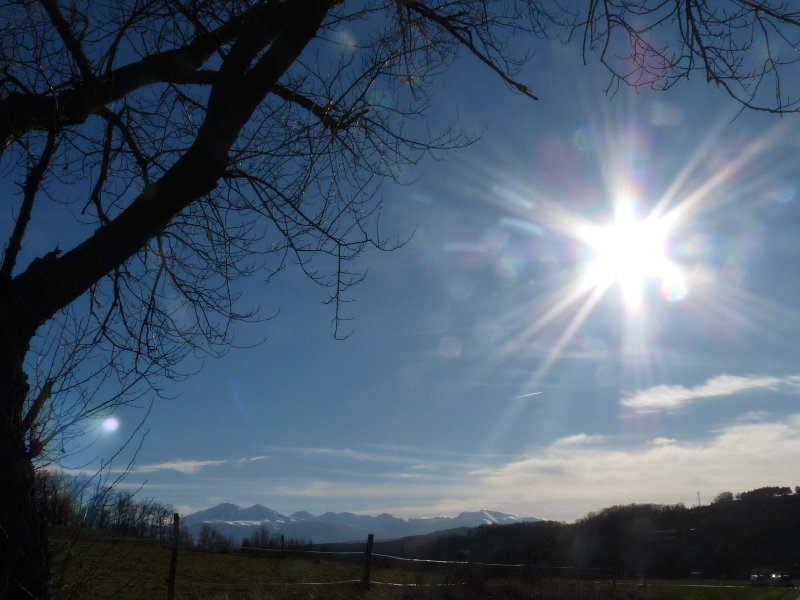
A moody morning sky.
In th Aude, Bugarach is never far away.
Vines and mountains.
Amond blossom against a midday sky
Old, gnarled, bowl-shaped vine.
Young vine, pruned with just one main shoot, and requiring support.
Both walks shared a fair bit up uphill (and therefore downhill) marching. And in both cases, the rewards were in the views of the distant Pyrenees, still covered in snow. In the Ariège, you’ll be looking to recognise the peaks of Saint Barthélemy and Soularac, whereas in the Aude, you’ll have no difficulty in recognising Bugarach looming above the surrounding peaks.
These last walks are bitter-sweet. We’re enjoying them, but not enjoying the fact that, for the time being, there are (almost) no more to come.
This time last year, and well into March in fact, I did little but moan about struggling around in snowshoes on our Sunday walks. Here’s a picture I took on March 4th last year.
Buried information board on a local snowshoes expedition last March
And here we are on February 23rd 2014, enjoying full-on Spring. These are shots of some of our daffodils in the garden, taken today.
Daffodils in our garden this evening.
Today, Joseph led us on a walk from the foot of Montségur to the Roc du Banquels. It’s one of those walks where from Step One, you’re climbing, ever upward. We whinged about it, and one of our number, who’d gone and left his hiking boots in a carrier bag in the car park at Laroque (you know who you are, M.rc.l) even had to jump ship.
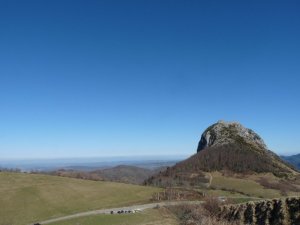
The walk begins. That’s Montségur you can see.
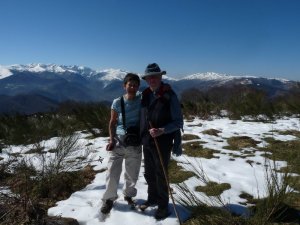
Ever onward, ever upward. It was warm though, and we brushed past trees covered not in snow as last year, but with tightly-furled leaves about to burst into growth, and catkins. Eventually, as we reached a height of some 1,200 metres, we did reach snow underfoot. It wasn’t very deep though, and walking through it wasn’t too much of a challenge.
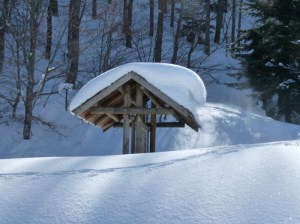
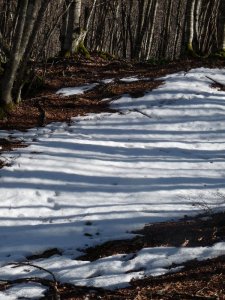
The snow begins.
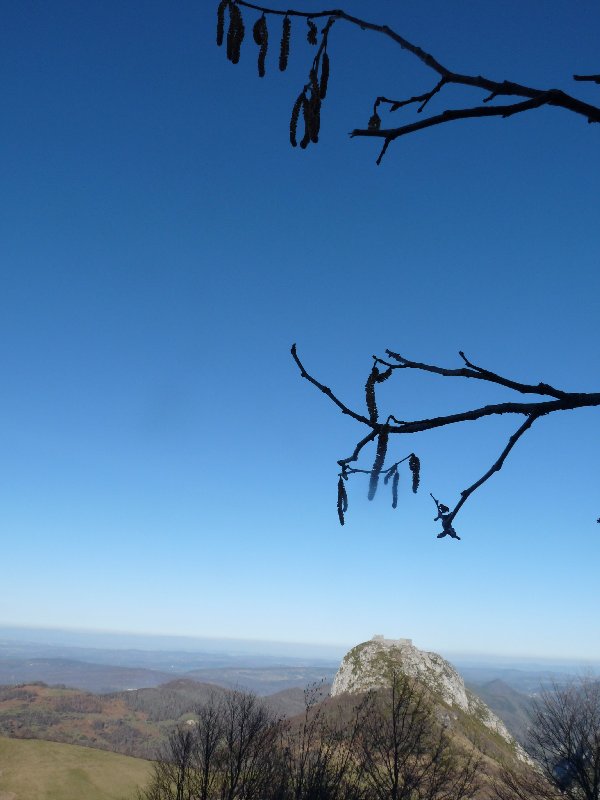
Our efforts were rewarded. As we panted up the final slope, we saw before us, clearly defined against a bright blue sky, a large and craggy rock over which juniper bushes straggled . This was our destination. We ditched our sacs and walking batons in favour of scrambling up those final few metres, searching for tiny footholds and clumps of juniper to help us on our way. There far below was the summit of Montségur. Beyond it, Laroque, St. Quentin. In another direction, the lac de Montbel, its usual Mediterranean blue. Look towards the Aude, and looming out of the mist was the immense peak of Bugarach. It’s nearly 60 km away, but is so imposing that it makes its presence felt even at this distance.
Down below, the road through Lavelanet, Laroque, Aigues-Vives, St. Quentin…and beyond.
.. and there’s Montségur again, with the lac de Montbel behind it and to the right.
So many peaks as your gaze swings round. Bugarach is the largest and furthest away.
And now we’ve come full circle.
We sat awhile, enjoying our magnificent vantage point and the warm sun. Heigh ho, time to go – before the sun sets behind the mountains and we all start feeling cold. Going down’s always quicker than climbing up.
We almost scuttled down the slopes, and were taking our boots off ready for our short ride home just as the sun began to drop behind the high peaks. An excellent afternoon.
‘Whether the weather be cold, or whether the weather be hot,
We’ll weather the weather, whatever the weather, whether we like it or not.’
Indeed. Not cold. Not hot. Just wet, very wet indeed. Just look at those floods in England, Brittany and even the Var. We really shouldn’t complain when the worst we’ve had here is a soaking and muddy boots. Especially when, as on Tuesday, the downpours suddenly stop, the sun comes out and dries up all the rain, and we can get out and enjoy the views.
Christine took us out on a walk she enjoys, just up the road from her house. It’s great for these soggy times, because it involves walking on roads so narrow they can barely be dignified as ‘single-track’ – but they are tarmacadam, and therefore mud free – and on farmyard tracks used so often that they too are in decent enough condition. The sky was very blue: spring was in the air.
As we started climbing, the mountains came into view
We passed Troye d’Ariège and the sheep farm we’d once visited, and then our path rose to allow us views of the Pyrenees before returning us once more to the valley floor, to la Bastide de Bousignac, and then back to her village, Saint Quentin.
Shadows lengthen as we near home.
The pollarded avenue on the road into la Bastide de Bousignac.
Reception committee from the birds as we arrive back in time for tea.
She’d made a cake. I’d made a cake. We put each to the test. Hers was yoghurt and bilberry. Mine was a pear, almond and chocolate loaf, recently posted by the deliciously greedy Teen Baker. Which was the better one? Malcolm and Max diplomatically cast a vote for each, and they weren’t wrong. We all tucked in, feeling we deserved a reward after an hour or two eating up the kilometres in the warming gentle sun.
Yesterday, I changed my mind. But nobody led me into a darkened room…..
I had my reasons after all. I was unlucky last year. I probably will never have the chance to do raquettes ever again. My Thursday walking friends wouldn’t set the bar too high. Everyone raves about the Plateau de Beille as a winter sports playground ….. These all turned out to be excuses rather than reasons.
A very mild winter means you have to climb pretty high this year to be sure of snow. The Plateau de Beille is high. 1800 metres and rising. The snow appeared at the roadside only during the last kilometre or so of a very dizzy 10 mile climb upwards. And when we arrived, the car park was packed, and every school child in the Ariège seemed to be there, muffled in ski-suits and excitedly fastening on skis. Which was fun to watch, but we were relieved that once we too had got booted and spurred, in our case with raquettes, and yomped just half a kilometre or so, we were in the wild and wide empty spaces .
Children arriving: all togged up
Getting organised.
Children get away from a day at their desks.
And that’s where it all could have gone wrong for me. We came to a signpost: ‘Pas de l’Ours. 11km’. ‘Eleven k? With raquettes? I don’t think so.’ I was not alone in protesting. Anne-Marie and I wimped out and chose a 3 km pathway, and had a fine time chatting as we soldiered up an admittedly steep slope, safe in the knowledge that this challenge would quite soon be over. Resting at a cabane at the top, we were surprised to be joined by our friends. It seemed their journey had taken a different route to this point, and whereas we had 2 km to complete, they still had 10. Three of them had a bit of a think. ‘We’re coming with you’. And that’s what they did. We waved the other six goodbye and arranged to meet in three or four hours: slow stuff, snow-shoeing.
The B team set off.
Tired already.
Nearly at the end of the journey.
We had a fine time. We got back to base in time for lunch and watched the children on the nursery slopes and the huskies drawing sleds as we ate our picnic in the bright cold sunshine.
Busy huskies
Then we discarded our raquettes and rucksacks, dumping them in the car, in favour of a snowy walk to see the views. It became windy. It became cold. It threatened to rain. But we weren’t on an 11km. route march, that was the main thing.
Can you see 3 different sets of animal tracks?
Perfect prints. But of what?
Bigger beasts.
When our friends re-joined us, they announced that they hadn’t been either. They’d found a short-cut and taken it. Cheats. But it just shows. This raquettes lark isn’t all it’s cracked up to be. Little and not-very-often seems to be the way forward. But next time, I’ll stay at home.
The end of the day: cold, windy, but still good to look at.
Click on any of the circular images to see the whole photo, and a miniature slide show.
About a year ago, someone suggested ‘Les Collines du Vent’ – the Windy Hills – for one of the Sunday walks with our Laroque walking group. The appointed day came, and it rained – a lot. We re-scheduled. The day came again, and it rained – a lot. We re-scheduled. The day came yet again, and it was foggy, a real pea-souper: the kind of fog that almost any Frenchman confidently assures us blankets London every day of the year (any Frenchman who’s read Charles Dickens that is).
And so it went on for five or six attempts. Today though, it didn’t rain. Nor was it foggy. In fact it was sunny until we left the Ariège and approached our destination in the hilly countryside in the Aude outside Castelnaudary. Then it became rather grey, though not menacing enough to stop us in our tracks. What DID nearly stop us in our tracks was the wind. The countryside here is rolling and open. The idea of any walk in the area is to get up there and stride from hilltop to hilltop. But that wind! It gusted and blew. It snatched us off-balance. It whistled through our trousers and tried to grab our hats. And it was only doing what it apparently does almost every day of the year. No wonder our path led us past a windmill during the afternoon.
The weather brightened, and we had wonderful all-round panoramas. Sadly we couldn’t quite see the Pyrenees: distant mists saw them off. And in the early afternoon, we had evidence that we really were the tough guys we thought we were, battling through that wind. We were overtaken by a battalion of the French Foreign Legion in training. Though admittedly they were all additionally burdened by enormous rucksacks that must have weighed 40 kilos. And guns. If you’ve read ‘Beau Geste’ you will remember that this band of soldiers is recruited from foreign nationals who wish to serve in the French army (don’t ask….). Coming from different countries, different cultures, the men are put through very challenging training designed to build their esprit de corps. We noted that Marcel, our leader for the day was putting us through a similar programme. Though at the end, he offered us a large slice of the Galette des Rois which he himself had made. We’d already had our usual lunch time bonanza of wine-and-cake-sharing. But nobody refused this last additional treat. We felt we’d earned it.
You must be logged in to post a comment.