I’m used to brick houses. And stone houses. And even houses whose facades have been rendered and painted, as our home in Laroque was. But house paints generally come in a very limited palette. White, of course, and a range of neutral or earthy tones such as ochre. That’s what I thought until I went to Wales, anyway. Now I know differently. Come on a very quick tour with me to see what colour you could paint your home. Click on an image to see it full size: I’m only sorry not to have included an example of my own particular favourite: crushed raspberry.
House with matching car. Note also the purple house next door..
We had such a good time wildlife watching in Wales. At first it was all simple wonder and enjoyment : ‘Look – there’s a…….’. But soon it all got quite competitive. Sarah bought an ‘I-Spy’ book – remember those? It was birds she decided to hunt for, and we all got involved in deciding whether it was guillemots, Manx shearwaters, or simple herring gulls that we’d just seen. And look! There’s a cormorant on that rock over there! And three choughs sitting on a wall! And over in those bushes – surely that’s a willow warbler?
Herring gulls taking a break
This cormorant almost got away before I got my camera out.
Choughs on a rock.
The day that we were in no doubt at all about the quantity of our wildlife sightings was the Sunday when we took a boat trip round Ramsay Island. There were indeed birds (but no puffins: it’s off-season for them): but what we relished seeing in huge numbers were seals, swimming in the coves, basking on the shore, or in the case of the white new-born pups, beached high up on some sheltered spot away from in-coming tides.
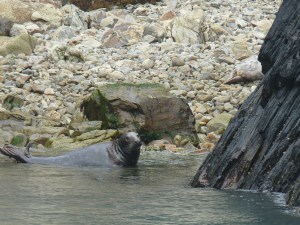
Grey seal on a beach at Ramsay Island
Ramsay Island’s a splendid place. These days it’s an RSPB bird reserve, and there were seabirds of course: not so many at the moment as the breeding season is over. Easy to see though where they nested – very precariously – on the rock faces which are heavily stained with guano. Sucked along by powerful tides, we plunged into sea caves, rode close to the shore squeezed between deep rock gorges as the cliffs soared high above us. We’re fairly sure we saw porpoises clipping along at speed just as we were turning for the mainland once more.
Grey seal swimming near our boat.
A beach full of seals.
A seal pup, easily identified by its white spotty coat.
Herring gull on Ramsay Island.
Empty sea bird nursery.
Sea bird settlement on the island
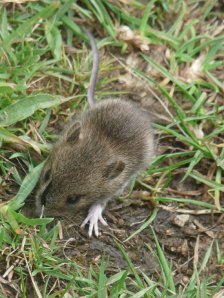
Every time we went walking we came to expect to engage in bird and seal spotting. But on Saturday, as we strode the cliffs of the coastal path, we came across this vole, and his (her?) two companions. The image you can see on your screen is almost certainly larger than the real thing. We were so lucky to have seen such a tiny creature, and so clearly.
One of the voles we spotted on our walk.
A few minutes later, I was the only one to spot a lizard: my first sighting since leaving France.
And then there was the evening when we went for a walk, and found ourselves accompanied by a whole troupe of friendly steers, who wanted nothing more than to follow us home, and to help us along with our map-reading….
We’re being followed…..
Not wildlife exactly: but these young steers were awfully keen to help Sarah and Brian out with the map-reading.
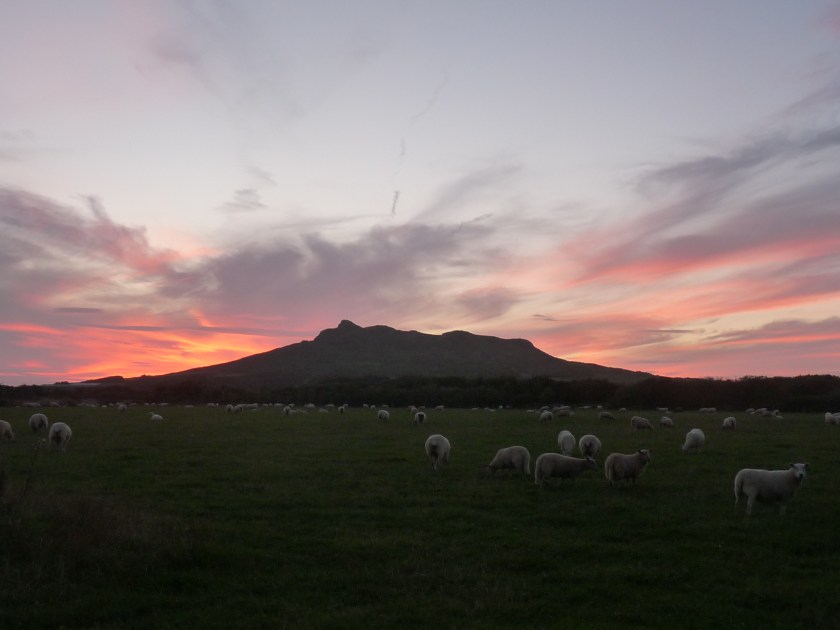
We’ve just come back from a glorious long weekend in Pembrokeshire in South Wales, with son, daughter-in-law and her parents. We were near St. David’s, Britain’s smallest city. Its population is the same as that of Laroque d’Olmes, and in other ways too the area seems to qualify as Ariège-on-Sea. Craggy mountains; fields of sheep and cattle; tiny one-track roads where the only likely traffic is a tractor, or even more likely, a herd of cattle coming home for milking; and long vistas, from the hill tops, of apparently endless countryside. And of course, the sea.
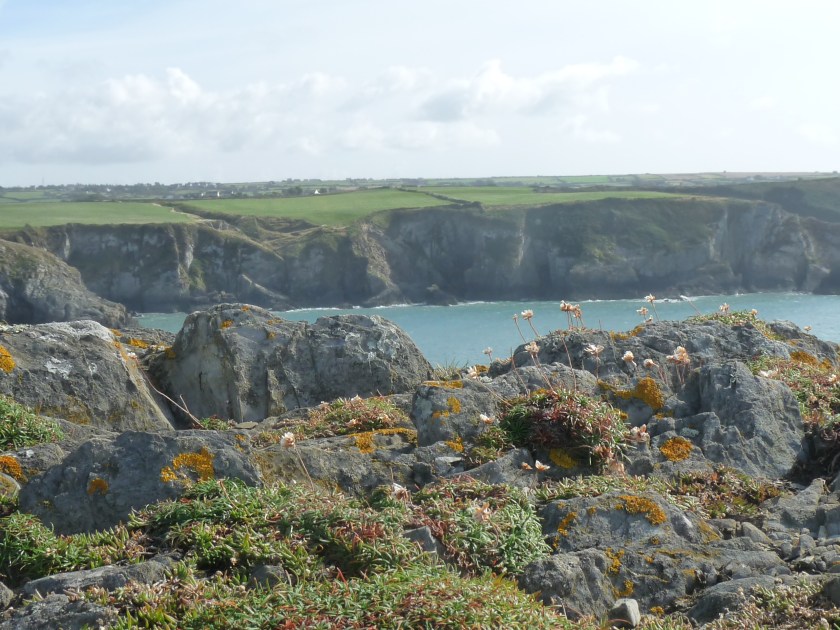
Our objective was to cover a goodish distance along the Pembrokeshire Coast Path. It’s some 299 km long: we managed about 40 km. so we have some distance to go. But what a journey. This scenery must be among the most stunning in the UK. Steep limestone cliffs and bays, volcanic headlands, beaches, inlets and flooded glacial valleys are the home to innumerable seabirds, and at this time of year, seals seeking sheltered nurseries to give birth to and rear their pups.
This slideshow requires JavaScript.
For me, this was the toughest walking since we’d left the Pyrenees. You know where you are there. On the whole, you’re walking up a mountain. Then you come down. Whereas along the coastal path, you’ll be scrambling upwards to reach the top of a high cliff, before descending again, perhaps almost to beach level. Then up again. After that you might swoop down to a cove before marching upwards to the next headland… and so on. Bright sunshine, warm breezes, and bracing sea air cheered us along and kept our energy levels high…. until the evening, when we found ourselves drooping and heading for bed as early as 10 o’clock.






 From Pyrenees to Pennines
You must be logged in to post a comment.