Until the early years of the twentieth century, there had been thousands of Greeks living in Turkey, and Turks living in Greece, preserving their own culture and ways of life over many centuries. But by the 1920s, both Turks and Greeks had been through a period of real upheaval, with a series of wars including the Greco-Turkish War of 1919-1922. Senior politicians in both countries could see problems ahead if largely Muslim Turks remained in Greece, and largely Orthodox Greeks remained in Turkey.
Their solution though, was a shocking one. Following the Treaty of Lausanne in 1923, thousands and thousands of Turks and Greeks were in effect deported from the lands where they and their ancestors had been living for centuries, back to their country of ethnic origin. They were given almost no time to prepare or to pack belongings: they were displaced refugees. Large Greek communities such as Smyrna were quite simply emptied of their citizens, to be stocked with Muslim Turks and re-named Izmir . The regional ethic mix which had prevailed for centuries ceased.
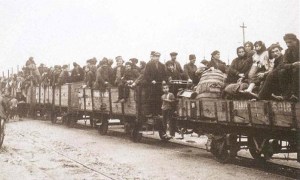
Greek refugees from Smyrna arriving at Thessaloniki 1923 (unknown source)
Though it’s hard to regard what happened then as anything better than ethnic cleansing, many Turks nowadays will say that now the dust has settled, and with the passage of time, both Greece and Turkey are the better for it. Greco-Turkish relations have often been poor, and with the two populations now separated, there’s one less thing to fight over.
It’s a hugely complex issue about which I know next to nothing. What I do know is that we spent the last morning of our Turkish holiday in Şirince, one of those villages that was forcibly de-populated, then re-populated, in this case by Turks moved out of Thessaloniki in Greece. It’s a charming place, set on a hillside amongst olive groves and orchards; a tourist trap for Turks and foreign tourists alike. But on a quiet warm morning in February, it was no hardship. We used the time to sample the fruit wines for which the village is noted: mulberry, peach, morello, quince (no, we didn’t try them ALL). We bought last-minute souvenirs: local olive oil, honey, pomegranate vinegar. It was easy to feel, strolling through the narrow streets, that we might be in Greece rather than Turkey, even though we didn’t hear, as promised, any of the older inhabitants speaking Greek.
A quiet bar: a good place to sample some of those fruit wines, or an apple tea.
Local textiles on sale.
Village life.
Bazaar in Şirince. Easy to see it’s part of Turkey now.
Fruit wines waiting to be sampled.
A quiet street in Şirince.
A mosque has now replaced the church.
Retail opportunity outside the now disused church.
The church has seen better days.
It was a peaceful way to end our holiday. We’ll be back, as independent travellers next time. And from now, it’ll be posts from misty moisty England. For a while at least.
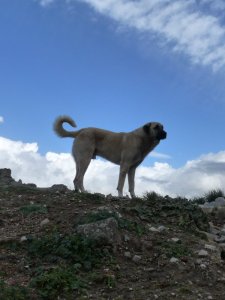
Efe took time out from his job as guardian of a group of nomads and their sheep wintering in the area, to accompany us on our visit to Miletus. He’s a kangal, and we all immediately took to this handsome, gentle and affectionate dog, one of a breed popular in Turkey for its qualities as a fine guardian of stock.
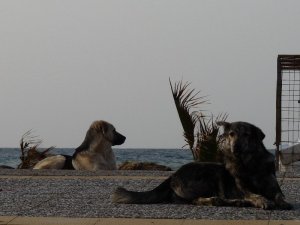
Like many Turkish dogs and cats, Efe has a home. But many others do not. There are hundreds and thousands of animals whose home is the street, and who are on the whole tolerated and even regarded as part of the community. Don’t imagine that these animals are mangy and sickly, with protruding ribs and rotting yellow teeth. They’re well fed and healthy.
Turks apparently, when planning a move to a new neighbourhood, will look and see how street dogs are treated. If they’re friendly and companionable, then that means the neighbourhood too is friendly. If the dogs are aggressive or fearful than it’s not a good area. Best not to buy.
Street dogs by the sea at Ayvelik.
These days though, street dogs are a problem, simply by virtue of their huge numbers. So they are tagged, vaccinated and spayed or neutered to prevent the spread of rabies and other diseases, and to limit their population.
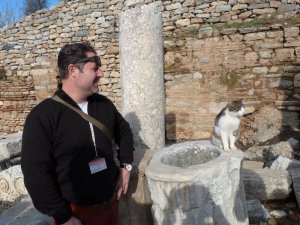
An Ephesus resident attempts to steal the show from our guide.
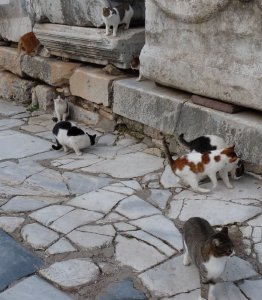
We saw cats too wherever we went. But never so many as at Ephesus, which is rather famous as an unofficial cat sanctuary. Looking round the site, we once saw 14 at a single glance, and they were quite at home as they lolled on marble pillars and lounged round the library.
Ephesus cats.
These photos of street dogs and cats are among the less expected souvenirs of our trip.
We’ve just come back from a short holiday in Turkey. We’ve just come back from our first organised tour. We’ll happily go back to Turkey. But we won’t be on a tour. There’s only one plus in this form of holiday, as far as I can see, though it’s quite a big one: a Turkish guide, born and bred, brings many insights into Turkey, its people, and their way of life. There’s a post or two coming about some of the things we learnt.
We were herded on long coach journeys from place to place, where after our official visit, we often had little time to linger, absorb, and just simply ‘be’ in ancient sites that have seen thousands and thousands of years of history. Large tourist hotels are comfortable but impersonal. The food they offer is perfectly tasty, but offers only a tiny glimpse of the country’s rich culinary tradition. And then the herding continues, as we’re compulsorily escorted into stores selling carpets, jewellery, leather. We longed for more free time. I snatched the chance late one afternoon to work out how to catch a bus into the nearest town, Ayvalik, and follow my nose for a few precious minutes. But I only had three-quarters of an hour before I needed to come back and re-enter the system.
However. In visiting Anatolia, we’ve seen glimpses of the most extraordinarily rich culture of the area, from pre-historic to post-Classical times. We’ve seen those places I’ve known about since childhood, when I first heard all those stories about Odysseus, Helen of Troy et al.
Here are some of the photos I took as souvenirs. Most of the places we visited have survived so well because they lost their reason for being busy, successful places. Originally on the sea, they are now several miles inland, since Anatolia’s western coastline has been silting up for millenia. One day it’ll link up with Greece, and who knows what ructions that will cause.
We visited Priene, already important by 300 BC. It made quite an impression on us to walk its ancient marble streets, built on a grid system, still intact, complete with gouged marks and notches to prevent slipping. Its drainage system is still visible, its bouleuterion (council chamber), its temple to Athena, and its theatre, designed to accommodate 6,500 people.
Steps up to the city of Priene.
A view of the theatre complete with marble throne.
Temple ruins
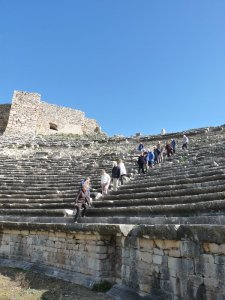
Miletus was next, a city that was a centre of Greek thought from as early as 1000 BC. It was fought over by Greeks, and Persians. Later Romans took over. Alexander the Great, St. Paul….. they’ve all been to Miletus. And the theatre here seats 15,000…….
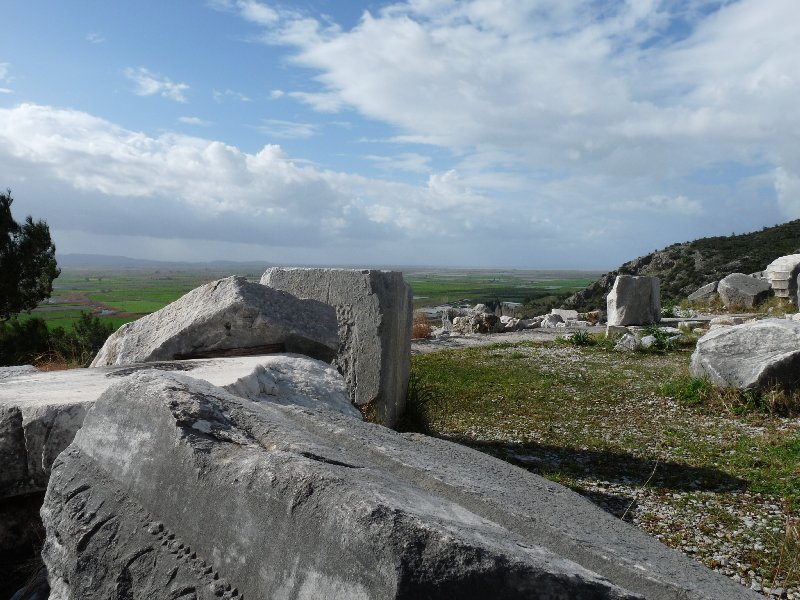
First view of Miletus
The baths.
Spreading the weight through a series of arches.
The theatre: the space between audience and arena indicates that animal fights were held here.
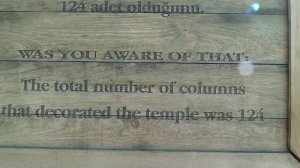
Didyma wasn’t a city, but what a temple! The Temple to Apollo here has 124 columns and used to have its very own oracle too. What impressed us was the height of those columns. How did those ancient builders do it?
Some of Didyma’s columns.
Medusa
A forest of columns.
Helpful tourist information.
And this was all on our first day……
Fast forward to Thursday and a visit to Troy. I ‘did’ Troy at school. I learned all about how it was occupied from the Bronze age until well into the 9th century , and how layer upon fantastic layer of history was preserved as each succeeding era built upon the remains of the last. The site there was ‘sliced’ through by archeologists, first of all by the archeologists’ Bad Boy Heinrich Schliemann, who destroyed by over-enthusiastic excavation almost as much as he preserved, and disposed of his finds to a variety of museums.
Walls of Troy.
The path to a palace.
The oldest known fired bricks, some 3000 years BC…..
…… now being attacked by solitary bees.
Sloping walls more successfully deflect enemy ammunition.
The remains of domestic housing.
Pergamum was perhaps my favourite. It’s the city that invented parchment – made from animal skin- when the Egyptians declined to let its citizens have papyrus. We reached the Acropolis, high above the modern city of Bergama by first a lift, and then a cable car: not an option in the city’s hey-day. It has a dizzyingly steep-raked theatre cut into the hillside with spectacular views which reminded me of parts of the Pyrenees. It has temples to a variety of Roman, Greek and Egyptian gods and emperors, and its library used to contain 20,000 volumes. We could have spent hours there exploring: but we got little more than one (we had longer at a carpet showroom).
Modern Bergama below, Pergamum above….
A glimpse of the aqueduct, far below…
The remains of domestic housing.
Then Ephesus at last. This is an extraordinary town which deserves several hours at least of anyone’s time. We got two hours. It was founded by immigrants from Athens in about 1000 BC, and because of its harbour, thrived under the Lydians, Persians, Greeks and Romans. It was already silting up by the 5th century AD, and that was that for Ephesus. Saint Paul wrote letters to the Ephesians, and more recently tourists have been sending postcards of the astonishing quantity and quality of its remains.
All human life is there, from latrines where statesmen would use the time to sit and discuss issues of the day, to brothels, to the 2nd century Library of Celcus, to a 24,000 seat theatre…. There are temples and terraced houses. These houses are fascinating for providing an almost unique chance to see the inside of such dwellings: the mosaic floors, the wall decorations, the ground plans, the bathrooms and plumbing.
Curetes Way: Ephesus’ main street
The Odeon: the debating chamber
The astonishing Library of Celsus.
A discreet entrance to the brothel.
Terraced housing: wallpaintings.
Terraced housing: walls with original downpipes.
Terraced housing: mosaic floor.
Our guide demonstrates the latrines.
Cats are quite at home at Ephesus.
We’ll have to go back. We haven’t seen the half of it.
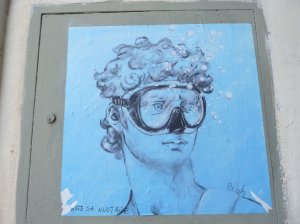
We hadn’t been in Florence long before we found this image, posted on the side of a building, on a gas box door.
Then we found another.
Then two more.
This slideshow requires JavaScript.
Each one is an iconic symbol of Italian art – Florentine art in particular – and each one is equipped with a diving mask.
We realised something was up when we saw that every one was signed ‘Blub’, with a slogan ‘L’arte sa nuotare’ – Art knows how to swim.
We needed to get back to England before we could find out more, courtesy of Google of course.
‘Blub’ is, apparently, more than one person. S/he is not available for interview, but will make the occasional statement. Blub says that they’ll never deface buildings, only paste their images on gas box doors. They aim to help beautify and improve the streetscape of Florence.
And why is each of the subjects shown under water? Well, because for Blub, water is a symbol of obstacles in life, of the challenges we all face. But art swims on and survives regardless.
‘L’Arte sa nuotare’ is a movement that’s spreading, apparently. Last spotted in Barcelona. Time for us to plan another visit to see Emily, then?
Meanwhile, here are the answers to a quiz you might have set yourself .
What are the originals of the pieces illustrated above?
First view of Piazza del Duomo on the evening we arrived
We’ve just come back from a few days in Florence. How could I send you picture-postcard views that are in any way better than ones you’ve seen a thousand times already in art books, travel guides – and postcards ? Well, I can’t, obviously, so I shan’t even try. Let me just give you a flavour of the city as it seemed to us for these few days in early June.
The Ponte Vecchio is crammed with tourists from morning till night. But even here, you can find a bit of peace if you try.
We’d gone because I’d had an e-mail offer of cheap fares from a Certain-Irish-Airline-We-All-Love-To-Hate. I discovered we could get from Leeds-Bradford to Pisa and back, the two of us, for £100. We booked. We found a last-minute deal on a hotel in nearby Florence. We booked. We found we’d chosen well. Despite being near the station, normally never a great part of town, this place was clean, well-appointed, cheerfully friendly, and within walking distance of almost everything – perfect in fact. The weather was perfect too. Sunny, cloud-free, and gradually getting hotter.
A little Lambretta van: Italy’s answer to France’s 2CV
The ubiquitous push-bikes: all parked up on Piazza della Signoria
The ubiquitous motor bikes: all parked up for the night.
Malcolm had never been to Florence, but once upon a time, I knew it well. Once upon a time – more than 45 years ago in fact – I’d had two extended periods in the city working as an au pair between school and university. I’d had plenty of time to explore the city, and to learn the language. I’ve had plenty of time in the intervening years to forget both. In fact a few years ago, when we went to another part of Italy, I found that whenever I opened my mouth to speak Italian, French came tumbling out….
I was pleased, so pleased, that this time, my Italian returned: haltingly at first, but getting better each time I had another go. A couple of times though, it would have been to my advantage to converse in French – there were French guests at the hotel. But guess what? No French words beyond the most basic could be prised from my lips. I seem to be strictly a one-language-at-a-time sort of person.
Drying the washing.
Watching the world go by.
A little window over a little courtyard.
We soon learned that our visit wasn’t going to work as expected. We’d always planned a mix of visiting some of the tourist hotspots with time at some of the less well-visited sites. After a chaotic afternoon at the Uffizi, pre-booked at what we had hoped was a quieter time, the hotspots got pretty much junked.
Here’s why the hot-spots got junked: so I could use my camera in peace……
The sheer numbers of visitors and the noise got us down, and my best memories of the Uffizi this time are of those moments spent on the relatively quiet roof terrace, looking down on the Florence skyline.
From one busy place to another. That’s a view of the cupola of the Duomo, seen from the Uffizi.
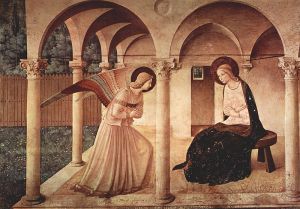
I wanted to share the Museum of San Marco with Malcolm. When I was in Florence in the 1960s, this was one of my favourite places. Back in the mid 1430s, the monk whom we know as Fra Angelico took on the task of painting the cell of each monk with a devotional image: often the Annunciation or Crucifixion. The monastery, even though now a museum, is a tranquil place where it’s still possible to be quiet and reflective, and to be moved and inspired by Fra Angelico’s interpretations of the familiar Bible stories .
One of Fra Angelico’s interpretations of the Annunciation, at the Museo di San Marco. Wikimedia Commons.
At first, we had a similar experience at the church of Santa Maria Novella. But as the morning more on, the crowds increased, and the levels of noise: we were shocked by the difference we noticed between our first moments in the almost-empty church, and the later ones when the building was filled with people busily moving around and talking.
At peace in Santa Maria Novella early in the day.
Christ in limbo, painted by Bonaiuto between 1365 and 1367
A bucolic scene painted by Uccello in the so-called Green Cloister.
But what’s the point of going to Italy if you don’t spend time enjoying food? There’s the magnificent Mercato Centrale, where every morning you can join the locals as they buy fruit, vegetables, fish, meat and cured meats and cheeses. It’s crowded here too, and vibrantly noisy, but that’s OK. Get your shopping bag out and join in!
Ham, salami and other cured meats
Dried funghi, whole stallsful of them.
Tripe, much loved by the Florentines. Try it ‘alla Fiorentina’. You might just enjoy it.
Tomatoes, more tomatoes, and so much else….
… and mushrooms…
… and courgettes, often sold with their flowers, because these too are delicious.
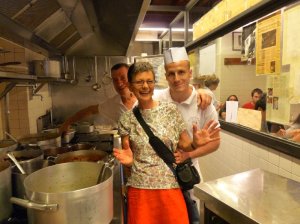
And then go over the road to Trattoria Mario for lunch. It used to feed students and local workers, and now tourists are added into the mix: Not the sort of tourists who expect a watered down ‘typical Italian’ menu, and translated into English or Russian , but ones who are happy to join a table where locals are already tucking into the daily specials. I was swept into the kitchen to watch the team cooking in an impossibly small space: here’s a photo. Such fun, and such good food.
The kitchen at Mario’s
Malcolm and another prospective customer inspect the menu.
Another busy lunchtime at Mario’s.
And here’s the kitchen stove.
The next day we headed over to the other side of the river, the Oltrarno, to Porta San Frediano. This is an area of craftspeople, working people, and strictly no tourists. And that’s where we found Trattoria Sabatino, and immediately felt at home. It’s the sort of place we used to like so much in France: simple food, well cooked, and served to local workers in their lunch break. As in France, the early customers were all men, but later, women, and even children appeared too.
The city walls near Porta San Frediano.
A busy tripe stall near Porta San Frediano.
The easy way to haul cement to the top of a building.
A back street near the church of San Frediano.
Once a church, now a neighbourhood restaurant.
You might think this is simply a 14th century palazzo. In fact it’s teh consulate of Burkina Faso.
We strolled past the Palazzo Pitti, and found these musicians playing to welcome EU delegates to a dinner there.
A quiet courtyard in a busy street.
Monument to the Italian Resistance in WWII, in Piazza Santo Spirito.
We spent our evenings on the other side of the river too, opposite Santa Croce. That’s where we found two bars, the same but different. Buy a drink in one of these places and it’ll cost you. But all of a sudden, it seems a good idea after all. Because trays and trays of food and nibbles appear, and they’re for you, the customers, to eat – and eat – and eat, if you wish, without handing over any more money.
The Ponte Vecchio at dusk.
Sunset over the Ponte Vecchio. I don’t know who this fellow is.
Young people at dusk on the Arno.
The Palazzo Vecchio at night.
The Uffizi and Ponte Vecchio by night.
The shops on the Ponte Vecchio all shuttered for the night.
A narrow street leading to the Palazzo Pitti.
A shrine on a residential building.
Another view of the Palazzo Vecchio.
And of course we spent time exploring those narrow medieval streets, where tall buildings shelter you from the glare of the sun. We people-watched in sunny piazzas over shots of strong espresso. We hung over the parapets of the many bridges over the Arno to enjoy the views and the sunsets. And the sun became hotter with each passing hour. We relished nearly every moment of our stay. But next time, we might go off season. February might be good.
In the end though, I have to give you one picture postcard. Here is the Duomo, seen from the path towards Piazzale Michelangelo.
Funny place, Andorra. It’s where we went to satisfy our desire for a ‘white Christmas’ and it’s one of the smallest nations in Europe – only 468 sq.km, and tightly wedged between France and Spain. It’s a mountainous place – every bit of it is between nearly 3000′ and nearly 10,000′ high, and only one main road linking France and Spain drives though the country. All other roads off peter out as they reach the small communities they serve.
It’s a principality, jointly ‘ruled’ by two ‘princes’. One is the Spanish Bishop of Urgell, the other the French President, currently François Hollande, and yet it forms no part of the European Union. It used to be extremely underpopulated: it only had some 6,000 inhabitants right up until the 1950’s. Now it has more than 85,000. But these new inhabitants aren’t indigenous Andorran baby-boomers. They’re incomers from principally Spain, Portugal and France, but also Britain, Italy, and more recently Russia. They come because Andorra’s a tax haven, because there is no income tax and goods are cheap, or because they love to ski: Andorra has some of the most reliable ski-fields in Europe.
And this is what makes Andorra a funny sort of place. Much – most – of the building is relatively new. It has very fine Romanesque churches, but little else that counts as historic buildings.
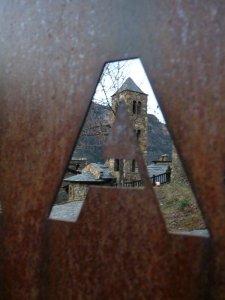
The Romanesque church at Aubinyà glimpsed through a village gate
So most settlements, even quite small ones, consist mainly of blocks of flats clustered together, often clinging apparently precariously to the edges of hillsides high above the valley floor. And everyone knows that Andorra is Shopping Central. People come in their thousands from France and Spain to stock up on – well, most things – and every weekend sees long lines of traffic from both countries as French and Spanish citizens flood into the supermarkets to load up with cigarettes – particularly cigarettes – alcohol, electrical goods, groceries, clothing…. before facing their own country’s customs who take a dim view of those exceeding their allowances.
Snowy Andorra
Near the French border.
More snow
Nevertheless, away from the towns, Andorra is beautiful. The mountains climb almost vertically skywards and this means that every road that leaves the valley bottom will zig-zag upwards with one hairpin bend after another. From our apartment in the tiny settlement of Aubinyà we could see a supermarket almost below us. We even thought of walking down to it (well, I did). When we came to try to shop there, we discovered we had to zig-zag to the valley, zig-zag back (left) to the nearest town, Sant Julia de Lorià, turn hard right and drive a kilometre or two to get there. Most journeys are like that. But it means that wherever you are, you will have fabulous views of craggy mountain sides cloaked in forest, or for much of the year, dusted or deeply covered with shimmering snow. Much as we loved the view from the window of our apartment, though, we wondered if eventually, we wouldn’t feel somewhat hemmed in, having no long distance views.
The view from our window
Another view.
And another. That’s a vineyard you can see below.
We had a lovely Christmas break, Malcolm, Emily and I. Many of our memories consist of eating out: it’s easy to find good Catalan cuisine , or anything else you fancy really at a very fair price. Skiing’s not our thing, but we enjoyed the brisk, sharp cold and the glaring whiteness of the snow set against the sombre green of the coniferous forest. We’d go again, but have no desire to join the many thousands of ex-pats from many nations who form much of Andorra’s day-to-day population. We’ll keep it as it was for us this time: a scenic and relaxing place for a break from routine.
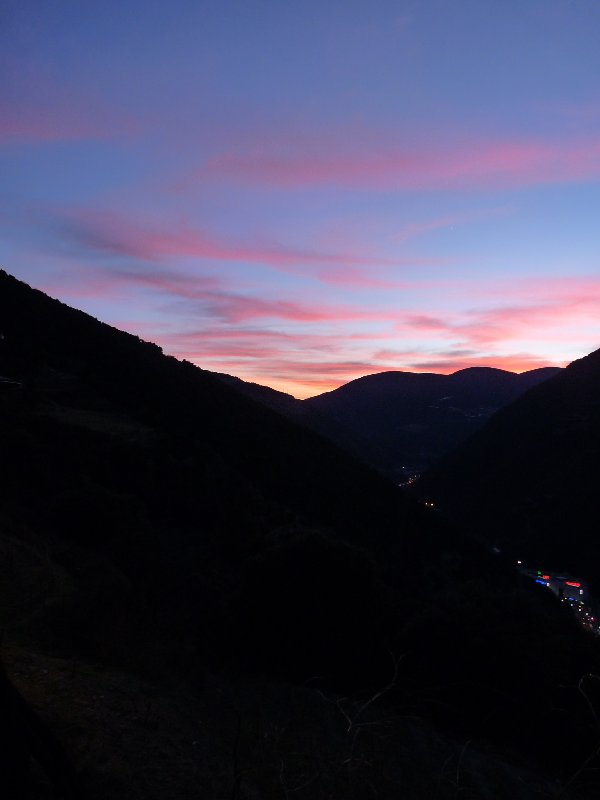
Sunset seen from our window. And yes, far below you can just see that so-near-yet-so-far supermarket.
We’re back in France, to rather strange mid-January scenes. Our local skiers’ playground at Mont d’Olmes appears to have only a dusting of snow, though it claims to have 5 pistes open. Our garden’s full of marigolds flowering alongside the snowdrops, and on a walk yesterday afternoon, dressed in light pullovers, we heard birds singing ceaselessly, apparently to welcome the spring as they busily seemed to be putting winter behind them.
And so it was in England too. We rarely wrapped up warmly, and enjoyed being out and about in the balmy conditions.
Best of all was our trip to the part of the country that includes parts of South Gloucestershire and Witshire and Somerset, to stay with my daughter-in-law’s family. They took a dim view of our lack of knowledge of their end of the country, and set about putting things right.
Everyone knows Bath as a Roman stronghold and as a wonderfully intact 18th century city much visited by Jane Austen. No wonder it’s an UNESCO World Heritage site. We had to be content with a taster session. And we began with a stroll across Pulteney Bridge, which has shops on it, like Florence’s Ponte Vecchio, and along the Avon to enjoy the views of the Abbey and Parade Gardens.
Bath Abbey’s an ancient church, but what we see today- a light graceful building soaring upwards to spectacular stone fan vaulting – is largely the work of the Victorian Gilbert Scott. Every wall is covered with memorials: so many people came to Bath to ‘take the waters’ and then upped and died. Plumbers, admirals, sugar plantation owners, soldiers – they’re all here.
Time for a coffee break. Where else but the 18th century Pump Room, where we decided a Bath Bun was a good idea, a sulphurous glass of spa water a very bad one?
We can’t recommend the Roman Baths Museum highly enough. After spending several hours there, we feel as if we’ve had a real taste of the life of a Roman citizen living, working, playing and praying in Bath during that period. The baths themselves have been very sensitively and imaginatively interpreted. If near Bath, just go!
After that, a quick stroll round the 18th century. The graceful symmetry of streets like the Royal Crescent is so impressive: just don’t look round the back, you’re not meant to.
Next day, we were tourists too. England at its most picturesque. Cotswold villages with solid stone-walled, stone tiled cottages.
Back in the medieval period and beyond, Castle Combe used to be a centre for the local woollen industry. Now, more often than not, it’s a film set, the scene of many a period drama on TV or at the cinema. And Lacock is so picture-postcard perfect that almost the whole village is owned by the National Trust. Great for a relaxing visit. I wonder what it’s like to live there.
We’d mooched happily round these two villages for some while. But after all that we needed to step out and stretch our legs. Kennet and Avon Canal anybody? Brian and Sue chose for our walk the Caen Hill Locks, a flight of 16 locks packed tight together, one after the other, with ponds at the side to store the water needed to operate the locks. We thought our walk up the canal banks used quite enough calories. What if we’d been taking a canal boat up the entire flight and beyond, through lock-gate after lock-gate? This 100 mile canal has more than 100 of them in total…..
A wonderful couple of days then, steeped in history and splendid views and countryside. We’ll be back – if Brian and Sue’ll have us.
We’ve just got back from our weekend on the other side of the Pyrénées, and I’ve decided to post these ‘postcards’ to show a few happy days in Sant Cugat del Vallès, the very attractive town where Emily is now working; the not-Hallowe’en-but- la Castañada festivities; and a relaxing weekend.
Eating and drinking were important. Straight away, as we drove across the mist and rain shrouded Pyrénées from France, there was a decision to be made. Lunch on this side of the border? You can’t get fed much later than 12.30 here. Or wait till Spain? Nothing there is open much before 2.00 p.m.
We arrived in Catalonia just in time for la Castañada. Instead of Hallowe’en, they commemorate All Souls’ Tide. Roasted chestnuts are sold wrapped in cones of newspaper with roasted sweet potatoes and peddled from impromptu stalls, or by excited groups of children. Panellets are mashed potato, sugar syrup and ground almonds – maybe cocoa or dried fruits too, rolled in pine nuts and briefly baked till the nuts turn golden. It sounds odd, but they’re delicious accompanied by a shot of strong black coffee.
Coffee shops, with tables outside so you can enjoy the late October heat seem to be in every street, and we adjusted our bodies to Spain’s very different rhythms. Food generally seems cheaper in Spain. A pleasant pause for breakfast, after taking the children to school, after shopping or work, or just because it’s a nice idea and the sun is shining is an affordable treat, and cafés don’t seem to struggle for custom. Nor do lunch-stops. As in France, the 3 course lunch with wine and coffee is on offer in most restaurants, but cheaper here. And it’s a leisurely affair. We found ourselves spending an hour or two every day that we were there over the lunch table, eating, talking and simply people-watching.
Shopping seems less anonymous too. Whether in St. Cugat, or city-centre Barcelona, greengrocers and grocers, wine merchants and bakers – especially bakers – all seemed to be doing brisk business. The out-of-town supermarkets are there alright, but so far, they don’t seem to have won.
So here are my postcards. Have a glance at them over a lazy cup of coffee.
Despondent about your DIY? Ground down by your garden? Then HelpX can help!
Its website says it’s ‘volunteer work in exchange for free accommodation and food on farms, backpacker hostels, lodges, horse stables and even sailing boats’. Or even places like ours, apparently.
For the past 10 days, we’ve been sharing our home with HelpX-ers Vicki – Australian – and her English husband Marc. It was a success from the very moment they landed outside our house with their laden motorbikes, fresh from working in Carcassonne and northern Italy.
Since they arrived they’ve rolled up their sleeves and cheerfully tiled and grouted most of our very awkward roof terrace, painted a stairwell, wrestled with brambles and ivy on the garden, solved computer problems…. and commandeered the kitchen.
Vicki and Marc travel the world, and many of their memories seem to be food related. So they’ve cooked southern Asian dishes like sang choy bow & gado gado and Vicki’s wonderfully decadent and not-at-all Asian chocolate mousse: recipes to follow in a later blog. The other evening – their final night – was the occasion for an ‘Asian tapas-Smörgåsbord’ of a dozen dishes masterminded by Marc.
Our memories of the week are of a happy, optimistic, funny and considerate couple who’ve worked hard and enthusiastically on our behalf, and whose company has been nothing but a pleasure. We miss them.
If you’re young, American, and living in Michigan, and if you like performing, you may be lucky enough to spend part of your summer at the Blue Lake Fine Arts Camp, a summer school of the arts located on a 1300 acre campus in the Manistee National Forest. If you’re really talented and work hard, you may one year be selected for one of the 8 or so ensembles that have been coming over for a European tour every year since 1969.
And if you live in Europe, you may be lucky enough to live in one of those towns that welcome these young people. Here at Laroque, we’re among those fortunate people.
The Blue Lake Jazz Ensemble first came here 2 years ago. Their director, David Jensen, and the leader of our own LDO Big Band, Michel Alvarez, hit it off. So when plans for this year were under way, both men were keen to see Laroque included in the itinerary.
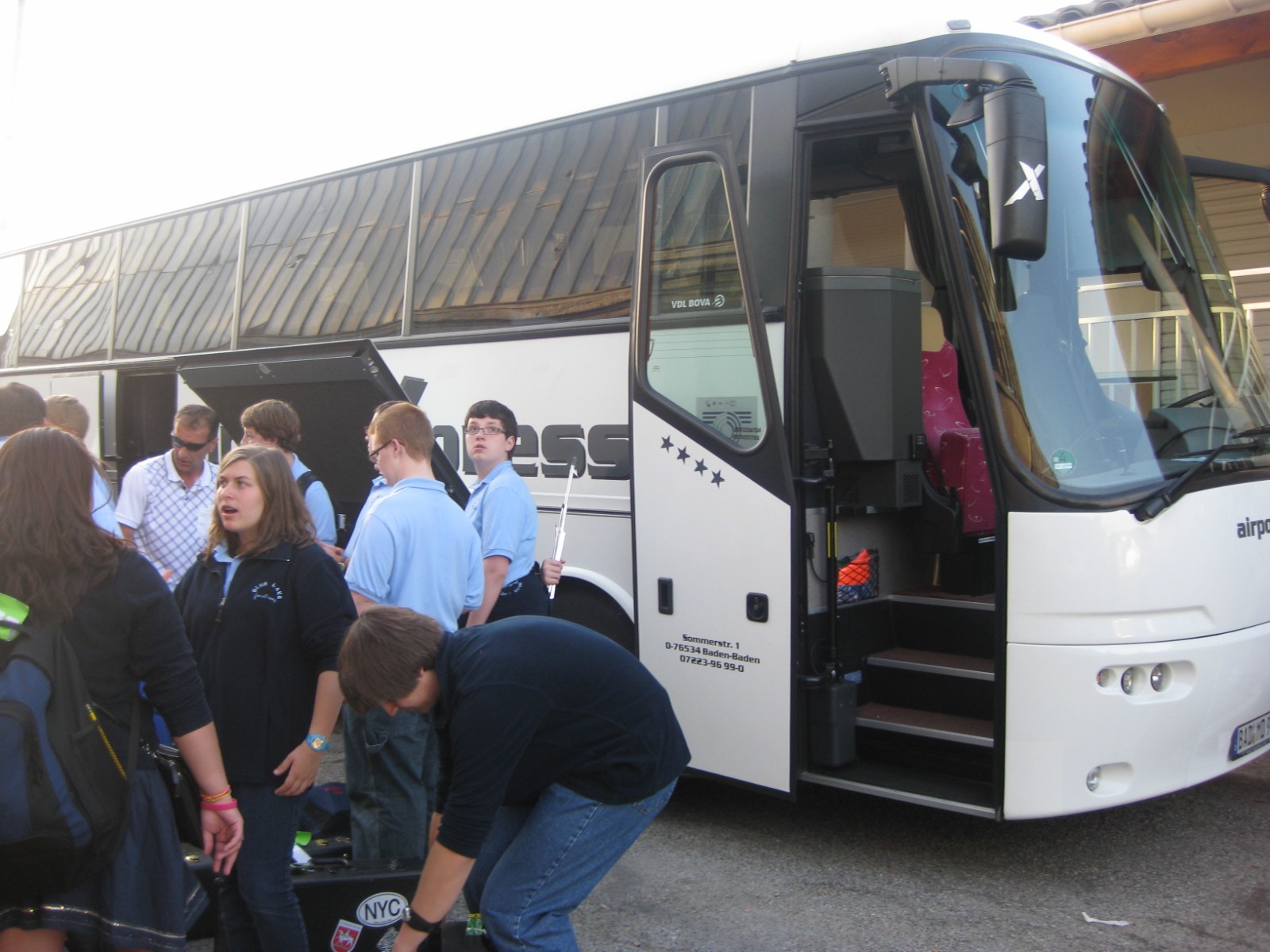
But what an itinerary! The band landed in Paris on 17th June. From Elbeuf in Normandy, they passed through Belgium to reach Germany, Denmark, Germany again, then Austria. Then they travelled 1588 km to reach Laroque d’Olmes, a coach journey that took a whole 24 hours. After staying with us, they were due to travel overnight to Paris and the plane home on July 9th.
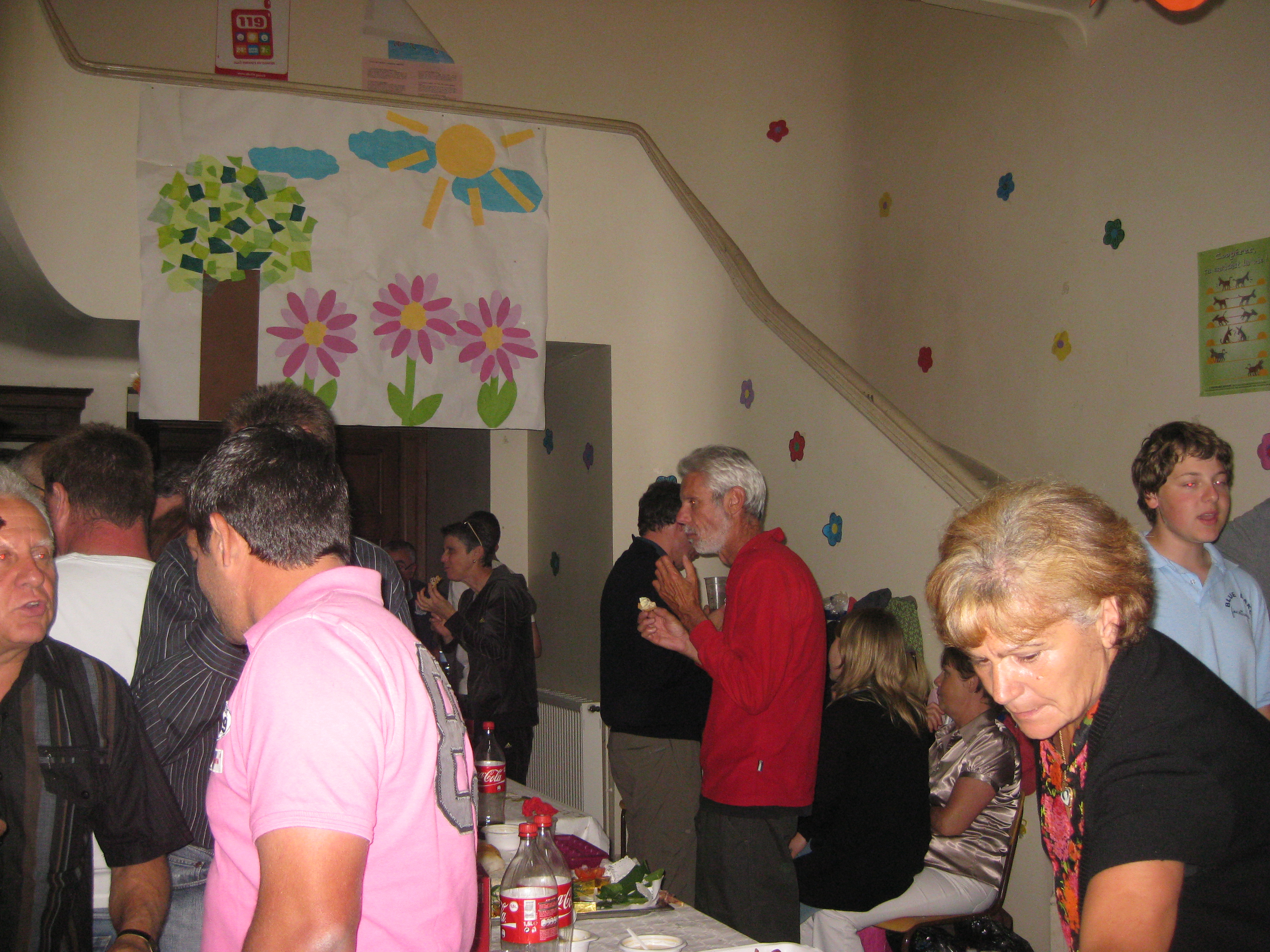
Party at the Château
They might have been tired, punch-drunk with cultural variety and new experiences, but they had to be welcomed with a party. It was here they met their host families. What would two 16 year old boys make of the fact that they got to stay with us instead of a French family? Pleased, as it happens. Grappling with unknown languages – French, German, Danish over 3 weeks or so takes its toll. At least we were a bit of a rest.
The concert on Thursday evening was what we were all looking forward to. Well, not me so much. Malcolm had provided translation and interpreting services last time, so this year, he thought it should be my turn.
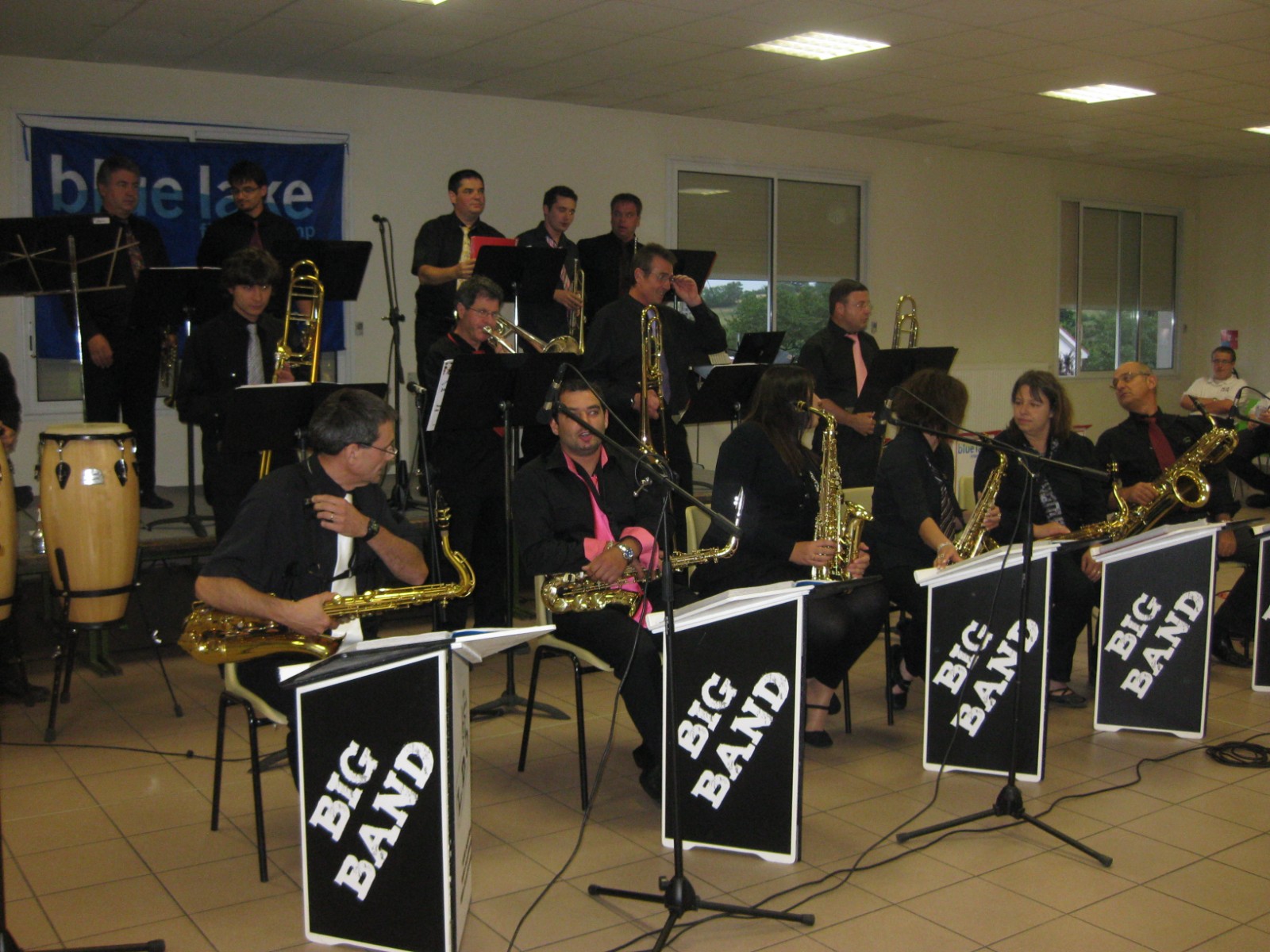
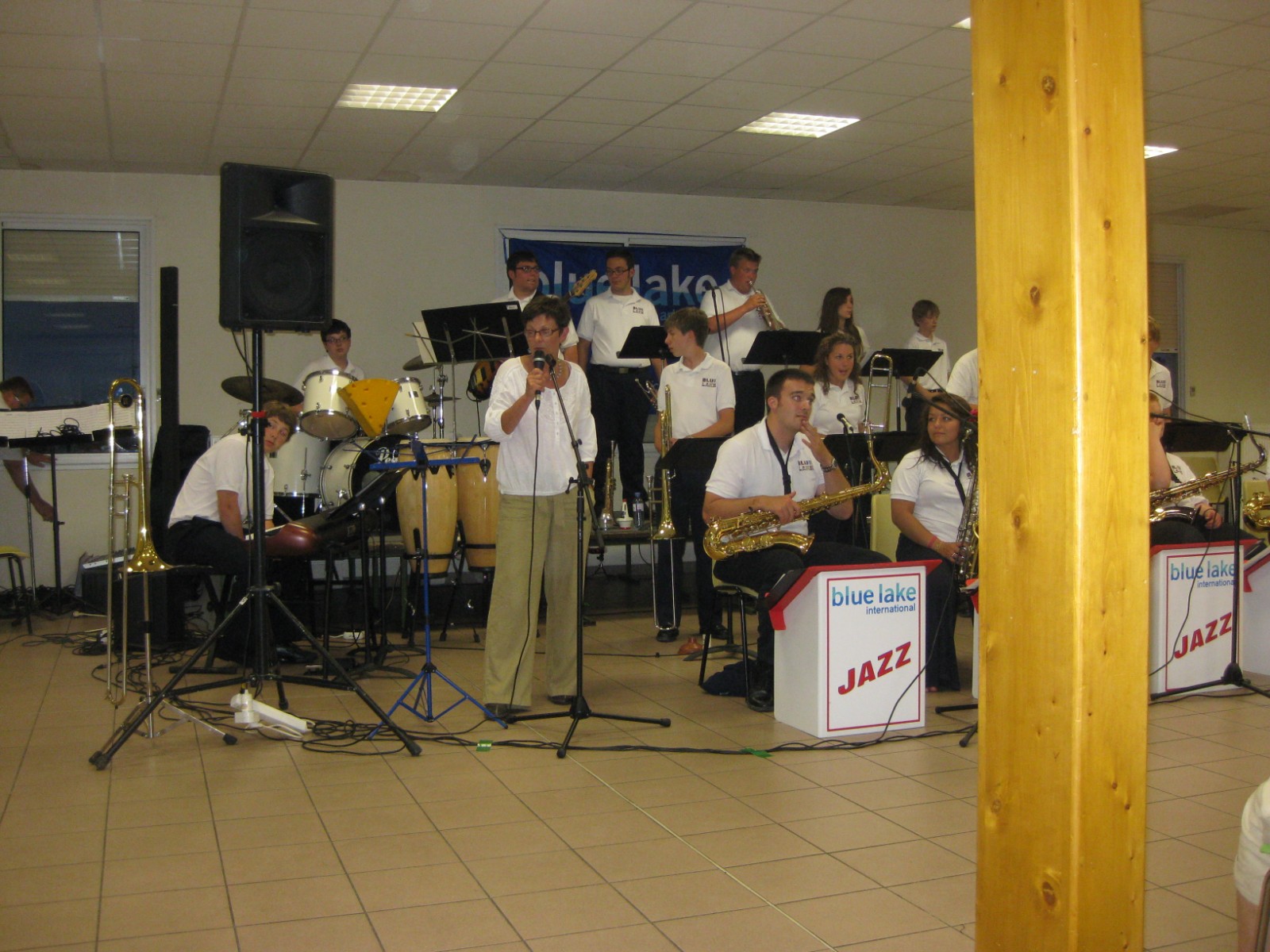
LDO Big Band get ready to playTranslation services in full swing
All went well at first: I’d seen Michel’s speech in advance, and David’s response contained no surprises. But when it came to introducing the pieces….well…what IS the French for ‘Dance of denial’? Or ‘Struttin’ with some barbecue’? We decided the titles didn’t matter; I bowed out, and then discovered the remaining repertoire was quite translatable, thank you.
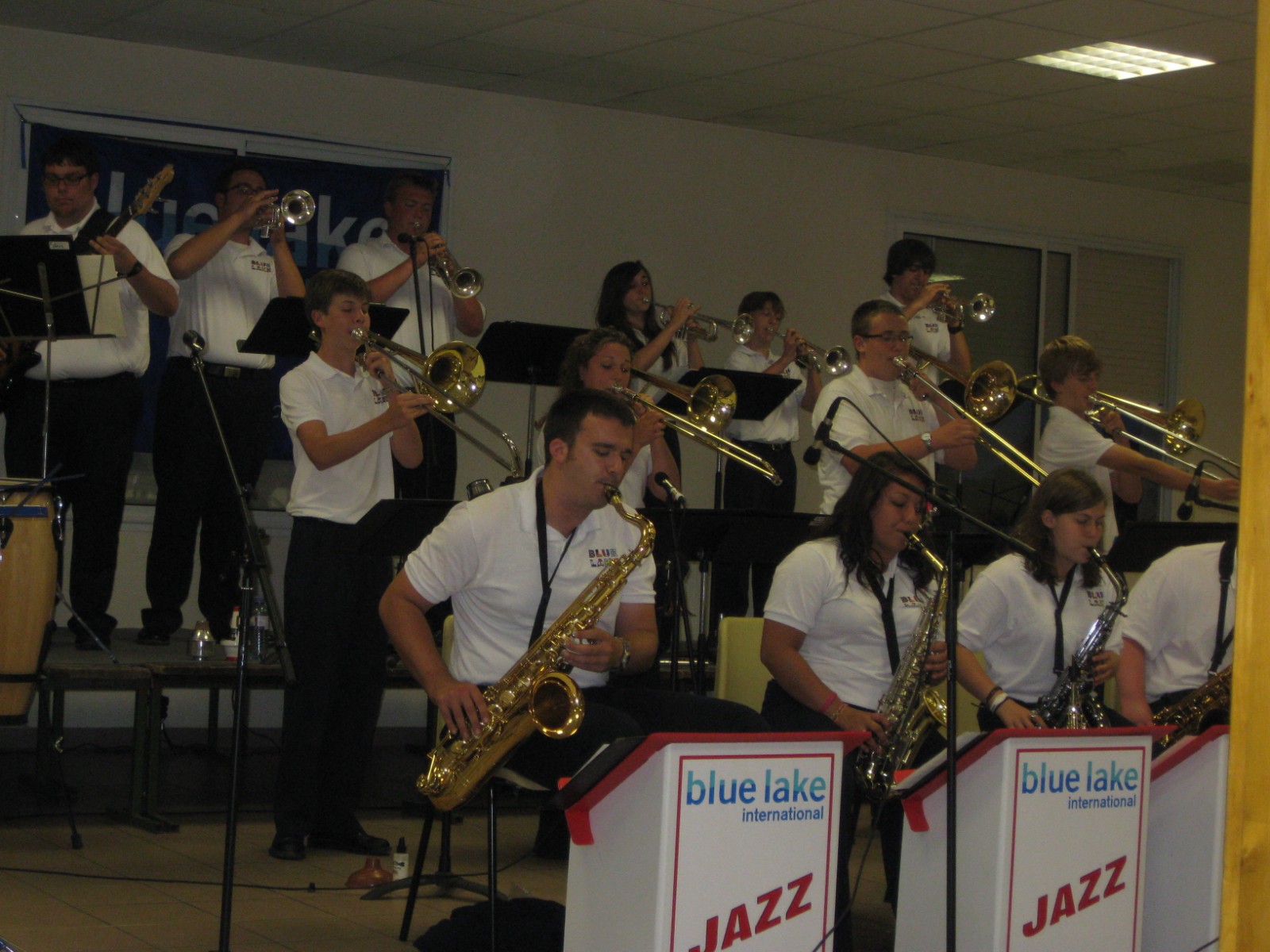
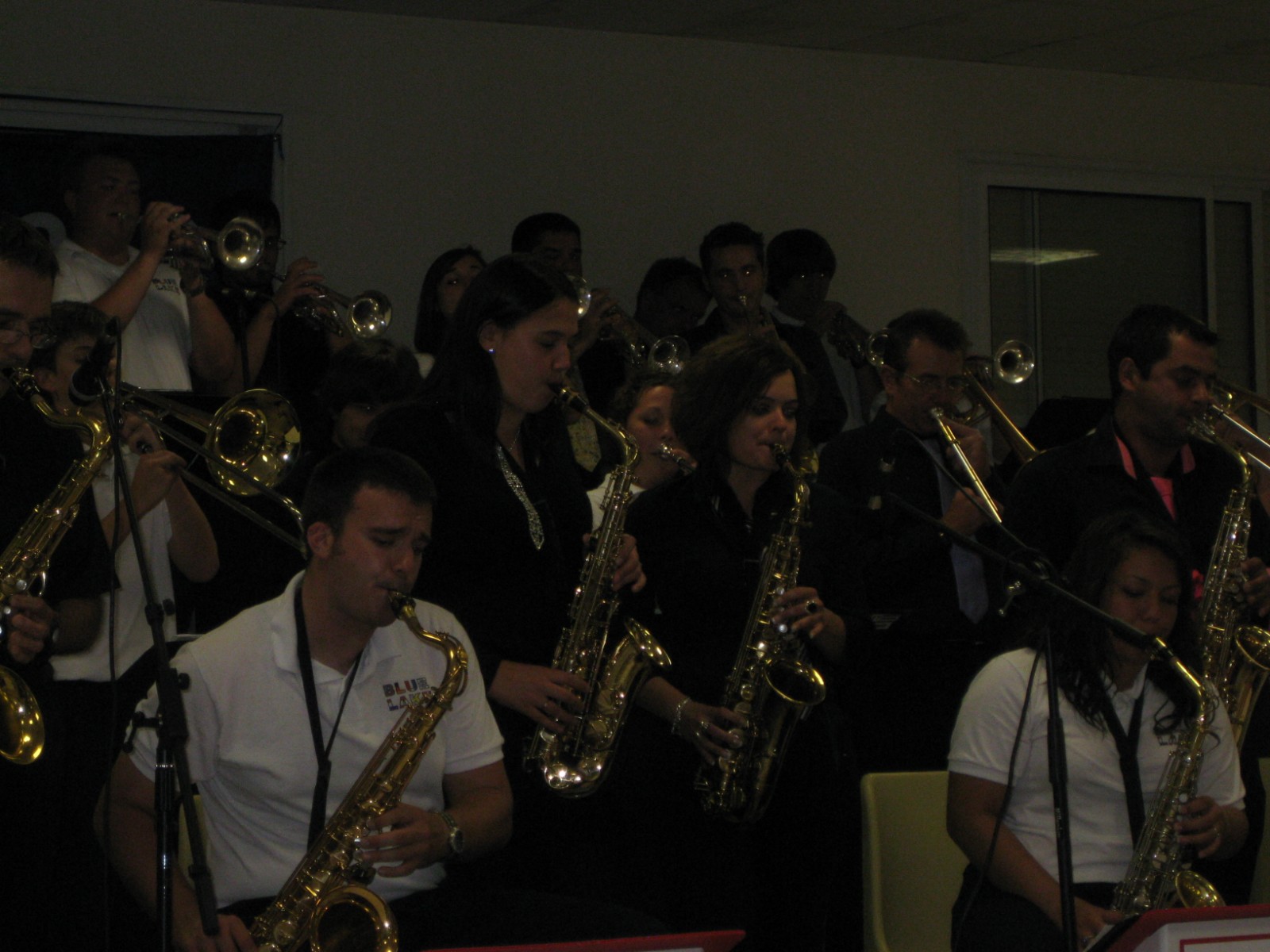
Blue Lake Jazz Band
But those Americans! The performance they turned in was exciting, exhilarating, excellent, extraordinary. Impossible to believe that some of the group were only 13, and that few had left High School. They’re so professional. LDO Big Band was on form too, so the high spot of the evening was when the two bands came together to perform. Their pleasure and pride in working together communicated itself to an already delighted audience, and the evening ended on a high for us all.
The two bands squeeze together to play
This opportunity to play together is apparently what makes little old Laroque worth the detour for the Blue Lake musicians: it’s not something they do elsewhere. They’d like to send a different band our way next year, David’s year off. It seems Laroque is now firmly on the Michigan map.
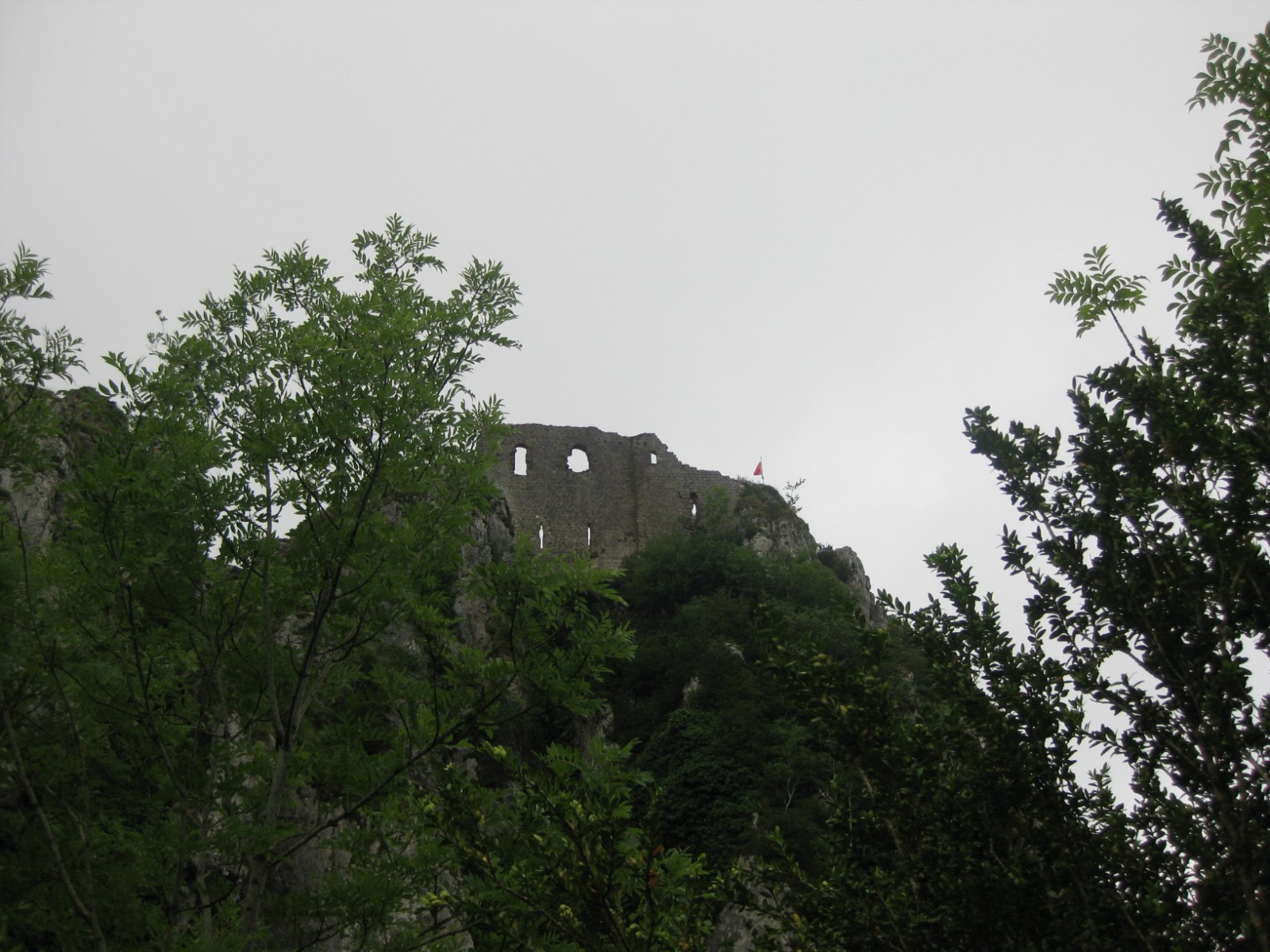
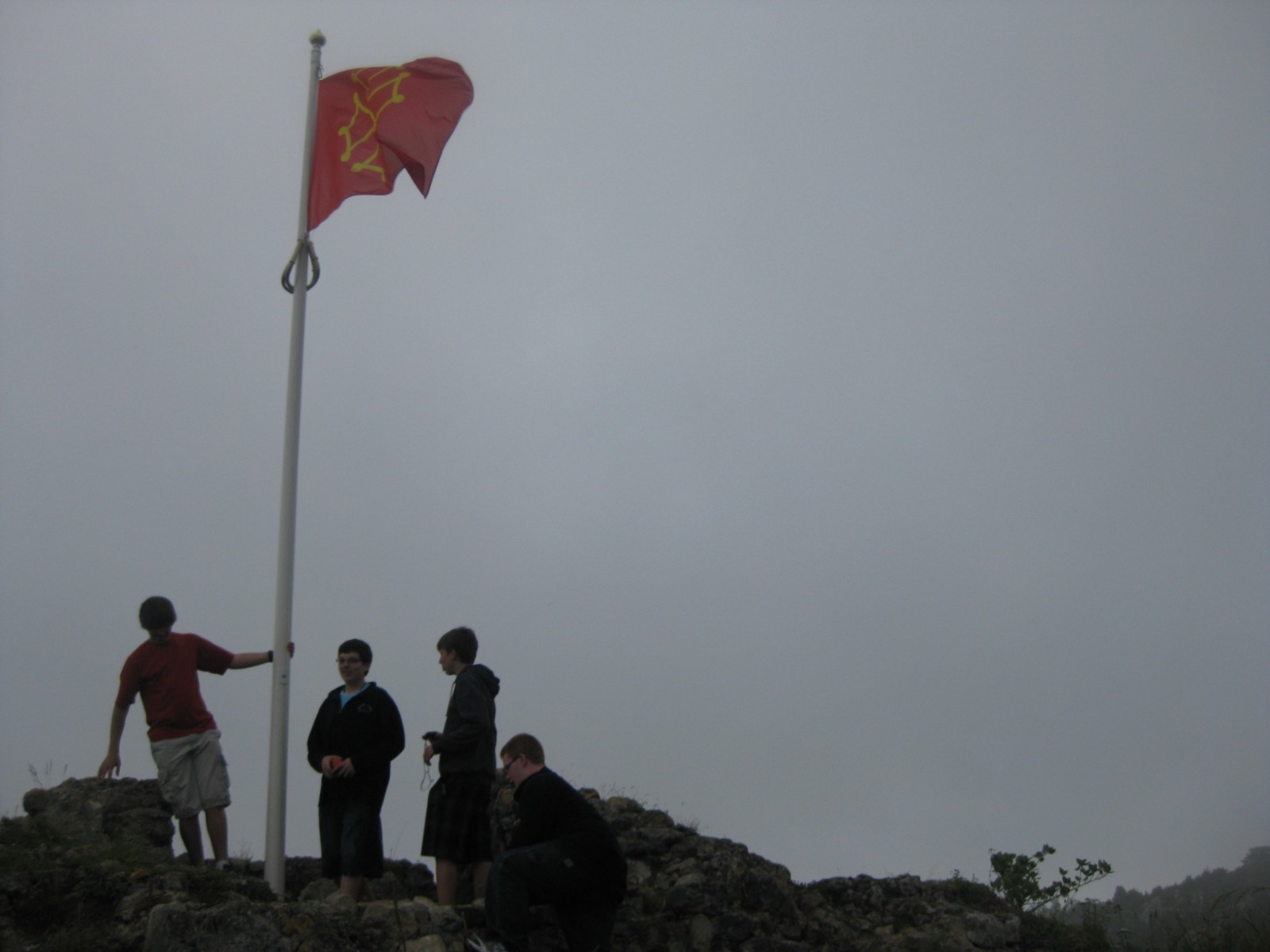
Roquefixade………. conquered by our American guests
The rest of the stay was given over to sleep, lots of it, and sightseeing, rather less of that. We climbed Roquefixade to see a ruined castle, and took in the medieval town of Mirepoix. Others had different days-of-yore experiences: Foix and Carcassonne.
The trip ended on a sad note though. One of the group had lost her passport, and despite every effort, it couldn’t be replaced in time. She’s still here.






















You must be logged in to post a comment.