Two Handy Benches Outside the Museum

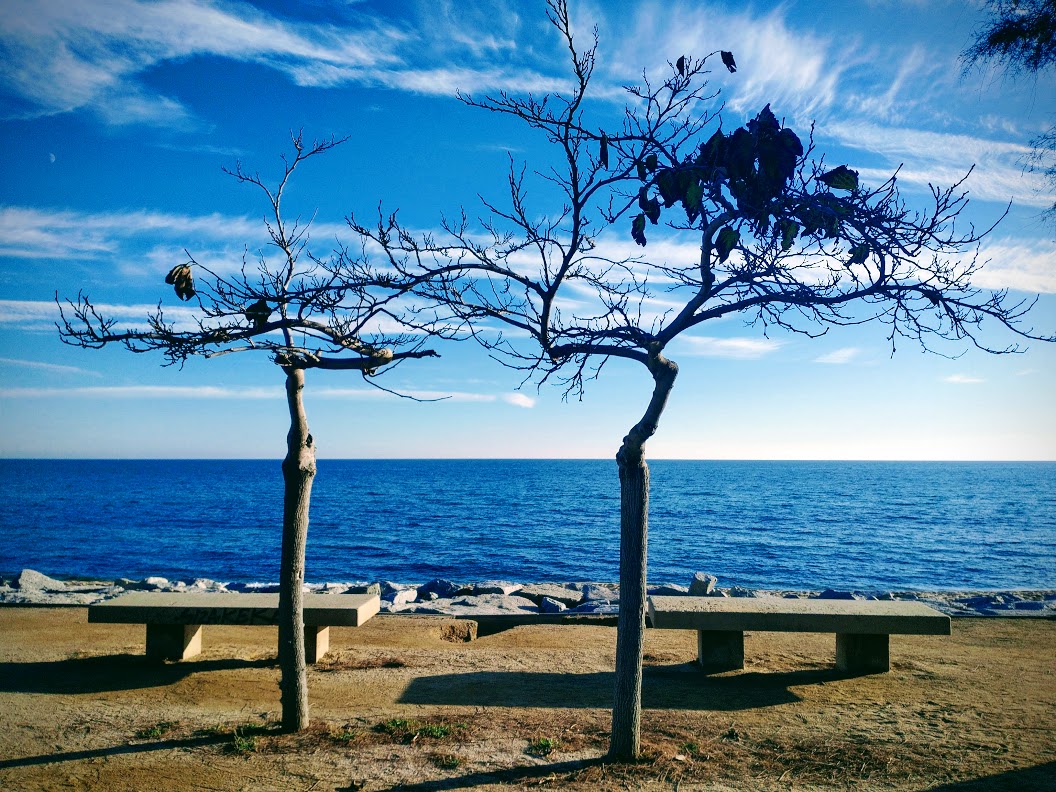
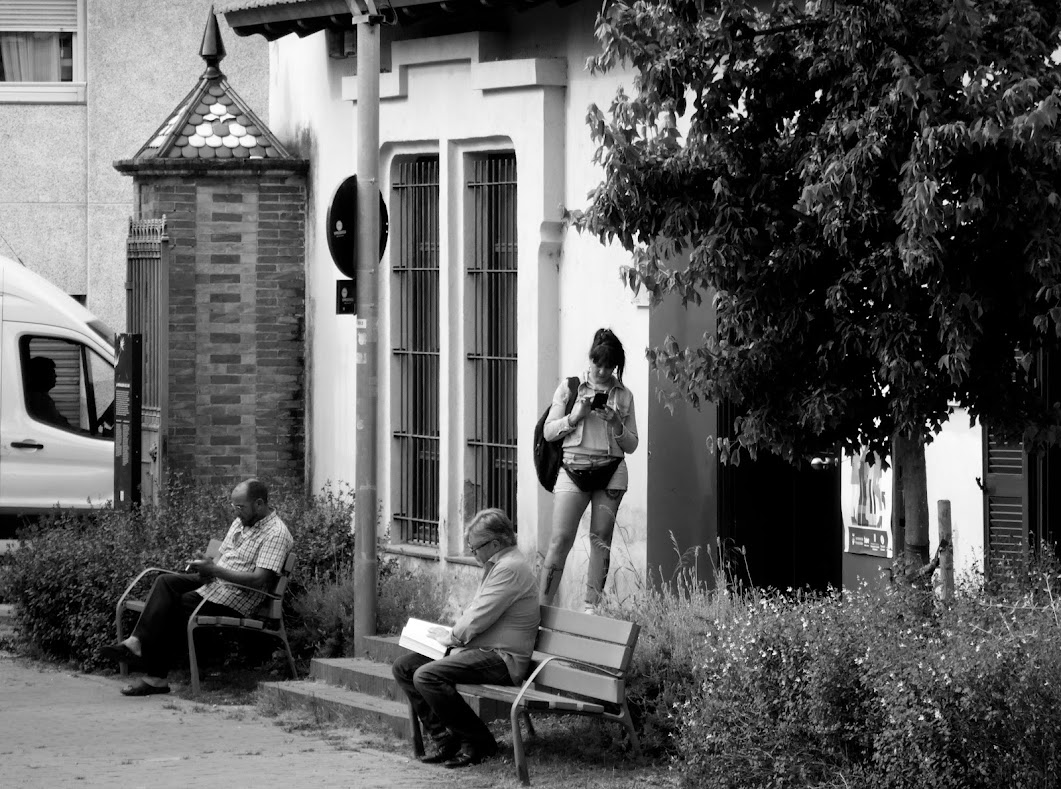
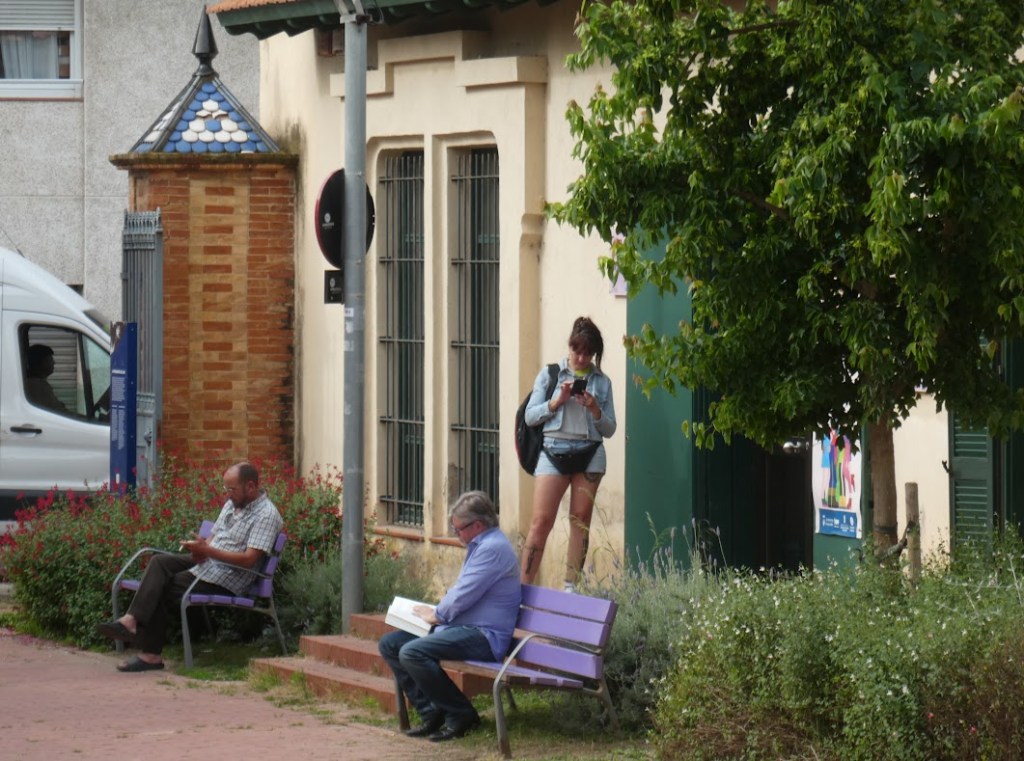
Passing Premià de Mar’s Museum of Textile Printing the other day, this is what I saw. Two benches: three people. Three readers: two on their phones, one with a good old fashioned book. Only the young woman, I think, was waiting for the museum to open.
Maybe you’d prefer it in colour?

For Jude’s Bench Challenge.

A Multicultural Bag of Oranges

Oranges within …

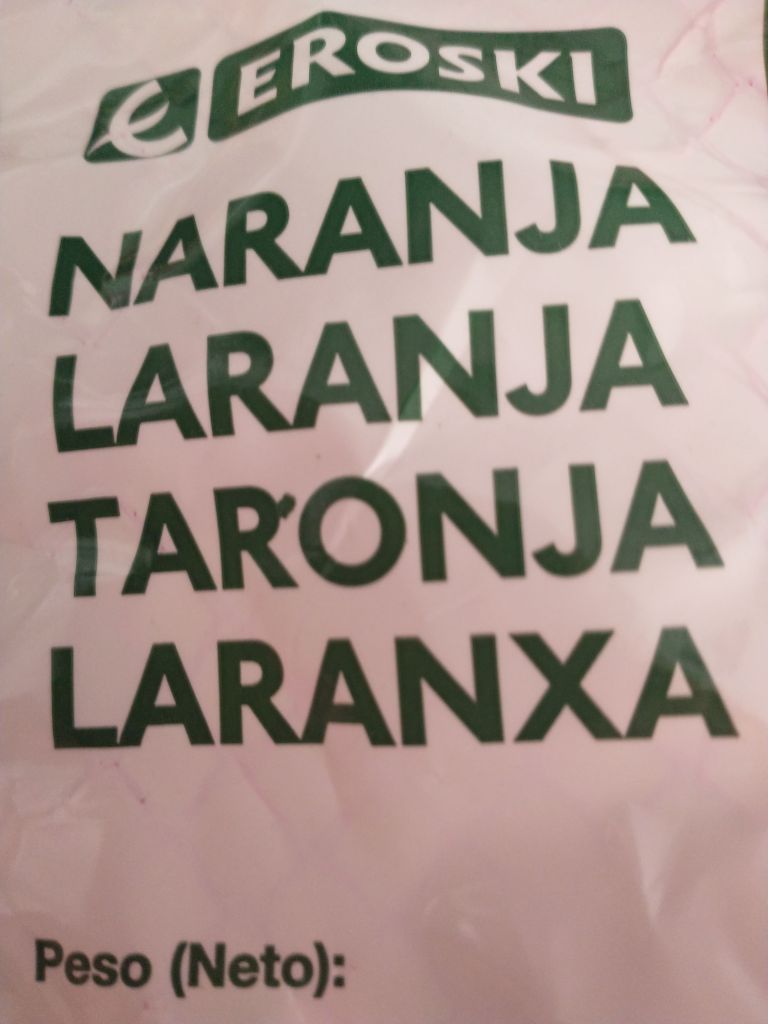
Here’s a bag of oranges from my daughter’s on-line shopping haul. It had been ready to be sold anywhere in Spain, as every official Spanish language is represented here: Castilian (Spanish); Gallego (Galician); Catalan; and Eureska (Basque). I think it’s got all bases covered.

And – oh look! – Carrots are even better.

Street lights in Spain

For this week’s Monochrome Madness, This week’s host Brian of Bushboy’s World has asked us to consider Street lights. I assembled a clutch of them, and realised that they all come from Spain.

The featured photo was taken one evening near our hotel in Seville. This next batch all come from Cádiz.

… and one of them is merely a shadow of a streetlight.

Off to Málaga now, just after Christmas.

Another one from Seville …

And the city I know best, Barcelona? Well, not a single night time shot. Instead, here are two taken in broad daylight.

I’m away for a few days, so this post, and the next few are scheduled. So – sorry – I may be slow in commenting, and even slower at reading your posts.

Mirror

Today, it’s my turn to offer a theme for Leanne’s Monochrome Madness. And I’ve chosen Mirror.

‘Magic mirror on the wall, who is the fairest one of all?’ So asks the evil queen in the classic 1937 Disney film Snow White and the Seven Dwarfs.

I haven’t used my mirror to find the answer to this question, largely because I haven’t got a magic one. But I have found some mirrors in a junk shop in Harrogate, reflecting both some of the goods on offer, and the Victorian street where you’ll find it. In fact the shop window itself serves as an extra mirror.

And here’s another street mirror, helping the motorist out into a busy road. And a car’s passenger-side mirror in Lancashire one winter’s morning.

Let’s default to shop windows as mirrors.

And the Baltic Gallery in Gateshead makes a ceiling into a mirror, while outside the VA in London is one in marble……

Water is an old favourite for a reflective surface. Let’s go to Studley Royal, Seville, a humble puddle in Masham, and the Leeds and Liverpool Canal in Gargrave.

…. and finally, an impromptu wintry lake mirror near home.

Oh, and finally finally, a bit of fun. Two little lambs spotted last week. Using a pre-digital film analogy, one’s a negative of the other. Not quite mirror images, but please don’t quibble when they’re so sweet.

Night Time

Night photography isn’t really my thing, so Elke, this week’s host for Monochrome Madness, provided me with a real challenge when she proposed Night time as her theme.

Unsurprisingly, towns and cities provided me with a few ideas. Let’s go on a quick tour. Let’s visit Albania, England, Spain, France, South Korea and Poland…

Really though, Country Mouse prefers to dodge big cities. My featured photo is of the moon as darkness fell recently, while the photo below was taken just at the end of the road.

Chairs in the Service of Art

Chairs. That’s what Brian of Bushboy’s World fame, and host this week of Leanne’s Monochrome Madness wants us to get our cameras out for. And I’ve decided to show Chairs in the Service of Art

My first clutch of photos all come from Spain. A day out in Logroño, la Rioja, yielded some street sculpture featuring chairs and those who sit in them, whether alive or sculpted.

More recently, in Barcelona, I visited of of its newer museums, Museu de l’Art Prohibit – the Musem of Censored Art. It covers political, religious and sexual themes, and is not for the faint-hearted, but I found it fascinating and enlightening.

The first image here was exhibited at the Pamplona Festival in 1972 – a brave thing to do, as Spain was still in the grip of Franco’s dictatorship. This depicts one of Franco’s secret policemen.

The second is by the South Korean artists Kim Eun-Sung & Kim Seo-Kyung, and shows a Girl of Peace. It was exhibited as part of the Aichi Triennale 2019 in Japan, and received threats of attack for being anti-Japanese propaganda. The exhibition was closed but reactions against its censorship forced it to be reopened. This artwork has caused various diplomatic incidents between Japan and South Korea. For its creators, it is an icon of peace. There’s another view of it as my featured photo.

My final Spanish shot is of a chair (and the kitchen stove?) painted on a garage door in a back street in Seville.

Back in the UK, to visit Harewood House near Leeds, and show an image of a chair constructed by the Galvin Brothers specifically for the house’s Yellow Drawing Room – a place to sit, talk, reflect, share, remember. Created at the time of the death of Elizabeth II, this chair was intended as a sober reflection on her reign. Its design, featuring maturing crops as part of the backrest, references the transient and intangible.

Lastly, I’ll take you to Edinburgh, to the National Museum of Scotland. This is where we saw this chair. An astonishing chair. It began its life as a simple willow tree, but was obliged to convolute itself as it grew into the form of a chair by Gavin Munro. Do have a look at his website.

Well, this hasty tour has turned up quite a few different chairs. It’s perhaps the simplest ones that convey the most potent messages.

A Bold Building in Barcelona

Anyone and everyone who visits Barcelona has a trip to La Sagrada Familia as a ‘must see’. They come because for almost a hundred years, since he was first involved, Antoni Gaudí’s bold vision of a church has been in the news as a source of controversy. We’ve all heard of it.

For a start it wasn’t commissioned by the diocese, as was usual when a new church was required. Instead, an association founded by a local bookseller wanted it built, and Gaudí wasn’t even their original choice of achitect. Work on the church began in 1882, but Gaudí wasn’t officially involved until 1914. Gaudí himself died in 1926, when the project was barely a quarter complete, and since then, many architects have been involved. Is the building that may be finished next year even reflecting Gaudí’s original vision?

Funds to build it relied and rely on donations from the public. The Spanish Civil War got in the way. In July 1936, anarchists from the FAI set fire to the crypt and broke their way into the workshop, partially destroying Gaudí’s original plans. Later, Covid 19 got in the way. The foundation that manages the finances neither publishes accounts nor pays taxes.

You won’t have to go far in Barcelona to find citizens who are no friends of La Sagrada Familia. They speak of how over-tourism round the church has lowered the local quality of life, and impacted negatively on other tourist sites. They find it ugly, and moving ever further from Gaudí’s original vision. One of the later additions to the plan, to build a stairway which will involve the demolition of local housing has generated a row which I think still isn’t resolved.

One was or another, I think it’s fair to say that La Sagrada Familia, by its sheer size and complexity, is an audacious bit of planning. Its impact on the city skyline is definitely bold.

If you haven’t yet been, and want to do so, plan well beforehand. Book ahead. It’s a bold and undaunted tourist, or a foolish one, who turns up at the gates and expects to get straight in. Once in, you’ll be shepherded around a prescribed route, and not at your own pace.

Whatever you think of the church, I think these builders, scrambling up unfeasibly high walls and towers are pretty bold.

Look how high up some of them have to work.

Here’s a miscellany of shots from the interior of the building.

And the exterior.

The featured photo is my most recent, taken in January from the Mercat dels Encants, some distance away. As you can see, quite a lot of recent additions have been made since the exterior shots shown above were taken .

What to visit instead? Be intrepid! Make your way (and it’s not that easy) to Colonia Güell, outside town, and visit Gaudí’s incomplete (but bold) church there, the one he expected to make his Magnum Opus until the funding stopped, and the Sagrada Familia presented itself as an opportunity. You can read about it here. You mght be able to tell where my sympathies lie.

For Sofia’s Lens-Artists Challenge #337: Bold

Geometry in Museu Blau

Our last day in Catalonia. Malcolm and I took ourselves off to the Museu de Ciències Naturals de Barcelona, commonly known as the Museu Blau. It’s in a really new part of town, Diagonal Mar. As the name suggests, it’s a thoughly geometric sort of area. Look.

And many of the museum’s contents are pretty geometric too. These fossils for instance …

… or shells …

… or butterflies & moths …

… or arachnids.

It’s a pretty fine museum. In an interesting area. And not on the tourist circuit. Yet. Recommended.

GeometricJanuary