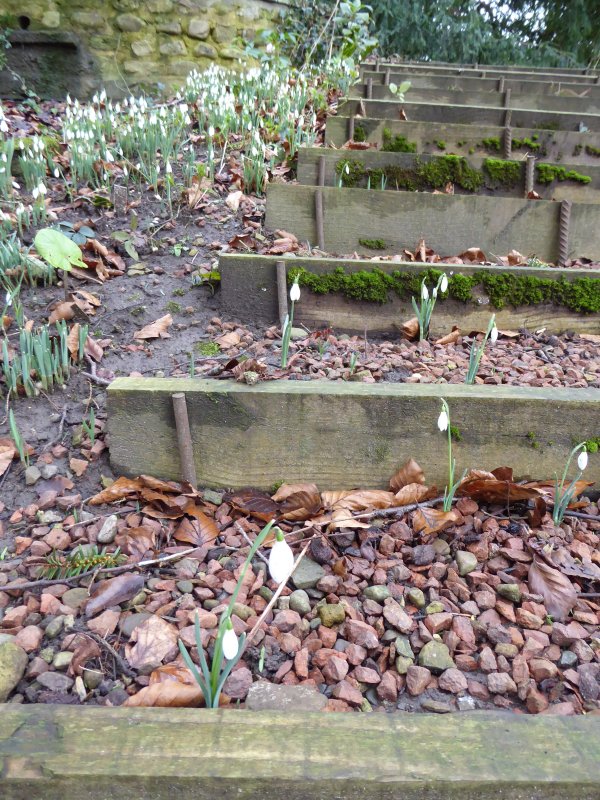
Step out into the garden, and the countryside beyond at the moment, and you’ll find snowdrops doing what they do best in January – piercing the barren earth, colonising grassy patches, nestling under trees and marching across gladed hillsides. Untroubled by unseasonal weather, their inner clocks direct them to grow, multiply, and cheer us all up in an otherwise gloomy, un-festive sort of month. That’s Nature for you: ordered, seasonal and predictable.
A farmer’s field? Or Sleningford-by-the-sea?
But Nature has another face. Come with me beyond the garden, past the fields slickly shimmering with surface water, to the banks of the River Ure. Just two minutes walk from here, it makes a wide sweeping curve away from its route from West Tanfield, and (normally) meanders gently into Ripon. That was before this winter, this rain, this unending water.
Once the rains came, and once it reached town, the River Ure rather wanted to swamp people’s gardens and make a bid to enter their houses. Recently-built flood defences put paid to that idea. The River Ure took its revenge on us, or more specifically, on the farmer whose fields adjoin us. Up in the hills, waters from streams and rivulets in the Dales cascaded into the Ure, which gushed and surged along its course, rising higher and higher, tearing at the banks, ingesting great clods of earth and forcing them downstream. The water levels are falling now. The damage remains.
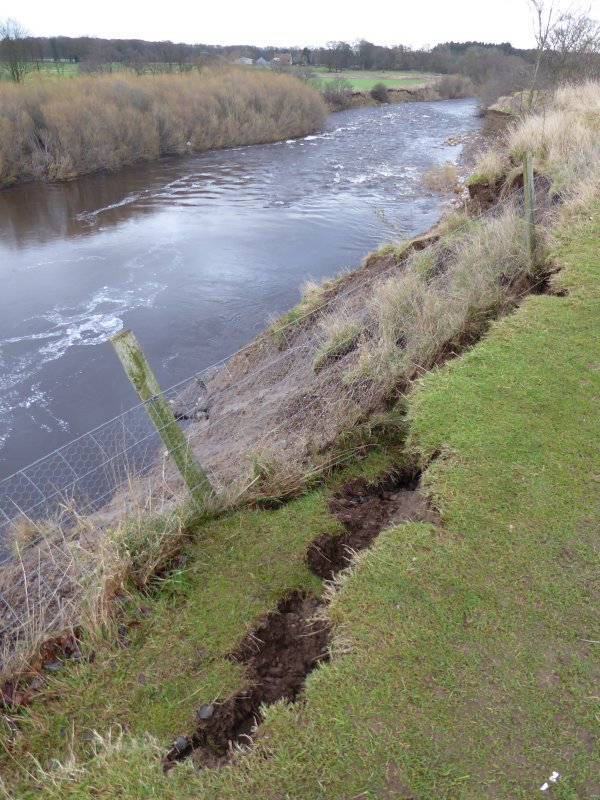
The River Ure seizes the land.
Look. Here’s a chain link fence which marks a pathway running along the edge of the farmer’s field. It should be on terra firma, with a nice grassy margin between the fence itself and the river bank. Now it has nothing to hold onto. The bank has been snatched away, and the fence is hanging crazily and directly over the swelling waters below. The earth has slipped, and continues to slip. The farmer is losing his field, and the river is changing course. There’s not much anybody can do about it.
We’ll watch the water awhile, and frighten ourselves witless at the prospect of falling in and being swept mercilessly away. Then we’ll wander back though the woods, and enjoy the snowdrops and aconites once more. Nature takes its course.
December in the north of England has been the month of the flood. Until Boxing Day, it was Cumbria that saw all the action, with some communities flooded out not once, not twice, but three times. They were told to stand by for more on Boxing Day. They readied themselves…. and nothing happened, because the torrential rains prophesied swept south and east of them, firstly into Lancashire, and then Yorkshire
We were staying with my daughter’s family in that part of Greater Manchester that used to be in Lancashire. They live near a Nature Reserve through which Bradshaw Brook passes. I’d say ‘flows’, but such a phrase is normally far too active a description for this narrow little watercourse.
This was Bradshaw Brook yesterday.
Bradshaw Brook, Boxing Day 2015
We were due to travel home from their house to ours, in Yorkshire. Highways England, the BBC, and motoring organisations all had conflicting information on their websites. But they all agreed that our usual route, a scenic drive over the Pennines, was largely impassable.
It would have to be the motorway. Longer, duller, but surer. We’d not long been travelling when we noticed that traffic on the other carriageway was at a complete standstill, for miles…and miles. It was only when we got home that we found out that a 20′ sinkhole had opened up near Rochdale. So much for safer-by-motorway…..
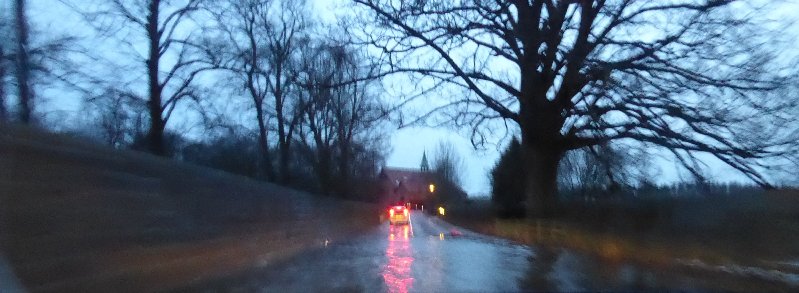
Where to leave the motorway though, for the final few miles home? There were floods in Leeds, floods near Harrogate – there were sure to be floods in Boroughbridge too. What about Knaresborough? It turned out there were floods near there too, as we discovered when warning notices turned us back on the road we’d come on, and sent us back by several miles to look for another route. Familiar fields had turned into lakes, deep and almost unfordable road-side puddles were unavoidable.
This doesn’t look too bad. Trust me. It’s deep.
We’re lucky. We were flood-tourists on our journey home, gawping at rivers-become-seas, and roads-become-rivers. Our home wasn’t flooded, nor will it be. Others aren’t so fortunate. They’re either contemplating the devastation of their own home or business – or both, or anxiously shoring up the front door with as many sandbags as they can lay their hands on, in anticipation of the days ahead, when the forecast continues to be grim. We could all do with a bit of an old-fashioned winter cold snap, with a touch of frost, but positively no rain.
You see that bridge, centre left? That’s a bridge over the River Ure, in Ripon. This lake in the foreground is not a lake, but open ground at the edge of the city, favoured by dog-walkers and children.
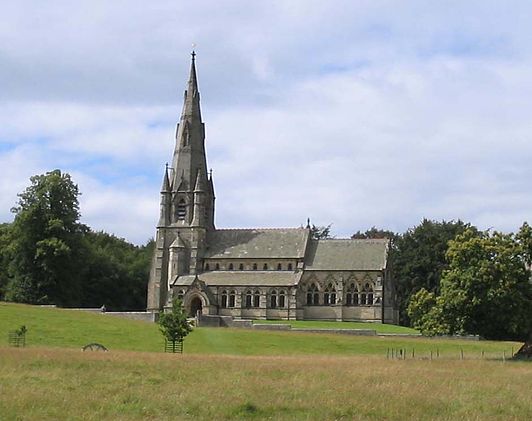
St. Mary’s Church, Studley Royal (Wikimedia Commons)
When I started out as a National Trust volunteer, when I began as an Information Assistant at St.Mary’s Church, Studley Royal, I didn’t expect to sort out a little mystery that’s continued to exercise my brain from time to time, ever since my first and only visit to India, 8 years ago.
Let’s begin there, back in 2007. It was my first day, all by myself, after a night flight into Bangalore. I was far too excited to sleep, and already over-stimulated by a city, busy since well before 6.00 a.m., alive with cows, horses, donkeys, sheep, chipmunks, dogs by the thousand, monkeys, parakeets, eagles …. and auto-rickshaws, always auto-rickshaws, and the unending sound of motorhorns constantly in use on every car and lorry. I’d already allowed an amiable rickshaw driver, who could doubtless see ‘arrived this morning’ tattooed across my forehead, to take me on a conducted tour of the city. We served each other’s purpose. I got a decent sit down and a running commentary in broken English on the city sights. He was probably paid over the odds by a very appreciative customer who knew a decent bargain when she saw one. When I left him, after a thoroughly entertaining morning, I found myself wandering towards London Road. And then Robinson Street. Robinson Street? Who could Mr. Robinson be? I finally found out ….. the other week. If only I’d wandered just a little further on that first day in Bangalore, I’d have been offered a clue. I’d have found ‘Ripon Street’.
My first friend in Bangalore: the rickshaw driver who took me on a tour of the city
Eagles fly above Bangalore
Bangalore street scene.
Fast forward to an early session at St. Mary’s Church, Studley Royal just a few months ago. My fellow-volunteer Frances was taking some visitors round. I tagged along, because Frances has an apparently bottomless fund of knowledge, and a way of engaging her willing listeners’ attention. She’d already told them that the church was the design of a noted exponent of Gothic Revival architecture, William Burges. She’d pointed out several examples of its inventive design, of its richly coloured decorative detail, of its religious symbolism.
First glimpse of the richly coloured interior
Starting outside the church…..
Burges famously loved animals. There are 16 of thse parrots.
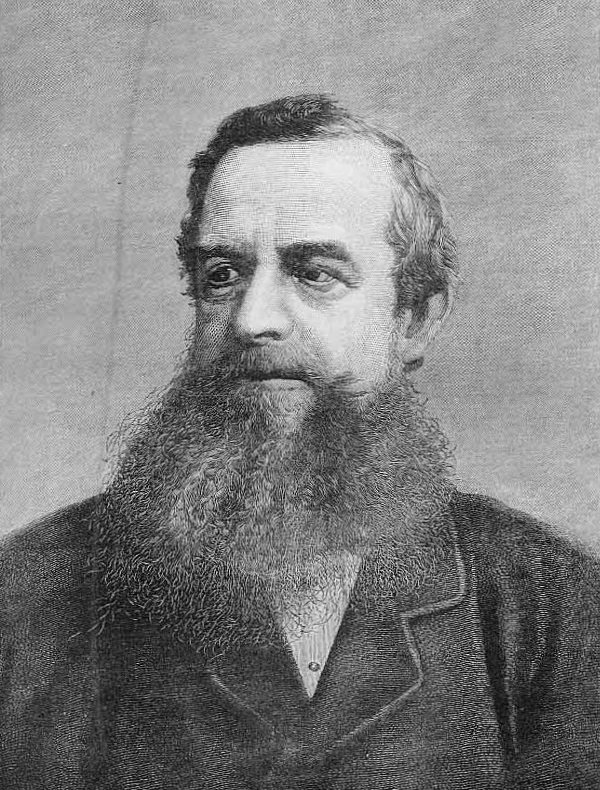
Now she was telling us that it was commissioned in 1870 by the deeply religious Marchioness of Ripon, and her husband, the Marquess. His full name and title was George Frederick Samuel Robinson, 1st Marquess of Ripon, 2nd Earl of Ripon. She thought we might like to know his story. She was right.
The Marquess of Ripon had an impeccable pedigree. He was born in No. 10 Downing Street, and as an adult, served as an MP in various northern constituencies. Shortly after succeeding to the title of Earl of Ripon in 1859, he became first Undersecretary to India, and later Secretary of State for India. From 1868 he was highly valuable in a variety of roles in William Gladstone’s government.
Then, in 1874, he converted to Roman Catholicism. His strong sense of duty prevented him from continuing to serve in government. The Church of England (the Established Church) and state are linked in the United Kingdom. He withdrew from public life.
However, in 1880, Gladstone persuaded him to take the post of Viceroy of India. The Indians grew to honour him: the British rather less so. Here’s why.
He expanded the powers of locally elected Indian governments, and liberalised internal administration. He lowered the salt tax. He gave local language newspapers the same freedoms as English ones, and enacted some improvements in labour conditions. He allowed Indian judges the same rights as European ones when handling European defendants. And he achieved all this in only four years. No wonder Indians felt the least they could do was name a few roads after him.
George Frederick Samuel Robinson, 1st Marquess of Ripon (Wikimedia Commons)
He went on to serve in other capacities before becoming leader of the Liberals in the House of Lords, and died in Ripon in 1909.
So – thank you St. Mary’s, Studley Royal. And thank you Frances, National Trust volunteer. An eight year old mystery is solved.
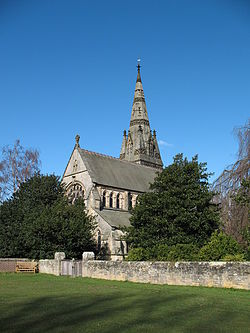
Christ the Consoler, Skelton-on-Ure. Wikimedia Commons
Here is a tale of a murder. A murder which led to the building of a very fine church not many miles from here.
In 1870, Frederick Vyner, son of the Marquess of Ripon and Lady Mary Vyner, travelled to Greece with a small band of English and Italian friends and servants. They were set upon by brigands who had probably been tipped off, and who demanded a huge ransom: £50,000. Women, children and servants in the party were regarded as useless bargaining tools by the brigands. They were released. But five men remained captive, including Frederick. The money was found to pay off the ransom, but before it could be delivered, the Greeks sent in the army, and in the resulting battle, soldiers, brigands and four of the hostages were killed, among them Frederick Vyner.
Vyner’s mother, Lady Mary, determined that she would build a church in her son’s memory on the Newby Hall estate which was their home. Her sister, Lady Ripon, was at the same time engaged in a project to build a church at Studley Royal, Fountains Abbey, Ripon. William Burges , noted Victorian architect, obtained the commissions for both churches in 1870.
I’m going to get to know St. Mary’s Church, and the work of William Burges very well over the weeks and months to come, as I have just been accepted as a volunteer for the National Trust at Fountains Abbey, where one of my duties will be as an Information Assistant at the church. Yesterday though, as part of our training, we were taken to see the church at Newby, which was until the 1990’s, the parish church of the village of Skelton-on-Ure.
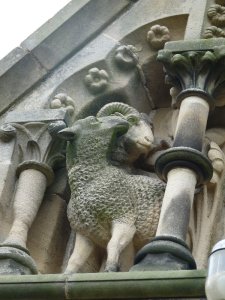
It’s clearly Saint Mary’s sister church, yet more stolid, more weighty in appearance. Originally to have been called St. Michael and All Angels, the church has a unique dedication – to Christ the Consoler. Wander round the outside, and you’ll see over the door Christ the good shepherd with some of his ovine flock: a complement to the sheep in the field beyond, at the moment nursing their young lambs.
Christ’s flock above the church door.
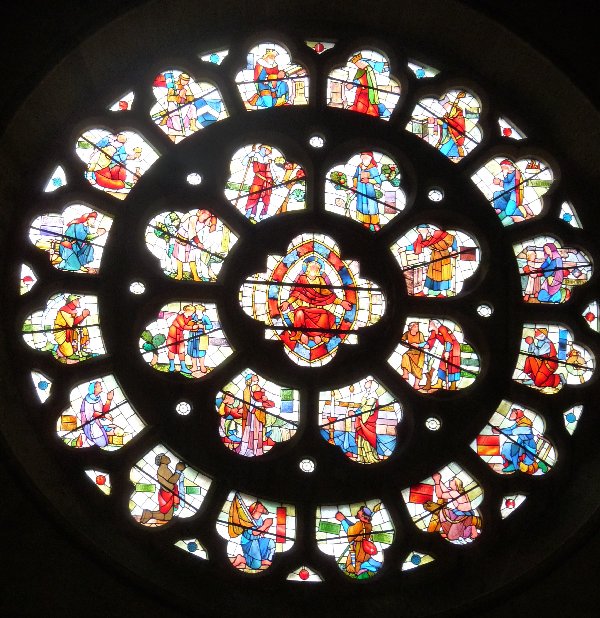
Within and outside the church Christ is omnipresent, perhaps most spectacularly in the rose window which portrays Him at its centre. The several ages of man are illustrated on an inner wheel of glass, and the various occupations and conditions of man on an outer wheel: noblemen at the top, working types below. Curiously, being ‘negro’, seems to be a job in itself. All turn their gaze upon the risen Christ the Consoler as they go about their business. It’s easy to imagine this spectacular window being a teaching aid to any cleric needing material for his sermon.
The rose window.
Christ the consoler
Infancy.
A fisherman and a hunter.
A negro.
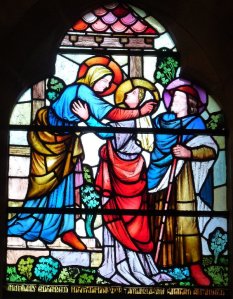
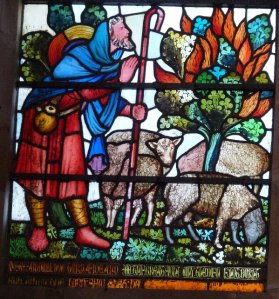
Walk down the nave and you’ll witness the miracles of Christ on one side, his parables on the other, each complemented by the event from the Old Testament which is traditionally held to be the precursor of that in the New Testament. This one was my particular favourite: the Annunciation, whose forerunner was the story of Moses and the burning bush.
The Annunciation.Moses and the Burning Bush.
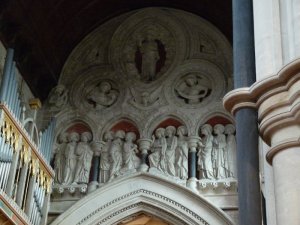
The dominating view as you enter the church is an almost overwhelming sculpture above the entrance to the chancel. Here is Christ’s Ascension with a crowd of 12 looking on. These are the disciples of course: but not Judas. His place is taken by Mary: a very mediaeval take on the event.
The Annunciation.
The chancel itself forms an intimate place for the Vyner family. Heraldic misericords record the arms of close and more distant branches of the family, all surrounding as if to embrace the memorial to the murdered young Frederick in a private and understated way. It’s decorated, as is St. Mary’s, with columns in Irish marble: dark green, plum red, greyish-white. More stained glass windows of Christ carrying his cross, then crucified, each with a number of Old Testament precursors.
Detail from the organ housing.
Angels rise above the chancel.
There’s more. There’s a glittering reredos with the Magi. There’s a spectacular organ casing set before the chancel. There’s detail to keep you happily busy and exploring for hours. Newby Hall and its gardens ought to be on your tourist map if you explore our area. Don’t leave the church out of your itinerary.
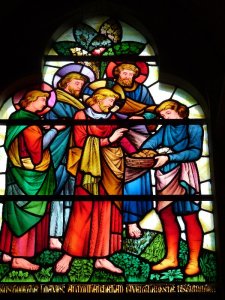
The miracle of the loaves and fishes.
As for William Burges, and the story of the two churches he built here near Ripon… well, there’s plenty here for another day
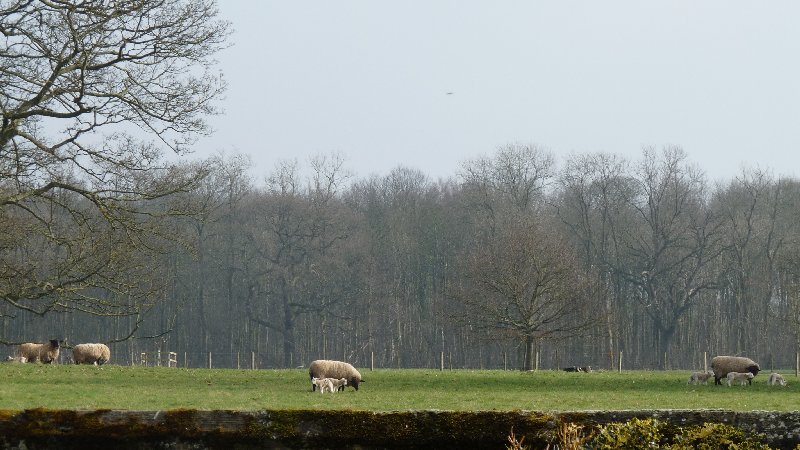
The sheep and lambs of Newby Hall, glimpsed from the churchyard.
A sunny morning on the River Ure, just before we reached the Canal.
We went for a walk along the Ripon Canal the other day, starting from the point where it meets the River Ure. Back in its heyday during the Industrial Revolution, busy as it was then, the rural towpath we walked along might not have looked so very different. Back in its heyday, keels would have hauled coal northwards from the Yorkshire coalfields, and lead and agricultural products southwards. The canals were the freight-haulage routes of their age, and even though they were busy thoroughfares, the whole business of passing vessels through the three locks in one direction at a time limited the flow traffic to levels well below what those of us who’ve ever been stuck in a bad-tempered rush hour traffic jam on the M1 have experienced.
Ripon Canal is not one of the country’s great canals. There are water super-highways such as the Grand Union Canal linking London with Birmingham. That’s 137 miles long. There’s the Leeds-Liverpool Canal. That’s 127 miles long. The Ripon Canal runs for just two miles, from Ripon to Oxclose Lock, where it links with the River Ure. Like many of the country’s canals, it was built in the latter part of the 18th century, between 1767 and 1783, opening up water traffic between Ripon and York, and it eventually put the products of the Durham coalfields within Ripon’s reach.
The railways proved to be the death of canals all over England. Ripon’s withstood the opening of the Darlington to York railway in 1841, but the Leeds and Thirsk Railway finished it off. The railway company actually bought the waterway, to ensure local support , but they then neglected it, failing to dredge it, so that it became less and less useable. The canal was abandoned as a waterway in 1906.
But its fortunes have changed again. No longer a tool of the industrial revolution, the canal has become a playground for people who like ‘messing about in boats‘*. The Ripon Canal Trust spearheaded its restoration from the 1960s, and now the whole thing is managed by the Canal and River Trust. So whether you like boats, barges, or a stroll along a quiet backwater near town, Ripon Canal’s worth a visit.
The towpath again.
Barges on the canal.
One of the canal bridges.
Walking the towpath
*That’s what Ratty used to like to do in Kenneth Grahame’s ‘The Wind in the Willows’
We’ve been back in the UK from France six months now, so this seems a good moment to take stock.
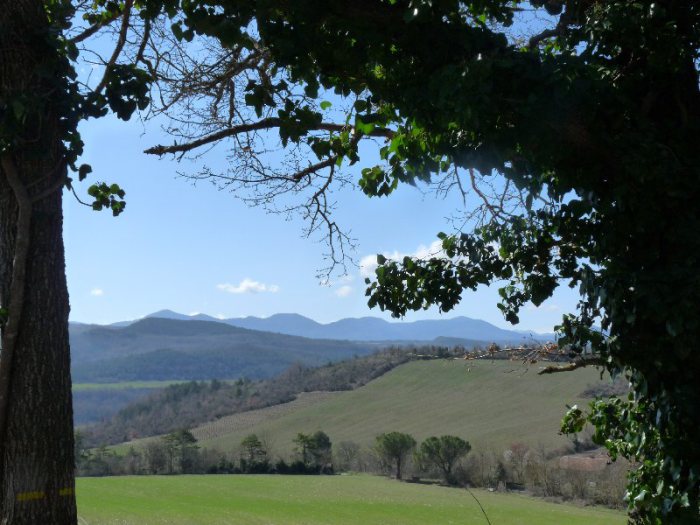
Did we do the right thing in coming back to England to live? Absolutely no question: we’re so happy to be here, and nearer to most of the family. There are things we miss about our lives in France though: of course there are. It was tough to leave friends behind, and we continue to miss them. Still, three have visited already, and there are more scheduled to come and see us here. And it’s sad no longer having the Pyrenees as the backdrop to our lives. Though North Yorkshire’s scenery brings its own pleasures.
Still, it’s wonderful not to have to tussle with language on a day-to-day basis. Our French was pretty good, but it was generally a bit of a challenge to talk in any kind of nuanced way about the more serious things in life. Now I feel I’ve freed up enough head-space to revise my very rusty Italian, and to learn enough Spanish to get by when we visit Emily in Spain.
Many of our regrets or rediscovered delights centre on food. This summer, we’ve gorged ourselves on the soft fruits that the British Isles grow so well: particularly raspberries, gooseberries and blackberries. Oh, they exist in southern France, but they’re wretched, puny little things, with no lively acidic tang like those of their British cousins. In a straight choice between raspberries and peaches, raspberries win every time (though of course, it’s even better not to have to choose).
Blackberrying near Harewood.
I miss, though, the choice we used to have in France of four or five different kinds of fresh, dewy whole lettuce available on market stalls every single week of the year. It’s flat, cos or little gem here, or those depressing bags of washed mixed leaves, and I find myself longing for the choices I used to have of crunchy, curly, bitter, blanched or soft leaves in various shades of green or even red. On the other hand, we do have tangy watercress here. And crisp crunchy apples, and Bramley cooking apples…..
And whereas in France there were always French cheeses on offer, and jolly good too, that was all there was, apart from the odd bit of shrink-wrapped Cheddar or waxy Edam. Here we can have English AND French (and Dutch and so on): decent French cheese too, unpasteurised, from small suppliers.
And what about eating out? Surely that’s better in France? Those copious home-cooked midday ‘formules’ – often a starter, main course, pudding AND wine, preferably eaten in the open air shaded by some nearby plane trees bring back such happy memories. But, but…. the menus were entirely predictable, and were dishes that had stood the test of time over the decades. After a few years, we wouldn’t have objected to a few surprises. Whereas back in Britain, most places seem to have upped their game considerably over the last few years. Local restaurants, pubs and cafés offer interesting menus, often based on what’s available that day, at fair prices. We’ve had some great meals since our return, and we’ve hardly started to get to know the area’s food map yet. And for Malcolm, there’s the constant possibility of slipping into a tea room to assess the quality of their coffee and walnut cake. This may be the main reason why he’s come back.
All the same, we can’t eat outside quite so often, particularly in the evening. And our fellow walkers have yet to be convinced of the pleasures of the shared picnic with home-made cakes and a bottle of wine: we’re working on them. Nor have we yet had a community meal, with long tables set out in the square as old friends and new share fun together over a leisurely meal.
Like most people who return from France, we find the crowded motorways unpleasant. But it is nice not to be followed at a distance of only a few inches by the cars behind us.
We’re struggling to shake off French bureaucracy too. Tax offices and banks over there continue to ignore our letters pointing out we no longer live there, continue to demand paperwork they’ve already seen, continue to ignore requests. And as we can no longer pop into the local office to sort things out, the problems just go on and on.
Something we’re enjoying here too is the possibility of being involved in volunteering. It’s something that exists in France of course: Secours Populaire and similar organisations couldn’t function without local help. But the French in general believe the state should provide, and the enriching possibilities for everyone concerned that volunteering in England can offer simply don’t exist. We already help at a community bakery, but I’m currently mulling over whether I should find out more about the local sheltered gardening scheme for people with learning disabilities, or about working with groups of children at Ripon Museums, or simply go into the local Council for Voluntary Service and find out what other opportunities exist.
Six months in, we’ve spent more time with our families, re-established old friendships, begun to make new ones. We’re happy in our new village home, and the slightly different centre-of-gravity we now have. Poor Malcolm’s waiting longer than he would have had to in France for a minor but necessary operation, but despite that, life’s good. We’re back in England to stay.
Ripon Cathedral: image courtesy of Wikimedia Commons.
Last week, I got the chance to climb the bell tower at Ripon Cathedral. How could I refuse? Hearing the full peal of bells joyously announcing Sunday worship, and at other times too, is one of the privileges of being near Ripon.
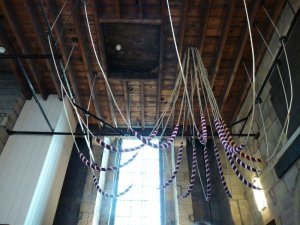
Bell ropes ready for action.
It was Wednesday evening. That’s when the team of ringers always meet to practise and learn new changes. I knew bells were rather heavy things, and imagined that tugging on the bell-ropes to make them chime must be a young person’s hobby – preferably a burly, muscular young person. But no. Bell-ringers are young, old, male, female, slim and rangy, tall and chunky, small and wiry. All that’s needed is an enthusiasm for this particularly British pursuit.
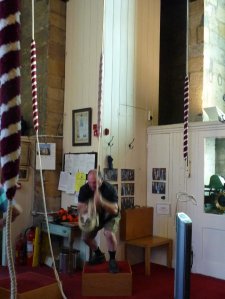
Getting started.
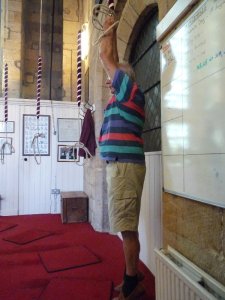
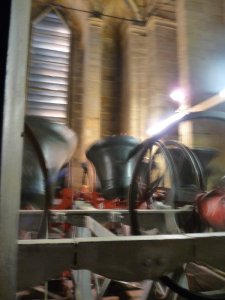
It was a fine thing to watch every member of the team as they got each bell going. That did look hard work. Holding the rope high above their heads, each ringer tugged to bring it low down, again and again, till the bell had acquired its own satisfying momentum: till indeed, it was turning so far that the bell reached the top of its 360 degree swing, paused momentarily, and could be controlled. Each bell sounds a different note in the scale, with each ringer sounding his or her bell in harmony with the rest.
Keeping the rhythm going.
There may have been bells in Ripon cathedral since the 13th century. Over the centuries, bells have been replaced or recast. The bell tower itself has been refurbished several times to replace ancient, beetle-infested timbers. By the early 20th century, the cathedral at Ripon acknowledged that its bells were no longer really doing a great job, so in 1932, ten of them were recast by John Taylor and Co. of Loughborough – one of only two bell foundries left in the country. Three more bells were added in 2007/8. At the same time as the main recasting, the bell tower was strengthened with steel and concrete. Since the heaviest bell (and it’s one of a team of 13) weighs in at one and a quarter tons, a good strong and safe bell tower seems essential.
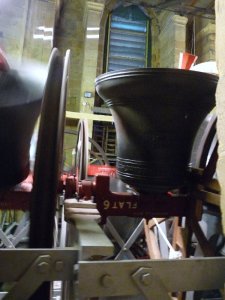
Bell in the belfry, almost fully turned.
It was a wonderful thing to watch the ringers working in rhythmic harmony (pull, pause, pause, pull), but what made the evening even more special was the opportunity to climb the bell tower itself. We had to put on thick ear protectors. Then we climbed the twisting narrow stone stairs, with almost impossibly far-apart treads, to find ourselves on what amounted to a walkway around the majestically swinging, harmoniously clanging quite enormous bells. We felt the tower shudder and sway and assumed it was our own fantasy. No, apparently it really does move with the momentum of all those bells. Despite the ear protectors, our ears felt sore from the auditory assault. Eyes and ears feasted on those bells swinging, sounding and reverberating.
A harmony of bells.
Reluctantly, we ventured down the stairway once more. The ringers were well into their rhythm now, guided by the somewhat arcane instructions of their leader, which meant absolutely nothing to us. But I can see the attraction of being part of such a well structured and purposeful team, using skills that have changed little over the centuries. I can understand why they like occasionally to give themselves challenges such as ringing a full three-hour peal, why they welcome visiting bell-ringers, why they enjoy the chance themselves to ring different bells in different churches. And why, apparently, at the end of a hard-working practice, they like nothing more than to get down to the local pub and sink a well-earned pint.
Thanks, North Stainley Women’s Institute, for organising this visit, and to the bellringers of the cathedral for allowing us a glimpse of their Wednesday evening practice.
One of the things I noticed about Ripon as soon as we started to get to know it is how many fine examples there are of what you might call civic signage. Then I came across a blog, by Simon Hawkesworth, a Lancastrian whose interest is in letterforms. In fact his blog is called City of Letters. Here’s what he discovered when he visited Ripon.
He wrote this post on his blog. Now I don’t have to: enjoy
When I was younger, I couldn’t be doing with formal displays in civic parks: the unwieldy floral clock, or the town’s name picked out in vividly orange French marigolds, or the little red begonias marching stiffly round a perfectly rectangular flowerbed. I felt sorry for the poor over-disciplined flowers and longed to release them to grow more freely under the trees.
These days, however, I quite enjoy the burst of colour that these formal displays offer as they welcome you into the park. I sense they aren’t quite the rigidly organised affairs of a few years back, and certainly they attract attention.
Yesterday, for instance, whilst in Ripon to do some jobs, Malcolm and I made a detour to idle away a little time in Ripon Spa Gardens, a really rather small park that’s a real oasis of relaxation very near the town centre.
Flowers round the bandstand.
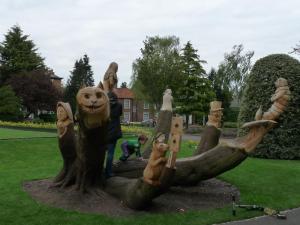
There are those colourful beds to meander through. There’s some trunks of thinned out cypress trees which have been transformed into a celebration of Alice ‘s Adventures in Wonderland. This is where grandparents stop to reminisce about this classic of childhood, whilst their grandchildren make it into an impromptu climbing frame. The Ripon connection with ‘Alice’ is that Dodgson was at one time Canon-in-Residence at the Cathedral here.
Alice’s Adventures in Ripon Spa Gardens.
There are trees fringing the edges of the park, making it seem larger and more extensive than it really is. There’s crazy golf, and a bowling green. There’s a bandstand. And best of all, there is a café.
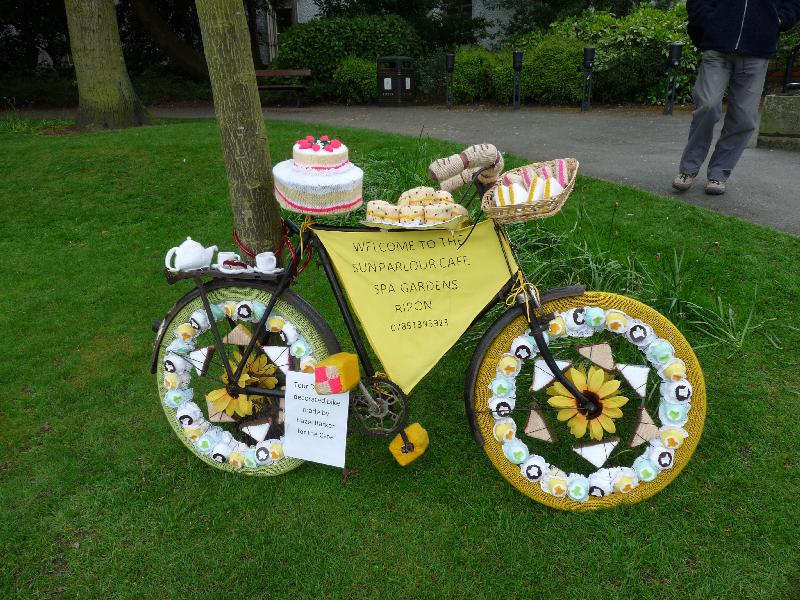
I was resistant to calling in for a cup of tea. Cafés in parks are often dismal affairs, lowest-common-factor places offering indifferent tea, cheap fizzy drinks and industrial biscuits. But Malcolm was correct in insisting we try it out. He rightly pointed out that a café with this wonderfully quirky bicycle parked outside, sporting knitted versions of everything on the café‘s menu couldn’t be all bad.
Fine publicity for a fine caff.
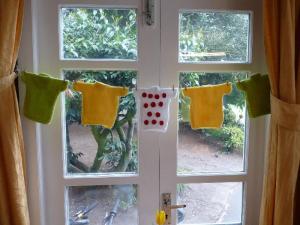
In fact it’s all good. The Sun Parlour Café is cheerily decorated in yellow, and already anticipating le Tour de France’s visit to Yorkshire by having lines of tiny knitted jerseys strung at every window.
Jolly jerseys at the windows.
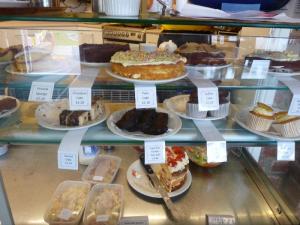
There’s a choice of a dozen or more home-made cakes or biscuits (coffee and walnut for Malcolm please, orange-and-lemon for me), and freshly baked scones all at unbeatable prices.
Which cake to choose?
Every day they offer a roast dinner and hot pudding with a drink for an excellent value £9.00. It’s run by a lively and welcoming woman who answers to the name of ‘Lefty’ (‘My surname was Wright before I married’, she explained). She clearly has regular customers. She’s just acquired two more.
Ripon’s living up to expectations. We’ve now added the Spa Gardens to its list of attractions.
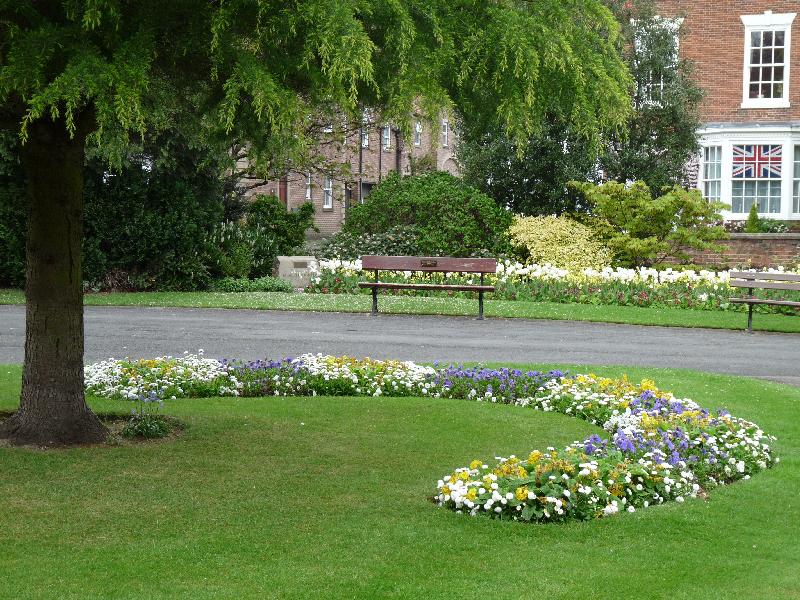
Time to go home. Nobody’s relaxing on that park bench.

















 From Pyrenees to Pennines
You must be logged in to post a comment.