A walk gone wrong

This slideshow requires JavaScript.

Yesterday was gorgeous.  Hot and sunny until long into the evening.  We ate outside and stayed on the roof terrace till 10 o’clock.  Today seemed to promise more of the same.  We should know better.  This year, getting even two days on the trot where the weather is hot and clear all day is asking a bit much.

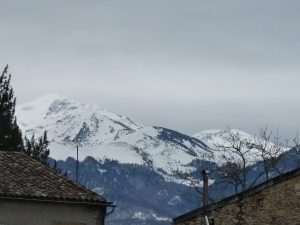
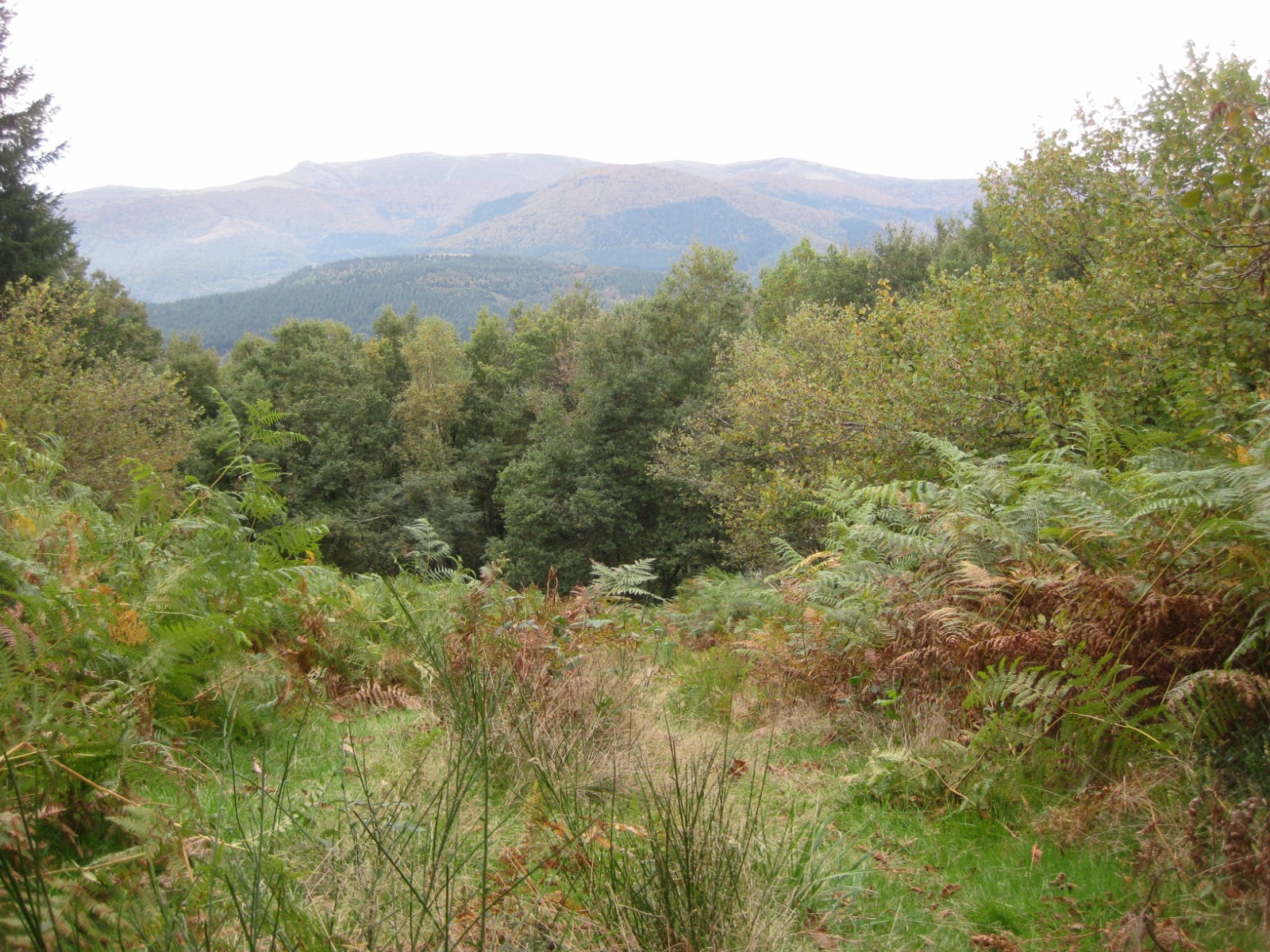
And so it proved.  Today, our walking group met to share lifts to where our walk was to begin.  We set off in the sunshine, watching our in-car thermometers climb steadily to 27 degrees as we drove ever upwards, beyond Villeneuve d’Olmes, beyond Montferrier, up a road which became narrower and less well maintained, to Frémis, a tiny hamlet.  We parked there, in a flower-spangled meadow offered by a local farmer.  We peeled off our fleeces, applied suncream and set off towards the peak, Coulobre. Sometimes the upward-going was tough and quite a scramble, but we were encouraged by looking across to the still snow-capped tops, and the thought that we’d be having our picnic at the top there,  the Ariège spread below us with views, views and more views.  We met a herd of black Mérens horses sheltering in a copse from the already-hot sun.   A donkey befriended us.  And still we climbed.

Towards midday, walking through the forest, we suddenly realised things were changing.  Didn’t it suddenly feel cooler?  And weren’t those little scraps of mist swirling round those peaks?  Apparently yes.  The mist descended.  The ‘cool’ became ‘chilly’.  With 20 minutes to go to arrive at our lunch spot, Micheline, who had developed a gammy knee, announced she could go no further.  It didn’t take much for us to decide that it was not only friendly to remain with her and have our lunch, it made sense.  The mist was swirling around us, the views up there wouldn’t be up to much, and it was obvious that rain or worse was on its way.

We found logs to sit on, got our fleeces out again, ate our lunch with little ceremony, and scuttled down.  The climb up had taken nearly three hours. Scurrying down took not much more than an hour.  And as we reached Frémis, the rain started.  It’s not stopped since.  And those in-car thermometers on the way home? 15 degrees.

Snowshoes III: The very last episode

I’m not doing raquettes (snowshoes) ever again.  Never.  If I ever show signs of changing my mind, lead me into a darkened room, talk kindly to me, and sit with me till the feeling passes.

I have no idea how I got through yesterday.  I must have done though, because every move I make causes some protesting and unhappy muscle to complain vigorously at the pain it endured on our expedition, and is still enduring now.  Five hours walking, with half an hour off for lunch.  Something over 600 metres up, 600 metres down – that’s nearly 1900 feet each way in old money.

I said last week’s sortie was tough.  Compared with yesterday’s, it was a stroll in the park.  I said last week’s was ‘an upward slog: unremitting, tough’.  Yesterday’s was a vertical slog: unending, unforgiving.  Last week, the snow had been deep and crisp and even, and easy to walk on.  We had crunched satisfyingly upwards through the forest, and our descent had been a brisk and easy downward march.

Yesterday, following a warm and sunny week, the snow was soft and our snowshoes sank deep.  Bad enough on the upward route march, but coming down, we all skidded, slipped and lost grip of our poles as they plunged into unseen cavities.  I made landing smack on my back and descending bumpily downwards, legs waving helplessly in the air my personal speciality.

Still, it was good to see Montségur, looming above us at our starting point, providing points of reference throughout the day.  Soon after we started, we were level with the castle at its summit, then it was below us, and disappeared for a while as we plodded upwards through a stretch of forest.  At lunchtime it was impossibly far below.  As we ate, we enjoyed plotting the landscape for other landmarks: Lavelanet and Laroque of course, the lac de Montbel, and far north of us, the Montagne Noire.

Best of all were the cloudscapes: massed plump white cushions of cumulus with wispy brushes of cirrus above, turning a more characterful and moody grey in the afternoon, foreshadowing the evening’s expected rain.  We were just back at the cars when the rain arrived a little ahead of schedule, with a brief hailstorm of pencil-point-sharp hailstones to encourage us on our way.  We didn’t need telling twice.  Home comforts have never seemed more inviting.

Snow Shoes II, The Sequel

We walkers of Laroque got our snowshoes out again today (well, in my case, I borrowed some), and went for a much more local sortie, just above Montferrier and en route for the local skiers’ playground, Mont d’Olmes.

How different from our last walk.  Instead of wide open snowfields with distant views, we had woodland walking and bright sunlight casting blue shadows across our path.

Instead of gentle slopes rising and falling before us, we had an upward slog; unremitting, tough.  Micheline and I, discouraged and tired, failed to reach the top, and missed the prize: a frozen lake with snow-clad views in every direction.  Most of the party stayed with us and kept us company.  Though our views were less exciting than those of the intrepid climbers, our picnic was the better one.  We low-achievers had wine, home-made cakes and hot coffee with us to supplement our bread and cheese.

And the journey down was completed in record time.  We arrived home as our gardens were gently baking in the last of the hot afternoon sun.  More of the same is forecast for several days: there won’t be much snow left this time next week.

Snow shoes at Scaramus

It’s 7 o’clock.  I can’t see me having a late night.  We’ve had a day of ‘raquettes’ – snow shoes.  Gosh it’s exhausting.  You strap great oval saucers of plastic, webbing, and toothed metal to your feet and spend some minutes feeling like an ungainly baby taking its first uncertain footsteps across the endless wastes of the living room carpet.

Booted and spurred
Booted and spurred

But equilibrium returns, and without these cumbersome contraptions, how else would you walk across the undulating white snowfields of the Plateau de Sault, with views of snow-sculpted hillsides nearby, jagged snow-crusted peaks beyond?  How else could you enjoy the sound of the satisfying crunch and crack as feet break through the crisp crust of the surface snow.  Thank goodness for that icy layer.  We found our 5’ long batons, plunged deep below the surface, wouldn’t touch the frozen ground beneath.

And with a bright blue sky, a hot sun enabling us to walk wearing T shirts and summer hats, what better way to spend a February Sunday?

Rain, rain…….

The banner headline on this morning’s regional paper, La Dépêche du Midi, told us what we already knew.  There’s been twice as much rain this month as is usual.  Of snow, we’ve seen hardly a flake.

Driving back from Foix yesterday, we saw meadows that have become mini- lakes.  Even more fields glistened with water as the water table has risen to the very surface of the soil. It’s made the month a somewhat gloomy one, even though the days have been pretty mild.  The mountain peaks are snow-capped, as expected, but the white stuff barely creeps down the mountainside and with all the low cloud and zilch visibility, it’s sometimes hard to know where the Pyrenees have disappeared off to.

Our regular yomps into the countryside have been a bit curtailed.  Walk after walk has been rained off, and when we do go, we choose our routes with care.  If we don’t, we’ll be lugging kilos and kilos of glutinous heavy clay with us as it clings to our boots and the bottom of our trousers.
 

Boots - with added mud
Boots – with added mud

Roll on the 2nd of February, Chandeleur (Candlemas), the day when Winter decides whether to stick around or push off.  Last year, it was icily cold, and Winter stayed and made his presence felt with several weeks of constant snow, ice and bitter cold.  This year, he‘s looking much more half-hearted about it all.  We blame ourselves. We invested in snow-tyres and snow chains for the car.  We clothed our olive tree and a few other plants in white dresses of horticultural fleece.

Our olive tree all wrapped up for winter

So Winter laughed in our face.  We daren’t change the tyres or undress the tree though.  We all know what will happen if we do.

There's snow on them there 'ills: but not a lot.  As seen from our roof terrace
There’s snow on them there ‘ills: but not a lot. As seen from our roof terrace

Bugarach: ‘Doomsday Destination’

Cold.  Pale thin fog baffles the contours of the hillsides, and those of the distant castle at Coustassa.  Glimmering frost bristles the short maquis grass beneath our feet.  A watered lemony sun high above us attempts to burn winter away, and eventually does so.

That’s when we have our first view of Bugarach, the imposing thick-set mountain which dominates this part of the Aude, because it stands alone, rather than as part of a range, and today is pretty much thatched in snow.

Bugarach has been in the news for a while.  Here’s BBC’s ‘From our Own correspondent’ back in July 2011:

‘According to an ancient Mayan calendar, at some point towards the end of 2012, the world will come to an end.

It is not clear how that will happen, but apparently humanity does not stand a chance – except for those who seek shelter in the area surrounding Bugarach.

Just 200 people live there all year round, but doomsday believers and spiritual groups are convinced the village has magical powers, thanks to the local mountain – the Pic de Bugarach.

For years, rumours have circulated on the internet that extra-terrestrials live in the mountain, and come the apocalypse, the top will open and they will emerge with spaceships, and rescue the local inhabitants.’

Although it’s quite hard to entertain the idea that the mountain might be some sort of underground UFO car park, there are plenty of people who have done so, and with great fervour.  Here’s today’s Daily Mail, which has been talking to Jean-Pierre Delord, Mayor of the tiny village of Bugarach (pop. 176).

‘On Wednesday, he will close the village for five days to anyone who doesn’t live here or isn’t already booked to stay, and draft in hundreds of police, military, firemen and Red Cross to ban any gatherings, shut off the mountain and arrest anyone silly enough to try flying over it.

‘What if tens of thousands of people turn up?’ he says, throwing his arms up in the air. ‘I have no way of knowing what will happen. I have no crystal ball! I don’t care if people want to chant naked or talk to the trees, but I have to protect my villagers. I am responsible for them.’’

He’s not over-reacting.  Local house-owners have been able to rent out their homes for the period in question for astronomical prices, and even camping spots are going for 400 euros a night.  For most locals though, the whole thing is at best a nuisance, at worst a real headache.  The nearer we get to December 21st, the more people descend on the area, and the police and army are already involved in keeping order.

We enjoyed our views of Bugarach, as ever.  We spent time pretending to look for UFOs and generally mocking the New-Agers who are so convinced by the end of the world as we know it.  Then we got on with the business of enjoying our walk in the here-and-now.  Here are some photos of our day.

‘All is safely gathered in, ere the winter storms begin’ *

Autumn colours beginning means it’s harvest time for foragers

I’ve written before about the ‘au cas où’ bag: the carrier you always have with you on a walk, ‘just in case’ something tasty turns up and demands to be taken home and eaten.

Well, at this time of year, it isn’t really a case of ‘au cas où’ .  You’re bound to find something.  A fortnight ago, for instance, Mal and I went on a country stroll from Lieurac to Neylis.  We had with us a rucksack and two large bags, and we came home with just under 5 kilos of walnuts, scavenged from beneath the walnut trees along the path.  A walk through the hamlet of Bourlat just above Laroque produced a tidy haul of chestnuts too.

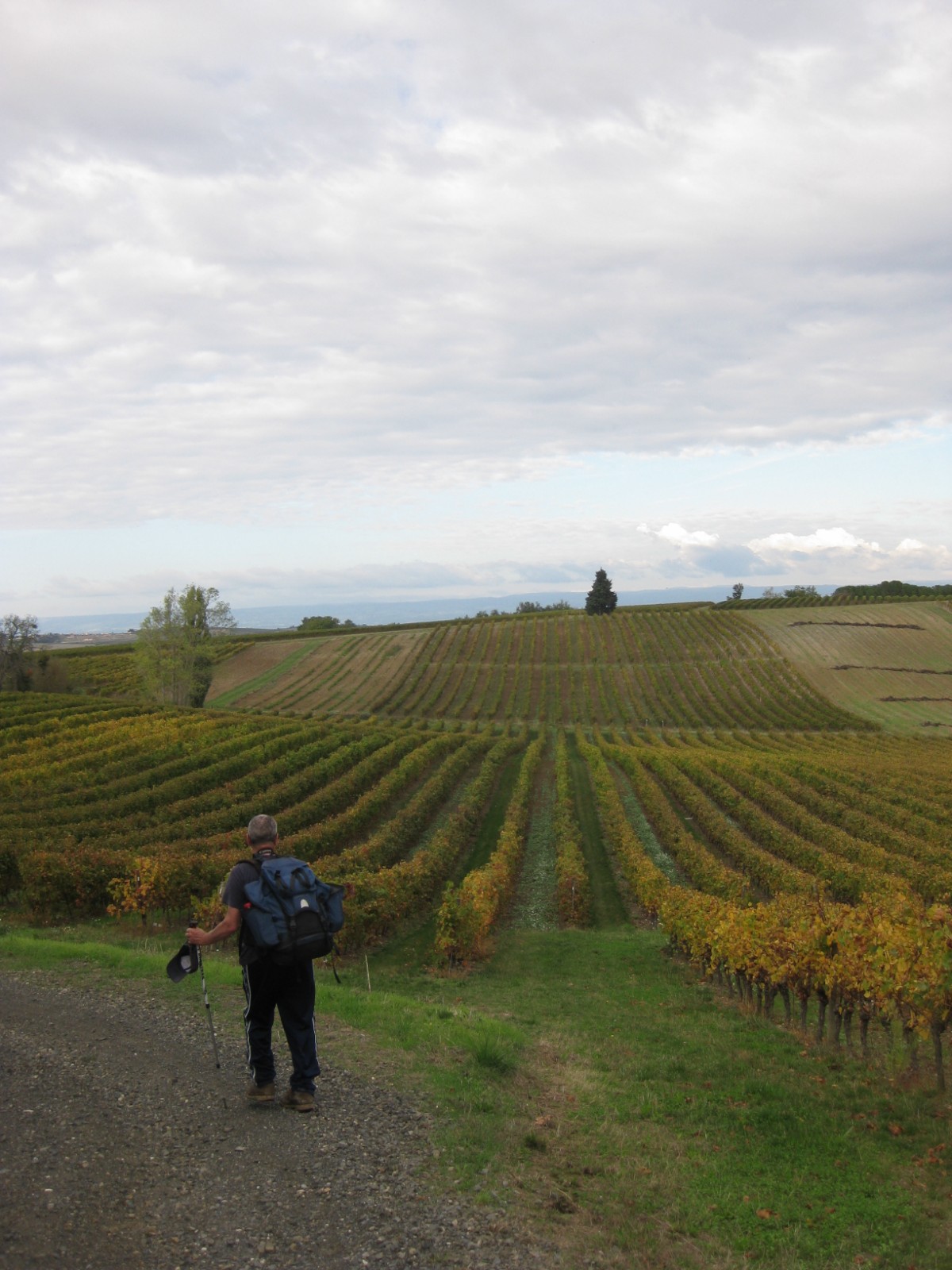
Yesterday, we Laroque walkers were among the vineyards of Belvèze-du-Razès.  The grapes had all been harvested in the weeks before, but luckily for us, some bunches remained on the endless rows of vines which lined the paths we walked along.  We felt no guilt as we gorged on this fruit all through the morning.  The grapes had either been missed at harvest-time, or hadn’t been sufficiently ripe.  They were unwanted – but not by us.

So many vines: there’ll be unharvested grapes there somewhere.

The walnuts we’re used to in the Ariège are replaced by almonds over in the Aude.  You have to be careful: non-grafted trees produce bitter almonds, not the sweet ones we wanted to find.  But most of us returned with a fine haul to inspect later.  Some of us found field mushrooms too.

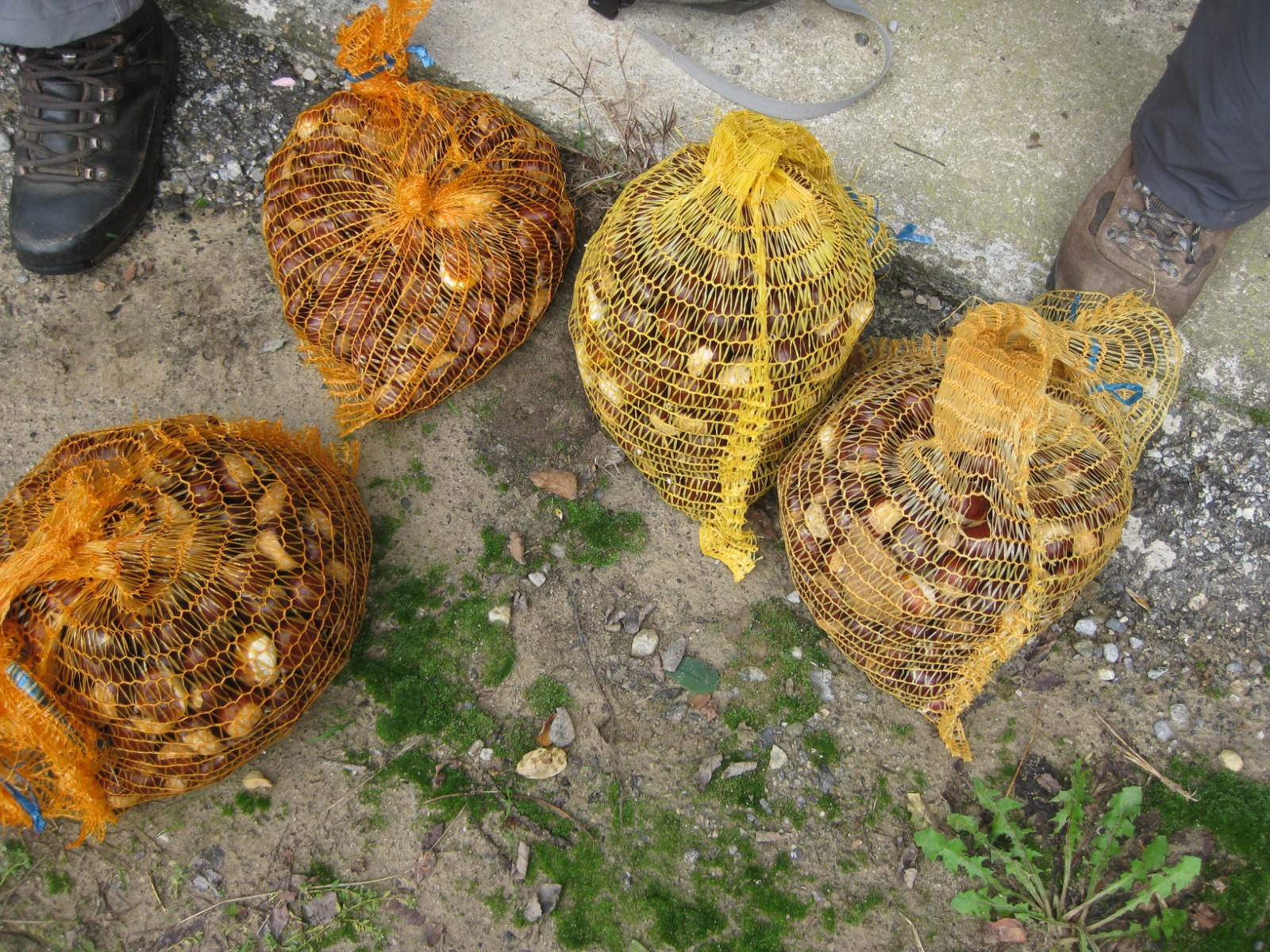
Today, the destination of the Thursday walking group was the gently rising forested and pastoral country outside Foix known as la Barguillère.  It’s also known locally as an area richly provided with chestnut trees.  Any wild boar with any sense really ought to arrange to spend the autumn there, snuffling and truffling for the rich pickings.  We walked for 9 km or so, trying to resist the temptation to stop and gather under every tree we saw.  The ground beneath our feet felt nubbly and uneven as we trod our way over thousands of chestnuts, and the trees above threw further fruits down at us, popping and exploding as their prickly casings burst on the downward journey.

As our hike drew to an end, so did our supply of will-power.  We took our bags from our rucksacks and got stuck in.  So plentiful are the chestnuts here that you can be as picky as you like.  Only the very largest and choicest specimens needed to make it through our rigorous quality control.  I was restrained.  I gathered a mere 4 kilos.  Jacqueline and Martine probably each collected 3 times as much.  Some we’ll use, some we’ll give to lucky friends.

Now I’d better settle myself down with a dish of roasted chestnuts at my side, and browse through my collections of recipes to find uses for all this ‘Food for Free’.

I think these chestnuts represent Jacqueline, Martine and Maguy’s harvest.

* Two lines from an English hymn sung at Harvest Festival season: Come, ye thankful people, come’

The tragic and savage history of l’étang d’Izourt

The drive to the start of the walk was dramatic enough.  Forested and craggy, our narrow road out of Auzat switch-backed steeply up the slopes in a seemingly endless series of hairpin bends.

And our walk began, an 1800 foot climb, upwards through forest then out onto the stony, rocky path towards the man-made étang d’Izourt, one of the many reservoirs in the area maintained by EDF to provide power. Once, a helicopter flew over.  Since there are no roads up there,  it was delivering either men or supplies to a team we could see labouring on a more distant slope.

The walk changed for me as I learnt the story of what had happened back in 1939 when the reservoir was being built.  Most of the members of the construction team at that time were economic migrants, Italians from the Veneto, and whilst working there, they lived in huts on site.

The weather conditions had already been atrocious for days when on March 24th 1939, a fierce blizzard struck.  There was no option for the workers but to hole up in their huts.  The storm was so fierce that huts B and C were destroyed from the weight of snow above, and the roof from hut A blew off.  The desperate men sought both to escape and to try to help their work mates, many of whom had died or been gravely injured by the tumbling buildings.  A nearby avalanche brought down the cable car linking the site with the works below.  The only way up was on foot, and rescue attempts were pretty much futile, though bodies and the injured were recovered as management attempted to evacuate the entire area.  On 28th March, a team of army skiers managed to get through and working into the night, brought down the remaining bodies and wounded.  31 men, 29 Italians and 2 French, were buried at the cemetery in Vicdessos on 31st March.  There they remain, as the families in Italy were too poor to manage the expense of repatriating the corpses.  The memorials at the lakeside are still the site of pilgrimage, thanks to the efforts of the ‘Ricordate-Izourt’ Association: locals and Italians who honour the memory of those lost workers.

We ourselves had started our walk in bright sunlight.   Spots of rain began.  Then the wind.  By the time we reached the lake, there were times when the gusts felt almost horizontal, and we struggled to find protection from the rocks to eat our lunch.  The more modern huts now on site have their roofs held on by strong metal cables, and we could understand why.

The sky turned the colour of lead, and we rejected the idea of exploring the lake in favour of hurrying down the way we had come.  We knew we’d be OK, but we also know to treat the mountains seriously and with respect – conditions can change very quickly.  We were fine of course, but that fierce wind on a warm October day gave us the smallest hint of what things could be like if you were trapped there in much nastier conditions.  Even now, the most efficient way of supporting the workers still on site from time to time is to get them and their supplies there by helicopter.  A noisy chopper whirled up and down the mountainside several times as we walked down, our journey cheered by a rainbow linking our mountain with the one next door.  Though we were sorry the weather had chased us home, we were grateful  not to have been exposed to  the dangers the mountains can offer from time to time.

This slideshow requires JavaScript.

Château de Lordat

This slideshow requires JavaScript.

Fourth of October.  The sun’s shining hot, but not too hot, high in an azure sky.  A small group of hikers stands outside a little church and gazes up a steep slope towards the ruins of the Château de Lordat.  And then sets off in the opposite direction.

It’s Anny who’s picked our route, and it’s designed to wind us up the hillside to the castle along chunks of country road, craggy uphill scrambles, dry-leaved woodland just thinking about exchanging green summer leaves for the ochre and russet tints of autumn, and the occasional tiny village – no more than a couple of streets encircling an ancient church.

Most of the time there are views upwards, towards the castle itself, or the cable-wagons serving the talc mines of nearby Luzenac, or across to the more distant mountains covered for the first time this season with bluish-white powdering of snow.  Or down, past thickly forested almost vertical slopes to craggy rust-stained rocky outcrops with occasional hamlets and villages scattered through the countryside. Near villages and farms, we pass walnut trees, and feel obliged to gather the recently ripened and fallen nuts – this is France after all.  We exchange recipe ideas.

Suddenly, we’re there. Lordat.  In high season, the village must be a tourist trap, but now we’re happy to saunter along the sunny empty streets, with their pastel-painted cottages and tubs of geraniums.  A final yomp and we’re at the castle walls.  It’s ruined and closed to the public at the moment, but the views in all directions make the climb worthwhile.

A meandering trek through the woods, trying hard not to kick over the delicately-stemmed autumn crocus, brings us to our lunch spot in Axiat, sitting outside its Romanesque church.  Mal and I are particularly taken by a notice on the door in French, English and Spanish. The English version reads: ‘Ladies and Gentlemen the visitors, we thank you for closing the door by going out’.

Afterwards, more craggy descents, sometimes through woods, at other times with more of those impressive views, along an ancient man-made winding path.  And back to the village we started from.  It’s a wonderful walk.  If you come to stay, make us take you.

In search of a druid – or a trout

Mont d’Olmes: local playground for skiers.  You wouldn’t travel any great distance to spend a holiday here, but for locals, it’s the ideal winter sports spot.  It’s a wonderful area for walkers too.  We’ve only just begun to discover the wealth of footpaths, mainly across truly ‘sauvage’ slopes, with views downwards to Montségur, Roquefixade, and northwards almost, it seems, as far as Toulouse.

It’s alright waxing lyrical though.  For many people living in the area many years past, and until the early years of the 20th century, these slopes were the places where they came for long hours each day, working both on the surface and by crawling through narrow airless tunnels, mining talc.

Talc?  Yes, that stuff you sprinkle on babies’ bottoms.  That stuff those Olympic gymnasts plunge their hands into before taking to an overhead bar.  That stuff that apparently still has many industrial uses, notably in the ceramics industry and for plastics paints and coatings.  This soft soapstone was found here on Mont d’Olmes and is still mined in nearby Luzenac.  Here though, all that is left are the gashes in the mountainside where the workings once were, and a few ancient trucks once used to transport the material down to civilisation.

Come and take the path we took last Sunday.  We walked in more or less a straight line, up and down hill after hill, as the path became increasingly rocky and impassable.  Our reward was the occasional handful of raspberries or bilberries, then a lunchtime picnic by l’étang des Druides.  No, sorry, l’étang des Truites.  Whatever.  Nobody seems to know which name is correct.  Some say the person making the first map of the area misheard and wrote ‘truite’ – trout – instead of ‘druide’.  We saw no trout.  We definitely saw no druids.  But we had a jolly nice picnic.  And I paddled.  And then ruined a perfectly good day, in which morning chill and mist had given over to hot sunshine, by falling flat against the rocky path, cutting open my face and chipping three teeth.  I hope the druids weren’t lining me up for some kind of sacrifice.

This slideshow requires JavaScript.