The morning after the night before.

I don’t celebrate the winter solstice.  From my point of view, what’s to celebrate on the shortest day of the year – and the longest night?  But the day after: that’s a different story.  Now the days get just a little bit longer, the nights a little bit shorter, every single day till the middle of next June.  So today was the day to jump cheerfully out of bed and enjoy the clear bright sunshine, lasting a whole 5 seconds longer than yesterday.  Come and join us on a brisk morning walk.

We’ll start from the Lac de Montbel, walk along the water’s edge to the hamlet of Les Baylards, and then climb up to the ridge that leads through the woods, overlooking the Plantaurel and the more distant Pyrenees, towards Mireval.  Back down the hill through Villaret.  This is a tiny hamlet on a single track road, but it charms me every time with its old blue enamel sign, ‘Poids Lourds’ – ‘HGV this way’.   Back to the car, and we’ll be home in time for lunch, with an afternoon’s sunshine still ahead of us.

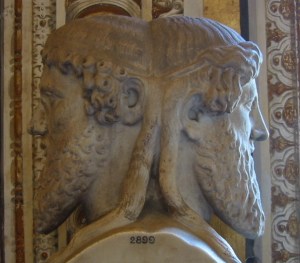
Janus


Janus in the Vatican: an image from Wikipedia

We’ve all heard of Janus, the Roman god of beginnings, endings and transitions.  He’s the one with two faces: the grizzled lived-in one looks back towards the past, while on the other side of his head is the younger version, looking with optimism and hope to the future.  He puts himself about at this time of year, and indeed gives his name to January.

He’s been putting more energy at the moment however, into clambering inside our heads, mine and Malcolm’s.  He’s got us at our own game, as we look both forwards and backwards at every moment

The grizzled half of my head is fully occupied in reminiscence.  It doesn’t even try to understand why anyone would want to look at a  future in England.  It thinks about our walks, particularly our Sunday walks with our Laroque friends. What scenery!  However characterful, green and lovely English scenery might be, nowhere is going to provide the snowy summits of the Pyrenees as a backdrop to every walk.  And there’s something about those midday picnics too which I’m not expecting to see repeated at an English walker’s lunch spot.  The aperitif that gets handed round, the bottle or two of wine,  two or three home-made cakes, coffee and digestif…..  And last Sunday, a mid-December Sunday, it was so warm that one of our number  stripped off his tee-shirt to get the sun on his back.

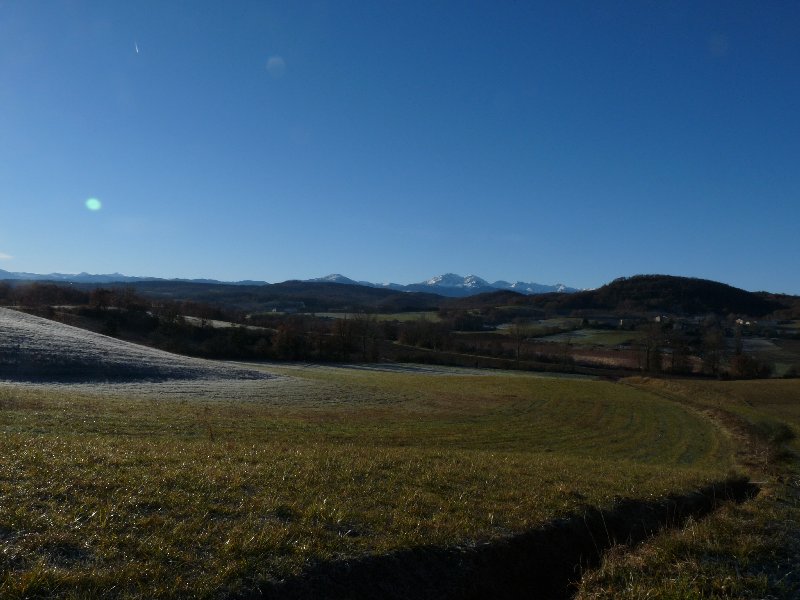
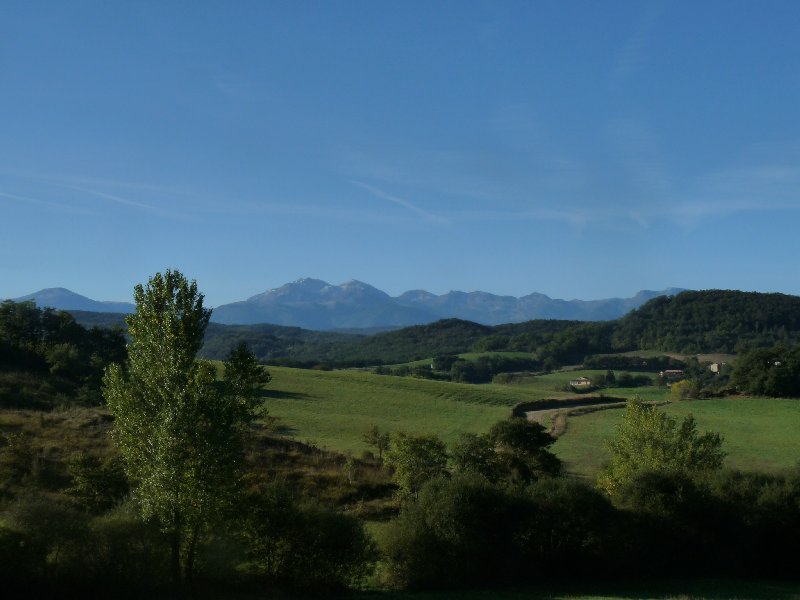
The Pyrenees: always there.  The constant backdrop round here
The Pyrenees: always there. The constant backdrop round here

The grizzled half of my head realises that tomorrow’s concert with the choir will be my last one ever and makes sure that my eyes mist over and my throat constricts as I try to follow the music.  It points out that those summer evenings spent in our back yard over a leisurely meal and  glass of wine are now things of the past.  Those moments with friends, those trips to explore, discover and re-discover the area we’ve called home these last few years area are all but over.  Grizzled Janus is holding all the cards when he’s in the mood.  He knows very well that we’re finding it tough to say ‘Goodbye’ to all this.

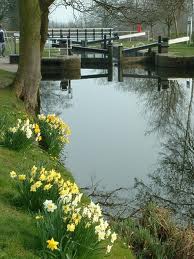
Ripon Canal in spring (Nigel Homer, geograph.org.uk via Wikimedia Commons)

But Janus has two equally potent faces.  The young version is optimistic and cheerful.  He points out that we’ve never fancied growing old, much less infirm in France, and this is the moment to get involved in life in Ripon,  a community where we already feel comfortable, but where there is so much more still to discover.  Much of what we most appreciate in France is available to us there too: wonderful walking scenery and an active community that welcomes people who want to join in.  Theatre and concerts will be within easy reach and we’ll be able to mix small-town life with easy access to bigger towns too.  And do you know what? I’m going to appreciate those English summers, if not the winters so much.  I can’t be doing with those days when the temperature is in the high 30s: and I used to be a sun-worshipper.  It’ll be good to return to speaking English and to understand most cultural references : though I expect we’re dreadfully out of touch.

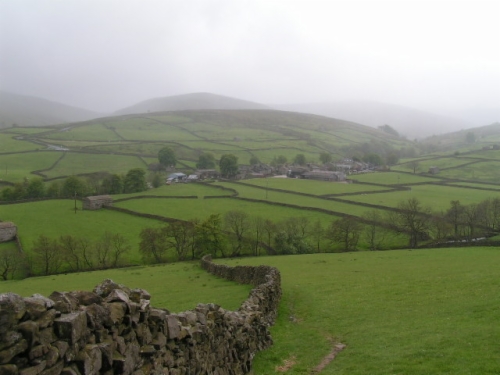
Thwaite in the Yorkshire Dales  (David Dunford, geograph.org.uk. via Wikimedia Commons)
Thwaite in the Yorkshire Dales (David Dunford, geograph.org.uk. via Wikimedia Commons)

Dear two-faced Janus, you’re a terribly mixed up sort of chap.  We expect to be terribly mixed up too.  We made a decision, and we believe it’s the right one.  But we don’t think  we’re going to get through the next few months without periods of excitement, periods of mourning, periods of confusion.  Often all on the same day.  It’s probably all going to be a bit exhausting….. and it might end in tears.

The winter playground up the road

Our Thursday walking friends opted for a day with raquettes today: snowshoes.  Earlier this year, I’d vowed never to indulge in this particular form of masochism again.  So we didn’t.

But the idea of walking near crisp white snow, with views from the clear air of a mountain top across to wooded slopes cloaked in snow, and as-yet uncloaked valley bottoms, appealed.  We’d pop up to Mont d’Olmes.  That would do the trick.  It’s the nearest place round here for winter sports, so maybe we could watch some of the action, and sit down for a bit clutching a strong shot of coffee or a mug of hot chocolate.

That was the theory.  We always forget how far away our friendly neighbourhood mountain really is.  Once you turn off the main drag to follow the road that goes only to Mont d’Olmes, you still have 8 miles of climbing to do.  Soon the sides of the road were boundaried by walls of snow, while the rocky mountain sides to which the road clings were home to packs of giant icicles and glassy pillars of ice, and still we drove on upwards.

And then we dumped the car.  As discussed, we weren’t equipped with snow shoes,  so we chose to finish our climb using the road.  We passed the chalets hired out to holiday-makers, all clearly shut up, the stairways to their doors still buried deep in the snow.  The only people we saw were tradesman in the area to do running repairs or make improvements for the hardly-started season.

And then there we were.  Mont d’Olmes The Resort.  Like most ski stations that aren’t really up and running, it was just a bit depressing.  It’s focussed on a few shops and a hotel that look exactly like a suburban ’60’s shopping centre.  And nothing was open: not even a single bar.  A few snow buggies were zipping around, their drivers busy with routine cleaning and maintenance.  The slopes themselves were scoured with the tracks left by weekend skiers.  There even were a couple of skiers.  But they had to manage without benefit of ski-lifts or any of the other infrastructure that would have made their day out less labour intensive.

Great views though.  White sparkling mountain sides above, more sparsely covered rocky crags below, and a shockingly blue sky.  And we had the place almost to ourselves.  It’ll be a different story at the weekend.  The car parks will be full, the bars, shops and restaurants busy, and above all the slopes will be crowded with hundreds of locals enjoying their very own neighbourhood winter playground.  Unlike us, they’ll be joining traffic jams on the way both up and down the mountains.  We got what we needed.  A decent walk in the sharp cold air, some deep-and-crisp-and-uneven snow, snowy peaks outlined against a clear sky, and a bit of peace.

It’s not about the view…..

Well, not much anyway.  You can’t go walking in that patch of the Aude near la Digne d’Amont and not enjoy looking at those vineyards marching across to the snow-covered Pyrenees one way, and the equally distant (and almost equally snow-covered) Montagne Noir the other.

This slideshow requires JavaScript.

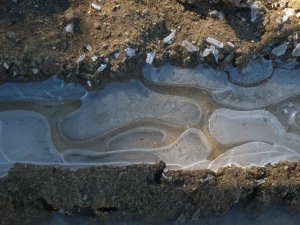
Today though, let’s not have a travelogue.  Let’s look at one or two of the other things that caught our eye on today’s walk, sunny but oh-so-cold.  We began walking in temperatures of not much more than minus 5 degrees. There was the ice itself, underfoot.  The cold froze the mud and made it good and hard to walk on.

P1090230

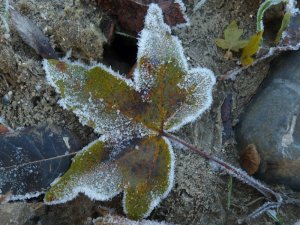
There were the frost-framed leaves mulching the ground.

P1090236

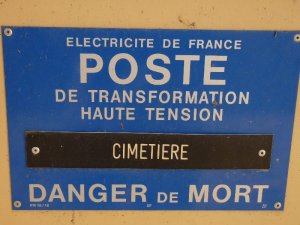
There was a giggle-worthy notice on an electricity sub-station.

P1090245

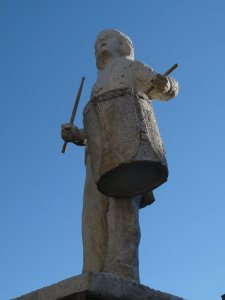
And in  the tiny village of Toureilles (population 143), there was a statue to its most famous son.  Pierre Bayle (1783-1794) was the youngest soldier ever to die for France.  A drummer boy in the Republican Army, he was engaged in the campaign to prevent the Spanish invade Roussillon, and died in battle at Figueres, aged 11.

P1090262

As we left Toureilles, along a single track road , we came upon a rather fine, wide, but very short stretch of road, with a fine stretch of car park along its length.  It led only to a dusty track.If we didn’t know why it was there, neither did the villagers.  Here’s what they thought of it.

Back in Digne d’Amont, the municipal notice board had news of an evening’s Bingo (Loto) on – shucks, we’ve missed it – 16th November.  Prizes?  Two loads of wood for burning,  a whole pig (dead, of course) and a hamper of beef as well as other smaller prizes.

P1090298

And at the end, Gilbert produced a cake for us to eat,  formerly much enjoyed locally and which he’d managed to find out about: amazérat, a pastry with a solid bite to it and strongly flavoured with aniseed.

Gilbert's amazérat
Gilbert’s amazérat

Winter meets Autumn head on

Eight days ago:  lunch outside in thin tee shirts: a garden umbrella protected us from the bright hot sun.

Seven, six, five, four, three, two, days ago.  Rain.  Rain.  More rain.  Heavy, chilly gusts choking the streets and drains with fallen leaves.  More rain.

One day ago.  Snow.  The first snow – and in advance of the first winter frost too.  Not a lot, but enough to rest heavily on fading garden plants, weighing down leaves and bowing stems.

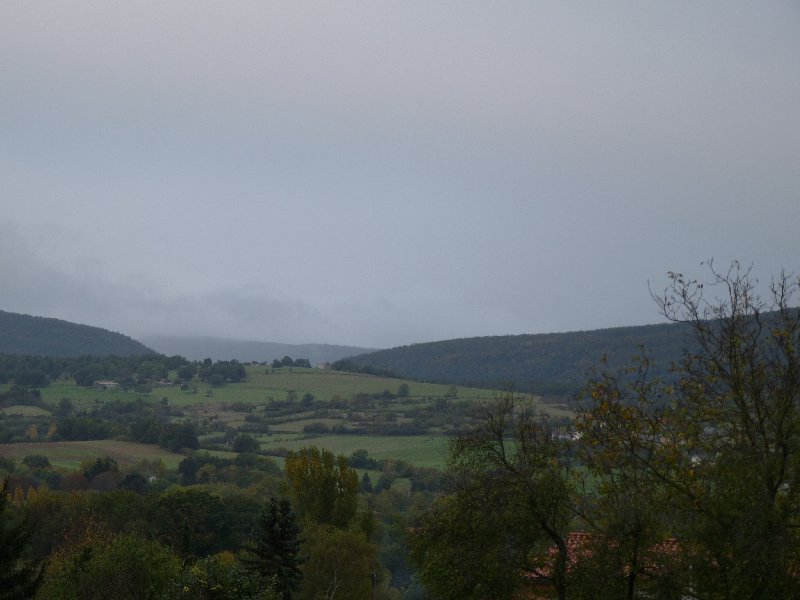
This morning, we knew we’d need to get out early to beat the rain, which was threatening yet again.  I didn’t take my camera because I thought the mountains would be shrouded in foggy mist.  They weren’t.  The lower peaks, and even the much lower hills of the Plantaurel peeked through a thin layer of snow that dusted trees and painted the rocky and grassy slopes a severe white.  I dashed back for my camera.  Five minutes? Ten?  Long enough for the misty clouds to drop down and dump themselves on the snowy hilltops like squashy berets, hiding them from view.

And then, straight away, the rain again.  That’s what we’ve had all day, streaming along the gutters, making splashy garden puddles, dripping incessantly from the trees and down our necks as we walk underneath.  I continued my early morning walk regardless though, and caught what may be the last few days of Autumn colour, though little enough of the snow, which is there somewhere, under those bonnets of mist and cloud.

Something old, something new

Lac de Montbel from La Régate

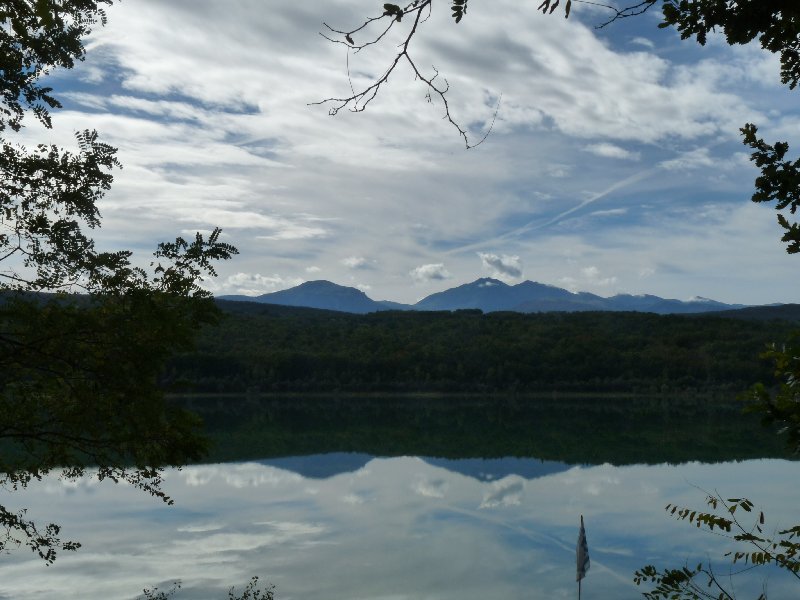
Our new friend Jenny-from-Bilbao came for a flying visit late last week, so we did a quick Cook’s Tour of some of our favourite spots.  Roquefixade, of course, Montségur: and then on a bright Autumnal Saturday morning, we finished off by a quick look at our local lake, Montbel.  It’s a man-made reservoir, actually, but it looks as though it’s been there forever, and fish, herons and humans all appreciate its cool expanse of water as a change from all those hills, mountains, rivers and streams.

What a difference a day makes.  Sunday sulked.  It rained in the night, it rained in the morning, grudgingly cleared up, then spent the rest of the day teasing us with odd showers which never quite decided whether to go for a full-blown drenching, or merely hang around as damp atmosphere, cloaking the landscape with fog.

So our planned walk from Croquié, with its promise of stunning views as our reward for a stiff climb was abandoned.  Instead we met at 1.00, we hardy types, and Jean-Charles proposed what I thought was little more than a walk round the block.  ‘Just up to Tabre, along the ridge and back’ he said.  Well, Tabre is the next village along, Mirepoix direction, so that sounded easy enough.  So off we went, along a bosky path, through Tabre, up a hilly climb to great views back to Laroque.  A long and often muddy forest track took us past further views, over the Douctouyre valley, and circled us over and past the next village along from Tabre, Aigues-Vives.  Down we climbed again, and took paths through fields back to Laroque.  A fabulous walk, all 15 km or so of it, and almost every step of it previously unknown to us.  And we pride ourselves on having got to know our patch pretty well.  Thank goodness for local friends who carry on helping us to discover even more.

The path home from Tabre

‘Our favourite walks’: a nomination

The walk begins.  St. Julien de Gras Capou
The walk begins. St. Julien de Gras Capou

We keep a mental list of the walks we’ve particularly enjoyed.  Walks we’ve treasured for the views, the flowers, the butterflies, the skyscapes, the lunchspot – all sorts of reasons.  The only problem is that the walk at the top of the list tends to be the one we did last.  There’s no such thing as a duff hike round here.

But last Sunday’s walk is assured a place of honour on this list.  It’s one we’ll want to share with you if you come to stay, and we’re keen to do it again ourselves, at every season of the year.

If you drive from here to Mirepoix, you’ll pass through a village called la Bastide de Bousignac.  Just after that there’s a road off to the left, signposted to Saint Julien de Gras Capou.  Take it.  It’ll wind upwards between grassy pastures, home to sheep and cattle and not much else, and finally deposit you in the main street of the village – current population 62.  Park near the church, lace up your walking boots, grab your rucksack with its all-important picnic, find the first yellow waymark – and set off.

The village is so-called because back in the 12th and 13th centuries, it had acquired a reputation as being the place where fine fat capons were raised to feed fine people: that’s the ‘gras capou’ bit.  I don’t know where St. Julien comes into it.  There are hens here still, and in so many ways, the village is perhaps little changed.  It’s a peaceful, rather isolated place, despite being so near to Mirepoix and one of the main roads in the Ariège.

Our walk took us along farm and forest tracks, through fields and woodland still splashed with colour from flowers and late butterflies.  It was an easy route, rising only gently, passing the tiny hamlet of Montcabirol towards the village of Besset.  Shortly after that though, we found we did have a short sharp climb, through the woods, to reach the Pic d’Estelle.

Wow.  It was worth it.  From here, we had a 360 degree panorama.  The chain of the Pyrenees marched across our horizon, its peaks already dusted with snow, or even quite thickly covered in the case of the higher summits.  As we turned in other directions, we could see Mirepoix, immediately recognisable from its distinctive cathedral spire, and the Montagne Noir beyond.  There are foothills nearby too, across which pilgrims on the Chemin de Saint Jacques de Compostelle still travel: and other sights too – the ruined Château de Lagarde, and its near neighbour the Château de Sibra.  We stayed a long time, simply relishing these views, the sky, the silence and peace at what seemed to us, at that moment, the top of the world.

When we finally shrugged on our rucksacks once more, we only had three or four more kilometres to go, along more unpeopled pathways.  After negotiating the only obstacle of the afternoon, a group of cows supervised by a bull – we let them get well ahead of us – we were soon back at base.  It was good, very good.  I just wish my camera could do justice to those peaks.  But we’ll be back, in winter, when they’re truly thick with snow

Butterflies III: Half an hour of my life

There we were at Roquefixade, showing our favourite walking destination off to two of our Harrogate friends, when a butterfly discovered me.  Then another.  These two creatures played round my wrist for more than half an hour before finally dancing off into the sunshine.  They made our day.
I’m thinking they’re the Common Blue (Polyommatus icarus).  Any dissenters?

Mountain Apollo

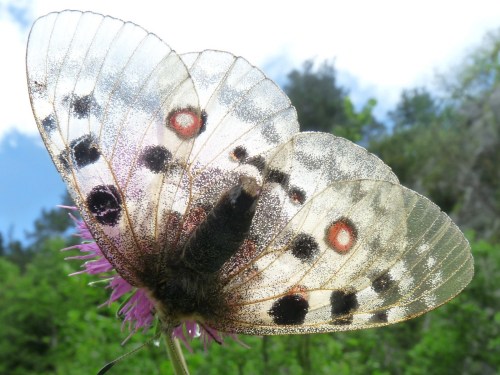
P1050895

I just want to share a photo I took on our walk on Sunday, when we went to the Gorges de la Frau.  This butterfly seduced us all with its distinctive spots and white grisaille wings.  It turns out to be rare, a protected species, and known only in mountain regions, mainly in Southern Europe.  The French know it as Apollon, and its Latin name is Parnassius Apollo.  If your French is up to it, you can read about it here.  
And here’s a small taste of the Gorges de la Frau, only a few miles from our house.

The comb

There’s an industry that’s had something of a walk-on part in this part of the Ariège for well over 300 years.  Against all the odds, it’s somehow clinging on.  It’s comb-making.  Specifically, combs made from horn.

Today, we went to find out more, courtesy of a visit organised by  ‘Pays d’art et d’histoire des Pyrénées Cathares’.  There are two ‘peignes en corne’ factories within just a very few miles of each other, and of our house too.  Each used to be the size of a hamlet, with separate buildings for all the different parts of the fabrication process.  Now, both firms conduct operations each from a single building.  We went to ‘Azema-Bigou’, in Campredon.

Azema-Bigou factory
Azema-Bigou factory

I’d always imagined the industry had developed as part of a waste-not-want-not mentality, using the horns from local sheep and cattle.  Not at all.

Our part of France has always been rather anti-establishment, in religion as in much else.  In the 16th and 17th centuries, when much of Europe was in religious turmoil, Protestants locally were persecuted.  Many fled, some to Switzerland.  And there they learnt a new skill, unknown to them before: comb making.

Following the 1598 Edict of Nantes, assuring greater religious freedom, many Protestants returned to their homes here, and wanted to continue the trade they’d learnt in exile.  But did they use local materials?  They did not.  Local cattle worked hard , ploughing and generally earning their keep.  They ended up with chipped, worn horns.  Over the years, the comb-makers developed markets with ports such as le Havre, Marseilles, London and Liverpool, and imported good quality horn fom Hungary, Turkey, and by the 19th century, Argentina.

Horns awaiting transformation into combs

Although in the early days, the trade was conducted on a domestic scale, with each worker capable of producing 10-15 combs per day, perhaps after a day in the fields, by the 1850’s the process was industrialised – with machinery imported from England.  Men women and children were all employed.  Men earned 2 francs a day, women 1.25, and children 1….. .  No wonder women in particular preferred to be paid for piece work: that way they too might get 2 francs daily.  The busy industry grew and thrived until more or less the second world war when plastic combs started to take over.  The factory of Azema-Bigou, in the hands of the same family for 5 generations, employs three people these days, though in its hey-day there were 180.

But these workers will tell you, as will many local people , that it’s well worth investing in a horn comb.  Like your hair, the comb is rich in keratin, and will treat your hair gently without generating static electricity.  Several of my friends have had the same comb since childhood and would never be happy to replace it with some cheap piece of plastic.

A selection of combs.

Apparently horn has to be soaked for up to a year before it becomes useable, and then it is forced through heavy rollers to make useable sheets.  There are some 15 different processes involved in producing the finished comb.  No wonder it costs rather more than its plastic poor relation.

I can’t tell you very much more.  Unusually, this event was not up to snuff. We were shown no artefacts, heard no tales from former workers in the industry.  So I don’t know what it felt like to work 11 hours a day in an atmosphere where horn dust hung heavy in the air cloaking  lungs and coating every surface in thick grey cushions. I don’t really understand what’s involved in transforming a rough, thick horn into a polished and handsome comb.   But I do know that  the waste and dust swirling round the factory got – and gets – used. The tiny fragments of waste used to be made into filaments in a factory here in Laroque, mixed with horn dust and sold as a fertiliser for vines.  Even now, you can buy bags of horn-waste fertiliser for your garden from the two comb factories.  Waste-not-want-not gets its moment after all.