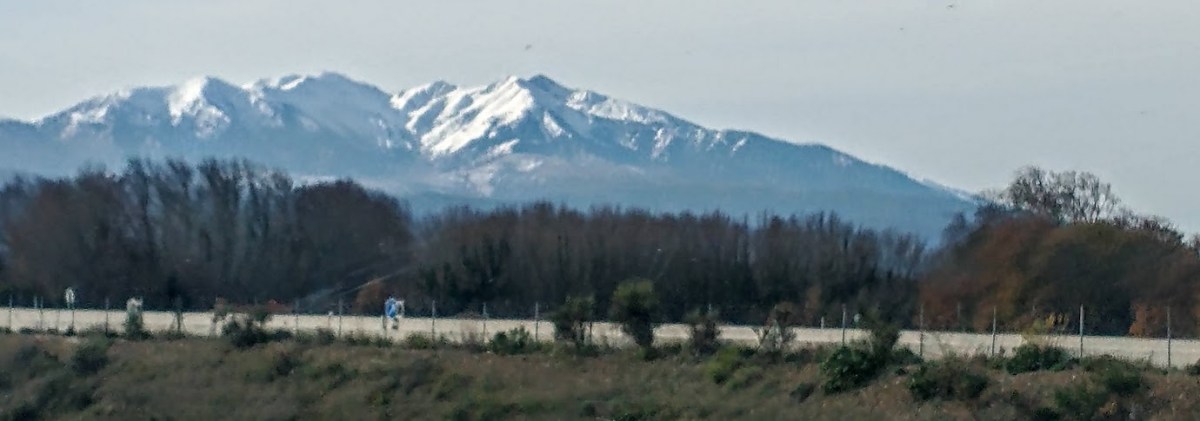
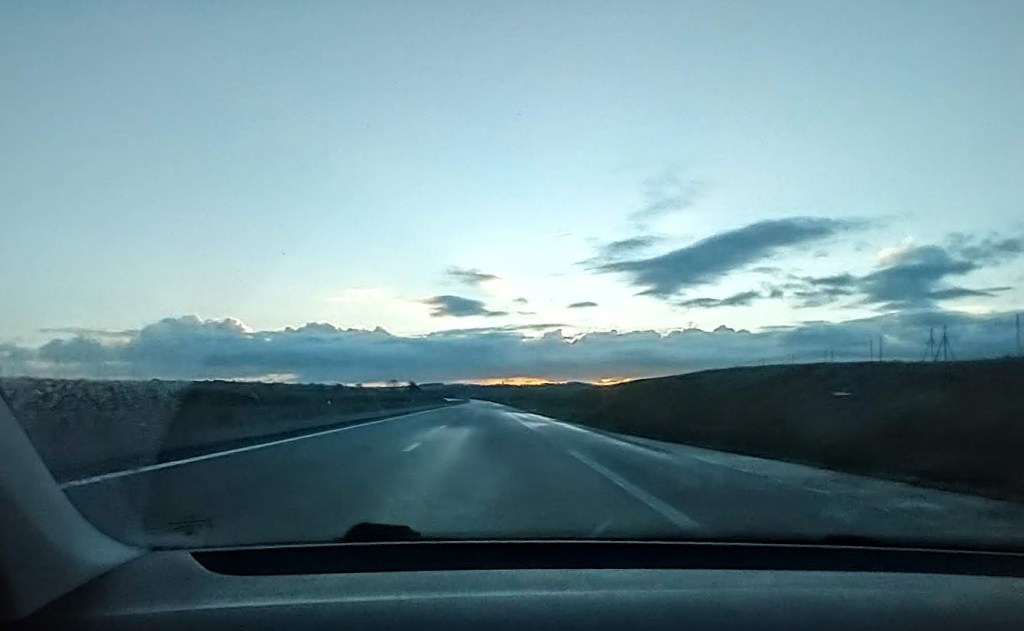
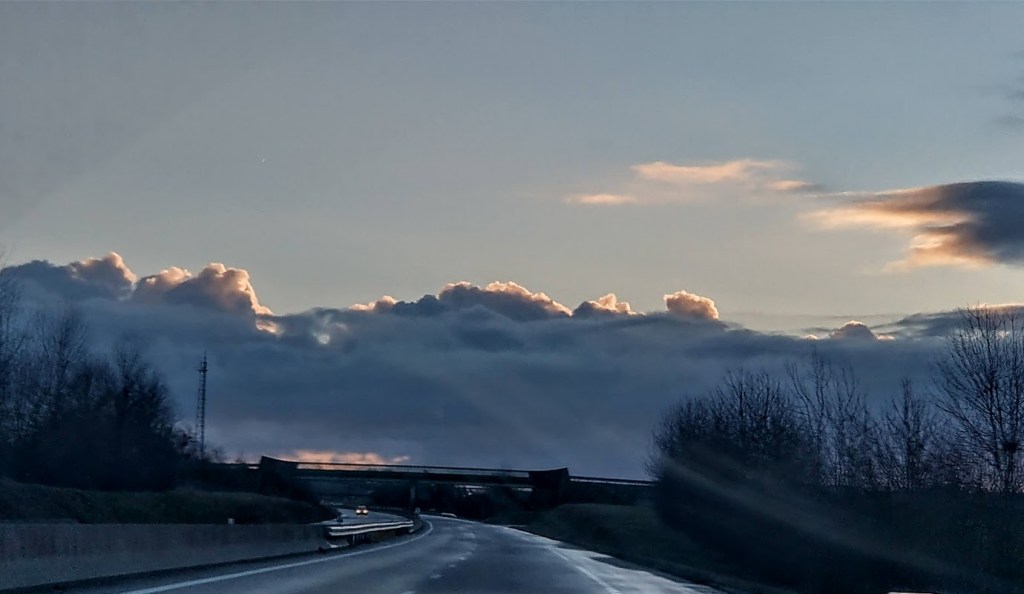
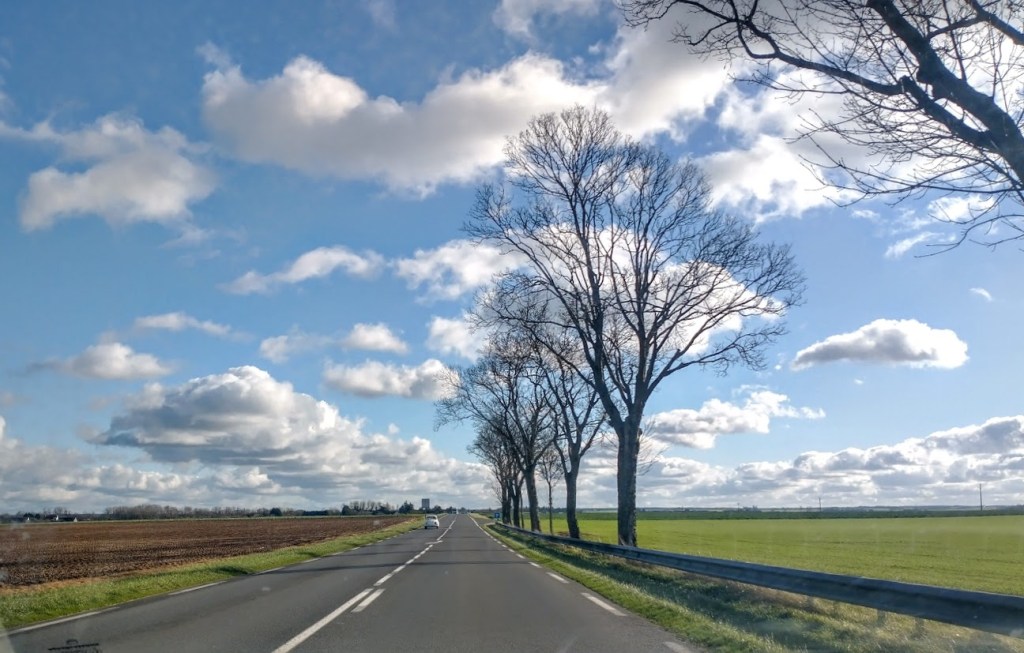
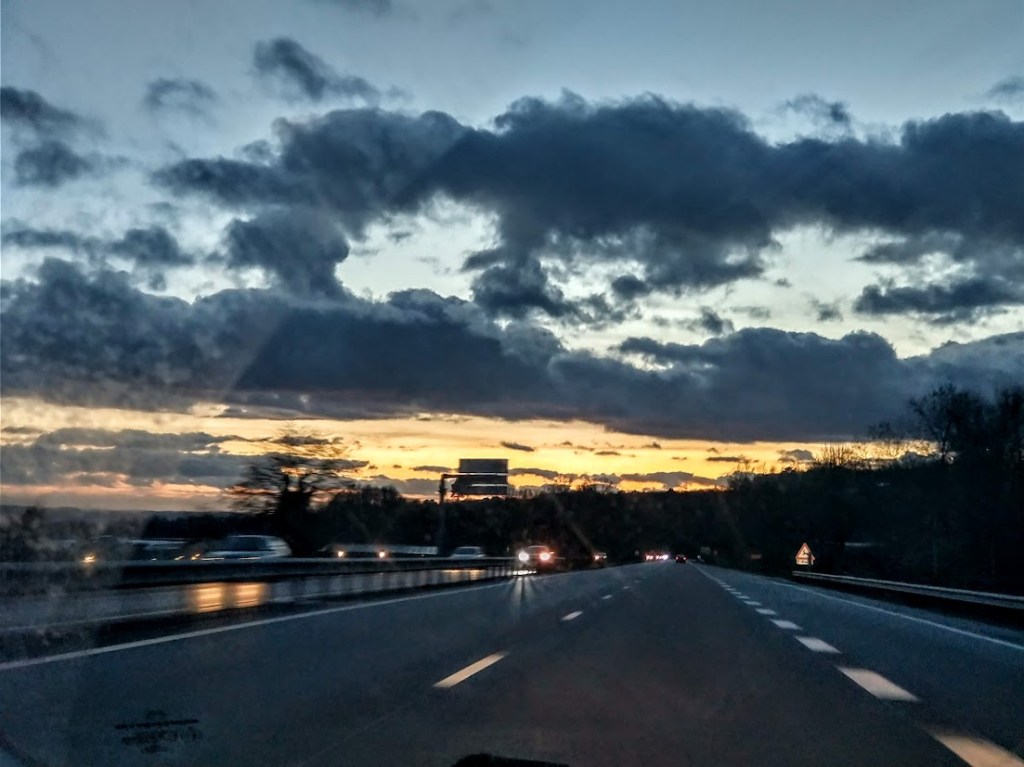
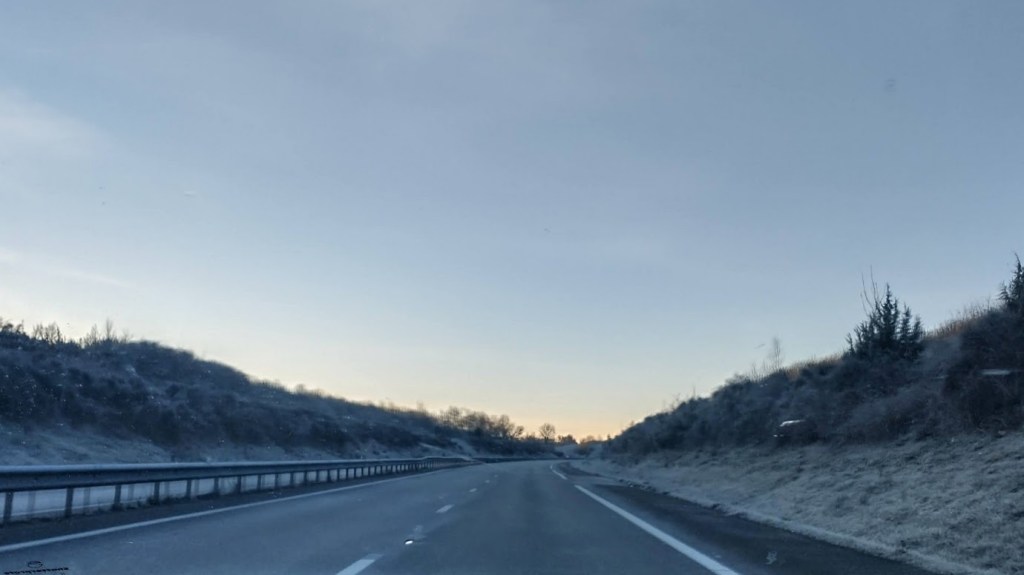
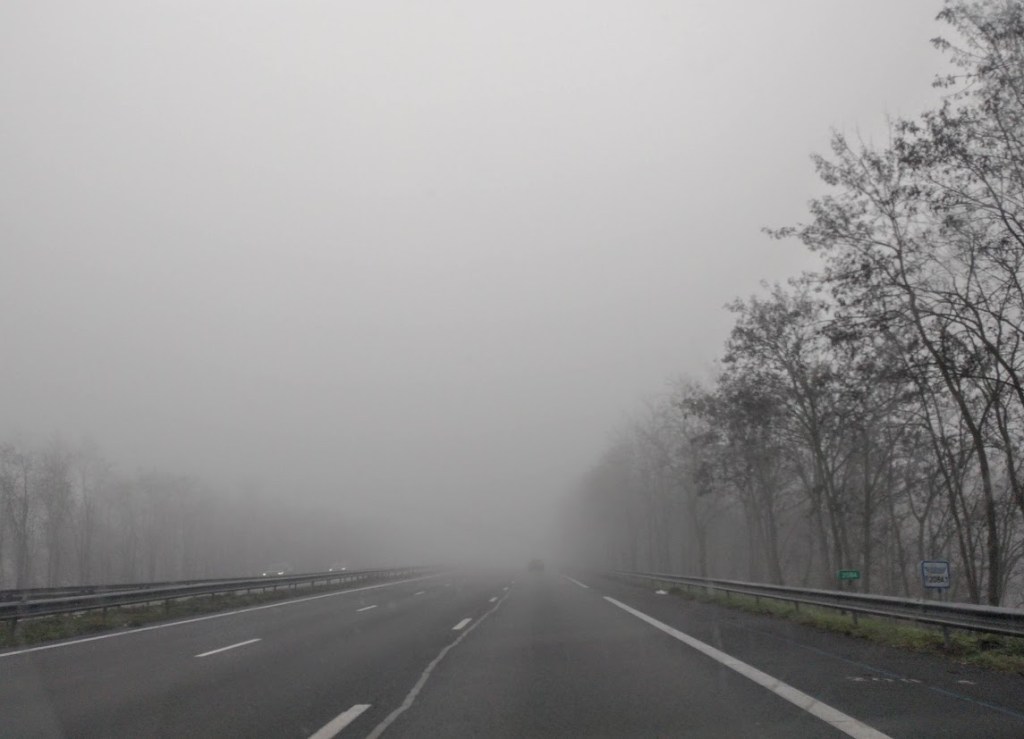
From dawn to dusk in France, then below-freezing dawn in France to sunny noon in Catalonia.
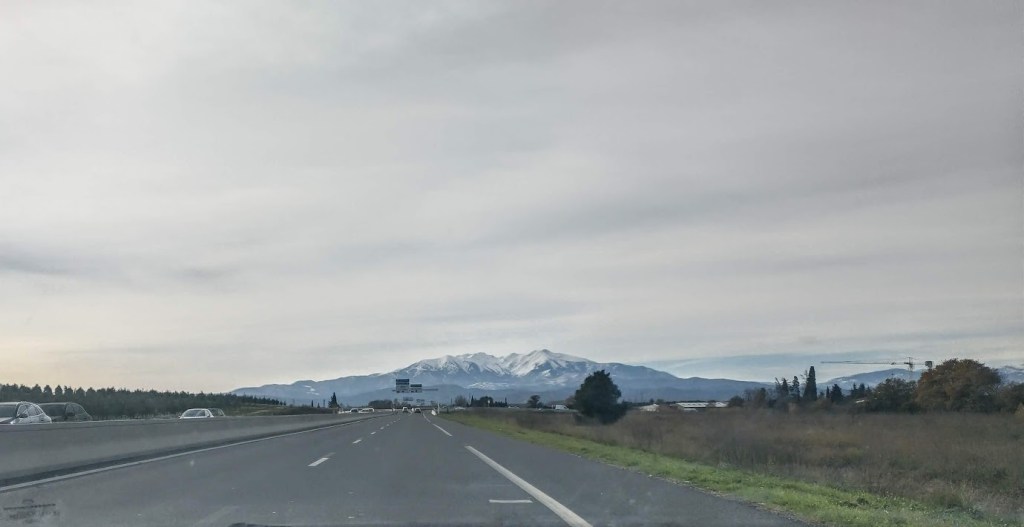
All taken from a moving car, so no prize-winning shots here. The featured photo is of the Pic du Canigou, the Pyrennean mountain which divides France from Spain.
We’ve started our journey home. It’s not all bad, because we’re visiting two sets of friends, having a mini-break, and yesterday we drove through a favourite haunt from our days in France: the Gorge du Quillan. It’s characterised by steep and narrow cliff sides, and geometrical peaks reminiscent of fearsome dragon’s teeth. Awful photo – sorry. Moving car, and a phone having a sulk and go-slow. Posting from said phone isn’t helping…
Back in 2012, we were living in France. And if we’d believed the doomsayers, not for very much longer. Here’s the story as I told it on my blog, after we’d spent the day with our walking group near the Pic de Bugarach.
Bugarach: ‘Doomsday Destination’
December 15th 2012
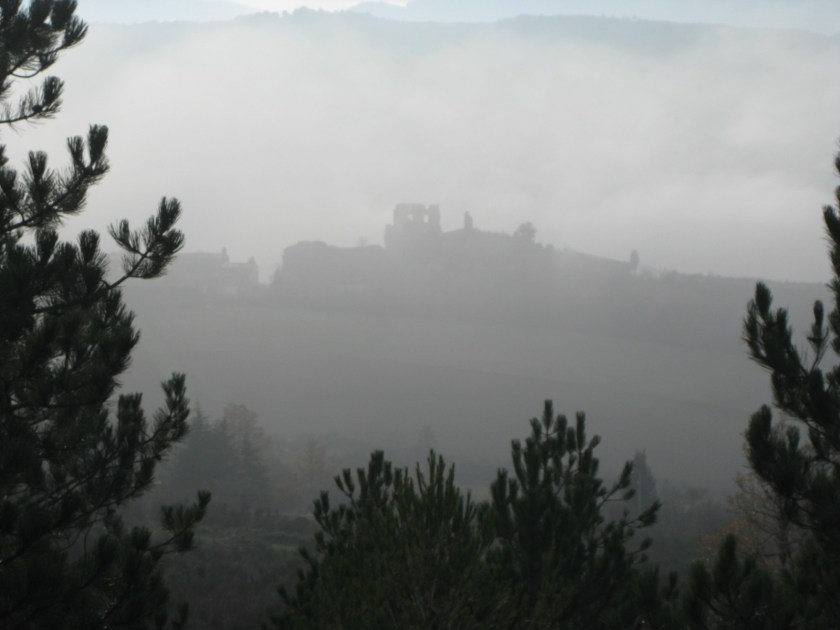
The castle at Coustassa glimpsed through the mist
Cold. Pale thin fog baffles the contours of the hillsides, and those of the distant castle at Coustassa. Glimmering frost bristles the short maquis grass beneath our feet. A watered lemony sun high above us attempts to burn winter away, and eventually does so.
The mists begin to clear
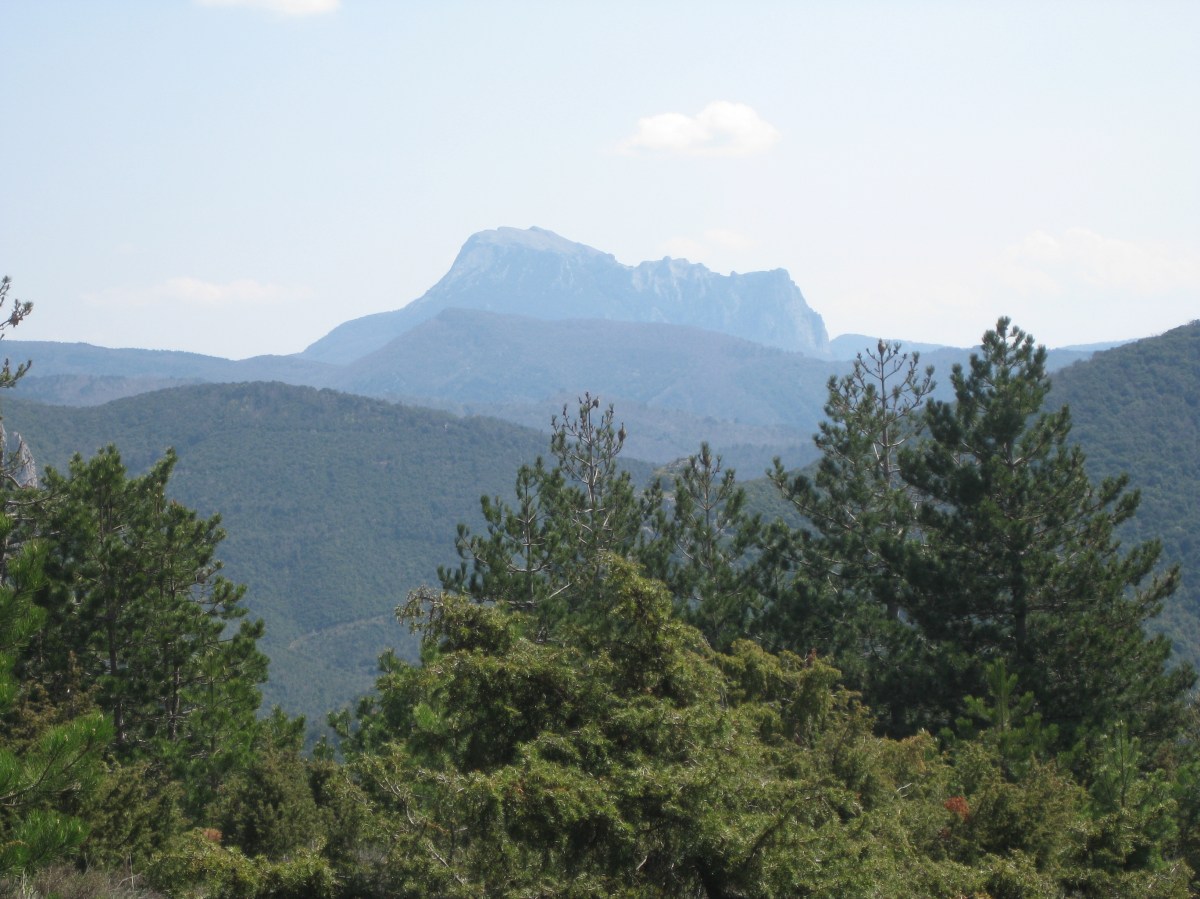
That’s when we have our first view of Bugarach – shown in the featured photo – the imposing thick-set mountain which dominates this part of the Aude, because it stands alone, rather than as part of a range, and today is pretty much thatched in snow.
‘According to an ancient Mayan calendar, at some point towards the end of 2012, the world will come to an end.
It is not clear how that will happen, but apparently humanity does not stand a chance – except for those who seek shelter in the area surrounding Bugarach.
Just 200 people live there all year round, but doomsday believers and spiritual groups are convinced the village has magical powers, thanks to the local mountain – the Pic de Bugarach.
For years, rumours have circulated on the internet that extra-terrestrials live in the mountain, and come the apocalypse, the top will open and they will emerge with spaceships, and rescue the local inhabitants.’
Although it’s quite hard to entertain the idea that the mountain might have some sort of underground UFO car park, there are plenty of people who have done so, and with great fervour. Here’s today’s Daily Mail, which has been talking to Jean-Pierre Delord, Mayor of the tiny village of Bugarach (pop. 176).
‘On Wednesday, he will close the village for five days to anyone who doesn’t live here or isn’t already booked to stay, and draft in hundreds of police, military, firemen and Red Cross to ban any gatherings, shut off the mountain and arrest anyone silly enough to try flying over it.
‘What if tens of thousands of people turn up?’ he says, throwing his arms up in the air. ‘I have no way of knowing what will happen. I have no crystal ball! I don’t care if people want to chant naked or talk to the trees, but I have to protect my villagers. I am responsible for them.’’
He’s not over-reacting. Local house-owners have been able to rent out their homes for the period in question for astronomical prices, and even camping spots are going for 400 euros a night. For most locals though, the whole thing is at best a nuisance, at worst a real headache. The nearer we get to December 21st, the more people descend on the area, and the police and army are already involved in keeping order.
We enjoyed our views of Bugarach, as ever. We spent time pretending to look for UFOs and generally mocking the New-Agers who are so convinced by the end of the world as we know it. Then we got on with the business of enjoying our walk in the here-and-now. Here are a couple of photos showing what else we saw that day
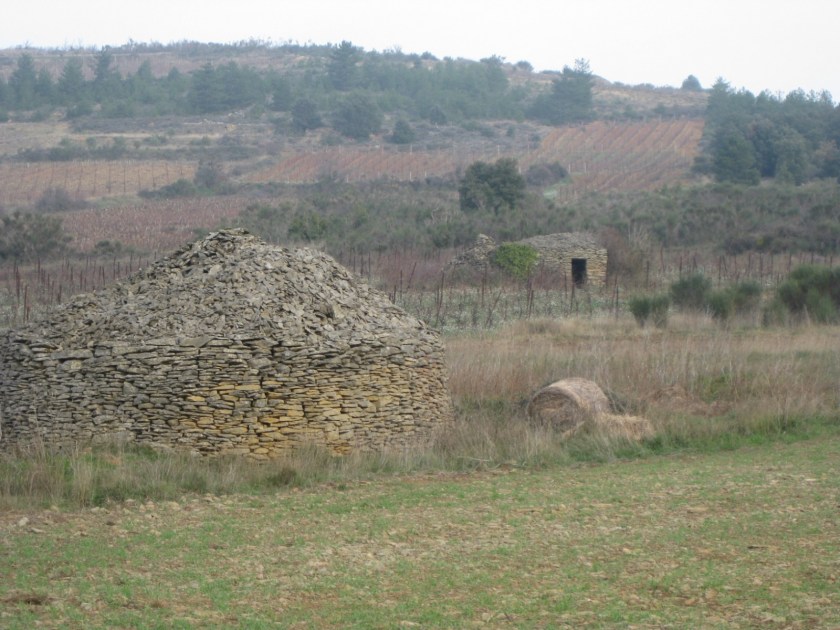
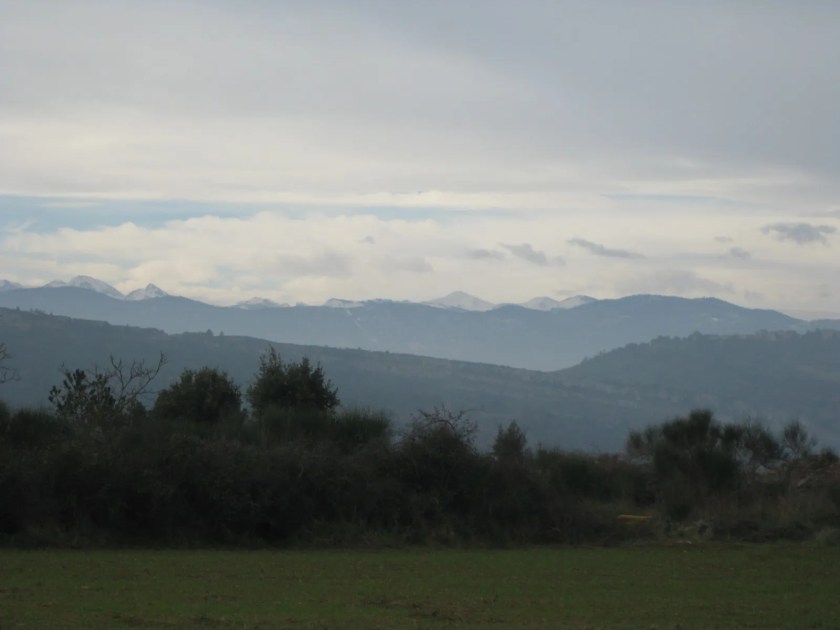
This is a walk past dozens of capitelles: shelter for sheep farmers & vineyard workers in former times.Glance away from Bugarach, and you’ll see the Pyrenees.
Update: December 14th, 2024. As you see, we’re still here. And so are you.
Here in the UK, we know a lot about clouds. And at this time of year, we know a lot about grey clouds. Looking out of the window just now yields an unending vista of smoky grey, darkening over Mickley way to gunmetal and slate. No cotton-wool puffs of cumulus for us.
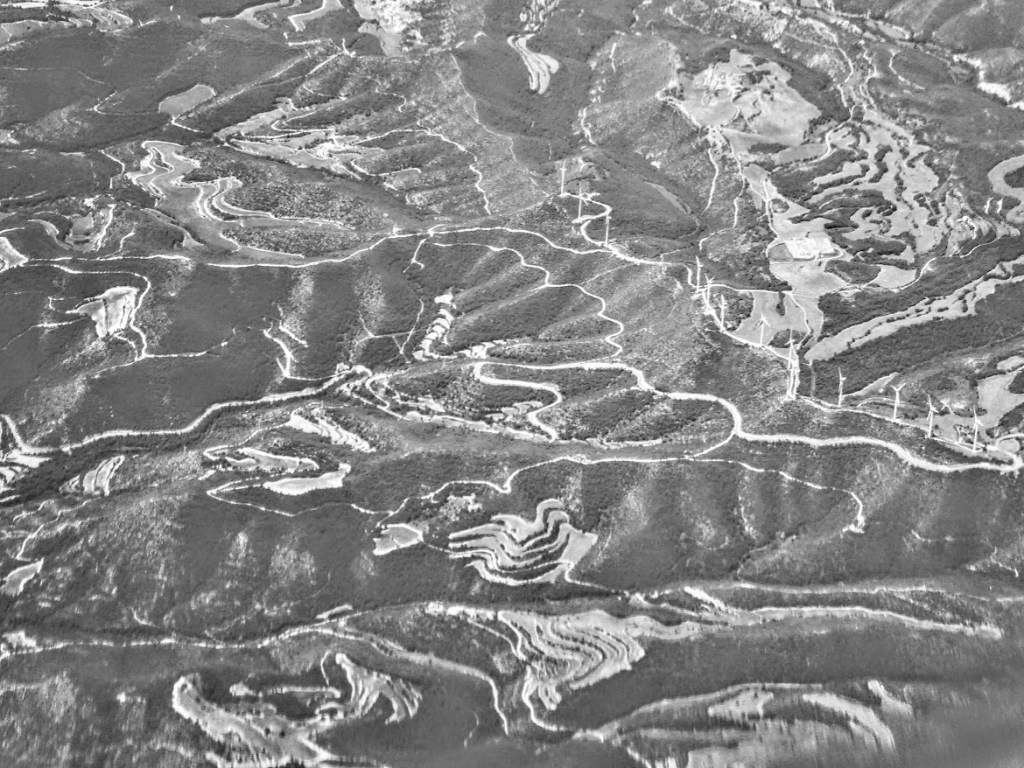
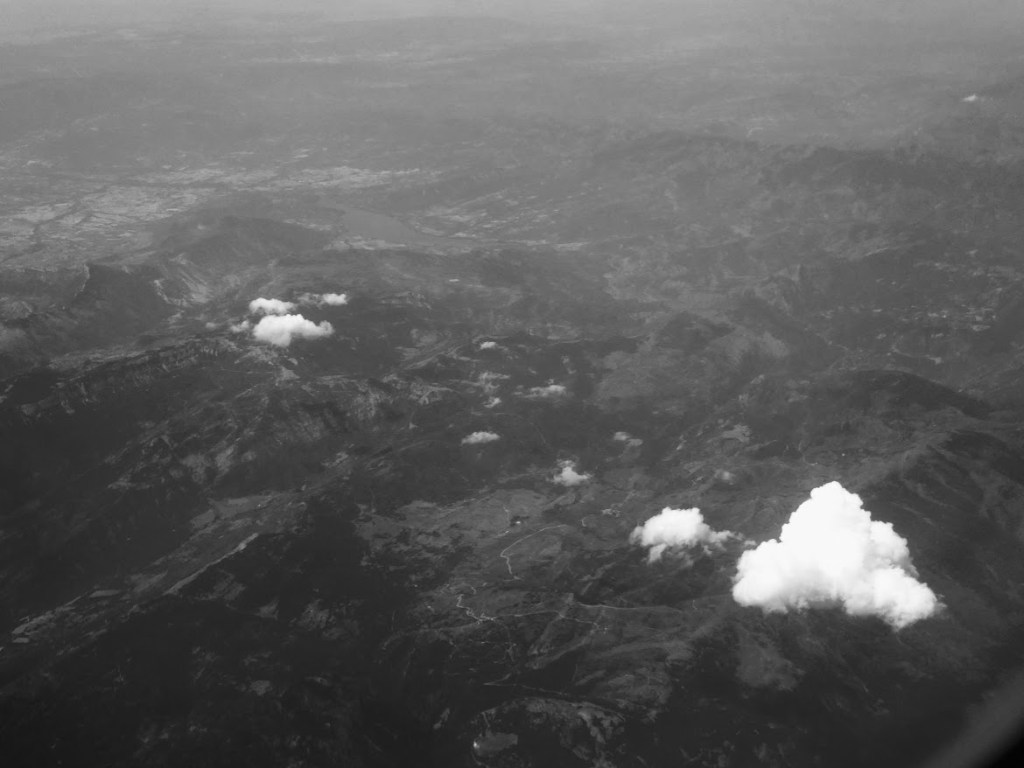
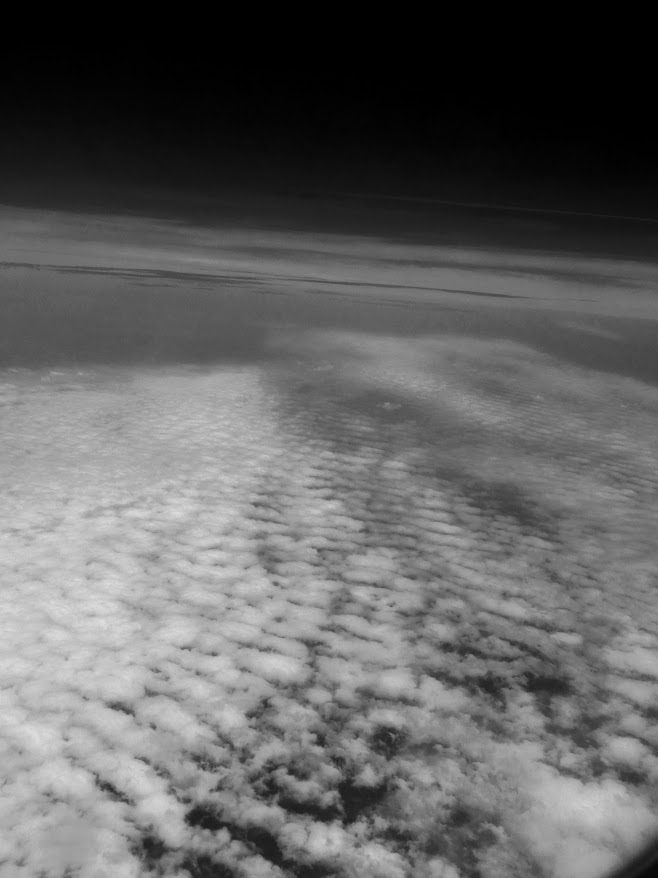
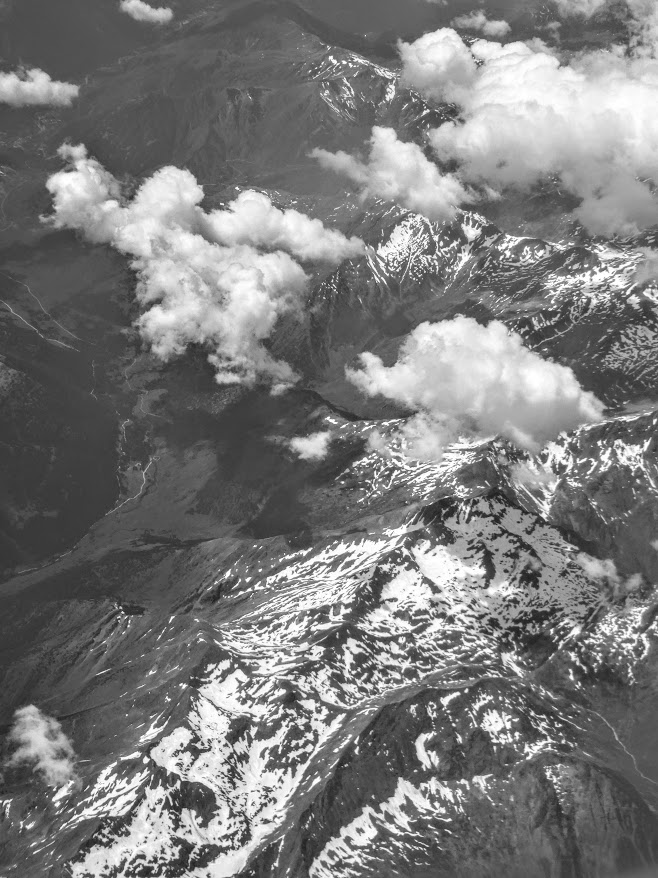
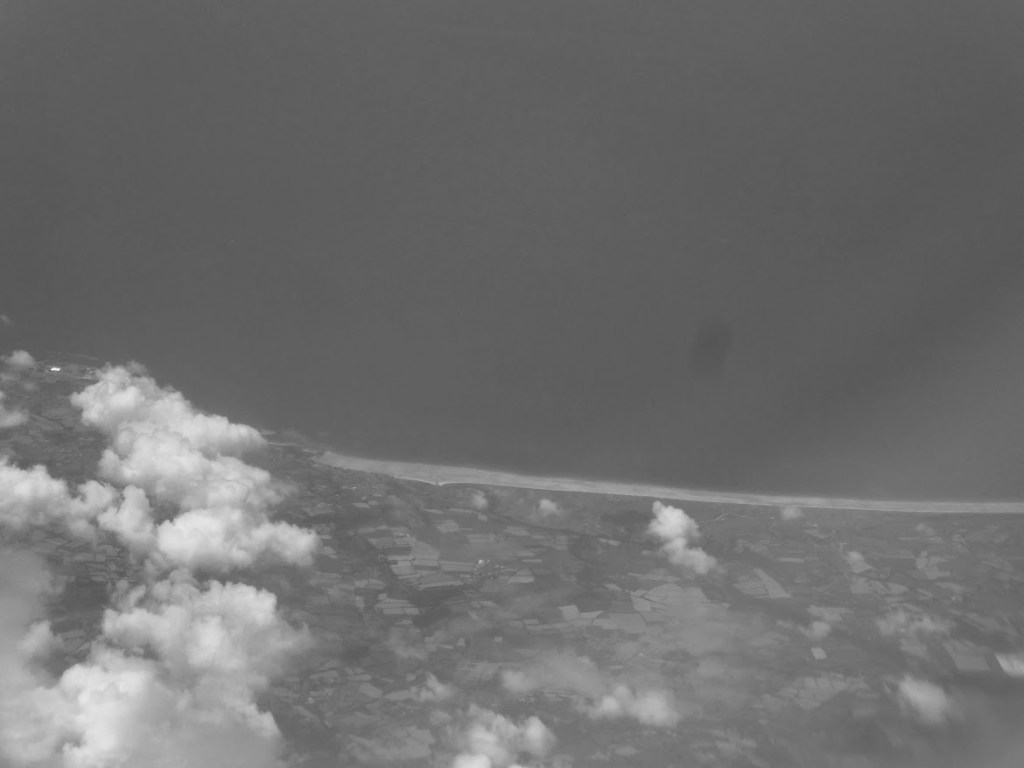
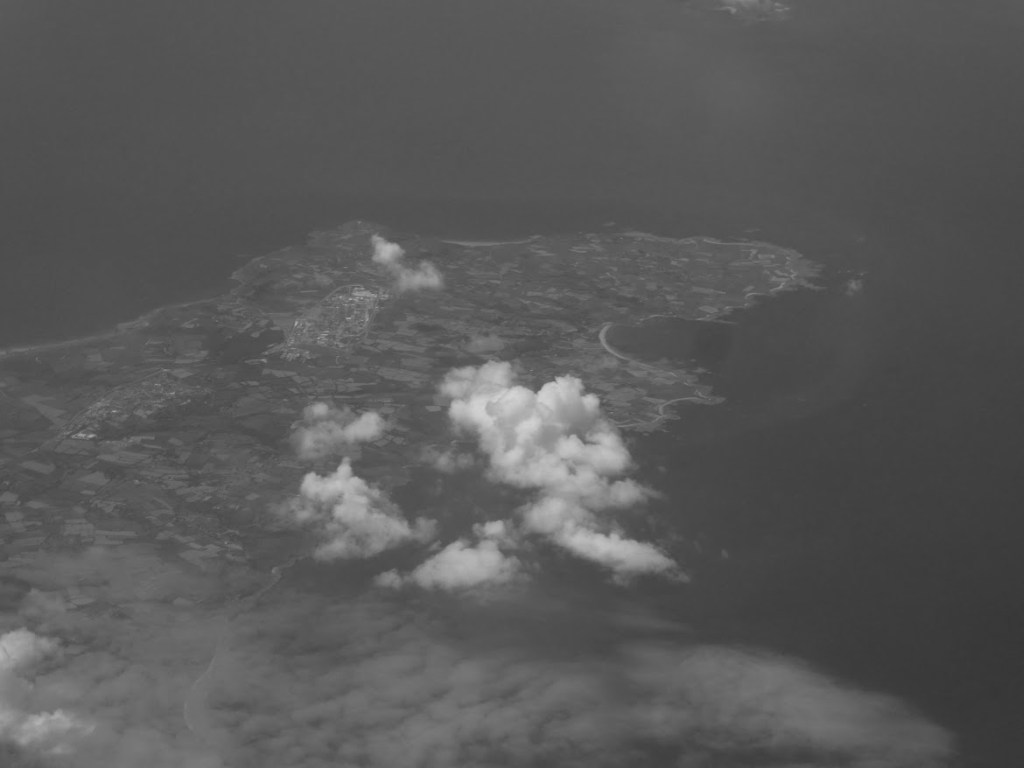
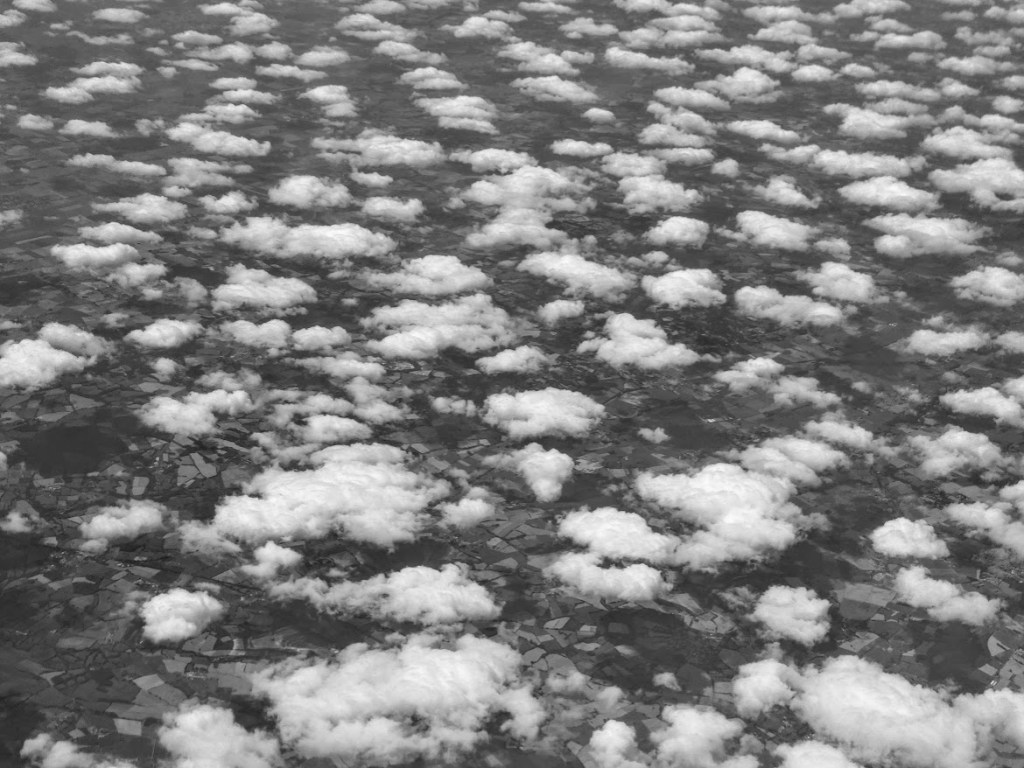
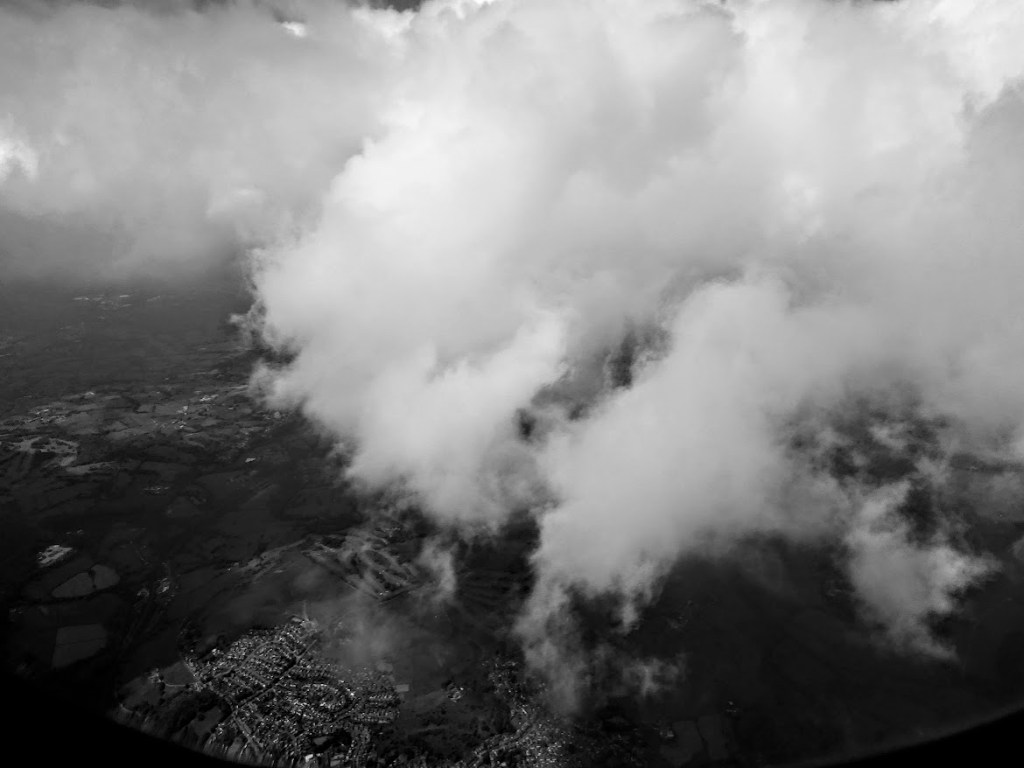
So let me whisk you to a day in June, when the plane transporting me from Barcelona to Leeds offered me a constantly changing cloudscape below me, with tantalising glimpses of beaches, landscapes and the Pyrenees, the Atlantic coast, and then crowded old England. The featured photo shows us just leaving Barcelona – hardly a cloud in the sky. And then …
Mist rather than cloud, to start with.The foothills of the PyreneesWell, who can tell?Cresting the Pyrennean peaksOver the French coast now…Here too.Still FranceNearly homeEven more nearly home.
Although generally a big fan of monochrome, on a grey day like this, I’m not sure I like these clouds and vistas in black and white. My memory of that summer day was of clear bright and optimistic colours. But needs must. This is for Monochrome Madness, and hosted this week by Brian, of Bushboy’s World.
Today, instead of a Monday Portrait, I offer you a Monday Anecdote, first told on November 26th, 2011.It dates back to the days when we lived in Laroque d’Olmes in the French Pyrenees.
Little Donkey: An Everyday Story of Country Folk
Every now and then, in among all the banns of marriage and planning notices on the information board at the town hall here in Laroque, there’s a poster about a stray dog that’s been found. Not cats or hamsters. Just dogs.
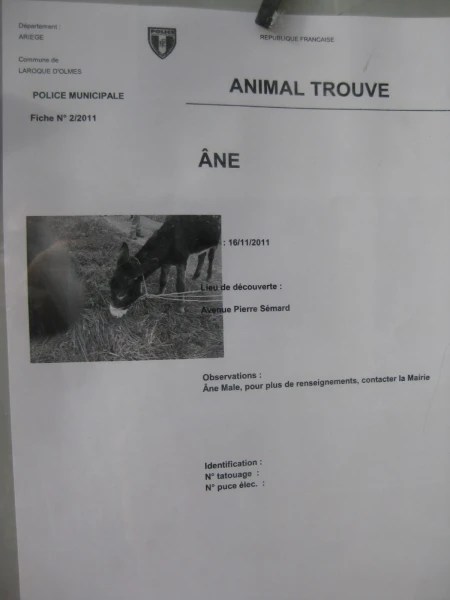
Last week, though, my eye was caught by this:
How does anyone lose a donkey? And what do you do with it whilst you put out an appeal for the owner? ‘Oh he’s fine’, said Thierry, our Community Copper, ‘We’ve put him to work in the office at the Mairie’. I decided against saying the obvious, that he would be bound to be doing a far better job than the current Mayor.
It took a week for his owner to show up. He – the donkey that is – had an exciting time. First of all he was rounded up by the three blokes who first spotted him in the road just outside town, but who had no idea how to set about the job. Then he was frisked for tattoos or identity chips. None. Next he was sent to stay with our friend Henri’s donkeys (Thierry was fibbing about the office work). That had to stop when Henri’s female donkey got all excited at the new arrival and came on heat. Then he went to stay with the vet’s partner. He escaped. Amateur detectives all over Laroque and Lavelanet tried to find out where he came from. Eventually, after a week, his owner showed up, really rather cross. ‘Why didn’t anyone think to get in touch with me?’
There we are. That’s our excitement for November over.
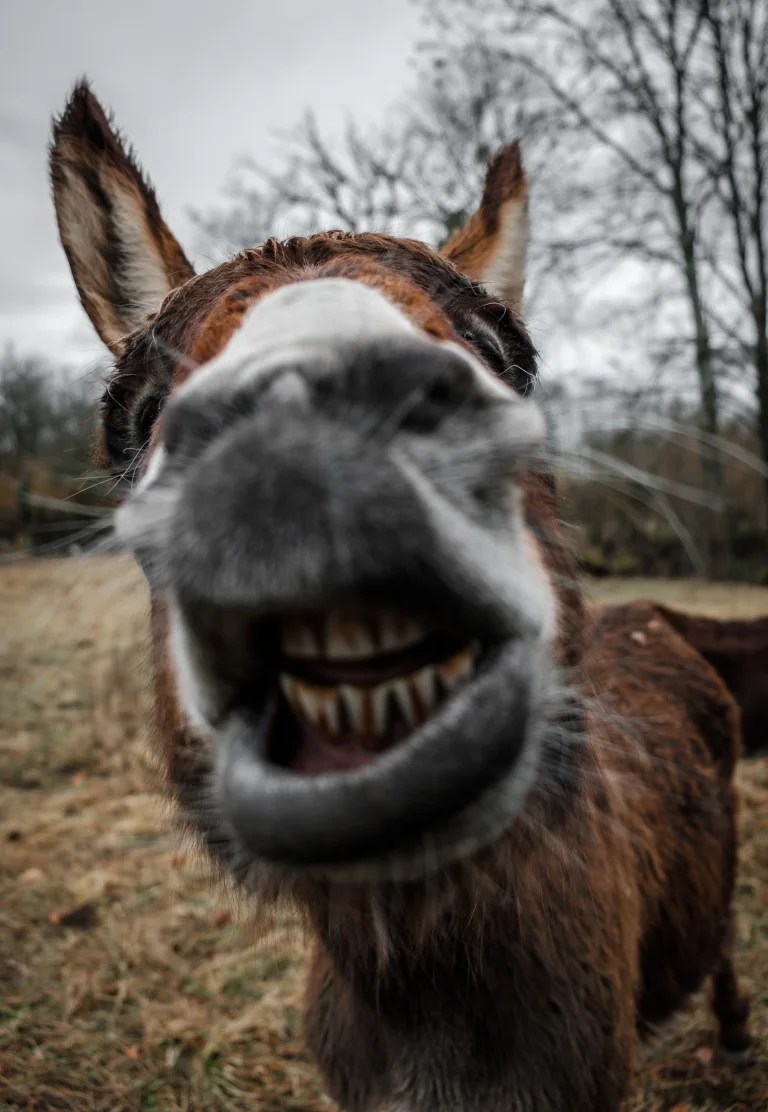
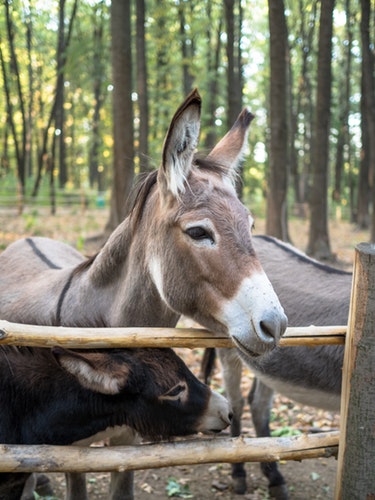
Unaccountably, I have no donkey photos. These are from Unsplash.
It’s not been a great week, has it? The American election has come and gone, and anxious nail-biting has been replaced by the new reality. I’m going to distract myself by looking through an old blog post, first posted in November 2009 – gosh – 15 years ago, when I was a fairly new blogger, recording our day-to-day life in the French Pyrenees.
Down on the Farm
Well, I mentioned Patrimoine in my last post. Yesterday we had Our Farming Heritage, an event organised by Pays d’art et d’histoire des Pyrénées Cathares. 20 or so of us turned up at a nearby village, Troye d’Ariège, to have a look round a traditionally run sheep farm.
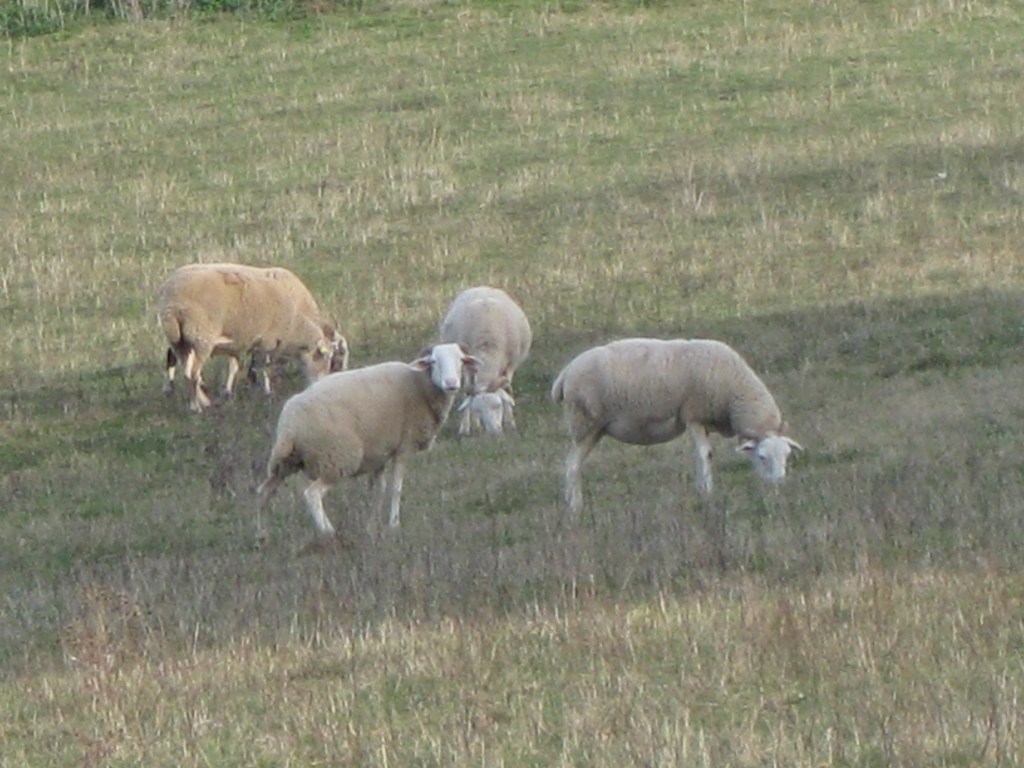
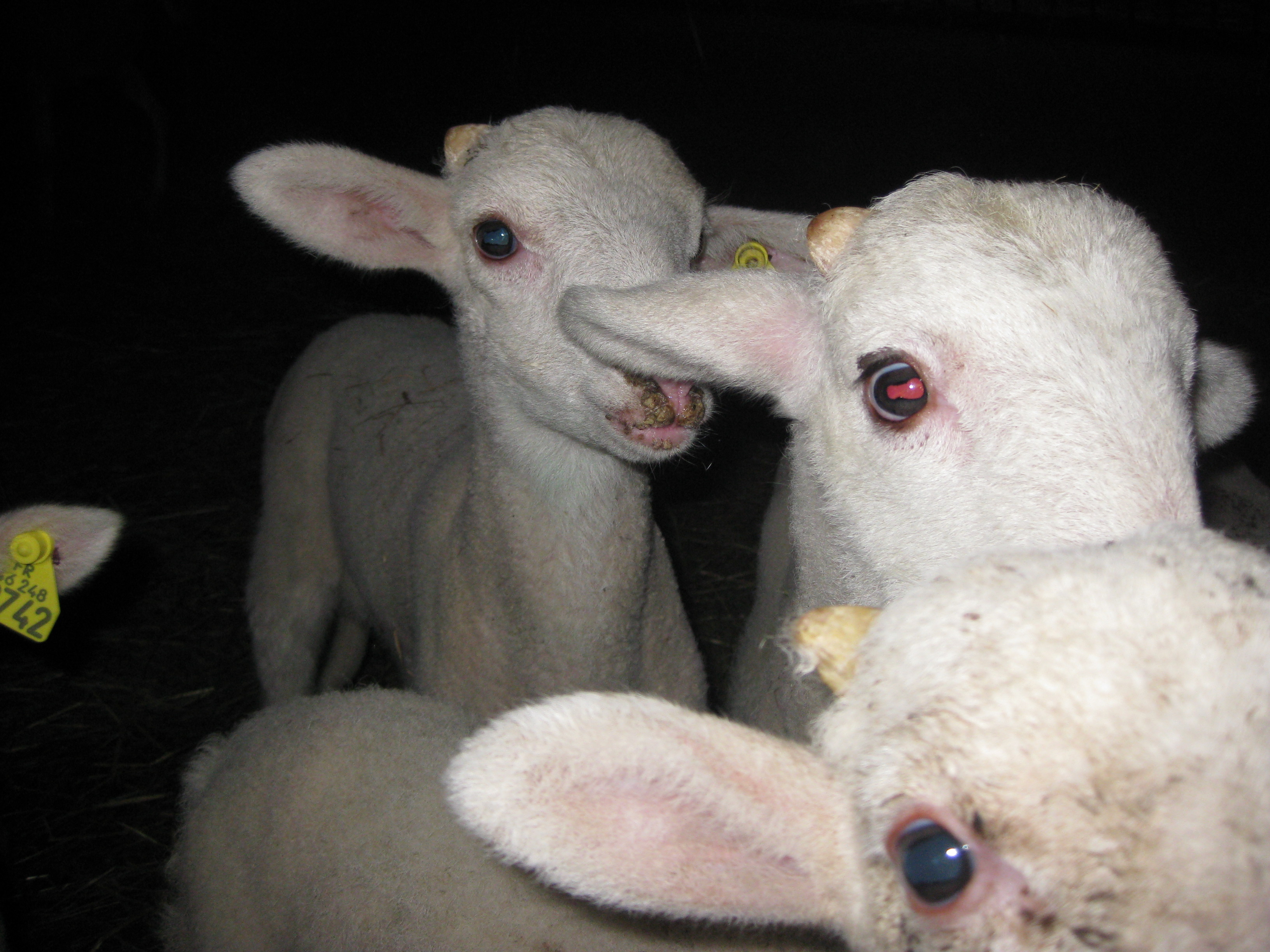
The event was immediately hi-jacked by an unscheduled event – the birth of a lamb. Out in a field, a mother sheep heaved herself up, plonked herself down, then up again, baahing loudly, until suddenly, quite suddenly, there was the front half of a lamb hanging out of her. A bit more wriggling and fussing, and there was the lamb, out on the grass, while the mother flopped beside it. A few minutes later, both were standing again. No shelter, no farmer in attendance – no need to worry apparently. These sheep are Tarasconnais, ‘The 2 CV of the sheep world’ said the farmer: rough and ready sheep who can turn their hooves to anything – wool production, milk and meat production, surviving on their own: molly-coddling is not required. They even get on with delivering their lambs regularly all the year round, somehow producing between them a steady crop of young, without human intervention.
Very pregnant sheep out in the fields.
Over to the lambing sheds then, where the mothers, having delivered, come inside for a while with their lambs. The noise! Dozens of lambs constantly baahing in their high-pitched tones, while the mothers hit more melodious lower notes. Hopeless to try to follow all that the farmer, Marcel, was telling us.
Supper time.
Marcel runs his farm of 800 sheep by himself, helped only by an apprentice (who has to go to College in among, of course) and occasional visits from a retired farm hand. He grows their feed – hay, beets & maize, keeps the animals fed and watered, dips them against insects monthly, de-parasites them every 3 months, regularly cuts 800 sets of hooves (he’s devised various metal narrow bus-shelter-style contraptions to make it easier to queue the animals up take their turns for these various procedures). He’s not organic, but many of his practices are, and he certainly usually chooses, for example, organic treatments if his beasts fall ill, believing them to be better.
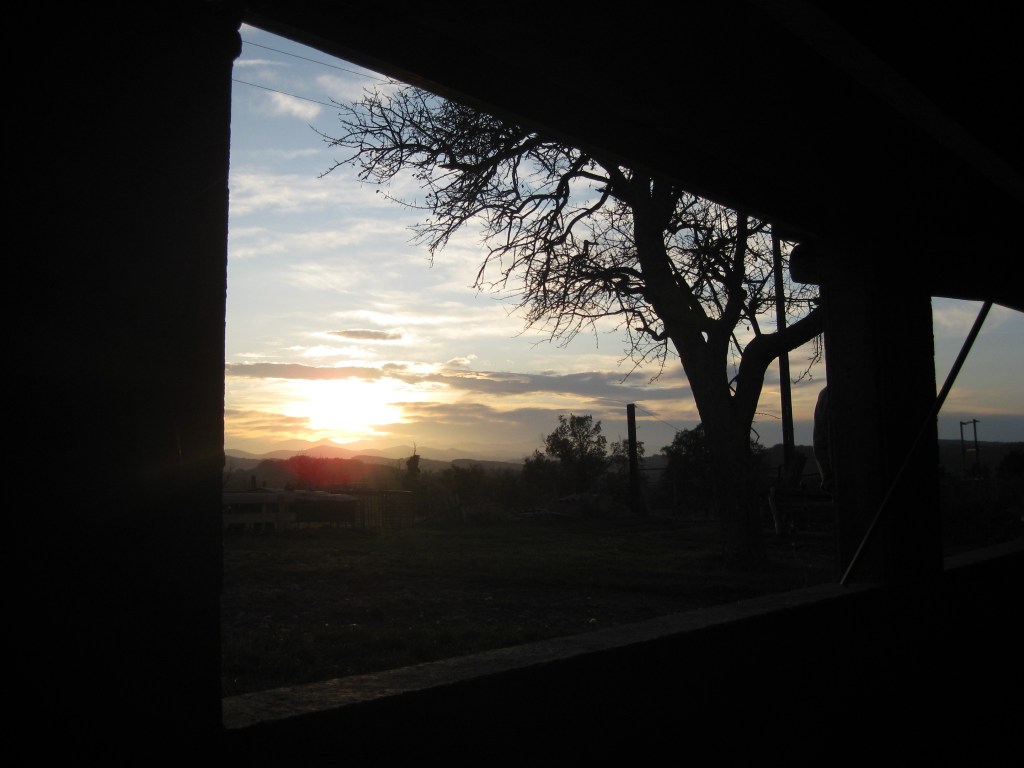
View from the ‘treatment shed’.
Every summer, about 400 of his sheep go off to the mountains with a shepherd, following the ancient tradition of transhumance. The old, the young and the weak remain behind.
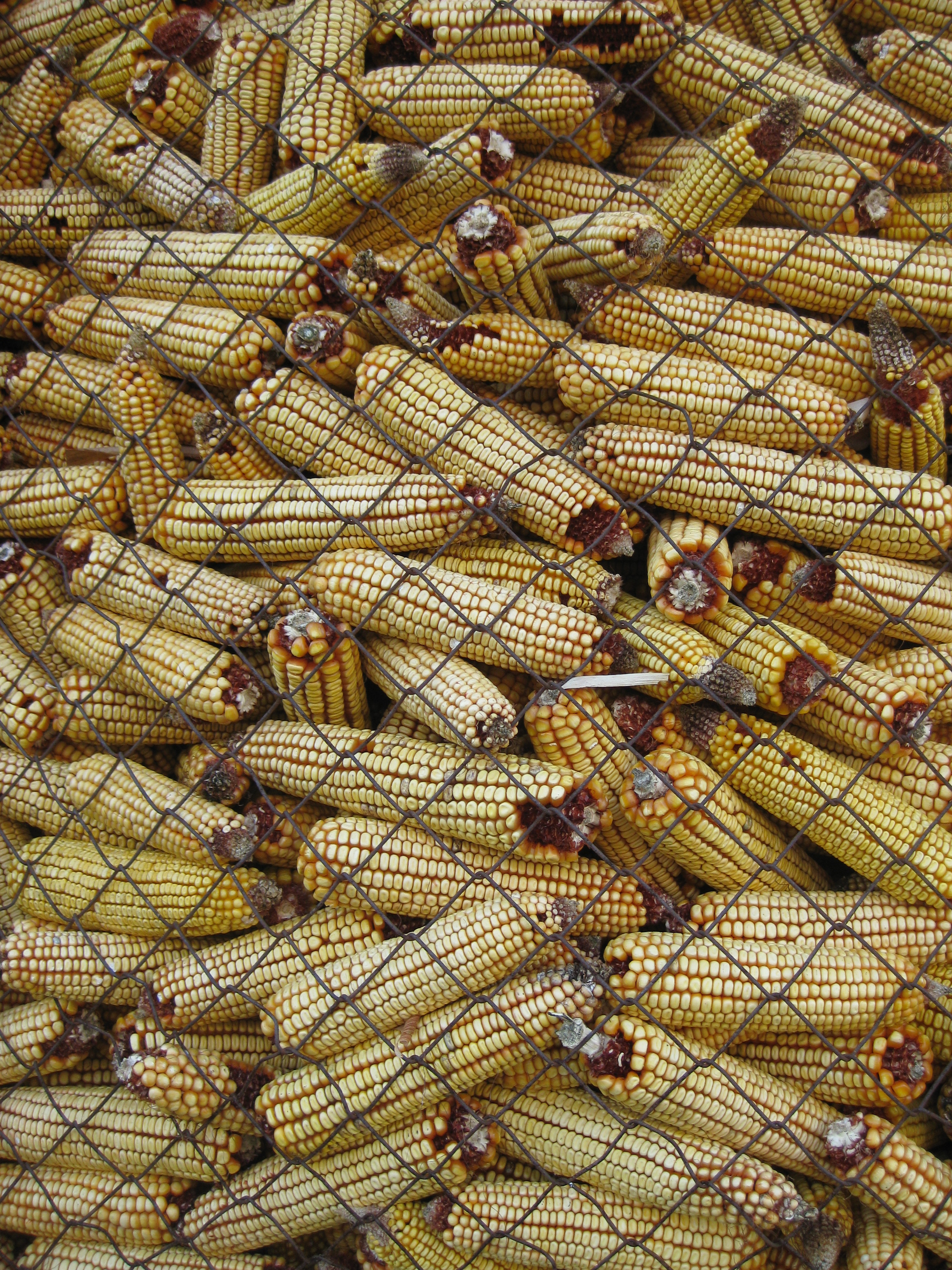
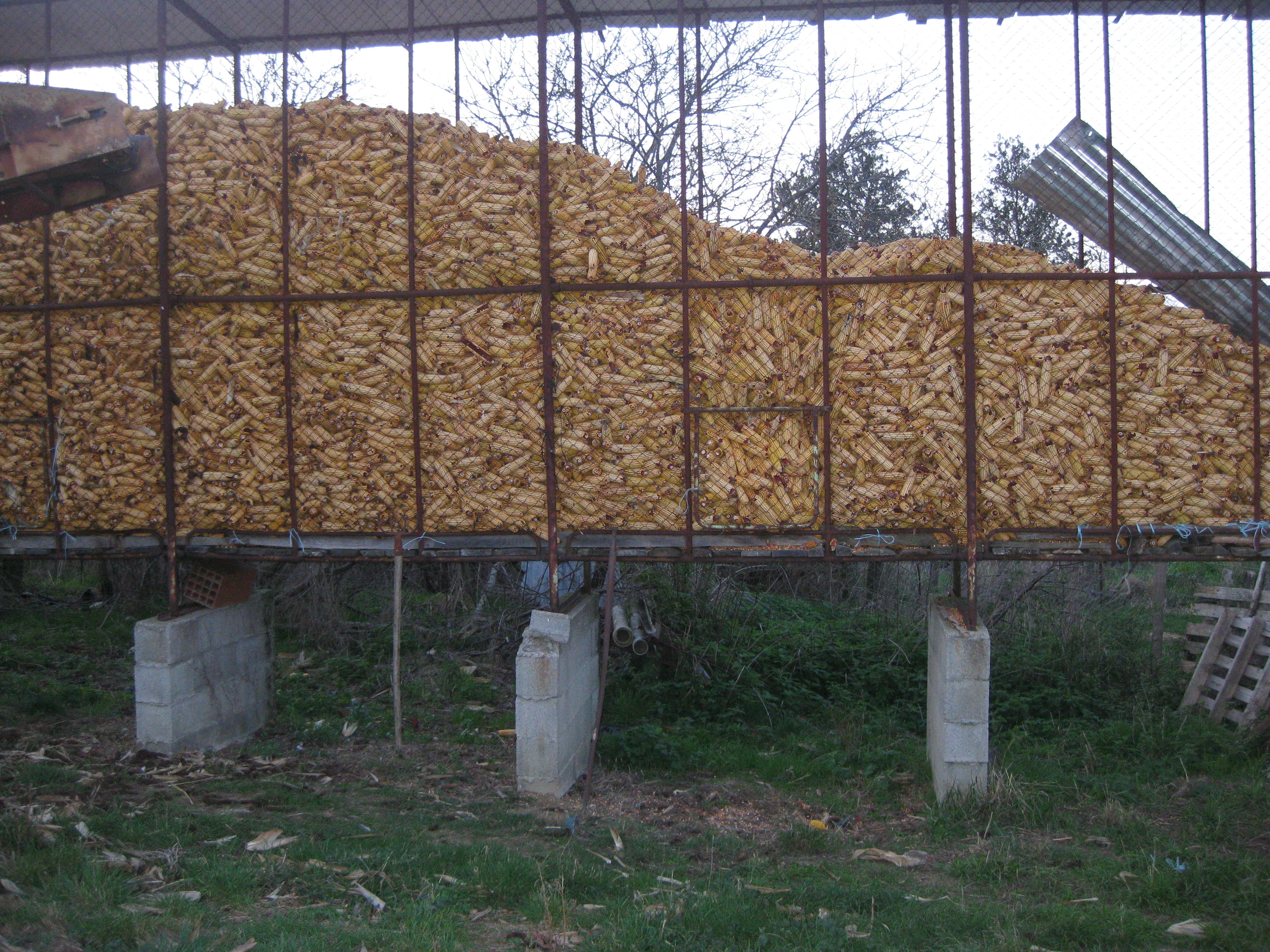
This maize is a winter treat. And here’s the cage where it is dried and stored.
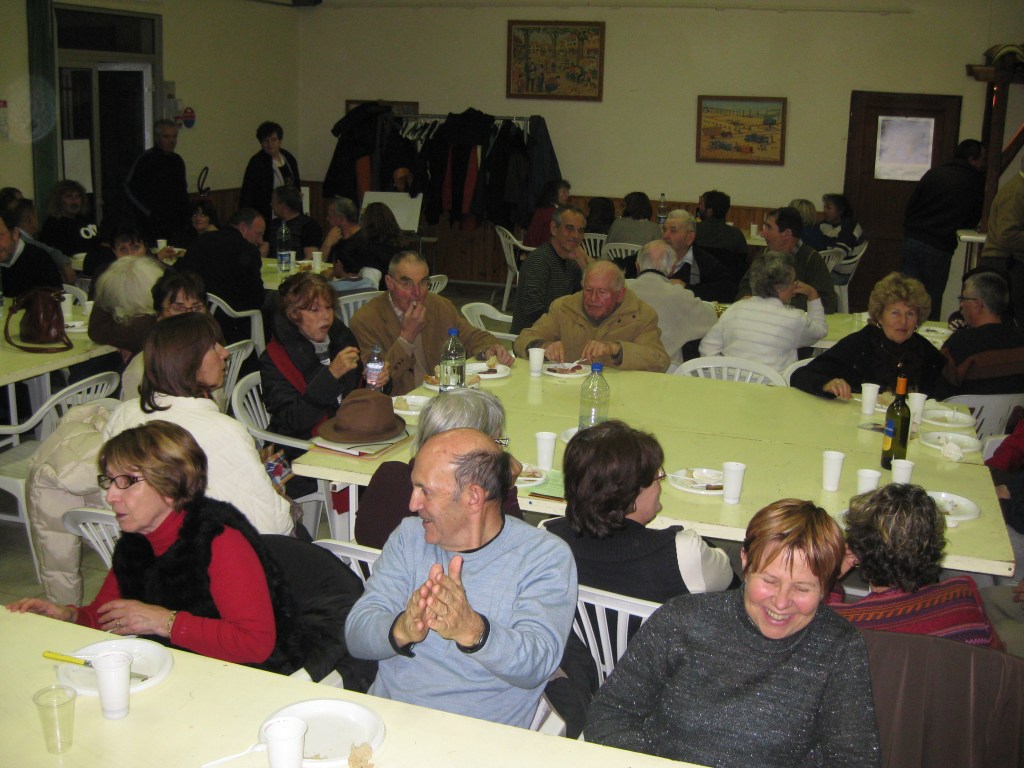
As the sun went down, it got colder and colder. Time for the next part of the evening, an Apéritif dinatoire. What this meant was that everyone from the farm walk and most of the village inhabitants got together to choose and share plates of local sausage, hams, pâtés, cheeses, bread, wine, apple croustades and fruit, mainly sourced from no more than 10 miles away.
Apéritif dinatoire over, time to clear the tables.
The atmosphere got merrier and merrier, and yet, come half past eight, the tables were cleared, and we all sat down for a lecture (this is Saturday evening we’re talking about…..). Eric Fabre, a university lecturer specialising in the farming history of our area painted a picture of 19th century life in which most people farmed tiny patches of land: only the Church and a very few landowners had substantial holdings. People grew what they and their few animals needed, and the sheep they had were valued for the manure they produced, and secondly for their wool. The meat got eaten, of course, but it only became a marketable product following urbanisation, when town based workers no longer had land of their own. The farmers listening to all this were even more interested then we were, and question time was lively. But it was late and we were tired, and in the end, we were glad to go. 11 o’clock seems well past bedtime when you’ve had a day down on the farm.
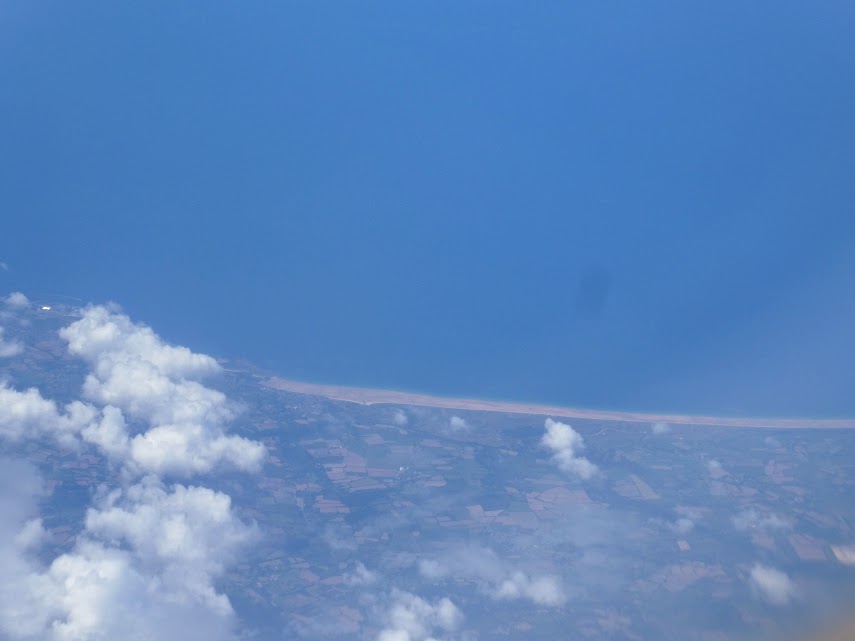
My flight home from Barcelona the other day was remarkable for two reasons. For one, I had a window seat; and for two, the earth below was visible almost every mile of the way. Here’s the story of a journey.
A small port just south of Barcelona.Arid fields.The foothills of the Pyrenees.The Pyrenees, still snow-capped in places.Rural France.We hugged the coast throughout almost all the French part of our flight.Reaching England …… and cloud cover.Manchester almost in sight.
Oh, and here’s an eleventh photo, from terra firma: alongside the (static) travelator at Manchester Airport.
What do you need to do to recharge your batteries? That’s the question posed by Egidio, in this week’s Lens-Artists Challenge. And my answer is the same as his: I need to get out, to surround myself with the natural world.
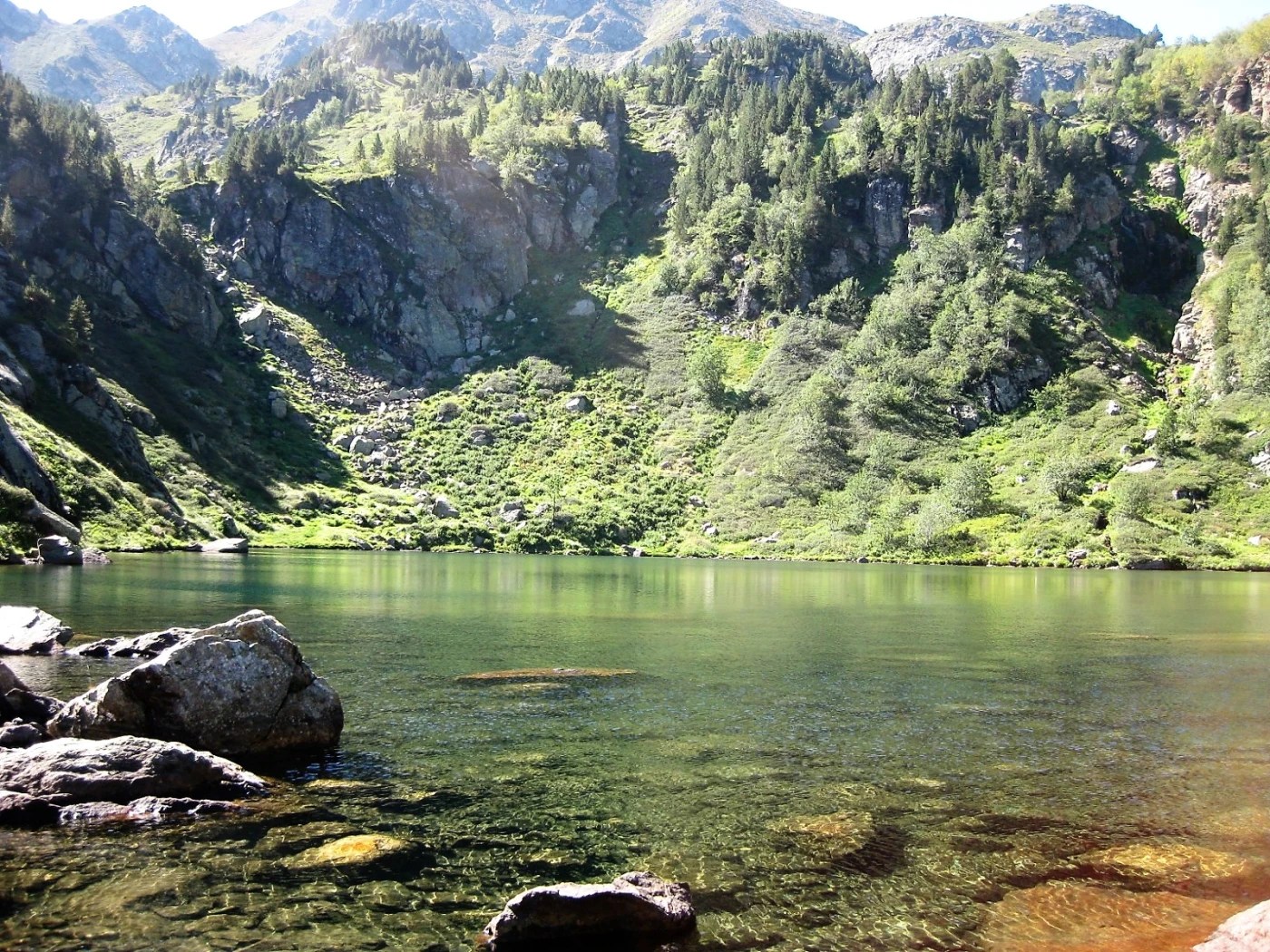
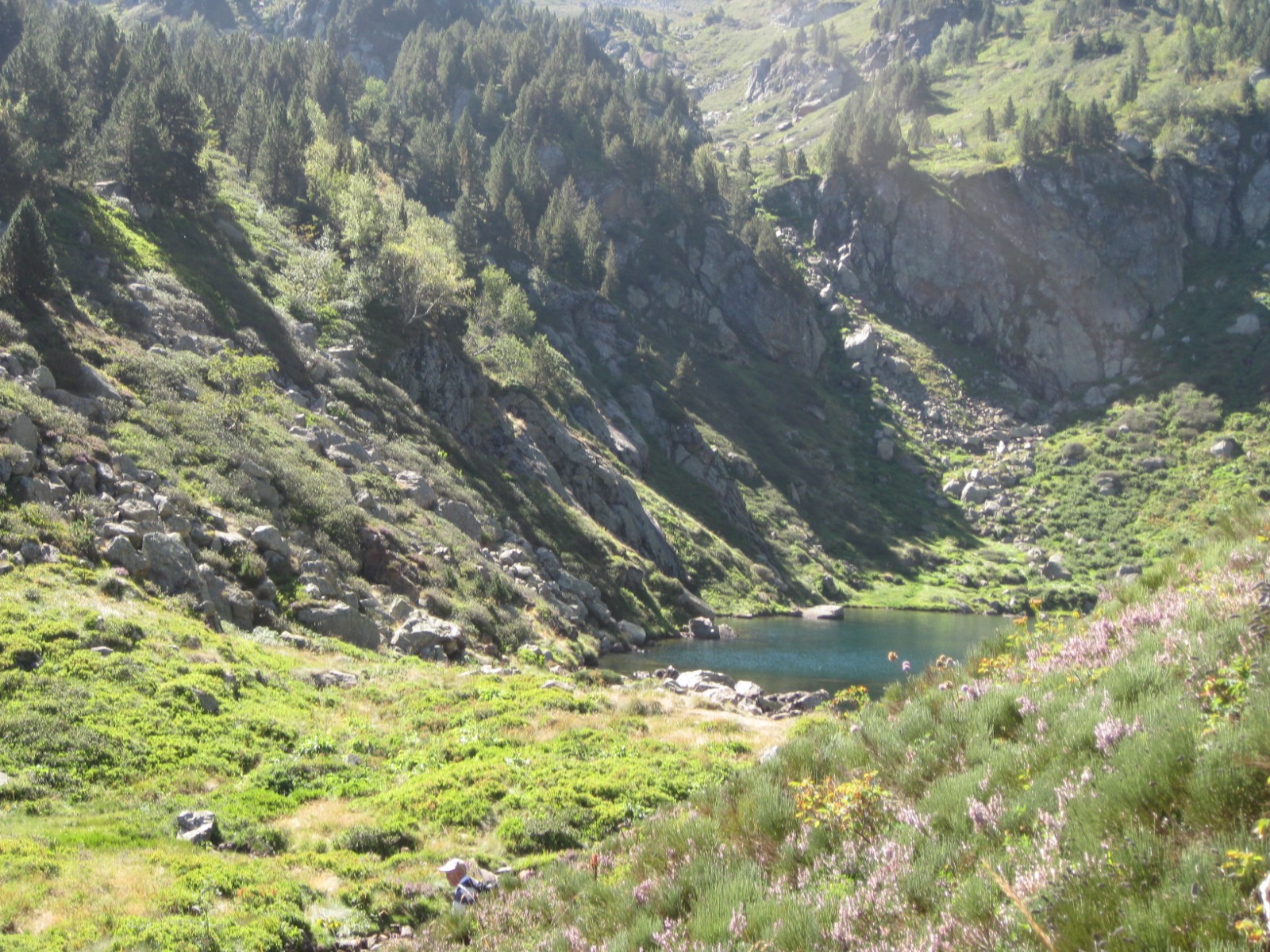
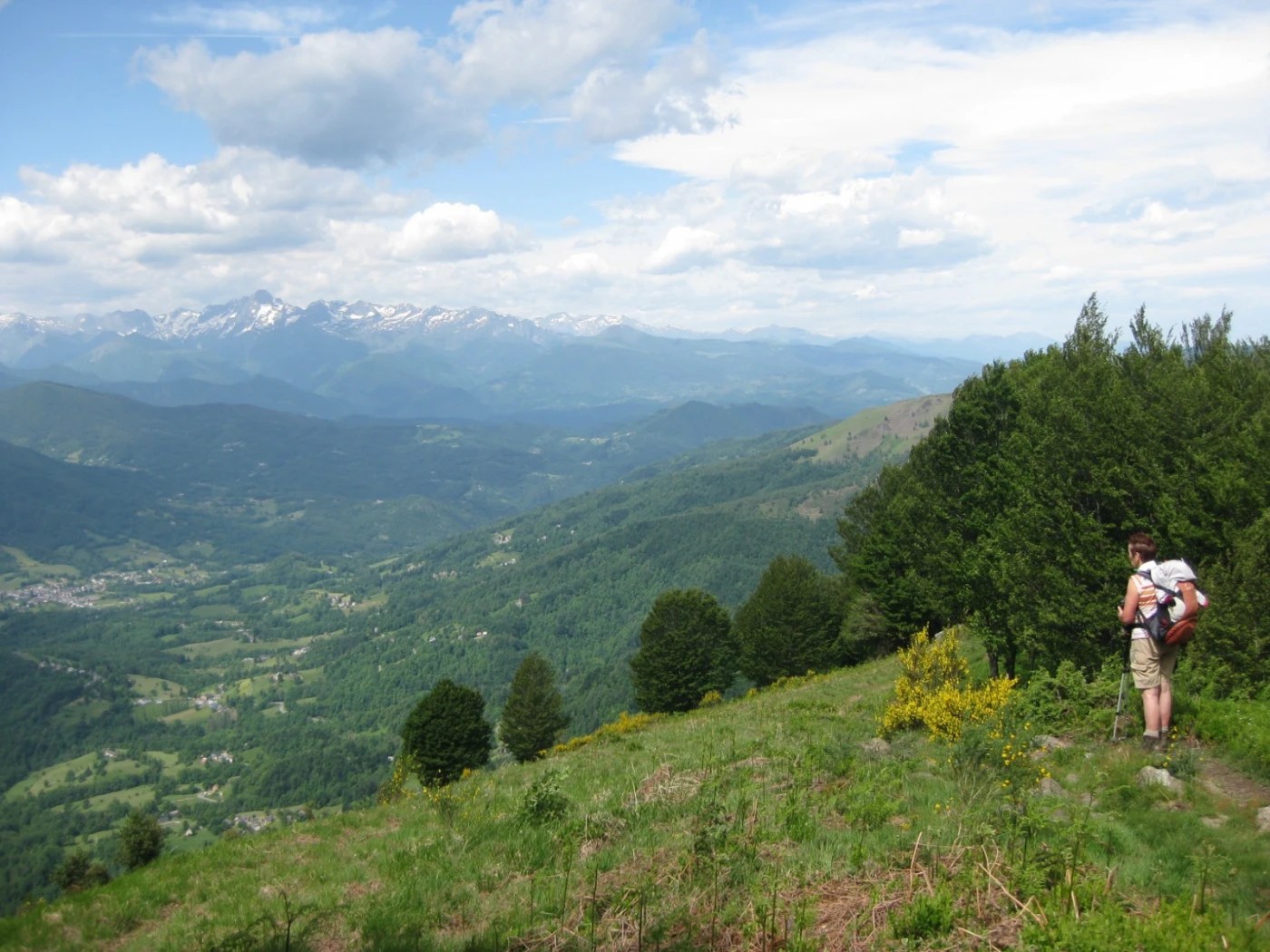
Living in France, in the foothills of the Pyrenees, the mountains grounded me in many ways. The sheer scale of them put me in my place – in a good way: reminding me how little my own concerns counted in the great scheme of things. Here’s a quiet scene from a lakeside high up the slopes not too far from our house.
Or these, from le Cap du Carmil …
There, lakes provided the solace that being near water often provides. Back in the UK, it’s the sea.
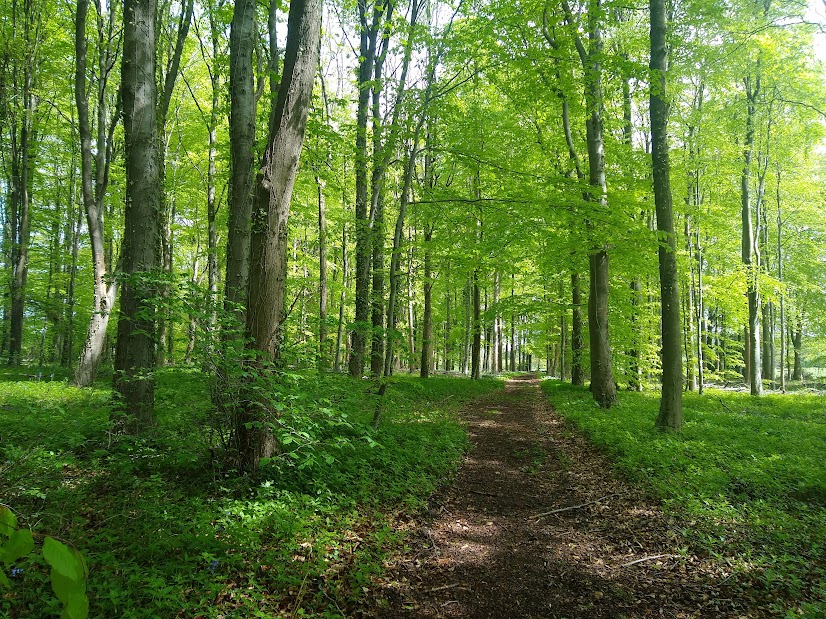
For the everyday recharge, it’s greenery, plain and simple. Local woodlands.
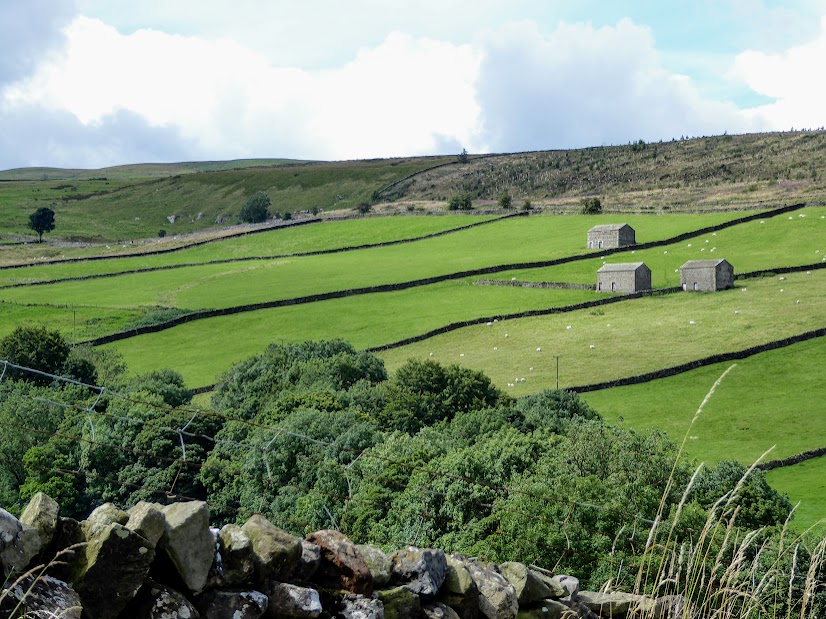
…or just a little bit more distant – Coverdale.
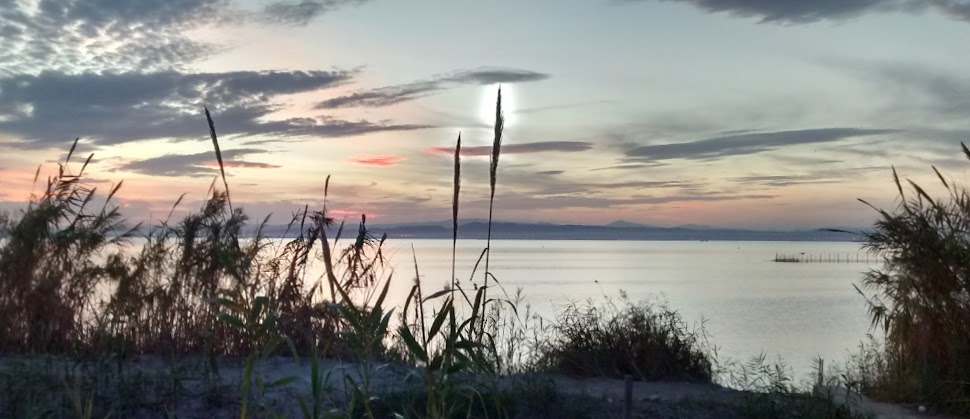
There’s just one place I need to mention though: one I’ve talked about before, more than once. A special afternoon and evening in l’Albufera, just beyond Valencia, where there is nothing but the lagoon, the sky, and wildlife … and peace. That’s my featured photo, and my best recharge ever.
Poor Algernon (if I may be so familiar). I abandoned my Major General last month as he planned further destinations in a trip to invigorate him in his old age. He’s my stooge as I attempt to complete Paula’s Pick a Word Challenge. The five words Paula offers us are intended to be a stimulus to us to choose five appropriate photos: I decided a bit of verbal silliness would add a little extra difficulty. Not ‘alf. These are Paula’s chosen words: distinctive; floating; fortified; playful and saddle. Make something of that, Major General!
In case you’re not familiar with him, this is how his saga began …
A retired Major General from Hove
with the moniker Algernon Gove
said ‘Before life unravels
I must finish my travels.’
And forthwith he made plans to rove.
But it gets worse …
His next plan was to go pony-trekking.
He booked something in Wales without checking.
It might be quite a chore ?
He could get saddle-sore?
Oh dear no - there’s a plan that needs wrecking.

Our old chap nursed a long-term ambition
to explore sites with years of tradition.
A castle, he voted,
fortified, or deep-moated.
He’d find one - he'd make that his mission.

Perhaps all his plans were restrictive?
He should aim now for something distinctive.
Something playful and fun.
‘Cos when all’s said and done
to enjoy life should just be instinctive.

He knew he’d no taste for long trips
that took him o’er oceans in ships.
But he’d go in a boat
floating nowhere remote -
while enjoying some fresh fish and chips.
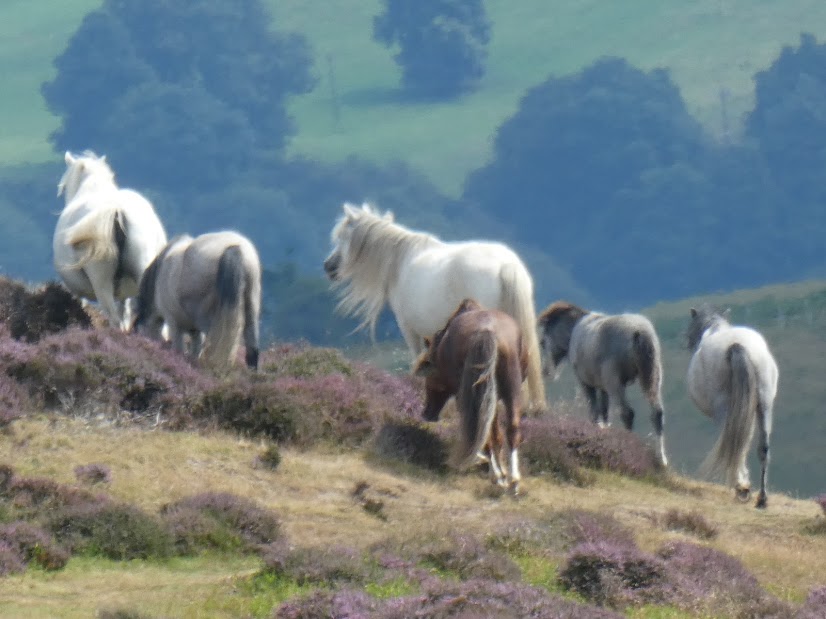
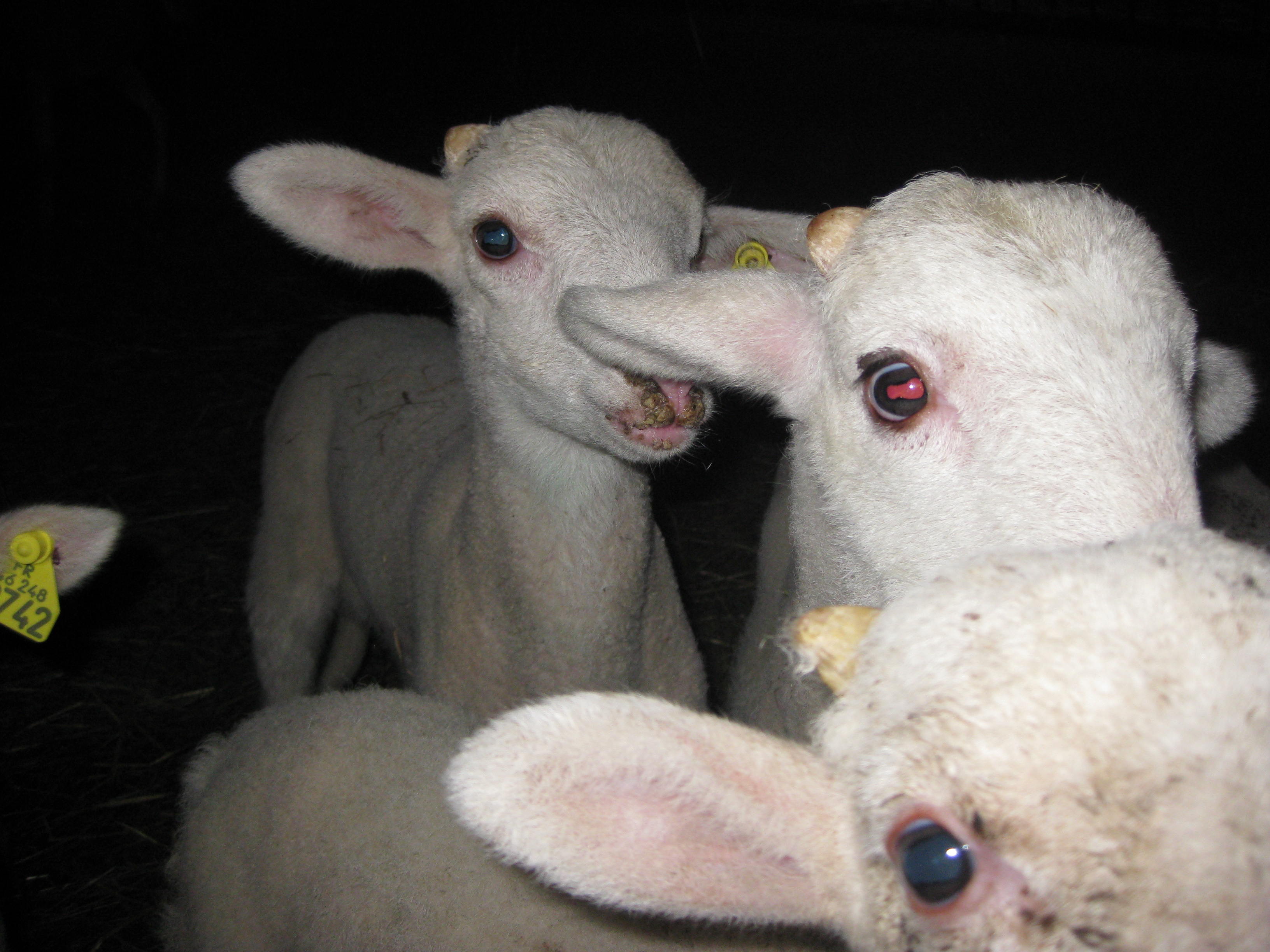
When the Major General saw frisky ponies like these, he knew he’d never be able to stay in the saddle.
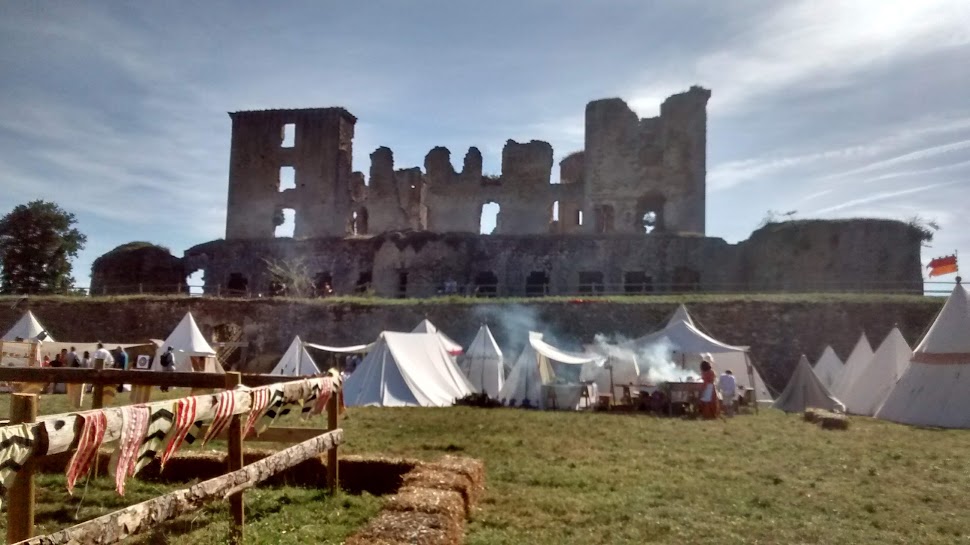
He started off at Dunstanburgh Castle in Northumberland. Not very adventurous. So he went to the Château de Lagarde in the Ariège, France, shown in the featured photo, and then…
… Sagunt, near Valencia.
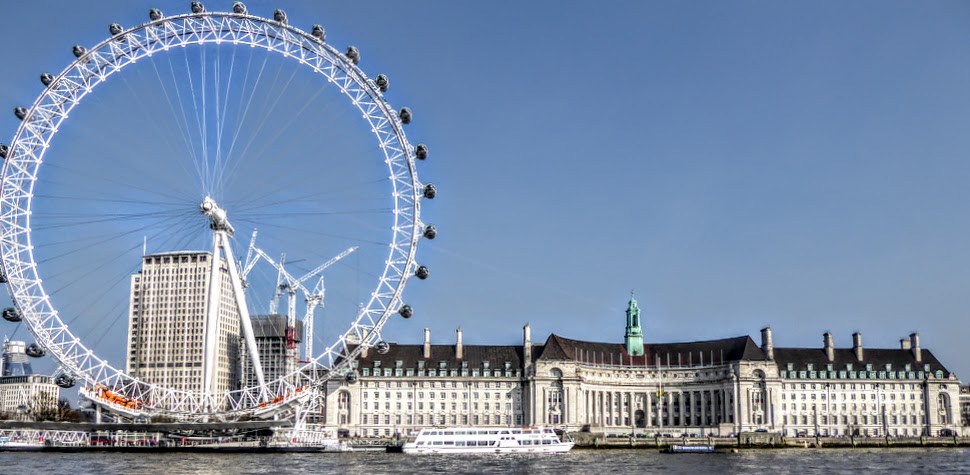
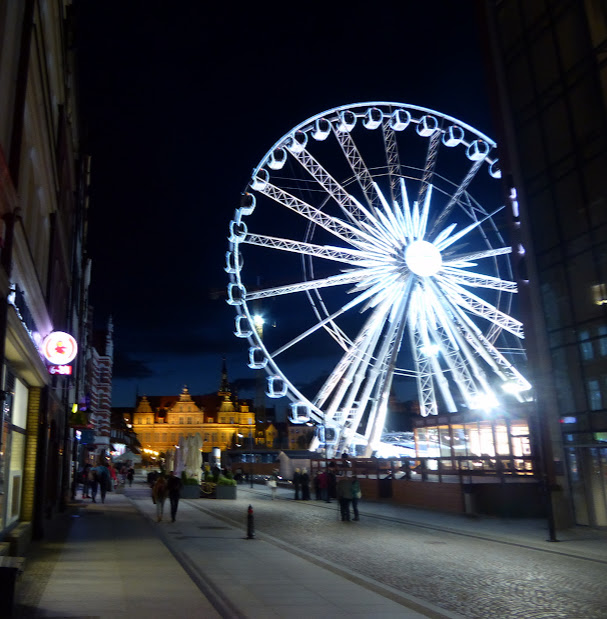
You can have a playful time on London’s South Bank, and at the London Eye. But it’s more distinctive to discover pastures new – at the evening fair in Gdansk, perhaps.
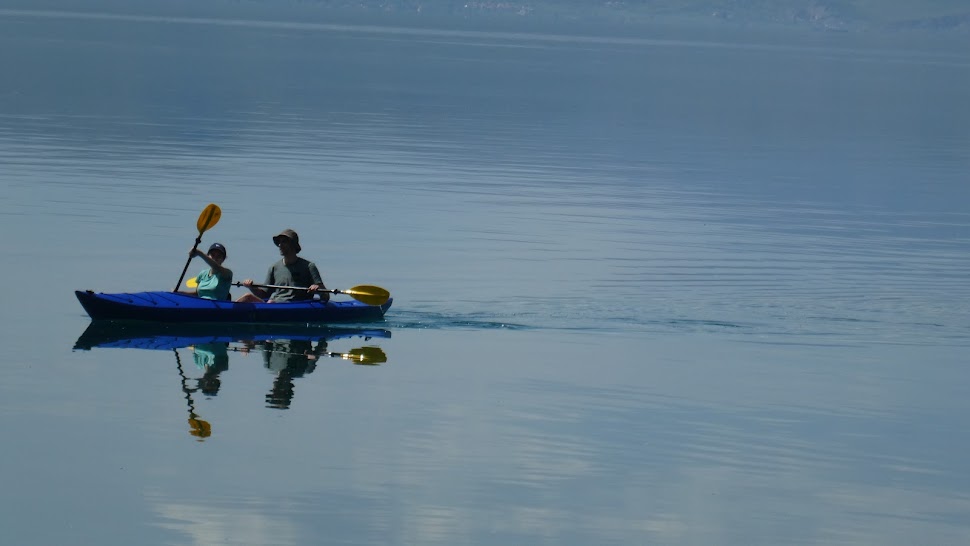
That’s more like it. Floating quietly on Lake Ohrid, North Macedonia. He had the fish he’d caught in the lake later, where they cooked it for him at the lakeside restaurant.
WP is being very irritating today. It won’t let me centre some of my photos, or alternatively to align all my shots to the left, whatever I try, and however loudly I shout at my laptop. So I have to admit defeat.













 From Pyrenees to Pennines
You must be logged in to post a comment.