A Renaissance feast

Mirepoix: Wikipedia Commons

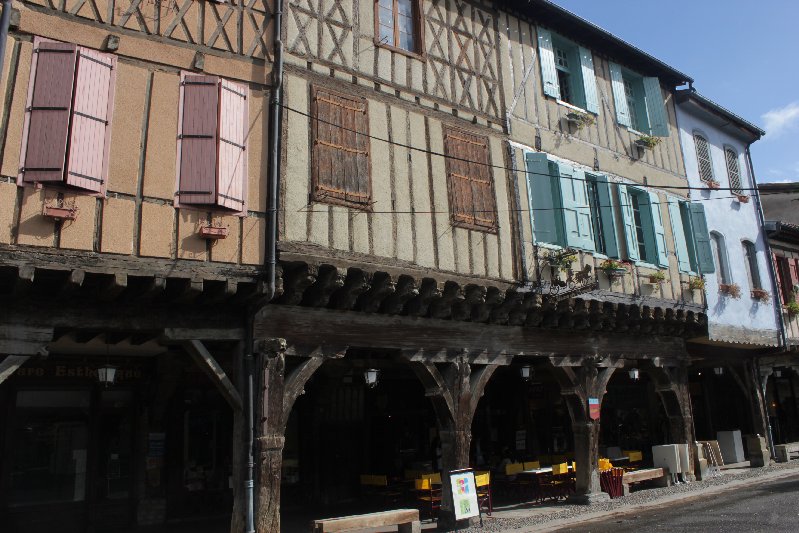
Along the road from us is Mirepoix: the pretty town, the one with the half-timbered houses set  round a central square, where it’s good to sit outside with a nice cool beer of a summer evening surveying several centuries of history.  A bit of a contrast with shabby old Laroque.  It’s something of a Mecca for both locals and tourists, as it has a busy programme of festivals throughout the year, celebrating everything from Jazz and Swing to the apple harvest.

There was new one the other week, La Fête de la Gastronomie.  We missed most of the talks, walks, demonstrations and foodie events, what with being in Bilbao.  But we did get back just in time to catch the visit to a tiny church in the tiny nearby hamlet of Mazerettes.  This was no church guided tour however.  We’d come to hear Martine Rouche talk about the fresco there, depicting the feast of Herod during which the head of John the Baptist was dished up.  No, it wasn’t an art history lecture either, nor a biblical exposition. Martine Rouche has researched this fresco – one of several recently restored in the church –  to help us understand dining and feasting in this part of 16th century France.

P1080352

The fresco is dated 1533, so Herod’s feast reflects the customs in use at that date.  At that time, there was no special room designated for dining.  The host had the table arranged wherever it suited him best, whether it was the main hall or a bed-chamber.  In contrast with the fine elaborate costumes worn by the guests, the table itself is quite simply and starkly dressed.  Not so many years before, food had been served on ‘tranchoirs‘, thick solid slices of bread.  Now, simple round plates were provided.

There weren’t many glasses on the table either.  P1080371These were expensive rare items still, so guests expected to share .  Servants would hover, ready to refill glasses as required, and everyone would drink from the glass nearest them.  Glasses didn’t come as a matching set: there were as many designs as there were drinking vessels.

Besides these, there were drageoires of crystal, designed to hold sugar and spices, which guests would nibble at throughout the meal.  This fashion for having these expensive and elegant tit-bits spread from Italy through southern France and Lyon , eventually reaching this area.

A drageoire
A drageoire

There were knives.  These were personal property.  You’d take your own with you and use it both to cut food, and as a means of conveying it to your mouth: no forks yet.  Then you’d take it home with you again.

And this curved implement is a furgeoir.  You may not want to have one at table yourself.  The pointed end is a toothpick, but you’d have used the spoon-like end to scoop out earwax when the fancy took you.
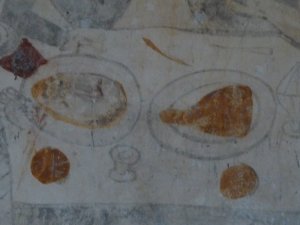
A furgeoir and a couple of plates

Under the table is a nef.  Though this one isn’t, such containers were often in the shape of a nautilus shell.  P1080367The principal guest at a banquet might have one as a sort of superior picnic hamper.  He’d use it to keep his knife, his napkin, maybe some spices, and some anti-poison specifics.  Later, the nef was replaced by the cadena, which might have several different compartments.
As to the food served, there are few clues here.  Apart from the head of John the Baptist, which was not intended to be eaten,  there were some sides of ham and other fairly unidentifiable items.  More information comes from contemporary receipt books.  Local  grandee Phillippe de Lévis, who was responsible for commissioning the frescos in the church, also hired patissiers, who of course submitted detailed bills .  These confirm what we already know: that the church calendar ruled.  Periods of plenty (‘régimes gras’) were interspersed with simpler and restricted ‘régimes maigres‘. Every Friday, Lent and Advent among others were ‘maigres‘ .  Meat and dairy products were  avoided in favour of simpler, less rich foods.  Fish was generally allowed, but for the wealthy, this was scarcely a privation.  The River Hers was rich in salmon, and would be prepared with fine and not-at-all-simple spices: cinnamon, ginger, pepper, cloves – and sugar.  Even certain water fowl, such as the moorhen –  ‘poule d’eau’ – were considered honorary fish.

But outside those periods of abstinence, what feasting took place!  A meal might begin with individual tarts, and go on to several courses of salads, fruits, boiled meats, roast meats, sauced meats.  From our point of view, the courses differed little from one another.  Our clear expectations of the kind of things that might appear as an entrée, a main course and a desert did not hold good back in the 16th century.

It all sounded pretty unappetising.  What with sharing glasses, enduring course after course of rich and highly spiced food, it would probably have been a relief to go home .  The men at least had opportunities with hunting and other manly pusuits to burn off a few calories.  Not quite so easy for the women, I think.

And thank you, Martine Rouche, for a fascinating and entertaining afternoon.

Tabariane: new light on the Dark Ages

When I was at school (back in the Dark Ages), we learnt in history that the Romans came after the Greeks.  They left us a legacy of Romance languages, our alphabet, Roman law, neo-Classical architecture, impossibly straight roads and under floor central heating.  As the empire crumbled, so we were told, the continent descended into the Dark Ages.  Barbarians, Vandals, and unpleasantly savage descendants of Asterix the Gaul ravaged Europe, raping, pillaging and generally leaving little time for culture and a settled everyday life.

I think we all knew it was a bit less straightforward than that.  The Frankish Germanic tribes entering the late Roman empire had a very different culture from that developed by the Romans, and it’s been much harder to research systematically because there are few contemporary written records.

This week though, we went to visit a Merovingian site, Tabariane, recently excavated and interpreted near Teilhet, not far from Mirepoix.  The Merovingians were an early Frankish dynasty established by Clovis, and they ruled an area roughly equivalent to much of France and Germany from the 5th to the 8th centuries, and are the kind of tribe that was dismissed as one of those from the very heart of the Dark Ages

It was a burial site we’d come to see.  It has first been discovered in the very early 20th century by Captain Henri Maurel, and had been partly excavated according to the fairly invasive practices of the period.  War and economic upheaval meant the site became first neglected, and then entirely forgotten about until recently.

Recent research lead by Nicolas Portet has meant that the burial ground, now carefully excavated, is now, as it almost certainly was then, a burial garden.  It’s a large site, on a hillside overlooking the site of the now disappeared Merovingian settlement  on the opposite side of the valley.  The 166 tombs seem to have been arranged in ‘clans’: loose arrangements of extended families and friends, over a long period of time.  It seems to have been a burial ground which held a place in the life of the community for many years, rather than being a cemetery developed as a result of tragedy – war or plague say.  Most of the bodies were laid with their heads to the west, their feet to the east.  Originally they were clothed, but little remained apart from metal objects: belt buckles, brooches, jewellery and, with some of the men, weapons.

This is where ideas have changed. Early 20th century archaeologists sent excavated objects to museums far and wide, even to America: modern practice which encourages an area’s ’patrimoine’ (heritage) to remain as far as possible intact did not then exist, but you can find examples of objects found here in the Museum at Mazères, and in Saint Raymond de Toulouse.

Now as then, the tombs are planted with local flowering plants: lavenders, marguerites, herbs.  It’s thought that locals would have visited the grounds with their families, spent time there, as we might in a modern park.  So it was important to both the living and the dead to make it a pleasant, calm place to be.  The burial ground overlooked the village. The village overlooked the burial ground.  Each had an interest in the other.  Each could intercede for the other.

It’s a tranquil, special place, surrounded by meadows and hilly countryside.  A circular walk of some two and a half kilometres , starting and ending in the village of Teilhet gives you a chance to spend a peaceful  hour or two exploring scenery that may not be so very different from the way it was when the Merovingian villagers first laid out their burial ground, some 800 years ago.  Excellent information boards will help you understand a little more about those Merovingian people who made their lives in this still rural area.

While you’re there, make time to enjoy the facade of the 14th century church at Teilhet.  Here are some pictures to whet your appetite.

This visit, guided by Marina Salby, formed part of the summer programme of Pays d’art et d’histoire des Pyrénées Cathares.  It will be repeated on 31st July and 21st August.  Meet outside the church at Teilhet at 9.30 a.m.  Cost: 2 euros.

The comb

There’s an industry that’s had something of a walk-on part in this part of the Ariège for well over 300 years.  Against all the odds, it’s somehow clinging on.  It’s comb-making.  Specifically, combs made from horn.

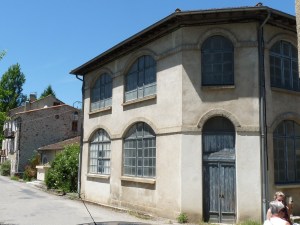
Today, we went to find out more, courtesy of a visit organised by  ‘Pays d’art et d’histoire des Pyrénées Cathares’.  There are two ‘peignes en corne’ factories within just a very few miles of each other, and of our house too.  Each used to be the size of a hamlet, with separate buildings for all the different parts of the fabrication process.  Now, both firms conduct operations each from a single building.  We went to ‘Azema-Bigou’, in Campredon.

Azema-Bigou factory
Azema-Bigou factory

I’d always imagined the industry had developed as part of a waste-not-want-not mentality, using the horns from local sheep and cattle.  Not at all.

Our part of France has always been rather anti-establishment, in religion as in much else.  In the 16th and 17th centuries, when much of Europe was in religious turmoil, Protestants locally were persecuted.  Many fled, some to Switzerland.  And there they learnt a new skill, unknown to them before: comb making.

Following the 1598 Edict of Nantes, assuring greater religious freedom, many Protestants returned to their homes here, and wanted to continue the trade they’d learnt in exile.  But did they use local materials?  They did not.  Local cattle worked hard , ploughing and generally earning their keep.  They ended up with chipped, worn horns.  Over the years, the comb-makers developed markets with ports such as le Havre, Marseilles, London and Liverpool, and imported good quality horn fom Hungary, Turkey, and by the 19th century, Argentina.

Horns awaiting transformation into combs

Although in the early days, the trade was conducted on a domestic scale, with each worker capable of producing 10-15 combs per day, perhaps after a day in the fields, by the 1850’s the process was industrialised – with machinery imported from England.  Men women and children were all employed.  Men earned 2 francs a day, women 1.25, and children 1….. .  No wonder women in particular preferred to be paid for piece work: that way they too might get 2 francs daily.  The busy industry grew and thrived until more or less the second world war when plastic combs started to take over.  The factory of Azema-Bigou, in the hands of the same family for 5 generations, employs three people these days, though in its hey-day there were 180.

But these workers will tell you, as will many local people , that it’s well worth investing in a horn comb.  Like your hair, the comb is rich in keratin, and will treat your hair gently without generating static electricity.  Several of my friends have had the same comb since childhood and would never be happy to replace it with some cheap piece of plastic.

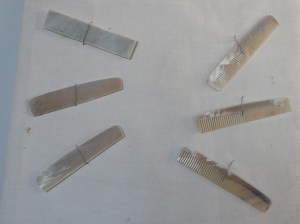
A selection of combs.

Apparently horn has to be soaked for up to a year before it becomes useable, and then it is forced through heavy rollers to make useable sheets.  There are some 15 different processes involved in producing the finished comb.  No wonder it costs rather more than its plastic poor relation.

I can’t tell you very much more.  Unusually, this event was not up to snuff. We were shown no artefacts, heard no tales from former workers in the industry.  So I don’t know what it felt like to work 11 hours a day in an atmosphere where horn dust hung heavy in the air cloaking  lungs and coating every surface in thick grey cushions. I don’t really understand what’s involved in transforming a rough, thick horn into a polished and handsome comb.   But I do know that  the waste and dust swirling round the factory got – and gets – used. The tiny fragments of waste used to be made into filaments in a factory here in Laroque, mixed with horn dust and sold as a fertiliser for vines.  Even now, you can buy bags of horn-waste fertiliser for your garden from the two comb factories.  Waste-not-want-not gets its moment after all.

Monks, marble, and a look-alike church

This slideshow requires JavaScript.

Here in Laroque , we have a Commission du Patrimoine, attached to the town council.  It has many enthusiastic and knowledgeable members who seek to preserve, restore and celebrate certain historic buildings, who manage the municipal archives, who research (for instance) the history of the area’s farms and who organise exhibitions.  It has other members who are like me, frankly, free-loaders.  We trot along to meetings but have little expertise to offer.  But we were all in favour of the day out organised last Saturday.

We started off in Caunes-Minervois, a small town in the Aude.  Most of us associate the Minervois with wine production, and we’re not wrong.    I didn’t know though that near Caunes Minervois there are important marble quarries, worked since Roman times.  It seems half the important buildings in Paris sourced their marble there … the Louvre, les Invalides, l’Opéra…. and then there are Fontainebleu and Versailles too.   It rivals Carrara in importance and marble is quarried here still: many colours, but mainly a rather plummy pink.

We came though to visit the Benedictine Abbey.  There’s been an abbey here since 790, and though the Carolingian buildings have long gone, the crypt, with early sarcophagi, remains beneath the present church.  It’s a rotten site  for a church in many ways, prone to an excess of water immediately below ground, so the four Christian martyrs whose relics are venerated here are targets for prayer that drought should not strike.  Have devotees been praying just a little too fervently this year?

The Abbey has had a long and complex religious and political history which you can read about here. We started by visiting the 17th century cloisters, austere and simple, as befits a building used by the Benedictine order. Then there’s another vaulted room in the complex with an interesting feature. Stand in a corner and whisper your confession, and the sound will travel up to the roof, over and down the other side into the ear of the listening priest.  He will be able to offer you absolution by whispering from his corner, in the knowledge that if you are carrying the plague, or some other contagious disease he’s at a safe distance from you.  We all tried it.  It works – the whispering that is.

The abbey became simply a parish church at the time of the French Revolution. From outside, it’s a fine Romanesque and early Gothic building, in a spacious uncluttered setting – the buildings that used to huddle up to it have been removed.  Within, it’s a temple to the local marble, and to that of Carrara: there are even Italian statues owing something to the school of Michelangelo.  Much of the former monastery is now used as space for art exhibitions.

Then it was off to lunch.  Another treat.  Not far from the village is another small  church, Notre Dame du Cros.  It’s in a splendid setting, in a gorge surrounded by craggy rocks.  Stone tables and benches were there beneath the shady plane trees and we had one of those shared picnics the French do so well: home made apéritifs, home cured sausage, home made pies and cakes, home grown fruit, wine…..

And then it was time for the look-alike church.  Still in the Minervois, there’s another village, Puicheric.  Its parish church bears a remarkable resemblance to ours here in Laroque.  Hence our visit.  Puicheric’s church, though, has a more intimate, homely feel.  This turns out to be because during the 19th century, those responsible for the church at Laroque had delusions of grandeur, encouraged by the likes of Viollet-le-Duc who promoted Gothic architecture in buildings where such features had never previously existed.  The roof height was raised, at vast expense, to create a more ‘Gothic’ feel to the building.

Nevertheless, Notre-Dame de Puicheric has a claim to fame as a place of pilgrimage.  Back in 1700 a marble staue of the Madonna was being shipped from Italy along the Canal du Midi, past Puicheric, bound for some fine church in Aquitaine.  Once in Puicheric, the barge could go no further, detained by some irresistible force.  The statue was taken to the church, and there it remains to this day, an object of veneration.

And then there’s the château.  Laroque had a castle once too, and we still have the odd remaining bit of wall.  Simon de Montfort saw that off, as so many other things round here.  Puicheric’s still looks very imposing – from round the back.  From the other side, what you get is a rather splendid chambres d’hôtes.  It had an aristocratic past, though much of the original site was destroyed by our very own Black Prince in 1355.  It housed the nobility until the French Revolution and then passed into the hands of a family with whom it remained until 1990.  Now it’s the home and business of Dominica and Phillippe Gouze, who aim to offer modern hospitality whilst retaining all those elements from the 16th, 17th and 18th centuries and long before that which inform its character.  We were seduced by the garden, the views, the ancient tower with a faded fresco of someone doing something dreadful to a dragon, and by the story-telling powers of our host.

While we were there, we could have seen so much more, as clicking through the links would reveal.  But that will have to be for another day ….  or two ….. or three.

To view any of the pictures in a larger format, simply click on the image.

When the Saints go marching in

Arrive in Calais, and all you have to do is drive about 700 miles south, as straight a route as you can, to find our house.  En route you’ll pass scores of towns and villages dedicated to saints you’ve never heard of.  Holy men and women such as:

  • Aignan
  • Cyr
  • Inglevert
  • Mesmin
  • Outrille
  • Pardoux
  • Pryvé
  • Sulpice
  • Ybard

I thought it was time to unearth a story or two.  So I dug out our dictionary of saints, which dates from my student days when I needed to know about such things, and then I put Google to work.  Nothing.  Almost nothing.  Not even on the websites of the communes themselves. There was the odd reference to a bishop who’d led a blameless life, but positively no ripping yarns.  Where’s the fun in that?

The story of St. Wilgefort was the kind of thing I had in mind.  In England we know her as St. Uncumber (you knew that, didn’t you?).  Her father, a Portuguese nobleman, wanted to marry her off to some pagan king.  As she’d taken a vow of virginity, she was not inclined to fall in with the plan.  Her prayers to become repulsive to her suitor were answered when she grew a beard.  Enraged, her father had her crucified.  For many years during the Middle Ages, she was venerated by people seeking solace from tribulation, and particularly by women who wanted to be liberated – unencumbered – from their abusive husbands.

St. Wilgefort in the church of St. Étienne, Beauvais

If you have any stories of forgotten French saints, I’d love to hear them.

The Château at Lagarde

Draw a square.  Now draw another one surrounding it, with a nice big border.  Now do it again.  Now draw a big rectangle alongside one of the sides, as wide as one of the sides of the square, and maybe 3 times as long.  There.  You’ve just given yourself a brief history of the Château de Lagarde.

We had a better history lesson, because we were there, in cold gusty conditions, being introduced to the site by Fabrice Chambon, as part of the series of events organised as part of this season’s Laissez-vous conter le Pays des Pyrenees Cathares.

Lagarde is a ruined castle, an imposing and dramatic addition to the skyline hereabouts.  We always assumed it was medieval, destroyed in one of the many wars that characterised that stormy period of history.

And certainly it was first constructed in the 11th century, by Ramire de Navarre, King of Navarre and Count of Barcelona.  During the crusades against the Cathars, it came into the possession of Simon de Montfort, who always gets a look in round here to any story from that time.  He gave it to his lieutenant, Guy de Lévis, and this is the family to whom it’s mainly belonged over the centuries.  They owned châteaux everywhere in the area:  Léran, Montségur, Terrefort – all within easy distance of Lagarde.  It was a fortress, a castle, and occupied that inner square you drew.

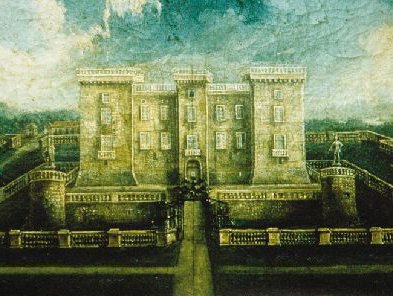
By the late 15th – 16th centuries, defensive castles were so last year.  Jean V de Lévis-Mirepoix had the money and the leisure to go travelling, and admired all those famous Châteaux of the Loire: Azay -le- Rideau, Chambord and so on.  He liked what he saw and had his own château remodelled with some of the features he had so admired, and windows piercing the original solid medieval masonry.  The finest feature may have been a splendid staircase with wide shallow steps curving upwards through the central tower: it was said that it was possible for horses to mount these stairs.  It was a fine Renaissance palace, and extended to fill that second square, because it included space to accommodate his artillery forces and a large dry moat.  Of course by the time the work was done, the style he’d copied had also become so last year.

By the time of Louis XIV, the château had become a fine palace.  The site had been considerably extended (to fill that third square!), and copied aspects of Versailles.  Think of Versailles, and it’s the formal gardens that come to mind, and the Hall of Mirrors.  That’s what Lagarde should bring to mind too.  But the vast and elegant formal gardens no longer exist: even the land on which they were constructed is no longer part of the site.  It had a Hall of Mirrors too, which though inevitably on a smaller scale than that at Versailles, was said to be magnificent.

Then came the French Revolution.  Lagarde escaped destruction, despite an order to knock it down in April 1794.  But its glory days were over.  It became an arsenal, a stables, an immense barn, a munitions factory and a bit of a ruin, until in 1805 it became once more the property of the Lévis-Mirepoix family.  These days a variety of charitable and national associations are working to restore the site and make it, at the least safe to visit, and at best a place where its glorious past will be explored and celebrated.

The photos I took are all of the exterior of the site, as it’s too dangerous still to penetrate the inner courtyards, much less the interior of the building.  Nor can I show you pictures of the château in its Renaissance glory days, nor of its time as a palace with formal gardens.

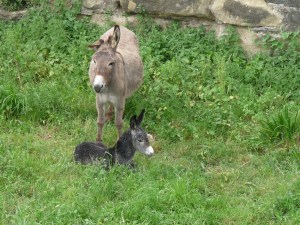
Sadly, because of the poor weather , the pictures I took yesterday weren’t up to much, so I’m mainly using some others I took recently. I can show you the ruins.  And I can show you the castle’s lawnmowers: an inquisitive and friendly herd of donkeys with their charming foals.

Mother-and-baby down in the dry moat.

UPDATE:  May 2nd 2013

Château de Lagarde
Château de Lagarde

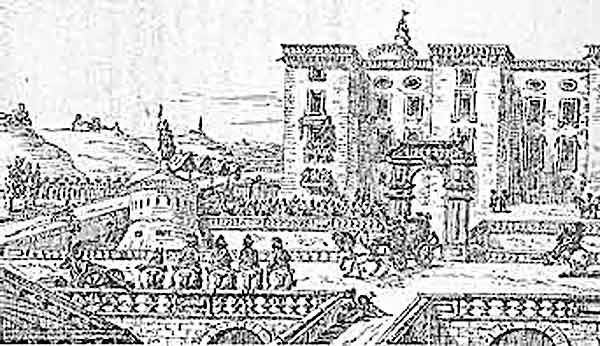
Thanks to local historian Martine Rouche, I can now show you some images of Lagarde as it was in its final most glorious days before the Revolution.

Look at the statues in the colour picture . One was taken to Mirepoix during the Revolution and  ” turned ” into Goddess Reason. Then it disappeared. Never to return. A few years ago, a man who was vaguely in charge of the grounds and ruins, found lots of things, including a foot of one of the statues. Nobody knows where that foot is now. It is a pity because it gave a precise idea of the size of the statue and showed those statues were made of brick, covered in some sort of white enamel. 
Anyway, enjoy these pictures, which certainly make it easier to imagine what the castle must once have been like than gazing at those ruins, however romantic they may be.
Château de Lagarde
Château de Lagarde


A man, a plan, a canal

Pierre-Paul Riquet.  Pierre-Paul Riquet?  Who’s he?  He’s not much known in the UK, and I’m not sure how much of a household name he is in France either.

Pierre-Paul Riquet.  Here he is, in the village of Bonrepos-Riquet.
Pierre-Paul Riquet. Here he is, in the village of Bonrepos-Riquet.

But he should be.  He’s the brains behind the wonderful UNESCO World Heritage Site, the Canal du Midi.  This lovely and elegant canal, opened in 1681, is 240 km. long, and runs from Toulouse to the Mediterranean.  It was built as a short cut from the Atlantic to the Mediterranean, avoiding a long sea voyage round Spain.  The idea had been discussed on and off since Roman times, but the problem was always the same.  How to deal with such hilly terrain and how to supply those hilly sections with enough water.

The Canal du Midi: a typical view, courtesy of Wikipedia

Riquet thought he had the answer.  Born in 1604 or 1609, he was a salt-tax collector.  Tax collecting was a rich man’s job: at that time, it involved paying all the monies due to the king up-front, and worrying about collecting from the relevant subjects later. A rich man can have a fine home, so Riquet set out to buy the ideal spot, and in 1652, he found it: the ancient but run-down Château de Bonrepos, near Toulouse.  It was a medieval building originally, fortified in the 16th century.  It interested him because it was a fine site, with splendid views of the Pyrenees (Not today: the weather was awful. Never saw the mountains at all through the gloom).  More importantly for him, the surrounding terrain, resembling parts of the nearby Montagne Noire, enabled him to conduct hydraulic experiments round an ancient fishpond on site from which he developed reservoirs and water-filled trenches replicating sections of the future Canal du Midi.  Bonrepos, then, was where he worked up his case for showing that the canal could after centuries of simply talking about it, become a reality.

The remnants of the mediaeval building interested him not at all.  He had a fine classical building built – 100 rooms.  Stone isn’t available locally, so it was built of Toulouse brick, and faced with stucco to hide this embarrassing fact: bricks were elsewhere the material of the poor.  He had formal gardens built, orchards, an orangery.  Every winter, an iceberg’s worth of ice was wrapped in hessian and floated from the Pyrenees to be stored in an excavated ice-house deep in the woodlands for use throughout the summer.

These days, the château is in a bad way.  The stucco’s falling off, the windows are rotted, and the internal decorations are absent or shabby.  The inhabitants of the small village where the château stands, Bonrepos-Riquet, bought the property some years ago, and while appealing for and attracting public and private funds, it also relies on monthly working parties of volunteers, who work enthusiastically in the house and grounds to stem the damage caused by wind and weather and to bring about improvements.

We visited today on one of Elyse Rivin’s informative Toulouse Guided Walks , which always focus on those corners of Toulouse and the surrounding area which you never knew about: you leave after her tour feeling an enthusiastic expert.  With input from the château’s own volunteer guides, steeped in the story of the place, we formed a picture of Paul Riquet himself.  He persuaded Louis XIV of his ability to master-mind the canal, and in 1661, work began, though he didn’t live to see the waterway opened as he died in 1680, leaving enormous debt and financial problems for his children who nevertheless continued the project.  The labourers – men and women, up to 12,000 of them – who built the canal were among the best paid workers in Europe, to the disapproval of other less philanthropic employers.  He insisted on provision being made for all aspects of their lives, from shops and refreshment to education and worship.

Those plane trees that line the canal.  They offered shade, then as now, to those who travel along it.  Their root systems bind the soil and offer stability to the canal, and the leaves don’t rot, so as they fall into the canal, they help make a waterproof base.  Sadly, these days those trees are afflicted by a virus.  One theory is that the wooden boxes which packaged American munitions in the war and were discarded along the canal, carried the infected spores and lay dormant for many years.

And there’s so much else.  Follow the links to get a fuller picture of the story, or better still, visit the Canal du Midi and Château Bonrepos, where this wonderful waterway was conceived and planned.

A morning with Saint Pierre: two versions

Once there was a fine Roman city, Tolosa, and just outside its walls was a temple to one of their gods.  Over the centuries, the city became Toulouse, and where there was once a temple, there’s now a concert hall.  The building that was once outside the city walls is now quite definitely part of central Toulouse.  What happened in all those years in between?

The first thing was that in the 4th century the Romans left Tolosa, pursued by the Visigoths.  And Visigoth Christians (who resembled Cathars more than they did the official Catholic variety) used the temple site to build a simple church.  You can still see and visit its foundations today, and its ancient sarcophagi holding the bones of the long-dead.

This church building served its purpose for many years, until the 10th century, when the count of Toulouse gave it over to the Benedictine order whose most important monastery in the area was at Moissac.  And they built and extended the church which was and is known as Saint Pierre des Cuisines.  Nothing to do with kitchens.  The word is a corruption of the word ‘coquinis’ – artisans, of whom there were many in the busy streets nearby.

Over the years, the church became more important as a parish church to the local population, rather than as a centre of worship for the Benedictines, so in the 16th century, the church became the property of the silent order of Cistercians.  18 monks had the use of the church and surrounding land and buildings.  Their simple uncluttered contemplative life was in stark contrast to that of the nearby citizens of Toulouse, crammed into the narrow overcrowded streets where they lived and worked.

The church continued to be used as a religious building until the Revolution.  Then, as for so many other churches, another secular use had to be found for it.  And one was.  The nearby arsenal was the local home of the army, and they took over the building to use it for … cannon ball manufacture.  When this slightly inglorious use for the building came to an end, it remained unused until the University of Toulouse took it over during the 20th century.  Eventually the funds were found to restore it, and the building is now a concert hall with magnificent acoustics.  So it’s now an established asset of the conservatoire, and part of that area of the university campus still known as the ‘arsenal’, in memory of its history.

It’s a beautiful and austerely simple building from the Romanesque and early Gothic periods, and a contrast with the other church we went to see just round the corner.  This church, Saint Pierre des Chartreux was begun in 1612 to meet the needs of the Cistercians who had moved to the site.  It has a very unusual feature.  The high altar is right in the middle of the nave.  Why?  So the parishioners could worship at one end of the church without being able to see the contemplative Cistercians at the other end of the building.  Much of the church is decorated in restrained grey and white stucco work, though there are stained glass windows by Louis-Victor Gesta, whose work is in several city churches, and ancient hammered ironwork.

Whilst in the area, walk round the corner and see the remains of the old Cistercian cloisters. Little is left, but there’s enough to show that a meditating monk would get a decent work-out by doing a single circuit.

And now it’s time to wander off and explore the little streets nearby: you’re never far from a lunch-spot in Toulouse.

This slideshow requires JavaScript.

We discovered these monuments and learnt their story courtesy of Elyse Rivin and one of her Toulouse Guided Walks.  

Château de Fiches

This weekend, as any fule kno (thank you, Nigel Molesworth.  That’s quite enough from you) are the European Heritage Days, when hosts of historic buildings not normally much open to the public, throw open their doors to curious locals.

So when Léonce proposed going to Château de Fiches, we were keen.  If you come home the back way from Pamiers, past villages with evocative names such as Seigneurix (Surely Asterix and Obelix can’t be far away?) and Parent, you’ll pass its fairly undistinguished drive-way: we’ve passed it dozens of times before, and it’s always been shut.

This gives some idea of the charmingly domestic scale of the operation

Not today.  This weekend, the team were keen to show the place off.  If you want a château complete with crenellated façade and turrets, you’ve come to the wrong place. This 16th century building is strictly domestic, more farmhouse than stately home.  It was built originally for a Toulousain Parliamentarian, and later passed into the hands of a lawyer from Pamiers, Joseph Fauré, whose family own it still.  It has unexpected treasures, most of which I wasn’t allowed to photograph.

Back in the 19th century, someone in the family went plant collecting, some 1600 specimens.  Nobody knows whether it was the plants themselves that were collected whilst travelling, or simply the seeds which were then raised back here in France.  Dried, mounted, thrust in dense piles deep into a cabinet, they’re only recently being catalogued by an English couple, Mavis and John Midgley, excited to use their expertise in this way.

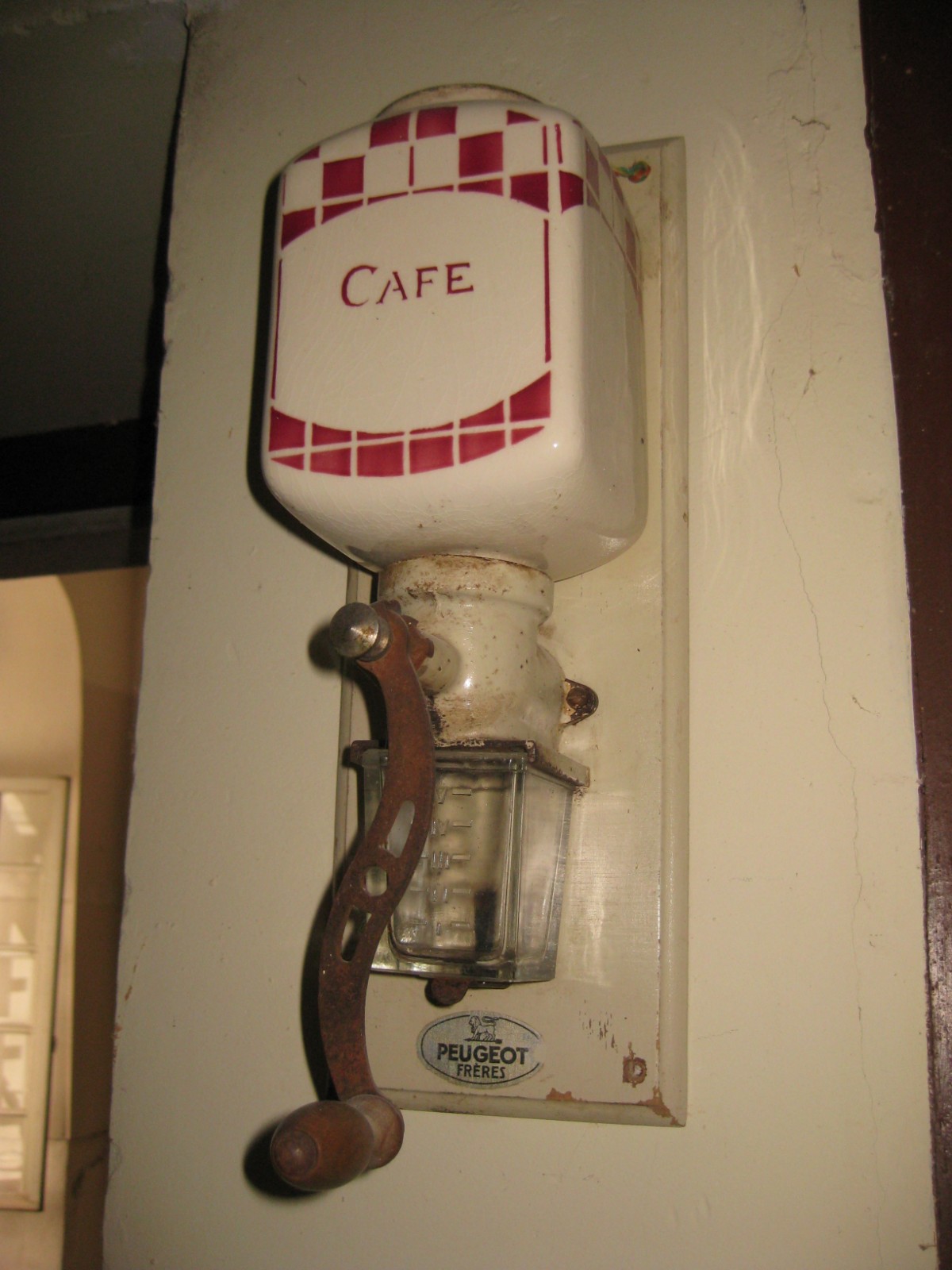
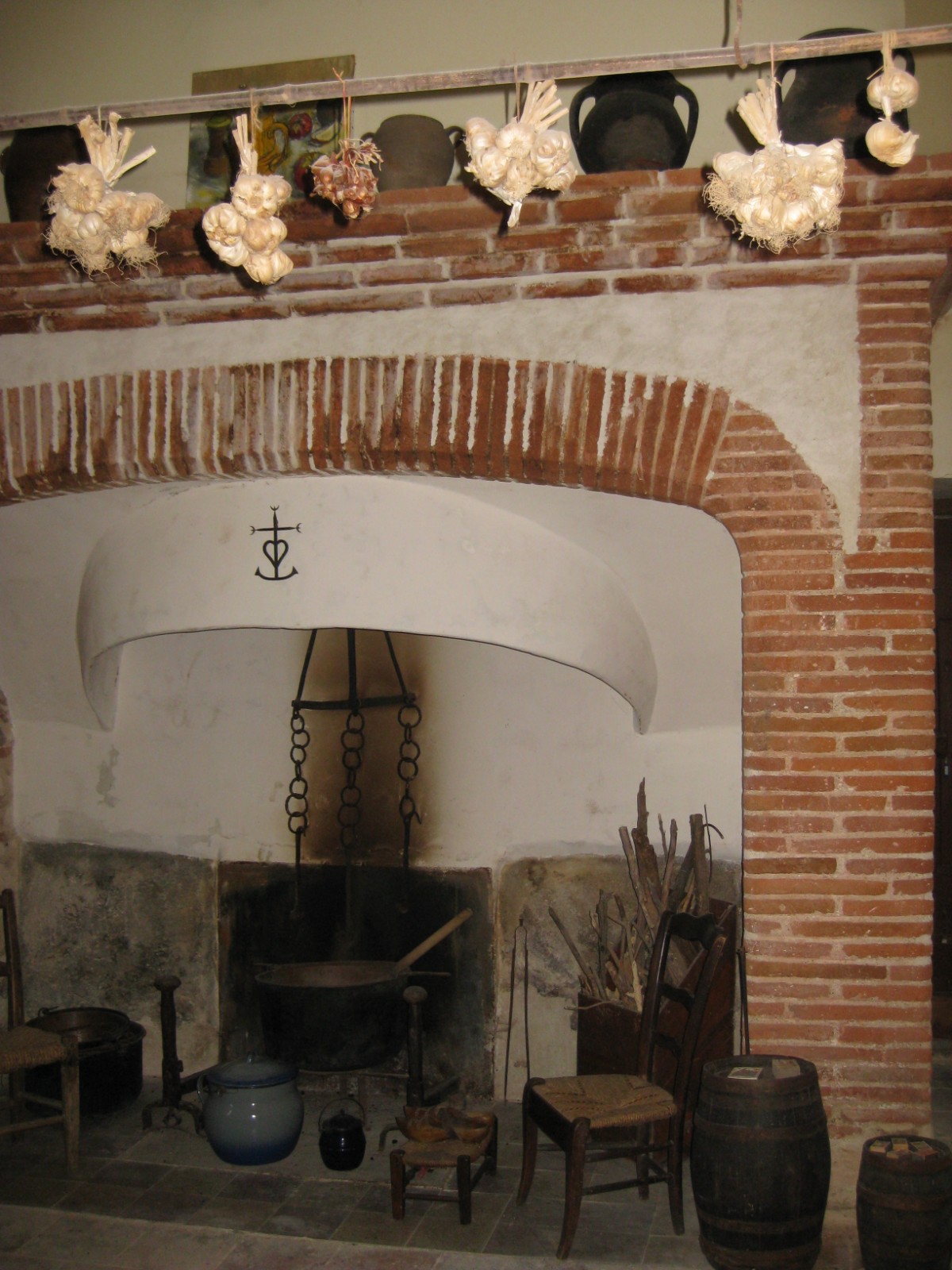
I can show you photos of the kitchen.  Enjoy the mechanical mayonnaise maker, the coffee grinder, the charming and enormous hearth.

Churn round your egg yolks, oil and so on in here, and apparently mayonnaise will emerge
Here’s the coffee grinder
And here’s the hearth

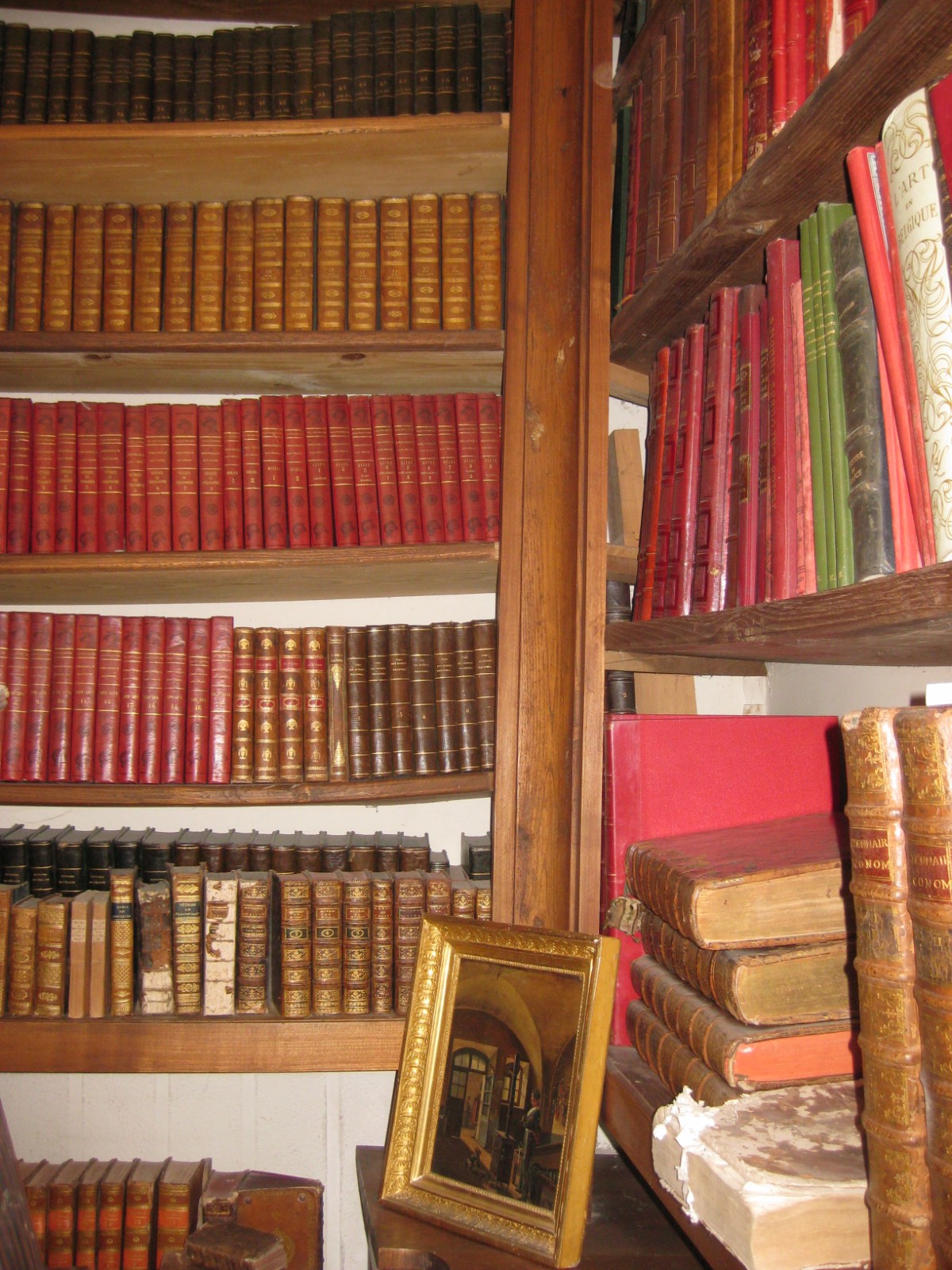
I can share pictures of the library.

The library

What you can’t see is the bestiary.  This is such a shame.  Painted in the 16th century, a series of charming and vibrantly coloured animals enliven the beams of a ceiling on the upper floor.  The artist is unknown to us, just as elephants, camels, monkeys, satyrs and so on were unknown to him.  He got his information third, fourth or fifth hand, and made an efficient if imaginative job of visually describing the 40 or so beasts he illustrates.  On safer ground with rabbits and peacocks, he painted every single beast, known and unknown, with vitality and verve.  Another equally interesting ceiling is currently being revealed.  Part of this are painted more in the manner of blue and white Delft ware.  If you’re round this way, they’re worth a look.

It’s only a shame that all the various treasures of the Heritage Weekend are usually available For One Weekend Only.  So much to see, so little time.

Once upon a time, in Benac….. Le Cami des Encantats

Today we visited Benac, one of those  small and almost picture-postcard-pretty  villages outside Foix.  I think it’s unlikely that too many horny-handed sons and daughters of toil live there these days.  Too many freshly painted facades and cheery boxes of geraniums at the windows. Too many sleek and highly-polished cars.

But once upon a time it was a busy working community. For the last few years, every summer the villagers here and in nearby hamlets arrange carefully constructed and dressed figures into appropriate corners of both village and countryside.  These figures celebrate the way of life that persisted here – and throughout France – for centuries, and only died out some time after the First World War.  They call the paths you follow to hunt out all these scenes Le Cami des Encantats: Occitan for something like the Enchanted Pathways.  Come with me and take a look.