Mr. Chilli

Jean Philippe Turpin and his stall at Mirepoix market last week.

About a year ago, I was doing my regular shopping in Lavelanet market when I saw a new stall.  An amazing stall, jewelled with the bright crimsons, scarlets, yellows, greens, purples and blacks of an array of a score or more of varieties of chilli.

It wasn’t busy.  The stall holder was holding court to nobody at all till I came along, so we got talking.  Mr. Chilli (Jean Philippe Turpin) would have as his mission statement if he went in for such things, ‘passionate about chillies’.  He was selling the harvest he had been carefully husbanding all season: mild chillies, warmly scented chillies, chillies with a kick, chillies with a punch, and killer chillies.  Nobody was interested.

He knew he had a chance with me, because I’m English.  The French, famously, do not like hot spices.  Without English customers – not many of us in Lavelanet, but rather more in Mirepoix – he would have had no business at all.  I bought quite a selection from him, carefully trying to memorise the properties of each variety, and froze them.  They lasted me all winter.

In the spring, he appeared again.  This time he was selling chilli seedlings. The varieties were coded from 1 to 10, with 1 being mildest-of-the-mild, to 10: blows your brains out .  He had one or two specimens even I wouldn’t touch – 10 + 6.  Together with two English fellow aficionados and gardeners, I’d pop to see him most weeks – maybe to buy another plant, maybe only for a few handy hints.  He never seemed to mind if we didn’t buy: our enthusiasm won him over and he would spend ages patiently explaining how to get the best out of our precious seedlings.

The season wore on.  The seedlings became plants, then fruiting specimens.  Now we’ve come full circle.  The stall is crammed again with baskets of chillies in every shape and size and colour.  Some look like crinkled Chinese lanterns, some like cherry tomatoes, some like tiny black bilberries, while many of course are the familiar long pointed droplet.  Now he’s busy producing chilli oil, chilli paste, chilli condiments of every kind to sell throughout the year.

He used to live in Paris, but it’s not the kind of place, or the kind of climate, where chillies can thrive.  Not in the kind of quantities he was growing them.  Even back in those days he had getting on for 50 varieties.  So a couple of years ago he looked for a space and a place in the sun, and ended up in a village near here, Saint-Quentin la Tour.  He decided to turn his obsession into a business: I think a man who eats chillies for breakfast can fairly be described as obsessed.  Mr. Chilli has few rivals.  To his knowledge, there is only one other chilli producer in the whole of France, near Béziers.  If you visit his garden, with its views over the Pyrenees, you’ll see row upon row of chillies, chillies and more chillies.  They are protected from frying in too much sun by a system of canopies, staked to keep them posture-perfect, and generally treated to a firm-but-fair regime designed to encourage self-reliant, hearty, healthy and productive plants.  He’ll have harvested the lot by now.

So from now on he has a busy period when he’ll swap his outdoor work for indoor activity.  He’ll be air-drying chillies for the winter, turning others into chilli-based products, always choosing the best and most appropriate variety for the job in hand.

And the last two times I’ve visited him, I’ve had to wait my turn.  Curious customers and would-be customers crowd round his stall, examining all those different varieties, asking questions, making tentative purchases .  They’re all French.  Mr.  Chilli knew he was in for the long game. Perhaps he’s beginning to win.
If it’s fish, it must be Wednesday.

Our village  shop has a daily battle on its hands to keep itself in our hearts and minds as we plan our weekly shopping.  With three supermarkets (two of them offering ‘le hard discount’) within two miles, it’s all uphill.

Dominique and Joel, the owners, have three types of customer: the old faithfuls who buy all their groceries there.  There are so few of these that if one of them goes on holiday, or worse, dies (I did say old faithfuls), it makes quite a difference.  There are those of us who shop a  fair bit there, and make a conscious decision to do so, to keep the shop in business as an asset for the whole community.  And there’s the passing trade, and those who only go if they’ve forgotten the matches, or fancy a tub of ice-cream just before closing time.

So they encourage local producers, offer delivery,  open earlier and later than the supermarkets (though they have a long break at midday) and are constantly on the look-out to stay noticed.

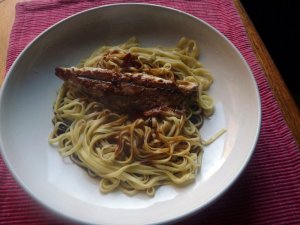
One of their winning ideas, though, is to supply fresh fish on one day a week.  You’re as well to get yourself there in good time on Wednesday, or it’ll all be gone.  Every week, there’ll be a choice of two varieties.  And last week, the choice was a fairly unusual one for this part of the world: mackerel, my favourite.  Inspired by various ideas from BBC Good Food, though owing allegiance to none in particular, this is the speedy no-nonsense meal I came up with.

Grilled sweet soy mackerel

P1070874

Ingredients

  • 4 mackerel fillets
  • zest and juice of 1 lime, or 1 lemon
  • 1 tbspn. rapeseed oil
  • Noodles, as required

For the sauce

  • 2 tbspn. soy sauce
  • 1 red chilli, deseeded and cut into matchsticks
  • Juice 1 lime or lemon
  • Thumb sized piece of ginger, finely grated
  • 2 tbspn. muscovado sugar
  • 2 tbspn. water
    1. Score the mackerel fillets a couple of times on the skin, then lay them in a shallow dish. Sprinkle with the lime or lemon zest and juice, and leave to marinate for 5-10 mins.
    2. Place all of the sauce ingredients in a small pan and gradually bring to a simmer. Cook for 5 mins to thicken slightly, then remove from the heat and set aside.
    3. Turn the grill to its highest setting and place the mackerel on a greased baking tray, skin side up. Sprinkle the fillets with the oil and some sea salt, then grill for 5 mins until the flesh is opaque and cooked through.
    4. Meanwhile, cook the noodles.

To serve: divide noodles between shallow bowls, top with mackerel fillets, and drizzle the soy sauce mixture over the top

Cookery blogs I like

I’ve got a large collection of recipe books.  Despite regular and judicious weeding, the shelves get heavier with every passing year.  You know me well enough to realise that Nigel Slater gets a shelf all to himself, which he shares with my latest new cooking best-friend, Diana Henry.

In among are certain stand-alone favourites: Denis Cotter’s ‘Paradiso seasons’ – stylish vegetarian recipes from an Irish restaurateur: Pushpesh Pant’s encyclopaedic ‘India cookbook‘: a reliable guide to quick and easy suppers from Sandeep Chatterjee’s ‘Indian Vegetarian Cookery’: and ‘Persia in Peckham’ by Sally Butcher, a great book to browse through and read, as well as to cook from.

Yet for all that, I find myself increasingly visiting the internet when hunting for new ideas.  Any page that is immediately greyed-out by a superimposed advert is banished without further ado.  So is any recipe that comes expressed in the cups so beloved of Americans and Australians (A tablespoon of butter?  Oh, please no.)

I’m likely to find what I want among the pages of my favourite food bloggers.  And here they are, in no particular order. What they can all do is write, and communicate their pleasure in the dishes they make with me, their reader.  Perhaps you’ll come to enjoy them too.

rachel eats


rachel eats

Once upon a time, just after I’d left school, I worked in Italy, in Florence.  As an au pair living en famille, I had no need to cook, but I remember those intriguing food shops; corn-yellow chickens, feathered heads intact, hanging in long lines from hooks above the counter; vast wheels of parmesan, fragrant hard flakes dusting the counter from the last-cut slice; the salumeria, with dusky cured meats and salamis suspended from the ceiling, and piled into baskets.  I remember thick soups of fagioli ad’oglio and  the excitement of first eating such simple dishes as soft cushions of mozzarella dressed with tomatoes, olive oil and pepper.  Mainstream now, but so exciting back in the 60’s.  Rachel’s blog puts me back in touch with those days.

Rachel is a young English woman living with her small son Luca in the Testaccio district of Rome.  I think perhaps she chooses to lives there, in Testaccio, as much as anything  because of its busy daily market, with its stalls of just-picked vegetables and fruits, its fresh local cheeses and cured meats all sold by the people who’ve grown and produced these goods.  Back home, she transforms what she’s just bought into simple tasty and achievable recipes which I always want to cook the second I’ve read about them. If ‘slow food’ is the motto you live by, Rachel’s your woman, because she’ll always point out that so many of the dishes she enjoys require time to develop a range of complex flavours, though otherwise not too much effort.  Here’s the last dish of hers we enjoyed.

The Ordinary Cook…..

the ordinary cook

I think that Kath is the less-than-ordinary cook I aspire to be.  Like me, she learnt from her mother – my earliest cooking memories are of helping to chop up candied lemon and orange peel for the Christmas cake, aged about 4.  Like me, her cooking school was family life.  Like me, she enjoys it when her children cook with her.  Unlike me, she seems to be able to get away with cooking a lot of cakes and puddings: I like to make them, but taking 2 slices out of a whole cake before it goes stale isn’t a great idea.  Kath is always keen to try things she’s never embarked on before, such as making her own butter.  Any woman who provides a recipe for damson ice cream gets my vote.  She’ll tweak a standard favourite and make it into something new: gooseberry and elderflower cheesecake comes to mind.  There’s a lot of baking, but also plenty of ideas for inexpensive tasty main meals such as chorizo, lentil and bean stew. Good stuff.

Cook eat live vegetarian

cook eat live vegetarian

Vegetarianism is by no means mainstream here in France.  It’s seen as cranky, even.  Outside the big cities, you’ll struggle to find a restaurant offering meat and fish-free main dishes (so take a bow, le Rendez-vous at Léran, for your daily vegetarian choice).  On a domestic level, the vegetarian diet here tends to be … well …. brown.  ’70’s retro, really.  Lentils and chick peas, tasty items in themselves, tend to be offered without the revitalising additions of brightly coloured vegetables or zingy spices.  How I long to thrust  Natalie Ward’s blog in front of French vegetarian cooks.  Here is what she says on her ‘About…’ page:

 ‘This blog is to share our enthusiasm for fantastic food with a world flavour. Using seasonal produce, grown locally where possible, we aim to excite with global vegetarian cuisine . Our inspiration comes from what fruit & vegetables we see growing while walking the dog in the “campo” in the morning  and we hope to share some of the beauty of Andalucia in the process.’

She succeeds alright.  She favours fresh, bright yet often quite complex flavours that excite the palate.  Almost every recipe of hers that I have cooked has become part of my repertoire.  It’s the sort of food I can make for non-vegetarians, who will have cleared the plate and asked for more even before they’ve realised that there’s not a mouthful of meat on offer.

I offer this recipe to those of you who despair over what to do with yet another mound of courgettes from the kitchen garden.

Marmaduke Scarlet.

I love London.  Why wouldn’t I ?  Visiting gives me the chance to stay with my son and daughter-in-law.  It gives me chances to expose myself to ‘culture’ with big and small ‘c’s’ of all kinds.  And I love shopping there.  No not THAT kind of shopping. Food shopping.

Rachel Kelly?  Or Marmaduke Scarlet?
Rachel Kelly? Or Marmaduke Scarlet?

I love to nosey round Lewisham, maybe beginning with a rich dark espresso at the noisy and friendly Italian delicatessen, crowded with members of the  local Italian community; going on to the Turkish shop; the Polish and Latvian stores; the Caribbean stalls on the market.  Then there are Indian stores, various kinds of African ……

Rachel Kelly, aka Marmaduke Scarlet enjoys London too.  She lives there. Having a  metropolitan address doesn’t stop Rachel from eating seasonally, from locally sourced ingredients, including the wild leeks from her own garden.  She celebrates the cultural diversity of London, using ingredients which we poor provincials sometimes struggle to find.  She asks herself why some things work best one way rather than another, and wonders how to be creative with those leftovers.   She tells a good story.  She loves Nigel Slater.  She makes me feel hungry as I read her latest post.  Really, what’s not to like?  You could try this one, maybe.

David Lebovitz

David LebovitzI hardly seem to need to recommend this.  I note that half the blogs I read already have him on their blog roll.  A professional American cook and baker living in Paris, he writes wittily about his life in the city and as he travels Europe and the world.  I wouldn’t think of visiting Paris now without checking first on the various food shops, bars and restaurants he recommends, and his recipes are worth a go too.  Those Whole Lemon Bars: once tasted, never forgotten.

Cherries gone wrong.

It was my twin grandsons’ birthdays yesterday.  One way for us to celebrate it here is to gather in the very last of the cherry harvest.  In this topsy-turvy year, 14th June marked our first, not our last chance for us to harvest this year’s crop, helping friends in a village just down the road.

Oh, they looked good, those cherries!  The tree was weighed down with luscious ruby fruits.  Max got out a ladder for us to reach the ones way up towards the top, but even before we got to work, we could see that all was not as it seemed.  Many cherries – most cherries – were turning brown and nasty or had already grow a furry coat, even before they’d fully ripened.  As we harvested, we discarded more than we dropped into our buckets.  After we’d done all we could, we only had two small buckets’ worth.

Then we went through our haul again: quality control.  Our two buckets-worth became one.  Christine complained that she couldn’t foresee getting more than a single clafoutis out of this lot.  Normally she makes cherry jam, cherry liqueur, bottled cherries, cherry clafoutis and cherry pies till she’s sick of the sight of them.  And what was worse, those cherries didn’t even taste of much.  Engorged with water, the flavour was diluted and thin somehow.

They gave the lot to us.

This morning, I got our cherries out of the fridge to pick them over before tackling that clafoutis.  Overnight, almost half of them had gone bad.  Saint Nigel, my unfailing kitchen guide, suggested an improvement on the traditional clafoutis recipe, and I followed it.  The recipe was not a success.  The batter was solid and heavy, and complemented by wishy-washy flavourless cherries, it was not a pudding to write home about.

By the way, do you know the French for ‘it’s nothing to write home about‘?  It’s ‘Il ne casse pas trois pattes à un canard‘.  It doesn’t break the three feet of a duck.  In other words, it’s nothing extraordinary, as a three-legged duck would certainly be.

Café society

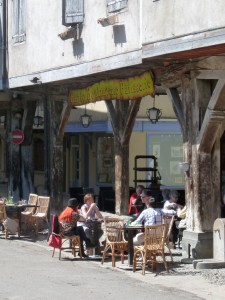
A table in the sun, a moment shared with friends... French café life in the traditional style.
A table in the sun, a moment shared with friends… French café life in the traditional style.

Think of your last holiday in France, and it’ll probably include memories of a morning coffee and croissant in a cosy little bar, or of relaxing and people-watching with an evening pastis, sitting outside a café in some pretty sunlit square.   Hang on to those memories.

In 1960, France had 200,000 cafés and bars. Now there are fewer than 40,000.  Those characterful smoky rooms with dark wooden furnishings, and solitary men sitting at the bar nursing an early morning brandy are an endangered species.  All over France, cafés are closing at the rate of about 10 a week.  Blame TV, blame the smoking ban, , blame ‘la crise’, blame readily available alcohol in the supermarket.  Whatever the reason, many cafés can no longer make a go of it.

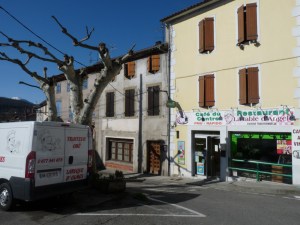
Take Laroque.  Our town of 2000 or so used to support more than half a dozen bars.  Now there are three, and they struggle.  Obé – that’s what everyone calls our Obelix look-alike – can’t make a living from half a dozen elderly men who come in most afternoons to nurse a single beer while they watch the afternoon’s horse racing.  But he can cook, so he’s reinvented the bar as Table d’Angèle, a successful lunch-time restaurant serving home-cooking, mainly to tradesmen looking for a once-a-week treat to break up a day’s plumbing, building or electrical work.

There we are.  That's Table d’Angèle.  And there's Obé's van.  He needs to offer outside catering too to bring home the bacon.
There we are. That’s Table d’Angèle. And there’s Obé’s van. He needs to offer outside catering too to bring home the bacon.

Down at Le Lounge, the owners have had to have a different strategy: food didn’t work for them.  They tried a traditional menu.  No good.  Then they had a go at offering an eat-all-you-can buffet.  When that failed, they tried Italian food.  Now there’s no lunch-time menu at all.  They make do with weekend trade, when sparkly lights and disco music attract the young people of the area before they head off for the Orient Express, the out-of-town nightclub at the once-upon-a-time station.

The Jingo’s still looking just about OK.  It’s on the main road and seems to get a steady enough stream of customers.  It may outlive the rest.

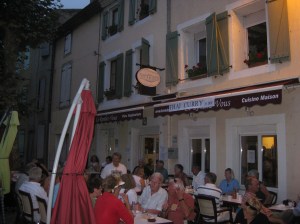
But bars can rise as well as fall.  When le Rendez-Vous in Léran, the village next door, came up for sale a few years back it was a hopeless case: dingy, unpopular and seemingly beyond rescue.  But an English couple who’d never run a bar in their lives bought it and made it the hub of village life.  Shirley cooks with imagination and flair – she even has that unknown round here menu item, the vegetarian dish.  Marek’s a cheerful and extremely hard-working host who’s always pleased to see you.  Quiz nights, open mic nights, a big screen to watch the rugby, a cosy corner with books to read and exchange….  It’s a winning formula, and both French and English from the village and beyond ensure the bar’s kept busy late into the evening, especially in the summer.

Le Rendez-Vous one busy evening in mid-summer.  There's an evening market in town too.
Le Rendez-Vous one busy evening in mid-summer. There’s an evening market in town too.

And over in Mirepoix, there’s another new café.  The Mad Hatter isn’t just another bar.  It’s hoping to cash in on the French love affair with things ‘so British’.  A nice cup of tea with a scone or slice of ginger cake might not be traditional French fare.  But it’s a welcome addition to café society, and yet another way in which the traditional French bar has to change, or sink without trace.

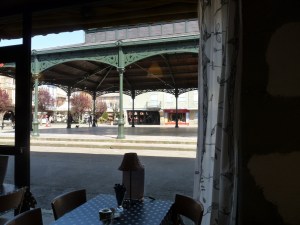
A welcome moment of calm, gazing out of the window over a cup of Earl Grey at The Mad Hatter, Mirepoix.

Catalonia visits southern France, bearing calçots

My daughter Emily’s just visited from her home in Barcelona, bringing her Catalan boyfriend, and an enormous bundle of calçots sent by his mother.

Calçots! Think we have enough?

Eating calçots is a century-old tradition in Catalonia at this time of year.  Garden onions are planted deep in the soil, and earthed up throughout their growing period, so they have long thick white stems, just like a leek’s.  Harvested between Christmas and Easter, they’re a much appreciated local delicacy.

Really, they should be grilled fiercely over an open fire or barbecue.  We lack a barbecue, and in any case, southern France has its own traditions: Holy week is cold, wet and miserable.  Without fail.

Preparing the calçots

So we settled for baking them in a fiercely hot oven.  And then we got down to the cheerfully messy business of eating them.  You strip the hot slippery skin off each calçot, and then dunk it in a punchy romanesco sauce before tipping your head back to ingest the lot.  You need napkins, yards of kitchen roll – bibs would be good –  and good bread to mop up the juices and sauce.

Serving the calçots.  Another break with tradition.  They should be on a terracotta roof tile.
Serving the calçots. Another break with tradition. They should be on a terracotta roof tile.

We had fun, but probably not as much as if we’d visited one of the outdoor festivals dedicated to the eating of these alliums.  Watch the video from Valls.

Eating the calçots.  No red wine for us.  The calçot-bearers drove back to Barcelona straight after the meal
Eating the calçots. No red wine for us. The calçot-bearers drove back to Barcelona straight after the meal

Coffee and walnut cake – the failure

I knew it would end in tears. I should have listened to Nigel.

Malcolm’s favourite cake in all the world is coffee and walnut cake. So why not indulge him for his birthday? I made one a while back, and it was just as it should have been – rich and indulgent, with a moist crumb, but not too sickly sweet. How could I have forgotten that it was Nigel who delivered, as he invariably does, the Tips That Matter? I turned to another book, a BBC book for heaven’s sake, which is normally pretty reliable. My instincts told me it was wrong. The size of tin relative to the mixture, the heat of the oven – everything. But I decided to go for it in every particular: you don’t argue with the Beeb.

And of course I shouldn’t have done. The two layers were too thin to rise into a satisying mound of comforting coffee-infused sponge, the quantity of icing advised would have filled and decorated enough cakes to fill the WI stall at the farmer’s market. I was unimpressed. Malcolm’s being too polite to say so, but he did venture to point out that Nigel is King in this house, and his recipes should always be first port of call.

Here’s his recipe. I’ve just this minute compared it with the one I made. And would you believe, the two are all but identical?  Extraordinary.  Jut reading a recipe by Nigel seems to make it succeed.

It’s rare for me to follow recipes to the letter.  Like Nigel Slater, I tend to adapt, substitute, tinker.  So what I’ve learnt from this is that instincts are there to be heeded.  If a recipe seems wrong, it probably is.  For you, anyway.  On that particular day, at least.

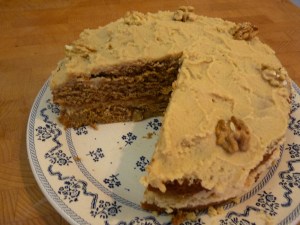
The failed coffee cake. It can't be all that bad.  We'll eat it.
The failed coffee cake. It can’t be all that bad. We’ll eat it.

Painter’s Toast

You might have noticed we’ve been busy lately.  Bathroom-building.  Time-consuming lunch-time cooking doesn’t fit well with such industriousness.  I’ll often have a pot of soup on the stove, but the other day, a lunchtime treat from our days in England suddenly popped into my head.

Painter’s toast.

I think I read this recipe back in the 70’s, in an early example of the genre where famous people were invited to submit a recipe for a book raising funds for a charity.  I’ve just remembered what it was:  ‘The Shelter Cookery Book’. Was it Roger McGough who suggested crisp sandwiches?

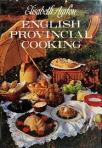
One of Elisabeth Ayrton's best-known books
One of Elisabeth Ayrton’s best-known books
Novel by the painter

Anyway, Michael Ayrton said he and his wife were often too busy to make lunch.  Unsurprising really. He was a painter, printmaker, sculptor and designer, broadcaster, novelist and stage and costume designer.  Fascinated by the Minotaur and the maze-builder Daedalus, he created many works inspired by them.  Elisabeth, his wife, was a writer and the author of several cookery books.  So I suppose beans on toast just wouldn’t do.

Here’s what they came up with, as far as I can remember.

Mix grated strong cheese – cheddar is good – with a small amount of milk and softened butter.  Add a bit of whatever you fancy to liven it up.  Maybe mustard.  Maybe a little chilli.  Pile onto bread which you’ve toasted on one side only, and grill until bubbling and browned on top.

That’s it.  This close cousin of Welsh Rarebit always goes down well with us on cheerless winter days.  It may suit you too.  And while you’re at it, you might enjoy looking at a few more of Michael Ayrton’s works.

If Heath Robinson* only knew

Over in a tiny village in the Couserans today for a huge lunch – Azinat – with friends, we came across this sight:

It’s an alambic – well two alambics actually.  We knew that, because we’ve seen plenty of these historic pieces of machinery on display in villages throughout the area.  We even know what they’re for: every autumn, villagers still look forward to the annual visit of the alambic man whom they pay to transform the juices from their apples, plums or whatever into the most potent hooch you can imagine: up to 50% proof.  These alambics  showed signs of having been recently used: the tractor next to them still had its engine running.

We retired to our restaurant for lunch.

Three and a half hours later, the meal over, we sauntered over to where we’d spotted the alambics: huge copper contraptions encased in a battered wooden frame.  They were functioning!  Three large rubicund men, the types you can meet in the countryside anywhere, any country, were supervising hooch production, and were very happy to explain everything.

Checking everything’s fine

Well, I can’t be sure I’ve got this right.  It’s something like this though.

A fire under the first cylinder heats the juices that are poured into it.

The all-important fire. Note the wheels on which the machine originally travelled

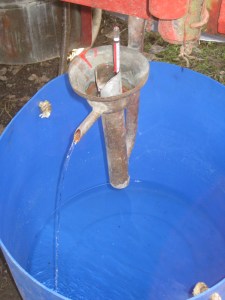
The resultant steam is forced up through pipes, which are cooled by water.  The vapour condenses into alcoholic liquid.  That doesn’t sound quite right to me: I never was any good at science.

Copper lid – parked for the moment.

Anyway, it’s the result that counts.  We met a Dutch couple who’d brought along their plum juice to be processed.  135 litres of juice.  And their eau de vie was now almost ready for them to pay for and take away.  Their 135 litres had become …. 10 litres.

Here’s the hooch

They didn’t yet know what they were going to be charged.  But they had been told they’d have to fill in a lengthy document for the tax office, and pay a suitable levy for this astonishingly potent product.  We know for a fact it’s strong stuff.  There were the dregs in a large plastic container.  They invited us all to dip a finger in and taste it.  We did.  And I promise you – just licking a fingerful probably put us over the limit.

We felt as if we’d witnessed a real piece of history.  When these men retire, are there young people around who will follow in their footsteps?

This alambic’s probably good for very many more years

* And if you don’t know Heath Robinson, click the link

‘Let them eat cake’

Back in the UK, I hear everyone’s gone baking mad, that the entire nation was glued to its screens to watch the final of  ‘The Great British Bake-off’.  Here in France, it’s the one branch of cookery in which the average French person will allow the average Brit some supremacy.

The French are rightly proud of their high-end patisserie, the delectable tarts and gâteaux which traditionally come to the table at the end of a family celebration or Sunday lunch: from the baker’s naturally, no shame in that.

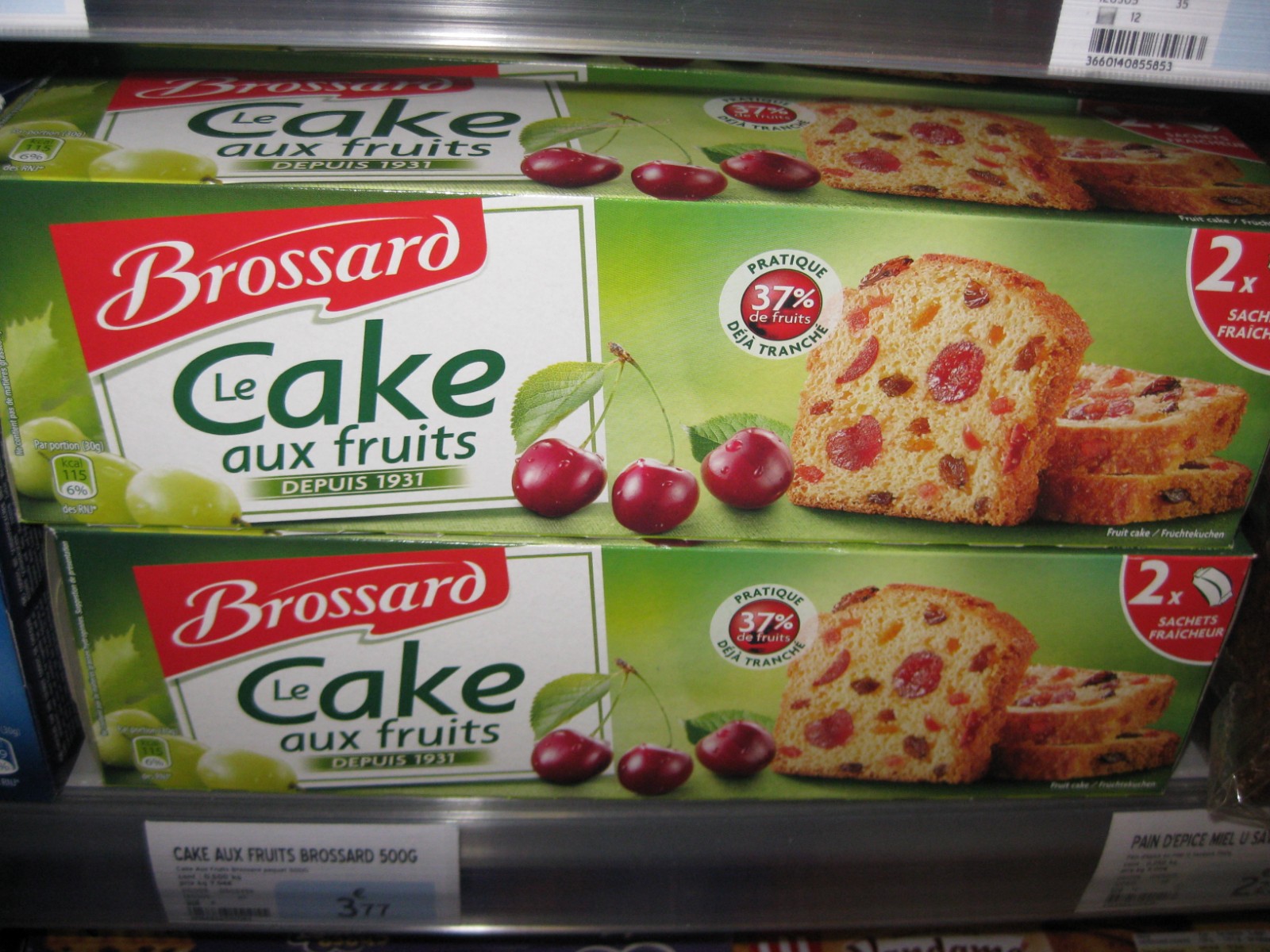
More day-to-day baking is a different matter, however.  Plainish cakes, loaf-shaped and known in France as ‘cake’, are a big disappointment, especially if they’re from the supermarket.  I find them over-dry, over-sugared, too strongly flavoured with something, such as vanilla, that should be a subtle undertone.  I never thought I’d find myself saying this, but even cakes available in any old British supermarket can be quite a treat in comparison.

McVitie’s Jamaican ginger cake, for example, dark and sticky, is just the thing with a hot cuppa after a brisk country walk in winter: it even has its own website.  And while I’m not sure that Mr. Kipling makes exceedingly good cakes, they’re – well – not too bad.

No wonder then, that when we run our cookery workshops at Découvertes Terres Lointaines, and announce that we’ll be turning our hands to British tea-time treats, the group is immediately oversubscribed .  Scones, coffee and walnut cake and a nice of cup of tea anyone?

Supermarket scene in France