Season of blackberries, apples and mellow fruitfulness

It’s been quite a year for blackberries.  Fine juicy berries tumble from every bramble bush, staining our clothes and ruining our shoes.  Even if, like me, you work on the principle of eating one berry for every two you collect for the pot, you’ll soon have more than you can realistically deal with.

Then there are apples.  Kind friends have given us fruits carefully picked from their trees, but we consider these too fine to mix with other ingredients.  When we have jellies and compotes to make, we prefer to rescue windfalls from back lanes in the village, cut away the bruises and discard the insecty bits.
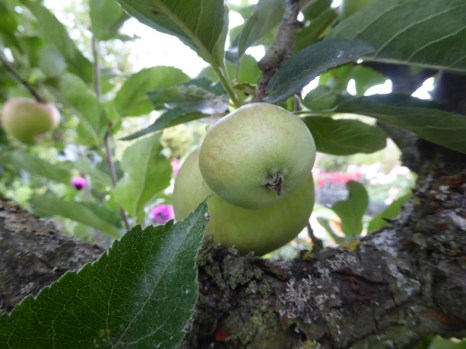
This year, we have two best uses for blackberries, and for apples too.

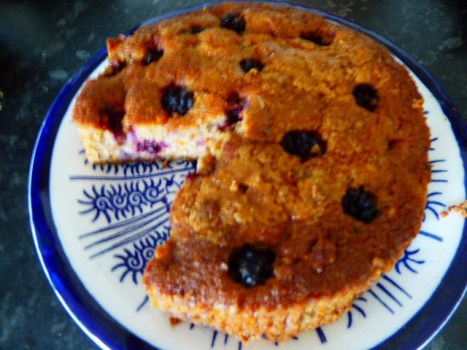
This is a blackberry bakewell tart.  The recipe is from the wonderful Mrs. Portly, and her recipe called for raspberries.  I used blackberries instead, and my greedy family demolished the lot in a single sitting.
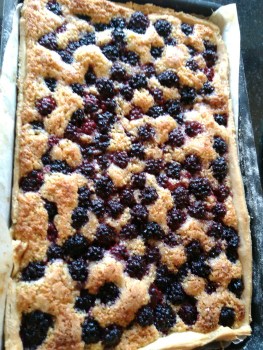
Blackberry bakewell slice – just out of the oven.

Much of the rest of our harvest has been used for blackberry and apple jelly.  We no longer eat jam, but the intense flavour, and rich ruby colouring of this jelly  is pure essence of blackberry, and a souvenir of late summer days in the dreary dark days of winter.  It’s really worth making a few pots.

Take equal quantities of blackberries and apples.  Roughly chop the apples, which you needn’t core or peel, and place in a pan, barely covering the fruit with water.  Bring to a simmer till the apple softens and the juices run from the berries: 10 – 15 minutes.


Strain the juices through a jelly bag, or through a muslin-lined sieve for several hours.  Measure the juice.  Although I usually cook in metric, at this point, I go all avoirdupois, and work exclusively in pounds and ounces and pints.  It just seems to work better for me.


Return the extract to the pan with the juice of a lemon, and for every pint of juice, add a pound of granulated sugar.  Stir till the sugar has dissolved and boil rapidly till a ‘jell’ is obtained on testing. If you’re new to making jelly or jam, this article is helpful.

Our blackberry jelly will taste all the better because we had help from grandson William, aged two. He gathered berries, and hunted for windfalls.  He’s a London child, and his parents were keen for him to help with any job not available to him in a city park.


His parents have taken a pot of jelly back to London as a souvenir, of course.
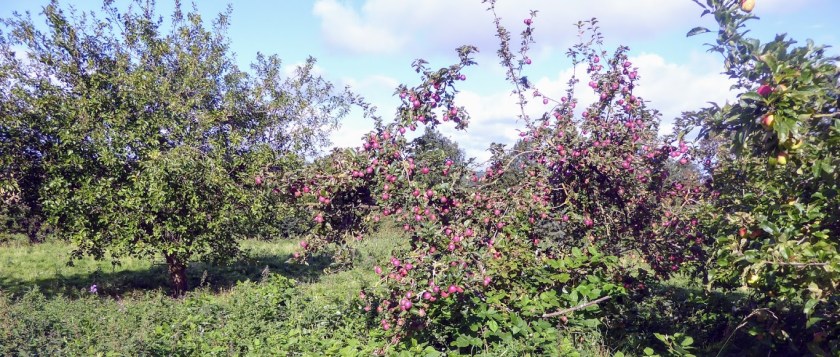
Dozens of plums, hundreds of plums ….

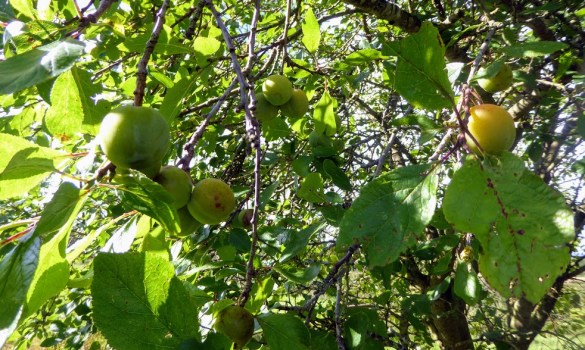
This is Gillian’s orchard. Her apples were more photogenic than her plum trees. Thanks for all this fruit, Gillian!

We don’t seem to eat jam any more.  And gifts of English style chutneys, full of summer and autumn fruits and piquant with the inevitable malt vinegar sit reproachfully at the back of the food cupboard, uneaten and unloved.

There are only so many plum frangipane tarts you can eat, delicious as they are (thanks, Mrs. Portly!) Or plum cakes.

What to do with all these plums we’ve picked?  Open freeze some for winter cakes and puddings?  There, that’s sorted a kilo out.  Now what?

Gathering greengages.

Well, perhaps we could make some chutney after all.  Fired up with chillies and warming spices, they could make a decent addition to a simple winter supper.  Finding a recipe that fits our bill is a task Google was made for.  And here it is, courtesy of a blog new to me that I’ll be following with interest from now on, The Cottage Smallholder.

Hot spiced plum chutney
 
Author: Fiona Nevile
Prep time: 30 mins
Cook time: 3 hours
Total time: 3 hours 30 mins
  • 1.45 kilos approx of sweet plums
  • 500 ml of white wine vinegar (don’t use malt or white vinegar)
  • 4 chunky cloves of garlic sliced fine
  • 175g of dried apricots chopped
  • 600g of white granulated sugar
  • I lemon cut lengthwise into 8 slices and sliced very fine (ours weighed 100g)
  • 1 large pinch of cayenne pepper
  • 1 teaspoon of coriander powder
  • 7 red birds eye chillis sliced fine, include the seeds
  • 1 tsp of salt
  • 1 tsp of allspice powder
  • 1 tsp cinnamon powder
  • 1 tsp ground ginger
  • 1 tsp of balsamic vinegar
  • 5 juniper berries
  • 10 black peppercorns
  • 1 tsp of dried chillies, chopped fine with seeds
  1. The night before you want to make the chutney, stone the plums and put them in a large heavy bottomed saucepan/preserving pan and add the vinegar. Bring to the boil, cover and leave to cool until the next day.
  2.  Add all the ingredients apart from the sugar and the dried chillies.
  3. Bring slowly to simmering point and add the sugar. Stir constantly until you are certain that the sugar has dissolved.
  4. Bring the chutney back to a good simmer and, after an hour or so, add the dried chillis to taste.
  5. Stir every few minutes to stop the bottom burning (this is a labour of love after all).
  6. Eventually depending on the strength of your simmer, the chutney will start to thicken (more like very thick soup than chutney), stirring every 10-15 minutes or so. Test for thickness by putting a spoonful in the fridge for half an hour and take the saucepan off the stove during the test.
  7. When you have a consistency that you like, very gently reheat the chutney and when it reaches simmering point pour into warm sterilised jars and seal with plastic lined metal lids. Leave for a month to mellow.
  8. N.B. Don’t use cellophane jam pot covers as the vinegar will evaporate and you will be left with relics from a Pharaoh’s tomb after a few months.

We haven’t had the chance to taste the fully matured version.  But this seems to be the business.  Hot, fiery, with complex flavours that aren’t overwhelmed by vinegar.

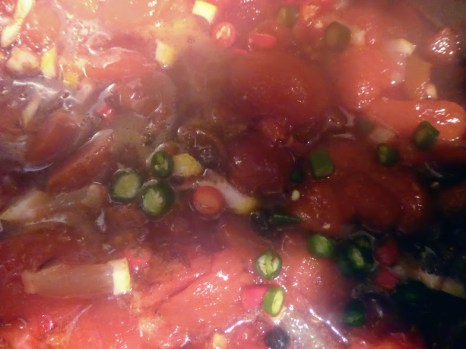
Chutney bubbling away.

And if you still want another chutney, good old Saint Nigel delivers another spicy treat in his cooking bible, ‘Tender’

Nigel Slater’s hot and sweet plum chutney
. 750g of plums (about 1 1/2 pounds)
. 350g of onions (about 3/4 pound)
. 125g of raisins (about 3/4 cup)
. 250g of light muscovado sugar (1 1/4 cups)
. 1/2 tsp of crushed dried chillies
. 2 tsp yellow mustard seeds
. 150ml of apple cider vinegar (5 1/2 fluid ounces)
. 150ml of malt vinegar (5 1/2 fluid ounces)
. a cinnamon stick broken in two

Halve the plums, discarding the stones. Peel and roughly chop the onions. Put the fruit and the onions into a large heavy bottomed saucepan. Add the remaining ingredients. Bring the mixture to the boil, then reduce the heat to low. Simmer on low heat, stirring occasionally, for about an hour. (DO not forget to stir it occasionally as it may catch if you don’t and you don’t want that to happen!) Pour into hot and sterilized jam jars. Seal. Allow it to mature for at least a couple of weeks.

Now then.  All you have to do is source your plums …. and get cooking.

The backdrop to all our picking activity. Not bad, eh?

‘Au cas où’ you need some wood, or a bag of fruit.

We’ve been getting in touch with our inner Ariègeois(e) today.

Our foraging country in the Ariège

We spent six years in France, living in the foothills of the Pyrenees in the Ariège, a département where almost everybody still had firm roots in the simple self-sufficient lifestyle of their forbears.  Nobody that we knew would have considered installing, as David Cameron recently has, a faux shepherd’s hut in the back garden.  Instead, most people had a serviceable shed, built of bits of this and that and adapted to personal requirements.

Nobody that we knew ever bought firelighters for their wood burning stove.  Instead, we’d all hang around as the weekly market packed up, rescuing the wooden fruit boxes, now empty of peaches and pears, which when broken up provide perfect kindling material.

Everyone we knew never left home without an ‘au cas où‘ (‘just in case’) bag, to fill with wild mushrooms, or walnuts, or sloes, or chestnuts, or apples, or any free food that came their way.

Foraging in the Ariège…..

That’s been us this week.  We don’t need a garden hut.  But we have got a wood-burning stove.  And today we’ve been re-purposing the wooden casing that our delivery of logs came in.  It’s soft wood, so we know we can only use it sparingly on our stove.  But it’s there – and we will use it.  So here we were, sawing it into manageable lengths, sorting and storing it.

We’re the odd-bods who gather the discarded fruit boxes at Ripon market. We’ve been breaking those up today too, for kindling.


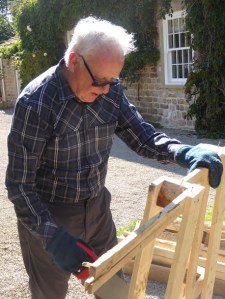
Malcolm does a fine job of sawing up some wooden pallets.

And yesterday, our friend Gillian had us over to raid her plum trees.  We came back with a pail full of greengages, and a pail full of czars. Today was the day when we started to convert this ripe fruit into chutneys and cakes and hooch and crumbles.  Our French friends would definitely approve.


‘Here we go making mulberry gin….’

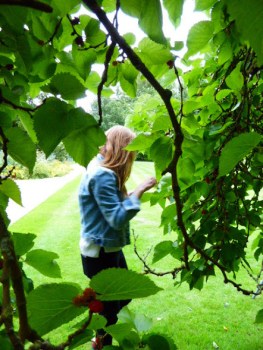
My morning sortie to gather a bowlful of mulberries for breakfast (actually, forget the bowl.  Mulberries go directly to mouth) has suddenly got much harder.  Autumn’s in the air as I traipse across the dewy grass.  The mulberries are fewer.

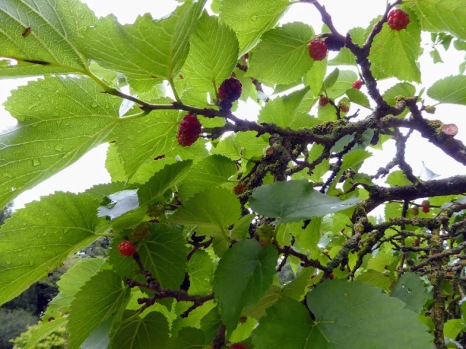
The mulberry tree still bears fruit.

This isn’t just the fault of the weather.  We have some new residents in the garden.  A family of moorhens: mum, dad, and five chicks.  They like mulberries too.  The windfalls that used to be mine, all mine, are now theirs, all theirs.  But who could begrudge such charming tenants?


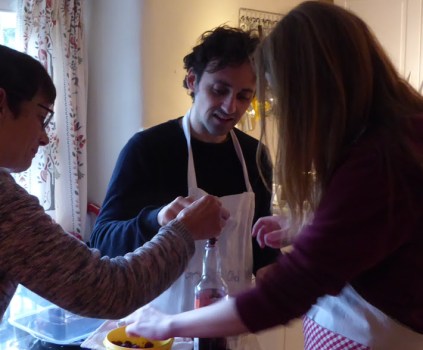
Anyway, I suddenly realised that if we were going to have our much talked-of mulberry gin in time for Christmas, we needed to act.  We had a houseful of helpers.  Not just Malcolm, but Emily and her boyfriend Miquel, over from Barcelona.

Out came the bowls.  Out came the small steps.  Out came the team.  We stripped the tree of any berries that were ripe enough to fall into our hands, as the moorhen chicks cheeped and protested from their lair in the flowerbed.

Emily concentrates on the task in hand.

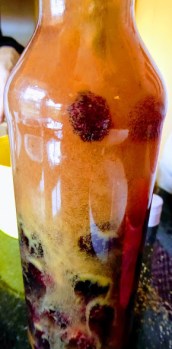
The rest was easy.  Wash the berries.  Half fill an empty bottle with gin.  Poke berries into bottle.  Add sugar.  Argue about whether to follow the recipe that suggests adding a handful of roasted almonds or not.  Decide to leave almonds out today, but add them to the next batch.  Screw cap on bottle.  Shake.  Place in cupboard with note to self to shake bottle daily for a couple of weeks, then wait for months.  That’s it.  Tidy up.  Before Christmas we’ll strain off the gin, re-bottle it … and look forward to sampling it on Christmas Day.

How many people does it take to fill a mulberry gin bottle?

Or … if you’re on our Christmas present list, you might get a bottle too.

Mulberry gin in the making.

Snapshot Saturday: Mulberries for the taking

The mulberry tree outside the study window.

See this tree?  I look at it every day, from the study window.  As trees go, it’s not so special to look at.  But for two months in summer it gives satisfaction to three households, by providing them with mulberries, day after day after day.

Mulberries ripe and under ripe.

Although they grow on trees, mulberries are a bit like loganberries, or a cross between raspberries and blackberries.  They’re tart, yet sweet, and very moreish indeed.  I can’t pass the tree without scavenging on the lawn for a handful to eat.

Yet another bowlful of mulberries

I collect a dishful every morning to put on my cereal. We add them to summer pudding, to yoghurt, to ice cream. We bake with them. We make syrups, cordials and mulberry gin with them. And the tree goes on and on, producing more and more fruits, every day from July to September.

The birds ignore them.  We don’t.  Such a satisfying job, collecting our daily ration of free fruit.

Here’s a recipe I tried out this week.  It’s adapted from one of Nigel Slater’s reliably tasty offerings.  No mulberries?  Poor you.  Use raspberries, tayberries, loganberries or blackberries instead. They’ll be good too.

Mulberry and apricot cake

  • 175 g. butter
  • 175 g. golden caster sugar
  • c. 200 g. apricots
  • 170 g. mulberries
  • 2 eggs
  • 175 g. self-raising flour
  • 100 g. ground nuts – I used a mixture of walnuts and almonds.  Hazelnuts are good too.
  • 2 tablespoons of milk.

20 cm. loose-bottomed cake tin, lined.  Oven temp 180 degrees (Gas 4)

  1. Stone and roughly chop the apricots.
  2. Cream butter and sugar together till pale and fluffy.
  3. Beat the eggs lightly and add to the creamed mixture a little at a time, adding a spoonful of the flour if necessary to prevent curdling.
  4. Slowly incorporate the flour and ground nuts, then the milk, then the apricots and mulberries.
  5. Scrape the mixture into the cake tin.  I added a few extra mulberries on the top  – this was decoration enough on the finished cake.
  6. Bake for an hour and ten minutes.  Test with a skewer.
  7. Leave to cool, then turn out onto a plate.  Eat.

    Someone’s been eating my mulberry cake ….

And that’s my offering for this week’s WordPress photo challenge: satisfaction


Snapshot Saturday: Danger! Death by chilli

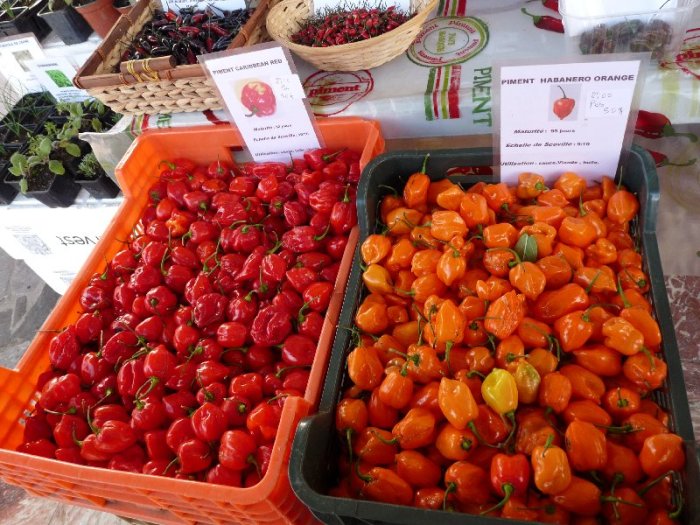
M. Chilli’s chillies

When we lived in France, the easiest way to persuade a French friend that you did not have their interests at heart was to produce a spiced dish, especially one with chillies in.

‘Oh, we love spicy food’, declared Henri and Brigitte when we broached the subject of cooking them a curry.  All the same, we were careful.  We dished up a korma so mild that it barely qualified as spiced at all.  ‘Ouf!’ exclaimed Henri, after the first tentative mouthful – ‘are you trying to kill us?’

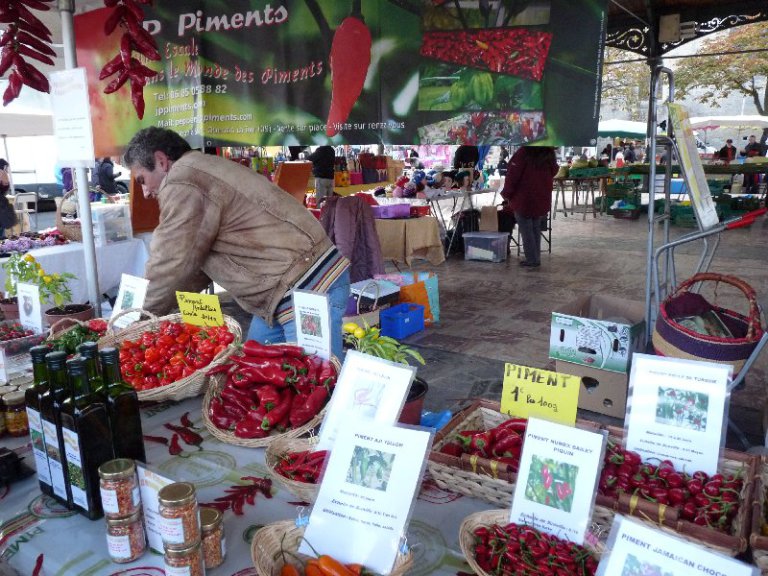
With this in mind, it was a huge surprise to us when one Friday in Lavelanet market, we came upon a man with a stall full of chillies.  Orange chillies, yellow chillies, green chillies, purple chillies, fresh chillies, dried chillies.  He had no customers at all.  So he had time to chat to us, and explained that he’d come to love chillies, and to be passionate about seeking out new varieties, growing and using them.  He was one of two such growers in France.  We bought from him.  He had other English customers.  The French?  Not so much.


Jean Philippe Turpin and his stall at Mirepoix market.

That was five years ago.  After relying on northern Europeans to bail him out, slowly but surely he started to attract a few French customers too.  He’s still in business.  Perhaps, despite the danger represented by a Red Savina chilli rated 500,000 on the Scoville scale, he hasn’t managed to kill anybody off yet.

M. Chilli’s smallholding, devoted exclusively to chillies, chillies, and more chillies.


This post responds to this week’s WordPress photo challenge: ‘Danger!’


Wild garlic, Mrs. Portly style.

Wild garlic is the ingredient du jour these days.  Good Lord, you can even buy it in the shops.  Just as you can buy dandelion leaves in France.  It even turned up in my veg. box last week: which was faintly annoying, as I can have as large a haul as I want of the stuff, simply by stepping out of the door and taking a two-minute walk to the woods.

It was fine though, as it made sure I tried this recipe from one of my favourite food bloggers, Linda Duffin, aka Mrs. Portly.  A recipe for gnocchi? Good.  With wild garlic?  Excellent.  But fried in butter and oil before serving?  Wasn’t that a little odd?  No, it wasn’t.  It changed those gnocchi from comforting nursery fodder into something altogether more satisfactory to accompany a fine plate of local sausages and some barely cooked purple sprouting broccoli.  Don’t tell Linda, by the way, but I steamed my potatoes rather than baking them.  It was absolutely fine.

Linda’s asked me to cut and paste her post rather than reblogging it.  I hope this won’t dissuade you from exploring her site. You’ll find some recipes you’ll want to try out within moments.

Mrs Portly’s Kitchen

A Suffolk Aga Saga

Image of wild garlic

Pan-Fried Wild Garlic Gnocchi

Image of wild garlic in woodsWild garlic abounds at this time of year … everywhere except in my neighbourhood. I am planting some for next year but in the meantime I have to forage far afield to find it. There are alternatives though if it’s equally elusive where you live.

You can replace it with three-cornered leek, which often grows wild where garlic doesn’t, or steal a few leaves from any domestic garlic bulbs you may have growing in the garden. I haven’t tried it with the green part of spring onions but it’s worth experimenting.

You don’t have to pan-fry the gnocchi (in which case try brown butter, a few fried sage leaves and grated parmesan) but it’s a lovely way to eat them, either as a side dish, or on their own with a good tomato sauce.

We ate them with seared venison fillet and purple sprouting broccoli, steamed and tossed with a mixture of butter, lemon juice and zest and anchovy.

Any leftover gnocchi can be frozen, uncooked, in a single layer. Transfer to a sealable bag and when you want to eat them, cook from frozen, straight into boiling water.

Image of wild garlic

A note on foraging: it’s not illegal to pick flowers, fruit, fungi and foliage in the UK provided it’s for personal rather than commercial use. There are exceptions to this: local by-laws may forbid foraging and for obvious reasons you can’t do it at Sites of Special Scientific Interest.

It is illegal to uproot a plant and it’s sensible to pick a leaf or two from lots of plants rather than to denude one. And bear in mind that while foraging isn’t classed as theft, you may still be committing the civil offence of trespass. If in doubt, ask the landowner.

PAN-FRIED WILD GARLIC GNOCCHI

  • Servings: makes around 40

Image of gnocchi frying

Ingredients:

700g floury potatoes

Salt and freshly ground black pepper

120g wild garlic leaves, thoroughly rinsed, or 80g domestic garlic leaves

2 egg yolks

150g plain flour

Rice flour, for dusting

Olive oil and butter, for frying

Method:

image of potatoes being riced

Bake the potatoes until soft. As soon as they’re cool enough to handle, scoop out the middles and push through a ricer into a bowl. Allow to cool.

Blanch the garlic leaves in boiling water for a minute, drain very thoroughly and chop finely. Add to the potato along with the eggs yolks and stir with a fork to mix.

Image of ingredients in bowl

Season well and add three-quarters of the flour, stirring with the fork again. Form into a dough and add more flour as necessary until you have a soft, pliable but not overly sticky dough. You may not need all the flour. Try not to over-work it or your gnocchi will be tough.

Dust your work surface lightly with rice flour. Divide the dough into four and roll into sausages, about 2cm in diameter. With a sharp knife, cut into 2.5cm sections.

Image of gnocchi being formed

You can either use these as they are, as little cushions, or roll them over a floured fork to make indentations. These ridges are supposed to help sauce adhere but honestly, I don’t think it makes much difference and unless you are deft and experienced, there’s a danger of over-working the dough.

Bring a large pan of salted water to a boil and drop in the gnocchi in batches. Don’t overcrowd the pan. They’re about done when they bob to the surface, around three minutes. Give them another 20 seconds then taste one: it should be cooked through and not floury. Remove with a slotted spoon and drain well.

Heat two tablespoons of olive oil with a good knob of butter in a heavy-based pan and fry the gnocchi on each side until golden brown. Eat straight away.

Image of gnocchi served

Marmalade in the rain

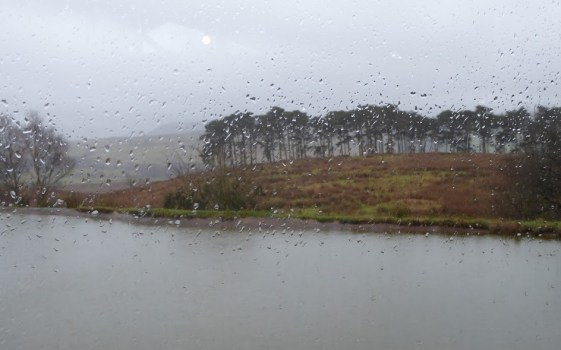
We’ve just had a typically British weekend.

Rain.

Coffee stop at Tebay.


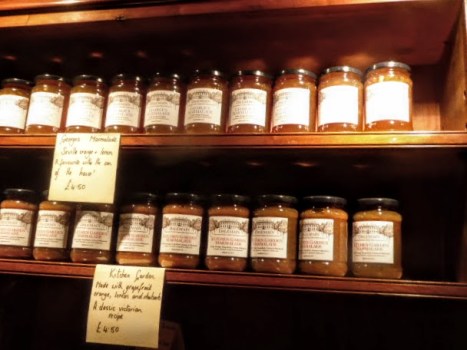
And lots of marmalade.

Marmalade shop at Dalemain.


Surely it’s only in England that you would find an annual festival dedicated to marmalade in all its forms?  And it’s no surprise to find it hosted in a delightful country house, Dalemain, the family home of the Hasell-McCosh family.

Delmain, Cumbria

Eleven years ago, Jane Hasell-McCosh devised this very British festival, and now in March every year, some 2,000 marmalade makers submit their entries to be judged .

The day kicked off in a rare rain-free moment with local schoolchildren belting out a jolly song about the delights of marmalade.  In this ballad, they rejected any treat they were offered, preferring instead a slice of toast, well slathered with this bitter orange preserve.  As if.

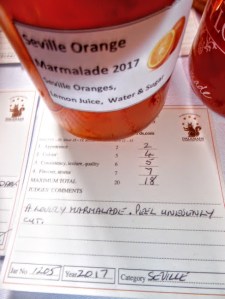
MC was one of my baking heroes, Dan Lepard.  He introduced everyone, and announced the winners.  And then we went into the house, to visit room after room stuffed with pots of marmalade.  Each jar is awarded a series of marks, and is given an individual critical commentary.  I was quite cross that I hadn’t in the end made the effort to enter any of my own efforts.

The entrants though are not only true Brits, eccentric or otherwise.  In our B&B we had met Chris Brown, a baker from Vancouver, who had come for this one weekend only to enter his marmalade.  He’d already won gold medals in previous years.  So many Japanese have done well that the Japanese Ambassador himself came to the opening ceremony and made a gracious and witty speech.  There were Australians there, and Kiwis, South Africans, Americans, someone from the Czech Republic ….

18 is a decent score: worth a silver medal, I believe.

The competition has categories for Seville orange marmalade of course, for marmalade with a twist, for any citrus marmalade, for dark and chunky marmalade ….. all this could be predicted.  But a category for marmalade makers who are also campanologists?  Octogenarians?  ‘The Establishment’: those redoubtable and upstanding members of society, such as bishops, MPs and judges who used to be the only people who could verify your likeness for a passport application?

This is entirely in keeping with the professional-but-with-a strong-hint-of-the-amateur feel of the festival.


I paid extra to go to Question Time.  Baker Dan Lepard, food historian Ivan Day, marmalade guru Pam ‘the jam’ Corbin, and  Martin Grant,  MD of Mackay’s Marmalade made the hour whizz past.  One conversation stood in my mind. ‘If we sent each of you home with a basket of raspberries, or blackcurrants and asked you to make jam, you’d all come back with much the same product.  If we sent you home with a bag of oranges, you’d each come back with something quite different.’ And it’s true.  They’d range from dense, dark and treacly with big chunky chewy peel to bright jewelled orange jellies with a delicate filigree of fine strands of zest suspended within.  And all stops in between.  This immense variety to be had from a product made simply with oranges, a bag of sugar, a lemon, and perhaps a little secret something is what gives marmalade its continuing appeal.

Who knew that squirrels like marmalade?

After lunch, we popped into Penrith.  The town had gone orange for the weekend.  The face of the town clock was orange: the shop windows were dressed in orange, and there was an orange-themed market in the town square.  Marmalade anyone?  It was all good fun, despite the unremitting rain.

Next morning, we headed home.  The rain was so intense that newly established rivers and waterfalls cascaded from the hills.  Older-established rivers burst their banks and flooded across roads.  Fields developed impromptu lakes.  It reminded us of a remark that Malcolm had overheard at the festival: ‘I come every year.  But it always rains’

Of course.  This is Britain.  This is Cumbria.

But this was our welcome home to Yorkshire.

Pancakes at the Cathedral

Ripon Cathedral – viewed from High St Agnesgate  (geograph.org.uk)

One of the bells of Ripon Cathedral sounded this morning: sonorous, measured and slow.  The pancake bell.  It’s rung out every Shrove Tuesday for centuries now, just like other bells in other churches, countrywide.  It reminds good Christian folk to come to church and confess their sins, before Ash Wednesday.  Some also believe it was to remind thrifty housewives to use up their eggs, butter and milk before fasting during Lent.

Gentlemen of the press outside the cathedral to record the action.

Nowadays it’s a signal to gather outside the cathedral and have a bit of fun.  Somebody has already cooked a pile of pancakes.  No point in making lacy delicate crepes.  These pancakes are in for a tough time as props in the annual pancake race. Contestants have to run from the Cathedral, down Kirkgate, pan in hand, tossing as they go …. onto the pavement, as often as not.

I watched teams from the Rotary Club, from local primary schools, from the Italian restaurant down the road.

The lads from Valentino's Italian Restaurant arrive to do their bit.
The lads from Valentino’s Italian Restaurant arrive to run in style.

 Sadly though I missed seeing the clergy do their bit: things to do, places to go.  It all seemed amiably uncompetitive.  Just a chance to chat to the Hornblower (who keeps us safe through the night here in Ripon), to friends, and to take a few snapshots of this happy little Shrove Tuesday tradition.

Later, much later, Malcolm and I had pancakes too, delicate lacey ones, served with lots of sugar and lemon juice.  We tossed them of course.  But we didn’t run down the street with them.

Bean and Bud

bbc-1We love Bean and Bud.  Without a visit to this coffee (and tea) shop, no visit to Harrogate is complete.  It’s a compact and friendly place, on a busy little street filled only with small independent and charity shops.

Bean and Bud sets the gold standard by which all cups of coffee should be judged. Choose between one of their two weekly featured beans – or something else if you prefer – and your coffee will never be churned out, just because they’re busy. Your cup will be perfectly prepared, with attention to every detail – a glass of iced water with your espresso, for instance.

They got our loyalty the first time we went.  For years, every coffee shop we’ve visited has lazily assumed that Malcolm, as the Real Man in the relationship, would need the espresso, whereas the Little Lady (me) would require a version with milk in.  Actually it’s the other way about, and Bean and Bud made it their business to find out – and then remember – our preferences.

I don’t care for tea much (yes, I am English) but friends who do admire the speciality loose leaf teas, weighed and brewed for just the right amount of time.  Perhaps I ought to give them a go.

 At lunch time, there are just a few types of sandwich on offer, but they’re on decent bread, well-filled with proper ingredients – local cheese, good serrano ham, fresh zingy salads, home-made chutneys.  But could you resist the home made cakes?  They’re not airy calorie-fests filled with cream and topped with thick layers of icing, but densely flavoured with gingered treacle, poppy seeds, bitter chocolate, citrus zest.

Come with a friend, and you’ll find a cosy corner to sit and chat while your coffee or tea is made.  If you’re alone, there’s a decent selection of newspapers to read.  This is a Daily Mail free zone.

daily-mail

There, I’ve gone and made myself nostalgic for another of their fine espressos.  Time to plan the next visit.

bba-1