Salvador Dali and a star-shaped fortress

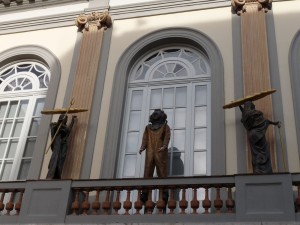
These three figures look down on you as you wait to visit the Dali Museum.  And the loaves of bread?
These three figures look down on you as you wait to visit the Dali Museum. And the loaves of bread?

“Where, if not in my own town, should the most extravagant and solid of my work endure, where if not here? The Municipal Theatre, or what remained of it, struck me as very appropriate, and for three reasons: first, because I am an eminently theatrical painter; second, because the theatre stands right opposite the church where I was baptised; and third, because it was precisely in the hall of the vestibule of the theatre where I gave my first exhibition of painting.”

That’s Salvador Dali, speaking about his wish to create a museum to his own work in the shell of the theatre at Figueres, destroyed, like so many other buildings in Catalonia and throughout Spain, at the height of their Civil war.
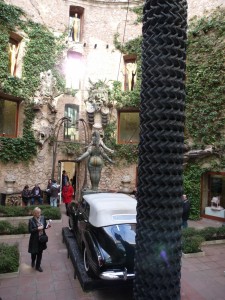
The courtyard, the Cadillac, the tyres... and... and....
The courtyard, the Cadillac, the tyres… and… and….

It’s an astonishing place.  Start out in the central courtyard, and you’re confronted by a Cadillac – Al Capone’s allegedly – beside a tower of tyres topped off by a fishing boat.  Wander round – in any order, please: Dali insisted there was no timeline or other imperative to be followed.
Homage to Hieronymus Bosch?
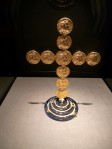
Gold cross.
Gold cross.

You’ll discover rooms of paintings in which he worked in the style of other artists as diverse as Vermeer, Picasso, Goya, Velasquez, Millet, de Chirico: was he in search of a personal voice, or simply exploring and celebrating his knowledge of art history?  A room full of fantastically bizarre creatures shows an affinity with the work of Hieronymus Bosch, but only a few yards away is a room full of exceptionally fine gold and bronze jewellery, largely made from coins with the heads either of Dali or his beloved wife Gala on them.

Then there’s the Mae West room.  Walk in, and you’ll see some random objects: a couch, two wall paintings, a fireplace.  Climb the stairs at one side of the room however, and look though the lens, and there she is, Mae West herself, in all her ruby-lipped glory.
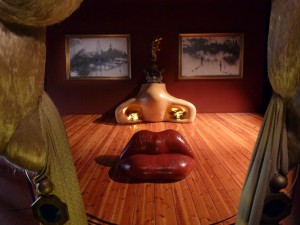
And here she is.
And here she is.

It goes on.  He’s copied Michelangelo’s Moses: but what’s an OT prophet doing with a giant squid?

Or go and get vertigo while standing four-square on the ground, viewing the dizzying perspectives of the ceiling in the Palau del Vent.

...and that's only a bit of the ceiling.
…and that’s only a bit of the ceiling.

The whole thing was by turns stimulating, exciting, puzzling and sometimes even annoying – bizarre for the sake of being bizarre.  We’re really glad we went, though once may be enough.  And if you want to know more, there’s an interesting account in the blog ‘Elsewhere’

The Civil War came up again when we visited the Castell de Sant Ferran, just outside Figueres.  It’s an enormous, star-shaped site, built in the 18th century to protect the Spanish from the French, but it saw almost no action.  But in the 1920’s, Salvador Dali did his military service there. It only came into its own during the Civil War.  Then it provided secure storage for masterpieces from the Prado in Madrid, and became a stronghold for international brigades and ammunition.

We spent so long tramping round the walls – it’s a 3 km walk to encircle the entire site – that we didn’t explore the interior, which may have been a pity: some other time.  But what a walk!  As we began we could clearly see the Mediterranean coast and towns such as Roses.  Then the Pyrenees, covered in snow over to the north, and the dusty more barren nearby hills.  Figueres itself doesn’t give a good account of itself from up here: modern concrete factories and lots of high-rise blocks.

A small stretch of castle wall, with the Pyrenees beyond

And that was it.  Our brush with the law in Barcelona had left us feeling a bit sour, and we felt our holiday was at an end.  So off home for us, planning a return one day to explore that coast we’d caught distant glimpses off from the castle walls.

The cops and robbers of Barcelona

Christmas in Barcelona.  A perfect way to celebrate.  Son and daughter-in-law were there too, and we all stayed in Emily’s flat, since her flatmates had gone away.  Perfect times for us don’t make for interesting reading for others: the balmy weather, meandering round the endlessly fascinating streets as desultory sight-seers, coffee stops at the outside tables of bars in picturesque squares, shopping at temptingly- stocked shops and market stalls in the cosmopolitan quarter which is Emily’s home, eating out or sharing tapas at simple neighbourhood restaurants….  Here’s the story in pictures.

So something had to come along and spoil it.

The car and Barcelona don’t go well together. Even driving in and out of the ill-signposted city is something we always dread.  With a superb and cheap public transport system, we’d have liked to have left the car at home, but it was stuffed with extra bedding, presents, bits and bobs Emily needed from home, so when we arrived, we unloaded and then took it off to park elsewhere for the duration, since she lives on a square with little parking.  She’d taken advice, and suggested a quiet nearby corner of town where a Spanish friend said it would be safe and out of the way.  Once there, we checked, and checked again that there were no restrictions.  One morning, we popped up and checked yet again.  All was well, so we left it until we were packing to go….. walked to the street where we’d left it…… No car.

Stolen!  Panic! What to do next?  Contact our insurers, see if we could sort out one-way car hire between Spain and France?  Would insurance pay? What about replacing the car, which we’d newly and expensively fitted out with snow tyres?  How could we possibly afford that? Emily rang the police, who promised to call back once they’d made enquiries.  After a couple of hours to-ing and fro-ing, we learnt that the car wasn’t stolen, but had been towed away because of parking infringements.  There should have been a notice stuck on the road where the car had been, telling us what had happened: but there was nothing there. We’d need to go in person to the Police.  There are three sorts here: those belonging to Barcelona itself, local Spanish police, and the national service.  We went to see the Barcelona lot, a 20 minute walk away.  Eventually they tracked our car down – thank goodness for Emily’s command of Spanish – to the Spanish police’s car pound at the last stop on the metro line.  If we went with ID and 239 Euros, we could have out car back……

Walk to metro.  Impatiently sit out long journey.  Emily spends time texting Spanish friends.  They’ve all had similar experiences: ‘It’s to try to fill the city’s empty coffers’, they explain. Track down car pound.  Join disgruntled queue of fellow-sufferers. Pay up.  No choice.  Receive form on which to write our grounds for appeal. Try to make our way back to Emily’s from a completely unknown part of town – we get good at buying time by circling roundabouts twice.  All the time fuming at the loss of precious hours with Tom and Sarah on our last day together.

Heigh ho.  Even run-ins with the Police however, can’t take away our memories of a wonderful Christmas break.

Fiesta in Sabadell

We’ve just come back from a weekend with Emily.  Every time we go to see her in Barcelona we’ve stayed somewhere different.  But now we’ve cracked it. Sabadell does it for us.

The accommodation was the first thing that went well: an art deco factory converted into a smart and well-priced hotel, the Arrahona,  not too far from the town centre.

Discontent, even in Sabadell

We liked Sabadell itself straight away.  It’s not Barcelona: there’s not a tourist in sight.  And that’s one of its attractions after the hurly burly and stimulation of a day spent sight-seeing.  We had feared Sabadell might be a bit down-at-heel and depressing, because it is, like many towns in our part of the Ariège, a place whose glory days as a centre of the textile industry are long over.  It seems to have successfully reinvented itself however, and despite Spain’s present undoubted economic problems, Sabadell and some of the surrounding towns like the one where Emily works, Sant Cugat del Vallès, seem to be in some protective bubble.  The bars and restaurants are full, shops are functioning and selling well-made and desirable goods, and this weekend at least, all seemed well with the world.

Drummers prepare the way for the devils

Because on Saturday and Sunday Sabadell had a festival. We’ve struggled to find out why.  It doesn’t seem to have been for Corpus Christi, which provided nearby Sitges with an excuse to carpet the streets in flower petal pictures.  It looks as if perhaps it was just an excuse for the inhabitants to dust off the drums, unpack the ‘gigantes’ – papier maché heads surmounting giant bodies, dig out the costumes, order the fireworks and have a good time.

We happened upon part of the festival by accident on Saturday night when we found hordes of people gathered in the main town square.  Quantities of drummers in red costumes – adults and children – kept up a regular and stimulating rhythm to warn of the approach of whirling dancing devils whose horns disgorged sparks, flames and loud bangs.  These demons leaped in frenzied groups round the church and through the back streets until their ammunition ran out.

Devils run amok near the church

And then, as darkness fell, the crowds who had been watching wandered off to one of the dozens of restaurants in town and sat in large friendly groups at outside tables, laughing and chatting about the evening’s events.

We didn’t find out till later that the festival was happening all the following day too.  We caught up with things again in the evening when children dressed as dragons, dogs and mythical creatures took pride of place in the central square.

Child? Or dragon?

Showers of golden sparks spun into the crowd as the children wheeled and pranced through their routines.  It turned out though that this was the Grand Finale.  Market stalls were beginning to pack up.  The ‘gigantes’ were shrouded in dust sheets and slid ingloriously into workmen’s vans, and once again the crowds finished off the evening in the bars and restaurants.

One of the ‘gigantes’ waits to be bundled off home

The main Rambla had been closed off to traffic, and it seemed as if the entire town’s population was enjoying strolling around, settling occasionally for a drink or some food with friends or family.

A perfect way to end the day: a meal with friends at an outside table in one of the town’s restaurants

We’d chosen to stay in Sabadell because it was near enough to Emily, and seemed to have a hotel that would meet our needs.  We didn’t expect that being there would be such a positive and enjoyable part of our short holiday.  We’d like to go back and explore it again

The Rambla, the main street in Sabadell, taken over by pleasure seekers, just for the weekend

Tongue-tied in Catalonia

The waitress gazed at us in bafflement. All she wanted to do was to take our order.  We became more and more frustrated and slightly hysterical at our inability to explain that we’d only given our order (‘café solo e café con leche’ – we could cope with that) about a minute ago to her colleague.  Sadly, he wasn’t in view, so we couldn’t point him out.

We were in Catalonia visiting our daughter for the weekend, and we couldn’t wait for her to join us in the bar.  When she arrived, she smoothly took over, explained the tapas menu to us, and gave our order to el patron.  He complimented her on her Spanish, but then spoilt it by wondering if she were Belgian.

She’s already had an interesting few months as a language assistant in a Catalan primary school.  She’s more likely to hear Catalan, but Spanish is common too, and this is the language she’s keen to learn.  The family she’s currently living with speaks Catalan, Spanish, German and English – even occasionally French – round the dinner table, but she claims this as a positive and helpful experience, probably because they all correct each other.

We found it difficult and frustrating being in Spain with only the most rudimentary language tools.  Any efforts on our part to communicate in Spanish or Catalan were greeted with friendliness and enthusiasm by the locals.  We battled to be understood, they battled to understand, and laughter at each other’s efforts broke down lots of barriers.  Still, we can’t go on like this.  We want to make an effort to learn a little more of the language before we visit Emily next.

How do people who come to live in Spain (or France come to that) cope if they don’t try to master the language?  We know of people who’ve been here ten years or more and can still hardly communicate.  If we found it hard booking a ten-journey train pass or telling the waitress we didn’t need her just then, how much worse would it have been if we’d been trying to contact a plumber, say, or the local town council?

And most of our best times here are spent sharing experiences – whether it’s a walk, an hour at the gym, or simply having a coffee together – with our French friends and neighbours.  Unable at the moment to replicate those free and easy exchanges when we go to Spain makes us feel we’re missing out.  Must Try Harder.

Postcards from Catalonia

We’ve just got back from our weekend on the other side of the Pyrénées, and I’ve decided to post these ‘postcards’ to show a few happy days in Sant Cugat del Vallès, the very attractive town where Emily is now working; the not-Hallowe’en-but- la Castañada festivities; and a relaxing weekend.

Eating and drinking were important.  Straight away, as we drove across the mist and rain shrouded Pyrénées from France, there was a decision to be made. Lunch on this side of the border?  You can’t get fed much later than 12.30 here.  Or wait till Spain?  Nothing there is open much before 2.00 p.m.

We arrived in Catalonia just in time for la Castañada. Instead of Hallowe’en, they commemorate All Souls’ Tide. Roasted chestnuts are sold wrapped in cones of newspaper with roasted sweet potatoes and peddled from impromptu stalls, or by excited groups of children.  Panellets are mashed potato, sugar syrup and ground almonds – maybe cocoa or dried fruits too, rolled in pine nuts and briefly baked till the nuts turn golden. It sounds odd, but they’re delicious accompanied by a shot of strong black coffee.

Coffee shops, with tables outside so you can enjoy the late October heat seem to be in every street, and we adjusted our bodies to Spain’s very different rhythms. Food generally seems cheaper in Spain.  A pleasant pause for breakfast, after taking the children to school, after shopping or work, or just because it’s a nice idea and the sun is shining is an affordable treat, and cafés don’t seem to struggle for custom.  Nor do lunch-stops.  As in France, the 3 course lunch with wine and coffee is on offer in most restaurants, but cheaper here.  And it’s a leisurely affair.  We found ourselves spending an hour or two every day that we were there over the lunch table, eating, talking and simply people-watching.

Shopping seems less anonymous too.  Whether in St. Cugat, or city-centre Barcelona, greengrocers and grocers, wine merchants and bakers – especially bakers – all seemed to be doing brisk business.  The out-of-town supermarkets are there alright, but so far, they don’t seem to have won.

So here are my postcards.  Have a glance at them over a lazy cup of coffee.

This slideshow requires JavaScript.

Bon viatge! Emily’s off to Barcelona….

When my generation graduated, back in the early 1970s, it never occurred to any of us that we wouldn’t get a half-way decent job in a field that interested us.  By 2010, it was a different story.  Emily’s first taste of work, post graduation, was as casual bar staff for a national pub chain.  Mind you, these posts now seem to be exclusively reserved for young graduates and the occasional favoured undergraduate.

Emily all checked in and ready to go at Leeds-Bradford airport

After that, it was a bank: that was pretty soul-destroying too.  Because all the time, what she really wanted to do was train as a teacher. And these days, you need lots of voluntary experience before they’ll even consider you.  How do you get that alongside a day-job?

Then she had a lucky break.  She spotted an advert from CAPS, an organisation supplying English Language Assistants to schools in Barcelona.  She applied.  She was accepted.  And today – she went.  She’s flying over, and she and the other successful candidates will spend a day (and a night) together, being briefed, before going tomorrow to meet the families they’ll be staying with.  School on Monday.

She’s looking forward to meeting the people she’s staying with.  She’ll be trading spending time with her six year old boy twin nephews, for staying with another family with 6 year old twins – girls this time.  She’s wondering if the Spanish she’s managed to learn over the last few weeks will be any help at all – or whether only Catalan will do.  She’s looking forward to being in Spain, to finding out if teaching really is for her, but most of all to the Big Barcelona Adventure she’s already started writing about in her blog

And we’re looking forward to a few excuses to go and visit her there.

Sagrada Familia: bound to be on Emily's visiting list