We’ve all had it. Months and months of horrible weather. Especially rain. Even now, when things are slowly picking up here, we expect to have all kinds of weather within a single day. Beautifully hot skin-warming sun may be followed by lashing winds, summer showers, or deluging heavy downpours. Glance up at the sky, and it will be in turn a cloudless azure, or bright blue patched with blowsy puffs of white cumulus. Or it may be grey, or even black. If the clouds aren’t coursing lazily across the heavens, they may be tearing across the sky so swiftly that they’ll have disappeared from view if you glance away only for a few moments. The rivers are still full to overflowing.
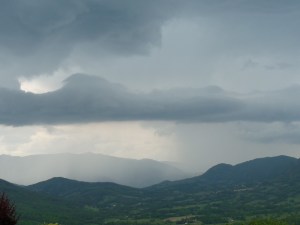
June sky from Roquefixade
Farmers are in a mess. They’ve only just begun to cut their hay, when normally they’d be onto their second harvest. Seeds have failed to germinate in the cold and wet. Often they haven’t been planted at all in the sodden and waterlogged fields. Preparations to take cattle and sheep up into the highland summer pastures have had to be postponed, with snow still on the ground at higher levels.
At last though, we walkers are once more getting out and about. We choose our routes with care, because thick sticky mud has made some of our favourite walks unuseable. Where we can walk though, spring has at last sprung. Familiar paths have become narrow passages edged by massed armies of knee-high grasses, shocking in their vibrant greenness. And our favourite spring flowers that by now should be sun-shrivelled and long past their best romp across meadows and pastureland, and spread across their favourite sun-warmed stones. Here are a few that we’ve enjoyed finding in the last days and weeks.
A springtime meadow
Can anybody tell me what these purple rock-clinging pom-poms are called?
Is this an Alpine aven? Anybody?
An Englishman in quest of that perfect flower portait. Tim did get some great shots on his visit.
I believe this to be a type of gentian, more delicate and solitary than its earlier gaudy cousins
A lesser butterfly orchid – I think.
A delicate potentilla.
Alpine willowherb – maybe?
I was practising with my zoom: this was yards above us – a type of campanula?
A type of saxifrage?
A flower-strewn meadow to you is a tasty salad to a sheep.
What a find in June! A daffodil, still fresh and bright.
UPDATE: After she’d read this post, a kind friend, AnnA, wrote to a botanist friend of hers enlisting help in identifying the flowers I’ve shown. Here’s some of what she said. Reading from the top, left to right:
3. Hélianthème – Helianthemum Alpestre (Alpine rock rose)
5. Perhaps from the Linacée family. She needs a photo of the leaves. Watch this space
6. Céphalanthère à longues feuilles – Cephalanthera longifolia (Sword-leaved Helleborine)
8. Oeillet – Dianthus – (Dianthus). She needs more info. to help her be more precise.
She’s asked to see more of the leaves, and to be told as well where the flowers were found and at what altitude. There’s such a lot to it. I had no idea and am so grateful for all this help.
‘Laroque d’Olmes, below Montaillou, was a small market town which produced cloth. At the local fair, which in the fourteenth century was held on 16th June, local cloth was sold, together with wood, fish, sheep, pottery and blankets from the Couserans.’ That’s what Emmanuel Le Roy Ladurie says in ‘Montaillou’, his wonderful examination of Catharism in the Ariège village of Montaillou at the turn of the 14th century.
Laroque’s June fair had already been a long-established event by then, and over the years it’s evolved. Our contemporaries in town remember when it was still a hugely important event in the agricultural calendar, something like the fair that’s still held every year in nearby Tarascon. There were animals everywhere. One area was given over to cattle, another to sheep and others to all the usual farmyard creatures. And at night there was dancing. Bands belted out dance music on both Place de la Cabanette, and Place de la Republique. It was quite a party, both for the Laroquais and for villagers from miles around.
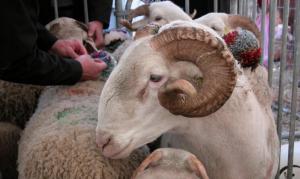
This is the kind of sheep we’d have had at Laroque Fête: our local Tarascon sheep. Photo courtesy of La Dépêche du Midi.
At some point in the fairly distant past, the Fête became associated not with 16th June, but with the Catholic festival of Corpus Christi. So it’s still called Festo del Corpus, though there are no religious ceremonies.
We love the idea that this fair has an unbroken history going back nearly1000 years. If only we could love the fair itself.
No animals or shepherds now. It all begins during the week beforehand. Fairground caravans arrive and make the open ground near the river their home for the week. In the car park just along from our back garden, municipal workmen clang and clatter all day long, erecting a stage and a marquee for the various performers who’ll be on duty for much of the weekend. The locals look on, unimpressed. For scores and scores of us, the weekend means three nights of little sleep as the bands on stage boom their way through a noisy repertoire lasting from early evening, when they start to limber up, to two or three o’clock next morning. Wander round to watch the dancing on those nights, and you’ll not find many locals. It’s mainly out-of-towners, and we’ve learnt not to trust them all. Two years running, our window boxes at the front of our house were stolen: now we remove them for the duration.
We leave town for the Fête. This year, we only went 7 miles to stay with friends, though often we’ll try to take a short holiday. Popping back briefly at 11 o’clock on Saturday night, I found the town as busy as Oxford Street in the January Sales, and our bedroom windows vibrating in time to the boom of the bass notes thundering from the stage. Some years though, there are only a few hardy types twirling around in time to the music.
During the day, there’s the fun fair, majorettes, bands. But they say the fair’s expensive, and while most people enjoy a stroll round to people-watch and chat to friends, there’s little sense that this event is a focus for the community.
I wouldn’t like Laroque Fête to disappear. But perhaps it’s time to take stock and look at how it can become again what it once was: a summer event for everyone in town and to a lesser extent the villages beyond. It seems that too many people at the moment actively avoid it or at best are unenthusiastic and uninvolved. And that’s the way for an event that’s happened every year for many hundreds of years to wither and die: which would be sad.
Fairground prizes: the same the world over.
Now THAT looks fun.
‘If you think you’re going out dressed like that, young lady, you can think on. No, wait, you’re going to Majoretttes’
Thursday evening. Choir. Arrive early in time for a quick chat and a gossip, and then settle down to work.
The mood’s established from the first note. Our voices chase up and down the scales in a series of jolly rounds, verses and tongue-twisters as we warm up our voices and then it’s down to work on the repertoire. Vanessa, who squeezes pretty good music out of a very mixed bunch of singers, keeps us busy, committed and enthusiastic. We love her.
It’s all so different from the choral society I belonged to in England. There, the repertoire was the attraction. Haydn’s ‘Creation’, Charpentier’s ‘Te Deum and all those stirring sacred Masses. I liked my fellow choristers too. Really though, I felt like Groucho Marx. I didn’t care to belong to any club that would have me as a member. I was never quite confident in what I was singing. I was always running from behind and rarely had the confidence to sing my heart out.
But the repertoire held me in thrall, and so when I arrived in France, I looked for more of the same. And didn’t find it. I guessed the Departmental Choir was beyond my reach. I took me ages to realise that most villages and small towns, even Laroque, do indeed have a choir, and even longer not to feel sniffy at what I then considered an irredeemably low-brow programme.
More fool me. Since I gave in and joined in I’ve had the best fun. Thursday nights when we have our rehearsals are simply unmissable. We sing a bit of everything: Henry VIII’s ‘Pastime with good company’ (en français naturallement); ‘Amezzing Gress’ (en American, off coss), some sacred stand-bys; Breton or Auvergnat folk songs: the odd sortie to Russia – but the general feel is vairy Frainch, often with songs to which everybody but me already knows the words. I soon catch up though. I have to.
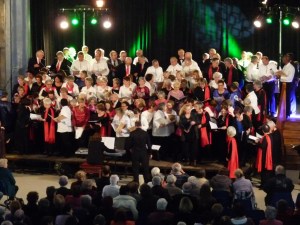
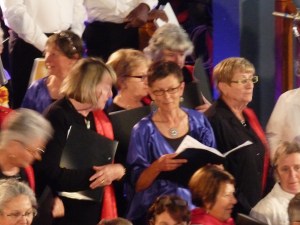
We’ll have concerts in the communities nearby. And every now and then, as last week, there‘ll be a ‘Rencontre de Chorales’, when a number of choirs from a wide area gather together for the afternoon and invite the general public in for a feast of singing. Each choir sings about 6 numbers from their repertoire, catering to every possible musical taste. And we all sit together in our concert get-up, sympathising with mistakes, applauding great performances until our own turn comes. At the end, every chorister from every choir will somehow squeeze onto the stage to join in the ‘chanson en commun’. The audience enjoy it, but it’s even more fun for we singers to join together, united by our love of singing. As we all suggested last week at the tops of our voices, ‘C’est magnifique’
Far too busy getting to know each other and renew old friendships to start singing yetThere we are, members of 5 different choirs, all in our different concert gear, squeezing together to begin singing. That’s me in the middle, in blue.
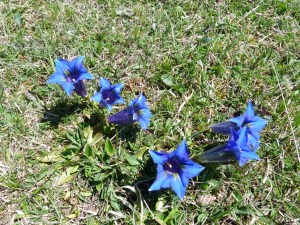
May Day here in France is the day when the French like to offer lilies of the valley. It’s been so cold and wet these last few days that ours in the garden are still tightly in bud. But the other day, we did see gentians. Turning their vivid blue faces to the sun, they were marching up the sunny sides of the slope at Roquefixade. I’d like to share some with you.
From a distance, the village of Lagarde, dominated by the Château.
The ruined site
The view from the siute to the distant Pyrenees.
Archway
The original medieval tower was extended and embellished during the Renaissance.
A detail from the tower
Castle lawnmowers
From this side of the castle, the gardens would have been visible.
Fabrice Chambon’s interested audience includes Sarko the donkey.
Draw a square. Now draw another one surrounding it, with a nice big border. Now do it again. Now draw a big rectangle alongside one of the sides, as wide as one of the sides of the square, and maybe 3 times as long. There. You’ve just given yourself a brief history of the Château de Lagarde.
We had a better history lesson, because we were there, in cold gusty conditions, being introduced to the site by Fabrice Chambon, as part of the series of events organised as part of this season’s Laissez-vous conter le Pays des Pyrenees Cathares.
Lagarde is a ruined castle, an imposing and dramatic addition to the skyline hereabouts. We always assumed it was medieval, destroyed in one of the many wars that characterised that stormy period of history.
And certainly it was first constructed in the 11th century, by Ramire de Navarre, King of Navarre and Count of Barcelona. During the crusades against the Cathars, it came into the possession of Simon de Montfort, who always gets a look in round here to any story from that time. He gave it to his lieutenant, Guy de Lévis, and this is the family to whom it’s mainly belonged over the centuries. They owned châteaux everywhere in the area: Léran, Montségur, Terrefort – all within easy distance of Lagarde. It was a fortress, a castle, and occupied that inner square you drew.
By the late 15th – 16th centuries, defensive castles were so last year. Jean V de Lévis-Mirepoix had the money and the leisure to go travelling, and admired all those famous Châteaux of the Loire: Azay -le- Rideau, Chambord and so on. He liked what he saw and had his own château remodelled with some of the features he had so admired, and windows piercing the original solid medieval masonry. The finest feature may have been a splendid staircase with wide shallow steps curving upwards through the central tower: it was said that it was possible for horses to mount these stairs. It was a fine Renaissance palace, and extended to fill that second square, because it included space to accommodate his artillery forces and a large dry moat. Of course by the time the work was done, the style he’d copied had also become so last year.
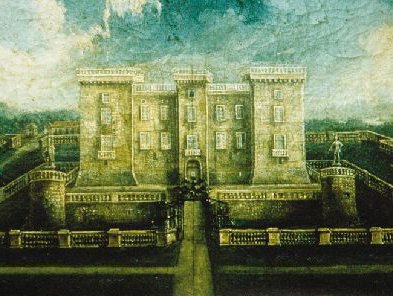
By the time of Louis XIV, the château had become a fine palace. The site had been considerably extended (to fill that third square!), and copied aspects of Versailles. Think of Versailles, and it’s the formal gardens that come to mind, and the Hall of Mirrors. That’s what Lagarde should bring to mind too. But the vast and elegant formal gardens no longer exist: even the land on which they were constructed is no longer part of the site. It had a Hall of Mirrors too, which though inevitably on a smaller scale than that at Versailles, was said to be magnificent.
Then came the French Revolution. Lagarde escaped destruction, despite an order to knock it down in April 1794. But its glory days were over. It became an arsenal, a stables, an immense barn, a munitions factory and a bit of a ruin, until in 1805 it became once more the property of the Lévis-Mirepoix family. These days a variety of charitable and national associations are working to restore the site and make it, at the least safe to visit, and at best a place where its glorious past will be explored and celebrated.
The photos I took are all of the exterior of the site, as it’s too dangerous still to penetrate the inner courtyards, much less the interior of the building. Nor can I show you pictures of the château in its Renaissance glory days, nor of its time as a palace with formal gardens.
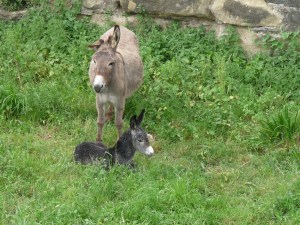
Sadly, because of the poor weather , the pictures I took yesterday weren’t up to much, so I’m mainly using some others I took recently. I can show you the ruins. And I can show you the castle’s lawnmowers: an inquisitive and friendly herd of donkeys with their charming foals.
Mother-and-baby down in the dry moat.
UPDATE: May 2nd 2013
Château de Lagarde
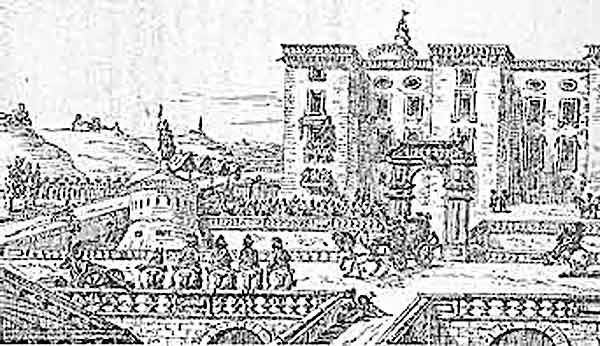
Thanks to local historian Martine Rouche, I can now show you some images of Lagarde as it was in its final most glorious days before the Revolution.
Look at the statues in the colour picture . One was taken to Mirepoix during the Revolution and ” turned ” into Goddess Reason. Then it disappeared. Never to return. A few years ago, a man who was vaguely in charge of the grounds and ruins, found lots of things, including a foot of one of the statues. Nobody knows where that foot is now. It is a pity because it gave a precise idea of the size of the statue and showed those statues were made of brick, covered in some sort of white enamel.
Anyway, enjoy these pictures, which certainly make it easier to imagine what the castle must once have been like than gazing at those ruins, however romantic they may be.
Once upon a time long ago in Caraybat, when times were hard, the men of this small village had to look far afield for work. And they went to Spain, for the hay-making season. Hawkers came to the village, and peddlers. They found a village with no men. They took advantage. So did the women.
When the hay-making season was over, the men returned, and the women spied them returning over the distant mountains. Suddenly ashamed and frightened, they fled to the hills. God, in vengeful and Old Testament mood, was displeased. As the women reached the summit, he turned each one of them to stone. And there they are to this day, les demoiselles de Caraybat, a petrified reminder of a summer of sin.
A few of those demoiselles hide themselves behind the woodland trees
We remembered this legend yesterday when I took our Laroquais walking friends to Caraybat and the dolomies to discover those daffodils I’d been shown on Thursday. I was quite chuffed that not a single one of them had previously known this special spot, and we had a pleasant hour up on the rocks, picnicking and enjoying the last days of the daffodil season.
We followed the walk I’d learnt about on Thursday, and then we finished our day by going to the plateau above Roquefixade to see the gentians there.
Gentians above Roquefixade
Sadly, it was by then rather cold and windy, and most of the gentians had sensibly folded their indigo skirts about their faces and tucked themselves away to wait for a sunny day. We’ll wait too. And when the sun comes out properly, we’ll be back.
Unlike our walk on Thursday, early morning was bright and clear.
The distant Pyrenees, just visible betwen two of those demoiselles.
A clump of pale and delicate woodland daffodils.
Daffodils on the windswept hillside.
The view from our picnic spot.
And another view.
A bank of spring flowers.
Our daffodils were there, up on the top.
Traditional pebble paving in front of a village house.
And the cock, keeping guard at the same house.
Magnolia in the village square at Soula.
A nut tree of some kind comes to life after winter.
More spring flowers.
Château de Roquefixade: we’re looking for gentians on the plateau.
Yesterday, we walked in Les Dolomies, which you could confuse with the Dolomites with its craggy pillars and rocky outcrops: though actually it’s a small area between Lavelanet and Foix, just along from Roquefixade. After a few days of hot sun and blue skies, it was disappointing to have the threat of rain, but the slight mistiness brought its own beauty to the landscape, softening the distant views, and enhancing the vibrant greens of the springtime meadows. Everywhere, blossom and flowers.
We walked upwards through the woods. Anny and Maguy had a surprise for us. And quite suddenly, there they were. Daffodils. Thousands and thousands of them, extending upwards over the hillside, tumbling over rocks, leaving not an inch of path for us to walk along. The weather cleared. The sun came out. We were entirely happy.
Come and share the walk with us, along blossom-laden paths, through the daffodil woods, and then down into the valley, looking across at those still snow-covered peaks.
Craggy peaks above the blossom
Apple blossom
Our upward path
Those dolomies
First sight of the daffodils
At the edge of the woods: our view
Maguy enjoys the view
Endless daffodils
Now bluebells: Spanish variety, not our beloved English
Cherry blossom
Walking down to the valley
An early gentian
A magnolia in Soula
To view any of these photos full-size, click on the image.
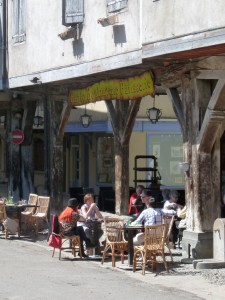
A table in the sun, a moment shared with friends… French café life in the traditional style.
Think of your last holiday in France, and it’ll probably include memories of a morning coffee and croissant in a cosy little bar, or of relaxing and people-watching with an evening pastis, sitting outside a café in some pretty sunlit square. Hang on to those memories.
In 1960, France had 200,000 cafés and bars. Now there are fewer than 40,000. Those characterful smoky rooms with dark wooden furnishings, and solitary men sitting at the bar nursing an early morning brandy are an endangered species. All over France, cafés are closing at the rate of about 10 a week. Blame TV, blame the smoking ban, , blame ‘la crise’, blame readily available alcohol in the supermarket. Whatever the reason, many cafés can no longer make a go of it.
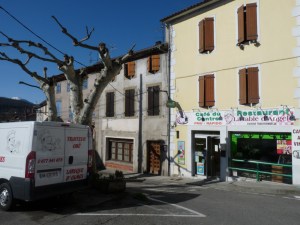
Take Laroque. Our town of 2000 or so used to support more than half a dozen bars. Now there are three, and they struggle. Obé – that’s what everyone calls our Obelix look-alike – can’t make a living from half a dozen elderly men who come in most afternoons to nurse a single beer while they watch the afternoon’s horse racing. But he can cook, so he’s reinvented the bar as Table d’Angèle, a successful lunch-time restaurant serving home-cooking, mainly to tradesmen looking for a once-a-week treat to break up a day’s plumbing, building or electrical work.
There we are. That’s Table d’Angèle. And there’s Obé’s van. He needs to offer outside catering too to bring home the bacon.
Down at Le Lounge, the owners have had to have a different strategy: food didn’t work for them. They tried a traditional menu. No good. Then they had a go at offering an eat-all-you-can buffet. When that failed, they tried Italian food. Now there’s no lunch-time menu at all. They make do with weekend trade, when sparkly lights and disco music attract the young people of the area before they head off for the Orient Express, the out-of-town nightclub at the once-upon-a-time station.
The Jingo’s still looking just about OK. It’s on the main road and seems to get a steady enough stream of customers. It may outlive the rest.
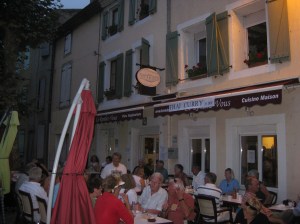
But bars can rise as well as fall. When le Rendez-Vous in Léran, the village next door, came up for sale a few years back it was a hopeless case: dingy, unpopular and seemingly beyond rescue. But an English couple who’d never run a bar in their lives bought it and made it the hub of village life. Shirley cooks with imagination and flair – she even has that unknown round here menu item, the vegetarian dish. Marek’s a cheerful and extremely hard-working host who’s always pleased to see you. Quiz nights, open mic nights, a big screen to watch the rugby, a cosy corner with books to read and exchange…. It’s a winning formula, and both French and English from the village and beyond ensure the bar’s kept busy late into the evening, especially in the summer.
Le Rendez-Vous one busy evening in mid-summer. There’s an evening market in town too.
And over in Mirepoix, there’s another new café. The Mad Hatter isn’t just another bar. It’s hoping to cash in on the French love affair with things ‘so British’. A nice cup of tea with a scone or slice of ginger cake might not be traditional French fare. But it’s a welcome addition to café society, and yet another way in which the traditional French bar has to change, or sink without trace.
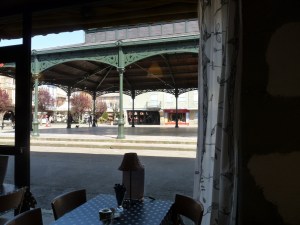
A welcome moment of calm, gazing out of the window over a cup of Earl Grey at The Mad Hatter, Mirepoix.
That’s where we first spotted them: they were close to home then/
Then they came and inspected us on the hillside.
A game of chase.
Quite a long way from home now.
Can you spot them?
Time for a roll in the dust.
They’ve fallen behind us….
But they soon catch up.
It’s ‘Goodbye’ now. Unac and their home is far below us as we continue our walk.
We were walking yesterday in glorious spring weather near a little village called Unac, quite near the winter sports area of Ax-les-Thermes. Just outside the village, we spotted donkeys: eight of them. They spotted us too. They came to say ‘hello’. And then they followed us.
Every field for miles about was theirs by the looks of things, because every time we rounded a corner, or scrambled higher up the craggy path, thinking we’d at last said our ‘goodbyes’ to them, there they were again, peering over the fence and hoping for carrots, which we failed to offer.
Someone remembered that they must come from La ferme aux ânes, in which case their job is to carry the baggage of any hikers who care to hire them. But they weren’t working then. Like us, they were enjoying the first day of spring. They cheered our afternoon along no end.
Here you are reading my blog: and the chances are that you’ve never visited Laroque.
Let’s go for a stroll then, and get to know the place a bit. You may think, when you’ve seen the photos, that the town is quite shabby-chic. It’s not. For the most part, Laroque is just plain shabby. It’s going through tough times, and it shows. Underneath it all, though, are characterful buildings, streets with a story, and even places that are enjoying a prosperous renaissance. Let’s set off from our house at the edge of the old town, and walk up Rue de la Joie……
And here’s Rue de la Joie: a happy name for a shabby street
But it’s a street with some very old houses indeed.
Laroque has several town squares. Here’s one: our market place on Thursdays
Another view of the square.
Onwards up the hill to the next square, Place de la Republique. This used to be the market place
And up the hill again – towards the church.
The fine great west door of the church.
Just a quick walk out of town. Chapelle St Roch used to be the parish church. But the town was emptied by the Black Death, and rebuilt lower down the hill, leaving the chapel isolated.
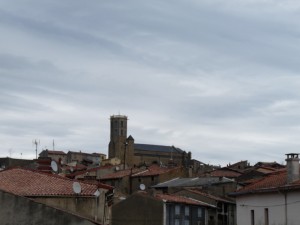
A view of the town from on high – old and new jostling together.
Back towards the church….
… and the old ramparts defending the town.
‘Beware of the bees’. But you can buy M. Gelineau’s honey at all the markets round here.
Once this textile factory was one of many, employing 1000s from the town and beyond. Now it’s disused and in ruins….
… and its grounds have become, in part, vegetable plots.
Sheep may safely graze outside the council flats.
We still have handsome houses in town.
This trompe l’oeil decorated the pharmacy, now closed, next to our house.
Once, the owners of the textile mills had fine houses such as this. Now it’s the home of the town nursery, the out-of-school club and the music centre












 From Pyrenees to Pennines
You must be logged in to post a comment.