Le Jardin Extraordinaire est mort. Vive le Jardin Extraordinaire.

Gosh.  Was it really only five weeks ago that we were there?  Was it only 5 weeks ago that we togged ourselves in skimpy sun gear, floppy hats and clodhopping sensible shoes to make our annual pilgrimage to Le Jardin Extraordinaire?  If you’ve been following our story of our life in France you may remember the photos of this joyful, playful, meditative, exuberant, and quite lovely space which so many of us come to explore and relax in for the one weekend only, in very early September (follow the link above).

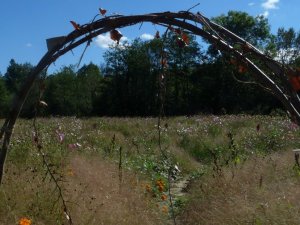
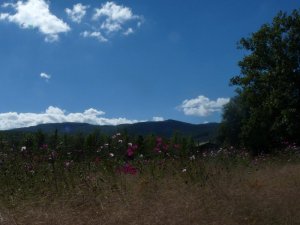
The meadow at the Jardin Extraordinaire today

Today we wanted a walk: it’s not high summer any more, but the sky was very blue, the sun was pretty hot, the morning mists had burnt off and who knows if tomorrow it may rain?  We wanted to take bags and a bucket and see if there were a few late blackberries (there were), a few sloes (there weren’t) and a few early walnuts (there were) to make our sortie near Lieurac worthwhile.

That was the entrance, a few weeks ago.

Our path took us past the site of Le Jardin Extraordinaire.  It’s not normally a public space, so we couldn’t wander down to the river, or scramble up the hillside.  But we could walk by the meadow which had greeted us at our last visit, and we could see the tunnels and bowers of gourds.  Autumn has struck.  The bright fleshy stems and leaves of the gourds and sunflowers have changed into gnarled and bony twigs.  The pumpkins which once peeped from beneath their leafy green sunhats are now exposed on bare earth, those leaves crisp and brown like curls of tobacco.  The sunflowers still rear their tall heads over the scene, but they too are blackened and dry.

It’s still lovely though.  This is no cemetery.  The seed pods, the gourds, the berries are all ripe now, They’re ready for the next stage: marauding animals may eat them, humans too, or else they’ll seed themselves, so that early next year, the garden can begin to grow again, and be transformed by the creative artists and gardeners of Artchoum.

Rosehips along our walk

And we too marauded today.  We came back after our walk with full bags, muddy shoes, and that feeling of well-being that comes from a peaceful and productive afternoon  out in the countryside in the bright Autumn sunshine

P1070802

Le Jardin Extraordinaire, 2013 version

Le Jardin Extraordinaire is always comfortingly familiar, yet always surprising.  If you’ve been once, you’ll go again, on this one weekend of the year, to enjoy strolling round this very special wild, yet bewitchingly tamed garden.  The members and volunteers of Artchoum have been working for months to create this space, just for your pleasure.  You’ll want to explore the riverside walk and exclaim at the enchanted place they’ve created with stones, trees and flower petals.  You’ll go on to wander through the leafy tunnels and arches tumbling with gourds.  Then you’ll amble off into the woods, where more fantastical experiences await you.  People come from miles around to explore, smile and wonder at this very special place.  But although you won’t be alone, there’s a relaxing feeling of space and of peace too.  You’ll go away refreshed, invigorated and joyful.

To see the pictures as a slideshow, click on the first photo to enlarge it and start the show

The story of a wood delivery, in pictures

And all to feed our wood-burning stove this winter.

Butterflies III: Half an hour of my life

There we were at Roquefixade, showing our favourite walking destination off to two of our Harrogate friends, when a butterfly discovered me.  Then another.  These two creatures played round my wrist for more than half an hour before finally dancing off into the sunshine.  They made our day.

I’m thinking they’re the Common Blue (Polyommatus icarus).  Any dissenters?

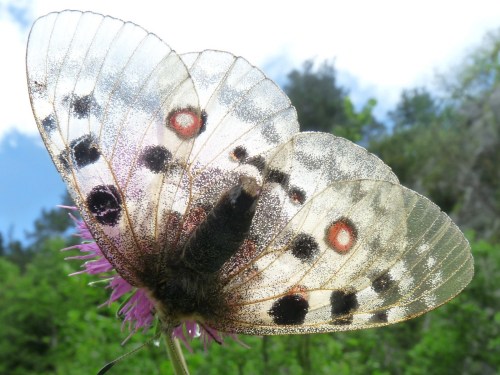
Mountain Apollo

P1050895

I just want to share a photo I took on our walk on Sunday, when we went to the Gorges de la Frau.  This butterfly seduced us all with its distinctive spots and white grisaille wings.  It turns out to be rare, a protected species, and known only in mountain regions, mainly in Southern Europe.  The French know it as Apollon, and its Latin name is Parnassius Apollo.  If your French is up to it, you can read about it here.  

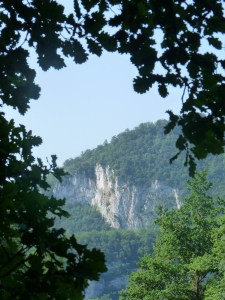
And here’s a small taste of the Gorges de la Frau, only a few miles from our house.

‘Not all those who wander are lost.’* But we were….

On Sundays we walk, with our friends from Laroque.  This time though, Malcolm and I were cramming in something else too: an afternoon birthday party right at the other end of the Ariège.

This was the plan. Walking Party A (which included me) set off at 8.00 a.m. to do a walk from Lieurac to Roquefort-les-Cascades, where we were to meet Party B (including Malcolm) for lunch. Party B consisted of the temporarily halt and lame, as well as Marcel, whose bread hadn’t finished baking by the time we left.  ETA for us all, 11.30.  At which point M & I would have made our excuses and left for the birthday party.

We did fine, we keenies in Walking Party A.  We walked past Rapy, Ilhat, Tanière, glad of the frequently wooded and well-signposted paths, and all went well till Bac d’en Haut.  There was a choice of routes which we discussed at length as we studied the map and made our choice, though we agreed it was an obvious one.

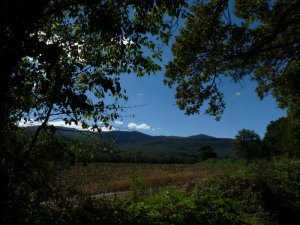
View towards Rapy
View towards Rapy

In due course it became clear that it was not obvious at all.  Instead of climbing up about 250m, then descending, we went on up…. and up… and up.  We’d been due to meet Party B at about 11.30, but midday came and went, 12.20, 12.30, 12.40… and then we came out of the woods to be confronted by a sight just behind us to the right. Roquefixade, a beauty spot really rather a long way from Roquefort-les Cascades.  Even if you’re a crow.  But if you use the paths, or even worse the roads, it’s absolute miles (19 km. actually.  It involves doing the two longer sides of a triangle).  We rang every member of group B who had a mobile.  Nobody responded.  We concluded there was ‘pas de reseau’ but wondered why at least one of them didn’t get into a reception area and ring us.

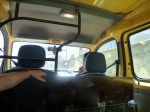
My view from the back of the van.

In the end, one of our group rang her husband, and he came to take some to Laroque to collect a rescue car, and others of us on to Roquefort. He didn’t drive a comfortable family saloon.  Oh no.  Our walking companion Corinne had that.  He had the bright yellow van he uses for hunting.  Behind the front seats was a compartment prickly with fresh straw where he and his fellow-hunters accommodate any wild boar they succeed in catching.  I was one of the ones who … er …. drew the short straw and travelled in the wild boar compartment.

By the time we climbed aboard it was…. 1.40.  By the time we reached Roquefort, it was well after 2.00.  By the time the rescue car arrived with the remaining walkers, it was well after 2.30.

Meanwhile I rang our hostess and warned her we might not be able to get to the party.  It didn’t take too long for ‘might not’ to become ‘can’t’.  Hot, sweaty, and with no time to go home for a shower, I don’t think we’d have been entirely welcome.

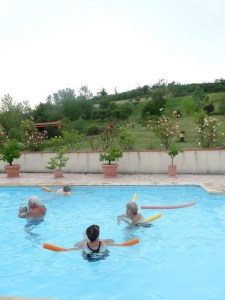
So we stayed with our friends from Laroque.  A picnic lunch, then home for that shower, before going round to the home of Michel and Annick, who have a pool.

P1050494

A refreshing swim, an ‘auberge espagnole’ (pot luck supper) and a glass or two of wine soon helped us reframe our day of not-very-brilliant navigating skills into a yarn that will no doubt go down in the annals of the group. It was just a shame about that party.

'Auberge espagnole'
‘Auberge espagnole’

*JRR Tolkein: ‘The Fellowship of the Ring’

Tabariane: new light on the Dark Ages

When I was at school (back in the Dark Ages), we learnt in history that the Romans came after the Greeks.  They left us a legacy of Romance languages, our alphabet, Roman law, neo-Classical architecture, impossibly straight roads and under floor central heating.  As the empire crumbled, so we were told, the continent descended into the Dark Ages.  Barbarians, Vandals, and unpleasantly savage descendants of Asterix the Gaul ravaged Europe, raping, pillaging and generally leaving little time for culture and a settled everyday life.

I think we all knew it was a bit less straightforward than that.  The Frankish Germanic tribes entering the late Roman empire had a very different culture from that developed by the Romans, and it’s been much harder to research systematically because there are few contemporary written records.

This week though, we went to visit a Merovingian site, Tabariane, recently excavated and interpreted near Teilhet, not far from Mirepoix.  The Merovingians were an early Frankish dynasty established by Clovis, and they ruled an area roughly equivalent to much of France and Germany from the 5th to the 8th centuries, and are the kind of tribe that was dismissed as one of those from the very heart of the Dark Ages

It was a burial site we’d come to see.  It has first been discovered in the very early 20th century by Captain Henri Maurel, and had been partly excavated according to the fairly invasive practices of the period.  War and economic upheaval meant the site became first neglected, and then entirely forgotten about until recently.

Recent research lead by Nicolas Portet has meant that the burial ground, now carefully excavated, is now, as it almost certainly was then, a burial garden.  It’s a large site, on a hillside overlooking the site of the now disappeared Merovingian settlement  on the opposite side of the valley.  The 166 tombs seem to have been arranged in ‘clans’: loose arrangements of extended families and friends, over a long period of time.  It seems to have been a burial ground which held a place in the life of the community for many years, rather than being a cemetery developed as a result of tragedy – war or plague say.  Most of the bodies were laid with their heads to the west, their feet to the east.  Originally they were clothed, but little remained apart from metal objects: belt buckles, brooches, jewellery and, with some of the men, weapons.

This is where ideas have changed. Early 20th century archaeologists sent excavated objects to museums far and wide, even to America: modern practice which encourages an area’s ’patrimoine’ (heritage) to remain as far as possible intact did not then exist, but you can find examples of objects found here in the Museum at Mazères, and in Saint Raymond de Toulouse.

Now as then, the tombs are planted with local flowering plants: lavenders, marguerites, herbs.  It’s thought that locals would have visited the grounds with their families, spent time there, as we might in a modern park.  So it was important to both the living and the dead to make it a pleasant, calm place to be.  The burial ground overlooked the village. The village overlooked the burial ground.  Each had an interest in the other.  Each could intercede for the other.

It’s a tranquil, special place, surrounded by meadows and hilly countryside.  A circular walk of some two and a half kilometres , starting and ending in the village of Teilhet gives you a chance to spend a peaceful  hour or two exploring scenery that may not be so very different from the way it was when the Merovingian villagers first laid out their burial ground, some 800 years ago.  Excellent information boards will help you understand a little more about those Merovingian people who made their lives in this still rural area.

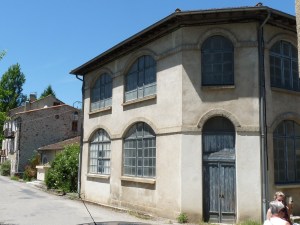
While you’re there, make time to enjoy the facade of the 14th century church at Teilhet.  Here are some pictures to whet your appetite.

This visit, guided by Marina Salby, formed part of the summer programme of Pays d’art et d’histoire des Pyrénées Cathares.  It will be repeated on 31st July and 21st August.  Meet outside the church at Teilhet at 9.30 a.m.  Cost: 2 euros.
The comb

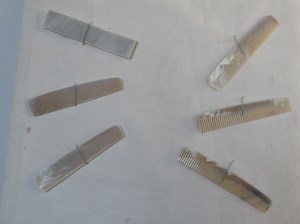
There’s an industry that’s had something of a walk-on part in this part of the Ariège for well over 300 years.  Against all the odds, it’s somehow clinging on.  It’s comb-making.  Specifically, combs made from horn.

Today, we went to find out more, courtesy of a visit organised by  ‘Pays d’art et d’histoire des Pyrénées Cathares’.  There are two ‘peignes en corne’ factories within just a very few miles of each other, and of our house too.  Each used to be the size of a hamlet, with separate buildings for all the different parts of the fabrication process.  Now, both firms conduct operations each from a single building.  We went to ‘Azema-Bigou’, in Campredon.

Azema-Bigou factory
Azema-Bigou factory

I’d always imagined the industry had developed as part of a waste-not-want-not mentality, using the horns from local sheep and cattle.  Not at all.

Our part of France has always been rather anti-establishment, in religion as in much else.  In the 16th and 17th centuries, when much of Europe was in religious turmoil, Protestants locally were persecuted.  Many fled, some to Switzerland.  And there they learnt a new skill, unknown to them before: comb making.

Following the 1598 Edict of Nantes, assuring greater religious freedom, many Protestants returned to their homes here, and wanted to continue the trade they’d learnt in exile.  But did they use local materials?  They did not.  Local cattle worked hard , ploughing and generally earning their keep.  They ended up with chipped, worn horns.  Over the years, the comb-makers developed markets with ports such as le Havre, Marseilles, London and Liverpool, and imported good quality horn fom Hungary, Turkey, and by the 19th century, Argentina.

Horns awaiting transformation into combs

Although in the early days, the trade was conducted on a domestic scale, with each worker capable of producing 10-15 combs per day, perhaps after a day in the fields, by the 1850’s the process was industrialised – with machinery imported from England.  Men women and children were all employed.  Men earned 2 francs a day, women 1.25, and children 1….. .  No wonder women in particular preferred to be paid for piece work: that way they too might get 2 francs daily.  The busy industry grew and thrived until more or less the second world war when plastic combs started to take over.  The factory of Azema-Bigou, in the hands of the same family for 5 generations, employs three people these days, though in its hey-day there were 180.

But these workers will tell you, as will many local people , that it’s well worth investing in a horn comb.  Like your hair, the comb is rich in keratin, and will treat your hair gently without generating static electricity.  Several of my friends have had the same comb since childhood and would never be happy to replace it with some cheap piece of plastic.

A selection of combs.

Apparently horn has to be soaked for up to a year before it becomes useable, and then it is forced through heavy rollers to make useable sheets.  There are some 15 different processes involved in producing the finished comb.  No wonder it costs rather more than its plastic poor relation.

I can’t tell you very much more.  Unusually, this event was not up to snuff. We were shown no artefacts, heard no tales from former workers in the industry.  So I don’t know what it felt like to work 11 hours a day in an atmosphere where horn dust hung heavy in the air cloaking  lungs and coating every surface in thick grey cushions. I don’t really understand what’s involved in transforming a rough, thick horn into a polished and handsome comb.   But I do know that  the waste and dust swirling round the factory got – and gets – used. The tiny fragments of waste used to be made into filaments in a factory here in Laroque, mixed with horn dust and sold as a fertiliser for vines.  Even now, you can buy bags of horn-waste fertiliser for your garden from the two comb factories.  Waste-not-want-not gets its moment after all.

The house in Laroque, 10 years on

I was going to post some photos of the bathroom, now it’s done.  But I seem to be unable to take good shots – not only of the bathroom, but of any room in the house.  Whether it’s the gloomy weather, or the fact that I have taken on the local failure to offer convincing visual ‘marketing’ of any house advertised courtesy of an estate agent I don’t know.  The fact remains I’m not pleased with a single shot.

Inadequate as they are, however, I’ll post a few, together with a selection of photos taken in the very early days of our ownership.  We bought this house exactly 10 years ago, though we’ve lived here only six.  When you look at the ‘before’ shots, you’ll wonder why we ever bought it.

It was, quite simply, a ‘coup de cœur’.  We loved the old woodwork, the spacious rooms, and the way the house had evolved, higgledy-piggledy, over the years as the needs of its owners changed.

And you may understand why getting to the ‘after’ has taken so very long.  We do have more photos of the really bad old days.  I’ll  dig them out and post them one day soon.  They may horrify you.

But back to the  bathroom again.  It’s maybe 5 years since we enlisted the help of a local plumber to get the ancient cast-iron bath out.  As he chipped and broke tiling in a whole lot of places besides the bathroom, he’s not been asked back.  Getting off tiling that had been cemented to the walls was a whole other saga.  So was straightening the walls.  So was dealing with the fact that the ancient steel pipework was deeply – deeply – embedded in inches of concrete that several friends and two different sets of plumbers, all with heavy-duty drills, failed to excavate.  Continuing to use it was not an option, as it had got lined with decades of detritus, and emptying so much as a washbasin could take an hour or more.  Eventually, we had new piping constructed alongside, and had to box it in.

One way or another, as real life got in the way, there were long pauses between each phase of bathroom construction, and it’s only today we can finally declare it officially open (though in the manner of all such official openings, we’ve actually been using it for some weeks, slightly unfinished).

In among we: refurbished 4 bedrooms and the living room; made a study from a lumber room with rough-plastered walls that had never been used as living space; made a shower room from a nasty corridor housing a museum-piece toilet; refurbished a kitchen; arted up the atelier; knocked down storage huts in the yard and created a ‘relaxing outdoor living environment’, as a certain Harrogate estate agent prefers to call a garden; made the roof terrace another pleasant place to idle away an afternoon or evening; made two storage rooms from the old shop cold rooms; smartened up the garage: re-worked the downstairs washroom – all with or without the great help of friends, neighbours, professionals.

Time for a rest then?  Nope.  Games room next, we think.  Unless it’s time really to get to grips with the atelier.

A walk gone wrong

This slideshow requires JavaScript.

Yesterday was gorgeous.  Hot and sunny until long into the evening.  We ate outside and stayed on the roof terrace till 10 o’clock.  Today seemed to promise more of the same.  We should know better.  This year, getting even two days on the trot where the weather is hot and clear all day is asking a bit much.

And so it proved.  Today, our walking group met to share lifts to where our walk was to begin.  We set off in the sunshine, watching our in-car thermometers climb steadily to 27 degrees as we drove ever upwards, beyond Villeneuve d’Olmes, beyond Montferrier, up a road which became narrower and less well maintained, to Frémis, a tiny hamlet.  We parked there, in a flower-spangled meadow offered by a local farmer.  We peeled off our fleeces, applied suncream and set off towards the peak, Coulobre. Sometimes the upward-going was tough and quite a scramble, but we were encouraged by looking across to the still snow-capped tops, and the thought that we’d be having our picnic at the top there,  the Ariège spread below us with views, views and more views.  We met a herd of black Mérens horses sheltering in a copse from the already-hot sun.   A donkey befriended us.  And still we climbed.

Towards midday, walking through the forest, we suddenly realised things were changing.  Didn’t it suddenly feel cooler?  And weren’t those little scraps of mist swirling round those peaks?  Apparently yes.  The mist descended.  The ‘cool’ became ‘chilly’.  With 20 minutes to go to arrive at our lunch spot, Micheline, who had developed a gammy knee, announced she could go no further.  It didn’t take much for us to decide that it was not only friendly to remain with her and have our lunch, it made sense.  The mist was swirling around us, the views up there wouldn’t be up to much, and it was obvious that rain or worse was on its way.

We found logs to sit on, got our fleeces out again, ate our lunch with little ceremony, and scuttled down.  The climb up had taken nearly three hours. Scurrying down took not much more than an hour.  And as we reached Frémis, the rain started.  It’s not stopped since.  And those in-car thermometers on the way home? 15 degrees.