
Once upon a time, the River Thames flowed gently through the city, slow and wide, or wider, according to the weather. At various points in the 19th century and particularly when Joseph Bazalgette was master-minding the critical job of master-minding a sewer network , the Thames was edged with a series of embankments. This had the effect of making the river narrower, deeper, and therefore faster flowing.
By the middle of the twentieth century, this was becoming a problem. A few times a year, high tides were presenting a danger of flooding to London. Something had to be done. That ‘something’ turned into the Thames Barrier at Woolwich.
In 1972, the Thames Barrier Act and Flood Protection Act was passed by The Greater London Council, and in 1972, work commenced.
'The gates, each of which are 19 metres high and weigh 3300 tonnes, divide the river into six navigable spans, four of 61metres (200 feet), and two of approximately 30 metres (100 feet). The barrier was designed to be solid, durable (serving London until at least 2030), failure proof and bomb proof. It has so far survived 12 collisions with ships without sustaining any serious damage.'
www.cityoflondon.gov.uk
The barrier was originally designed to protect London from a very large flood (1 in 100 years) up to 2030. By October 2021, it had been closed 200 times – it’s 208 times now. And the barrier has been modernised and improved to take it beyond its original shelf-life.
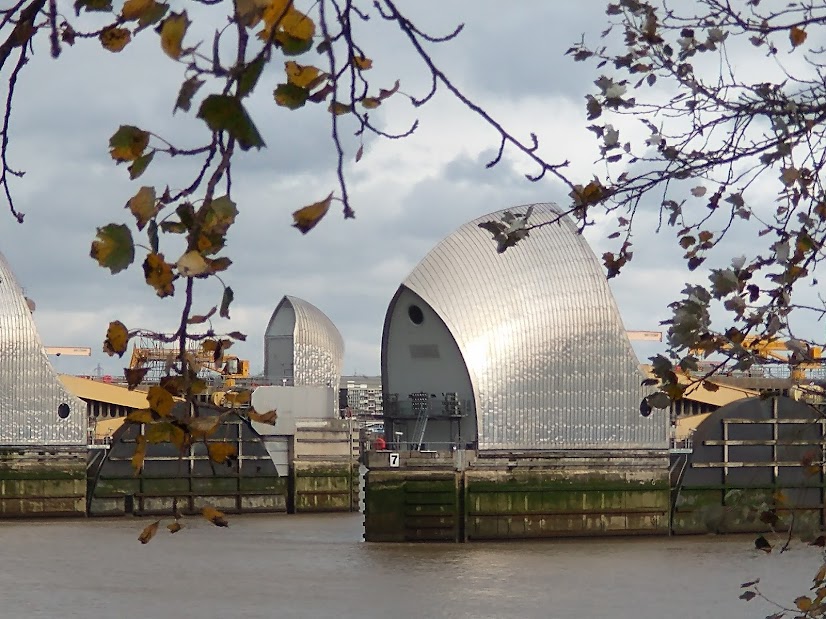
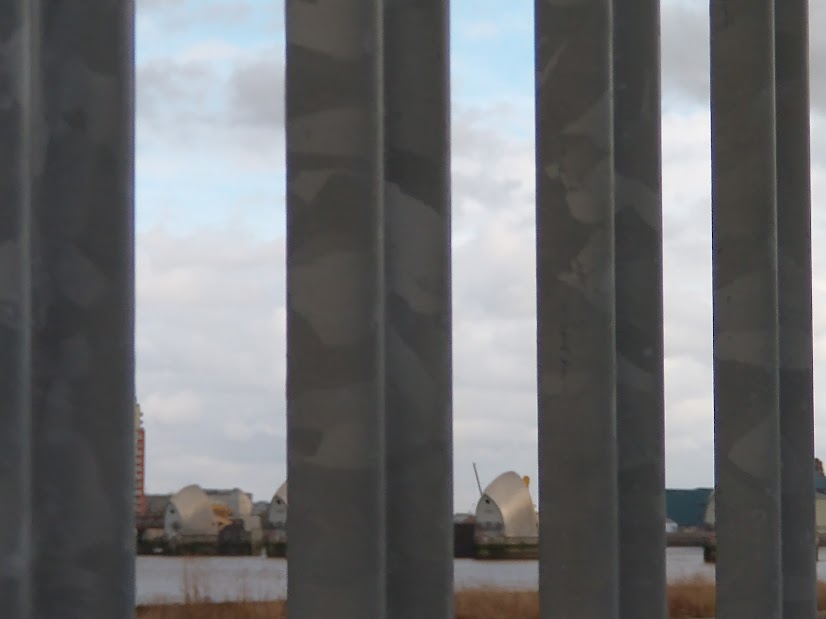
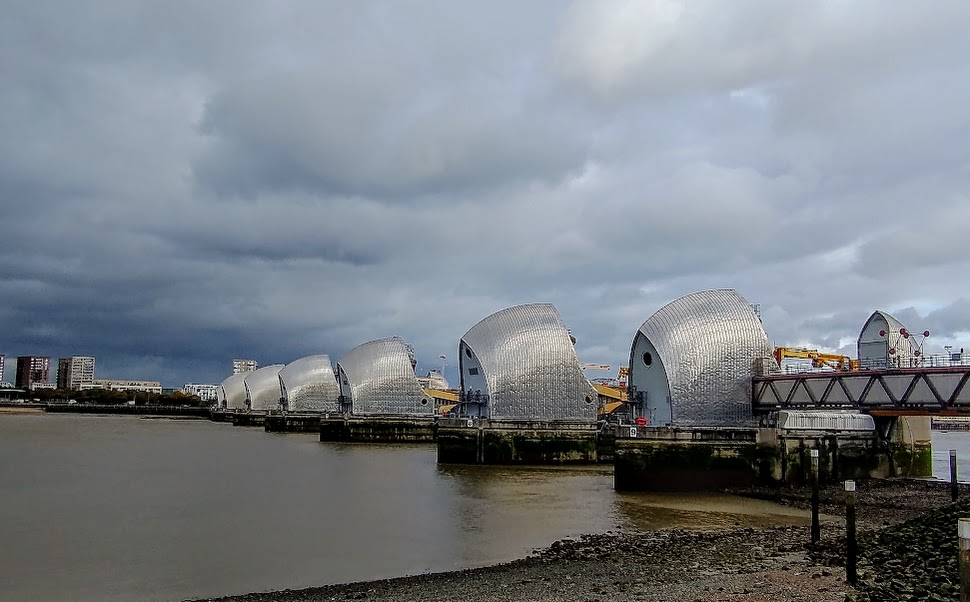
Much of the science behind it is beyond me. But it’s a beautiful thing in its own right, and I can appreciate that: even if I don’t understand the engineering. This short video may help.

For Debbie’s Six Word Saturday. And if you haven’t visited this post and voted … please do.

 From Pyrenees to Pennines
It is rather attractive.
LikeLiked by 1 person
I love it!
LikeLike
An amazing structure. I keep meaning to go back and see it in action. They publish the opening and closing times but I either forget to look or the times just don’t work for me.
A lot of the boat trips come up to it too – a RIB trip with the grandchildren wold be good fun if you haven’t done it already, Margaret
LikeLiked by 1 person
It’s true, it’s on the list but not yet accomplished. A half term idea – thanks!
LikeLike
Oh, excellent!
LikeLiked by 1 person
🙂
LikeLiked by 1 person
It is an incredible structure. I grew up by the Thames and the Joseph Baguelette bridge crossing from Hammersmith to Barnes! And my playground of marshy reservoirs now the Wetland Centre. So sweet Thames flow softly. Don’t flood!
LikeLiked by 1 person
Lucky you. I wasn’t so near the Thames, but near enough. Marshy reservoirs sounds good, and probably made you who you are!
LikeLiked by 1 person
Oh thanks, Margaret, missed that. Been out of it this past week.
LikeLiked by 1 person
Out of it in a good way, I hope.
LikeLiked by 1 person
Just a bad bout of a bad cold I hope. But taking too long to recover.
LikeLiked by 1 person
Ach! Getting older’s no fun! Hope you pull round soon.
LikeLiked by 1 person
Beautiful photos. Well done.
LikeLiked by 1 person
Thanks you. They’re only phone photos too!
LikeLiked by 1 person
Amazing what they can do now!
LikeLiked by 1 person
Thanks for the introduction to this unusual structure (or group of structures.) Nice that it can do something useful while looking good. 🙂
janet
LikeLiked by 1 person
Absolutely! It’s been well worth it on several occasions.
LikeLiked by 1 person
What fascinating photos!
LikeLiked by 1 person
It’s a great place.
LikeLiked by 1 person
Thanks for showing more of this structure. I can’t help feeling that the guys behind the cybermen from Dr Who were looking at this when they thought up these aliens. https://thedoctorwhosite.co.uk/cybermen/
LikeLiked by 1 person
Well, there’s a thought!
LikeLike
I still have never been this close – I really must do so one day!
LikeLike
It’s only recently that I have Sarah, and I’ll go again. The Thames Barrier and nearby Woolwich are so worth exploring. A possible destination for a future London expedition together?
LikeLiked by 1 person
I’d enjoy that 🙂 Today I was in Rotherhithe with some visiting Virtual Tourist friends – another area that not many people get around to visiting!
LikeLiked by 1 person
beautiful photos! I enjoyed this informational post and watched the video. thank you for sharing this
LikeLiked by 1 person
And thanks for reading it. Glad you enjoyed it.
LikeLiked by 1 person
I didn’t know about this. I wonder if it will be efficient enough if London fasces the problems shown in the fabulous scifi novel Flood, by Stephen Baxter. Highly recommended
LikeLiked by 1 person
I’d rather not know thanks … it’s all bad enough as it is …
LikeLike
oops, if London faces…
LikeLiked by 1 person
This is very interesting. I had no idea such a thing was there.
LikeLiked by 1 person
An awful lot of people don’t. It’s outside the usual Tourist Route.
LikeLike
Amazing structures 😮
LikeLiked by 1 person
They really are impressive.
LikeLiked by 1 person
It’s an impressive piece of engineering. I love it too.
LikeLiked by 1 person
It’s in an interesting and underrated part of London too.
LikeLike
Well Margaret, I must admit I felt like an idiot after seeing your post. I’d never heard of nor seen this approach to moderating an area of flooding. Here in nearby Charleston it’s been a major area of focus as the city floods pretty much at every rain or high tide. They’ve gone to incredible measures including building a higher wall at the area of most floods and creating underground piping for the floodwaters to use. It’s an ever-increasing issue with climate change and the remedies are ever-more important. What a beautiful, effective solution for the Thames!
LikeLike
So many interesting solutions to a growing problem. But will they be enough? Meanwhile, I love this Barrier.
LikeLike
Thanks to Debs I found this beauty of a shot. So happy to see Becky’s comments too 🤗🩷
LikeLiked by 1 person
All good, eh? Thanks! Train strike over?
LikeLike
Seems to be. I came a cropper climbing up to Cite de Carcassonne today but I bounce back. Of necessity. Ca va bien 🤣🩷
LikeLiked by 1 person
I’ll swear you’re as clumsy as me. Not an achievement to be proud of! Enjoy the rest of your break (travel break, not body break)
LikeLike
Limped back to hotel. Ice on very swollen knee. Pride comes before a fall and all that. Might not be restless tomorrow 😗🩶
LikeLiked by 1 person
Poor you…. 😦
LikeLiked by 1 person
As someone who works in Canary Wharf, I guess, I ought to appreciate this…. Your writing about the Thames’ history made me think of Mudlark by Lara Maiklem. Have you read it? It is filled with facts and anecdotes from the history of the Thames.
LikeLike
I loved Mudlark! When I was at school, I had a friend who was a proficient mudlarker, and found lots of interesting objects many years before this pursuit became a ‘thing’.
LikeLiked by 1 person
Thanks for that post Margaret, the barrier does an amazing job. Great pics too.
LikeLiked by 1 person
Thank you. Yes, it’s working harder than was originally envisaged.
LikeLike
Sadly.
LikeLiked by 1 person