If Heath Robinson* only knew

Over in a tiny village in the Couserans today for a huge lunch – Azinat – with friends, we came across this sight:

It’s an alambic – well two alambics actually.  We knew that, because we’ve seen plenty of these historic pieces of machinery on display in villages throughout the area.  We even know what they’re for: every autumn, villagers still look forward to the annual visit of the alambic man whom they pay to transform the juices from their apples, plums or whatever into the most potent hooch you can imagine: up to 50% proof.  These alambics  showed signs of having been recently used: the tractor next to them still had its engine running.

We retired to our restaurant for lunch.

Three and a half hours later, the meal over, we sauntered over to where we’d spotted the alambics: huge copper contraptions encased in a battered wooden frame.  They were functioning!  Three large rubicund men, the types you can meet in the countryside anywhere, any country, were supervising hooch production, and were very happy to explain everything.

Checking everything’s fine

Well, I can’t be sure I’ve got this right.  It’s something like this though.

A fire under the first cylinder heats the juices that are poured into it.

The all-important fire. Note the wheels on which the machine originally travelled

The resultant steam is forced up through pipes, which are cooled by water.  The vapour condenses into alcoholic liquid.  That doesn’t sound quite right to me: I never was any good at science.

Copper lid – parked for the moment.

Anyway, it’s the result that counts.  We met a Dutch couple who’d brought along their plum juice to be processed.  135 litres of juice.  And their eau de vie was now almost ready for them to pay for and take away.  Their 135 litres had become …. 10 litres.
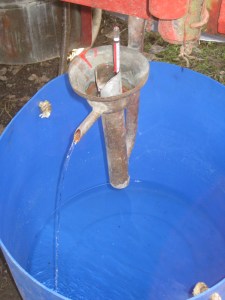
Here’s the hooch

They didn’t yet know what they were going to be charged.  But they had been told they’d have to fill in a lengthy document for the tax office, and pay a suitable levy for this astonishingly potent product.  We know for a fact it’s strong stuff.  There were the dregs in a large plastic container.  They invited us all to dip a finger in and taste it.  We did.  And I promise you – just licking a fingerful probably put us over the limit.

We felt as if we’d witnessed a real piece of history.  When these men retire, are there young people around who will follow in their footsteps?

This alambic’s probably good for very many more years

* And if you don’t know Heath Robinson, click the link

‘Let them eat cake’

Back in the UK, I hear everyone’s gone baking mad, that the entire nation was glued to its screens to watch the final of  ‘The Great British Bake-off’.  Here in France, it’s the one branch of cookery in which the average French person will allow the average Brit some supremacy.

The French are rightly proud of their high-end patisserie, the delectable tarts and gâteaux which traditionally come to the table at the end of a family celebration or Sunday lunch: from the baker’s naturally, no shame in that.

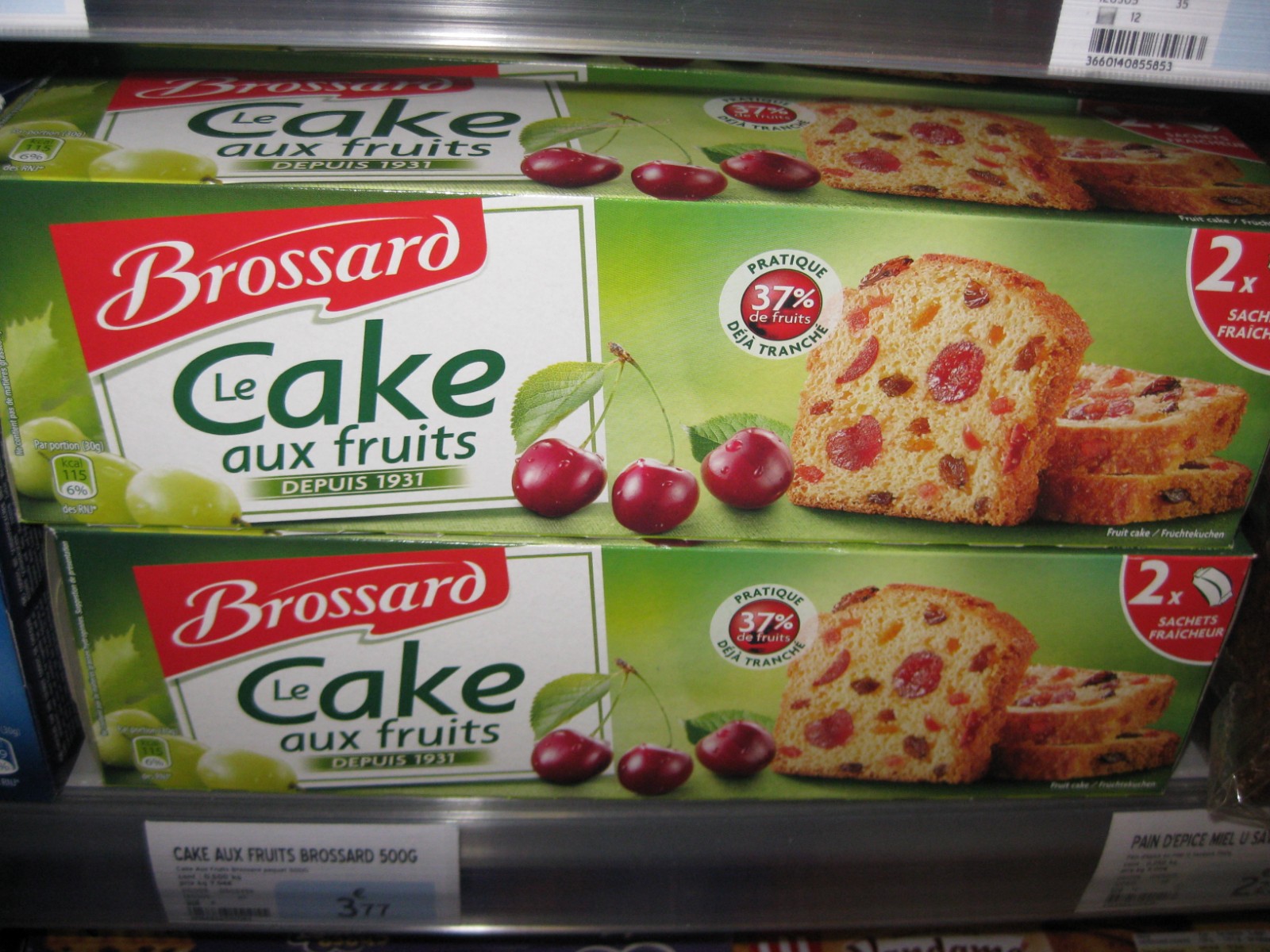
More day-to-day baking is a different matter, however.  Plainish cakes, loaf-shaped and known in France as ‘cake’, are a big disappointment, especially if they’re from the supermarket.  I find them over-dry, over-sugared, too strongly flavoured with something, such as vanilla, that should be a subtle undertone.  I never thought I’d find myself saying this, but even cakes available in any old British supermarket can be quite a treat in comparison.

McVitie’s Jamaican ginger cake, for example, dark and sticky, is just the thing with a hot cuppa after a brisk country walk in winter: it even has its own website.  And while I’m not sure that Mr. Kipling makes exceedingly good cakes, they’re – well – not too bad.

No wonder then, that when we run our cookery workshops at Découvertes Terres Lointaines, and announce that we’ll be turning our hands to British tea-time treats, the group is immediately oversubscribed .  Scones, coffee and walnut cake and a nice of cup of tea anyone?

Supermarket scene in France

The Orange Man

Winter has arrived.  How do I know?  Although the nights are cold, the afternoons are still for going walking or tidying up the garden wearing a tee-shirt, beneath a duck-egg blue sky. So until the other day, I thought we were clinging on to autumn.

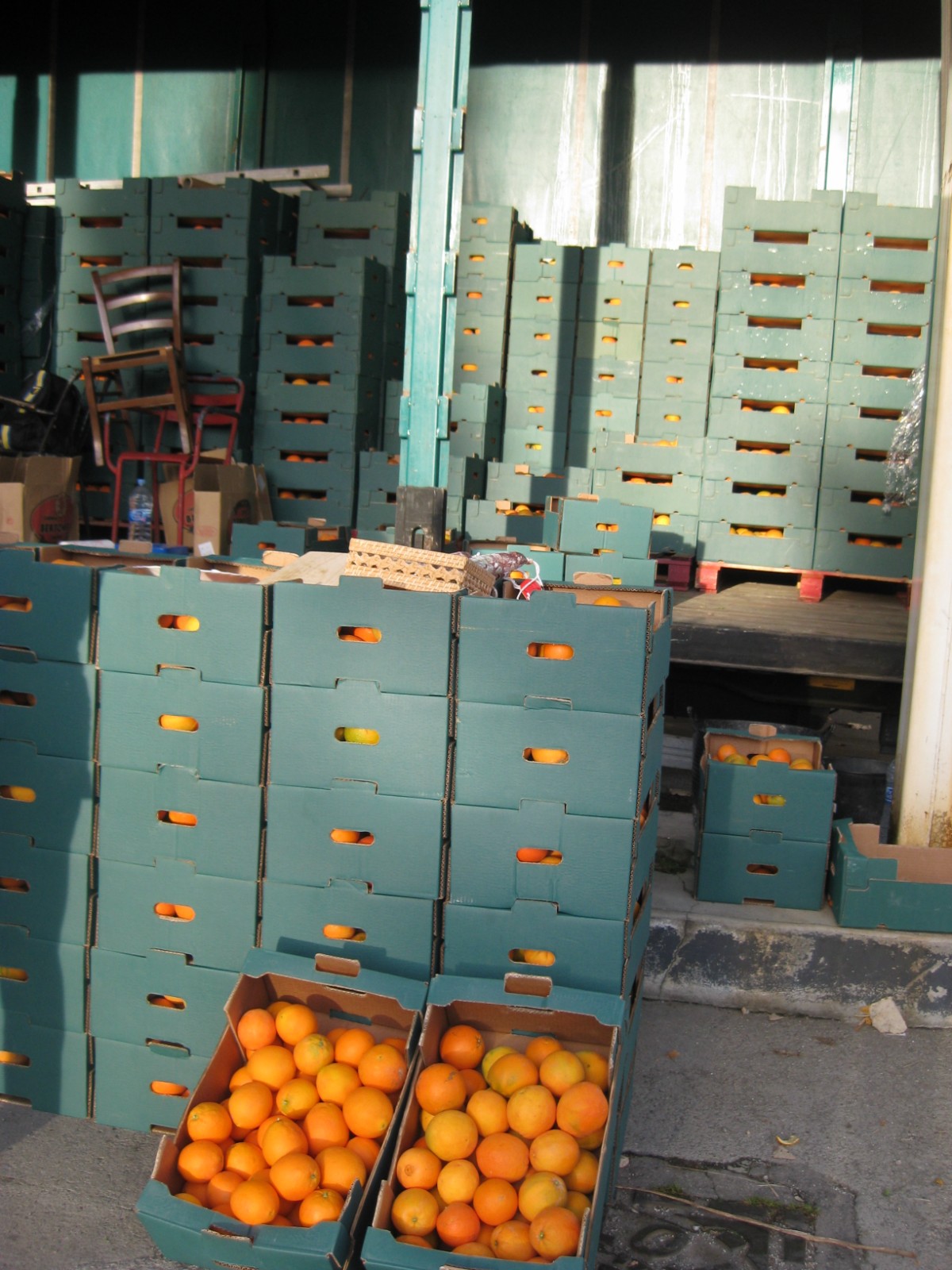
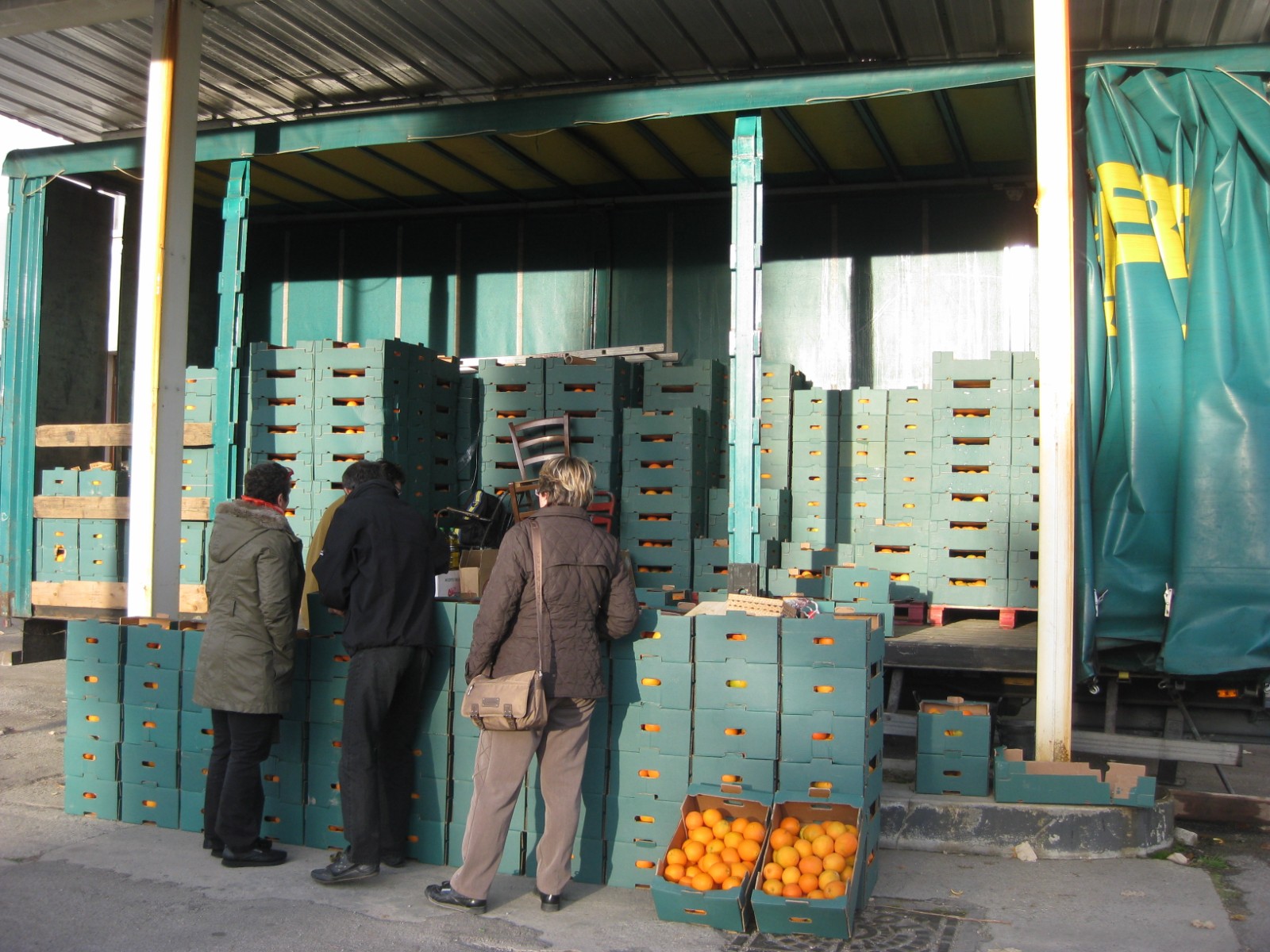
But on Thursday, the Orange Man arrived.  This is exciting enough news for it to be worth phoning a friend.  Every year, once winter kicks in and the orange harvest is well under way in southern Spain, a huge container lorry arrives in Lavelanet. It parks up at a disused petrol station on the main road into town and becomes an impromptu shop.

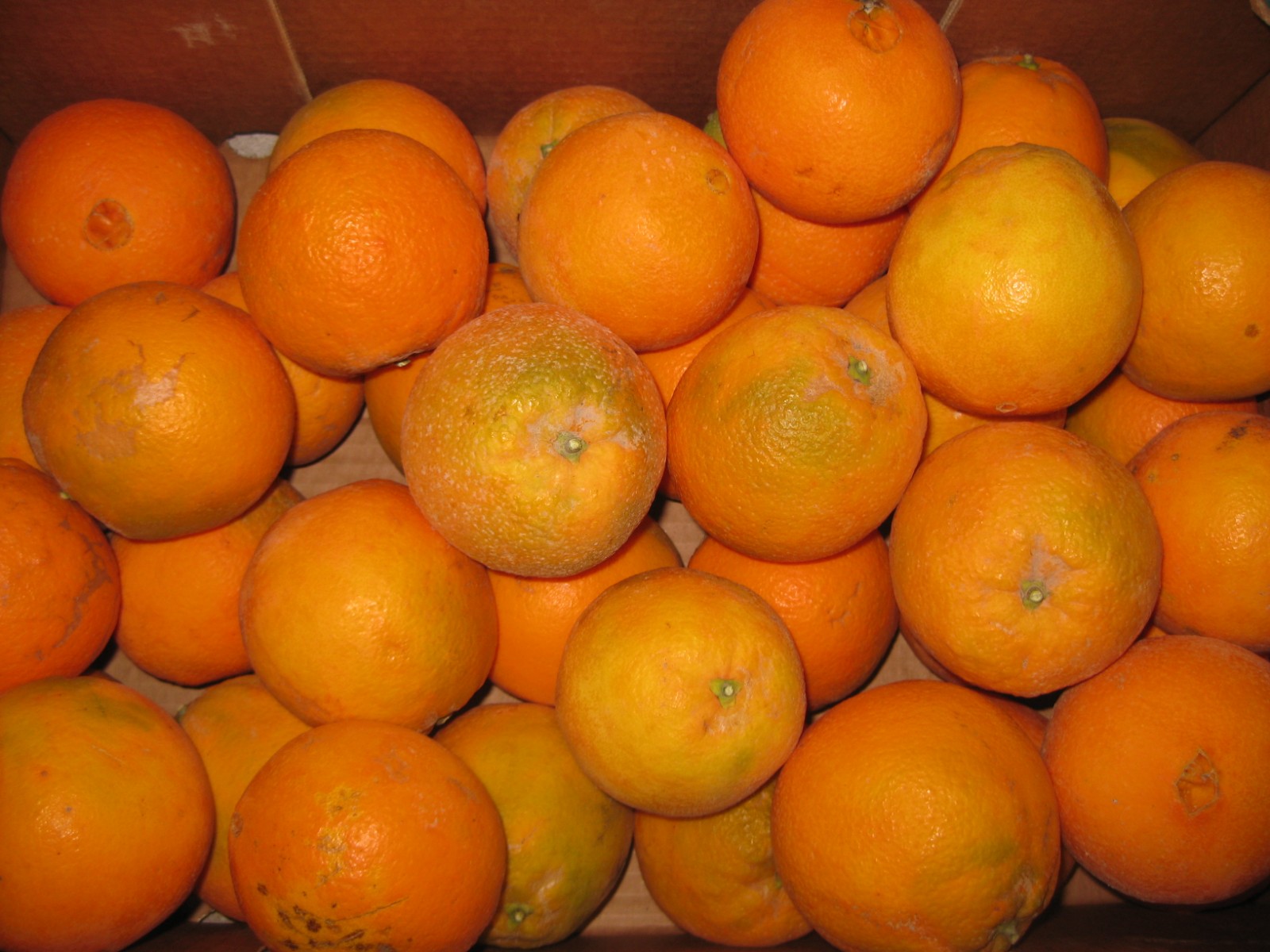
The man with the lorry, the Orange Man,  speaks only Spanish, and sells only oranges.  Not singly or by the half-dozen, but in large 10 kilo boxes.  10 kilos, 10 euros.  What a bargain.  These oranges, though sometimes a little knobbly and in irregular sizes, are the juiciest and tastiest you’ll ever eat, and it’s no wonder that whenever you pass, you’ll see someone pulling up their car and opening the boot for a case or two.  Our Spanish friend won’t have to stay long.  In a few days the entire container-load will be sold, he’ll return to Spain …. only to return when he’s loaded up again.

When he departs for the last time at the end of the season, we’ll know for sure that spring has arrived.

PS.  Very topically, Hugh Fearnley-Whittingstall takes oranges as his subject in today’s cookery column in the Guardian

Our day out with John Rylands

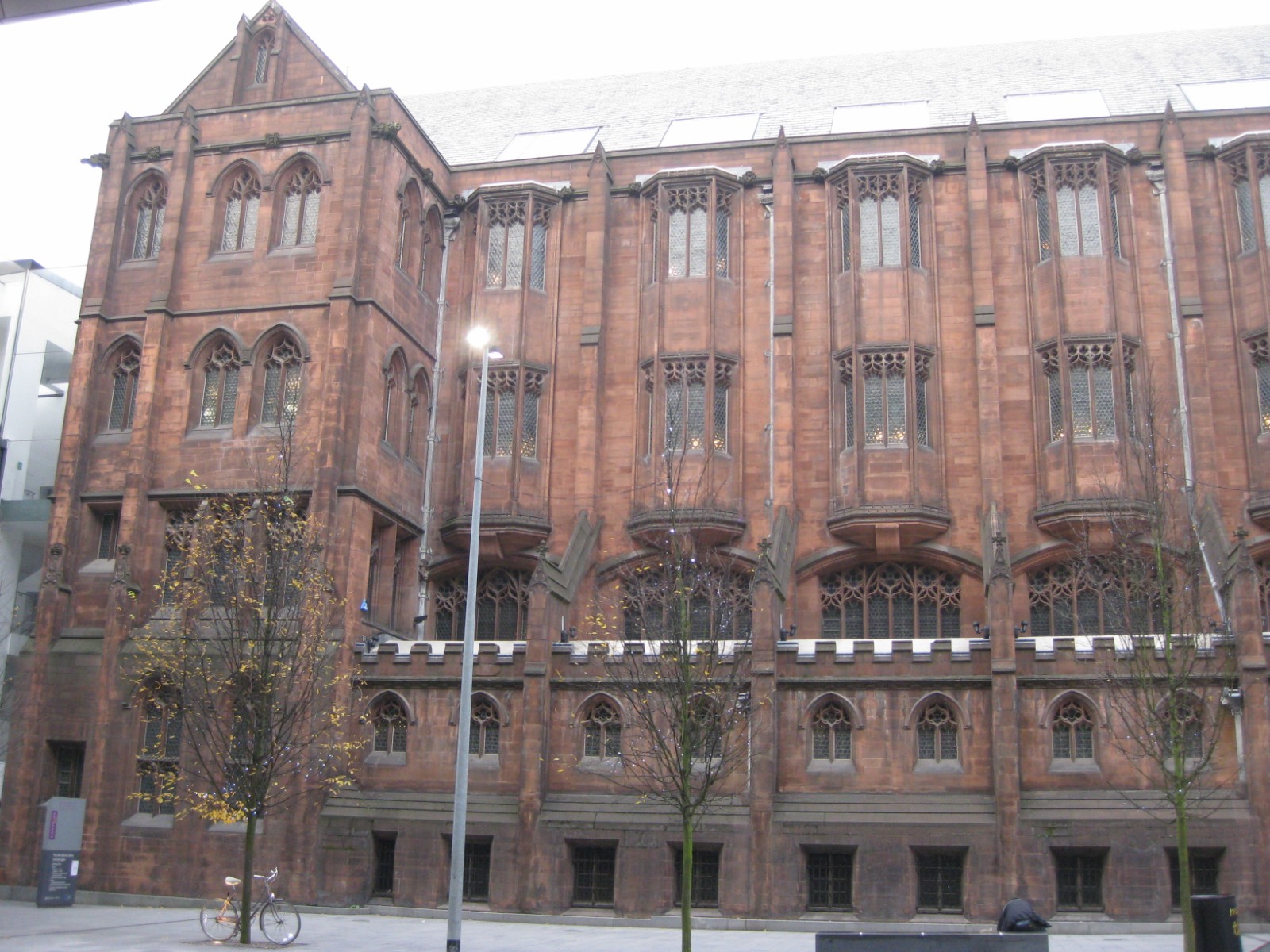
Before we came back to France at the weekend, I wanted a day in Manchester, where I was at University more than 40 years ago.  It was a city people at that time seemed to love or hate.  I loved it then, and I still do.  It’s buzzy and busy, with galleries, music, shops, and a bravura display of civic Victorian architecture down every city centre street.

Outside John Rylands library

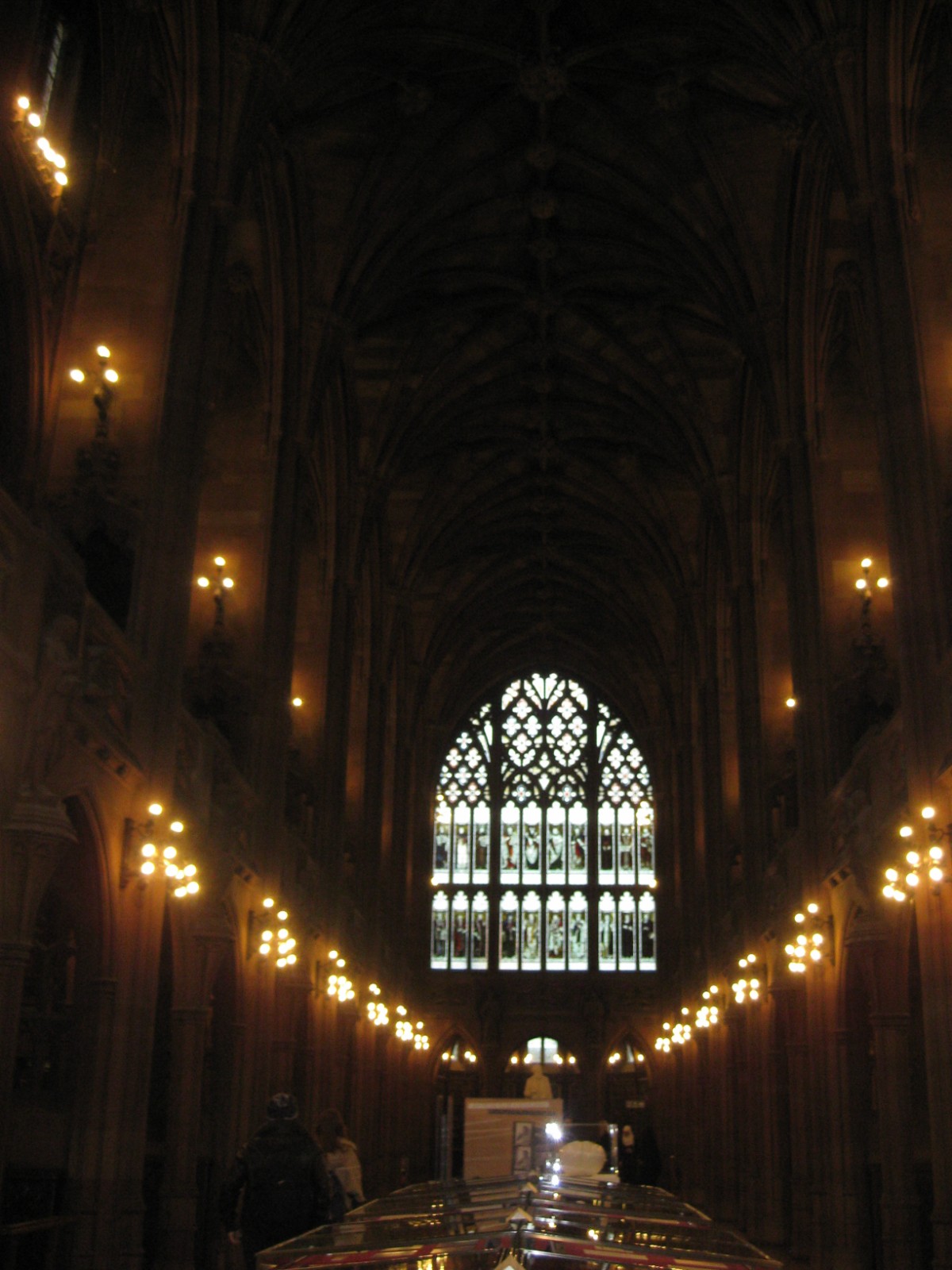
I had a particular memory I wanted to share with Malcolm.  The John Rylands Library.  I used to go there to write an essay or prepare for a seminar on those days when I wanted to pretend to some kind of scholarship that in truth was never part of my make-up.  The building was a celebration of Victorian Gothic architecture at its finest, with wonderful plaster tracery on the walls, splendid fan-vaulted ceilings, and shelf after shelf of ancient leather-bound books.  Seated in some darkened alcove, surrounded by the particular smell of the place – beeswax polish mixed with dusty books, I would work away for an hour or two, convincing myself, if nobody else, that I was getting down to the serious matter of studying in an industrious and creative manner.  Few other people would be there: there were no distractions other than the quiet beauty of the building itself.  The place was built for scholarship.

The reading room where I pretended to write essays.

It was built in the 1890’s by Enriqueta Rylands in memory of her husband John.  Although his origins were humble, he became Manchester’s first multi-millionaire, making his fortune in the textile industry as a cotton manufacturer.  At first, the library collection was modest, but over the years, has come to hold works of world-class importance: everything from the earliest known New Testament text, on papyrus, to medieval illustrated manuscripts, a Gutenberg bible, and the personal papers of the likes of Elizabeth Gaskell.

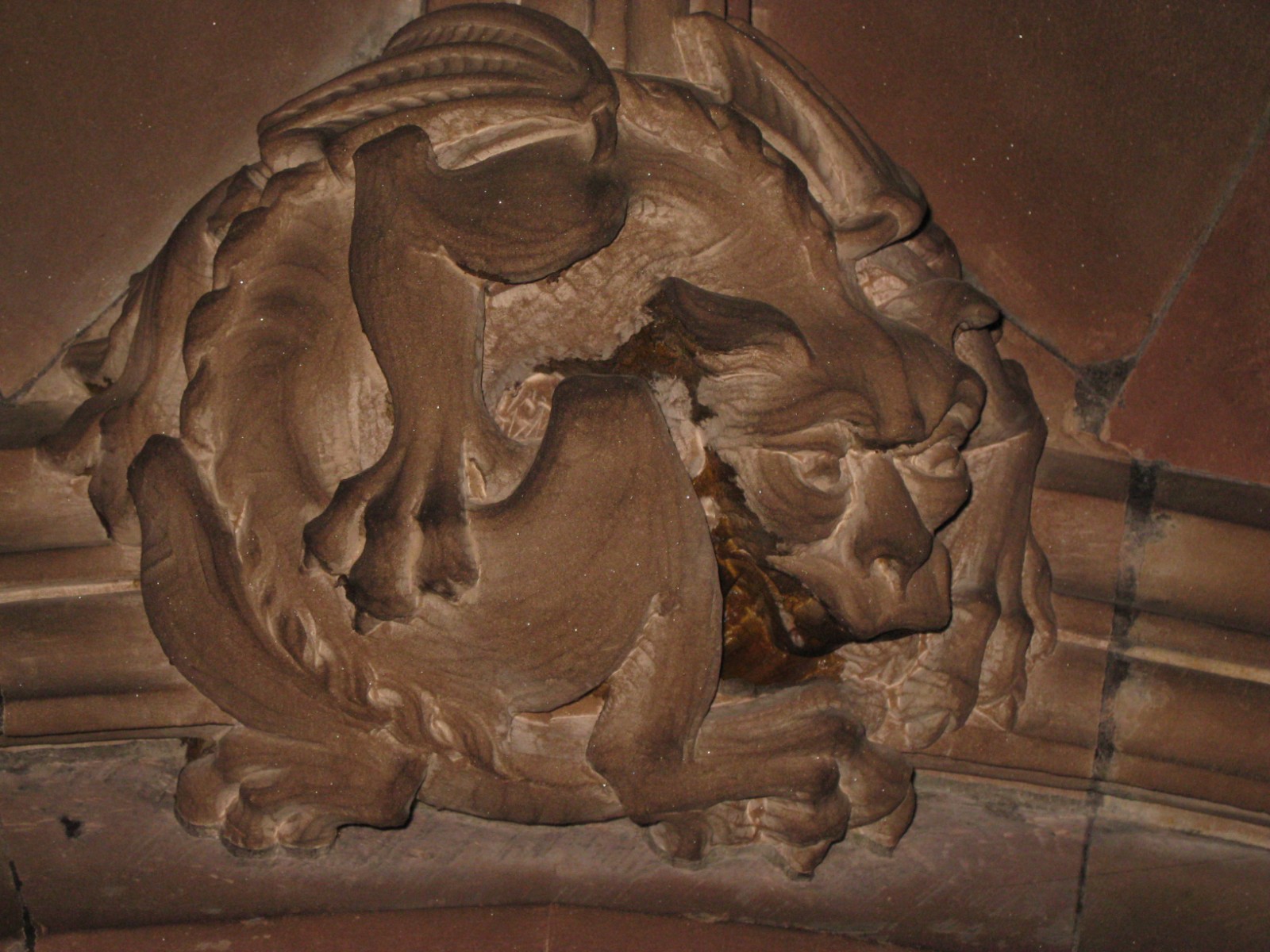
One of dozens of different fantastical creatures forming the roof bosses

I’m not qualified to comment on the early air conditioning systems, or the electricity originally generated on site.  I simply enjoy the richly patterned stained glass, the sumptuous woodwork, the dragons encircling ceiling bosses, and the sandstones in which the building is constructed, which range from soft pink to a rich dull red.

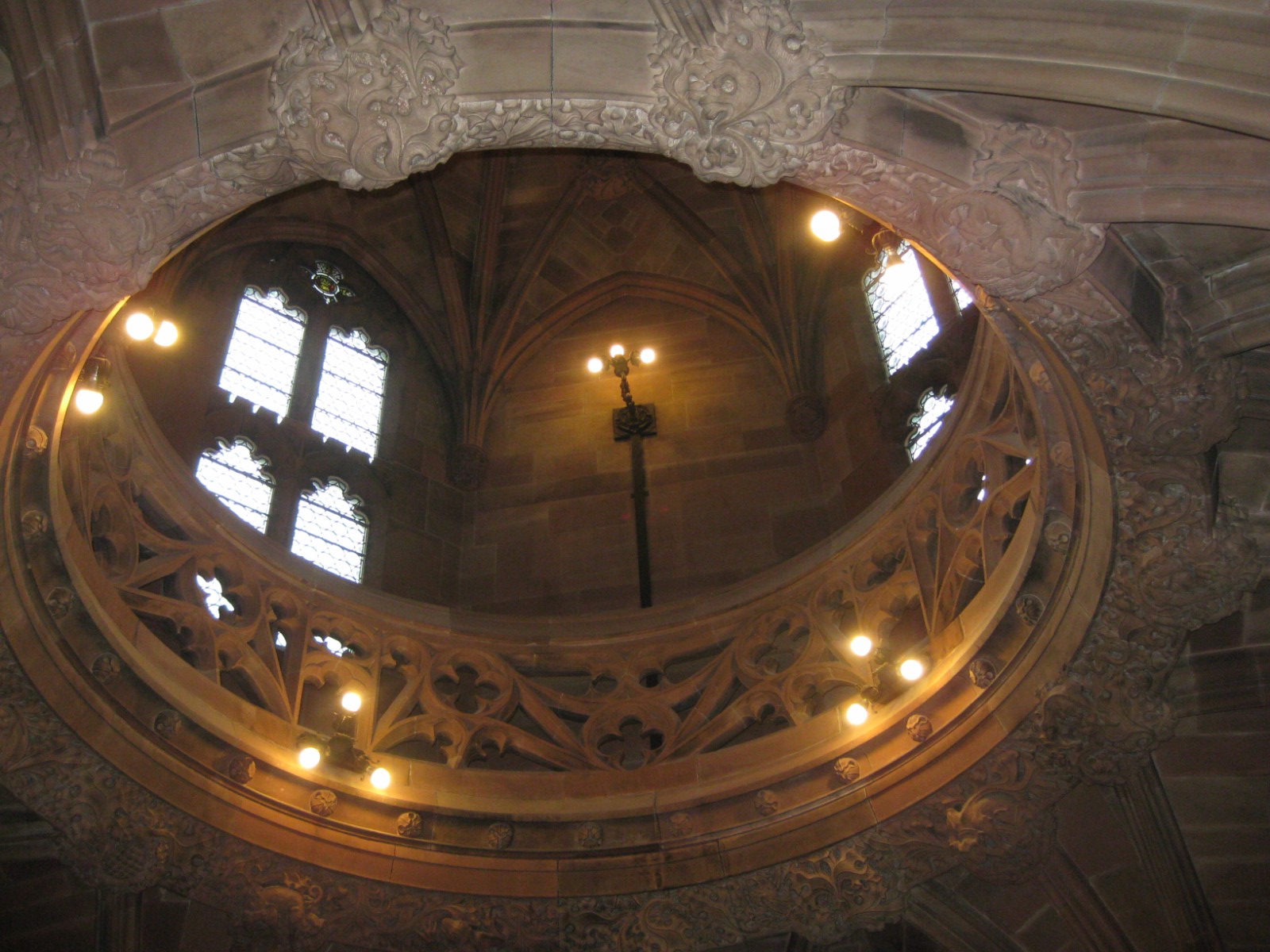
An upward glance whilst on a staircase

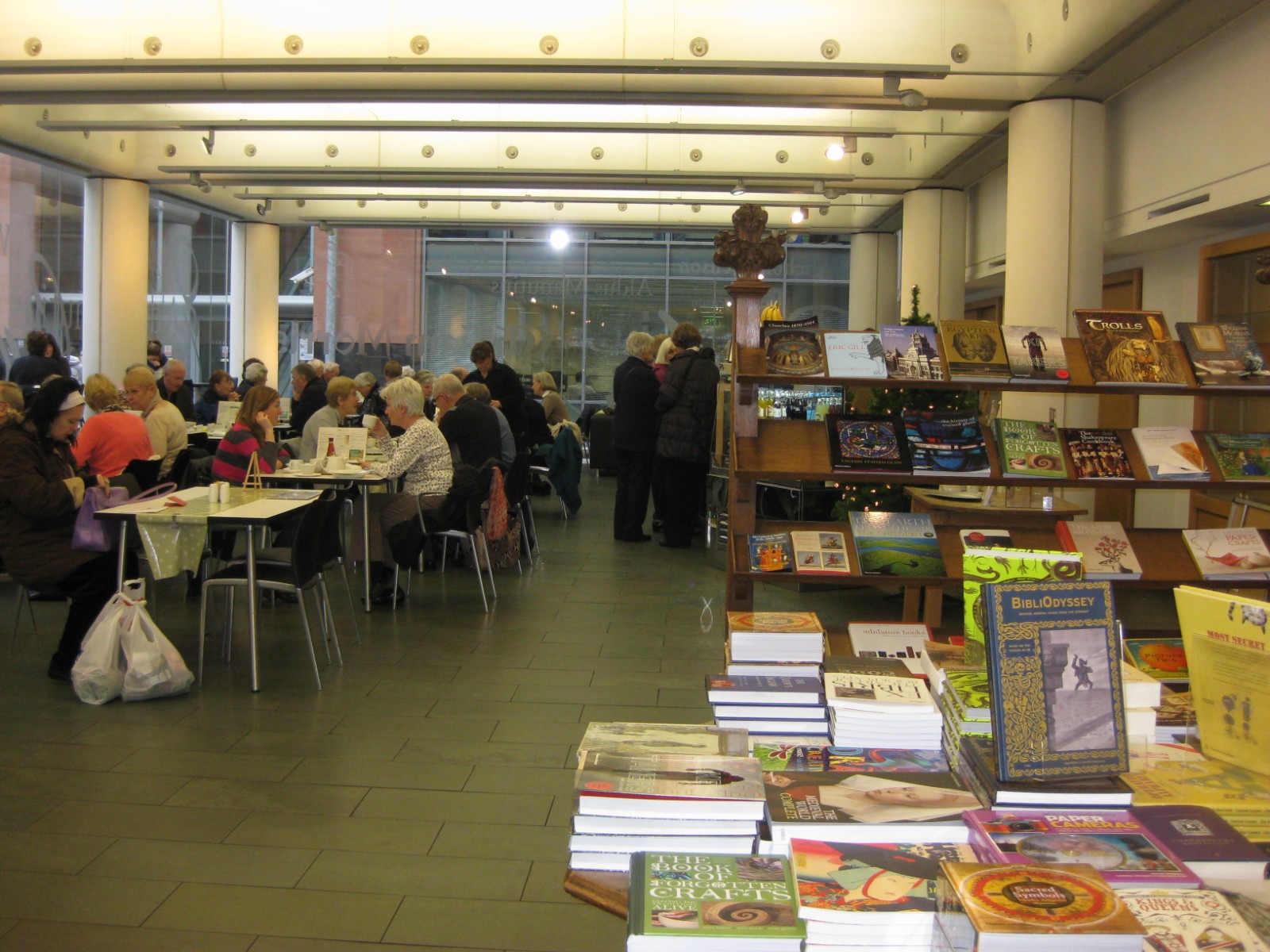
Back in the ‘60’s, I’d work till I got hungry, thirsty, or both.  Last week, we discovered that these days I’d have no excuse to leave, because there’s a modern extension sensitively joined to the side of the building.  This houses Café Rylands, where we had our lunch, made from locally sourced produce; a bookshop which, though small, presented us with fascinating choices, from architecture and design books to children’s stories; and an almost irresistible gift-shop.  It has an energetic and exciting programme of educational events, and I wished we could have signed up for some of them.

Café Rylands and the book shop

When I was a student in Manchester, the library was little known outside academic circles.  Now it’s a different story.  John Rylands Library has been made  Manchester’s ‘Large Visitor Attraction of the Year’ at the city’s annual tourism awards.  You could spend happy hours here, exploring the building itself, the exhibits, and making frequent sorties to the coffee shop for a relaxing break and browse through the papers.  And apart from your spending money, it’s all free.

Drop a coin or two into the donation box, and the automaton will go through its paces

The page three ‘Beastie Boys’

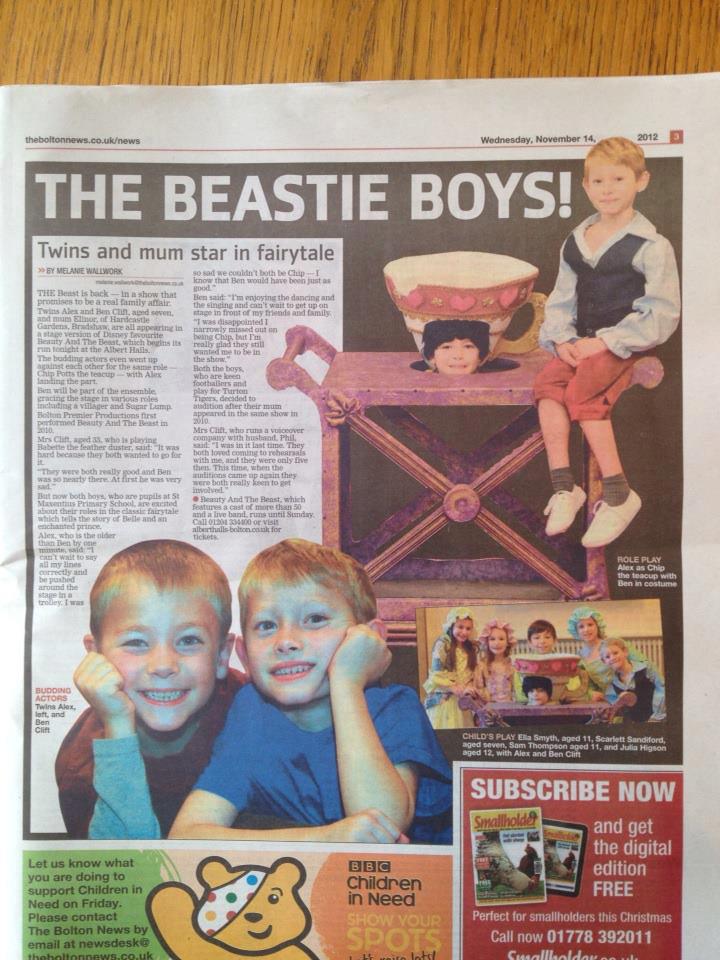
The blog I was going to post has been pretty much written for me.  Here’s what we found on page 3 of the Bolton News this morning.

Page three boys

‘THE Beast is back — in a show that promises to be a real family affair.

Twins Alex and Ben Clift, aged seven, and mum Elinor, of Hardcastle Gardens, Bradshaw, are all appearing in a stage version of Disney favourite Beauty And The Beast, which begins its run tonight at the Albert Halls

The budding actors even went up against each other for the same role — Chip Potts the teacup — with Alex landing the part.

Ben will be part of the ensemble, gracing the stage in various roles including a villager and Sugar Lump.

Bolton Premier Productions first performed Beauty And The Beast in 2010.

Mrs Clift, aged 33, who is playing Babette the feather duster, said: “It was hard because they both wanted to go for it.

They were both really good and Ben was so nearly there. At first he was very sad.”

But now both boys, who are pupils at St Maxentius Primary School, are excited about their roles in the classic fairytale which tells the story of Belle and an enchanted prince.

Alex, who is the older than Ben by one minute, said: “I can’t wait to say all my lines correctly and be pushed around the stage in a trolley. I was so sad we couldn’t both be Chip — I know that Ben would have been just as good.”

Ben said: “I’m enjoying the dancing and the singing and can’t wait to get up on stage in front of my friends and family.

“I was disappointed I narrowly missed out on being Chip, but I’m really glad they still wanted me to be in the show.”

Both the boys, who are keen footballers and play for Turton Tigers, decided to audition after their mum appeared in the same show in 2010.

Mrs Clift, who runs a voiceover company with husband, Phil, said: “I was in it last time. They both loved coming to rehearsals with me, and they were only five then. This time, when the auditions came up again they were both really keen to get involved.” ‘

Thanks, Bolton News and reporter Melanie Wallwork.

Well, tonight we’re off to see the show – with all four of them: even Phil, Ellie’s husband, has his part to play.  He voices the ‘Ealth and Safety announcement at the beginning.  No wonder we had to come to England to be part of the audience.

What to do with a bag of foraged walnuts

Another set of recipes.  But these two walnut cake recipes are too good not to share.  The worst thing is shelling 175 grams of walnuts all at one go: but when the nuts have been foraged for free, it doesn’t seem right to complain.  So I won’t.

This first one isn’t something to knock together with only half an hour to spare, but it IS very good.  Thanks James Martin and the BBC Good Food website for this recipe,, which I’ve slightly simplified.

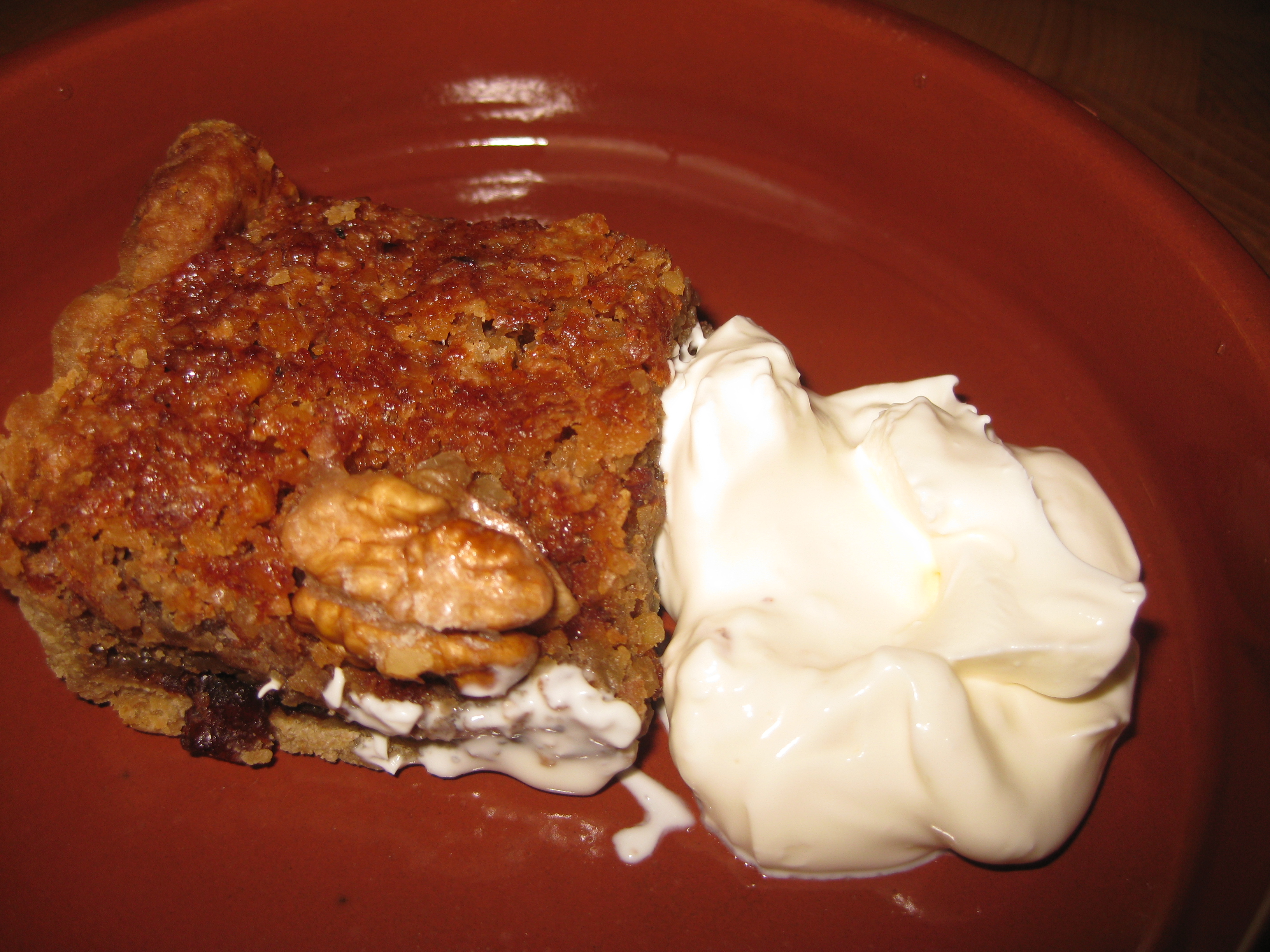
I forgot to photograph it till it was almost gone

Walnut and coffee frangipane tart with candied walnuts

Ingredients

For the tart

  • 500g sweet shortcrust pastry
  • plain flour, for dusting
  • 110g prunes, stoned, roughly chopped, soaked in Armagnac

For the frangipane

  • 175g butter, softened
  • 175g caster sugar
  • 4 free-range eggs
  • 3 tbsp strong coffee, cold
  • 175g walnuts, ground to a fine powder

For the candied walnuts 

  • 50g. caster sugar
  • 60ml. water
  • 18 walnut halves
  • 200g cream, to serve
  • Roll out the sweet shortcrust pastry on a floured work surface lightly dusted with flour to a 3mm thickness.
  • Carefully line six x 7.5cm deep-sided tart tins with the pastry, pressing the pastry into the edges of the tin. Leave 2.5cm of pastry overhanging the edge. Leave the lined tins to rest in the fridge for 10 minutes.
  • Line the pastry cases with greaseproof paper and then fill with baking beans or rice. Place the tart tins onto two large baking trays and bake in the oven for 10-12 minutes.
  • Remove the greaseproof paper and baking beans or rice, then return the tart cases to the oven for a further 5-10 minutes, or until they are pale golden-brown.
  • Remove from the oven and set aside to cool slightly. Trim the excess pastry with a sharp knife.
  • Meanwhile, blend the prunes with a little of the Armagnac in a food processor to make a thick paste.
  • For the frangipane, beat the butter and sugar together in a bowl until pale and fluffy.
  • Beat in the eggs, one at a time, beating well after each addition, until all of the eggs have been fully incorporated into the mixture.
  • Fold in the coffee and ground walnuts until well combined.
  • When the pastry case has cooled, spread the puréed prunes across the bottom of the sweet shortcrust pastry case. Top with the walnut mixture and smooth to the edges.
  • Return the tart to the oven for 15-18 minutes, or until the filling has risen and is cooked through and the surface is pale golden-brown. (The filling is cooked through when a skewer inserted into the centre comes out clean.)
  • Meanwhile, for the candied walnuts, place the sugar and water into a saucepan and bring to a simmer.
  • Add the walnuts and cook for a couple of minutes, or until just tender.
  • Drain and place onto a large sheet of greaseproof paper.
  • Carefully add the candied walnuts to the oil and cook for 1-2 minutes, or until just golden-brown.
  • Lift out and drain on a fresh sheet of greaseproof paper. Leave until cool.
  • To serve, place each tart in the centre of a small plate and top with a few candied walnuts. Finish with a dollop of cream.

Michel up the road gave me this recipe.   It’s a nicely moist cake which keeps and freezes well.

Walnut cake Amafaçon (my way)

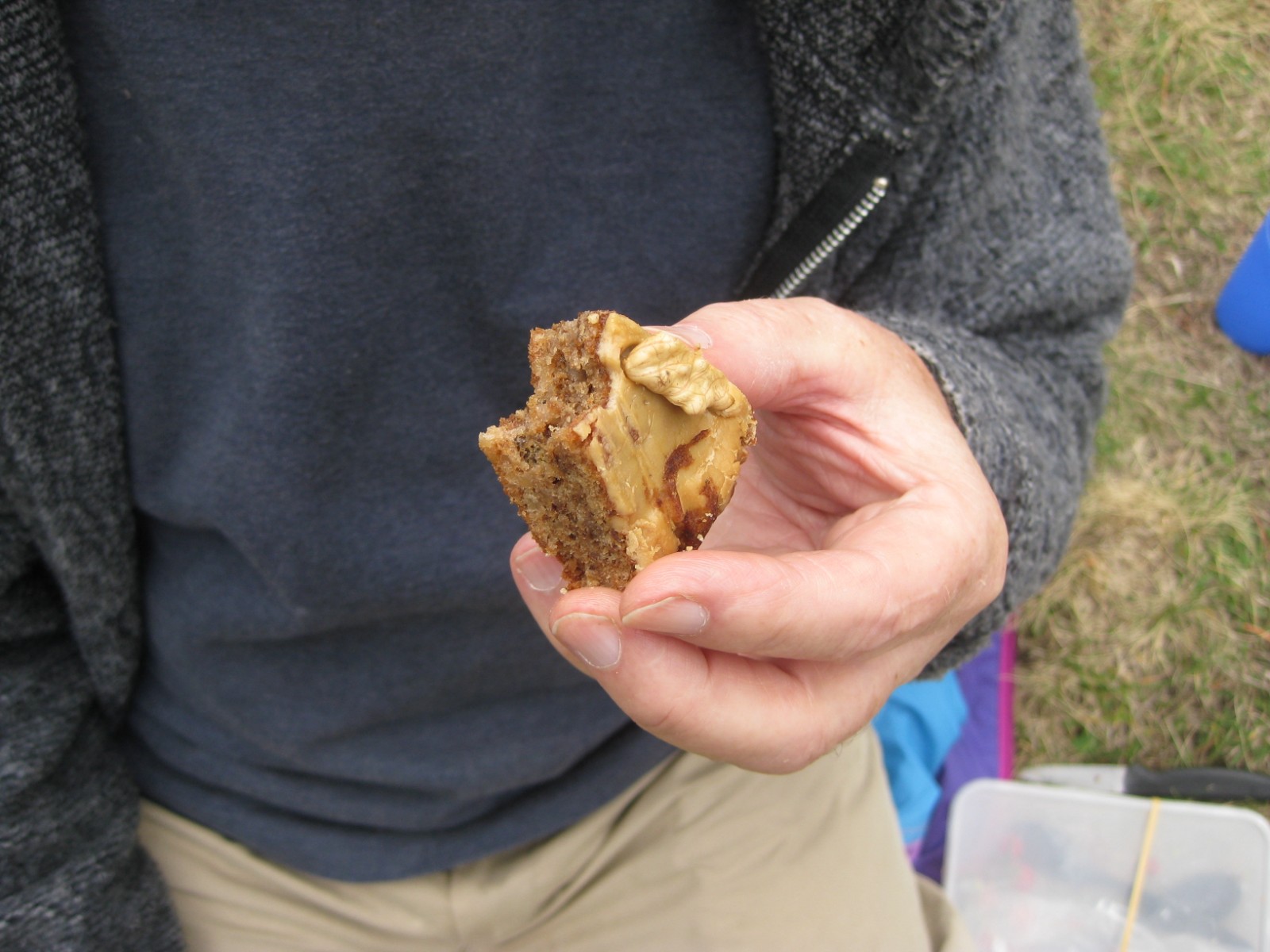
Mal puts away a slice of walnut cake on our walk to Bésines

 Ingredients    

180g. finely ground walnuts

30g. SR flour

12g. cornflour

4 eggs

120g. caster sugar

100g. butter

½ glass walnut liqueur, rum, or alcohol of choice

Pinch of salt

Preparation :

  • Heat the oven to 200°C
  • Mix half the sugar with the ground walnuts.
  • Mix the remaining sugar with the softened butter and add the walnut mixture.
  • Add 2 whole eggs one by one, and 2 yolks, one by one.  Mix well then add salt, flour, cornflour and liqueur.
  • Beat the 2 egg whites to soft peaks, and fold into the cake mixture.
  • Pour into a well-greased 22cm cake tin and bake for 35 minutes at 200°C .  The cake’s cooked through when a skewer inserted into the centre comes out clean.
    For a 24 cm. cake tin, bake for 50 minutes at 180°C.

Serve it just as it is, or if you’d like something more elegant,

  • ice with a strong coffee icing or
  • decorate with caramelised walnut kernels and a caramel sauce made with 150g. sugar caramelised in a thick-bottomed saucepan to which you add 30 g. of salted butter and 50ml. single cream.

A very English Sunday walk

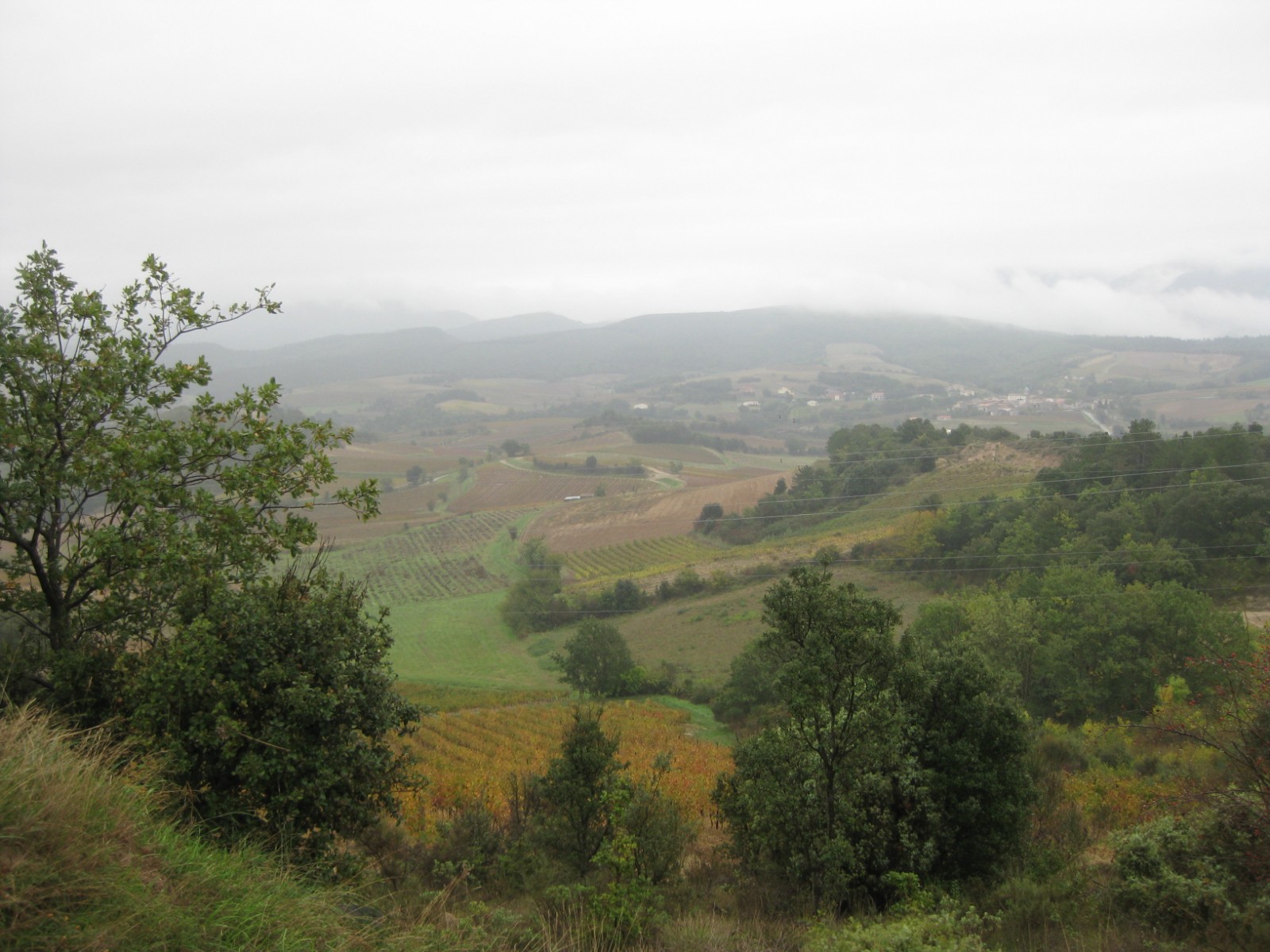
If you go on a walk near Limoux in the Aude at this time of year, you’re entitled to scenery like this:

Vineyards near Villar -St-Anselme

In our walking group here in Laroque we all take turns to organise the weekly outings.  And this week, it was the two of us, the only English, who were in charge. We decided on an autumn walk among the vines round Saint Polycarpe, near Limoux.  The weather forecast wasn’t great, but the rain promised to hold off till 3 o’clock.  But no.  English leaders, English weather. Think of us plodding through the mud as the rain increased in intensity, long long before 3 o’clock arrived.  Everyone blamed us, of course.  They think this is the only kind of weather we know, back in England.

It all began so well….

Above Saint Polycarpe, 10.00 this morning.

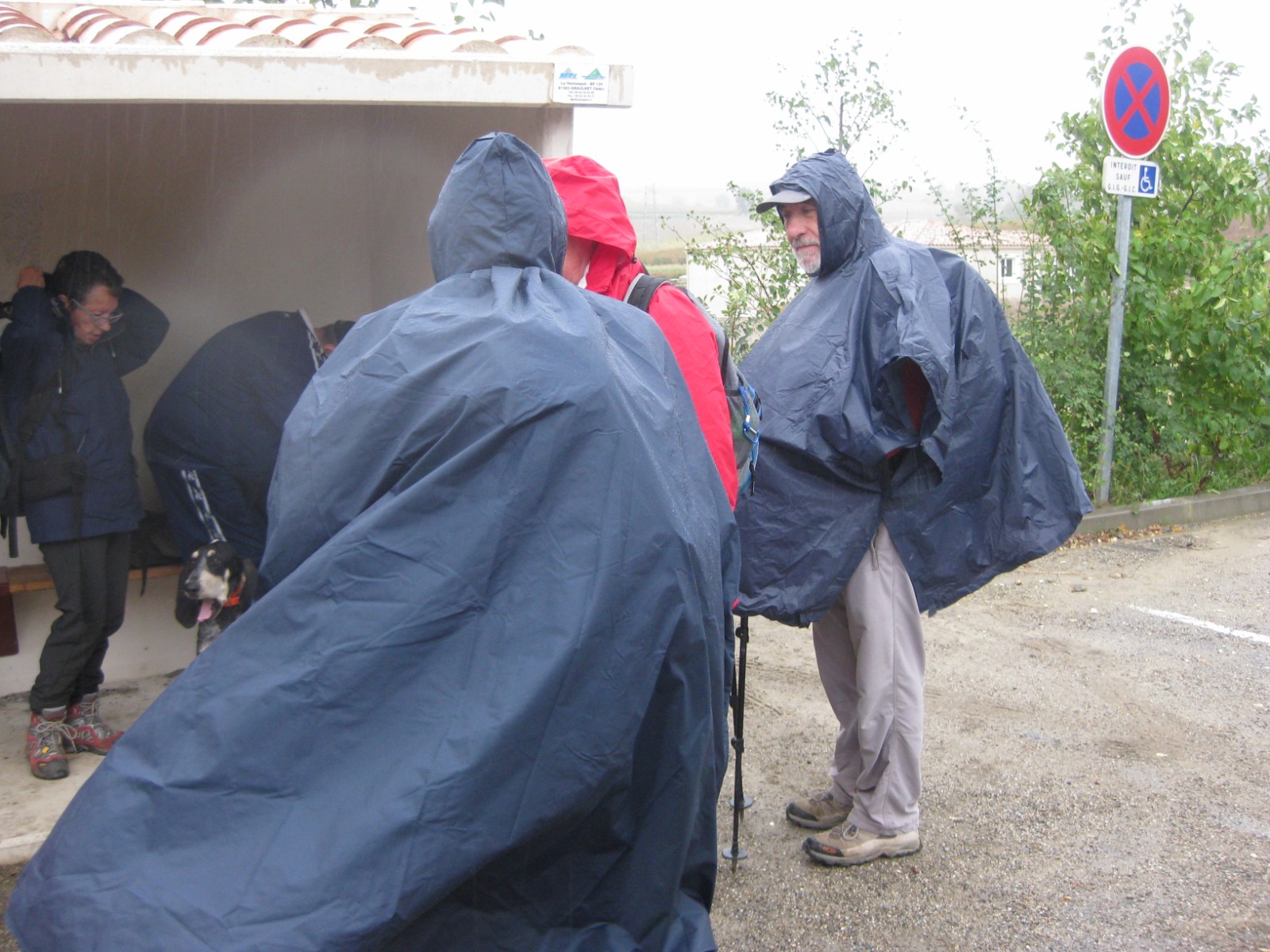
Lunch was early, at Gardie, but we didn’t beat the rain.  We had our break in the bus shelter, for goodness sake, and got togged up like this immediately after.

The clouds descend…..

And the gloom.

Can’t see much.

Saint Polycarpe’s down there somewhere…

Still, nobody complained.  We got our fresh air and exercise, and our friends had a thoroughly good time holding us responsible for the rain and mud.

PS.  Dangermouse update.  We caught him last week.  He is no more.  He was a rat.  Eurghhhhh.