A walk in the Aude

Last Sunday, we went off as usual with our walking group, Rando de l’Aubo.  We went a mere 20 km eastwards into the neighbouring Aude.  What a difference a few miles makes.  The rugged forests, with hillside pasture for cattle and sheep, fields of maize and feed crops in our own department are exchanged for an almost Tuscan landscape, with little hillside towns overlooking ranks and ranks of vineyards delineating the contours.  Both departments are lovely, but we hicks from the Ariège tend to prefer our less manicured and somewhat wilder countryside.

Still, Sunday’s walk was quite a sentimental journey for Malcolm and for me, because we walked through the village, Ferran, that was our first introduction to this part of the world.

A few years ago, an old friend of Malcolm’s sent him an email.  In his letter, he said that it was February, and he’d been sitting outside in his shirtsleeves, gazing out at his perennial view of the distant Pyrenees, at that time covered with bluish-white snow.  Did we fancy a visit to him in Ferran?  We did.  We were of course seduced by those hillside towns, those vineyards, and especially by those views of the Pyrenees.  Not too long after, we came over again, to house hunt, and of course didn’t find that elusive, perfect spot.  Only after we’d returned home did our friend’s wife, who’s an estate agent, spot the possibility that we just might like the butcher’s house in Laroque where we now live.

It was crazy really. We bought it without really knowing the first thing about the area.  But we’ve never regretted it.  We’ll never finish exploring the hillside pathways, always deeply mulched with fallen oak and beech leaves, or the craggier routes up mountainsides, or the gently undulating lower paths through meadowlands, bright with orchids and other flowers, as well as butterflies, throughout the spring and summer.
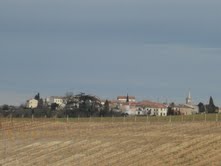
Ferran

But that’s the Ariège.  Ferran and the other villages we skirted last Sunday are typical of the Aude.  Colour washed houses and farms in shades of barley, corn and almond perch high on the hillside, looking down over their vineyards, and beyond – one way to the Montagne Noire, the other to the Pyrenees.  The hills roll away into the distance, not so blanketed by forest as our hills are, but at this time of year, green and lush. Though we only walked about 13 km, by the end we were exhausted, because throughout the day we’d been buffeted by the winds for which the Aude is known. But how lucky we are to have two such very different kinds of countryside within such easy reach of our homes.

St. Barthelemy seen from near Ferran

As I’m still camera-less, thanks to Jean-Noël, Michel and Anny for letting me use their photos from this walk, and a recent one near Donazac, also in the Aude

A visit to Fontfroide

Yesterday, the day here in Laroque started with the threat of snow, finally realised this morning.  But with our Rando group, we set off for the brighter if bracing Corbières.

The Corbières are of course well known for wine production.  As our mini-bus reached the area, we saw no cows, sheep, donkeys…or any animals at all.  What we did see was acre after acre of vineyards, along the narrow plains, scrambling up the hillsides, with each Domaine favouring a different style of pruning, from the wild and wiry abundance of tendrils clearly being left alone till the spring, to almost knobbly stumps sticking bare out of the ground, scalped of any living shoot.

The Abbey, as we first saw it

Walking here is so very different from the Ariège.  The scrubby garrigue, so reminiscent of Spain, is covered in tough herbs such as rosemary and thyme, tiny wiry green oak trees with richly burnished brown acorns, and olive trees.  The soil is sandy, shot through with red ferruginous deposits.  There were views of the sea, of distant castles, and of the monastery we’d come to see, Fontfroide. We loved it as a change, but this scenery simply seemed lacking in the variety that our own patch offers – map reading was a nightmare, so we’ll stick with it as a holiday destination, we think.  Still, our trek was invigorating in the bright winter sunshine, and it was a good way to spend the morning before an afternoon devoted to cultural matters.

The elegant courtyard, once the scene of manual labour

The Abbey of Fontfroide was founded as a Benedictine abbey in 1093 and affiliated with the Cistercians in 1145.  It began its history then, as a Romanesque gem, though it was added to in Gothic, Romanesque and elegant 17th and 18th times.  It’s been privately owned since it ceased to be a monastery in 1901, and in this last century, accomplished craftspeople have continued to restore and add to it.  Quite simply, it is an architectural gem.

It looks old - but it's Catalan and early 20th century

Right from its early days, the monastery flourished and soon became a centre of orthodoxy.  The murder in 1208 of Pierre de Castelnau, a Fontfroide monk and legate to Pope Innocent III, led to the Albigensian Crusade, which is such a living part of our history over here, at nearby Montségur.  After peace was restored, construction on Fontfroide Abbey continued. The influence of the abbey soon dominated the entire region, all the way to Catalonia, and a daughter monastery was founded in Poblet.  After the Black Death, the monastery had a chequered history, but it always escaped physical damage, and was often added to and improved with taste and elegance.  Nowadays, it’s almost unique among Cistercian abbeys in being in such wonderful condition.

The cloisters

The Abbey of Fontfroide is an excellent example of the kind of monastic town prescribed by Saint Bernard of Clairvaux, in which the buildings and surrounding gardens and land contain everything necessary for simple living. The monks devoted themselves to hard work and worship, and had no contact with the lay people who worked there too, physically separated from the monastic community.  This is only apparent now whenpointed out, but despite the Abbey now being in private hands, many ecclesiastical references remain, especially in the cloisters and church.  If you ever have the opportunity, do visit this very special place.