Because of our 6 weeks’ hard labour, because the weather here is so unseasonably gorgeous, and most of all, because it was Mal’s birthday yesterday, we decided on a Mid-Week Break. A friend had just posted some photos of the sea at Collioure, radiant in the early spring sunshine, and we thought we’d like an off-season visit too. The Pyrénées Orientales are nearly always sunny, with high temperatures and blue skies, even if we’re shivering over here, so we never bothered to check the forecast. Big mistake.
Half way through our journey to the coast, the mist descended. The sky turned pale, then grey. The temperature fell. Sea mist, we thought. It’ll burn off. It didn’t.
So our afternoon consisted in making the best of a bad job. Which worked. Rather than stop for lunch first at Collioure, which we feared might be closed for business, winter, mid-week, we went on to Port-Vendre. This is still a busy fishing port, with tuna and sardine canning factories, so we had the idea that we’d be lunching with fishermen in oilskins. Well, not at all actually, but fishy menus are centre stage, and we ate well – very well.
Then we came back to Collioure. As we’d thought, nearly everything was closed, and without the sun to add sparkle and joie de vivre, we contented ourselves with an invigorating walk along the front before moving on: this is a region with plenty to offer.
This is Catalan France. It’s been ruled by Spain, by France, back and forth over the centuries, and many of its current inhabitants fled from Spain during the Franco regime, so it does have a very Spanish feel. The frequent change of rule means that many bloody battles have taken place here too, and back in the 13th century, the fortified town of Elne suffered cruelly. Under Catalan rule at the time, the troops of French king Philip the Hardy laid waste the town. The townspeople fled to the traditional sanctuary of the church. There the soldiers killed the menfolk, raped the women before the altar, and flung small children against the walls before burning the church, which still bears scorch marks on the main doorway. It was this church, Sainte-Eulalie and its cloister we’d come to see. The church itself is a strikingly simple Romanesque building, beautifully lit and inviting quiet contemplation. It’s a little reminiscent of Durham Cathedral, but on a more domestic scale. The cloisters are really special. Partly Romanesque, partly Gothic, the capitals and pillars have been immaculately carved with foliage, animals and biblical scenes still in crisp and fresh condition. It’s a lovely, quiet place.
We stayed the night at a traditional Catalan 19th century farmhouse, Mas Bazan. After a night in our elegantly simple room, we enjoyed a ‘bio’ breakfast of home made cake and jams, newly baked bread, and the company of our stimulating and cheery hostess. It was she who planned our day for us, suggesting things we might enjoy.
The misty weather limited our choices to some degree, but we had two highlights. As we left the coast, we climbed upwards into the scrubby, shrubby Mediterranean hillside which we now know is called ‘maquis’, rather than ‘garrigue’, because the soils are different in each. And we spotted in the distance our first destination, Castelnou, not destined to be twinned with Newcastle. A mediaeval castle and village appeared through the mist, with beyond, tantalizing glimpses of the massif of the Canigou. As we wandered round the village, a few minutes later, we wondered who would choose to live in such a picturesque museum, overrun with tourists in summer, its several restaurants and craft showrooms overflowing, while in winter nothing, apparently, happens.
We had lunch in Ille-sur-Têt, which also has medieval streets, but ordinary small town life goes on there: it’s no tourist showpiece. We’d come to see Les Orgues, north of the town. These take the form of an amphitheatre of cliffs which the elements have eroded, and continue to erode, into extraordinary columns and pillars. It’s arid, quite desert like, and quite ephemeral in that it’s constantly changing as the sand from which these structures are formed wears away and is re-deposited. The photos I took record them as they are at the moment. In a few years they’ll be different again.
And then we wound our way home, on a series of snaking backroads through the maquis. The nearer to the Ariège we got, the hotter the sun became, the bluer the sky. It’s not supposed to work like that.
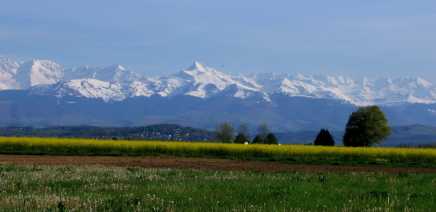
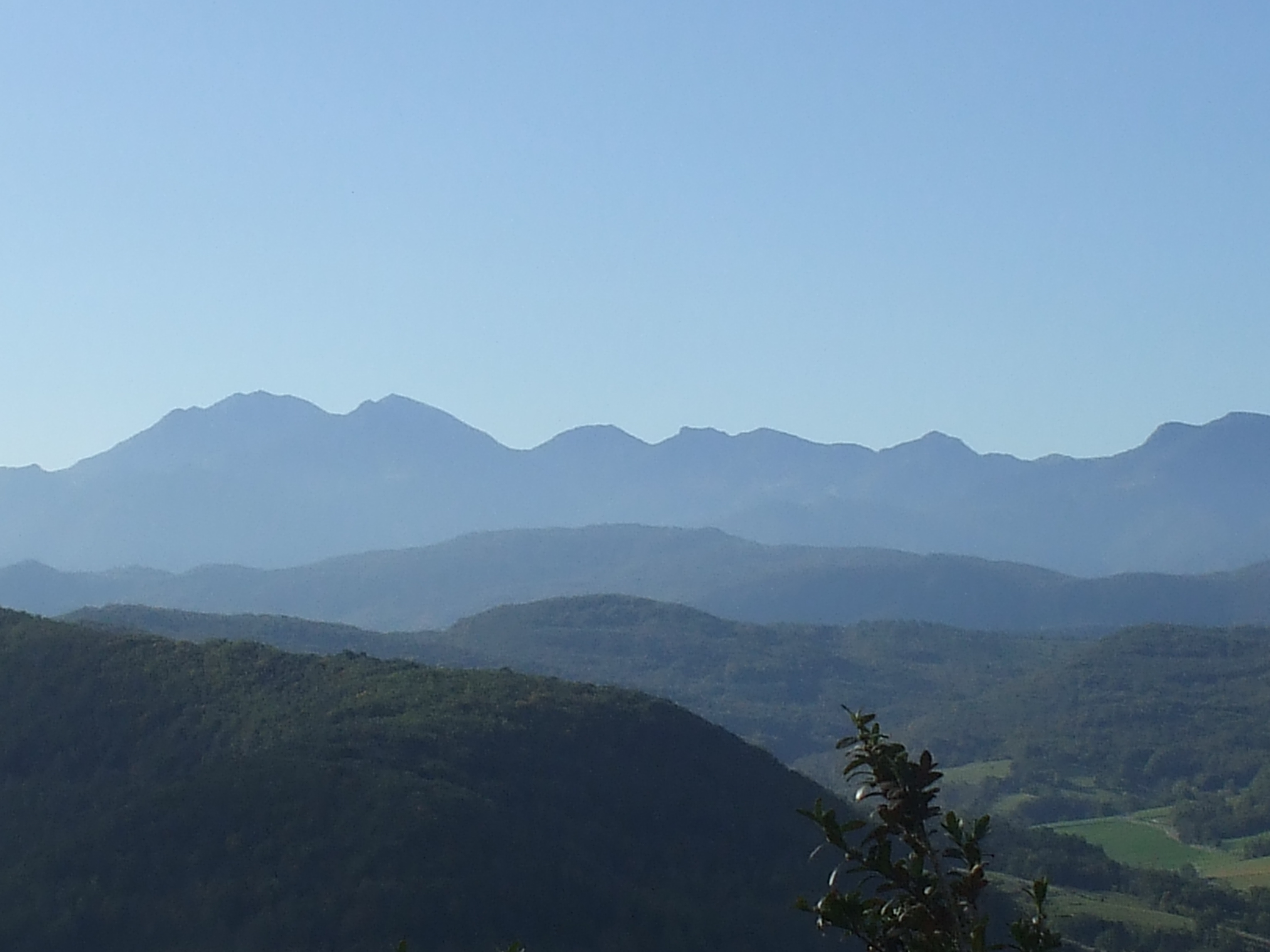
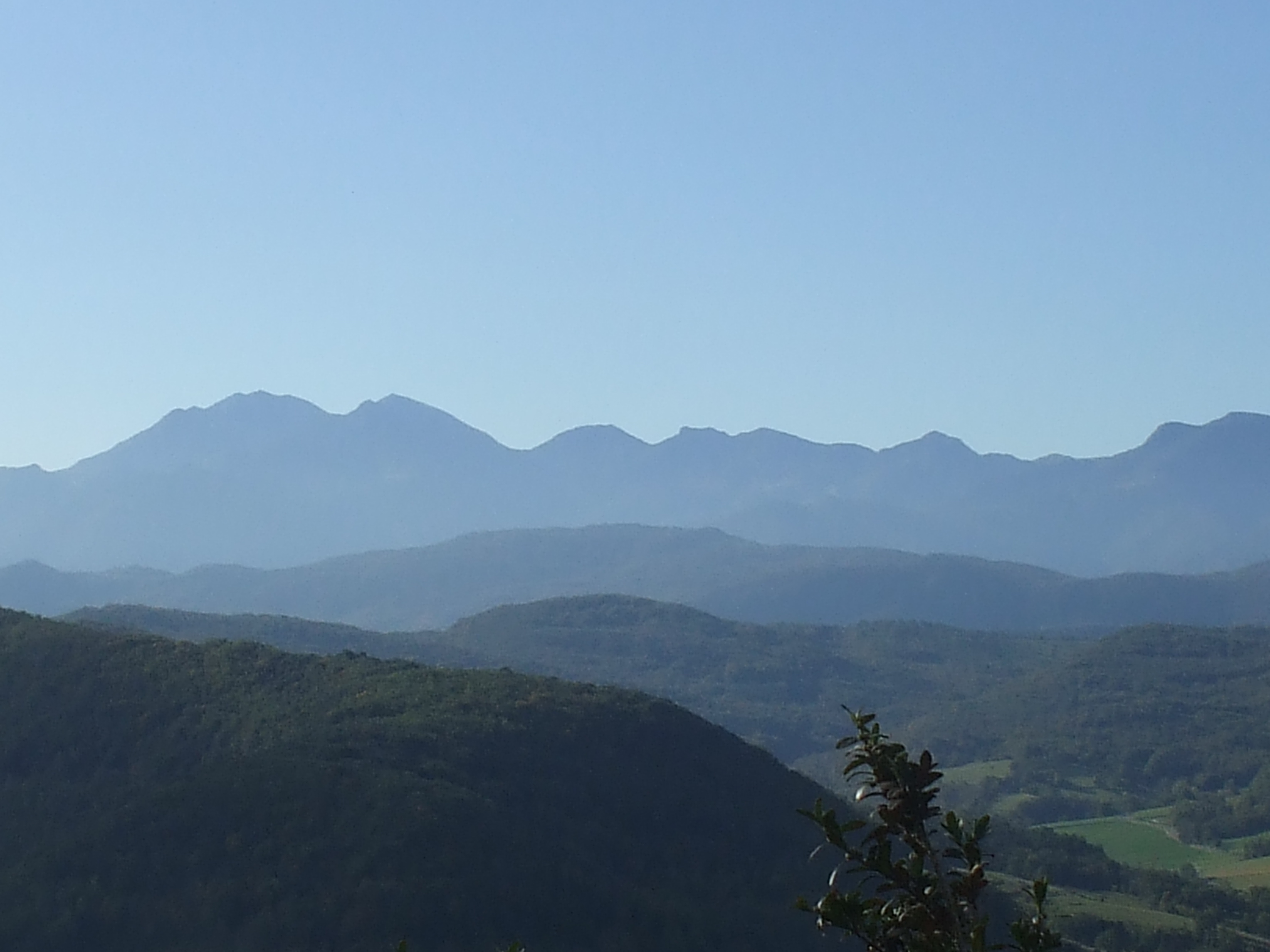
Distant Pyrénées. Not my photo, not the view we saw. But you get the idea
I gather that the last thing anyone in England needs right now is someone chirruping about how beautiful the snow is. Well, here in the foothills of the Pyrénées, we’ve been almost alone in France in being a snow-free zone. But please note: ‘the foothills’. The mountain tops have been covered for some weeks, and over the last week, the snow levels have crept down..and down…and ever nearer. And it’s quite simply beautiful.
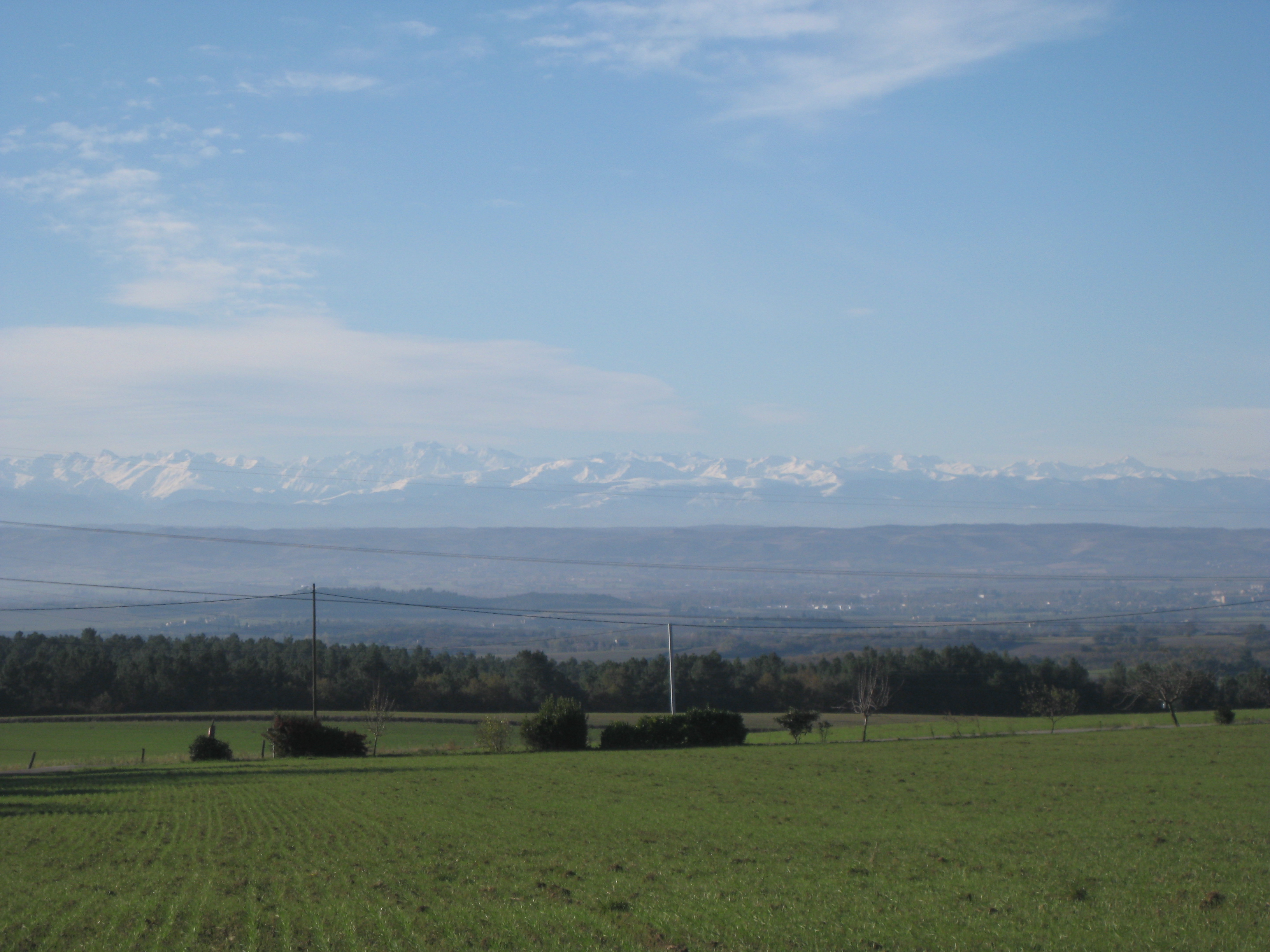
Distant Pyrénées
Yesterday we went walking in the Lauragais. That’s a gentle, verdant region north of here on the edge of la Montagne Noir. Perhaps the most wonderful thing about the walk we had here, through sandy woodland paths, crunchy with fallen leaves, were the views across to the Pyrénées: mile after mile of distant peaks blanketed in blue-white snow beneath a bluer sky. If only my camera began to do justice to this impressive sight.
A misericord to support a monkish bottomAbbaye de Saint Papoul
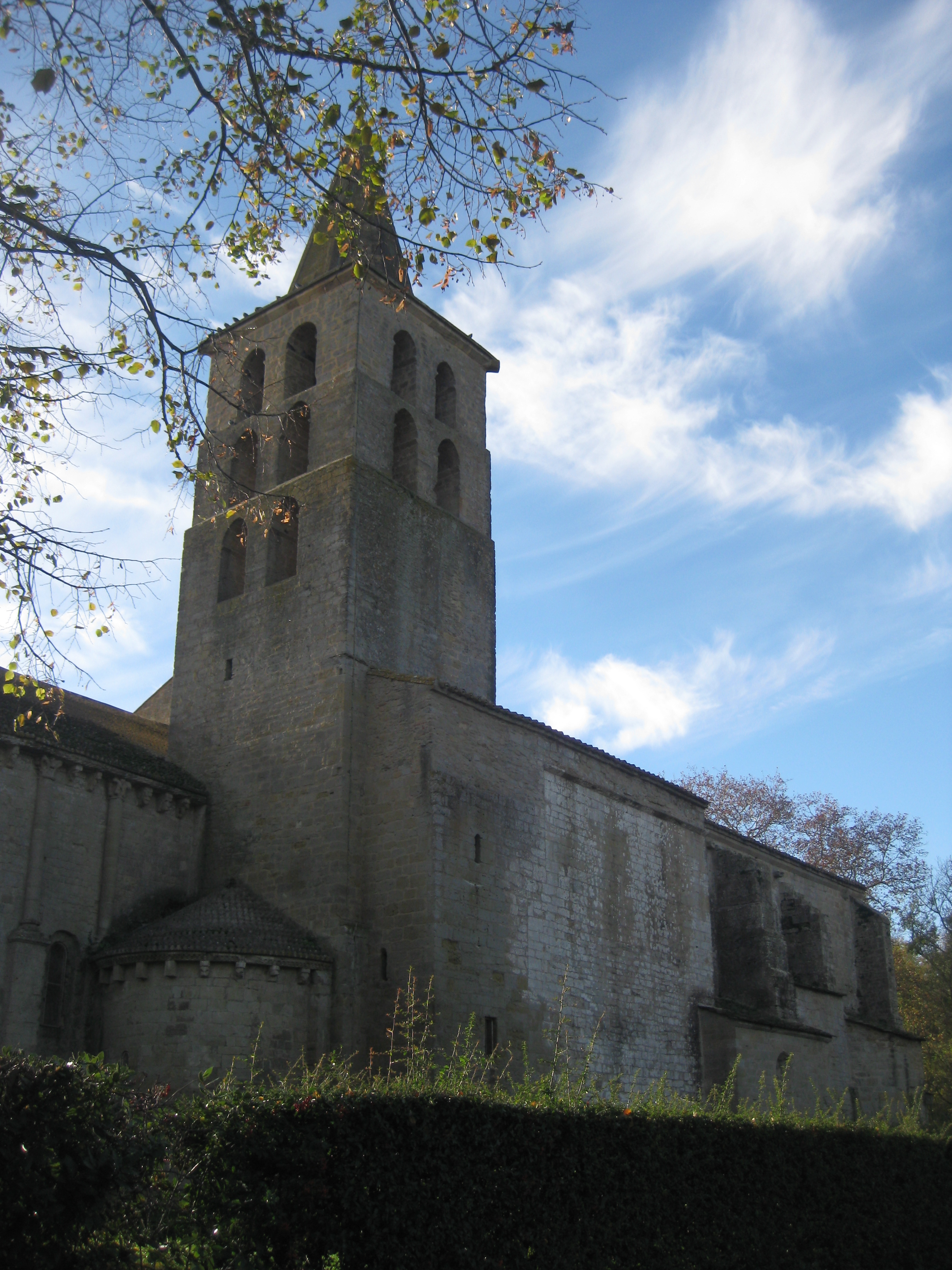
Healthily exercised, we came down to the village of Saint Papoul, and looked round the Benedictine Abbey of the same name. I found myself lingering in the 14th century cloisters and in the abbey itself, inspecting the misericords, the small decorated wooden shelves hidden under the seats to provide a bit of support for the poor monks as they stood for long hours during their religious devotions.
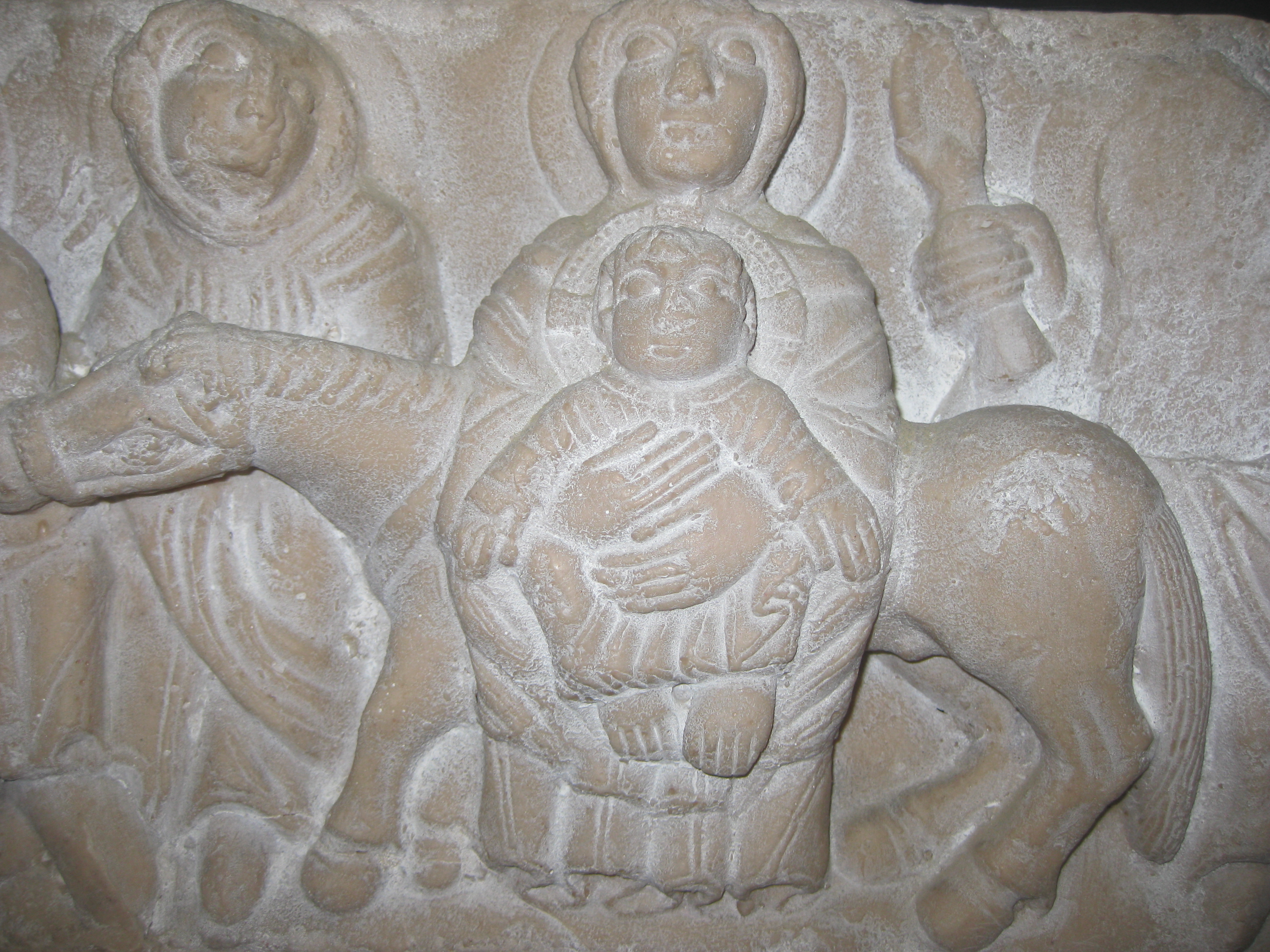
The Flight into Egypt
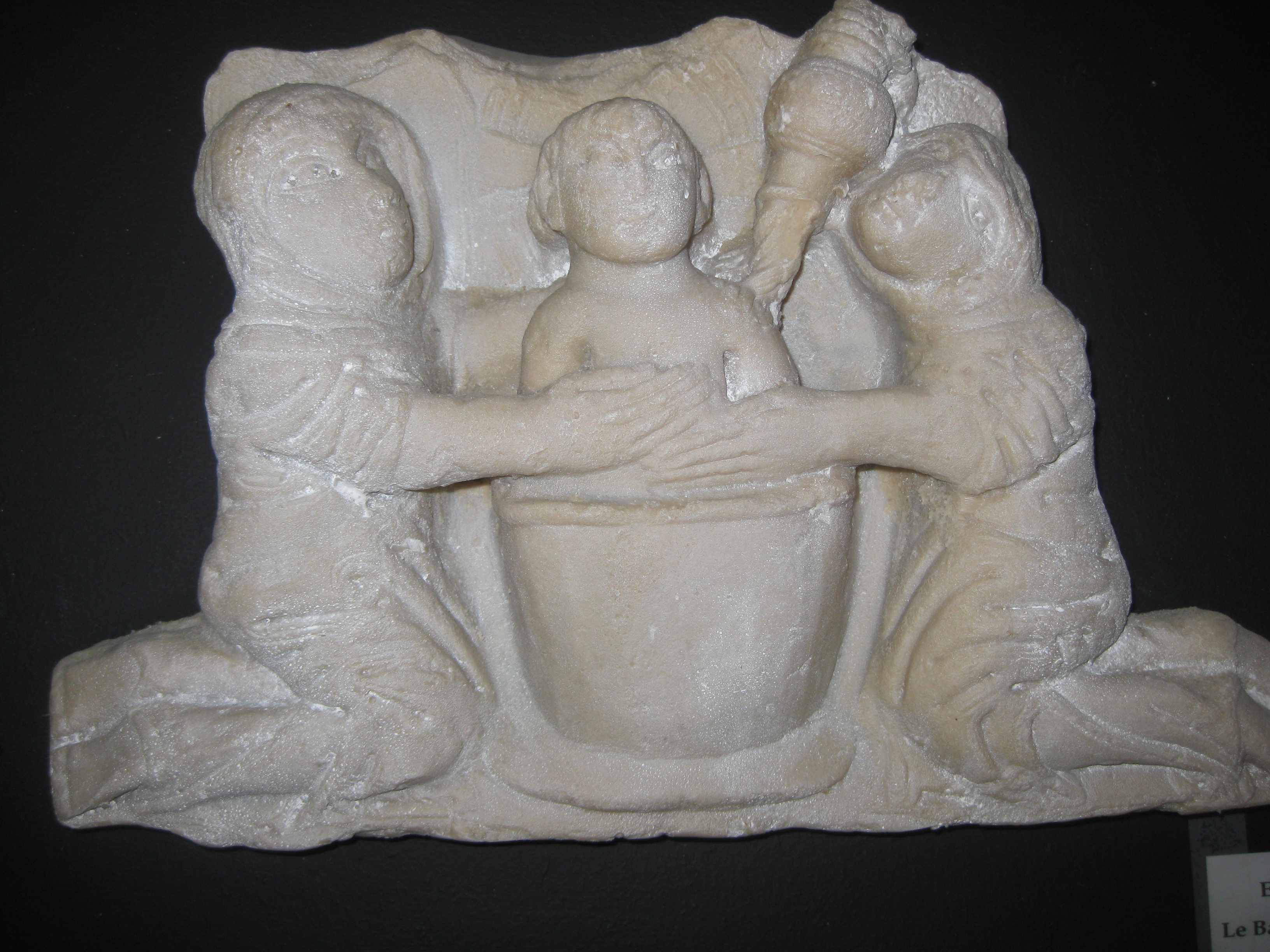
Perhaps the most enjoyable bit of our visit was a chance to look at the special exhibition devoted to le Maître de Cabestany, a Romanesque sculptor who seems to have left his mark on many of the pilgrimage churches on the route from Rome to Compostella.
The infant Jesus takes a bath
His figures, despite their realism, their chunky hands and elongated eyes, seem to have a slightly supernatural feel to them and they were fun to explore and enjoy.
It was cold though. Snow threatened, but didn’t fall in the end. We decided against a mooch round the village: probably something to do in the future, and scurried back home to toast our toes and fingers
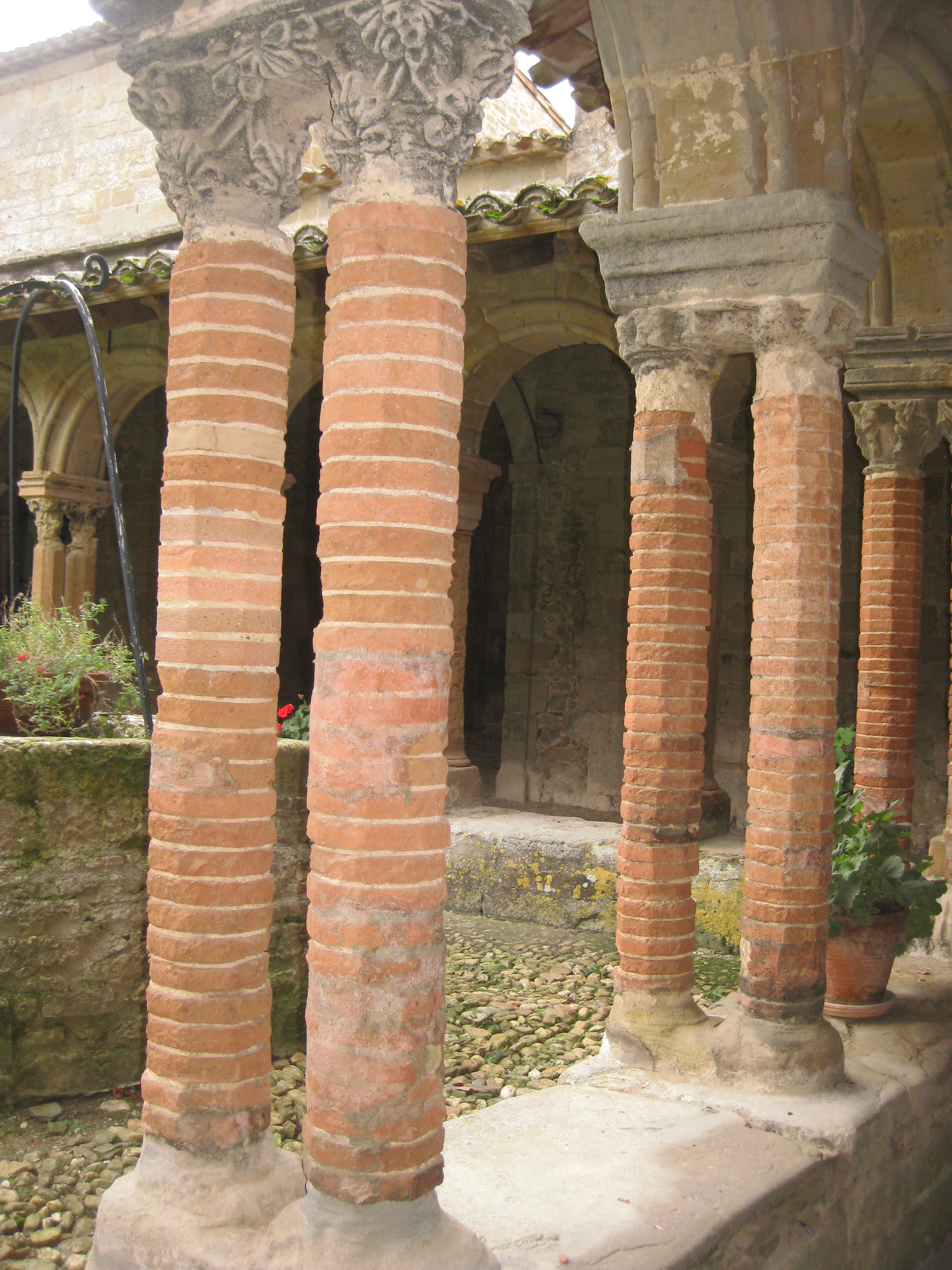
The weathered pillars of the cloisters, and their equally weathered capitals
I love Atout Fruit. It’s a relatively small, but very effective local organisation that exists to protect and promote our heritage of local and ancient varieties of fruit trees. By being a member, I’ve learned such a lot at some of their monthly workshops. I’ve for instance practised grafting (as in:
‘a. To unite (a shoot or bud) with a growing plant by insertion or by placing in close contact.
Actually, what I learned about grafting, when I did it last year, was that it wasn’t my thing. It’s very steady meticulous work, demanding razor sharp knives and attention to detail, deeply unsuited to a slap-dash like me. My painstakingly grafted specimen died within weeks.
But there have been sessions on pruning, on traditional methods of gathering and preserving fruits, using those fruits in cooking….and so on. Later this month, the session on growing biodynamically will be held in our garden, and I just can’t wait.
I’m different from most other members. I don’t just mean that I’m English, though there’s that too. Most ‘adherents’ were born with more know-how than I will ever have about trees and crops, and practice their skills every day. Nearly all the rest have this background to their lives, even if they have themselves moved away from their ‘paysan’ origins. I hesitate to use the word ‘peasant’ in English, because of the somewhat negative picture it paints. Not here. Even University graduates who have returned to the land are proud to describe themselves as ‘paysan’. It’s been great for me that everyone is keen to help me and seems pleased that I want to learn: nobody patronises my amateurishness.
Sorting those saplings
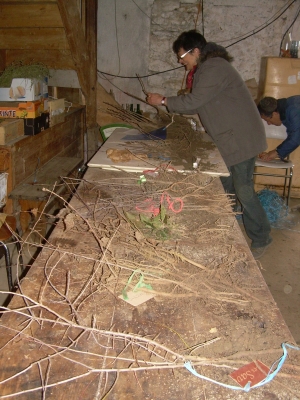
Once a year, Atout Fruit is given a range of tree seedlings to hand out free to members – mainly fruiting trees, but other indigenous and introduced species too. Members pore over the spread sheets of offerings and make their choices, and wait for the day when we can all go and collect. I felt greedy: I’d chosen 10, but later found that others, with larger pieces of land, had chosen 20, 40, even 100 saplings. This year I volunteered to help sort and distribute the trees, and drove to Claude’s place (which includes a wonderfully eco-efficient house of straw), high above lake Montbel, where it was all happening. My job was to help replace the battered identification labels with rather more legible ones, and make up orders with members as they arrived. Have you ever tried to distinguish an 18-inch high mulberry whip from a crabapple or a wild cherry? Best leave it to the experts….. Later, warmed by glasses of hot coffee, 4 of us made up the bundles of trees for the people who hadn’t been able to come to collect. Here’s a picture of some hard work in a chilly barn: merci, Claude!
Later that day, I planted my seedlings in pots, or direct in the garden. I had quite a time of it. But that’s another story….
Accent –local: If standard French is a challenge, how much more so is the local accent? Remember school French, and being told that usually you don’t pronounce the final letter? Doesn’t apply here. ‘Pain’ is ‘peng’, ‘loin’ is ‘lueng’, and so on. ‘G’s happen a lot – ‘tous ensemble’ becomes ‘tous angsamble’
L’Apero, l’heure de: Great custom
Bio: – organic. Buying organic food is ‘normale’ here, especially at the markets.
Bountiful free food: The hoarding season’s pretty much past its best now. We’ve been out looking for walnuts, almonds, chestnuts, rosehips, apples, sloes and coming home with the kind of quantities that will see us through the year. It’s a full time job.
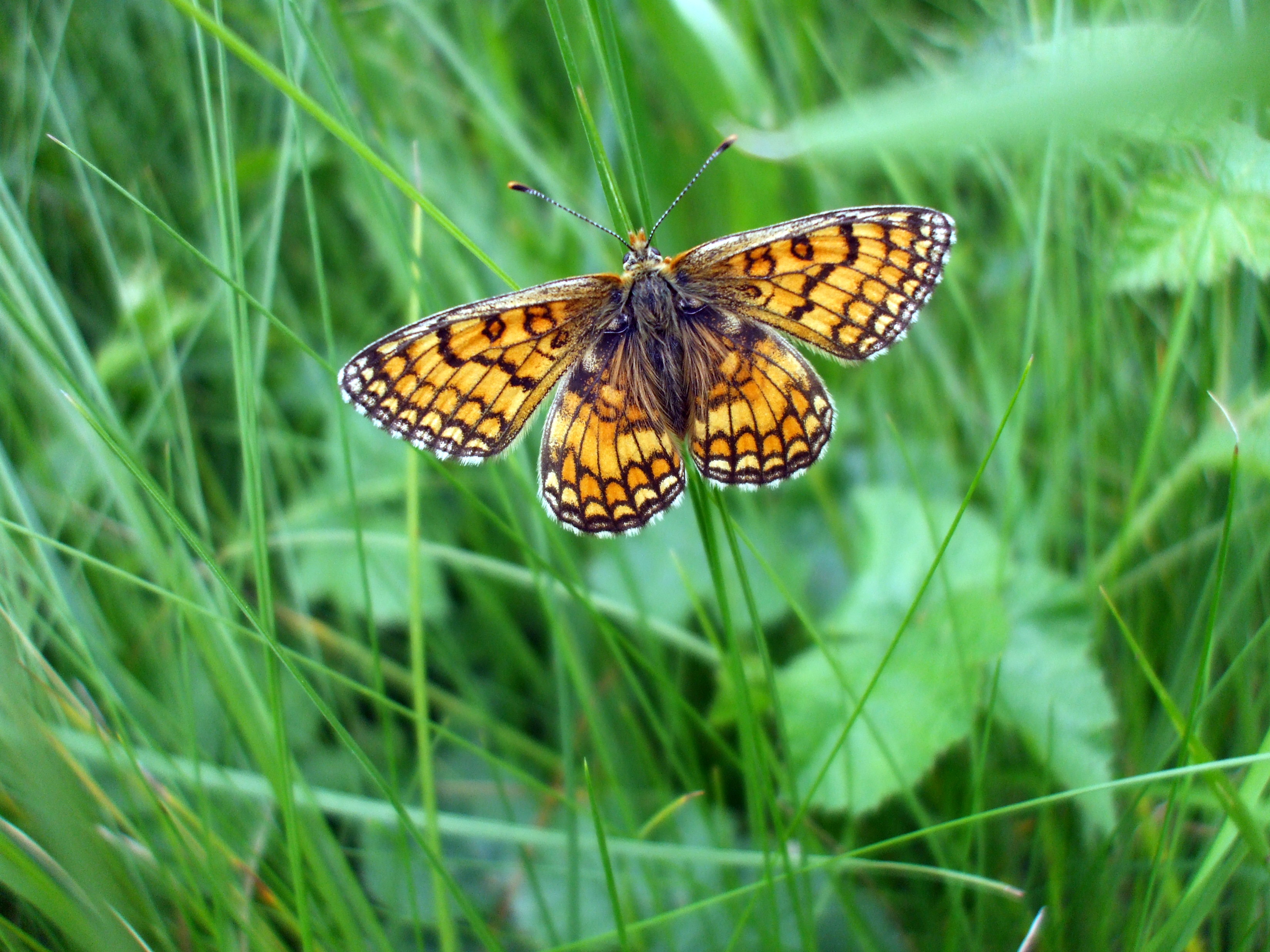
Butterflies: So many varieties, and seen everywhere, almost all the year round. Even yesterday, November 22nd.
Courtesy: Walking down the street here, it’s normal to offer greetings to everyone you meet. ‘Bonjour Madame!’ With anyone you actually know, you shake hands, maybe exchange bises on both cheeks. Small children greet you, surly teenagers greet you. It’s one of the real pleasures of small town life.
This sheep is currently not on milk-for-cheese duties
Cheeses: Cows, goats, sheep, all busily producing milk for dozens of varieties of (preferably non pasteurised) cheese: soft, hard, creamy, runny, mild, stinky.
Dépêche du Midi (La): It’s the local daily. We don’t often buy it, as world events seem to pass it by in favour of the marriage of the local lass in La Bastide de Bousignac.
En cas où…….. Out walking, we always have a spare bag stuffed in a pocket. En cas où we find some mushrooms, a handful of berries, some windfalls, a log for the fire. Everybody does it.
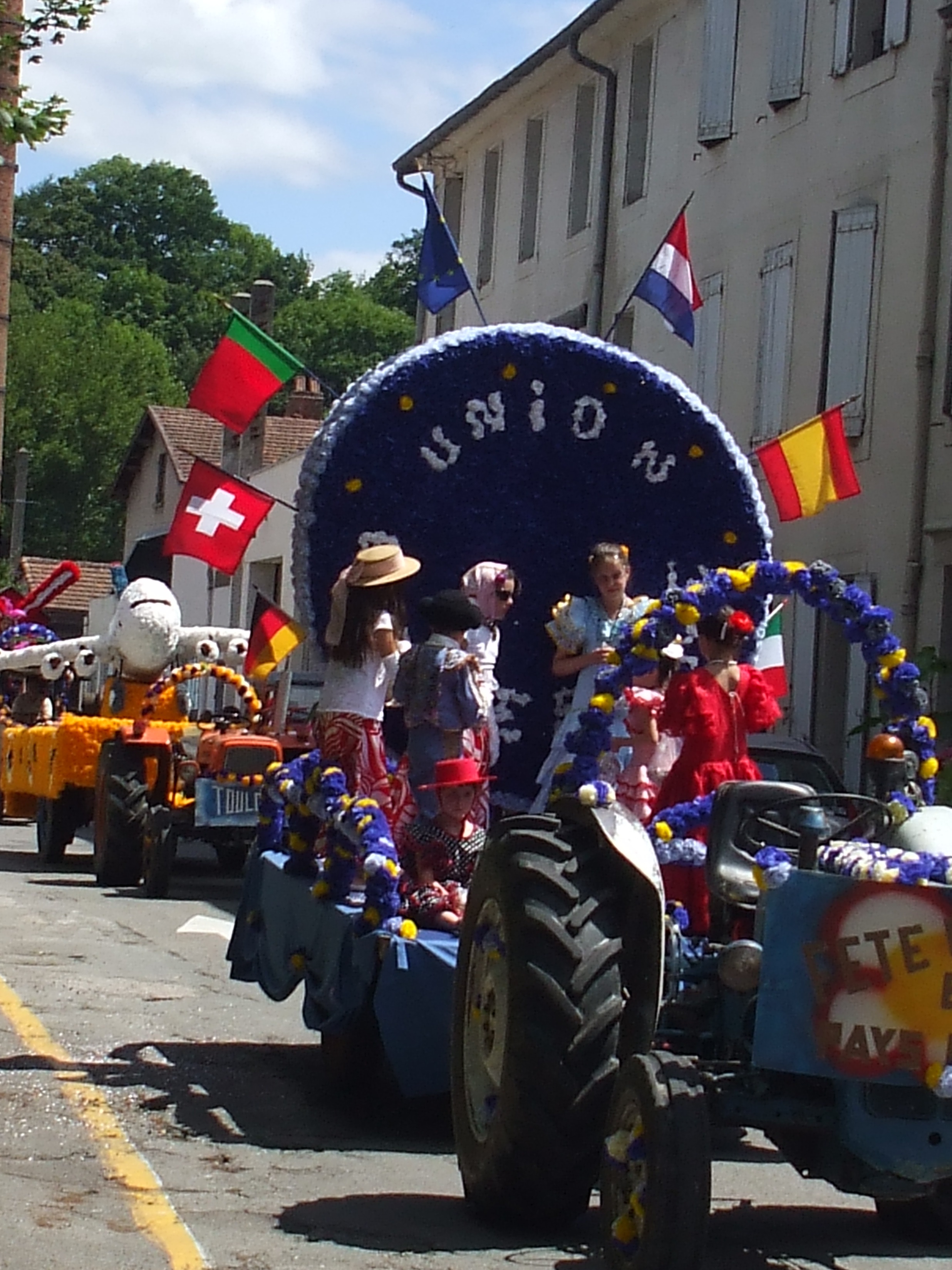
Fêtes Festivals and Fun: No weekend is complete without its fête, or festival, somewhere nearby. The other weekend saw the Fête de la Transhumance at le Sautel, with cows and sheep returning to the lowlands. There was a food market, a vide grenier (see below), films, dancing, a barbary organ, a big communal meal on Sunday. Le Sautel is a hamlet rather than a village, but it hasn’t stopped it running a right good show. Recently, there have been la Fête de la Noisette at Lavelanet, la Fête de la Figue at Mas d’Azil…. and in among, there are small local fêtes in nearby villages. No need to get bored at weekends, ever.
Gallic shrugs and gestures. I’ve posted about this before, and do you know, I don’t think my accent’s getting any better. I’m rubbish (shakes left hand vigorously with floppy movement from wrist)
History: I love it that so many people, especially older people, seem to know so much about the history of the region. They’re proud to tell you stories of times past, farming traditions and customs.
Ingenuity: The sort of make-do-and-mend that is such a feature of English allotment life is even more commonplace here. Our garden shed is made of several old doors, a redundant polystyrene fish box, random bits of corrugated iron and plastic screwed together, ancient bits of wire netting and bits of string. To our knowledge it’s been standing 20 years or more, and it’s not about to fall down.
Junk: Freecycle may not exist here – yet – but one person’s junk is another person’s lucky find. We take our household rubbish to central collection points – no dustbin collections here. On Sunday evenings, lots of people (including us, naturally) will be hovering to walk off with and make use of discarded pans, empty packaging, toys, plant pots….
Kilometres and Kilometres of space….. North Yorkshire, which always seems spacious by English standards, has a population density of 74 people per square km. The Ariège has 28. So there’s plenty of room
Lizards: Our garden companions on any sunny day
Lunar calendar: Planting by the phases of the moon is completely mainstream here. Gardening magazines carry free lunar calendars early every spring, and anybody you talk to will give you unsolicited advice on which day the moon dictates you get those spuds into the ground
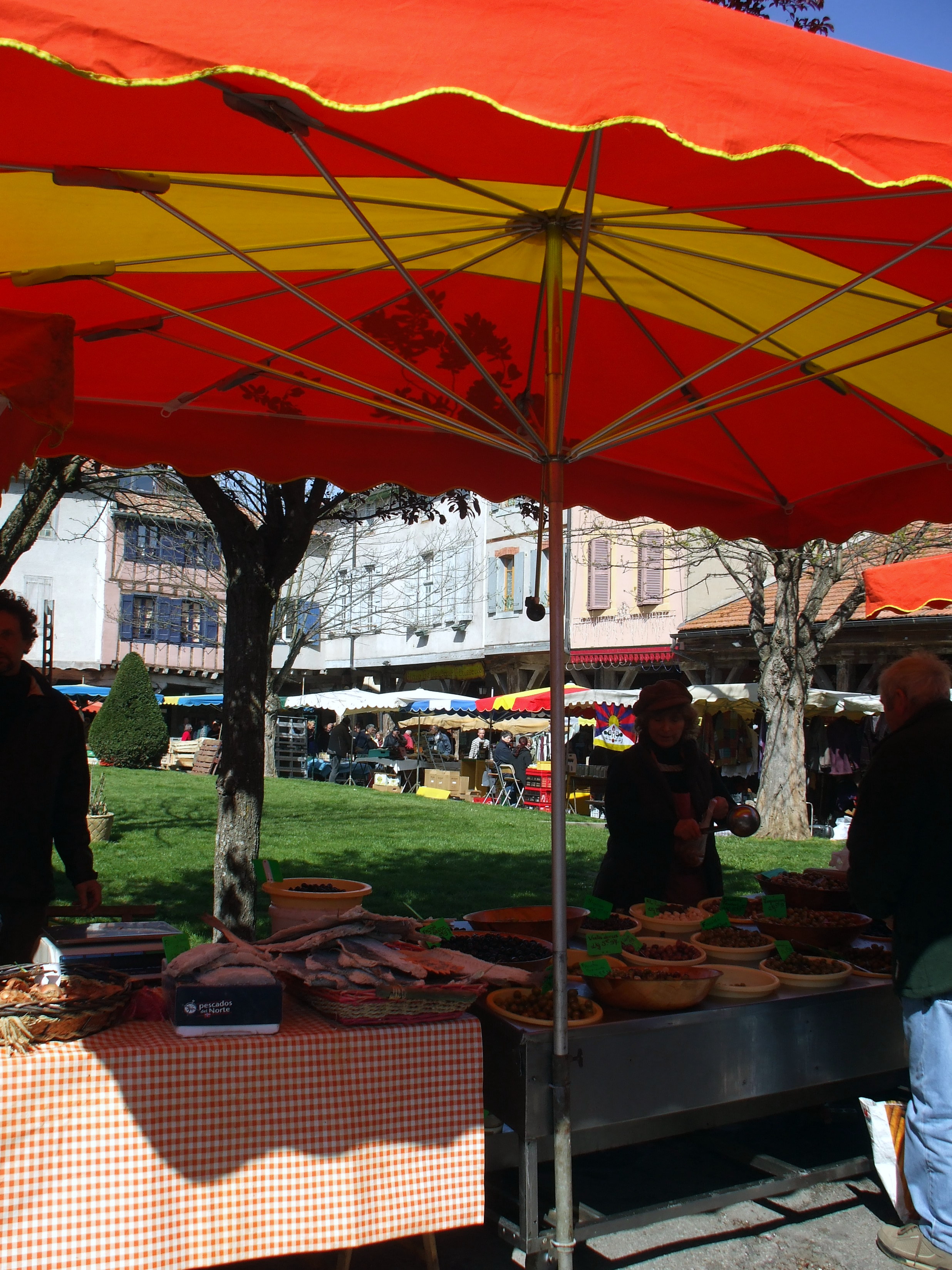
Monday market, Mirepoix
Markets: The best and happiest way to shop for fresh seasonal food. Don’t be in a hurry though.
Music: So important here. Concerts of every kind, cheap or free, in public buildings, market halls and squares, and churches everywhere. Choirs (introduced to a large extent by the English apparently) in most communes – I belong to two. Bands and singers at fêtes. Even small towns like ours have their own music centres. And lots of bars are home to groups of local musicians too.
Non! Protest comes naturally to the French. We’ve even been on a ‘manif’ ourselves, protesting at teacher cuts. But you won’t travel too far in France before you see signs painted, very large, across the road. ‘Non à l’ours’ (bears are being reintroduced to the Pyrénées, to the disgust of the farmers). ‘Non à la déchetterie!’ (tip), ‘Non aux aeoliennes !’ (wind farms)
Occitan: The everyday language of south western France until well into the 20th century, the Lenga d’òc is little spoken now, thanks to the systematic imposition of the French language in the early years of the twentieth century. Nevertheless, we do hear the elderly speaking it from time to time. It’s once again taught as an option in schools, and in adult education classes. I love passing through the many places that celebrate their Occitan heritage by having town and street names expressed in Occitan as well as French – Autariba rather than Auterive for example.
Patrimoine in the Pays d’Olmes et Pyrénées: ‘Patrimoine’ translates I suppose as ‘heritage’, but it’s not quite as chintzy and twee as that word suggests. Everyone here is proud of their history, and there’s so much going on to celebrate it – talks, walks, conferences, often with a meal thrown in. Just join the party!
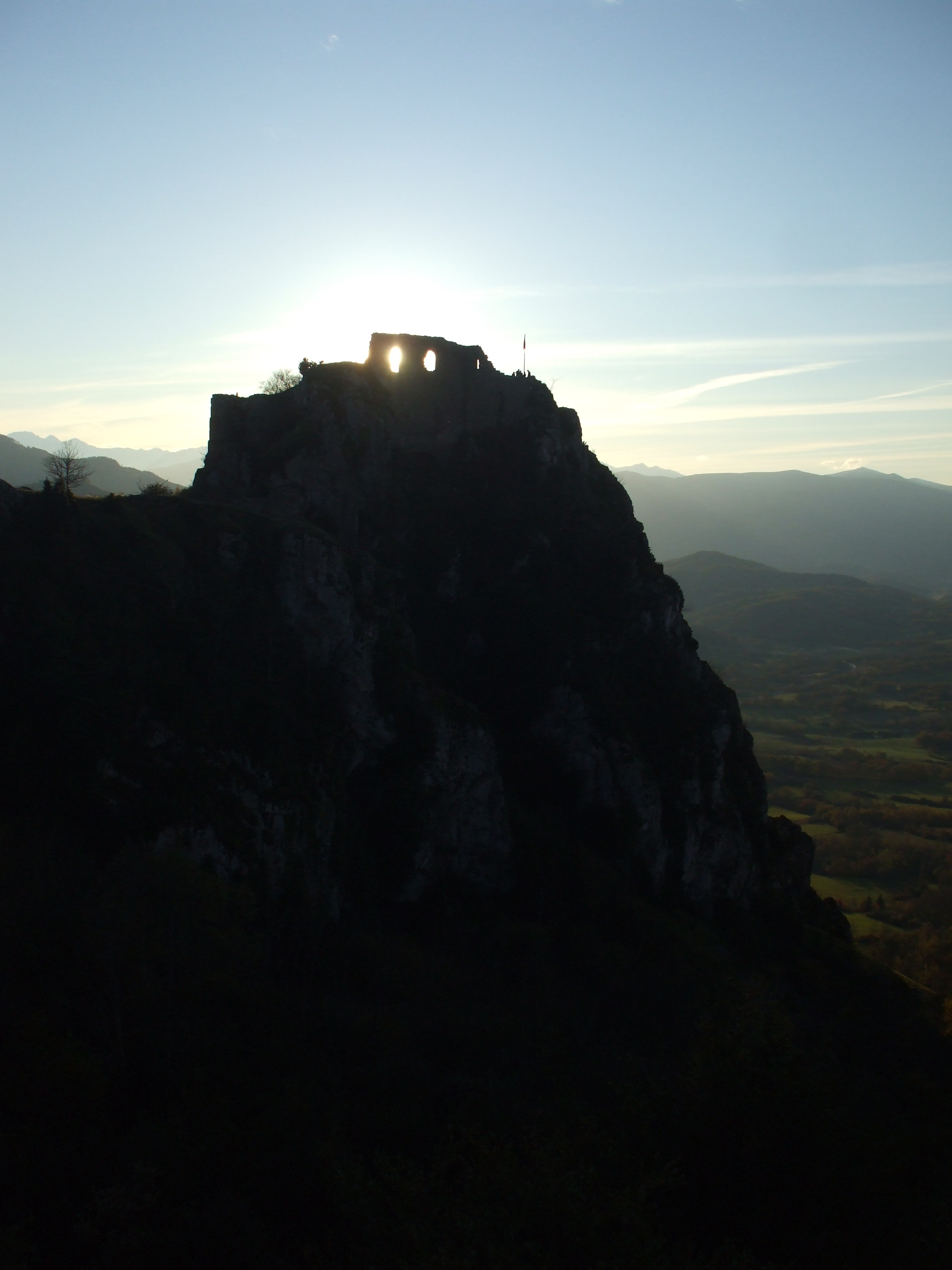
Sunset over Roquefixade
Queuing. Don’t let anyone tell you that only the English queue. It’s part of life in neighbourhood shops and markets here. But it’s not a problem. It’s an opportunity to chat with friends and strangers, exchanging local gossip, recipes, scandals. If it’s our cheese man in Lavelanet market, he’ll join in too, and you’ll never get away
Restaurants: I’m not thinking of the elegant once-in-a-blue-moon meal out. I’m thinking of the ‘formule’ at midday, when to a large extent you get what you’re given, in copious and well cooked quantities. Take today, when we went to a fairly down-at-heel looking brasserie on a busy street corner at the wrong end of town. Great salad, followed by tender tasty magret de canard and wonderfully creamy dauphinoise potatoes, a home made concoction of fromage blanc and crème chantilly, coffee, wine, all for 12 euros. We shan’t be eating again today….
Shopping-centre-free-zone. Bliss. Also, though this has recently been partially undermined, almost no Sunday shopping. AND shops usually close for between 2 and 4 hours at midday
Temperatures: Proper seasons here. Summers are hot, winters cold. Autumn, warm, is a time of glorious colour and food for free. Spring, warm, is a treat for its flowers
Underwear. If you want to be disabused of the notion that the French are chic, that haute couture rules, go to any market stall selling women’s undies. Turquoise knickers, orange bras, lime green or luridly lavender matching sets….. And while you’re there, check out those lovely pinafore dresses so beloved of French women of a certain age. Wonder when I’ll be old enough to wear one?
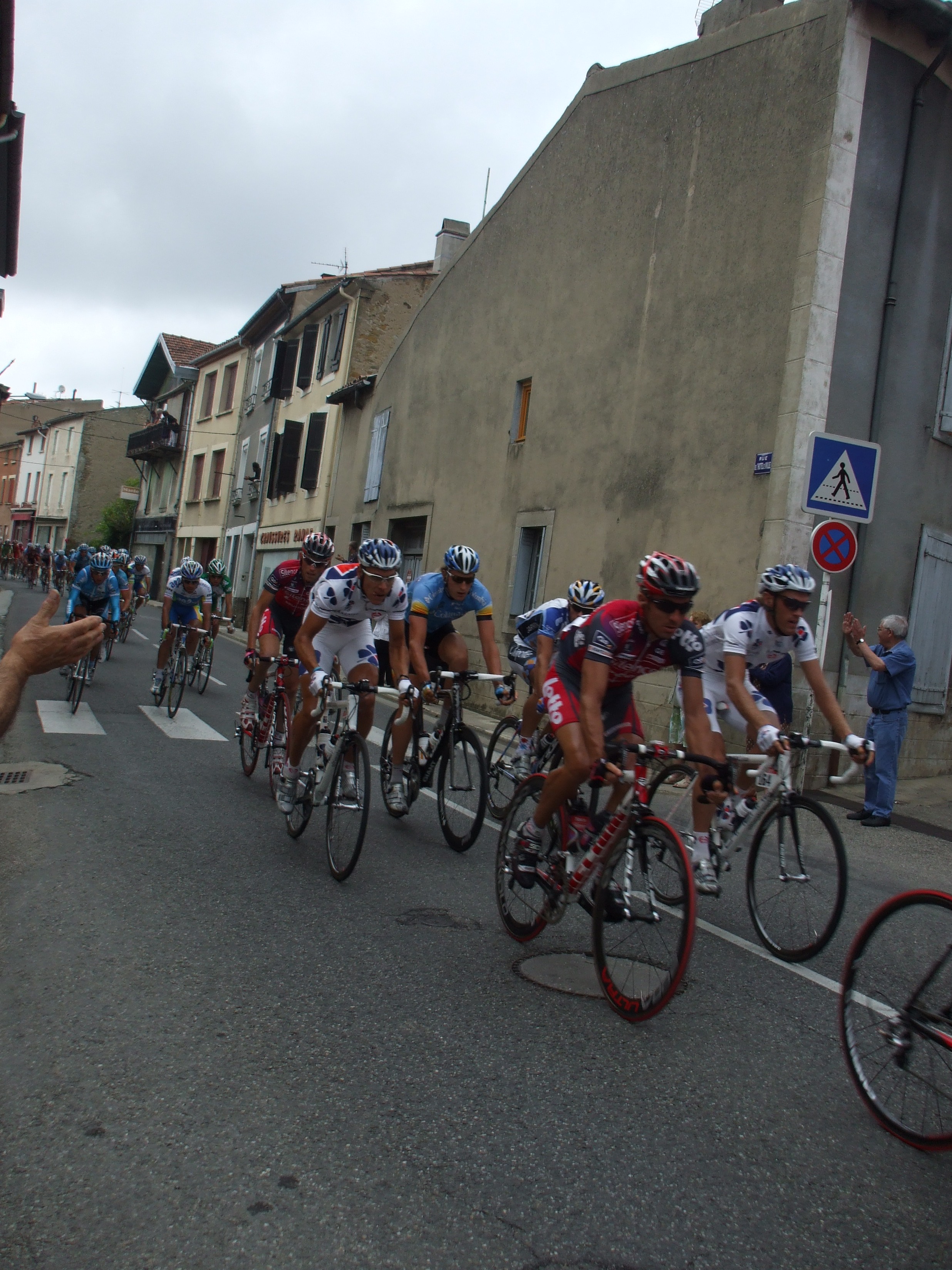
The Tour de France whips down our street in 2008
Vélo . Cycling’s big here. Any cyclist, old or young, is kitted out in skin tight lycra, and may well own a bike costing several thousand euros. There’s a cycling club here that meets on Wednesdays and Saturdays. Its runs are routinely 120 km. or more (and it’s very hilly). The wimps manage some 80 km., but only ‘les ancêtres’ can get away with a mere 40 km or so
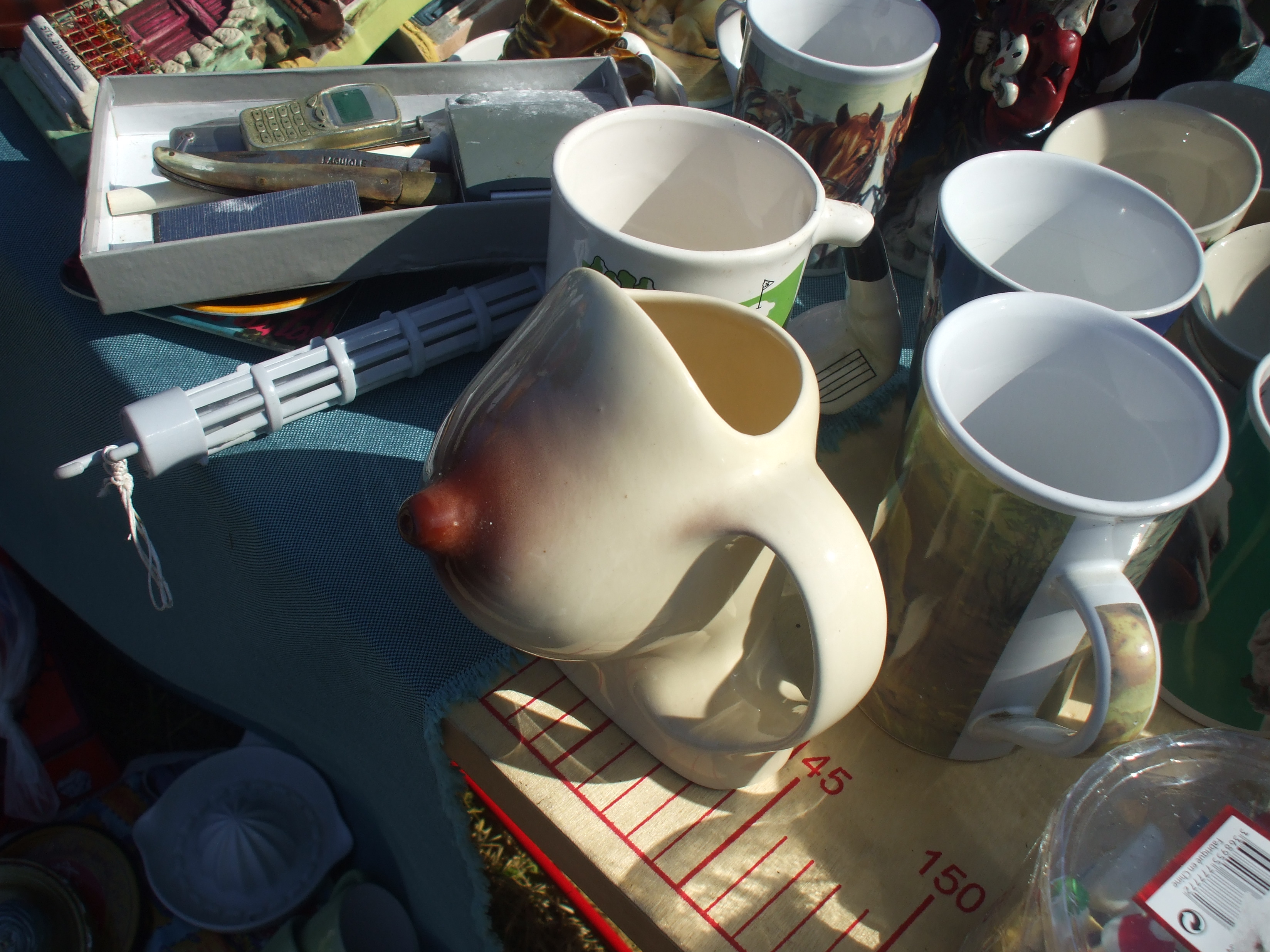
A lucky find at a vide grenier?
Vide Greniers; People here empty their attics instead of filling their car boots. Any Sunday in spring, summer or autumn some commune or another nearby will have a Vide Grenier organized. One of the larger streets, and probably a few more besides, will have been taken over by the sellers, who display their goods from early morning till supper time,. It’s the same mixture as an English car boot sale, with the addition of all kinds of rusting tools and junk that really HAS come out of the attic. Nobody will buy it. It’ll just appear at the next sale
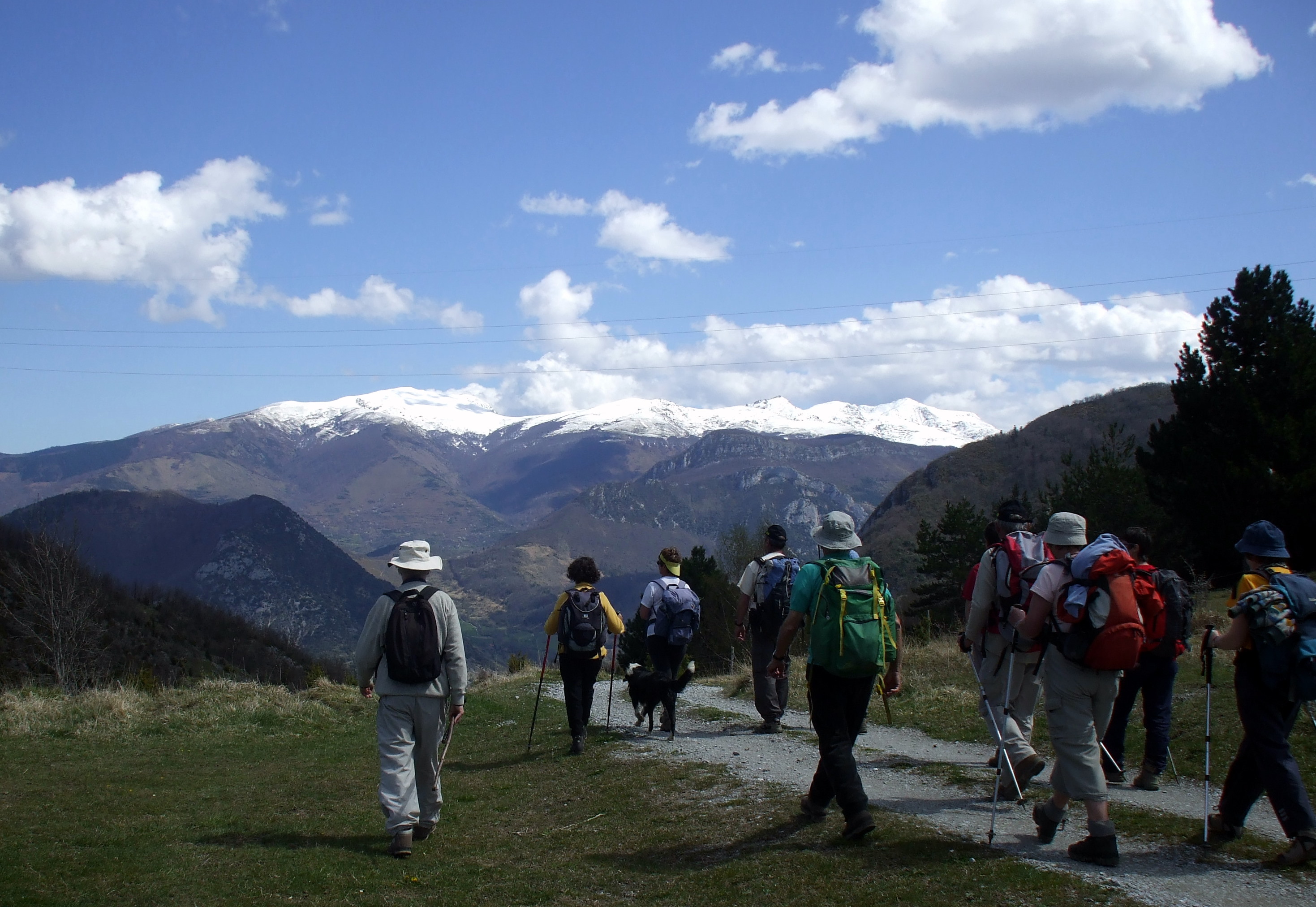
A walk with our group, near Tarascon
Walking: so many walks, so much variety. We love learning about new places to explore from books, from maps, from talking to friends, from walking groups. We’ll never run out of fresh walks to try, ever.
Wood-burning stoves: So cosy, we really looked forward to November chill. As for foraging for wood, see ‘en cas où ’, above
Xmas. In early September, a friend over from the UK said that Christmas had already started in the shops. We’re happy to report that nothing at all will happen here until the first week of December at the earliest. Wonderful.
You: Here, there’s the whole tricky business of ‘tu’ or ‘vous’, and it’s a minefield. Children and your friends are of course ‘tu’. The shopkeeper, the bank manager and those adults you really don’t know, are obviously ‘vous’. But there’s a whole grey area in between. Fellow randonneurs and choir members generally settle for ‘tu’ from Day 1, on the grounds we’re all in this together. But not necessarily. Last year at Choir, I sat between 2 women, both more or less my age, both chatty and friendly. To one I was routinely ‘tu’, to the other. ‘vous’. And I was supposed to pick the bones out of that??
Zero Neuf: 09, the Ariège, our department. We love the space, the huge variety of scenery. There’s gently rolling countryside that wouldn’t be out of place in Shropshire with its orchards and winding lanes, oak and beech forests, gentle foothills with grey Gascon cattle, and stunning, awe-inspiring mountains with craggy outcrops and peaks. And all within easy reach of our house.
A few minutes from our house...and this is the view



 From Pyrenees to Pennines


You must be logged in to post a comment.