Cabin fever.

The rainy season still hasn’t stopped. It’s rained every day for over a fortnight now, except for one.  That was Friday, the day it snowed.  I had to come back from nearby Villeneuve d’Olmes at nearly midnight that day, driving at a stately 12 miles an hour along newly – and deeply – snow-covered roads.  The last bit was easy enough though.  I followed a snow plough.

So Sunday’s all-day walk was abandoned yet again.  There was heavy rain again this morning.  Nobody was leaving home except to collect the daily bread.  We had a back-up plan, we members of the walking group,  to begin walking at 1 o’clock if the morning’s weather was poor.  By 11.45, with the skies still black and full of rain we were all ‘phoning each other to say ‘No thanks.  Count me out’.

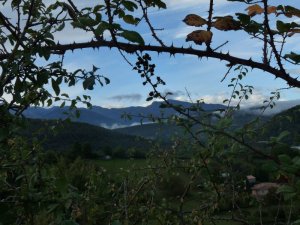
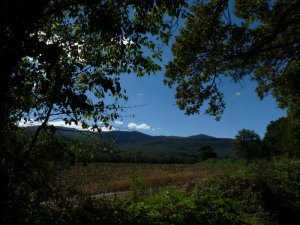
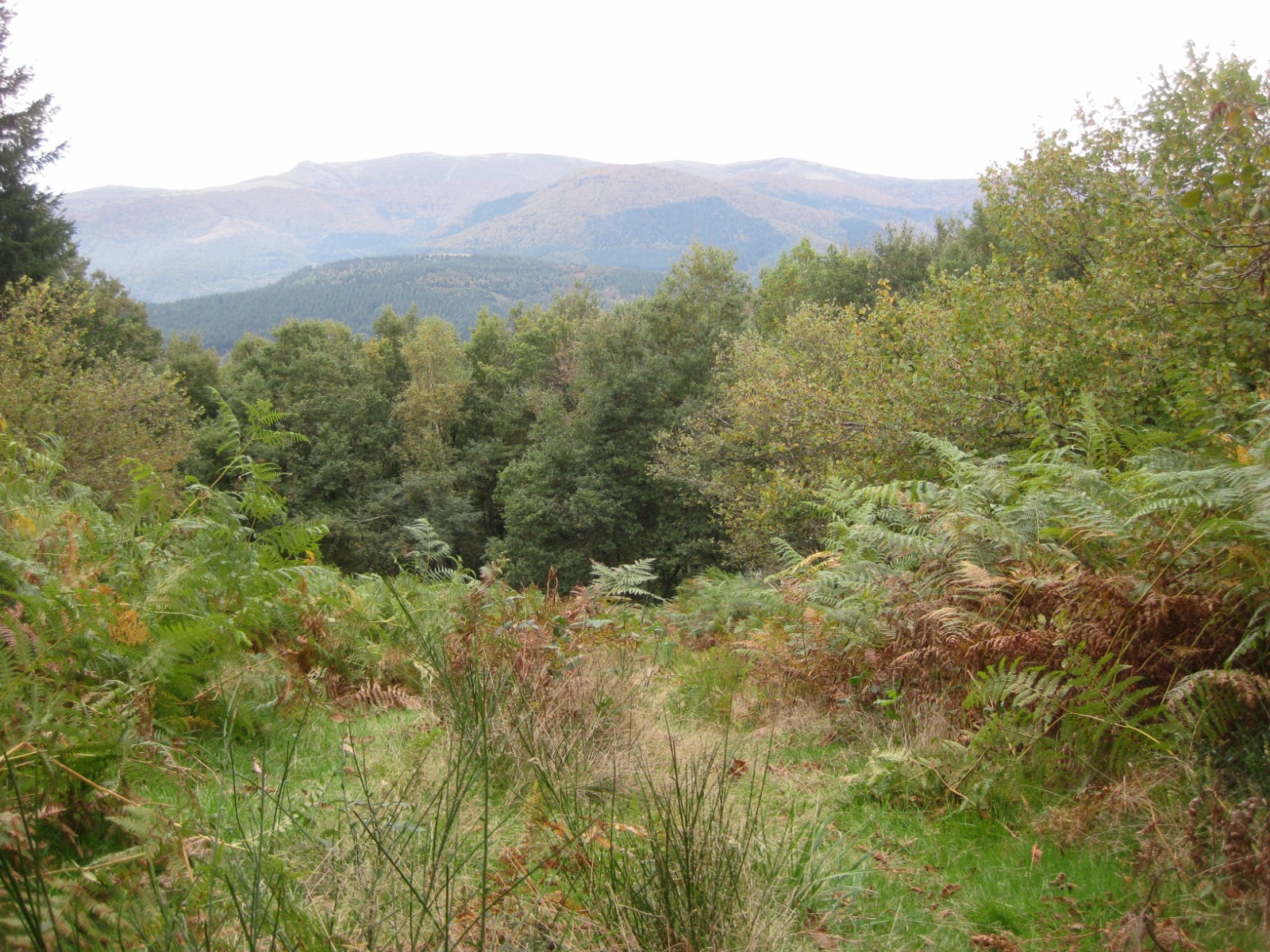
Except that at quarter to one, it stopped raining.  I decided after all to make a break for it (Malcolm stayed in front of the fire).  Maryse arrived at the usual rendezvous too, then Annick and Michel turned up.  Then Jean-Charles, Danielle and Marcel.  We’d all got cabin fever and we’d walk come what may.  We had three rain-free hours.  No country paths for us today: all sodden.  Strictly road-walking.  Snowy fields, snowy views across to the Plantaurel, a small lake, forest paths.  We had our ‘pause café’ at Fajou, with its 400 year old oak, and an apple tree just waiting for us to collect its windfalls.  Still no rain.  Still an hour’s walk to do though, so we didn’t stop for long, and continued onwards, enjoying the familiar landscape in its new white winter clothing

Back home, refreshed after a shower and a cup of tea, I leaned over to draw the curtains.  Of course I glanced out of the window.  You’ve guessed.  It was raining again

Prunelles, gratte-culs et champignons…

…  which are, being translated, sloes, rosehips and mushrooms.  But it sounds rather more poetic in French, non?  Even if you take into account that ‘gratte-cul‘ translates as ‘scratch-bum‘, because as every naughty school child knows, rosehips seeds are distressingly itchy when shoved down against the skin.

Chapelle Saint Roch
Chapelle Saint Roch

Anyway, I went off by myself for a walk the other day, starting by the ancient and slightly isolated Chapelle Saint Roch.  There’s still a pilgrimage there every year, because he’s the patron saint of plague victims, and well, you never know, do you?

I’d got several ‘au cas ‘ bags, ‘just in case’ I found sloes, rosehips and mushrooms.  It wasn’t ‘just in case’ really though.  I know exactly where to look for the juiciest sloes, the thorniest rosehips, and even a decent clutch of field mushrooms.  Finding mushrooms before the French get to them counts as a real achievement for me.

It pays to have tough clothes when you hunt among the scratchy brambles for the sloes and hips nearby

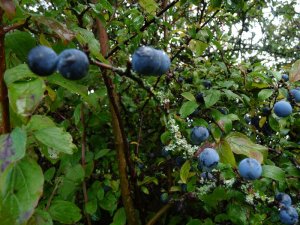
Here are my sloes, destined not for sloe gin this year: we seem to have such a lot left from the last few years.  No, this year I’m making  a richly flavoured jelly with the fruit I picked that morning and a few windfalls.

Sloes waiting to be picked

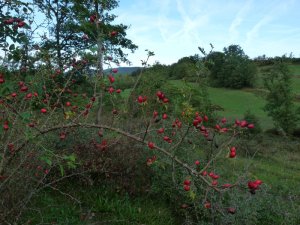
And here are the rosehips.  It’s a syrup for those, I think.

Rosehips with thorns ready for the attack

But the mushrooms……  Someone got there before me.  And it wasn’t a Frenchman .  Grrr.

I didn't know slugs ate mushrooms
I didn’t know slugs ate mushrooms

Le Jardin Extraordinaire est mort. Vive le Jardin Extraordinaire.

Gosh.  Was it really only five weeks ago that we were there?  Was it only 5 weeks ago that we togged ourselves in skimpy sun gear, floppy hats and clodhopping sensible shoes to make our annual pilgrimage to Le Jardin Extraordinaire?  If you’ve been following our story of our life in France you may remember the photos of this joyful, playful, meditative, exuberant, and quite lovely space which so many of us come to explore and relax in for the one weekend only, in very early September (follow the link above).

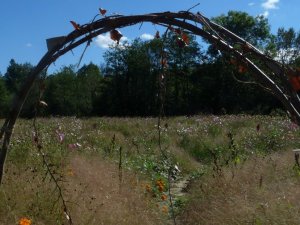
The meadow at the Jardin Extraordinaire today

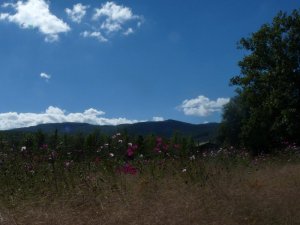
Today we wanted a walk: it’s not high summer any more, but the sky was very blue, the sun was pretty hot, the morning mists had burnt off and who knows if tomorrow it may rain?  We wanted to take bags and a bucket and see if there were a few late blackberries (there were), a few sloes (there weren’t) and a few early walnuts (there were) to make our sortie near Lieurac worthwhile.

That was the entrance, a few weeks ago.

Our path took us past the site of Le Jardin Extraordinaire.  It’s not normally a public space, so we couldn’t wander down to the river, or scramble up the hillside.  But we could walk by the meadow which had greeted us at our last visit, and we could see the tunnels and bowers of gourds.  Autumn has struck.  The bright fleshy stems and leaves of the gourds and sunflowers have changed into gnarled and bony twigs.  The pumpkins which once peeped from beneath their leafy green sunhats are now exposed on bare earth, those leaves crisp and brown like curls of tobacco.  The sunflowers still rear their tall heads over the scene, but they too are blackened and dry.

It’s still lovely though.  This is no cemetery.  The seed pods, the gourds, the berries are all ripe now, They’re ready for the next stage: marauding animals may eat them, humans too, or else they’ll seed themselves, so that early next year, the garden can begin to grow again, and be transformed by the creative artists and gardeners of Artchoum.

Rosehips along our walk

And we too marauded today.  We came back after our walk with full bags, muddy shoes, and that feeling of well-being that comes from a peaceful and productive afternoon  out in the countryside in the bright Autumn sunshine

P1070802

What to do with a bag of foraged walnuts

Another set of recipes.  But these two walnut cake recipes are too good not to share.  The worst thing is shelling 175 grams of walnuts all at one go: but when the nuts have been foraged for free, it doesn’t seem right to complain.  So I won’t.

This first one isn’t something to knock together with only half an hour to spare, but it IS very good.  Thanks James Martin and the BBC Good Food website for this recipe,, which I’ve slightly simplified.

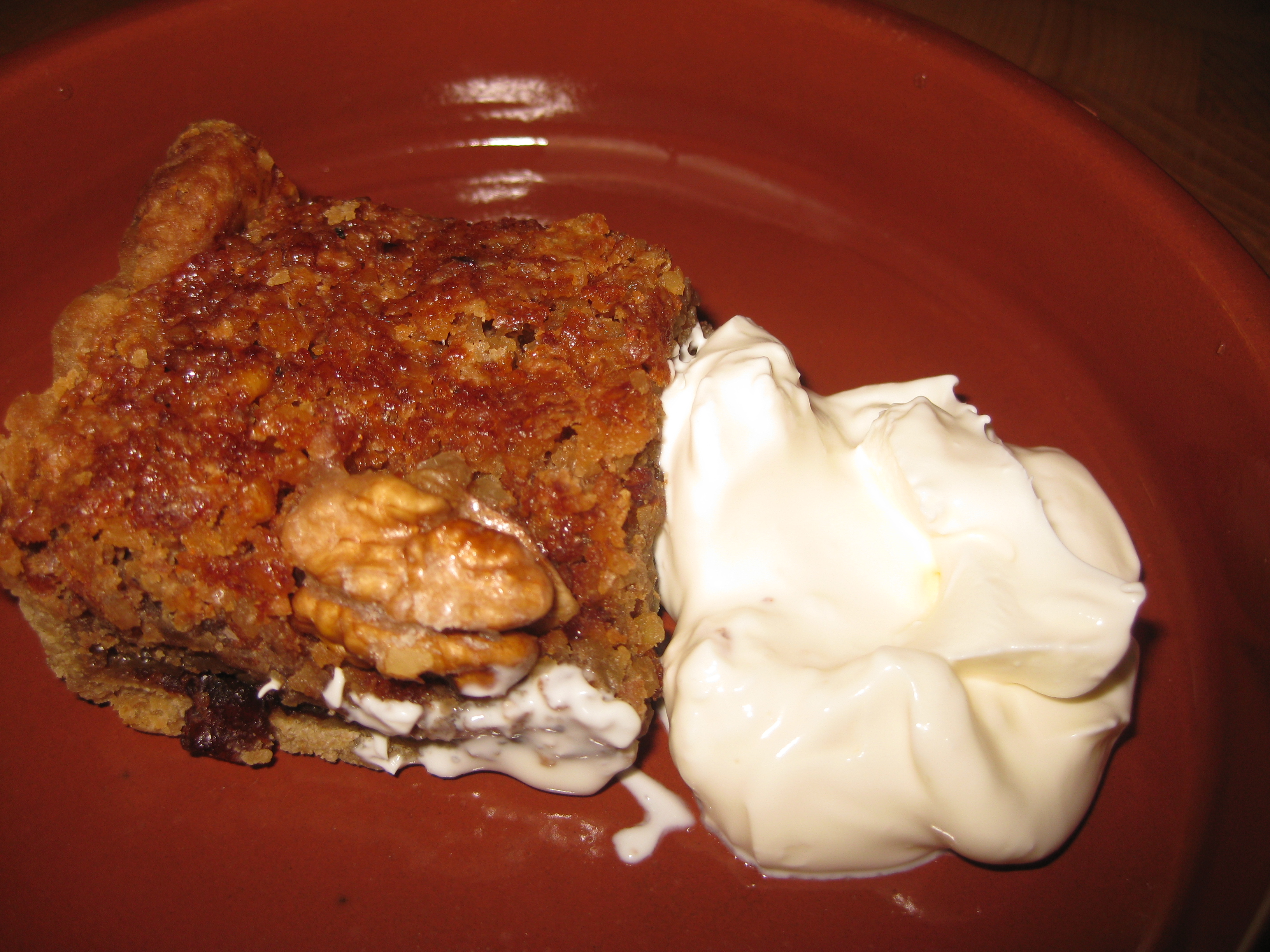
I forgot to photograph it till it was almost gone

Walnut and coffee frangipane tart with candied walnuts

Ingredients

For the tart

  • 500g sweet shortcrust pastry
  • plain flour, for dusting
  • 110g prunes, stoned, roughly chopped, soaked in Armagnac

For the frangipane

  • 175g butter, softened
  • 175g caster sugar
  • 4 free-range eggs
  • 3 tbsp strong coffee, cold
  • 175g walnuts, ground to a fine powder

For the candied walnuts 

  • 50g. caster sugar
  • 60ml. water
  • 18 walnut halves
  • 200g cream, to serve
  • Roll out the sweet shortcrust pastry on a floured work surface lightly dusted with flour to a 3mm thickness.
  • Carefully line six x 7.5cm deep-sided tart tins with the pastry, pressing the pastry into the edges of the tin. Leave 2.5cm of pastry overhanging the edge. Leave the lined tins to rest in the fridge for 10 minutes.
  • Line the pastry cases with greaseproof paper and then fill with baking beans or rice. Place the tart tins onto two large baking trays and bake in the oven for 10-12 minutes.
  • Remove the greaseproof paper and baking beans or rice, then return the tart cases to the oven for a further 5-10 minutes, or until they are pale golden-brown.
  • Remove from the oven and set aside to cool slightly. Trim the excess pastry with a sharp knife.
  • Meanwhile, blend the prunes with a little of the Armagnac in a food processor to make a thick paste.
  • For the frangipane, beat the butter and sugar together in a bowl until pale and fluffy.
  • Beat in the eggs, one at a time, beating well after each addition, until all of the eggs have been fully incorporated into the mixture.
  • Fold in the coffee and ground walnuts until well combined.
  • When the pastry case has cooled, spread the puréed prunes across the bottom of the sweet shortcrust pastry case. Top with the walnut mixture and smooth to the edges.
  • Return the tart to the oven for 15-18 minutes, or until the filling has risen and is cooked through and the surface is pale golden-brown. (The filling is cooked through when a skewer inserted into the centre comes out clean.)
  • Meanwhile, for the candied walnuts, place the sugar and water into a saucepan and bring to a simmer.
  • Add the walnuts and cook for a couple of minutes, or until just tender.
  • Drain and place onto a large sheet of greaseproof paper.
  • Carefully add the candied walnuts to the oil and cook for 1-2 minutes, or until just golden-brown.
  • Lift out and drain on a fresh sheet of greaseproof paper. Leave until cool.
  • To serve, place each tart in the centre of a small plate and top with a few candied walnuts. Finish with a dollop of cream.

Michel up the road gave me this recipe.   It’s a nicely moist cake which keeps and freezes well.

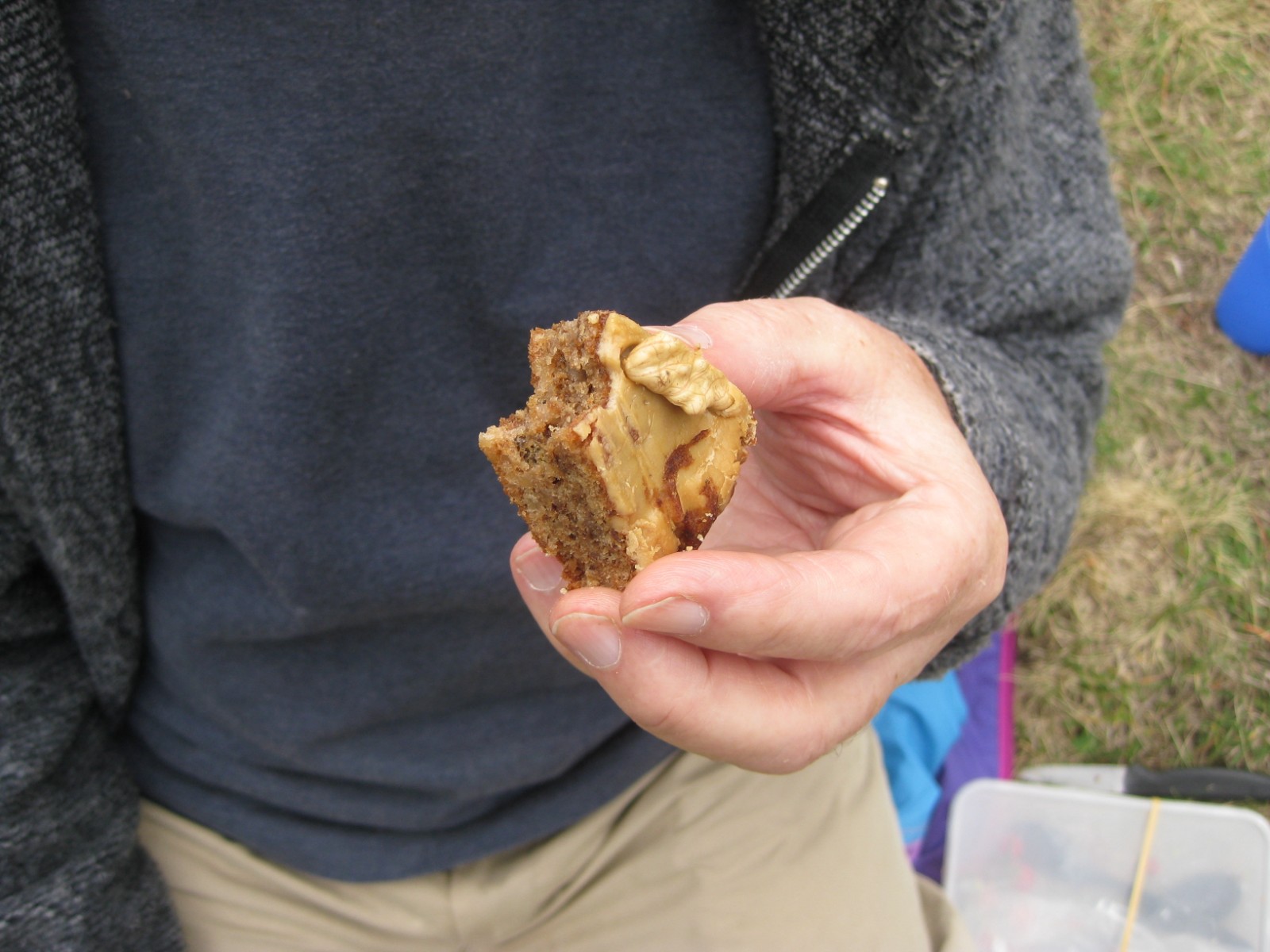
Walnut cake Amafaçon (my way)

Mal puts away a slice of walnut cake on our walk to Bésines

 Ingredients    

180g. finely ground walnuts

30g. SR flour

12g. cornflour

4 eggs

120g. caster sugar

100g. butter

½ glass walnut liqueur, rum, or alcohol of choice

Pinch of salt

Preparation :

  • Heat the oven to 200°C
  • Mix half the sugar with the ground walnuts.
  • Mix the remaining sugar with the softened butter and add the walnut mixture.
  • Add 2 whole eggs one by one, and 2 yolks, one by one.  Mix well then add salt, flour, cornflour and liqueur.
  • Beat the 2 egg whites to soft peaks, and fold into the cake mixture.
  • Pour into a well-greased 22cm cake tin and bake for 35 minutes at 200°C .  The cake’s cooked through when a skewer inserted into the centre comes out clean.
    For a 24 cm. cake tin, bake for 50 minutes at 180°C.

Serve it just as it is, or if you’d like something more elegant,

  • ice with a strong coffee icing or
  • decorate with caramelised walnut kernels and a caramel sauce made with 150g. sugar caramelised in a thick-bottomed saucepan to which you add 30 g. of salted butter and 50ml. single cream.

‘All is safely gathered in, ere the winter storms begin’ *

Autumn colours beginning means it’s harvest time for foragers

I’ve written before about the ‘au cas où’ bag: the carrier you always have with you on a walk, ‘just in case’ something tasty turns up and demands to be taken home and eaten.

Well, at this time of year, it isn’t really a case of ‘au cas où’ .  You’re bound to find something.  A fortnight ago, for instance, Mal and I went on a country stroll from Lieurac to Neylis.  We had with us a rucksack and two large bags, and we came home with just under 5 kilos of walnuts, scavenged from beneath the walnut trees along the path.  A walk through the hamlet of Bourlat just above Laroque produced a tidy haul of chestnuts too.

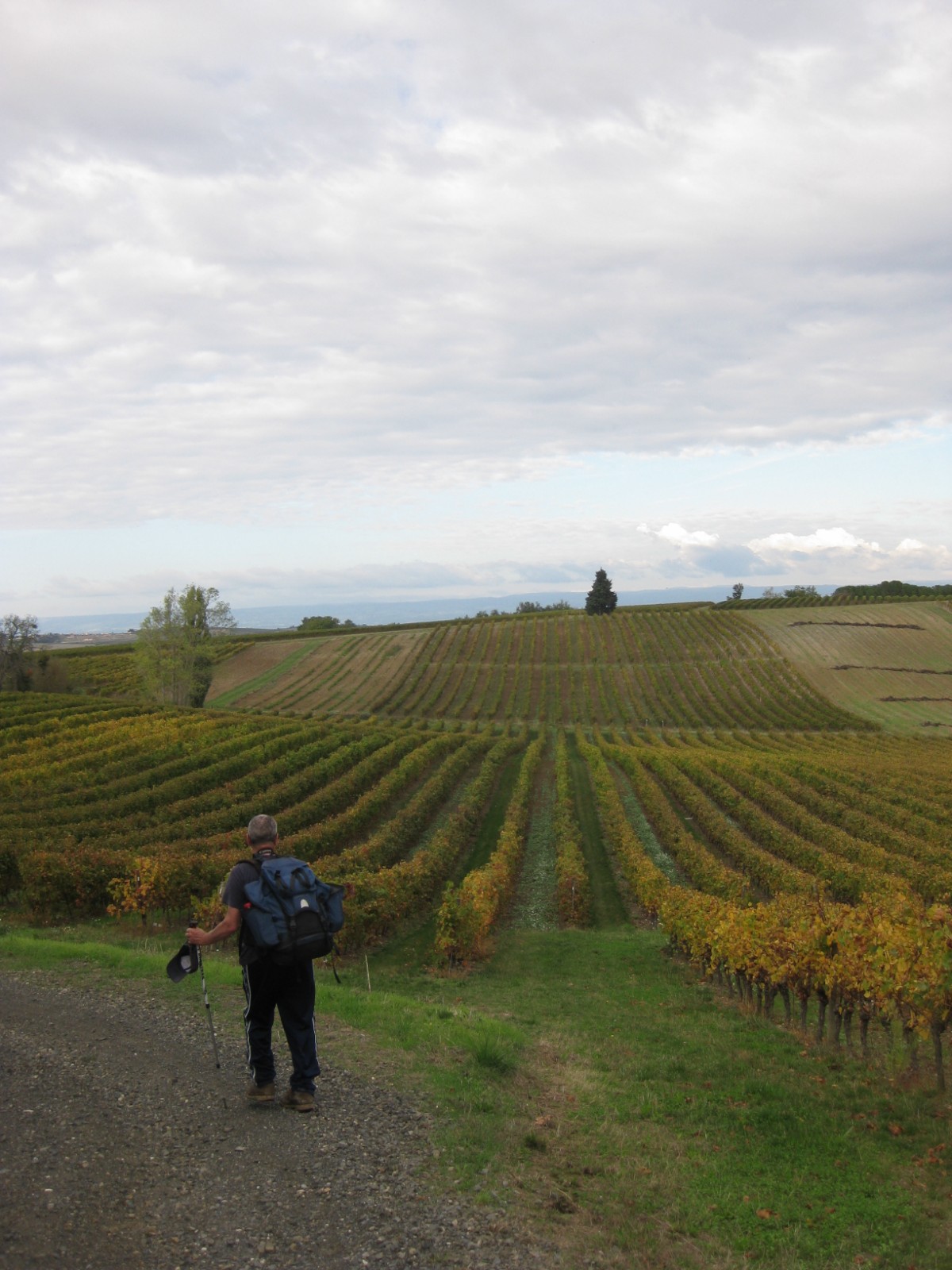
Yesterday, we Laroque walkers were among the vineyards of Belvèze-du-Razès.  The grapes had all been harvested in the weeks before, but luckily for us, some bunches remained on the endless rows of vines which lined the paths we walked along.  We felt no guilt as we gorged on this fruit all through the morning.  The grapes had either been missed at harvest-time, or hadn’t been sufficiently ripe.  They were unwanted – but not by us.

So many vines: there’ll be unharvested grapes there somewhere.

The walnuts we’re used to in the Ariège are replaced by almonds over in the Aude.  You have to be careful: non-grafted trees produce bitter almonds, not the sweet ones we wanted to find.  But most of us returned with a fine haul to inspect later.  Some of us found field mushrooms too.

Today, the destination of the Thursday walking group was the gently rising forested and pastoral country outside Foix known as la Barguillère.  It’s also known locally as an area richly provided with chestnut trees.  Any wild boar with any sense really ought to arrange to spend the autumn there, snuffling and truffling for the rich pickings.  We walked for 9 km or so, trying to resist the temptation to stop and gather under every tree we saw.  The ground beneath our feet felt nubbly and uneven as we trod our way over thousands of chestnuts, and the trees above threw further fruits down at us, popping and exploding as their prickly casings burst on the downward journey.

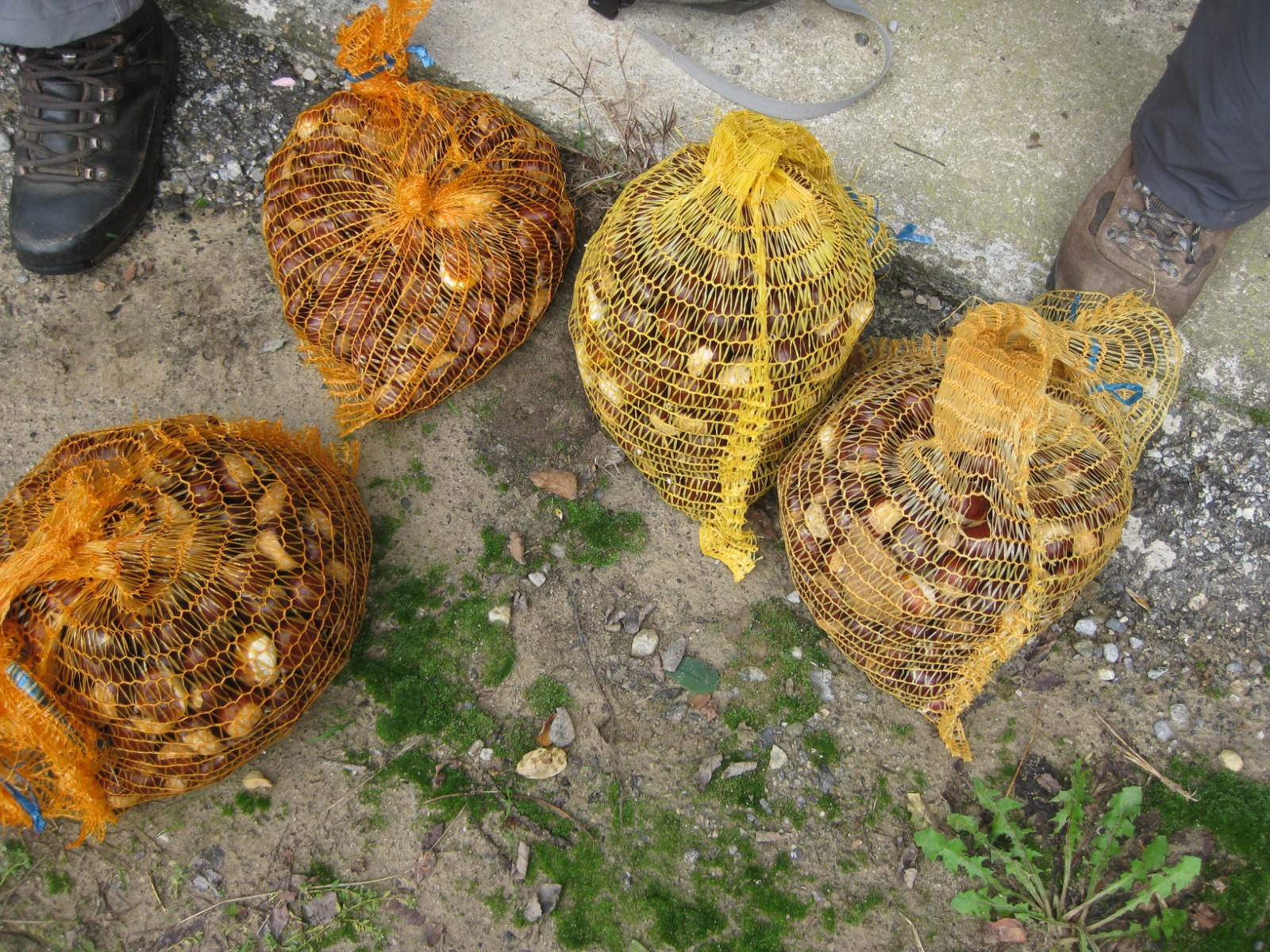
As our hike drew to an end, so did our supply of will-power.  We took our bags from our rucksacks and got stuck in.  So plentiful are the chestnuts here that you can be as picky as you like.  Only the very largest and choicest specimens needed to make it through our rigorous quality control.  I was restrained.  I gathered a mere 4 kilos.  Jacqueline and Martine probably each collected 3 times as much.  Some we’ll use, some we’ll give to lucky friends.

Now I’d better settle myself down with a dish of roasted chestnuts at my side, and browse through my collections of recipes to find uses for all this ‘Food for Free’.

I think these chestnuts represent Jacqueline, Martine and Maguy’s harvest.

* Two lines from an English hymn sung at Harvest Festival season: Come, ye thankful people, come’

Au cas où ….you find some mirabelles

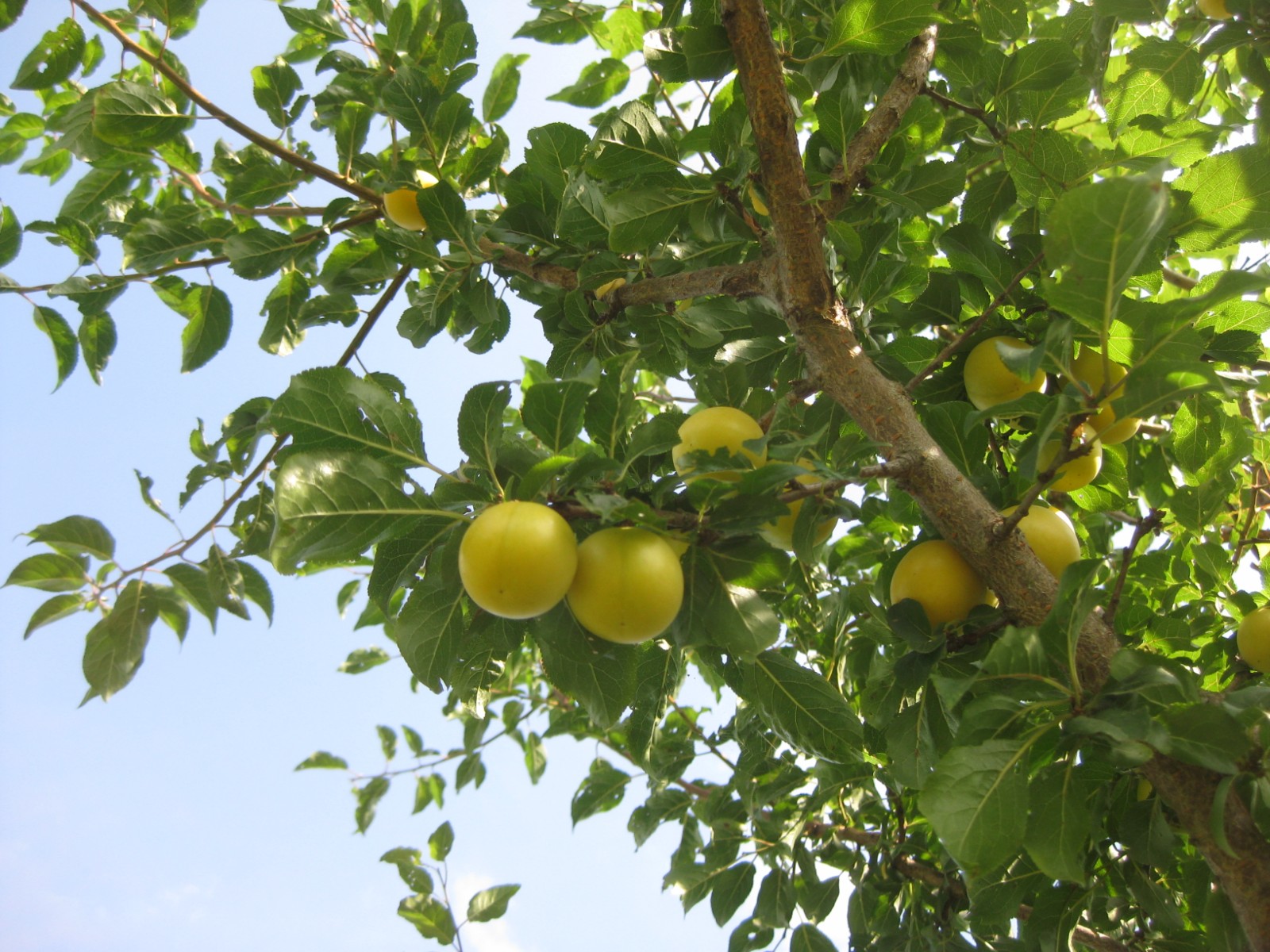
Mirabelles…there for the taking

I’ve written about the au cas où bag before: that little shopping bag or some such that you tuck into your pocket before any walk, au cas où you find something worth harvesting or talking home.  It was as well we had that bag yesterday.  Walking in the fields above Laroque, we found 2 mirabelle trees, their tiny juicy fruits just turning to golden ripeness.  We harvested what we could, and came home.

Then we remembered the trees we’d seen one previous year on the road between us and Léran.  We went home for another bag and hunted out those mirabelle trees lining the route.

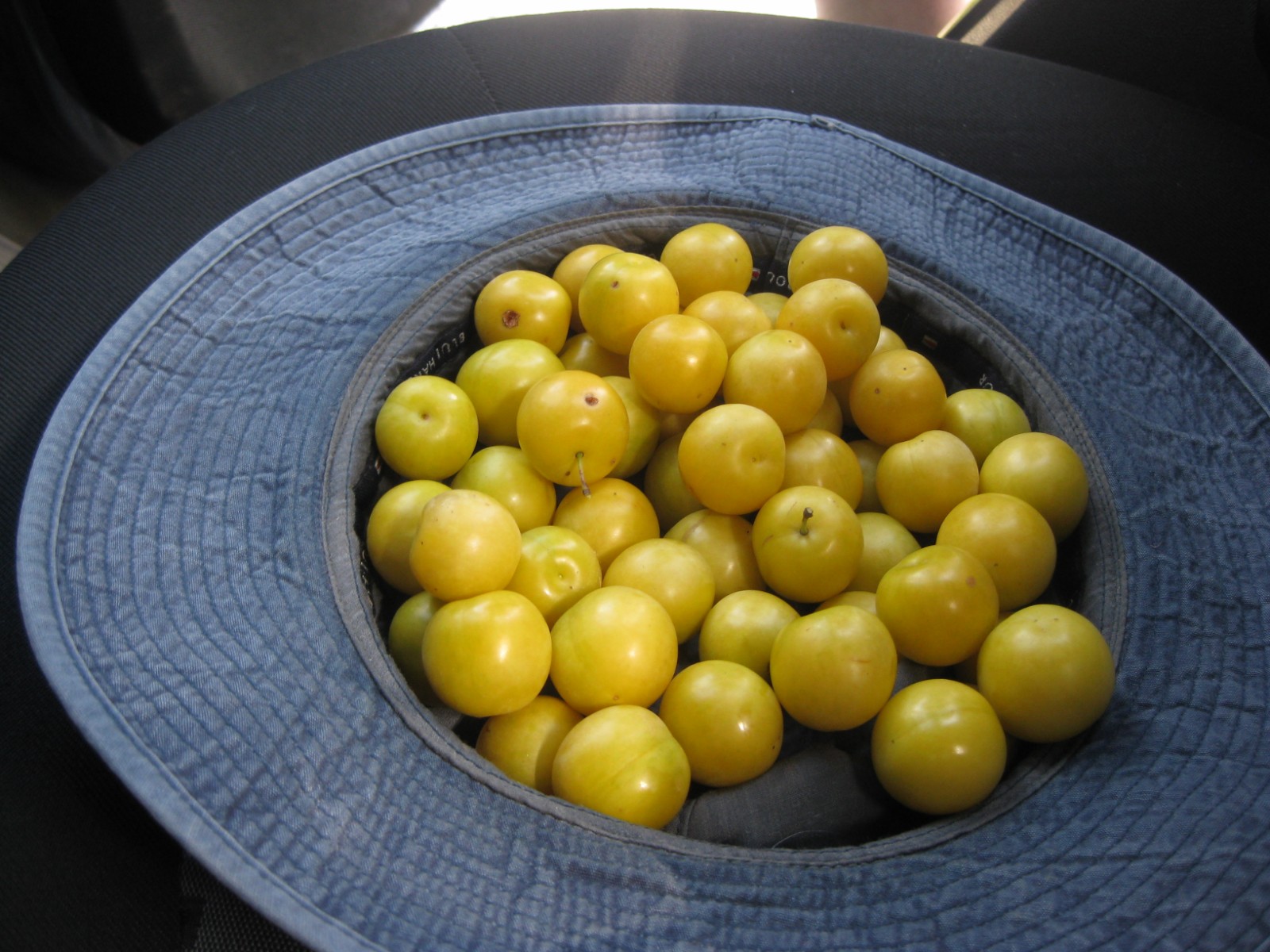
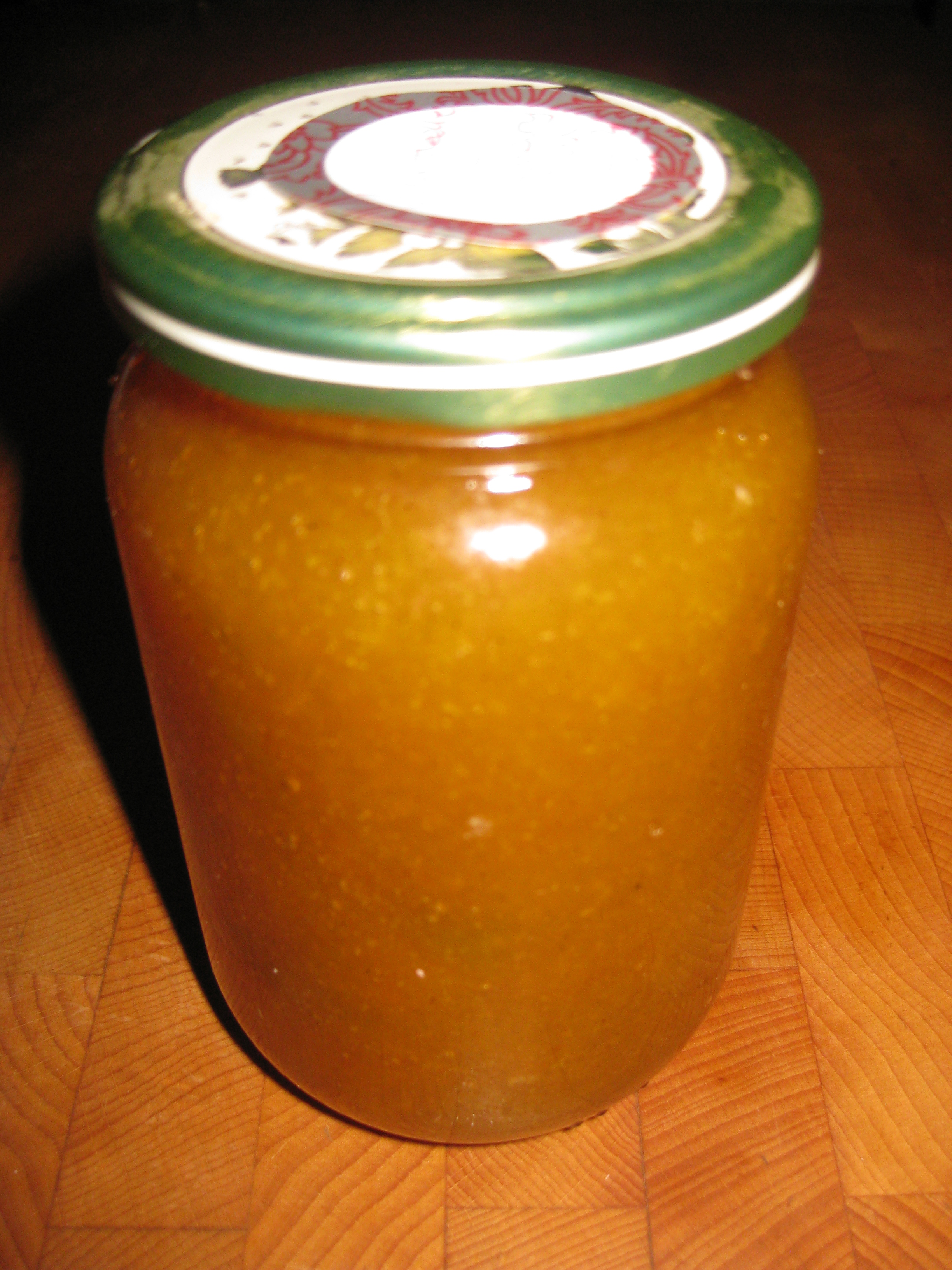
Hundreds of plums, thousands of plums, millions and billions and trillions of plums – to misquote that much loved picture book by Wanda Gagabout rather a lot of cats.  Reader, we picked them – some of them anyway.  We came home.  And this is what we made.  With a few of them, anyway.

Bag not big enough? Find a hat.

Mirabelle and Rosemary Jam

I kg mirabelles

400g high-pectin sugar, or add pectin powder according to pack instructions to granulated sugar.

4 rosemary sprigs, each approx 5 cm long

1/2 vanilla pod.

Directions:

  • Put mirabelles, sugar, rosemary and vanilla pod in a preserving pan and bring slowly to the boil, so the plums have chance to release their juices.
  • Simmer briskly for about 7 minutes.  It’s not necessary to bring it to jam setting temperature as the pectin will do its work, and it’s a fresh flavour you’re aiming for. But the jam won’t keep long outside the fridge.
  • Take from heat and remove rosemary sprigs and vanilla pod.  This is important.  If you leave the herb in, the jam will taste medicinal. The hint of rosemary should remain elusive, and just add that extra Mediterranean je ne sais quoi
  • This is the bad bit.  You could have halved the plums before you started and removed the stones then.  But I think it’s marginally easier to fish them out now.  Only marginally though.  The choice is yours……
  • Add vanilla seeds from the pod and mix.
  • Fill your ready-prepared jars.

Posh squash

Fetch up at our friend Peta’s on a summers day, and she’ll have thrust a cool glass of sophisticated, refreshing and home-made elderflower cordial into your hand before you’ve even had time to admire the garden.  Somehow, I’ve never got round to making it myself …. before this year.

Which is silly, because it’s too easy, and you can make several bottles of concentrated cordial for the price of a bag of sugar and a couple of lemons.  Oh, and a small amount of citric acid.  And there’s the rub.  I had a small pack left over from some project in England.  It’s all gone and now I’m trying to replace it.  Every chemist I’ve spoken here to has narrowed his or her eyes suspiciously and offered to order me half a kilo to arrive next week.  What CAN they think I’m up to?

Here’s Sophie Grigson’s recipe:

 Ingredients

20 heads of elderflower, well shaken to remove any insects

1.8 kg. granulated sugar

1.2 litres water

2 unwaxed lemons

75 g. citric acid.

Method.

  • Heat the water and sugar to boiling point and stir till the sugar has dissolved.
  • Meanwhile pare the zest of the lemons in wide strips and put into a bowl with the elderflowers.
  • Slice the lemons, discard the ends and add the slices to the bowl.
  • Pour over the boiling syrup and add the citric acid.
  • Cover with a cloth and leave at room temperature for 24 hours.
  • Next day, strain the cordial through a muslin-lined sieve, and pour into thoroughly clean bottles.  And it’s done.

And if you explore this link, you’ll find lots of ideas for using it.


BookCrossing

I like BookCrossing.  I love the idea of ‘releasing books into the wild’ for some lucky reader to find, and I love finding books in the same way.  It brings me face to face with choices I wouldn’t normally consider when I’m browsing the shelves of my local bookshop, library or charity shop.  Unfortunately, I’m not very good at releasing books.  If I leave one in a café, an anxious waitress will scurry after me waving my latest offering.  Leave them on a park bench, and the heavens open.  And so on.

But I do have 3 outlets.  The first was McQueen’s coffee shop in Knaresborough. For the first and only time in my history of BookCrossing, I heard from someone who’d found and enjoyed a book I’d left.  She was writing to me from France.  Result.

The next place is Le Rendezvous in Léran, a village near our house in Laroque. The bar is not an official BookCrossing site, but owners Marek and Shirley encourage people to browse the shelves of the overflowing bookcase and choose a book or two, leave a book or two.  It’s a great resource of both English and French reading matter.

My third place is new to me. It’s in the adjacent block of flats to ours in Ripon. Calling on a friend there, I discovered a bookcase in the entrance hall to the block. Unofficial BookCrossing again: the great idea of one of my friend’s neighbours.  I met her at his party on Friday and she told me her ideas of encouraging neighbours to share books has become popular, with paperbacks changing on an almost daily basis.

So now I’m deep in a gritty ‘policier’, set in Portsmouth, a town I thought until this weekend that I knew quite well. I’d never heard of Graham Hurley, or of  ‘Angels passing’.   Glad I have now.

Here we go round the blackberry bush…

I’m so chuffed to be in England for the blackberry season.  Ariègeois blackberries baked in the hot sun are sweet, characterless and make a rather dull jam.  But then who goes to southern France to go blackberrying?

So yesterday I went out, meandered down a few nearby lanes, and came back with a bowl filled with large glossy, juicy, sweet and yet tart berries, a stained T shirt and fingers stuffed with tiny spines and tingling from nettle stings.  I was very happy.

I set my berries to simmer down with the early apples from Jonet and Richard’s tree, and then…. only then, remembered I had neither a  jelly bag nor a cache of jam jars ready waiting for the next stage.  Oddly, I do have a preserving pan.

So it’s been the moment for a little ingenuity.  An old clean T shirt ripped up made a jelly bag, and this morning we’ve been piling our toast with a week’s ration of marmalade, decanting apricot jam into a bowl, and scraping clean an almost-finished jar of honey.  So far so good.  But what happens when I need to make the next lot?

Food for free

In the UK, Richard Mabey’s the original, and still the best known proponent of foraging for good things to eat in the countryside.  Here in our patch of France, it’s Stéphane Martineau, and we spent yesterday afternoon with him, strolling down the lanes near Roquefort les Cascades, nibbling at petals, leaves and roots.

It was a free afternoon organised by Alptis, who provide us with the health insurance we need to complement the state-provided health service, and we enrolled as soon as the invitation came through the post.

Stéphane encouraged us to look carefully at each plant, at how it’s structured, what it feels like, what the crushed leaves smell like.  That afternoon, we found leaves that reminded us of mushroom, garlic, mint, cloves….

We began to understand how welcome the new spring growth must have been to villagers over the centuries.  After months and months of bland beans and turnips, the tasty bitterness of black bindweed, eaten raw or lightly cooked like asparagus must have been a real treat.  Its other name is l’asperge aux femmes battues – battered wives’ asparagus, because it’s also good at relieving bruising and swelling.

At this time of year, before many of the plants have flowered, and growth is young and fresh, there are so many tasty additions to the salad bowl.  Garlic mustard has both leaves and flowers to offer.  Hedge woundwort has nettle like leaves and a slight mushroomy odour.  Primula gives a pleasantly bitter taste so use it sparingly, and creeping Charlie  makes a lively addition to a salad, or an unusual addition to soup or lasagne.

Nettles are of course the kings of country flowers, packed with vitamins, minerals and even proteins.  They can be eaten raw (with a thick and tasty dressing) lightly cooked, or included in sauces and stews and baking.  Fermented, they make an all-round fertiliser, and gardeners dig them into the ground too, to enrich the soil.

We found plants to cure warts, substitutes for aspirin and for the cloves that we’re supposed to tuck next to a throbbing tooth.  We even learnt that horsetail, just as it first thrusts above the ground, makes a good mineral-tasting asparagus substitute. Failing that, once it’s matured, a big bunch tied together is a good pan scourer.

Just one plant was completely new to me: purple toothwort.  It’s a mauve parasitic plant, looking rather like a small clutch of rhodedendrons in bud, and modestly hidden under grasses at the foot of trees.

I’ve got pages of notes about plants I plan to look out for and try: using only a few specimens from each patch, of course, and just taking  a few of the very youngest leaves, as instructed.
Just before we all headed off home, we shared a foraged snack which Stéphane had prepared earlier.  Nettle blinis, Douglas fir cordial, various jams and jellies.  Good stuff, this food for free.

This slideshow requires JavaScript.