Indian Friday: Last Day in Chennai

My diary, revived from my trip to India back in 2007. This second part details my solo travels during the last three weeks or so. From now on, increasingly exhausted, my entries become terser and frustratingly light on detail.

Last Day in Chennai

Monday 3rd December

I woke up with a high fever and sore throat, listening to heavy rain outside – and I only had the clothes I stood up in. I’d have liked to have bought a brolly, but no luck.

Heavy rain in Mamallapuram

Finally the Blue Elephant cafe, where I’d been yesterday opened, and the woman in charge, on hearing my voice, wouldn’t hear of my having a coffee – ‘Lemon and ginger for you!’ Mighty delicious – huge chunks of ginger brewing in squeezed lemon juice and hot water. I couldn’t face an Indian breakfast though, so it was eggs and toast. After that it wasn’t too long before I caught the bus back to Chennai, where fever or no fever, there was still shopping to be done, and packing to be done back at The Hotel from Hell.

My rickshaw driver in Chennai

I eventually made it to the station , where I planned to catch a train to the airport  –  a local service with a quick journey time. How was I to know that the train would fill and fill and fill and fill until people were hanging from the doorways in true travel doc. style? With me crushed inside feeling iller by the second? Actually, ‘crushed’ doesn’t begin to cover it: the only reason I didn’t fall to the floor was that it was physically impossible. At a certain point I couldn’t stand it any more, and somehow forced myself and luggage off the train, with everyone shouting behind me ‘No! No! Airport is 2 more stations!’. By then though I was sprawled across the platform, vomiting and vomiting as the train went off. A lovely man tried to help – he brought me water which he poured over me, washing my face and making me drink. A concerned crowd gathered, but by then I had lost all pride as I lay there, being repeatedly sick.

Two police women turned up, at as much of a loss as everyone else. Finally, they made a decision. They manhandled me, extraordinarily roughly, as if I were a somewhat dangerous demonstrator rather than a rather ill female tourist, and tried to bundle me onto a train. By yelling and weeping I managed to avoid the first train (later now, the trains were nearly empty again), but lost the battle in the end as they chucked me onto the floor of the next one.

At the airport station, we were joined by a handsome young male PC, who carried me ‘Gone with the Wind’ style up the stairs (shame I was way too ill to appreciate it) and heaved me into a rickshaw, where they all joined me, together with my luggage. Airport at last – or at least the airport medical centre. Here they finally examined me and decided I needed to go to hospital – I’d been muttering that for at least an hour. An ambulance appeared and I was dumped on a stretcher – bang! The ambulance driver revelled in using his siren – who wouldn’t if it meant actually MOVING in the streets of Chennai? And after arriving at hospital  I don’t remember much of the rest of the day. I think the Consulate was told, and dealt with the fact I could no longer catch my flight home.

It’s rather astonishing to me that I even took two photos that day. But I did: one on the beach at Mamallapuram in the rain, the other of my very last auto-rickshaw driver in Chennai. My featured photo, of the central station at Chennai is courtesy of Unsplash, and taken by Ahamed Sameel.

Quiet Fog

Ours is a land of rivers. Nearby, the Ure, the Skell and the Laver all course through Ripon, and the Ripon Canal peacefully splices the town in two. Local gravel pits end their working lives transformed into watery nature reserves. We’re approaching the time of year when, because of the surrounding water, morning mists envelop the landscape. I relish those early hours when quiet descends with the mist, muffling sound, slowing us down and encouraging us to savour these peaceful moments.

For Ritva’s Lens-Artists Challenge #364: Quiet Moment.

And Leanne’s Monochrome Madness.

Six Degrees of Separation: from Ghost Cities to My Father’s House

On the first Saturday of every month, a book is chosen as a starting point and linked to six other books to form a chain. Readers and bloggers are invited to join in by creating their own ‘chain’ leading from the selected book.

Kate:  Books are my Favourite and Best

I haven’t read Siang Lu’s Ghost Cities.  But I’ve read several reviews, and it seems that this novel is inspired by the vacant, uninhabited megacities of China, and follows multiple narratives many years apart. In the present day, Xiang is fired from his job as a translator at Sydney’s Chinese Consulate after it’s discovered he’s been using Google Translate. This alternates with stories from the past of a dictatorial Imperial Emperor and his escapades.

I immediately thought of Italo Calvino’s Invisible Cities, which I read far too long ago to comment on seriously now.  But it begins: ’Kublai Khan does not necessarily believe everything Marco Polo says when he describes the cities visited on his expeditions, but the emperor of the Tartars does continue listening to the young Venetian with greater attention and curiosity than he shows any other messenger or explorer of his.’  And here begins Italo Calvino’s compilation of fragmentary urban images.
This Italian author made me think of one travel writer’s account of one part of Italy.  Jan MorrisTrieste and The Meaning of Nowhere. I felt a little ambivalent about this book. I wanted to like it more than I actually did. It’s a meditation on, and an exploration of Trieste, a city history has left behind, whose glory days are over, which is top of nobody’s tourist agenda, and which Jan Morris entertains strong feelings for. She discusses its history, its streets, its day-to-day life in a loving, melancholic way, and relates it to her own experience of being outside the mainstream. It’s a book which I’m glad to have read about a part of Italy I don’t know, but which I was happy enough to finish and set aside.

Vigàta in Sicily is another town which time has perhaps forgotten.  It’s also imaginary, and the setting for a series of murder mysteries by Andrea Camilleri. Despite the fact that as a detective series, which therefore concerns murder and other crimes, the Inspector Montalbano books are ones I turn to when I need a bit of relief from weightier tomes. I love to meet the people Camilleri describes. I like to accompany Montalbano as he seeks out delicious meals at home or at neighbourhood restaurants. And I like to observe his relationships with his colleagues. The Voice of the Violin doesn’t disappoint. It’s about a murder which might have taken a very long time to have come to light if the police car in which Montalbano was a passenger hadn’t careered into a car parked outside a villa…. And in due course, Montalbano’s curiosity is piqued … He finds a body, of course. And up to five people might be responsible for the gruesome murder. But who? And you’ll need to read this book to find out why the title it’s been given is so apposite.

From one Italian detective to another. I love Commissario Brunetti, and I love the picture of Venice that Donna Leon, his creator, always conjures up. The alleys between ancient buildings, those palazzi themselves, the little bars Brunetti frequents…. and so on and so on. So even before I get involved in the plot, I’m absorbed by the ambience she creates. Death at la Fenice is, like all Leon’s tales, a good story. This one features the conductor who’s murdered during the interval at a performance at la Fenice. Whodunnit? His wife? That soprano? Her lover? As ever, the result of Brunetti’s investigation is an unexpected one, and convincing. Read it.

We’re staying in Italy for the rest of this chain.  But we’ll leap back several centuries in Maggie O’Farrell’s The Marriage Portrait.. Lucrezia, third daughter Cosimo de’ Medici, finds herself betrothed, then married to Alfonso, heir to the Duke of Ferrara when her older sister, his original choice, dies. The story flits between her early life in Florence and her early married life. Underneath, throughout her marriage, her conviction that she will be killed by her apparently loving husband bubbles away. She’s a Duchess now, her father-in-law having died. She’s only 15, more than 10 years younger than her husband. Although she’s been brought up privileged, her new status brings with it loneliness and challenges. Virtually her only constant friend is her maid.
This book links with the two previous ones by being rich in quotidian detail. O’Farrell paints the pictures of her privileged life in such a way that we can hear, see and smell the scenes that surround her: her father’s exotic menagerie; her husband’s castrati singers; the sumptuous clothing; the simple bowls of fruit which she examines with her painterly eye – she is a talented artist.  This rich attention to detail brings an already absorbing story fully to life.

Still Italy, still history, but much more recent in the first volume of Joseph O’Connor‘s Escape Line TrilogyMy Father’s House is an immersive story, taking as its starting point the fact that while Rome was under German occupation in 1942, there was an Irish priest, Hugh O’Flaherty, based at the Vatican who was involved in running an escape line for Jews, escaped POWs and resistance fighters during WWII.

The plan is to evacuate scores of refugees and resistance fighters, all separately hidden, out of Rome on Christmas Eve, when perhaps guard is lowered. Plans take place at the rehearsals of a specially convened Chamber Choir: singing drowns out the mutter of whispered instructions to each singer in turn. Each player in the plot has a role, No one knows what any other individual is required to do. Gestapo leader Paul Hauptmann has his suspicions that a plan is afoot, and O’Flaherty is in his sights.

This is a work of fiction, even though heavily indebted to known facts. It’s told in a series of distinct voices, all characters in the book.  Each voice is distinctive, authentic, even funny: Irish, English, Italian, aristocrats and shopkeepers. An often thrilling, always thought-provoking and absorbing story.

My chain seems to owe everything to Italy, and little to the starter book. I won’t do any better next month. I’m unliklely to participate, as we’ll be away, and I don’t like the idea of not responding promptly to comments. But the starter book will be  Dominic Amerena’s novel about authors and publishing, I Want Everything. I think I’ll try to read it anyway.

With thanks to the photographers from Pixabay whose photos I have used: LeoLeo (cities); VBosica (Miremare, Trieste); Gianni Cio 10 (Sicily); Filip Filopovic (Ferrara); Davide Cattini (Rome).  And from Unsplash, Giusi Borrasi (La Fenice, Venice)

Indian Friday: In Which I Make My Escape

My diary, revived from my trip to India back in 2007. This second part details my solo travels during the last three weeks or so. From now on, increasingly exhausted, my entries become terser and frustratingly light on detail.

In Which I Make My Escape

Sunday 2nd December

Night came and endless hours of listening to traffic and my fellow guests noisily throat-clearing and spitting. I dreaded hanging around till 9.00 a.m. to go out with Y and her driver, being driven around and cramming in three Sites of Interest before 4 o’clock, when I’d be free to … return to the hotel.  So at 6.30 I got up, wrote a note excusing myself, delivered it to Y’s house. and got a rickshaw to the Bus Stand. I knew I was being rude, but I was at the end of my tether and beyond caring.

It’s not easy when at the Bus Stand, 3 different people give you 3 different bus numbers, and 3 different stops, and the bus destinations are only in Tamil script, but I was determined to get to my intended destinaton, Mamallapuram, good and early. Chaotic Chennai traffic eventually gave way to palm trees, lagoons, and views of the sea, Finally I was happy.

Mamallapuram struck me as a more congenial place to be. Small seaside town , albeit touristy, With Added Culture. It’s a World Heritage Site with fantastic temple architecture and sculpture. I knew it dated from the 7th and 8th centuries CE, that it is a UNESCO World Heritage Site, and features intricate stone carvings scattered over a wide area, mainly the beach.

Beach at Mamallapuram with the Shore Temple in the background

Walking down the street, I suddenly thought ‘I don’t HAVE to go back to Chennai tonight’. The first hotel I called at had a room for a mere RS 200, monastically simple, but clean. Outside my room is a shady courtyard, and as I started to talk about Chennai to the American tourist relaxing there, I just burst into tears. I didn’t know just how badly the noise had been affecting me, but I DID know that once I’d decided to stay here, a weight fell from me, and I’ve bounded around feeling I’ve got out of jail free. And of course I only went there in the first place to CouchSurf, which didn’t happen, for reasons that aren’t altogether clear to me.

I sauntered round being a tourist, getting a coffee on a roof terraced cafe, and in a fairly low-key way enjoyed the sculpture all over the place from the beach to sites at the end of town. In among are extraordinary boulders balancing precariously in the manner of Brimham rocks.

I had a salad lunch at an Indo-French cafe before returning to the beach and its treasures. At one destination, I found I’d made the huge mistake of arriving at the same time as 12 coaches worth of local university students. I couldn’t help comparing them with Emily and friends, in the unlikely event that their university course leaders, at her – or any other English seat of learning – would bring upwards of 200 students out on a Sunday afternoon to Do Culture. Instead of distressed jeans, subversive T Shirts and Attitude, the girls were sweetly young, quietly standing in pairs separately from the equally demure young male students. Luckily for me they were all made to wait outside quietly until long after I’d been and gone. Most people seemed to be there to have pictures of themselves and their families taken in front of the more famous sculptures, such as the life-sized elephant, so it was all a bit of a challenge, if entertaining.

I’ll go back to Chennai at the last possible moment to check out of the hell-hole and go to the airport. Luckily there are loads of opportunities to shop here, and I had some fun souvenir shopping – until I came to pay. For some reason, my card has apparently been blocked, which saves money, but could be awkward tomorrow….. Mal rang the bank for me and they say there is no problem, so let’s see.

But I’ve bought a toothbrush for tonight. Sorted. Later, I had a not very exciting meal in the rooftop restaurant above my hotel – in a powercut. My companion was an American/German woman flying home tonight, but she was a bit of a misery. In bed now, writing this, since I couldn’t get to sleep. And actually, I don’t feel very well….

Rummaging Through My Archives

This week, for the Lens-Artists Challenge, Anne has proposed a Scavenger hunt. What fun! Here’s what I’ve come up with, starting with my featured photo exhibiting the soft coats of of those baby ducklings.

Onwards.

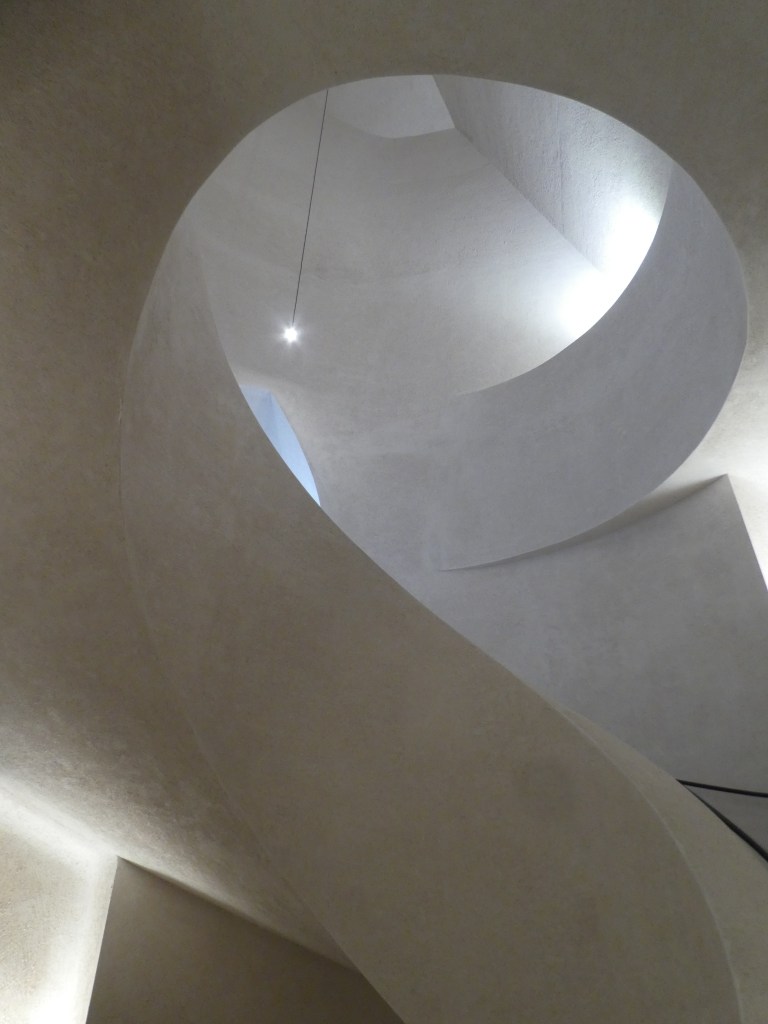
Circular. A window at the end of an exhibition space in  Lluís Domènech i Montaner House-Museum, Canet de Mar.

Glass. All kinds of glass here. The plate glass of the shop window itself, and the glass and the bottle within. Each of them reflecting the Barcelona street where the shop is situated.

Shoelaces – usefully stringing up some discarded trainers in a residential district near Park Güell in Barcelona.

Waves. We’ll leave Spain for England, but just fish out our cameras as the ferry leaves Rotterdam, causing a variety of waves as it glides throuh the water.

Shadow. Some discovered in the Valley Gardens in Harrogate.

Wheels. Some old charmers noticed this year at Masham Steam Rally.

Rectangular: lots of rectangles here, from bricks to planks to the battered doors themselves – afarm door near Staveley, North Yorkshire.

Jewellery: my British readers will understand that I entirely approve of the sentiments displayed in this pair of earrings.

And that’s me done for today. An extra post for the week – just for fun.

Dogs on the Beach

This week’s Monochrome Madness, hosted by Elke of Pictures Imperfect, takes pets as its subject. We don’t have one of those, though we are required to provide daily chats and cuddles to Newt, the dog next door on one side, and catering services when her owner is away to MiMi, the cat next door on the other side.

So I’m taking you to Bamburgh in Northumbria, where we were walking recently on the best sort of afternoon at an English seaside, with bright sun, breeze and gentle warmth. It was an afternoon for beach strolls and games … and for taking the dog out to play.

Breakfast Time for a Heron

Walking through the orchard at Fountains Abbey early yesterday, I came upon this heron, not 10 feet away. He was unconcerned about me, and spent his time alert for a breakfast meal. He found three courses during the time I watched him – about 20 minutes. This video shows him enjoying just one of them.

A heron out hunting along the river bank for breakfast.

It’s my last (and first) video of the month. My last shot of the month is also one of the heron, and is my featured photo. I was quite fed up that I only had my bargain-basement phone with me, rather than my camera. Never mind.

For Brian’s Last on the Card

… and IJK’s Bird of the Week.

A Bench for a Fairy or Two

Last Sunday, my Spanish grandaughters went to fairyland. Actually, they went to Mother Shipton’s Cave. This long-established tourist site is where, back in the 1500s, a woman we now know as Mother Shipton apparently prophesied many things which came to pass, such as the Great Fire of London, and the invention of the iron ship. It’s also where you’ll find a source of water which petrifies into stone any objects left long enough beneath the roof of the cave from whence the water drips: calcified teddy bear anyone?

These days the paying public expects more, so this season, the woodland surrounding the cave has been transformed into a fairyland of exactly the kind beloved by small children. Anaïs and Olivia were entranced, especially when they met a real live fairy, all the way from Greece.

My featured photo is of a bench much favoured for sitting on by would-be fairies. The remaining shots are from other parts of the site.

For Jude’s Bench Challenge.

Indian Friday: Sightseeing in Chennai

My diary, revived from my trip to India back in 2007. This second part details my solo travels during the last three weeks or so. From now on, increasingly exhausted, my entries become terser and frustratingly light on detail.

Sightseeing in Chennai

Saturday 1st December.

Got up.  What else could I do?  Pounded the area looking unsuccessfully for hotels.  Went over to Y’s house – she was out at a school meeting, but we eventually set off at about 10.30. Every few minutes she would stop the car at ‘point of view’ and commanded me and my camera to ‘Take this!’  So we saw the English Church of the Naval Base – surprisingly early – the 1600s. 

And at various points on the seashore where we’d stop for half a minute ‘Take this!  Take this!’

We ended up in an Indian vegetarian cafe, the expensive bit upstairs, where I bought her a – quite nice – lunch.

Then ever onwards.  Various sights on the beach again, then the Theosophical Society Gardens which was a wonderful green lung.  It was interesting to see the 400 year old Banyan tree whose main trunk had gone but which had endless ‘babies’ spread over a very wide area.

And back to base at 4.30.  I’d hoped to take a nap (though I don’t ‘do’ daytime sleep) but it was impossible – noise again.  So I got up and rang and emailed loads of hotel – none with vacancies.

Then at 8.30, over to Y’s for a dry and pretty nasty mac cheese, and so to bed, perchance not to sleep.  Y had rung the hotel who promised me a room away from the road tomorrow.

The building in my featured photo is I think the Ice House, which we didn’t visit. What interested me was the group of boys playing cricket. Such groups were everywhere, but not once was I instructed to take a shot of them. So it was quite hard to steal a moment to do so.