Herons World-Wide(ish)

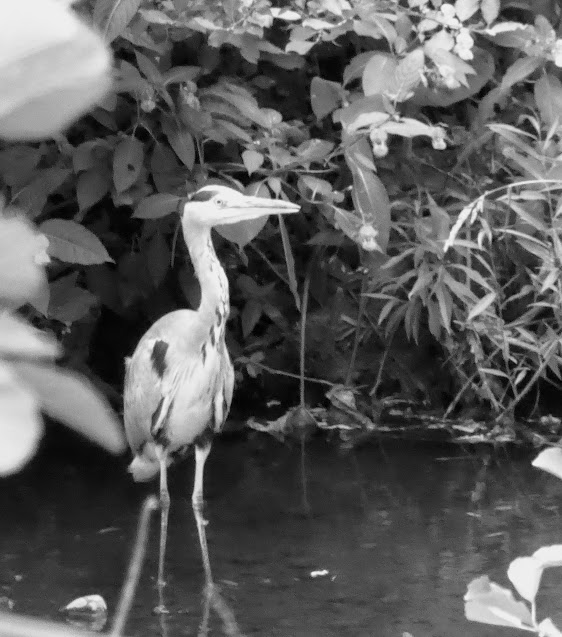
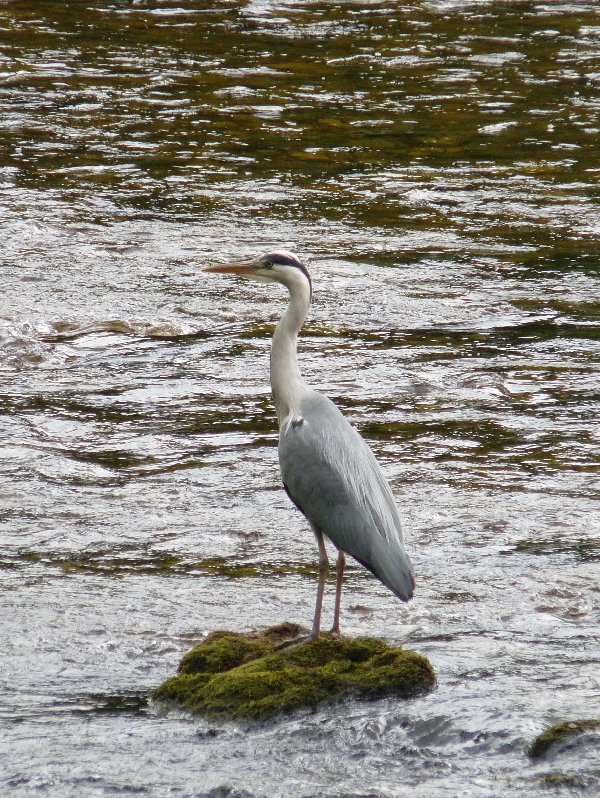
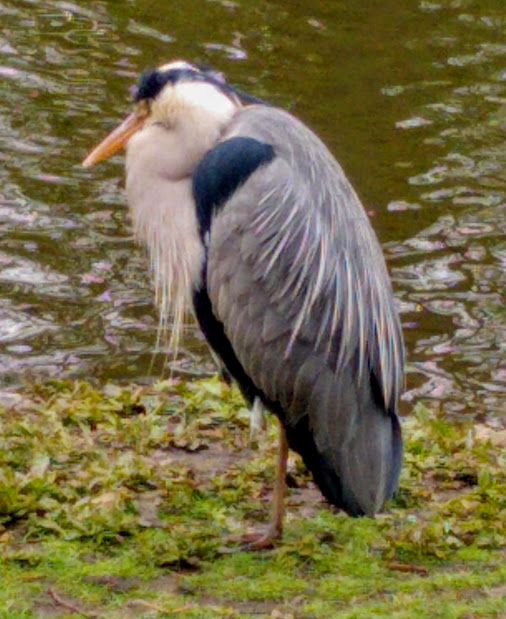
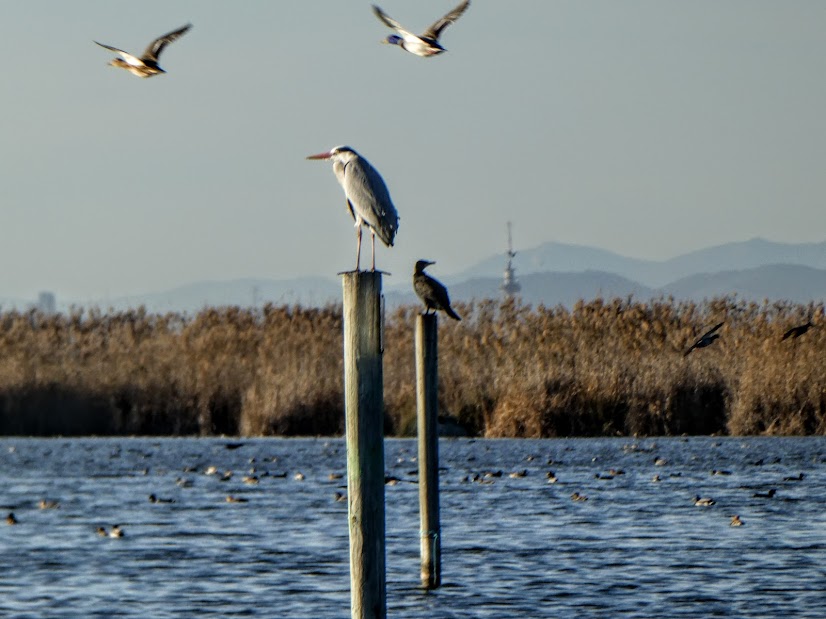
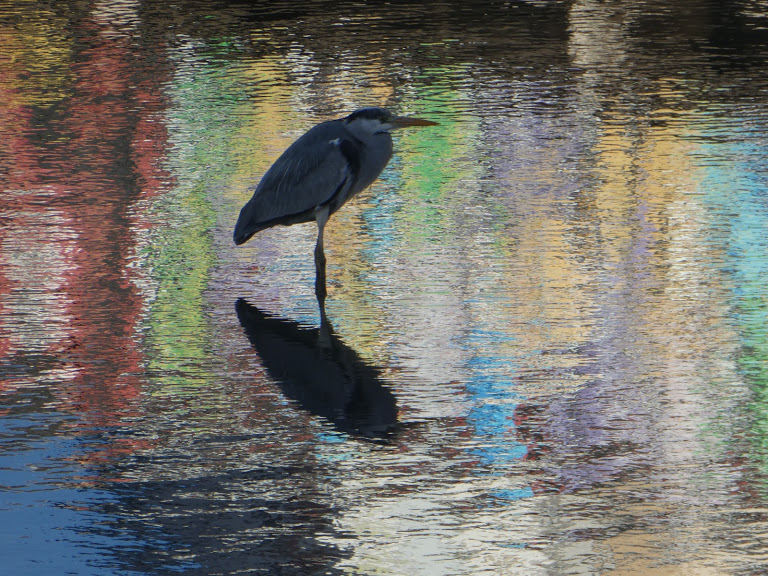
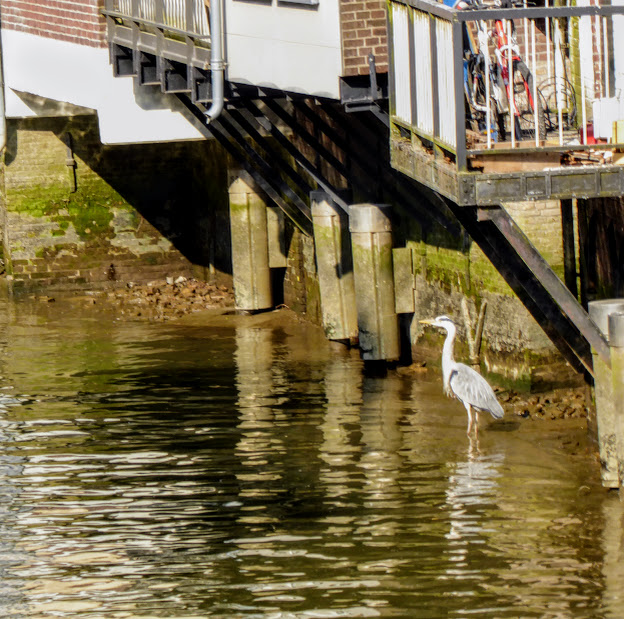
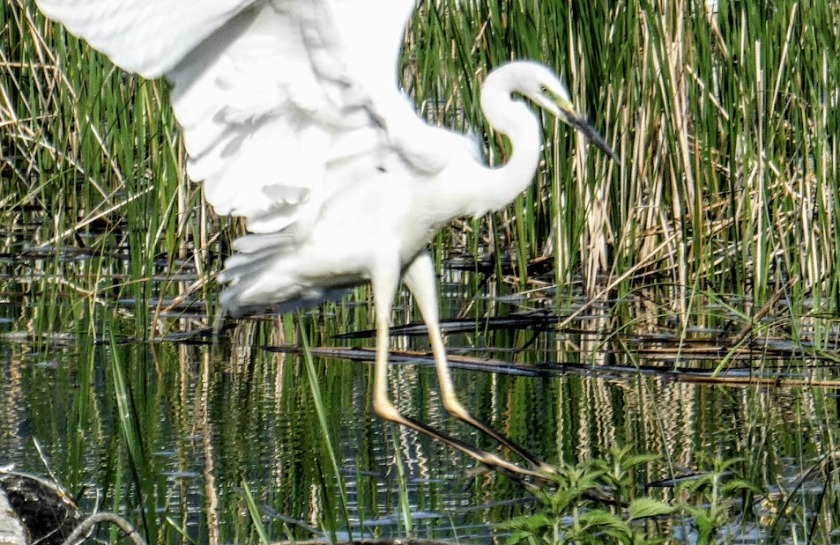
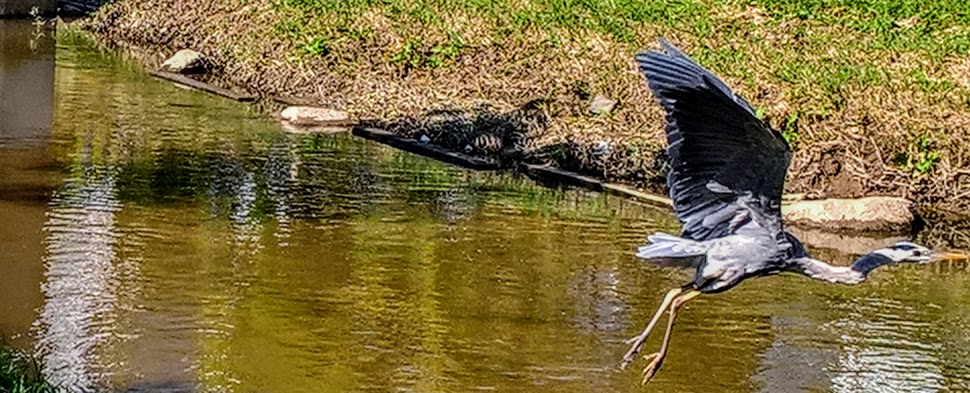
Over at Don’t hold your Breath, IJ Khanewala features an Indian Pond Heron as his Bird of the Week. I remarked to him that herons get everywhere. And here’s the proof. I can’t claim to show examples from anything like every continent, much less every country where you’ll find herons, but here are just a few.

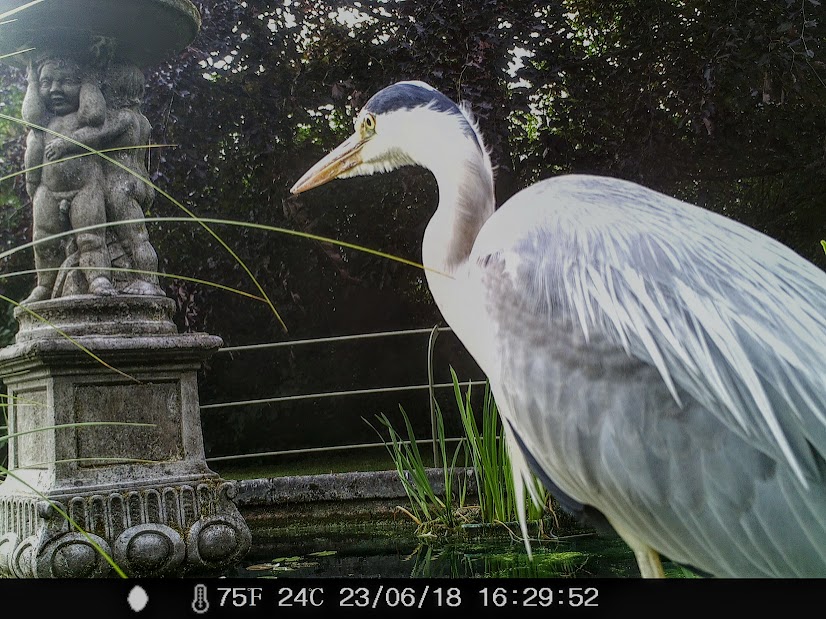
This one was after an easy catch in our landlord’s garden and noticed by our trail camera.

These are all from England: click on an image to find out where.

These two come from Spain, from l’Albufera near Valencia, and from Córdoba.

Dordrecht in the Netherlands
Lake Prespa in Greece (but it’s an egret?)

And the featured image comes from Busan in South Korea.

Not exactly a world-wide survey. But I go a small way towards proving my point.

Six Degrees of Separation: from Kitchen Confidential to The Christmas Chronicles

On the first Saturday of every month, a book is chosen as a starting point and linked to six other books to form a chain. Readers and bloggers are invited to join in by creating their own ‘chain’ leading from the selected book.

Kate: Six Degrees of Separation

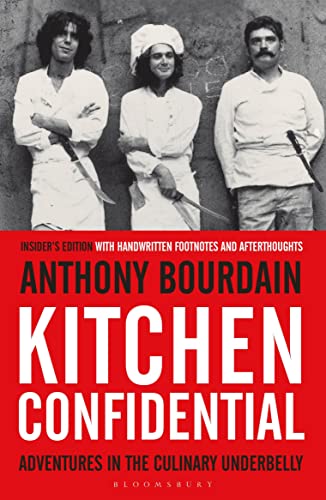
I read Anthony Bourdain‘s Kitchen Confidential quite a long time ago, and seem to remember not liking it – or indeed him – very much. But it’s given me my chain for the month. You’re not getting a single novel from me this time, not one. Simply a run-down of a few cookery books.

To ease you in gently, I will start with a book that – though full of recipes – is also meant to be read from cover to cover; the 1950s classic by Patience Gray: Honey from a Weed. I’ve only just got it out of the library, so I can’t really comment on it. The inside cover says that it’s a ‘passionate autobiographical cookery book; Mediterranean through and through, and as compelling as a first class novel.

Which leads me to one of the first cookery books I owned, one which was my cookery bible when I was a student in the late 60s and early 70s: Elizabeth David‘s A book of Mediterranean food. She wrote very readably and enticingly about ingredients which I was able to source on a student budget in multi-cultural Manchester, and cemented the love of cooking fostered by my mother when I was growing up. All the same, my only memory from that time of using one of her recipes was when I cooked an indifferent moussaka for a lecturer whom my then boyfriend and I were trying to impress. I’ve never really liked moussaka since.

Now I have different cooking bibles. Unsurprisingly, some are written by the cooks who contribute to the Guardian’s food supplement on Saturdays. I went through a phase of perpetually using Meera Sodha‘s East: ‘vegan and vegetarian recipes from Bangalore to Beijing‘. Try this one: Leek and Chard Martabak.

I like to keep cooking straightfoward these days. So Yotam Ottolenghi‘s Simple hits the spot. Recipes like his Puy lentils with aubergine tomatoes and yoghourt.

Yotam Ottolenghi came my way via the Guardian: Rick Stein via his television series. I recently found his India in a charity shop, and it seduced me because of its glorious pictures of food and street life . The recipes are pretty good too. How about Aloo dum: potato and pea curry with tomato and coriander?

But for my last book, I’ll choose another cookery book which can be read from cover to cover. And I’ll make it seasonal: Nigel Slater‘s The Christmas Chronicles. Nigel Slater is my sort of cook, in that he doesn’t go in for careful measuring. If you haven’t got this, use that. He’s keen to tell you what he doesn’t bother with. And licking the bowl out is part of the joy. Recipes here are interspersed with stories of his Christmases, and his greedily-anticipated preparations for them. I hope you made your Christmas cake at the end of October. But if you didn’t, here’s his.

So that’s my chain. one in which most of the books I’ve chosen are capable of being linked with each other. It’ll be business as usual next month, with books where you can start at the beginning, and read until the end. Our starter book will be Gabrielle Zevin‘s Tomorrow and Tomorrow and Tomorrow. I happen to know our daughter’s read this, and I shall be able to snaffle it from her bookshelves when we go to visit the Spanish branch of the family early next month. Not in time for the next Six Degrees, but still …
You’ve ‘Done’ Barcelona. Now what? (Part One)

Here you are in Barcelona. You’ve strolled down Las Ramblas, and fought your way through the scrum in La Boqueria market. You’ve queued to get round La Sagrada Familia: and in fact visited every other creation you can think of by Antoni Gaudí . At my insistence, you’ve visited the Hospital de Sant Pau (here and here). You’ve got a bad case of Museum Foot, and you’re fed up with the crowds.

Perhaps I could make a few suggestions? One’s yet another museum, but it’s only been opened a for a short while and you may have the place almost to yourself. It’s the Museu de l’Art Prohibit. Here’s the story:

During the ARCO 2018 edition, collector Tatxo Benet acquired an artwork by artist Santiago Sierra, titled Presos Políticos en la España Contemporánea (Political Prisoners in Contemporary Spain). Shortly thereafter … the gallery that sold the piece removed it from its stand. The mere labelling of ‘political prisoners’ triggered its CENSORSHIP

This incident laid the groundwork for conceiving a distinctive collection. Five years later, the accumulation of works subjected to CENSORSHIP, CANCELLATION or DIVERSE FORMS OF ATTACK has given rise to the Museu de l’Art Prohibit. 

The Manifesto: Museu de l’Art Prohibit

Here, you’ll find work by the likes of Goya , Picasso, Banksy, as well as names less familiar to me like Amina Benbouchta and Charro Corrales. The works shown here have fallen foul of political, religious or sexual censors. It’s powerful stuff and I urge you to go and make your own mind up.

It’s not just repressive or totalitarian regimes that practice censorship. It’s not just the Catholic church or hardline Muslims who do so either. I was quite surprised to find that I too was practising self-censorship when deciding which images to share on a public platform. In the end, I went with these.

This MacDonald’s refuser really liked this one:

Yoshua Okon, 2014: Freedom Fries, Naturaleza Morta. A London gallery refused to accept this work in an exhibition of Mexican art, because of its ‘political nature’.

There was this:

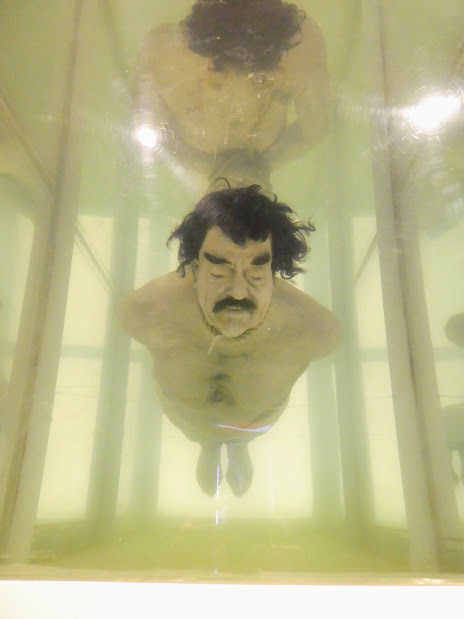
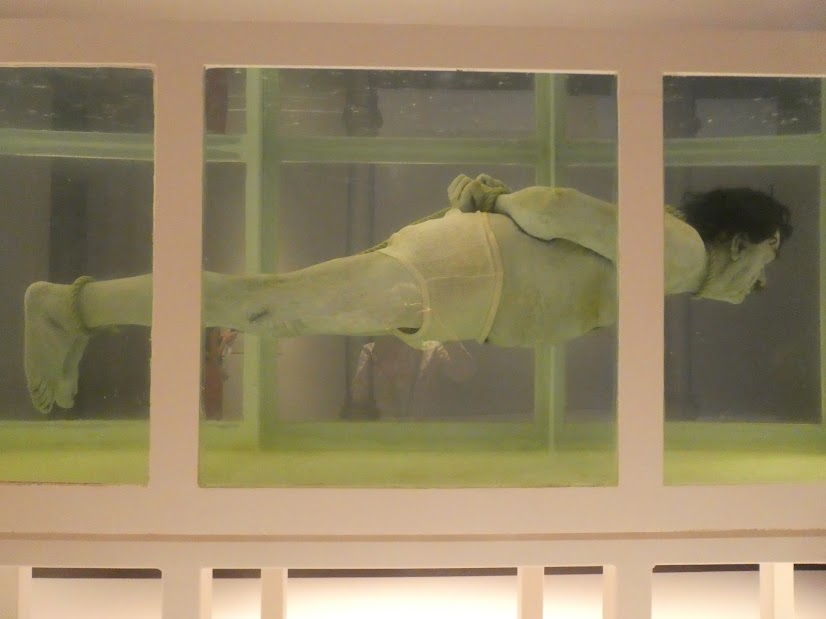
David Cerny 2006: Shark. Saddam Hussein in a shark tank 2005. A Belgian town demanded its removal as being offensive to Muslims and off-putting to tourists.

Natalia LL: Consumer Art 1972-75. Following Natalia’s first works in this series, Poles posted posters of themselves eating bananas as a protest against government censorship. One of a large series .

It’s housed in an elegant Modernist building, the Casa Garriga Nogués. These windows give you a taste of it.

These windows are the work of Antoni Rigalt, who was also the creator of the windows at the Palacio de la Música Catalana.

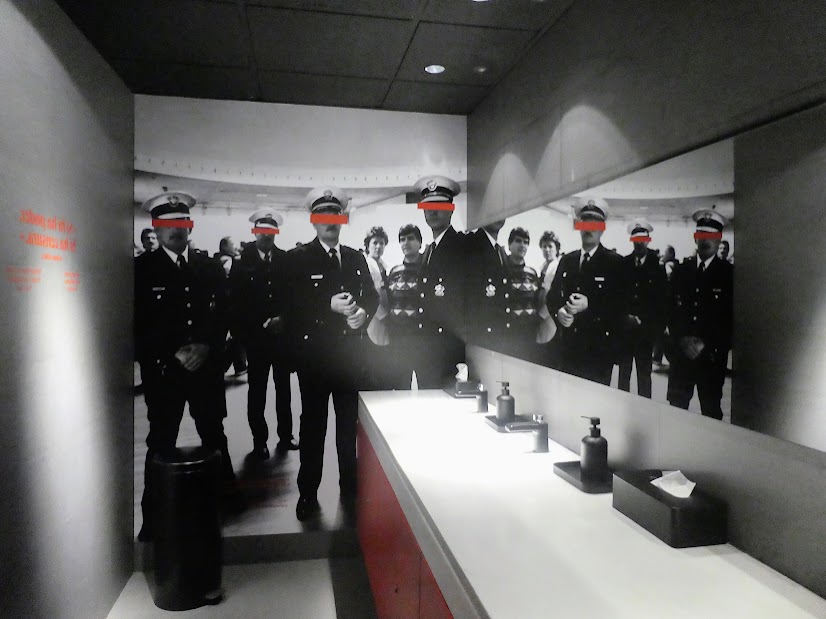
I found the whole thing thought-provoking and was glad to have spent a couple of hours there. I wondered whether I’d been wise to go to the women’s toilets though. The featured photo shows what confronted me as I walked in.

Next week we’ll stay in Barcelona, but I’ll take you somewhere restful and restorative: that’s so long as you don’t get lost. And you will…

Monday Portrait: Pushy Pigeon

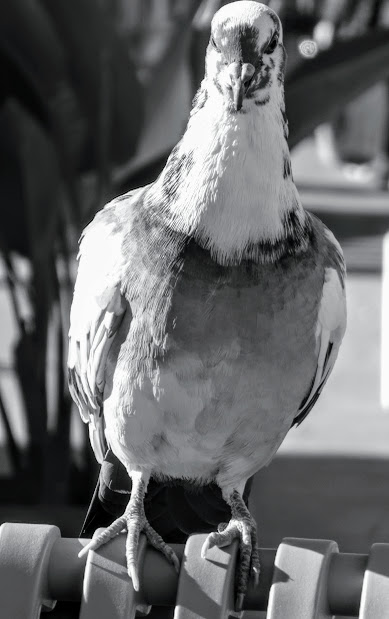
Pigeons of different varieties are apparently found on every continent on earth except Antarctica. I’m not surprised. I’ve yet to visit a country where I’ve seen none. This particular specimen was opportunistically hanging round the outside tables of a a café down at the port in Premià de Mar on Thursday. There were croissant crumbs to be had …

For IJ Khanewala’s Bird of the Week XXXIX

Thursday Doors visits Caldes d’Estrac

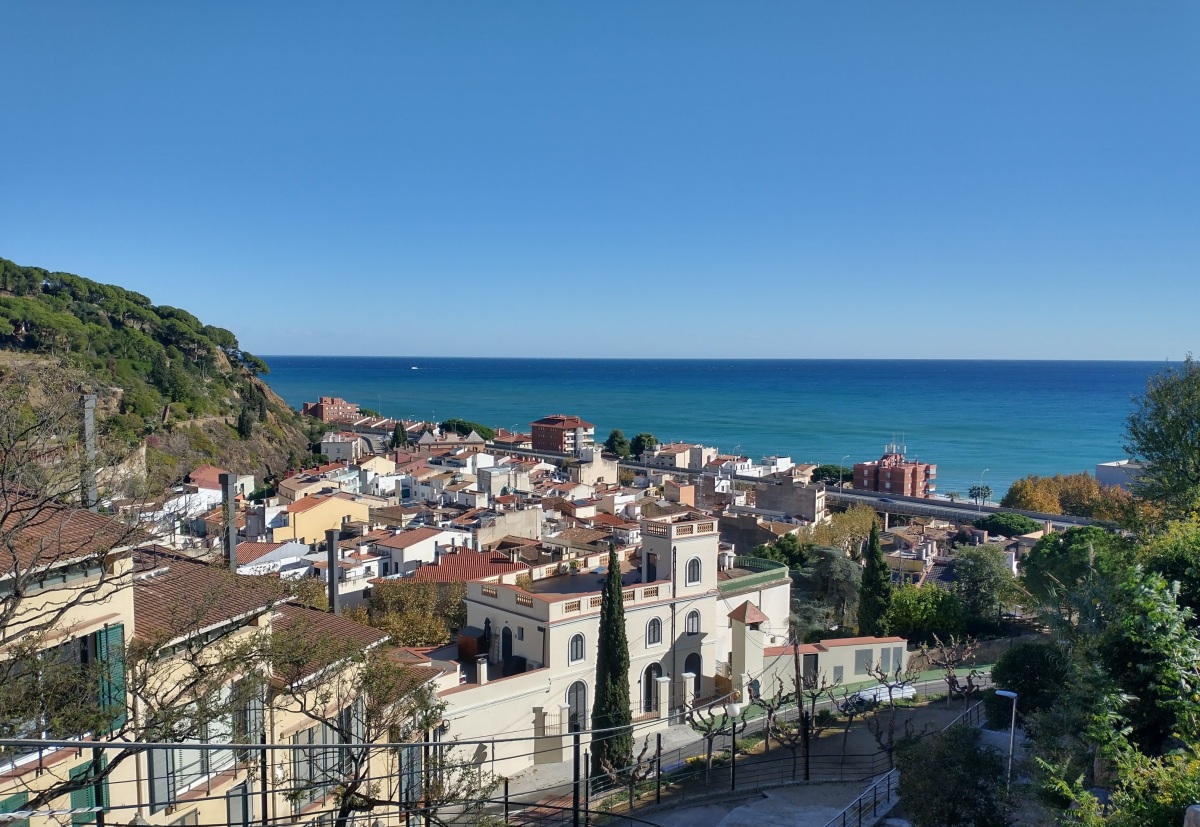
I had only one reason to visit Caldes d’Estrac. Not because back in the late 19th and early 20th centuries it was noted for its thermal baths. Those glory days are largely gone: and in any case I live near the spa town of Harrogate. I went because of its art gallery, Fundacio Palau Fabre, largely dedicated to Picasso. More about that another day.

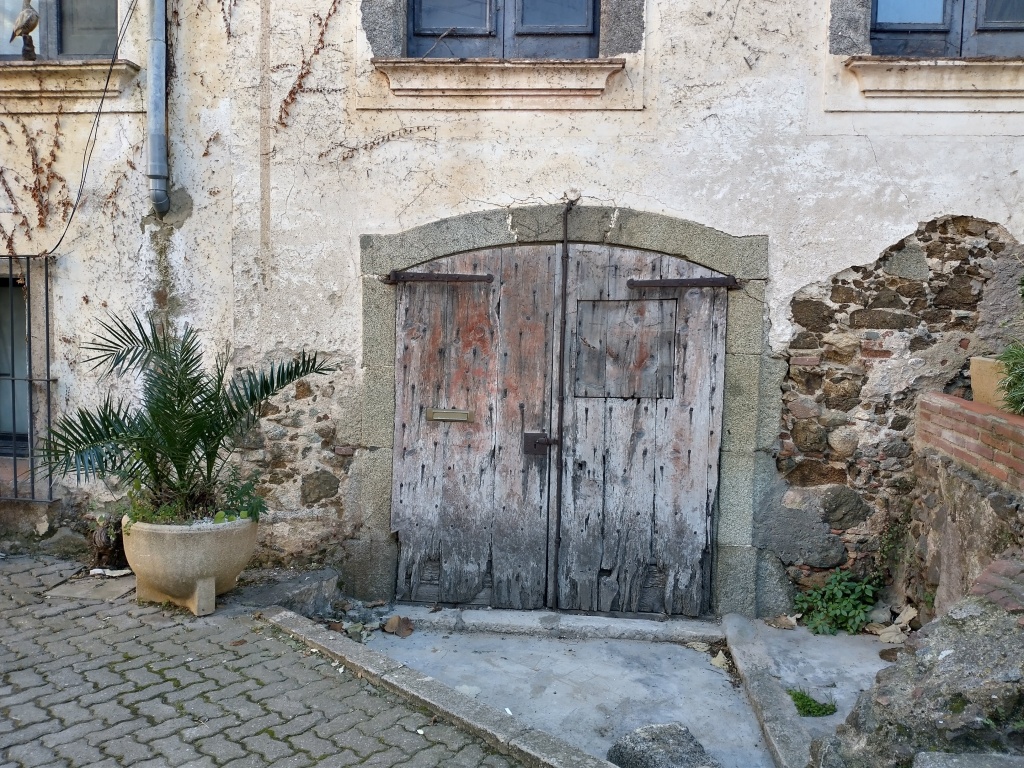
This is a small town with big hills. I toiled up, then skittered down slope after slope as I explored. But it had doors to pause by. Most of my shots are in my camera, and not to be seen till I go home. (Tomorrow. How shall I survive? It’s 14 whole degrees colder back in England) So here’s just one that took my fancy.

This is my first offering to Dan’s Thursday Doors for a very long time. But I thought this distressed door deserved its fifteen minutes of fame. Or 5 anyway.

La Sardana Sunday

La Sardana is the traditional dance of Catalonia. It’s been around in one way or another since the 1600s, but really came into its own in the 19th century. Back in the fascist era, Franco did his best to ban it, as he tried to ban all forms of regionalism, or worse, independence. He suppressed the distinct languages within Spain: Catalan, Basque, Galician, with the result that they have now sprung back stronger than before.

Anyway, la Sardana. It’s a circle dance, with men and women, neighbours, friends, strangers joining hands, moving slowly in a circle following the fairly complex foot moves of the leader. When the circle starts getting too big, a second circle starts, then a third ..

On Sunday morning, we took ourselves down into town to watch the mini-Sardana festival. We immediately noticed that I fitted the age-profile the best. Every single dancer was over 60. Anaïs’ friend’s granny immediately wanted to put that right, and appointed herself Anaïs’ personal Dance Mistress. With not much success.

A few younger citizens took themselves off to practice in a quiet corner …

And after a slow start, the event got going. Not having a single dance gene in my body, I wasn’t tempted to get involved, despite being The Right Age. But it’s rather sad that this seems to be the general view among the young. Would Franco get his wish after all, and see the Sardana vanish a hundred years after he tried to banish it?