Indian Friday: Last Day at the Rainforest Retreat

I rather enjoyed re-visiting India via my blog the other week. So I went and dug out the diary I faithfully kept. The events it describes have never yet seen the light of day. For the first ten days I was with the group of people my ex-brother-in-law had put together, to explore aspects of rural Indian life, focussing on small producers working in traditional and organic ways. We had no internet access during that period.

I’ve decided to share my diary with you. This will take several Fridays. I’m pleased that I kept such a detailed record of a piece of personal history, and of a country I’d never visited. I wonder how dated this account would seem to the current traveller?

Last Day at the Rainforest Retreat

Wednesday 14th November

Dhosas with potato curry and scrambled egg Indian style (i.e. spicy) for breakfast.  Then off with Ravi and Nak for the Ridge Walk.  This involved serious climbing through the rainforest till we rose above it to the hilltops with pasture, bracken and smaller foliage plats.  Wonderfully bright acid green paddy fields below – such a contrast with the darker green of the plantation trees.  One or two cattle here too. More of the same, passing a few settlements on the way down……

….. Later, M, C, L  I had a few jobs to do in town so we had a lift in.  We enjoyed pootling around.  I left an answerphone message for Malcolm and spent Rs60 on a hat (about 54 pence).  We bought chocolates for Sujata and A (Cadbury’s, made in Poona and unavailable in England) and waited and waited for our photos to be downloaded.

…and waht you can buy there

It was dark by now, and we started to worry we wouldn’t be back for 8.00 and our farewell dinner, but M made friends with someone in a shop who took my letter which I’d found no postbox for, and got us an auto-rickshaw.  Well! Health and Safety need not apply.  4 of us plus luggage somehow squeezed in with L on M’s knee and all of us bulging out all over.  We admired the artificial flowers decorating the driver’s dashboard while M negotiated the price (Rs 150 – £1.35 – for a 10 km. ride) and off we hurtled, through puddles and over potholes (easier perhaps in a rick, with its smaller wheelbase) only grinding to a halt once.

Home just in time to make the journey up the hill to S&A’s house where we sat round a bonfire with A’s blues music in the background, eating dish after dish of all kinds of curry.  Ludwig was there too.  Home by 10.30, looking at a sky fuller by far of stars than we can ever manage in light-polluted Europe.

the barbecue

Photographing the Photographers

Let’s have a bit of fun this week. Let’s spy on the photographers we spot, and take snaps of them as they do what photographers have to do. The featured photo was taken last summer near Bamburgh. These people with their cameras and all the tackle were actually twitchers, in pursuit of some bird that had fetched up there – I can’t remember what.

Here’s another image from there, and then another, also from Northumberland: the Baltic in Gateshead, where one eager visitor was taking shots of the bridges on the Tyne.

Or there’s that photographer’s paradise, Whitby Goth Weekend.

Or sometimes a TV photographer turns up. Much more impressive.

Or even what passes for film crew, spotted in Brick Lane.

But we’ll end where we began, with shots of photographers being snapped. A friend and I enjoyed playing around with this once-upon-a-time camera shop in Newcastle, and if you look very hard, you’ll see me in the second image, looking for that perfect shot.

For Leanne’s Monochrome Madness.

Six Degrees of Separation: from Knife to The Lightless Sky

On the first Saturday of every month, a book is chosen as a starting point and linked to six other books to form a chain. Readers and bloggers are invited to join in by creating their own ‘chain’ leading from the selected book.

Kate: Books are my Favourite and Best

This month’s starter book is Salman Rushdie‘s Knife, a memoir written in the aftermath of the attempt on his life in 2022, and as a result of which he lost his sight in one eye. I haven’t yet read it. But I have read another memoir which deals with the shadow of death.

This is Amy Bloom‘s In Love – a Memoir of Love and Loss. Bloom has written a searing account of the last year of her husband Brian Ameche’s life. This became a roller coaster year: except it wasn’t, because as she points out, roller coaster rides are thrilling, fun, and fast and furious. Ameche’s last year of life was none of those things. It was the year in which he received the diagnosis he – and she, and those close to him – feared: dementia. Within a week, he had decided, and never wavered, that he would choose to die rather than totter onwards through some kind of half-life . The book reports, dodging back and forth through time, their exploration of how he might die, and arriving at the decision that Dignitas offered him – well – dignity in dying. Against the odds, this book is often wry, funny, darkly humorous, sarcastic and savvy. The pages turn very easily. It’s a moving, very thought-provoking memoir.

Now to a book featuring a character who has – not dementia, but its close cousin – Alzheimer’s disease. The Wilderness, by Samantha Harvey. This is the story of Jake, 65 year old Jake, whose wife has died, whose son is in prison, whose daughter ….. well, Jake has Alzheimers, and we tumble with him into a tangle of reminiscence, misleading timelines and confusion, as like him, we try to make sense of his new helplessness and puzzlement about the fates of those he holds dear. It’s a wonderfully imagined book, which gave me real insight (and fears) into an existence entirely dominated by unreliable memories, whether of mothers, lovers, or where to store the coffee cups. Here is a man who was once an architect with vision, now reduced to dependency and frustration. Beautifully written, it had me gripped till the last page.

Here’s a book about a wilderness of the natural world kind, by Jim Crace. Quarantine. I read it years ago, long before I kept reviews of every book I read. So I’ll quote Carys Davies, writing in the Guardian. ‘Crace’s masterful novel takes us into the parched and hostile landscape of the Judean desert, where we meet Christ himself – naked and fasting – and a small band of other “quarantiners”, all with their different reasons for being there. A spellbinding tale that is by turns funny and grotesque, lyrical and philosophical; a fascinating study of hope and fear, belief and imagination’.

Delia OwensWhere the Crawdads Sing is set in a kind of wilderness too – a wild untamed place at the edge of the sea. Is it the perfect novel? Perhaps. It’s got something for everyone: a coming-of-age story about a young friendless girl, Kya, abandoned by her family and siblings, who has to make her own way in the world as ‘Marsh girl’, living in a shack on the shoreline. It’s a mystery story. Though this element unfolds slowly, once it developed, it had me gripped until the very last page. It’s beautifully evocative nature writing too, informed yet lyrical, capturing the soul of a North Carolina marshland shoreline rich in bird and other wildlife. This is a book about Kya herself, and about the community where she grew up in the 1950s and 60s, with its racial divisions.

There’s a wilderness of yet a different kind in Leo Vardiashvili‘s Hard by a Great Forest. Saba, his older brother and his father came to England – originally as asylum seekers from Georgia following the collapse of the Soviet Union. They’re dogged by guilt that they never managed to bring Saba’s mother over before she died. Some twelve years after their arrival, the father returns to Georgia, to Tbilisi, then disappears. The same happens with Saba’s brother when he goes to look for him. So Saba goes too. What follows is an adventure that is in turn picaresque and Kafkaesque. His trail is guided by the dead relatives and friends who speak to him from the grave, with their grievances and advice. He is by turns optimistic, melancholy, cynical, and with a great line in absurdist wit. In his quest he’s assisted by the first taxi driver to give him a lift, Nodar, who offers him bed and board, and then all of his time. Nodar has an agenda of his own, which first leads to the story’s first crisis. Their adventures have a nightmare quixotishness which are exhausting to read, and full of menace. Leitmotifs running through the book are the incidents involving the wild animals who have escaped from Tbilisi zoo and roam town and countryside randomly, and sometimes menacingly. This is a galloping adventure story that is at times difficult to read, because rooted in an uncomfortable reality.

Vardiashvili was himself once an asylum seeker, arriving here when he was twelve. So was Gulwari Passarlay, who wrote The Lightless Sky. This memoir is the story of an ordinary twelve year old Afghan boy, forced to become extraordinary when his family pays traffickers to get him out of the country and into Europe. It’s the story of a child forced within weeks to become an adult confronted with situations nobody should ever have to deal with. It should be required reading for anyone who’s ever complained that such people should get back where they came from, that they are here for the benefits they can extract from their host country. This is a powerful, harrowing book by a boy – now a man – who has survived, and is now making the most of every opportunity that he can to change the situation of refugees and our perception of them.

I’m not going to attempt to link this last book back to the beginning of my chain: except perhaps that both are memoirs. Instead, I’ll tell you that next month’s starter book will be Rapture by Emily Maguire. And I have this evening finished the first book which I’ll link with it.

With the exception of my first image, which comes from the Times’ article about Ameche’s decision to end his life, the rest come from photographers contributing to Pexels: Abdul Rahman Abu Baker; Christyn Reyes; A G Rosales; Roman Odintsov; Tolga Karakaya. Thank you to each one of them.

Indian Friday: Tea Plantation Day

I rather enjoyed re-visiting India via my blog the other week. So I went and dug out the diary I faithfully kept. The events it describes have never yet seen the light of day. For the first ten days I was with the group of people my ex-brother-in-law had put together, to explore aspects of rural Indian life, focussing on small producers working in traditional and organic ways. We had no internet access during that period.

I’ve decided to share my diary with you. This will take several Fridays. I’m pleased that I kept such a detailed record of a piece of personal history, and of a country I’d never visited. I wonder how dated this account would seem to the current traveller?

Tea Plantation Day

18th November 2007

Tea Plantation day! We set off later than we should have – who knows why? Led by Ravi, who pointed out vine snakes, trees, all sorts.  We were VERY late at Ludwig’s and he had to go out soon.  I was pretty annoyed, and I suspect L was too.  He’s German, but has lived and worked here for many years.

Still, he showed us the coffee production process: collect beans, dry them, rub off ‘cherry’ coating (big producers wash this off – superior, but expensive), winnow, size-grade by riddling and store till roasting.  His roasting machine, powered by gas, is the sort you still see from time to time.

A coffee roaster, just like the ones that used to be common in England

We were shown the tea sheds, but that, it seemed, was that, apart from seeing the tea-picking, then seeing a Hindu temple.  Ludwig offered that we could see tea processing in the afternoon and I accepted straight away, and so did C and M. L offered a simple lunch.

Tea production is not well-established here, so the pickers don’t have the experience of those in other areas. When we saw the workers, we were surprised to see them take more than the first couple of leaves, and it proved we were right – this batch will only be fit for lower-grade tea.

Picking tea

Then along another long walk to see the Sacred Grove and Temple.  It’s been long neglected, but its bright colours are still evident.  We had to approach, shoeless, via a long green passageway which was apparently the established home of a crew of leeches (which we found out about the hard way).

On the way back, Ci felt ill, so we stopped at a village shop for refreshments, and to phone for a taxi for her. After that, our paths divided.  The others went home, and M, C and I returned to Ludwig’s. He was out, but had arranged a simple lunch which we ate at one of his guest lodges (he’s currently building another, out of mud bricks).  

After that, the women began work on the tea leaves.  For green tea, you steam the leaves briefly.  This arrests the fermentation process.  Then the leaves are pounded – this doesn’t take long – till they become shredded.

Steaming the tea leaves

For conventional tea, the leaves are first dried – only for an hour or two, before the pounding process.  This is long and hard, and involves a huge three and a half foot long pestle, and the woman at the mortar beneath constantly moving the material from the edges to the centre.  Then the mixture is dried.

There is enough of a local market for this organic tea to make it viable for Ludwig to employ  ten people all the year round.  They also work in his paddy field and care for his cattle.  Typically, workers in larger plantations are only employed seasonally. Ludwig doesn’t own his farm: as a non-Indian, he can’t, but he has an Indian sponsor from whom he rents it.

A view from Ludwig’s Golden Mist Plantation

On our way home we saw egrets, parakeets and various birds we couldn’t identify, as well as lots of frogs.  Hornbills too.

Oh yes!  In the afternoon, while talking to L, we suddenly heard the cicadas in the trees.  The noise grew and grew, reaching a crescendo so loud we had to raise our voices: then as suddenly died down.  Extraordinary. This YouTube video gives some idea of it.

Brimham Rocks: a Wild Place, Once the Haunt of Druids

I have posted several times about Brimham Rocks – mainly about its function as a challenging and wonderful playground for the grandchildren. The other day, however, I went on my own, to explore its history.

In Victorian times, it was believed that the Druids were reponsible for carving many of the fantastical shapes dominating the landscape.

They weren’t. Blame geology instead. About 320 million years ago, this corner of the planet was dominated by an immense river, splitting into many deltas spilling over the land here, often changing course. As it travelled, it deposited layers and layers of sand and grit which over the millenia formed layers of rock we now call millstone grit. The area was eroded by water, by wind sand-blasting the rocks, by earth movements: and by the Ice Age, when – more than 10, 000 years ago – slow-moving glaciers sculpted and moved the rocks.

It’s easy to see the layers of sediment here which formed the millstone grit.

Earthquakes, millenia ago liquefied the rock, forcing boiling water upwards through the layers that had been laid down. You can see that phenomenon here.

There’s one particular rock, known as The Idol (because the Druids must have carved it!) Just look:

Can you see how this inmmense rock , all 200 tons of it, is supported on the tiniest of pillars? It’s quite safe – for now.

And here’s an oak tree in direct competition with another rock. It continues to grow and thrive, somehow, with a rock that declines to split any further and give it extra growing room.

All this is a rather long-winded way of saying that Brimham Rocks is the wildest place I know, and therefore a suitable candidate for Egidio’s Wild Lens-Artists Challenge

Night Time

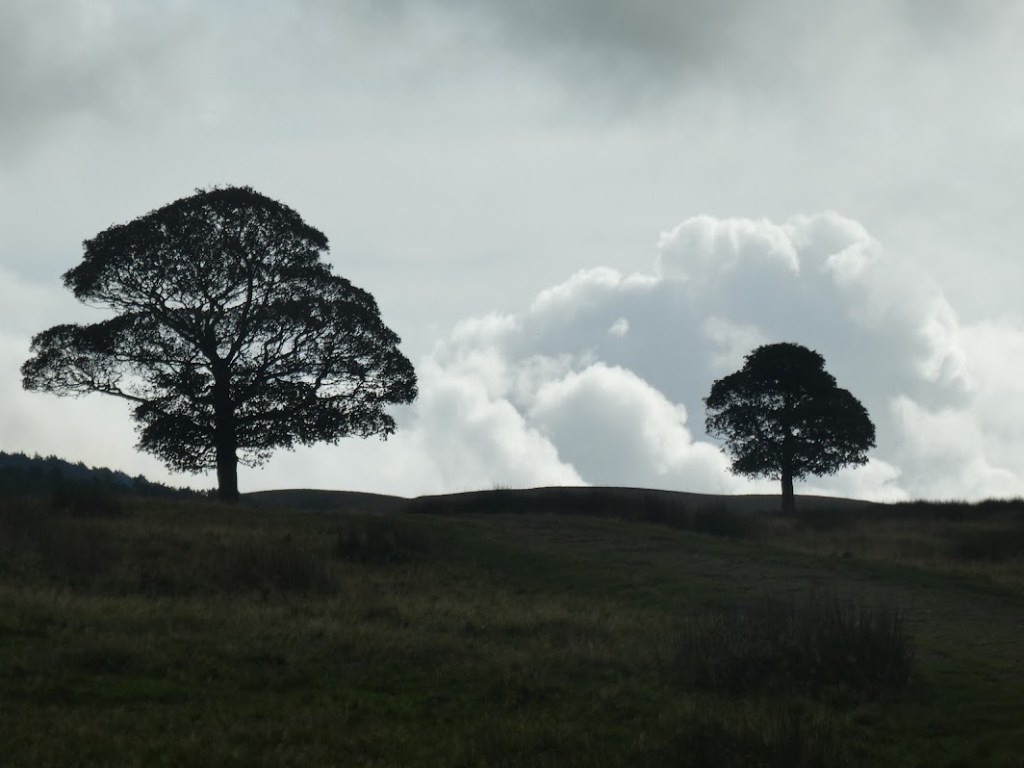
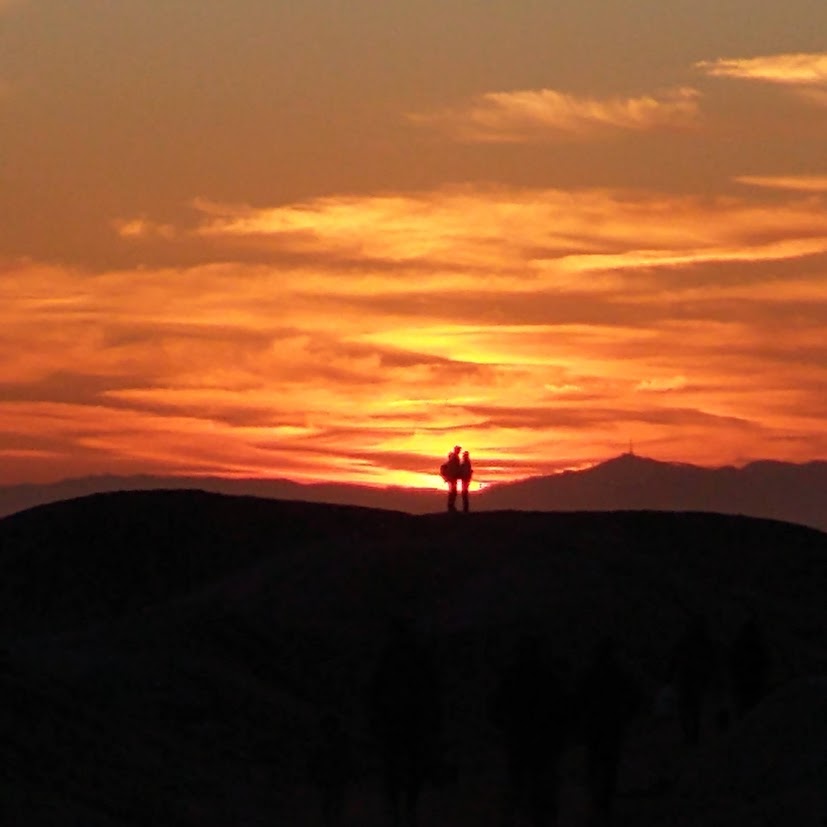
Night photography isn’t really my thing, so Elke, this week’s host for Monochrome Madness, provided me with a real challenge when she proposed Night time as her theme.

Unsurprisingly, towns and cities provided me with a few ideas. Let’s go on a quick tour. Let’s visit Albania, England, Spain, France, South Korea and Poland…

Really though, Country Mouse prefers to dodge big cities. My featured photo is of the moon as darkness fell recently, while the photo below was taken just at the end of the road.

Benches in Harrogate’s Valley Gardens

I spent much of Thursday in this lovely park with some members of my photo club on Thursday. I thought I ought to take a few shots of benches, in among, especially for Jude’s Bench Challenge. Here they are: though the header photo was taken in the town centre, and shows a bench as possible Photo Opportunity. As you see, we declined to take advantage.

Indian Friday: From an Elephant Camp to Madekeri

I rather enjoyed re-visiting India via my blog the other week. So I went and dug out the diary I faithfully kept. The events it describes have never yet seen the light of day. For the first ten days I was with the group of people my ex-brother-in-law had put together, to explore aspects of rural Indian life, focussing on small producers working in traditional and organic ways. We had no internet access during that period.

I’ve decided to share my diary with you. This will take several Fridays. I’m pleased that I kept such a detailed record of a piece of personal history, and of a country I’d never visited. I wonder how dated this account would seem to the current traveller?

From an Elephant Camp to Madekeri

Monday 10th November 2007

Elephant day.  So we were up good and early and set off in two taxis.  On the way, we enjoyed seeing school children going to all their various seats of learning – they all looked so smart in their English style uniforms c. 1958 (that was the year I started grammar school, and I looked smart at first too).  Dubare Elephant Camp however, was a disappointment. We  arrived at about 9.30 to find the washing of the elephants nearly over.  Nevertheless it was good to give that hard leathery hide with hard bristly hair a good scratch. 

We went to watch them have their breakfast.  There’s a sort of cookhouse where they boil up an appetising concoction of jaggery (a traditional caramel coloured unrefined sugar), millet and vegetation, and roll it into gigantic balls which the men feed to them.  And sadly, that was it really.  They went off into the forest to work, and we went off in our taxis, and fetched up at Sujata’s summer house (she owned Rainforest Retreat).  Rest, tea, relaxing in the garden full of pepper plants, hibiscus, coffee, poinsettia.

Then a country walk down to the River Cauvery.  It’s just what you see in all the travel documentaries.  Tall palm trees, intricate knotted tree roots, and little islands set among the fast-flowing currents of the Cauvery.

We walked through the paddy fields – the green of the young plants is so green, vivid and vibrant: and then with some difficulty, we waded through the waters.  We were glad to get down to our cozzies and plunge into the river – muddy, but otherwise clean.  There was quite a current, but staying close to the edges was ok.  The stronger swimmers swam across to the other bank, but I had a go and wasn’t up to it.

The picnic was something special.  Great metal pails were clanked down the hillside by the ‘staff’ at Sujita’s residence.  Rice, sambal; a wonderful bitter curry made out of some dark green tree leaf also used to dose children who have worms; chicken curry; a sour and bitter dark red chutney; curds and a gorgeous buttered cabbage curry.  Further swimming after, further baking in the sun, then back across the fields, and taxis home.

The walk back home

A stop-off at Madekeri.  It’s a largish town, with rows and rows of tiny shops – the usual mixture.  Indian shopping streets are standard in their own way: no MS, Boots and Costa Coffee certainly, but still a uniformity in the small shop fronts with goods stacked and hanging outside, and with pedestrians, bullocks and auto-rickshaws and cars all jockeying for position in the crowded streets.  I got all my photos onto a CD so was well pleased even though I had to buy a CD holder separately( Rs 17! About 15p) and had 10 minutes at an internet centre.

Got home to find them building a BBQ outside – BBQ chicken, and for us two veggies, potatoes in the embers.  Two new guests appeared – a Swiss monk and his mum.

Exactly a Year Ago Today, We Were in …

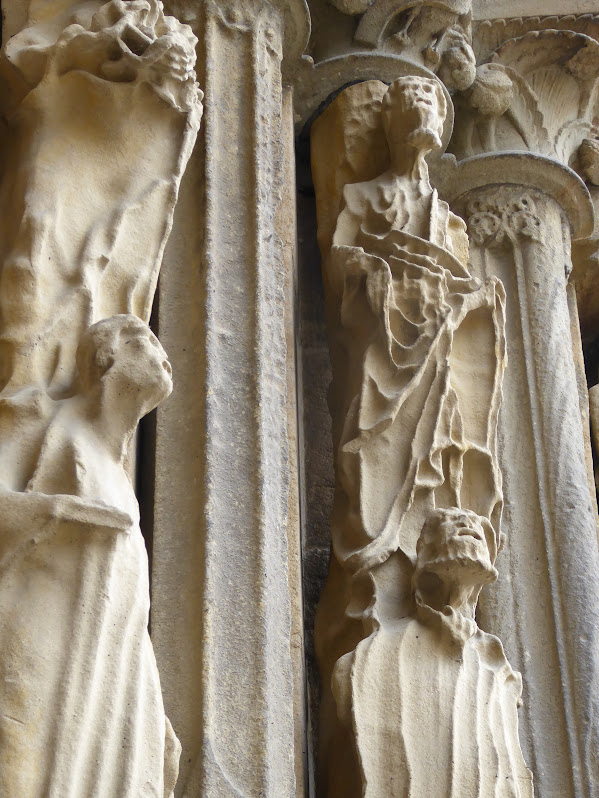
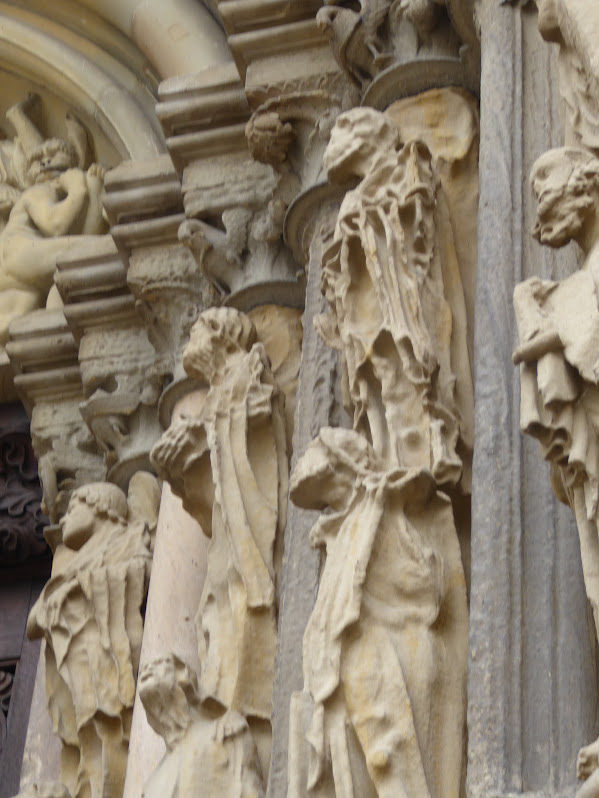
Laon, as we made our way down eastern France towards our daughter’s family in Spain. This is a lovely place. We zig-zagged our way up the steep slopes of a hill straight out of a children’s picture book and found ourselves in a perfect mediaeval town. It used to be quite a place. Important in Roman times; a hub of the Carolingian Empire, it was capital city of this part of France – until 987 CE, when the baton passed to Paris. The 12th century cathedral testifies to the fact that the city remained a religious hub for long after that. These days it’s an administrative centre and modestly-sized industrial hub, and well worth a day of your time as a tourist.

I’m focussing, for today’s Monochrome Madness on some of the more quirky recent features of the town – the mediaeval-style signs above the shops announcing their trade, some street art – some formal, and other more idiosyncratic items. The cathedral barely gets a look in – we weren’t allowed to visit much of it it inside, and it was raining outside. But I’ve given you a glance at it.

A final image from an unloved corner, where ancient buildings had been deserted before they tumbled down an eroding cliff-face.