A long day: Team UK (Laroque branch) support the Tour de France

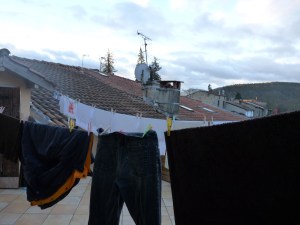
The Tour de France 2012 hit Laroque on the Limoux – Foix stage on Sunday 15th July. It was a long day…. and that was just for the supporters.

Thanks Sue, thanks Tom for the use of all your photos.

The Tour de France: a dilemma

La Boulangerie Fonquernie at Laroque prepares for the arrival of the Tour de France

We have a few of the family here staying with us.  They claim that they want to see us.  They’ve mentioned walking in and near the mountains.  They certainly want good food and wine – lots of it – whether here at home or in one of the restaurants in the patch.

Really though, they’ve chosen this weekend with some care.  It’s the one when the Tour de France whizzes past our house.

Today then has been a day of careful research in advance of Sunday’s ‘fly past’.  There was a planning meeting at a nearby restaurant, ‘La Maison’, over copious and varied hors d’oeuvres, blanquette d’agneau and bavarois de framboises to decide what we should choose as our vantage point for the action.

We’ll have the planning meeting after we’ve got outside this little lot

Then there was the walk.  This followed the Voie Verte between us and la Bastide sur l’Hers, and closely hugs the route the cyclists will take; and the ridge path between la Bastide and home, which peers down over the same road.  Where to choose to watch?

We’d thought of the land occupied by the old station.  A film crew has moved in for the duration.  We considered looking up towards the race from the old railway line itself.  Too far away.

And the ridge, which we’d thought the perfect answer, turns out not to be.  Certainly we could see many hundreds of metres of road at once, but at a distance that means that we’d be doing no better than sitting at home in front of the TV.

We’ve decided against watching from here.

In the end, we’ll be staying put.  We want to see the riders close up, smell the sweat, and absorb the atmosphere.  There are still decisions to be made.  Upstairs in one of the bedrooms?  If so, which one?  Downstairs on the street, where we’ll be nearer still?

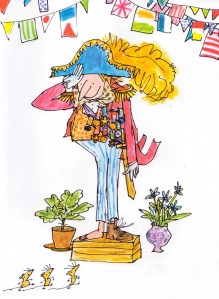
Shall we ham it up and decorate the house in Union flags, and hang banners reading ‘Go Wiggins’ out of the window?  So many decisions, so little time.

The painful death of a door

The good life? Not with all that DIY to do

You probably thought we’d finished with all that house renovation stuff.  Perhaps you imagine us out there in our fully finished yard, sipping a chilled white wine as we wonder how to fill the long hours between lunch and dinner.  It’s not quite like that.

The bathroom renovation involves tearing down heavy, impossibly unbreakable layers of concrete which some ham-fisted type many years ago slapped thickly onto every surface, floor to ceiling.  It certainly held the tiling in place, as well as fixing irrevocably all the ancient plumbing.  It has to go, though two powerful drills have already given up on the task.  When we finally manage it – and we almost have – it’ll replaced by some decent insulation, a new surface and tiling.  But it’s so frustrating, that any displacement activity will distract us.

On Monday, for instance, for no reason other than it seemed a good idea, we set about removing one of the doors into the old cold rooms in the former butcher’s shop.  Now it’s become a store room, the space simply doesn’t need to be protected by a fortress-like door 13 cm. thick, with chunky prison-grade hinges, and heavy door handles some 20 cm. long.

Not many of us require a door so sturdy, handles so stout and strong

Wooden doors, thickly insulated and finished off with a heavy sheet of protective asbestos (aagh!)  are not easy to manoeuvre.  Screws, in position maybe 50 years and probably held in place by crusty layers of congealed blood and pig fat don’t respond well to gentle teasing by a screwdriver.  We togged up in steel-capped boots and wrestled.

I wonder when Toulouse phone numbers were last only 4 digits long?

And eventually won.  Then the asbestos back of the door had to come off.  The tip won’t take asbestos, and the dangerous substances depot won’t take wood.  Finally, using thick and sturdy planks,  we had to lever the door onto the trailer and trundle off to the tip.  It’s gone.

Off to the tip. Shame really, it’s quite a handsome door

And so it was back to the bathroom yesterday.  If you pride yourself on your DIY standards, stop reading now.  Yes, that includes you Kalba and Sharon.  Here is a picture of how we’ve worked out where the floor tiling should go.  Lots of paper cut-outs, held in place by the contents of a book case.  Well, when you’ve got an odd-shaped room, with not a straight wall in sight, what else to do?

How-not-to-do-bathroom-tiling

Entendre cordiale: Blue Lake again

It’s been Blue Lake time again: that time of year when for 3 years now, we at Laroque have come to expect great entertainment from the musicians of the Blue Lake Fine Arts Camp in Michigan, USA, as well as some music from our own LDO Big Band.

This year, we welcomed a slightly different group from previous years – the International Jazz Band.  Mostly still in their teens, these players have been selected for the European tour not only because they’re good at what they do, but they’re hungry to become even better.  They want to seize the opportunity to spend time in cultures other than their own, and to perform in locations throughout parts of Europe, from prestigious concert halls and cathedrals, to smaller town venues like ours.

At the end of last night’s concert, the band’s conductor and group director Bill MacFarlin, spoke of how these chances for young Americans to travel and make music was a real opportunity to foster international friendship and understanding.

We’ve been watching that at work over the last 3 days.  The Blue Lake team, 17 of them, arrived in sunshine to a big welcome group in the Municipal Park.

Our School of Music’s housed here in the château. I took this shot just before everyone arrived

The event went well, but it was easy to see the Americans and French weren’t mixing much – it was too hard to communicate: Malcolm’s and my interpreting skills were much in demand (Not that we’re much good.  I listened to our French head honcho, Michel Alvarez, and carefully interpreted it to Bill McFarlin.  Bill raised an eyebrow. ‘Do you realise’, he said ‘that you’ve just said all that entirely in French?’).

A giraffe of beer

Later, down at the bar with older students and members of LDO Big Band it got a lot easier.  The giraffe of beer may have helped.

Lucas Munce – with a clarinet this time

It was next day that real change took place. First of all, there was a Master Class, with Lucas Munce, acclaimed as a saxophonist back in the US (AND for his clarinet and flute  playing too), and Parker Grant, a young jazz pianist also gaining recognition.  After a slow start, the need to exchange musical knowledge overcame shyness and the language barrier.

Then after a shared meal it was time to rehearse.  Towards the end of the evening, members of the French and American bands sat together to practise the pieces they planned to play together to conclude Fridays’ concert.  It was wonderful to witness them, heads together as they pored over their shared scores, animatedly and enthusiastically discussing  their music.  Their mutual comprehension of each other’s tongues seemed to have moved up a gear, but above all they now had a shared language – music.

Blue lake International Jazz Band and LDO Big Band at rehearsal

By the time Friday’s concert came, these musicians were friends.  They greeted each other affectionately and settled down to listen to each other’s performances with relish.  When they had to squeeze themselves together for those final numbers, placing themselves alternately American/French, they were confident to give the music their all.  They loved it.  The audience loved it.

Blue Lake and LDO saxophonists share the moment at Friday’s concert

At the moment of parting, there were hugs and all round and quite a few sniffles too.  As ambassadors for their country, Blue Lake do a pretty fine job.

L’Ariégeoise & le Mountagnole: a very sticky moment

L’Ariégeoise comes to town

If you live in a small town like ours, you look for excitement where you can.  Today,  lAriégeoise passed our house.  This is a cycle race organised just before the Tour de France every year in our department.  Unlike the Tour itself, you can choose which of three races to join.  The truly serious do lAriégeoise itself: 160 km, with 3430 metres of climbing to do. The fairly serious do Le Mountagnole, 117.400 km, 2569m climb.  And the ones who are frankly playing at it do the Passejade, a mere 68.5 km, with a 745m. climb.

The two first groups were due to cycle through Laroque, and we locals were ready at 10 o’clock, lining the streets to cheer them on.  L’Ariégeoise marshals with Stop-Go batons in red and green strutted about importantly, directing the traffic, stopping and diverting cars as necessary.

The first cohort arrived, swished at speed past our house…and was gone.

Seconds later, some of them did a hasty U-turn and cycled back again, turned right across the bridge and picked up speed in a different direction.  What could be going on?

The parting of the ways

It turned out that l’Ariégeoises and the Mountagnoles, who until then had been sharing a route, parted company here.  The Mountagnoles had no special marshals, and when the time came, with heads down and intent only on completing their circuit in record time, they followed the l’Ariégeoise pack.  And some l’Ariégeoises followed the Mountagnoles pack.

Erm…..should we be here?

With nothing but their batons and booming voices to help them, l’Ariégeoise marshals tried to sort the sheep from the goats and send everyone on the correct path.  But it was hopeless.  More and more cyclists went wrong, and the area round the bridge became a clutter of wheeling tumbling bikes and their confused riders.  Some of them were amused.  Others not.  ‘Merde!’, ‘putain!’ and worse coloured the air as they saw their hard-won average speeds taking a turn for the worse.

A marshal tries to hold things together

I recorded some of the juicier moments and uploaded a short video to YouTube.  Why don’t you have a look?

‘I am the lizard king. I can do anything.’ *

Summer’s arrived: well, this week anyway.  So from before breakfast until long after the evening meal we’re spending as much time as we can out in the garden.  And we have plenty of company.  Lizards.  Common wall lizards, podarcis muralis.  They are indeed spectacularly common here.  We have no idea exactly where they live, but there are plenty who call our garden ‘home’.  We’re beginning to get to know a few.

Easily the most identifiable is Ms. Forktail, she of the two tails.  She’s the only one we’ve been able to sex conclusively as well, because we caught her ‘in flagrante’ with Mr. Big behind the gas bottles recently.  And then the next day she was making eyes at a younger, lither specimen, and the day after that it was someone else.  She’s lowering the moral tone of our back yard.

Longstump

Then there’s Longstump, who’s lost a tiny portion of tail, and Mr. Stumpy, who hasn’t got one at all, though it seems not to bother him.  Redthroat has a patch of crimson under her chin.  There are several youngsters who zip around with enthusiasm and incredible speed.

In fact they all divide their time between sitting motionless for many minutes on end, and suddenly accelerating, at top speed and usually for no apparent reason, from one end of the garden to the other, or vertically up the wall that supports our young wisteria. On hot days like this  (36 degrees and counting) they’ll seem to be waving at us.  Really they’re just cooling a foot, sizzled on the hot wood or concrete.  Sometimes you’ll see them chomping their way through some insect they’ve hunted, but often they’ll step carelessly and without interest over an ant or other miniature creepy-crawly in their path.

Happy hour for Longstump

Mainly they ignore one another, but sometimes there are tussles.  These may end with an uneasy standoff, or with the two concerned knotted briefly together in what could scarcely be described as an act of love.

We could spend hours watching them, and sometimes we do.  But there is still a bathroom to build, a workroom to fit out, and a pergola to design.  The kings and queens of the yard have no such worries.  They can do anything: they choose not to.

‘Our’ lizards on their personal sun-loungers

*Jim Morrison, 2008

‘East, west, home’s best’

When guests come to stay, Malcolm and I often pore over maps looking for some unexplored – by us – corner of our patch.  But in the end, what’s the point?  Our visitors aren’t sickly pale wraiths whose jaded walking appetites have to be tempted by novelty.  They’re happy with the solid day-to-day fare just a mile or two down the road. To them, in any case, everything is new.

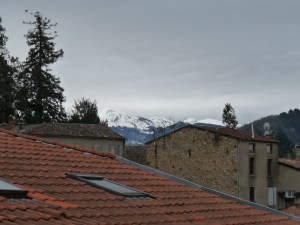
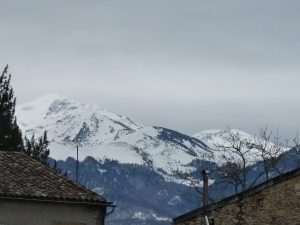
We too are happy to revisit favourite walks.  They’re never the same.  The changing seasons bring different flowers, different cloud formations.   Mountains which perhaps were sparkling bluish-white last time we visited, turn green and purple towards summertime with just the odd small patch of snow near their summits.

Today, then, we went with Christine to visit our old friend Roquefixade, just a few miles away.  A steady climb through the juniper-scented woods and along a rocky ridge leads to a ruined château, once far above us, now somewhat below. Here it is.  Enjoy the views.  We did.

Capital Capitelles

The first capitelle on our walk

We’ve been walking north of Carcassonne today, with our friends Barbara and Tim, holidaying in the Aude from North Yorkshire.  When we decided to go and explore the curious stone huts called capitelles in the scrubby garrigue near Conques sur Orbiel, we assumed they were something like the orris of the Ariège.  These too are small sturdy dry stone wall huts: but orris were used by upland shepherds.

The dry stone walls of the capitelles

Capitelles are quite different.  Following the formation of France’s Second Republic in 1848, everyone wanted something to call their own.  Here in Conques, the poorest members of society looked beyond the village where they lived for some way of acquiring a bit of land  and earning some extra money. They realised that the dry impoverished soils of the garrigue were good for only one crop: vines.  As the peasants started to work the land to plant their vines, they dug up stones – hundreds of stones.  And they used them in the first place to make low stone walls marking the limit of their territory.

That south-facing door’s not very big

After that they built small huts to shelter from bad weather.  These round or square huts are in the form of a dry stone wall rising to a semi-circular vaulted roof also in stone: no mortar, no foundations, a bare earthed-floor and a single small door, always facing south.  They were all built by1880 or so, and the peasants who built the huts and worked the land here would have done so in any spare time left from their ‘day jobs’ as farm labourers.  And this continued till the Fist World War.  Men left to become soldiers, and at much the same time phylloxera struck.  This double blow meant the area returned to uncultivated garrigue, and only recently have the capitelles been restored.  They add interest to a stony landscape characterised by scrubby vegetation, low trees and shrubs and bright ground-hugging summer flowers.  I’d have said distant views of the Pyrenees too, but today was misty and overcast, so Barbara and Tim had to take our word for it.

Close up of a carefully constructed roof

Once upon a time there was a town…

We thought we knew Laroque. An afternoon’s walk round town with local historian Paul Garrigues as part of this weekend’s Journées du Patrimoine has convinced us otherwise.

The bridge near our house is modern and slightly re-sited. But we had no idea that the main road it’s on, leading to one the busiest roads in the Ariège, the D625 to Lavelanet, used not to exist. To go to Lavelanet, you used to go straight up the hill, and down back-street Rue des Pas Perdus.

To those in the know, evidence of the former town gates

And here you’d go through one of the town gates. Using this path day after day to reach our garden, we’d never noticed the buttressing that indicated the former presence of these gates. Nor did we suspect that the narrow road and path which is now a way-marked walker’s route which passes past our garden, down to the River Touyre was once a busy thoroughfare. You follow the river to the former railway line, where you turn right and take a shady tree-lined route barred to anything more technical than a bicycle through the next village, Dreuilhe, and on into Lavelanet. Quite different from the lorry-van-and-busy-commuter route now in operation.

Once upon a time the main road to Lavelanet. Now the path past our garden.

We knew our town is an old one. It’s not uncommon to pass houses whose door lintels are inscribed with a date from the 17th century.

A nearby house announces its d.o.b.

What we didn’t know was that in the old town itself, there are no buildings at all from before this time. This is because every single dwelling was destroyed during the French Wars of Religion (1562 – 1598). The crisis was so grave the King permitted the townspeople an amnesty from paying taxes for several years to give them a chance to rebuild.

But before all that was …. the Women’s Revolt.  Back in the 16th century, the women of the town would bring their bread to be cooked at the Four Banal, the site of which lives on today as a street name.

Rue Montée du Four Banal: the sign’s fixed to remnants of the old town wall

They paid the local lord to manage this service and the lord paid a baker. Who decided to exact his own charges too – one loaf in every 20. When the women’s angry protests were ignored, some 80 women held a somewhat violent demonstration, and followed up by taking their bread to nearby Esclagne and La Bastide to be baked. It all ended up in an enquiry directed from Carcassonne. Result? It was the baker himself who was found to be at fault: his taxes were illegal, but it was the lord who had to reimburse the women. For their part the women were forbidden to have their bread baked elsewhere. The Four Banal itself is by yet another former town gate, and traces of the old town wall still exist.

Perhaps the Four Banal looked like this?

It was during this period too that several streams ran through the town, forced into culverts between the houses, with little wooden bridges built over. They were useful to all the artisans involved in various aspects of the textile industry and other trades.  Can you imagine the smells you’d have had to endure if you were unlucky enough to live in the same street as the tanner?

More recently, in the late 19th and early 20th centuries, Laroque was a prosperous commercial centre for its then more than 4000 inhabitants (2000 now) and the workers who flocked from a wide area to work in the textile mills. There were three cafés in the market square alone, as well as an hotel. Three abattoirs too, to serve the needs of all the butchers – one was in what’s now our garage. And shops of every description in what are now entirely residential streets. Then as now there was a huge social mix. One fine house, now down on its luck, was built for a successful surgeon and his banker son.

Once a surgeon’s house: now increasingly shabby

So now we’ll keep our eyes open, and perhaps notice those clues of former commercial activity: a ring set in a wall perhaps, for a trader delivering stock to tie up his horse or donkey, as well as the more obvious painted-over shop signs. I-Spy for residents.

I-Spy a delivery man’s tethering ring

I-Spy a shop front: one of the several vintners in town

Fiesta in Sabadell

We’ve just come back from a weekend with Emily.  Every time we go to see her in Barcelona we’ve stayed somewhere different.  But now we’ve cracked it. Sabadell does it for us.

The accommodation was the first thing that went well: an art deco factory converted into a smart and well-priced hotel, the Arrahona,  not too far from the town centre.

Discontent, even in Sabadell

We liked Sabadell itself straight away.  It’s not Barcelona: there’s not a tourist in sight.  And that’s one of its attractions after the hurly burly and stimulation of a day spent sight-seeing.  We had feared Sabadell might be a bit down-at-heel and depressing, because it is, like many towns in our part of the Ariège, a place whose glory days as a centre of the textile industry are long over.  It seems to have successfully reinvented itself however, and despite Spain’s present undoubted economic problems, Sabadell and some of the surrounding towns like the one where Emily works, Sant Cugat del Vallès, seem to be in some protective bubble.  The bars and restaurants are full, shops are functioning and selling well-made and desirable goods, and this weekend at least, all seemed well with the world.

Drummers prepare the way for the devils

Because on Saturday and Sunday Sabadell had a festival. We’ve struggled to find out why.  It doesn’t seem to have been for Corpus Christi, which provided nearby Sitges with an excuse to carpet the streets in flower petal pictures.  It looks as if perhaps it was just an excuse for the inhabitants to dust off the drums, unpack the ‘gigantes’ – papier maché heads surmounting giant bodies, dig out the costumes, order the fireworks and have a good time.

We happened upon part of the festival by accident on Saturday night when we found hordes of people gathered in the main town square.  Quantities of drummers in red costumes – adults and children – kept up a regular and stimulating rhythm to warn of the approach of whirling dancing devils whose horns disgorged sparks, flames and loud bangs.  These demons leaped in frenzied groups round the church and through the back streets until their ammunition ran out.

Devils run amok near the church

And then, as darkness fell, the crowds who had been watching wandered off to one of the dozens of restaurants in town and sat in large friendly groups at outside tables, laughing and chatting about the evening’s events.

We didn’t find out till later that the festival was happening all the following day too.  We caught up with things again in the evening when children dressed as dragons, dogs and mythical creatures took pride of place in the central square.

Child? Or dragon?

Showers of golden sparks spun into the crowd as the children wheeled and pranced through their routines.  It turned out though that this was the Grand Finale.  Market stalls were beginning to pack up.  The ‘gigantes’ were shrouded in dust sheets and slid ingloriously into workmen’s vans, and once again the crowds finished off the evening in the bars and restaurants.

One of the ‘gigantes’ waits to be bundled off home

The main Rambla had been closed off to traffic, and it seemed as if the entire town’s population was enjoying strolling around, settling occasionally for a drink or some food with friends or family.

A perfect way to end the day: a meal with friends at an outside table in one of the town’s restaurants

We’d chosen to stay in Sabadell because it was near enough to Emily, and seemed to have a hotel that would meet our needs.  We didn’t expect that being there would be such a positive and enjoyable part of our short holiday.  We’d like to go back and explore it again

The Rambla, the main street in Sabadell, taken over by pleasure seekers, just for the weekend