Here’s a town we Brits should know. It’s where 1066 And All That really began. William of Normandy and his troops set sail from here, landed on the English south coast and won the Battle of Hastings. William became King of England, introduced a whole new French vocabulary into the English language (‘Pork or beef, madam?’), and his brother Odo commissioned the first strip cartoon, the Bayeux tapestry, to record and commemorate the event. Later though, in 1431, the English held Joan of Arc captive here, before conveying her to Rouen to be burnt at the stake.
En route from France to England: a detail from the Bayeux Tapestry (Wikimedia Commons)
Even without those compelling reasons to make a pilgrimage, Saint Valery is worth a detour. It was and is a harbour and a fishing town with a picturesque mediaeval centre. Like many pretty towns on the coast, it’s popular with writers and artists: Victor Hugo, Jules Verne, Alfred Sisley and Edgar Degas all had homes here, and we spent a pleasant day exploring, poking round the (rather touristy) Sunday market, choosing a restaurant-stop, and generally enjoying the pleasures of a seaside town.
Housing in the old town.
The gateway to the old town.
Town housing.
An old doorway.
Paths in the old town, planted up by ‘The Herbarium’
Looking down on the old town.
While we were there, something special happened. After lunch (moules, what else?) we wandered down to the beach. There, on the other side of the estuary, were sheep, paddling. Dozens of sheep, scores of sheep, hundreds of sheep. They’re unique. They’re bred from English Suffolk and Hampshire sheep, and they spend their lives grazing the salt marshes., which gives them a highly regarded flavour, rich in mineral salts, and the name ‘Estran salt meadow lamb’. The life of those sheep, and their shepherds, and sheep dogs, is an energetic one. They have to keep moving each and every day to avoid getting stuck in the damp and boggy sand. Their shepherds keep an eye on them, oiling their feet to prevent foot rot, and every night the flock returns to pens with fresh straw via a special tunnel under the road.
Sheep grazing at the estuary.
Before we left, we wandered through the harbour, and up to the Chapelle des Marins, a neo-Gothic building, built on the site where the hermit-saint Gualaric, who gave his name to the town, once lived. It’s a good place from which to say ‘Goodbye’ to the town and get some final views of the bay.
No it’s not. But before we went there last week, we were inclined to agree with Noel Coward’s judgment. We’d decided to go to north Norfolk for a week off from the twenty-first century: no wi-fi, no TV, no motorways, but instead wide open countryside and sea, small uncluttered villages with a parish church worth exploring, market towns, and a night sky unspoilt by light pollution.
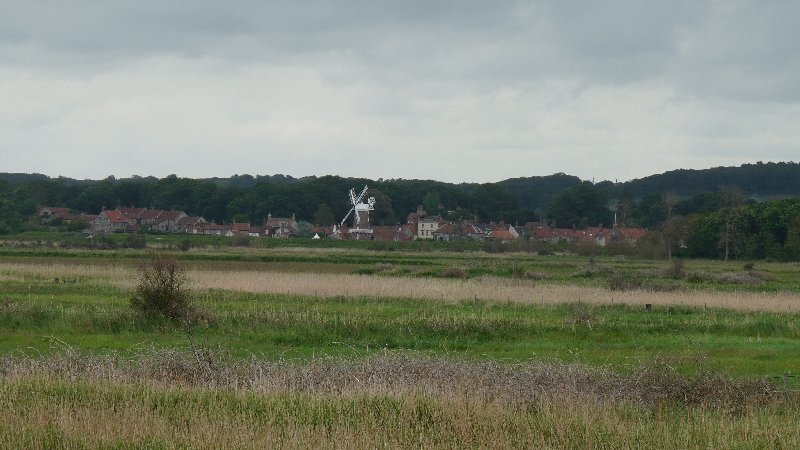
The village of Cley-next-the-sea, seen from the nature reserves on the marshland between the village and the sea.
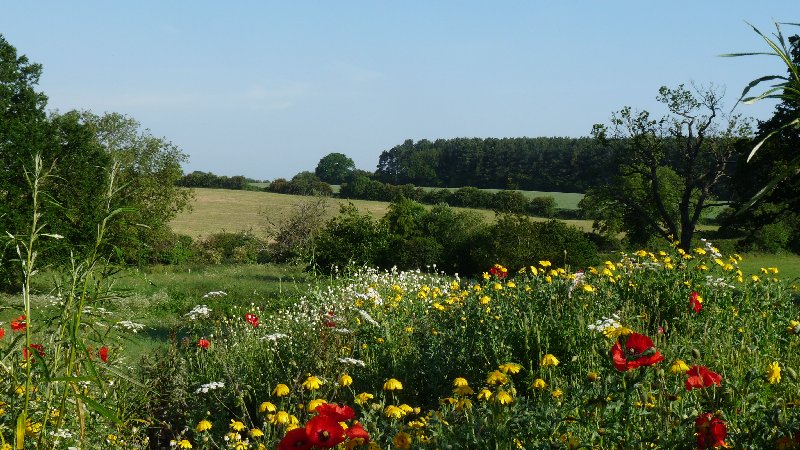
We stayed near South Creake in North Norfolk, in the delightful bed and breakfast accommodation of Sara and Bob Freakley. Here is the view from their front gate.
Leicester Meadows: the view from the garden.
You can see that it’s not flat. It’s quietly, comfortably, gently hilly, with woodland and meadowland nearby. South Creake is the kind of village where any number of ducks raise their families on the village green.
Flint cottages at South Creake.
Heavy traffic at South Creake.
A narrow pathway in Cley-next-the-sea.
And like so many Norfolk villages, it has a grand church far in excess of its apparent needs. We loved St. Mary’s church, as so many in the area. Landowners spent money outdoing their neighbours when it came to church commissioning and building. Get it right, and royalty might come to stay – they never did. But wooden angels soar among the rafters of splendid wooden-vaulted roofs. Some churches are tall and stately, others rustic, with flinty walls. A few have chunky cylindrical towers, because flint doesn’t lend itself to crisply finished corners.
St. Mary’s, Burnham Deepdale, with its Saxon round tower.
A typical tombstone in a typical churchyard.
King Charles the Martyr at South Creake church. The Anglo-catholic tradition is strong here.
An angel above our heads at South Creake church.
And angels at North Creake church.
The splendid parish church at Cley-next-the-sea (population: 376)
And then there are the stately homes. Oxburgh Hall – once seen, never forgotten. It’s a romantic, moated 15th century manor house which almost came to the end of its life in the 1950s. This was a period when many landowners, crippled by debt, felt they had no option but to throw in the towel, and dozens of ancient manor houses in Norfolk alone were quite simply pulled down. The auctioneer charged with disposing of Oxburgh declined to allow the winning bid from someone who wanted only the sturdy roof timbers, proposing to leave the rest of the house to tumble down. Members of the family came to the rescue, as did the National Trust. Now it’s one of Norfolk’s best-loved tourist attractions. Here’s why….
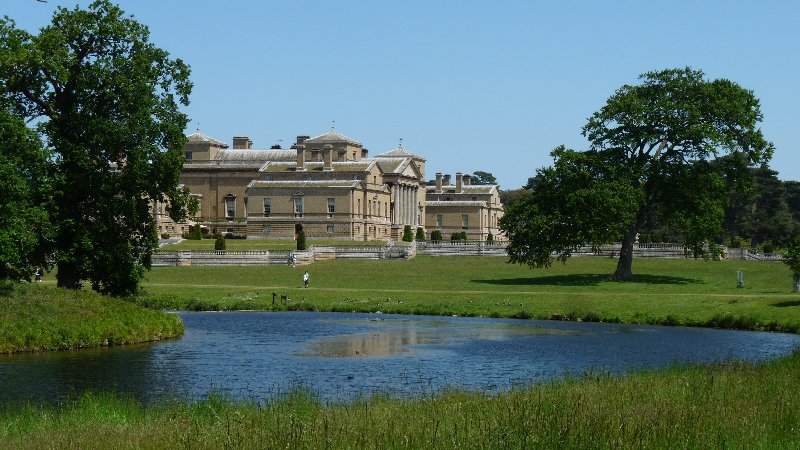
Holkham Hall is overwhelmingly big. We decided we couldn’t do it justice and confined this visit to its four-acre walled kitchen gardens, with its vines, peach trees, vegetable gardens sufficient, back in the day, to support everyone who lived and worked in this sizeable community. Many English readers probably remember all about school history lessons featuring Coke of Holkham, early 19th century politician and agricultural reformer, credited with promoting crop rotation and pioneer experiments in sheep and cattle breeding. Holkham Hall was his home and family seat.
Holkham Hall.
I’d tell you about Peckover House, suggested by friend and fellow-blogger Sharon and her husband Andrew. But it’s just over the border in Cambridgeshire, so not this time.
The orangery.
And then there’s the sea…and the wildlife. But I’ve told you about them already.
We’ve just had a brilliant few days away. First of all in Norfolk, then the Baie de Somme. I’ve realised I love the sea. Not sun-kissed beaches, though. Not ‘miles and miles of golden sand….’ *. Definitely no lying around sun-bathing for me, and building sandcastles is only fun for the first ten minutes.
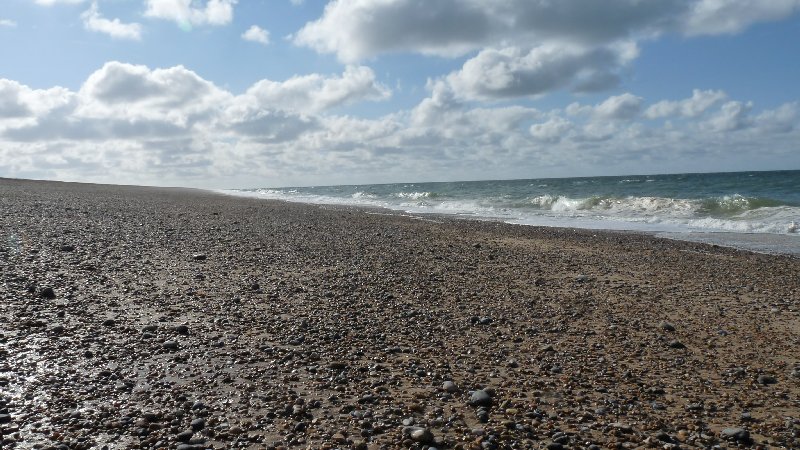
No, I love the kind of seaside we’ve enjoyed this week. In north Norfolk, we seemed to be on the coast whenever it was low tide, squinting at the distant sea in retreat, as it left behind belts of shingle, mud, scrubby dunes and sand. We’d get a convincing work-out crunching along a stony,pebbly beach, taking in the views across a flat but ever-changing landscape in subtle shades of mossy greens, grey and beige, and across a sea foaming white as it crashed to the shore, but with its own varied palette of bands of blue and grey from the shore to the distant horizon. The sky went in for moody tones, too, rather than clear summery blues, with feathery scudding clouds chased along by the rather challenging winds.
We weren’t there just for the landscape though. Birds come here to live and breed, and as birds of passage too. There are supposed to be as many as 420 species here. We knew that while the birds are nesting they are less visible than at some other times of the year. Though we’ve just got ourselves pairs of binoculars, we haven’t yet got the skills to identify everything we see. But we still wanted to be down on the seashore, every chance we got.
Egret in the evening.
Snipe feeding.
Shelduck.
Our favourite. The graceful avocet.
These geese weren’t precisely on the shore. But they were pretty close.
These ducklings were keen to steal our lunch one day, as we had a blustery picnic overlooking the sea near Hunstanton.
Then it was the Baie de Somme, a mere 90 minutes from Calais. We all know about the Somme and the bloody, ceaseless, pointless battle that took place some distance inland during WWI, in 1916. But the Somme estuary is a peaceful place. Like north Norfolk, it’s an area of marshland, water and sky. It offers fresh, brackish and salted water as a rich habitat for a huge variety of birds – and seals. We weren’t very successful bird watchers here either, but it didn’t stop us trying.
*’…in Whitley Bay, Northumberland’. Travel slogan, Whitley Bay, February 1964
I’ve just bought a cookery book. This is not a newsworthy event in this house, despite the fact that I turn increasingly to the internet when trying to come up with something fascinating to do with a handful of leftovers discovered at the back of the fridge.
In fact it’s the internet that’s brought me into a relationship with this recipe book. No, actually, it’s this blogging business. You know how it is. You discover someone’s blog. And through that, you discover someone else’s. And you end up following it (whilst trying to hang on to a sense of proportion: following blogs is not a substitute for real life). Kath, the far-from-ordinary The Ordinary Cook was responsible, quite a few years ago now, for introducing me to racheleats.
I love Rachel’s bogs. She’s an Englishwoman who found that a short visit to Rome turned into a longer one. Then she found that she was no longer visiting, but living there. She had the luck to live in a busy, ordinary, un-touristy district with a bustling market just down the road. This market in Testaccio became central to her life there. I guess she’s always cooked. But she made it her business to buy local ingredients, to ask questions, to get thoroughly in touch with the ingredients and recipes of her new life in Rome. And she started her blog.
There’s always a story to be told in her posts. She’ll write about shopping for the ingredients, or how her version of the dish she’s writing about has come into being, or some other anecdote. She has the knack of making you feel you’re sitting at her kitchen table, watching and learning while she chats as she assembles her ingredients and starts preparing the vegetables. Because then there’s the recipe. After I’ve read it, I want to dash into my kitchen and cook immediately. There’s just a small matter of not having that market to hand, with all its local stallholders and ingredients….
I wasn’t alone in loving her writing. A couple of years ago, she was approached to write a cookery book, using the same personal lively style that characterises her blog posts.
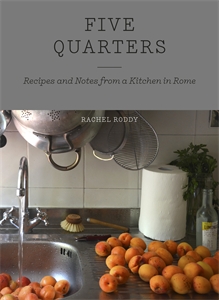
And last week, the book, written whilst juggling her busy life as a mother, teacher, partner, recipe-chooser-and-tester, was published. I ordered a copy immediately, from The Little Ripon Bookshop, and as soon as I got it, I started to read…. It’s a page turner. She explains how it is that the book got its title ‘Five Quarters’.. She writes about the path that led her from London to Rome, from a career as an actress to the one she has now. And she writes about the food she cooks. Simple food, food made tasty by careful cooking of (to her) readily available ingredients: the dishes of the working people who lived – and live – in Testaccio. The stories she weaves round the dishes she writes about make you want to cook, and eat, and go on reading this inspirational book. If you like Italy, or food, or eating or cooking – or even better, all of these things, you’ll love this book, and want a copy to read and use and make your own.
If you’re English, of rather mature years, and of a rural disposition, you won’t turn down the chance to snoop round somebody else’s garden. That’s what Open Gardens is all about. And early summer is open season for Open Gardens.
The other day we chose to go to Old Sleningford Farm, only just down the road from here. We knew we’d get the chance to stroll round a country house garden, with informal parkland and rather more formal borders and flowerbeds. We knew there would be a productive kitchen garden. We knew we’d be offered afternoon tea, with far too many delicious home-made cakes to choose from.
What really interested us, though, was the Forest Garden. A what?
Here’s what they say on their website:
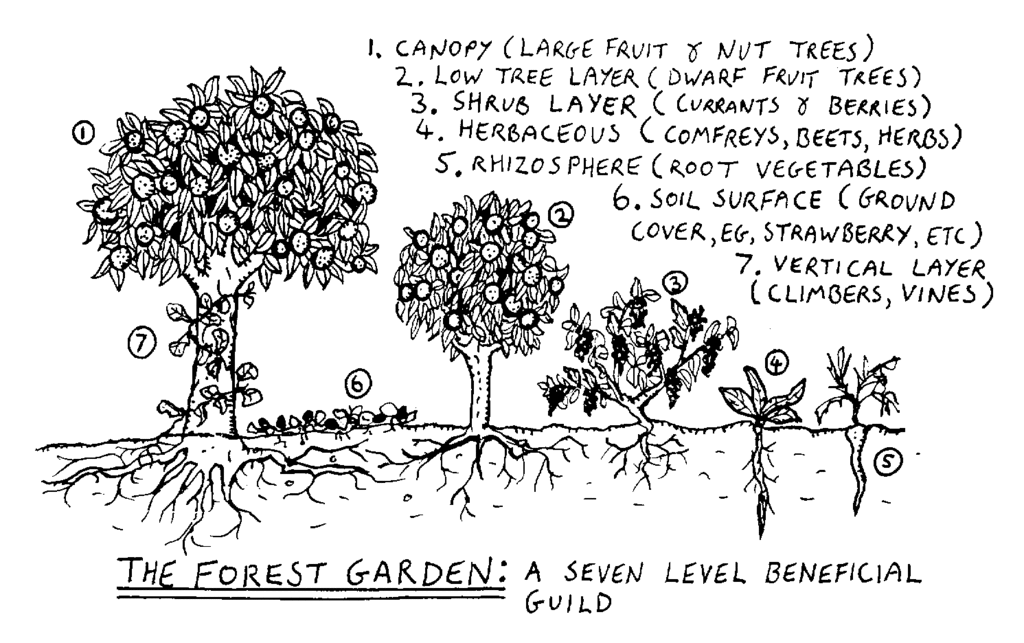
‘A Forest Garden is a planting which mimics an immature woodland, in which everything is edible or useful. Plants are grown using every available space – under the ground, on the ground, as bushes, trees and climbers. It requires minimal maintenance once established as all the plants are perennials or self seed easily and the ground is permanently covered.’
As you approach it, it seems you’re just going to enter a patch of woodland, albeit well-gated against pesky rabbits. Simple paths mown through the undergrowth send you on a winding route that meanders through the two acre site. Gradually we realised that there were things to eat here: fruit trees, certainly – apples, plums, gages, pears and so on – but also fruit bushes growing hither and yon. Raspberries; currants red, white, pink and black; gooseberries. Strawberries extended their runners along the ground. Then we noticed herbs, and then some vegetables: chard, kale, leeks, onions…..
This is a garden that has required hours of work from everyone at Old Sleningford, from volunteers who come one Sunday every month and from wwoofers. But over time, the garden will to an extent manage itself, as the desirable, productive plants take proper hold and leave no room for any plant not prepared to earn its keep.
Narrow paths lead you through the forest.
Garden sheds hide among the foliage.
And here’s a living roof, thatched with house leeks.
We didn’t have long enough to explore as much as we’d have liked. But we found a moment or two to relax in the summer-house at the forest garden’s centre. Here was a simple wooden structure, with a roof of sempervivum – house leeks – equipped with a chair or two, a book or two. Here, with only bird song for company, surrounded by productive woodland, was the perfect place to spend a summer’s afternoon.
Forest Gardens, via Graham Burnett, Wikimedia Commons.
I love Appleby Horse Fair. In truth I’ve never been there, nor am I likely to go. But we know it’s happening, very soon, and here’s how we know.
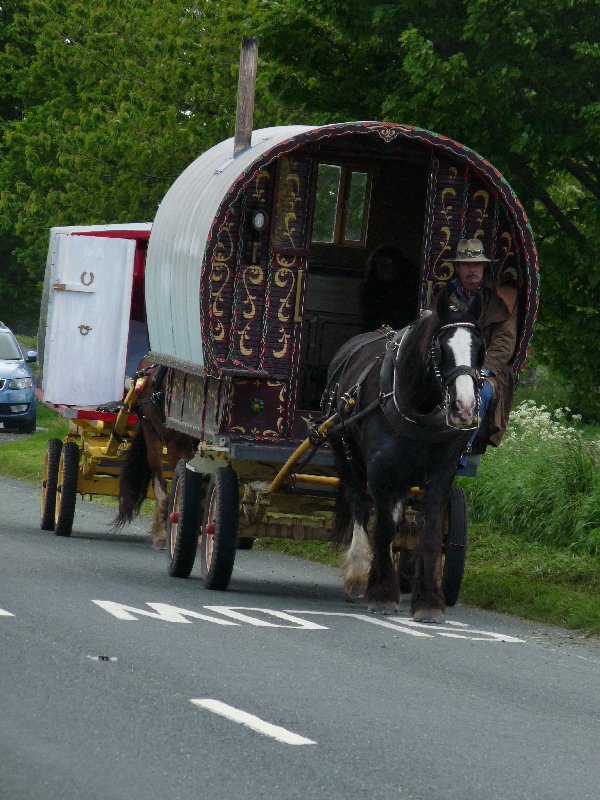
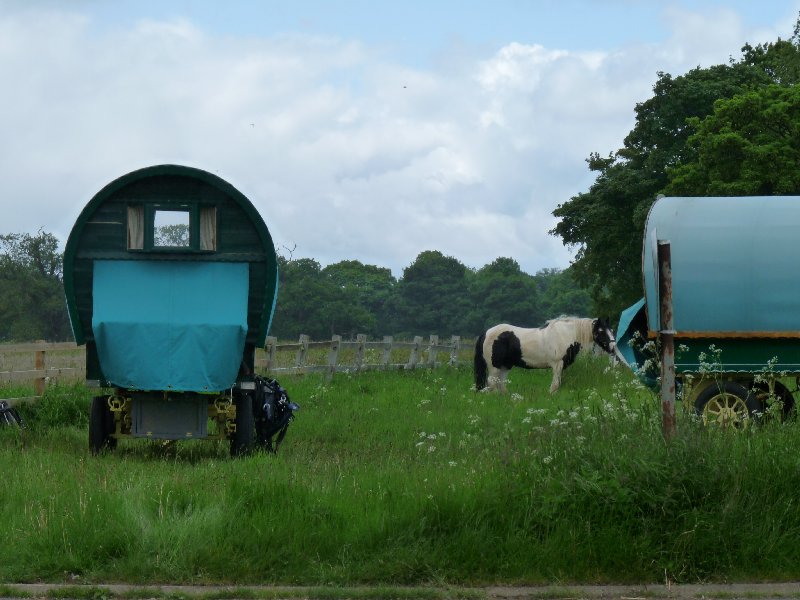
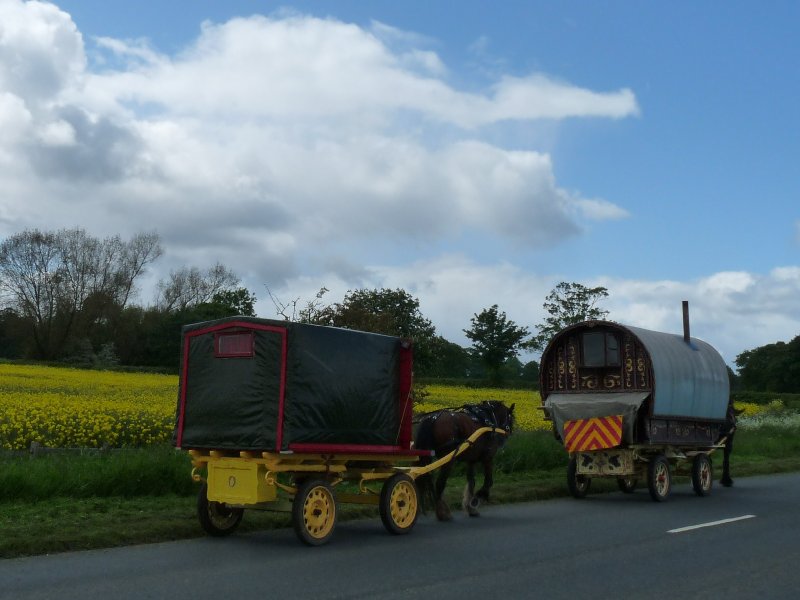
Every day for a week or more, we’ve seen sturdy shire horses, or work-horses in any case, plodding steadily up the main road out of Ripon, drawing behind them colourful and traditionally decorated gipsy caravans, or vardoes. That’s how we know that it’s the horse-fair at Appleby pretty soon.
Here in Ripon, we’re a good 65 miles from Appleby, avoiding motorways. But some of those caravans are travelling from much far further away than that: travellers coming up from as far away as Wisbech in the Fens have made the news this week. This fair is a huge occasion.
Every year in early June 10,000 – 15,000 English, Welsh, Scottish and Irish gypsies and travellers gather there to buy and sell horses, meet friends and celebrate their culture. Originally, when it started in 1775, the fair was held on unenclosed land just outside the town boundaries of Appleby. It was quite a different affair then, Sheep and cattle drovers and horse dealers met to sell their stock. Only gradually did it evolve into its present incarnation as a celebration of the Romany gypsy and traveller way of life.
People tell stories that the fair evolved following the granting of a Royal Charter by King James II in 1685. Others say that the fair continues the tradition of Appleby’s mediaeval borough fair, once held at Whitsuntide. But no. The fair exists backed by no royal charter, no civic tradition. It was and is a people’s fair which nobody owns, and to which nobody charges admission.
Overnight camp at the roadside.
I wonder about these colourful travellers and their even more colourful vardoes. At night, they’ll tether their horses on the lush grass verges, and set up camp. Everything bar sleeping has to be done in the open air, since these vardoes seem to be no larger than the average single bed. By day, these horse-drawn caravans hold up traffic in long slow-moving tailbacks as they advance slowly towards their destination. Nobody seems to mind. But when do we ever see these sights except in the days leading up to and away from the fair? What happens to the caravans, and even to the horses in between times? Every gypsy and traveller encampment I’ve seen in recent years has featured large modern caravans and a motley crew of vehicles from state-of-the-art Mercedes to clapped out old Fords. It must make life more comfortable. I wonder if older traveller folk mourn the passing of the old days, or whether they’re quite simply grateful to have a home featuring all mod. cons?
A short convoy of vardoes.
I know I promised another post on the National Trust. That’s coming soon. Really.
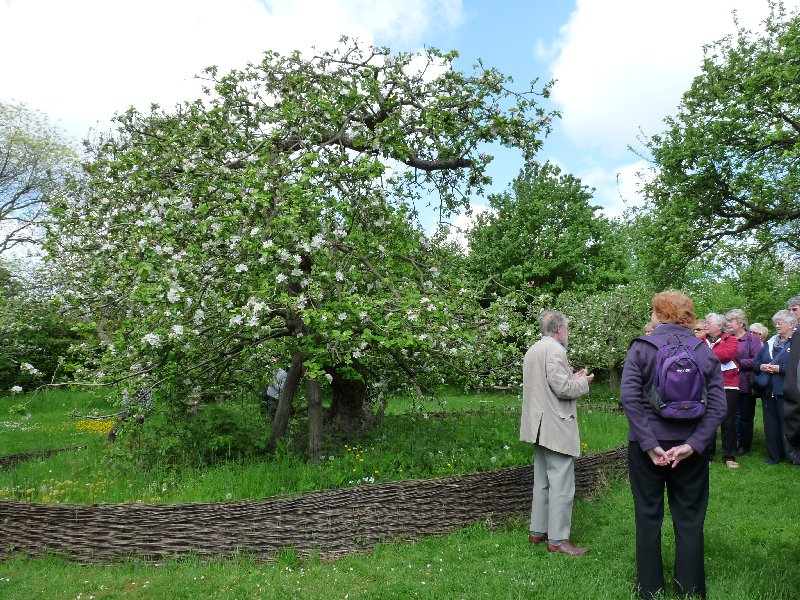
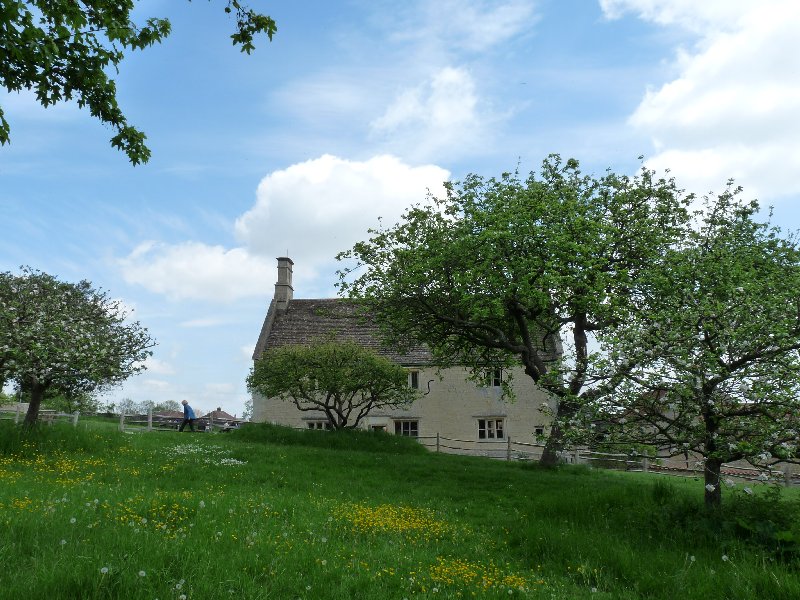
We gather round That Apple Tree to hear its story.
Isaac Newton, as every English school child knows, was sitting in the garden when an apple from the tree under which he was sitting dropped beside him.
He thought about it. And then he thought some more. Why do objects always fall vertically? Why not go sideways? Or upwards? Me, I’ve never even wondered about this. It’s just the way things are. But sitting under that apple tree, 350 years ago, Isaac Newton began to work on developing his best-known achievement: the theory of gravity.
Yesterday, we visited the house where Isaac Newton used to live, and saw the apple tree which grew from the ruined trunk of the tree which he sat under. I’m a National Trust volunteer at Fountains Abbey and Studley Royal – more of that in my next post – and we were on a summer ‘works outing’, visiting a couple of properties in Lincolnshire.
And here we were at Woolsthorpe Manor. It’s the farmhouse where Newton was born in 1642, and where he grew up. Isaac was a reflective, head-in-the-clouds sort of child, and it was obvious that he’d never be a useful farmer. His teacher persuaded his mother to let him study at Cambridge University, where he paid his way for some of the time by working as a valet. But in 1665, Cambridge temporarily closed its doors, for fear of the plague.
It was during this time of ‘exile’ that Newton began many of his experiments in the field of optics, astronomy and the laws of motion. He developed the branch of mathematics we know as calculus. And then he left for Cambridge once more, and his career as academic, MP, and warden at the Royal Mint was launched.
Woolsthorpe Manor , as Newton seems to have discovered, is the place to come to be reflective. This is a seventeenth century yeoman farmer’s house, comfortable, unostentatious, and set among a jumble of outbuildings and an apple orchard where that famous tree still stands. In truth, it’s not quite the same apple tree. That was struck by lightning in its old age. But a shoot grew from its ruined trunk, and that’s the specimen we see today, propped, pruned, and generally cossetted to keep it going as long as possible. Other fragments have grown into other trees, as far away as a university in America. The orchard is filled with other ‘babies’ born of the original, against the day that almost-Newton’s-tree finally gives up. The orchard and grass are tended, but not too much, and sitting amongst the apple blossom, with the buttercups and meadow flowers moving gently in the breeze was a fine way to pass the late morning.
There’s the house to see too. A working kitchen, a living area focussed round an enormous hearth, bedrooms – this was a comfortable family home.
A comfortable living room.
A working kitchen.
A privy for two.
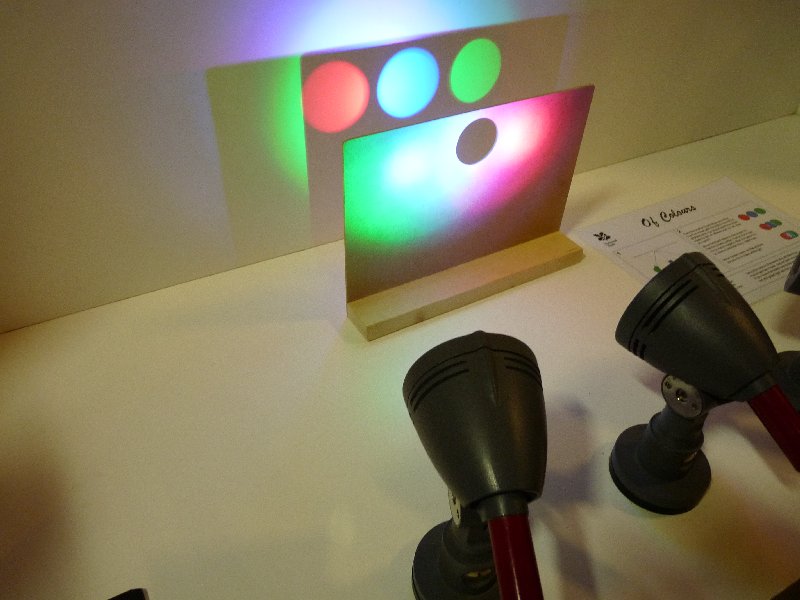
Then there’s the Science Discovery centre. Enjoy the chance to play with prisms, to break light up into all the colours of the rainbow before uniting them to white. Experiment with gravity, throwing weighted balls from the top of a tower… and so on. Get in touch with your inner child and learn a lot whilst you’re having fun.
Playing with light in the Science Discovery Centre.
And then go to the coffee shop there, treat yourself to a home-made cake and a nice cup of tea, and sit quietly in the courtyard there, reflecting on your good fortune at being in such a charming, relaxing, yet instructive place.
Recently, we became members at High Batts Nature Reserve, just down the road. Many of those who join are enthusiasts, well able to name every bird, bat, butterfly, moth and insect that inhabits or passes through this area of mixed woodland and open clearings. We can’t, but that’s rather why we wanted to join. We’re keen to learn.
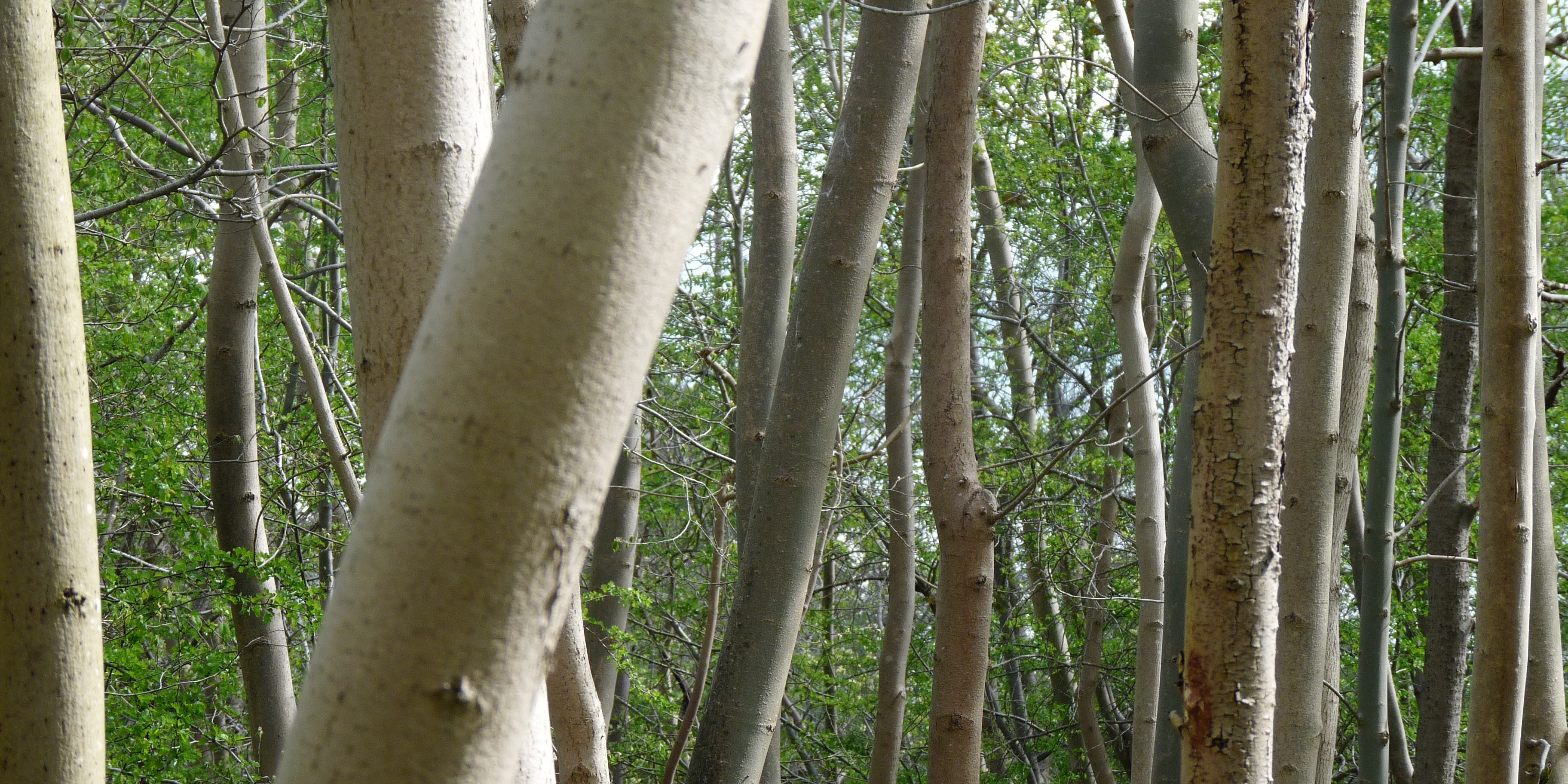
Close-packed trees at High Batts.
We had a bit of a chance the other evening. And yet High Batts wasn’t our destination. Instead it was one of the local quarries, normally closed to the public, but open for one night only to members of High Batts. It’s Quarry Central round here: lorries hauling gravel hither and yon are a common sight. But once exhausted, and in fact in many cases while they’re still actively being quarried, these places become nature reserves, havens for native and migrating water birds, and creatures of every kind, pleased to find tracts of undisturbed, unfarmed countryside where they can live and prosper.
Rabbit housing estate.
This verdant corridor is home to thousands of butterflies and moths during the warmer months.
Home to a badger.
So the other evening we were at Bellflask. A still very active quarry, it’s not open to the public, and hidden from view down long and fairly inaccessible tracks. But it’s very much open to wildlife. Our guides on a cold and blustery May evening were the quarry’s manager, Bob Orange, and Brian and Sue Morland, whose passion is for the flora and fauna of the place.
Bob’s role is to ensure that as each part of the site outlives its industrial usefulness, it becomes a housing and holiday destination for as wide a variety of wildlife as possible. He says that even where gravel is actively being extracted, sandpipers, martins and so on fly within inches of the giant-sized machinery and immense trundling diggers with no fear at all.
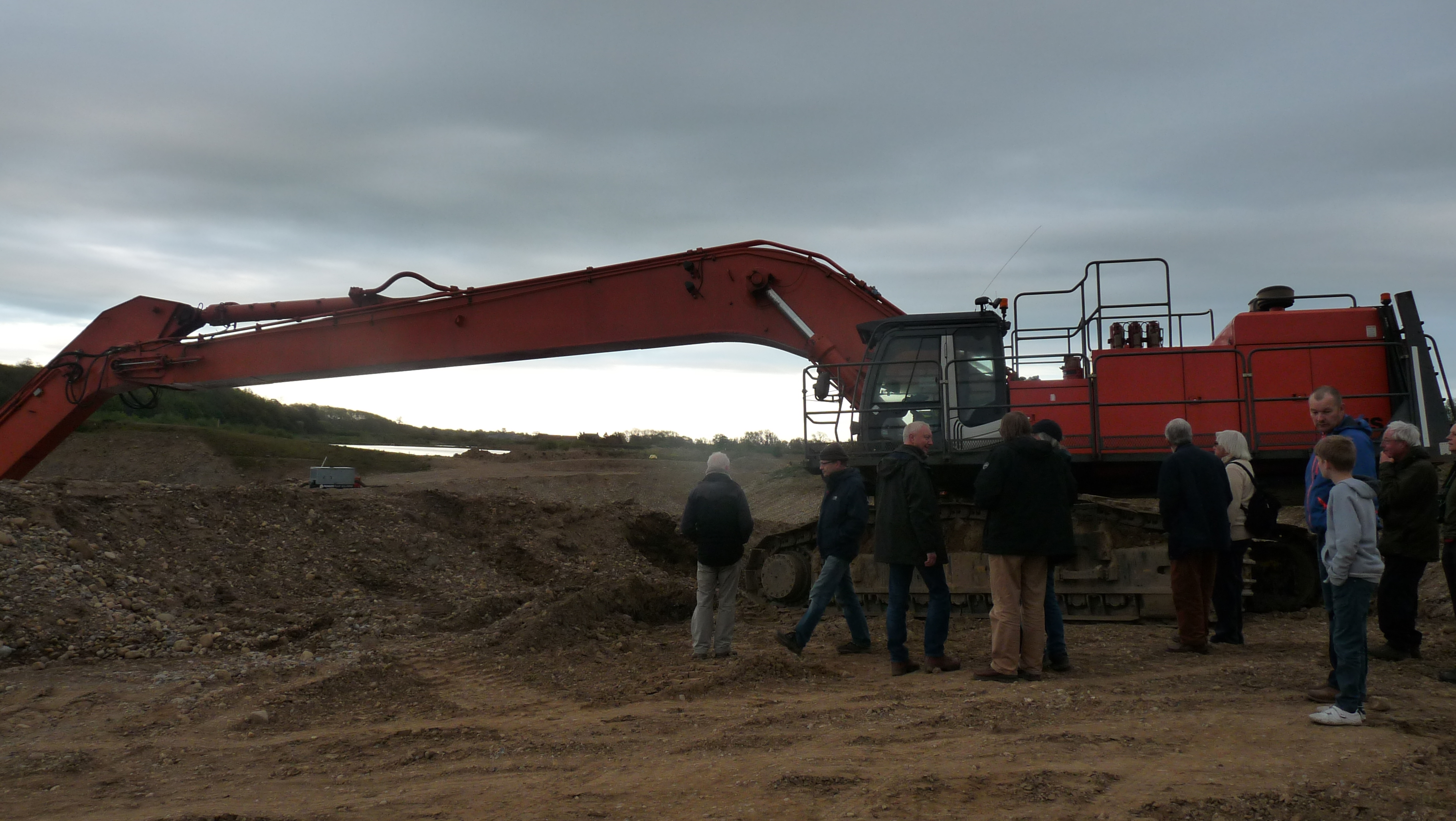
A larger than life digger at the quarry.
But it was Brian and Sue who were most endlessly fascinating. They live in a cottage on site, where they have a lease on a large area of riverside. Their income comes from the fishery they’ve developed, but their real passion is in creating a favourable wildlife habitat. Largely, this means leaving things to grow unimpeded. Every evening for many years, Bob has set moth traps. Because of the richness of habitat on the site, undisturbed by farming and pesticides, there are moths here that are found nowhere else in Yorkshire, and hardly anywhere ‘up north’. This is important, he says. ‘What a lot of people don’t understand is that if you take, say, a pair of blue tits, to raise a family they require about 35,000 caterpillars and each one of these moths lays three or four hundred eggs. This is the bottom end of the food chain. Take your moths away and your birds starve’.*
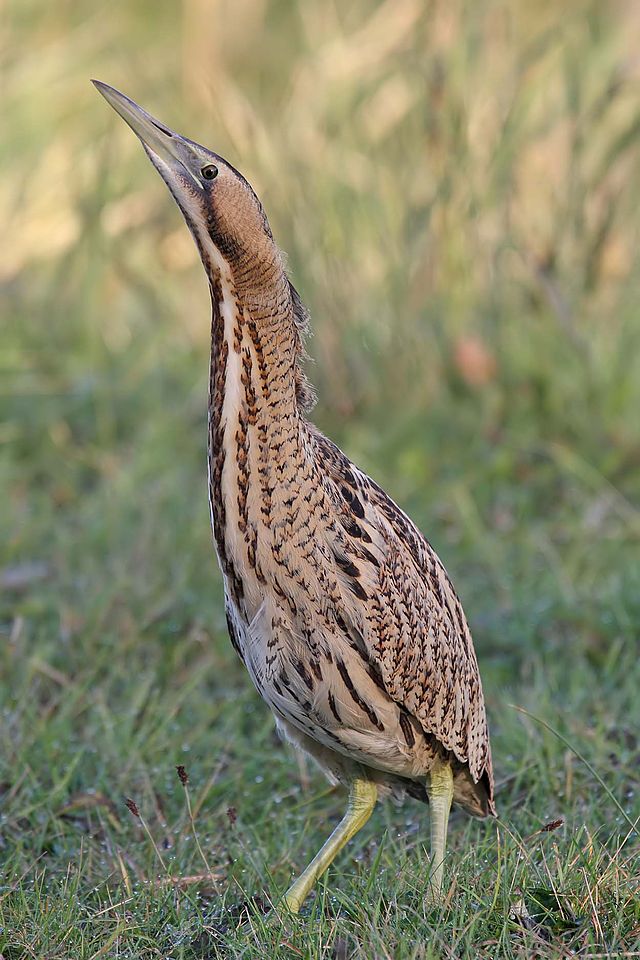
Their secluded address means that they are the ones who have found a grey atlantic seal here, quietly fishing after having been swept nearly 60 miles up river one summer in unusual flood conditions. On a summer’s evening, Brian may go looking for lampreys in the river, and find himself at the centre of a group of gambolling and playing young otters. He and Sue are keen to allow nature to take over, but they’re not above giving a helping hand. They’ve planted reed beds. That way, the increasingly rare reed warbler is thriving, and they even hope to have the bittern that now pass through breeding here.
We saw nothing like this. The cold and slightly dismal conditions kept wildlife at bay. But just as interesting was the sight of all that machinery: the 24-hour-a-day pumps keeping the water level in the gravel pits at a level that permitted working to take place, the mammoth diggers with their immense caterpillar tracks.
Excavator at rest.
A working quarry……
…. starts to return to nature….
… becoming greener with each passing season
We’ve noticed a few more sessions when this place will be open to the public over the next few months. We’ll be there
We were over in Bolton for the night – Daughter Number One played on of the lead roles in ‘The Nerd’, with the Marco Players. It’s a play which deserves to be far more widely known: it’s clever, funny and a grand night out.
But being over in Bolton on Friday night means being over in Bolton for Saturday morning. And Saturday morning, for twin grandsons nine years old Alex and Ben, means only one thing. It’s match day for their footie team. They play for Turton Tigers. Parents, grandparents and associated hangers-on play at being supporters.
The thing about being a supporter is that it involves being cold. We knew that only too well when Daughter Number Two played away matches for a hockey team in Harrogate. Nowhere is colder and windier than a hockey pitch made from a reclaimed slag heap somewhere outside South Elmsall. Except perhaps a community football pitch somewhere in Bolton. It might be May at the moment, the tail end of the season, but wrap up warm. Find your woolly socks. Don’t forget your hat.
Football is a closed book to me. I can’t tell which shots are amazingly good, and which ones might be astonishingly bad. I can’t understand why it seem to be OK when the ball goes off the pitch. It was never allowed in netball I seem to recall. I can’t tell when a ball has even half a chance of getting between the goalposts. I can’t join in those conversations which Malcolm is able to initiate on the lines of how very much the team has improved and matured since last we saw them play a few months ago. I try hard not to clock-watch.
It’s half time. That’s why nobody’s looking at the pitch.
It’s lovely to see the boys giving it their all, to see their enjoyment, determination and sheer physical fluency. I just wish I knew what was going on
But I’ve realised we may have a get-out clause. Last Saturday was their first defeat in an unbroken nine week run of success. The time before when we watched them play they lost as well. And the time before that. I think the boys are beginning to observe a pattern. Next time we visit, we may be forbidden from watching. Oh dear.
It’s OK, Alex and Ben. I don’t mean I don’t enjoy watching you two. But you hit the nail on the head a few weeks ago Ben. You’d been talking animatedly and without pausing for breath for several minutes about (of course) football. Suddenly you stopped and regarded me pityingly. ‘Granny’, he said, ‘You haven’t understood a word I’ve been saying, have you?’. And I’d been trying so hard…..
Do you fancy coming out to lunch with me? I know a nice place we could go – it’s only been open for a few days. We tried it out on Monday, and we’ll be back.
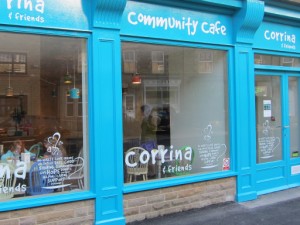
Corrina and Friends Community Café is no ordinary caff, though you might think it’s just another cheerful addition to the high street when you spot its bright blue facade and funky decor. Friendly staff will greet you as you walk in, and present you with a menu.
But what’s this? There are no prices mentioned. That’s because you’re invited to ‘pay as you feel’. You’ll slip the sum you decide to pay into an envelope, and nobody will be any the wiser about how much you think your meal was worth. Those staff who welcomed us were all volunteers, and so were the cooks in the kitchen. This is why, according to their website:
‘With no set prices, customers pay what they feel the meal is worth or what they can afford. At the end of each day the café will open its doors to Harrogate’s homeless and vulnerable – all produce left over at the end of the day will be given away to those in need. All profits will go back into helping Harrogate District’s homeless and vulnerable people.’
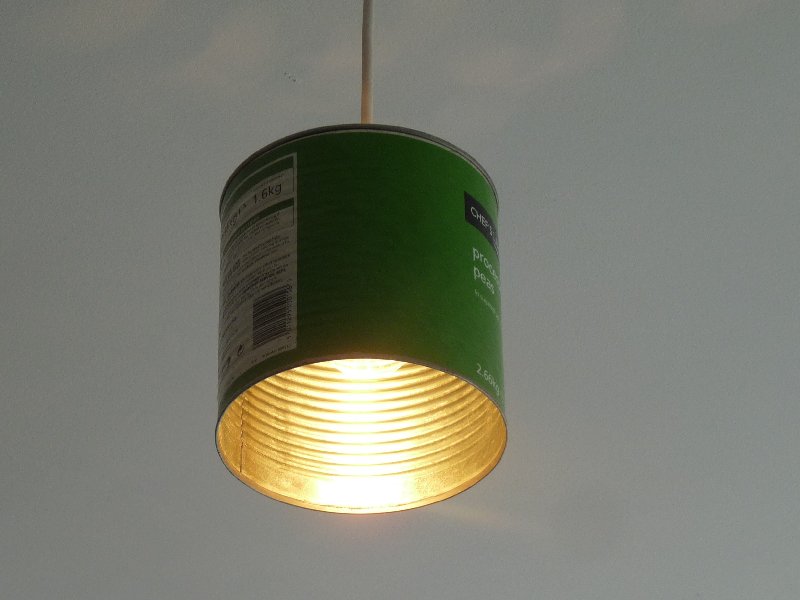
Corrina’s partner up-cycled these catering-sized tins into up-to-the-minute lampshades.
Corrina Young and her friends make a redoubtable team. They’ve persuaded businesses to give their surplus food, or food which is still fresh at the end of the day, but has reached its sell-by date, to the cafe. Individuals have donated dry goods, tinned goods, storage space, kitchen equipment and white goods. Local groups have organised whip-rounds and raffles. Others have donated paint and their skills as painters and decorators to make the place look clean, smart and inviting. Corrina herself raised money last month by getting people to sponsor her when she spent 72 hours in a skip outside her business premises (yes, she has a day-job as well)
Corrina seems to have endless energy and enthusiasm. Wanting to do something worthwhile, in December 2013, she and her family and friends provided a Christmas meal for the homeless and vulnerable. The idea developed and quickly became a weekly two-course meal. Yes, Harrogate, prosperous and successful spa town, contrary to appearances, knows all about poverty and homelessness.
By then, people were beginning to talk about The Real Junk Food Project in Leeds. Alarmed by increasing food waste, a chef, Adam Smith, developed a café in Armley that uses exclusively food destined for landfill: all that stuff that food retailers, especially supermarkets, are legally obliged to junk because it’s reached its sell by date, but not the end of its life. Corrina was inspired by his work. But her motivation is slightly different. She wants to help prevent food waste. But above all, she wants to help the homeless. Getting a good hot meal inside someone who hasn’t the means of cooking is only the first step. But a very important one.
A busy day. Photo: Mandy Lotts.
So….. a café for the cash-poor homeless then, using where possible the food that’s had to be discarded by other shops. That’s not sustainable. But a café that attracts a wider paying public? That might just work. It brings the project to life. A paying public have a jolly good meal, see what the project’s achieving, pay what they feel for what they’ve just eaten, maybe make a donation. And at 5 o’clock, the café closes….and immediately re-opens its doors to the homeless and vulnerable.
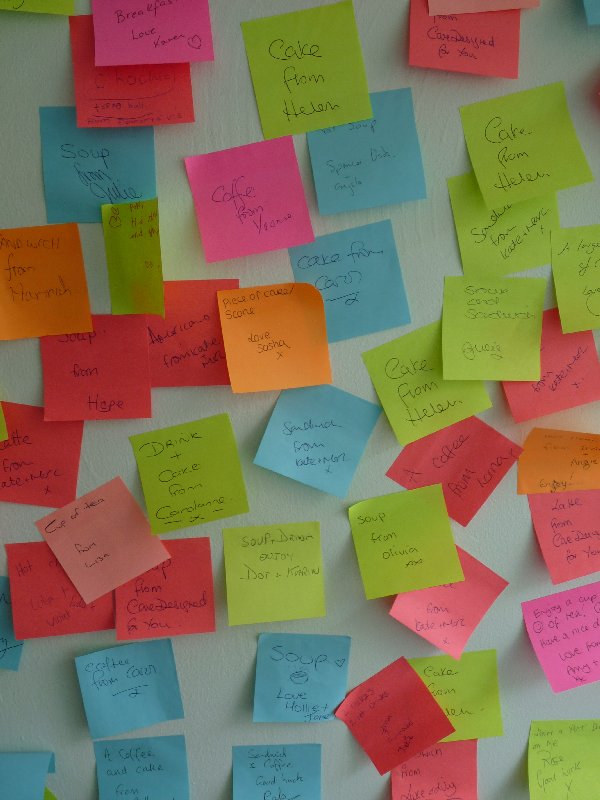
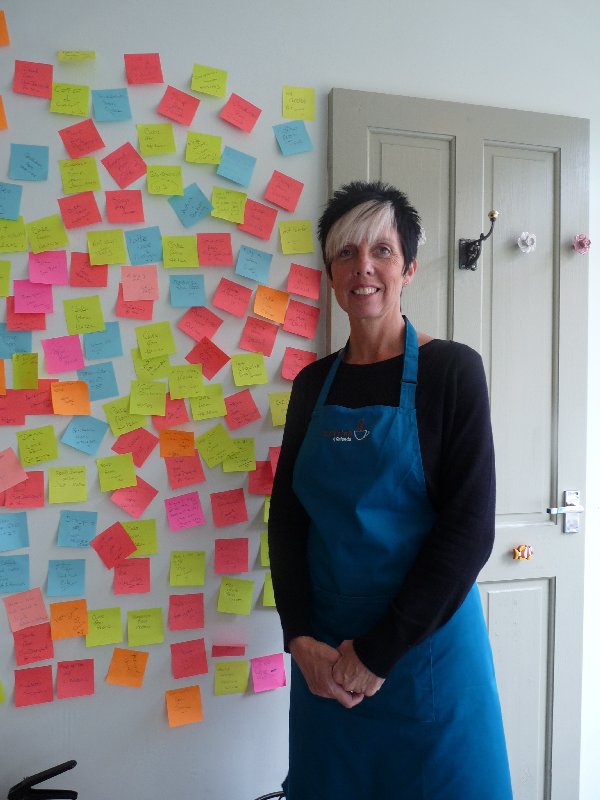
These non-paying customers choose what to eat by looking at this board, covered in post-its.
People who’ve donated money write a ‘serving suggestion’ on their post-it, and the café users who come in at 5.00 chose a couple of these, and hand them over in lieu of payment. They’ll eat what’s listed on the post-it. Here’s what some people have written:
‘Soup and a toastie, Hannah x’
‘Coffee and a cake, George.’
‘Something hot and tasty. Love, Alison xx’
‘Eat what you fancy. Enjoy! Lee x’
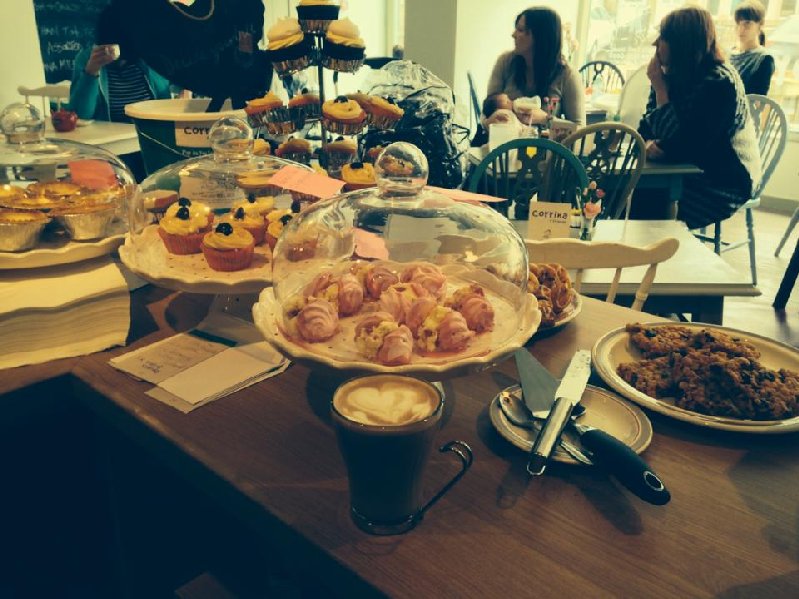
We didn’t want a big meal, so Malcolm and I had home-made soup. Then we shared a cheese and ham toastie, and after that, we thought the cakes looked nice…… We’d had a great time, and Corrina made time to talk to us. She’s found 2 more supporters in us. She’s got 47 people begging to be considered as volunteer waiting staff. All the profits that the café makes will be ploughed back into helping the target community. The long-term aim is to resource, help and empower those people who are so vulnerable in today’s harsh economic and political climate.
Here’s Corrina, in her bright pinny, ready to welcome customers.
Congratulations, Corrina and friends You’re an inspiration.





















You must be logged in to post a comment.