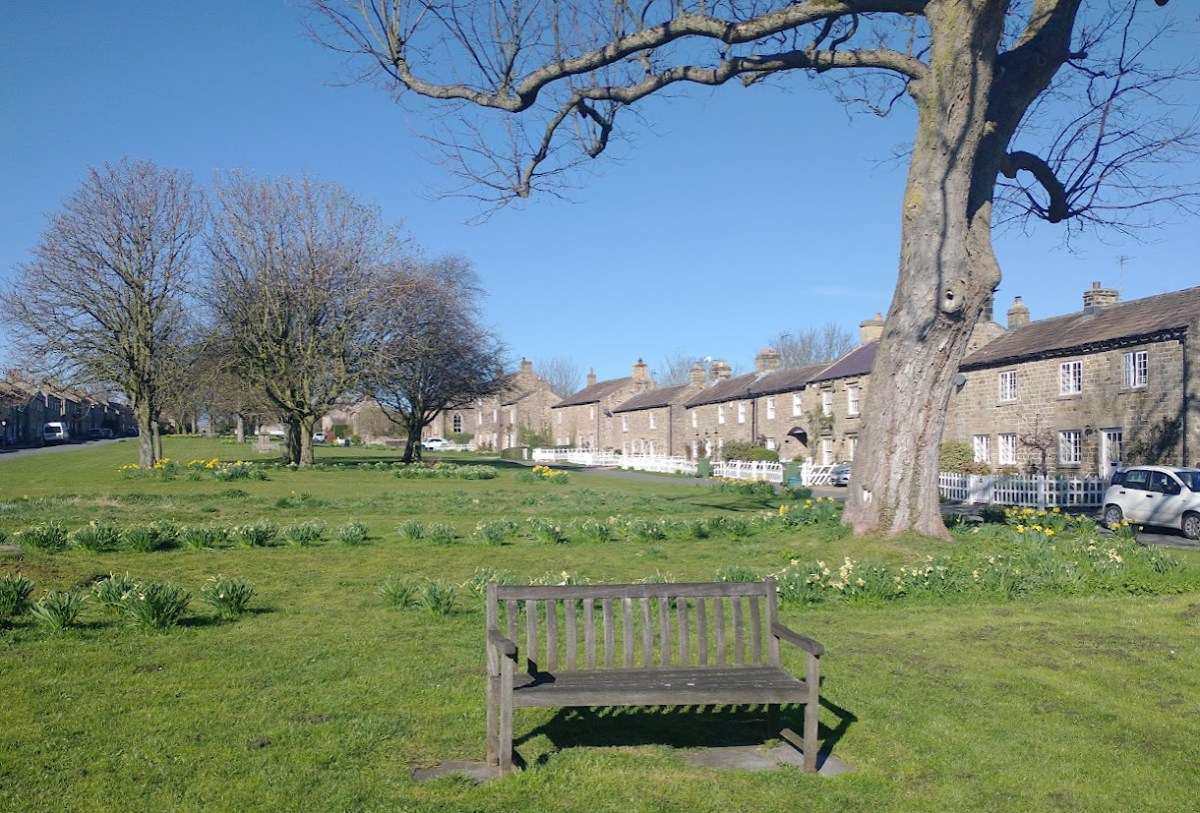
Out walking in Wensleydale the other day, we came upon this bench in East Witton. I thought it important to catalogue it, front and back, for Jude’s Bench Challenge.
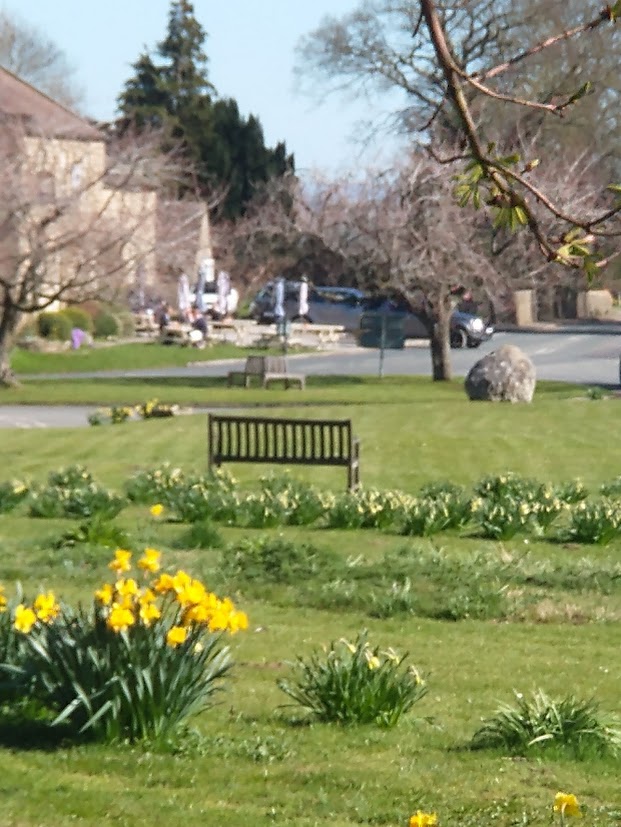
Out walking in Wensleydale the other day, we came upon this bench in East Witton. I thought it important to catalogue it, front and back, for Jude’s Bench Challenge.
This week, A Canadian blogging pal, Rebecca of Rebecca’s Reading Room reflected on re-reading Emily Brontë’s Wuthering Heights. It made me think of a post which I wrote six years ago, in which I described a walk in Emily’s footsteps. Now it’s not really playing fair to re-post something I published before for the Lens-Artists Challenge: Tourist Attractions Near and Far. But I’m going to do it anyway. How many walking routes does anyone know in the UK where the way-marking is in any language other than English? Here, they’re in Japanese. This wild and often unforgiving part if England has become an unlikely tourist Mecca for devotees of Brontë’s story of the passionate and tumultuous love affair between Heathcliff and Catherine Earnshaw.
28th July 2018
Haworth: a charming village on the top of a high and steep hill, in an area of high, bleak and steep hills; home to the Brontë sisters and the surrounding moorland countryside of Wuthering Heights.

Everyone knows that you can expect ‘weather’ when you come here, whatever time of year you arrive. As you stumble along the church path to leave the village, slashing rain tumbling from sullen hostile skies needles your skin, slicks your hair to your face and saturates your clothes. As you set your face against the wild wind, your boots sink into the sodden peaty turf as you trudge onto the moor. If you dare to glance up, you see unending moorland before you: bleak, barren and bare, with sheep huddled against the dry stone walls which march across the landscape. This is Nature-in-the-Raw, and we expect no different.
I went there earlier this week. None of the above applied.
We are in Week Five of a heatwave. I doubt if either the Brontës or even Heathcliff himself had ever seen the like. Brittle coir matting now carpets the brooding moorland fells: and several weeks early, the heather is almost in flower, rich and purple. Yellowing grasses replace the dense green turf the sheep prefer, whispering and rustling in the light breeze.
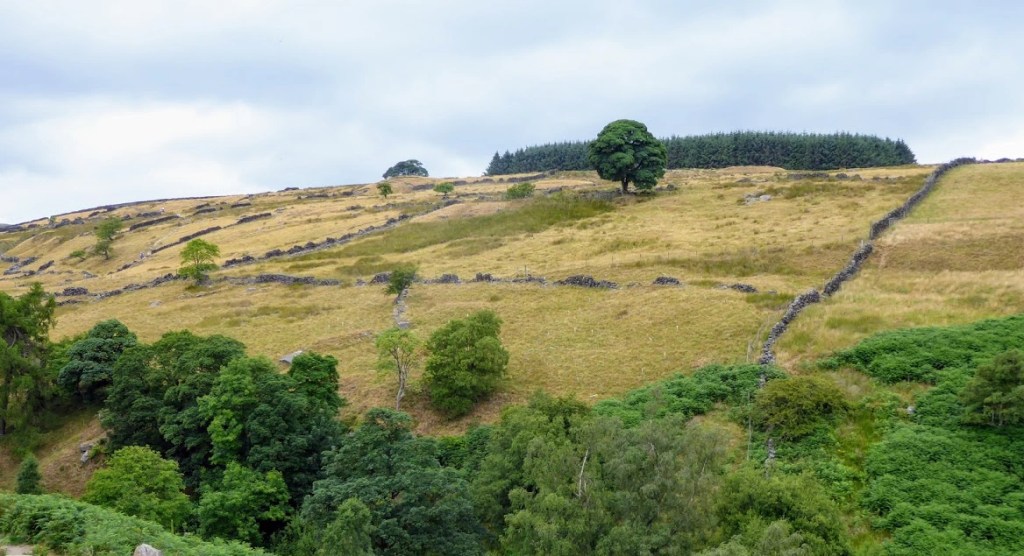
There’s a little brook in the valley here. Angry peaty water jostling officiously along its path has been replaced by still, clear shallow pools.

The Brontë sisters would cheerfully have paused here to rest, reflect and write a little. Then, like me, they would have slogged on, up the peat-and-stone pathway that leads upwards, ever upwards, towards Top Withens.
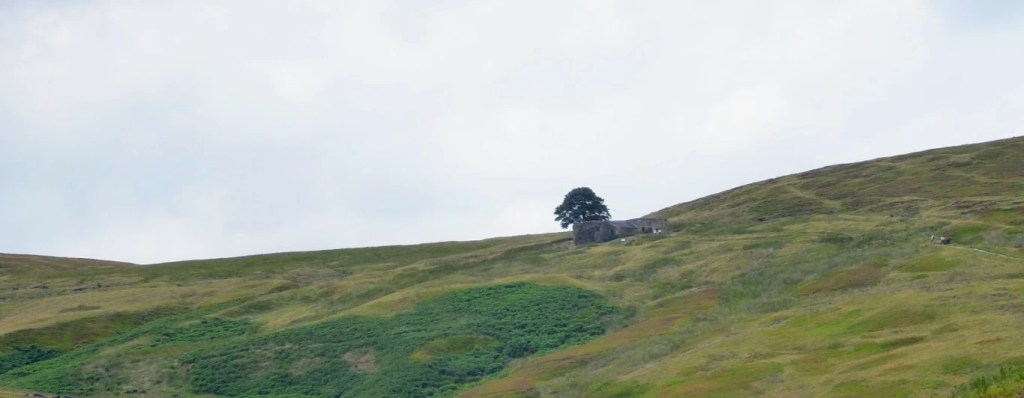
Top Withens may have been the isolated upland farmhouse that Emily Brontë pictured Cathy Earnshaw and family living in when she wrote Wuthering Heights. It’s a ruin now, the roof torn off in a violent thunderstorm in the 1890s. Just as you’d expect.
It was the perfect picnic spot for me. The moorland stretched before me, its hillsides rhythmically rising and falling. The world was silent: not that silence in which there is no sound, but that of the living countryside: the low susuration of the swaying grasses; the humming of the wind in my ears; the occasional complaint of a bird sweeping overhead. Beyond the moorland, greener fields lay, chopped centuries ago into rough rectangles by drystone walls. Some held sheep, some cattle, others recently cut hay. The sun warmed my rocky seat, and I was perfectly content.

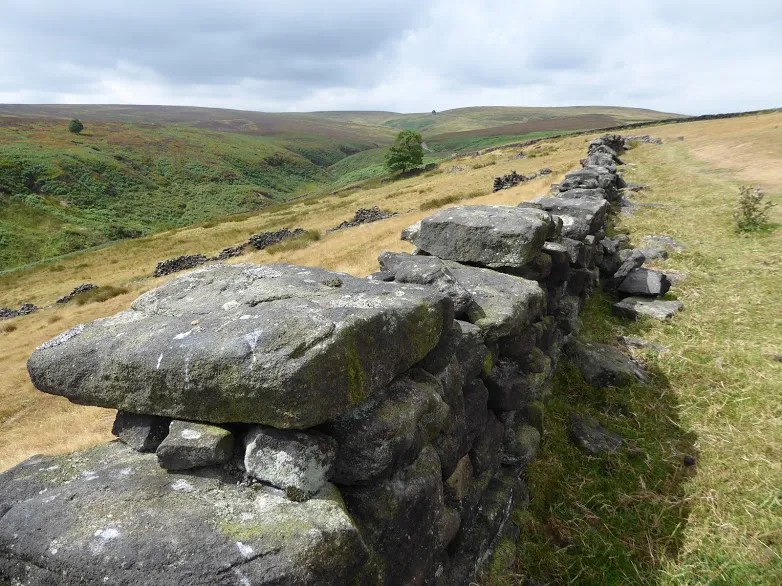

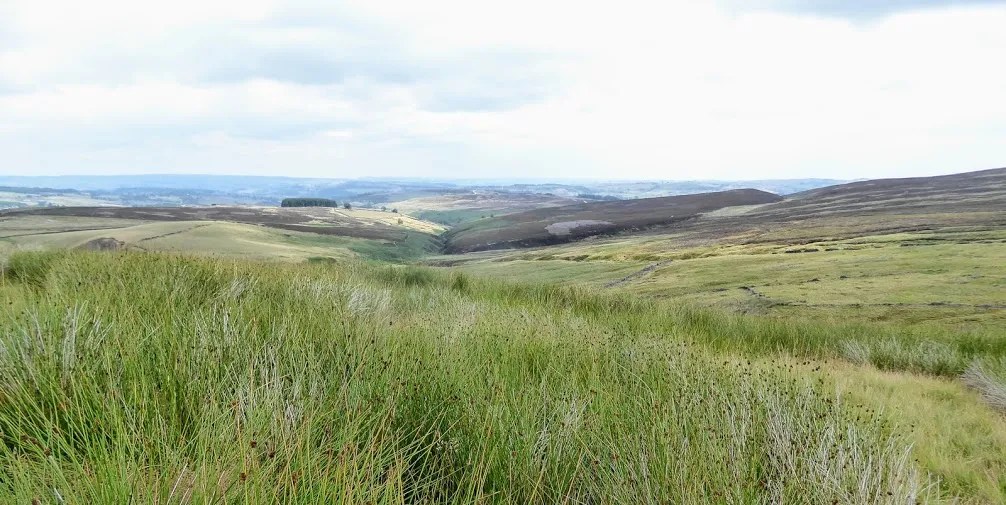
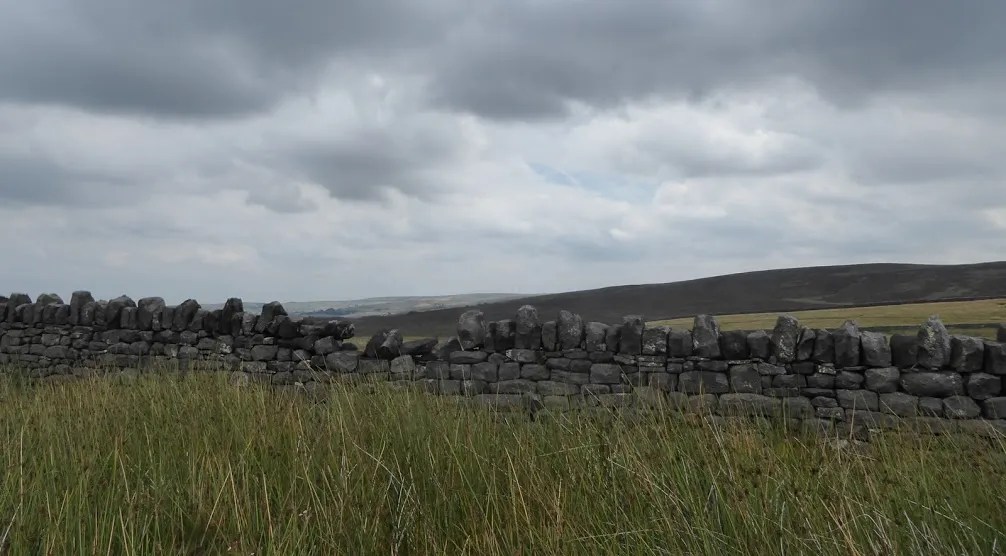
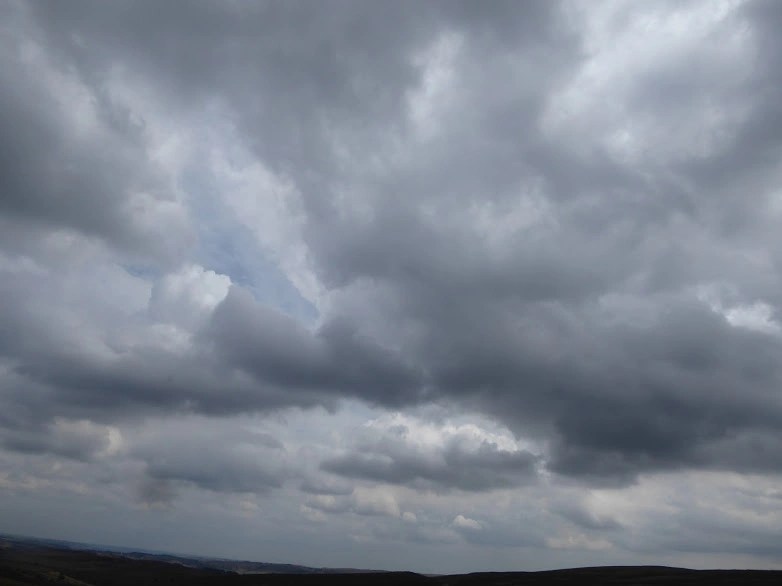
Except for the sky. The day was sultry, sweaty, but freshened by a soft breeze. I knew the sun might be chased away by gusty rain. Ash-grey clouds swelled and receded, revealing granite tones behind: and beyond that, cornflower blue once more. It was a signal. Haworth takes weather seriously. Never be tempted to climb these uplands without a very capable waterproof in your kit.
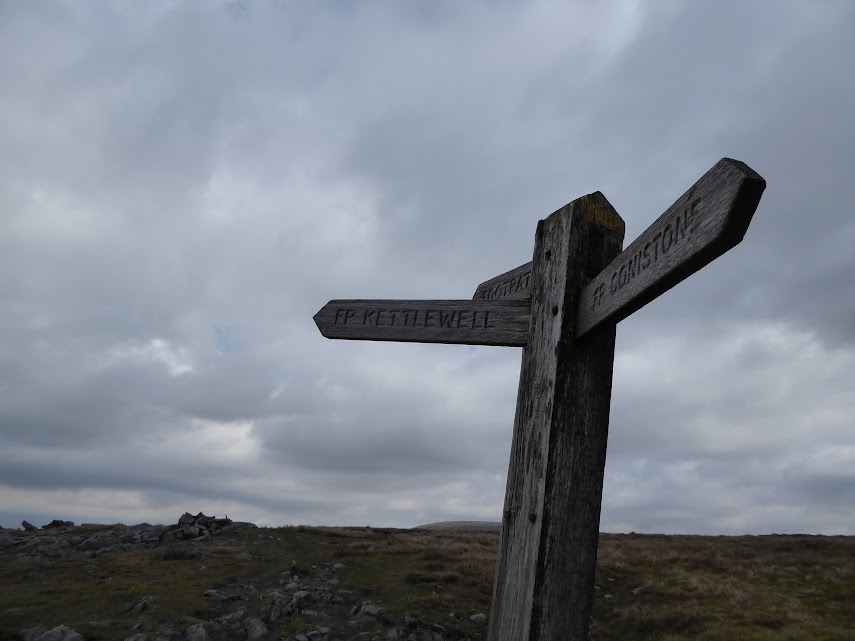
The moorland I saw this week was not the Brontë’s moorland. It’s been a little sanitised. There are helpful finger posts pointing the way at every junction, in English and … Japanese.

The pathways the sisters trod are no longer springy peat tracks, or sticky muddy gullies. Instead, heavy slabs line the way, to prevent footfall damage to this fragile area from the hundreds of people who tramp these paths looking for the Real Brontë Experience.

My day was far too comfortable for that. I was not returning to a draughty parsonage with self-destructive brother Branwell to worry about. If you want to see the Brontë’s life through his eyes, read Robert Edric’s ‘Sanctuary’. You’ll be glad to get back to bustling tourist-destination Haworth for a nice cup of tea.
This post should qualify for a mention in Jo’s Monday Walk, I hope.
The other day, a friend and I took ourselves off to the Ryedale countryside to reconnoitre a route. It turned out to be not only the Longest Day, but the First Day of Summer, in the sense that the weather was wonderful – hot and sunny .
Setting off on a shaded woodland path, we criss-crossed a flowers-edged stream several times.

We forged our way up a steep – unending – hill. Is that even a path?

We exchanged woodland for fields and open views, with clouds above:


We met a ford which lapped along a long stretch of road. Luckily there was a footpath through a field nearby, and edged with iris too.

Sheep looked on, and ancient walls often marked our way.


And at last, below us the ancient ruined Cistercian Abbey of Rievaulx.

Now let’s run this in black and white.
We criss-crossed a stream:

… and later, the woods opened out into farmland. Crazy sky!

Luckily, we were able to dodge fording the ford: or testing our brakes.

As an alternative to sheep-watching, we chose shadow-watching on the narrow road that was part of our route.

And soon after that, Rievaulx Abbey was no longer below us, but alongside.

And as our walk finished, the road sign confirmed that we had indeed seen Rievaulx.

For Jo’s Monday Walk.
And for Leanne and Dawn‘s Monochrome Madness: Roads, Lanes, Paths and Tracks.
Last week, I invited you to join me in Spain, and hunt for the symmetrical. This week, we’ll stay closer to home, and have a countryside wander looking for the asymmetrical for Dawn’s Lens-Artist Challenge.
What we’ll do is start off in the Yorkshire Dales. Let’s peek over a drystone wall and look at the patchwork of small fields that has evolved over the centuries, way before agri-business and the space-gobbling demands of giant machinery.
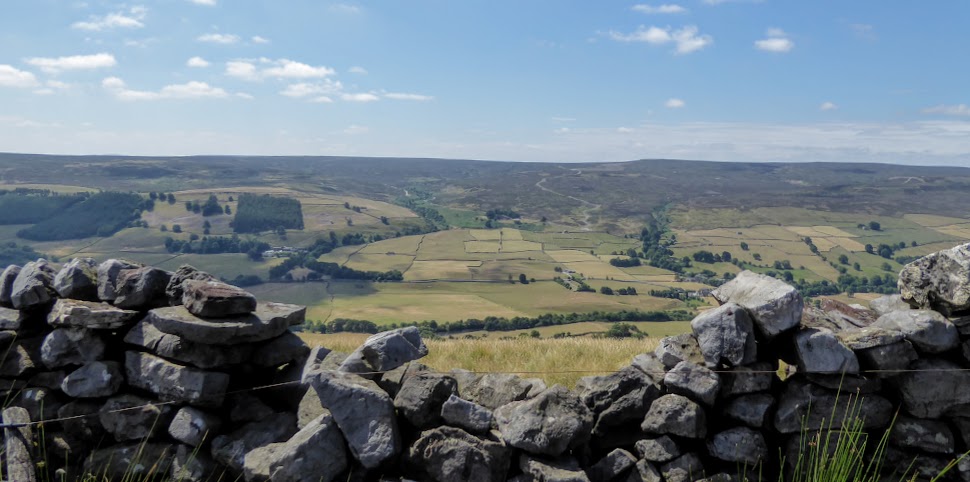
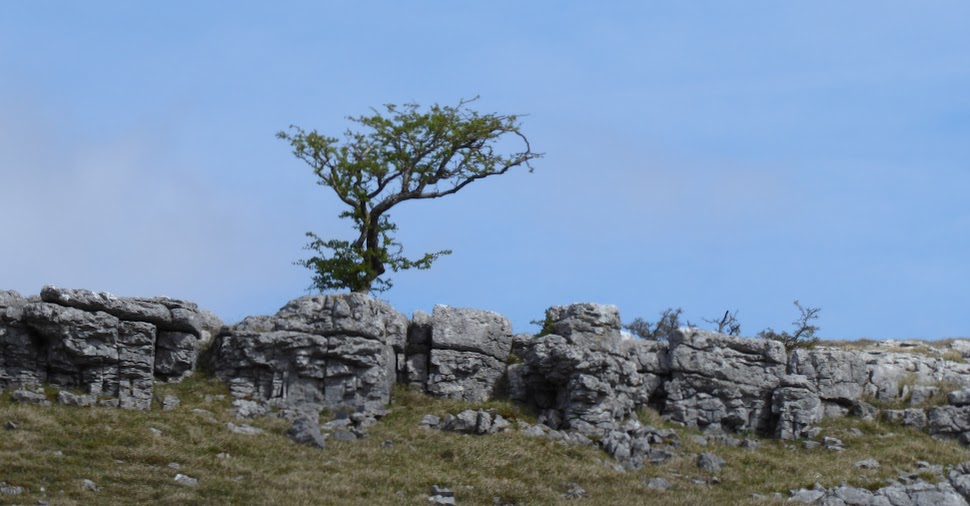
Conditions are harsh: not too many trees then. But those there are battle to reach maturity and stay upright against prevailing winds. Symmetry is the last thing on their minds.
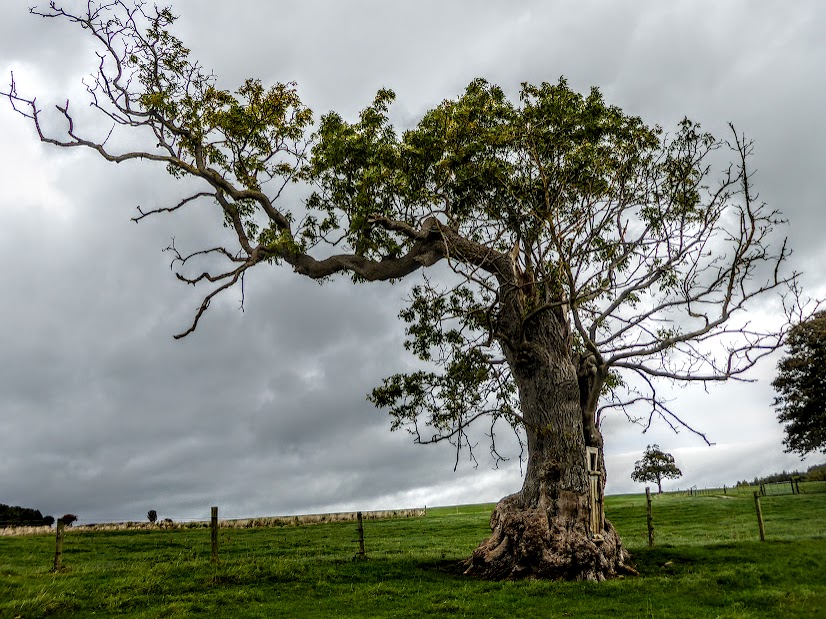
Look carefully. At the right hand side of the hollow trunk, some fond grandfather (I’m guessing) has fashioned a door to the hollow trunk, to make a very special tree-house.
Let’s hurry back to civilisation, before darkness falls. Here in Studley Royal is a blasted tree that always reminds me of the antlers of the red deer stags who call this area home.

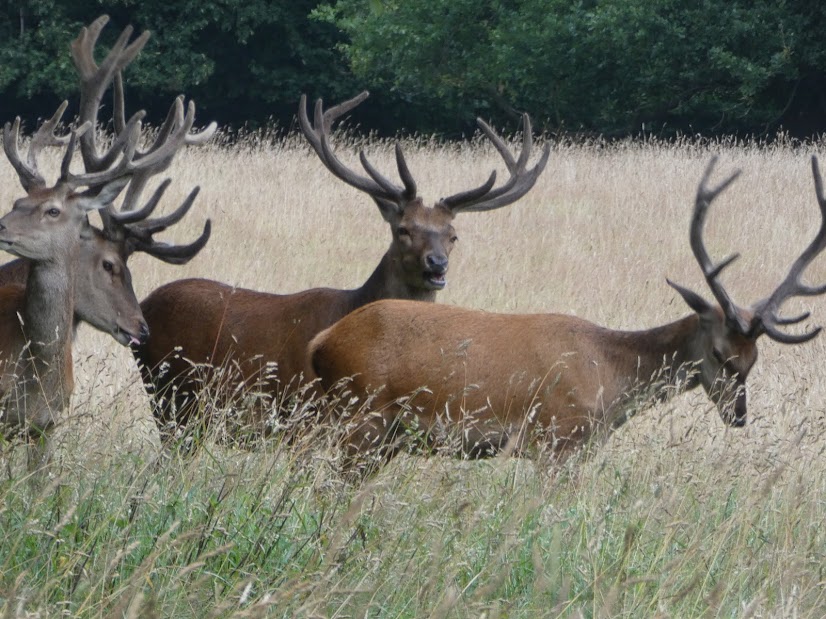
And here too are ancient tree roots, complete strangers to symmetry: some of the older stumps house fungi.
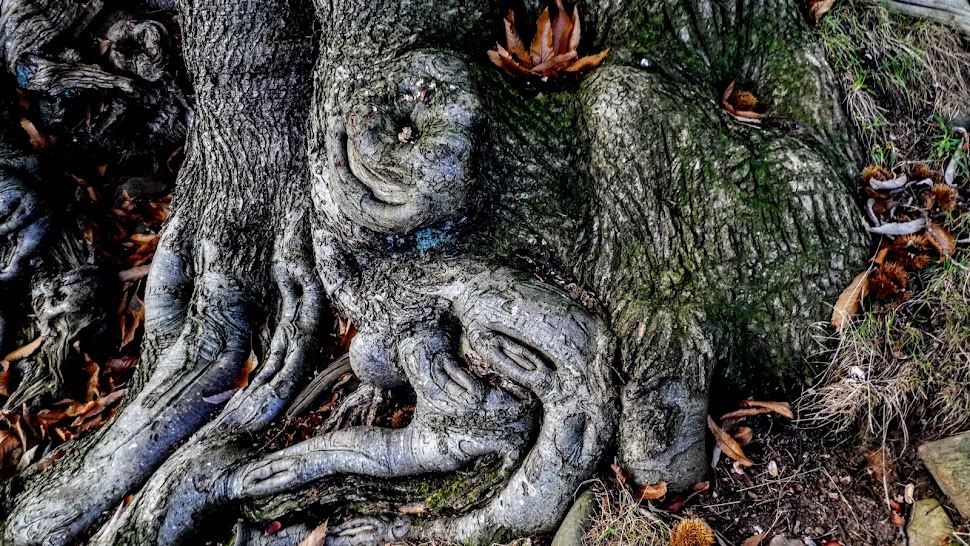

Oh look. Darkness is falling.
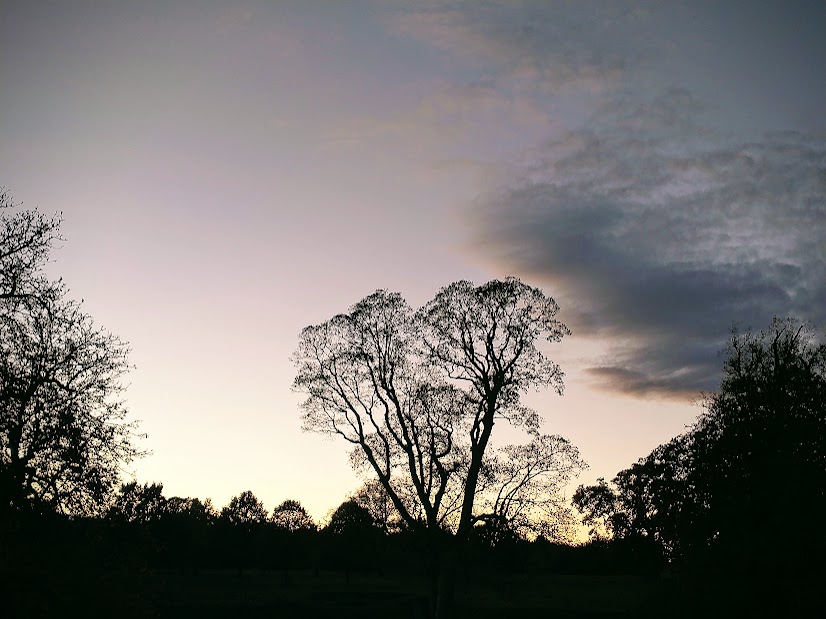
Let’s hurry into town. Bright lights, big city. Perhaps we could grab a warming mug of hot chocolate to thaw out our chilly fingers. And that’s where I’ll leave you for now. See you soon, I hope.
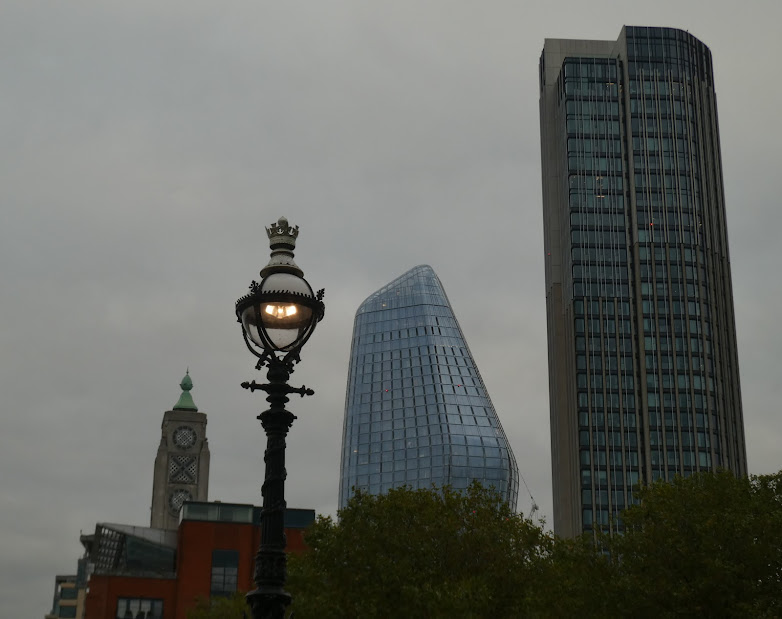
It’s a bit of a stretch to get from Studley Royal to London in time for the final photo-op of the day (250 miles). Photographer’s licence.
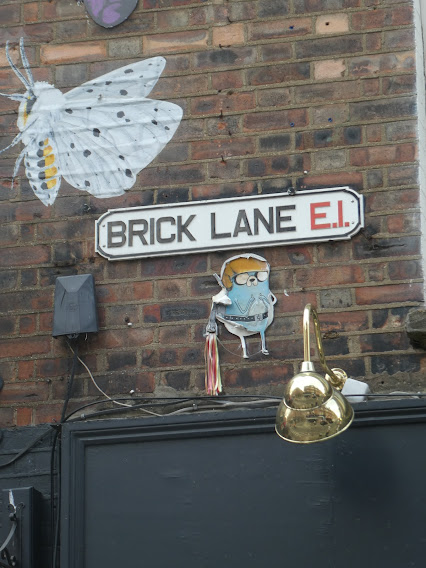
I was in London last week. And the highlight – apart from being with family of course – was a day mooching round Spitalfields with fellow blogger Sarah of Travel with Me fame. We’d planned to meet, and I’d appointed Sarah as Tour Guide. Good plan. She knows Brick Lane and the area well.
We started in Spitalfields Market, and immediately spotted Morph, well known to all British children and their parents of a certain age (1970s) through the TV series Take Hart. He and his acolytes are making guest appearances throughout central London this summer for the charity Whizz-Kidz.
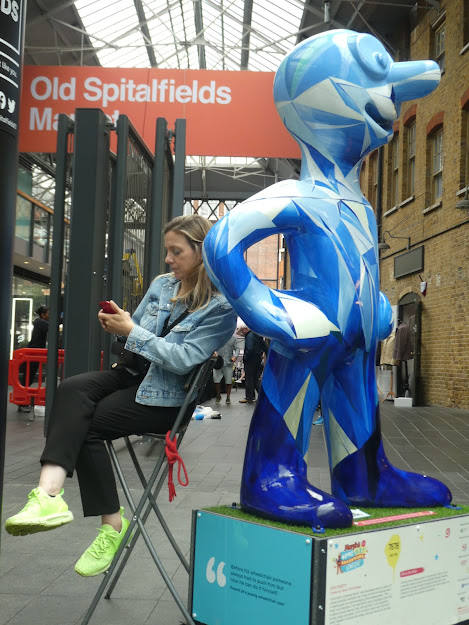
Coffee next. You’ll never be short of a refreshment stop round here, though the one shown here wasn’t ours. We chose somewhere cosier.

Spitalfields was once the heart of the Huguenot community in London – Protestant refugees from persecution in 17th and 18th century Catholic France. They brought their skills as weavers with them, and formed a community here, which still has the houses from that era at its heart. For many, these houses have now become a desirable address.
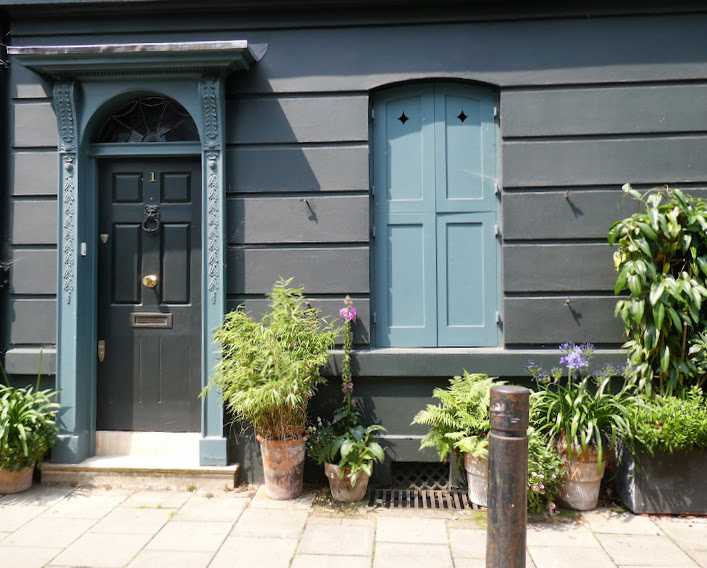
We chanced upon the Town House Gallery here, and rather wished we’d stopped here for our coffee and cake. Another time.
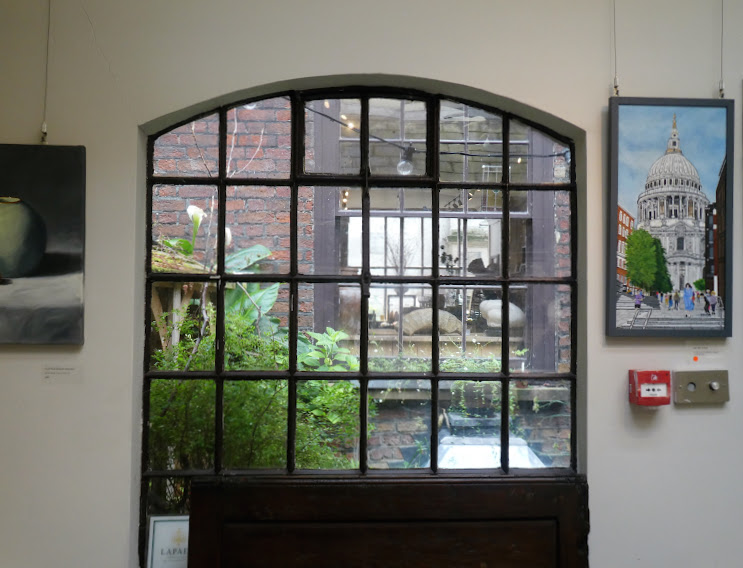
Spitalfields has gone on being an area welcoming those seeking a fresh life away from persecution and poverty, more recently Bangaldeshi citizens who’ve now made their own mark on the area.

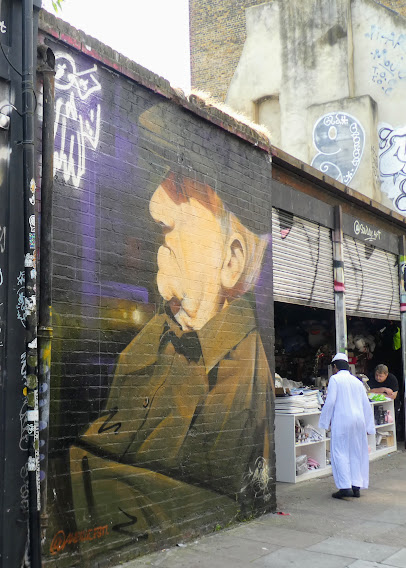
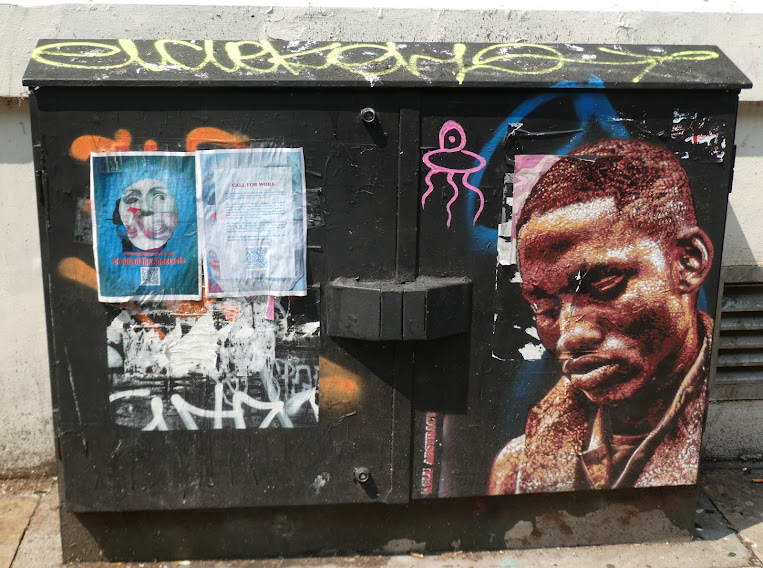
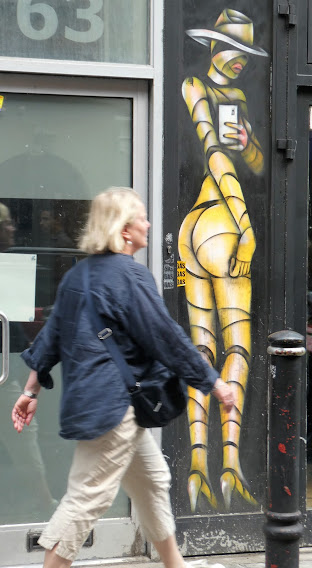
All the same, it was street art we’d come for, and that meant Brick Lane, and the streets round and about. Sarah’s already posted about our walk, and as so many of you already read her (and if you don’t already, you should – link above) I’ve tried to choose different images from those she shows: click on any one to enlarge.
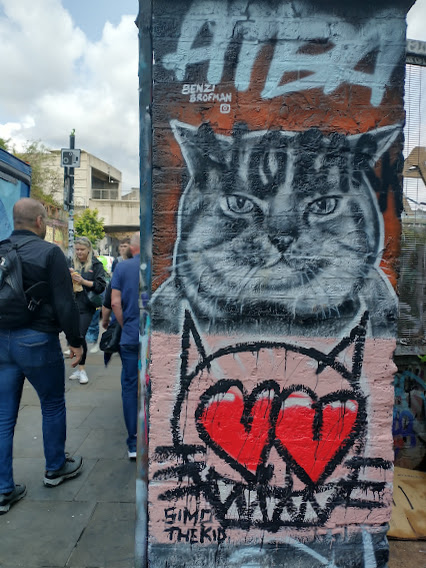



You don’t even need a spare bit of wall:
We didn’t just have street art to keep us amused. There was filming going on. A documentary? A drama? We don’t know. Maybe we’ll find out one day.

Then under a railway bridge …
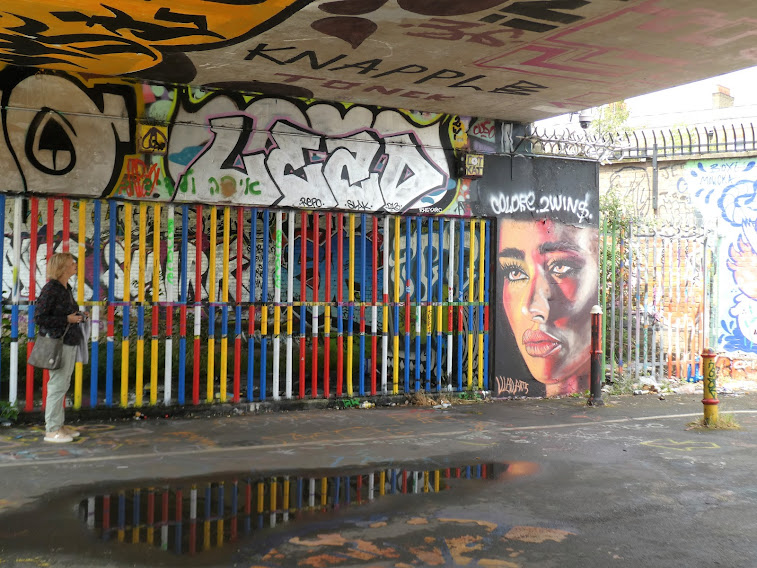
… a promising back street – a couple of street artists preparing the ground for a new work. I’m just going to show you the preparations in action. We popped back a couple of hours later to inspect progress, but were underwhelmed.

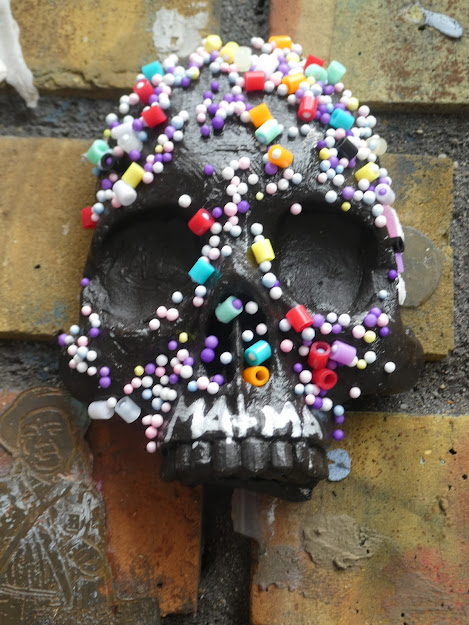
A lunch stop, then we retraced our steps. Don’t forget to look up! We were intrigued by the lines of broccoli we kept on coming across, above eye level, but they remained a mystery.


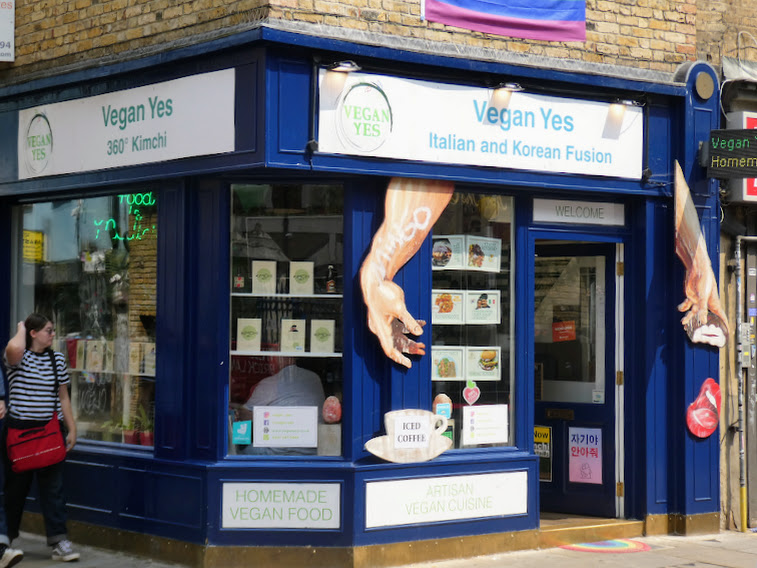
Should we instead have stopped here for lunch? We’d both have settled for Italian food. Or Korean. But that particular fusion?
Just a couple more images, of passers by oblivious to their surroundings. Which we certainly weren’t. A day full of interest. A day well spent. Thanks Sarah!

Oh, hang on. This bit’s for Jo. We found the all-important cake shop, but it wasn’t a coffee-stop too. We contented ourselves with gazing through the window, and I got an oddly surreal image of us both, with Sarah having another woman’s head superimposed on her own.
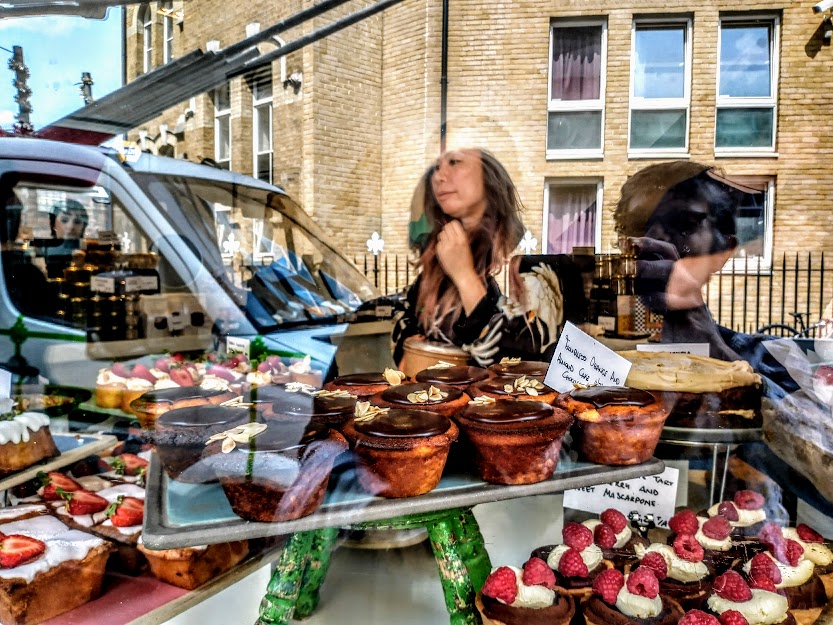
For Jo’s Monday Walk, and Natalie’s Photographing Public Art Challenge
I had my photos of the much-loved butterflies of an English summer day all lined up to display for Denzils’ Nature Photo Challenge 13# Butterflies. Then I realised I wanted to share something else instead: a photo of a rare butterfly I first saw in the Pyrenees, ten years ago now: the Mountain Apollo.
July 31st 2013
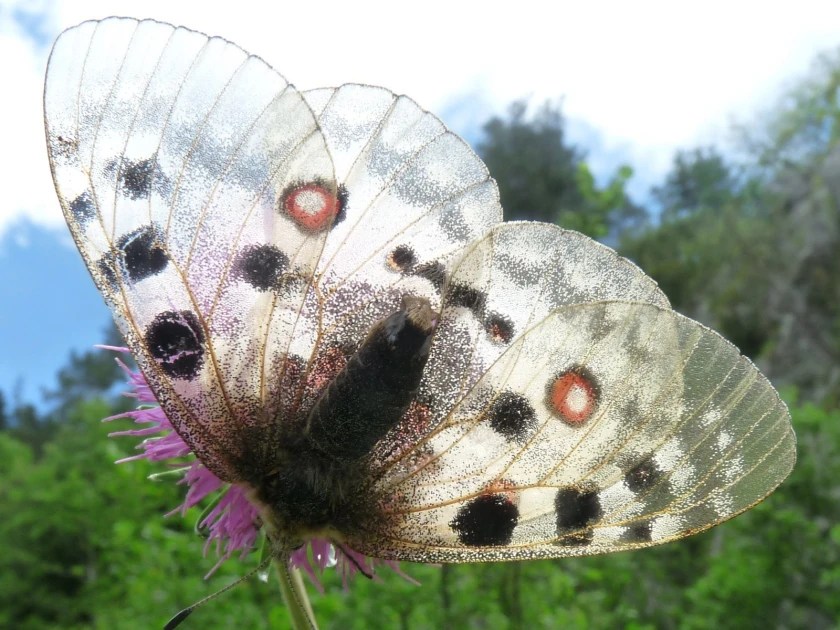
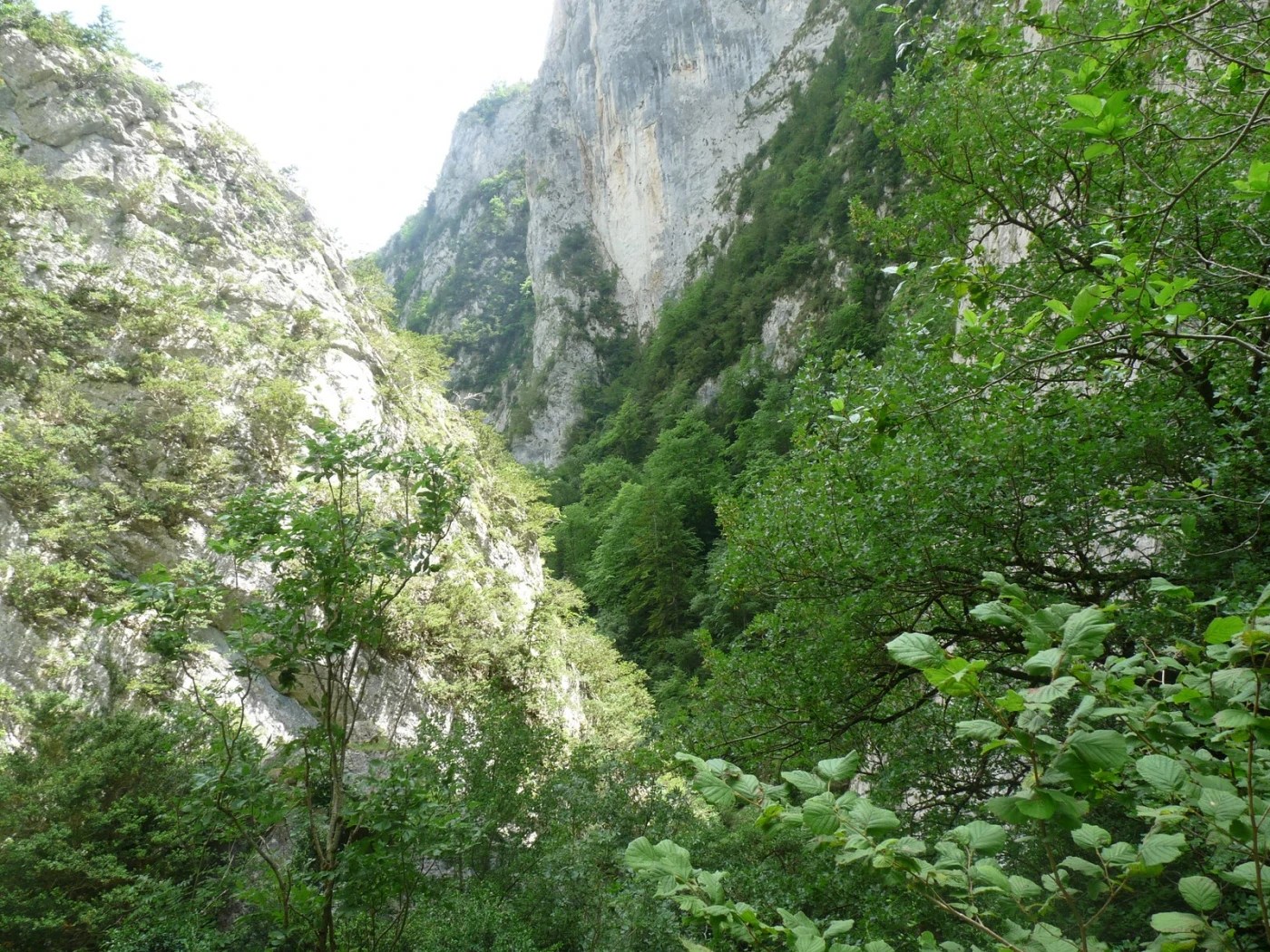
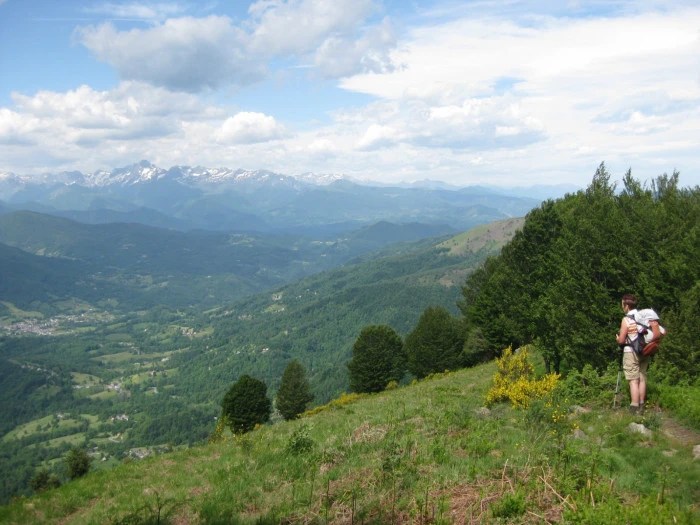
I just want to share a photo I took on our walk on Sunday, when we went to the Gorges de la Frau. This butterfly seduced us all with its distinctive spots and white grisaille wings. It turns out to be rare, a protected species, and known only in mountain regions, mainly in Southern Europe. The French know it as Apollon, and its Latin name is Parnassius Apollo. If your French is up to it, you can read about it here.
And here’s a small taste of the Gorges de la Frau, only a few miles from our house.
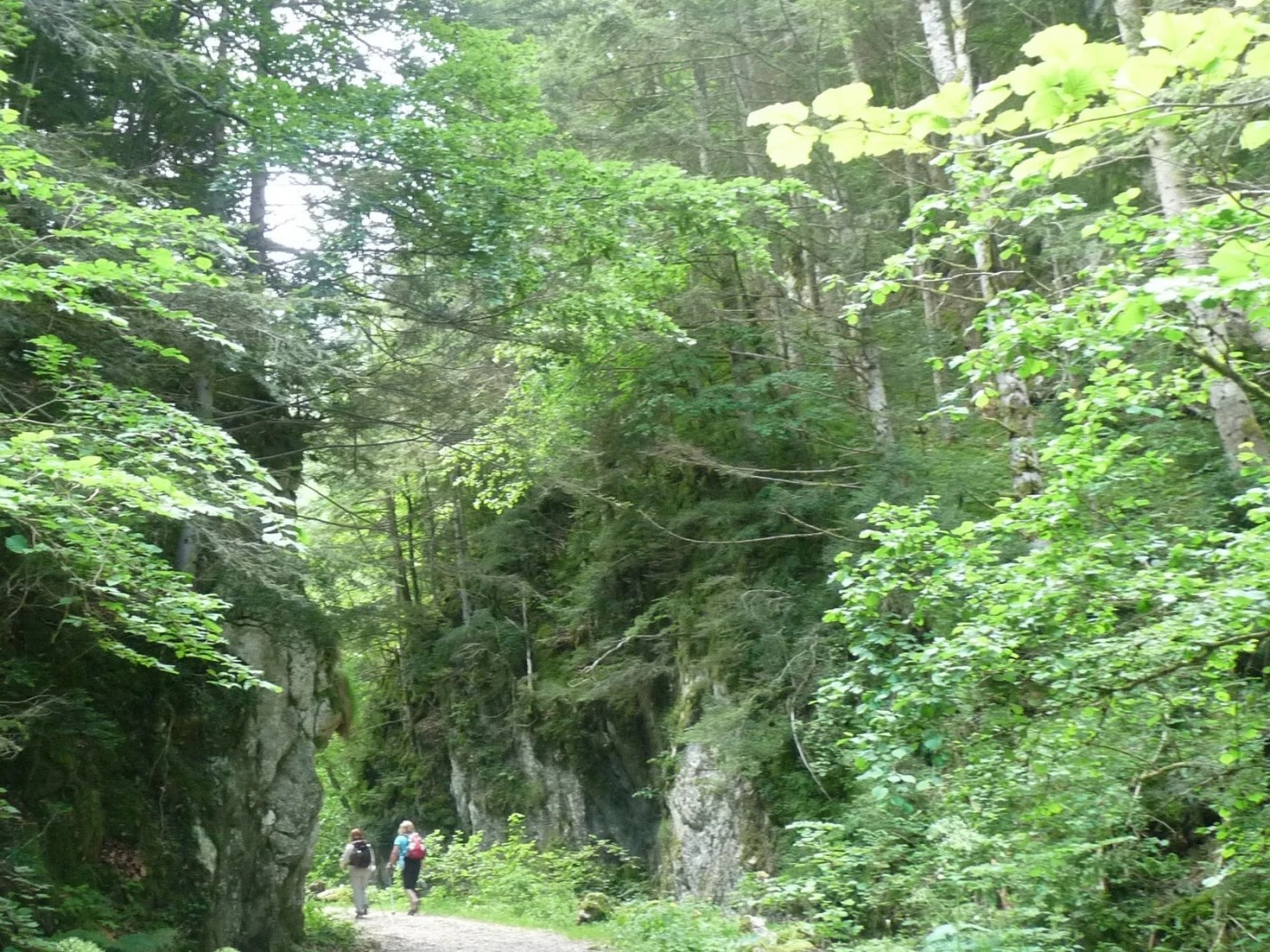
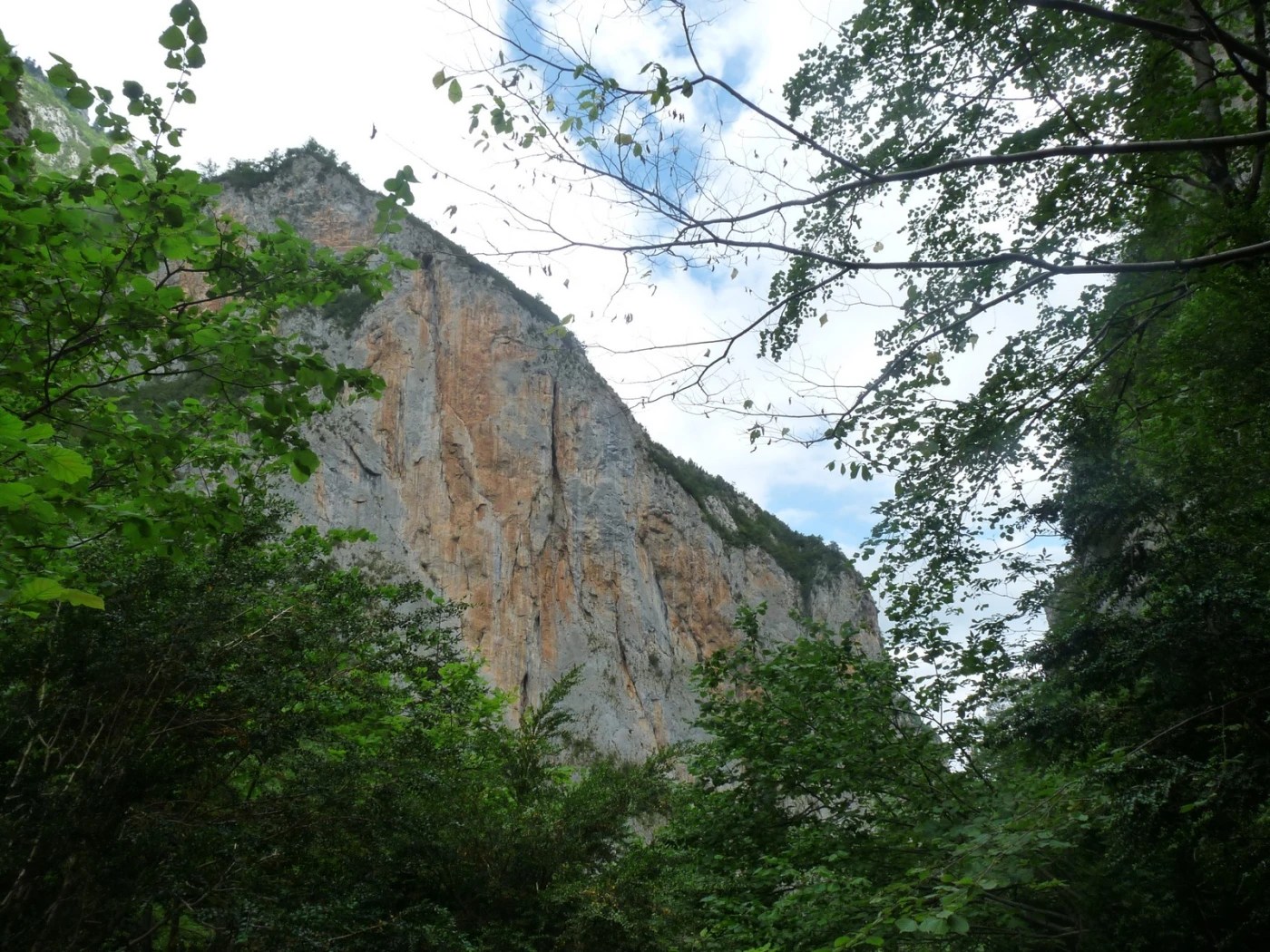
Sunday. A day that promised sunshine, maybe showers. A day to get out of the house somewhere a little more distant and explore.
My friend Sandra and I picked Boltby. It’s on the edge of the North York Moors, but fertile farming country, transected by rippling streams and glades of trees. Before setting out, we found a wonky-lozenge-shaped network of paths that would take us to another village – Felixkirk – in time for lunch before returning us, wonkily – to Boltby on the other side of the lozenge.
The feature photo shows how the walk started. Honestly, it wasn’t as grey as it appears. Just moodily misty: a warning that it might – just might – rain. It didn’t.
Instead, we enjoyed noticing how the gnarled and characterful trees were at last springing into leaf: bright and sappy.
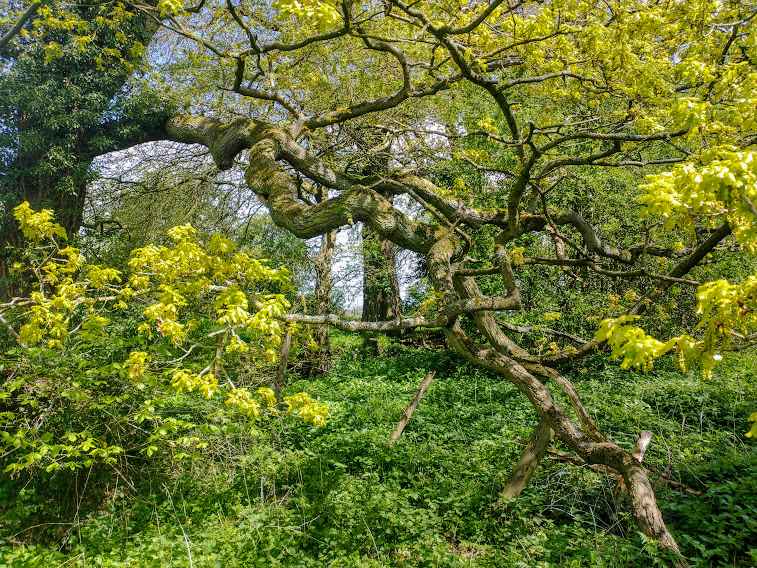
Our feet bounced along on the springy (though wet) turf, and we made good progress until we hit a series of stream-crossings. I should have taken photos of the battered little bridges, in once case so falling-apart that we forded the waters instead. We should have recorded evidence of stiles so past their use-by date that they swivelled and see-sawed as we tried to use them. We soldiered on. By now the mists were gone, the sun was out, and this was the scene.
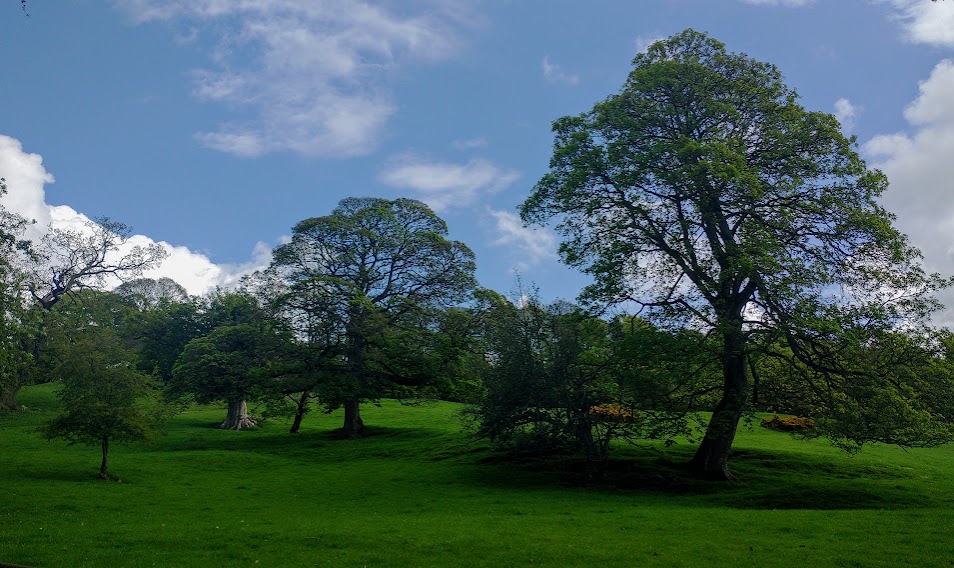
Then Felixkirk. We sat with our sandwiches on the village green and enjoyed watching the villagers strolling towards the village hall with offerings of scones, sausage rolls and cakes of all kinds ahead of an afternoon dedicated to celebrating Saturday’s Coronation.

After lunch, the walk became more open, with long-distance views. We were on the home straits, with one more village – Thirlby – in our sights.
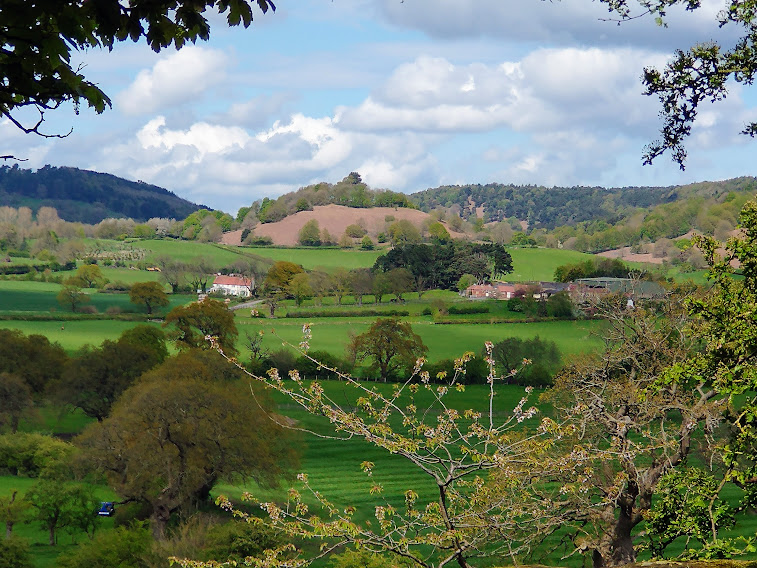
Then finally – back to Boltby, with a spot of bad planning: a hill at the very end, just after crossing its ancient pack-horse bridge.
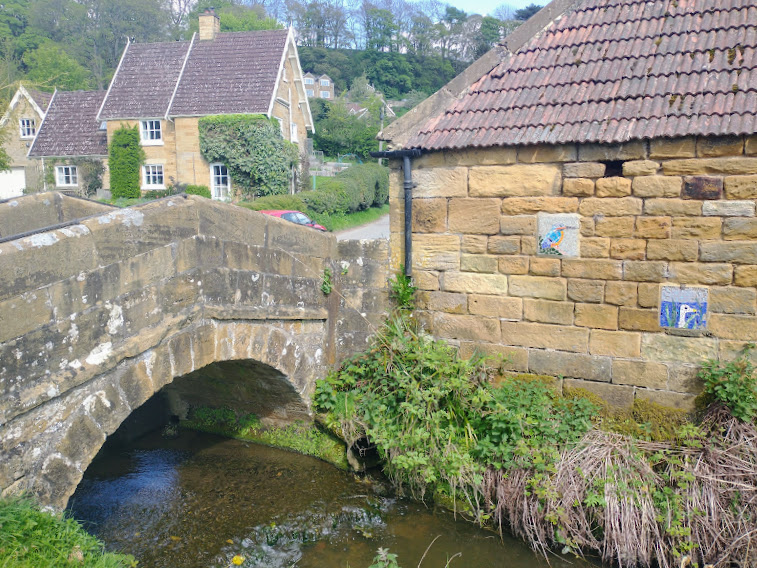
But Boltby has no teashop. To Thirsk then – after four o’clock. All tea shops closed. So instead, we bought ginger beer, and sat on the market square enjoying the Coronation yarn bombing. At least King Charles had his cup of tea. And cake.

Here’s the walk we did. In our opinion (that of Sandra’s app anyway) it was just shy of 10 miles. A good day out.
For Jo’s Monday Walk.
It was twelve years ago this weekend that I realised that even ordinary-seeming mishaps on country walks can have very unfortunate consequences …
March 20th, 2011
Poor Micheline. Her pain, her distress was our Sunday Soap Opera.
We’d gone walking with our Rando del’Aubo friends, near Nébias again. We’d yomped up a mountainside, two hours of it, and were looking forward to lunch in – oooh, maybe ten minutes. That’s when Micheline fell over a tree root.
It was bad. Very bad. Broken ankle? Knee? We still don’t know. Anny, who has GPS, ran off to find some kind of reception for her mobile, so she could ring emergency services, and give them our exact reference.
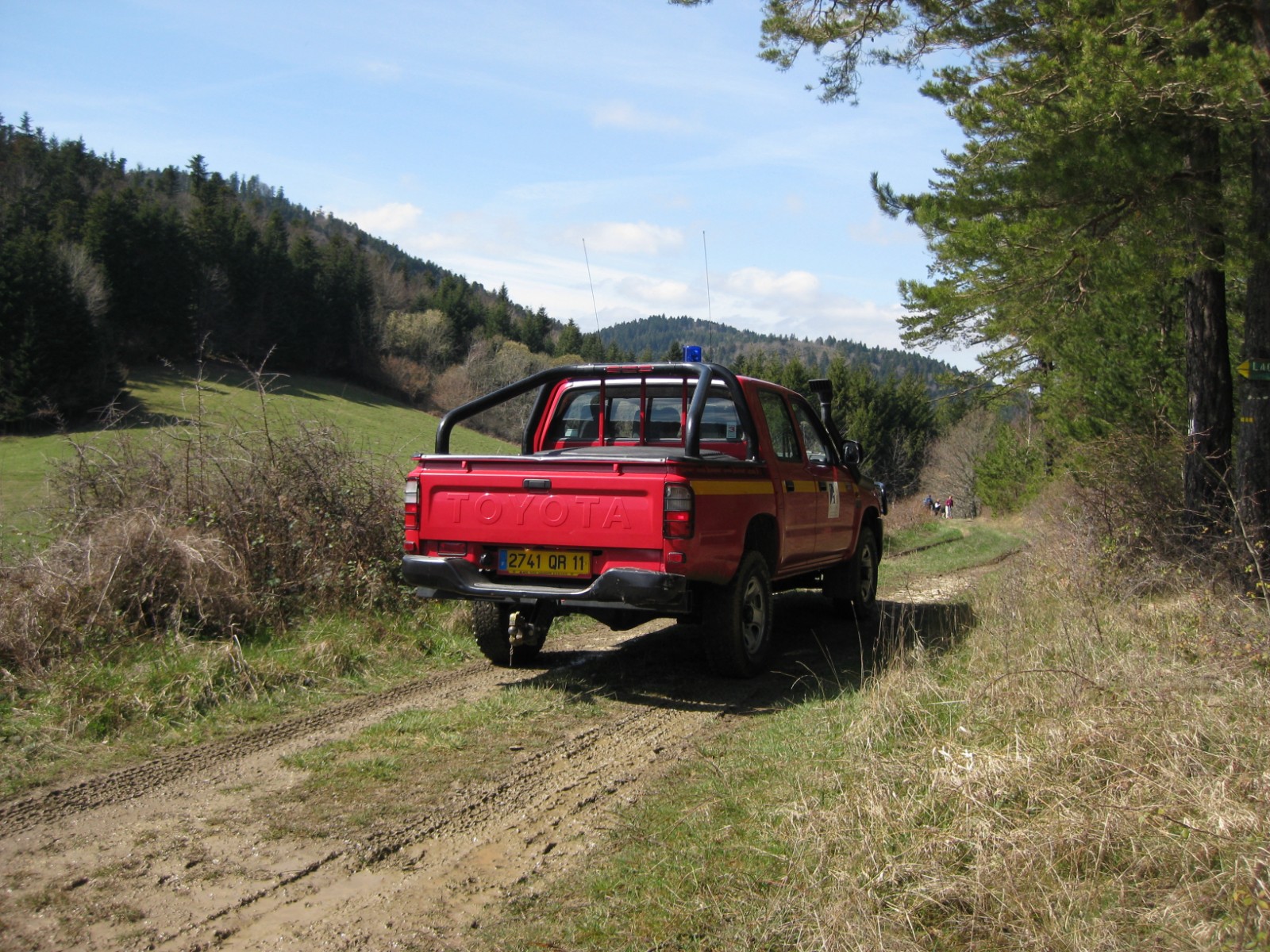
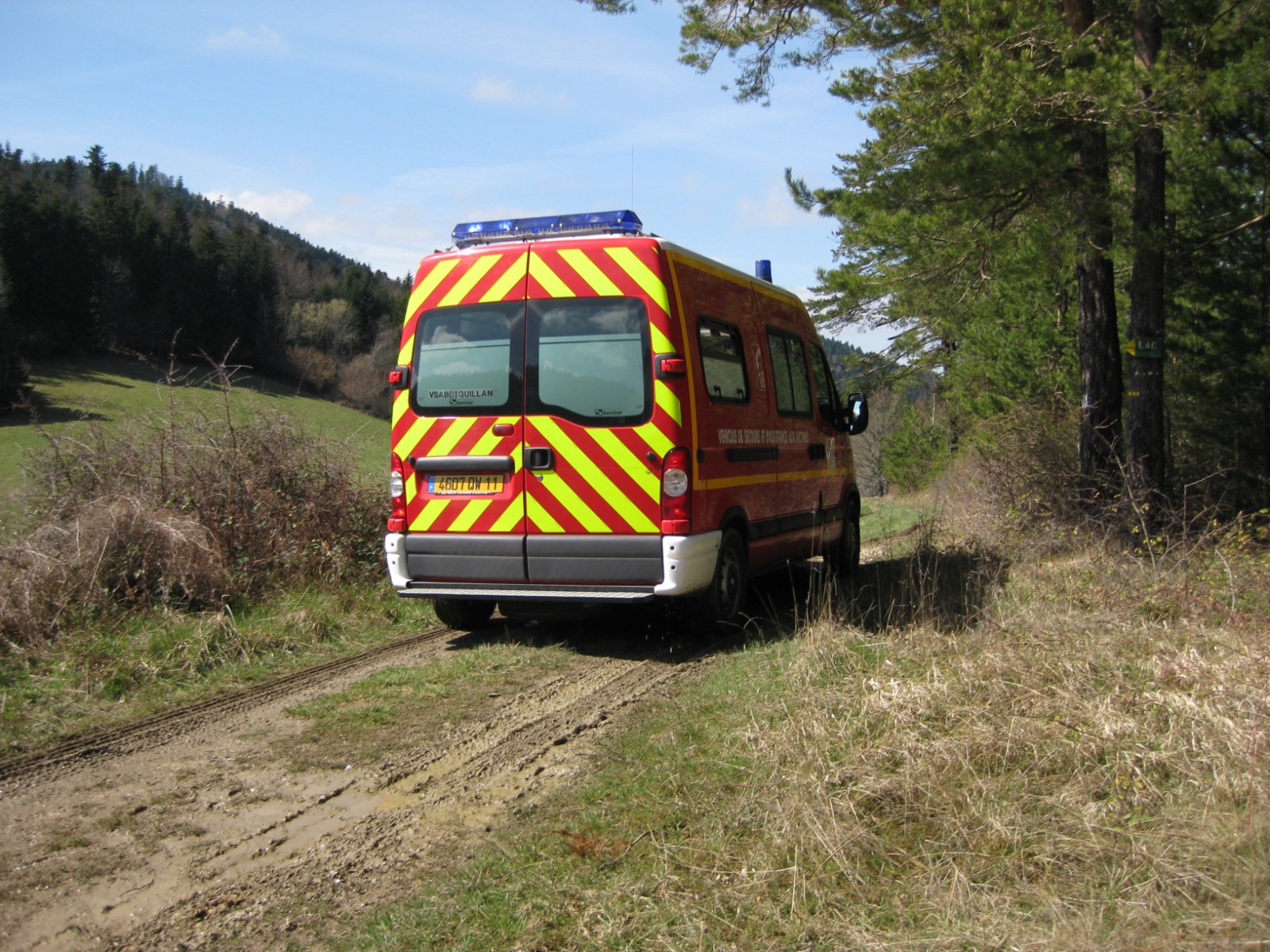
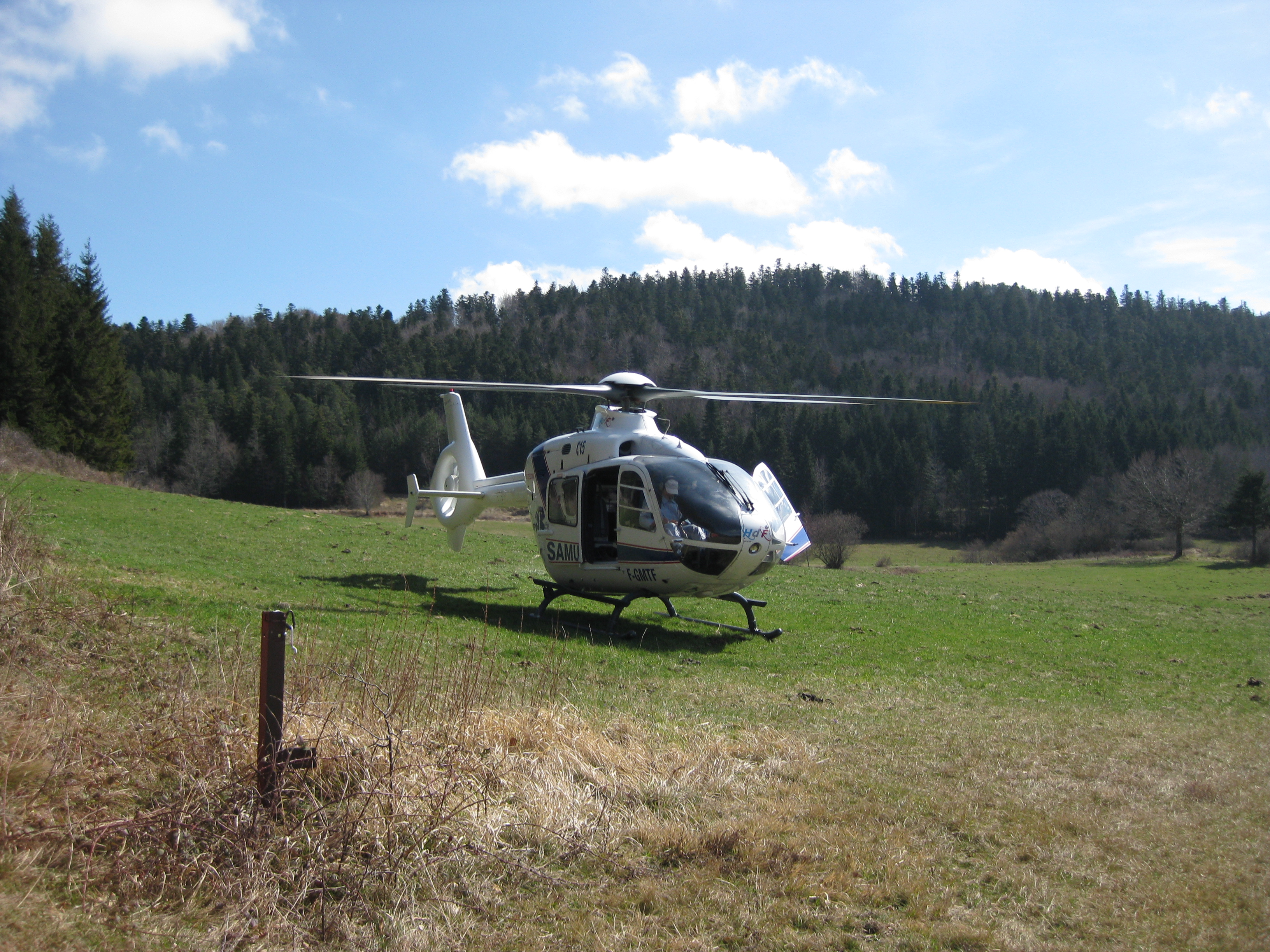
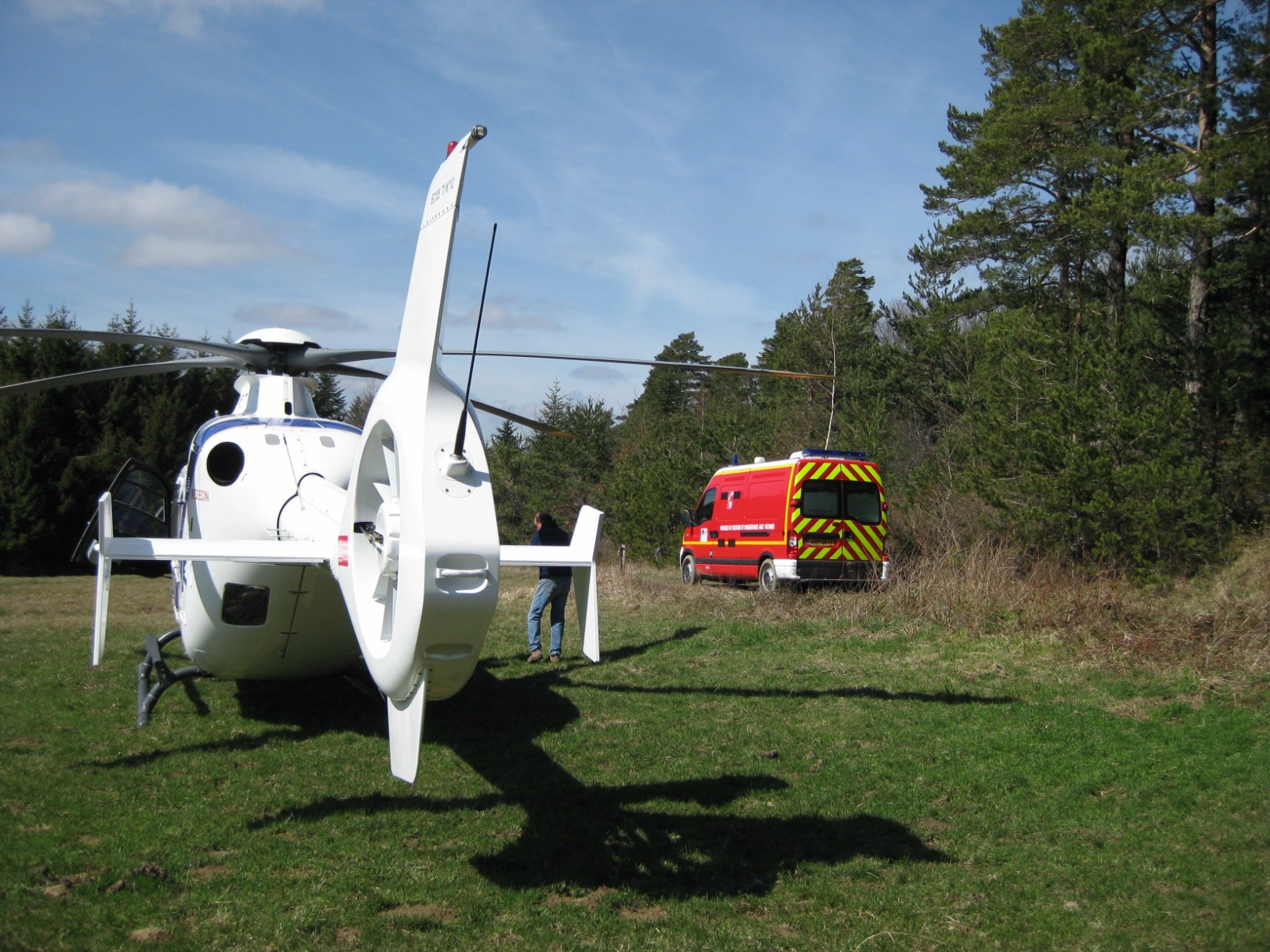
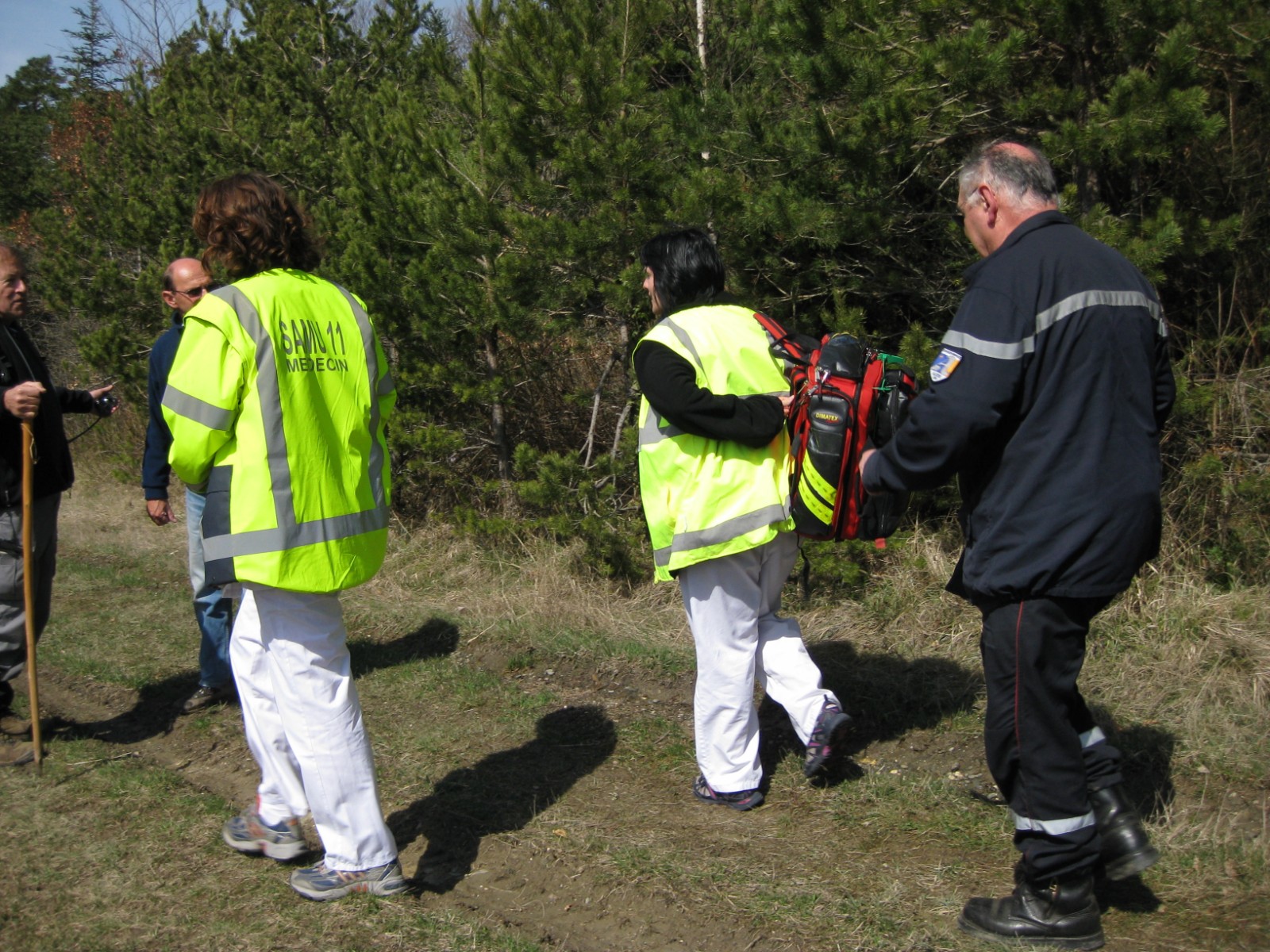
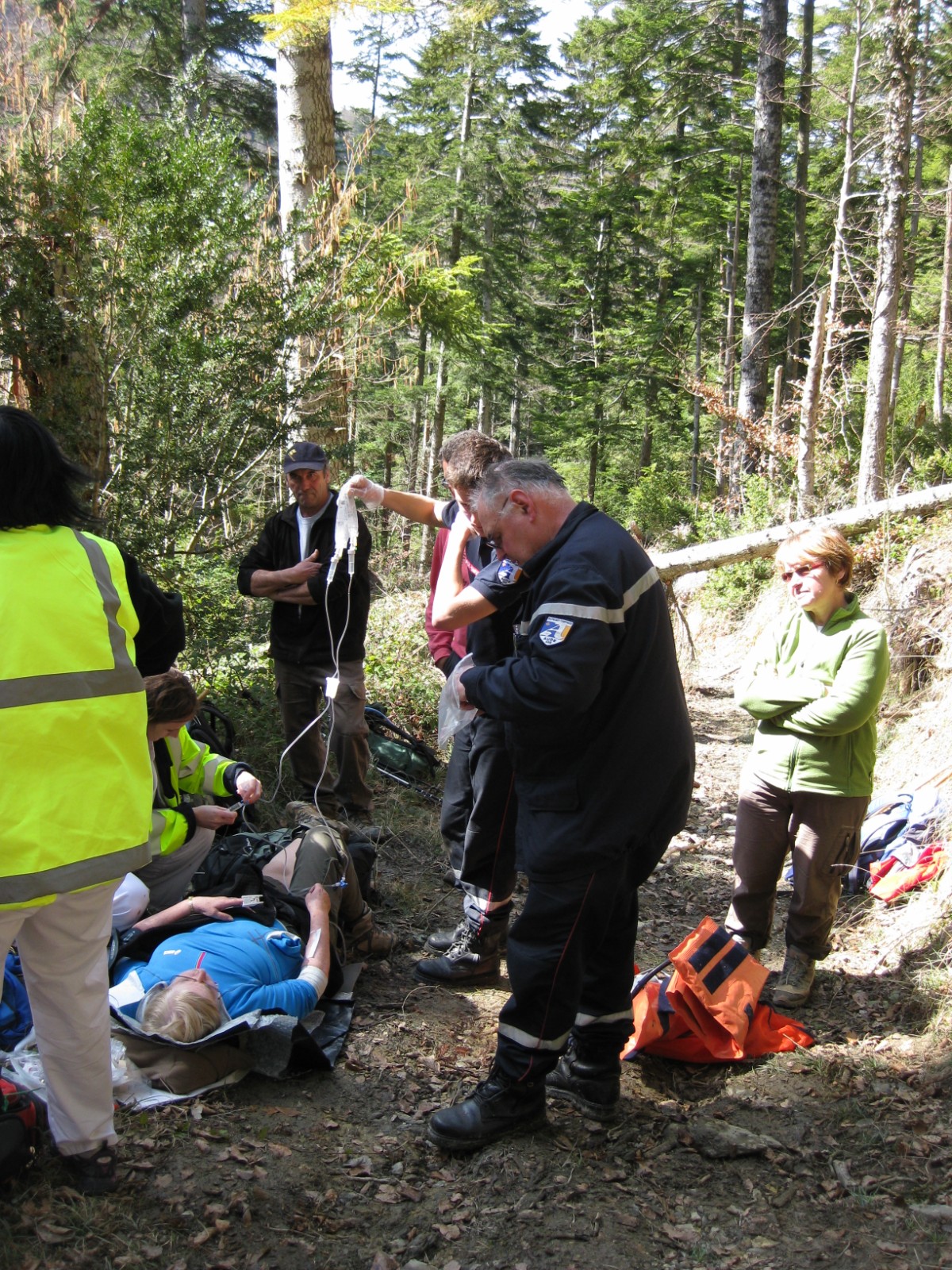
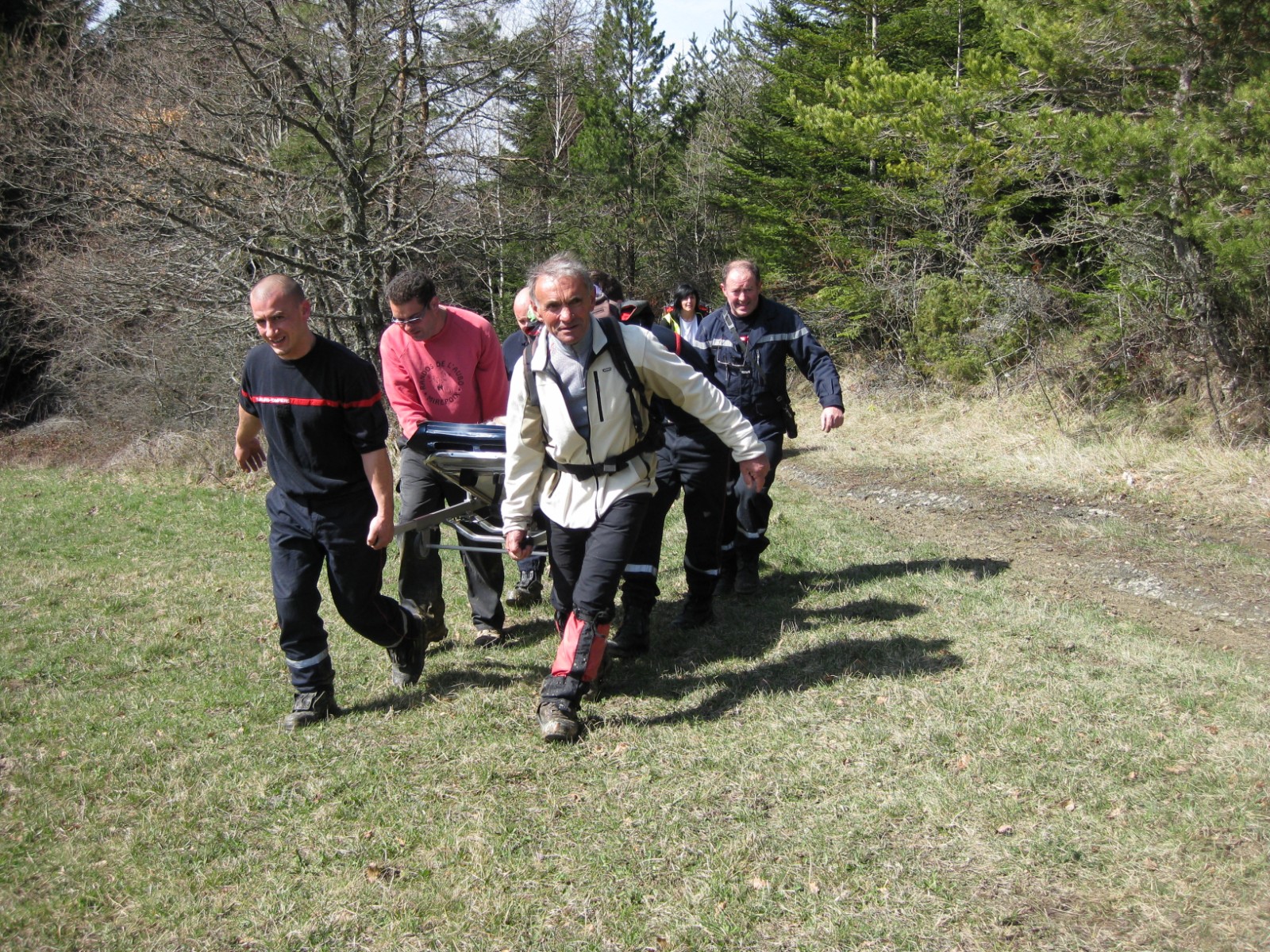
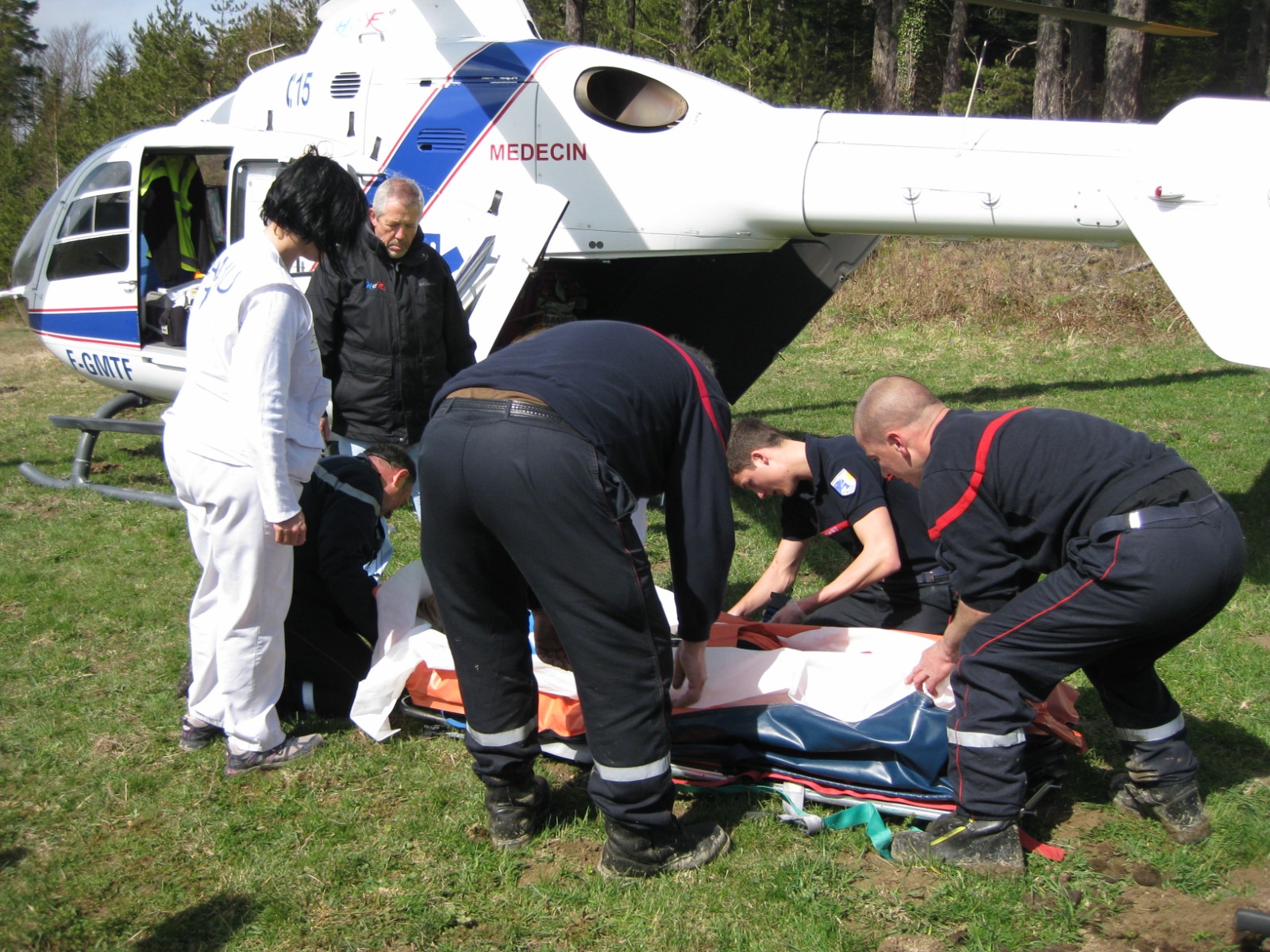
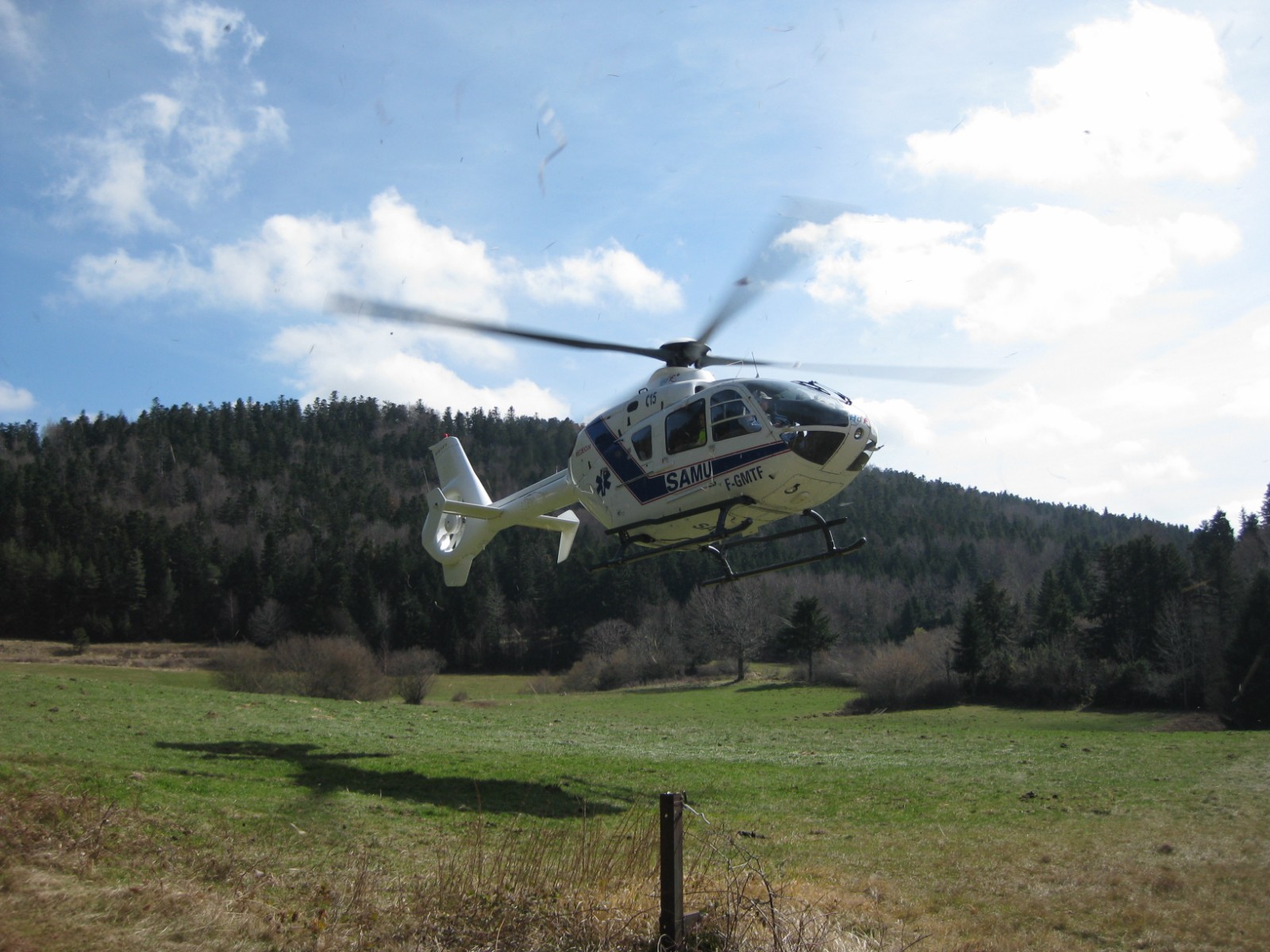
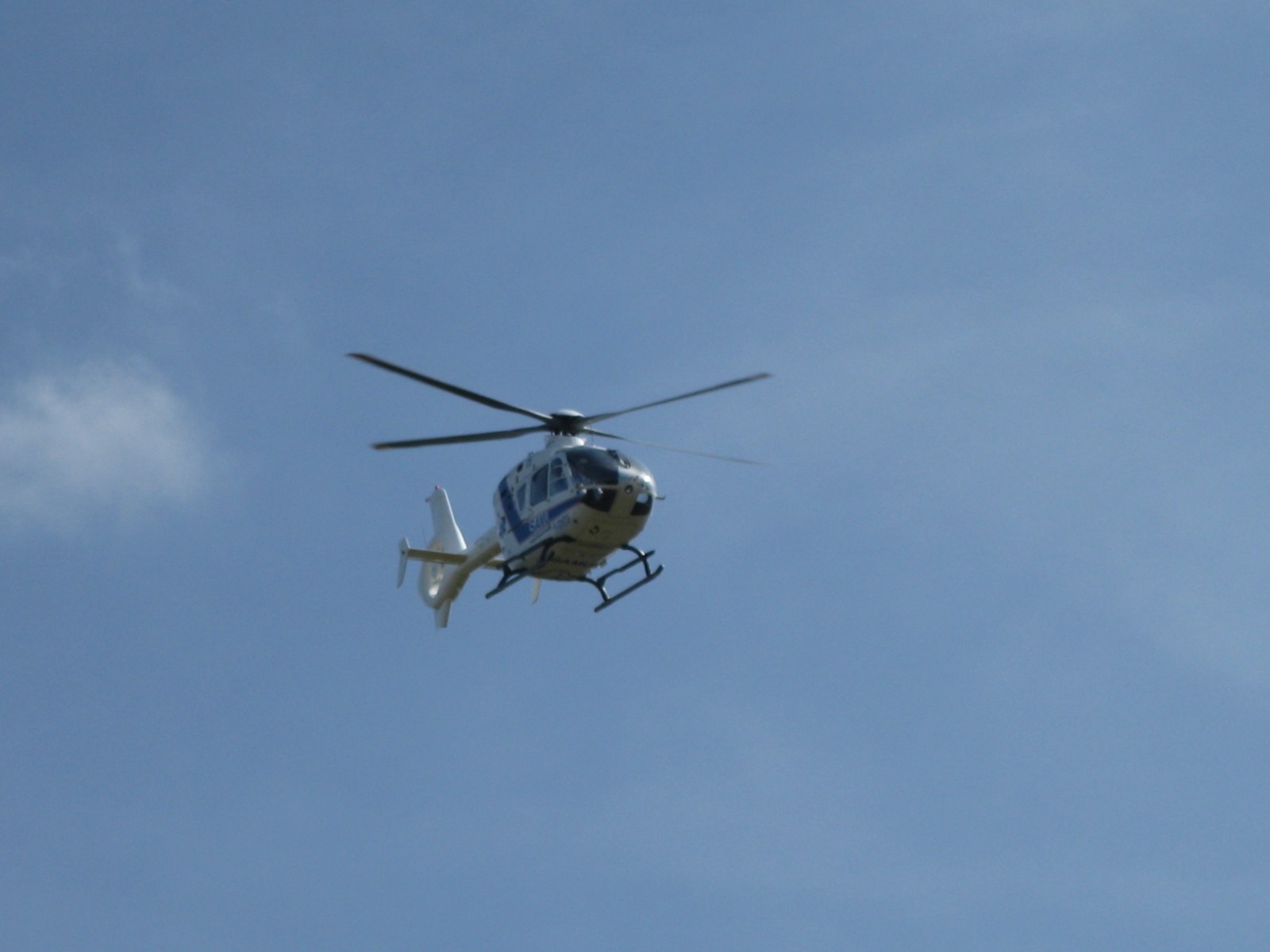
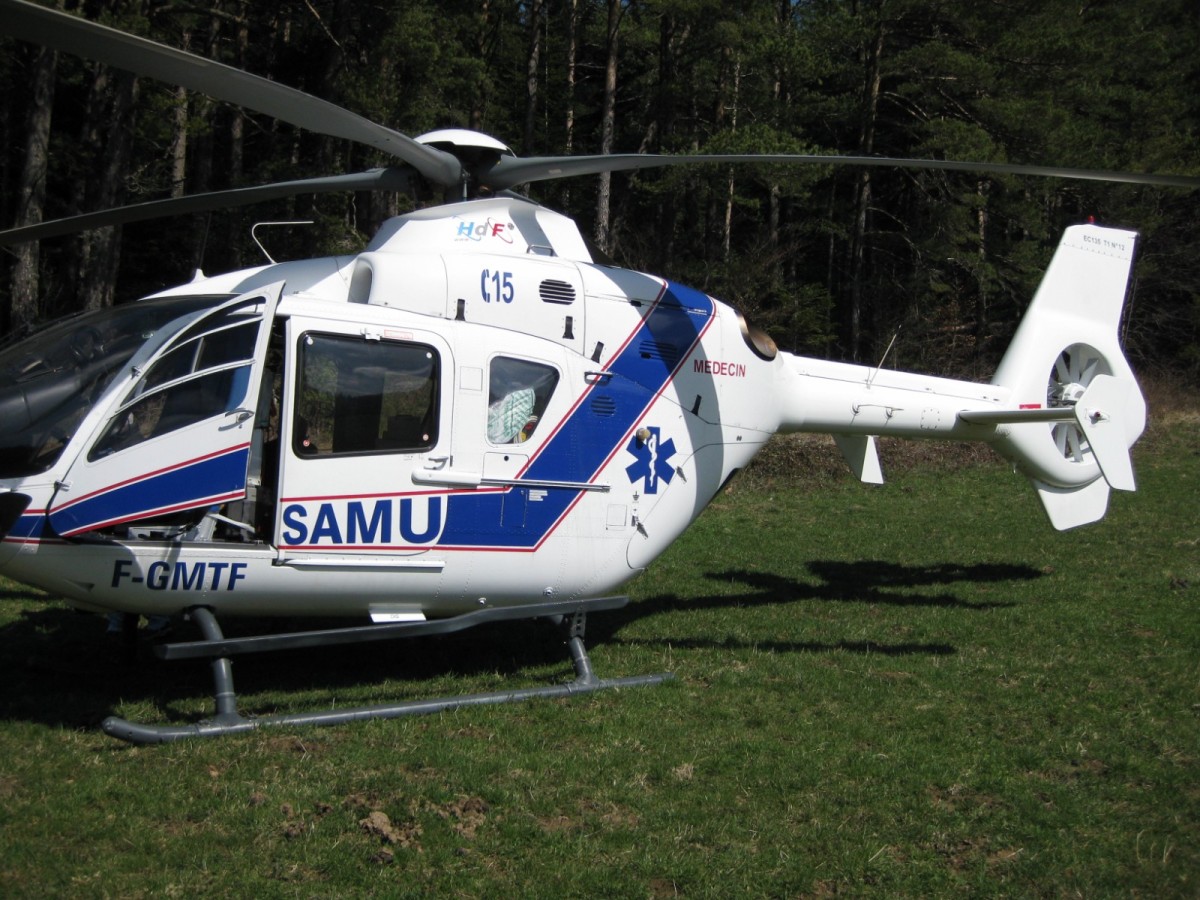
Pretty quickly, it became exciting. We were fairly inaccessible, though not as badly so as we might have been, considering we were almost at the top of a (smallish) mountain: because there was, for the first time that morning, open land nearby. A bright red ambulance service 4×4 came into view, then an ambulance, tossing about on the rutted track. The sapeurs pompiers had to walk down into the woods, carrying all their equipment and a stretcher, to see Micheline, who was now in quite a lot of pain. Then – wow! A helicopter air ambulance hovered overhead, looking for a landing spot.
The pictures show the efficient and organised crew. (11 of them, sapeurs pompiers, nurses, pilot) doing what they had to do in muddy, dirty conditions to get Micheline sedated and sorted and ready to be air-lifted to Carcassonne Hospital. They don’t show the 4×4 being ignominiously towed out of the mud by a local farmer.
Despite our compassion for Micheline and the acute pain and discomfort she was in, we were quietly excited to be part of such a drama, the first apparently, in Rando del’Aubo’s long history of weekend walks. No news from Micheline yet: but she won’t be at work tomorrow.
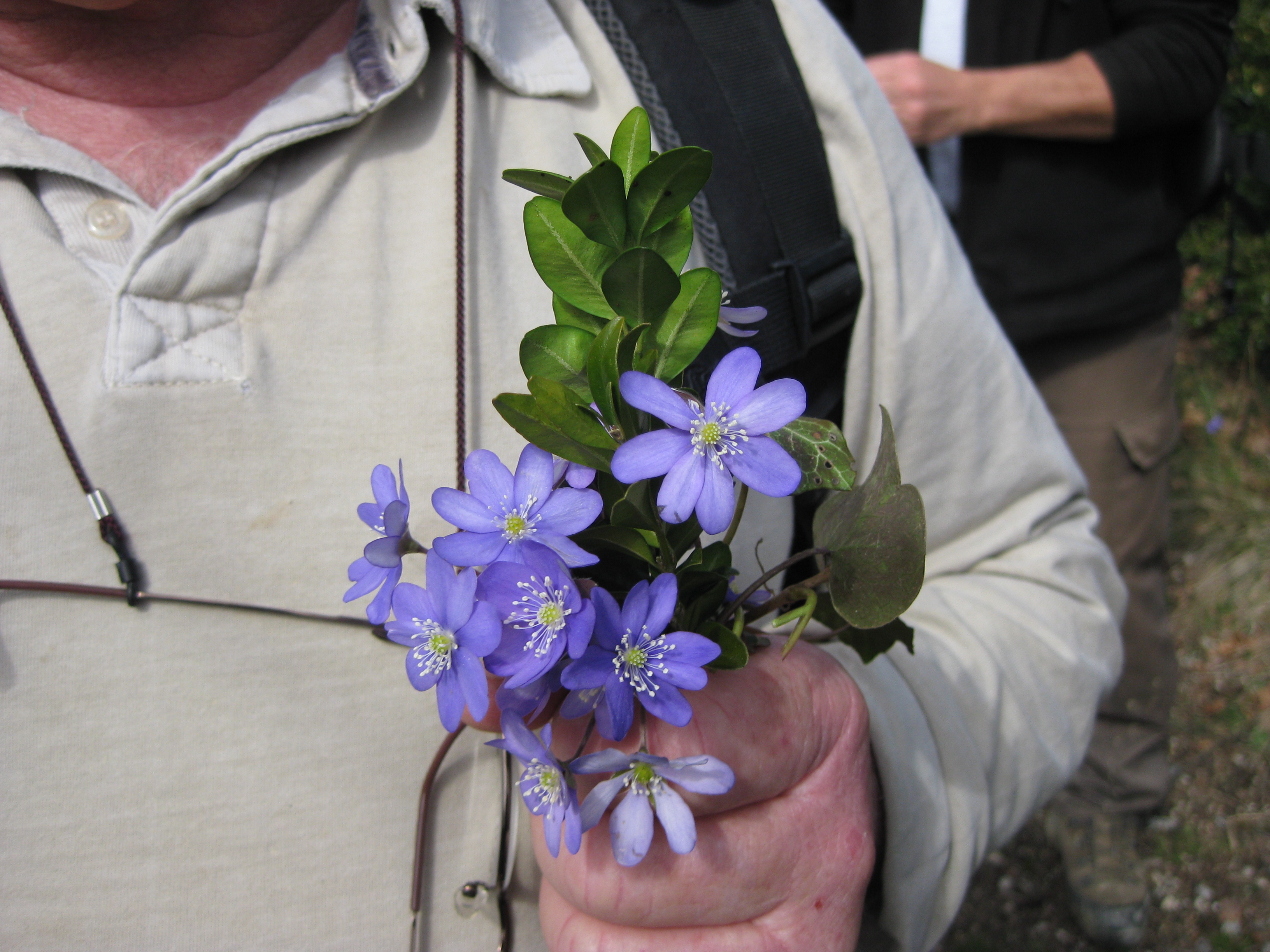
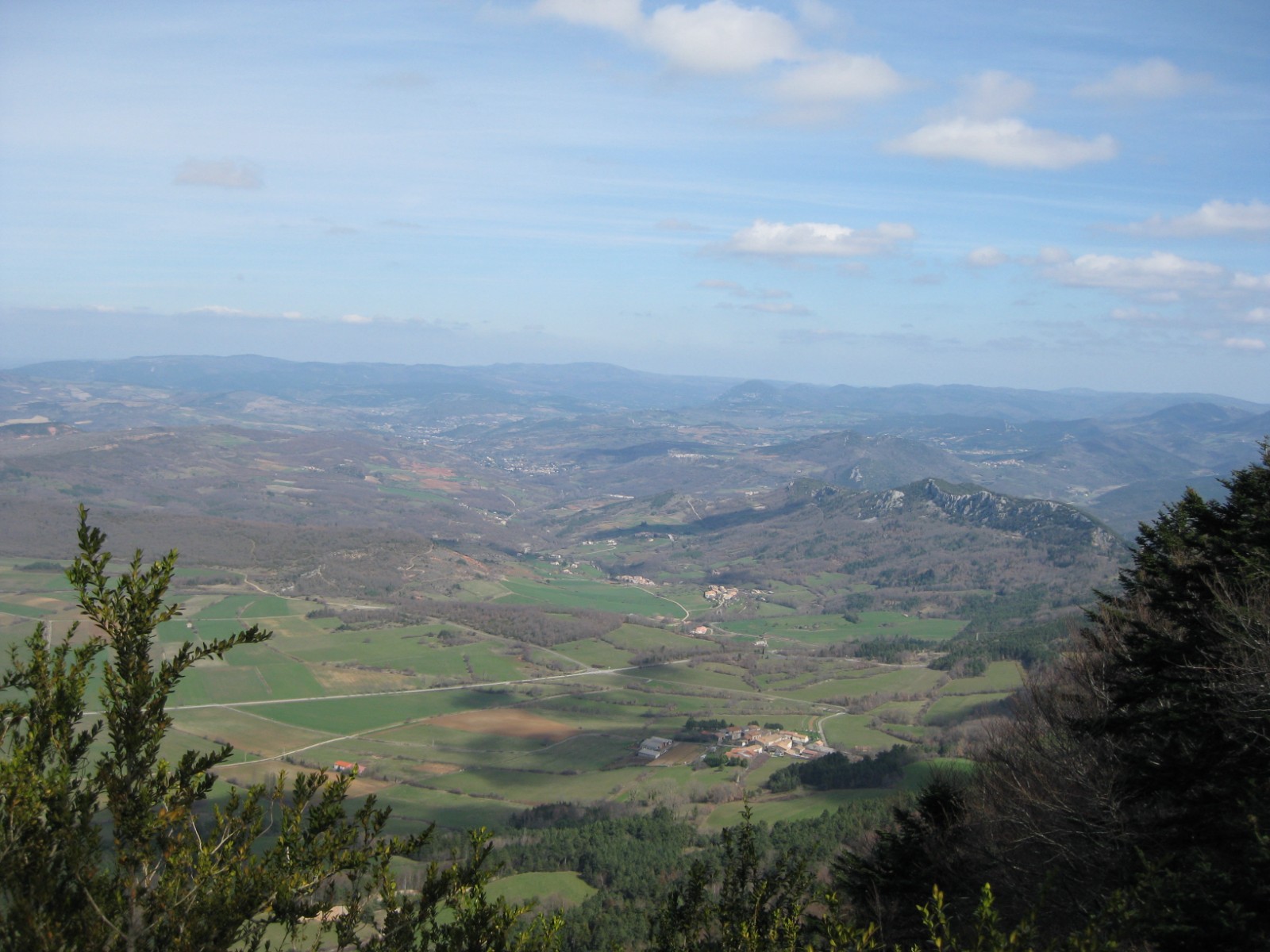
That was all I wrote in the immediate aftermath of the accident. In fact, Micheline -who worked in a shop – was never fit enough to return to an on-your-feet-all-day job. The French Ramblers’ Association argued for months about whose insurance should pick up the tab for the helicopter call-out. It was all a sorry mess, and I’ve thought twice since then about venturing to out-of-the-way places for a solitary walk.
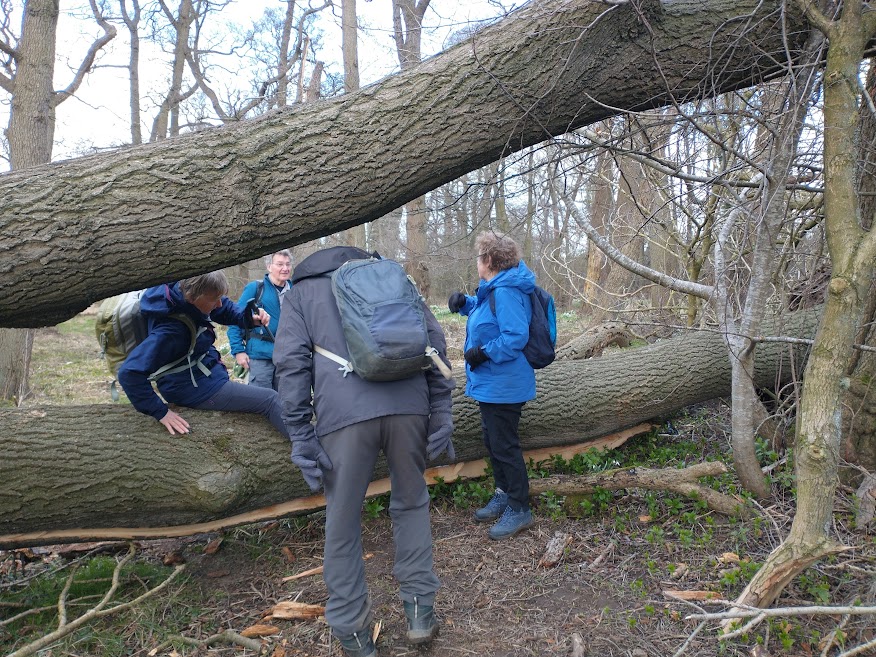
A lovely walk with friends: up hills, down dales, along two rivers – the Burn and the Ure – and finally, through woodland. Storm Otto had got here first. Look what was across the path.
For Brian Bushboy’s Last on the Card.







You must be logged in to post a comment.