Postcards from Catalonia

We’ve just got back from our weekend on the other side of the Pyrénées, and I’ve decided to post these ‘postcards’ to show a few happy days in Sant Cugat del Vallès, the very attractive town where Emily is now working; the not-Hallowe’en-but- la Castañada festivities; and a relaxing weekend.

Eating and drinking were important.  Straight away, as we drove across the mist and rain shrouded Pyrénées from France, there was a decision to be made. Lunch on this side of the border?  You can’t get fed much later than 12.30 here.  Or wait till Spain?  Nothing there is open much before 2.00 p.m.

We arrived in Catalonia just in time for la Castañada. Instead of Hallowe’en, they commemorate All Souls’ Tide. Roasted chestnuts are sold wrapped in cones of newspaper with roasted sweet potatoes and peddled from impromptu stalls, or by excited groups of children.  Panellets are mashed potato, sugar syrup and ground almonds – maybe cocoa or dried fruits too, rolled in pine nuts and briefly baked till the nuts turn golden. It sounds odd, but they’re delicious accompanied by a shot of strong black coffee.

Coffee shops, with tables outside so you can enjoy the late October heat seem to be in every street, and we adjusted our bodies to Spain’s very different rhythms. Food generally seems cheaper in Spain.  A pleasant pause for breakfast, after taking the children to school, after shopping or work, or just because it’s a nice idea and the sun is shining is an affordable treat, and cafés don’t seem to struggle for custom.  Nor do lunch-stops.  As in France, the 3 course lunch with wine and coffee is on offer in most restaurants, but cheaper here.  And it’s a leisurely affair.  We found ourselves spending an hour or two every day that we were there over the lunch table, eating, talking and simply people-watching.

Shopping seems less anonymous too.  Whether in St. Cugat, or city-centre Barcelona, greengrocers and grocers, wine merchants and bakers – especially bakers – all seemed to be doing brisk business.  The out-of-town supermarkets are there alright, but so far, they don’t seem to have won.

So here are my postcards.  Have a glance at them over a lazy cup of coffee.

This slideshow requires JavaScript.

The stars from HelpX

Despondent about your DIY? Ground down by your garden?  Then HelpX can help!

Its website says it’s ‘volunteer work in exchange for free accommodation and food on farms, backpacker hostels, lodges, horse stables and even sailing boats’.  Or even places like ours, apparently.

For the past 10 days, we’ve been sharing our home with HelpX-ers Vicki – Australian – and her English husband Marc.  It was a success from the very moment they landed outside our house with their laden motorbikes, fresh from working in Carcassonne and northern Italy.

Since they arrived they’ve rolled up their sleeves and cheerfully tiled and grouted most of our very awkward roof terrace, painted a stairwell, wrestled with brambles and ivy on the garden, solved computer problems…. and commandeered the kitchen.

Vicki and Marc travel the world, and many of their memories seem to be food related.  So they’ve cooked southern Asian dishes like sang choy bow & gado gado and Vicki’s wonderfully decadent and not-at-all Asian chocolate mousse: recipes to follow in a later blog.  The other evening – their final night – was the occasion for an ‘Asian tapas-Smörgåsbord’ of a dozen dishes masterminded by Marc.

Our memories of the week are of a happy, optimistic, funny and considerate couple who’ve worked hard and enthusiastically on our behalf, and whose company has been nothing but a pleasure.  We miss them.

From the northern US to southern France: Blue Lake International Jazz Band

If you’re young, American, and living in Michigan, and if you like performing, you may be lucky enough to spend part of your summer at the Blue Lake Fine Arts Camp, a summer school of the arts located on a 1300 acre campus in the Manistee National Forest.  If you’re really talented and work hard, you may one year be selected for one of the 8 or so ensembles that have been coming over for a European tour every year since 1969.

And if you live in Europe, you may be lucky enough to live in one of those towns that welcome these young people. Here at Laroque, we’re among those fortunate people.

The Blue Lake Jazz Ensemble first came here 2 years ago. Their director, David Jensen, and the leader of our own LDO Big Band, Michel Alvarez, hit it off.  So when plans for this year were under way, both men were keen to see Laroque included in the itinerary.

But what an itinerary!  The band landed in Paris on 17th June.  From Elbeuf in Normandy, they passed through Belgium to reach Germany, Denmark, Germany again, then Austria.  Then they travelled 1588 km to reach Laroque d’Olmes, a coach journey that took a whole 24 hours.  After staying with us, they were due to travel overnight to Paris and the plane home on July 9th.

Party at the Château

They might have been tired, punch-drunk with cultural variety and new experiences, but they had to be welcomed with a party.  It was here they met their host families.  What would two 16 year old boys make of the fact that they got to stay with us instead of a French family?  Pleased, as it happens.  Grappling with unknown languages – French, German, Danish over 3 weeks or so takes its toll.  At least we were a bit of a rest.

The concert on Thursday evening was what we were all looking forward to.  Well, not me so much.  Malcolm had provided translation and interpreting services last time, so this year, he thought it should be my turn.

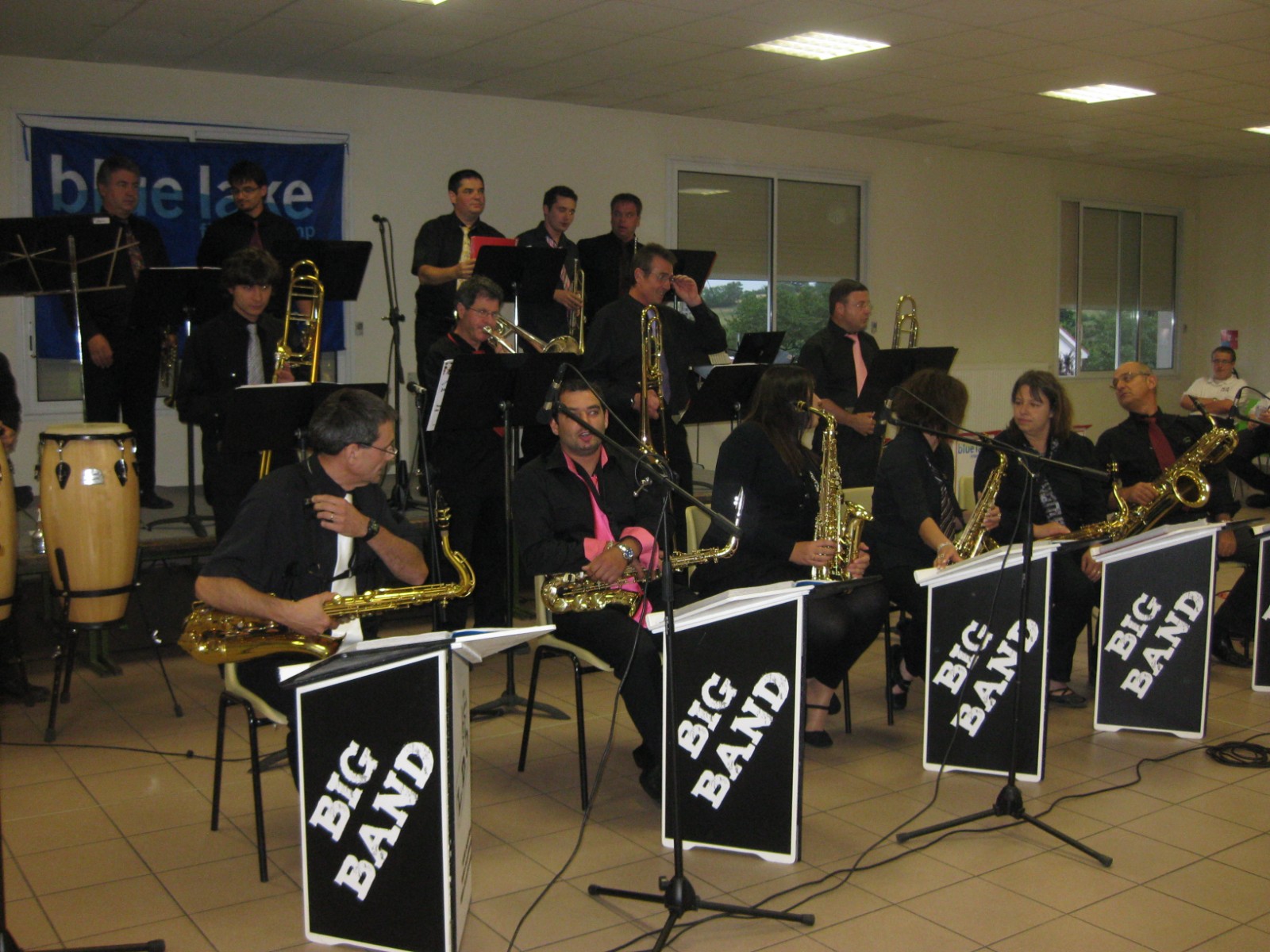
LDO Big Band get ready to play
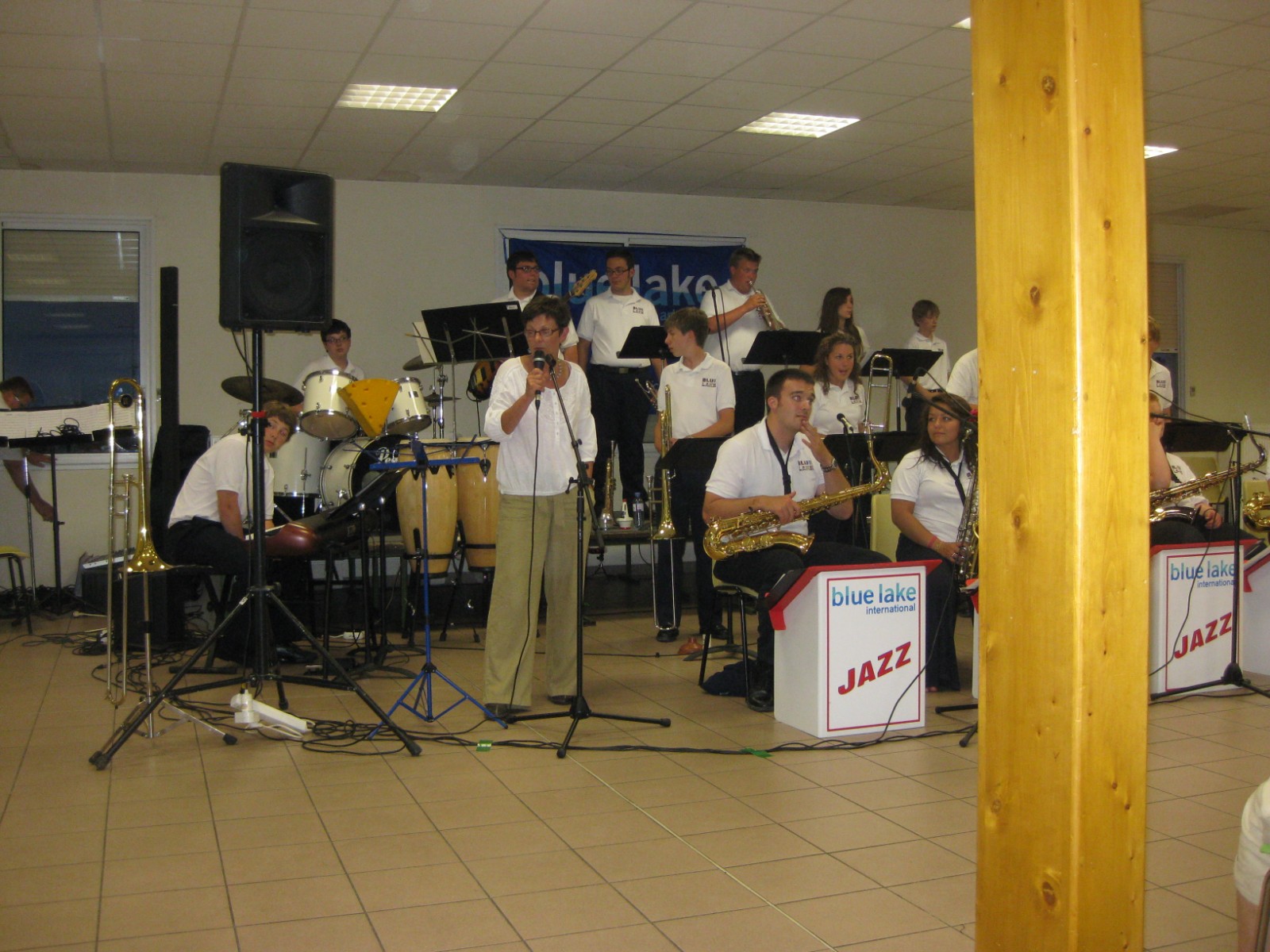
Translation services in full swing

All went well at first:  I’d seen Michel’s speech in advance, and David’s response contained no surprises. But when it came to introducing the pieces….well…what IS the French for ‘Dance of denial’? Or ‘Struttin’ with some barbecue’?  We decided the titles didn’t matter; I bowed out, and then discovered the remaining repertoire was quite translatable, thank you.

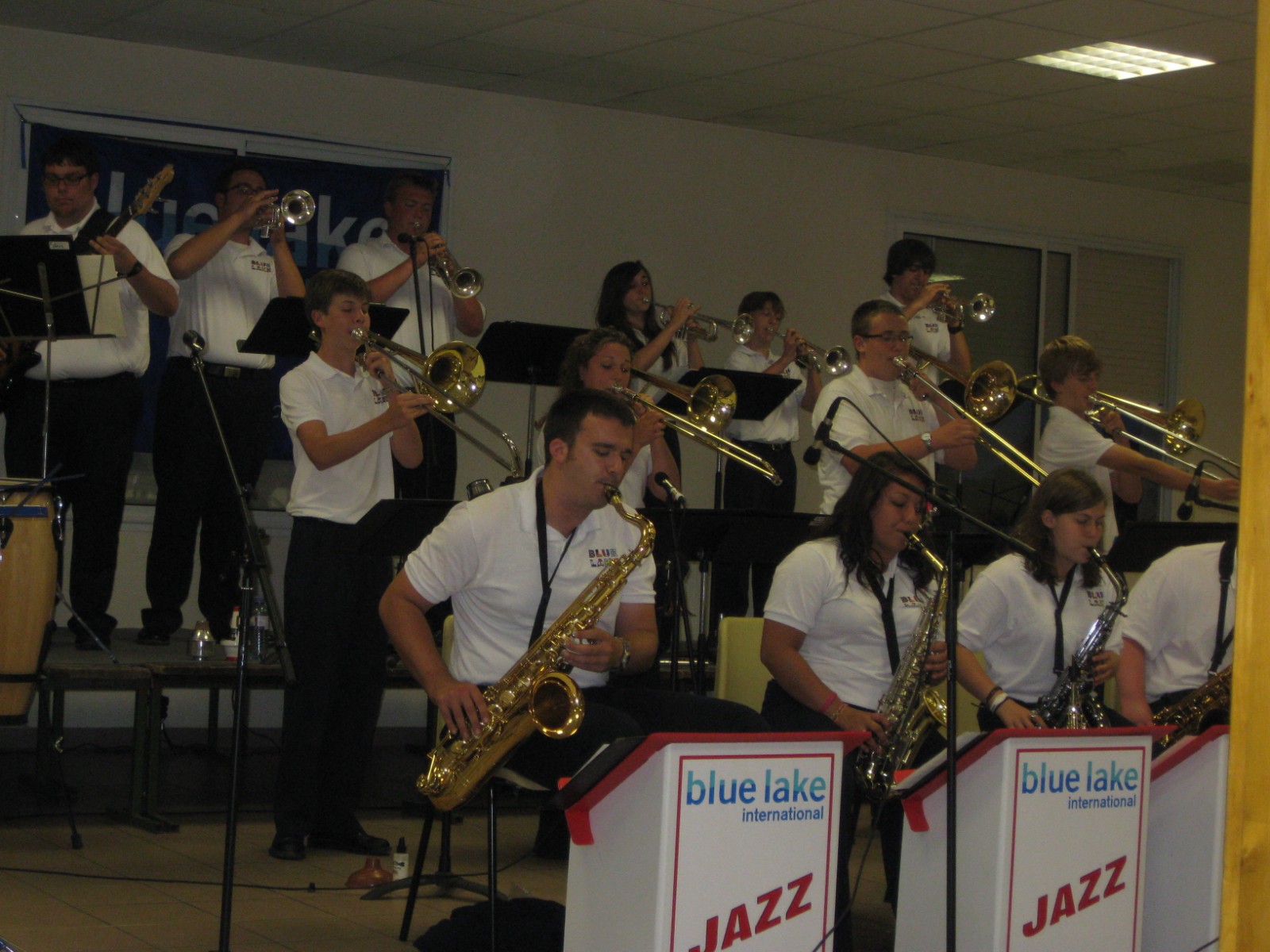
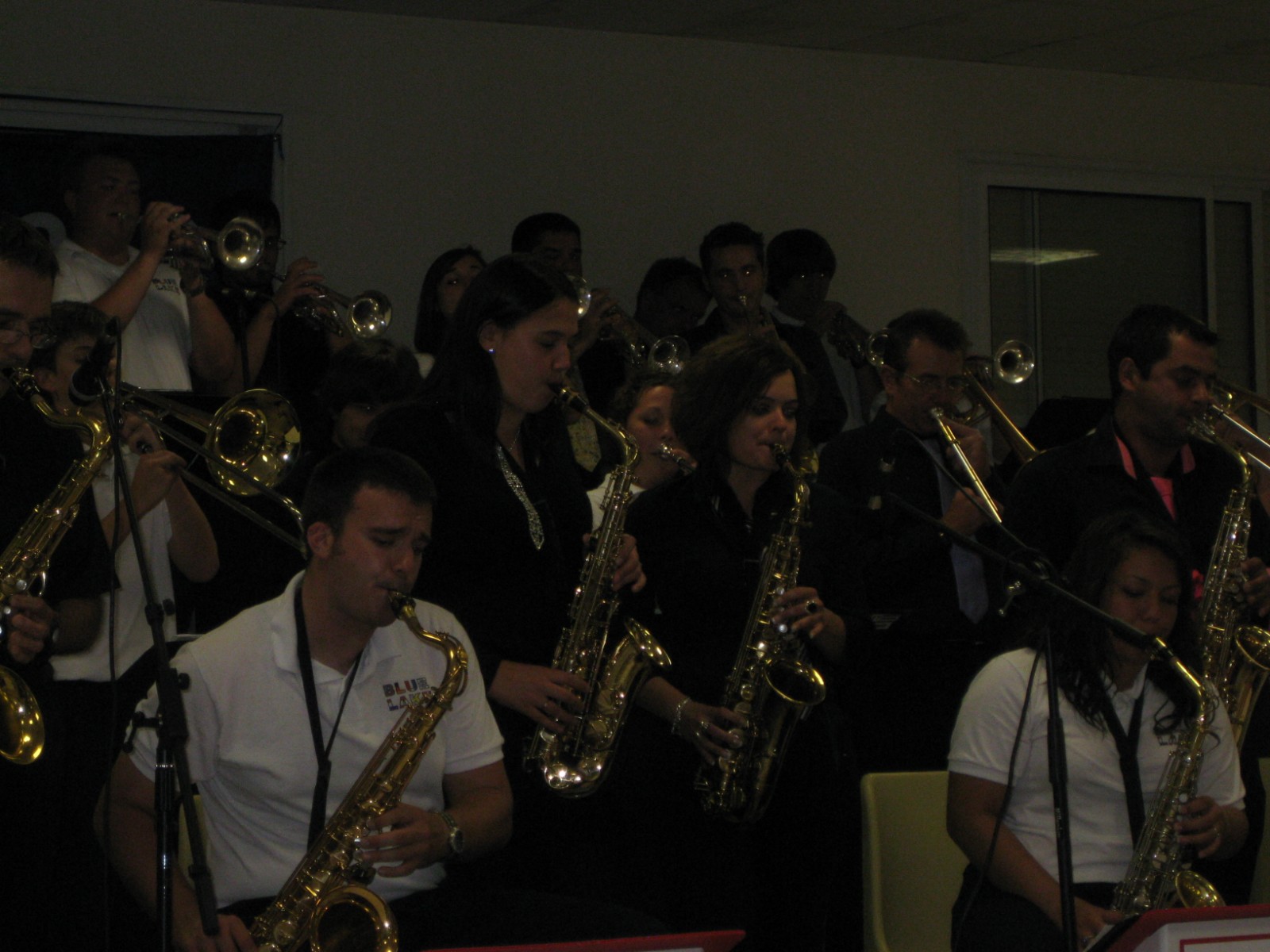
Blue Lake Jazz Band

But those Americans!  The performance they turned in was exciting, exhilarating, excellent, extraordinary.  Impossible to believe that some of the group were only 13, and that few had left High School.  They’re so professional.   LDO Big Band was on form too, so the high spot of the evening was when the two bands came together to perform.  Their pleasure and pride in working together communicated itself to an already delighted audience, and the evening ended on a high for us all.

The two bands squeeze together to play

This opportunity to play together is apparently what makes little old Laroque worth the detour for the Blue Lake musicians: it’s not something they do elsewhere.  They’d like to send a different band our way next year, David’s year off.  It seems Laroque is now firmly on the Michigan map.

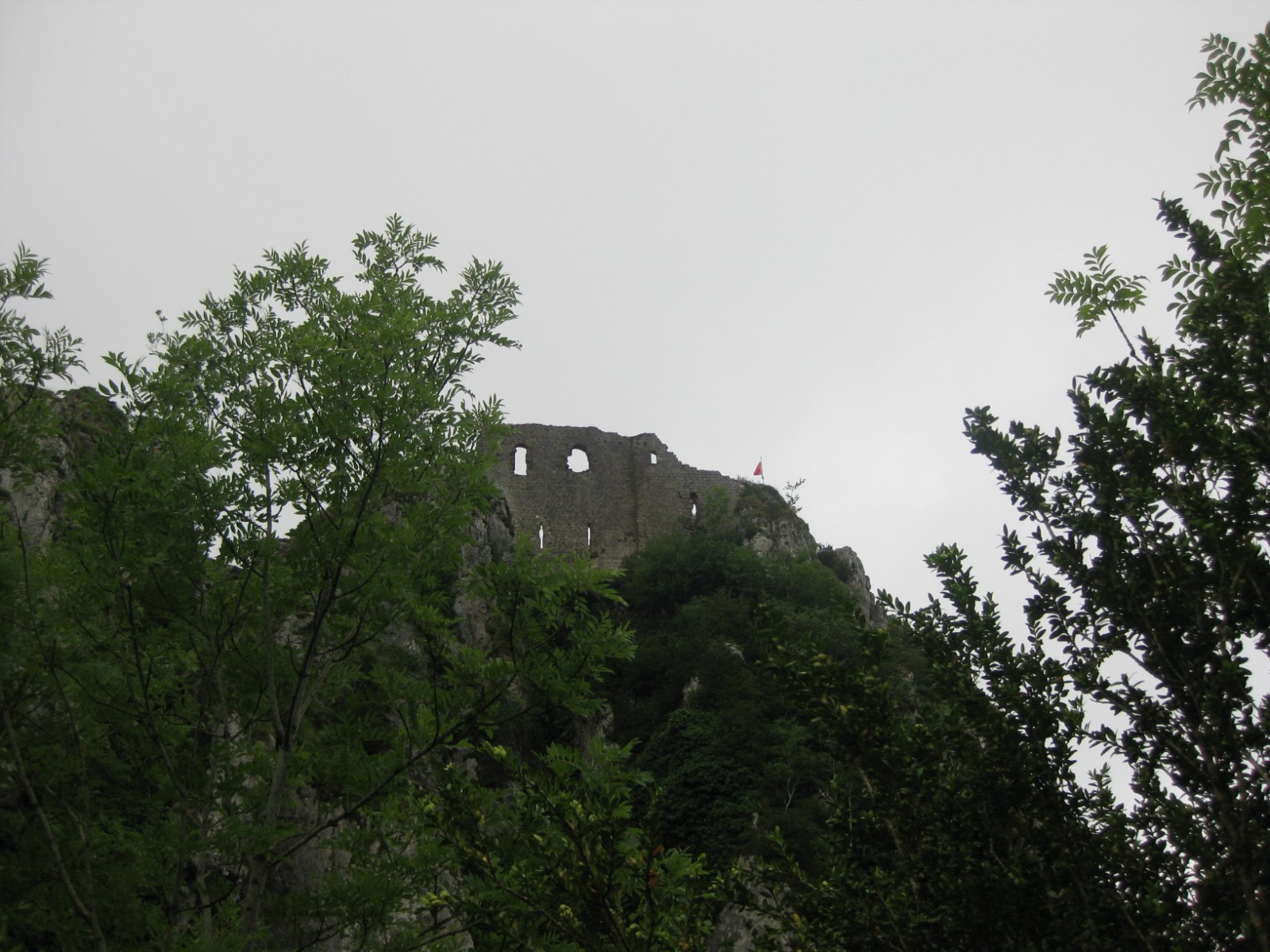
Roquefixade……
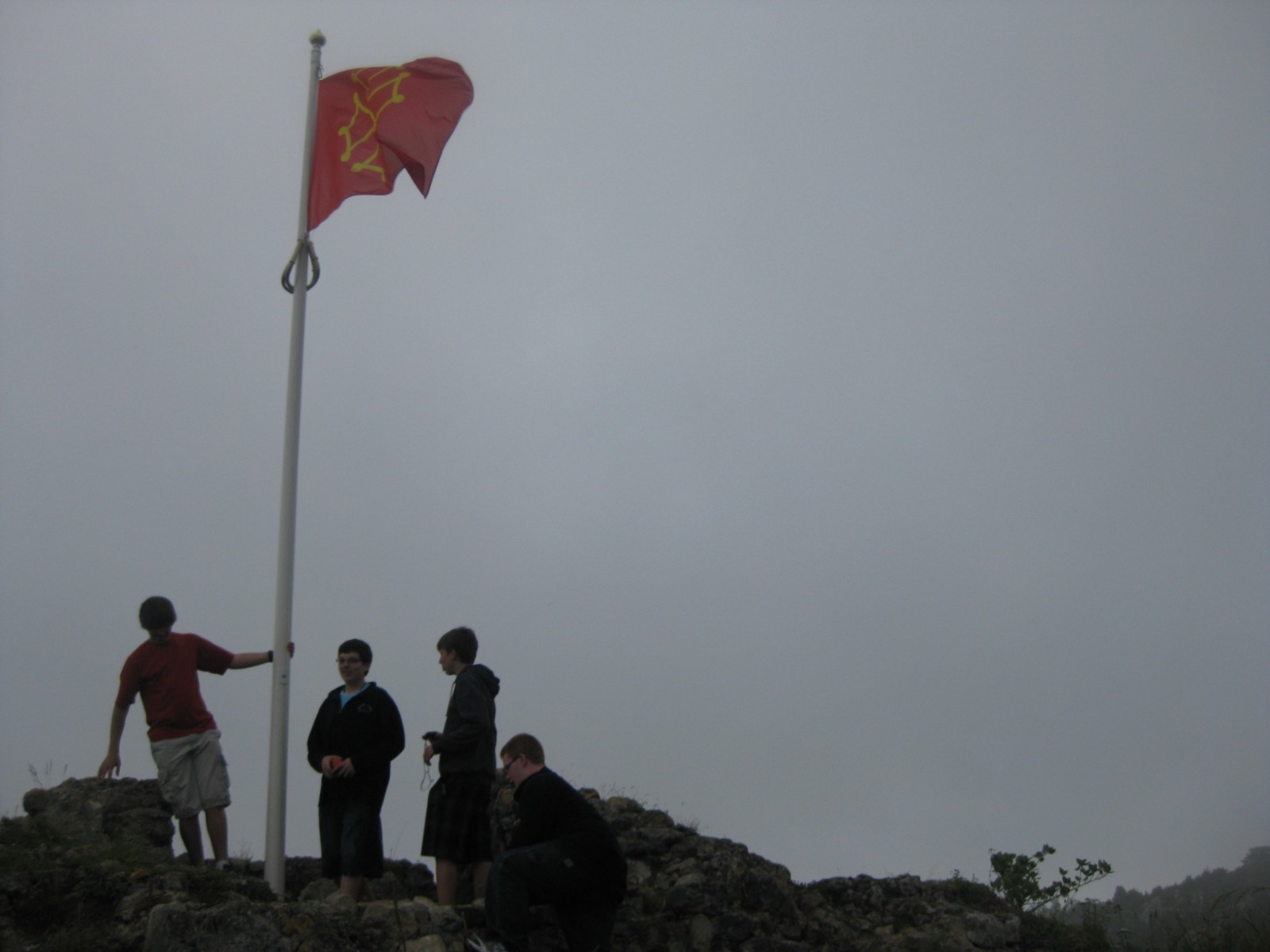
…. conquered by our American guests

The rest of the stay was given over to sleep, lots of it, and sightseeing, rather less of that.  We climbed Roquefixade to see a ruined castle, and took in the medieval town of Mirepoix. Others had different days-of-yore experiences:  Foix and Carcassonne.

The trip ended on a sad note though.  One of the group had lost her passport, and despite every effort, it couldn’t be replaced in time.  She’s still here.

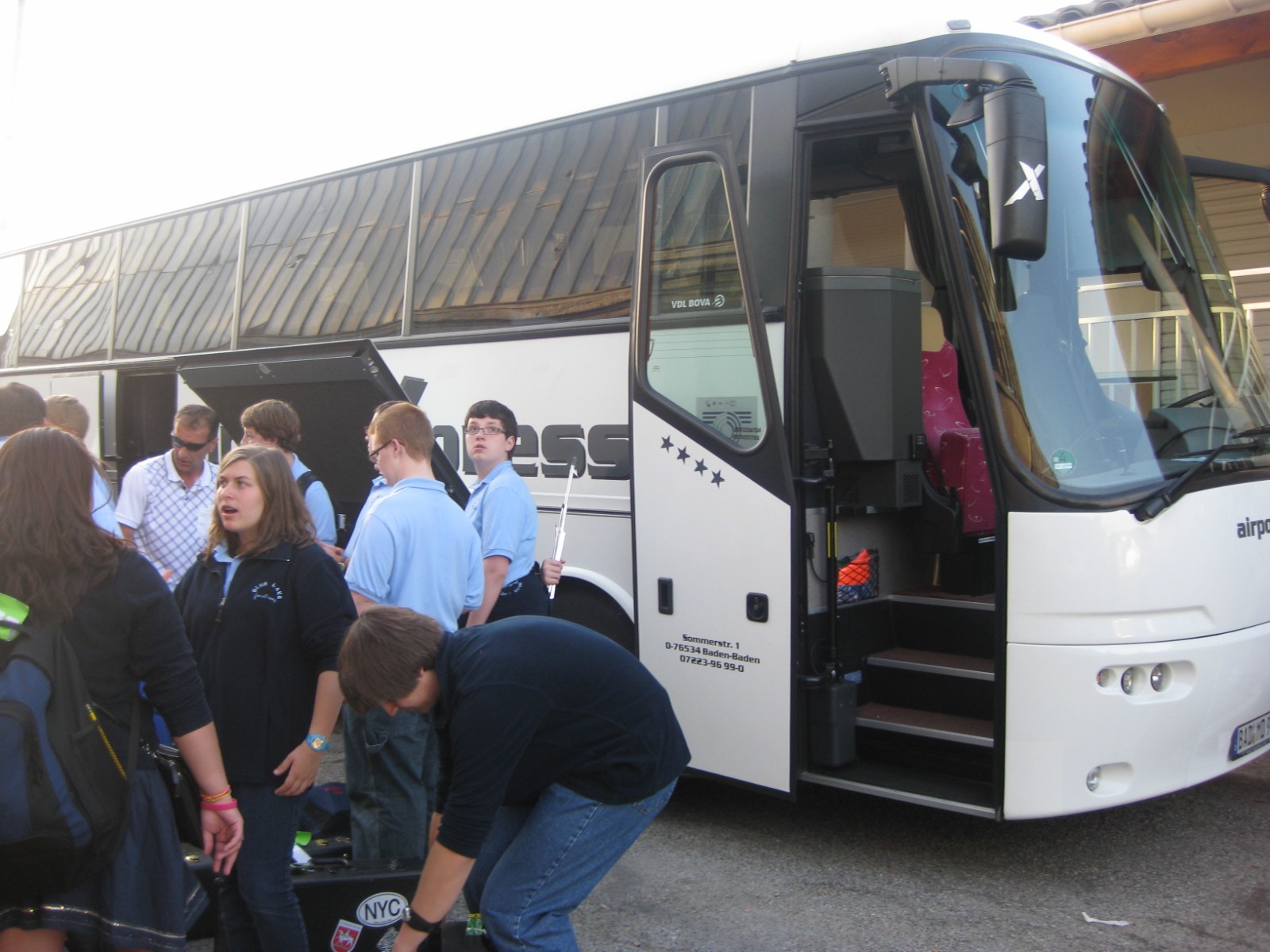
Loading the bus for departure

Andorra

Tell most Ariegeois that you’re going to Andorra, and they’ll assume you’re popping over to stock up on hooch, cigarettes, cosmetics and cleaning products, then fill the car with as much petrol or diesel as it’ll hold.

The Principat de les Valles de Andorra is a little historical oddity.  It’s a Catalan speaking independent country, only 468 square km., slap in the midst of the Pyrénées between France and Spain.  It was, since 1278, co-ruled by the President of France (as the Count of Foix is no more) and the Bishop of La Seu d’Urgell in Cataluña.  In odd numbered years, France receives tribute money, and in even-numbered years, the Spanish bishop calls in 900 pesetas (or the euro equivalent, I suppose), 12 chickens, 6 hams and 12 cheeses. 1n 1993, the Andorrans voted for democracy and a constitution- but those tributes still get paid.

What makes Andorra popular, here in the Ariège as elsewhere in France, is its lack of taxes.  Petrol therefore costs something like 40 cents a litre less than in neighbouring France, and you can buy 3 new car tyres for the cost of two here.  And so on.  So Andorra’s border towns are nothing more than huge unpleasant shopping malls, blighting the slopes of the wilderness Pyrénées on which they’re situated.  The capital city, Andorra le Velle, and the surrounding towns which have become its suburbs, are given over to little other than retail therapy.

In other words, not really our cup of tea.

Andorra, though, offers so much more.  Zig-zag up the narrow mountain roads only a few kilometres away from the capital, and you’ll be alone amongst grand peaks, dense forest and craggy paths.  Apparently, the further you travel from the capital, the wilder and more spectacular the scenery becomes.  Tiny villages remain undefended by castles: the circumstances of its past government meant castles were forbidden.  But charming Romanesque churches, often with original frescoes, are common throughout the country.

Henri and Brigitte invited his cousin and wife and us, to join them on a mid-week break at an Andorran hotel they’d chanced upon a few months ago.  Henri doesn’t do bargain basement, so we were surprised when he told us that full board at this 3 star hotel was 51 euros each.

Hostal La Font is in a tiny village, Os de Civis, clinging to the mountain side not, as it turned out, in Andorra at all.  It’s in Spain.  But it might as well not be.  The one road serving the community connects the village to Andorra la Velle and to nowhere whatsoever in Spain.  Out of season, 20 people live there.

It was busy when we checked in to the hotel though, just in time for lunch.  Vegetarians need not apply.  Before the meal, tomatoes, garlic, olive oil, dried sausage, olives all appeared on the table.  Then a hearty meatball-cabbage-chickpea-potato soup arrived.  Then a selection of salads and charcuterie.  Full yet?  I hope not.  There’s grilled lamb and 3 different sorts of grilled sausage with baked potato, and a large choice of puddings to come.  The secret of course is to help yourself to tiny portions of everything offered: that’s what I did anyway, because I knew there would be a 3 course meal in the evening, and Henri has a way of making sure that nobody does their own thing by skipping dinner – or even a course.

Anyway, after lunch, we all chose to stride forth into the mountains.  Henri’s cousin, Jean-Claude, has been a lifelong farmer, and made a great walking companion.  We learnt from him the grasses that any discerning sheep chooses, given half a chance.  He showed us how the local cows, a Swiss grey breed, have narrow agile hooves and legs to enable them to cope with climbing up and down the steep slopes of their summer pasture.  And he told us tales of transhumance: the days in spring and autumn when cows and sheep are taken up to high pastures for the summer, and down again in winter: for his sheep, each journey took three days.

Later, we explored the village.  Just as well the streets are equipped with handrails.  Steepest village I’ve met.  The dark local stone is the picturesque material both houses and streets are built from.  It might look pretty in the September sun, but life looks tough here, and I’m not surprised the village all but closes once the tourists go.

We’ll be back.  A walking week or so in these wild and empty mountains is a must, and hotels are affordable.  Anyway, the car needed 2 new tyres, and the money we saved by buying in Andorra all but paid for the holiday.

This slideshow requires JavaScript.

An Italian Interlude

We spent last week in Italy, Lago di Garda to be exact.  We joined daughter No. 1, her husband and twin boys for a camping holiday. It  was all we hoped for: time simply to enjoy being together; breakfast, lunch and dinner all eaten outside; the easy transitory friendships of campsite life; splashing in the pool with the boys; rowing or swimming – rather badly – in the lake; and the pleasures of small-town Italy – people-watching as we sat at some street side bar or restaurant with an ice cream, beer, or plate of pasta, and  exploring charming back streets or ancient churches.

Malcolm and I had it best though.  Not for us the tedious wait in crowded airport departure lounges for the journeys there and back.  We drove through France and Northern Italy, and had a taste of regions we didn’t know, but plan to know better.  Here’s a slide show of some of the places we saw: the Alpes de Haute Provence, little known gems such as Cremona, where Stradivarius came from, the Mercantour and Luberon National Parks. Best of all was a day spent in Mantova (Mantua).  Unlike Florence or Rome, it’s on few tourist itineraries, so it’s unspoilt, uncluttered.

It’s a town whose prosperous Medieval, Renaissance and Baroque mercantile past is told in every street in the city centre, as piazzas, churches and fortified buildings crowd together demanding attention.  The old city is surrounded by waterways which once were swampy rivers, were then extended and widened for defence, and are now pleasant open spaces for pleasure boats, wildlife, fishermen, and people who like us, simply wanted a cool walk at the water’s edge. Go there if you ever have the chance.

Just in case you think we had a totally idyllic week, you might like to know that on the way home, Saturday night in our particular bit of northern Italy proved to be a hotel-free zone.  The nearest we came to finding a bed was when I went to check out a faintly unpromising looking albergo in some very untouristy town.  I scuttled away when I realised it was certainly the local brothel.  We slept in the car.

This slideshow requires JavaScript.