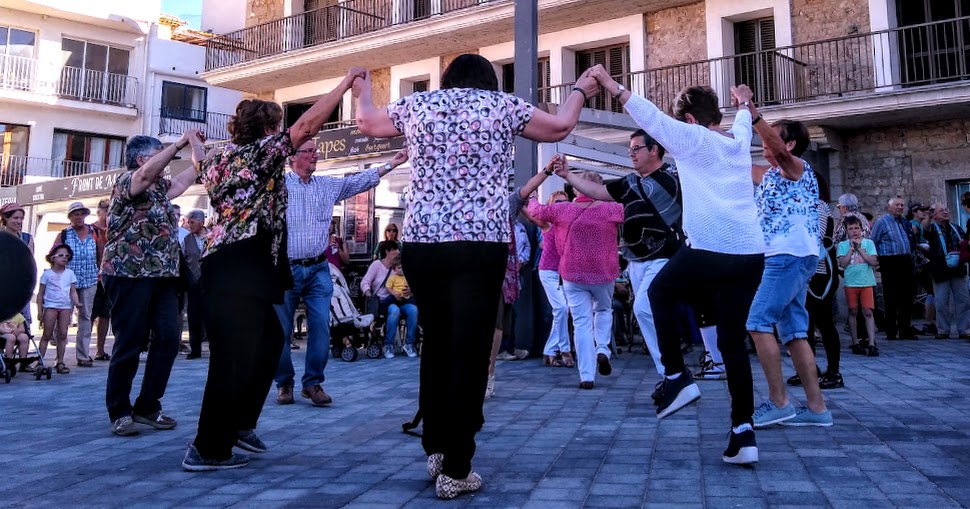
La Sardana is the traditional dance of Catalonia. It’s been around in one way or another since the 1600s, but really came into its own in the 19th century. Back in the fascist era, Franco did his best to ban it, as he tried to ban all forms of regionalism, or worse, independence. He suppressed the distinct languages within Spain: Catalan, Basque, Galician, with the result that they have now sprung back stronger than before.
Anyway, la Sardana. It’s a circle dance, with men and women, neighbours, friends, strangers joining hands, moving slowly in a circle following the fairly complex foot moves of the leader. When the circle starts getting too big, a second circle starts, then a third ..
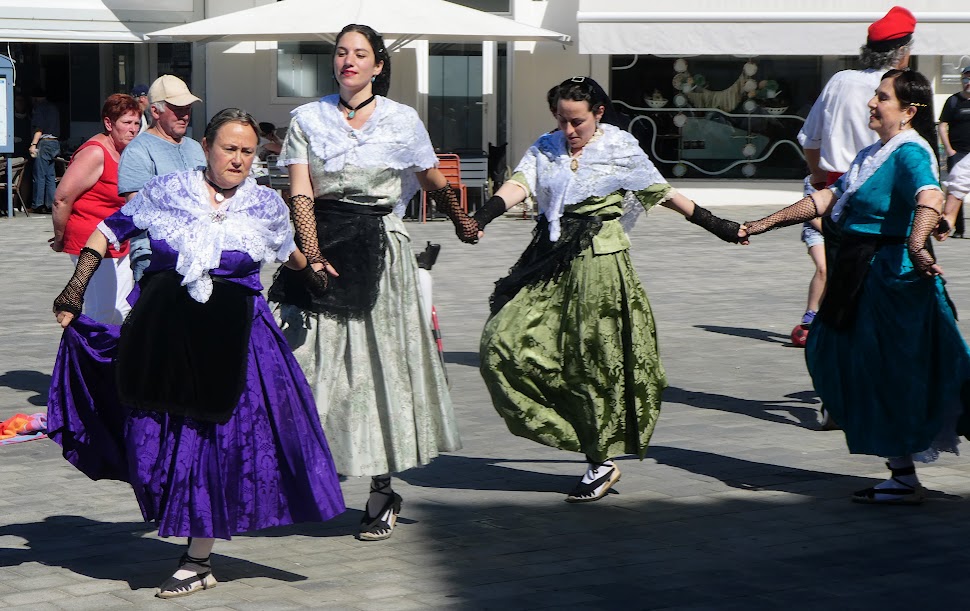
On Sunday morning, we took ourselves down into town to watch the mini-Sardana festival. We immediately noticed that I fitted the age-profile the best. Every single dancer was over 60. Anaïs’ friend’s granny immediately wanted to put that right, and appointed herself Anaïs’ personal Dance Mistress. With not much success.
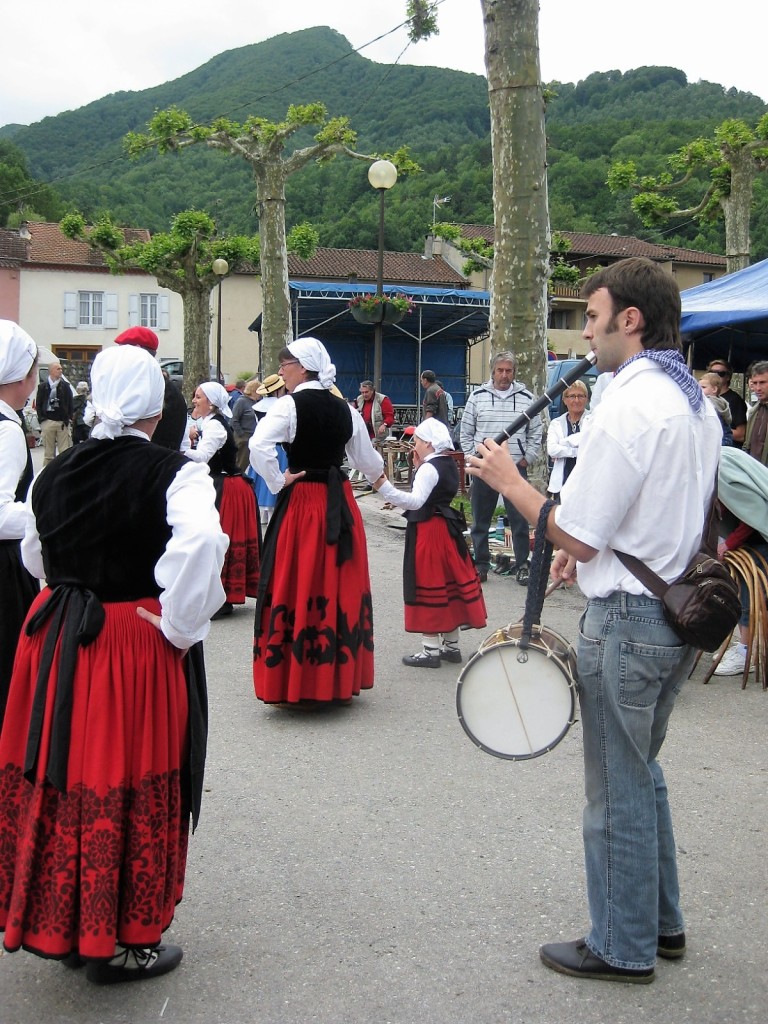
A few younger citizens took themselves off to practice in a quiet corner …
And after a slow start, the event got going. Not having a single dance gene in my body, I wasn’t tempted to get involved, despite being The Right Age. But it’s rather sad that this seems to be the general view among the young. Would Franco get his wish after all, and see the Sardana vanish a hundred years after he tried to banish it?
This week’s Lens-Artists Challenge, set by Donna, asks us to look at Time. So … I’ve decided to focus on traditions: traditions about celebration – long enjoyed, long maintained, and still meaningful in the communities where they take place.
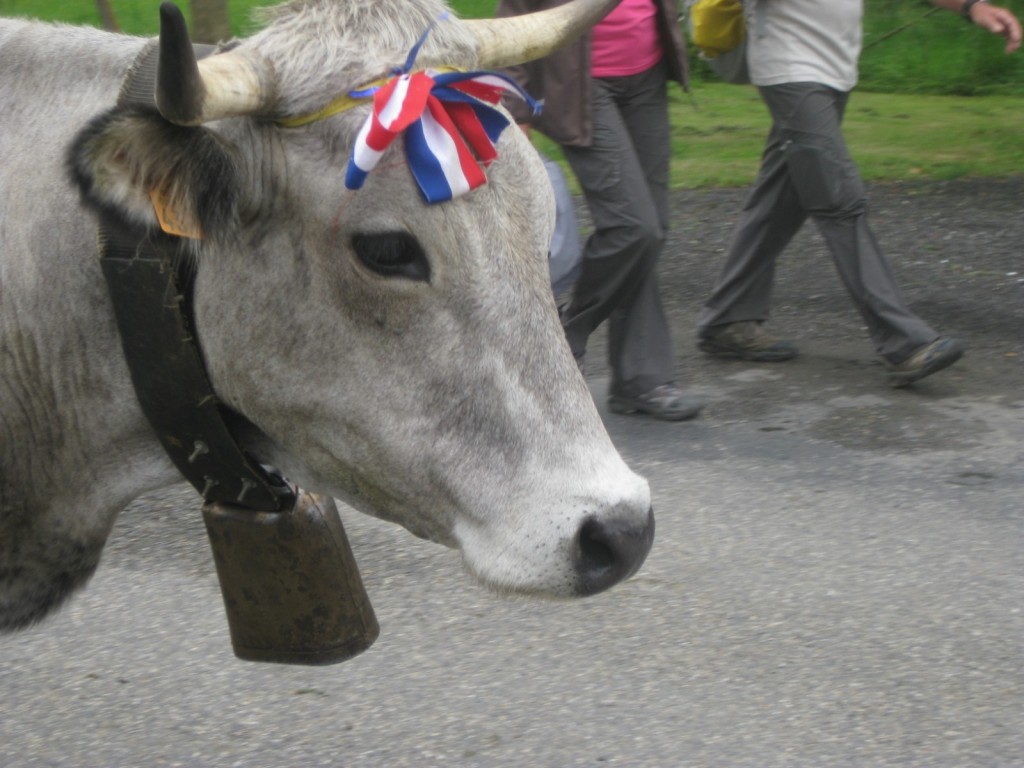
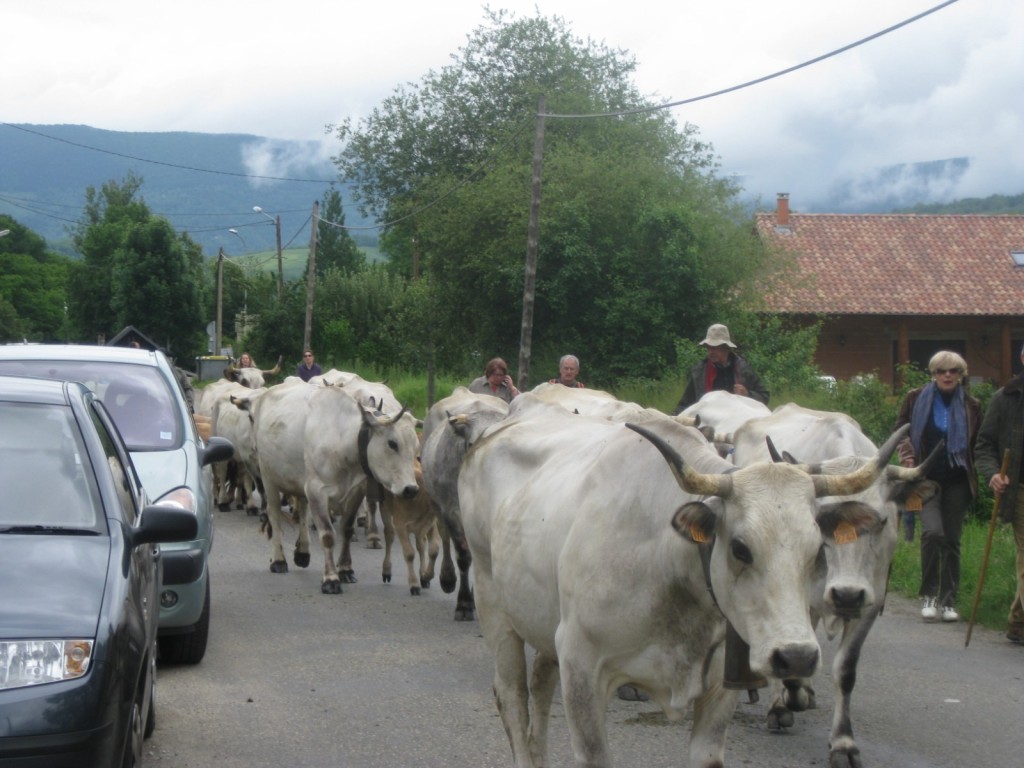
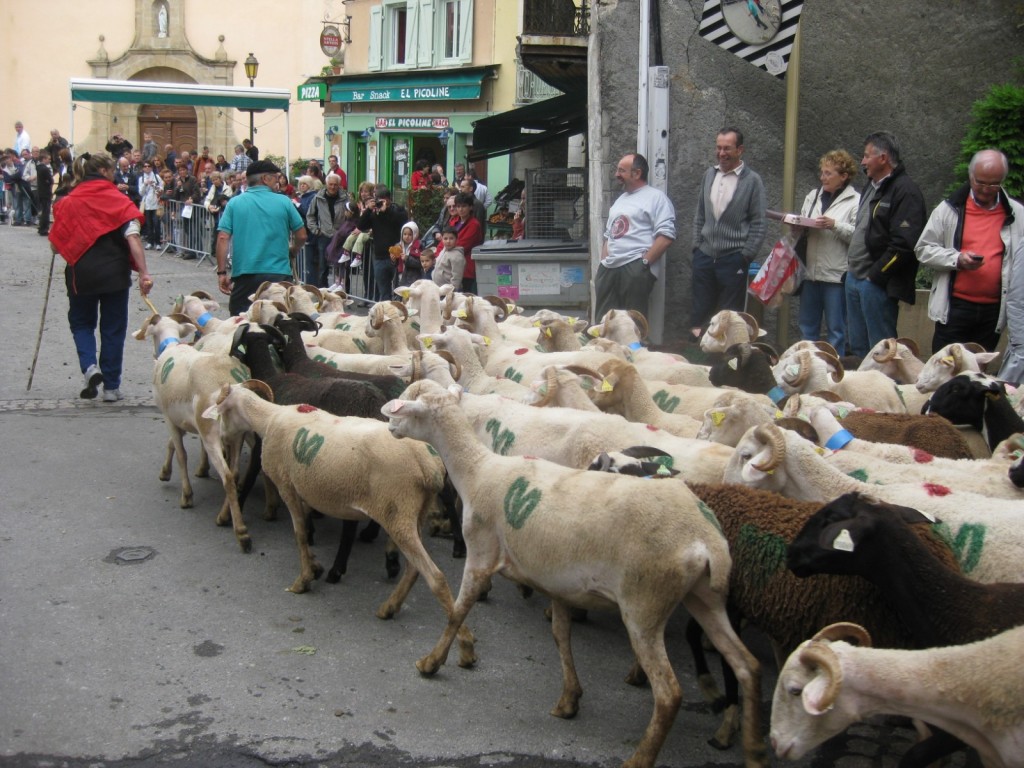
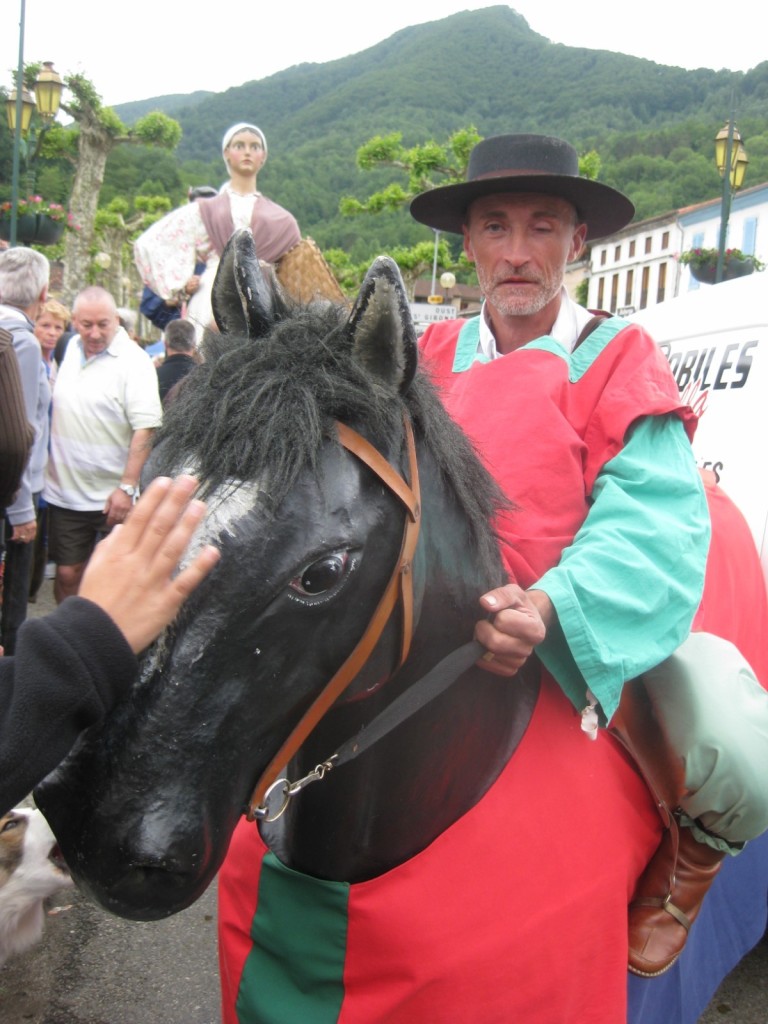
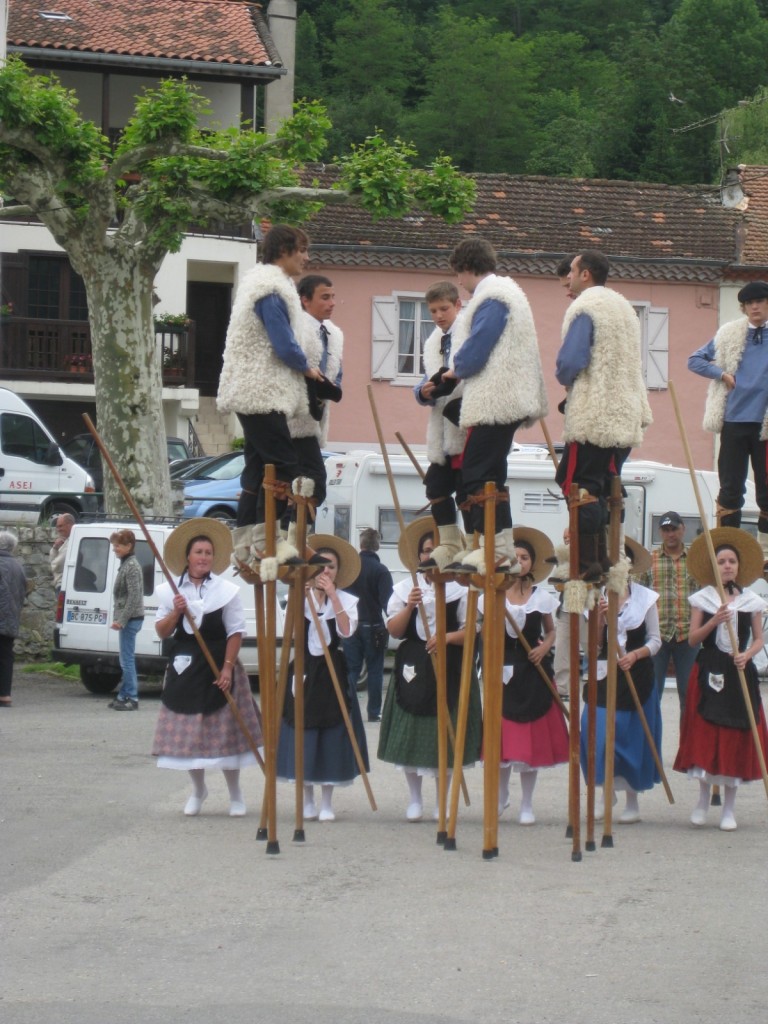
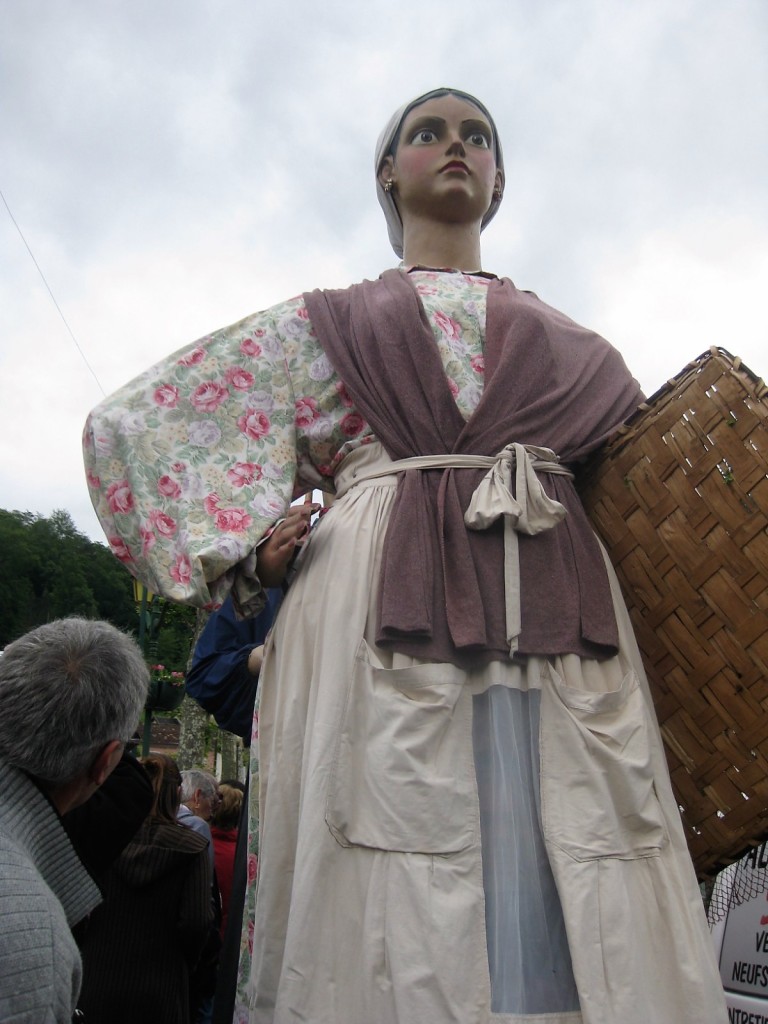
Transhumance for instance. It’s that time of year when in the Pyrénées (and in other mountain regions too), near where we lived in France, the cattle and sheep are moved from the lush summer pastures in the mountains down to their winter quarters down on their lowland(ish) farms . They stay there till spring, and then they’re taken up again. And each time, it’s the excuse for a party. Here are some scenes from Seix a few years ago, of the upward part of the year.
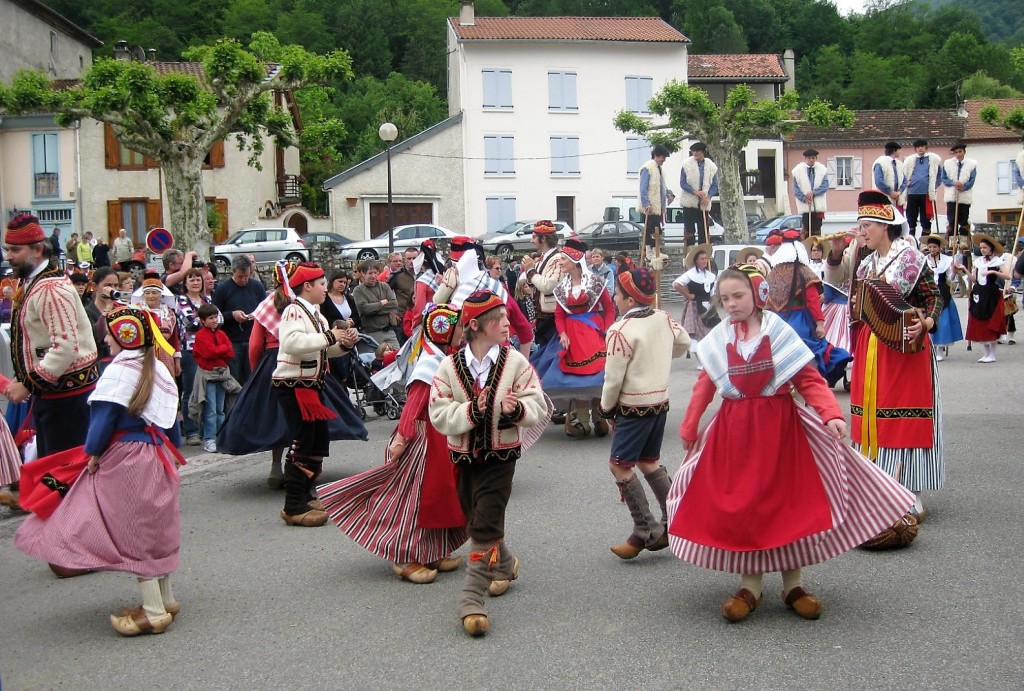
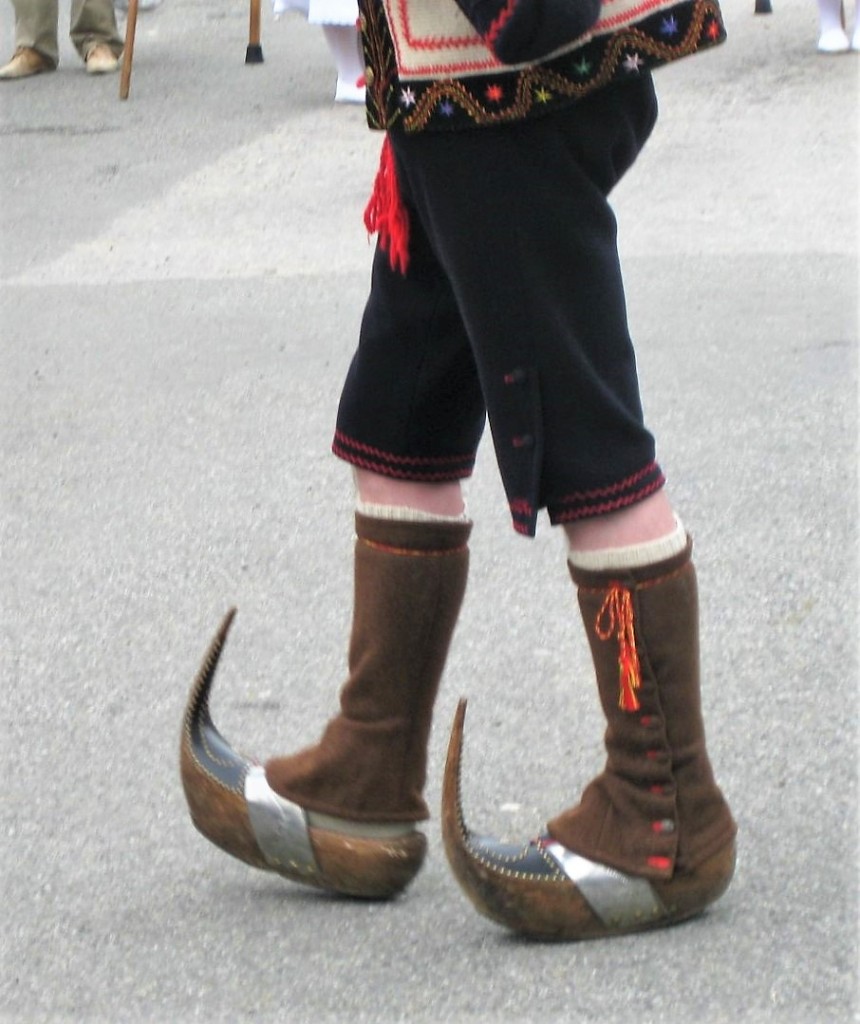
Patriotic cows are led to townCattle trudge patiently down the road …Sheep come tooIt seems strange to ride a plaster pony when there are so many real ones aroundDancing – always dancingMore dancersTraditional clogsShepherds from the Landes on their traditional look-outs – their stilts.Traditional géants
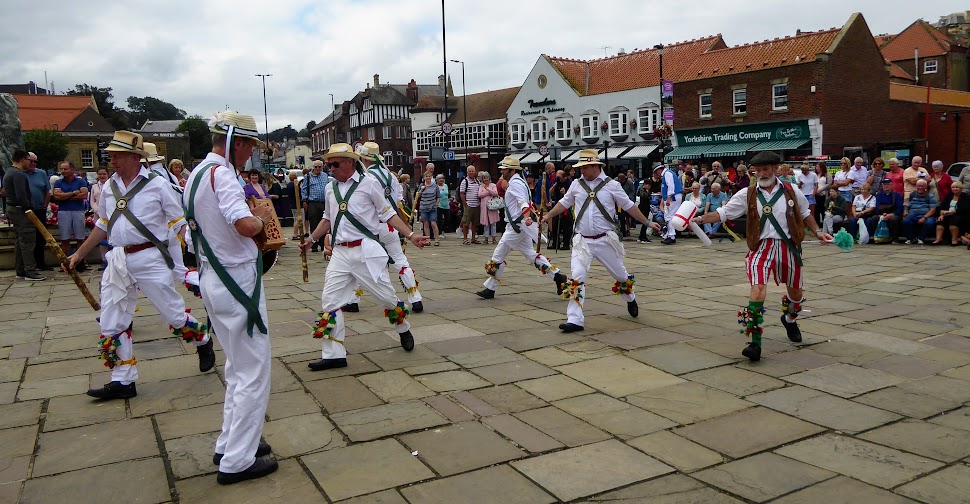
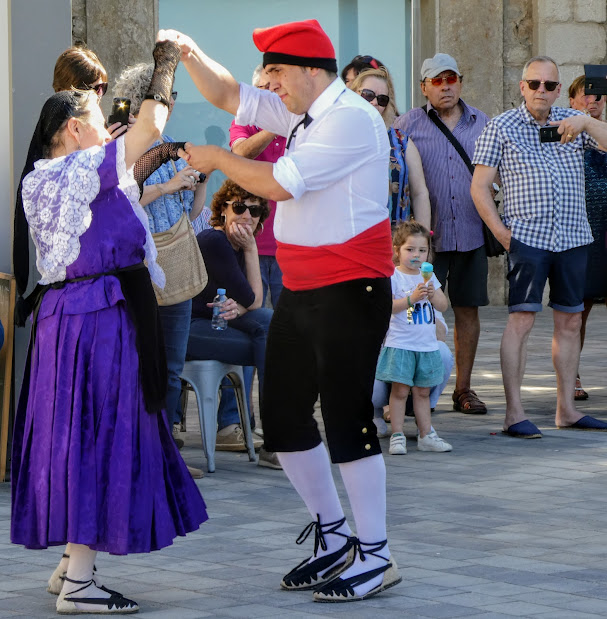
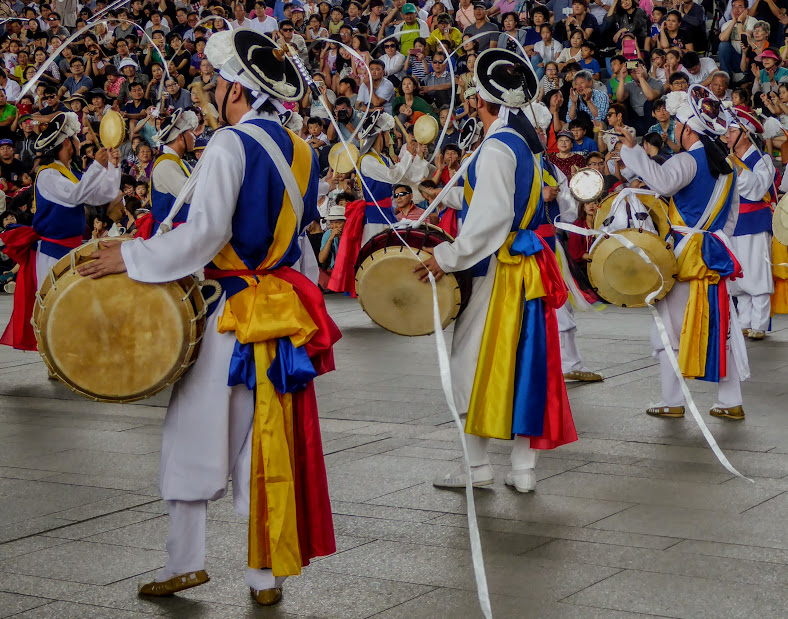
They were dancing in Seix. We dance to celebrate wherever we live – always have. Here are Morris Dancers in England, traditional dancers in Catalonia (and more of them in the featured photo) and dancing for the big Harvest celebration of Chuseok in South Korea.
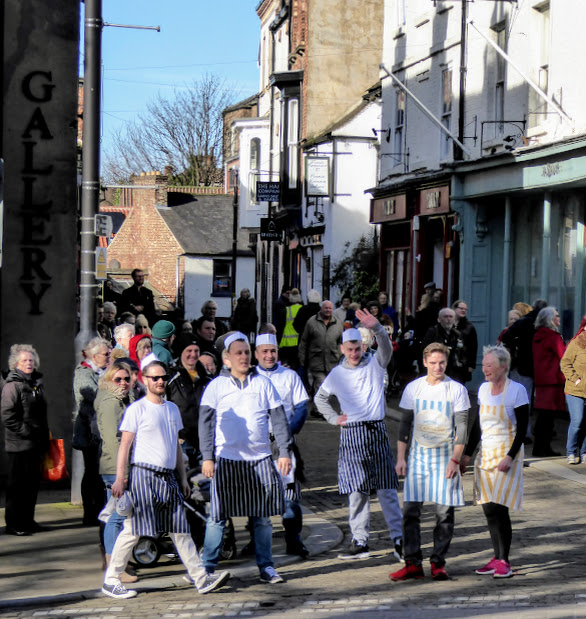
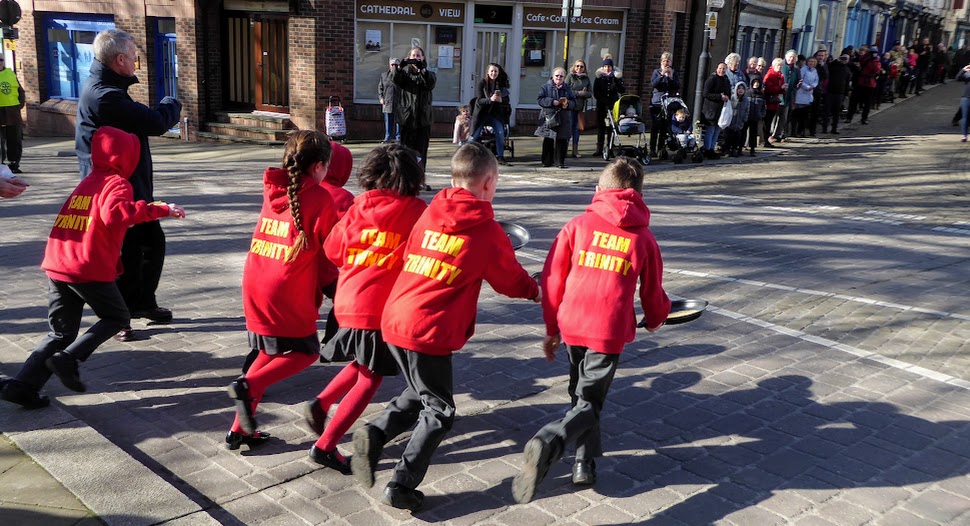
What next? How about Shrove Tuesday, the day when it’s the last excuse to have a bit of fun before the privations of Lent? The day when eggs and butter and other indulgences get used up in the making of pancakes, some of which end up in a race. Participants run the course, pan in hand, tossing their pancakes as they run towards the finishing line. It’s part of every Shrove Tuesday, as it has been for hundreds of years here in Ripon, and in towns and villages throughout the land.
Restaurant and café cooks take time out and celebrate a race well-won. Schools vie with each other for the prize.
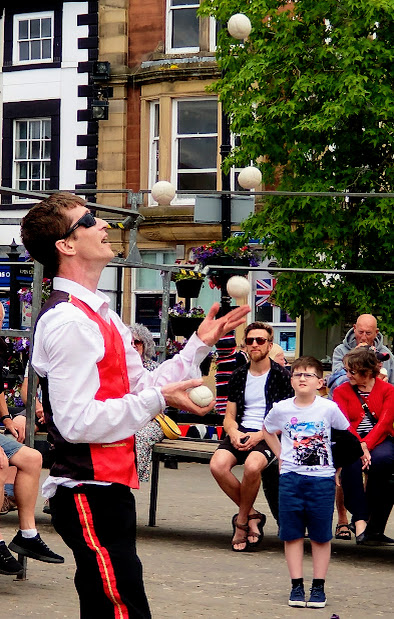
Street entertainers have engaged out attention as long as there have been streets. Jugglers, Punch and Judy shows … anything goes.
Juggler in RiponPunch … but no Judy.
Anyway, let’s finish off with a dance, the Sardana, dear to Catalonians for … well, centuries. It’s easy enough – join in the circle and just copy the person opposite you. Come on – you don’t even need a partner!
Friends and strangers enjoy the Sardana in a Catalan square.
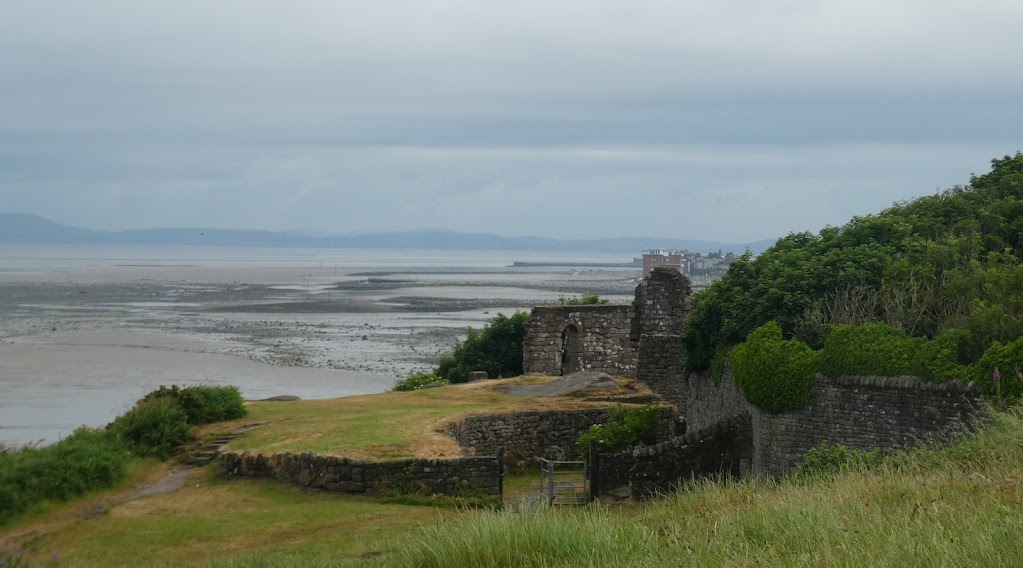
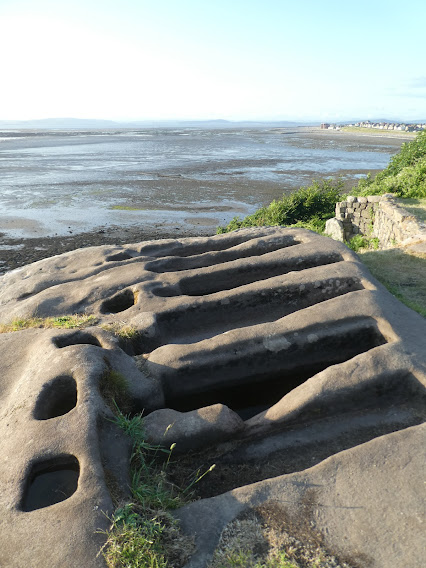
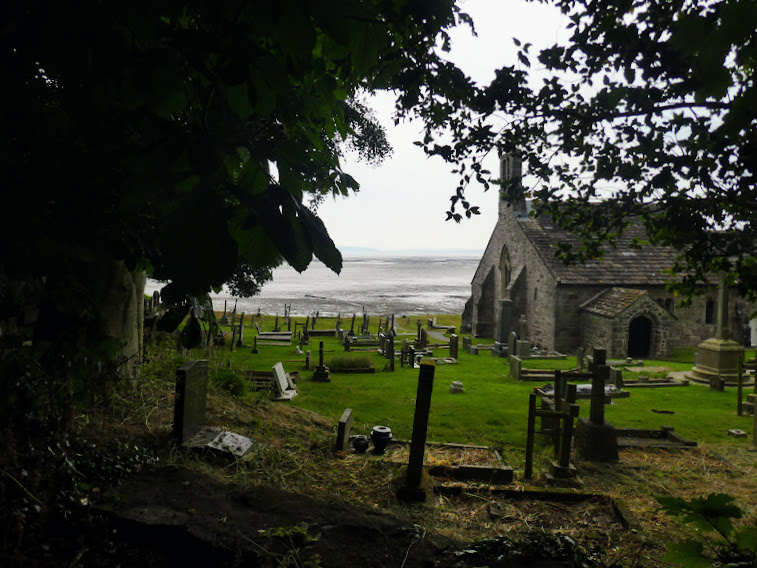
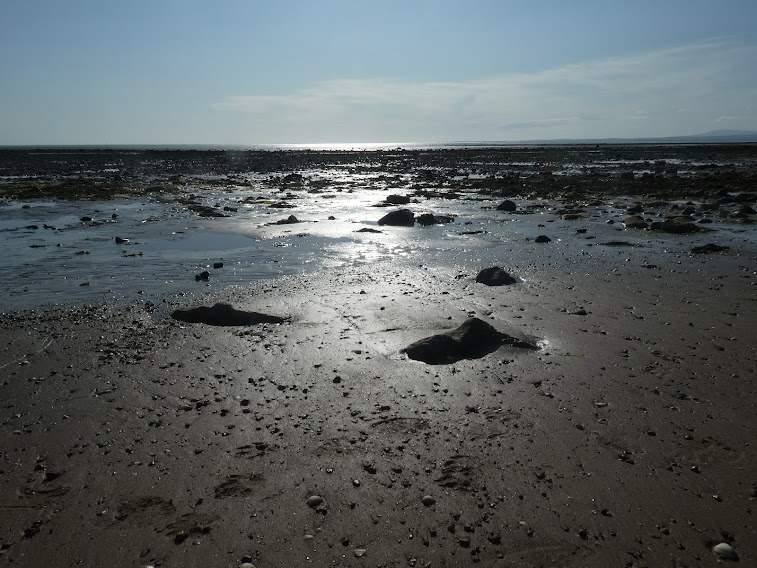
I sent a postcard from Heysham in Lancashire on Monday (pronounced Heesham, by the way, not Haysham). And I found myself drawn to this spot time and again during our short stay.
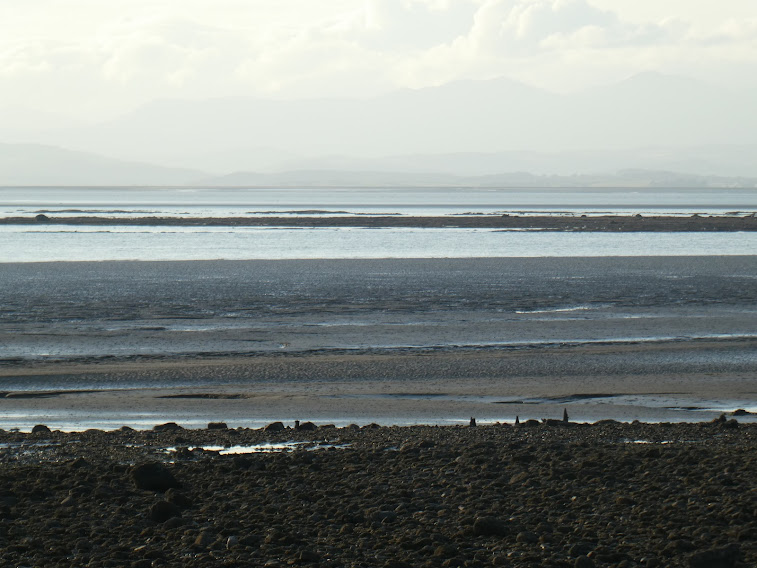
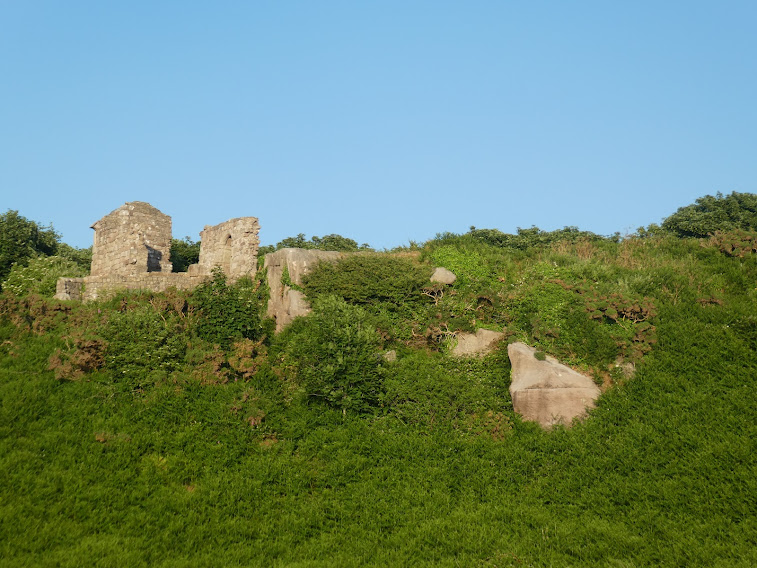
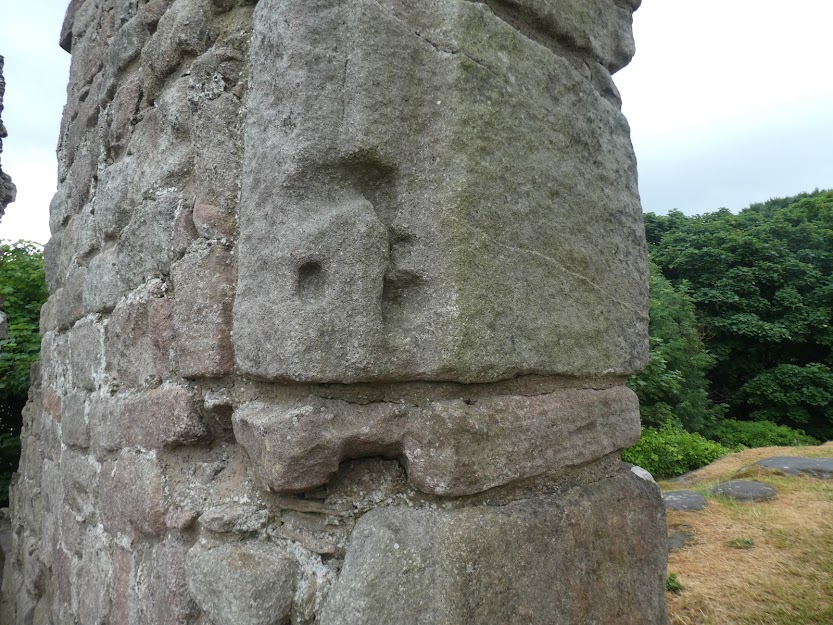
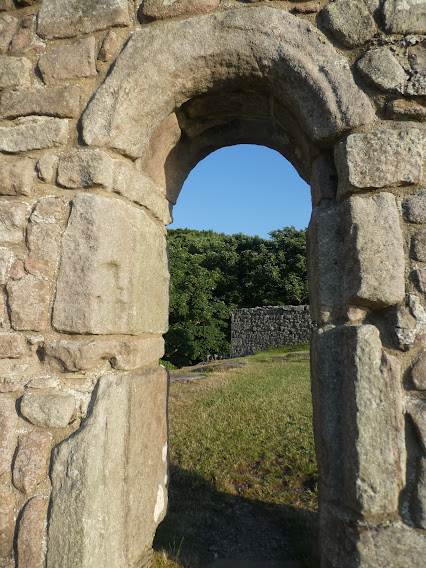
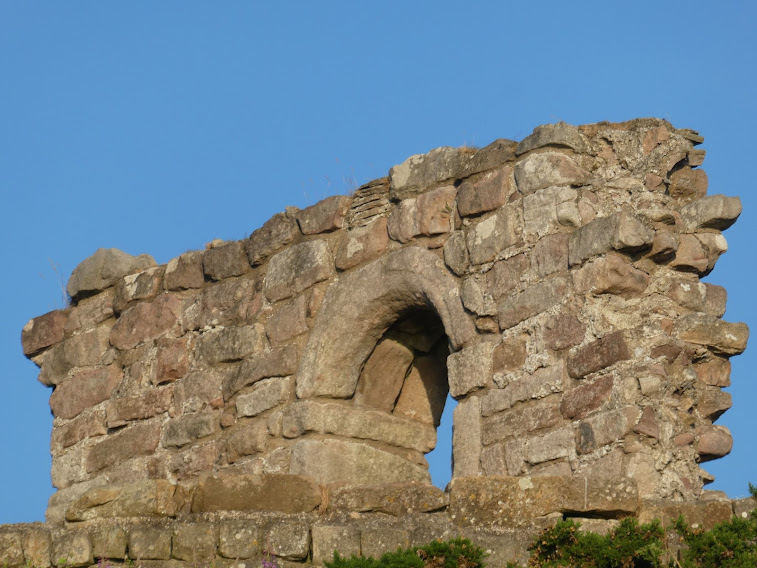
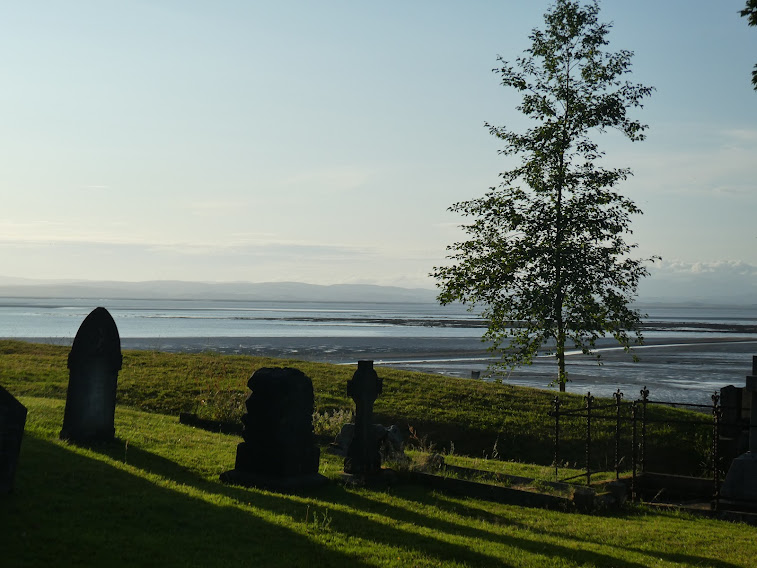
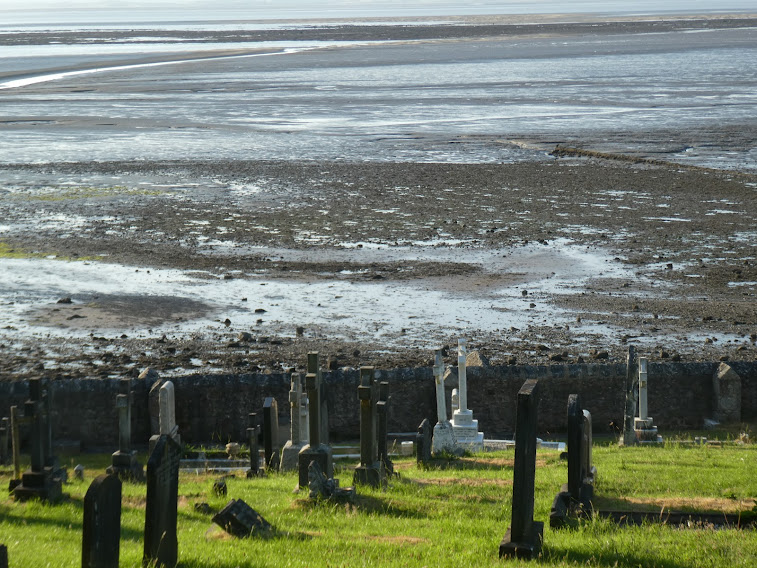
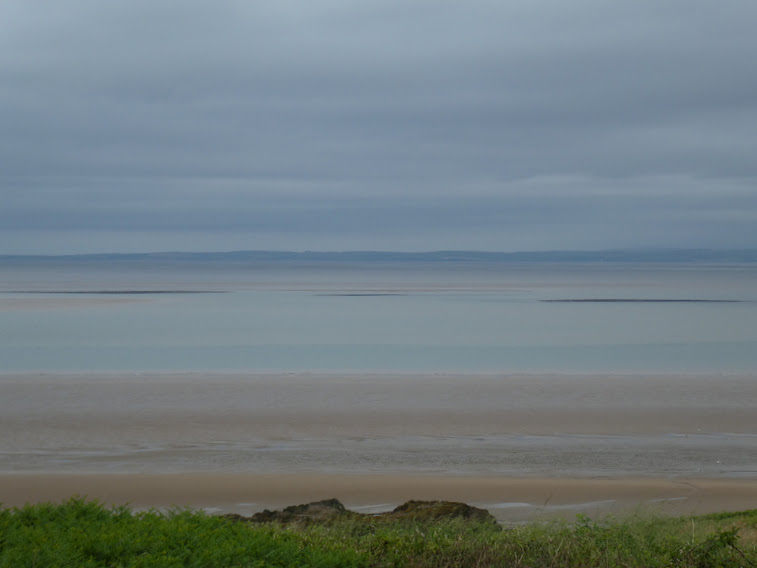
A scrub-tangled cliff-side looked across the stony, muddy shoreline of Morecambe Bay and to the mountains beyond. This was the view the Vikings had as they landed and began to make their homes here. This was the view the early English had as, in the eighth century, they built a chapel right here at the edge of the cliff, and dedicated in to Saint Patrick. Yes, THAT Saint Patrick, patron saint of Ireland. Born in Cumbria, he was captured and enslaved in Ireland. After six years, he escaped and fled on a ship bound for France. But the ship blew off course and wrecked on the English coast – here in Heysham . From here he went to France as planned to continue his religious education before returning to Ireland to convert the population there. The reason for the chapel was probably as a place of rest for those pilgrims who visited the rock-cut graves I showed you in my postcard – and now again, here. As the years went by, the chapel was enlarged and the ground around it became a burial place – over 80 bodies have been found.
And what about those rock-cut graves? Despite their human shapes, it’s thought the bones kept there were disarticulated, and may have been those of local saints and important Christians – even perhaps Saint Patrick himself? That’s why they became a place of pilgrimage. Once, they will have been topped off with heavy stone slabs, and those sockets at the head of the graves would each have held a cross
Almost next door is a church. This church, dedicated to Saint Peter also has 8th century origins. I wish we could have gone inside to explore, but we didn’t manage it. Now it’s the parish church, with a graveyard below sweeping down to the sea.
Something about the site ensnared me. Isolated, and with atmospheric light and views, it’s become my choice for Tina’s Lens-Artists Challenge #254 this week: Spiritual Sites.
It’s a mere 18 months or so since I reblogged my post about Beltane, but I’m doing so again because it fits so well with my last post celebrating Thornborough Henges.
Beltane at ‘The Stonehenge of the North’
May 1st 2016
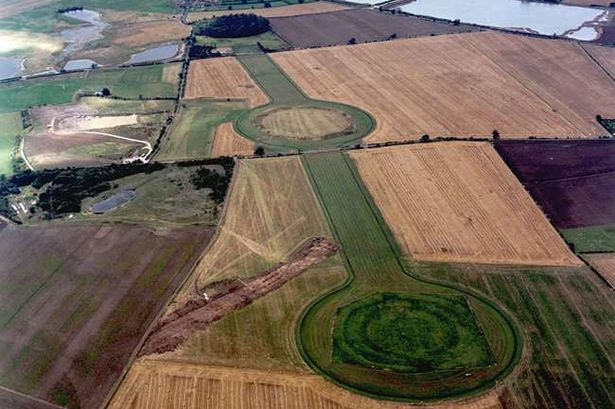
Not much further than a mile from us as the crow flies lies Thornborough Henge. It’s a prehistoric monument consisting of three giant circular earthworks. Constructed 5000 years ago by the first Neolithic (New Stone Age) farmers, it was probably an enclosure for their ritual gatherings. The Henges became an important centre in Britain for pilgrimage and trade, although its exact purpose still remains a mystery.
It sends shivers down my spine to think that this ancient piece of our history lies just a short walk from our home.
An ariel view of Thornborough Henges (photo courtesy of Historic England)
We can visit it any time we choose, simply to tramp round and try to imagine it in its heyday, and we’ll have the place to ourselves. Not on May Day though. Today is the Gaelic feast of Beltane, half way between the spring and summer solstices. It’s a day to mark the beginning of summer. Sadly, today is very cold, rather windy and a bit wet.
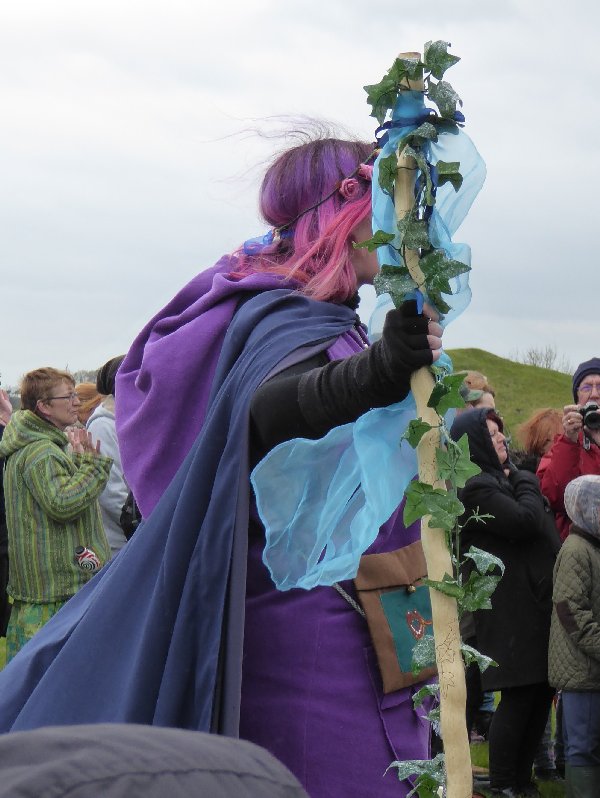
Back in pre-historic times, rituals were held on this day to protect the cattle, crops and people, and to encourage growth. Bonfires, deemed to have protective powers, were lit. For many centuries these practices died out. But nowadays, at sites like Thornborough, pagans, Wiccans, New-Agers and lovers of history and tradition gather once more to celebrate the renewal of life and growth.
Today I was there too. For an hour at least, for the opening ceremony. Brrr! It was cold.
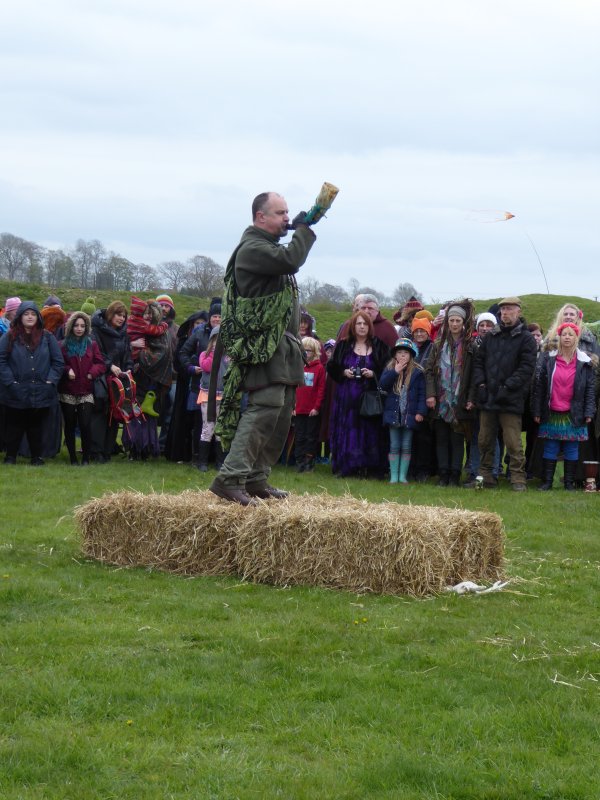
The Green Man and his horn.
I was strangely moved. The Green Man, representing rebirth and the cycle of growth was our Master of Ceremonies. He invited us all to join hands, whether friends or strangers, in fellowship, and shout out three times the invocation to new life. We hailed Brigantia, Celtic goddess of Northern England. Then at his bidding and as he sounded his horn, we turned to the east and welcomed the summer rains. We turned south to welcome the sun (who was coyly absent today), to the west to welcome summer winds, and to the north where the wolves apparently are.
Welcoming the West Wind.
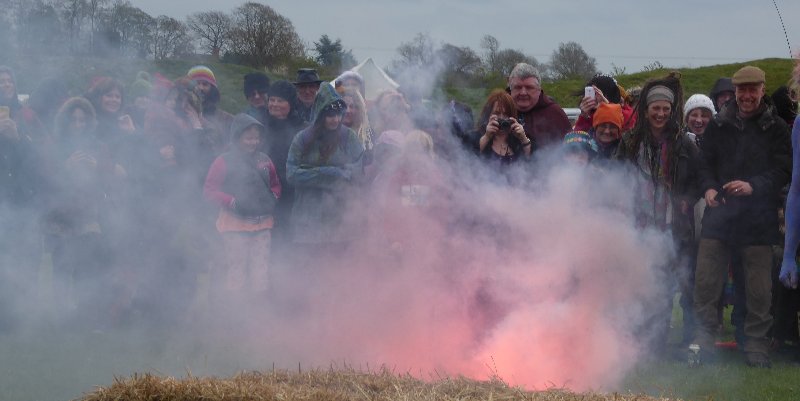
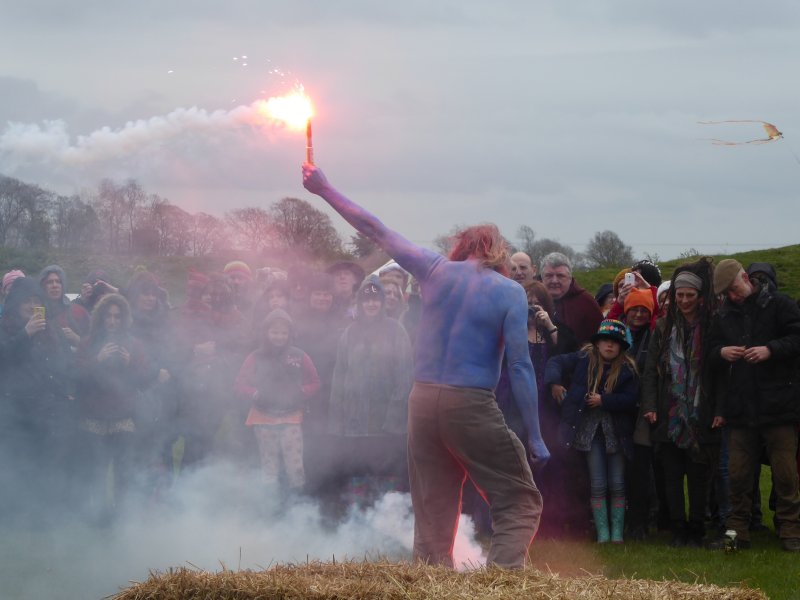
Then a man, naked from the waist upwards save for his covering of woad-coloured paint, leapt among us bearing the flaming torches which would offer us all protection over the coming months.
Protective flames.
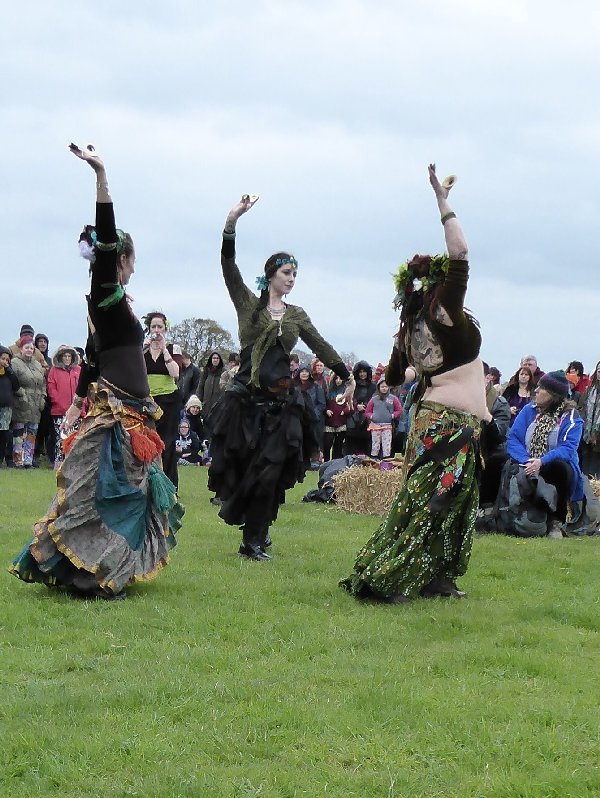
And that was the ceremony over. Dancers entertained us. They seemed to me to owe much to flamenco and to middle-eastern belly dancing traditions, but we all cheered them on with enthusiasm.
I shan’t be there this year for the closing ceremony. I’m still thawing out. But weather permitting, I’ll certainly go along next year. Will you come along too?
We haven’t been along since: cold May Days, Covid – all the usual tired excuses. But we definitely should make the effort this year.
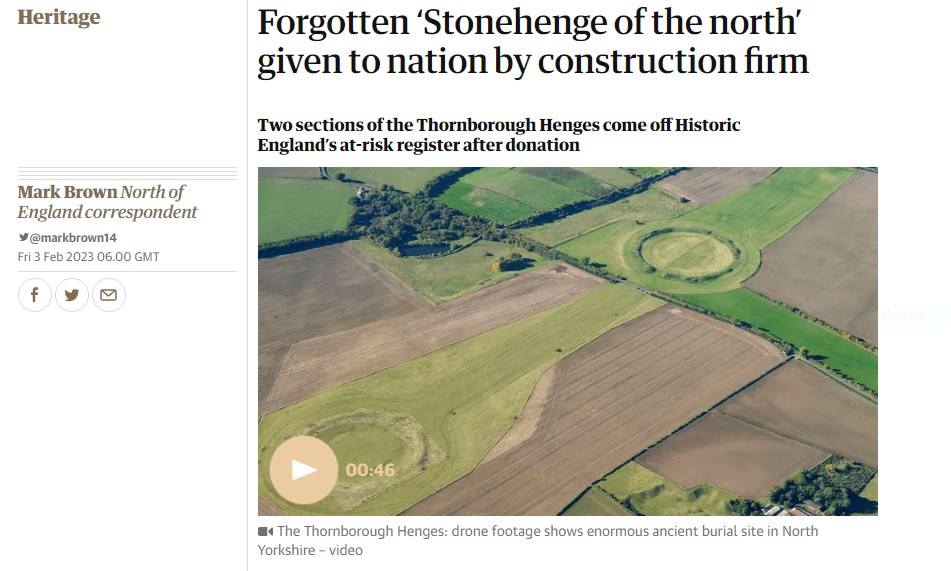
Just over a week ago, a couple of fields within two miles of our house hit the national news. Those of us who live round and about have long known about our very own piece of history: not as visually impressive from ground level at Stonehenge but still thrilling to think about. Now we can share it with the rest of you.
Thornborough Henges are two enormous, human made earth-circles – 200+ metres in diameter, from the neolithic/early bronze ages: somewhere between 3, 500 BCE and 2,500 BCE. Imagine the effort required to construct such circles, originally about 5 metres high, thought to have been coated with bright white gypsum, making them an extremely visible and potent part of the landscape. Why were they built? Nobody is sure, but they almost certainly had a spiritual purpose. Ritual is still important at this site. On Friday, I’ll re-blog a post I wrote one May Day about the ceremony of Beltane held here every year.
To walk here, with only the henge itself surrounding us, in an area normally busy with fields of crops or sheep, with woodland, and with gravel pits, is even now an almost unnervingly peaceful experience.
The henges have rather suffered from rabbits and livestock over the centuries. Now, the monuments have been gifted by Tarmac and by Lightwater Holdings to Historic England and to English Heritage and their future will be more secure.
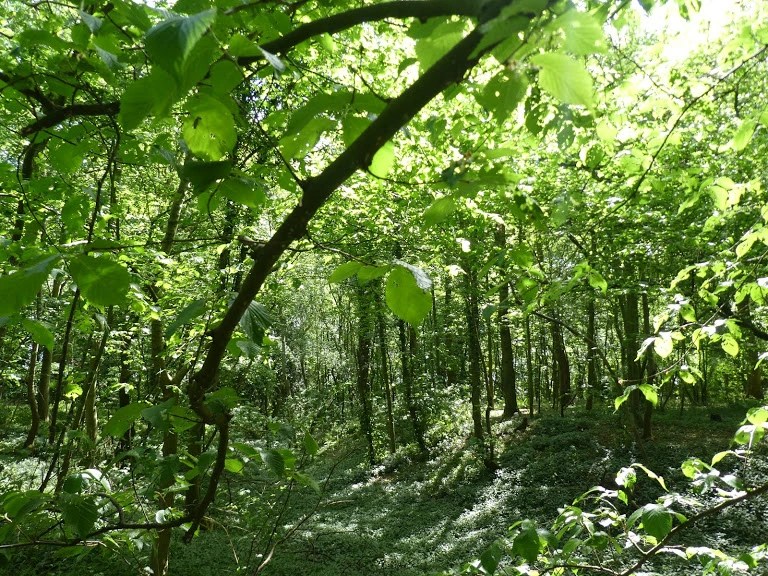
There is a third henge too. This was planted up as woodland in the Victorian period. Though it’s not a large wood, it’s a peaceful place where I love to go and stroll and spend quiet moments, disturbed only by birdsong. Here it is in summer.
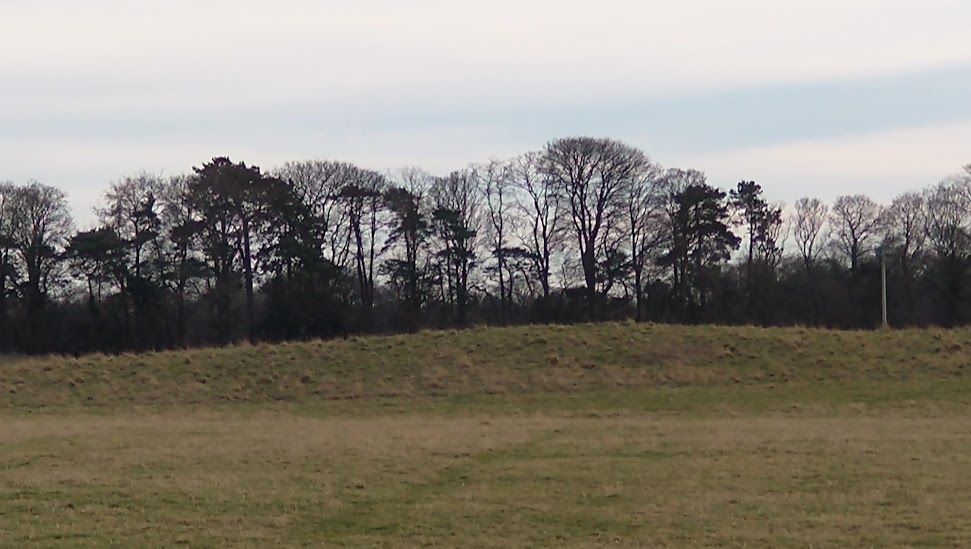
At ground level, it’s impossible (for me) to get decent photos of the henges. I offer you just one, as my feature photo, and then leave the rest to this YouTube video, courtesy of the Guardian.
Come and visit. You can pop in for a chat here afterwards. I’d love to meet you!
On the seventh day of Christmas my true love sent to me –
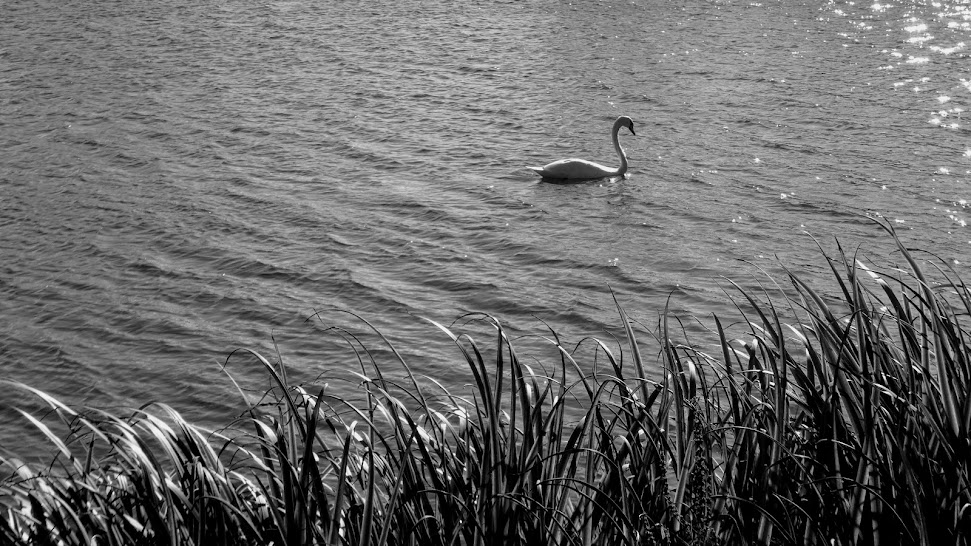
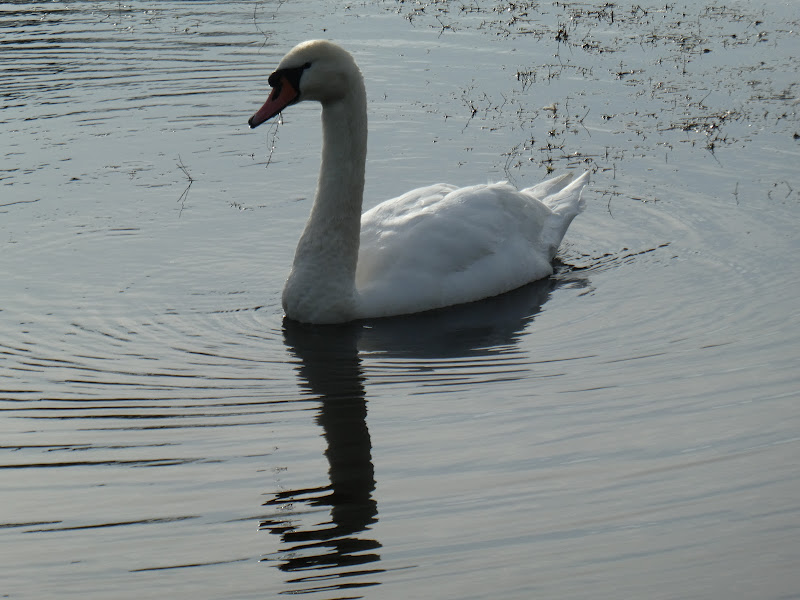
Seven swans a swimming …
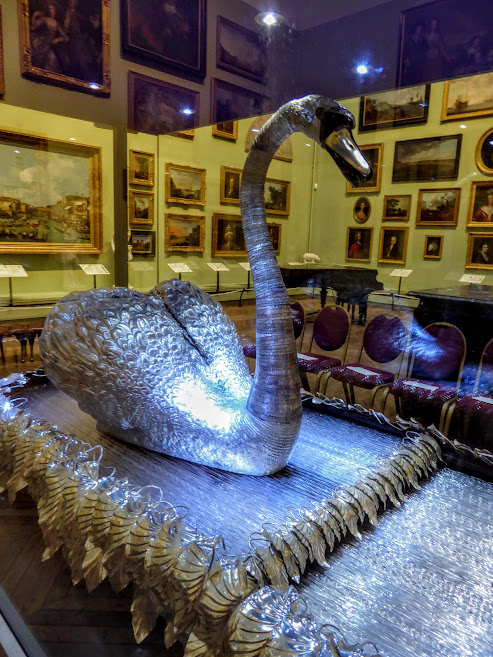
Nobody said the seven swans couldn’t include cygnets. Or that they had to be real swans. The silver swan is a nineteenth century automaton at The Bowes Museum, whose story you can read here.
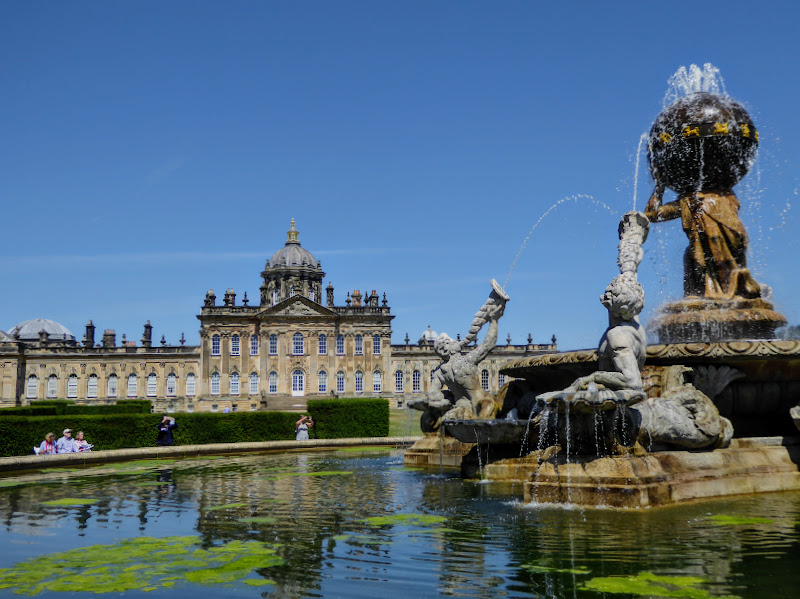
Atlas bears the weight of the heavens on his shoulders as he gazes at Castle Howard. Who knew that the heavens constantly gush babbling geysers of water which then fall to earth? Those of us who live in England might not be surprised: this statue shows us that it must be so.
In Ancient Greek mythology, Atlas was one of a race of giants, the Titans, waging war on Zeus, King of the Gods. In defeat, his punishment was to spend eternity holding up the heavens.
As on Saturday, I’m taking refuge from the cold by posting pictures of sunnier times.
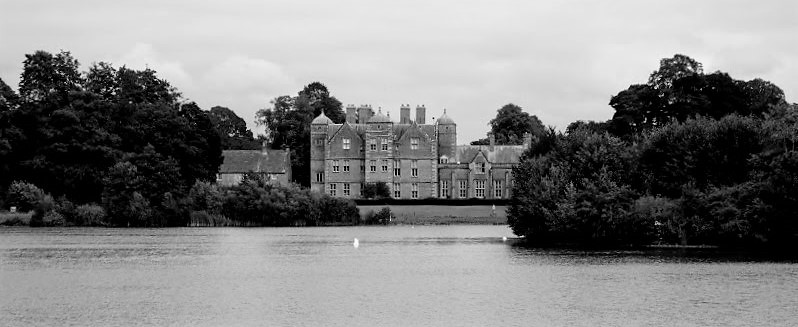
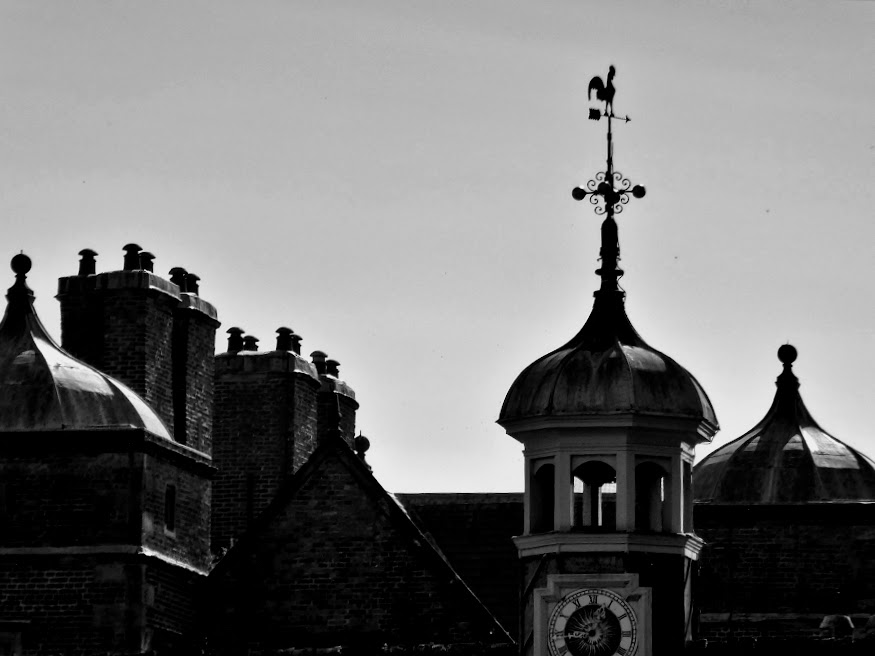
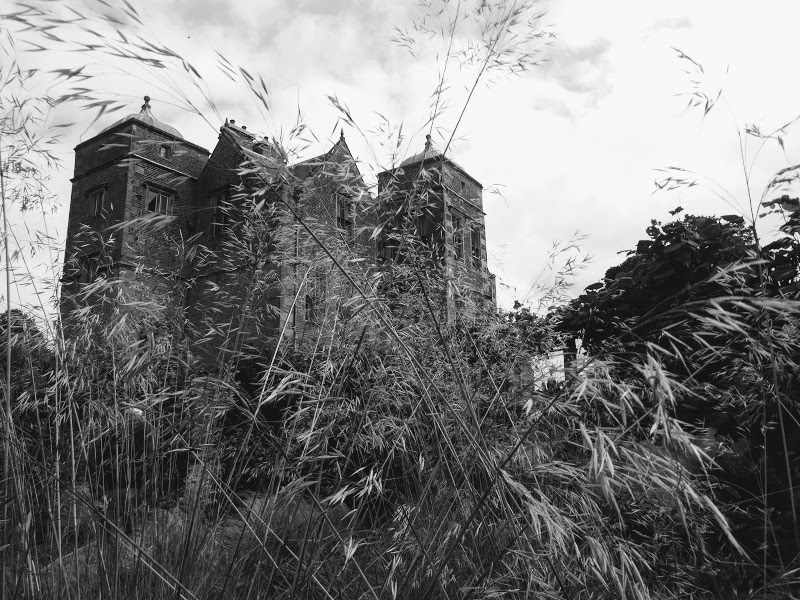
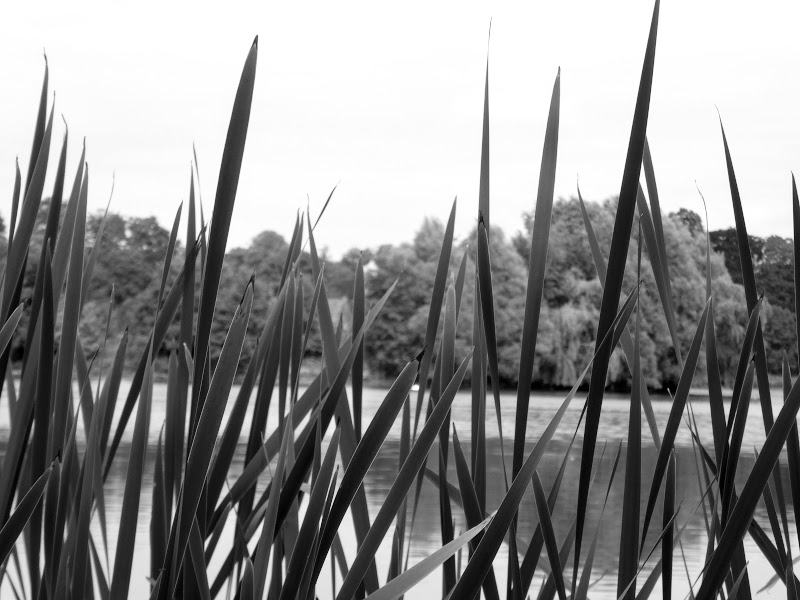
Kiplin Hall. That was our destination on Sunday. We first went there a few years ago for joyful Shakespeare productions, such as Romeo and Juliet, by the irrepressible Handlebards. These days, we go if we need a quiet few hours at a country house whose grounds are extensive enough to offer a walk, a view and coffee and cake after. Here are my picture postcards – monochrome, as picture postcards always used to be – for Mid-Week Monochrome #110 – and to send to Jo, of Jo’s Monday Walk fame.
Kiplin Hall was built as a hunting lodge in the 1620s by one George Calvert, who was Secretary of State to King James VI. American readers may like to know that he was made Baron Baltimore, and was granted a charter to found a colony in America. This colony became – the State of Maryland.
Here’s our first sight of the hall:
Goodness, it was breezy that day. But walk we would, all the way round the lake -into the wind at first – one of the images give an idea of the scudding waves. We set off to get various views of the lake and hall. Here’s a clutch of postcards.
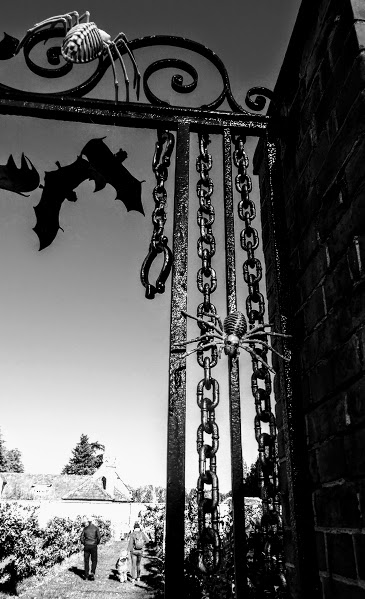
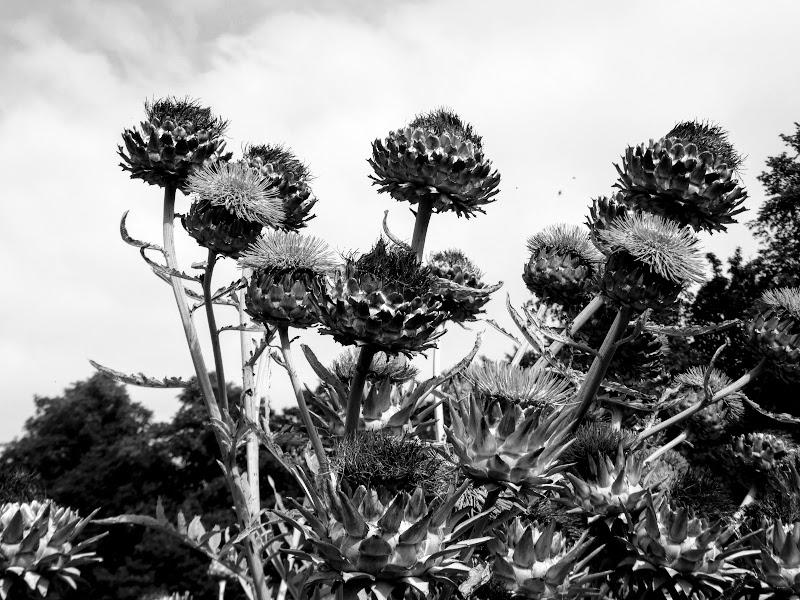
There are woodlands to explore: but the wind was picking up. Better to find shelter and explore the huge walled garden perhaps, where they grow all the fruit and vegetables used in their tearooms, and to make the jams, jellies and chutneys on sale. But wait! Suddenly it’s quite forbidding … Hallowe’en is on the way…
We’ll take our courage in both hands and enter anyway … there, that’s not so bad …
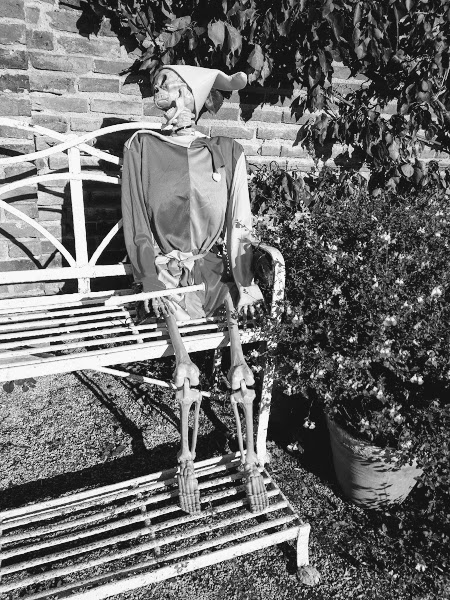
Although …. who’s that sitting on the bench over there?
We decided the tea room was a better option. Coffee, date and pecan cake anyone? No photo available. We ate every crumb before we gave the camera a thought.
Harewood House is the archetypical country house. Built for Edward Lascelles, the first Baron Harewood, in the mid eighteenth century to designs by John Carr and Robert Adam, it is set in one hundred acres of garden designed by Capability Brown. It’s among Yorkshire’s most prized treasures. These days, such treasure has lost some of its lustre as people remember that the Harewood family acquired their immense wealth from being slave owners and having plantations in West India. The present Harewood family can’t change that past, but their exhibition programme does what it can to redress the balance: this month there’s an exhibition on Windrush generation Arthur France, founder of Leeds West Indian Carnival.
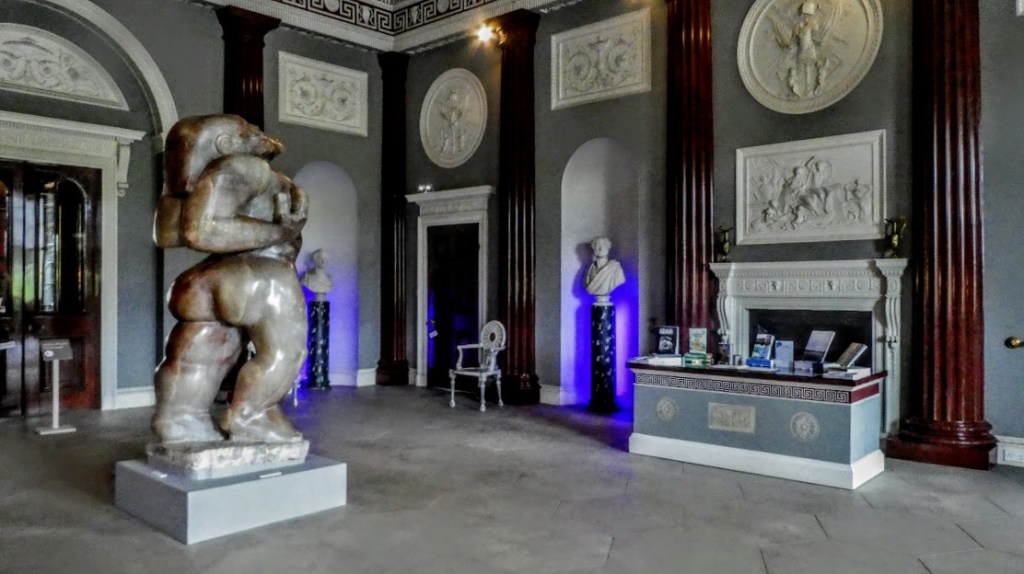
I mention this, because as you enter the house, this is what you see:
A spacious and gracious entrance hall: delicate plaster work, elegant columns: and slap bang in the centre, a mighty sculpture, monumental, assertive and demanding attention. This figure isn’t a slave: he’s not even Afro-Caribbean. No, this is a sculpture by Jacob Epstein, who was greatly influenced by what was in the early twentieth century thought of as ‘primitive’ art – that of Polynesia and Africa. This is Adam.
How he got here is a curious tale. Back in 1961 the then Lord Harewood saw this sculpture in of all places, a Tussaud’s peep show in Blackpool, together with other works by Epstein. A long and complicated story, but he eventually bought it, and now it’s recognised for the stirring and monumental piece that it is, rather than a grotesque to be laughed at. Do look at this post hereto get a flavour of how Epstein’s work was regarded in its early days, at least as it was displayed in Blackpool. The short video below however places Adam in the context of Harewood House.
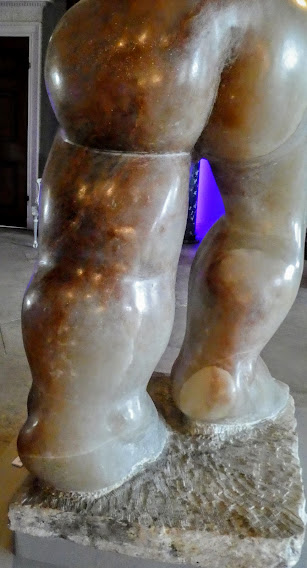
I wanted, for this week’s Lens-Artist Challenge #220 One Subject Three Ways by Patti, to observe Adam in several ways, to look at how this potent figure works in a space to which it seems in many ways unsuited. I found the lighting difficult and am not pleased with my results, but … I did it anyway. You’ve seen the first one already. Here are more…
So … Adam. But knowing the story of Harewood and where the money came from to build it, I found this figure, which relies on an African, rather than an European artistic heritage, makes a powerful statement to those who enter this house to enjoy its treasures and its finely proportioned and handsome grandeur.
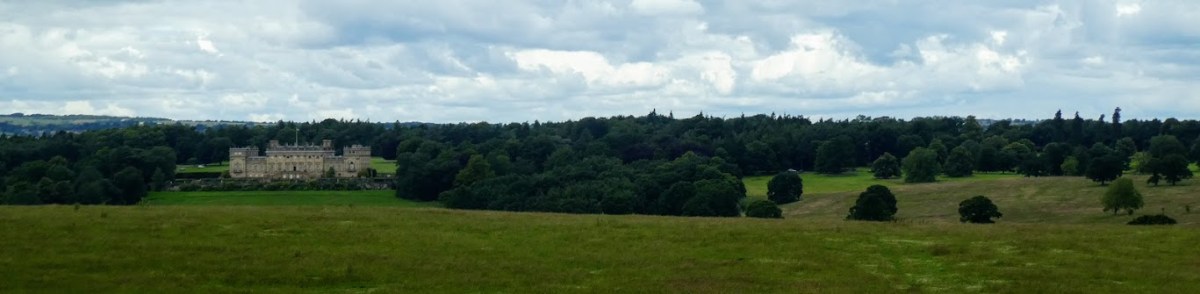
I’m going to have another go at the challenge, perhaps tomorrow, when I take a stroll in the artfully designed ‘natural’ landscape of Harewood House.
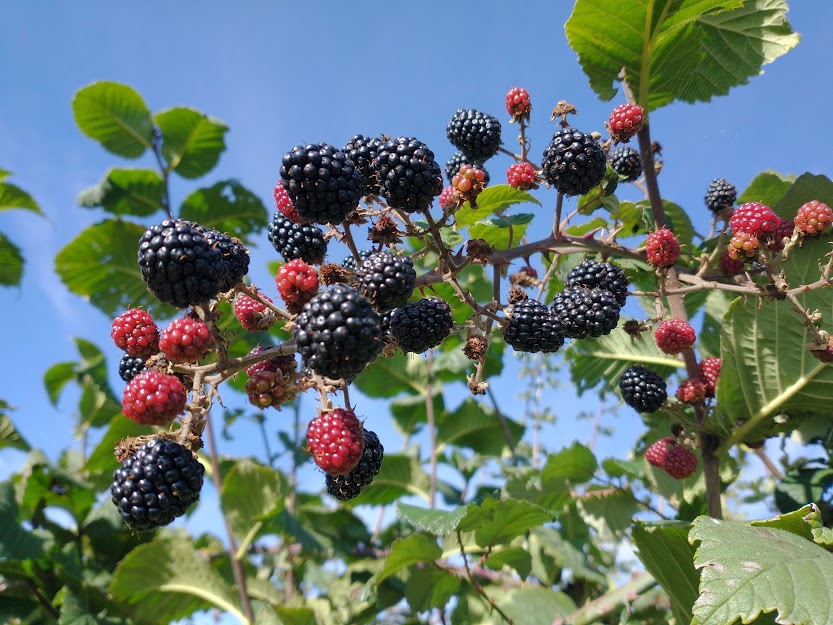
Seen (and eaten) today, 8th October. English (British?) tradition has it that on Michaelmas Day – 29th September – the Devil takes it upon himself to spit on all remaining blackberries, rendering them wizened and inedible.













 From Pyrenees to Pennines
You must be logged in to post a comment.