Small boy in the kitchen

playfood-008William has Christmas sorted.  He doesn’t know it, but he’s going to become a home-maker and possibly a shopkeeper.

By December 25th, William, my grandson, will be almost 18 months old. Time to learn how to keep house, then.  His parents are planning to give him his very own kitchen.  Here it is:
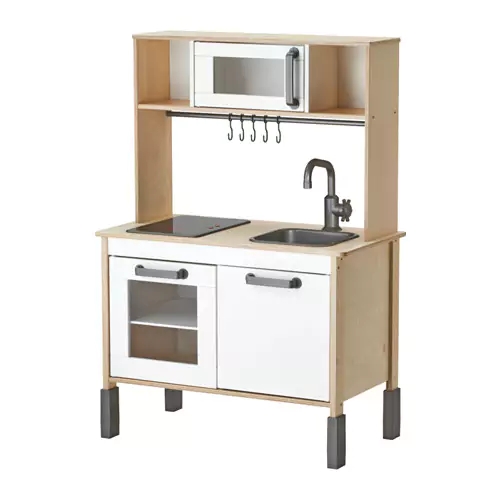
Play kitchen (IKEA Duktig)

It’s very different from the affair my son and his sisters had when they were small.  Their appliances were fashioned from sturdy boxes and painted to look rather like the simplest of student kitchens.

His other grandparents are planning to stock this ultra-smart 2016 kitchen with pots and pans, teacups and plates.  And my son, William’s dad, remembered that when he was small, I supplied him with home made play-food.  He’s asked me to make a larder full for William.

So here we are.  For the past week or so, I’ve been kneading salt dough, and fashioning food of all kinds to bake in the oven, paint and then varnish.

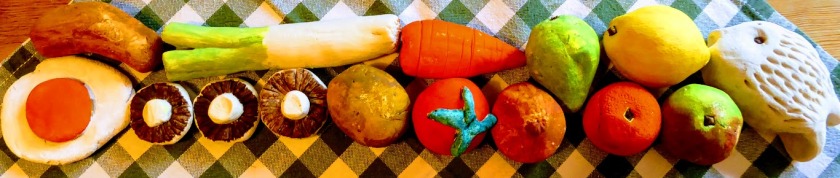
If you call to see William in January, he may offer you a meal of fish and chips, sausage egg and chips (no fine dining here, I’m afraid) with oranges, lemons, apples or pears to follow.

Hmm. Pears proved tricky. But they look - slightly - better away from the glare of the camera.
Hmm. Pears proved tricky. But they look – slightly – better away from the glare of the camera.

If you want to cook instead, there are just potatoes, onions, leeks, mushrooms, tomatoes – cabbages are too unwieldy, peas too accident-prone.
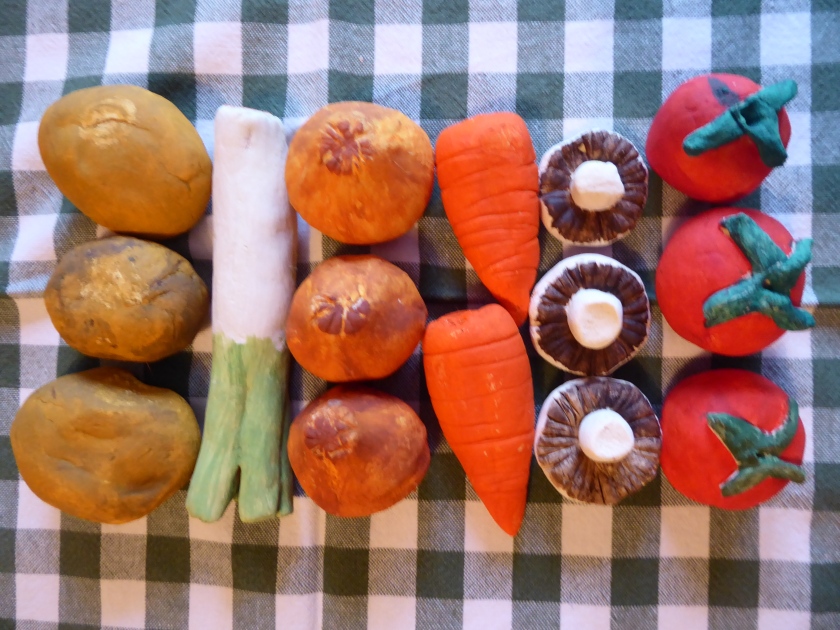
playfood-007

I’ve had fun.  Let’s hope William enjoys his kitchen, and turns out to be as good and creative a cook as his dad – and mum – are.


Marmite

Marmite: all ready to slather on hot buttered toast (Wikimedia Commons)

We’re almost packed for Korea.  We’ve remembered to pack the Marmite for Emily.

My friend Penny’s packed and left for France, where she’s staying at Maison Grillou with Kalba, happily exiled from England.  She’s remembered to pack the Marmite too.  Two jars – large.

What is it about us Brits?  We can live abroad for years and years, and learn to do without Proper Tea (very easy for me, that one), baked beans on toast (even easier), and Bird’s custard powder (easier still).  But deprive us of our Marmite, and we go into a steady decline.  It’s not as if we all like it.  Marmite themselves never try to convert anyone in their advertising.  They know full well we either love it or loathe it, and there’s no point whatsoever in trying to persuade a Marmite-hater to give it another go.

Marmite-Wars.
Marmite-Wars.

What is clear though is that you do have to be British to love it.  I’ve never spoken to anyone born outside the UK who could understand our love for this peculiar, salty yeast extract, a by-product of the brewing industry.

What’s your take on it?  Incredibly, there’s even a board game to help you decide.  I don’t need to play.  I love it.

Marmite - the board game.
Marmite – the board game.

The Greasy Spoon

As you travel Britain’s main roads, every few miles or so you’ll pass a convenient lay-by with a caravan, a shack, a portakabin – some less-than-permanent structure which has actually been there as long as anyone can remember.  Parked outside it are lorries, vans, cars – all empty, because their drivers are in the Greasy Spoon – that’s what these huts and caravans are affectionately called.

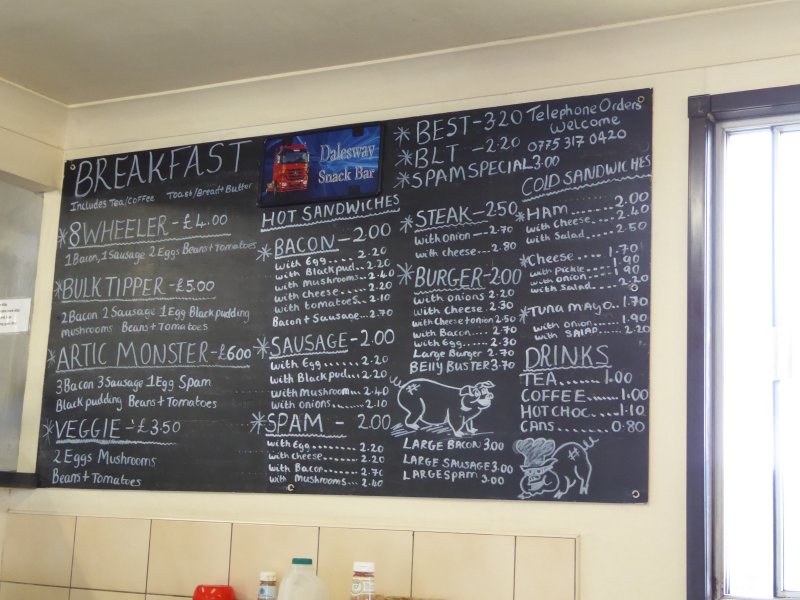
The unchanging menu at the greasy spoon.
The unchanging menu at the Greasy Spoon.

These truckers and travellers have gone in for an all-day breakfast.  The menu’s limited.  All that’s on offer are various combinations of bacon, sausage, eggs – with baked beans, grilled tomatoes, grilled mushrooms or bread on the side.  This is not Fine Dining.  The bread served here is not artisan-crafted from some small bakery using speciality organic stone-ground flour from the mill down the road.  It’s industrial strength pre-sliced pap.  I doubt if the pigs used for the sausages and bacon have truffled around in the woods looking for acorns, or been fed wholesome scraps from the farm. The baked beans come in catering-size cans.

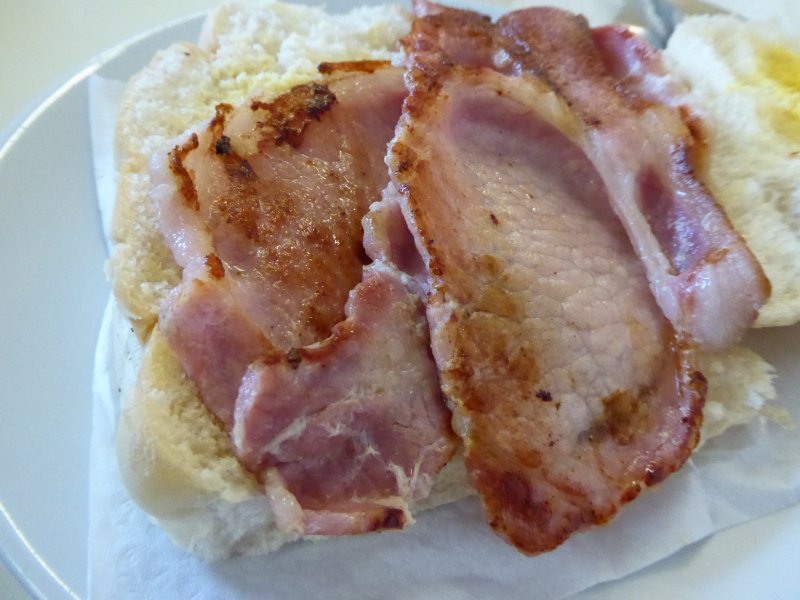
One bacon sarnie.
One bacon sarnie.

But we’ve got into the habit, when the boys stay with us, of having lunch at a particular greasy spoon near Skipton.  What it lacks in finesse it makes up for by offering a really friendly welcome and rock-bottom prices.  We make our order, plonk ourselves down at one of the formica tables, and relish a rib-sticking calorie-fest which will keep our stomachs lined for an afternoon of fresh air and fun at nearby Brimham Rocks.  It comes under the heading of ‘Naughty but Nice.’*

Here we are.  Open dining at the Dalesway caff.  Only it was way too cold.  Everyone was inside that day in the fuggy warmth.
Here’s Alex showing off the open dining area at the Dalesway caff. Only it was way too cold. Everyone was inside that day in the fuggy warmth.

*Salman Rushdie coined this advertising slogan for Fresh Cream Cakes when he was working as a copywriter back in the 1970s.  Warning: Don’t Google this phrase unless you are on the look-out for sex toys or ‘adult-themed materials’.  You have been warned.

Bischofsbrot

The other day, apropos a post I’d written on my blog, Notes on a family, an old school friend, Gillian,  sent me this message.

‘I still have your mum’s recipe for fruit cake with chunks of dark chocolate in it – to die for !’

What could she have meant?  So I thought.  Then I thought some more.  And suddenly I remembered.  Bischofsbrot.

I remembered helping my mother make this cake from time to time:  not often, it was expensive.  I remember chunks of chocolate, nuts, cherries, dried fruit… lots of eggs.  And I wanted to make it again.  Like Gillian, I liked it – a lot.  I hunted through my mother’s old notebook, crammed with recipes from old friends or clipped out of the paper.  Nothing doing.  None of my own recipe books helped out.  I turned to the net, and found a few there, but none of them seemed quite right.  I settled on this one, because it was at least measured in grams rather than the dreaded cups, and here it is.

We’ve just eaten a slice each.  I’m not happy.  It’s nice enough, but it’s not startling me with memories of what the cake, bright with jewelled candied fruits, nuts and satisfying chunks of dark chocolate, ought to taste like.

It doesn't even look right. Not happy.
It doesn’t even look right. Not happy.

I need help.  Gillian?  You claim to have the recipe!  Stephan over in Germany?  Heidi, half-German pâtissière extraordinaire with friends who bake with you in the Clandestine Cake Club? Patty, with your German heritage?  Sarah, adventurous seeker after new recipes? Someone must have the definitive version, the one that will summon up that long-forgotten taste from childhood.  I can’t even get a straight story about this cake.  Is it German?  Or Austrian? Is it a cake for Christmas?  Or something else?  So many different stories.   Someone must be able to put me right.  Get in touch. This is becoming urgent.  I want Bischofsbrot, and I want it now.


Food for free 2

Blackberries in a landscape, ready to be eaten.
Blackberries in a landscape, ready to be picked and eaten.

I’m not a fashionable forager.  You won’t find me back in the kitchen preparing to fry hogweed, or blitzing ground-ivy into my mayo.  I’m a bit conventional, and I stick with what I know.  A month or two back it was elderflowers for cordial.  Just now the blackberry season is in full swing, and cob nuts are there if you know where to look.  Friends with big gardens invite me to forage beneath their apple and pear trees for windfalls, and as soon as the first frosts strike, I’ll be looking for sloes to make a batch of sloe gin, and maybe I’ll make some rosehip syrup too..

I like to look for mushrooms too, though I’m only confident to identify two or three kinds of fungi at most.  There are field mushrooms for the taking at the bottom of the garden.

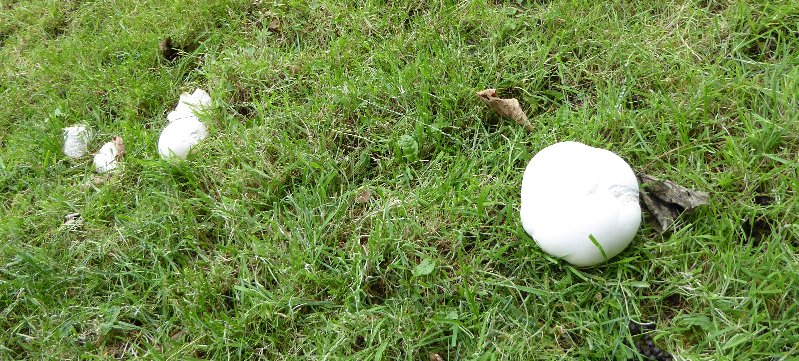
Refugees from the sports pitch? Or puffballs?

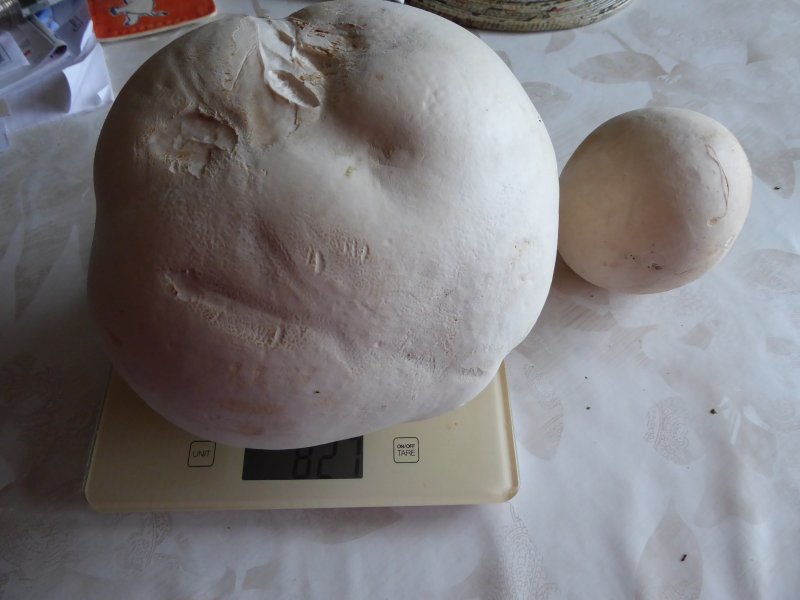
But last Thursday I was out walking with a friend when we saw something that put any existing evening meal plans on hold.  Over there in the corner of that meadow – look!  A white football, miles from any football pitch or recreation ground, with a tennis ball alongside, and a couple of golf balls next to them too.  Except we knew they weren’t lost property accidentally abandoned by sportspeople .  They were puffballs, those extraordinary giant white mushrooms which have no open cap with spore-bearing gills.  And they are barely attached to the ground, with no apparent stem.  My friend didn’t want them: she’s married to an amateur mycologist and sees quite enough of mushrooms without eating the wretched things, thank you.  But I did.  I reorganised my rucksack to accommodate the football and the tennis ball , and left the golf balls to grow up to be footballs in their turn.

My pack seemed unexpectedly heavier for the last mile or two of our walk.  It was hardly surprising.  My football weighed in at 827 grams – well over 1 1/2 lb.  It made a wonderful supper, fried in thick slices in butter with lardons and parley and lemon zest, with just a hint of garlic.  I gave a big chunk to friends who had us round to forage for apples and plums the next day, and the rest made a vast vat of soup.  Who said there was no such thing as a free lunch?

Here's our bigger puffball, on the scales and weighing in at 827 grams.
Here’s our bigger puffball, on the scales and weighing in at 827 grams.
  • ‘Food for Free 2’ to distinguish it from a post I wrote in April 2011, when I did indeed join in foraging for some rather odd items of wild food

another kitchen

Regular readers will know I’m a huge fan of Rachel Roddy, and her tales of life and cooking in Rome, as told in her blog ‘rachel eats’. Well, here she is in Sicily. And if you’re reading this under a sullen English August sky, you might like to take a virtual trip with me, and join her there.

rachel's avatarrachel eats

DSC_3227

Hello. We are in Southeast Sicily in a town called Gela. I have written a piece about this for the FT Weekend magazine, which is beautifully illustrated by Luke Best. If you would like to read it, here is the link. More here soon – R

DSC_3160

View original post

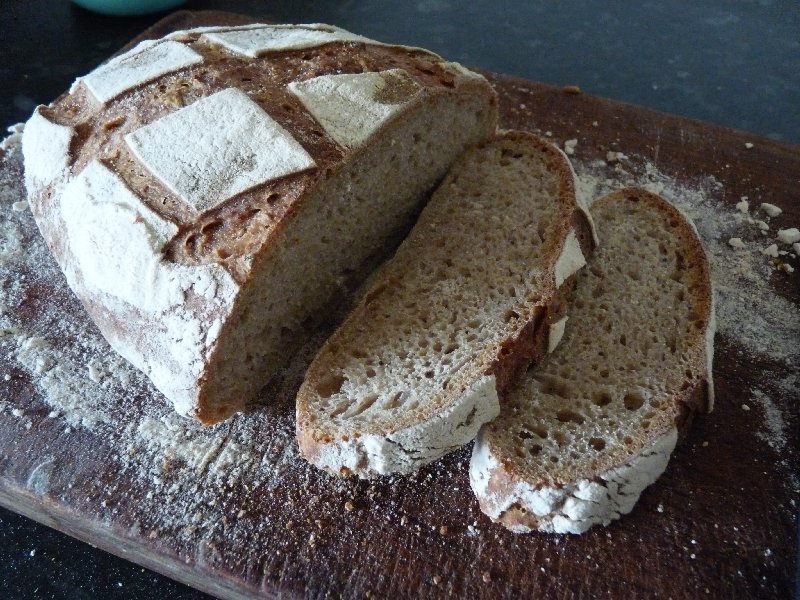
The genie of the bread basket.

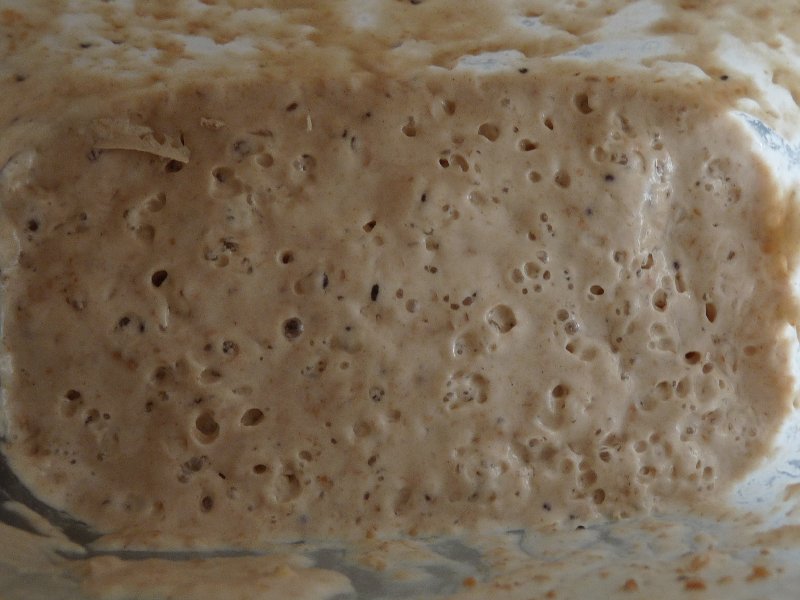
We’ve got a genie living in the corner of our kitchen.  He’s not very prepossessing.  He’s a kind of fawny-beige colour, and he just sits there, fidgeting and occasionally burping quietly in his pot. He’s just a little smelly.  If we just left him, he’d quietly expire, and probably get a bit more pungent.  But I do feed him, every two days or so.  I spoon a couple of measures of flour and a glug of tepid water into him, and give him a soothing stir, because I’m very fond of him.  We eat a little bit of him every day.

The sourdough genie.

Here’s how.  Whenever we need a new load of bread, I split our genie in two, and return half of him to his pot, with a little meal of flour and water.  The rest I turn into a bowl, add a loaf’s worth of flour, salt, and some tepid water.  And I knead this exceedingly sticky mess until it becomes an obedient ball of soft, rather floppy dough.  Then it’s into a warm place with it for a few hours, till it’s grown a whole lot bigger.

Then it’s time to knock the dough back, form into a nicely loaf-like sphere, and pop it into a well-floured basket: the sort you might have acquired on holiday in France a few years ago to pop your morning croissants into.  Leave it to rise again.

When it’s nearly ready, turn the oven on, good and high.  Put a dish of hot water on the oven floor.  Get a baking tray ready.

Here’s the scary bit: inverting the basket so the dough falls, but doesn’t tumble heavily, out of its basket and onto the tray.  Slash the top of the loaf with a few deep cuts, pop it in the oven, and you’re done.  Forty minutes later, there’s your very own loaf of sourdough bread.

Sourdough loaf, fresh for breakfast.

The hardest bit is getting your sourdough genie into the kitchen in the first place: it’s a bit of a faff rather than difficult.  Here’s how it’s done: though Googling ‘sourdough starter’ will deliver a dozen or more ways of getting going.   What you’ve done in making your very own sourdough starter is introduce wild, local yeasts into your flour and water mixture.  So your starter will be different from mine. The one you’re making now will be different from the one you make in the middle of winter.  I have a friend who’s been known to take his sourdough starter on holiday with him, to get his yeasts making friends with exotic foreign strains.

I’m having a bit of a sourdough moment.  It’s only a phase.  One day soon, I’ll forget to feed our little genie, or worse, I’ll get fed up and let him die.  Meanwhile, I enjoy the particular magic of creating the conditions for yeasts I can neither see, touch nor smell to come into my kitchen and help me create our daily bread.

Five quarters

five-quarters

I’ve just bought a cookery book.  This is not a newsworthy event in this house, despite the fact that I turn increasingly to the internet when trying to come up with something fascinating to do with a handful of leftovers discovered at the back of the fridge.

In fact it’s the internet that’s brought me into a relationship with this recipe book.  No, actually, it’s this blogging business.  You know how it is.  You discover someone’s blog.  And through that, you discover someone else’s.  And you end up following it (whilst trying to hang on to a sense of proportion: following blogs is not a substitute for real life).  Kath, the far-from-ordinary The Ordinary Cook was responsible, quite a few years ago now, for introducing me to racheleats.

I love Rachel’s bogs.  She’s an Englishwoman who found that a short visit to Rome turned into a longer one.  Then she found that she was no longer visiting, but living there.  She had the luck to live in a busy, ordinary, un-touristy district with a bustling market just down the road.  This market in Testaccio became central to her life there.  I guess she’s always cooked.  But she made it her business to buy local ingredients, to ask questions, to get thoroughly in touch with the ingredients and recipes of her new life in Rome.  And she started her blog.

There’s always a story to be told in her posts.  She’ll write about shopping for the ingredients, or how her version of the dish she’s writing about has come into being, or some other anecdote.  She has the knack of making you feel you’re sitting at her kitchen table, watching and learning while she chats as she assembles her ingredients and starts preparing the vegetables.  Because then there’s the recipe.  After I’ve read it, I want to dash into my kitchen and cook immediately. There’s just a small matter of not having that market to hand, with all its local stallholders and ingredients….

I wasn’t alone in loving her writing.  A couple of years ago, she was approached to write a cookery book, using the same personal lively style that characterises her blog posts.

And last week, the book, written whilst juggling her busy life as a mother, teacher, partner, recipe-chooser-and-tester, was published.  I ordered a copy immediately, from The Little Ripon Bookshop, and as soon as I got it, I started to read….  It’s a page turner.  She explains how it is that the book got its title ‘Five Quarters’..  She writes about the path that led her from London to Rome, from a career as an actress to the one she has now.  And she writes about the food she cooks.  Simple food, food made tasty by careful cooking of (to her) readily available ingredients: the dishes of the working people who lived –  and live –  in Testaccio.  The stories she weaves round the dishes she writes about make you want to cook, and eat, and go on reading this inspirational book.  If you like Italy, or food, or eating or cooking – or even better, all of these things, you’ll love this book, and want a copy to read and use and make your own.

‘This is a top pasta dish, this is’

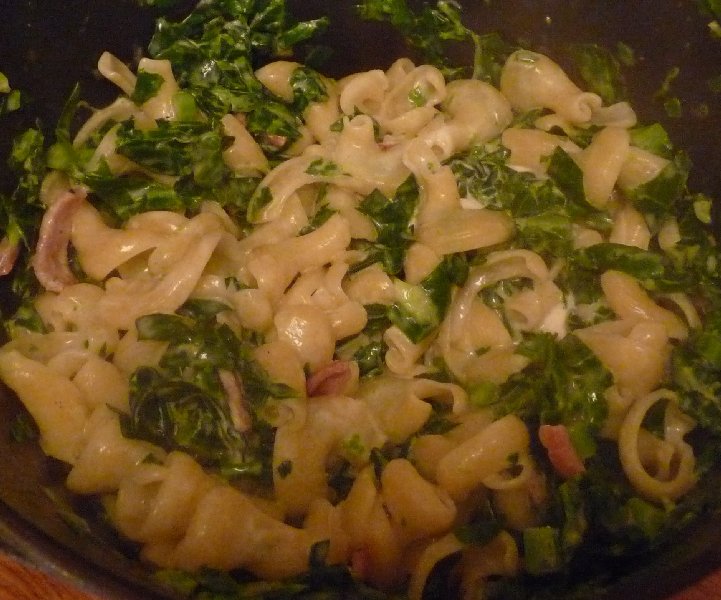
That was Malcolm, three-quarters of an hour ago, while we were just mopping up the last creamy, lemony, chilli-ish morsels from our pasta bowls.

It wasn’t a day when I’d given much thought to cooking.  All sorts of domestic tasks, boring but necessary, followed by my currently – slightly obsessive – daily attention to learning Spanish. Our landlords popped round, and a couple of glasses of wine later, there we were, quarter to eight and nothing on the stove.

Except I’d remembered glancing at this recipe in some idle moment the other day, spotted on the BBC Good Food website

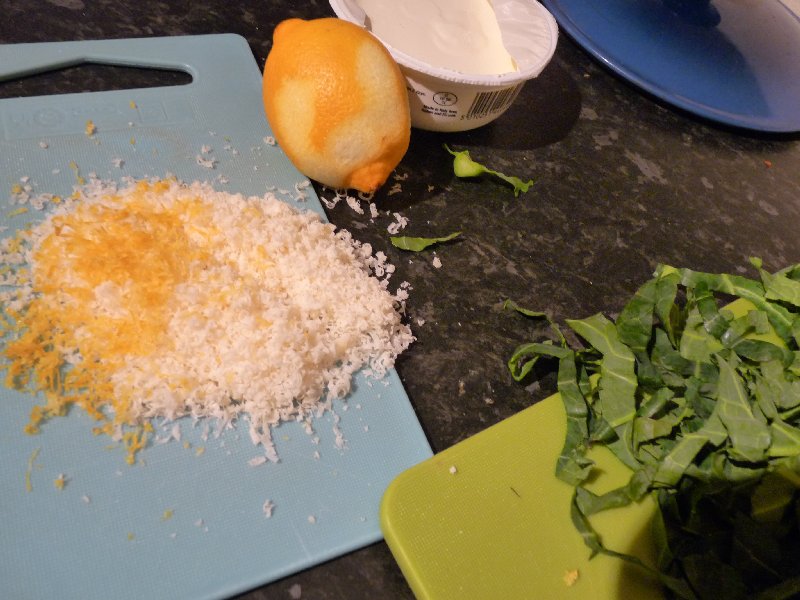
No kale?  I have spring greens.  No anchovies?  I have bacon.  And gran padano and mascarpone and lemons and nutmeg and chilli – and the all-important pasta.  Twenty five minutes later, we were sitting down enjoying our meal.

Messy cook at work
Messy cook at work

And it’s a meal for when you don’t feel like a long session at the stove, but need something comforting yet with light and bright flavours.  Oh, and dear veggie friends.  You could easily leave out the bacon or anchovies.

Messy meal in the pan.

Stir up Sunday

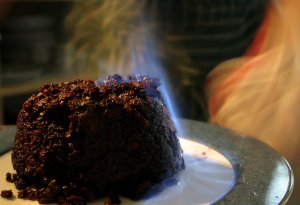
A Christmas pudding surrounded by brandy-induced flames.  Wikimedia Commons.
A Christmas pudding surrounded by brandy-induced flames. Wikimedia Commons.

I hope you made your Christmas pudding today, the last Sunday before Advent.  It’s more or less obligatory.

Once upon a time, if you were a good housewife of the parish, you’d have been kneeling at your pew in church as the vicar intoned the words of the Collect for the day:

‘Stir up, we beseech thee, O Lord, the wills of thy faithful people…..’

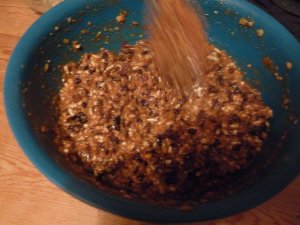
‘Stir up?  Stir up?  Oh, goodness me, I haven’t made my Christmas pudding’.  And church service over, our good housewife would scuttle home and make it.  She’d assemble dried fruits, suet, flour, rich dark muscovado sugar, cinnamon, cloves, eggs,  a bottle of barley wine or some other hooch, grate an apple and some lemon zest .  Then she’d tip all the ingredients into a bowl, and gather all her family around to stir the pudding too, and make a wish as they did so.  Then she’d spoon the lot into a pudding basin, firmly tie a greaseproof paper lid over it, and steam it for 5 hours or so.

On Christmas day, she’d steam it again.  She’d heat brandy, pour it over her pudding,  then set the alcohol alight  and bring it, flaming bright,  to table with a jugful of sherry sauce for all the family to enjoy.  We’ll be doing that too.

Stirring the pudding mixture and making a wish.

Today I went walking as usual with Ripon Ramblers, and told them I’d be making my pud later on.  They thought I was frankly bonkers.  Everyone, it seems,  plans to buy their puddings.  I don’t care.  We’ve had fun measuring, mixing, stirring and wishing.  The pudding is steaming as I type.  This is the recipe I chose this year.  The kitchen’s smelling pretty good at the moment.

Three Christmas puddings, waiting to be steamed.