Hallowe’en and Toussaint

I’ve just found the blog post I wrote at our very first Hallowe’en season in France, back in 2007.  This particular celebration seems to have become more and more Americanised here in the UK, and now in France too. In fact, I understand that the Fête de la Citrouille in Belesta is no more.  Exhibiting pumpkins has been exchanged for ‘trick or treating’: 0r as the French so snappily put it ‘Donnez-nous des bonbons ou nous vous jetons un mauvais sort’.

I thought I’d like to reminisce.  Here’s that blog post from a day in our very first autumn in France.
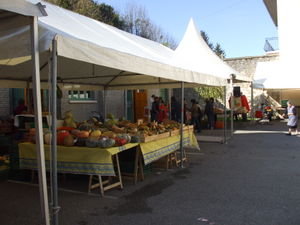
Pumpkin stall: most of these were grown by just one man

‘In Harrogate, Hallowe’en seems to mean spending the evening of 31st October greeting a steady stream of cheerful young witches, wizards, ghosts and ghouls to the door threatening tricks if they don’t get their treats. Here in nearby Belesta, it’s something rather different, since the period round Hallowe’en is for them  La Fête de la Citrouille – the Feast of the Pumpkin.

Well, just look at those pictures. If you could grow pumpkins like that, wouldn’t you want to celebrate? Yesterday, we had real fun looking round on the first day, which was also their Vide-Grenier day (Empty Your Attics). Pretty much like an English car boot sale really, except the stalls spread through the streets of the town. French attics and barns can turn out some splendidly puzzling tools and equipment, and as for the light fittings…… We enjoyed rooting around, and got ourselves quite a hoard of books at knock-down prices.

Of course the highlight of the day was yet another walk, a long ramble from Lesparrou, where we had dumped the car, along the wooded banks of l’Hers and through fairly isolated hamlets with picturesquely dilapidated (but still functional) barns, and productive potagers. Every day, the snow on the Pyrenees creeps just a little lower down the slopes, and we enjoy watching its progress. We ourselves celebrate the fact that the steeply wooded slopes which form part of nearly every walk become less strenuous as our fitness increases.’

It seems all such a distant memory now.  Back in England, we don’t enjoy the huge variety of pumpkins, squash and gourds which are part of every autumn and winter market in France.  Back in England, All Saints’ Day on November 1st goes unremarked.  Our cemetries are not suddenly overwhelmed with pots – hundreds and hundreds of pots – of chrysanthemums, as the entire population make this annual pilgrimage to the graves of their relatives during the period of ‘la Toussaint’.  Even though it’s half-term here too, our roads are not suddenly nose-to-tail with holiday makers as French families take this last opportunity to get away together before Christmas.  In England, as shopkeepers clear away the pumpkins and Hallowee’en paraphernalia, they’ll fill their shelves with Christmas goods.  That won’t happen in France, not until early December.  Hallowe’en and Toussaint have a particular feel in France which is quite absent from the same period in England.  I miss the pumpkins.  But not the chrysanthemums.
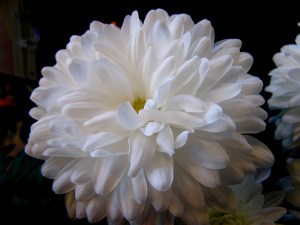
Chrysanthemums for Toussaint.  Wikimedia Commons
Chrysanthemums for Toussaint. Wikimedia Commons

Tour de France: the last gasp

‘I’ll bet’, ventured a friend the other week, ‘that the last few of those yellow bicycles don’t disappear from sight until round about Christmas’.  I didn’t take her on.  My own bet is that just a few of those yellow bikes, which so many people put outside their homes to celebrate the Tour de France in early July, will still be around many years from now .  Most have gone of course.

Little by little, in the weeks after the Tour, the bunting came down, then those miles and miles of hand-knitted jerseys, then the yellow bikes.  Now that Autumn winds are kicking in, all the bright yellow floral displays, often cascading from the panniers of those yellow bikes, are finally being grubbed up too.

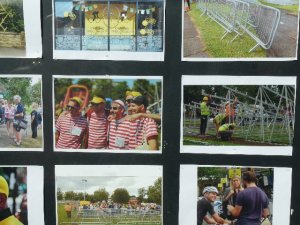
A few of the photos of the pre-Tour preparations

As far as Harrogate was concerned, the Tour de France Swan Song took place last week, in the form of an exhibition mounted by the Harrogate Photographic Society, ‘Le Tour in Harrogate’.  It took over the town.  The ‘hub’ – a term borrowed from the Tour itself to indicate where the main action was to be found – was in the exhibition space of town centre Saint Peter’s Church.  But there were satellite exhibits in a local café, an optician’s shop, and in the windows of a recently closed department store.

When we visited last Sunday, we found ourselves in company with dozens of others, poring over the images, sharing memories, exclaiming over forgotten moments of the preparations for the race in the days and weeks before, and its aftermath, as well as the days of the Race itself.  There were pictures of old gnarled hands knitting away industriously to produce those yellow-jersey banners, of hi-viz-clothed teams of men road-mending late into the night beneath the glare of floodlights.  Here were the gardeners making sure Harrogate’s famous floral displays were at their best, or French members of the huge Tour de France preparation team taking time out to link arms, laugh and pose for pictures.  My favourite shot, taken on race-day itself was of two young men perched high on a chimney-stack looking down on the race far below them.  And then there were the scenes of riders disappearing from view, only seconds after they’d first come into sight.

I’ve taken my own photos of the photos.  Perhaps that’s a bit like the video which was said to have been offered for sale a few years ago by a dodgy salesman operating from a battered old suitcase at the corner of the market place.  It was ‘Jurassic Park’, filmed in a darkened cinema on a hand-held camcorder.  But these pictures shown here are just souvenirs.  If you want to see these wonderful images in all their glory, you’ll have to contact the Photographic Society, who have produced a fully illustrated souvenir catalogue.  We’ve ordered a copy.

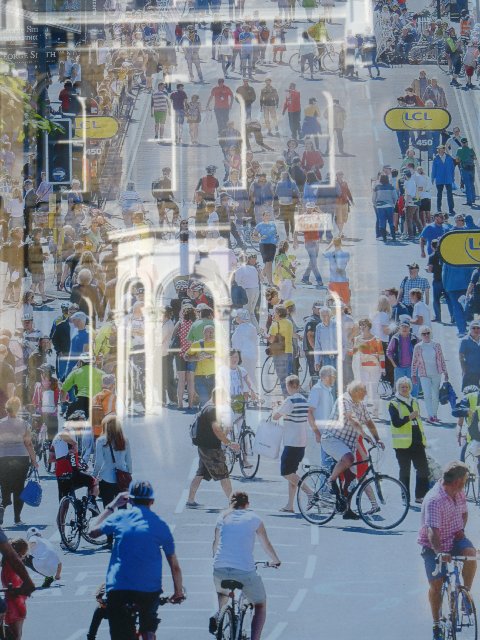
A shot of the crowds enjoyng the party atmosphere before the riders arrived.   Just as visible  is Harrogate's skyline, reflected in the shop-window where this picture was exhibited
A shot of the crowds enjoying the party atmosphere before the riders arrived. Just as visible is a Harrogate streetscape, reflected in the shop-window where this picture was exhibited

I haven’t been able to credit individual images shown here as the photographers weren’t identified in this particular display.  These aren’t however so much reproductions of their work as impressions.  The photos themselves are well worth seeing in their original form. 

A sheep is a sheep is a sheep…..

… or not.

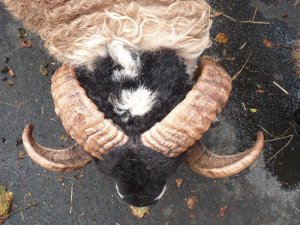
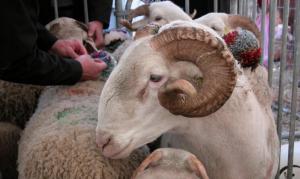
The splendid horns of a Swaledale sheep.

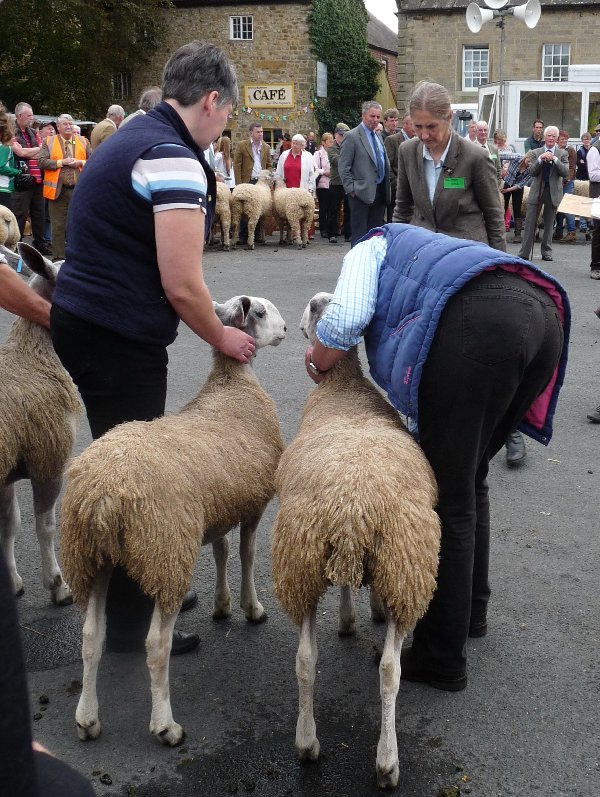
On Saturday we called in, far too briefly, at the annual Masham Sheep Fair. This is the place to go if you believe a sheep looks just like this.

549---Sheep

Saturday was the day a whole lot of sheep judging was going on in the market square.  Here are a few of the not-at-all identical candidates. And yet they are only a few of the many breeds in England, and in the world. There are 32 distinct breeds commonly seen in different parts of the UK, and many more half-breeds.  I was going to identify the ones I’m showing you, but have decided that with one or two exceptions (I know a Swaledale, a Blue-faced Leicester or a Jacobs when I see one), I’d get them wrong. So this is simply a Beauty Pageant for Masham and District sheep.

And if you thought wool was just wool, these pictures may be even more surprising.  Who knew that sheep are not simply…. just sheep?


Judgment day at Masham Sheep Fair

Wensleydale bread

We love a good country show.  Farm animals on their best behaviour,  sheepdogs out to impress with their skills in rounding up sheep, horses in the ring neatly jumping a clear round, country crafts, tough-guy tractors, food to sample, all in some pretty slice of countryside with the sun (maybe) beating down.

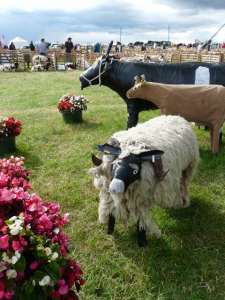
At Wensleydale Show, Leyburn Auction Mart went for animals made from  gaffer tape and oddments.  So much more biddable.
At Wensleydale Show, Leyburn Auction Mart went for animals made from gaffer tape and oddments. So much more biddable.


Since we got back to England, we’ve failed to go to the Great Yorkshire Show in Harrogate – too crowded, and the Ripley Show – way too wet.  Would it be third time lucky at the Wensleydale Agricultural Show?  Well, yes, we did make it there.  And just after we arrived (this was the 23rd August, remember) we found ourselves scurrying for cover to avoid a heavy hail storm, with sharp icy crystals slashing at our faces and battering at the marquees.

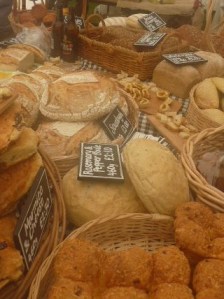
It didn’t matter.  The sun soon came out again, but in any case, we spent much of the day inside.  We were there to work.  Bedale Community Bakery, where we continue to enjoy volunteering every Wednesday, had a stall, and there was bread to sell.  Some of the team had worked through the night to get loaf after loaf mixed, kneaded, proved, baked and loaded up for the journey from Bedale to Leyburn and the show.  By the time Malcolm and I arrived, some of the team had been there several hours already.  And here’s what the stall looked like….

A tiny part of our stall.

We sliced and buttered loaves to provide samples for an eager public who wanted to talk to us and to try before they bought: sourdough; spicy chilli sourdough (soooooo good); cheese and onion bread; another cheesy loaf marbled with Marmite; harvester loaves; wholemeal loaves; bloomers; rosemary and pepper loaves; ‘seedtastic’ spelt; a loaf made using a locally brewed beer; a Mediterranean bread, all made the traditional way, proved long and slowly over several hours.  There were spicy vegetable pasties; tomato and onion focaccia; roasted vegetable focaccia; four different types of scone (Jamie and I had made quite a lot of those on Friday, and they were baked off in the small hours of Saturday morning).

Try before you buy.
Try before you buy.

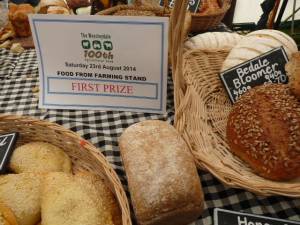
It all paid off.  We were in the food marquee, surrounded by other small food businesses offering bread, pies, jams and curds, cakes and biscuits, chocolate, cured meats: all good stuff.  But we got first prize in the ‘Food from Farming’ category, for the quality of our products and (buzz word alert) our community engagement.

And here's the certificate
And here’s the certificate


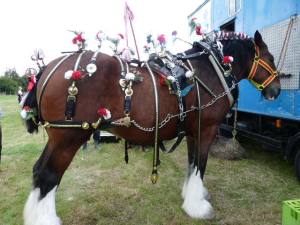
There was almost no time to get away and enjoy the show, but it hardly mattered.  Serving on the stall to an appreciative public was all good fun.  But here are a few shots from the times I did escape.  Here are shire horses, beautifully decorated in the manner traditional for the area.  Yorkshire horses, apparently, sport flowers, whereas Lancashire ones wear woollen decorations (very odd, as we had a  woollen industry in Yorkshire, whilst Lancashire did cotton).


A Yorkshire shire horse, her 80 year-old owner's pride and joy.
A Yorkshire shire horse, her 80 year-old owner’s pride and joy.


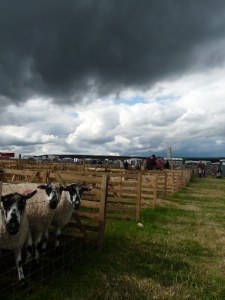
Here are sheep.

P1150966

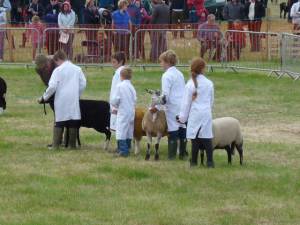
And here are children working sheep.  There seemed to be opportunities in every category for smartly-overalled and seriously skilled children to show off their prowess as animal managers: it’s clearly important to encourage the next generation of farmers.

P1150957

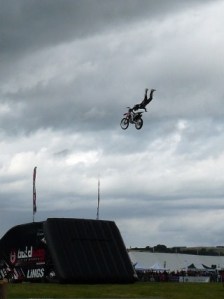
And here, oddly, are stunt bikers.  We saw them as we left somewhat before 5.00, every single loaf sold, as the show slowly started packing up for yet another year .P1150980

There are quite a few more shows left before the summer’s over.  We’ll get one into the diary.

Outside the showground: on our way home now.

Harrogate: le Tour de France se prépare

Knaresborough Market Place.

Off to Harrogate today, via Knaresborough, which has just been voted Best Dressed Town ahead of the Tour de France.  It’s done a fine job.  The whole town is festooned with bunting: not the signature knitted-yellow-jersey bunting favoured all over the rest of the district, but hundreds upon hundreds of white T-shirts, decorated by the schoolchildren of the town.  It all looks very festive, and combined with a yellow bike trail to send you bike-spotting down every street and in every shop window, it’s made for a fine community effort.  I still have a soft spot for red-spotted Hawes however, which we visited last week.  But Knaresborough’s Mayor has tricked out his house in red spots too.

Knaresborough's spotted house on a busy corner.
Knaresborough’s spotted house on a busy corner.

Harrogate though.  What a shock.  We were diverted away from West Park Stray, and once we’d  parked up, we discovered why.  This usually car-filled thoroughfare was a pedestrian-only zone.  No, that’s not true.  There were no cars, but instead, huge articulated lorries, buses, media vehicles from all over Europe, Tour de France  vehicles so large that no ordinary parking place could accommodate them.  There was even an immense lorry whose purpose was to offer, at just the right moment, 3 rows of tiered seats for about 3 dozen spectators.  All this circus came from the Netherlands, Belgium, Italy, Germany…. but above all, from France.

All around us, busy teams of workmen and women, technicians, electricians, craftspeople, media types rushed busily around, talking in the main in French.  We spotted registration plates from Val-de-Marne; le Nord; Pas-de-Calais; even the Haute Garonne, the next door département to the Ariège.  And suddenly, I was assailed by homesickness.  It was just like being back in France.  There was even a marquee filled with one particular team of workers sitting down together and sharing a midday meal.  That really whisked us back.  We wandered about, listening in, and engineering conversations with any French type taking a breather.  England’s nice, we’re given to understand, but our motorways are a nightmare.  We know.

But this immense team is only one of several.  There are others in Leeds, in York, in Sheffield, Cambridge and London, the other five towns where the three English stages begin or end.  I’d never previously understood quite what an industry the Tour de France really is.

Local teams from Harrogate itself had already uprooted many of the town’s pride and joy, its colourful flower-beds, in favour of providing viewing platforms for spectators who want to see the Race finish there on Day One.  I expect it was the right decision.  No self-respecting flowers could survive the expected onslaught, and the beds that remain look particularly magnificent.

When we’d looked around for a while, we nipped into a supermarket for some odds and ends we’d forgotten.  This is what the fresh produce department looked like……….

One more shopping day before le Tour.....
One more shopping day before le Tour…..

Normal life has been suspended, for one weekend only.

Back in the shopping quarter, Duttons for Buttons celebrates le Tour ... entirely in buttons.
Back in the shopping quarter, Duttons for Buttons celebrates le Tour … entirely in buttons.

Le Jardin Extraordinaire est mort. Vive le Jardin Extraordinaire.

Gosh.  Was it really only five weeks ago that we were there?  Was it only 5 weeks ago that we togged ourselves in skimpy sun gear, floppy hats and clodhopping sensible shoes to make our annual pilgrimage to Le Jardin Extraordinaire?  If you’ve been following our story of our life in France you may remember the photos of this joyful, playful, meditative, exuberant, and quite lovely space which so many of us come to explore and relax in for the one weekend only, in very early September (follow the link above).

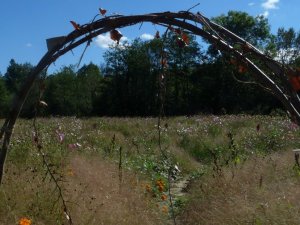
The meadow at the Jardin Extraordinaire today

Today we wanted a walk: it’s not high summer any more, but the sky was very blue, the sun was pretty hot, the morning mists had burnt off and who knows if tomorrow it may rain?  We wanted to take bags and a bucket and see if there were a few late blackberries (there were), a few sloes (there weren’t) and a few early walnuts (there were) to make our sortie near Lieurac worthwhile.

That was the entrance, a few weeks ago.

Our path took us past the site of Le Jardin Extraordinaire.  It’s not normally a public space, so we couldn’t wander down to the river, or scramble up the hillside.  But we could walk by the meadow which had greeted us at our last visit, and we could see the tunnels and bowers of gourds.  Autumn has struck.  The bright fleshy stems and leaves of the gourds and sunflowers have changed into gnarled and bony twigs.  The pumpkins which once peeped from beneath their leafy green sunhats are now exposed on bare earth, those leaves crisp and brown like curls of tobacco.  The sunflowers still rear their tall heads over the scene, but they too are blackened and dry.

It’s still lovely though.  This is no cemetery.  The seed pods, the gourds, the berries are all ripe now, They’re ready for the next stage: marauding animals may eat them, humans too, or else they’ll seed themselves, so that early next year, the garden can begin to grow again, and be transformed by the creative artists and gardeners of Artchoum.

Rosehips along our walk

And we too marauded today.  We came back after our walk with full bags, muddy shoes, and that feeling of well-being that comes from a peaceful and productive afternoon  out in the countryside in the bright Autumn sunshine

P1070802

Shipshape and Bristol fashion

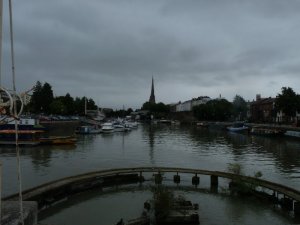
I hardly know Bristol.  I did stay there for the night, maybe 40 years ago, with friends who lived near the zoo.  It was thrilling to be woken in the morning by the lions roaring as they rose from sleep to greet the day. But our South Gloucestershire stay included a day-trip to the city.  With no chance at all of doing such a big place justice, we decided we’d spend the whole day exploring the harbourside area.  If I’d gone there during my first visit to Bristol I’d have found an industrial zone, its glory days over, unkempt and unwelcoming to the casual visitor.  Now the harbour is  a vibrant, shipshape and attractive area, busy with locals and tourists alike.

An early view of the harbour

We planned to go to Isambard Kingdom Brunel’s SS Great Britain, an early passenger steamship, the first to cross the Atlantic, back in 1845.  But it’s so worth an extended visit we decided instead we’d spend a whole day there, next time.  Because there will be a next time.

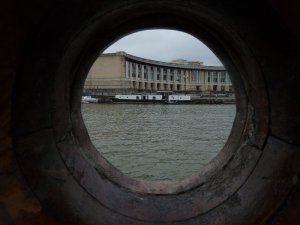
Old and new.  A view of the Lloyd's building from the Matthew
Old and new. A view of the Lloyd’s building from the Matthew

Instead we climbed aboard a replica of the Matthew, a caravel in which John Cabot sailed to America with a crew of some 20 men, in 1497.  It’s unbelievably small.  With little space for the men, no privacy, uncertain kitchen and sanitary arrangements and positively no computer-assisted stabilisers, it’s hard to believe that there were sailors willing and able to undertake the voyage.  But they sailed forth, and reached land – perhaps Newfoundland – some five weeks later.  They got home too, though somewhat confusingly via Brittany.  Their travellers’ tales are unrecorded.

The Matthew
The Matthew

Besides boats and ships of all kinds, there were the working trains of Bristol Harbour Railway shunting back and forth, trailing unlikely trucks of what looked like scrap and jumble There were museums, to most of which we gave a reluctant miss .  We did visit, though far too briefly, M shed, which gives a lively account of the history of Bristol and its role in the slave trade.  I don’t quite know how we managed to avoid visiting the Arnolfini gallery: probably because we know we must go back.

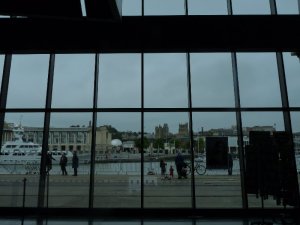
View of the harbour from the M shed

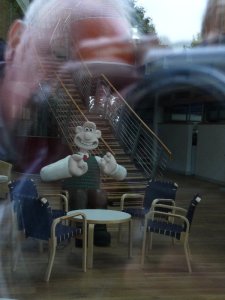
There’s something very exciting about being near a working waterway: because we did see boatbuilding and other water trades going on, despite its being a Saturday.  And we saw Nick Park’s place too, Aardman Animations, and peered through the windows in hopes of catching a glimpse of Wallace – or Gromit.

Peering in to see Wallace

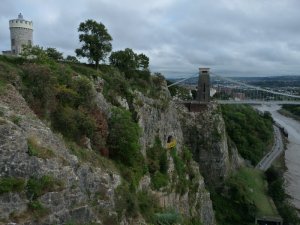
And we had coffee stops, and lunch stops, and afternoon tea stops.  Because it was that sort of lazy day. But having failed to visit SS Great Britain, we felt it only right to finish the day by allowing ourselves to be astonished by Clifton Suspension Bridge, which Isambard Kingdom Brunel designed when he was only 24, though it still wasn’t completed when he died almost 30 years later.

I couldn't take the whole bridge in at one glance
I couldn’t take the whole bridge in at one glance

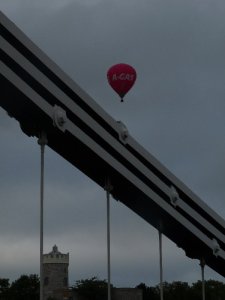
Now however, it’s used daily by more than 11.000 vehicles daily: rather different from the light horse-drawn traffic he had in mind when he made his design.  Our day was complete when we spotted another form of transport drifting lazily over the bridge: a hot air balloon. Bristol, you did us proud.

Hot air balloon over Clifton Suspension Bridge

Why ‘Shipshape and Bristol fashion’?  Here’s why


Le Jardin Extraordinaire, 2013 version

Le Jardin Extraordinaire is always comfortingly familiar, yet always surprising.  If you’ve been once, you’ll go again, on this one weekend of the year, to enjoy strolling round this very special wild, yet bewitchingly tamed garden.  The members and volunteers of Artchoum have been working for months to create this space, just for your pleasure.  You’ll want to explore the riverside walk and exclaim at the enchanted place they’ve created with stones, trees and flower petals.  You’ll go on to wander through the leafy tunnels and arches tumbling with gourds.  Then you’ll amble off into the woods, where more fantastical experiences await you.  People come from miles around to explore, smile and wonder at this very special place.  But although you won’t be alone, there’s a relaxing feeling of space and of peace too.  You’ll go away refreshed, invigorated and joyful.

To see the pictures as a slideshow, click on the first photo to enlarge it and start the show

Fireworks at Puivert

Late on Wednesday afternoon we went to Puivert.  Why not? It’s a pretty town not far from here, with a beach beside a charming lake.  

When we arrived at 5 o’clock, the car park was already almost full.  We weren’t surprised.  Nobody was leaving the beach: in fact, like us, dozens of people were making tracks for it, burdened with swimming gear, beach towels, fold-up chairs, picnic hampers.
We were getting there early, to make sure of a grand-stand view. After the regular summer-Wednesday-evening market, there was going to be a firework display, and we knew it would be good.  We picked our spot under a tree and near the lake.  Nearby, a musician set up his stall, and his balladeering (think Simon and Garfunkel) helped while away the evening.  A spot of swimming (not for me, not this time) a spot of people watching, and soon it was time to think about food.  About half those market-traders had set up stoves and ovens and complicated gas-rings and were busy slicing, stirring, grilling, frying and baking to provide meals for the hundreds of us who planned to eat ‘sur place’ as the evening wore on and darkness fell.  What to choose. Local grilled meat?  Tapas? Pizza? Something salady?  Paella?  Something oriental?  Wandering round in a state of terminal indecision’s part of the fun.
We chose paella, Susie and I, our young companions went Chinese, and we all finished off with sheep’s milk ice-cream (rose petal’s very good, so’s speculoos).
 
Then it was time to move nearer the water, listen to the nearby singer and the croaking frogs, and wait for darkness.
 
I enjoy fireworks.  But about 10-15 minutes is usually enough.  There are only so many rockets and golden fountains you can exclaim over.  This though, was different.
 
As it became truly night, laser beams (‘testing, testing’) drew blue lines and beams across the darkness.  White smoke emerged from large pipes at the water’s edge, and billowed softly across the lake.  What on earth?
 
Then it began.  Laser beams drew architect’s plans in the sky.  These futuristic ‘buildings’ revealed clouds above them: ah!  That’s what the smoke was for.  And above them, orange and red firework fountains dripped from the sky, seen through the ‘ceilings’ and the clouds.  The laser drawings slipped and slid, plunged and dived, in an ever-changing palette of electric blues, citric greens, livid yellows and magenta.  The fireworks went relentlessly on, mirroring the insistent rhythms of dramatic, dynamic music which seemed to herald the Apocalypse.  I don’t know how to describe how utterly involving and exciting it was.  My camera – no camera – begins to do justice to that extraordinary marriage of lightshow and fireworks.
 
After 20 minutes, it stopped. Just like that.  We held our collective breath, utterly silent, hundreds of us.  And then we applauded, wildly, recognising the genius of what we’d just seen, and knowing that an encore simply wasn’t going to happen.  Not this year.
 
It was, quite simply, one of the most exciting and compelling spectacles I’ve seen.  Ever.

This slideshow requires JavaScript.


Fête at Laroque

Montaillou in the 21st century

‘Laroque d’Olmes, below Montaillou, was a small market town which produced cloth.  At the local fair, which in the fourteenth century was held on 16th June, local cloth was sold, together with wood, fish, sheep, pottery and blankets from the Couserans.’  That’s what Emmanuel Le Roy Ladurie says in ‘Montaillou’, his wonderful examination of Catharism in the Ariège village of Montaillou at the turn of the 14th century.

Laroque’s June fair had already been a long-established event by then, and over the years it’s evolved.  Our contemporaries in town remember when it was still a hugely important event in the agricultural calendar, something like the fair that’s still held every year in nearby Tarascon.  There were animals everywhere.  One area was given over to cattle, another to sheep and others to all the usual farmyard creatures.  And at night there was dancing.  Bands belted out dance music on both Place de la Cabanette, and Place de la Republique.  It was quite a party, both for the Laroquais and for villagers from miles around.

This is the kind of sheep we'd have had at Laroque Fête: our local Tarascon sheep. Photo courtesy of La Dépêche du Midi.
This is the kind of sheep we’d have had at Laroque Fête: our local Tarascon sheep. Photo courtesy of La Dépêche du Midi.

At some point in the fairly distant past, the Fête became associated not with 16th June, but with the Catholic festival of Corpus Christi.  So it’s still called Festo del Corpus, though there are no religious ceremonies.

We love the idea that this fair has an unbroken history going back nearly1000 years. If only we could love the fair itself.

No animals or shepherds now.  It all begins during the week beforehand.  Fairground caravans arrive and make the open ground near the river their home for the week.  In the car park just along from our back garden, municipal workmen clang and clatter all day long, erecting a stage and a marquee for the various performers who’ll be on duty for much of the weekend.  The locals look on, unimpressed.  For scores and scores of us, the weekend means three nights of little sleep as the bands on stage boom their way through a noisy repertoire lasting from early evening, when they start to limber up, to two or three o’clock next morning.  Wander round to watch the dancing on those nights, and you’ll not find many locals.  It’s mainly out-of-towners, and we’ve learnt not to trust them all.  Two years running, our window boxes at the front of our house were stolen: now we remove them for the duration.

We leave town for the Fête.  This year, we only went 7 miles to stay with friends, though often we’ll try to take a short holiday.  Popping back briefly at 11 o’clock on Saturday night, I found the town as busy as Oxford Street in the January Sales, and our bedroom windows vibrating in time to the boom of the bass notes thundering from the stage.  Some years though, there are only a few hardy types twirling around in time to the music.

During the day, there’s the fun fair, majorettes, bands.  But they say the fair’s expensive, and while most people enjoy a stroll round to people-watch and chat to friends, there’s little sense that this event is a focus for the community.

I wouldn’t like Laroque Fête to disappear.  But perhaps it’s time to take stock and look at how it can become again what it once was: a summer event for everyone in town and to a lesser extent the villages beyond.  It seems that too many people at the moment actively avoid it or at best are unenthusiastic and uninvolved. And that’s the way for an event that’s happened every year for many hundreds of years to wither and die: which would be sad.