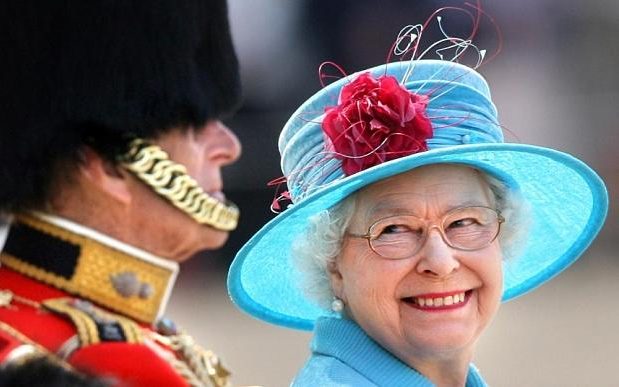
The Queen at the Trooping of the Colour (Daily Telegraph)
I’m neither a Royalist nor a Republican. I’m pretty indifferent to the lives of the Royal family, though on balance I think they fulfil a useful role in society. Elected Presidents bring little in the way of colour and charm to the kinds of jobs – opening factories and presenting awards – which are their frequent lot. I don’t begrudge them their large income, because nothing on earth would persuade me that their lives, constantly in the public gaze, are worth living.
Our indifference was a cause of constant bemusement to our French neighbours. These devout Republicans knew more, via the likes of ‘Hello’ magazine, than I had ever thought to enquire about. They were astonished that I did not have my finger on the pulse of life in ‘Buckingham’, that I knew little and cared less about Kate and her pregnancy – the Royal story of choice in our final weeks living in France.
But today, the Queen is in the news. It’s her ‘Official’ birthday, her 90th. British monarchs have all had two birthdays since the reign of George III in 1748, to enable them to enjoy any celebrations in the summer months. And today, throughout Britain , communities have welcomed the excuse to get together and party. The Queen is well liked and respected, the longest reigning monarch in British history, the world’s oldest monarch, and apparently still pretty sprightly and healthy. That’s worth getting out the bunting, a few bottles of fizz and some home-baked cakes for, surely?
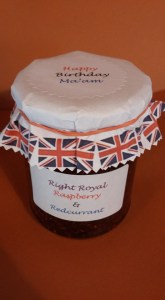
Here’s the Royal Jam prepared by my friend Jonet for their street party in Harrogate.
Jonet’s loyal jam.
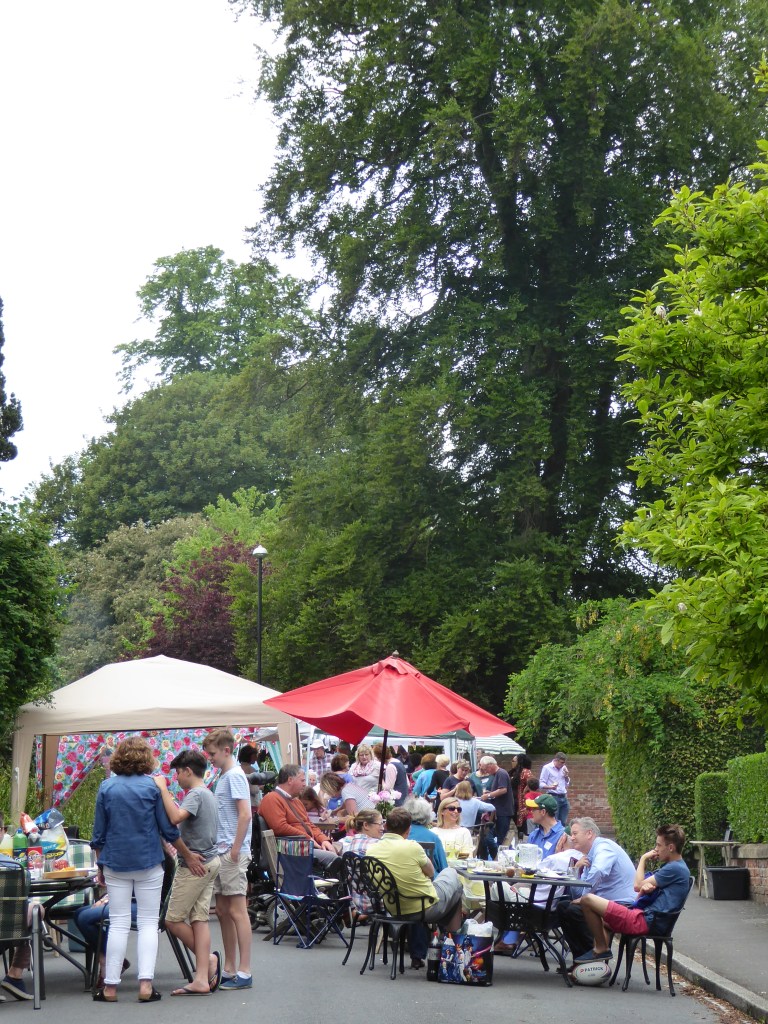
And here’s the party I went to in Ripon. Three members of our choir live in this particular street, so we all went along and sang to everybody, and ate, and drank and made merry, and admitted that the date of this particular knees-up had been fixed long before anyone realised it was HMQ’s birthday.
Street party in full swing.
Well, does it matter? Any excuse for a party. And since it was a thoroughly English party, the rain arrived, as predicted, at 3.30, just as everyone was being rounded up for rounders on the green.
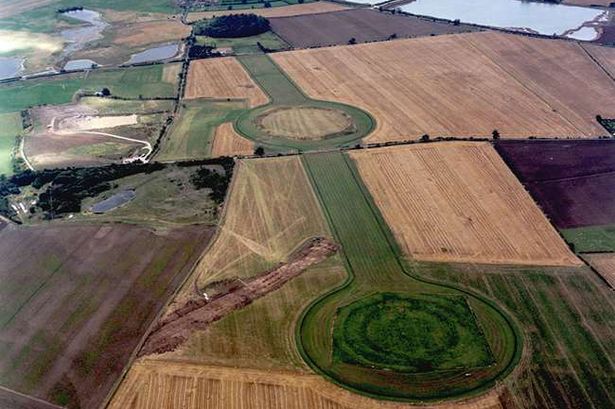
Not much further than a mile from us as the crow flies, lies Thornborough Henge. It’s a prehistoric monument consisting of three giant circular earthworks. Constructed 5000 years ago by the first neolithic (new stone age) farmers, it was probably an enclosure for their ritual gatherings. The Henge became an important centre in Britain for pilgrimage and trade, although its exact purpose still remains a mystery.
It sends shivers down my spine to think that this ancient piece of our history lies just a short walk from our home.
An ariel view of Thornborough Henges (photo courtesy of Historic England)
We can visit it any time we choose, simply to tramp round and try to imagine it in its heyday, and we’ll have the place to ourselves. Not on May-day though. Today is the Gaelic feast of Beltane, half way between the spring and summer solstices. It’s a day to mark the beginning of summer. Sadly, today is very cold, rather windy and a bit wet.
Back in pre-historic times, rituals were held on this day to protect the cattle, crops and people, and to encourage growth. Bonfires, deemed to have protective powers, were lit. For many centuries these practices died out. But nowadays, at sites like Thornborough, pagans, Wiccans, New-Agers and lovers of history and tradition gather once more to celebrate the renewal of life and growth.
Today I was there too. For an hour at least, for the opening ceremony. Brrr! It was cold.
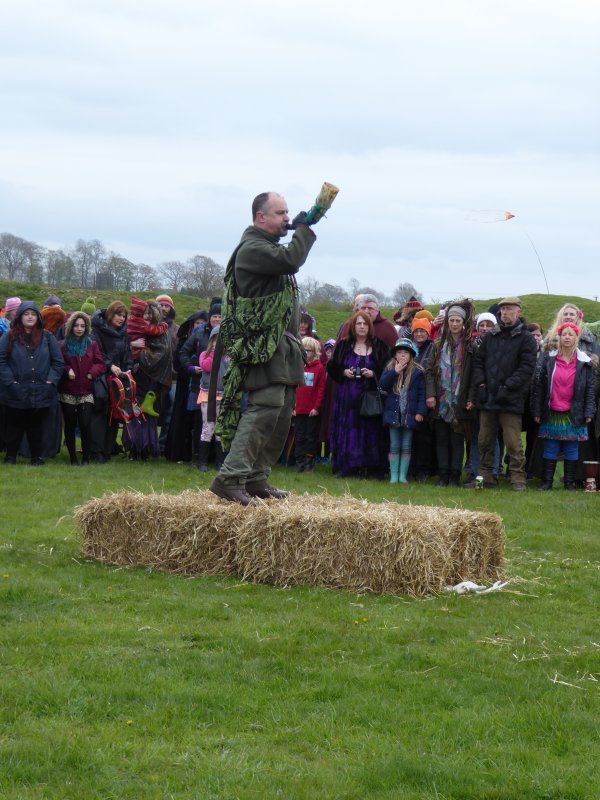
The Green Man and his horn.
I was strangely moved. The Green Man, representing rebirth and the cycle of growth was our Master of Ceremonies. He invited us all to join hands, whether friends or strangers, in fellowship, and shout out three times the invocation to new life. We hailed Brigantia, Celtic goddess of Northern England. Then at his bidding and as he sounded his horn, we turned to the east and welcomed the summer rains. We turned south to welcome the sun (who was coyly absent today), to the west to welcome summer winds, and to the north where the wolves apparently are.
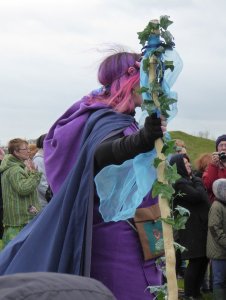
Welcoming the West Wind.
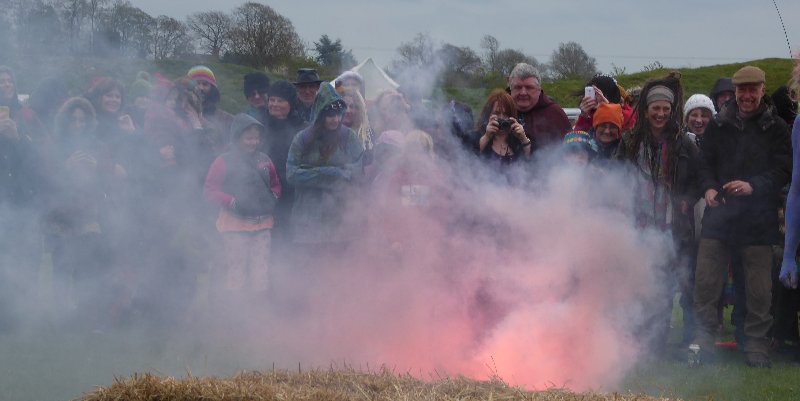
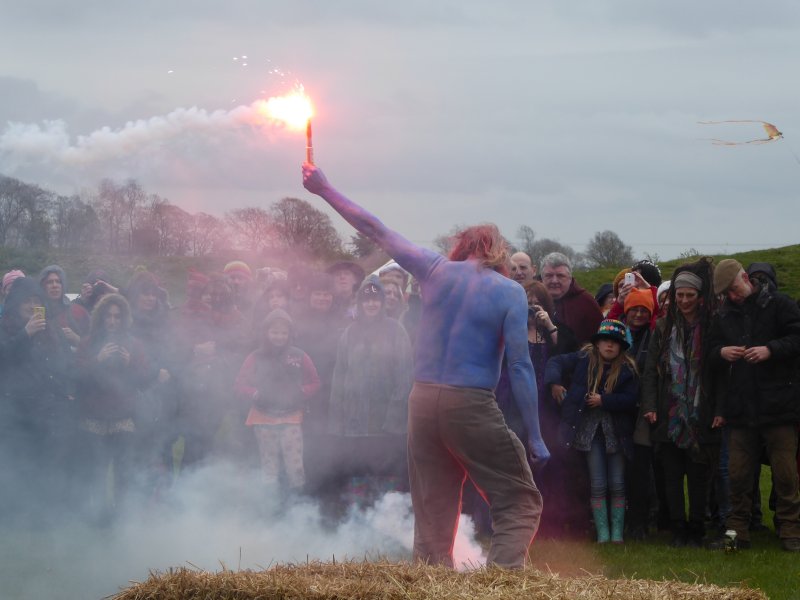
Then a man, naked from the waist upwards save for his covering of woad-coloured paint, leapt among us bearing the flaming torches which would offer us all protection over the coming months.
Protective flames.
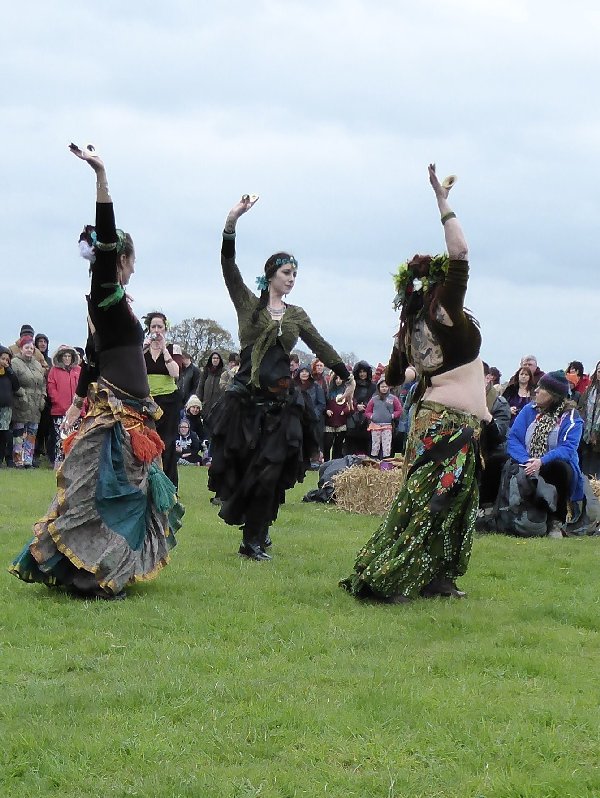
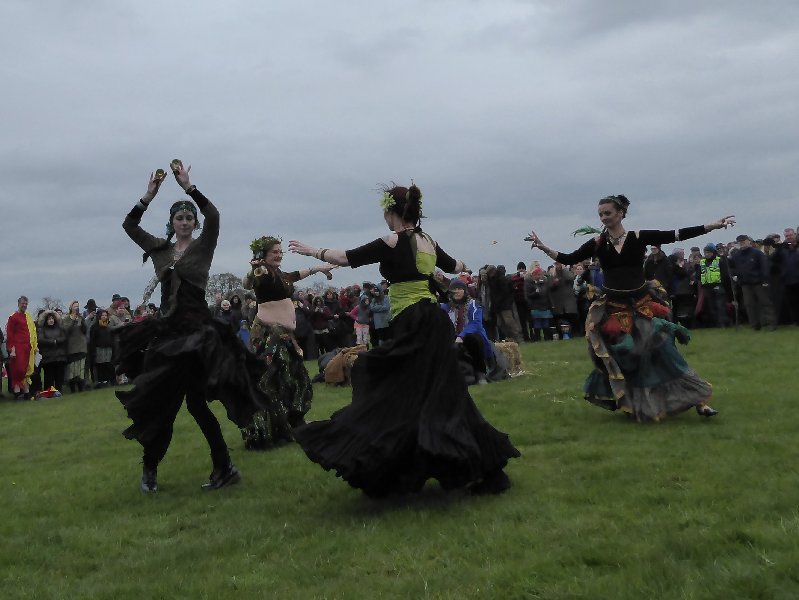
And that was the ceremony over. Dancers entertained us. They seemed to me to owe much to flamenco and to middle-eastern belly dancing traditions, but we all cheered them on with enthusiasm.
I shan’t be there this year for the closing ceremony. I’m still thawing out. But weather permitting, I’ll certainly go along next year. Will you come along too?
It was Christmas Day last Saturday (30th January). You hadn’t realised? Were you having a fairly normal-for-January sort of day? I expect you were. You’re not a member of our family, who this year, felt entitled to celebrate the festival on a day that suits us, even though we’d ‘done’ Christmas in December, just as you did. We take our cue from the Queen , who has an official birthday in June in addition to her actual birthday in April.
We had our reasons. The London Team had spent their Christmas in Gloucestershire with Sarah’s parents. The Barcelona Team had spent Christmas in Barcelona with Miquel’s mum. The Ripon team had spent Christmas In Bolton with Ellie, Phil and the twins. Now we wanted to have Christmas with each other.
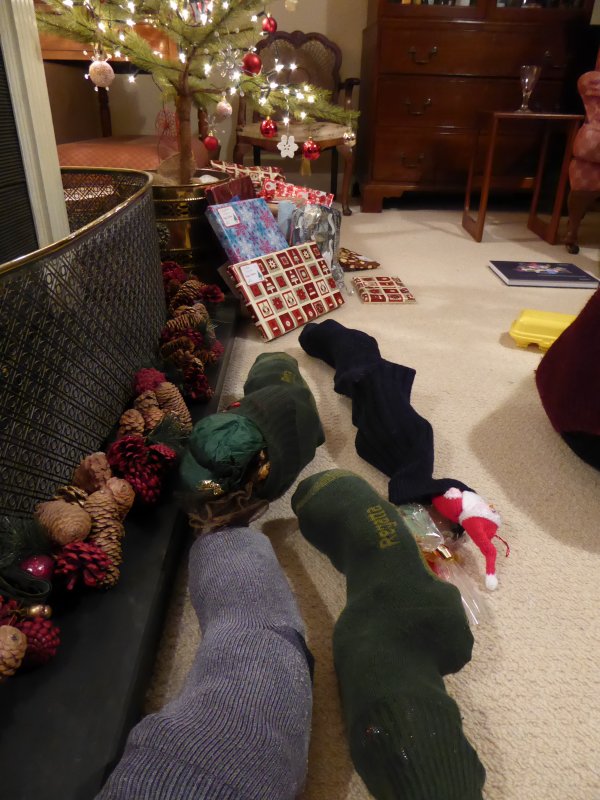
So we did. The Christmas tree was pressed into service. The Christmas cards re-appeared. Father Christmas briefly came back on duty and made sure that stockings were filled with gifts. Presents materialised under the tree. We even perpetuated a new tradition, begun only last year, of being ill for the duration. Last year, Malcolm and I had flu. This year, Sarah took to her bed within two hours of arrival, though she managed to surface on ‘Christmas Day’. William streamed with cold and was generally off-colour the whole time, and Emily and I coughed and wheezed.
Christmas dinner featured all the trimmings … but no turkey, no goose, nothing like that. The English teams had already done all that on December 25th, and Team Barcelona was pining for a really good British banger. So that’s what we had. Thanks, Geordie Banger Company.
The crackers featured appalling jokes, just as they should, and even more appalling novelties (floppy plastic golf tees, anybody?). William was entranced by the flaming of the Christmas pudding. And in the best tradition of all family Christmases with a baby in tow, playing with noisy, rustly wrapping paper and discarded ribbon offered the best fun of all. There’s a lot to be said for doing good things twice.
Father Christmas appears to have dumped all the stockings in rather a hurry.
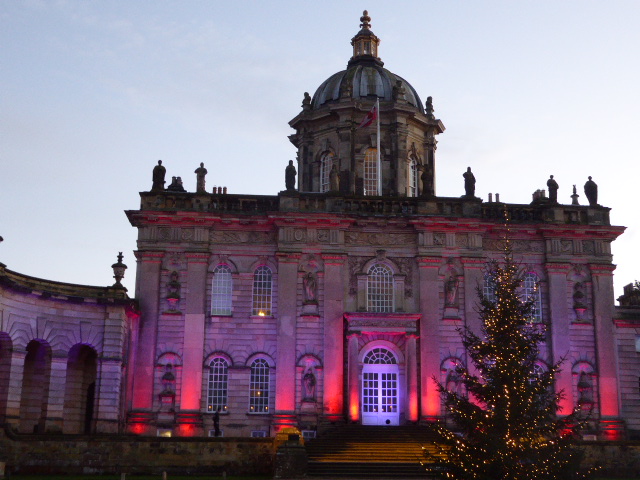
You all know Castle Howard, that magnificent 18th century stately home, and one of Yorkshire’s treasures. I’ve even blogged about it. It provides the backdrops in endless films and TV dramas.
This time, though, as it’s Christmas, I just want to show you how its been decorated for the season. A few weeks ago they shut the doors for a whole fortnight, and everyone from groundsmen and gardeners to guides and caretaking staff turned to and spent their time dragging trees into place, painting, placing baubles, candles and foliage, gilding, and generally making the place festive. Then they re-opened. We came away from our afternoon there, admiring everyone’s hard work and enthusiasm, feeling Christmassy for the first time this year. Happy Christmas everyone!
If the National Trust property where you volunteer has an abbey on site, albeit a ruined one, that’s where a good few of the Christmas celebrations need to take place.It’s fair to say that there are many people locally who regard a chance to hear singing from a local choir at one of the ‘Music and Lights’ events, or at the carol service here, as one of the focal points of their pre-Christmas celebrations.
The Abbey hasn’t had a roof since Henry VIII’s men came and removed it. Only the cellarium, which the monks used for storage, specifically for vast quantities of valuable woollen fleeces, is still under cover. It’s a little draughty too, as the windows remain unglazed, but the acoustics are amazing. The monks who used to call the abbey home might be rather surprised to find that their storage facility is nowadays, from time to time, a concert hall.
Picture the scene before the service began. Here’s the cellarium at 1.30 p.m.
The cellarium, empty at 1.30 p.m.
For two hours after that, though, there was a batallion of volunteers, with a couple of members of staff cheerfully mucking in to transform the place. Some of us hauled ranks and ranks of folding chairs out from storage and arranged them neatly. Some protected scores of candles with little cardboard collars so nobody would be burnt by molten wax when the time came to light them during the service. Others uncoiled lengthy snakes of cable for the sound and lighting systems. And the largest team of all arranged the refreshments: coffee, tea, hot chocolate, mulled wine.
By 3 o’clock. members of the public were already choosing their seats, and the refreshment stand was very much in business. ‘One coffee, two teas and four mulled wines please!’ ‘Two hot chocolates, a mulled wine and a coffee’. On and on we worked. Suddenly, someone said she thought she could hear ‘Oh come all ye faithful’ in the distance. The service had long since begun, and we’d been too busy to notice.
The carol service continued, service of refreshments continued. By half past 4, things finally started to quieten down as the event drew to a close. Time for the team to snatch a refreshment break, and do a little accounting. We’d sold far more than £1000 worth of hot drinks, including 66 bottles-worth of mulled wine. Not bad for a couple of hours’ hard graft. And as the congregation proved willing to do a whole lot of chair shifting, clearing up didn’t take too long.
Even if we didn’t hear many carols, we felt we’d had a good start to the Christmas season. It hadn’t been very peaceful, but there had been plenty of cheerful good will from staff, volunteers and visitors alike.
And meanwhile, up at the entrance to Fountains Abbey & Studley Royal, two other volunteers had been busy. Here’s Sharon, Volunteer Elf, welcoming visitors to meet Father Christmas – a volunteer, of course.
‘Even in 1215 London was an independent sort of a place: rich, well-connected and hard to govern. With nearly 15,000 residents it was already the largest city north of the Alps. Its merchants were organising a mediæval commune to protect themselves against pillaging barons and a taxing King, and its diverse trading population had strong connections to Europe and Scandinavia.
Meanwhile, bad King John was in trouble. He was retreating in France, running out of money and losing control of his Barons. Discontent was turning into open revolt and the King was very short of allies.
In 1215 the King was persuaded to issue a Royal Charter that allowed the City of London to elect its own Mayor. We presume that he gave his blessing to the commune in order to keep the City on his side, but there was an important condition. Every year the newly elected Mayor must leave the safety of the City, travel upriver to the small town of Westminster and swear loyalty to the Crown. The Lord Mayor has now made that journey for 800 years, despite plagues and fires and countless wars and pledged his (and her) loyalty to 34 kings and queens of England.’
That’s a quotation from the official site of the Lord Mayor’s Show. This is not so much a show as a procession that over the centuries recognised the Lord Mayor of London as one of the most powerful men in the country. This may no longer be the case, but in its day the procession was one of the greatest spectacles in the country, worth a mention by the likes of Shakespeare and Samuel Pepys. It’s still the occasion when the new Lord Mayor travels in a splendid coach which, were it to be built today, might cost some £2,000,000 to build.
The new Lord Mayor bravely sticks his head out into the pouring rain to wave at the crowds.
You’ll see city businesses, Livery companies, charities, the armed forces, police, Londoners from every walk of life, marching or on floats reminding us of the complex and varied history of the City of London, a small square mile area at the centre of the now enormous wider city, which is some 607 square miles in area. London has its own Mayor, an elected politician (currently Boris Johnson): please don’t confuse the two offices!
We were in London for a couple of days. Son Tom was singing in a concert with his Choral Society on Saturday evening, and for the rest of the weekend, the five of us, including four-month old William, became tourists. Four month old babies have a habit of imposing their own daily rhythms on the day, so we didn’t arrive for the start of the procession, or in time to secure a very good vantage point. But there were highlights, the last of which was the appearance of the Lord Mayor himself in that magnificent coach, accompanied by halberdiers in their ancient uniforms. Before that we’d seen horseguards, and representatives of some of the great Livery Companies. These were ancient trade and craft guilds. They existed all over Europe as Trading Standards organisations, as trade unions, as philanthropic organisations helping members in times of sickness and infirmity, but those remaining in London are unique in their survival, number and diversity.
The Royal Horse Guards wait patiently to take their place in the procession.
The Honourable Company of Air Pilots.
Not a Worshipful Company.
The Worshipful Company of World Traders.
We have no idea how Yorkshire muscled in.
A splendid coach. But not as splendid as the Lord Mayor’s.
Another splendid coach,
Haberdiers accompany the Lord Mayor.
Avery British sight. An elderly woman waits patiently for the Lord Mayor’s procession to wend its way past her again in …. oh, maybe an hour or so
These days we are charmed by the names of the more ancient Guilds: the Watermen and Lightermen; the Tallow Chandlers; the Spectacle Makers; the Painter-Stainers, the Merchant Taylors: we saw none of those, though they still exist. More recent additions are the Air Pilots, the Environmental Cleaners and so on, and we saw representatives of the Guild of Human Resources Practitioners and of the World Traders. What would Dick Whittington, the 14th century rags-to-riches thrice times Lord Mayor of London, more commonly these days seen in Pantomime have made of them, I wonder?
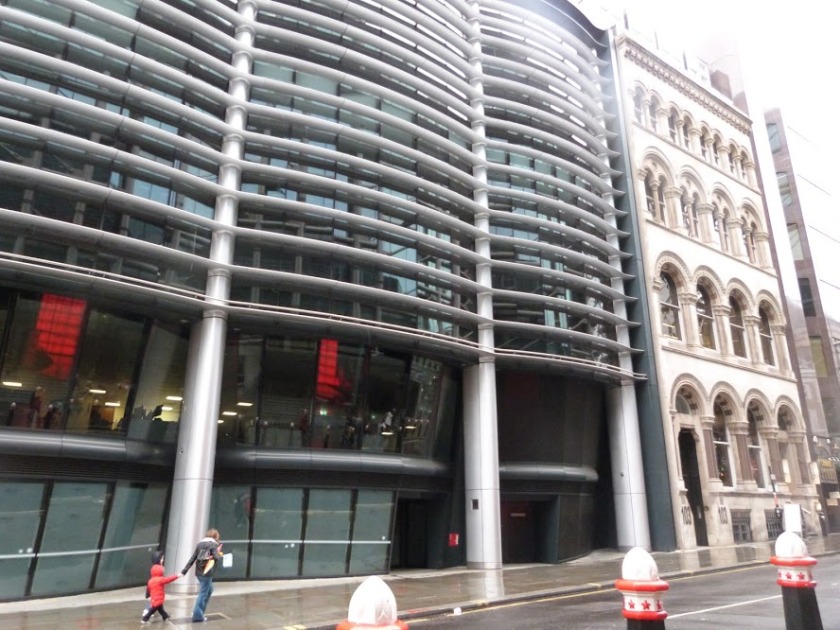
The City of London old and new, seen through the windows of Leon, a natural fast-food restaurant.
I love the City of London. Despite its being home to the Tower of London, to some 4 dozen Wren churches including St Paul’s and a host of other sites; despite its wonderful street names (‘Hanging Sword Alley’, ‘Gutter Lane’, ‘Wardrobe Terrace’), it’s a surprisingly people-free zone at the weekend. I love the dissonant notes as delicate, ancient buidings and churches butt up against stark modern constructions. I love it that these modern flights of fancy in glass and steel are obliged to squeeze themselves into street patterns established in the middle ages, and unchanged even after London’s famous Great Fire of 1666. There’s a surprise around every corner.
New city, old city.
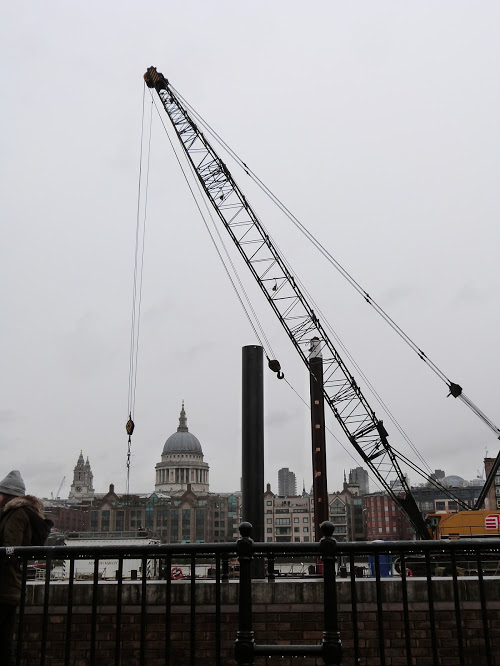
And afterwards, a stroll along the Thames, to see more evidence of London old, London new.
Pateley Bridge, population just over 2,000, is slap in the middle of Nidderdale, an AONB (Area of Outstanding Natural Beauty) appreciated for its landscapes, its rich flora and fauna, and its now hard-to-spot industrial past. But if you were there this last weekend, it might not have been to use the town as a base to explore the Yorkshire Dales. You might instead have been coming to Niddfest, a new family-friendly festival offering a weekend of talks and outside events for nature lovers, and especially book-loving nature lovers, of all ages. That’s why we went, on Saturday, and again on Sunday. We had a pretty busy weekend there, but it turns out we weren’t busy enough.
Pateley Bridge High Street (Wikimedia Commons)
We weren’t there when Poet Laureate Carol Ann Duffy and National Poet of Wales Gillian Clarke introduced the festival, reading from their work. We were absent from the sessions when the likes of Piers Torday, Katharine Norbury and Michelle Harrison were reading from and discussing their books. We didn’t go on the Moor Safari, or on the river walk along the Nidd, or foraging for wild edible plants. We didn’t commandeer our grandsons so they could explore for bugs at Studfold Adventure Trail, or go den-building in the woods.
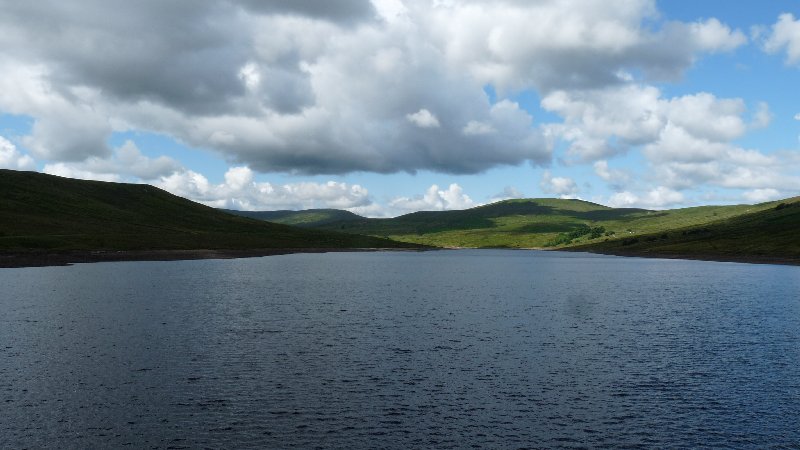
Scar House Reservoir, scene of our bird-watching walk.
What we did do was go on what was billed as a bird-watching walk with Mark Cocker and the Nidderdale Bird watchers’ group. And what a way to start. A young cuckoo landed on a fence post, and was immediately followed by his unwitting foster-mother, a meadow pipit, who spent frantic moments stuffing food down his always-open throat. Bear in mind that a meadow pipit is some 15 cm. long, and weighs in at 15 g . The cuckoo wasn’t far from its adult size of 33cm, and 110 g.
With a start like that, the rest of the morning might have been a let-down. But it wasn’t. We saw an old shed where a colony of swallows had begun their days, and learnt that they, like most swallows, would end up wintering in a reed bed somewhere near Durban, South Africa…. some twelve and a half thousand kilometres away. We saw house martins, goldfinch, and quantities of ‘red’ birds – red kites, redpolls, redstarts. We learnt to distinguish thistle varieties, and learnt which ones bees favour. We began to understand just how many varieties of bees, beetles, flies and other insects populated this limited corner of Nidderdale. All this thanks to the bird watchers and especially to Mark.
Then we hurried up to Middlesmoor – to hear Mark again, in conversation about his books. Do look at his website – here – to learn more. His nature writing is something special. He celebrates wildlife in its day-to-day environment, but believes the natural world is far more than an interesting and quite engaging backdrop to our lives. It’s fundamentally important, and environmental issues need to assume an equal, if not a greater importance in political decision-making than, for instance economic affairs. Instead, they are sidelined if not totally disregarded.
Middlesmoor churchyard.
This politics-with-a-small-p approach continued the next day, when we heard Oxford graduate and Cumbrian shepherd James Rebanks speak about his bestseller ‘The Shepherd’s Life’. He has many strings to his bow (adviser to UNESCO for instance) – farming in the Lake District simply doesn’t pay. He points out that our desire for cheap food, our disconnection from where our day-to-day nourishment comes from is putting traditional farming, where animals are treated well and with respect at risk.
And then it was Rob Cowen. How could we not be fascinated by his book ‘Common Ground’? He has become forensically interested – almost obsessed – by a small patch of green space just at the edge of Harrogate. This small area was our own ‘green lung’, only yards away from our front door when we too lived in Harrogate. He weaves the story of his growing infatuation together with more personal notes about the baby he and his wife were expecting. It’s clear his well-being depends upon his developing close relationship with this edge-land, this little piece of woodland, river and grass still clinging on to the top corner of a busily expanding town. Nature writing with a difference.
What a rich feast we had. In some ways we’re sorry we didn’t cram in more of what was on offer. But as you see, we had more than enough to digest. A brilliant festival. It had better come back next year.
I love Appleby Horse Fair. In truth I’ve never been there, nor am I likely to go. But we know it’s happening, very soon, and here’s how we know.
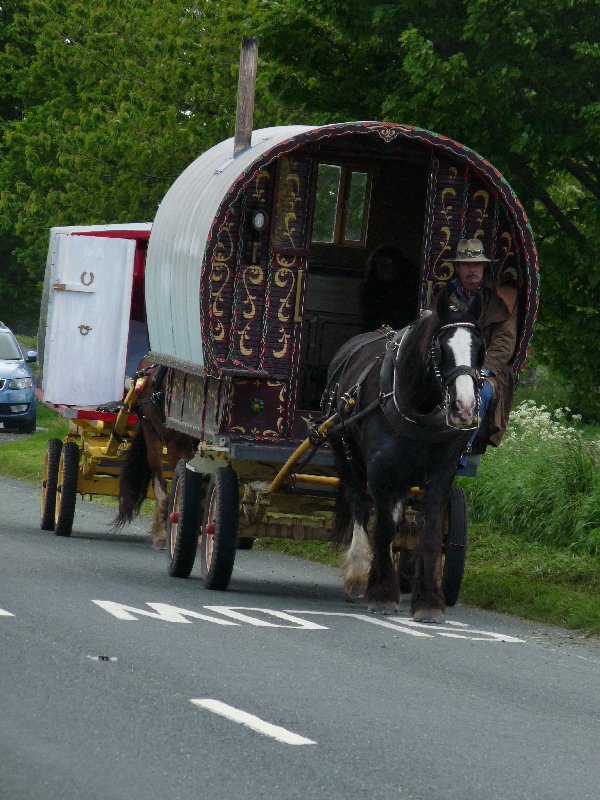
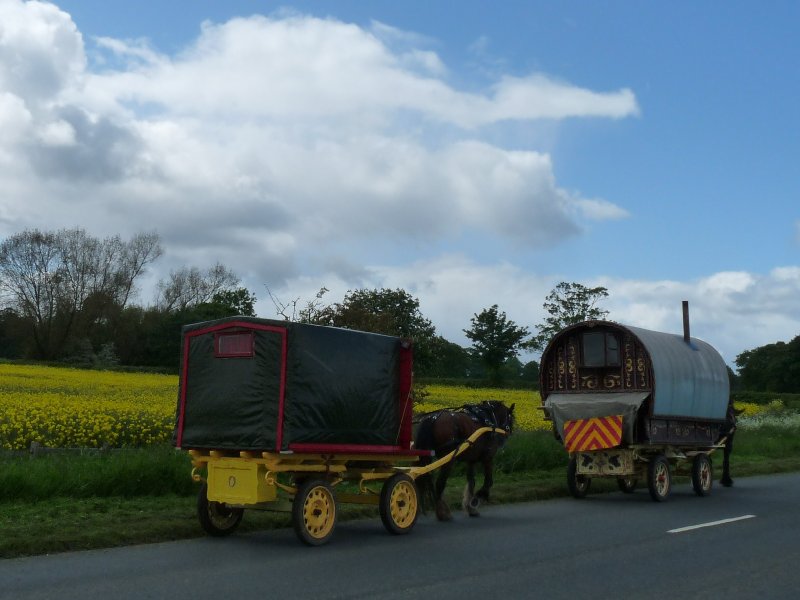
Every day for a week or more, we’ve seen sturdy shire horses, or work-horses in any case, plodding steadily up the main road out of Ripon, drawing behind them colourful and traditionally decorated gipsy caravans, or vardoes. That’s how we know that it’s the horse-fair at Appleby pretty soon.
Here in Ripon, we’re a good 65 miles from Appleby, avoiding motorways. But some of those caravans are travelling from much far further away than that: travellers coming up from as far away as Wisbech in the Fens have made the news this week. This fair is a huge occasion.
Every year in early June 10,000 – 15,000 English, Welsh, Scottish and Irish gypsies and travellers gather there to buy and sell horses, meet friends and celebrate their culture. Originally, when it started in 1775, the fair was held on unenclosed land just outside the town boundaries of Appleby. It was quite a different affair then, Sheep and cattle drovers and horse dealers met to sell their stock. Only gradually did it evolve into its present incarnation as a celebration of the Romany gypsy and traveller way of life.
People tell stories that the fair evolved following the granting of a Royal Charter by King James II in 1685. Others say that the fair continues the tradition of Appleby’s mediaeval borough fair, once held at Whitsuntide. But no. The fair exists backed by no royal charter, no civic tradition. It was and is a people’s fair which nobody owns, and to which nobody charges admission.
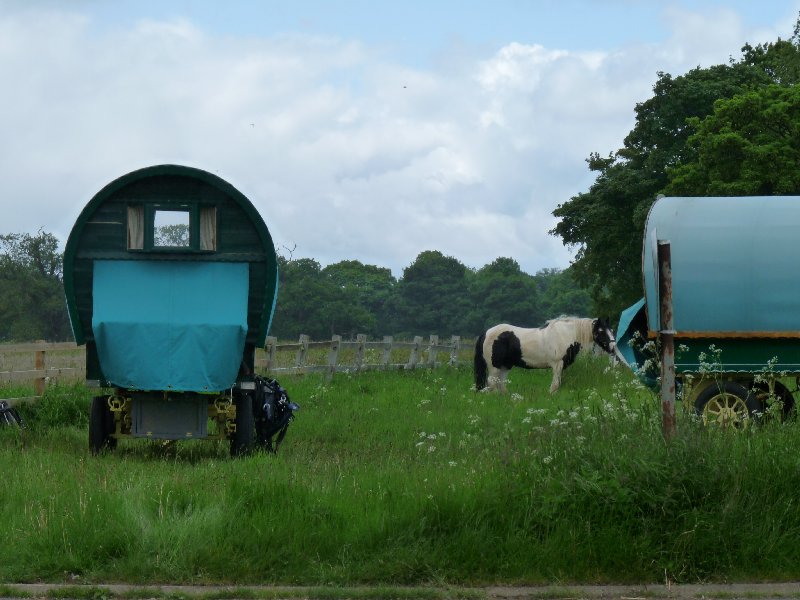
Overnight camp at the roadside.
I wonder about these colourful travellers and their even more colourful vardoes. At night, they’ll tether their horses on the lush grass verges, and set up camp. Everything bar sleeping has to be done in the open air, since these vardoes seem to be no larger than the average single bed. By day, these horse-drawn caravans hold up traffic in long slow-moving tailbacks as they advance slowly towards their destination. Nobody seems to mind. But when do we ever see these sights except in the days leading up to and away from the fair? What happens to the caravans, and even to the horses in between times? Every gypsy and traveller encampment I’ve seen in recent years has featured large modern caravans and a motley crew of vehicles from state-of-the-art Mercedes to clapped out old Fords. It must make life more comfortable. I wonder if older traveller folk mourn the passing of the old days, or whether they’re quite simply grateful to have a home featuring all mod. cons?
A short convoy of vardoes.
I know I promised another post on the National Trust. That’s coming soon. Really.
Twelfth Night is a bit of a grumpy day for me. Nothing festive happens. It’s just the day for dismantling the Christmas tree, packing baubles and Christmas wreaths away for another year, and reading through Christmas cards from old friends for the last time before they’re taken off to some recycling point. The house looks sparse and bare, and maybe in need of a spring-clean.
I think of Emily over in Barcelona. She’s not at work today because Twelfth Night is Epiphany. It’s the day on which Spanish children at last get their Christmas gifts, because the Day of the Three Kings is when legend has it that the Magi presented their gold, frankincense and myrrh to the infant Jesus. As Emily points out, the main downside to this late arrival of gifts is that this is the very last day of the holidays: school tomorrow, and no time to get to play with those new toys. Still, today is another chance to party and enjoy a family feast.
Our caganer is clockwork. He does back-flips.
It was Emily who may have been responsible for our finding ‘el caganer’ in our Christmas stocking this year. If your Catalan isn’t up to translating this, let me explain. It means, um, ‘the crapper’. El caganer is a little fellow in Catalan costume, squatting with his trousers down, and defecating. Why? Well, he’s a traditional part of Catalan nativity scenes. Maybe he’s a fertility symbol. Most people these days prefer the idea that it shows that great or small, we all have the same very basic needs.
Caganers on a market stall. Anybody you recognise here? (Wikimedia Commons)
So these days at any street market, you can buy caganer figures who represent the Pope, the Queen, Barack Obama, a whole range of footballers – any personality you can think of. And they’re just the same as us. Even if it’s Twelfth Night, I don’t think I’ll pack away our little ‘el caganer’ just yet.
Galette des rois, courtesy of Wikimedia CommonsA dusty miller. (Wikimedia Commons)
And when we lived in France, Epiphany was the start of the Galette des Rois season. As guests anywhere, you’ll be sure to be offered a slice of this almondy pastry confection. Part of you wants the good luck of being the person to find the ‘fève’ within your slice. This used to be a lucky bean, making you king for the day. Nowadays it’s a small china figurine, and maybe quite collectable. I’ve just been looking unsuccessfully for our little fireman ‘fève’: goodness knows where I’ve hidden him . The downside of finding the lucky bean though, is that it’s your turn to make the galette next time round.
Parts of Europe seem to be having fun. Ho hum. Here, it’s all too easy to be aware that there’s January to get through before we can think of the days lengthening and the arrival of Spring.
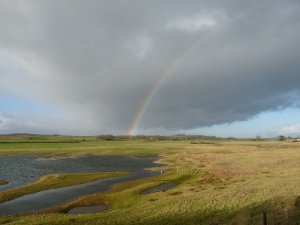
There’s a rainbow on the walk to the gravel ponds – before the lurgie set in.
We’d been looking forward to this Christmas, our first in England, and in our own home here, for some years. Son and daughter-in-law planned to come from London, and Emily was arriving from Barcelona, bringing her boyfriend so he could enjoy his first English Christmas. The Bolton Posse were also booked in for parts of the time. We’d spent time making things ready for a real family Christmas …. and then the day before Christmas Eve, I got a cold.
Only it wasn’t a cold. I kept on giving myself severe talkings to, and pointing out to myself that a hacking cough and a swimmy head could all be kept firmly under control. Then, at a neighbour’s Christmas Eve party, I passed out. And had to be helped home and put to bed by the family.
The next day, I wasn’t up to anything. Everyone had to turn to and cook and prepare – which actually they didn’t mind at all. I somehow got up for Christmas dinner, which I couldn’t bring myself to eat. I was going to bow out before I put too much of a damper on things when Malcolm too succumbed and retired to bed …. where he has remained, and has refused food for several days.
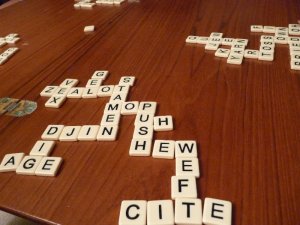
It’s been such a disappointment. I don’t think we were guilty of setting the bar too high, of wanting an unattainable Christmas ideal. We just wanted time together, having fun in a low-key kind of way. In fact, the rest of the family has. And I too have been able to join them for some of the time. So long as I don’t move around too much, I can join in the games we’re all so fond of. ‘Bananagram’ has been the all-out winner: at most times of the day, you could find at least a couple of people hunched over alphabet tiles, competing to construct their grid of connected words. But we’re keen on ‘Scattergories’ too, and ‘Balderdash‘, which involves writing definitions for words nobody’s heard of, alternative plots for long-forgotten films, and unlikely explanations for various acronyms.
Bananagram game in full swing.
None of this would do while Catalan Miquel was still here of course, so there were plenty of card games, and, for those with steady hands, the chance to construct increasingly wobbly wooden towers in games of ‘Jenga’. But I don’t know what the poor bloke made of our Christmas -in-the-sanitorium.
The family pronounced themselves satisfied with this low-key celebration. But for both Malcolm and me, still nowhere near to feeling healthy again, it’s been a bit of a let down. And it’s not just because of Christmas. Today, we should have been setting off to drive to Laroque, to spend New Year with our friends there. We’re simply too ill to consider driving the 1000 mile journey at the moment. Let’s hope we can delay our journey by only a few days.






 From Pyrenees to Pennines
You must be logged in to post a comment.