‘Brittany is a Foreign Country: They Do Things Differently There’

…as LP Hartley nearly said.

When we first understood that Laroque is twinned with Melgven in Brittany, we were nonplussed.  Surely twinning arrangements are with England, Germany, Spain – or anywhere abroad.  What’s the point in twinning with a town in your own country?

Well, quite a lot as it turns out.  As part of the twinning arrangements, citizens from Melgven come for a long weekend here in Laroque , while Laroquais have the chance of a few days’ stay there in May.  This year, we signed up for the 10 hour mini-bus trip to Finistère

Straight away, we began to see the differences.  As we arrived, we were welcomed to enjoy poking round their fundraising ‘Troc et puces’ fair in the Sports hall.  The Bretons are a Celtic race, and it shows in their physical appearance.  Meanwhile, down here, there’s a long tradition of Spanish immigration, most recently in the Spanish Civil War, and the Second World War, so many locals here are olive-skinned and not very tall.  A tannoyed announcement for M. Garcia and M. Sanchez to report to the desk in a public hall somewhere near here would have nearly half the room scurrying to reception.

And then there’s the food.  Brittany, like Britain, favours butter, and unlike the rest of France, the salted variety.  Out to a meal on Saturday, the lunchtime bread came with pats of butter, something that never happens down south.  In the Ariège, cooking’s done in duck fat, and more recently, olive oil.   No part of  Finistère is very far from the sea, so fish and seafood are an important part of the diet.  Down here, duck in all forms is king.  But pork, lamb, game, beef are all welcome on the dinner plate. If it moves, eat it.

When we looked round a market in Concarneau on Saturday, we were struck that there was little charcuterie or cheese on sale, and what there was came from elsewhere.  It seems as if every other stall in our local Ariègois markets is one selling cheese and charcuterie, much of it from just a few miles away.

Brittany – cider and beer.  Southern France – wine.  As part of our welcome apéro, we were served kir made with cassis and cider.  After sipping it suspiciously, we accepted refills with enthusiasm.

So…what were the highlights?

The welcome. Of course.  Some Laroquais have been going on these exchanges for several years, and the warmth of the relationships forged is clear to see.

A change of scene: the countryside. Our host, Albert, took us on several walks, and we were struck with how very British this part of Brittany looks: softly rolling hillsides, woodland and meadows.  We traded orchid spotting in the Ariège for enjoying the swathes of bluebell glades in the woods.
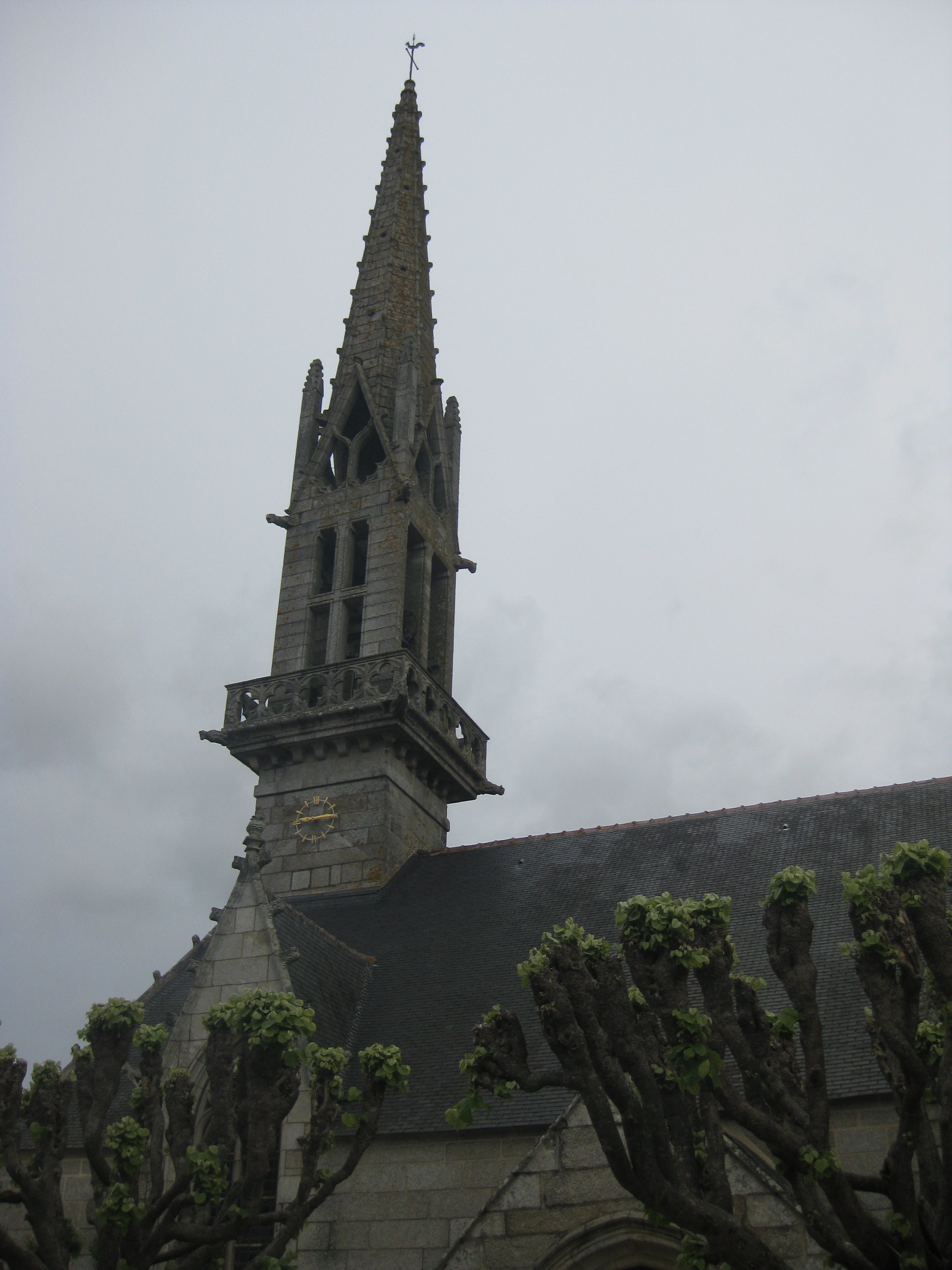
A change of scene: the town.  We exchanged the shallow-roofed, unpainted or pastel coloured houses of the south for the tall white narrow pitched roofs of Brittany.  Down here, we’re used to our towns and villages being shabby.  Brittany’s are clean, sparklingly so, with flower boxes, neat gardens, and a general air of pride in the community.  And then there are the churches.  No clochers-murs in Brittany, but rather complicated steeples instead.

The seaside. Concarneau was at its sparkling best, with breezes tugging at the flags, clouds pluming across the sky, an early pre-season freshness to the narrow streets of the historic quarter.  Their fishing museum there shows all too graphically just how very tough the life of the fisherman was – and is. But it’s a picturesque sight for the tourist
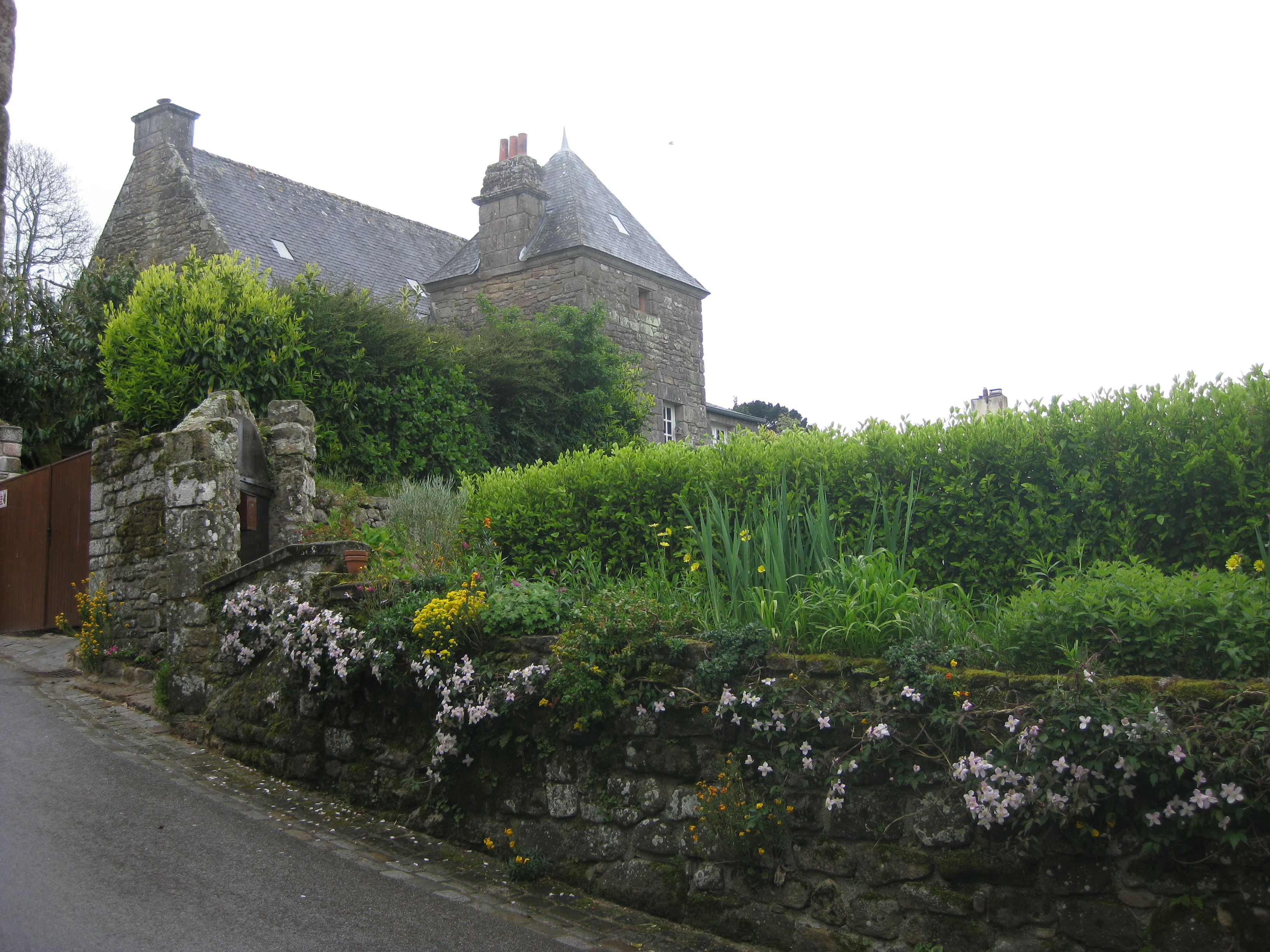
Sightseeing: Our first treat was to visit Locronan, a beautifully preserved granite built 16th & 17th century village, with a mighty central church, and a small chapel at the end of a charming walk.
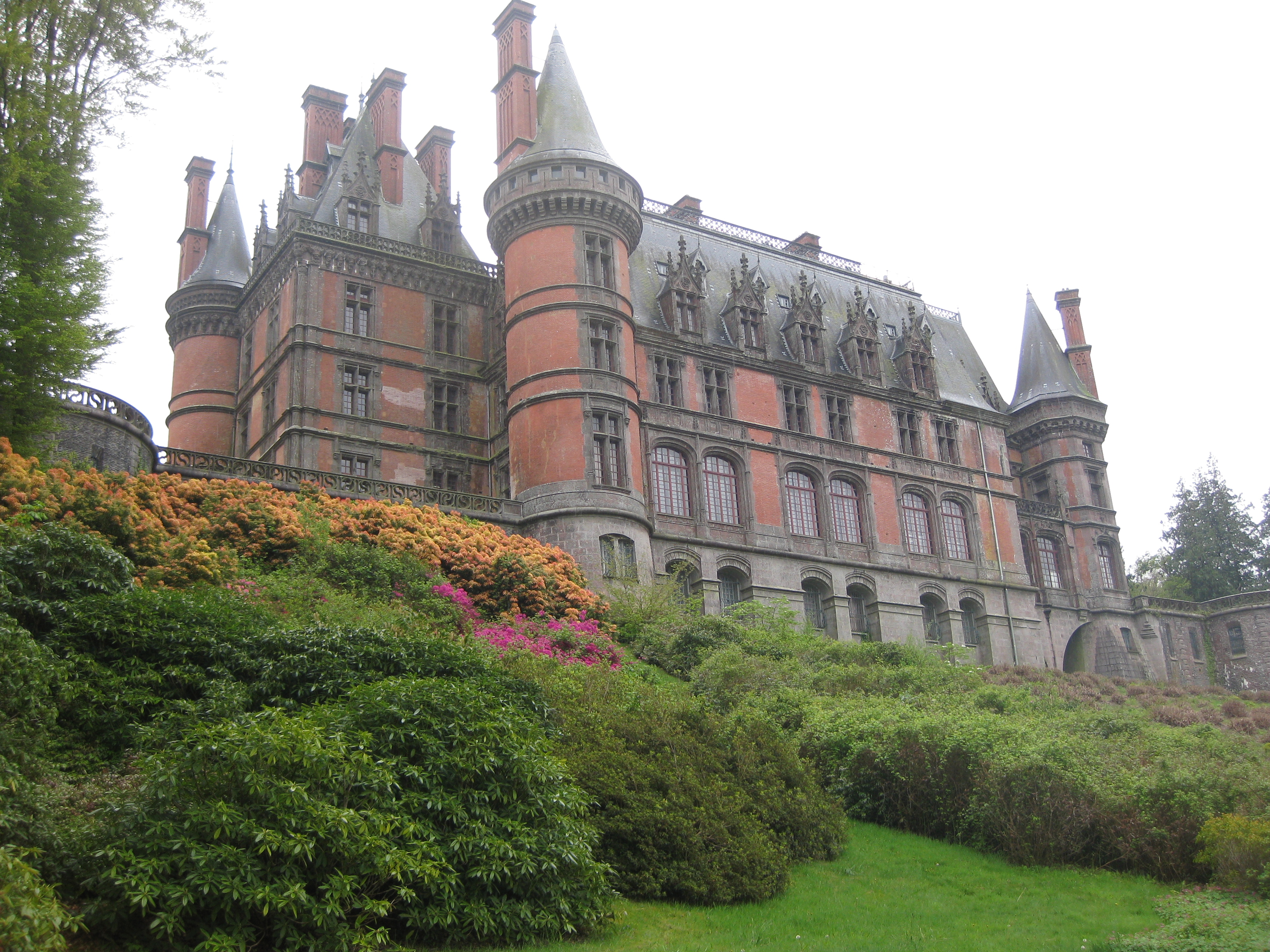
Next was Trévarez, a chateau that might look Gothic, but is in fact a 19th and 20th century construction.  Its brickwork gives it the name “château rose”.  We spent more time in the gardens though.  Apart from a formal area near the house itself, the garden is informal in the style we’re so used to from English stately homes, and glorious at the moment with azaleas and rhododendrons

Celtic music: Friday night was concert night: the chance to listen to an hour or two of traditional Breton music.  Malcolm and I particularly enjoyed hearing those favourite Welsh hymns – Land of my Fathers, Cwm Rhondda in Breton– they sounded very different, but just as good

Story telling: Such a treat.  Michel Sevellec enchants audiences in Finistère and beyond with his tales drawn from many traditions.  On Saturday, as part of a local festival, we joined local children to hear his interpretation of Native American and other stories.  Can’t wait for him to come to Laroque in a fortnight!
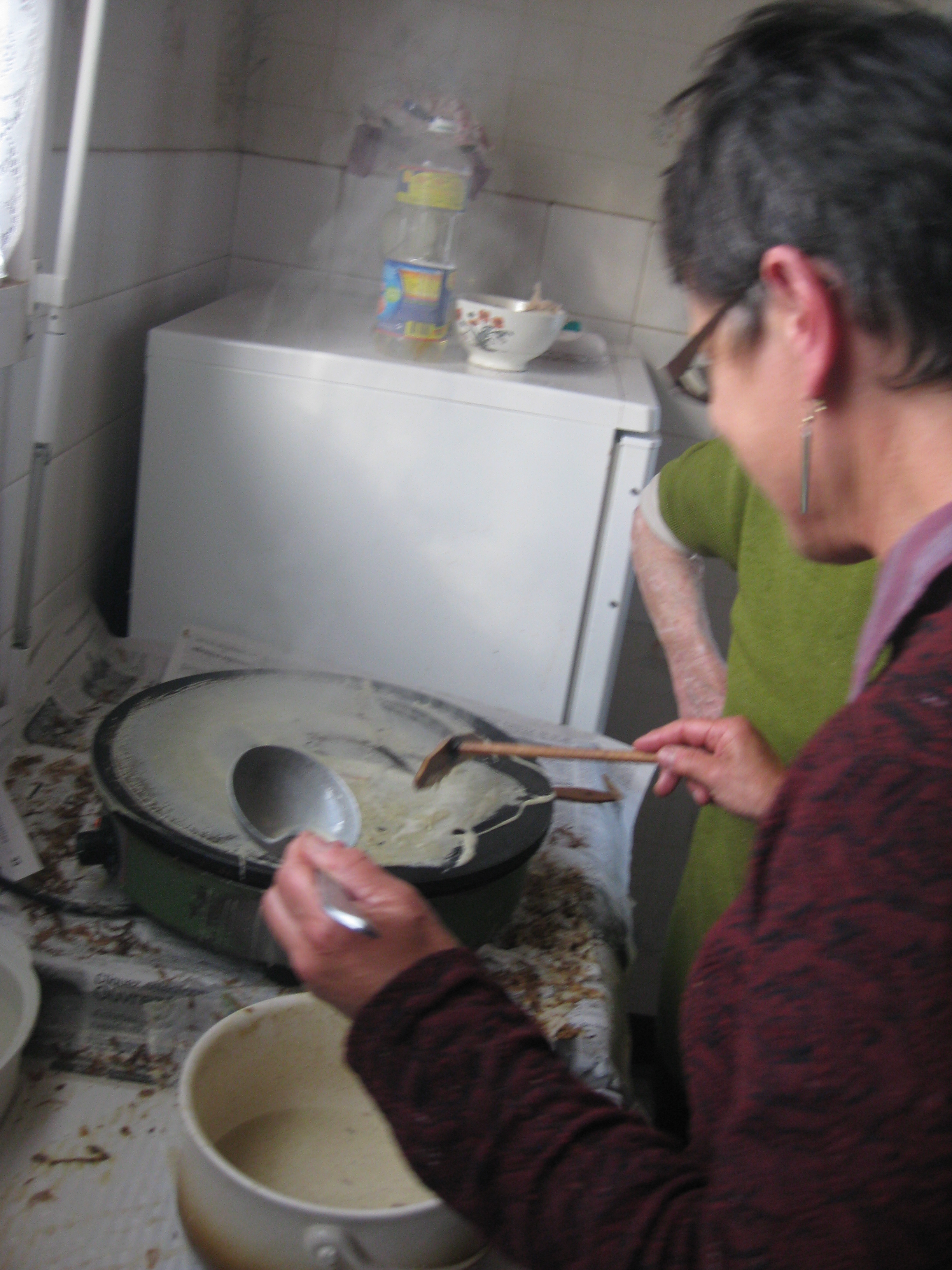
Crêpes:Everyone knows they make crêpes in Brittany.  Lots of us have watched them being turned out on those special round hotplates.  I always assumed it was easy-peasy.  Until we went to eat crêpes at Albert’s mum’s house and she let me have a go.  First, carefully pour the batter with your left hand while equally carefully drawing the batter round the plate with a special wooden spatula – not too fast & not too slow, not too thin & not too thick.

Expert at work

Then flip the delicate creation, so thin you could read a newspaper through it, over onto its other side to finish cooking. It was lucky there were hungry dogs to eat all my cast-offs.  Lucky for us too perhaps: we’d still be eating them now.  Malcolm and I thought 6 crêpes each ought to have been enough for anybody.  Our hostess disagreed.

So….we discovered in Brittany an area very different from our own in languages, customs and appearance, and had a chance to be more than simply tourists.  We now have new friends in  Melgven but also in Laroque as a direct result of this weekend.  A good experience.
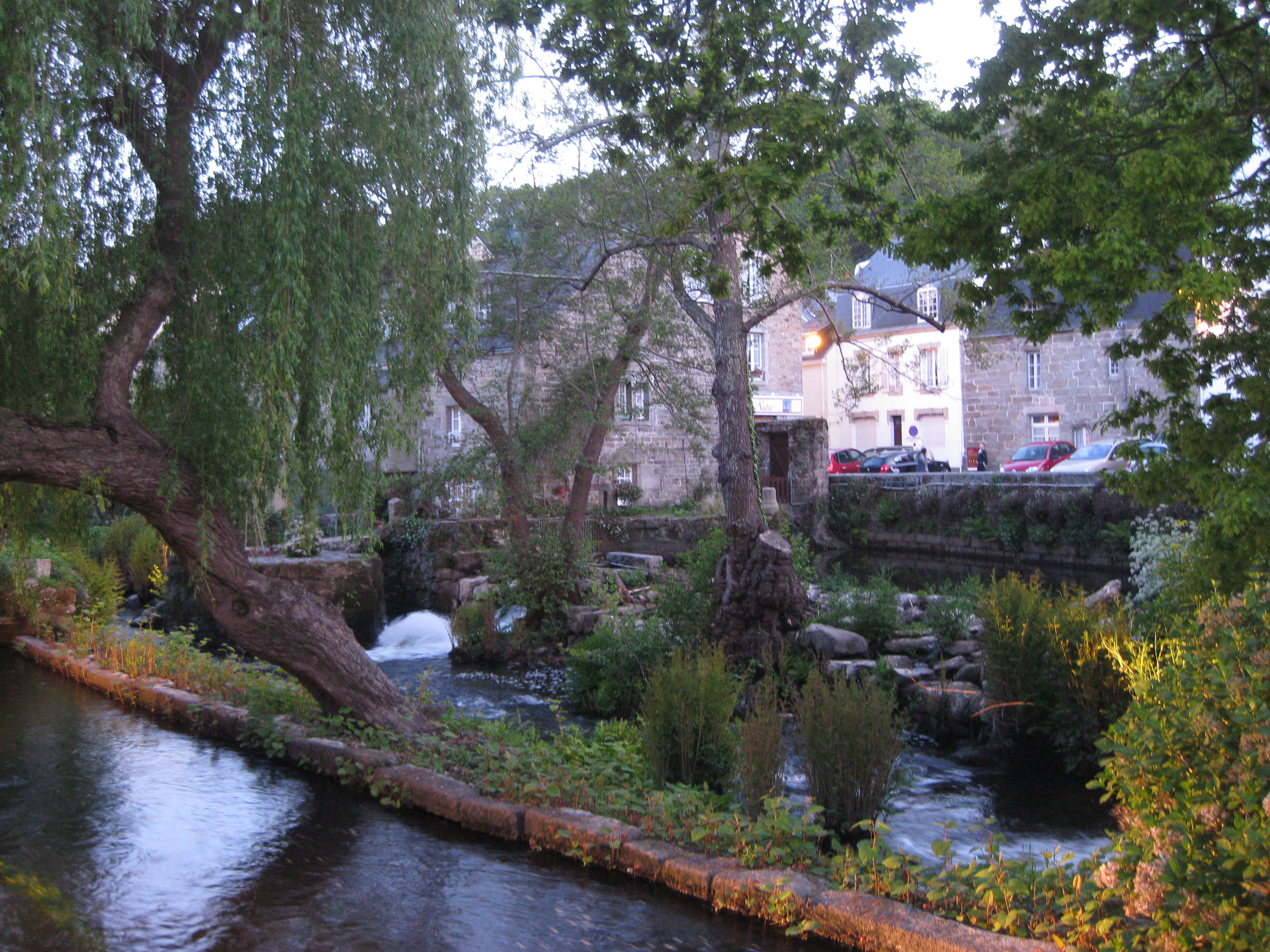
Pont Aven: I didn’t even mention this lovely little town, did I?

We’ll Weather the Weather, Whatever the Weather

Over at the BBC, they do things differently. The weather forecast, that is.  It’s a big operation, the weather: 24 broadcasters– Daniel Corbett, Helen Willetts et al, and between them, they cover all the bulletins broadcast on BBC radio and television – even World service. On the radio, it’s the word picture you might expect, while on TV, the graphics are ever more sophisticated

Here in France, it’s different.  Switch on France Inter for the weather forecast, and what you’ll get is the slightly southern, slightly nasal, but warm and measured tones of Joël Collado.  Forecast after forecast.  Day after day. Year after year  He is allowed days off: he’s even allowed holidays sometimes, and when those occur, we’ll have Jacques Kessler or sometimes Jean-Michel Golynski. Just those three.

It’s quite comforting really.  The French obviously think so. Watch a French film or television drama, and Collado’s reassuring, slightly soothing voice may well be murmuring in the background of those early establishing shots.  The good old British forecast wouldn’t send out such a message of timeless normality, I don’t think.  A young French social care assistant wrote what almost amounted to a declaration of love to Joël Collado on her blog Pause Café, (‘You’re my ray of sunshine, even when you’re forecasting rain and cold’). Facebook apparently has The Joël Collado and Jacques Kessler Appreciation Society – which I’ve not been able to read, as I think I am the next-to-last person in this web-aware world not to have a Facebook account. The last is Malcolm

Those three radio forecasters though, don’t present on TV. There are other teams for that job, depending on the station. We’re always amused that female presenters, who in this house go under the generic name Pixie-frou-frou, seem to have been hired specifically for the shortness of their skirts and the archness of their radiant smiles.

Then there are the papers, and the internet.  Our local paper, La Dépêche du Midi, is famously wrong much of the time, and I gave up on the internet when the site I was reading assured me that at that very moment, it was snowing in Laroque d’Olmes.  It wasn’t.  It was sunny.  I saw not one snowflake all that day.  As in England, so in France, those who forecast the weather are only talked about when they are wrong

Election Fever: a View from France

I’ve been quite interested in the run-up to the UK election.  That may come as a surprise to those of you who know me as a not-very-party-political-animal, and as even more of a surprise to UK residents who seem to have been engulfed in non-stop election fever since early March.

For us, access to the election news has been via French radio and television.  We don’t buy the papers very often, but I generally hear a couple of news bulletins a day from France Inter (roughly Radio 4 equivalent), and we often watch the main evening news on France 2 (BBC1-ish channel).  So this scarcely constitutes an academic study of the British elections seen through French eyes.

It’s been quite a surprise to me that for the last couple of weeks, there’s usually been something about the British elections in every main bulletin.  France 2 has had a series of mini-election specials every night.  These have covered everything from SamCam versus Sarah Brown (Sarah Brown won on points, because they had a library photo of her talking to Carla Bruni-Sarkozy.  In that particular encounter though, they clearly thought Carla B-S won on points), to the National Front in Barking, to Boris Johnson talking in sub-O Level French (but at least he did it.  I’m old enough to have memories of Ted Heath’s sabotage of the French language back in the 1970’s). Nick Clegg has the French vote sewn up, on account of his fluent French (and Dutch, German and Spanish) – he’s had several interviews on pro-European matters in the French media

Yesterday’s report on France Inter’s lunch time news covered the fact that the polling stations are open from 7.00 a.m. – 10.00 p.m, to accommodate the fact that we vote on a Thursday, a working day, unlike most of the rest of Europe, which has Sunday as Polling Day.  They incorrectly stated too that churches were among the buildings used as polling stations.  Then they went on to explain our first-past-the-post voting system, which they rightly find bizarre.

And today, how much more bizarre it all seems. The first-past-the-post system seems even more unacceptable now that the Liberal Democrat share of the vote is so little behind that of the Labour Party.  It’s impossible to spin it in a positive way to the French who ask about it.  Like most Europeans, the French are more at ease with the idea of multi-party government, and perhaps bemused at the total impasse in which the leaders find themselves.

I thought I was going to see the election story out to the end on this blog.  I’ve a feeling that could involve a very long wait, though.  Here is the unfinished article

An English Interlude

We were back in England for a while, getting our house ready to market.  Those TV makeover shows have got a lot to answer for.  It’s no longer enough to do a bit of casual dusting.  We de-cluttered surfaces, touched up paint, knocked the garden into shape, and even gave one room a total makeover (‘People are so thick’, advised one chap who’d come round to give us an estimate for removal. ’Just because you’ve got that room organised as a study, they won’t be able to see it as the house second bedroom.  If you can, get rid of all those books, and set it up as a bedroom’). So we did.  We boxed up several hundred books and put them in the garage, then covered the dark green walls in restrained buttermilk paint, and popped in a spare double bed we just happen to have, a chest of drawers, a bedside light or two.  Add an artificial orchid from Habitat, et….voilà…one genuine bedroom makeover.  And then we had to live in, and keep up with, all the unaccustomed tidiness.  We hated it.

But we did love being in England.  At least I did.  Here are my 13 reasons for happiness.  Definitely NOT in rank order

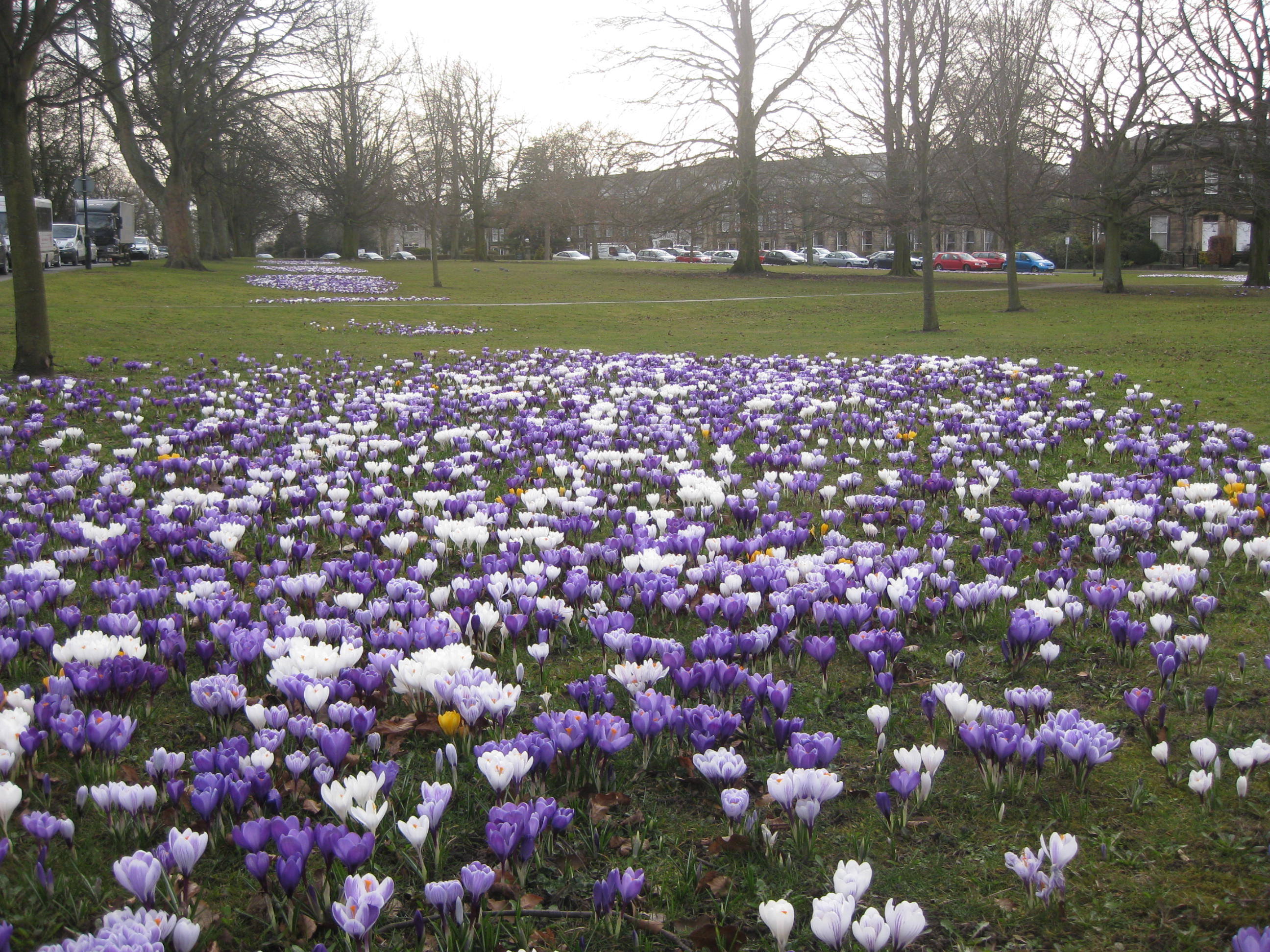
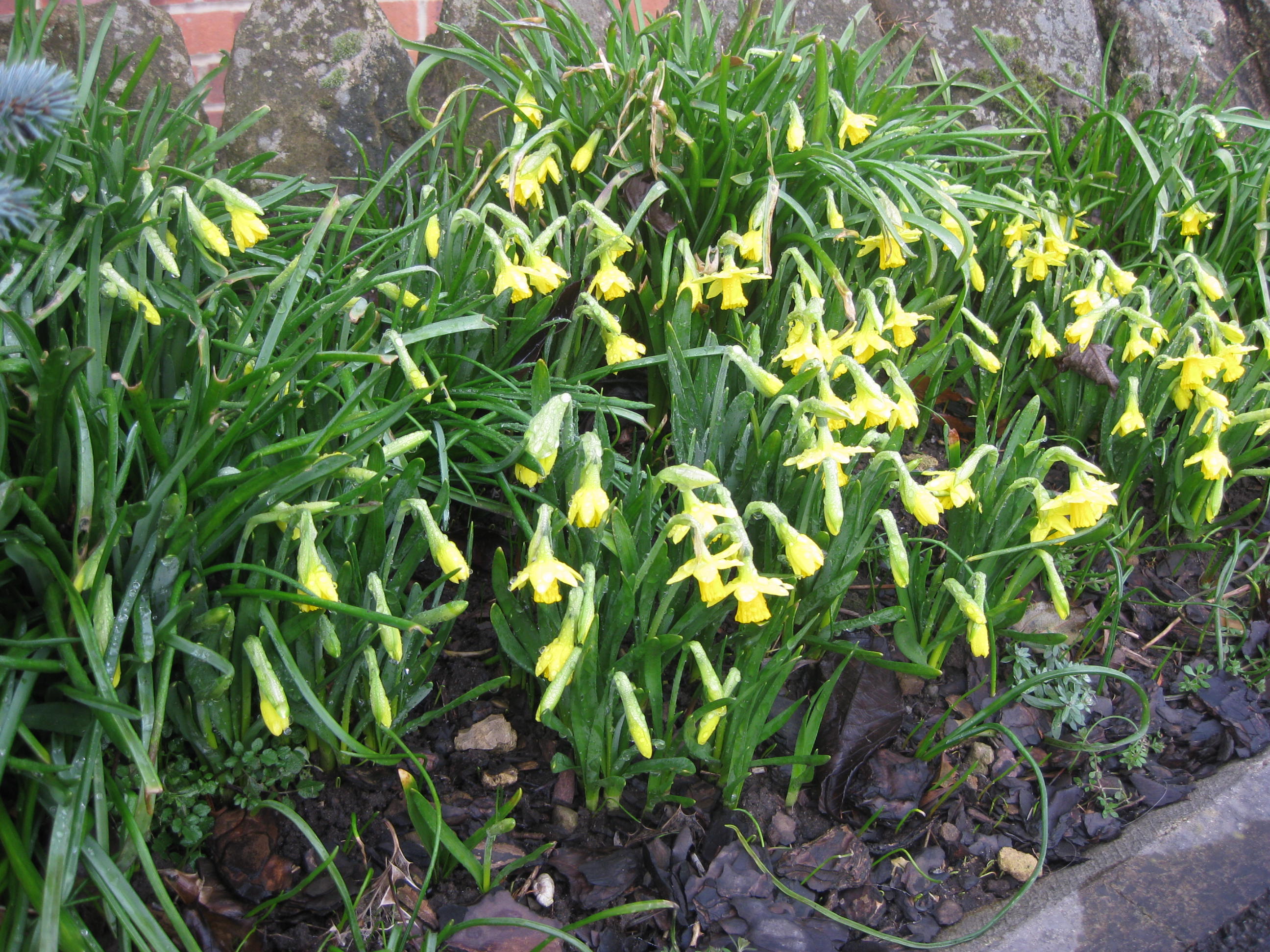
  1. Harrogate in crocus and daffodil season must be one of the loveliest urban sights in Europe.  The Stray, that splendid open parkland which girdles the southern part of the town, was all but submerged in a sea of purple white and orange crocus, gradually opening to reveal saffron coloured stamens as the sun teased the flower petals apart towards midday.  The crocus fade away to be replaced by an equally extensive display of daffodils. They were only just reaching their best as we left town, but we did at least see them.
  2. Radio 4. I had it on constantly. From Our Own Correspondent, Paul Merton on Just a Minute, Daniel Corbett’s animated and informative weather forecasts, Gardeners’ Question Time….. all to help the day go by as we scrubbed and polished
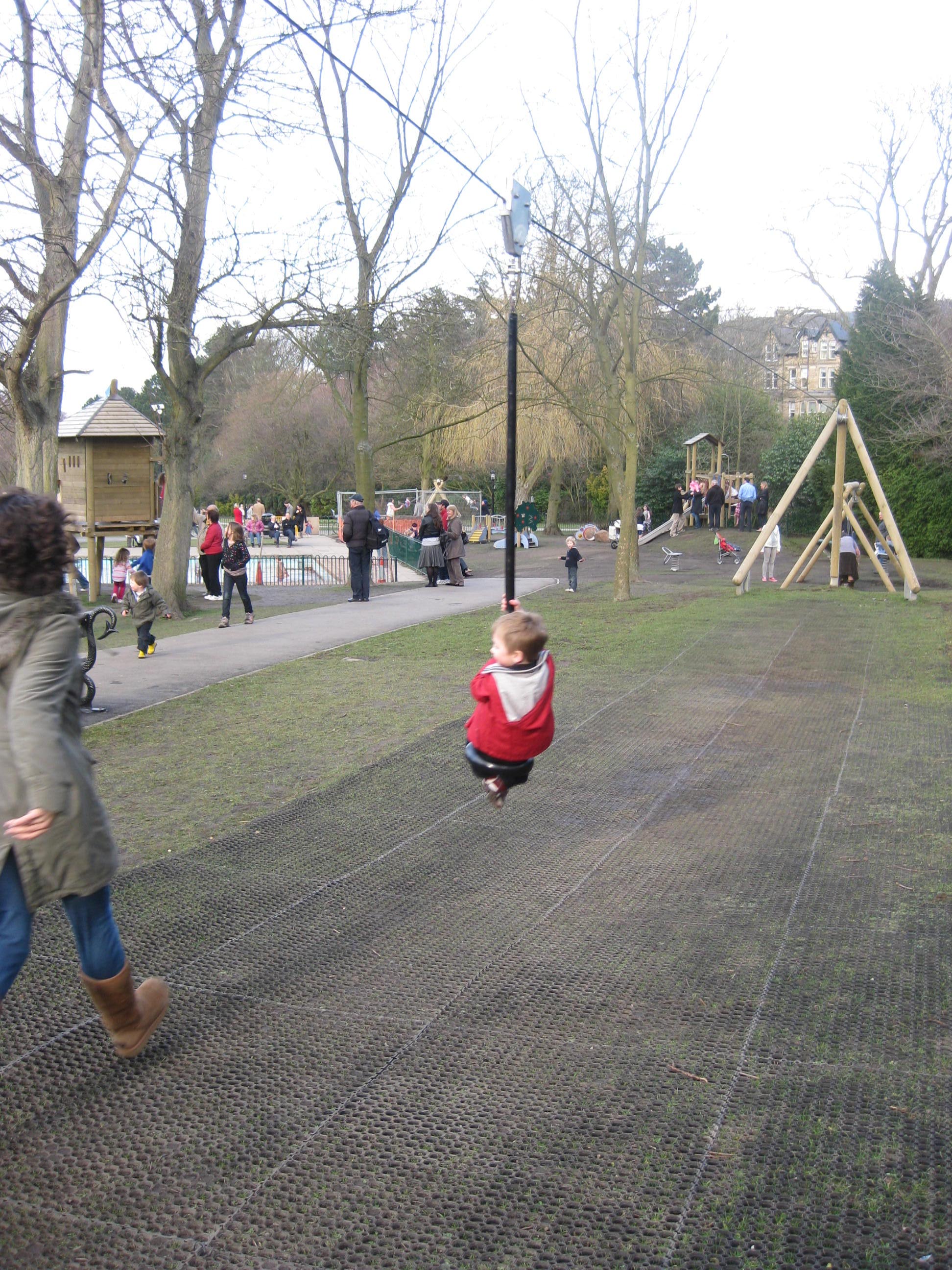
  3. Spending time with those fantastic twin boys, the grandchildren, as they discovered the new adventure playground in Harrogate’s Valley Gardens.
  4. Nidderdale LETS. What a great bunch of friends.  We’d organised a Task Force of willing members to tackle the overgrown jungle that was our garden. Naturally it rained on the day.  So everyone turned to in the house.  They scrubbed paintwork, wrapped ornaments, painted the above-mentioned bedroom, hoovered…And we all had fun, and lunch together.  How do people manage without LETS, or SEL as it’s called in France?
  5. Friends. We had little enough time to socialise, but those hours spent sharing time at our house, in Ripon, in Huby, and in various spots in and around Harrogate were all very special
  6. Charity shops. Whenever I’m in England, I spend time combing through the stock of books in all our local charity shops. With everything from the latest Man Booker winner to little-heard-of classics all going for anything from 30p. to a pound, why wouldn’t I want to stock up?  And this time, we off-loaded quite a few things too
  7. Freecycle. The amount of stuff that Harrogate Freecycle keeps out of landfill must be quite phenomenal these days.  And its members seem to be amongst the nicest people in town.  So we were glad to pass on some stuff to various happy recipients.
  8. Pontefract cakes. Nothing else quite hits the spot.  Oh, except perhaps luxury-end crunchy hand-cooked crisps from Marks and Spencer or Waitrose.  Chilli flavour.
  9. Power walking in the Valley Gardens, 8.30 a.m. Sunday morning, with Angela and Chris.  Best start to the week.  Not sure we really ought to call it power walking any longer though.  Power chatting maybe.
  10. Hot cross buns. When I was younger, Good Friday was the day of the year when we ate hot cross buns.  Maybe for a day or two after as well, but no more than that.  Freshly toasted and dripping with butter, the sugary cinnammon smells wafting through the kitchen, they were one of the food highlights of the year.  Now they’re available all the time, they don’t seem half so special.  But during this last English fortnight, Good Friday or no Good Friday, Malcolm and I made sure we got quite a few hot cross buns under our belts.
  11. Indian take-away. After hard days spent painting and cleaning, few things are more reviving than a good Indian take-away.  Hot, pungent, spicey, sour, the vivid flavours cheered us up and brightened our mood.  The French don’t know what they’re missing!
  12. Guardian and Observer. I know I could read Polly Toynbee, Nigel Slater et al on line.  But it’s really not the same, is it?
  13. Talking in English. The sheer relief of being able to chat, chunter, chew the fat, confide, discuss, digress, argue, amplify, explain, entertain, without pausing to consider whether I’ve chosen the right gender, the right word, the right ending.  Yes, perhaps this really is so precious it really needs to go right up to the top of the list at number 1.

The Big Snow: History

If you turn on the radio these days, or look at the inside pages of the daily paper, you’re likely to find reminiscences of the big freezes of last century, 1947, 1960, 1963 and 1979.

Well, I don’t remember 1947. My mother had bitter memories of it, but I was rocking gently in a warm bath of amniotioc fluid, and didn’t have to worry about the cold.

In 1960, I was at girls’ grammar school, and becoming, with my class mates, a sulky teenager. My main memory is of long frozen January lunch hours in the school playground (unthinkable that we’d be allowed to remain inside in the warm). Considering ourselves too old to have fun chasing each other with snowballs, we stood around in morose groups, comparing our newly fashionable long johns with each other (they were long legged bloomers really, in garish colours. But they helped a bit).

By 1963, an even starker winter, we were sitting out mock O Levels. The school heating system broke down, and we sat several exams in our winter coats, and sometimes even our velour hats. We had to write with our woolly gloves on. No ‘manifs’, no walk outs, and no line of indignant parents outside the headmistress’ office complaining about Health and Safety. The stroppiest of us (and I wasn’t stroppy in those days) just got on with it as just one more thing to be endured in those gloomy January days. We must all have been raving bonkers.

Things were very different by 1979. Elinor was born in late ’78, and Thomas was just under 2 years old. We lived perched towards the top of one of Sheffield’s (allegedly) 7 hills (‘Same as Rome, see?’), and getting up and down that steep slope of ours with a pram was unthinkable. It WAS a steep slope. Occasionally, a hired coach would try to take a short cut down our road. It would find itself marooned at the bottom, the driver’s cab already on the level main road, while the back of the bus remained suspended on the 45 degree tarmac behind, to the unbridled delight of all of us who lived in the street: we’d all turn out to watch the fun.

So we stayed at home as the snow fell, and continued to fall. For 6 weeks. No shopping, no walks in the park or toddler groups or visits to friends (apart from the family next door, in exactly the same position as us). For someone like me, always looking for busy things to fill the day, it should have been utterly unthinkable. But it wasn’t. My memory of that time is of spending hour after hour, the three of us, cosily curled up on the sofa while I breastfed Elinor, reading one story after another to Thomas. Children’s picture books were just taking off in those days, and we had our supply of Picture Puffins… Farmer Fisher, Wonky Donkey, Bread & Jam for Frances, Maurice Sendak…. Whenever I remember that long and rather lazy winter, it’s always with simple pleasure.

This winter is a little more complicated. We’d like to be in France, but since we can’t be, we’d like to be seeing our friends. We can’t do that either. Either we can’t get up our hill, or they can’t get down theirs. Or their children’s school is closed. Or something. So instead we worry about feeding the birds: They’re pretty hungry, but it wouldn’t do to have them depend on a supply of food which may disappear at any moment. We compromise, and put scraps, but only scraps, scattering them in different places. And then we worry about weather forecasts. If it’s not snowing here, it is in the south of England. How’s northern France doing? And further south? It depends which forecast you listen to or read. What to do……? Watch this space

The Big Snow: Chapter Two

Another day, another freeze.  The other evening, we were with some friends.  We watched the 10 o’clock news and saw satellite images of a totally white UK.  Then a friend in the Ariège told us that the snow’s reached there too – not sent from our end though, but driven northwards from Spain.  By lunchtime, the news on the French channel TF1 had made the snowy Ariège its special feature.

 We might as well stay here then.  The papers and radio repeat regular warnings of the ‘is your journey really necessary?’ variety, and they’re probably right.  With grit and salt in short supply, the roads aren’t getting any easier, and the temperatures are dropping.

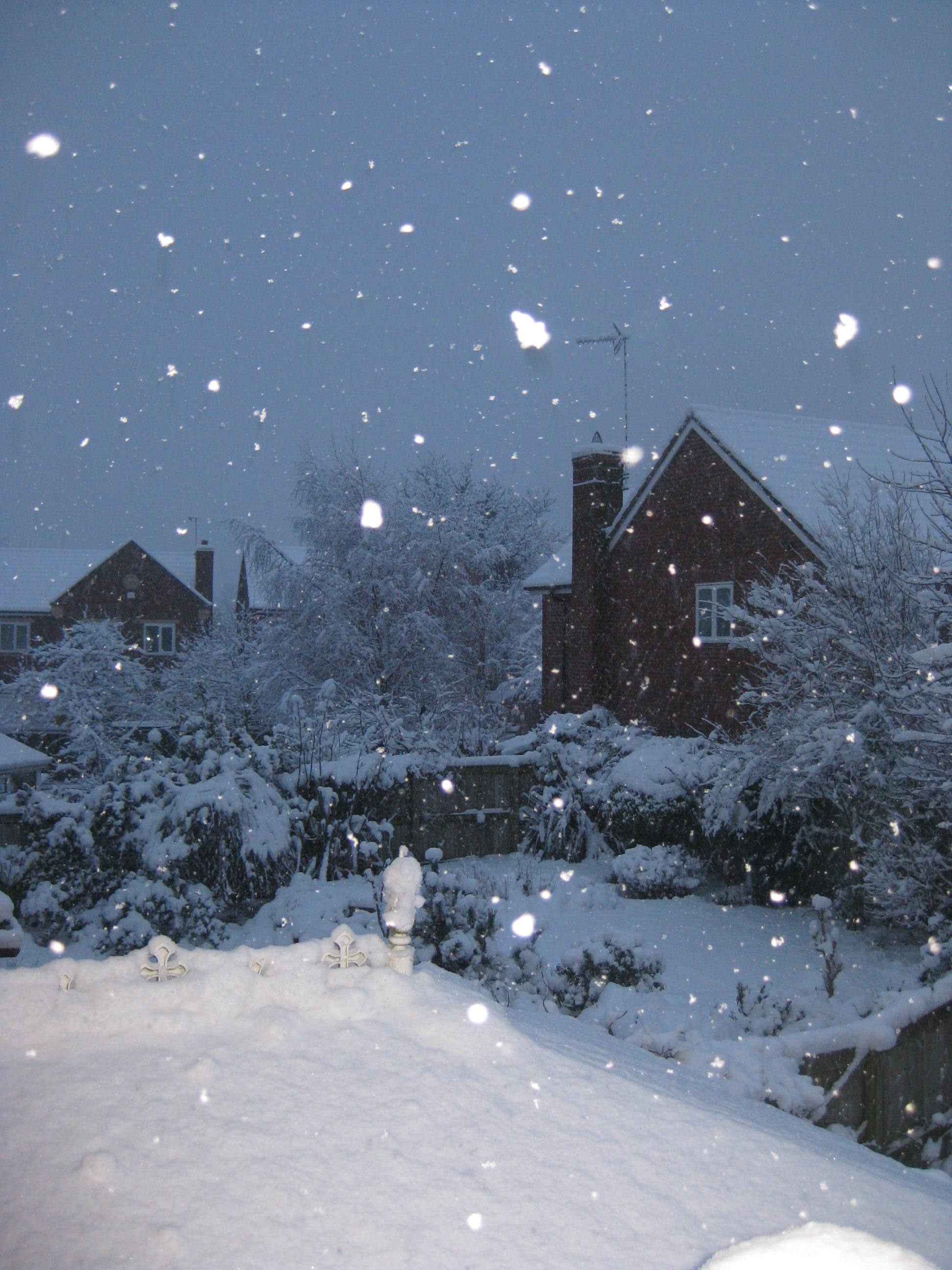
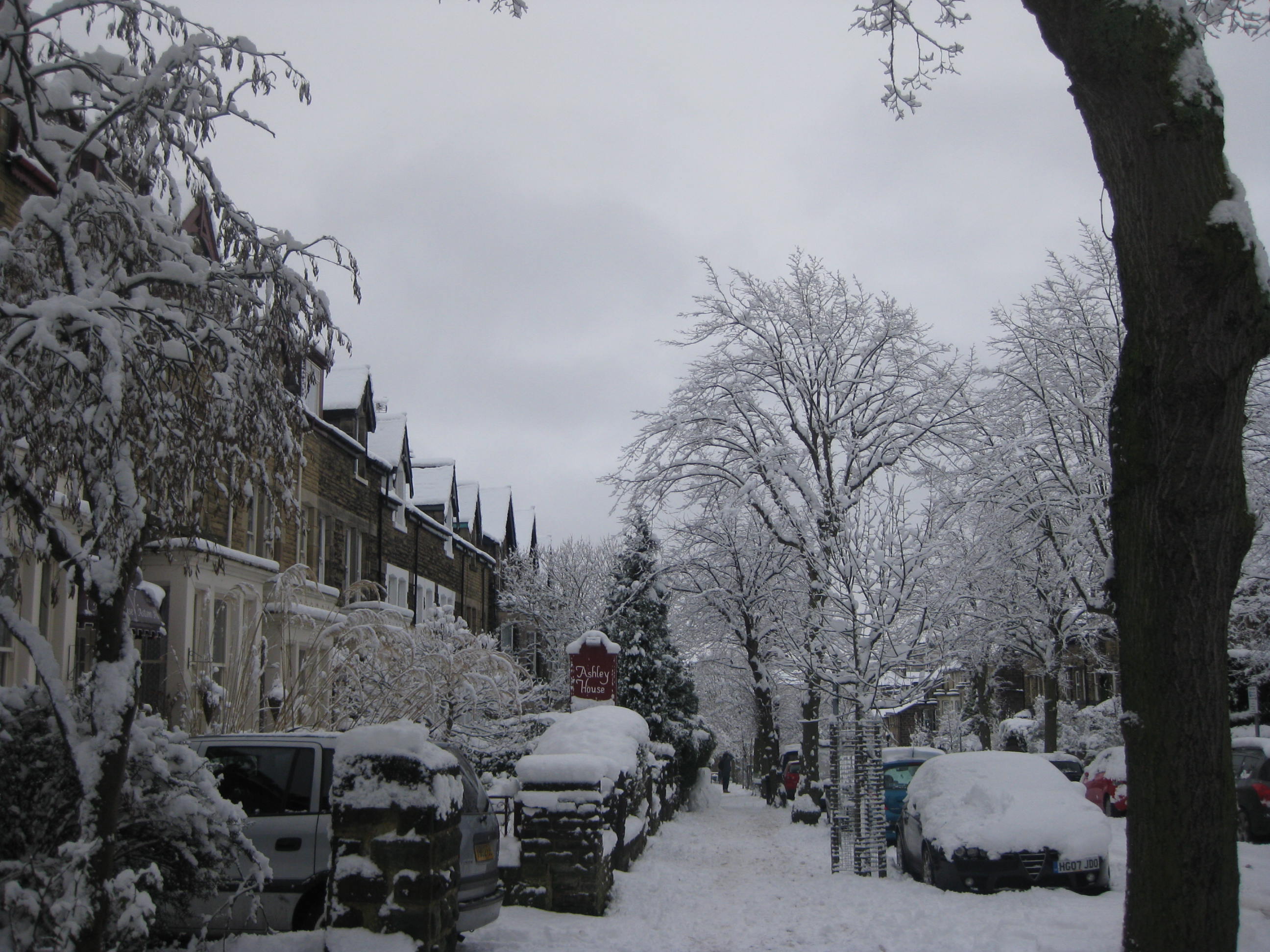
 Here’s a miscellany of Harrogate photos: the town centre, chilly allotments, chillier birds, snowmen and similar, icicles….all a record of this extraordinary January

The Big Snow

‘Christmas shopping in the snow. A white Christmas. A whiter new year. Christmas in the Ariège? No, apparently not. It was mild and sunny there. Instead, this was Christmas and New Year UK style. The days in England were very odd for us. We’d wake up to glittering, powdery snow on the streets, and hungry birds scavenging for crumbs. We’d fail to drive the car up the road, because we live at the bottom of a hill, and the poor thing couldn’t get a grip: 4x4s, usually so derided in our urban setting, had the last laugh, because only they could go anywhere much.

From our window.....


Visits to friends were cancelled. Their visits to us were abandoned. All because of the snow. It wasn’t so very deep, admittedly, but in urban and suburban England, we’re just not geared up to dealing with it. No snow chains on the cars, not enough grit, not enough salt. And it’s not so surprising we were unprepared. Until last year’s freak snowstorms, many English children had only seen snow on skiing holidays or Christmas cards, so why would local authorities plan for anything worse than the occasional sleet shower?

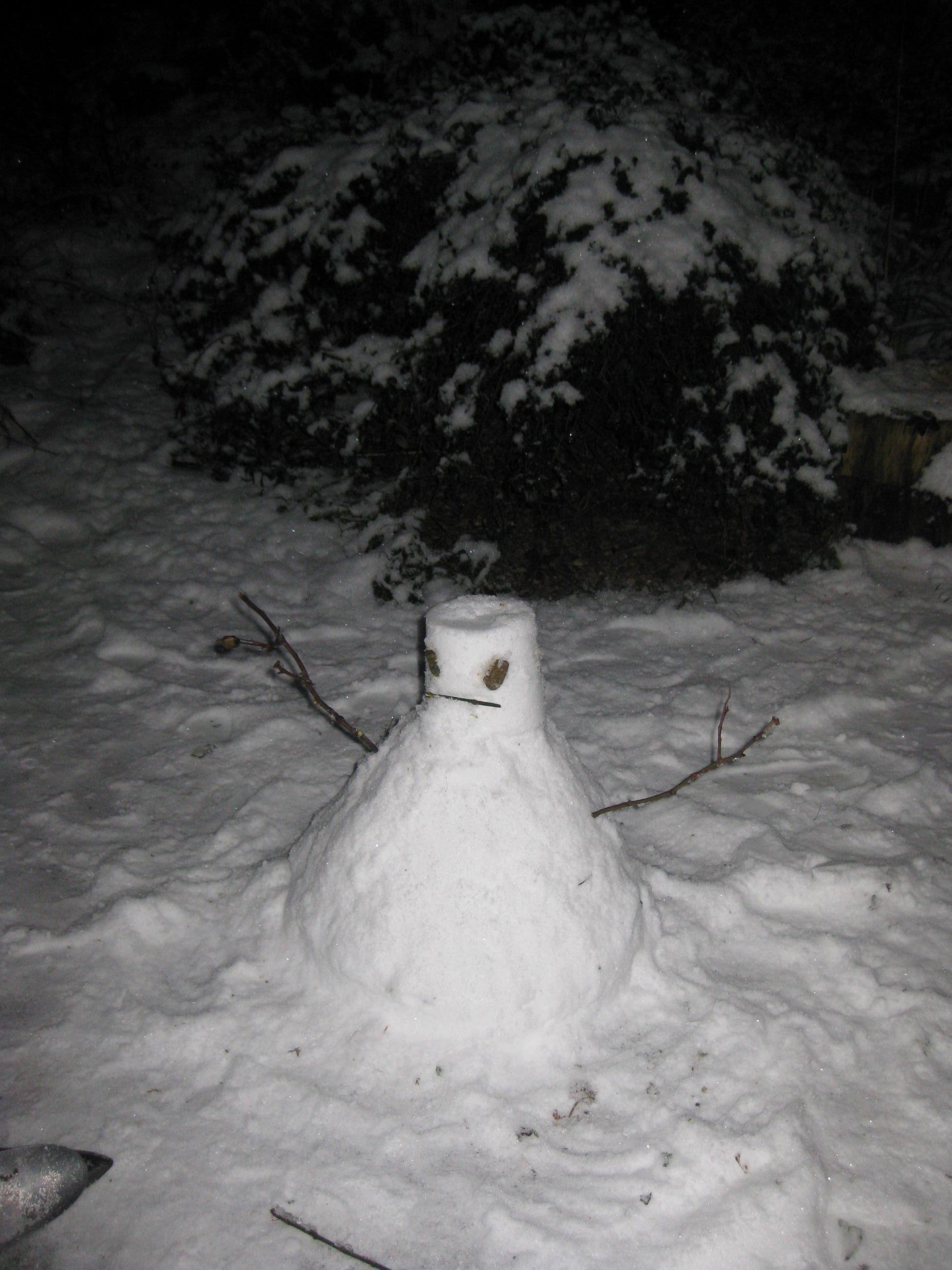
So here are some pictures of life in cold and snowy Harrogate. Emily and I even made a mini snowman. He’s mini because making him was like trying to model something in very cold granulated sugar. The snow wouldn’t stick together. We had fun trying though, and though he was very small, he was a little monster’

All that was written before The Big Snow. The Big Snow suddenly descended here sometime after 4.00 a.m. on Tuesday 4th January, the day we were due to set off back for France. The Big Snow decided otherwise. Harrogate; like much of Northern England, was closed for business. No buses, no schools, few people at work …. but lots of snowmen suddenly populating the streets and gardens –even an authentic looking igloo in the next street along. It was fun at first, and lovely to look at. Then reality began to bite. Slogging to the distant shops through 8’’ of snow, with streets and roads ungritted isn’t much fun. Not everybody can work from home, and too many of those who couldn’t get to work, either had their wages docked, or had to take a day from their annual leave allowance. There’s still a bit of a holiday atmosphere, but the novelty’s worn off, especially as the Big Snow has become the Big Freeze and is going to continue, it seems.

Franklin Road, Harrogate

When will we be able to leave for France? Who knows. The South has taken over from the north as Snow Capital of the UK, and we’ve been very firmly advised against travelling (anyway, we still can’t drive the car up our hill). From what we can see, northern France is a winter wonderland as well – with added fog.

I’d like to add more photos – I will later.  But I’m working with a dongle, and if you’re geek enough to know what I’m talking about, you’ll know it’s not ideal