We’ve finally made it back to France, after 4 weeks of family, fun, and titivating our house there for marketing purposes. When we arrived, stocking up with food was a problem. The shop was closed: the baker’s was closed: holidays you see. Then I remembered the evening market at La Bastide sur l’Hers.
Over the last few years, during July and August, evening markets have grown in popularity in the towns and villages in this part of the world. Originally, the idea was to attract people in to spend a pleasant hour or two browsing at the stalls offering hand-crafted goods and bits of this and that. Increasingly, they’ve become somewhere to come to have a night off cooking, and spend a cheerful hour or two eating or drinking with friends. There are always plenty of food stalls: couscous, paella, oriental stir fries, pizzas, barbecued meats….. Bring your own knives and forks, don’t forget the corkscrew, find a place at a communal table, sit down and enjoy!
Well, that was what we planned for yesterday. Then it started to look grey. Soft warm raindrops slowly started to drop intermittently from the sky. With no food in the house, we had to go anyway. We knew we’d be alone. The French seem to have no appetite, like we Brits, who are used to such things, for hiking in the rain, or market shopping in a storm. In the past, we’ve been victim of the cancelled walks, we’ve seen the empty market squares.
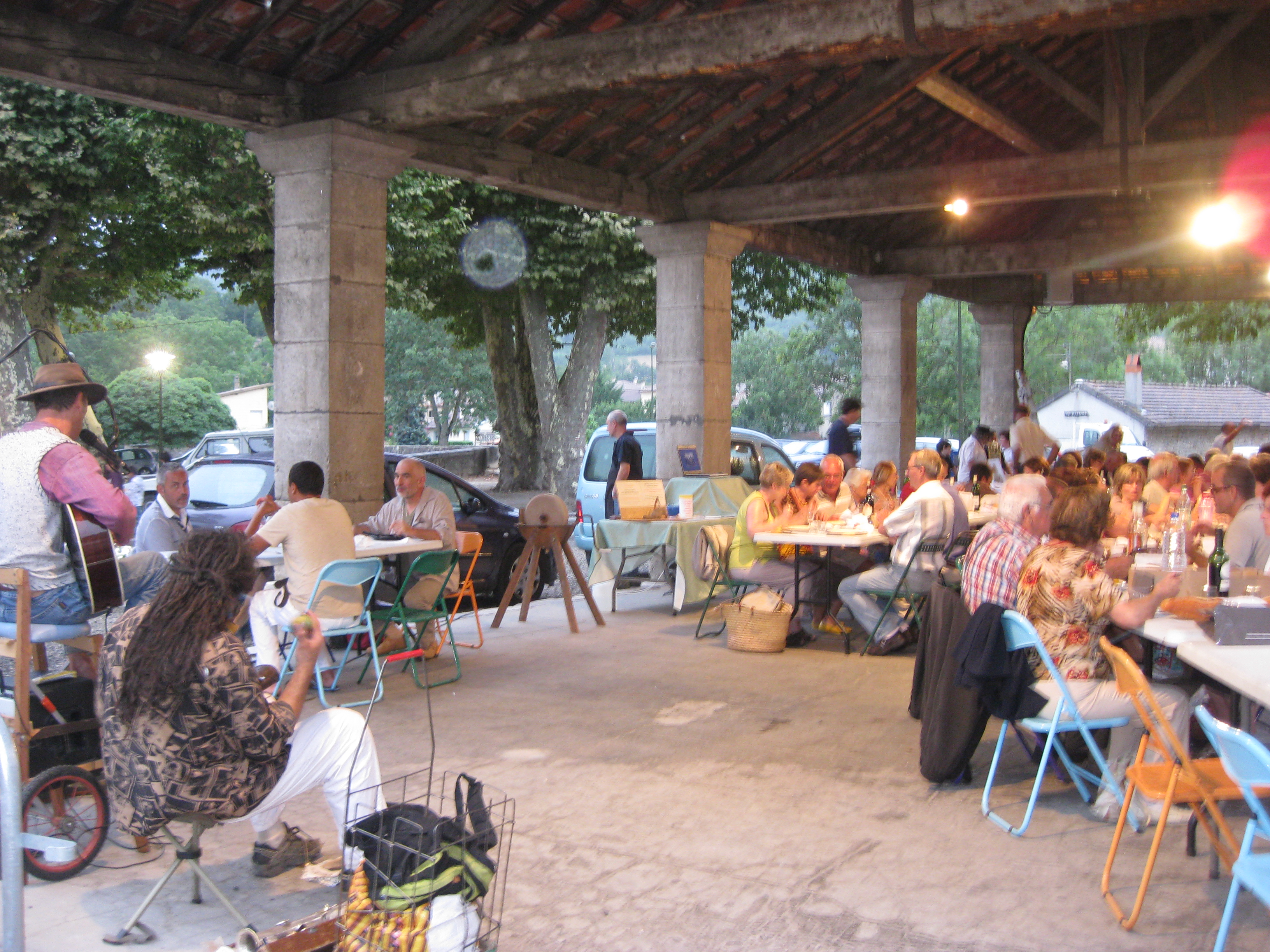
This time, we were wrong. We chose a spot at a table under a row of plane trees which sheltered us from the worst of the rain, bought our food, opened our wine, and tucked in as we got gradually damper and damper. We people-watched: there were plenty of people to watch. We saw others doing the same. We saw families arrive with their cool boxes, determinedly striding through the puddles. We saw chivalrous men standing with opened umbrellas protecting the rest of their party from the worst of the weather. We laughed and shared the fun with our neighbours at table as the rain got heavier and heavier. Obé’s paella has never tasted better.
Some lucky people - including the musicians - kept dry under the shelter of the market hall
We carelessly missed the local excitement of the Tour this year, by having to leave for England the very day it passed within 4 km. of our house. But we didn’t miss it ALL. Speeding northwards through the outskirts of Pamiers, a ville d’étape this year, we met these front-runners, all made from flowers, on a roundabout. So if you’re having Tour withdrawal symptoms, now it’s been over for a fortnight or more, here’s a small souvenir.
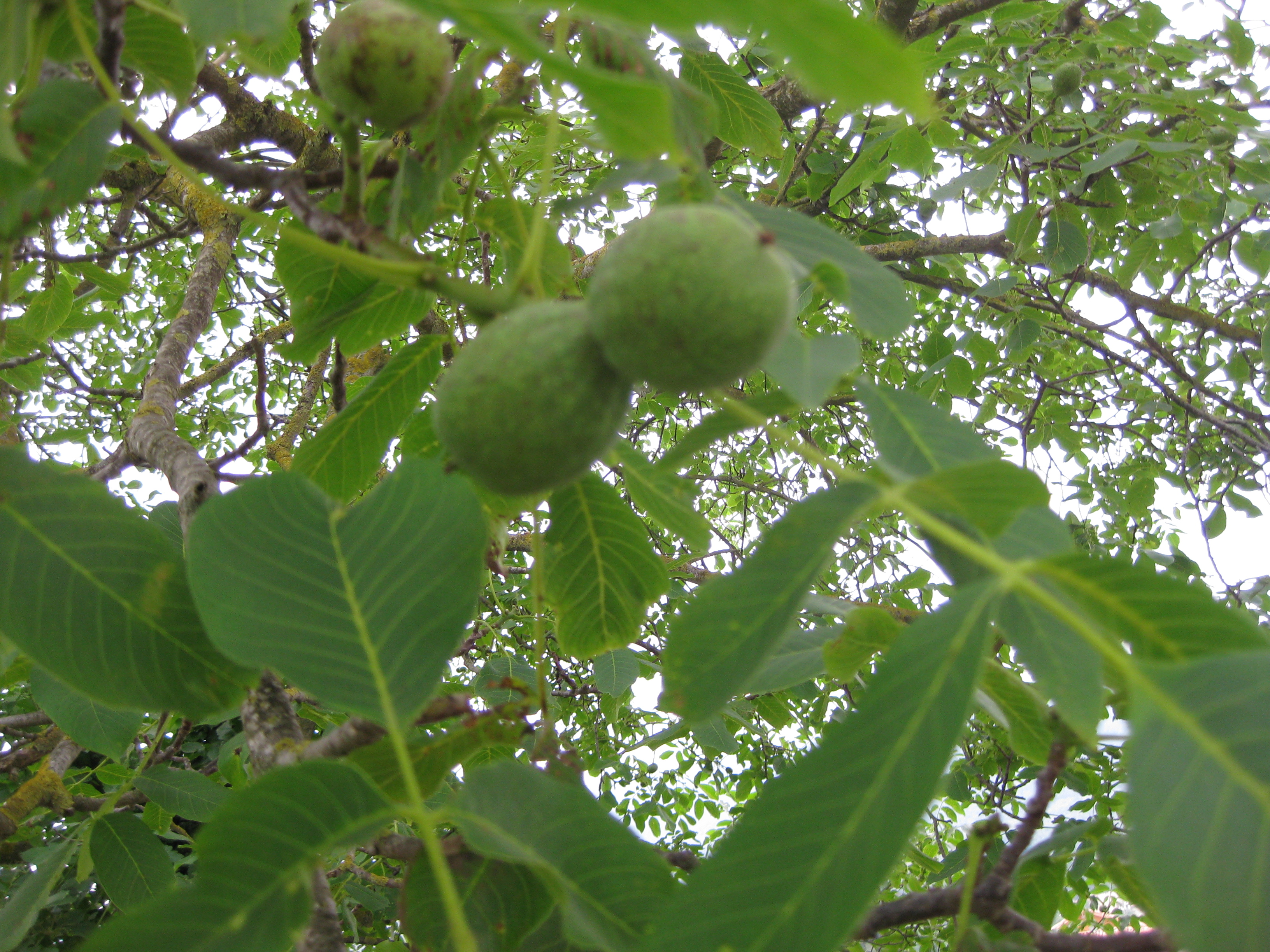
Léonce has a walnut tree outside her house. On the 24th June, she picked just 40 baby walnuts.
Why 24th June? Well, it’s traditionally Midsummer Day, celebrated here by huge pagan bonfires, but named for John the Baptist whose birthday it’s said to be (le Feu de la St. Jean). On this day, summer fruits are at their most perfect, and just asking to be picked. So they say.
And why pick the nuts when they’re still green, the fruit within unformed? It’s to make a Christmas treat – vin de noix. This year, Léonce asked me to come and be part of her select manufacturing team of two.
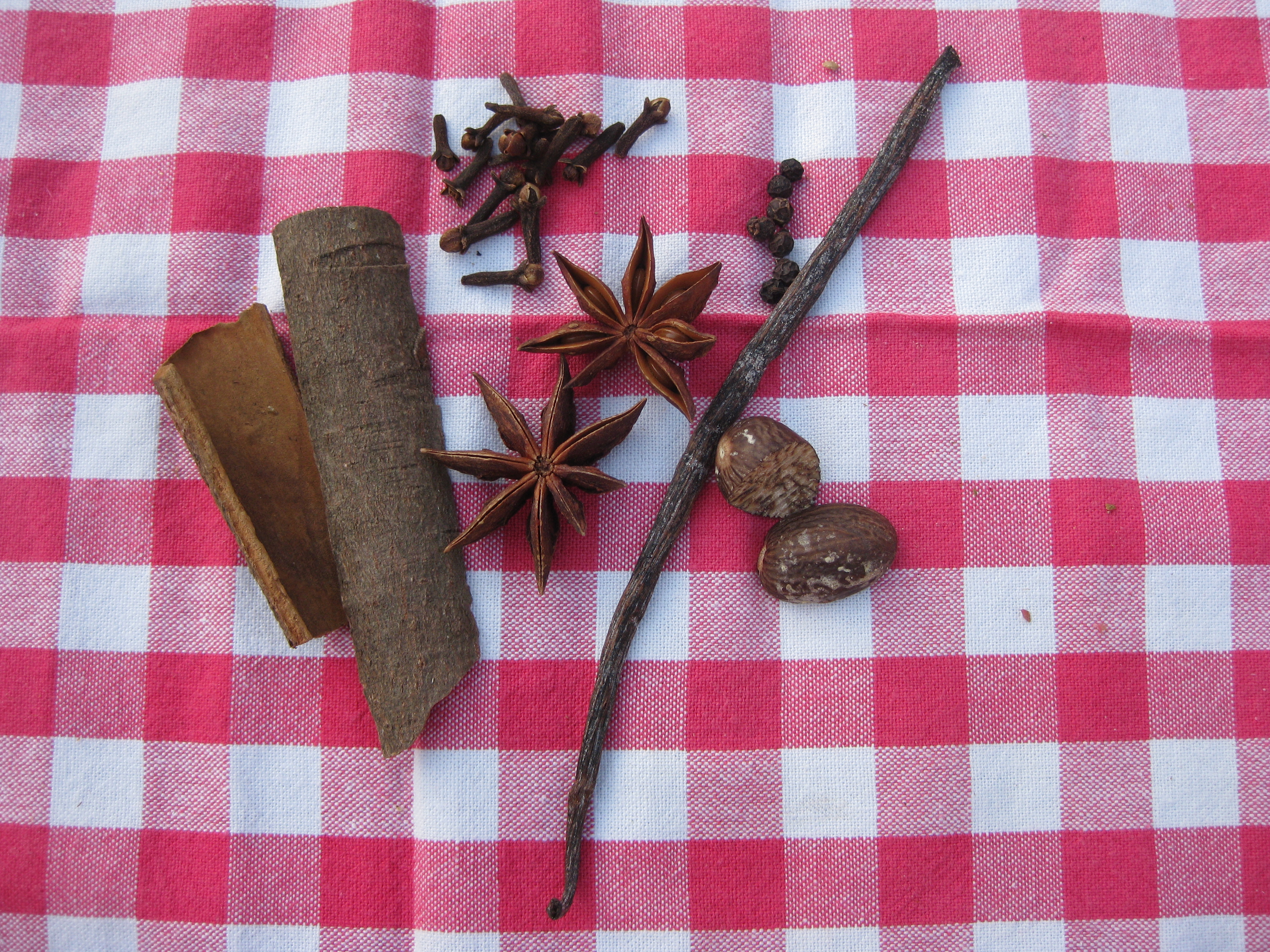
Spices at the ready
When I arrived at her house, with my demijohn (or bonbonne), red wine and eau de vie, her kitchen table was already crowded with all the other ingredients we needed:
Brown sugar cubes – Oranges – Star Anise – Vanilla – Cinnamon sticks
Cloves – Nutmeg – Peppercorns.
They don't look much like walnuts, do they?
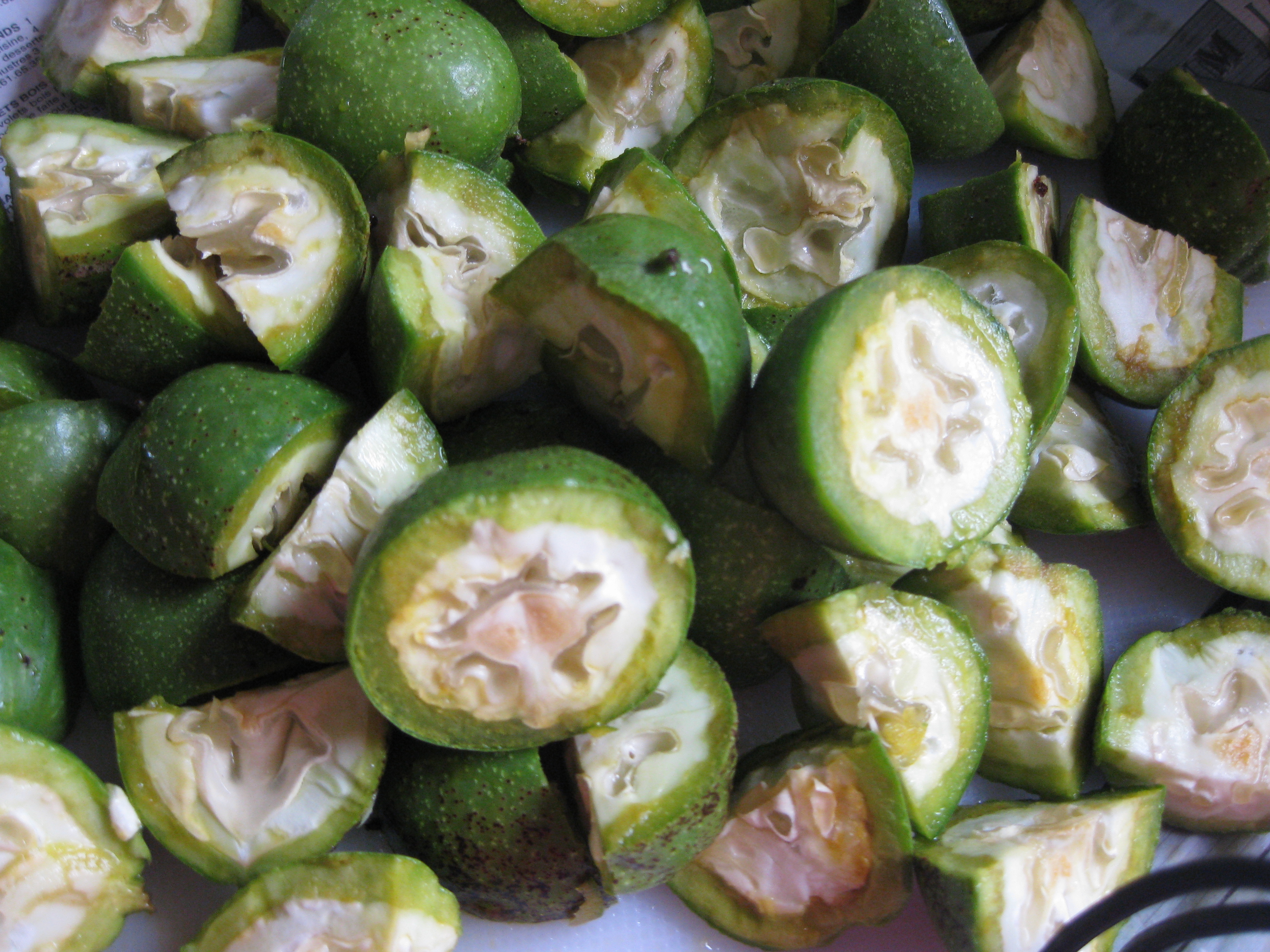
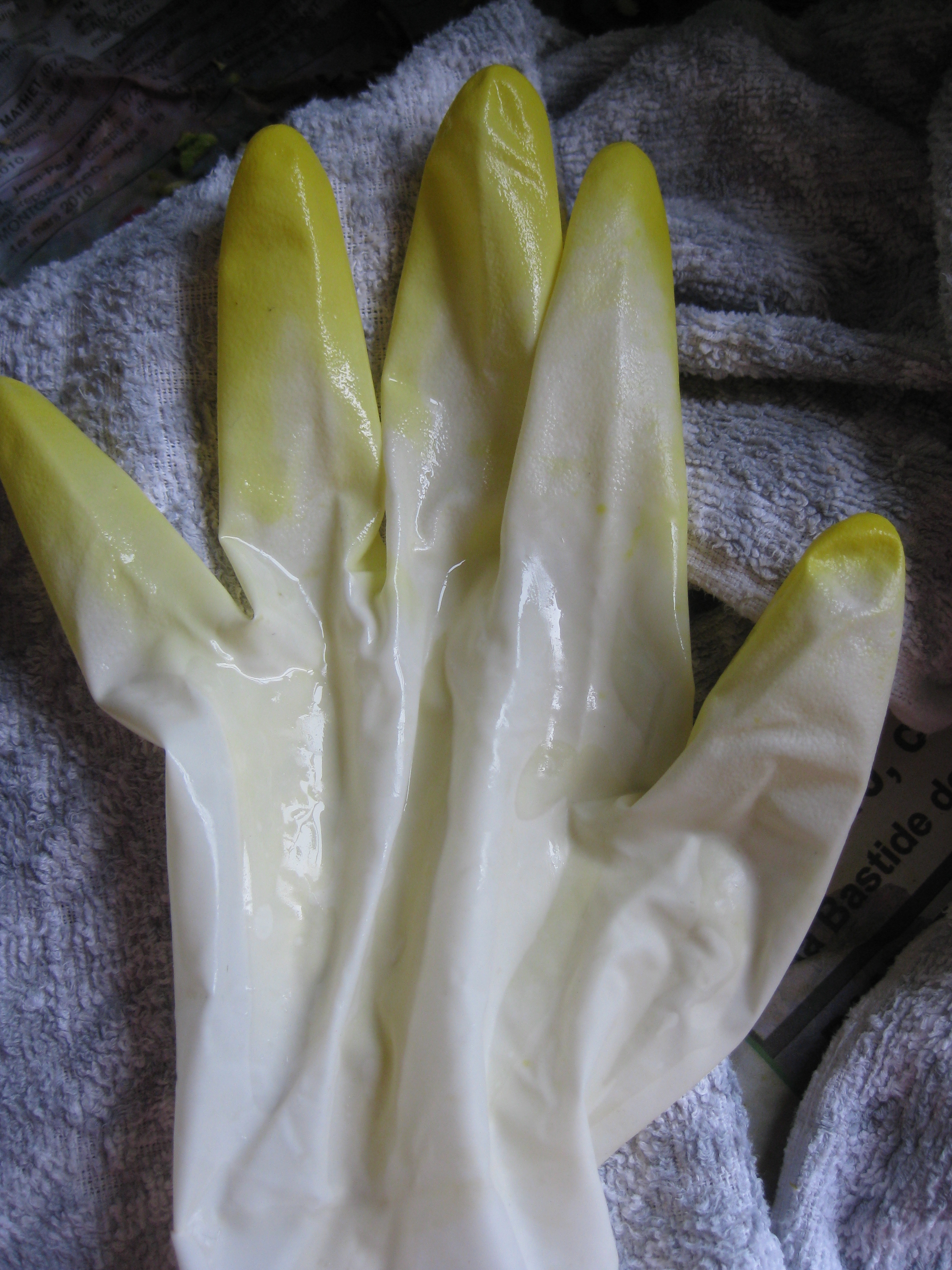
I got the job of cutting the walnuts into four. You need rubber gloves for this. Without them, your fingers would be stained a vivid orangey yellow, like those of a lifelong heavy smoker.
These are the hands that cut the nuts.....
Meanwhile, Léonce sliced oranges, measured and crushed spices, and opened bottles of wine – we needed 4 litres each, and one litre of eau de vie.
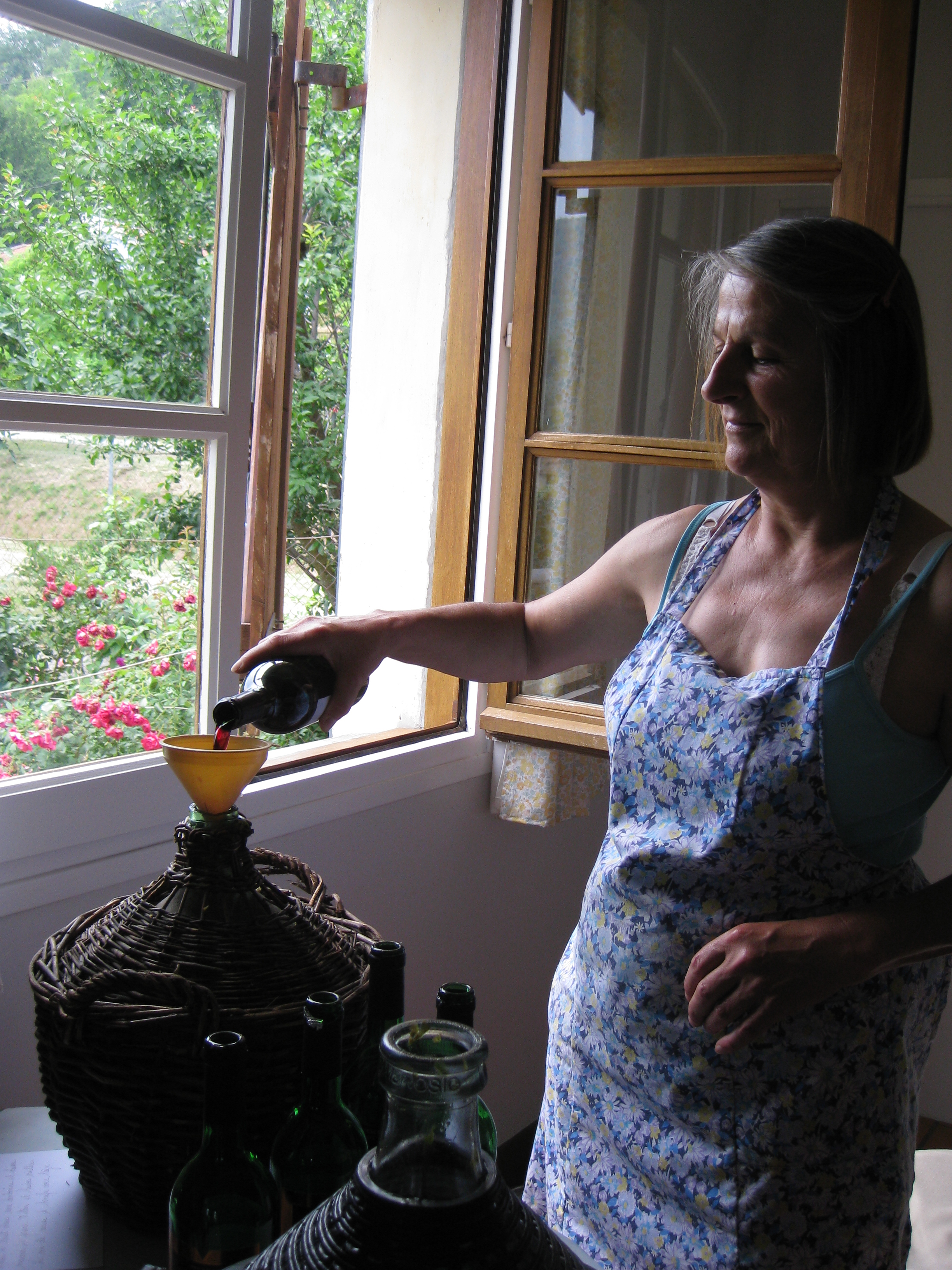
Finally we were ready. We pushed the walnut segments into our large jars, followed by chunks of orange, the sugar cubes, and then the spices. All those bottles of wine, all that eau de vie glugged down to mix with everything else, and then all we had to do was cork our bonbonnes, and lug them to a dark cool storage room.
in goes the wine....
We’ll leave them there for 6 weeks for the flavours to blend and develop, then we’ll strain and bottle our concoctions, and leave them again to mature as long as possible. Don’t do as I do. Every time I pass, I uncork the bonbonne and have another quick sniff. Quite wonderful.
You’re not expecting vin de noix from me in your Christmas stocking this year are you? Oh no, sorry, that’s far too soon. It’ll be Christmas 2011 at the earliest. It takes a long time to produce a decent vin de noix.
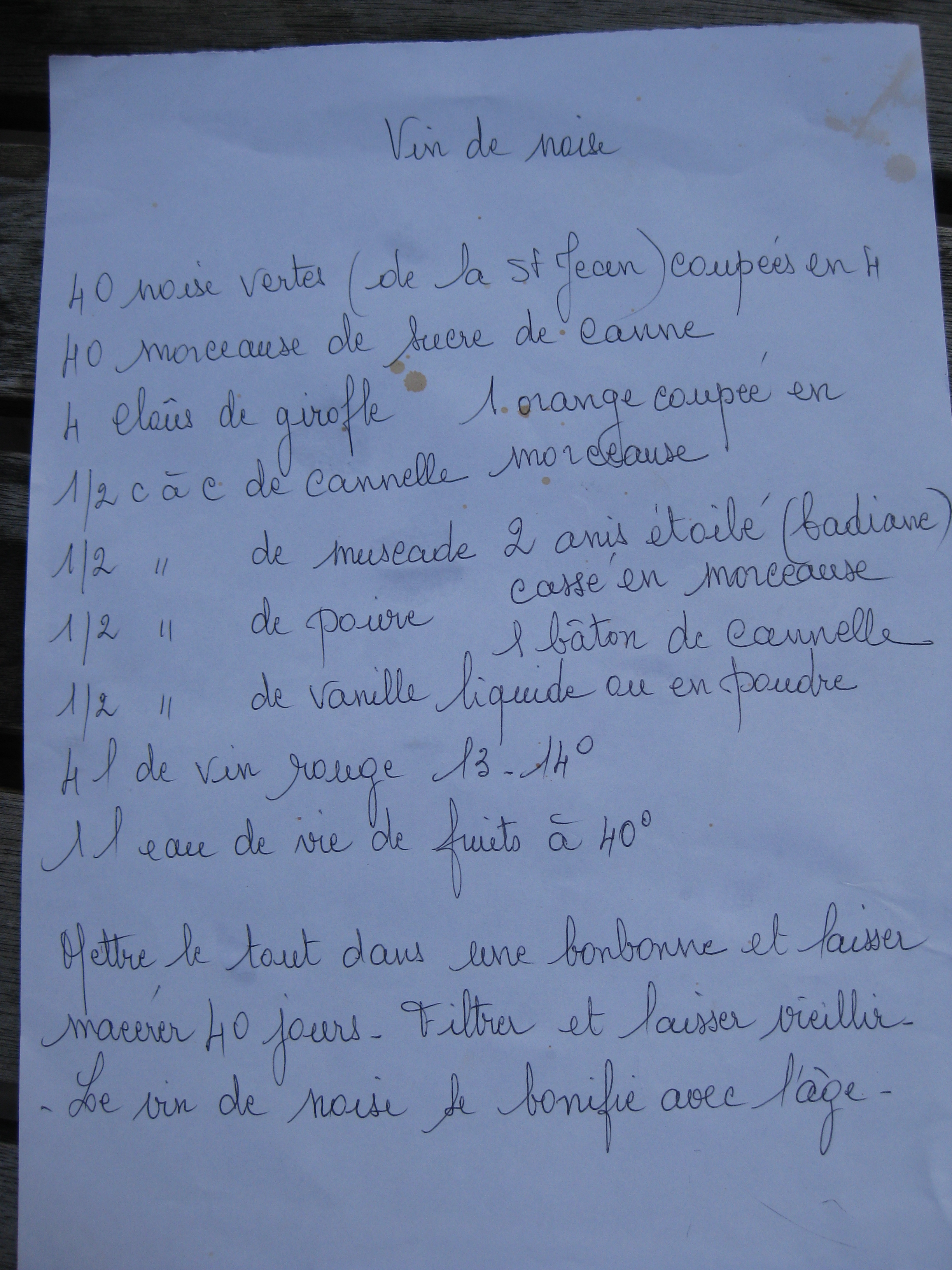
So here’s the recipe…
Vin de noix
The recipe: french version
40 green walnuts, each chopped into 4
40 brown sugar cubes
1 orange, chopped into chunks, peel and all
4 cloves
1 cinnamon stick
½ tsp. grated nutmeg
½ tsp. black pepper
½ tsp. vanilla essence, or a small vanilla pod
2 star anise, crushed
4 litres of red wine (13 – 14%)
1 litre eau de vie de fruits (40%)
Put the lots into a demi-john and leave for 40 days. Filter and bottle and leave to mature for at least a year. The older the better.
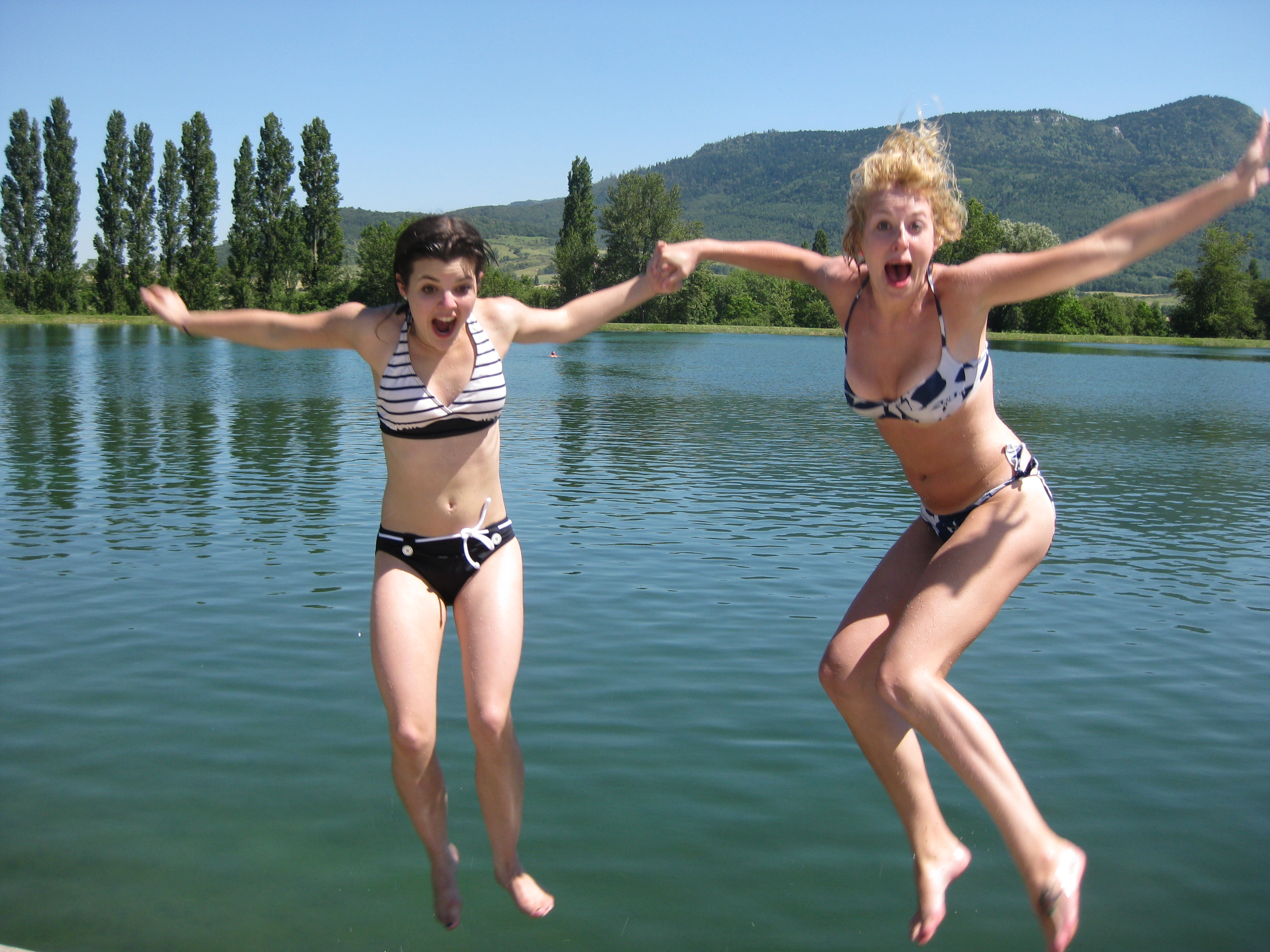
Emily (that’s our daughter, the 21 year old) and her friend Sophie have been to stay. After all that cold, rain and gloom, they brought the sunshine with them, and a holiday mood. They quite rightly wanted sightseeing, markets to mooch round, and sunbathing opportunities. Most afternoons, we finished off with a swim at either Montbel or Puivert.
Emily starts off
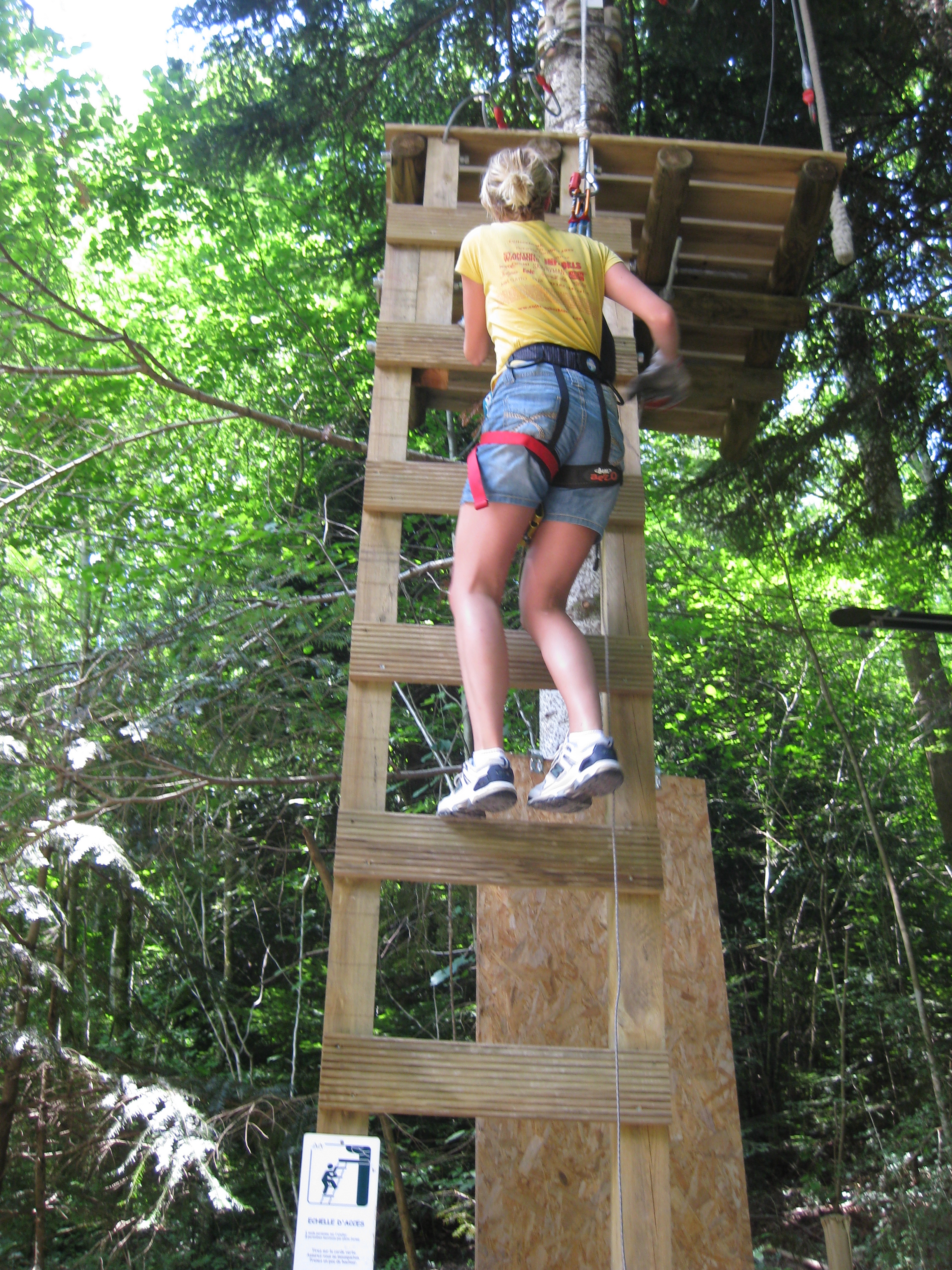
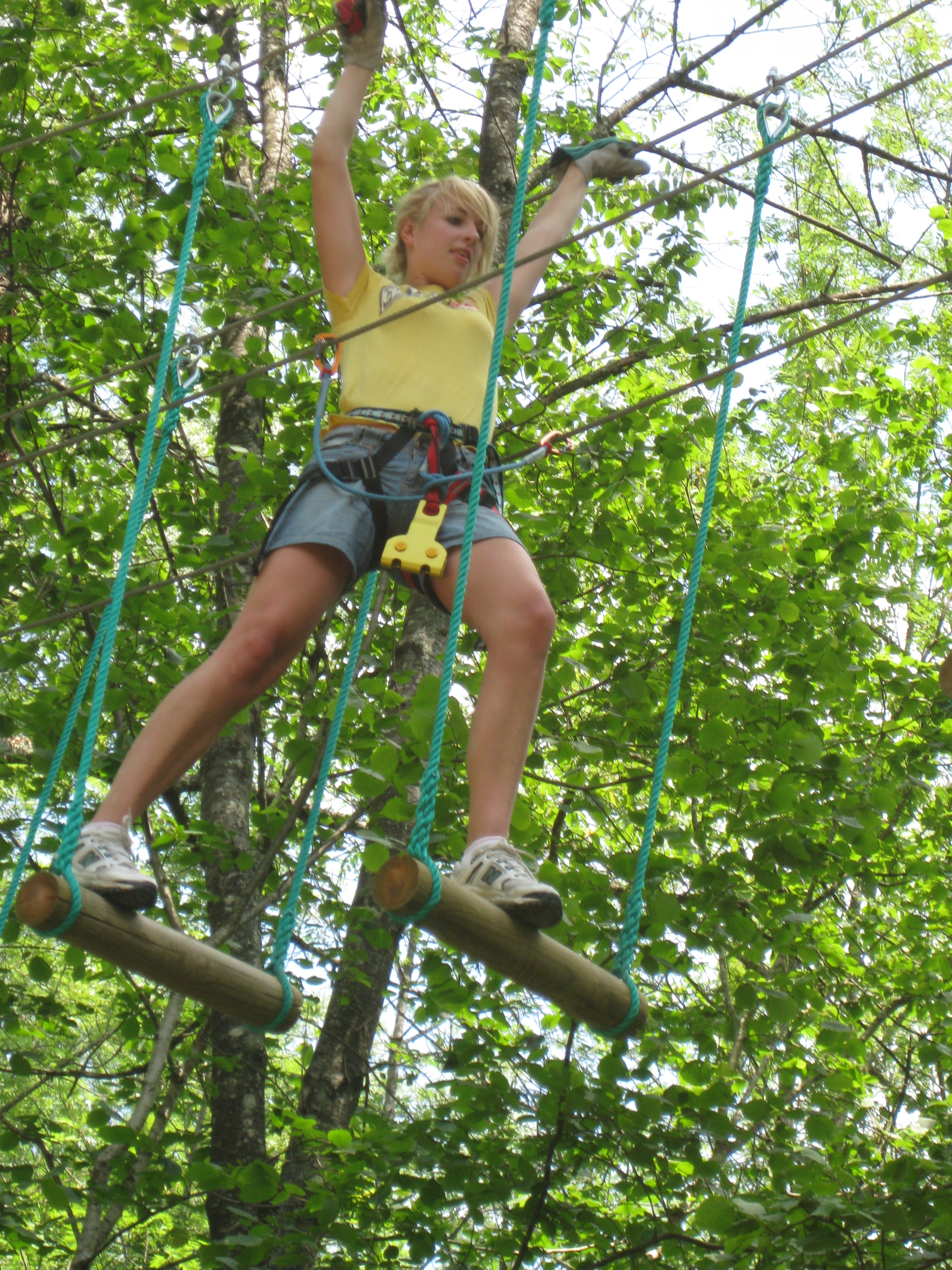
Yesterday was their last day, and they wanted Action, with a capital A. We’d seen the publicity for something new: CRAPAHUT PARC AVENTURE – a sort of mile-high adventure playground in the forest at Fontestorbes, near Belesta.
It’s the sort of thing that makes you wonder why on earth you’d pay to be scared witless. It involved serious safety harnesses, and a training session on clipping karabiners onto safety wires so you were secured at all times.
…and the journey begins
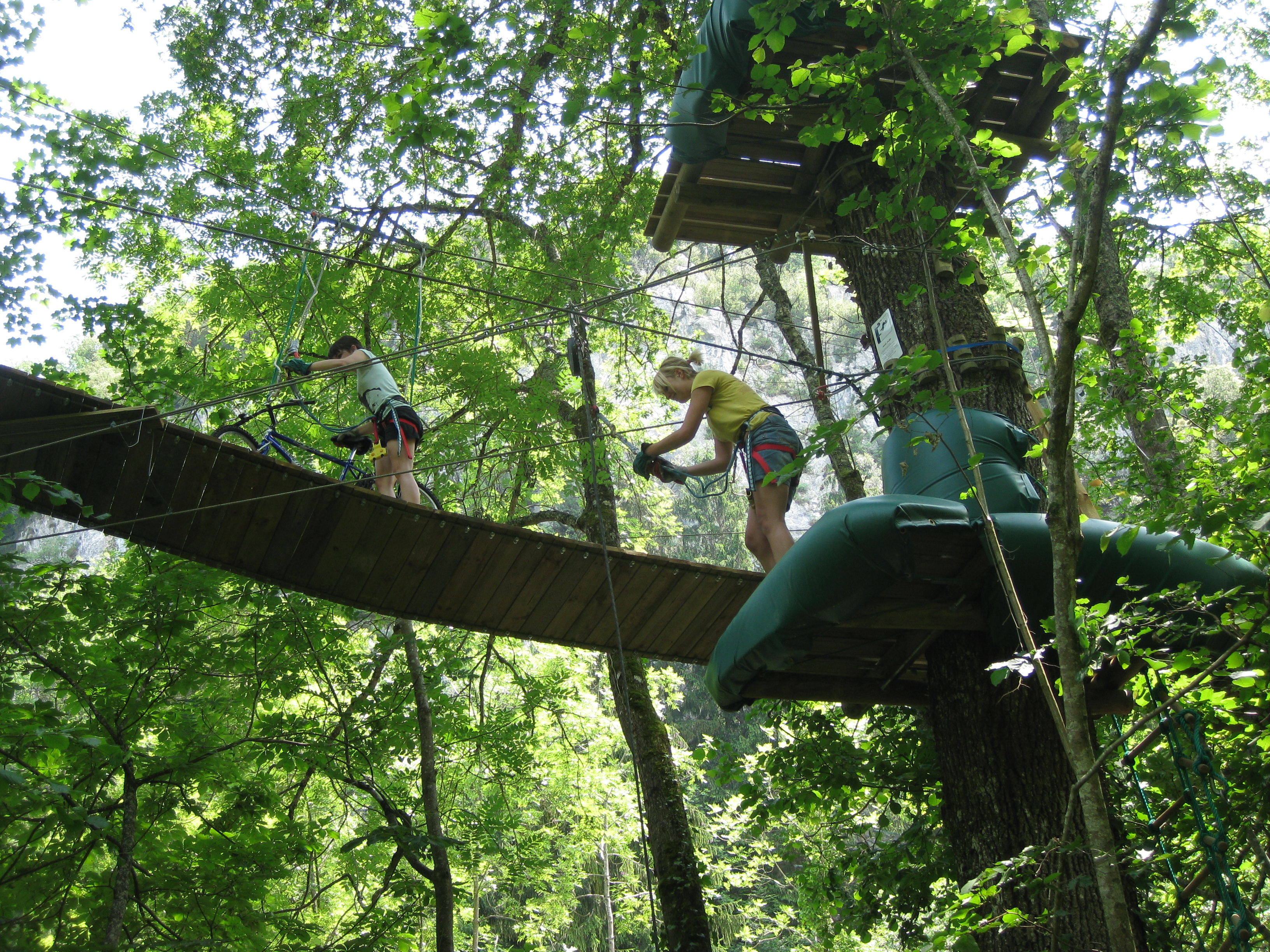
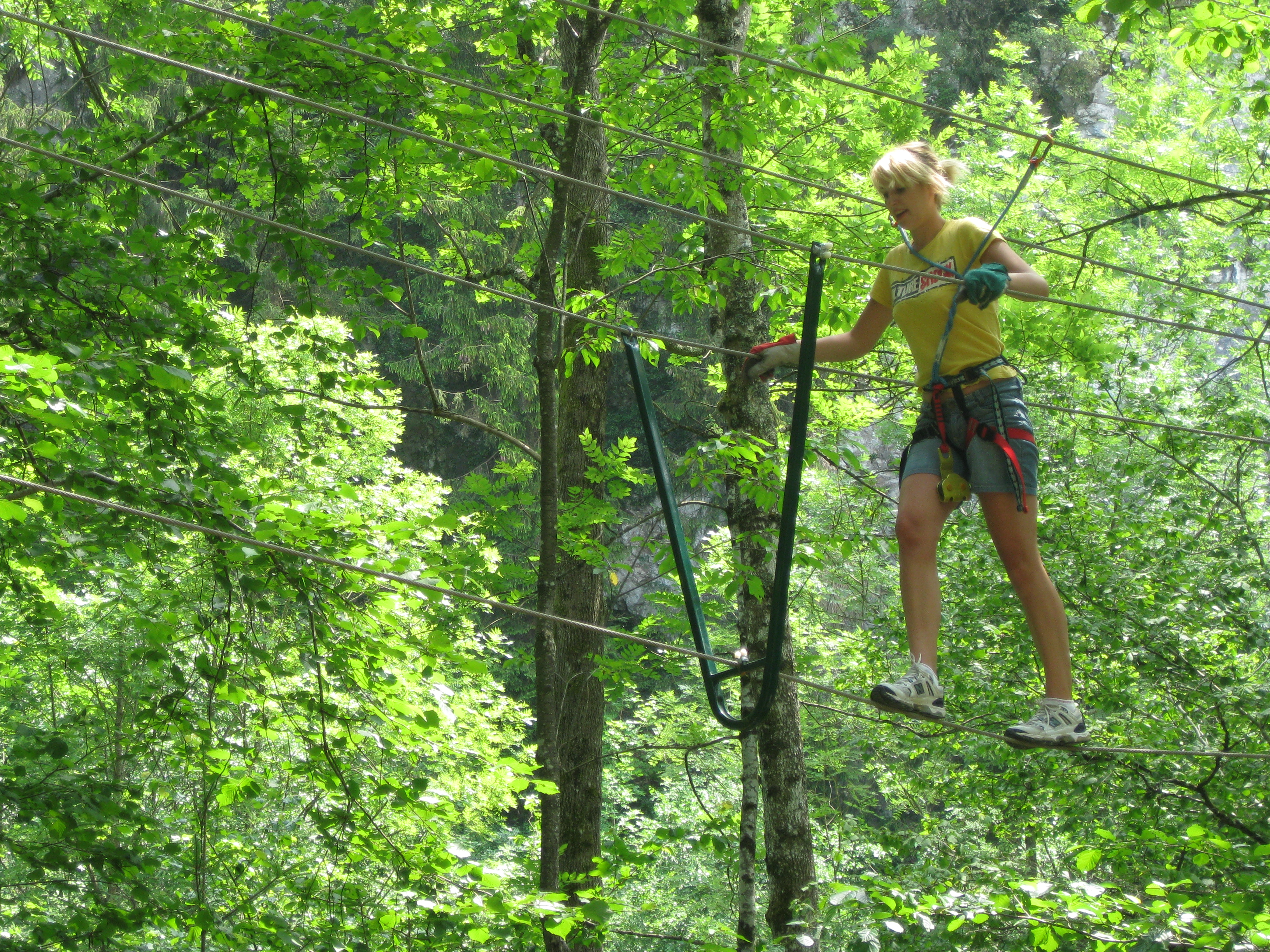
Malcolm and I watched from below. Often, the two were so high up in the tree canopy we could barely see what they were up to. Whizzing through the forest on zip wires seemed to be the pay-off for challenges such as rope bridges, swaying wooden fences with equally swaying footholds. High up on the wooden security platform between each section, they had time to contemplate the scariness of the next challenge whilst unclipping and reclipping their karabiners. Sadly, my camera battery gave out after they’d gone round the first of three sections – the ‘easiest’ one, so I can’t show you the scariest bits of all: such as swinging on a rope, Tarzan-like, to a large vertically strung net, which you have to climb along, crab-like, to reach the next point of safety.
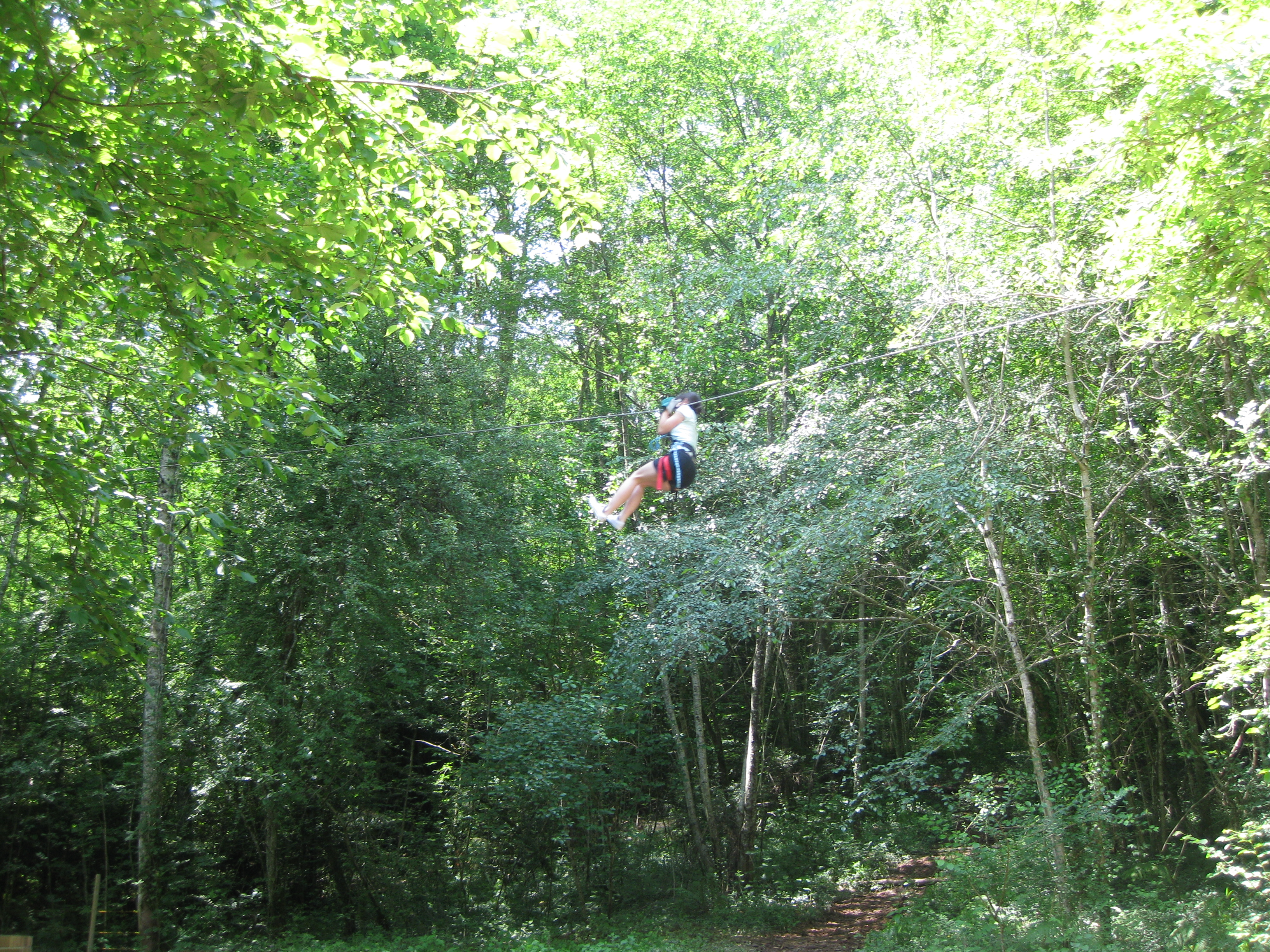
A zip-wire experience
Or the longest zip wire of all, so much higher than the others, which sent them screaming through the trees, across a river, through more quite dense forest, before they disappeared from view. They came back into view as they returned across the river via precarious rope bridges and swinging platforms
Emily walks the not-so-tight rope
It was fun and a challenge for them. But it was fun for us too, the two wimps left below. We wandered through the forest following their progress and astonished at their courage: being safe isn’t the same as feeling safe.
Watch out. If you come to stay, we may send you there. Malcolm and I will be watching from below again
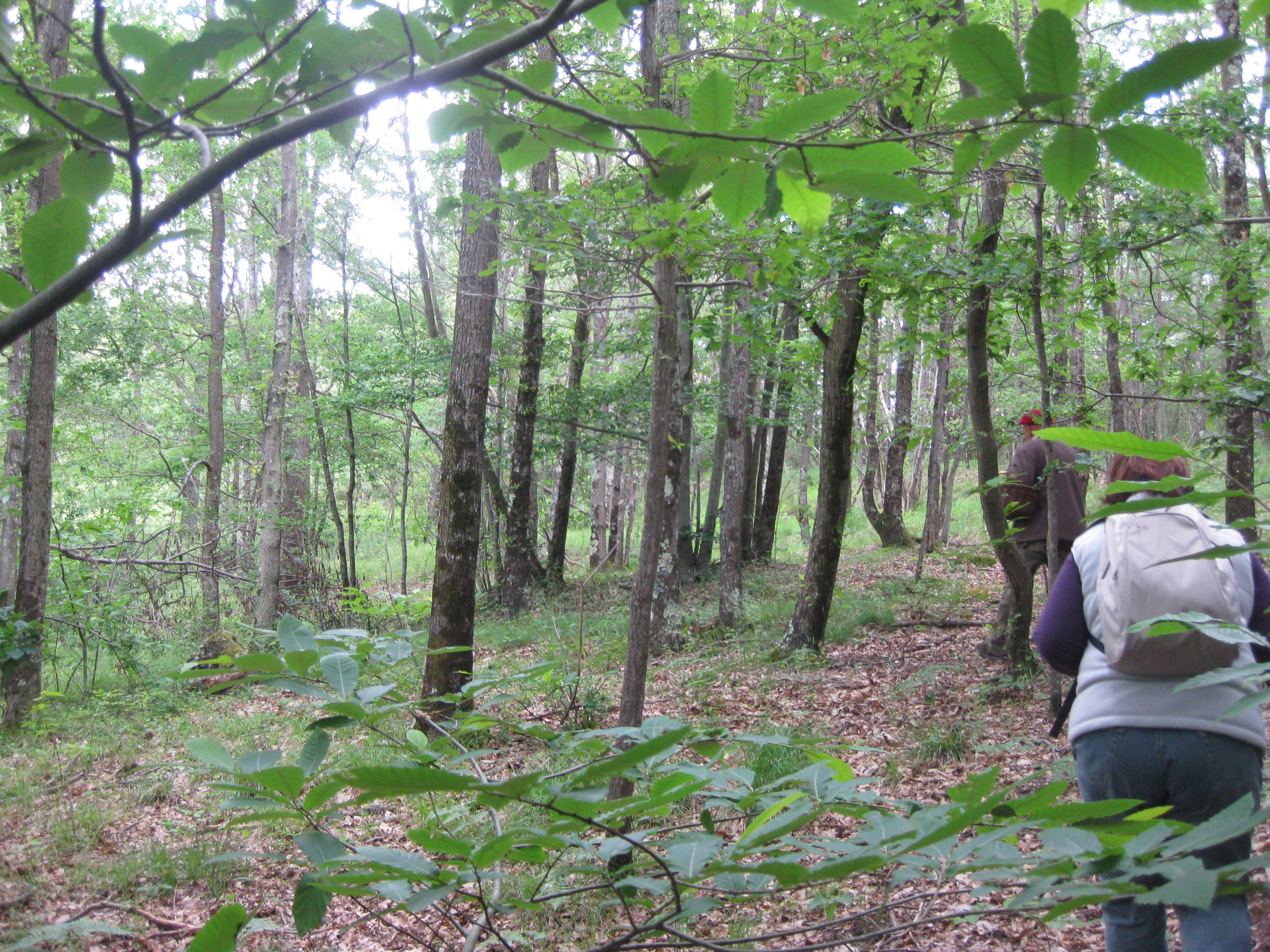
Yesterday, members of Atout Fruit went mushrooming. ‘ You couldn’t have!’, I hear you cry, as several people I mentioned it to did, ‘Autumn’s mushrooming time. On the whole’. Well, yes, up to a point. But our guide Francis, an organic farmer near Chalabre, keeps his family in mushrooms every single week of the year. He knows where to look.
The hunters set forth
And so he took a group of about 10 of us to the woods. Where? I’m not going to tell you that silly. Somewhere near Lavelanet. That’s all you need to know.
He told us some of the lore and laws surrounding mushrooming. That you can gather 5 kilos per person per day in the Aude, but only 3 kilos here in the Ariège . I wish. I’m ecstatic generally if I find as many as three mushrooms. That about 85% of land is in private ownership. That you may have the right to gather in the Fôret Communale of certain communes if you are resident there. That you must have written permission if a landowner gives you permission to go mushrooming on his land in case the police stop you as you carry your haul home. Theoretically, you could be stopped as you return from the shops with an extra-big bag of them.
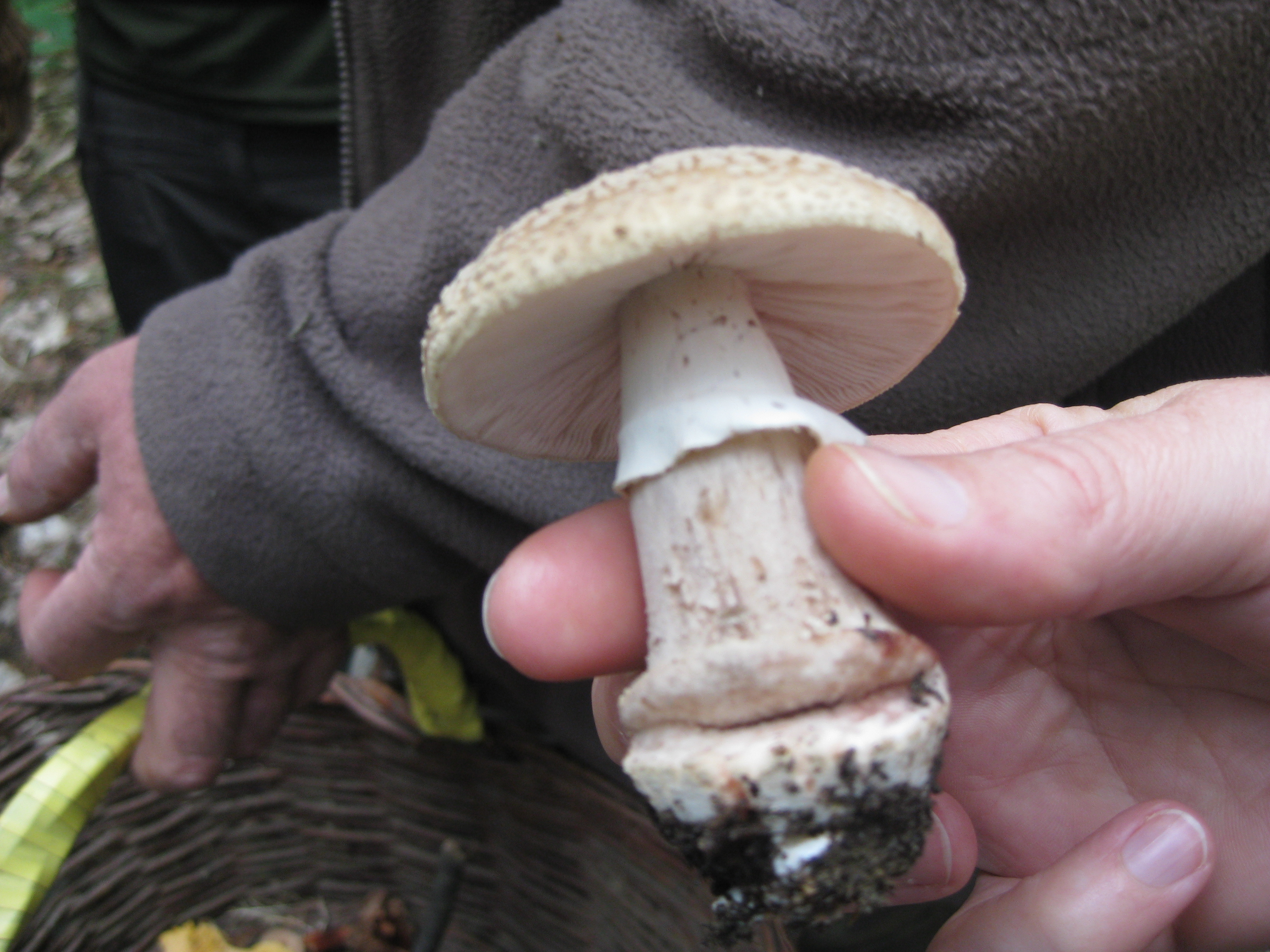
An inedible amonite
Mushrooms in the woods, pushing steadily through the thick thatch of decaying leaves, are surprisingly hard to spot, clinging to the base of tree trunks, bulging through the crust of impacted dry foliage. We quickly divided into a hit squad of those who seemed to have an eye for it, and others, who like me, were destined to remain in the B team. Francis showed us edible girolles, gariguettes and russules, and warned against the attractive-but-not-to-be-eaten family of amanites.
Look at the whole thing to identify it correctly
We’d trot over to him with our finds, to be disappointed when he warned us against putting them in the pot, triumphant on those occasions when he said they were ‘delicieux’. We could guess after a while which ones were delicieux. The slugs and worms had got there first and eaten little circles out of them. No matter. Plenty left for us.
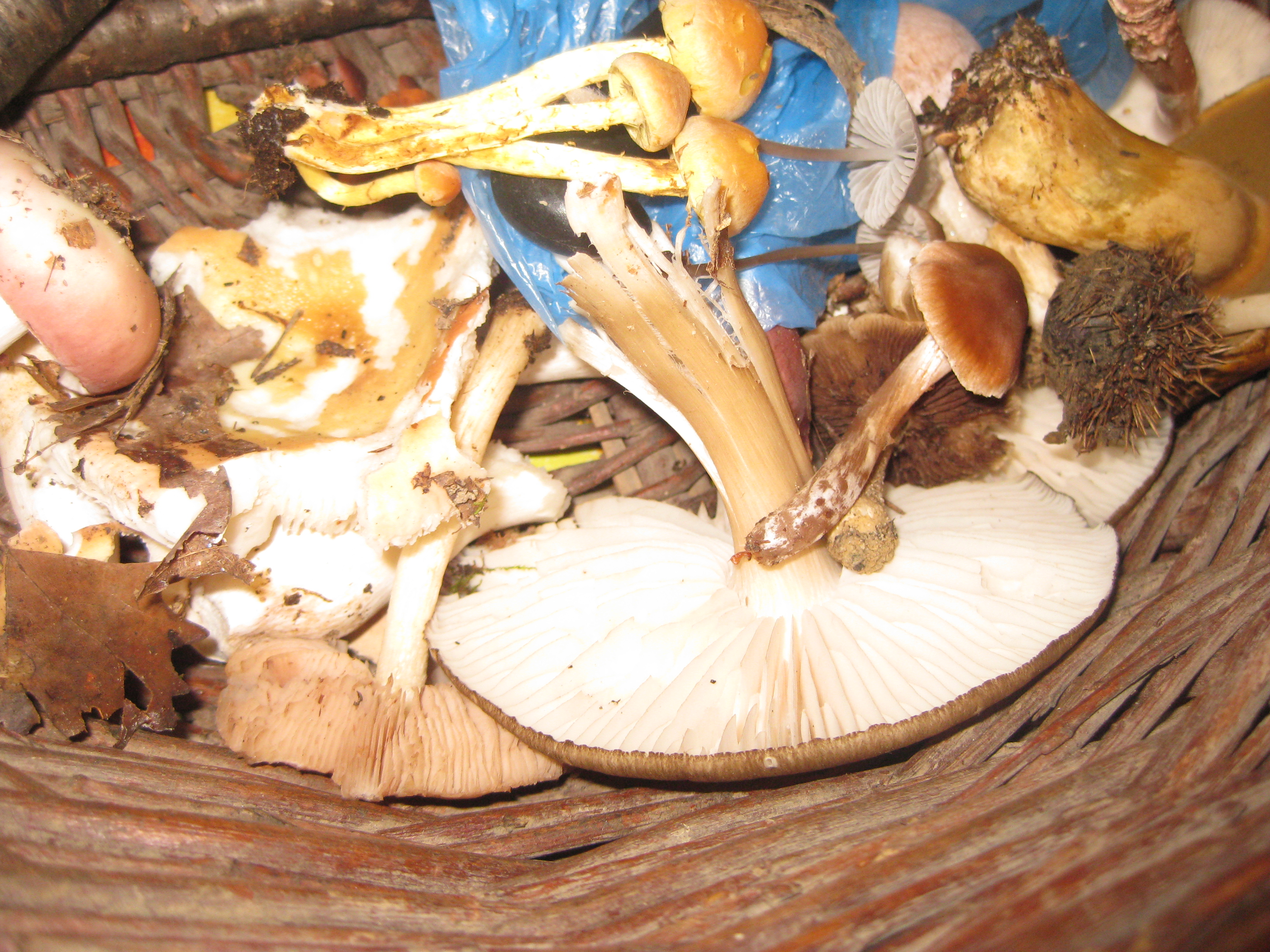
After a couple of hours, we wandered back to his mum’s kitchen (she’d lent her house for the afternoon), got out the textbooks, and discussed our finds. Not many mushrooms are dangerous, but unfortunately, they do tend to look rather like their edible cousins, and it only takes one……
Some of our haul
The family takes its mushrooms seriously. The ones they can’t immediately eat are preserved in oil, or dried, and the surplus sold to discerning customers. We spend a happy time exchanging our favourite ways of preserving, drying and bottling all the fruits of the seasons – this sharing is always my favourite part of an Atout Fruit gathering.
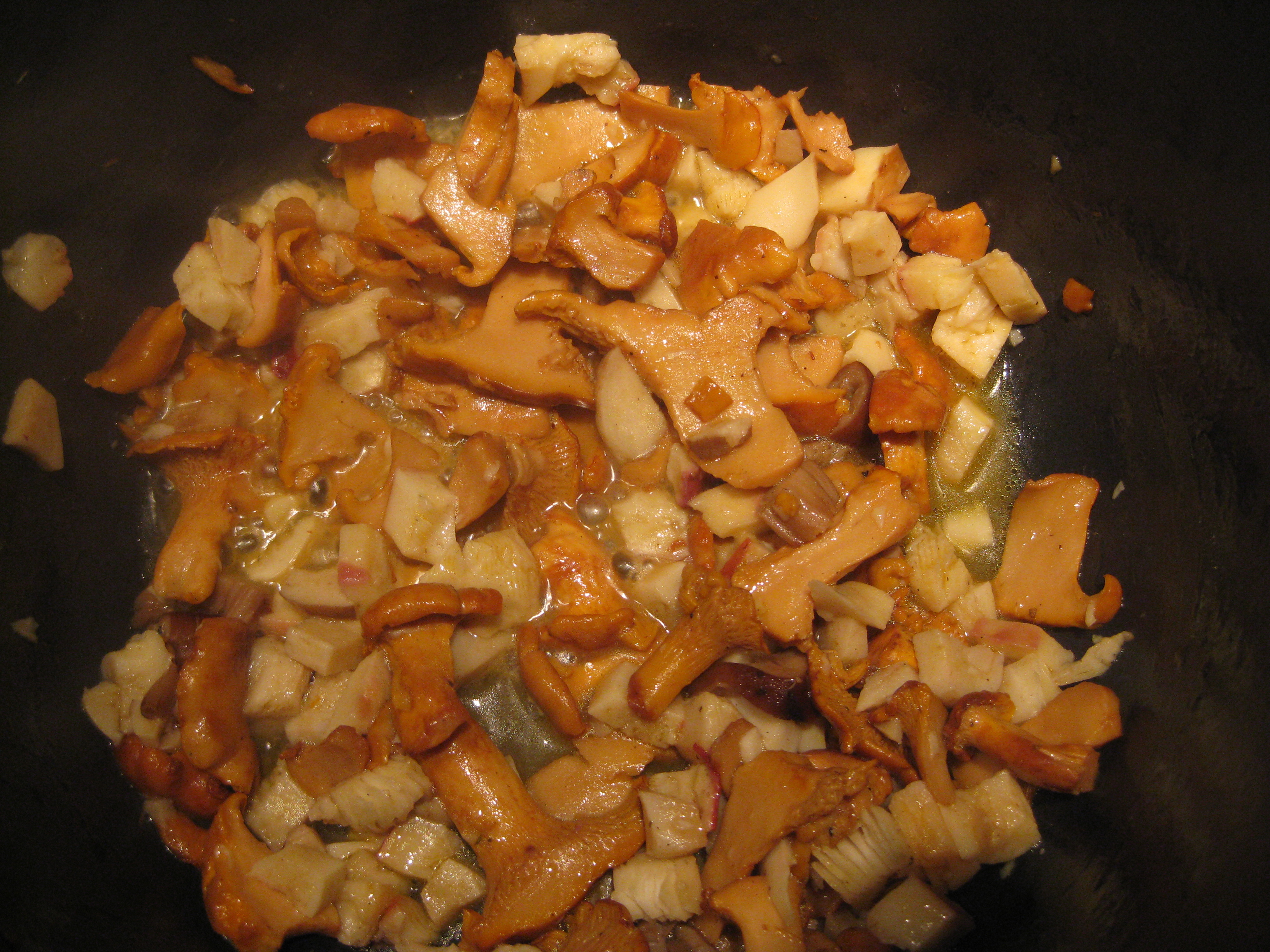
Together, we disposed of a big pot of sautéed mushrooms, the juices sopped up with bread, and helped down with a glass of wine, before reluctantly setting off home, our baskets more or less filled with our afternoon finds. When I got home, Malcolm and Henri were drinking coffee. ‘Whaddya mean, you’re not telling where you got those mushrooms?’ Henri grumbled. ‘You’re a right proper Ariègoise you are’.
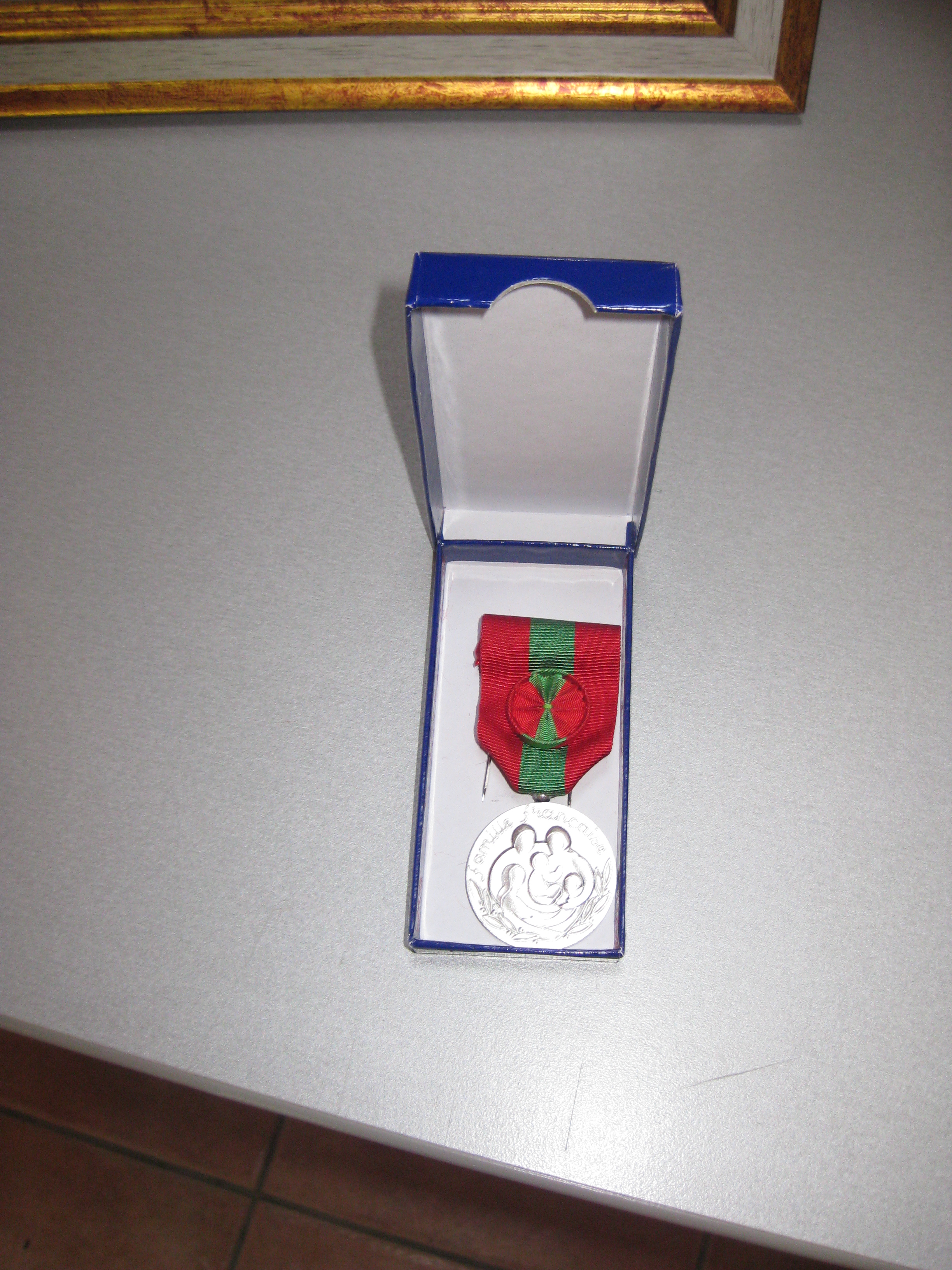
The Médaille de la Famille Française was created on 26th May 1920, following the catastrophic losses of the First World War, and can be awarded to mothers:
Bronze medal: for raising 4 or 5 children
Silver: for raising 6 or 7 children
Gold: for raising 8 or more children.
Since 1983, fathers or non-family members who have been responsible for bringing up numbers of French children can also qualify for a medal. There’s even a Catholic priest who qualified for the award, having raised his housekeeper’s children when she died.
Why the history lesson? Well, recently, we were invited to a ceremony to award such a medal. Sadly, I was in England on the day, but Our Man in Laroque, Malcolm, has submitted his report of the event
Two French friends, Martine and Francis, have a large and happy family – six children: three boys, three girls. Recently, Francis invited us to attend a ceremony to award his wife a silver Médaille de la Famille Française– not a word to Martine about this, you understand – a family event, but to be a surprise for her.
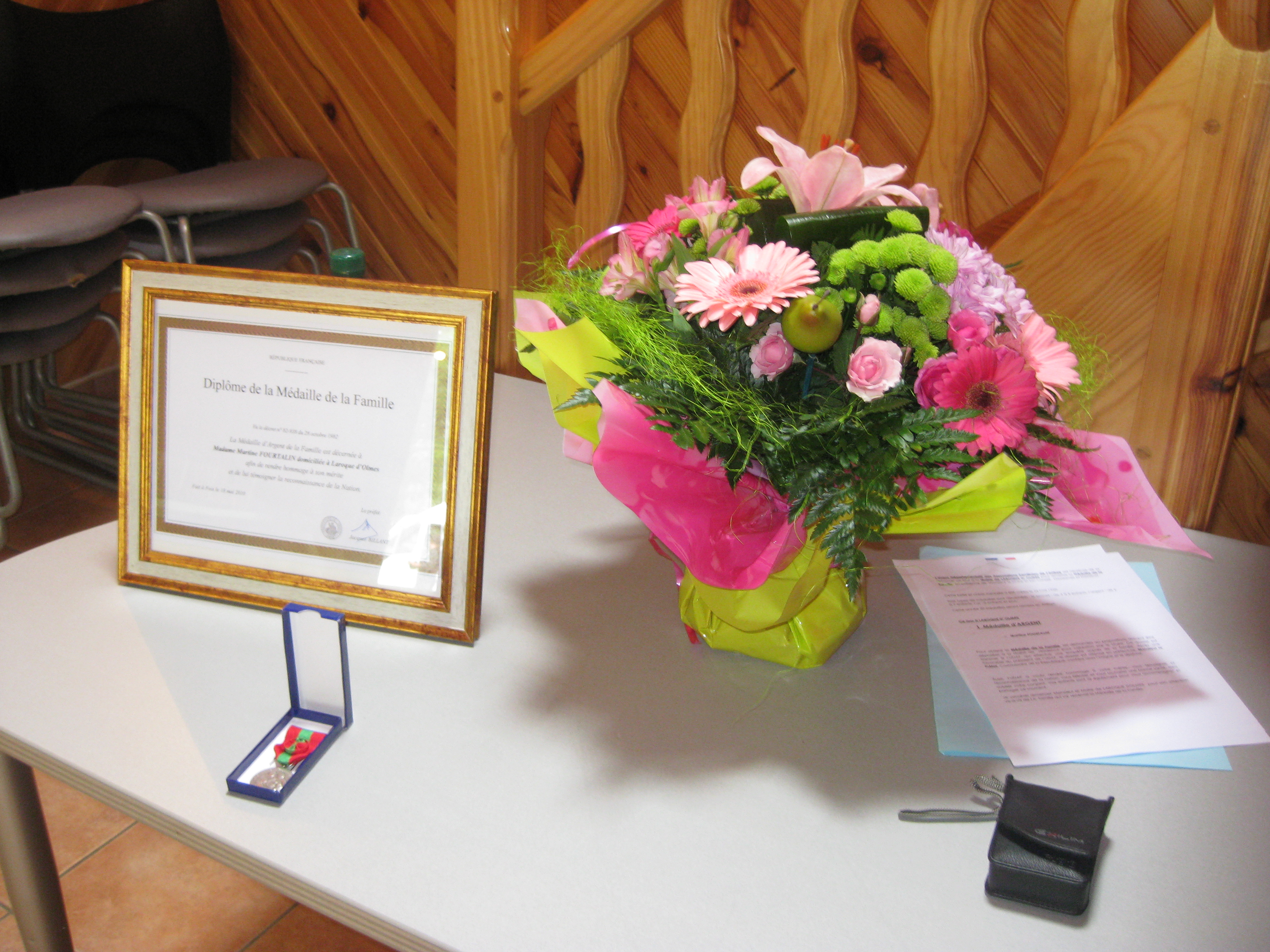
Turned up on the dot – a quaint English practice – at the appointed place. There were only six people there, and no sign of husband or wife. Nibbles were ready and waiting on tables, along with a few bottles of champagne, and there, on a separate table, stood a framed award, a small velvet-lined box containing a medal, and flowers, beautifully wrapped in presentation packaging.
And so we waited. And waited. Gradually, more of the children arrived. But not all. Then Francis, wearing a blue suit (before, we’ve only ever seen him casually dressed). And then, eventually, Martine appeared, chauffeured by one of her boys, and looking somewhat bemused. She too was wearing some finery.
And still we waited. For the sixth, and youngest, child of the family to arrive. But she didn’t. Turned out she had a football match on, and had forgotten….
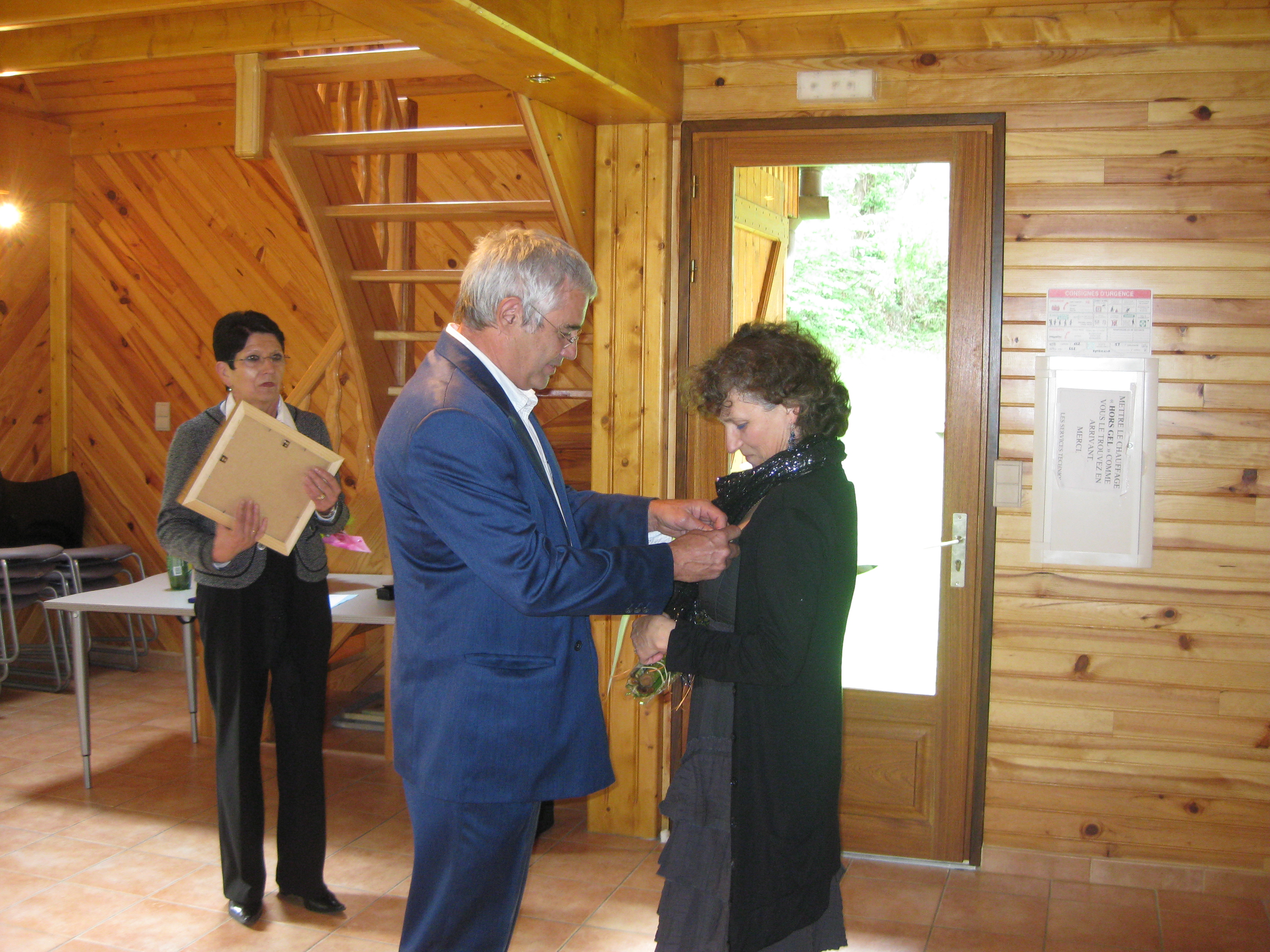
So the ceremony began without her. A smartly dressed woman of a certain age, the representative of the préfet, read a prepared speech from a sheet, Francis read another, and then presented Martine with a large bouquet of beautiful and rather exotic-looking flowers. Then came the handing over of the framed certificate, more flowers, and, most importantly, the silver medal, which was taken from its box and pinned on her.
The ceremony over, it was time for wine, nibbles, and photos.
And later? The family went back home to eat a special meal. This time, all the children were present, as the football match had ended. More posing, more photos, then an evening round the table – mother and father, their six children, a daughter-in-law, heavily pregnant, her parents, and one guest – me. I felt tremendously privileged to have been invited to this ceremony and then to their celebratory meal. Unique – I’d never been to such an event before, and doubt I’ll ever go to another like it – and moving – if integration is what we’re trying to achieve, it doesn’t come better than this.
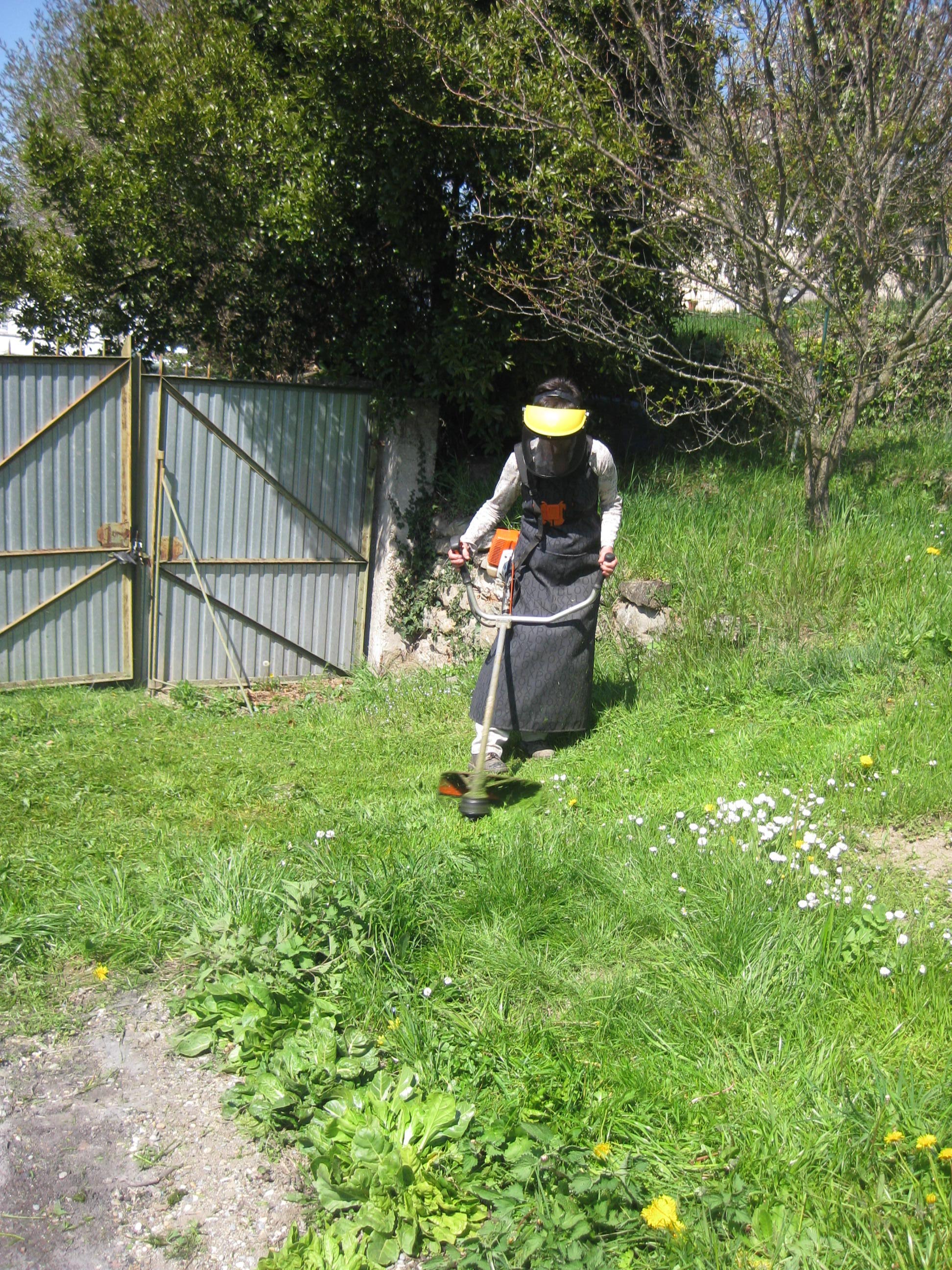
Up at that garden of ours, there’s rough grass to cut. We use a strimmer, and it takes a long, sweaty time. We can’t do away with it, but perhaps we need help?
We thought of sheep:
We considered a donkey:
We discussed a goat:
We’re serious about hens:But when came back to Harrogate, I saw that our neighbour’s 5 year old’s just acquired a guinea pig. Every day the run is moved, and every day, there’s a new rectangle of freshly nibbled grass. Hmmm.Nah, not really. Hens it’ll be. But that little guinea pig of Paul’s is very efficient and purposeful
This is the time of year when France begins to limber up for the Tour de France, which happens this year between the 3rd and 25th July. In truth, cycling never really goes away in France. Out driving the car, one of the occupational hazards is overtaking largish groups of keenies togged up in bright Lycra cycling gear, with bikes that in some cases have cost more than a decent second hand family car.
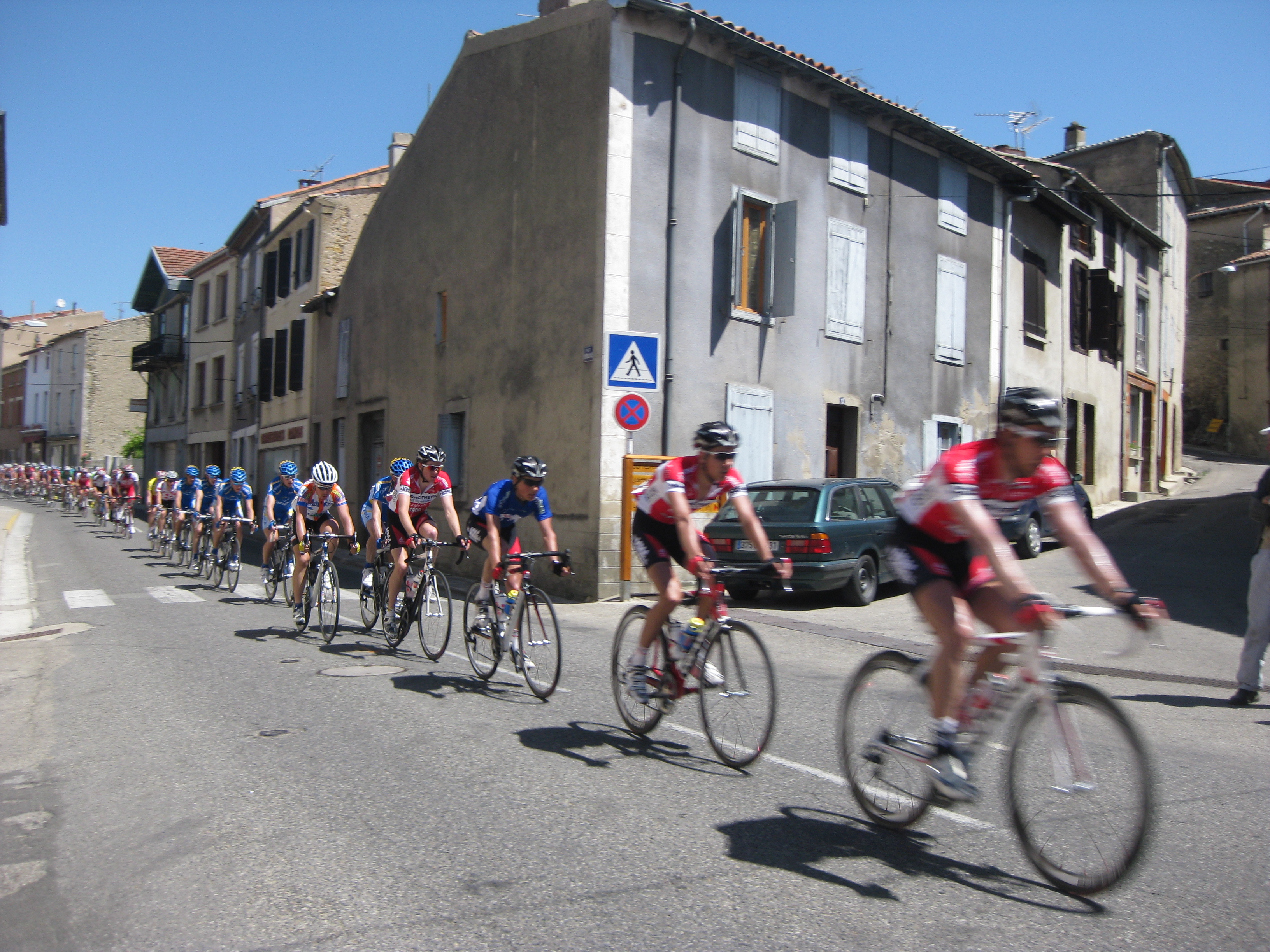
I’d forgotten that this weekend is the Ronde de l’Isard. This is a 4-day cycling event held here in the Ariège that began in the late 1970’s as a bit of a competition between local clubs. It’s since grown to have entrants from nearly as wide a range of countries as the Tour de France itself.
Free baseball cap....
So, this morning I was strolling along to the baker’s – rather late – it was almost noon. Suddenly, I could hear hooting, sirens, tannoyed announcements, and a fleet of vehicles led by smartly polished blue gendarmerie motorcycles advanced down the street towards me. Ronde de l’Isard, Advance Guard. As with the Tour de France, they had gifts, and as I was the only person on my side of the street, they made sure I got the lot: a spotted baseball cap, a key ring, and a leaflet from Tourist Information.
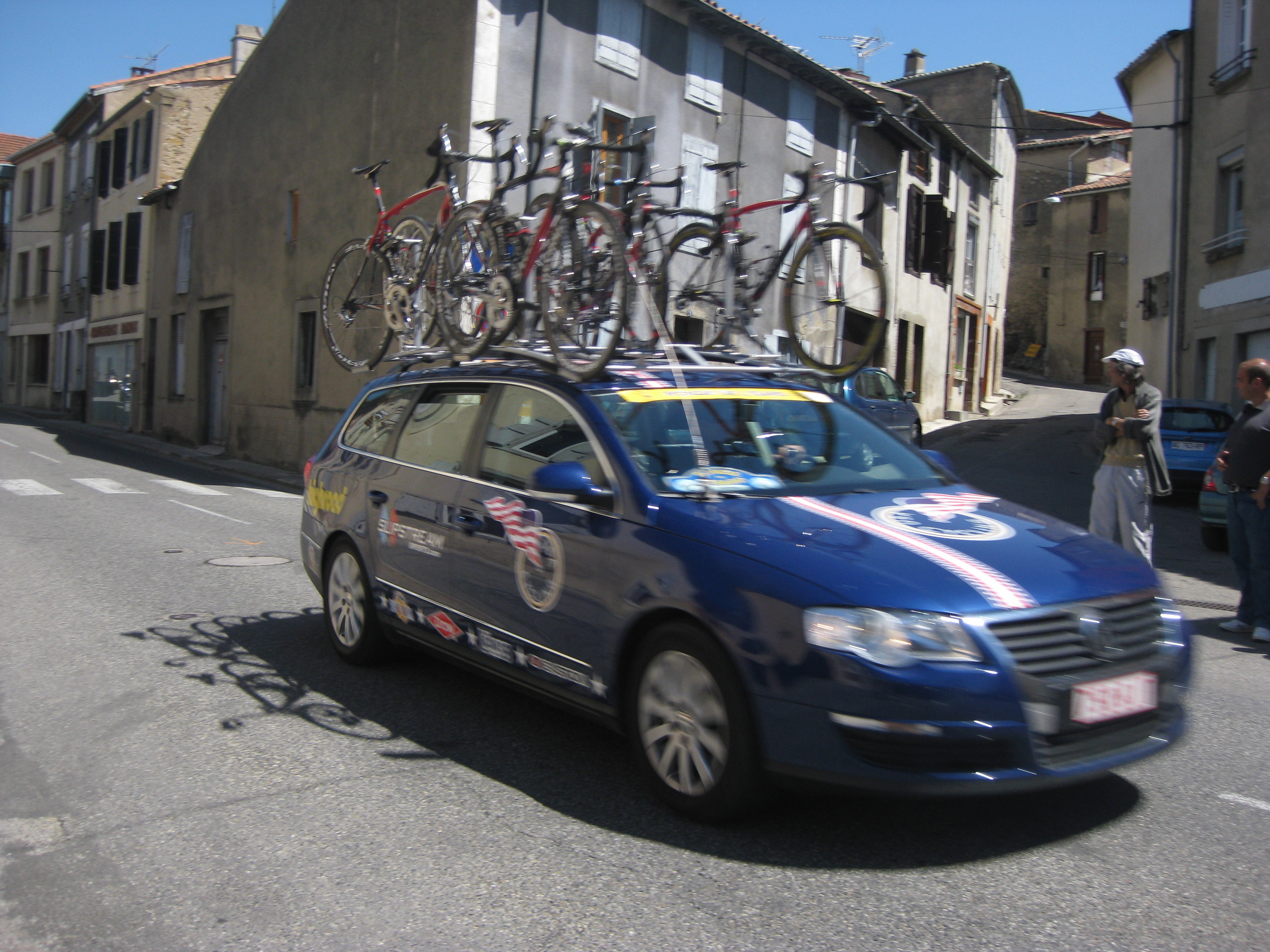
And that as it, for half an hour. At precisely 12.33, as advertised, the riders themselves tore into view. The whole of the rest of the Ariège gendarmerie were there on their motorbikes, advance vehicles of various kinds, and then – whoosh! – the cyclists, a l-o-n-g streak of them, flashed past: to be followed by support teams carrying spare bikes, ambulances, press.
Team support
Today they only had 149.1 km to do. Just now, the thermometer at the back is reading 37 degrees. Still, yesterday, just as hot, the distance was 175.5 km. The winner for the day managed it in 3 hours 55.9 seconds. Count me out
When we first understood that Laroque is twinned with Melgven in Brittany, we were nonplussed. Surely twinning arrangements are with England, Germany, Spain – or anywhere abroad. What’s the point in twinning with a town in your own country?
Well, quite a lot as it turns out. As part of the twinning arrangements, citizens from Melgven come for a long weekend here in Laroque , while Laroquais have the chance of a few days’ stay there in May. This year, we signed up for the 10 hour mini-bus trip to Finistère
Straight away, we began to see the differences. As we arrived, we were welcomed to enjoy poking round their fundraising ‘Troc et puces’ fair in the Sports hall. The Bretons are a Celtic race, and it shows in their physical appearance. Meanwhile, down here, there’s a long tradition of Spanish immigration, most recently in the Spanish Civil War, and the Second World War, so many locals here are olive-skinned and not very tall. A tannoyed announcement for M. Garcia and M. Sanchez to report to the desk in a public hall somewhere near here would have nearly half the room scurrying to reception.
And then there’s the food. Brittany, like Britain, favours butter, and unlike the rest of France, the salted variety. Out to a meal on Saturday, the lunchtime bread came with pats of butter, something that never happens down south. In the Ariège, cooking’s done in duck fat, and more recently, olive oil. No part of Finistère is very far from the sea, so fish and seafood are an important part of the diet. Down here, duck in all forms is king. But pork, lamb, game, beef are all welcome on the dinner plate. If it moves, eat it.
When we looked round a market in Concarneau on Saturday, we were struck that there was little charcuterie or cheese on sale, and what there was came from elsewhere. It seems as if every other stall in our local Ariègois markets is one selling cheese and charcuterie, much of it from just a few miles away.
Brittany – cider and beer. Southern France – wine. As part of our welcome apéro, we were served kir made with cassis and cider. After sipping it suspiciously, we accepted refills with enthusiasm.
So…what were the highlights?
The welcome. Of course. Some Laroquais have been going on these exchanges for several years, and the warmth of the relationships forged is clear to see.
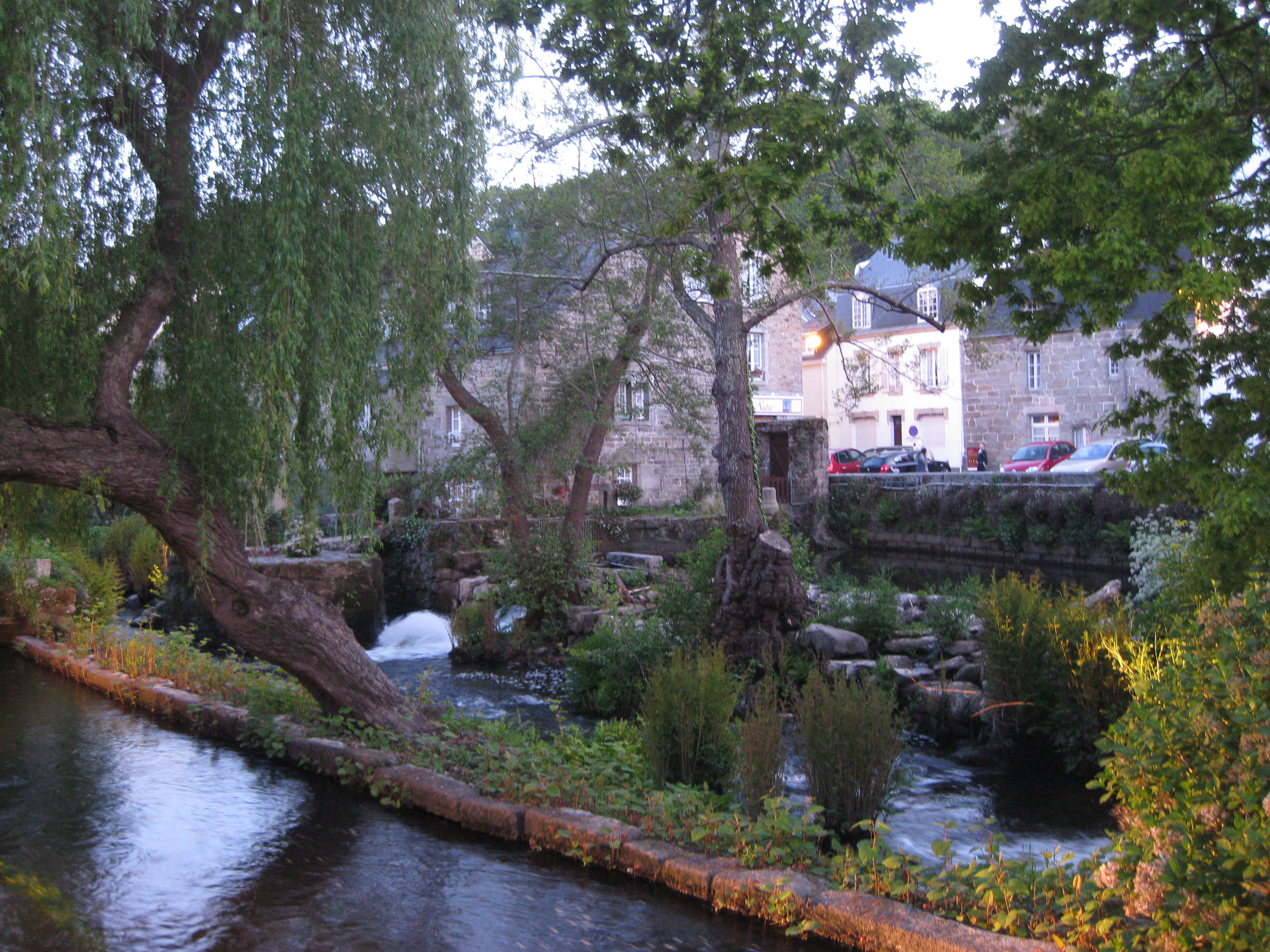
A change of scene: the countryside. Our host, Albert, took us on several walks, and we were struck with how very British this part of Brittany looks: softly rolling hillsides, woodland and meadows. We traded orchid spotting in the Ariège for enjoying the swathes of bluebell glades in the woods.
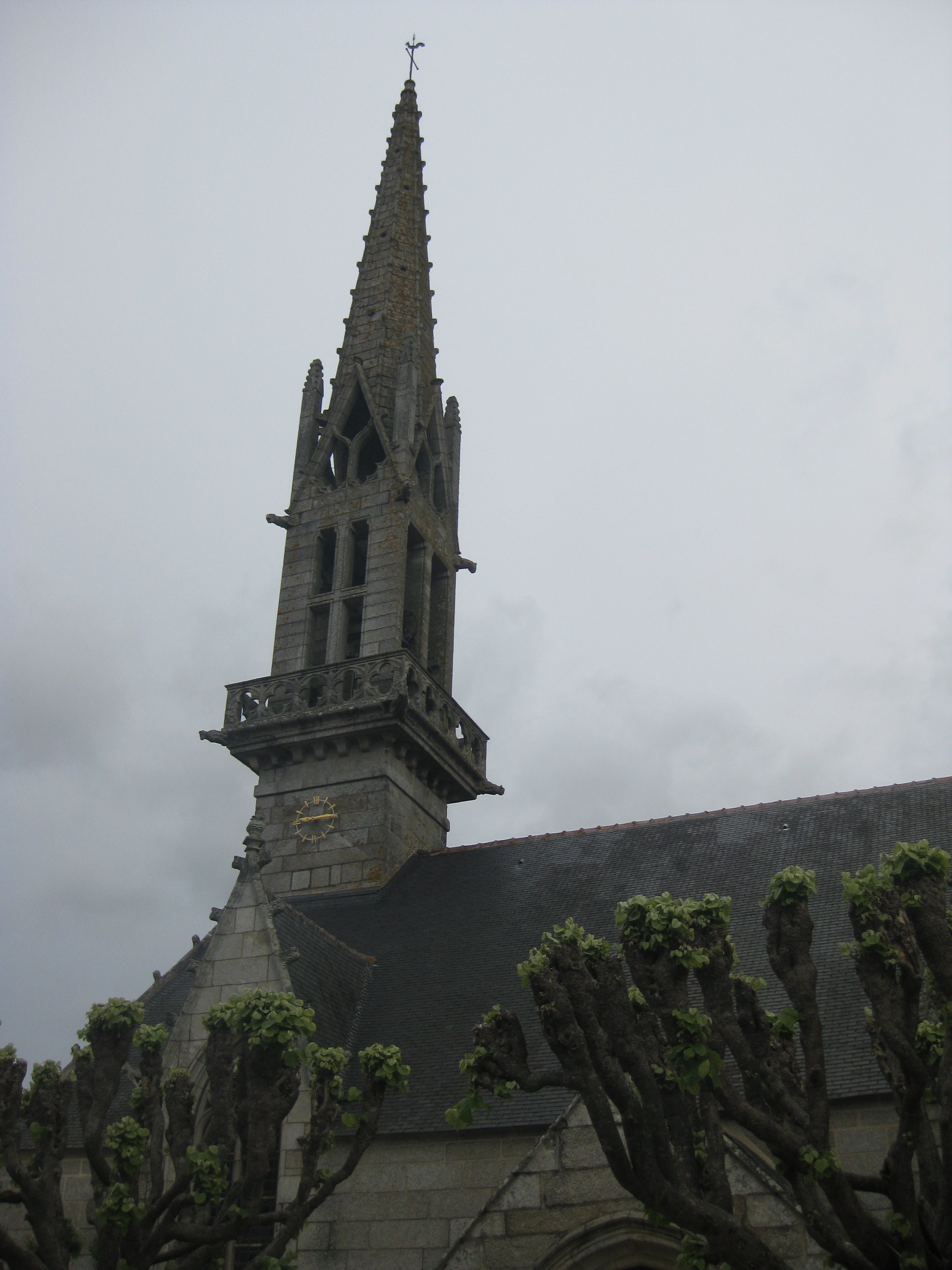
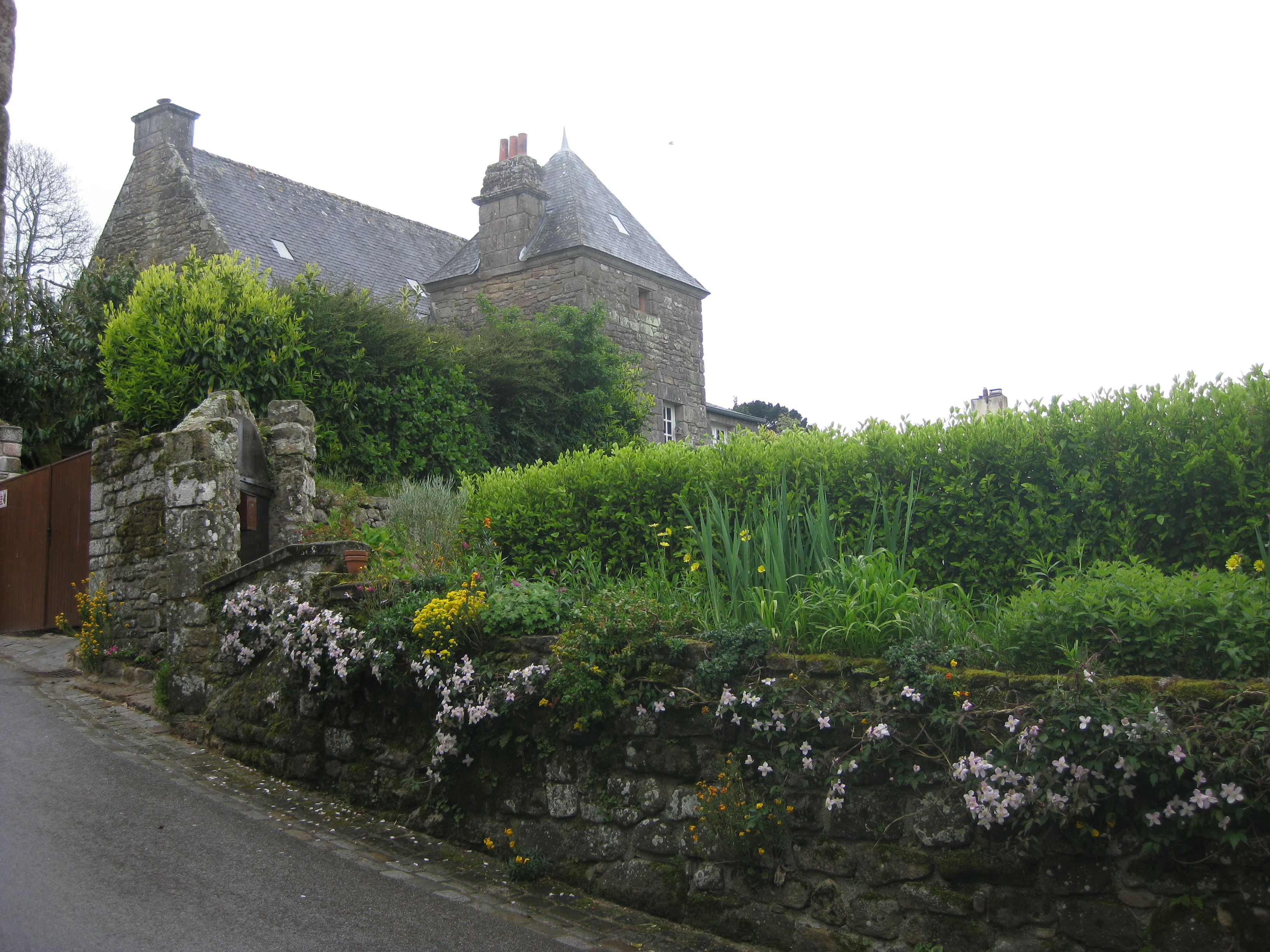
A change of scene: the town. We exchanged the shallow-roofed, unpainted or pastel coloured houses of the south for the tall white narrow pitched roofs of Brittany. Down here, we’re used to our towns and villages being shabby. Brittany’s are clean, sparklingly so, with flower boxes, neat gardens, and a general air of pride in the community. And then there are the churches. No clochers-murs in Brittany, but rather complicated steeples instead.
The seaside. Concarneau was at its sparkling best, with breezes tugging at the flags, clouds pluming across the sky, an early pre-season freshness to the narrow streets of the historic quarter. Their fishing museum there shows all too graphically just how very tough the life of the fisherman was – and is. But it’s a picturesque sight for the tourist
Sightseeing: Our first treat was to visit Locronan, a beautifully preserved granite built 16th & 17th century village, with a mighty central church, and a small chapel at the end of a charming walk.
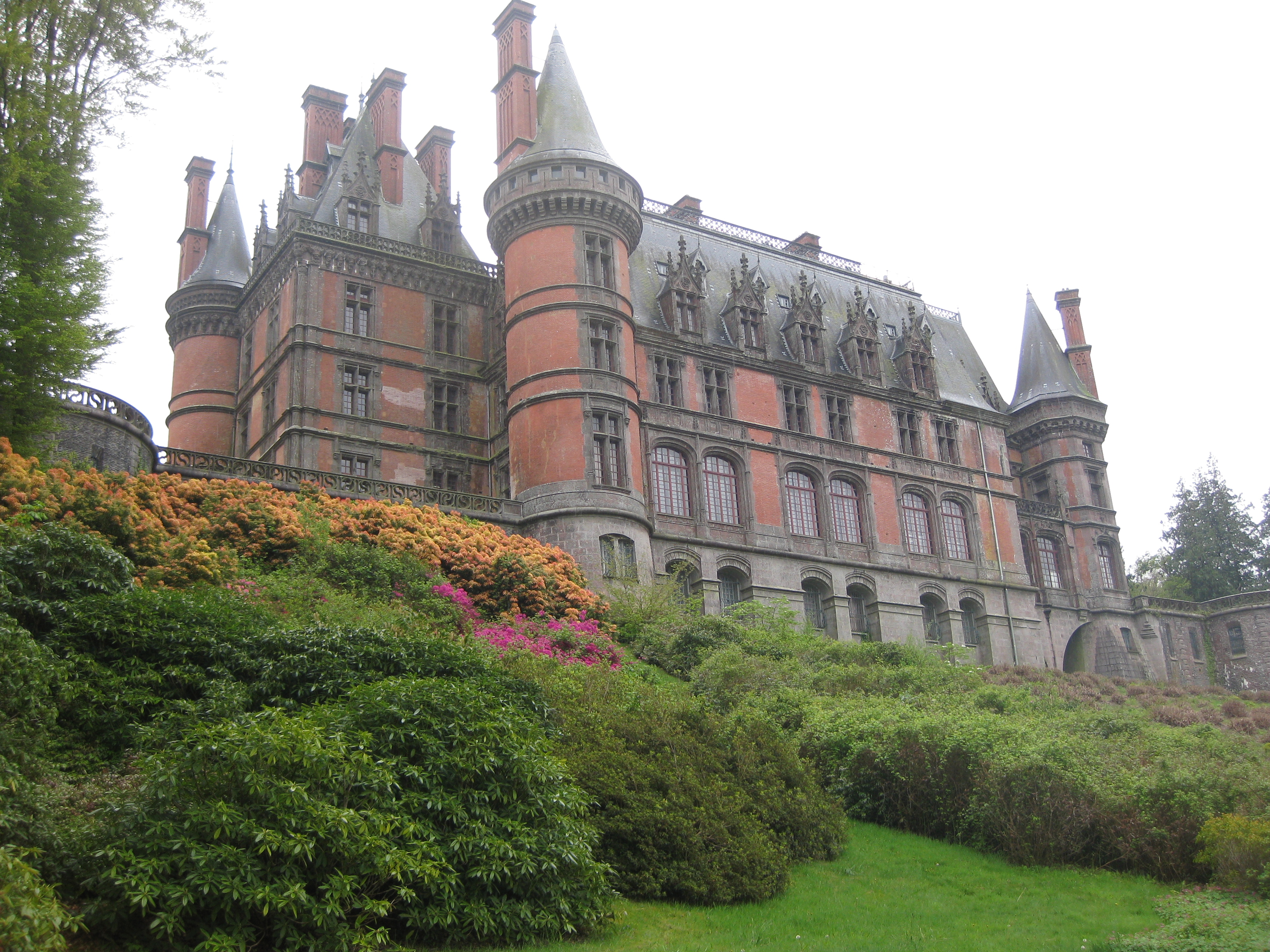
Next was Trévarez, a chateau that might look Gothic, but is in fact a 19th and 20th century construction. Its brickwork gives it the name “château rose”. We spent more time in the gardens though. Apart from a formal area near the house itself, the garden is informal in the style we’re so used to from English stately homes, and glorious at the moment with azaleas and rhododendrons
Celtic music: Friday night was concert night: the chance to listen to an hour or two of traditional Breton music. Malcolm and I particularly enjoyed hearing those favourite Welsh hymns – Land of my Fathers, Cwm Rhondda in Breton– they sounded very different, but just as good
Story telling: Such a treat. Michel Sevellec enchants audiences in Finistère and beyond with his tales drawn from many traditions. On Saturday, as part of a local festival, we joined local children to hear his interpretation of Native American and other stories. Can’t wait for him to come to Laroque in a fortnight!
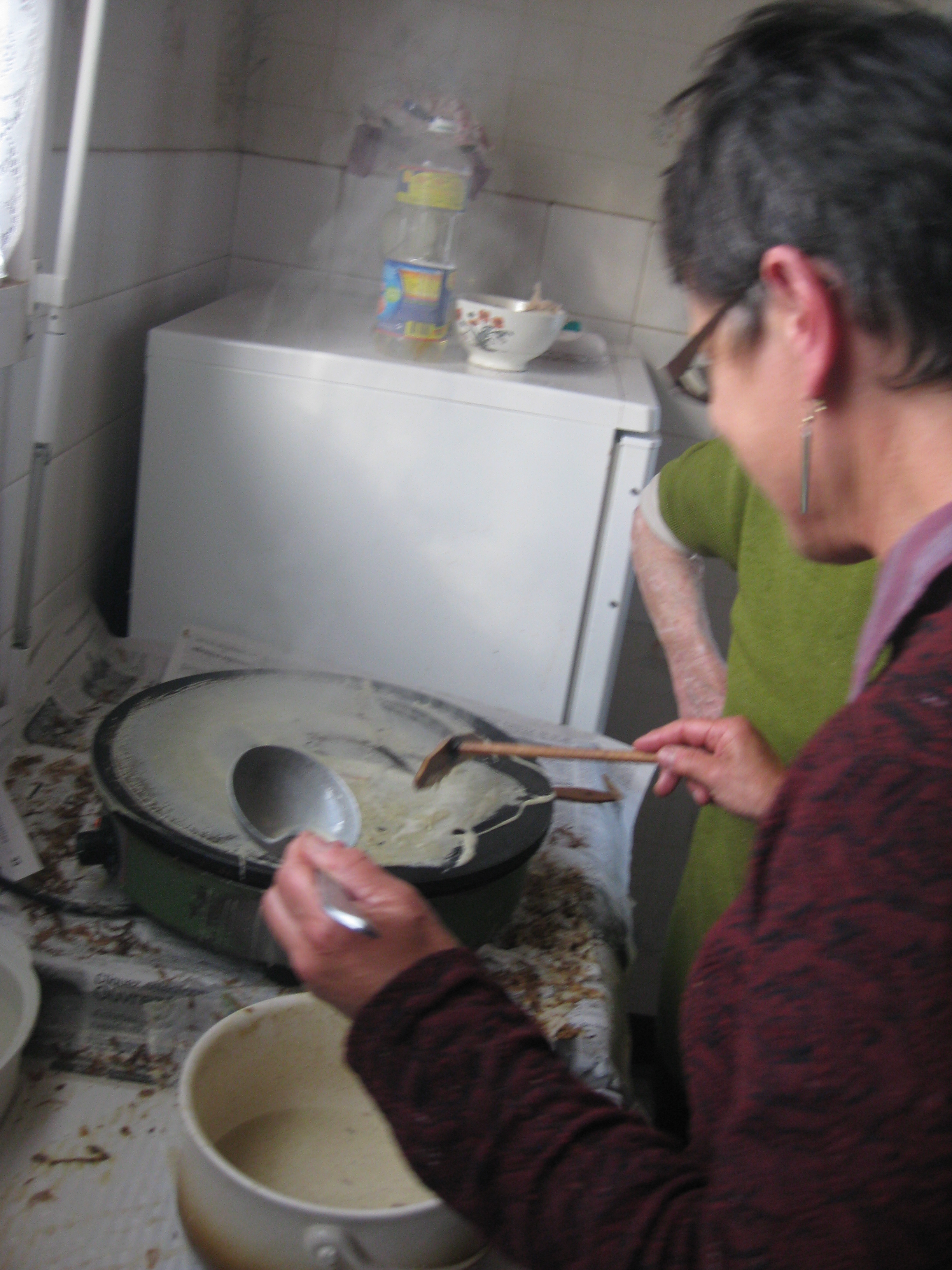
Crêpes:Everyone knows they make crêpes in Brittany. Lots of us have watched them being turned out on those special round hotplates. I always assumed it was easy-peasy. Until we went to eat crêpes at Albert’s mum’s house and she let me have a go. First, carefully pour the batter with your left hand while equally carefully drawing the batter round the plate with a special wooden spatula – not too fast & not too slow, not too thin & not too thick.
Expert at work
Then flip the delicate creation, so thin you could read a newspaper through it, over onto its other side to finish cooking. It was lucky there were hungry dogs to eat all my cast-offs. Lucky for us too perhaps: we’d still be eating them now. Malcolm and I thought 6 crêpes each ought to have been enough for anybody. Our hostess disagreed.
So….we discovered in Brittany an area very different from our own in languages, customs and appearance, and had a chance to be more than simply tourists. We now have new friends in Melgven but also in Laroque as a direct result of this weekend. A good experience.
Pont Aven: I didn’t even mention this lovely little town, did I?
1st May, 4.00 p.m. The washing machine’s just finished washing strappy tops and shorts, but I’m sitting here in front of a cosy log fire watching the rain scything it down in true British style. This time 2 days ago it was 37 in the shade, today it’s 11. What’s gone wrong?
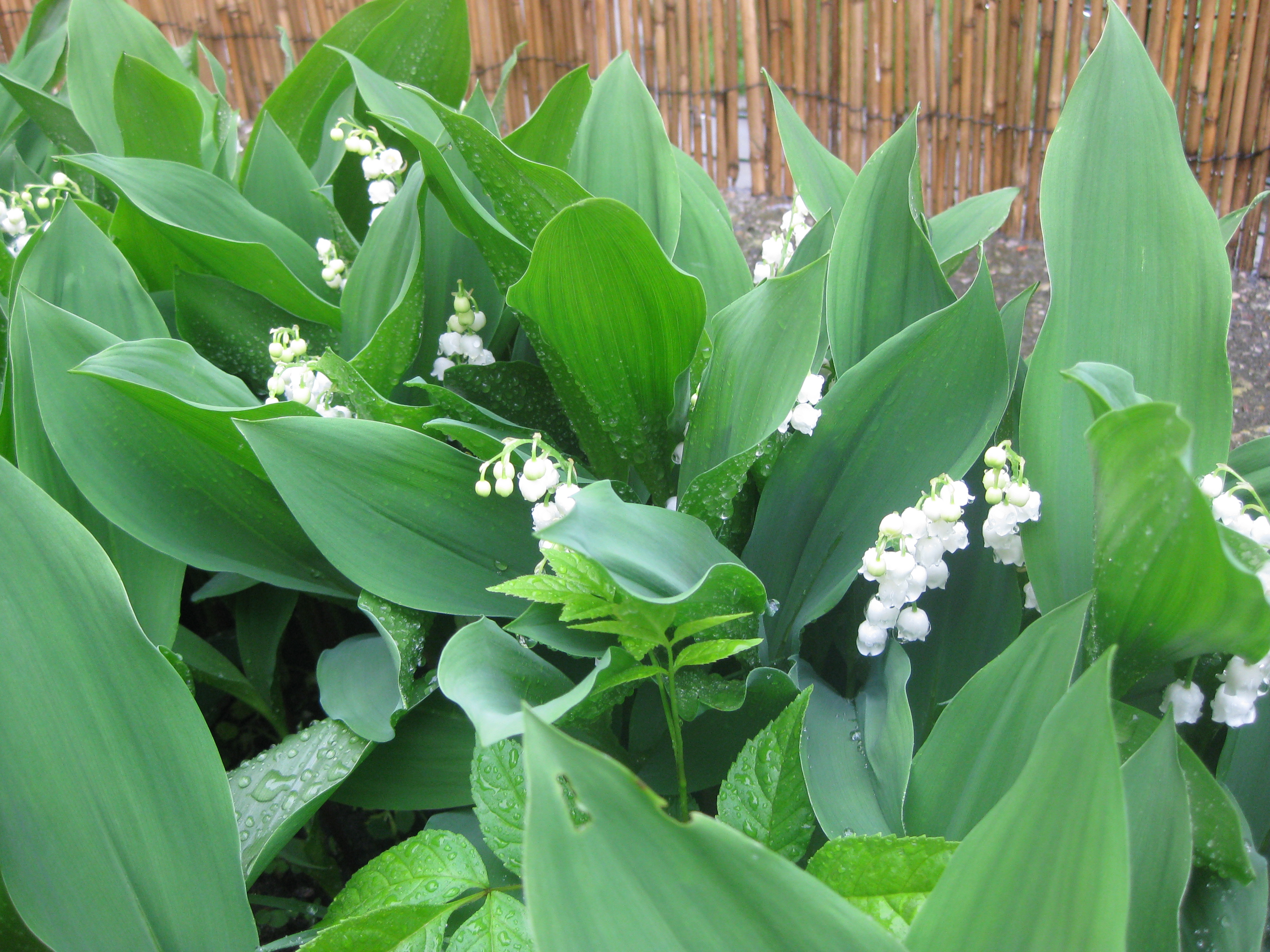
As in England, I suppose the reason is that it’s a national holiday, and few people are at work. In fact it’s THE national holiday, la Fête du Travail. Only a few neighbourhood shops are open, and then only in the morning: no supermarkets, garages, big stores – no newspapers today either. But that doesn’t mean there’s no commercial activity. Oh no! Today’s the day when everyone offers one another a traditional token of friendship and esteem – a sprig or two of lily of the valley, prettily presented. In every village, every town, you’ll find people on street corners, outside the bakers’, at the cross roads, selling the flowers that they probably spent yesterday gathering and tying into pretty posies. Here in Laroque we had groups of children as entrepreneurs. A friend of mine went to Mirepoix to set out her stall, and she’s made 70 euros. It’s the one day of the year when anyone who wants to can sell on the streets without a licence – so long as they’re selling only lilies of the valley (muguets).
I must have asked a dozen people the origin of this tradition. Nobody knows. ‘It’s simply to offer bonheur’, they shrugged. But Léonce had a couple of stories to tell. We all know that lilies of the valley have a strong and lovely perfume. The nightingale smells them as they come into flower on the first of May, and this gives him the energy he needs to get into the woods and begin courting, nest building, and singing. And those bell shaped flowers? Well, they apparently surround the Heavenly Gates, where they come in handy by tinkling musically to announce the arrival of another soul from earth.















 From Pyrenees to Pennines
You must be logged in to post a comment.