We were walking in the Aude today, and with every step we took, we realised that harvest season is well on its way.
Sorghum grains for animal feed swelled in fields where last year sunflowers had grown. A few seeds had escaped the Autumn harvest, and so this year a few cheeky sunflowers raised their heads above the more lowly winter feed.
Sunflowers among the sorghum.
Grapes cluster on the vine. They’ve grown almost as much as they intend, but they still have work to do. Most are still a bright acidic green. A few are starting to blush a bruised pink. Some have even achieved a classic purple: but they’re not ripe yet. We know. We tried one or two.
Grren grapes
Pink grapes
Purple grapes
And those fields of sunflowers, Apart from one field’s worth, they no longer look like those cheerful images you see on postcards from our region. Their bright sunny faces no longer track the movement of the sun as it travels across the sky. Instead, they’ve developed a hang-dog look as the weight of their maturing seeds pulls their heads earthwards.
Then there were almonds. We found a few had fallen already, so made a handful of creamy nuts into a small 11 o’clock treat. Walnuts are a different matter. They’re still heavily enclosed in their thick green fleshy coats. It’ll be a few weeks before this protection dries and splits to reveal the ripened nuts within.
A solitary almond
Ripening walnuts
Blackberries in the breeze
Apples? Yes, a few, but they’re still green, with white flesh that browns as soon as it’s bitten into. Blackberries? Hardly any have turned black. They’re still very small and green, or rather small and pink. We’ll have to wait.
So far then, only the hay bales sit plumply at the edges of the fields, ready for winter. The other crops soak up the remaining summer sunshine, fatten, ripen, and wait for the moment when they too will be gathered in.
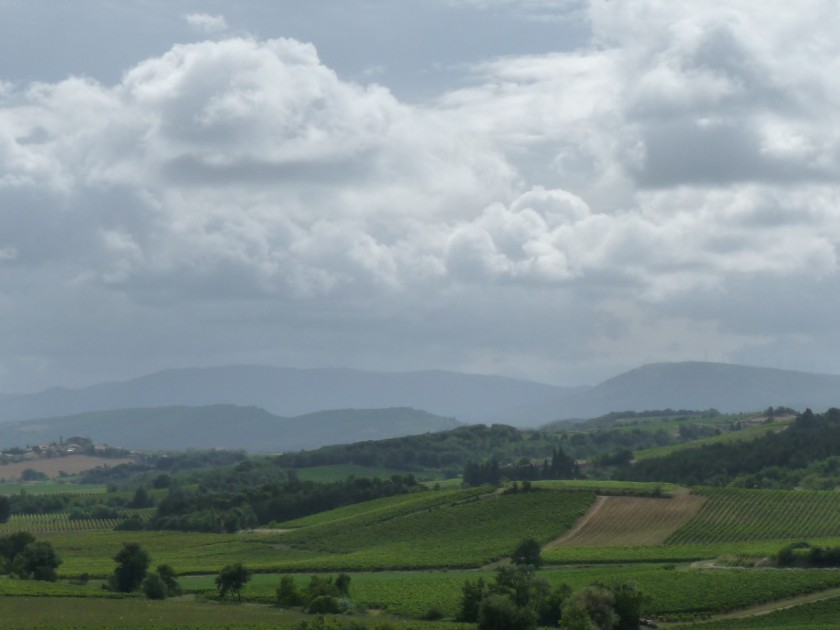
Fields of vines and sunflowers near Villelongue d’Aude
There we were at Roquefixade, showing our favourite walking destination off to two of our Harrogate friends, when a butterfly discovered me. Then another. These two creatures played round my wrist for more than half an hour before finally dancing off into the sunshine. They made our day.
He found Chris first……
… then abandoned her for my wrist.
Then there were two.
I’m thinking they’re the Common Blue (Polyommatus icarus). Any dissenters?
Green-veined white – Artogeia napi? I don’t really think so
Some kind of admiral?
..and another view.
Chalk-hill blue – Lysandra coridon. Or is it?
Their wings seem to get so ragged. They love to gather in their hundreds in damp spaces
So hard to pin down: they were never still for a moment
I’ve never been all that good at butterfly spotting. Back in the UK, I could manage my red admirals, peacock butterflies and cabbage whites. Oh yes, I could certainly identify those pesky cabbage whites. Their eggs were usually plastered over the undersides of nearly every vegetable I had on my allotment.
On Sunday though, we had a real butterfly bonanza. We had a perfect day’s walking on the nearby Plateau de Sault, near Belcaire. It was perfect because the scenery was friendly: gently rising and falling lightly forested slopes offered distant panoramas of the Pyrenees. The wonderful weather was bright and sunny, without being too hot. The walk offered challenges but no real difficulty; good companionship too. What made this Sunday memorable though were the butterflies. At this altitude – about 1000 metres – the summer flowers were still bright and fresh, and the butterflies couldn’t leave them alone. They fluttered ahead of us every step of the way, and we finally gave up exclaiming over their delicate beauty.
What we couldn’t do was identify them. This evening I’ve pored over sites on the internet. I’ve excitedly identified a specimen. Then I’ve looked at the next image… and the next… and realised that my confident identification isn’t at all secure. Tentatively, then, I’ve named my photos. But I rely on you, dear reader, to put me right about the undoubted mistakes I’ve made.
Not a butterfly at all: a Six-spot Burnet, Zygaena filipendulae, a day-flying moth
In the end though, whether I’ve been able to name them or not, I carry with me the memory of a summer’s day made extra special by the presence of those butterflies wheeling, turning, diving and fluttering, rarely still, but constantly engaging our admiration and attention
It’s five years since we were last up there, and it shows. That roof of ours needs a good clean-up, just as much as any other part of the house, because if we don’t…. it leaks. You’d think that a good coat of grime and lichens, with a thick crust of moss nudging at the edges of the tiles would provide a nice impenetrable and insulating covering to help the roof in its task. But no. Rain soaks into the moss, and wiggles its way into the roof space and then our attic. It’s not managed to break through yet, but time is not on our side.
We have a routine. An early breakfast, so we can get as much done as we can before the sun gets too hot. By quarter to 8, we’ve rounded up old pointy knives, wire brushes, lengths of thick wire, softer brushes, knee pads, kneelers, a bottle of drink: and up we climb onto the roof, via our roof terrace.
We’re neither of us wild about heights, me especially. But it’s not quite as scary as it looks. The pitch of our roof is quite gentle, and we can move about more safely than you’d think, though at considerable damage to our knees. We try to divide the roof into work zones and fail. It’s easy to go off piste when one tile looks so much like another. But we both scrape and scratch and pry away at springy cushions of moss, yellow puddles of lichen, odd tile chippings.
A couple of hours on, one of us will say: ‘It’s getting hot. Had enough?’ Neither of us needs asking twice. We each sweep our section of roof carefully, round up our tools and put them away, ease our aching bodies into the shower….. and flop, fit for nothing much at all, at least until lunchtime. Malcolm at least is allowed this luxury. He’s 73, long past the age at which most roofers begin their careers.
We’ve had three sessions already. Might a fourth see the job done?
There’s a series on BBC Radio 4 that somehow I’ve never caught up with on i-player. It’s called ‘What’s the point of….?’ and examines a whole range of British institutions, from the Tate Gallery at the more serious end of the spectrum, to lawns and pubs at the other. Though some right-thinking Englishmen might argue that nothing could be more important than a well-kept lawn and a drink in your local after you’ve finished mowing same.
I have a suggestion for a programme, though the subject that interests me isn’t a British institution. But I really need to know.
What’s the point of horse flies?
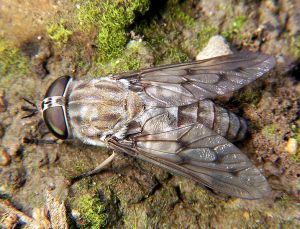
Thanks to Dennis Ray and Wikimedia Commons for this graphic image of a happy horsefly
Out walking at this time of year, some – but not all of us – have come to dread being near horses, cattle or still water. Because when we’re near any of them, we’re likely suddenly to feel a sharp piercing of our skin, as a horse fly eagerly pumps poison into our flesh whilst sucking our blood. It’s not easily brushed away. In the hours that follow, our skin swells, and for several nights, sleep will elude us as we scratch frantically at our fiery, itchy, tightly inflamed skin. These nasty creatures are pretty immune to any repellents, though a cocktail of essential oils such as lavender, melissa and tea-tree sometimes helps. Nor have I found any remedy soothing after the event.
So what are they for? It’s bad enough for us humans, but cattle and horses seem truly to suffer all summer long, as flies of all kinds cluster round their eyes and mouths, resisting all attempts to flick them away.
Here be horseflies….
…. and here be horse flies
Apparently they make a tasty snack for a swallow or a frog. I’m sorry, that’s no good. There are plenty of other insects about, so their having a place in the food chain simply isn’t justification enough.
And while we’re about it, what’s the point of ticks? And mosquitos? And another thing. Why do I get so many bites from all of the above while Malcolm, and so many of my other friends, are blissfully immune?




 From Pyrenees to Pennines
You must be logged in to post a comment.