We look forward to Wednesdays. It’s the day when our local shop gets in a delivery of fresh fish. And if you think that getting excited about fish is terminally sad, you haven’t met our friends who live in a hamlet in the Charente. The high spot of their week is the day the rubbish lorry comes.
Still, back to that fish. Generally, I keep things simple with such good quality fresh ingredients. But there are days when only spicy will do. This recipe by Atol Kochhar always hits the spot. Though you may prefer to use only half the chilli paste if you don’t want numbed lips for several hours….It really IS very hot.
Back in the UK, I’ve noticed that in the media, topics, like buses, come in threes. For instance, I’d flick through an article in the second section of the Guardian: maybe about female circumcision, education-other-than-at-school, or some other equally right-on Guardian topic. Two or three days later, listening to say Women’s Hour on Radio 4, they’d be discussing exactly the same subject, with exactly the same slant. Then the following week, maybe on Channel 4, it would appear yet again.
Recipe from Kalba's blog. Recommended.
And so it has been in the world of blogging. On April 24th, Kalba’s blog dropped into my in-box. I complained immediately. It was about asparagus, and I could have written it myself. Not all of it. I’ve never run a restaurant, and I’ve never lived in Norfolk. But like her, I do like green asparagus, the thinner the better: I don’t like the blanched, thick white spears favoured by the French and throughout most of mainland Europe.
Then on the 30th April, Bloggerboy, the writer of my other favourite blog, Welcome Visitor, pitched in with an account of the German love of asparagus. He even convinced me to have another go with the white stuff.
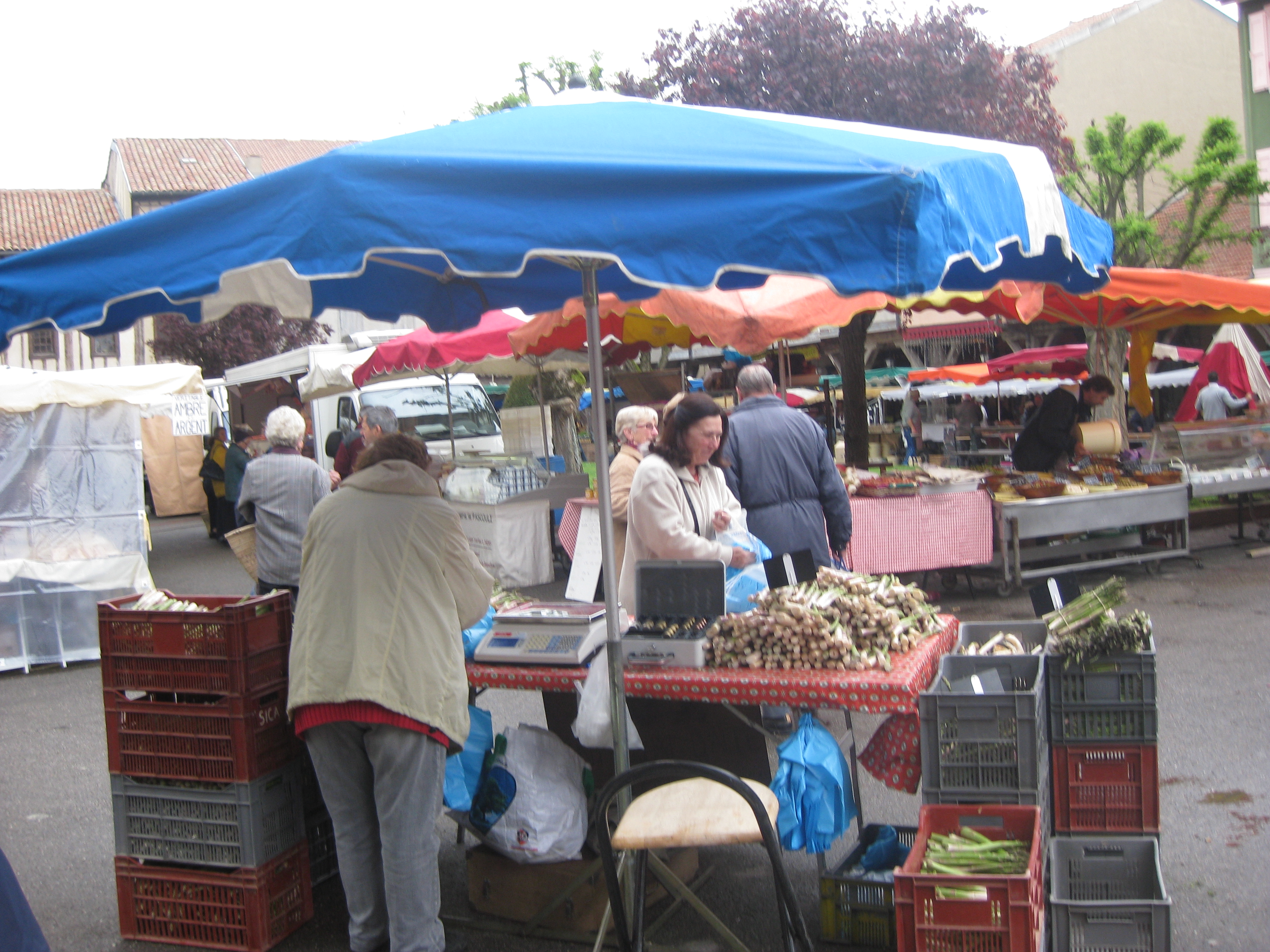
An asparagus stall at Mirepoix
So now it’s my turn to write an asparagus blog. In Mirepoix market yesterday morning there were quite a few asparagus stalls, and I picked the one where I could buy thin and thick green spears, and white too. ‘I’m not too keen on the white spears’, I confided to the stall holder, ‘but I’m sure I must be wrong when you all seem to like them so. How do you like to cook them?’. If I’d expected to have my hand wrung in gratitude at my acknowledgement of his expertise: if I’d expected him to call over his wife to share her culinary tips, I would have been disappointed. What I got was a Gallic shrug. He was mystified by the stupidity of my question. ‘Well, you could use them in tarts, or omelettes. Whatever you like really’. I realised our conversation was at an end.
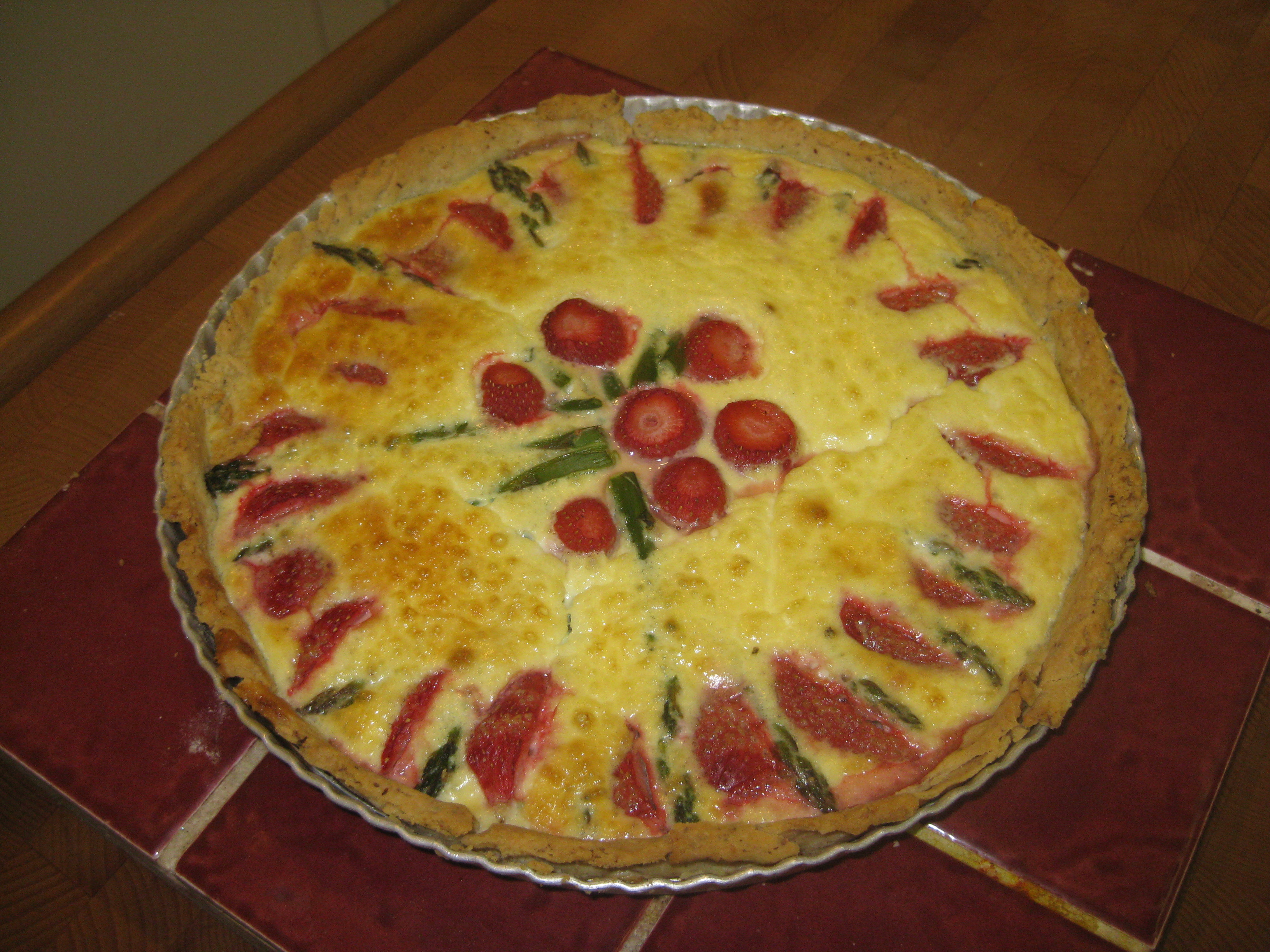
Asparagus & strawberry tart
Luckily, there are recipe books, and there are other blogs. I’ve just tried a suggestion from another blog I enjoy, ‘Chocolate and Zucchini’, which is available in English and French. Asparagus and strawberry tart. A very odd idea indeed, but it works. In fact it was memorably good.
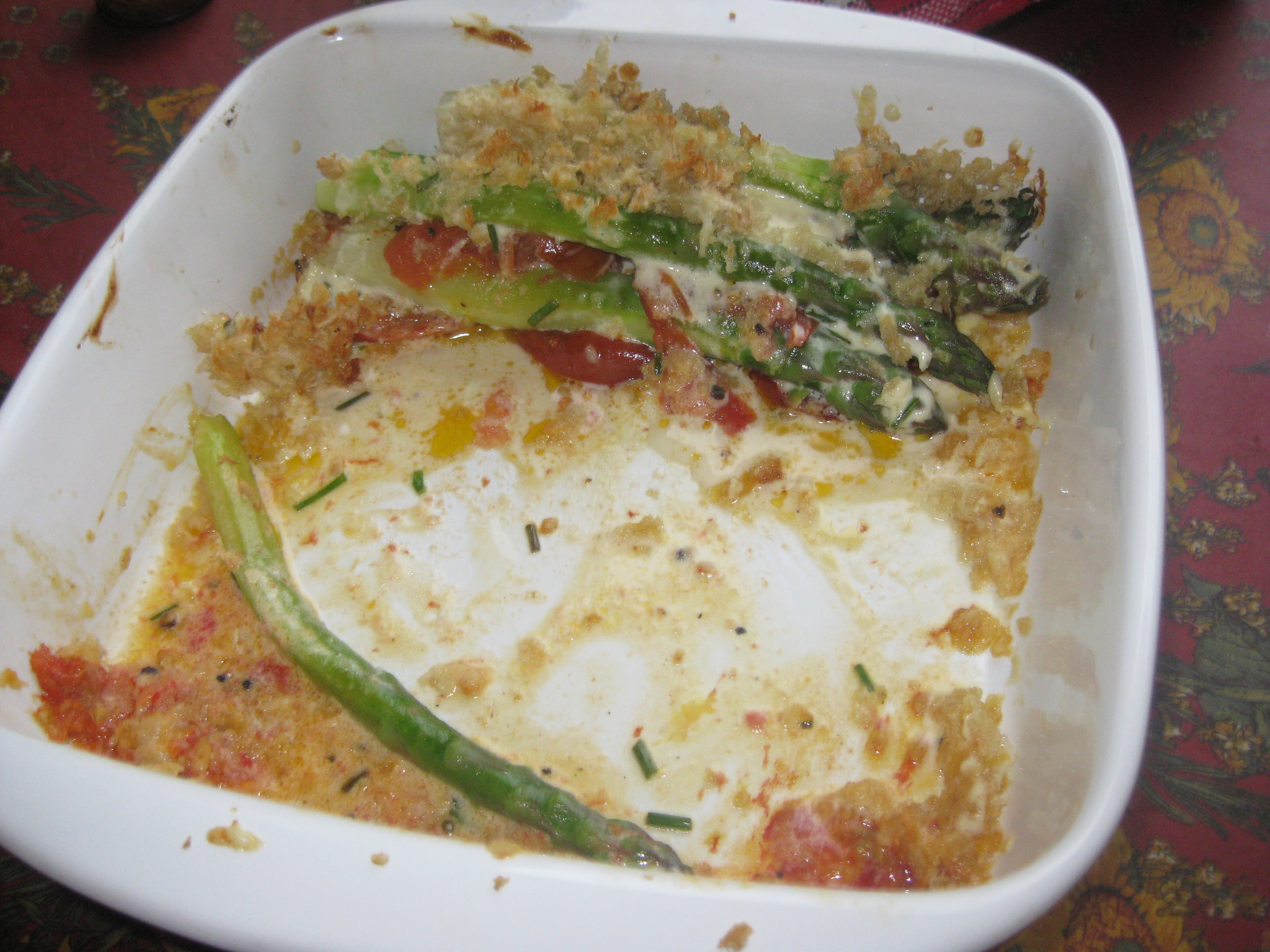
This is what we ate yesterday evening, from Denis Cotter’s wonderful vegetarian book, ‘Paradiso seasons’.
Gratin of Asparagus, Roasted Tomatoes and Gabriel Cheese with Chive and Mustard Cream.
Ingredients – for 2
4 -5 large tomatoes
Salt and pepper, to season
Drizzle of olive oil.
40g. fine breadcrumbs
40 g. Gabriel cheese, finely grated. I can’t get this, unsurprisingly, and maybe you can’t either. Settle for a hard, densely textured cheese.
1 sprig thyme
I tablespoon butter, melted
30 ml. vegetable stock
30 ml. white wine
150 ml. cream
Small bunch of chives, chopped
½ tsp. hot mustard
16 asparagus spears
Heat oven to 190 degrees. Cut tomatoes into 3-4 thick slices each. Place on oven trays lined with baking parchment, season and drizzle with olive oil. Roast until lightly browned and semi-dried – you may need to turn them once.
Mix the breadcrumbs with the thyme, the butter, and most of the cheese. Season.
Boil the stock and the wine until reduced by half. Add the cream and mustard, bring it back to the boil and simmer for 2 – 3 minutes until pouring consistency.
During this time, briefly cook the asparagus.
Heat a grill. On each plate, place 6 slices of tomato, lined up 3 x 2, and cover with 5 asparagus spears. Place a single line of tomatoes on top, then 3 more asparagus spears on top. Spoon a little mustard cream over the top, then finish with a generous sprinkling of the crumble. Cook under a hot grill for 2 – 3 minutes until the cream is bubbling, and the top is crisp and brown. Put remaining cream back on the stove, whisk in the rest of the cheese and chives, and pour round the finished gratins.
Just enough for a second helping?
Alternatively (and this is more my style), arrange the ingredients in an oven dish instead of individual plates, and bake for 10 minutes until the cream is bubbling and the top is crisped and brown.
This too is a really tasty simple dish, well worth adding to the regular asparagus repertoire.
Um, have you noticed, I still haven’t got round to thinking about those wretched white spears?
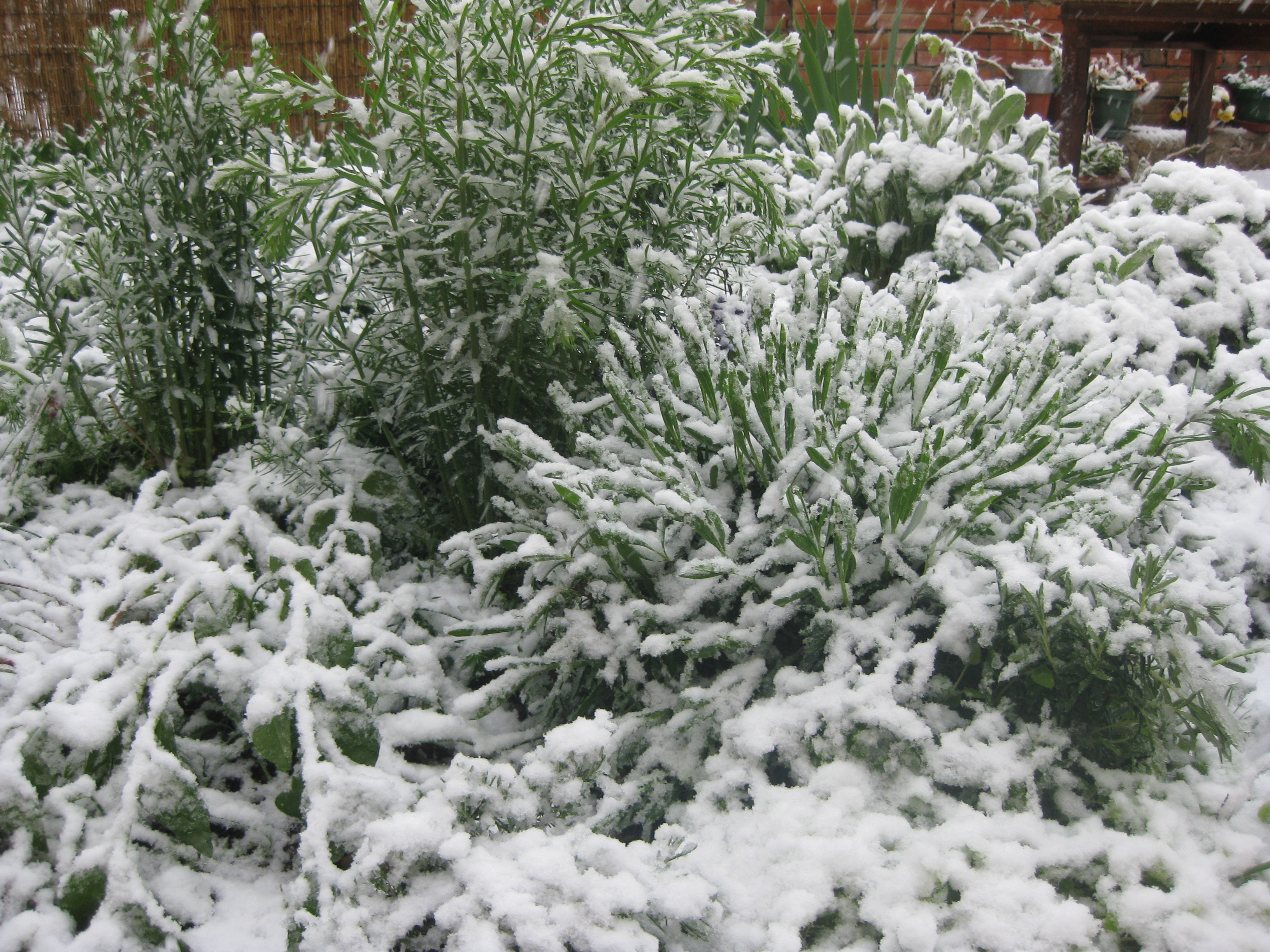
Nothing to do with asparagus. Our garden, south of France, 4th May 2010
Come to the Ariège on Easter Monday, and you won’t be too far from a community omelette. Communes and clubs all over the department seek out their biggest frying pan, get hold of dozens of eggs, sugar and rum, to make this sweet confection to round off, with any luck, the first barbecue of the season. Why? Nobody in our walking group could tell me, and Google wasn’t much help, but it does seem to be an ancient tradition dating back to….ooh, 1973 at least.
Anyway, the Rando del’Aubo have made this an annual event for some years now. For the last couple, it’s been rainy and cold. Not this year though. Down at the bottom of the page, you’ll find a few pictures of our walk between La Pène, an Audois hamlet on a delightful small lake, and Monthaut, which is a hill….higher up. It was a great way to work up an appetite.
Because the weather was warm, sunny and spring-like, we relaxed at the lakeside after our walk, chatting and enjoying those woodsmokey smells of a barbecue coming to life. Apéros first: Muscat, suze, pernod, whisky…all the usual French tipples, with nibbles to stem our hunger. Then grilled pork, grilled Toulouse sausage, bread (and wine of course), Coulommiers cheese, vanilla or chocolate pudding. And then we still had to find room for the all-important omelette.
Since the beginning of time, it’s been Marie-Therèse’s ‘job’ (good French word, that) to make the omelette, and of course it all ended in noisy recriminations because there were too many cooks all muscling in, breaking eggs, beating eggs, heating the pan, greasing the pan, measuring the rum. Half the raw egg mixture tipped out onto the grass, and Etienne and Danielle dashed off to every farm they could find to buy another….. 4 dozen.
Finally, it was done. Really, this omelette is scrambled egg with lots of sugar chucked in at the end, and flambéed with rum. Once a year is quite enough.
It wasn’t the end of the party though. Oh no. We couldn’t go before downing glasses of Blanquette de Limoux, an Alpine eau-de-vie, then cups of coffee (with madeleines, in case we were still hungry). And as a final touch, Easter eggs.
We came away suntanned and rather full, at the end of an Easter Monday that was one of the first really hot and sunny days of the year. A taste of things to come?
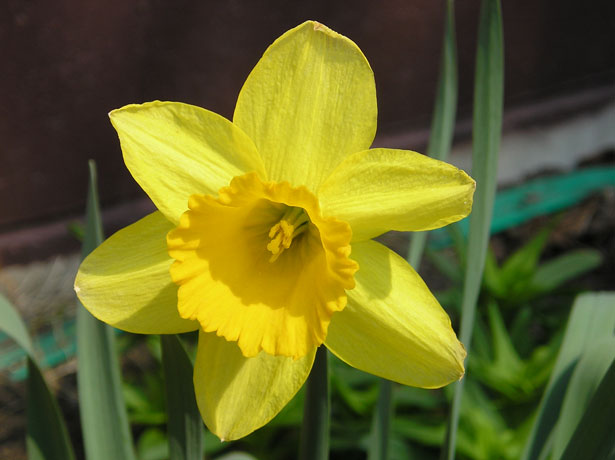
There are two things I especially love about early spring. Daffodils. Purple sprouting broccoli. The French don’t really do either.
Well, that’s not fair. In the woods near here, in a few weeks, there’ll be swathes of delicate, rather pale and lovely daffodils blooming. At weekends, people will go and pick enormous basketsful of them. They’ll take them home and stick the flowers in vases, where they’ll last only a day or two before wilting in the indoor heat. But the civic displays which for me are one of the glories of the UK simply hardly exist here. No dual carriageways are planted with unreasonable quantities of brilliant yellow daffs announcing to every passing motorist ‘Spring is here!’ There are no newspaper headlines ‘Daffodils on the Stray’, featuring a couple of four year olds gambolling among the flowers. No florists or supermarkets here have buckets of blooms ‘3 bunches for £1’. I probably won’t buy any here if I can find them, as they’ll already be open and the joy of watching them unfurl won’t be an option.
Purple sprouting broccoli’s even more unknown. I haven’t even found an exact translation. Like other English here, if I want to eat it, I have to grow it myself, with seed brought over from England. For 9 months of the year, the large ungainly plants occupy more than their fair share of the vegetable plot, and really, half the time I wonder whether it’s worth it. Well, it is. Today, I picked the very first handful of tightly closed purple heads, enclosed in a collar of dark frilly leaves. And now I know that there’ll be enough and to spare for several weeks to come.
Such a special vegetable deserves to be more than a bit part, one of two veg. playing second fiddle to a plate of meat. This is the meal we cooked this evening, thanks to Nigel Slater and his newest book ‘Tender’ (Read it, even if you don’t cook much. It’s as good as a bedtime story, though it WILL make you greedily hungry)
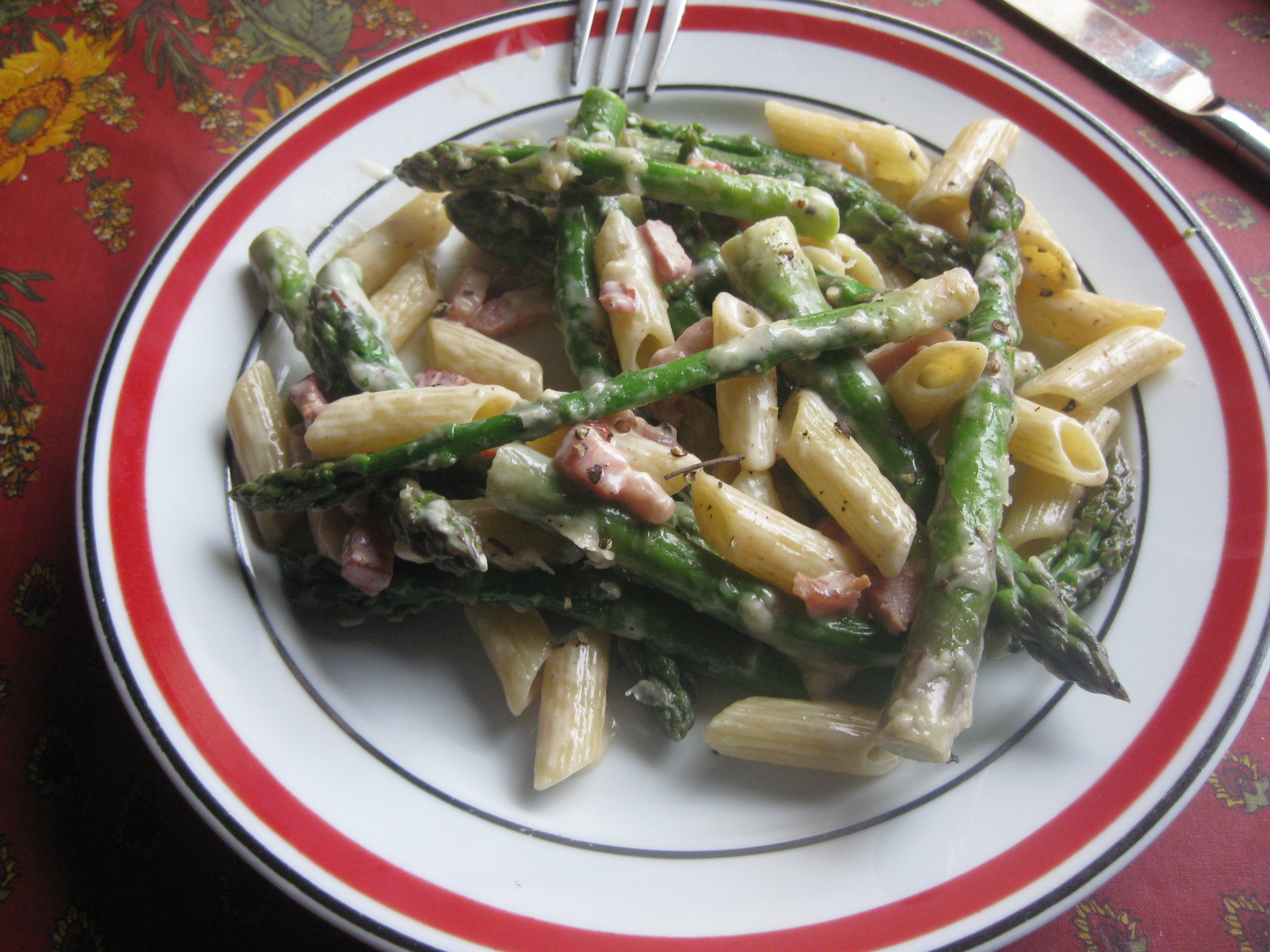
Pasta with Sprouting Broccoli & Cream
250g. sprouting broccoli
250 g. orechiette or fusilli
30g. butter
2 cloves garlic, thinly sliced
4 chopped anchovy fillets
250 g. crème fraîche
170 g. crumbled gorgonzola (well, we used Roquefort – you would round here)
Put 2 pans of boiling salted water on the stove. Drop the pasta into one, and the trimmed broccoli into the other. As soon as the broccoli’s tender – 3 or 4 minutes- drain it, wipe the pan, and return it to the heat with the butter, garlic and anchovies. Let them cook slowly for a minute or two before adding the crème fraîche and cheese. Bring to the boil and turn down the heat. Add the broccoli, season with black pepper, and then add the drained pasta.
Cheap, quick, delicious, and a real celebration of early spring
I’m not a big fan of Christmas, but ever since I was a very small girl, I’ve loved cooking for Christmas – cakes, puddings and mincemeat: those things that have to be done well ahead, and squirreled away in some cool dark spot to mature and develop complex sweet rich flavours.
First there’s the shopping and preparation. All the vine fruits in their cellophane packages; bright crystallised cherries; whole candied peel with crunchy sugary crusts; packets of ivory coloured almonds, and smaller quantities of other fruits to add interest – warming crystallised ginger, emerald green angelica, pale rounds of candied pineapple. Spices too – whole nutmegs and cloves, powdered cinnamon, allspice, mace and mixed spice. Fresh butter, lemons, eggs and flour. Make sure that there’s enough dark and light muscovado sugar in the house. Line the cake tins and grease the pudding basins. Hunt out clean jars for mincemeat.
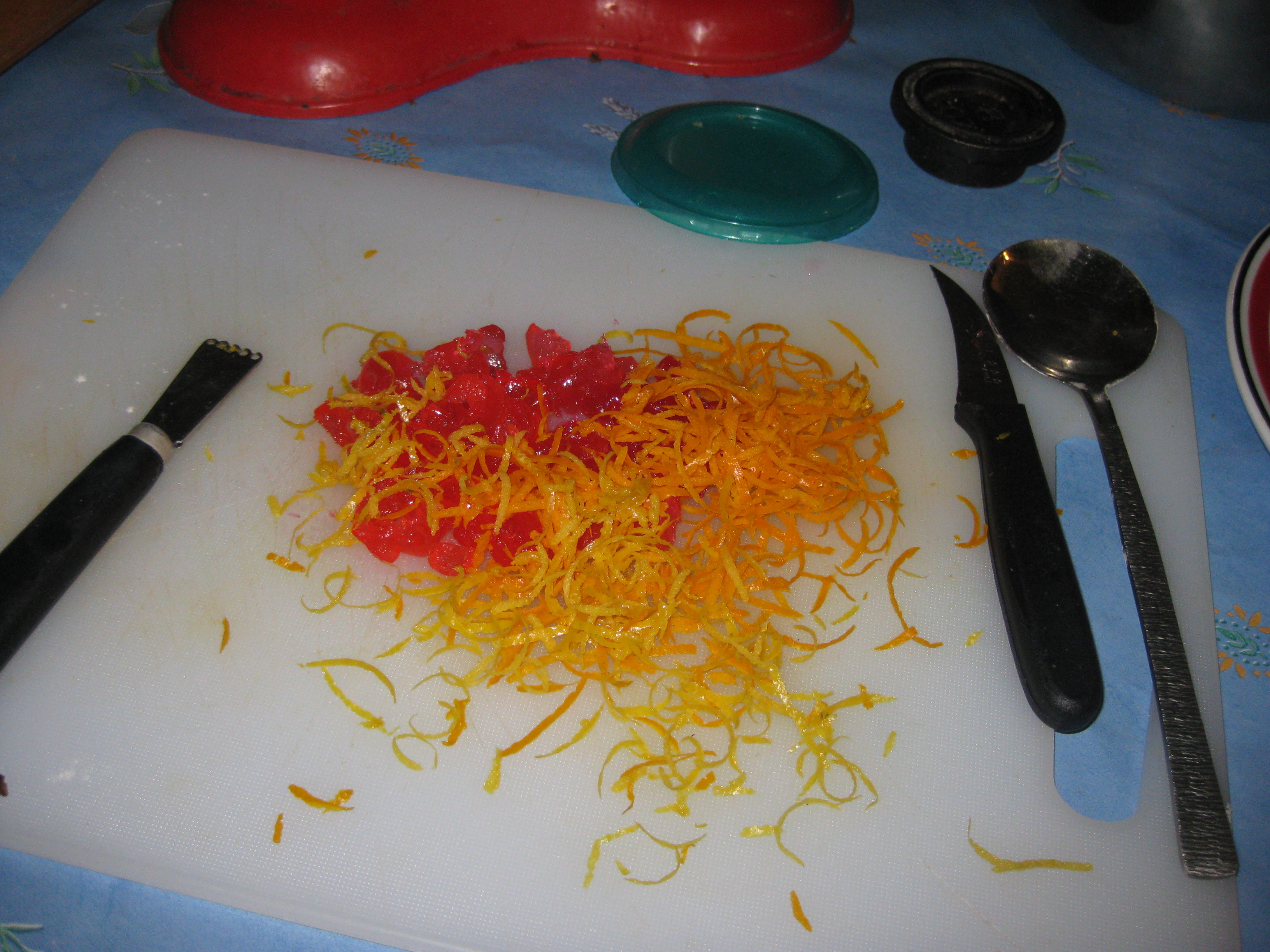
Cherries, lemon and orange zest ready for action
This year, I’ve rediscovered the pleasure in all this Christmas cooking by seeing it through the eyes of those French friends who’ve come and shared the job of making all these Christmas treats.
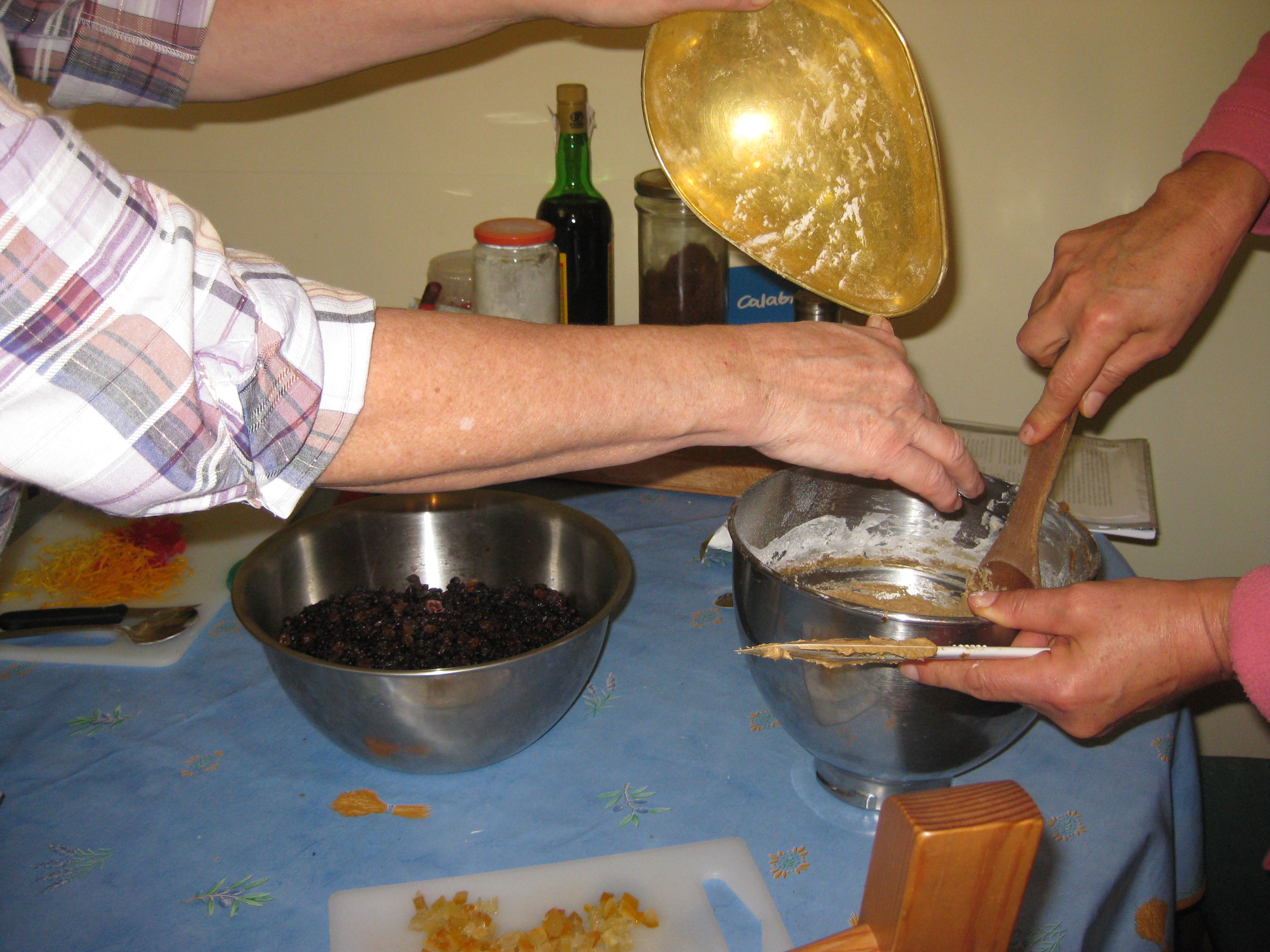
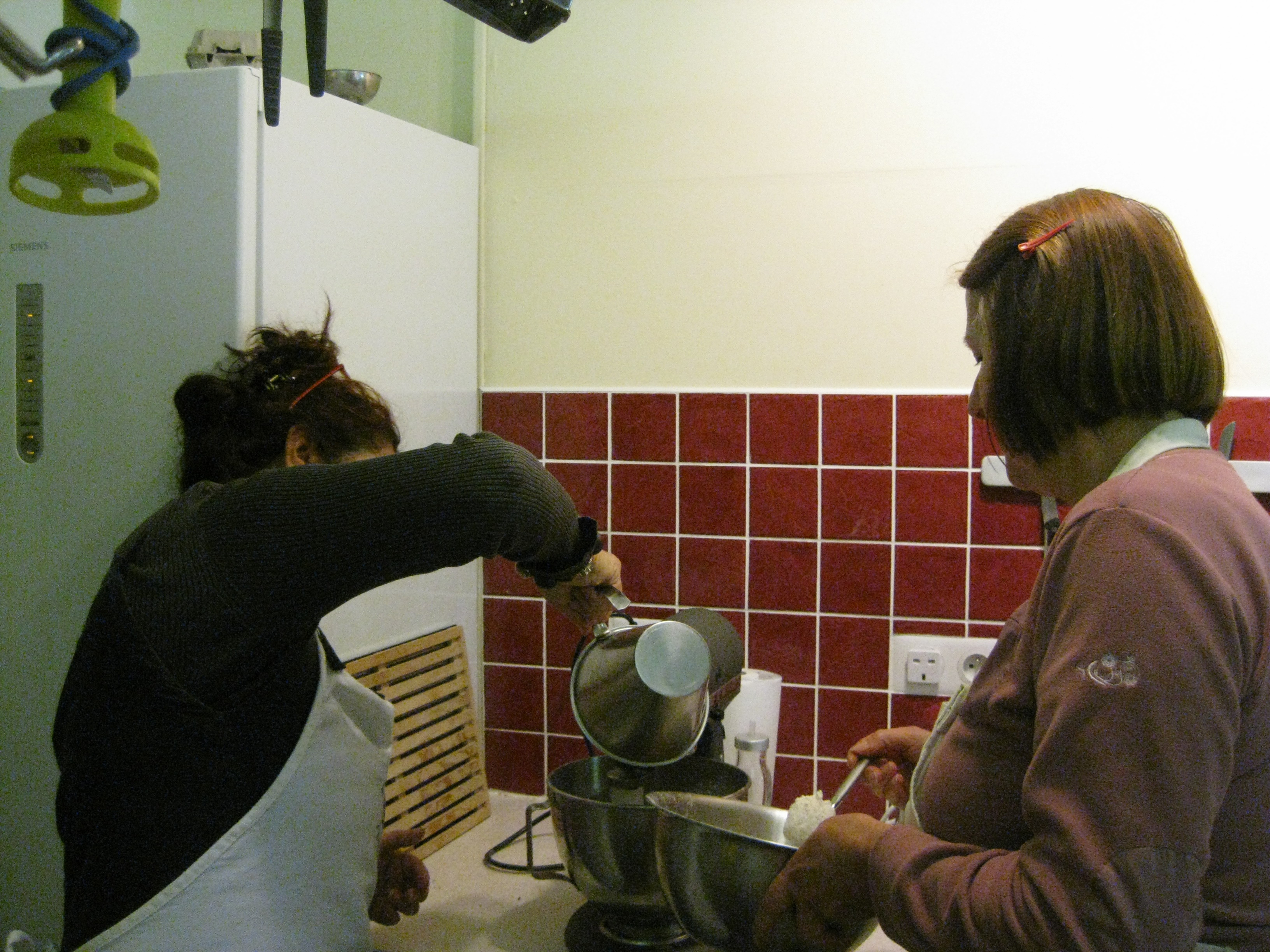
Sitting round the kitchen table with our pinnies on, we discussed the less familiar ingredients. Suet, muscovado sugar, treacle aren’t unknown here, but they’re not on every kitchen shelf. Cakes and puddings that need to be made well ahead, and fed with spoonsful of brandy in the weeks before Christmas – now that’s very different. I made my friends weigh everything out in pounds and ounces too – well, it’s what I do, and here are the pictures of how we all got on.
Many hands make light work?Brigitte and Léonce busily mixing
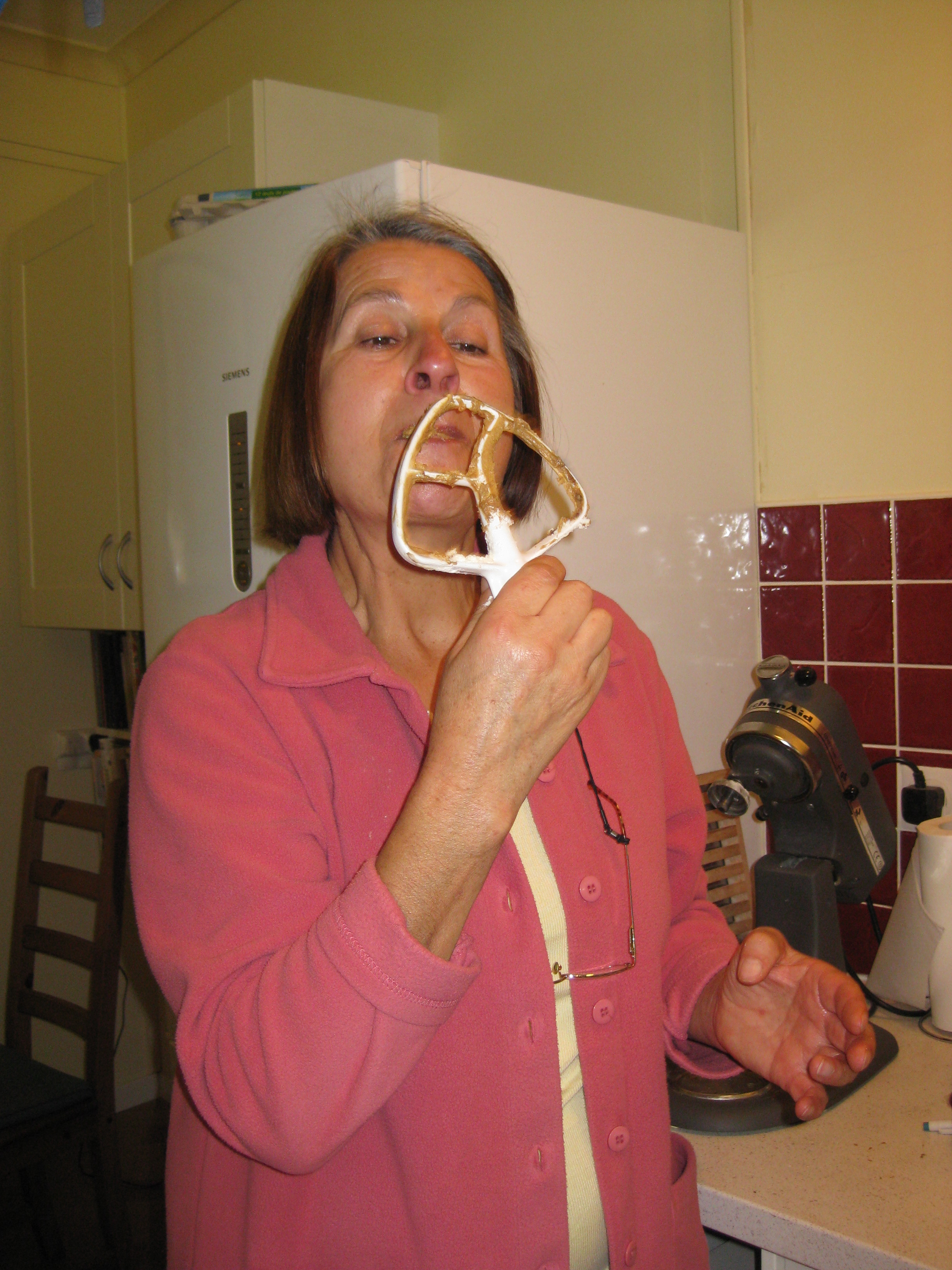
Léonce enjoys the best bit
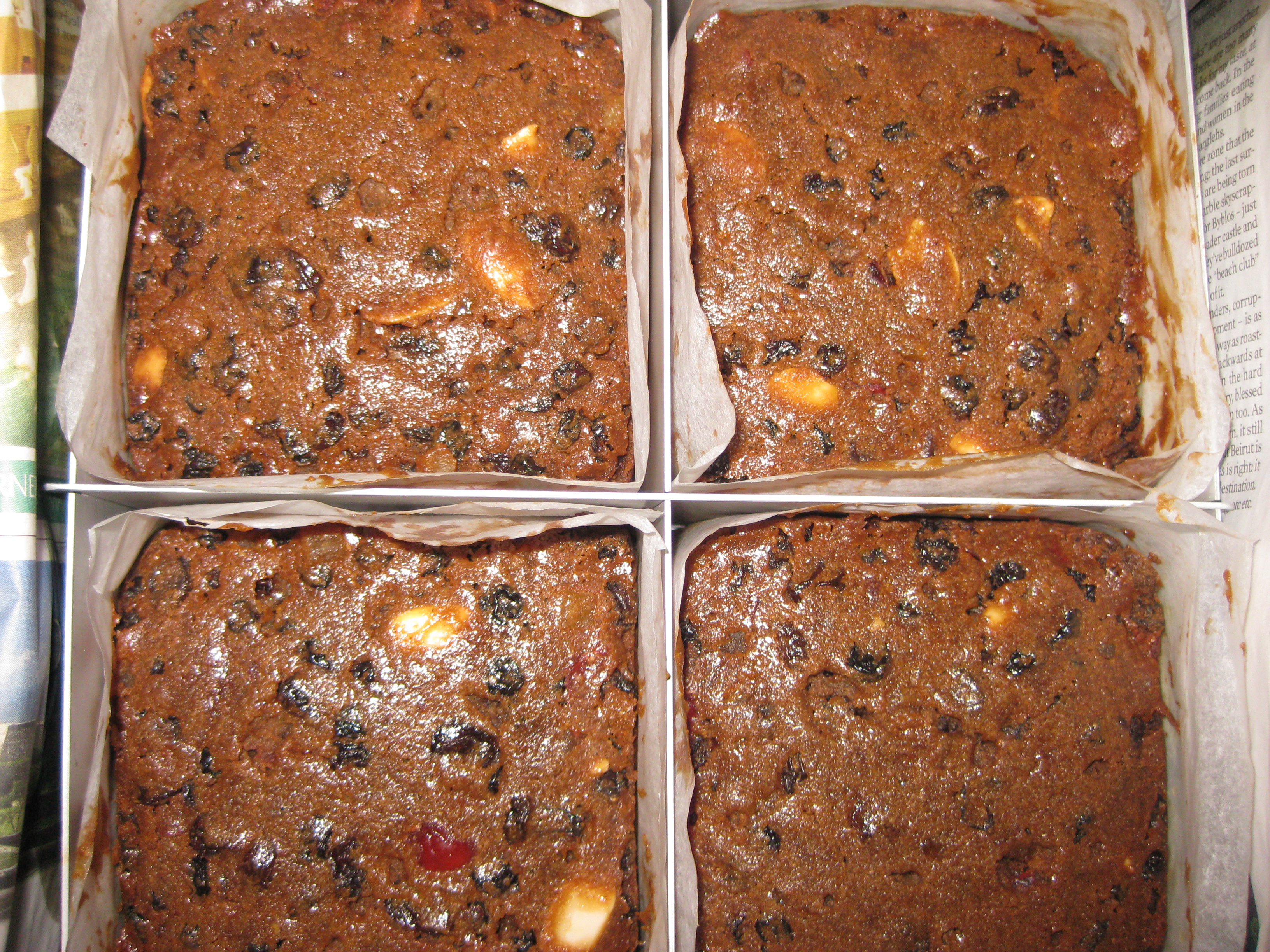
Sadly, they weren’t any longer in the house when the cakes, cooking at low temperatures over several hours, started to give off their warming Christmassy aromas. Which is a pity, because it’s the best bit of all.
Baked and ready to be fed with spoonsful of brandy before Christmas
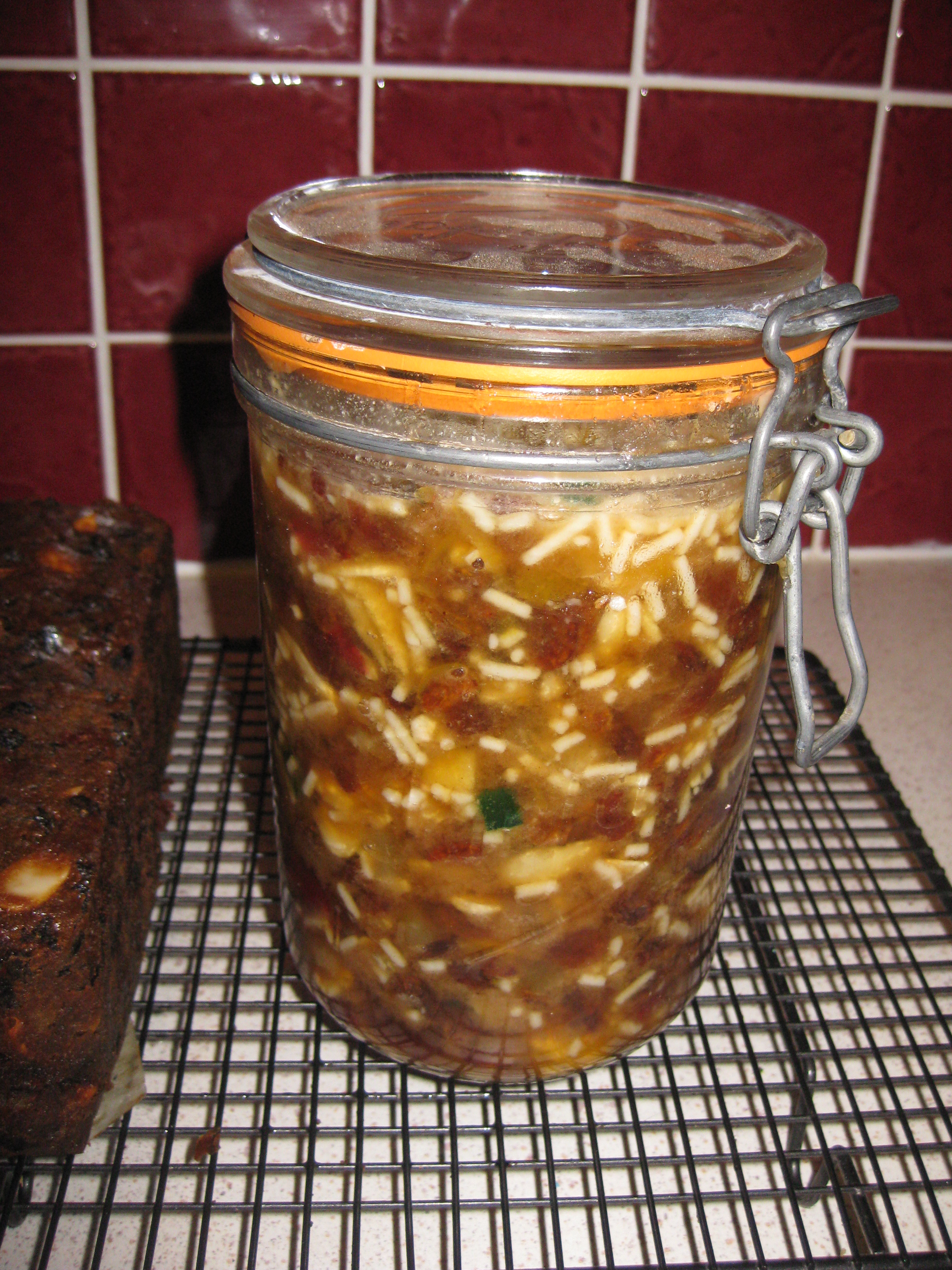
This is one of the mincemeats we made. It’s one my mother taught me, and our favourite, with its bright lemon flavour.
Lemon mincemeat
Ingredients
6 large lemons
450g (1 lb.) sultanas
¼ pint brandy
225 g (8 oz.) mixed crystallised fruits – I always use crystallised lemons and oranges, perhaps limes too (all bought in large pieces and hand cut), and often cherries, ginger, pineapple, angelica – but it’s up to you.
75 g (2oz.) blanched almonds
800g (1 ½ lb.) golden caster sugar
225g (8oz.) suet
½ level tsp. each ground mace, cloves, nutmeg
Method
Peel the lemons extremely thinly, so that you have the zest, rather than the pith.
Place the lemon peels in pan & cover with cold water, bring to boil.
Drain, re-cover with cold water, & repeat twice more.
Halve & squeeze juice from lemons.
Reserve juice.
Chop blanched lemon peel finely, and mix with the other finely chopped fruits.
Mix with sugar, suet, brandy.
And mince pies in our house always go down best when they’re made with the recipe my sister-in-law Fenella shared with me.
Pastry for mince pies
Ingredients
230 g (8 oz.) plain flour
40 g (1 ½ oz.) ground almonds
85 g. (3 oz.) icing sugar
170 g. (6 oz.) butter
1 medium egg yolk (you might need 2).
Method
Sift the flour, almonds and icing sugar into a warmed bowl, and rub in the butter. Stir in the egg yolk and work gently to form a soft dough. Knead lightly, cover and chill for 30 minutes.
You’ll need 230 – 340 g (8 – 12 oz.) mincemeat to make this pastry into about 12 tarts. Bake at Gas mark 4, 180 degrees C. for 15 – 20 minutes




 From Pyrenees to Pennines
You must be logged in to post a comment.