Les demoiselles de Caraybat, daffodils and gentians

Once upon a time long ago in Caraybat, when times were hard, the men of this small village had to look far afield for work.  And they went to Spain, for the hay-making season.  Hawkers came to the village, and peddlers.  They found a village with no men.  They took advantage.  So did the women.

When the hay-making season was over, the men returned, and the women spied them returning over the distant mountains.  Suddenly ashamed and frightened, they fled to the hills.  God, in vengeful and Old Testament mood, was displeased.  As the women reached the summit, he turned each one of them to stone.  And there they are to this day, les demoiselles de Caraybat, a petrified reminder of a summer of sin.

A few of those demoiselles hide themselves behind the woodland trees

We remembered this legend yesterday when I took our Laroquais walking friends to Caraybat and the dolomies to discover those daffodils I’d been shown on Thursday.  I was quite chuffed that not a single one of them had previously known this special spot, and we had a pleasant hour up on the rocks, picnicking and enjoying the last days of the daffodil season.

We followed the walk I’d learnt about on Thursday, and then we finished our day by going to the plateau above Roquefixade to see the gentians there.

Gentians above Roquefixade

Sadly, it was by then rather cold and windy, and most of the gentians had sensibly folded their indigo skirts about their faces and tucked themselves away to wait for a sunny day.  We’ll wait too.  And when the sun comes out properly, we’ll be back.

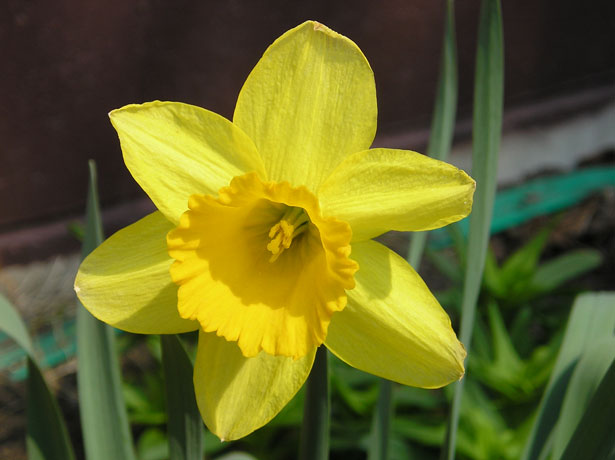
Daffodil time

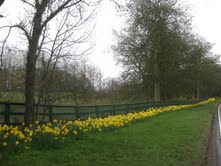
On the road from Ripon to Harrogate

I had a very pressing reason for wanting to come back to England for a few weeks.  I couldn’t wait for April, much less May.  The March heat wave made me worry that already I might be too late: I needed to see daffodils.

Of course the French have daffodils in their gardens too. Well, some people do.  You can even find them, delicate and lemon-hued up in the woods.  But nothing to compare with our English exuberance.

Here, regiments of daffodils march down the edges of inner-city dual carriageways.  Swathes of them along the verges announce the entrance to almost every town.  Shopping centres have great tubs full.  Gardens, whether tiny gravelled spaces in front of town terraces, cottage style plots, or more extensive lawned affairs, all boast generous clumps of brilliant yellow trumpets swaying in the breeze.

From the top of the bus passing through Ripley

Nothing else makes me so aware that winter’s on the way out.  Not the blossom slowly unfurling on the trees, nor the spears of green thrusting through the soil and moss on every country walk, and in every garden.  Of course I love these too.  But for me, nothing but those bright assertive confident flowers can state quite so definitely – even defiantly – ‘Spring is here!’

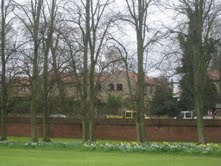
The Old College, Ripon

The Broccoli Blog

There are two things I especially love about early spring.  Daffodils.  Purple sprouting broccoli.  The French don’t really do either.

Well, that’s not fair.  In the woods near here, in a few weeks, there’ll be swathes of delicate, rather pale and lovely daffodils blooming.  At weekends, people will go and pick enormous basketsful of them.  They’ll take them home and stick the flowers in vases, where they’ll last only a day or two before wilting in the indoor heat.  But the civic displays which for me are one of the glories of the UK simply hardly exist here.  No dual carriageways are planted with unreasonable quantities of brilliant yellow daffs announcing to every passing motorist ‘Spring is here!’  There are no newspaper headlines ‘Daffodils on the Stray’, featuring a couple of four year olds gambolling among the flowers.  No florists or supermarkets here have buckets of blooms ‘3 bunches for £1’.  I probably won’t buy any here if I can find them, as they’ll already be open and the joy of watching them unfurl won’t be an option.

Purple sprouting broccoli’s even more unknown.  I haven’t even found an exact translation.  Like other English here, if I want to eat it, I have to grow it myself, with seed brought over from England. For 9 months of the year, the large ungainly plants occupy more than their fair share of the vegetable plot, and really, half the time I wonder whether it’s worth it.  Well,  it is.  Today, I picked the very first handful of tightly closed purple heads, enclosed in a collar of dark frilly leaves.  And now I know that there’ll be enough and to spare for several weeks to come.

Such a special vegetable deserves to be more than a bit part, one of two veg. playing second fiddle to a plate of meat. This is the meal we cooked this evening, thanks to Nigel Slater and his newest book ‘Tender’ (Read it, even if you don’t cook much.  It’s as good as a bedtime story, though it WILL make you greedily hungry)

Pasta with Sprouting Broccoli & Cream

250g. sprouting broccoli

250 g. orechiette or fusilli

30g. butter

2 cloves garlic, thinly sliced

4 chopped anchovy fillets

250 g. crème fraîche

170 g. crumbled gorgonzola (well, we used Roquefort – you would round here)

Put 2 pans of boiling salted water on the stove.  Drop the pasta into one, and the trimmed broccoli into the other.  As soon as the broccoli’s tender – 3 or 4 minutes- drain it, wipe the pan, and return it to the heat with the butter, garlic and anchovies.  Let them cook slowly for a minute or two before adding the crème fraîche and cheese.  Bring to the boil and turn down the heat.  Add the broccoli, season with black pepper, and then add the drained pasta.

Cheap, quick, delicious, and a real celebration of early spring