The comb

There’s an industry that’s had something of a walk-on part in this part of the Ariège for well over 300 years.  Against all the odds, it’s somehow clinging on.  It’s comb-making.  Specifically, combs made from horn.

Today, we went to find out more, courtesy of a visit organised by  ‘Pays d’art et d’histoire des Pyrénées Cathares’.  There are two ‘peignes en corne’ factories within just a very few miles of each other, and of our house too.  Each used to be the size of a hamlet, with separate buildings for all the different parts of the fabrication process.  Now, both firms conduct operations each from a single building.  We went to ‘Azema-Bigou’, in Campredon.
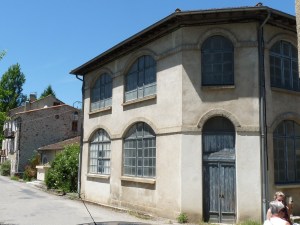
Azema-Bigou factory
Azema-Bigou factory

I’d always imagined the industry had developed as part of a waste-not-want-not mentality, using the horns from local sheep and cattle.  Not at all.

Our part of France has always been rather anti-establishment, in religion as in much else.  In the 16th and 17th centuries, when much of Europe was in religious turmoil, Protestants locally were persecuted.  Many fled, some to Switzerland.  And there they learnt a new skill, unknown to them before: comb making.

Following the 1598 Edict of Nantes, assuring greater religious freedom, many Protestants returned to their homes here, and wanted to continue the trade they’d learnt in exile.  But did they use local materials?  They did not.  Local cattle worked hard , ploughing and generally earning their keep.  They ended up with chipped, worn horns.  Over the years, the comb-makers developed markets with ports such as le Havre, Marseilles, London and Liverpool, and imported good quality horn fom Hungary, Turkey, and by the 19th century, Argentina.

Horns awaiting transformation into combs

Although in the early days, the trade was conducted on a domestic scale, with each worker capable of producing 10-15 combs per day, perhaps after a day in the fields, by the 1850’s the process was industrialised – with machinery imported from England.  Men women and children were all employed.  Men earned 2 francs a day, women 1.25, and children 1….. .  No wonder women in particular preferred to be paid for piece work: that way they too might get 2 francs daily.  The busy industry grew and thrived until more or less the second world war when plastic combs started to take over.  The factory of Azema-Bigou, in the hands of the same family for 5 generations, employs three people these days, though in its hey-day there were 180.

But these workers will tell you, as will many local people , that it’s well worth investing in a horn comb.  Like your hair, the comb is rich in keratin, and will treat your hair gently without generating static electricity.  Several of my friends have had the same comb since childhood and would never be happy to replace it with some cheap piece of plastic.
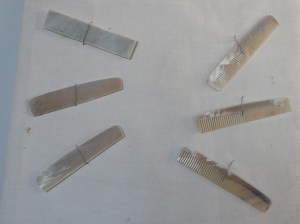
A selection of combs.

Apparently horn has to be soaked for up to a year before it becomes useable, and then it is forced through heavy rollers to make useable sheets.  There are some 15 different processes involved in producing the finished comb.  No wonder it costs rather more than its plastic poor relation.

I can’t tell you very much more.  Unusually, this event was not up to snuff. We were shown no artefacts, heard no tales from former workers in the industry.  So I don’t know what it felt like to work 11 hours a day in an atmosphere where horn dust hung heavy in the air cloaking  lungs and coating every surface in thick grey cushions. I don’t really understand what’s involved in transforming a rough, thick horn into a polished and handsome comb.   But I do know that  the waste and dust swirling round the factory got – and gets – used. The tiny fragments of waste used to be made into filaments in a factory here in Laroque, mixed with horn dust and sold as a fertiliser for vines.  Even now, you can buy bags of horn-waste fertiliser for your garden from the two comb factories.  Waste-not-want-not gets its moment after all.

The house in Laroque, 10 years on

I was going to post some photos of the bathroom, now it’s done.  But I seem to be unable to take good shots – not only of the bathroom, but of any room in the house.  Whether it’s the gloomy weather, or the fact that I have taken on the local failure to offer convincing visual ‘marketing’ of any house advertised courtesy of an estate agent I don’t know.  The fact remains I’m not pleased with a single shot.

Inadequate as they are, however, I’ll post a few, together with a selection of photos taken in the very early days of our ownership.  We bought this house exactly 10 years ago, though we’ve lived here only six.  When you look at the ‘before’ shots, you’ll wonder why we ever bought it.

It was, quite simply, a ‘coup de cœur’.  We loved the old woodwork, the spacious rooms, and the way the house had evolved, higgledy-piggledy, over the years as the needs of its owners changed.

And you may understand why getting to the ‘after’ has taken so very long.  We do have more photos of the really bad old days.  I’ll  dig them out and post them one day soon.  They may horrify you.

But back to the  bathroom again.  It’s maybe 5 years since we enlisted the help of a local plumber to get the ancient cast-iron bath out.  As he chipped and broke tiling in a whole lot of places besides the bathroom, he’s not been asked back.  Getting off tiling that had been cemented to the walls was a whole other saga.  So was straightening the walls.  So was dealing with the fact that the ancient steel pipework was deeply – deeply – embedded in inches of concrete that several friends and two different sets of plumbers, all with heavy-duty drills, failed to excavate.  Continuing to use it was not an option, as it had got lined with decades of detritus, and emptying so much as a washbasin could take an hour or more.  Eventually, we had new piping constructed alongside, and had to box it in.

One way or another, as real life got in the way, there were long pauses between each phase of bathroom construction, and it’s only today we can finally declare it officially open (though in the manner of all such official openings, we’ve actually been using it for some weeks, slightly unfinished).

In among we: refurbished 4 bedrooms and the living room; made a study from a lumber room with rough-plastered walls that had never been used as living space; made a shower room from a nasty corridor housing a museum-piece toilet; refurbished a kitchen; arted up the atelier; knocked down storage huts in the yard and created a ‘relaxing outdoor living environment’, as a certain Harrogate estate agent prefers to call a garden; made the roof terrace another pleasant place to idle away an afternoon or evening; made two storage rooms from the old shop cold rooms; smartened up the garage: re-worked the downstairs washroom – all with or without the great help of friends, neighbours, professionals.

Time for a rest then?  Nope.  Games room next, we think.  Unless it’s time really to get to grips with the atelier.

A walk gone wrong

This slideshow requires JavaScript.

Yesterday was gorgeous.  Hot and sunny until long into the evening.  We ate outside and stayed on the roof terrace till 10 o’clock.  Today seemed to promise more of the same.  We should know better.  This year, getting even two days on the trot where the weather is hot and clear all day is asking a bit much.

And so it proved.  Today, our walking group met to share lifts to where our walk was to begin.  We set off in the sunshine, watching our in-car thermometers climb steadily to 27 degrees as we drove ever upwards, beyond Villeneuve d’Olmes, beyond Montferrier, up a road which became narrower and less well maintained, to Frémis, a tiny hamlet.  We parked there, in a flower-spangled meadow offered by a local farmer.  We peeled off our fleeces, applied suncream and set off towards the peak, Coulobre. Sometimes the upward-going was tough and quite a scramble, but we were encouraged by looking across to the still snow-capped tops, and the thought that we’d be having our picnic at the top there,  the Ariège spread below us with views, views and more views.  We met a herd of black Mérens horses sheltering in a copse from the already-hot sun.   A donkey befriended us.  And still we climbed.

Towards midday, walking through the forest, we suddenly realised things were changing.  Didn’t it suddenly feel cooler?  And weren’t those little scraps of mist swirling round those peaks?  Apparently yes.  The mist descended.  The ‘cool’ became ‘chilly’.  With 20 minutes to go to arrive at our lunch spot, Micheline, who had developed a gammy knee, announced she could go no further.  It didn’t take much for us to decide that it was not only friendly to remain with her and have our lunch, it made sense.  The mist was swirling around us, the views up there wouldn’t be up to much, and it was obvious that rain or worse was on its way.

We found logs to sit on, got our fleeces out again, ate our lunch with little ceremony, and scuttled down.  The climb up had taken nearly three hours. Scurrying down took not much more than an hour.  And as we reached Frémis, the rain started.  It’s not stopped since.  And those in-car thermometers on the way home? 15 degrees.

June is the new May: a springtime nosegay

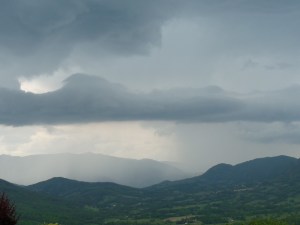
We’ve all had it.  Months and months of horrible weather.  Especially rain.  Even now, when things are slowly picking up here, we expect to have all kinds of weather within a single day.  Beautifully hot skin-warming sun may be followed by lashing winds, summer showers, or deluging  heavy downpours.  Glance up at the sky, and it will be in turn a cloudless azure, or bright blue patched with blowsy puffs of white cumulus.  Or it may be grey, or even black.  If the clouds aren’t coursing lazily across the heavens, they may be tearing across the sky so swiftly that they’ll have disappeared from view if you glance away only for a few moments.  The rivers are still full to overflowing.

June sky from Roquefixade

Farmers are in a mess.  They’ve only just begun to cut their hay, when normally they’d be onto their second harvest.  Seeds have failed to germinate in the cold and wet.  Often they haven’t been planted at all in the sodden and waterlogged fields.  Preparations to take cattle and sheep up into the highland summer pastures have had to be postponed, with snow still on the ground at higher levels.

At last though, we walkers are once more getting out and about.  We choose our routes with care, because thick sticky mud has made some of our favourite walks unuseable.  Where we can walk though, spring has at last sprung. Familiar paths have become narrow passages edged by massed armies of knee-high grasses, shocking in their vibrant greenness.   And our favourite spring flowers that by now should be sun-shrivelled and long past their best romp across meadows and pastureland, and spread across their favourite sun-warmed stones.  Here are a few that we’ve enjoyed finding  in the last days and weeks.

UPDATE:  After she’d read this post, a kind friend, AnnA, wrote to a botanist friend of hers enlisting help in identifying the flowers I’ve shown.  Here’s some of what she said. Reading from the top, left to right:

2. Globulaire rampante – Globularia repens (Creeping Globularia)

3. Hélianthème – Helianthemum Alpestre (Alpine rock rose)

5.  Perhaps from the Linacée family.  She needs a photo of the leaves.  Watch this space

6.  Céphalanthère à longues feuilles – Cephalanthera longifolia (Sword-leaved Helleborine)

8. Oeillet – Dianthus – (Dianthus).  She needs more info. to help her be more precise.

She’s asked to see more of the leaves, and to be told as well where the flowers were found and at what altitude.  There’s such a lot to it.  I had no idea and am so grateful for all this help.

Fête at Laroque

Montaillou in the 21st century

‘Laroque d’Olmes, below Montaillou, was a small market town which produced cloth.  At the local fair, which in the fourteenth century was held on 16th June, local cloth was sold, together with wood, fish, sheep, pottery and blankets from the Couserans.’  That’s what Emmanuel Le Roy Ladurie says in ‘Montaillou’, his wonderful examination of Catharism in the Ariège village of Montaillou at the turn of the 14th century.

Laroque’s June fair had already been a long-established event by then, and over the years it’s evolved.  Our contemporaries in town remember when it was still a hugely important event in the agricultural calendar, something like the fair that’s still held every year in nearby Tarascon.  There were animals everywhere.  One area was given over to cattle, another to sheep and others to all the usual farmyard creatures.  And at night there was dancing.  Bands belted out dance music on both Place de la Cabanette, and Place de la Republique.  It was quite a party, both for the Laroquais and for villagers from miles around.

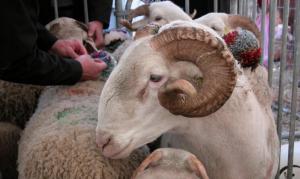
This is the kind of sheep we'd have had at Laroque Fête: our local Tarascon sheep. Photo courtesy of La Dépêche du Midi.
This is the kind of sheep we’d have had at Laroque Fête: our local Tarascon sheep. Photo courtesy of La Dépêche du Midi.

At some point in the fairly distant past, the Fête became associated not with 16th June, but with the Catholic festival of Corpus Christi.  So it’s still called Festo del Corpus, though there are no religious ceremonies.

We love the idea that this fair has an unbroken history going back nearly1000 years. If only we could love the fair itself.

No animals or shepherds now.  It all begins during the week beforehand.  Fairground caravans arrive and make the open ground near the river their home for the week.  In the car park just along from our back garden, municipal workmen clang and clatter all day long, erecting a stage and a marquee for the various performers who’ll be on duty for much of the weekend.  The locals look on, unimpressed.  For scores and scores of us, the weekend means three nights of little sleep as the bands on stage boom their way through a noisy repertoire lasting from early evening, when they start to limber up, to two or three o’clock next morning.  Wander round to watch the dancing on those nights, and you’ll not find many locals.  It’s mainly out-of-towners, and we’ve learnt not to trust them all.  Two years running, our window boxes at the front of our house were stolen: now we remove them for the duration.

We leave town for the Fête.  This year, we only went 7 miles to stay with friends, though often we’ll try to take a short holiday.  Popping back briefly at 11 o’clock on Saturday night, I found the town as busy as Oxford Street in the January Sales, and our bedroom windows vibrating in time to the boom of the bass notes thundering from the stage.  Some years though, there are only a few hardy types twirling around in time to the music.

During the day, there’s the fun fair, majorettes, bands.  But they say the fair’s expensive, and while most people enjoy a stroll round to people-watch and chat to friends, there’s little sense that this event is a focus for the community.

I wouldn’t like Laroque Fête to disappear.  But perhaps it’s time to take stock and look at how it can become again what it once was: a summer event for everyone in town and to a lesser extent the villages beyond.  It seems that too many people at the moment actively avoid it or at best are unenthusiastic and uninvolved. And that’s the way for an event that’s happened every year for many hundreds of years to wither and die: which would be sad.

The Château at Lagarde

Draw a square.  Now draw another one surrounding it, with a nice big border.  Now do it again.  Now draw a big rectangle alongside one of the sides, as wide as one of the sides of the square, and maybe 3 times as long.  There.  You’ve just given yourself a brief history of the Château de Lagarde.

We had a better history lesson, because we were there, in cold gusty conditions, being introduced to the site by Fabrice Chambon, as part of the series of events organised as part of this season’s Laissez-vous conter le Pays des Pyrenees Cathares.

Lagarde is a ruined castle, an imposing and dramatic addition to the skyline hereabouts.  We always assumed it was medieval, destroyed in one of the many wars that characterised that stormy period of history.

And certainly it was first constructed in the 11th century, by Ramire de Navarre, King of Navarre and Count of Barcelona.  During the crusades against the Cathars, it came into the possession of Simon de Montfort, who always gets a look in round here to any story from that time.  He gave it to his lieutenant, Guy de Lévis, and this is the family to whom it’s mainly belonged over the centuries.  They owned châteaux everywhere in the area:  Léran, Montségur, Terrefort – all within easy distance of Lagarde.  It was a fortress, a castle, and occupied that inner square you drew.

By the late 15th – 16th centuries, defensive castles were so last year.  Jean V de Lévis-Mirepoix had the money and the leisure to go travelling, and admired all those famous Châteaux of the Loire: Azay -le- Rideau, Chambord and so on.  He liked what he saw and had his own château remodelled with some of the features he had so admired, and windows piercing the original solid medieval masonry.  The finest feature may have been a splendid staircase with wide shallow steps curving upwards through the central tower: it was said that it was possible for horses to mount these stairs.  It was a fine Renaissance palace, and extended to fill that second square, because it included space to accommodate his artillery forces and a large dry moat.  Of course by the time the work was done, the style he’d copied had also become so last year.

By the time of Louis XIV, the château had become a fine palace.  The site had been considerably extended (to fill that third square!), and copied aspects of Versailles.  Think of Versailles, and it’s the formal gardens that come to mind, and the Hall of Mirrors.  That’s what Lagarde should bring to mind too.  But the vast and elegant formal gardens no longer exist: even the land on which they were constructed is no longer part of the site.  It had a Hall of Mirrors too, which though inevitably on a smaller scale than that at Versailles, was said to be magnificent.

Then came the French Revolution.  Lagarde escaped destruction, despite an order to knock it down in April 1794.  But its glory days were over.  It became an arsenal, a stables, an immense barn, a munitions factory and a bit of a ruin, until in 1805 it became once more the property of the Lévis-Mirepoix family.  These days a variety of charitable and national associations are working to restore the site and make it, at the least safe to visit, and at best a place where its glorious past will be explored and celebrated.

The photos I took are all of the exterior of the site, as it’s too dangerous still to penetrate the inner courtyards, much less the interior of the building.  Nor can I show you pictures of the château in its Renaissance glory days, nor of its time as a palace with formal gardens.

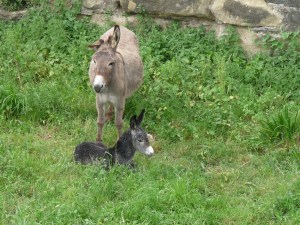
Sadly, because of the poor weather , the pictures I took yesterday weren’t up to much, so I’m mainly using some others I took recently. I can show you the ruins.  And I can show you the castle’s lawnmowers: an inquisitive and friendly herd of donkeys with their charming foals.

Mother-and-baby down in the dry moat.

UPDATE:  May 2nd 2013

Château de Lagarde
Château de Lagarde

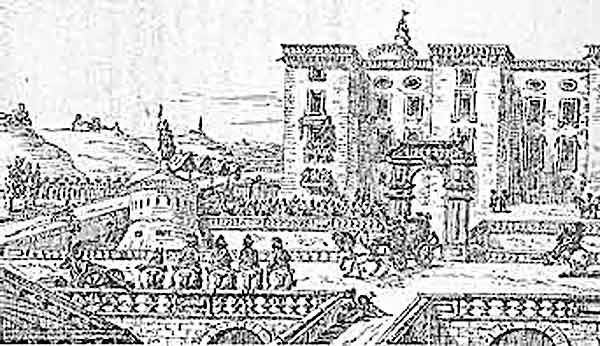
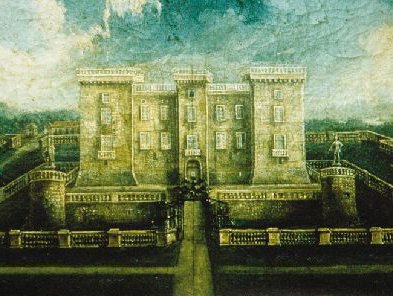
Thanks to local historian Martine Rouche, I can now show you some images of Lagarde as it was in its final most glorious days before the Revolution.

Look at the statues in the colour picture . One was taken to Mirepoix during the Revolution and  ” turned ” into Goddess Reason. Then it disappeared. Never to return. A few years ago, a man who was vaguely in charge of the grounds and ruins, found lots of things, including a foot of one of the statues. Nobody knows where that foot is now. It is a pity because it gave a precise idea of the size of the statue and showed those statues were made of brick, covered in some sort of white enamel. 
Anyway, enjoy these pictures, which certainly make it easier to imagine what the castle must once have been like than gazing at those ruins, however romantic they may be.
Château de Lagarde
Château de Lagarde


Les demoiselles de Caraybat, daffodils and gentians

Once upon a time long ago in Caraybat, when times were hard, the men of this small village had to look far afield for work.  And they went to Spain, for the hay-making season.  Hawkers came to the village, and peddlers.  They found a village with no men.  They took advantage.  So did the women.

When the hay-making season was over, the men returned, and the women spied them returning over the distant mountains.  Suddenly ashamed and frightened, they fled to the hills.  God, in vengeful and Old Testament mood, was displeased.  As the women reached the summit, he turned each one of them to stone.  And there they are to this day, les demoiselles de Caraybat, a petrified reminder of a summer of sin.

A few of those demoiselles hide themselves behind the woodland trees

We remembered this legend yesterday when I took our Laroquais walking friends to Caraybat and the dolomies to discover those daffodils I’d been shown on Thursday.  I was quite chuffed that not a single one of them had previously known this special spot, and we had a pleasant hour up on the rocks, picnicking and enjoying the last days of the daffodil season.

We followed the walk I’d learnt about on Thursday, and then we finished our day by going to the plateau above Roquefixade to see the gentians there.

Gentians above Roquefixade

Sadly, it was by then rather cold and windy, and most of the gentians had sensibly folded their indigo skirts about their faces and tucked themselves away to wait for a sunny day.  We’ll wait too.  And when the sun comes out properly, we’ll be back.

Daffodils in the Dolomies

Yesterday, we walked in Les Dolomies, which you could confuse with the Dolomites with its craggy pillars and rocky outcrops: though actually it’s a small area between Lavelanet and Foix, just along from Roquefixade.  After a few days of hot sun and blue skies, it was disappointing to have the threat of rain, but the slight mistiness brought its own beauty to the landscape, softening the distant views, and enhancing the vibrant greens of the springtime meadows. Everywhere, blossom and flowers.

We walked upwards through the woods.  Anny and Maguy had a surprise for us.  And quite suddenly, there they were.  Daffodils.  Thousands and thousands of them, extending upwards over the hillside, tumbling over rocks, leaving not an inch of path for us to walk along.  The weather cleared. The sun came out.  We were entirely happy.

Come and share the walk with us, along blossom-laden paths, through the daffodil woods, and then down into the valley, looking across at those still snow-covered peaks.

To view any of these photos  full-size, click on the image.

Laroque: a town tour

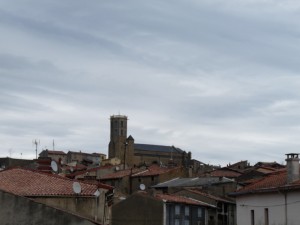
Laroque: a roofscape.

Here you are reading my blog: and the chances are that you’ve never visited Laroque.

Let’s go for a stroll then, and get to know the place a bit.  You may think, when you’ve seen the photos, that the town is quite shabby-chic.  It’s not.  For the most part, Laroque is just plain shabby.  It’s going through tough times, and it shows.  Underneath it all, though, are characterful buildings, streets with a story, and even places that are enjoying a prosperous renaissance.  Let’s set off from our house at the edge of the old town, and walk up Rue de la Joie……

Snowshoes III: The very last episode

I’m not doing raquettes (snowshoes) ever again.  Never.  If I ever show signs of changing my mind, lead me into a darkened room, talk kindly to me, and sit with me till the feeling passes.

I have no idea how I got through yesterday.  I must have done though, because every move I make causes some protesting and unhappy muscle to complain vigorously at the pain it endured on our expedition, and is still enduring now.  Five hours walking, with half an hour off for lunch.  Something over 600 metres up, 600 metres down – that’s nearly 1900 feet each way in old money.

I said last week’s sortie was tough.  Compared with yesterday’s, it was a stroll in the park.  I said last week’s was ‘an upward slog: unremitting, tough’.  Yesterday’s was a vertical slog: unending, unforgiving.  Last week, the snow had been deep and crisp and even, and easy to walk on.  We had crunched satisfyingly upwards through the forest, and our descent had been a brisk and easy downward march.

Yesterday, following a warm and sunny week, the snow was soft and our snowshoes sank deep.  Bad enough on the upward route march, but coming down, we all skidded, slipped and lost grip of our poles as they plunged into unseen cavities.  I made landing smack on my back and descending bumpily downwards, legs waving helplessly in the air my personal speciality.

Still, it was good to see Montségur, looming above us at our starting point, providing points of reference throughout the day.  Soon after we started, we were level with the castle at its summit, then it was below us, and disappeared for a while as we plodded upwards through a stretch of forest.  At lunchtime it was impossibly far below.  As we ate, we enjoyed plotting the landscape for other landmarks: Lavelanet and Laroque of course, the lac de Montbel, and far north of us, the Montagne Noire.

Best of all were the cloudscapes: massed plump white cushions of cumulus with wispy brushes of cirrus above, turning a more characterful and moody grey in the afternoon, foreshadowing the evening’s expected rain.  We were just back at the cars when the rain arrived a little ahead of schedule, with a brief hailstorm of pencil-point-sharp hailstones to encourage us on our way.  We didn’t need telling twice.  Home comforts have never seemed more inviting.