This week’s Nature Photo Challenge from Denzil is to showcase corvids: the crows, ravens, jackdaws, magpies and similar in our lives. I want to showcase as well the collective nouns they’ve all acquired. The ravens in the feature photo seem rather stand off-ish. They are probably extremely miffed at their collective noun: an unkindness of ravens.
I have just one crow for you: I didn’t manage a photo of a murder of crows.
Crow on a roof.
Two jackdaws though. Is that enough to describe them as a clattering of jackdaws?
Then we’re off to Germany to spot a rather odd magpie: is it a magpie? He should be off to join his mates in a conventicle, a tittering, a gulp or a mischief of magpies.
And we’ll end where we started: with a raven, who looks far too dignified to be involved in any unkindness.
By the way. As a child, to help me to distinguish between crows and rooks, I was taught that a crow by itself is in fact a rook. And a crow surrounded by others is – a rook. I hope that’s clear.
Besides Denzil’s challenge, this is also forI. J. Khanewala’s Bird of the Week.Quite a few different birds here, but all are corvids, so I may get away with it … again.
If you look at this girder in a certain light, it looks slightly orange. Maybe. But I just wanted to find an excuse to post this photo: almost the only one I took in colour on our Newcastle sortie the other day.
Our day in Newcastle earlier this week wasn’t just about people-watching. We’d come to walk the banks of the Tyne, weaving back and forth over at least some of its seven bridges. Let’s take a bird’s eye view of the scenes we saw.
This is what those pigeons in the header photo were looking for.
This is the Tyne Bridge, with just beyond, the Sage Gateshead and the Baltic Centre.
This young herring gull was inspecting me as I inspected him. He was tucked behind a railing just beyond that first planter.
We wandered onto the Swing Bridge, which luckily didn’t want to open to allow river traffic through. Its elderly wooden jetties provided the perfect resting place for gangs of pigeons.
Then we walked down this walkway, for another view of the Millennium Bridge …
… but one of our views of the Sage was reflected in a nearby office window.
We didn’t really see any more wildlife. Unless this counts.
I’ll see if I’m allowed to sneak both the pigeons and the herring gull into I. J. Khanewala’s Bird of the Week.
On Tuesday, Country Mouse (me) went to the Big City (Newcastle). Big cities are busy, full of life, of people. And that’s why I was there. A friend in my fairly-newly-joined photographic club had offered to take me in hand, get me over my diffidence in photographing people I don’t know, and communicate as well his affection for black-and-white photography. Newcastle was the place to go.
We started in the station. We walked along the banks of the Tyne. We criss-crossed several of the seven – yes seven – bridges spanning the river between Newcastle and Gateshead. The shots we took there are for another day.
We took pictures of bridges, buildings, windows, shadows, gulls, pigeons, statues, rotting wood, city swank and urban decay. And we took shots of people click on any image to see it full-size.
Man meets sheep
The two of us take our last shot of the day -reflected in a shop window.
In this week’s Nature Photo Challenge, Denzil has asked us to focus on seedheads. You won’t get any more ripened seeds in one place than in a field of cereal crops awaiting harvest. Here’s a local example in my header photo.
And here are some close-ups of barley and wheat.
And here’s a gallery of their wild cousins – grasses. Not one of which I can more accurately identify. Any offers?
Then there’s cow parsley -or a close relation. It can be yielding its seed, perhaps in the midst of a field of crops round about now, or picturesquely hosting a spider’s web in misty November.
At this time of year too there’s rosebay willow herb: it seems to develop seed pods earlier every year. Here are some at a local reservoir, Grimwith.
Shrewsbury in Shropshire. How to pronounce it? Shrowsbury or Shrusebury? I was brought up with the former. Apparently most locals prefer the latter. Apart from those who don’t. I give up. Let’s go on a stroll round this lovely, quiet, tucked-away town with oodles of history. Click on any image to reveal it full size, with caption.
This week, for the Lens Artists Challenge, Amy asks us to consider ways of framing our shots. So my featured photo doesn’t do that. The frame shown here, at Brimham Rocks IS the subject of the shot.
Sometimes, the photographer finds a frame has been fortuitously laid on. Here we are on the Regents Canal in London, in maritime Barcelona and at Harlow Carr Gardens in Harrogate.
A band plays on the floating bookshop, Word on the Water, on the Regent’s Canal, London
Sometimes a window – an actual window, or a suitably-shaped hole-in-the-wall provides that frame. Here’s the South Bank in London, a shot taken while sailing to Bilbao, another view at Harlow Carr, and a convenient window overlooking the River Thames near Blackfriar’s Bridge.
In her post about framing, Sarah of Travel with Me fame took us to Fountains Abbey and Studley Royal. We’ll go there too, but wander through the wooded area of the High Ride, and into the parkland of Studley Royal, allowing the trees themselves to frame the picture.
Fountains Abbey in autumn.
And lastly, another view which didn’t work as well as I hoped, through a chink in a drystone wall in the Yorkshire Dales.
As regular readers know already, I’m a huge fan of Food for Free. Especially at this time of year, I never leave the house without a useful ‘au cas où’ bag stuffed in my pocket . This is a bag that any rural French person will have about their person always – just in case they find something useful – a few nuts, berries, fungi or leaves to add interest to the store cupboard. At the moment, this is all about the apples, blackberries, bullace and mirabelle plums all growing wild locally. At other times it might be young nettles, wild garlic or other leaves. Soon it will be puffballs. I’m not especially knowledgeable, but I do my best.Yesterday’s haul? Windfall apples (simple stewed apple) mirabelles (frangipane and jam) and bullaces (crumble and bullace cheese – think a plum version of membrillo – very labour intensive).
Although I was brought up foraging, my commitment to it was sealed when we lived in France. Here’s a post I wrote in October 2012.
‘All is safely gathered in, ere the winter storms begin’*
October 25th, 2012
Well, at this time of year, it isn’t really a case of ‘au cas où’ . You’re bound to find something. A fortnight ago, for instance, Malcolm and I went on a country stroll from Lieurac to Neylis. We had with us a rucksack and two large bags, and we came home with just under 5 kilos of walnuts, scavenged from beneath the walnut trees along the path. A walk through the hamlet of Bourlat just above Laroque produced a tidy haul of chestnuts too.
Yesterday, we Laroque walkers were among the vineyards of Belvèze-du-Razès. The grapes had all been harvested in the weeks before, but luckily for us, some bunches remained on the endless rows of vines which lined the paths we walked along. We felt no guilt as we gorged on this fruit all through the morning. The grapes had either been missed at harvest-time, or hadn’t been sufficiently ripe. They were unwanted – but not by us.
So many vines: there’ll be unharvested grapes there somewhere.
The walnuts we’re used to in the Ariège are replaced by almonds over in the Aude. You have to be careful: non-grafted trees produce bitter almonds, not the sweet ones we wanted to find. But most of us returned with a fine haul to inspect later. Some of us found field mushrooms too.
A solitary almond
Today, the destination of the Thursday walking group was the gently rising forested and pastoral country outside Foix known as la Barguillère. It’s also known locally as an area richly provided with chestnut trees. Any wild boar with any sense really ought to arrange to spend the autumn there, snuffling and truffling for the rich pickings. We walked for 9 km or so, trying to resist the temptation to stop and gather under every tree we saw. The ground beneath our feet felt nubbly and uneven as we trod our way over thousands of chestnuts, and the trees above threw further fruits down at us, popping and exploding as their prickly casings burst on the downward journey.
Just picture whole paths, thickly covered with chestnuts like this for dozens of yards at a time.
As our hike drew to an end, so did our supply of will-power. We took our bags from our rucksacks and got stuck in. So plentiful are the chestnuts here that you can be as picky as you like. Only the very largest and choicest specimens needed to make it through our rigorous quality control. I was restrained. I gathered a mere four kilos. Jacqueline and Martine probably each collected three times as much. Some we’ll use, some we’ll give to lucky friends.
I think these chestnuts represent Jacqueline, Martine and Maguy’s harvest.
Now I’d better settle myself down with a dish of roasted chestnuts at my side, and browse through my collections of recipes to find uses for all this ‘Food for Free’.
*From the words of an English hymn sung during Harvest Festival.
That’s this post, really. We’ve been away all week, discovering Shropshire with friends who’ve moved there. Getting to know this county and its landscapes, its industrial history, its towns and villages is a work in progress for us. But it’s left me only with time to throw together a quick response to Ann-Christine’s Lens Artists Challenge: Work in Progress.
We’re all Works in Progress – all our lives. But children especially so. Fierce concentration here, and enjoyment too …
Hard at work with bucket and spade.
Slightly older children can hold their own with adults when it comes to demonstrating proficiency – in this case sheep-handling at Masham Sheep Fair.
Sheep-handlers young and old at Masham Sheep Fair
Over in the city, street art out-numbers sheep. Here are two works in progress: the first in Valencia, Spain, the second near Brick Lane, London.
And finally, two shots from India that I remember well: the house opposite my hotel in Puducherry, whose construction was a work-in-progress from about six, till late… it’s up there as my featured photo … and a metalworker hard at work producing figures inspired by the nearby temple at Kumbakonam in Tamil Nadu.
Five random words. Paula, over at Lost in Translation posts five different words every month, and invites bloggers to choose five different photos to illustrate them. Well, I decided I’d join in. But I thought I’d have even more fun if I wrangled those five words into a piece of doggerel to accompany my images. Here we go…
A retired Major General from Hove
with the moniker Algernon Gove
said ‘Before life unravels
I must finish my travels.’
And forthwith he made plans to rove.
He selected some places to stay:
His first port of call was Norway.
He thought he'd get bored
with a trip round a fjord.
But he found it quite splendid, if grey.
.
Thereafter, he thought the romance
Of a yacht sailing slowly to France
Would just do the trick.
But the poor chap was sick.
What nautical mis-happenstance!
Dry land seemed a safer idea.
Get his plans and his thoughts into gear.
The familiar? Go home?
Or a day-trip to Rome?
Or ditch the whole plan till next year?
He mused - and looked up at the sky
Which was sulky and grey - though now dry.
And saw the attraction
Of a rainbow’s refraction
It was time to bid drifting ‘goodbye’.
So what did the old fellow do then?
It needs planning, the where and the when.
But I’ve got a hunch
That after his lunch
He’ll announce an adventure. Amen.
Maps are a good place to make destination-selections from. This is the Catalan Atlas, created in 1375 by Abraham Cresques, and may not be the map book that Major General Gove made use of.
This isn’t a fjord. It isn’t even in Norway. I’ve never been there. It’s Lake Ohrid in North Macedonia. But I think it’s rather splendid – if grey.
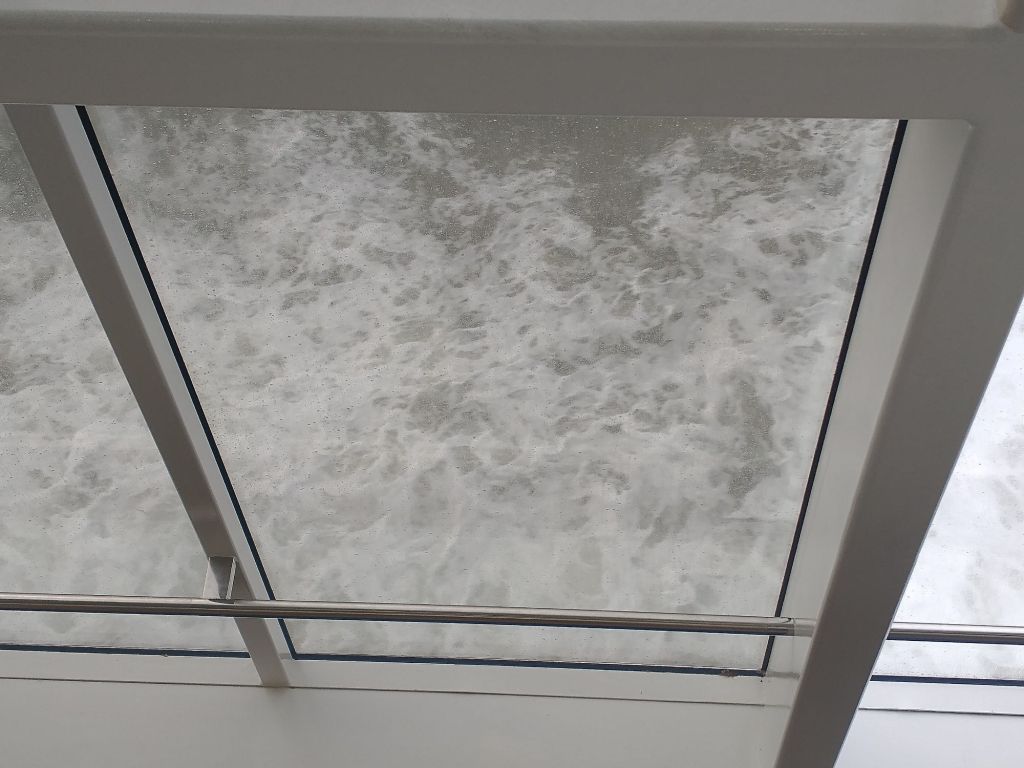
These yachts look a little small for a nautical voyage. No wonder the Major General was sea-sick.
A familiar scene to the Major General as he gazed out of his bedroom window in Cheshire.
A rainbow. A double rainbow in fact. Plenty of refraction here.
Before he retired, the Major General was commanding chaps like the fellows shown in the featured photo.
You must be logged in to post a comment.