We were over in Bolton for the night – Daughter Number One played on of the lead roles in ‘The Nerd’, with the Marco Players. It’s a play which deserves to be far more widely known: it’s clever, funny and a grand night out.
But being over in Bolton on Friday night means being over in Bolton for Saturday morning. And Saturday morning, for twin grandsons nine years old Alex and Ben, means only one thing. It’s match day for their footie team. They play for Turton Tigers. Parents, grandparents and associated hangers-on play at being supporters.
The thing about being a supporter is that it involves being cold. We knew that only too well when Daughter Number Two played away matches for a hockey team in Harrogate. Nowhere is colder and windier than a hockey pitch made from a reclaimed slag heap somewhere outside South Elmsall. Except perhaps a community football pitch somewhere in Bolton. It might be May at the moment, the tail end of the season, but wrap up warm. Find your woolly socks. Don’t forget your hat.
Football is a closed book to me. I can’t tell which shots are amazingly good, and which ones might be astonishingly bad. I can’t understand why it seem to be OK when the ball goes off the pitch. It was never allowed in netball I seem to recall. I can’t tell when a ball has even half a chance of getting between the goalposts. I can’t join in those conversations which Malcolm is able to initiate on the lines of how very much the team has improved and matured since last we saw them play a few months ago. I try hard not to clock-watch.
It’s half time. That’s why nobody’s looking at the pitch.
It’s lovely to see the boys giving it their all, to see their enjoyment, determination and sheer physical fluency. I just wish I knew what was going on
But I’ve realised we may have a get-out clause. Last Saturday was their first defeat in an unbroken nine week run of success. The time before when we watched them play they lost as well. And the time before that. I think the boys are beginning to observe a pattern. Next time we visit, we may be forbidden from watching. Oh dear.
It’s OK, Alex and Ben. I don’t mean I don’t enjoy watching you two. But you hit the nail on the head a few weeks ago Ben. You’d been talking animatedly and without pausing for breath for several minutes about (of course) football. Suddenly you stopped and regarded me pityingly. ‘Granny’, he said, ‘You haven’t understood a word I’ve been saying, have you?’. And I’d been trying so hard…..
Once upon a time, if you had a country house, you had to have deer too. At Studley Royal, part of the Fountains Abbey and Studley Royal World Heritage Site, there are deer and a deer park….. but no country house.
There was a medieval manor house once. That burnt down in 1716. John Aislabie, who inherited the site, and was responsible for the magnificent water gardens here, rebuilt the site as a Palladian mansion. That burnt down too, in 1946. There is no house any more. But there are some 350 deer.
And on Saturday afternoon, we went to see them, and to find out more. We’d been promised a grey but tolerable day. In fact, it was grey and intolerable, with drizzle turning to driving rain. But if the deer – some 350 of them – could manage, so could we.
Some of them are red deer, the native species of the British Isles, and the largest.
Red deer stag. Wikimedia Commons
Some are fallow deer. These were introduced to Britain by the Normans, and became prized as ornamental animals, and for hunting. They’re smaller than red deer, and perhaps seen as prettier. They can come in two shades of tan with spotted coats, or in some cases black, or even white. Look at their antlers: quite different from those of the red deer.
Fallow deer stag, Wikimedia Commons.
And some are sika. They look a little like darker versions of fallow deer (not the antlers though), and were introduced from China and Japan in the 19th century.
Sika doe, Wikimedia Commons.
We learnt to distinguish one from the other by looking at their size, their antlers, their coats, their markings, their tails. We learnt that deer are responsible for the very neat way in which the trees in the park are finished off. Deer graze the leaves they can reach, thus leaving all the lowest branches and twigs at exactly the same height. They’ll all happily munch bramble, gorse and nettles too: stinging leaves and prickly thorns don’t worry them at all.
At this time of year the males are losing their antlers. They lose and re-grow them every year, which is a terrific drain on their energy, so they tend to take things fairly easy while this is happening in the early summer. Each year until they’re aged 10 or so, they’ll grow larger antlers than the year before, and with more points. New antlers are velvety, so stags will spend time rubbing this soft coating off by scraping their new accessories against the dead wood that’s deliberately left lying in the deer park. They’ll want them to be good and ready for the rutting season when they’ll wrestle other males in the quest to be the females’ Top Stag.
They’ll also enjoy a wallow. We saw muddy depressions here and there where deer have lain down to have a good old scratch and bathe in thick oozy mud. At this time of year it’s to help free themselves of their winter coat as they moult. But it’s a different story in the breeding season. Males urinate into the earth to make it even muddier. Then they’ll roll round in the resulting muddy soup. Their splendid appearance and smell as they rise up, magnificently coated in sticky earth and bits of vegetation makes them thoroughly alluring to the females they hope to attract.
On Saturday, the deer were edgy, a little spooked. Nobody knew why. The large groups we saw were always at a distance, always ready to bolt away. The three varieties of deer don’t really mix, but neither do they feel the need to place real distance between themselves. We didn’t get to see them at close quarters. But we saw them well enough to distinguish one species from another with increasing confidence. A good day then, despite the increasingly dirty weather. We’ll be back when the sun shines, to visit the deer again.
Fallow deer.
Fallow deer. There’s just one white one in their midst.
Sika.
Young red deer.
Deer highways in the grass.
You can see moulted hairs in this recently used wallow.
Thanks to members of the volunteer Wildlife Team at Fountains Abbey and Studley Royal for our afternoon with the deer.
Anyone who knows me even a little bit must be aware that I consider daffodils to be the main reason to be in England in the spring. We have wild daffodils of course. Think Wordsworth tramping through fields of flowers in the Lake District: think Farndale’s charming walk through the daffodils crowded along the River Dove in Yorkshire. But it’s the vibrant displays planted along roadside verges, in urban parks and on village greens, in garden tubs and along dual carriageways that grab my attention, every day.
Today though, I was thinking of a walk in France, just two years ago, to see the astonishing display of wild daffodils, in hills not so far from Foix. I thought you might like to remember it too.
Yesterday, we walked in Les Dolomies, which you could confuse with the Dolomites with its craggy pillars and rocky outcrops: though actually it’s a small area between Lavelanet and Foix, just along from Roquefixade. After a few days of hot sun and blue skies, it was disappointing to have the threat of rain, but the slight mistiness brought its own beauty to the landscape, softening the distant views, and enhancing the vibrant greens of the springtime meadows. Everywhere, blossom and flowers.
We walked upwards through the woods. Anny and Maguy had a surprise for us. And quite suddenly, there they were. Daffodils. Thousands and thousands of them, extending upwards over the hillside, tumbling over rocks, leaving not an inch of path for us to walk along. The weather cleared. The sun came out. We were entirely happy.
Come and share the walk with us, along blossom-laden paths, through the daffodil…
ArtisOn? ArtisOn? Never heard of ArtisOn? Well, that’s your bad luck, is all I can say. Just six miles from here, outside Masham, are some studios. These belong to ArtisOn, who provide programmes of day workshops that will unlock your creativity in ways you might never have thought of.
I’d fancied doing some print-making. Back in the dark ages, when I was at school, I’d enjoyed the odd chance to do lino cuts. Something about simplifying objects back to their very essence, seeking to capture their vitality using simple materials, simple cutting tools, choosing papers to print my images appealed to me then and appeals to me now.
I spotted one of ArtisOn’s courses – Printing without a Printing Press. This promised the chance to re-visit now rusty skills and have a go at one or two more. And Malcolm promised to enrol me on it as an early birthday present
What a fantastic day. Only six students, and one most motivating teacher, Hester Cox. You can see her work, largely inspired by the rural environment in which she lives, here. She showed us collographs: we added to and removed layers from thick card, adding scraps of textured paper, dried leaves, sand and small found objects to make simple textured images. My resulting stylised flower looked OK, I thought, but when I tried printing it later, I was disappointed.
Collograph sample board.
My collograph, ready for printing…..
… and post-printing
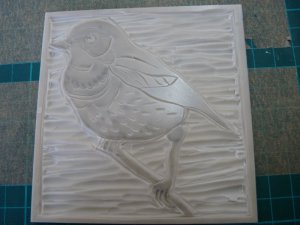
Lino cutting went better. I enjoyed choosing the best cutter for achieving different effects. I enjoyed choosing which parts of my design to leave in relief, and which to gouge away. What a satisfying time that was, carefully cutting away at the lino until it revealed something like the effect I was after.
I’ve just finished hacking away at my sheet of lino.
Then it was time to eat. I’d been told – several times – that the real motive for going to ArtisOn is to have lunch. I can confirm this is an excellent reason. Pasta bake and bowls full of different salads may not sound exciting, but when a simple dish is crammed full of varied vegetable tastes and textures, there is really nothing not to like. Berry pudding, tiramisu, juicy fruit salad… it all slipped down very easily, as did a quite sensational parsnip and ginger cake with our afternoon tea.
Hester rolls paint on her image: ready to print.
Then she shows us how to work with two colours.
These are Japanese barens, used to apply pressure to the the back of the paper to transfer the image.
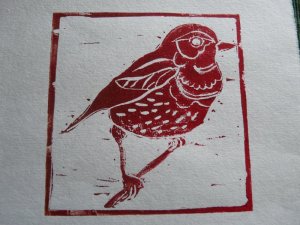
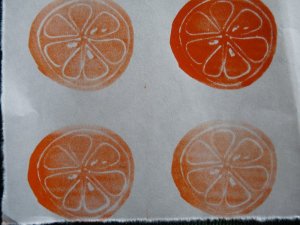
After lunch it was time to get printing. We learnt how to prepare our paint for action with rollers, how to mix colours within a single print, how to apply pressure to our papers to get the image to ‘take’. And we had the excitement of seeing our efforts come to life. We got so involved that we had little time for our final activity of making simple stamps from wood blocks and easily-worked soft polystyrene ‘funfoam’. I shall enjoy making stamps such as these to label my pots of marmalade, or to make hand-stamped wrapping paper. Here’s my first effort.
Marmalade labels in the making.
This was a great day. I was buzzing with ideas on the way home, and I know I’ve been equipped to begin to develop my long-forgotten interest in print-making. If you’re on my Christmas card list – you have been warned. Limited edition print on its way to you in nine months time. Blame Malcolm. He paid.
Saturday night. All dressed up and somewhere to go: friends in Ripon – good company and good cooks – had invited us over. Malcolm popped out to the car, leaving the keys in the ignition, then came back into the house. Two minutes later, we left together …. and found the car firmly locked. It had done it all by itself.
We peered in, we rattled the door, we shook the car. Nothing. No spare key. We lost that years ago, and never got round to replacing it. The car defiantly remained unusable.
Distinctly disgruntled, we shelved the problem and ordered a taxi. And had a good evening.
The next morning, there we were, prowling round the car once more. Our neighbour and Malcolm mulled over and rejected various strategies. I walked into West Tanfield for a newspaper. The shopkeeper there knows everyone. He was sure to come up with someone who could help. He couldn’t.
The internet revealed a couple of businesses who would come and help: at a price. £100? We didn’t think so.
But several hours later, we were forced to admit defeat. The man we rang said he charged no extra for Sunday work, and would come in an hour. He thought he’d have us sorted out within seconds. But he didn’t. He struggled with ever more sophisticated gizmos until finally, after about 20 minutes, the lock gave in, and opened once more.
Workshop on site.
And this is his advice, which I share with you. You’re welcome.
Never leave your key in the ignition unless you also turn the key. If the car doesn’t ‘know’ you’ve put the key there, it may lock automatically as one of its safety features.
If you normally ‘zap’ open your car by using the remote control button, the lock may eventually clog with dust and so forth. About once a month, open your car the old-fashioned way by inserting the key and turning the lock.
What with his visit, and two taxi fares, this little incident cost us £130.
I think it may be time to replace that lost car key.
…. or alternatively, A is for ‘attachment’, B is for ‘blog’ and C is for ‘chatroom’.
Somehow, back in January, I missed the fuss that surrounded the publication of the updated edition of the Oxford Junior Dictionary. I caught up with it today, when reading an absorbing article in today’s Guardian by landscape and natural world enthusiast Robert Macfarlane. This is what he said.
‘The same summer I was on Lewis, a new edition of the Oxford Junior Dictionary was published. A sharp-eyed reader noticed that there had been a culling of words concerning nature. Under pressure, Oxford University Press revealed a list of the entries it no longer felt to be relevant to a modern-day childhood. The deletions included acorn, adder, ash, beech, bluebell, buttercup, catkin, conker, cowslip, cygnet, dandelion, fern, hazel, heather, heron, ivy, kingfisher, lark,mistletoe, nectar, newt, otter, pasture and willow. The words taking their places in the new edition included attachment, block-graph, blog, broadband, bullet-point, celebrity, chatroom, committee, cut-and-paste, MP3 player and voice-mail. ………I was dismayed by the language that had fallen (been pushed) from the dictionary. For blackberry, read Blackberry.’
I too was dismayed. Everywhere there is evidence that children are playing out far less than they used to, seeing green space less often than their parents did. Perhaps more than ever they need a dictionary to help them know about chestnuts and clover. Since the Second World War, there have been regular complaints from teachers and others, that there are city children who don’t know that milk comes from cows, or potatoes from the earth, or that blackberries are for gathering and devouring. Best not cut them out of works of reference too.
But then, I’m not sure how many children use dictionaries either. I’ve seen lots of young people, including our own daughter, who will turn to an online source rather than the dictionary when needing to check a spelling or a meaning. But really, what can be more fun than turning to a dictionary to look something up, and then becoming distracted, for more than 20 minutes at a time, by reading about words you never knew, or knew you needed to know, like ‘pursier’, or ‘grager’, or ‘chip breaker’ or ‘squaloid’?
All the same, I’m glad and relieved that my grandchildren know the meanings of all the words Macfarlane singles out, both the new edition inclusions, and the ousted ones from, apparently, a bygone age.
The Republic of Turkey has only existed since 1923, and rapidly transformed itself under Kemal Atatürk from a failing Ottoman Empire with a glorious past, into a modern nation, looking towards Europe as it pushed through a programme of reforms. Then and now predominantly Muslim, it became an uncompromisingly secular state, in which religious symbols in schools and public buildings were forbidden, and women achieved universal suffrage by 1934. These days, you’ll see fewer veiled Turkish women than in the average British city centre.
Look below the surface, however, and Turkish life is centred round the extended family, as it has been for centuries.
When they’re 19, Turkish young men go off to do their National Service for two years. Those from the west serve in the east of the country, and those in the east go west. What they’re hoping for is a nice post as a jandarm (army police) in a quiet country town, though they’ll lie through their teeth and tell anyone who asks that they were posted to the borders with Syria, Iran or Iraq. No internet, no mobile phones, no wild social life: it’s not fun, and they count the days till their discharge, aged 22.
Back home, mother has no time to indulge in ’empty nest syndrome’. She has her son’s marriage to arrange. She trawls through likely candidates, looking for a young woman from the same caste, of good family, aged about 17 – 19. She’ll check out whether the girl can make a decent Turkish coffee and a good pilau rice, and even get the chance to appraise her naked body when they go to the Turkish baths together. Her son will almost certainly fall in with her choice, and the girl’s family too usually agrees.
Father’s role in all this is to foot the bill for the wedding, which is cripplingly expensive, so he’ll have been saving all his married life. Average wages in Turkey are low, and after regular bills have been met, don’t allow much slack for buying or building a home complete with fixtures, fittings and furniture, much less a new car. This is where the wedding comes in.
Wedding gold. (altinka.net)
The guest list for the ceremony will include about 2000 of the couple’s closest friends, of whom about 1,500 will actually come on the day. And they will bring gold, which they’ll pin to the couple’s clothes. Nobody will dare to offer a smaller amount than the person in front: social death. This gold will be transformed into a new home, a car and all the other things the young couple might need. Now their modest income will be enough for day-to-day life.
After the marriage, the young woman leaves her family behind. Her new life is with the extended family of her husband. They will all live together. We saw whole blocks of flats, maybe 4 storeys high, which our guide assured us were likely to belong to a single family. People buy from developers or build for themselves: renting is almost unknown. As are planning regulations. You can build what you like, where you like, on land that you already own or have acquired. Surveys of the land are unnecessary, so in this earthquake prone land, many buildings are destroyed by ‘quakes or landslip, or subsidence.
Earning a living is paramount for the men. While communities will be proud of those who make it into the professions, there’s no shame in, for instance, washing cars at a petrol station: it may in fact be more lucrative than say, teaching. Many families find ways to earn their living together, by running a shop or garage, or by working the land together. Almost every block of flats in Turkey has shops on the ground floor. You can be sure the business is being run by the family who lives above.
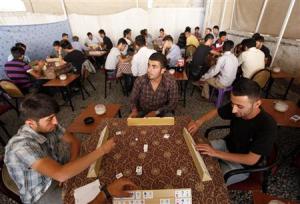
Traditional Turkish tea house: men only. (Reuters/Umit Bektas)
When not actually working, men retire for the day to a tea shop. The woman’s domain is the home, all day, and woe betide the man who reports home sick at 2.00 in the afternoon. The average family has about 5 children, and life expectancy is 61 for men, 67 for women. This is because health services are rudimentary and expensive. Most families are dependent on traditional remedies, or failing that, the pharmacy. A stay in hospital is an unthinkable expense for much of the population.
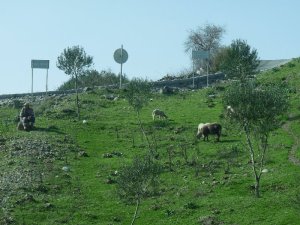
The family groupings apply to to the very many nomad familiies who still exist in Turkey. Some families are still entirely nomadic, whilst others have a nomad existence in summer, and return to a more low-lying village in the colder months. Most rear stock, especially sheep and goats.
A nomad tends his flock outside Bergama.
I’m sure Turkish life is changing. We certainly saw many Turkish women working outside the home. But walking about the streets in the evening, it was clear that home and family is still central to everyday life here.
Modern housing.
A block of flats with solar heating captors and satellite dishes.
Much town development seems very high density, with little outside space.
Solar heating captors are everywhere.
Street furniture in Ayvalik.
As in France, old village centres are neglected in favour of edge-of-town modern development.
A village scene in Didyma. Outside appearances aren’t important in Turkey.
Old Ayvalik.
Orange trees often line the streets, or offer shade in gardens.
I like my diary a lot. It’s big and bright and yellow and demands I remember to stuff it in my bag as I’m out and about and adding in appointments I shouldn’t forget. I like to leaf through its pages in idle moments, because on nearly every page, there’s a poem: an old one; a recent one; a classic; or one that’s, to me at least, unknown.
Here’s my diary
Here’s ‘After Africa’
And on another page, here’s the cover of a book I used to love in childhood
Here’s the poem I found this week. It speaks to me, though I’ve never been to Africa, and it’s very many years since I worked in Surbiton Library in Surrey. It touches me with its imagery of rich and different landscapes lost, at the same time as rediscovering the softly-washed colours of once more familiar territory. No-one would compare France with Africa. But they might recognise the bittersweet feelings of regret yet acceptance that accompany those of us who come home after some years in a very different culture.
After Africa
After Africa, Surbiton: An unheated house, and flagstone pavements; No colobus monkeys, no cheetahs scouring the plains. Verrucas and weeping blisters ravaged our feet.
An unheated house, and flagstone pavements, And snow falling through the halos of street lamps; Verrucas and weeping blisters ravaged our feet; But the shavings made by our carpenter, Chippy, were as soft as bougainvillea flowers
Or snow falling through the halos of street lamps. Everyone was pale, pale or gray, as pale or gray But the shavings made by our carpenter, Chippy, were as soft as bougainvillea flowers … Red, African dust spilled from the wheels of our toy trucks and cars.
Everyone was pale, pale or gray, as pale or gray As the faded carpet on which Red, African dust spilled from the wheels of our toy trucks and cars. Real traffic roared outside.
A faded carpet on which Everything seemed after Africa, Surbiton’s Real traffic roared outside – No colobus monkeys, no cheetahs scouring the plains.
Mark Ford.
You can listen to Mark Ford reading his poem by clicking here.
Mark Ford: Selected Poems was published by Coffee House Books in 2014: ISBN 978-1-56689-349-7
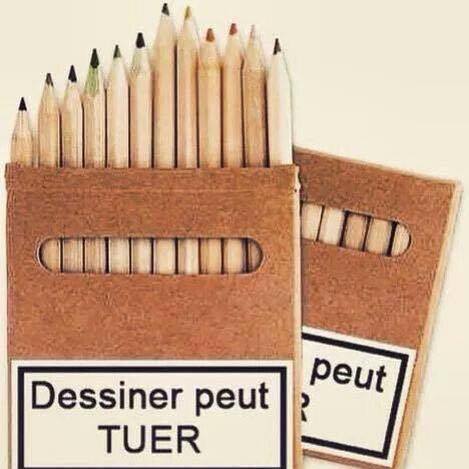
There’s nothing I can say to add anything to the general outpouring of grief and anger at the murders that took place within the Paris offices of Charlie Hebdo yesterday. It’s frightening though. Acts of violence beget acts of violence. Ordinary people of Muslim heritage, in France, England and elsewhere must find it hard to get on with normal everyday life, interacting unselfconsciously with neighbours and colleagues. Those who fight extremism with their computers, pens and pencils may now think twice about the consequences of words and images intended only to provoke thought and debate.
I liked very much an article by Owen Jones in today’s Guardian. He reminded us of the Oslo bombings, and the murder of dozens of young Norwegians about three and a half years ago, and pointed out that in the main, Norway responded with calmness and humanity. No bloodbath followed, with faction set against faction. Somehow though, things seem different now, with arguments about religious extremism set centre-stage throughout Europe. Will France be able to manage the calm and dignified reaction the Norwegians achieved a while back?
In the community where I lived in France, there was large Muslim population, largely from North Africa. Many had decent jobs, friends from a range of backgrounds , and were fully integrated into local life. But in an area of high unemployment, they were often among the most likely to be jobless. Whole blocks of council housing had only Muslim tenants, and they stuck together, supported each other. They seemed to me to be quite vulnerable. I wonder how things will go for them if anti-Muslim feeling rises in the aftermath of this week’s events?
Today, in France, religious leaders from all faiths met and prayed together in solidarity. Implacable political opponents Nicholas Sarkozy and FrançoisHollande met at the Élysée Palace to share thoughts and ideas, where however, they were not joined by the increasingly popular and outspoken Front National leader Marine le Pen.
It feels as if we’re at a crossroads. Do we join with those who, despite their differences, come together to seek to unite communities? Or will the violence, quite simply, spread?
There are quite a lot of life-changing illnesses that I’m glad not to have personal experience of. And in the great scheme of things, ‘flu isn’t a big deal. But in our own little world, it has assumed a far too important place.
Here we are, more than one week on, and for both of us, day-to-day life is defined by what we can’t do, rather than by what we can. No energy to eat, which is as well, as we have no energy to cook (‘cooking’ in this context, means boiling an egg). No energy to get out and enjoy the frosty sunshine. No energy to keep the house tidy. Not even the energy to read anything but the most appreciated old favourites (thank you, Donna Leon, for reliably transporting me this week to the sights, sounds, smells and flavours of Commissario Brunetti’s beloved Venice).
We’ve both got what it takes to cough, loudly and constantly: we bark our way through morning, afternoon and evening, finally shutting up when sleep overtakes us. Talking makes it worse: not that we have much to say after our long-enforced house arrest. Maybe later I should find the energy to throw away all the uneaten Christmas treats that we didn’t have the foresight to freeze once the ‘flu took its stranglehold on everyday life.
Maybe later today I could resume my Spanish studies. I’ve been learning on-line the last few weeks, though much good it did me when Miquel came to stay: well, how useful is this? ‘Las tazas son feas’ (the cups are ugly): ‘La niña duerme cerca del gato’ (the girl sleeps near the cat). It wasn’t the stuff of fascinating conversational gambits.
Bits of gossip reach us from the world beyond our front door. That other friends had equally ‘flu-blighted Christmasses. That local seasonal gatherings saw the guest list diminish, thanks to ‘flu, from 20 friends or so to merely 7. That even households in far-flung Birmingham and Norfolk have not escaped. That even America is in the grip of The Epidemic.
So we can continue to feel sorry for ourselves, secure in the knowledge that at least we’re not alone.
Some fellow-survivors called by yesterday, and left us some of these. They haven’t kicked in yet.













You must be logged in to post a comment.