I’m learning hangul. Why’s that? No, stop. WHAT is that?
It’s a writing system. It’s the Korean writing system. And it didn’t just evolve over the years as so many do. A Korean King, Sejong devised it in 1446. He realised that the classical Chinese script used at the time was unsuited to the sounds and grammar of the Korean language, so sat down and invented something more suitable.
It’s a writing system so appreciated by the Koreans that they even have a day off to celebrate it. Hangul day is in October every year.
I don’t appreciate it much. I find it quite tricky. But learn it I must, and Malcolm too, preferably before September.
Why though? Because in September we’re going to visit daughter Emily. You may remember she’s working in South Korea for a year, and how could we not go to the other side of the world to visit her in a place she’s so enjoying, where she’s seeing and experiencing so many new things (raw octopus anyone?)?
And if we want to read a menu outside the few tourist areas, if we want to read a few street names, and catch the right bus, and not wander into the gents if we want the ladies, reading hangul might be a good place to start.
There are 40 characters. Some of them aren’t too bad.

Can you see the ‘n’ sound? Well, that sort of looks like a nose. And the ‘h’? That sort of looks like a man wearing a hat. And it’s easy enough to get your head round the ‘s’ sound looking like a ‘moustache’.
And once you’ve got the single consonants sorted, their doubles are a doddle. Though I can’t for the life of me see how they sound different from each other.
That only took a couple of weeks to get to grips with – please ignore all those internet videos called things like ‘Learn hangul in two days’, which begin by chattering over-excitedly about how easy it all is. It’s just … not.
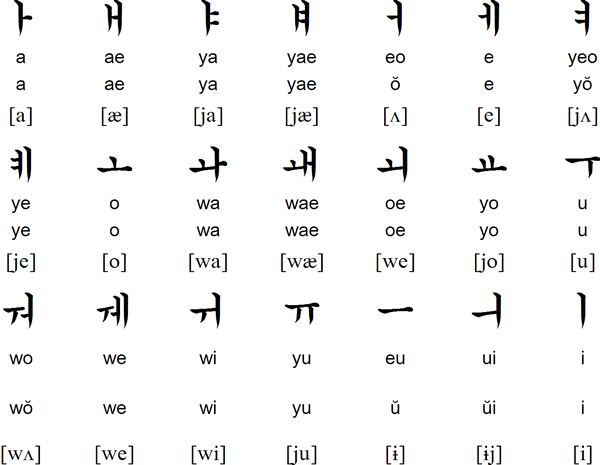
Then came the vowels:
Honestly, these vowels are a nightmare. I test myself on
Memrise every day, and every day I get my
yaes, my
yeos, my
yes, my
wos and my
wis, to name but a few, totally, totally muddled.
And it doesn’t end there. Some versions of the script are neat, thin computer strokes, the Korean equivalent of ‘Ariel’. Others, like the ones shown here, are more painterly, and yet others are positively ebullient. Shall I even recognise my painfully memorised lessons?
And then, these symbols don’t trot from left to right across the page. Each word is organised in groups ….
….. like this. This is ‘hello’ by the way.
So as to learning the language. I think that may be an effort too far. We’ll have to survive on ‘hello’, ‘please’, ‘thank you’ and ‘goodbye’. And throw ourselves on the mercy of the people we meet. Emily says everyone is friendly, courteous and eager to help. They haven’t met us yet.
We understand the way forward is to pack a quantity of card and some chunky felt tip pens. Then, when we want to catch a bus, or ask directions, we write our proposed destination in hangul on the card, thrust it in someone’s face, and hope for the best.
All the same, I can’t wait. I’ll be sure to send some ‘Postcards from Korea’ on my blog.


 From Pyrenees to Pennines