Winter meets Autumn head on

Eight days ago:  lunch outside in thin tee shirts: a garden umbrella protected us from the bright hot sun.

Seven, six, five, four, three, two, days ago.  Rain.  Rain.  More rain.  Heavy, chilly gusts choking the streets and drains with fallen leaves.  More rain.

One day ago.  Snow.  The first snow – and in advance of the first winter frost too.  Not a lot, but enough to rest heavily on fading garden plants, weighing down leaves and bowing stems.

This morning, we knew we’d need to get out early to beat the rain, which was threatening yet again.  I didn’t take my camera because I thought the mountains would be shrouded in foggy mist.  They weren’t.  The lower peaks, and even the much lower hills of the Plantaurel peeked through a thin layer of snow that dusted trees and painted the rocky and grassy slopes a severe white.  I dashed back for my camera.  Five minutes? Ten?  Long enough for the misty clouds to drop down and dump themselves on the snowy hilltops like squashy berets, hiding them from view.

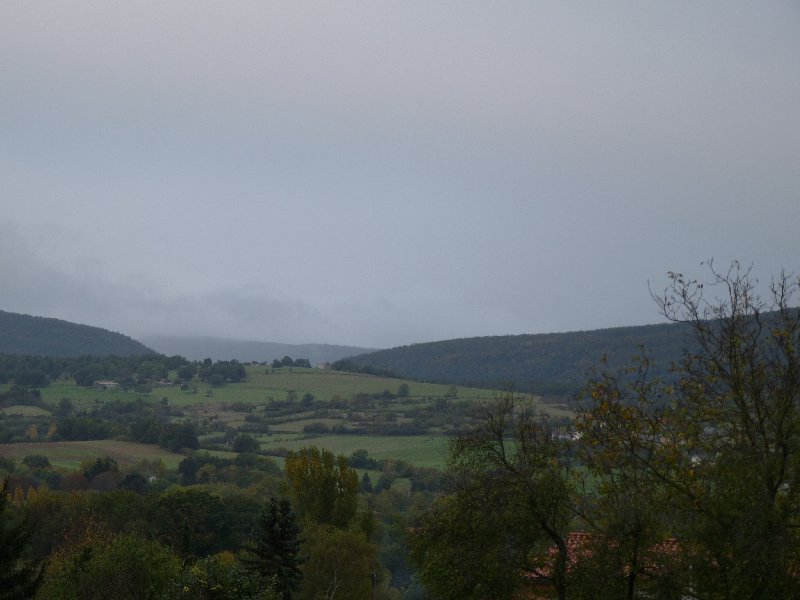
And then, straight away, the rain again.  That’s what we’ve had all day, streaming along the gutters, making splashy garden puddles, dripping incessantly from the trees and down our necks as we walk underneath.  I continued my early morning walk regardless though, and caught what may be the last few days of Autumn colour, though little enough of the snow, which is there somewhere, under those bonnets of mist and cloud.

Something old, something new

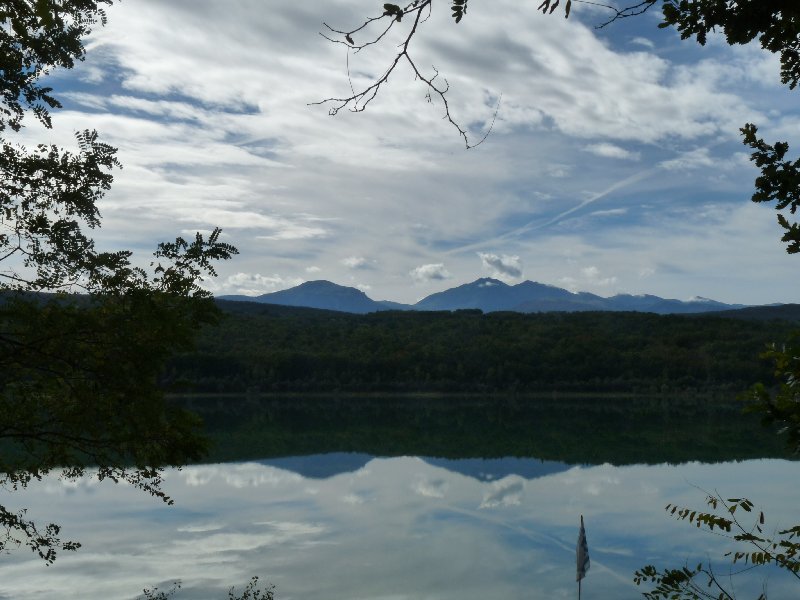
Lac de Montbel from La Régate

Our new friend Jenny-from-Bilbao came for a flying visit late last week, so we did a quick Cook’s Tour of some of our favourite spots.  Roquefixade, of course, Montségur: and then on a bright Autumnal Saturday morning, we finished off by a quick look at our local lake, Montbel.  It’s a man-made reservoir, actually, but it looks as though it’s been there forever, and fish, herons and humans all appreciate its cool expanse of water as a change from all those hills, mountains, rivers and streams.

What a difference a day makes.  Sunday sulked.  It rained in the night, it rained in the morning, grudgingly cleared up, then spent the rest of the day teasing us with odd showers which never quite decided whether to go for a full-blown drenching, or merely hang around as damp atmosphere, cloaking the landscape with fog.

So our planned walk from Croquié, with its promise of stunning views as our reward for a stiff climb was abandoned.  Instead we met at 1.00, we hardy types, and Jean-Charles proposed what I thought was little more than a walk round the block.  ‘Just up to Tabre, along the ridge and back’ he said.  Well, Tabre is the next village along, Mirepoix direction, so that sounded easy enough.  So off we went, along a bosky path, through Tabre, up a hilly climb to great views back to Laroque.  A long and often muddy forest track took us past further views, over the Douctouyre valley, and circled us over and past the next village along from Tabre, Aigues-Vives.  Down we climbed again, and took paths through fields back to Laroque.  A fabulous walk, all 15 km or so of it, and almost every step of it previously unknown to us.  And we pride ourselves on having got to know our patch pretty well.  Thank goodness for local friends who carry on helping us to discover even more.

The path home from Tabre

‘Not all those who wander are lost.’* But we were….

On Sundays we walk, with our friends from Laroque.  This time though, Malcolm and I were cramming in something else too: an afternoon birthday party right at the other end of the Ariège.

This was the plan. Walking Party A (which included me) set off at 8.00 a.m. to do a walk from Lieurac to Roquefort-les-Cascades, where we were to meet Party B (including Malcolm) for lunch. Party B consisted of the temporarily halt and lame, as well as Marcel, whose bread hadn’t finished baking by the time we left.  ETA for us all, 11.30.  At which point M & I would have made our excuses and left for the birthday party.

We did fine, we keenies in Walking Party A.  We walked past Rapy, Ilhat, Tanière, glad of the frequently wooded and well-signposted paths, and all went well till Bac d’en Haut.  There was a choice of routes which we discussed at length as we studied the map and made our choice, though we agreed it was an obvious one.

View towards Rapy
View towards Rapy

In due course it became clear that it was not obvious at all.  Instead of climbing up about 250m, then descending, we went on up…. and up… and up.  We’d been due to meet Party B at about 11.30, but midday came and went, 12.20, 12.30, 12.40… and then we came out of the woods to be confronted by a sight just behind us to the right. Roquefixade, a beauty spot really rather a long way from Roquefort-les Cascades.  Even if you’re a crow.  But if you use the paths, or even worse the roads, it’s absolute miles (19 km. actually.  It involves doing the two longer sides of a triangle).  We rang every member of group B who had a mobile.  Nobody responded.  We concluded there was ‘pas de reseau’ but wondered why at least one of them didn’t get into a reception area and ring us.

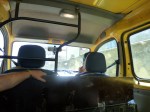
My view from the back of the van.

In the end, one of our group rang her husband, and he came to take some to Laroque to collect a rescue car, and others of us on to Roquefort. He didn’t drive a comfortable family saloon.  Oh no.  Our walking companion Corinne had that.  He had the bright yellow van he uses for hunting.  Behind the front seats was a compartment prickly with fresh straw where he and his fellow-hunters accommodate any wild boar they succeed in catching.  I was one of the ones who … er …. drew the short straw and travelled in the wild boar compartment.

By the time we climbed aboard it was…. 1.40.  By the time we reached Roquefort, it was well after 2.00.  By the time the rescue car arrived with the remaining walkers, it was well after 2.30.

Meanwhile I rang our hostess and warned her we might not be able to get to the party.  It didn’t take too long for ‘might not’ to become ‘can’t’.  Hot, sweaty, and with no time to go home for a shower, I don’t think we’d have been entirely welcome.

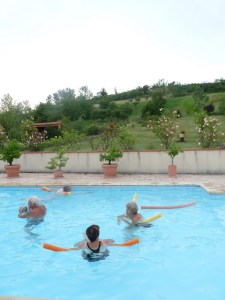
So we stayed with our friends from Laroque.  A picnic lunch, then home for that shower, before going round to the home of Michel and Annick, who have a pool.

P1050494

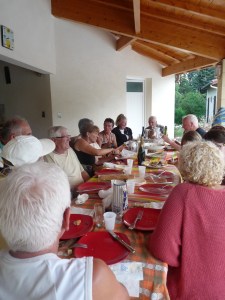
A refreshing swim, an ‘auberge espagnole’ (pot luck supper) and a glass or two of wine soon helped us reframe our day of not-very-brilliant navigating skills into a yarn that will no doubt go down in the annals of the group. It was just a shame about that party.

'Auberge espagnole'
‘Auberge espagnole’

*JRR Tolkein: ‘The Fellowship of the Ring’

Monks, marble, and a look-alike church

This slideshow requires JavaScript.

Here in Laroque , we have a Commission du Patrimoine, attached to the town council.  It has many enthusiastic and knowledgeable members who seek to preserve, restore and celebrate certain historic buildings, who manage the municipal archives, who research (for instance) the history of the area’s farms and who organise exhibitions.  It has other members who are like me, frankly, free-loaders.  We trot along to meetings but have little expertise to offer.  But we were all in favour of the day out organised last Saturday.

We started off in Caunes-Minervois, a small town in the Aude.  Most of us associate the Minervois with wine production, and we’re not wrong.    I didn’t know though that near Caunes Minervois there are important marble quarries, worked since Roman times.  It seems half the important buildings in Paris sourced their marble there … the Louvre, les Invalides, l’Opéra…. and then there are Fontainebleu and Versailles too.   It rivals Carrara in importance and marble is quarried here still: many colours, but mainly a rather plummy pink.

We came though to visit the Benedictine Abbey.  There’s been an abbey here since 790, and though the Carolingian buildings have long gone, the crypt, with early sarcophagi, remains beneath the present church.  It’s a rotten site  for a church in many ways, prone to an excess of water immediately below ground, so the four Christian martyrs whose relics are venerated here are targets for prayer that drought should not strike.  Have devotees been praying just a little too fervently this year?

The Abbey has had a long and complex religious and political history which you can read about here. We started by visiting the 17th century cloisters, austere and simple, as befits a building used by the Benedictine order. Then there’s another vaulted room in the complex with an interesting feature. Stand in a corner and whisper your confession, and the sound will travel up to the roof, over and down the other side into the ear of the listening priest.  He will be able to offer you absolution by whispering from his corner, in the knowledge that if you are carrying the plague, or some other contagious disease he’s at a safe distance from you.  We all tried it.  It works – the whispering that is.

The abbey became simply a parish church at the time of the French Revolution. From outside, it’s a fine Romanesque and early Gothic building, in a spacious uncluttered setting – the buildings that used to huddle up to it have been removed.  Within, it’s a temple to the local marble, and to that of Carrara: there are even Italian statues owing something to the school of Michelangelo.  Much of the former monastery is now used as space for art exhibitions.

Then it was off to lunch.  Another treat.  Not far from the village is another small  church, Notre Dame du Cros.  It’s in a splendid setting, in a gorge surrounded by craggy rocks.  Stone tables and benches were there beneath the shady plane trees and we had one of those shared picnics the French do so well: home made apéritifs, home cured sausage, home made pies and cakes, home grown fruit, wine…..

And then it was time for the look-alike church.  Still in the Minervois, there’s another village, Puicheric.  Its parish church bears a remarkable resemblance to ours here in Laroque.  Hence our visit.  Puicheric’s church, though, has a more intimate, homely feel.  This turns out to be because during the 19th century, those responsible for the church at Laroque had delusions of grandeur, encouraged by the likes of Viollet-le-Duc who promoted Gothic architecture in buildings where such features had never previously existed.  The roof height was raised, at vast expense, to create a more ‘Gothic’ feel to the building.

Nevertheless, Notre-Dame de Puicheric has a claim to fame as a place of pilgrimage.  Back in 1700 a marble staue of the Madonna was being shipped from Italy along the Canal du Midi, past Puicheric, bound for some fine church in Aquitaine.  Once in Puicheric, the barge could go no further, detained by some irresistible force.  The statue was taken to the church, and there it remains to this day, an object of veneration.

And then there’s the château.  Laroque had a castle once too, and we still have the odd remaining bit of wall.  Simon de Montfort saw that off, as so many other things round here.  Puicheric’s still looks very imposing – from round the back.  From the other side, what you get is a rather splendid chambres d’hôtes.  It had an aristocratic past, though much of the original site was destroyed by our very own Black Prince in 1355.  It housed the nobility until the French Revolution and then passed into the hands of a family with whom it remained until 1990.  Now it’s the home and business of Dominica and Phillippe Gouze, who aim to offer modern hospitality whilst retaining all those elements from the 16th, 17th and 18th centuries and long before that which inform its character.  We were seduced by the garden, the views, the ancient tower with a faded fresco of someone doing something dreadful to a dragon, and by the story-telling powers of our host.

While we were there, we could have seen so much more, as clicking through the links would reveal.  But that will have to be for another day ….  or two ….. or three.

To view any of the pictures in a larger format, simply click on the image.

The house in Laroque, 10 years on

I was going to post some photos of the bathroom, now it’s done.  But I seem to be unable to take good shots – not only of the bathroom, but of any room in the house.  Whether it’s the gloomy weather, or the fact that I have taken on the local failure to offer convincing visual ‘marketing’ of any house advertised courtesy of an estate agent I don’t know.  The fact remains I’m not pleased with a single shot.

Inadequate as they are, however, I’ll post a few, together with a selection of photos taken in the very early days of our ownership.  We bought this house exactly 10 years ago, though we’ve lived here only six.  When you look at the ‘before’ shots, you’ll wonder why we ever bought it.

It was, quite simply, a ‘coup de cœur’.  We loved the old woodwork, the spacious rooms, and the way the house had evolved, higgledy-piggledy, over the years as the needs of its owners changed.

And you may understand why getting to the ‘after’ has taken so very long.  We do have more photos of the really bad old days.  I’ll  dig them out and post them one day soon.  They may horrify you.

But back to the  bathroom again.  It’s maybe 5 years since we enlisted the help of a local plumber to get the ancient cast-iron bath out.  As he chipped and broke tiling in a whole lot of places besides the bathroom, he’s not been asked back.  Getting off tiling that had been cemented to the walls was a whole other saga.  So was straightening the walls.  So was dealing with the fact that the ancient steel pipework was deeply – deeply – embedded in inches of concrete that several friends and two different sets of plumbers, all with heavy-duty drills, failed to excavate.  Continuing to use it was not an option, as it had got lined with decades of detritus, and emptying so much as a washbasin could take an hour or more.  Eventually, we had new piping constructed alongside, and had to box it in.

One way or another, as real life got in the way, there were long pauses between each phase of bathroom construction, and it’s only today we can finally declare it officially open (though in the manner of all such official openings, we’ve actually been using it for some weeks, slightly unfinished).

In among we: refurbished 4 bedrooms and the living room; made a study from a lumber room with rough-plastered walls that had never been used as living space; made a shower room from a nasty corridor housing a museum-piece toilet; refurbished a kitchen; arted up the atelier; knocked down storage huts in the yard and created a ‘relaxing outdoor living environment’, as a certain Harrogate estate agent prefers to call a garden; made the roof terrace another pleasant place to idle away an afternoon or evening; made two storage rooms from the old shop cold rooms; smartened up the garage: re-worked the downstairs washroom – all with or without the great help of friends, neighbours, professionals.

Time for a rest then?  Nope.  Games room next, we think.  Unless it’s time really to get to grips with the atelier.

‘I don’t sing because I’m happy; I’m happy because I sing.’ *

Thursday evening.  Choir.  Arrive early in time for a quick chat and a gossip, and then settle down to work.

The mood’s established from the first note.  Our voices chase up and down the scales in a series of jolly rounds, verses and tongue-twisters as we warm up our voices and then it’s down to work on the repertoire.  Vanessa, who squeezes pretty good music out of a very mixed bunch of singers, keeps us busy, committed and enthusiastic.  We love her.

It’s all so different from the choral society I belonged to in England.  There, the repertoire was the attraction.  Haydn’s ‘Creation’, Charpentier’s ‘Te Deum and all those stirring sacred Masses.  I liked my fellow choristers too.  Really though, I felt like Groucho Marx.  I didn’t care to belong to any club that would have me as a member.  I was never quite confident in what I was singing.  I was always running from behind and rarely had the confidence to sing my heart out.

But the repertoire held me in thrall, and so when I arrived in France, I looked for more of the same.  And didn’t find it.  I guessed the Departmental Choir was beyond my reach.  I took me ages to realise that most villages and small towns, even Laroque, do indeed have a choir, and even longer not to feel sniffy at what I then considered an irredeemably low-brow  programme.

More fool me.  Since I gave in and joined in I’ve had the best fun.  Thursday nights when we have our rehearsals are simply unmissable.  We sing a bit of everything: Henry VIII’s ‘Pastime with good company’ (en français naturallement); ‘Amezzing Gress’ (en American, off coss), some sacred stand-bys; Breton or Auvergnat folk songs: the odd sortie to Russia – but the general feel is vairy Frainch, often with songs to which everybody but me already knows the words.  I soon catch up though.  I have to.

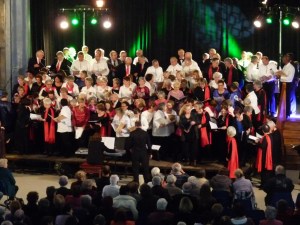
We’ll have concerts in the communities nearby.  And every now and then, as last week, there‘ll be a ‘Rencontre de Chorales’, when a number of choirs from a wide area gather together for the afternoon and invite the general public in for a feast of singing.  Each choir sings about 6 numbers from their repertoire, catering to every possible musical taste. And we all sit together in our concert get-up, sympathising with mistakes, applauding great performances until our own turn comes. At the end, every chorister from every choir will somehow squeeze onto the stage to join in the ‘chanson en commun’.  The audience enjoy it, but it’s even more fun for we singers to join together, united by our love of singing.  As we all suggested last week at the tops of our voices, ‘C’est magnifique’

Far too busy getting to know each other and renew old friendships to start singing yet
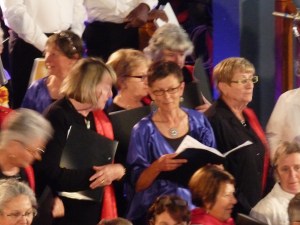
There we are, members of 5 different choirs, all in our different concert gear, squeezing together to begin singing.  That's me in the middle, in blue.
There we are, members of 5 different choirs, all in our different concert gear, squeezing together to begin singing. That’s me in the middle, in blue.

* William James

Laroque: a town tour

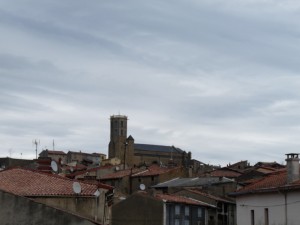
Laroque: a roofscape.

Here you are reading my blog: and the chances are that you’ve never visited Laroque.

Let’s go for a stroll then, and get to know the place a bit.  You may think, when you’ve seen the photos, that the town is quite shabby-chic.  It’s not.  For the most part, Laroque is just plain shabby.  It’s going through tough times, and it shows.  Underneath it all, though, are characterful buildings, streets with a story, and even places that are enjoying a prosperous renaissance.  Let’s set off from our house at the edge of the old town, and walk up Rue de la Joie……

Data unprotected

Annuaire pages blanches_18672

Arrive home to find that you’ve missed a call on the phone from an unfamiliar number?  No problem.  Just turn to the Pages Blanches (phone book) on the net and tap the number into the Annuaire inversé.  Your caller’s details will be revealed.  Try the same thing in the UK, and you’re up against data protection legislation. Although that always seems odd to me.  If you’d been in to take the call, you’d have known who it was ringing you.  Which is clearly the view they take in France.

Because Data Protection is clearly not big news here.

Recently, Malcolm and I went for blood tests.  A few days later I popped into our local surgery for a repeat prescription, and our doctor spotted me in the reception area.

‘Morning!  Have you a few moments?  I’ve got your blood test results here. Shall I go over them with you?’

‘No’ was not the right answer.  So she went though the lot, right there in the public area. Unluckily for the captive audience waiting to see one or other of the doctors, my results were very dull – nothing gossip-worthy there at all.

‘And since you’re here’ she continued, ‘I might as well tell you your husband’s results’.  And she did.  Malcolm’s results were dull too.  In fact I had the utmost difficulty in reporting back to him, because I forgot most of what she told me.

I’d barely recovered from the shock of that blatant disregard of data protection when I needed to visit the mairie, the town hall. Having done what I needed to do, I chatted idly to the official I’d gone to see.  Who told me, apropos nothing at all, that someone living fairly nearby had been admitted to a psychiatric ward.  I simply didn’t need to know.  In fact the person concerned was completely unknown to me at that time.  This time, I wasn’t so much shocked as scandalised.   I don’t expect to go to the mairie every time I want a good gossip.  I don’t expect to have to wonder whether our own lives are part of the common currency of official chit-chat.

Life in France?  Or just small town life?  I’ve done a bit of Googling, and data protection legislation certainly exists in France: just not so much down here, in the fin fond de l’Ariège.


The loto evening

APEM posterNot getting out enough?  Bored by those long winter evenings at home?  Do like the French.  Go out to a loto evening.

Loto – bingo or lotto to you – is the astonishingly popular pastime of seemingly half the local population.  Last weekend we could have gone on Friday to a session at the next door village of Aigues-Vives, stayed in Laroque for more of the same on Saturday, and then gone to Lavelanet on Sunday afternoon for yet another action-packed few hours.

Somehow, we’d so far managed to avoid being roped in.  Until last Saturday.  Well, the Loto in Laroque was to fundraise for the Ecole de Musique, and the organ teacher Vanessa’s Organ fund.

So what’s an evening at the Loto actually like?

You’ll arrive to find ranks and ranks of tables set out.  You’ll need to buy your Loto cards – and spend hours choosing your lucky set.  First mistake: we just took the top few.  If you know what you’re doing  – we didn’t – you’ll have brought a bag of counters with you to cover the called-out numbers.  Settle down with your friends and family, buy some crêpes or a slice or two of home-made cake to pass the time, and wait for the action.

And at 9 o’clock, it all begins.  Nearly four hours of heads-down, as the loto numbers are called out.  What you’re aiming for at different points in the evening is a full line (‘quine’) or a full card (‘carton plein’).  And if you achieve one of these feats, the winnings are worth having.  A microwave.  An i-pad.  A SatNav.  A flat-screen TV. A food processor. Half a pig.  Several ducks (To cook.  Not to take home and rear in your back yard).  A weekly-shop’s worth of vouchers to spend in a local shop.  A free meal in a local restaurant.  A hairdo.  Local businesses are incredibly generous with their donations – more so when you consider how very often they must be asked.  Yet our Asso. also invested about 800 euros in the judicious purchase over many months, of high-end prizes.  Only decent makes need apply.  No dubious bits of equipment from some unknown factory in China.  To make good money on these evenings, the organisers have to spend, spend, spend.

Naturally, Malcolm and I won nothing, so time hung a bit heavy: we had to concentrate to be sure of filling our cards correctly (‘soixante quatorze: quatre vingt dix: soixante dix-neuf’.  No ‘Clickety-click, 66, Two fat ladies 88’ to help us out here).  Chatting the night away not an option – this is serious stuff.  The friends we were with were no more enthusiastic than we were.  We’d all come to support the cause.

At about 12.45, the very last numbers were called.  Nobody, not elderly inhabitants, not young parents, nor their – often tiny – children, had pushed off early.  But one lucky group of women trundled home with some difficulty: they’d won four major prizes.  But they wouldn’t have got lost on the way home.  One of their prizes was a SatNav.

French as she is spoke

Did you do French at school?  Probably, if you’re English.  You had all that stuff to learn about not usually pronouncing the final letter, that ‘choux’ (cabbages) is pronounced ‘shoe’.  Perhaps you battled to remember when to use accents, and whether they should be grave (`) or acute (´) or circumflex (ˆ)?  With any luck, you learnt some everyday phrases to use on everyday occasions.

And that was fine for the school trip to Paris and later, that nice holiday in Normandy.

Where you’ll come unstuck though, is down here, and across wide swathes of the southern parts of France.

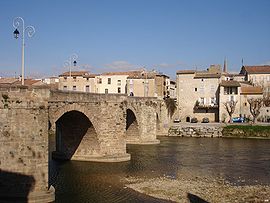
You’ll be OK if you visit an attractive town some 25 miles from here, Limoux.  It’s pronounced just as you’d expect, to rhyme with ‘choux’.

Limoux, Pont Neuf
Limoux, Pont Neuf

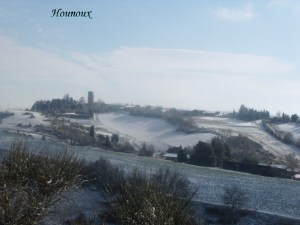
But last week, we went walking near a little village a few miles north, Hounoux.  It doesn’t rhyme with ‘choux’.  No, you must pronounce every letter – sort of ‘Hoonoox’.

A snowy day near Hounoux: Thanks Anny, for this photo

Driving there, we passed very near another village, Roumengoux.  It doesn’t rhyme with ‘choux’ and ‘Limoux’.  It doesn’t rhyme with ‘Hounoux’ either.  Instead, the locals call it ‘Roumengousse’.panneau-roumengoux.

Here, we spend our daily round with people who don’t talk standard French, as taught in all good GCSE textbooks.  They’ll go to the baker’s tomorrow (demeng) morning (matteng), to buy their bread (peng).  Then later they may work in their garden (jardeng).  In the evening, perhaps the Music Centre will put on a concert, with one of the local ensembles (angsambles) centre stage.  Très bien! (byeng).

There’s a sort of energy and vigour in the local speech patterns I find very attractive, as local people give full weight to every syllable in a word.  So rather than Laroque, it’s Laroqu-e.  I’m quite relieved it’s nothing more complicated than that, and that in any case, everyone round here is quite prepared to listen to standard French, or even Franglais.