A couple of months ago, our friends Sue and Kevin went to see some friends for a meal. Their friends produced a very fine cake, so they asked for the recipe.
A few weeks ago, we went to see our friends Sue and Kevin for a meal. They produced a very fine cake, so we asked for the recipe.
The other evening, our friends Jonet and Richard came round for a meal. We produced a very fine cake, so they asked for the recipe.
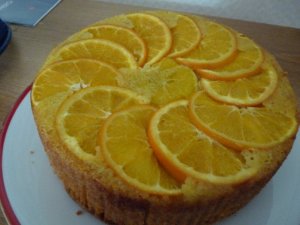
This is the cake. This is the recipe. It’s a little unusual, it’s easy to make, and it works well – as we all discovered – as a pudding. It’s also dairy and gluten-free, which can come in handy too.
Polenta and Olive Oil Orange cake
Ingredients:
2-3 large oranges
300 g. golden caster sugar
250 g. fine ground polenta
200 g. ground almonds
1 1/2 tsp baking powder
Pinch salt
4 eggs, beaten
225 ml. olive oil
zest of 1 orange
Oven 170 degrees centigrade.
Grease and line tin (equivalent of 2 lb. loaf tin, or 20 cm. round tin).
Peel and slice oranges and arrange, overlapping, on base
Combine all dry ingredients.
Beat eggs and add to mixture.
Add the oil and combine all ingredients
Pour the thick batter over oranges.
Place on baking tray and bake 75-90 mins.
Allow to cool before inverting on plate.
The cake works well on its own, but is even better with, say, a handful of raspberries and some Jersey cream.
We love a good country show. Farm animals on their best behaviour, sheepdogs out to impress with their skills in rounding up sheep, horses in the ring neatly jumping a clear round, country crafts, tough-guy tractors, food to sample, all in some pretty slice of countryside with the sun (maybe) beating down.
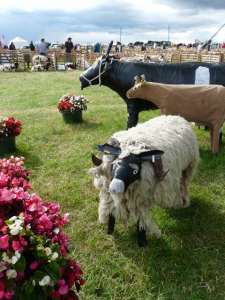
At Wensleydale Show, Leyburn Auction Mart went for animals made from gaffer tape and oddments. So much more biddable.
Since we got back to England, we’ve failed to go to the Great Yorkshire Show in Harrogate – too crowded, and the Ripley Show – way too wet. Would it be third time lucky at the Wensleydale Agricultural Show? Well, yes, we did make it there. And just after we arrived (this was the 23rd August, remember) we found ourselves scurrying for cover to avoid a heavy hail storm, with sharp icy crystals slashing at our faces and battering at the marquees.
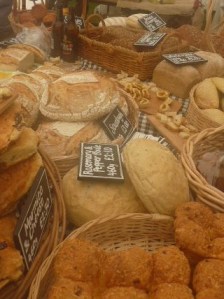
It didn’t matter. The sun soon came out again, but in any case, we spent much of the day inside. We were there to work. Bedale Community Bakery, where we continue to enjoy volunteering every Wednesday, had a stall, and there was bread to sell. Some of the team had worked through the night to get loaf after loaf mixed, kneaded, proved, baked and loaded up for the journey from Bedale to Leyburn and the show. By the time Malcolm and I arrived, some of the team had been there several hours already. And here’s what the stall looked like….
A tiny part of our stall.
We sliced and buttered loaves to provide samples for an eager public who wanted to talk to us and to try before they bought: sourdough; spicy chilli sourdough (soooooo good); cheese and onion bread; another cheesy loaf marbled with Marmite; harvester loaves; wholemeal loaves; bloomers; rosemary and pepper loaves; ‘seedtastic’ spelt; a loaf made using a locally brewed beer; a Mediterranean bread, all made the traditional way, proved long and slowly over several hours. There were spicy vegetable pasties; tomato and onion focaccia; roasted vegetable focaccia; four different types of scone (Jamie and I had made quite a lot of those on Friday, and they were baked off in the small hours of Saturday morning).
Try before you buy.
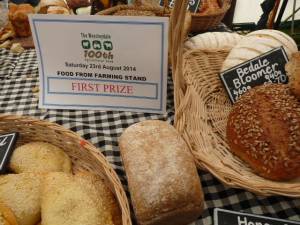
It all paid off. We were in the food marquee, surrounded by other small food businesses offering bread, pies, jams and curds, cakes and biscuits, chocolate, cured meats: all good stuff. But we got first prize in the ‘Food from Farming’ category, for the quality of our products and (buzz word alert) our community engagement.
And here’s the certificate
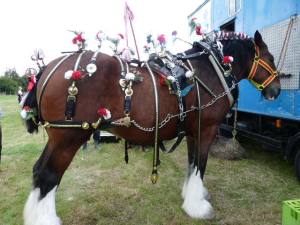
There was almost no time to get away and enjoy the show, but it hardly mattered. Serving on the stall to an appreciative public was all good fun. But here are a few shots from the times I did escape. Here are shire horses, beautifully decorated in the manner traditional for the area. Yorkshire horses, apparently, sport flowers, whereas Lancashire ones wear woollen decorations (very odd, as we had a woollen industry in Yorkshire, whilst Lancashire did cotton).
A Yorkshire shire horse, her 80 year-old owner’s pride and joy.
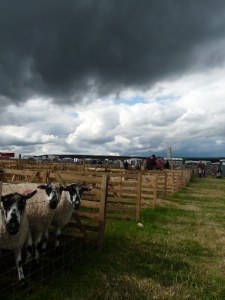
Here are sheep.
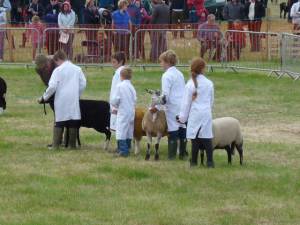
And here are children working sheep. There seemed to be opportunities in every category for smartly-overalled and seriously skilled children to show off their prowess as animal managers: it’s clearly important to encourage the next generation of farmers.
And here, oddly, are stunt bikers. We saw them as we left somewhat before 5.00, every single loaf sold, as the show slowly started packing up for yet another year .
There are quite a few more shows left before the summer’s over. We’ll get one into the diary.
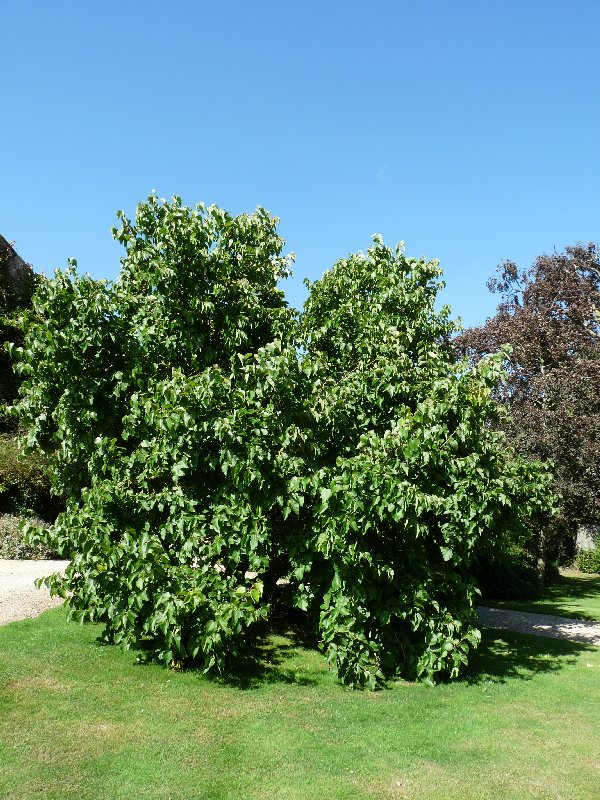
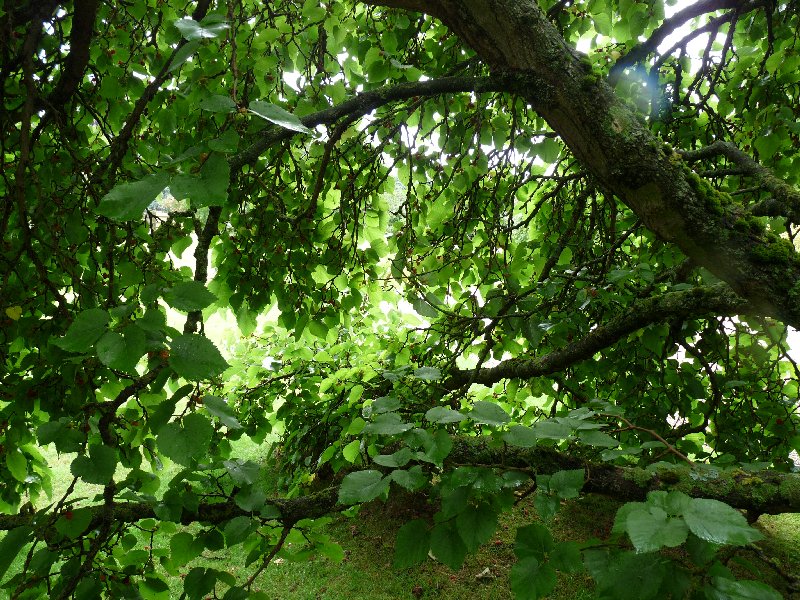
…. the birds, that is. I’m sitting looking out of the study window. There, almost centre front, is the mulberry tree. I can see why it’s secured itself a place in the history of children’s singing rhymes, even though it’s quite certainly a tree and not a bush. Its densely leaved branches curve down to the ground, leaving a perfect den for small people to spend an hour or two hiding away, playing games away from interfering adults.
There it is, our magnificent mulberry tree
And just now, mid-summer, is the time it fruits. I’ve never lived with a mulberry tree on tap before, so I made the usual deal with the birds: ‘You take the high-up berries, I’ll take the low ones. There are plenty to go round.’ They weren’t listening. I’m watching them now, those pesky blackbirds, swooping in to select a not-quite-ripe fruit and flying away to enjoy in private.
OK, it’s not a blackbird, but a crow. They’re thieves too.
Mulberries are in fact quite a curious fruit, the size and shape of a raspberry or blackberry, but with quite a pithy core. It’s quite a challenge to find these relatively small berries growing on a fully-sized tree, hidden among large almost heart-shaped leaves. The majority of the berries fall to the ground (where the birds ignore them, it seems), and this is a crop that can only be picked when black, juicy, and very fully ripe. So fingers and clothes alike get quickly and indelibly stained. Purple is the best colour to wear.
A bough laden with mulberries.
They hide themselves pretty well.
Not quite ripe yet.
All my recipe books tell me to use them in any recipe calling for blackberries or raspberries. I’ve discovered I prefer both those more familiar fruits, but it won’t stop me having a go at using the unexpected haul of free berries. I made a coulis for ice-cream yesterday. What next, I wonder?
Hunt the mulberry. It’s quite a job.
Here we go round the mulberry bush, The mulberry bush, the mulberry bush. Here we go round the mulberry bush, On a cold and frosty morning.
A man walks in to the bakery with a tray of eggs, newly laid by his hens. He’s ‘paid’ in bread. A woman comes with a bag of rosemary from her garden: she too receives bread, still warm from the oven. Over there, at the back, another woman is steadily getting an enormous batch of scones ready for the oven, while in another corner, someone else is weighing out the ingredients to make biscuits.
Margaret Number 3 makes scones
We’re in the market town of Bedale (population four and a half thousand). More specifically, we’re at Bedale Community Bakery (or ‘Bread Actually’), tucked away behind the railway bridge next to the Big Cow Little Sheep educational farm. This is no ordinary baker’s shop. For a start, though there’s a busy team at work throughout the day, there are few paid staff. This is a not-for-profit community venture.
The generously-seeded multi-seed bread has just gone into the oven.
The sourdough moulds have finished their work for the day.
And here are rolls, ready to buy.
The bakers are paid – they’re the ‘bread and butter’ of the organisation after all. Then there’s hands-on Chairman Carol, and Sarah who seems to be involved in everything. But all the biscuits, cakes, scones – the non-bread items – are made by a willing team of volunteers managed by retired baker Alan. From today, Malcolm and I are part of that team.
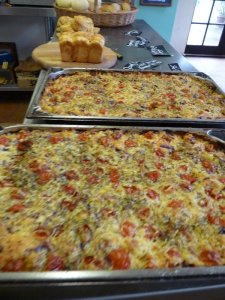
Focaccia in waiting.
It was a wonderful experience. From the first moment, we were expected to roll our sleeves up and turn to. But the friendly welcome, the team spirit, the willingness to share and help each other, the generosity of spirit shown by everyone there made for an unforgettable first morning. Malcolm washed up and sliced cakes into even portions, and I helped Margaret ( ‘Not another Margaret, there’s three of you now’) make an entire batch of about 210 Anzac biscuits, bake them, cool them, and package them for sale in cellophane sacks of 6, closed with yellow ribbon. There was focaccia to part-prepare for the just-about-to-start Bedale BAMfest. There was more washing up, and sweeping and cleaning. And time for a coffee-stop of course.
Two Margarets make Anzac biscuits.
Anzac biscuits partly packaged…..
…. and ready for sale.
They’re seeking to build up the customer base. There’s a country house, a high-end hotel or so, and various other outlets who like the quality and range that the bakery offers. There are locals of course, who know a good thing when they find it, because there are always samples of the bread to taste, people around to discuss ingredients and recipes, and a constantly changing repertoire. Today there was multi-seeded bread; cheese, chilli and – oh, crumbs, I’ve forgotten what else – sourdough; rosemary and black pepper; cheese, chive and onion bread; harvester loaves….. and so on and so on. This is Slow Food at its best, made with locally sourced flour from Crakehall Watermill with not a single flour improver, and proved gently over several hours to develop the flavour. Recipes are carefully tested and recorded, and every opportunity is taken to use seasonal flavours and ingredients offered from the community: a glut of fruits or herbs, as well as those eggs and that rosemary.
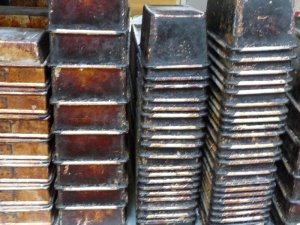
Off-duty loaf tins.
I hope there’s plenty more to tell about this place. We think it’s worth the 16 mile round trip to volunteer here (and be ‘paid’ in bread), but others come from much further afield: Redcar, the home of one of the team, is nearly 40 miles away, and Saltburn, where another lives, 50 miles. We all appreciate good bread, and recognise a worthwhile project which offers the chance to learn new skills in a supportive and ‘can-do’ environment.
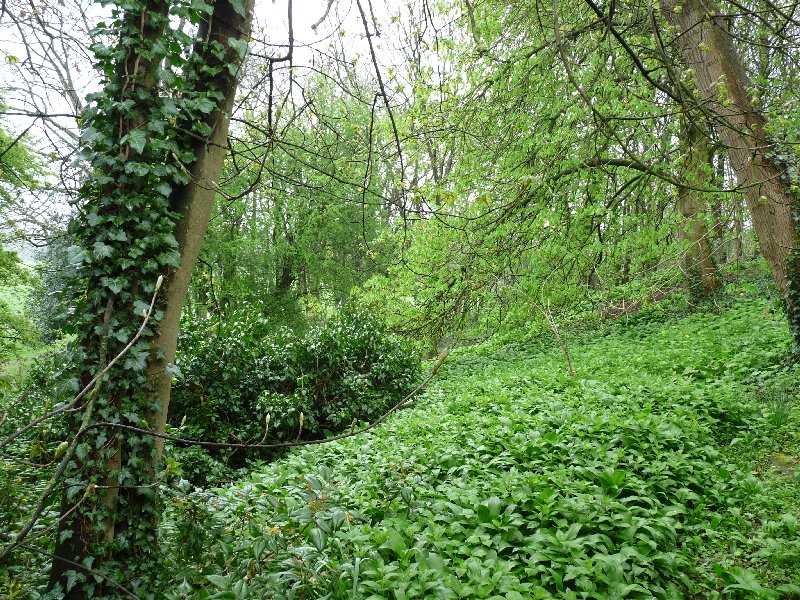
Little tells me more forcefully than a walk through the woods at this time of year that we are back in England. Instead of crisp brown leaves underfoot, from the Autumn before and the Autumn before that, there are narrow damp paths through the rich carpet of undergrowth.
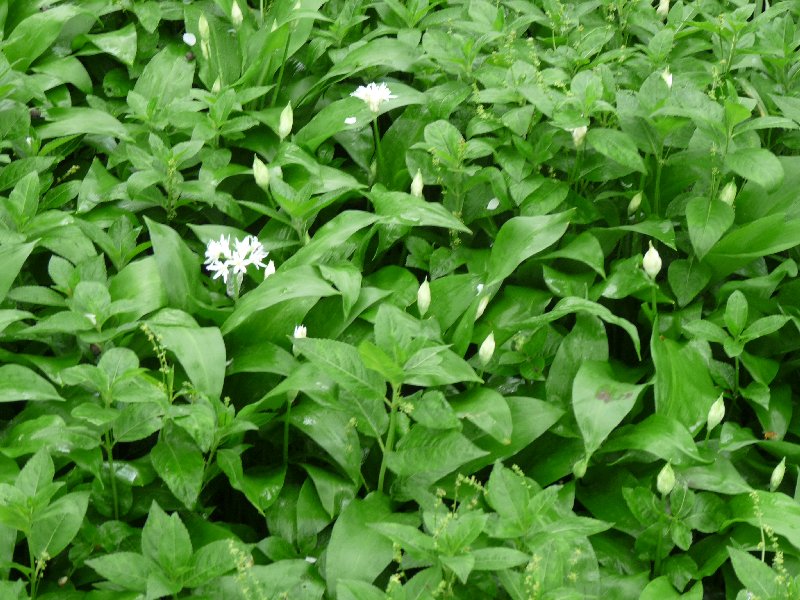
Wild garlic, ransoms, bear’s garlic, ramps
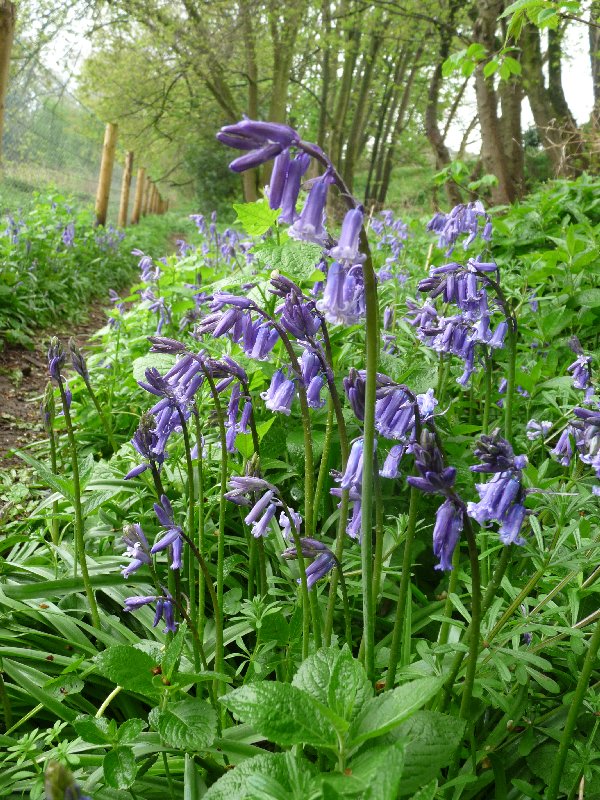
And that smell! As you walk, inevitably bruising the leaves that crowd onto your path, you’ll smell the pungent notes of garlic: because those leaves, topped off by a mass of star-shaped flowers, are wild garlic (or ransoms, ramps or bear’s garlic), and they’re unknown in the part of France where we lived. In among, competing for the sun which dapples in through the tree canopy, are bluebells. At the moment, they’re largely still in bud but give them a few days and they too will carpet the woodland floor in a shimmering violet-blue. And these are our English bluebells. They’re more graceful than the upright, paler Spanish bluebells that we sometimes saw in France.
Bluebells
The blogosphere is crammed with suggestions for making use of the garlic, among the earliest greenstuffs available after the winter months. Here‘s what David Lebovitz suggests.
Well, I rely on David to supply ideas for delicious grub, so off into the woods I went for garlic leaves. I was careful to pick only leaves, rather than yank up entire plants with their tiny bulbs, so that they would grow again next year, though a few bulbs crept into my harvest despite my efforts. I’d taken my haul in any case from the woodland edge, as the garlic plants made an escape bid into nearby fields.
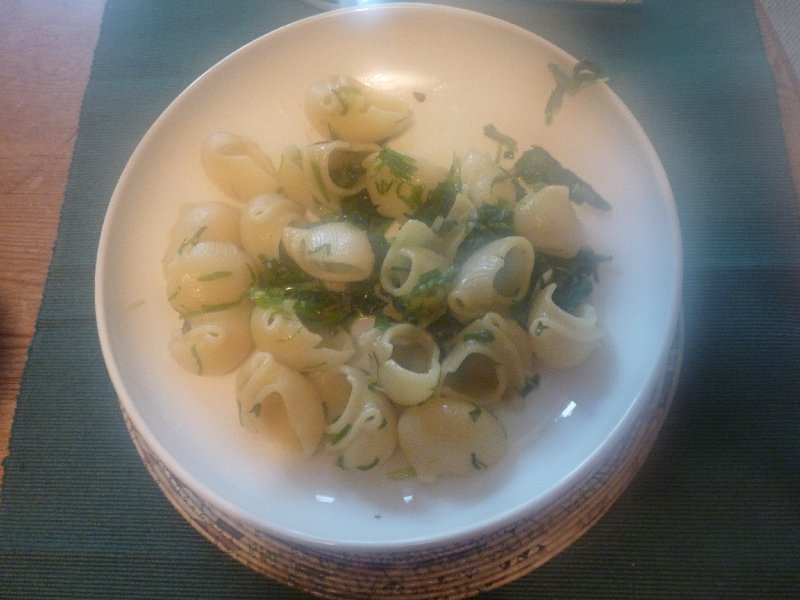
And here’s the resulting pasta dish. Frankly, we were a little disappointed. It wasn’t the most interesting dish we’d ever eaten. But I could see the charm of these leaves to those who’d struggled through the winter months on a diet of beans, swede, and the odd bit of salted pork. Wild garlic has a bright, ‘green’ flavour, mildly garlicky of course, and I will try it again, maybe substituting it for spinach in a tart with walnuts and a sharp cheese for instance. I always enjoy an excuse to forage for food.
Pop along to your local butcher round here, and you’ll find pale yellow slabs of something that rather resembles polenta on sale. It’s millas. And it resembles polenta because they’re first cousins. Both are made of corn meal cooked into a kind of porridge. Whereas Italians favour polenta as a base for various savoury dishes, millas is usually served sweet.
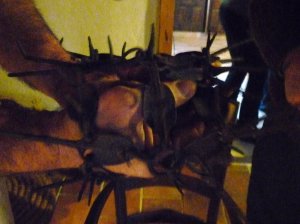
And today, we were invited, together with the rest of the Commission du Patrimoine here in Laroque to watch it being made, before sitting down to a millas tea party. Our hosts were Paul and Aline Garrigue, whose house is a fascinating museum to traditional Ariègeois life, and filled with artefacts from the not-at-all-distant past. Who’d have guessed that the fearsome collar six inches wide and covered with spikes used to be worn by local dogs to prevent their being savaged in the neck by wolves? Which of us still has a bread oven built into the side of the fire-place?
A fearsome anti-wolf collar for a dog
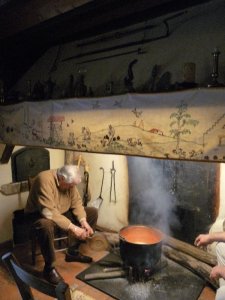
By early afternoon, water was set to come to the boil in a huge copper pan set over an open fire. Various expert fire-makers set to with the bellows, and soon the water was ready for other ingredients.
Getting the fire blazing with bellows.
Milk first. Then cornmeal, slowly and gently dropped in by hand so that it didn’t go all lumpy. Then more cornmeal. A small amount of flour. Salt. Duck fat. Vanilla sugar. A decent slug of eau de vie. And all the while, Paul stirred and stirred, with his toudaille. You could have one of your own if you’d like. Next year, on Twelfth Night, take your Christmas tree, and cut away almost all its branches, apart from maybe six or seven towards the bottom. Trim these so they’re just a few inches long. Strip the bark off and dry the whole thing out. And there you have it. A multi-pronged stirring instrument that does the job of a balloon whisk, but on a much larger scale.
You can just about spot the ‘prongs’ of the toudaille.
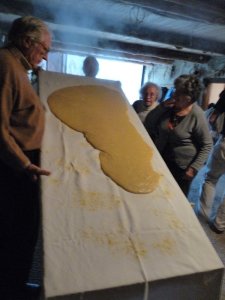
And still Paul stirred. He tasted. Nope, not thick enough. He stirred some more. Finally, he pronounced it just right. A couple of muscular types staggered off with this huge vat of the pale porridgey stuff, and …. tipped it out over a trestle table, covered with a flour-sprinkled cloth. Then the table itself was tipped, this way and that, so that the millas flowed and settled into a thickish sheet. And there it stayed. It’ll probably still be there till tomorrow morning. Once it’s good and cold, it can be cut up into slices and …. on to the next stage.
Tipping the millas.
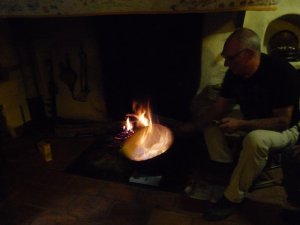
The un-scraped out pan was put back on the fire. Eau de vie, plenty of it, was added. Paul set a match to it, and it flamed in the manner of a good old British Christmas pudding. We were all issued with a teaspoon, and had a go scraping the pan. Malcolm and I couldn’t quite manage the enthusiasm of the rest, but it was pleasant enough.
Flaming the millas.
Then it was time for tea . It was a ‘Here’s one I made earlier’ moment, with yesterday’s millas chilled then grilled, to be served with jam, honey, whatever you fancy. We decided once more that you have to be Ariègeois to appreciate it. It doesn’t really taste of a great deal to us. We had assumed it was a cheap and filling everyday food once upon a time. But it was particularly associated with this time of year, when families killed their pigs and spent time feasting, cooking and preserving all the meat the pig provides. Another version of millas, less common now, uses pig’s blood, in much the same way as in a black pudding.
Grilled millas.
Nowadays you’ll find millas at every time of year, but in memory of its associations with the pig, it’s the butcher’s shop where you’ll need to look.
We weren’t converted to millas eating, but watching the stuff being made, and sharing the moment with people who had so much to tell us about this traditional treat was a wonderful way to spend a wet Saturday afternoon.
Nothing to do with millas. A charming detail from the embroidered smoke screen above the chimney breast.
‘Whether the weather be cold, or whether the weather be hot,
We’ll weather the weather, whatever the weather, whether we like it or not.’
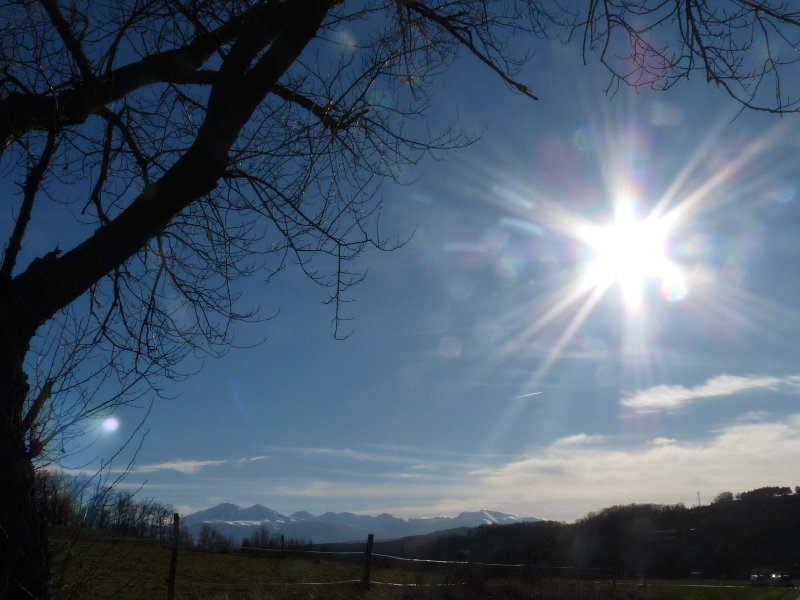
Indeed. Not cold. Not hot. Just wet, very wet indeed. Just look at those floods in England, Brittany and even the Var. We really shouldn’t complain when the worst we’ve had here is a soaking and muddy boots. Especially when, as on Tuesday, the downpours suddenly stop, the sun comes out and dries up all the rain, and we can get out and enjoy the views.
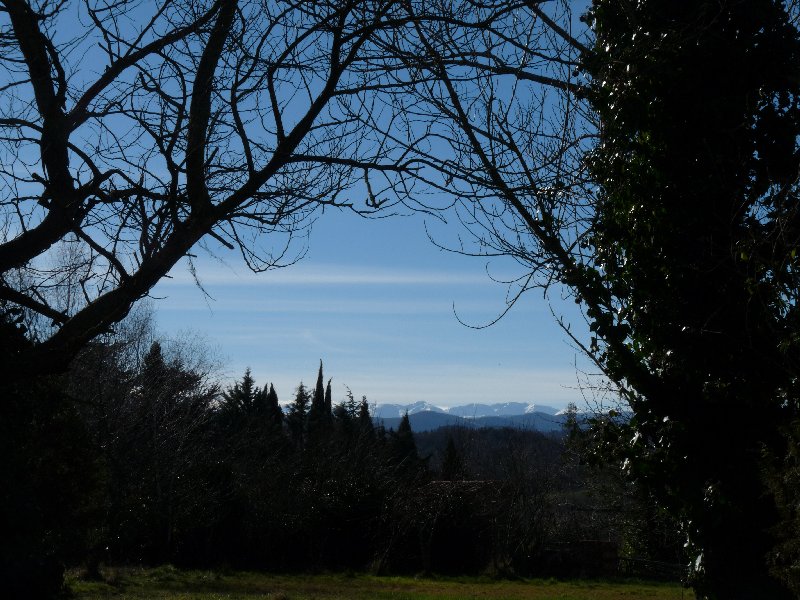
Christine took us out on a walk she enjoys, just up the road from her house. It’s great for these soggy times, because it involves walking on roads so narrow they can barely be dignified as ‘single-track’ – but they are tarmacadam, and therefore mud free – and on farmyard tracks used so often that they too are in decent enough condition. The sky was very blue: spring was in the air.
As we started climbing, the mountains came into view
We passed Troye d’Ariège and the sheep farm we’d once visited, and then our path rose to allow us views of the Pyrenees before returning us once more to the valley floor, to la Bastide de Bousignac, and then back to her village, Saint Quentin.
Shadows lengthen as we near home.
The pollarded avenue on the road into la Bastide de Bousignac.
Reception committee from the birds as we arrive back in time for tea.
She’d made a cake. I’d made a cake. We put each to the test. Hers was yoghurt and bilberry. Mine was a pear, almond and chocolate loaf, recently posted by the deliciously greedy Teen Baker. Which was the better one? Malcolm and Max diplomatically cast a vote for each, and they weren’t wrong. We all tucked in, feeling we deserved a reward after an hour or two eating up the kilometres in the warming gentle sun.
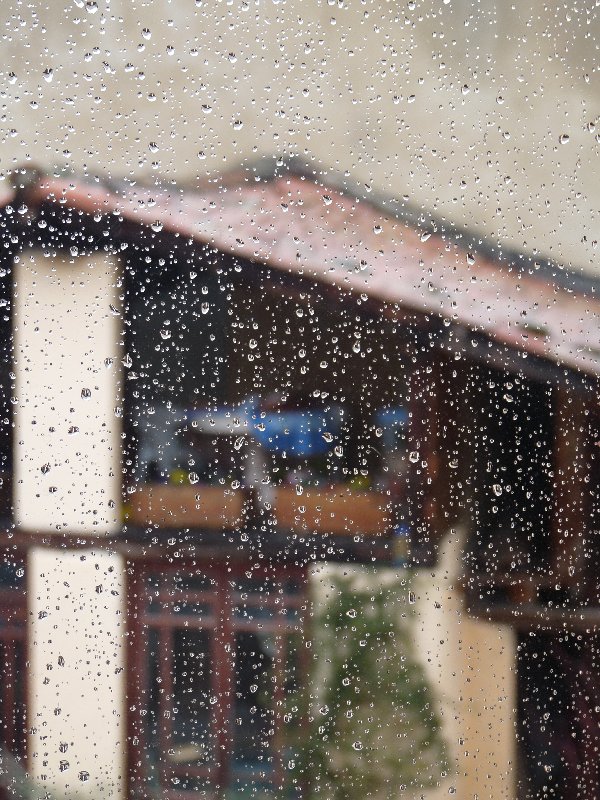
View from our bedroom window, today and every day this week
This is getting beyond a joke. For a week now, with the exception of last Tuesday, it’s rained. Sometimes it’s just drizzled. Sometimes it’s rained good and proper. Sometimes it’s poured. Walks are cancelled, and the market’s a dismal affair with few stallholders and even fewer customers.
The River Touyre crashing under the bridge near our house.
It’s muddy, angry, fast-flowing, and rising steadily
Surging past the back of our house: too close for comfort
But I had to go yesterday, whatever the weather. I’d been promised Seville oranges. ‘Will you have any more next week?’ I asked anxiously. ‘Oh yes, I’m bound to.’ ‘For we English types, I guess?’ ‘No. Not at all. I adore Sevilles. I make tons of marmalade. So do my neighbours.’
Well, that did surprise me. Listen to this recipe from a French neighbour, a lovely woman whom I know to be a keen cook. (Sorry, Sharon, you’ve heard this tale. Bear with me).
‘Take ordinary oranges. Squeeze the juice, and then take the peel and boil it in plenty of water. Throw away the water. Repeat three times until you’ve got rid of the bitterness. Chop the peel finely…..’ By then she’d lost me. I didn’t really listen to the end of the recipe. I felt that on the subject of good gutsy marmalade, this woman and I had nothing to say to one another.
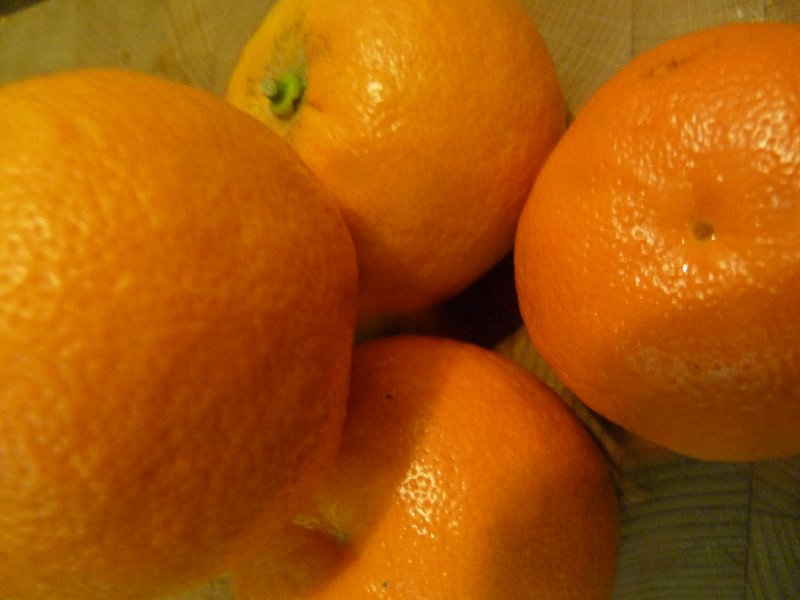
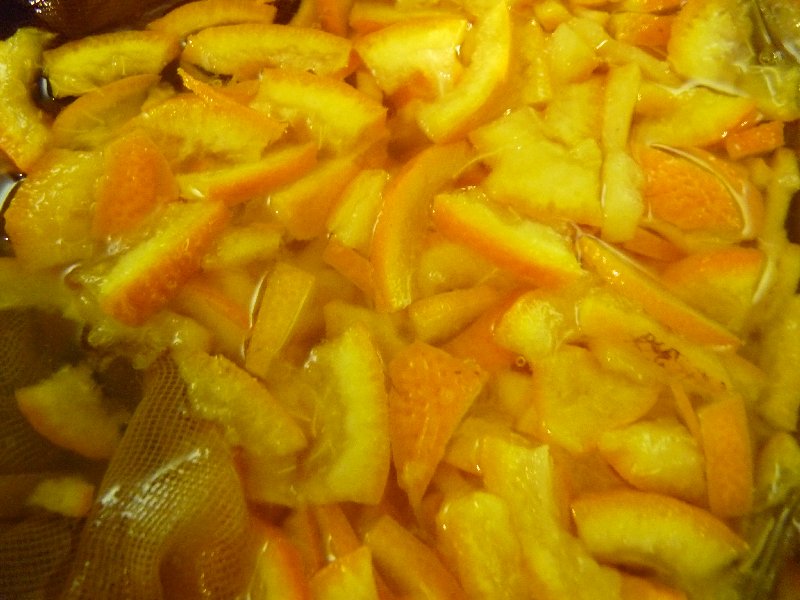
Seville oranges waiting for the chop.
Anyway, tired of downsizing for the time being, we’ve applied ourselves to the business of our marmalade factory. We have our own needs to satisfy, and those of all our French friends, who profess themselves rather keen on our bright and bitter conserve. This year, I’ve chosen Dan Leppard’s recipe. I’ve got a variation on the go, as well as one version where I follow him to the letter. Instead of using the whole peel in the finished product, I’m using only the thinly peeled zesty part, though of course all the pith will be boiled up with the pips before being discarded.
Chopped Seville oranges waiting for the pot.
We’ve been scrubbing, squeezing and chopping half the morning, and now the two varieties are sitting waiting for tomorrow , when we can boil each of them to setting point, get out a crusty loaf, butter, and apply ourselves to the serious business of a taste-test.
Epiphany, 6th January. Today’s the day when here in France we’re supposed to eat Galette des Rois – Kings’ Cake, because this is the day when, according to tradition, the three kings arrived to visit the baby Jesus.
When I went down to the baker’s this morning, I found there were two sorts on offer. Should I chose the yeasted brioche style more popular down here? Or should I go for the layers of puff pastry filled with almond cream? I couldn’t help thinking that Madame was nudging me towards the puff-pastry option, and that suited me fine.
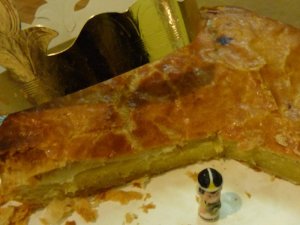
A galette, a cardboard crown, a fève…. and just a few buttery crumbs
As you share it out, one of you will find yourself with a fève in your portion. This used to be a bean, but these days it’s usually a little china trinket. And there he was, in the very first slice I had on my plate, a little yellow-uniformed fellow on a plinth inscribed ‘le pompier japonais’ – the Japanese fireman. Lucky me. I got to wear the cardboard golden crown supplied at the baker’s and proclaimed myself King For The Day. Which was fine as far as it went. I’m still waiting to be dressed in fine robes and whisked off in a sparkling limousine to some red carpet event. It’s getting on for bedtime, and so far…. nothing.
I did get to commune with a kitchen full of odds and ends however. I found half a stale ‘bio’ baguette, and half a Livarot cheese that was uncharacteristically disappointing from the very first mouthful. Though it wouldn’t find a place on the menu of any Royal banquet, I decided on a version of an austerity dish that’s always popular in this house.
Savoury bread and butter pudding
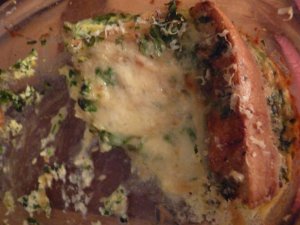
Ooops! I almost left it too late to take a snap of a crunchy crust of baguette nestling in its cheesy, eggy blanket.
(serves 2)
Butter the base of a shallowish baking dish
Cut and butter thick slices from a baguette or other loaf . I usually find 2 slices per person is enough.
Grate or slice some cheese you’re trying to get rid of and use it to top the bread and butter. Usually I use a hard cheese like cheddar, but the Livarot worked just fine .
Arrange in the bottom of the baking dish.
Beat together 2 eggs, about 150 ml. milk, or milk and cream, or milk and plain yoghurt (this really is about emptying out your cupboards and the fridge), and season. Today I added a teaspoonful of grainy mustard and a handful of chopped parsley, but it could have been chopped chives, chopped chilli, some crisply fried bacon pieces…..
Pour the eggy milk over the bread and cheese and – this is important – leave for at least half an hour for the bread to absorb the liquid.
Bake in a hot oven (170 degrees fan oven) for about half an hour till puffy, risen, and with a rich golden crust. Eat immediately, with an astringent salad of bitter leaves to counteract the richness of the dish.
Actually, it’s not remotely sophisticated, but I don’t think those three kings would have turned up their noses at this meal after all those days and nights trekking across the desert to find a baby in a stable. But we still have a slice or two of Galette des Rois if they’d prefer.
Those cauliflowers with their crisp, bright creamy curds look so enticing on the market stall at this time of year. They beg to be bought and transformed into something both appetising and full of goodness.
So often they disappoint . That bright white face displayed among all the cheery autumn colours of carrots and pumpkins, and the deep forest green of spinach and cabbage turns a sullen shade of oatmeal the second it’s introduced to a pan of boiling water. Leave it there a moment too long and it’s watery, tasteless and almost slimy.
But there are recipes in which it shines. On a miserable winter’s day after a few hours out in the cold, you can’t beat a plateful of good old cauliflower cheese made with lots of decent sharp-flavoured cheddar. You can get away with Cantal Entre Deux, but not the ready-grated Emmenthal that seems to be the default cooking cheese round here.
My next favourite is Rose Elliot‘s cashew nut korma – very mild indeed as far as curries go, but tasty and more-ish. I’ll adapt the vegetables to what I have in the house, but I’m always sure to include cauliflower. It’s a recipe I try to make a day ahead, because that way, the ingredients sit together in the pan and get very well acquainted overnight. By the time we eat them, they’ve become good and harmonious friends. And I get to use two of the chillies I’ve been carefully growing all summer.
There’s a bit of a theme emerging here: it’s all about comfort food. Perhaps because this week’s been unremittingly horrible. It’s rained and rained, the wind has blown, and then it’s rained some more. A fresh crunchy salad involving fine slices of cauliflower, enlivened by finely chopped herbs and a bright dressing simply wouldn’t hit the spot. Here’s the last suggestion, from Nigel Slater’s Tender, Volume one.
A mildly spiced supper of cauliflower and potatoes
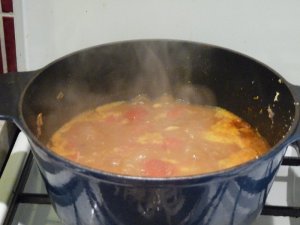
That potato and cauliflower dish bubbling away
Serves 4
Ingredients:
3 large onions
Rapeseed oil
4 cloves garlic
Ginger: a thumb-sized lump
1 tbsp. ground coriander-a tablespoon
2 tsp. ground cumin
1/2 tsp.cayenne
1/2 tsp. ground turmeric
3 tomatoes (or 1/2 tin)
600 ml. water
3 medium potatoes
a large cauliflower
Handful unroasted cashew nuts
6 green cardamom pods
1 tbsp. garam masala-a tablespoon
150- 200 ml. crème fraîche
coriander-a small bunch
Peel the onions, chop one of them roughly, then let it soften with a tablespoon or two of oil in a deep pan over a moderate heat.
Halve and thinly slice the others and set aside. peel the garlic cloves, slice them thinly then stir into the softening onion. Continue cooking, without browning either the onion or the garlic.
Grate the ginger. These days I freeze ginger when I buy it, and grate from frozen. It’s so easy to deal with this way. Add to the onion and garlic.
Stir the ground coriander, cumin, cayenne and turmeric into the onion. Let them fry for a minute or two, then roughly chop the tomatoes and add them to the pan.
Add the water and bring to the boil.
Season with salt and a generous grind of black pepper.
Cut the potatoes into large pieces (as if for boiling) and add them to the pan. lower the heat and leave to simmer for fifteen minutes before breaking the cauliflower into florets and adding to the sauce.
Quickly toast the cashew nuts in a small non-stick frying pan until golden, tip them into the pot, cover with a lid and continue to simmer for fifteen to twenty minutes.
Meanwhile, fry the reserved onions in a little oil in a shallow pan till deep, nutty gold.
Whilst they are cooking, crack the cardamom pods, scrape out the seeds, crush lightly and add to the onions.
Continue cooking for five minutes or so, then, when all is gold and fragrant, remove and place on kitchen paper.
When the cauliflower and potatoes are tender to the point of a knife, stir in the garam masala (the spices in it are already roasted, so it needs very little cooking) and the crème fraîche. Simmer for a minute, then serve topped with the reserved onions and the roughly chopped or torn coriander leaves.


















 From Pyrenees to Pennines
You must be logged in to post a comment.